Mobile video delivery using ICN
Giovanna Carofiglio, Cisco Distinguished Engineer
Michele Papalini, Jacques Samain et al.
FG IMT-2020 Workshop and Demo Day
December 7, 2016
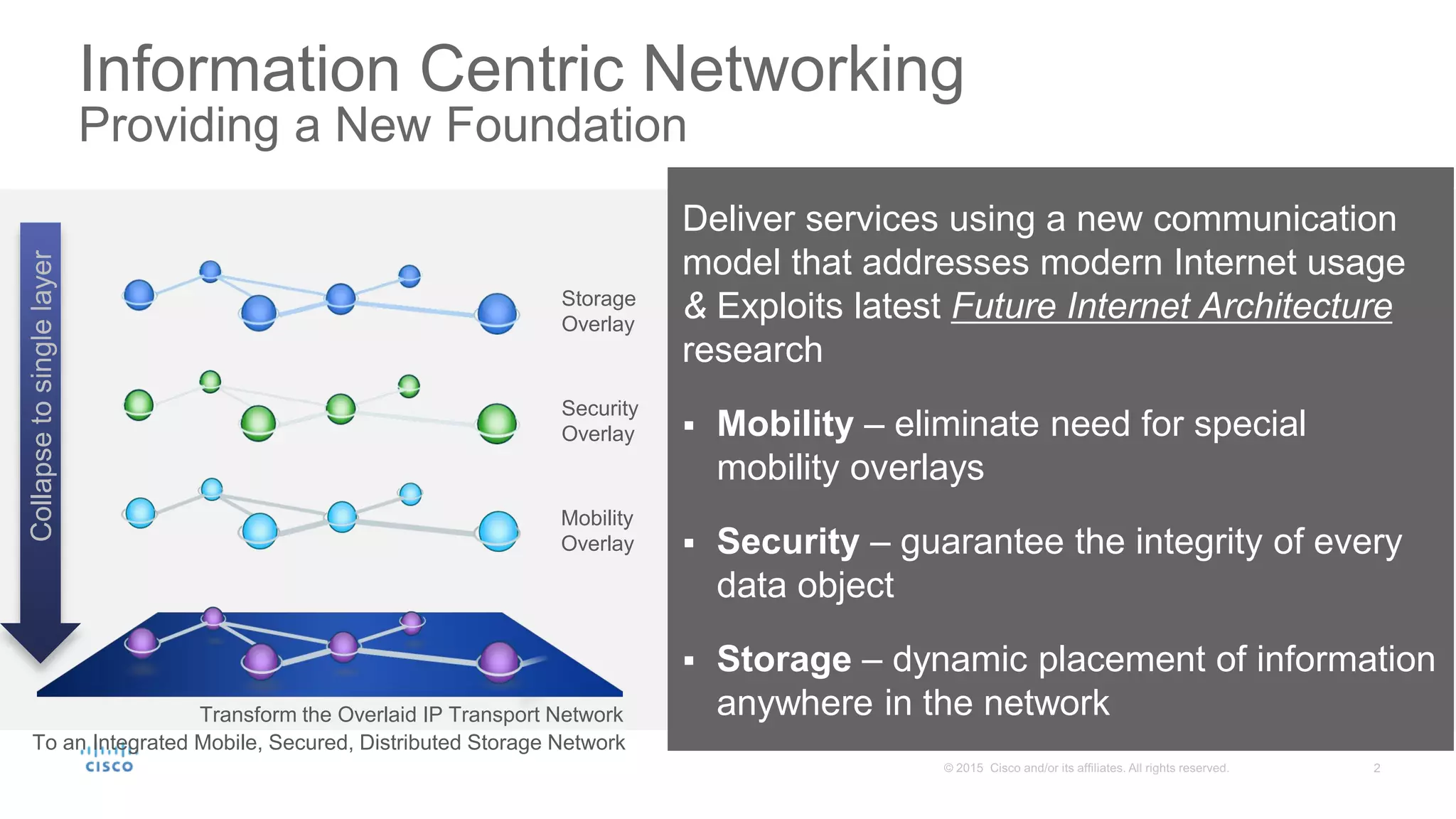
Mobility
Overlay
Security
Overlay
Transform the Overlaid IP Transport Network
Storage
Overlay
To an Integrated Mobile, Secured, Distributed Storage Network
Deliver services using a new communication
model that addresses modern Internet usage
& Exploits latest Future Internet Architecture
research
 Mobility – eliminate need for special
mobility overlays
 Security – guarantee the integrity of every
data object
 Storage – dynamic placement of information
anywhere in the network
Information Centric Networking
Providing a New Foundation
Collapsetosinglelayer
What Information Centric Networking brings
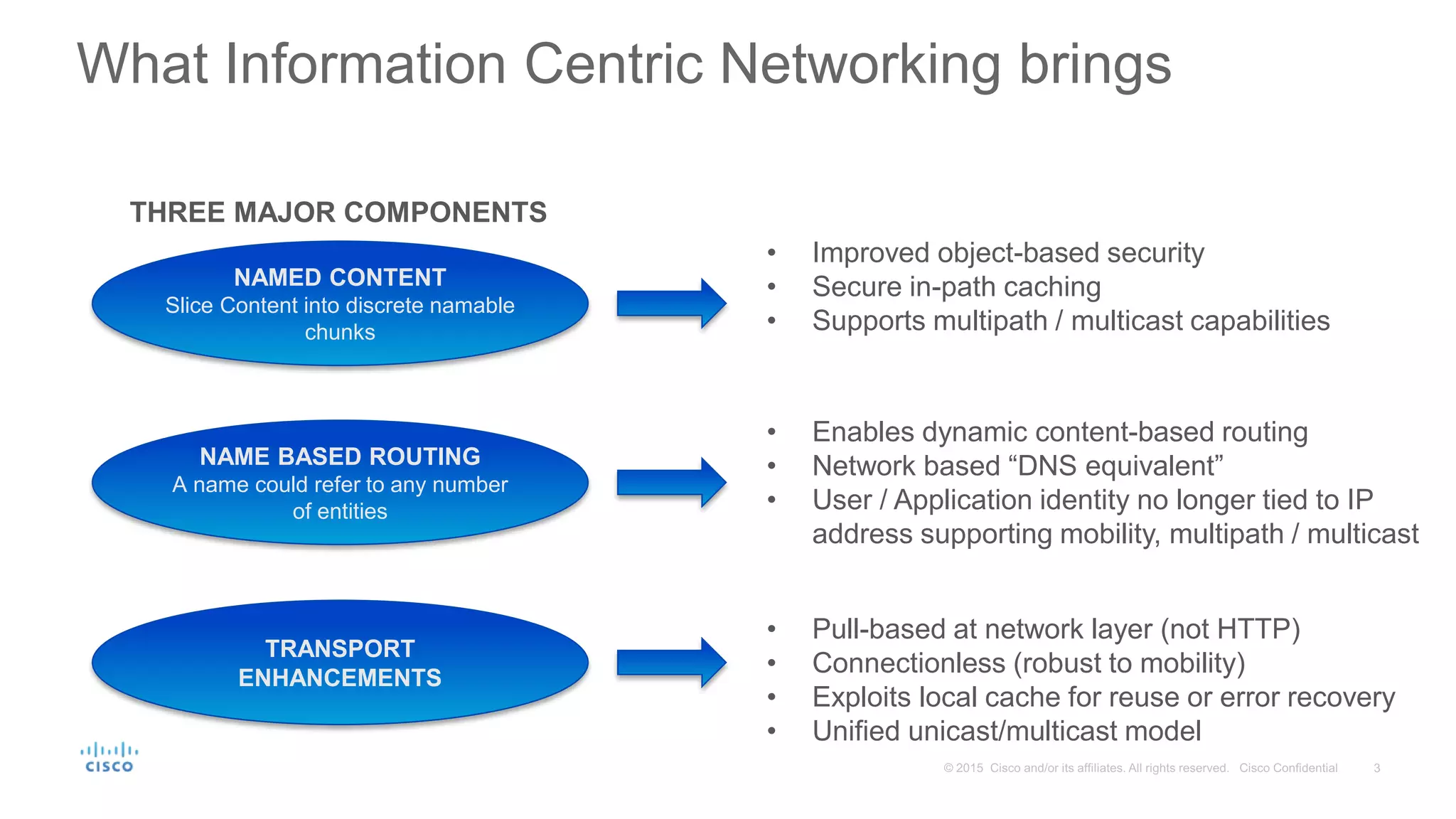
NAMED CONTENT
Slice Content into discrete namable
chunks
THREE MAJOR COMPONENTS
NAME BASED ROUTING
A name could refer to any number
of entities
TRANSPORT
ENHANCEMENTS
• Improved object-based security)
• Secure in-path caching
• Supports multipath / multicast capabilities
• Enables dynamic content-based routing
• Network based “DNS equivalent”
• User / Application identity no longer tied to IP
address supporting mobility, multipath / multicast
• Pull-based at network layer (not HTTP)
• Connectionless (robust to mobility)
• Exploits local cache for reuse or error recovery
• Unified unicast/multicast model
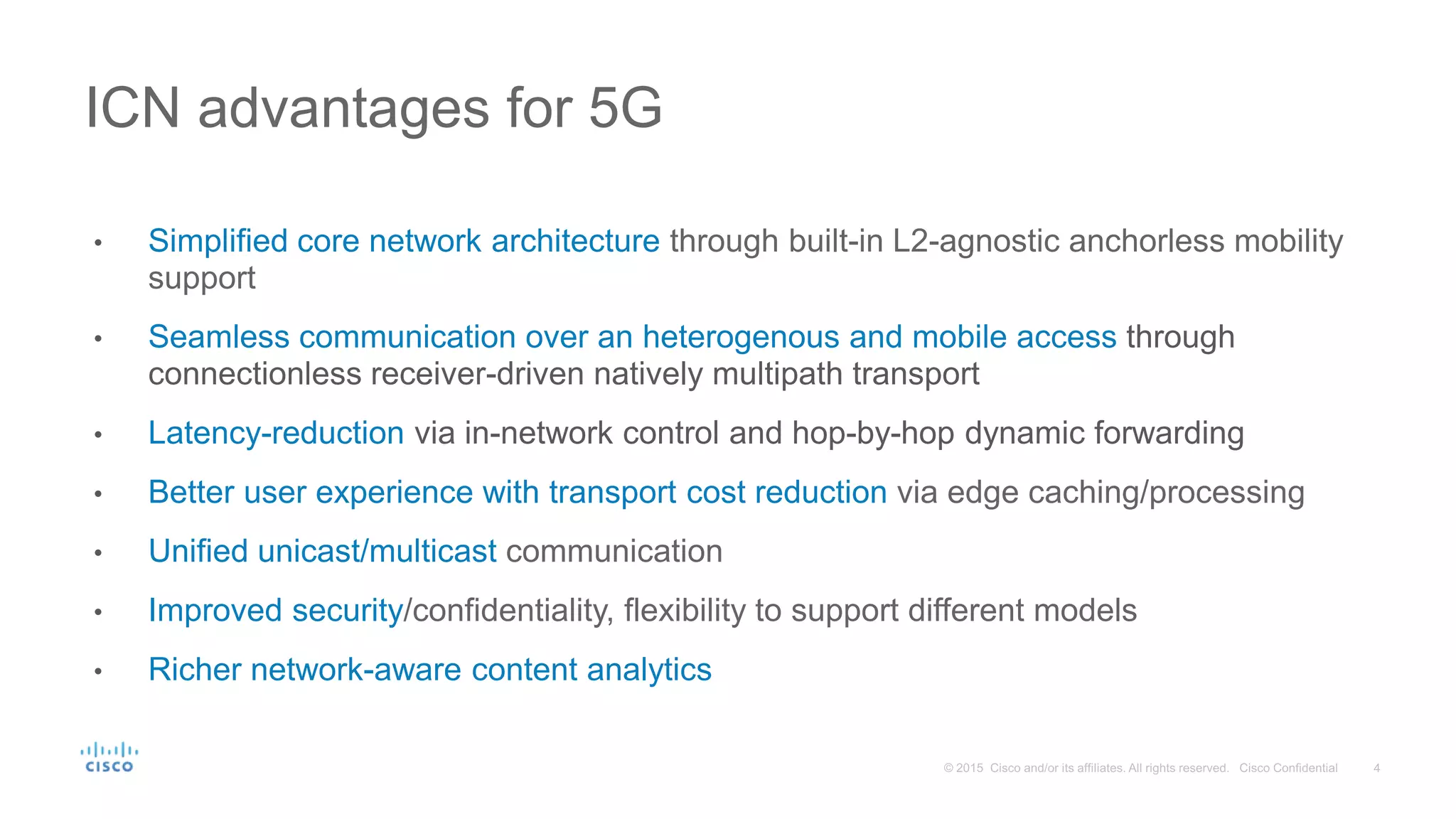
• Simplified core network architecture through built-in L2-agnostic anchorless mobility
support
• Seamless communication over an heterogenous and mobile access through
connectionless receiver-driven natively multipath transport
• Latency-reduction via in-network control and hop-by-hop dynamic forwarding
• Better user experience with transport cost reduction via edge caching/processing
• Unified unicast/multicast communication
• Improved security/confidentiality, flexibility to support different models
• Richer network-aware content analytics
ICN advantages for 5G
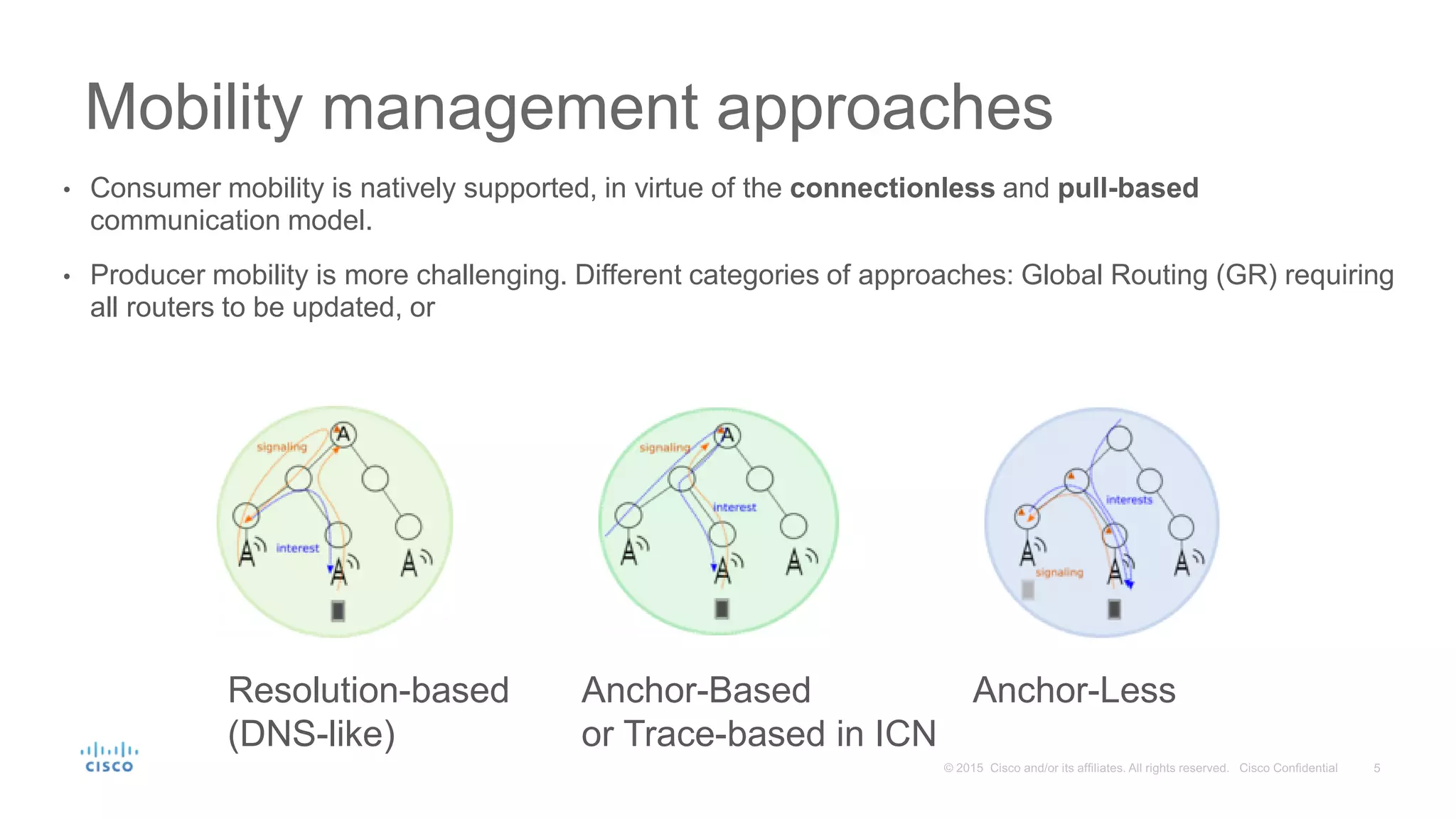
Mobility management approaches
• Consumer mobility is natively supported, in virtue of the connectionless and pull-based
communication model.
• Producer mobility is more challenging. Different categories of approaches: Global Routing (GR) requiring
all routers to be updated, or
Resolution-based
(DNS-like)
Anchor-Based
or Trace-based in ICN
Anchor-Less
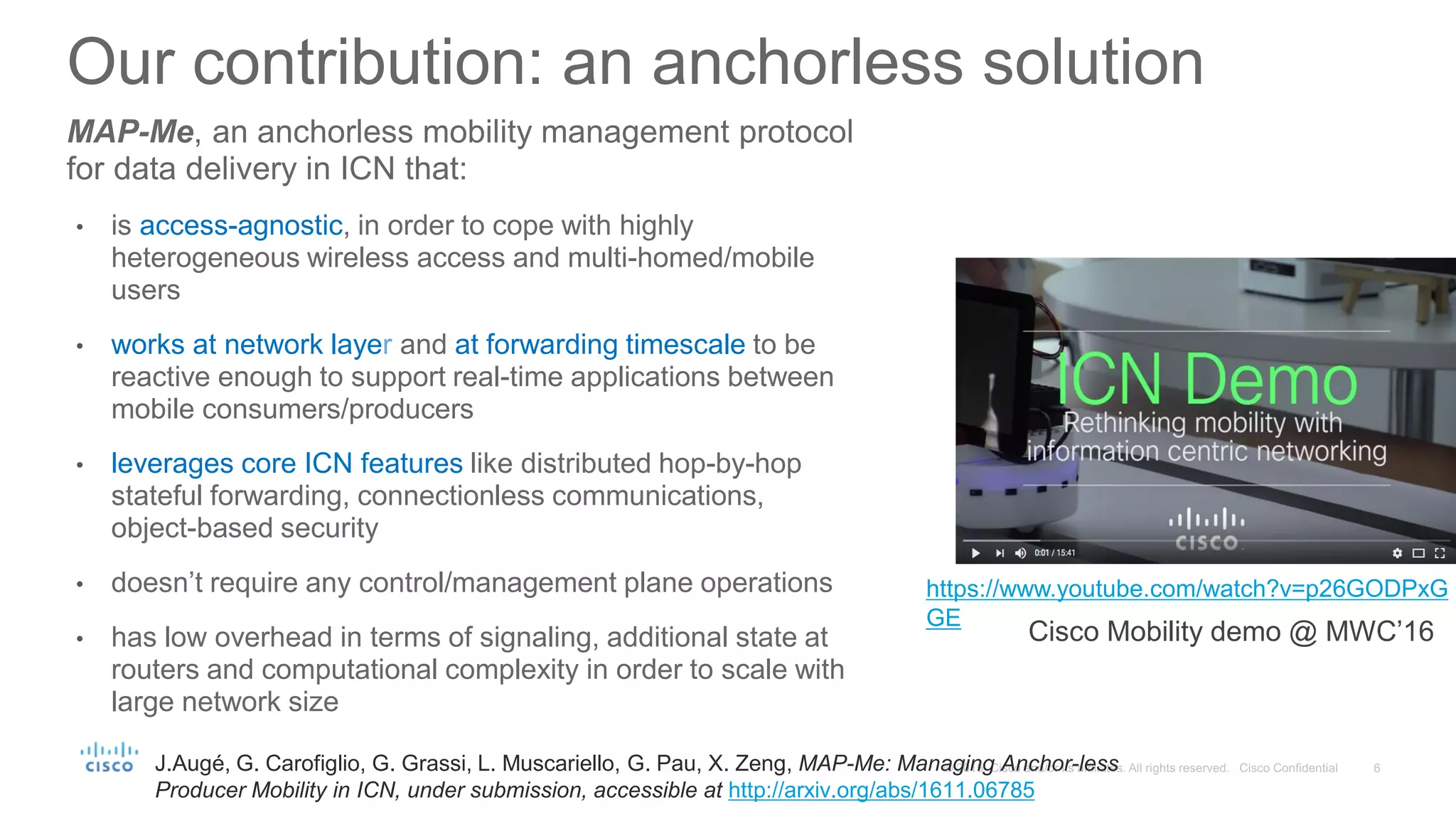
MAP-Me, an anchorless mobility management protocol
for data delivery in ICN that:
• is access-agnostic, in order to cope with highly
heterogeneous wireless access and multi-homed/mobile
users
• works at network layer and at forwarding timescale to be
reactive enough to support real-time applications between
mobile consumers/producers
• leverages core ICN features like distributed hop-by-hop
stateful forwarding, connectionless communications,
object-based security
• doesn’t require any control/management plane operations
• has low overhead in terms of signaling, additional state at
routers and computational complexity in order to scale with
large network size
Our contribution: an anchorless solution
https://www.youtube.com/watch?v=p26GODPxG
GE
Cisco Mobility demo @ MWC’16
J.Augé, G. Carofiglio, G. Grassi, L. Muscariello, G. Pau, X. Zeng, MAP-Me: Managing Anchor-less
Producer Mobility in ICN, under submission, accessible at http://arxiv.org/abs/1611.06785
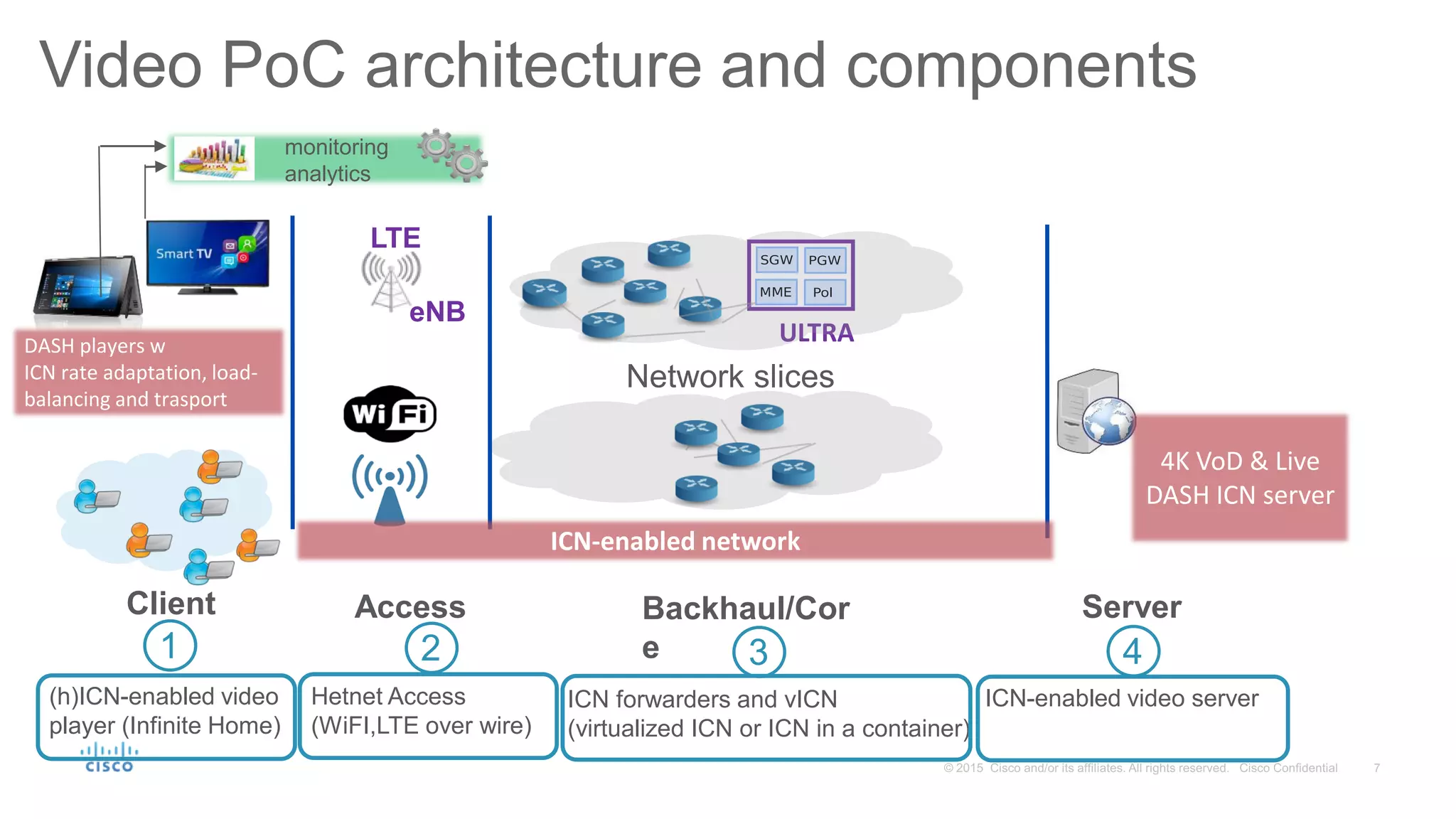
Video PoC architecture and components
ULTRA
eNB
Client Access
LTE
Backhaul/Cor
e
Server
DASH players w
ICN rate adaptation, load-
balancing and trasport
ICN-enabled network
monitoring
analytics
4K VoD & Live
DASH ICN server
1
(h)ICN-enabled video
player (Infinite Home)
2 3 4
Hetnet Access
(WiFI,LTE over wire)
ICN forwarders and vICN
(virtualized ICN or ICN in a container)
ICN-enabled video server
Network slices
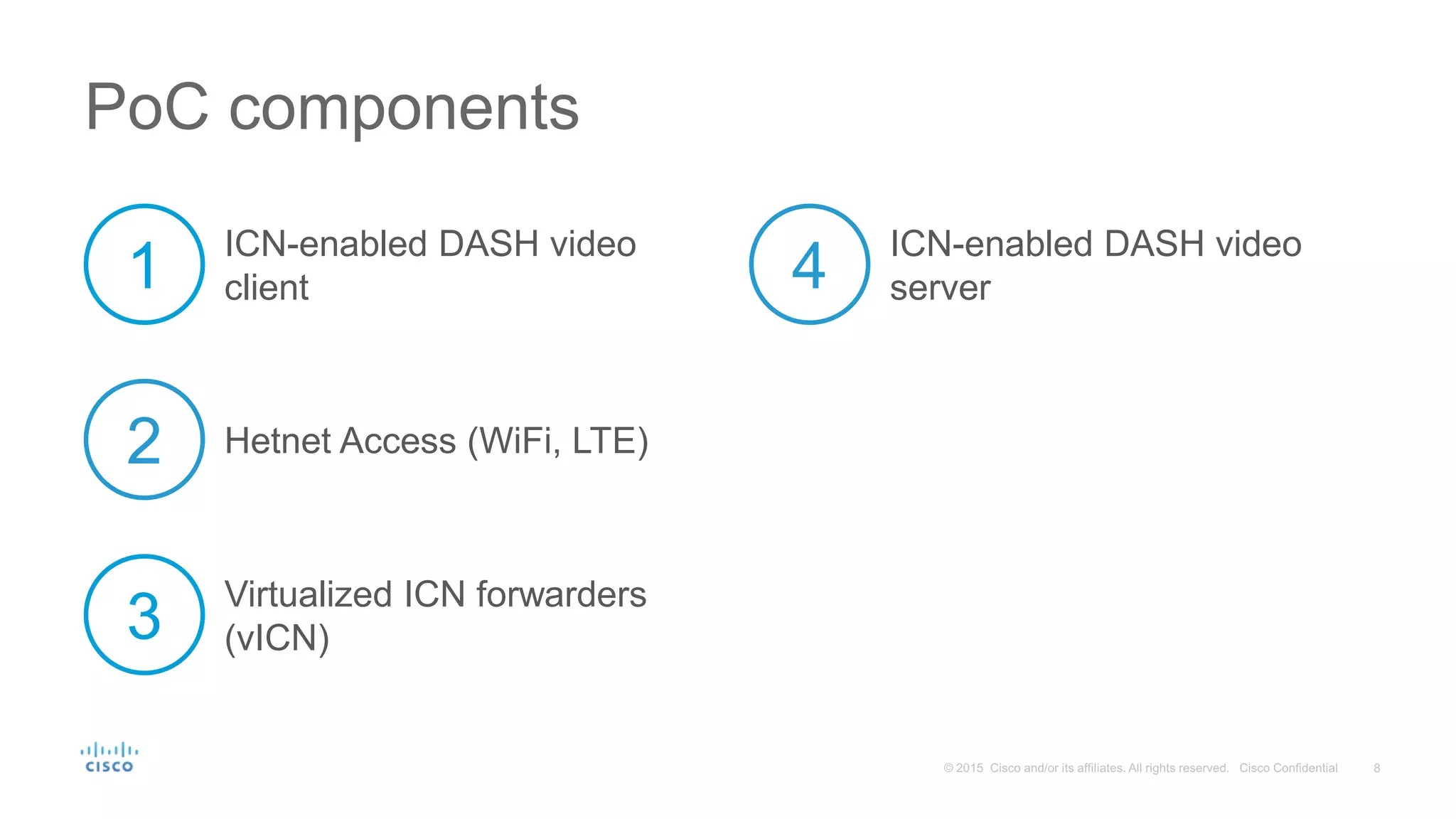
PoC components
1
2
3
ICN-enabled DASH video
client
Hetnet Access (WiFi, LTE)
Virtualized ICN forwarders
(vICN)
4 ICN-enabled DASH video
server
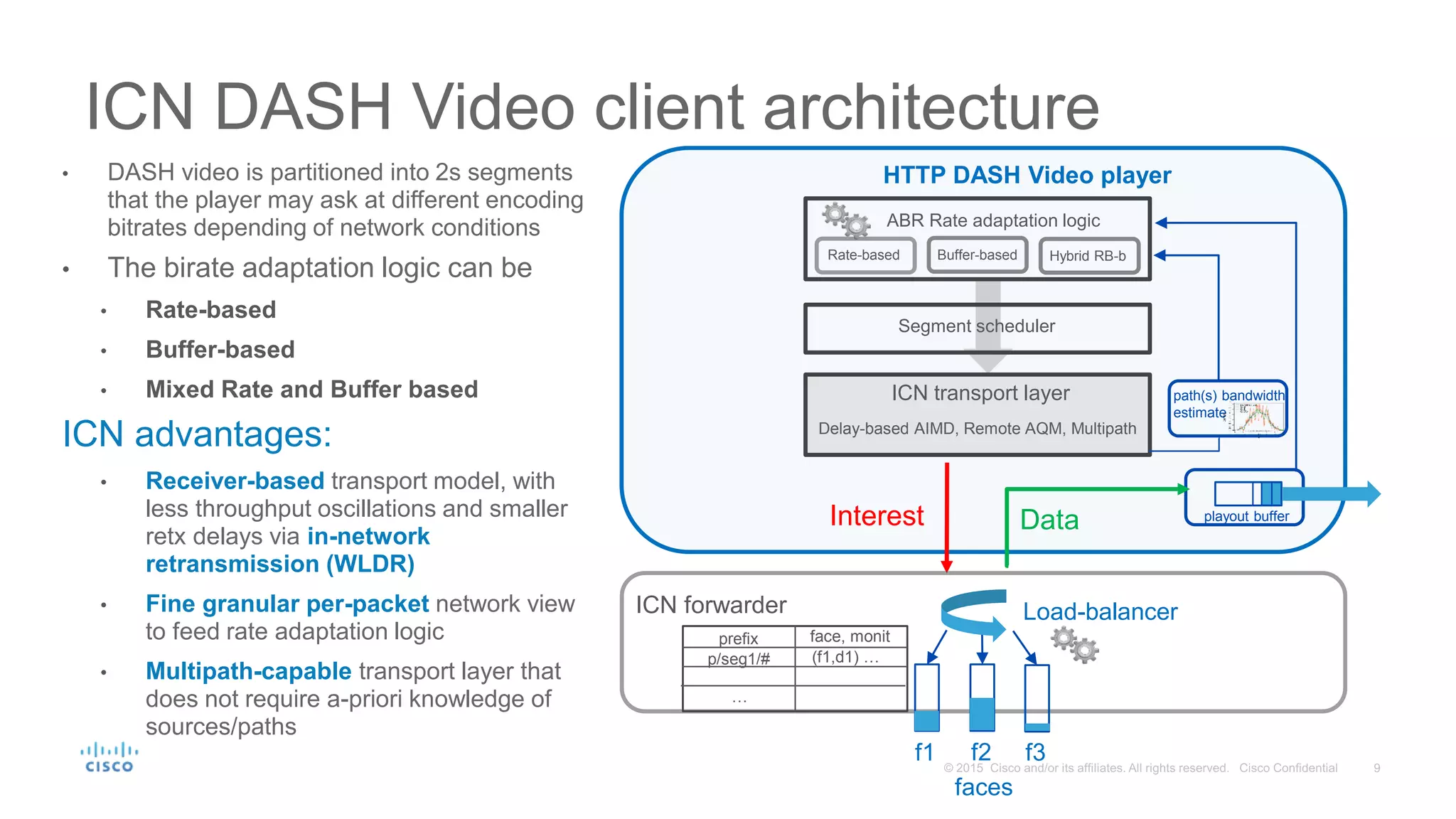
ICN DASH Video client architecture
Segment scheduler
ICN transport layer
Rate-based Buffer-based Hybrid RB-b
ABR Rate adaptation logic
Delay-based AIMD, Remote AQM, Multipath
path(s) bandwidth
estimate
playout buffer
ICN forwarder
Interest Data
HTTP DASH Video player
Load-balancer
f1 f2 f3
faces
prefix face, monit
p/seg1/# (f1,d1) …
…
• DASH video is partitioned into 2s segments
that the player may ask at different encoding
bitrates depending of network conditions
• The birate adaptation logic can be
• Rate-based
• Buffer-based
• Mixed Rate and Buffer based
ICN advantages:
• Receiver-based transport model, with
less throughput oscillations and smaller
retx delays via in-network
retransmission (WLDR)
• Fine granular per-packet network view
to feed rate adaptation logic
• Multipath-capable transport layer that
does not require a-priori knowledge of
sources/paths
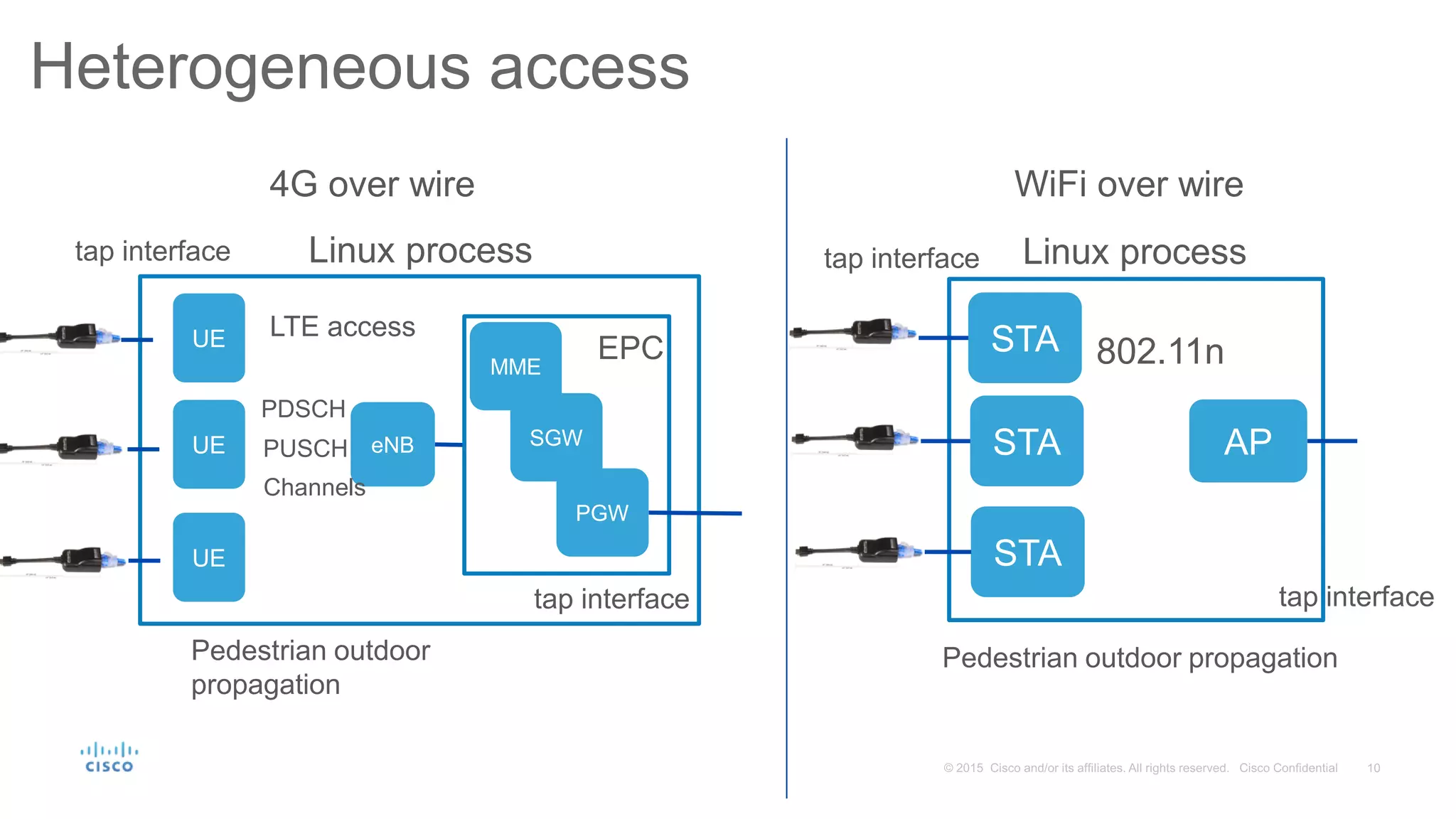
Heterogeneous access
MME
SGW
PGW
EPC
eNB
Linux process
tap interface
UE
UE
UE
tap interface
PDSCH
PUSCH
Channels
LTE access
Pedestrian outdoor
propagation
AP
tap interface Linux process
STA
STA
STA
802.11n
Pedestrian outdoor propagation
tap interface
4G over wire WiFi over wire
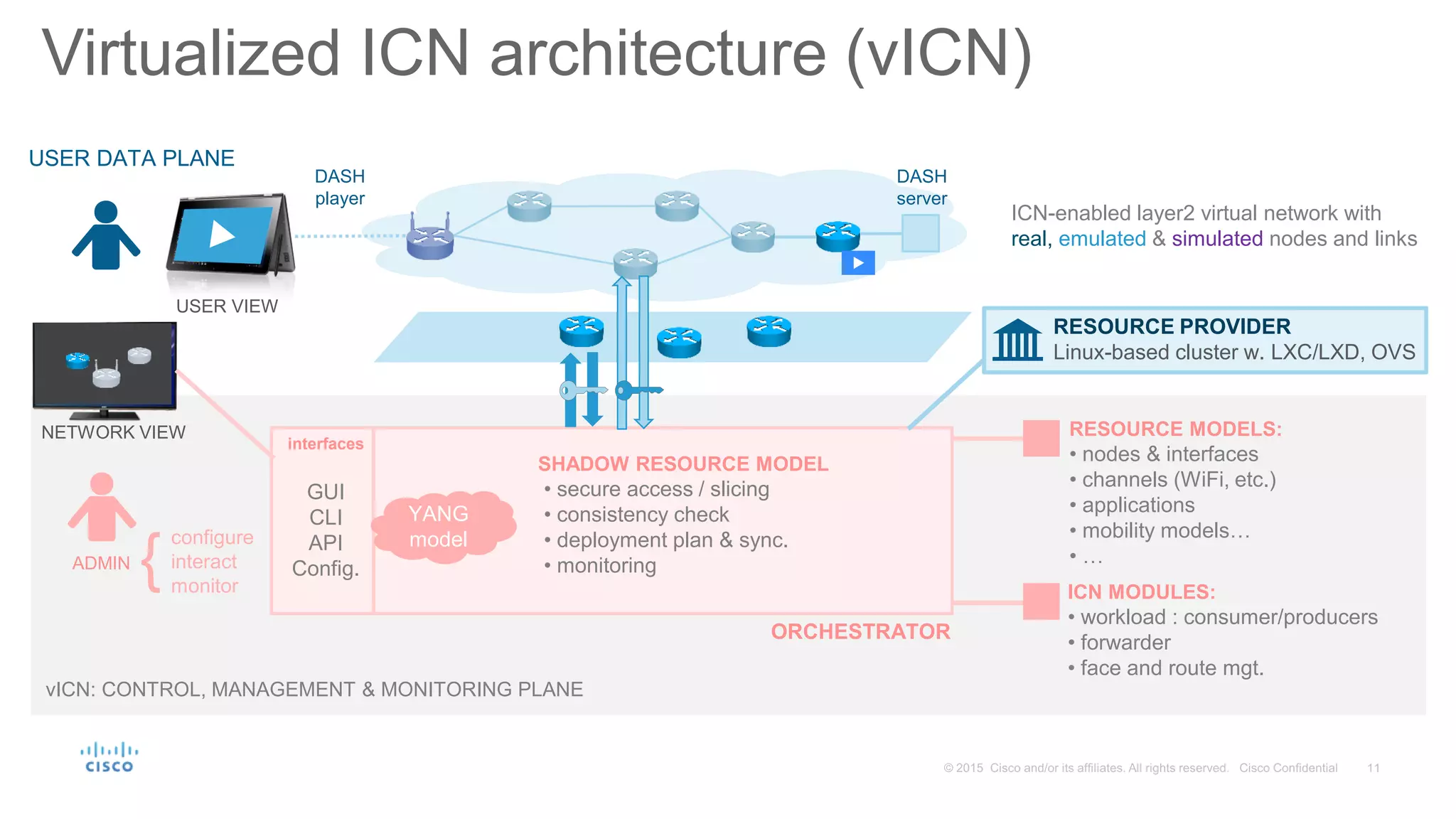
Virtualized ICN architecture (vICN)
RESOURCE PROVIDER
Linux-based cluster w. LXC/LXD, OVS
ORCHESTRATOR
RESOURCE MODELS:
• nodes & interfaces
• channels (WiFi, etc.)
• applications
• mobility models…
• …
ICN MODULES:
• workload : consumer/producers
• forwarder
• face and route mgt.
vICN: CONTROL, MANAGEMENT & MONITORING PLANE
interfaces
GUI
CLI
API
Config.
YANG
modelconfigure
interact
monitor
SHADOW RESOURCE MODEL
• secure access / slicing
• consistency check
• deployment plan & sync.
• monitoring
USER DATA PLANE
DASH
server
ICN-enabled layer2 virtual network with
real, emulated & simulated nodes and links
ADMIN
NETWORK VIEW
{
DASH
player
USER VIEW
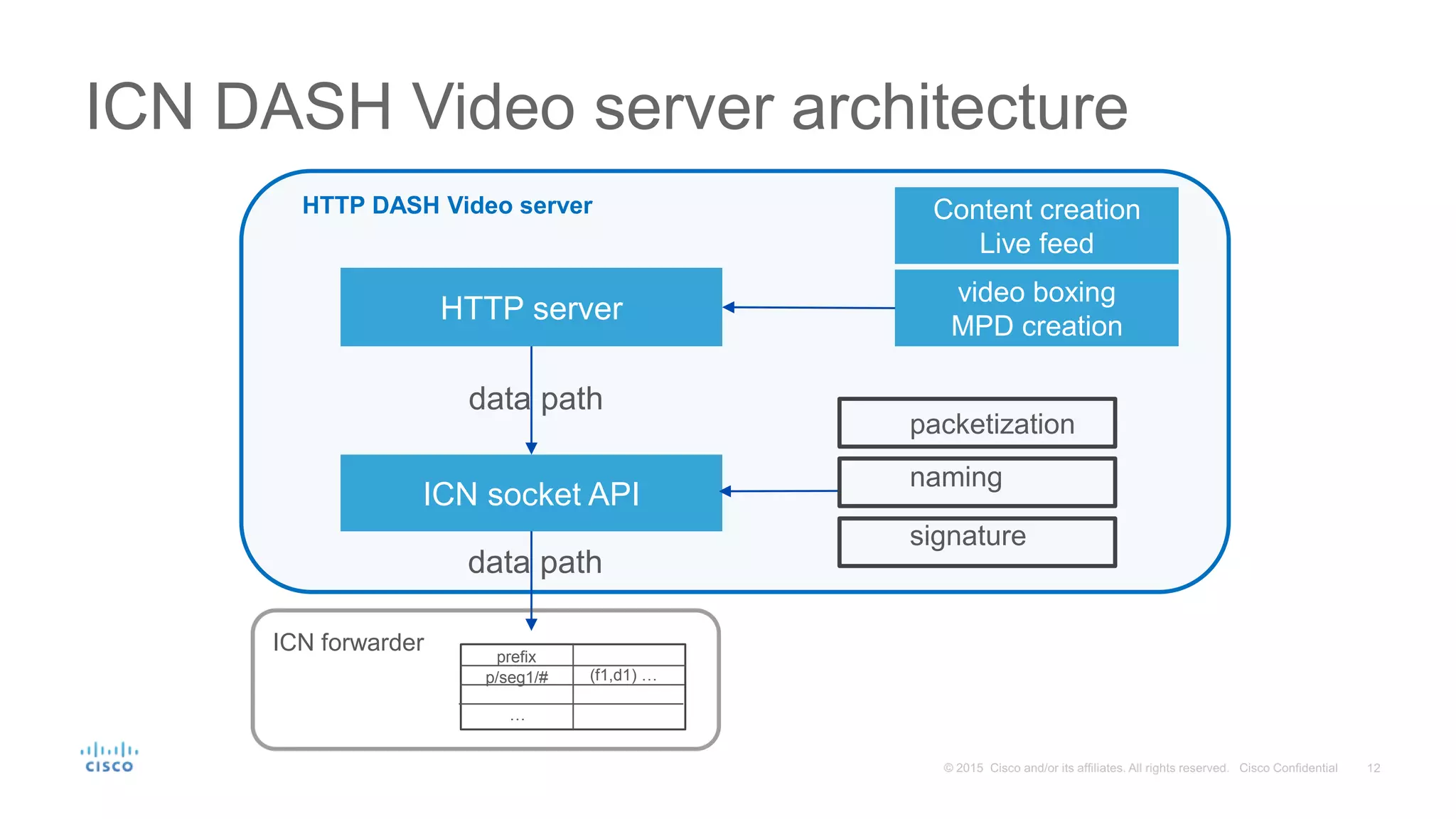
ICN DASH Video server architecture
ICN socket API
HTTP server
video boxing
MPD creation
data path
data path
Content creation
Live feed
packetization
naming
signature
prefix
p/seg1/# (f1,d1) …
…
ICN forwarder
HTTP DASH Video server
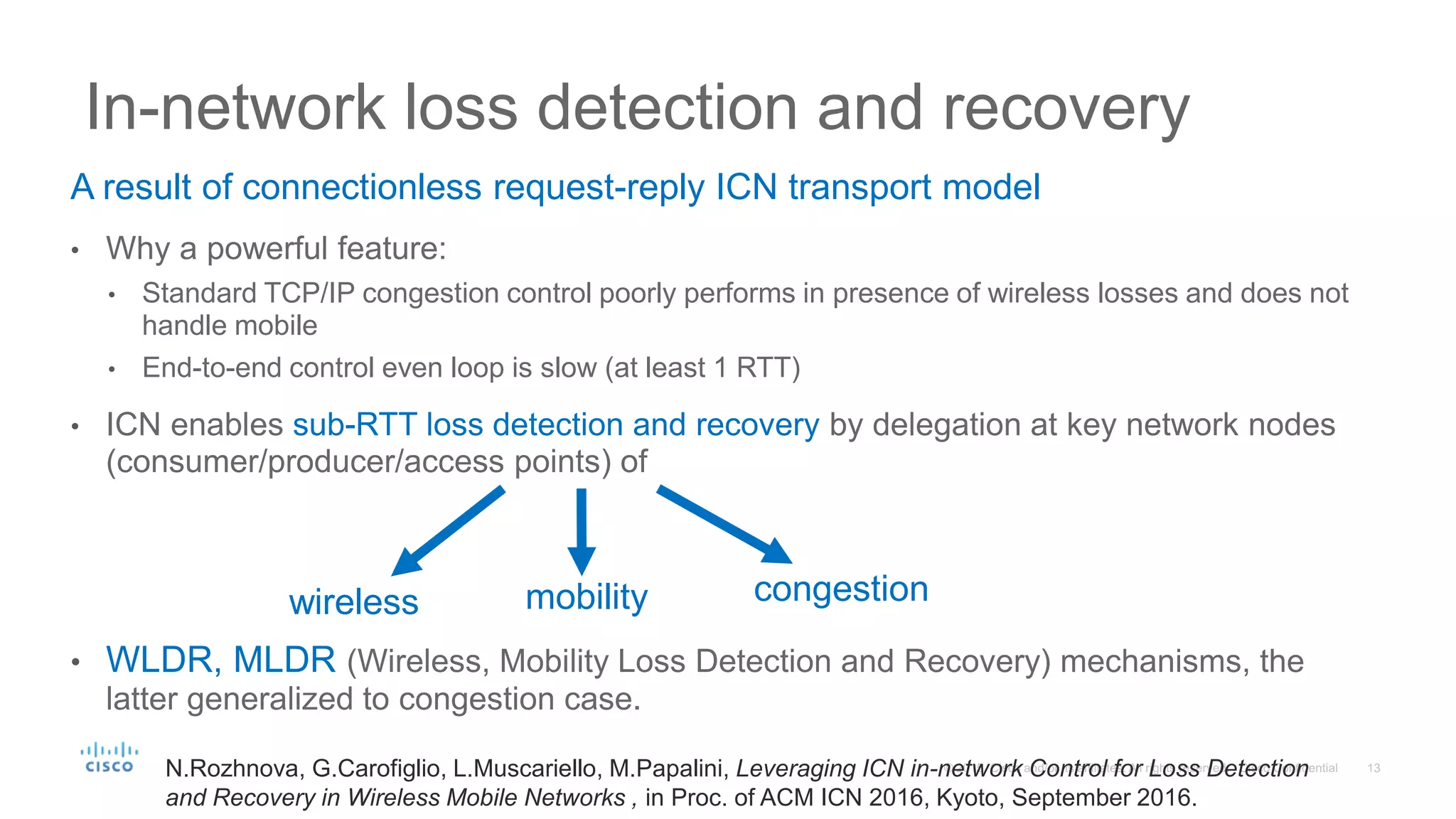
A result of connectionless request-reply ICN transport model
• Why a powerful feature:
• Standard TCP/IP congestion control poorly performs in presence of wireless losses and does not
handle mobile
• End-to-end control even loop is slow (at least 1 RTT)
• ICN enables sub-RTT loss detection and recovery by delegation at key network nodes
(consumer/producer/access points) of
• WLDR, MLDR (Wireless, Mobility Loss Detection and Recovery) mechanisms, the
latter generalized to congestion case.
In-network loss detection and recovery
wireless mobility congestion
N.Rozhnova, G.Carofiglio, L.Muscariello, M.Papalini, Leveraging ICN in-network Control for Loss Detection
and Recovery in Wireless Mobile Networks , in Proc. of ACM ICN 2016, Kyoto, September 2016.
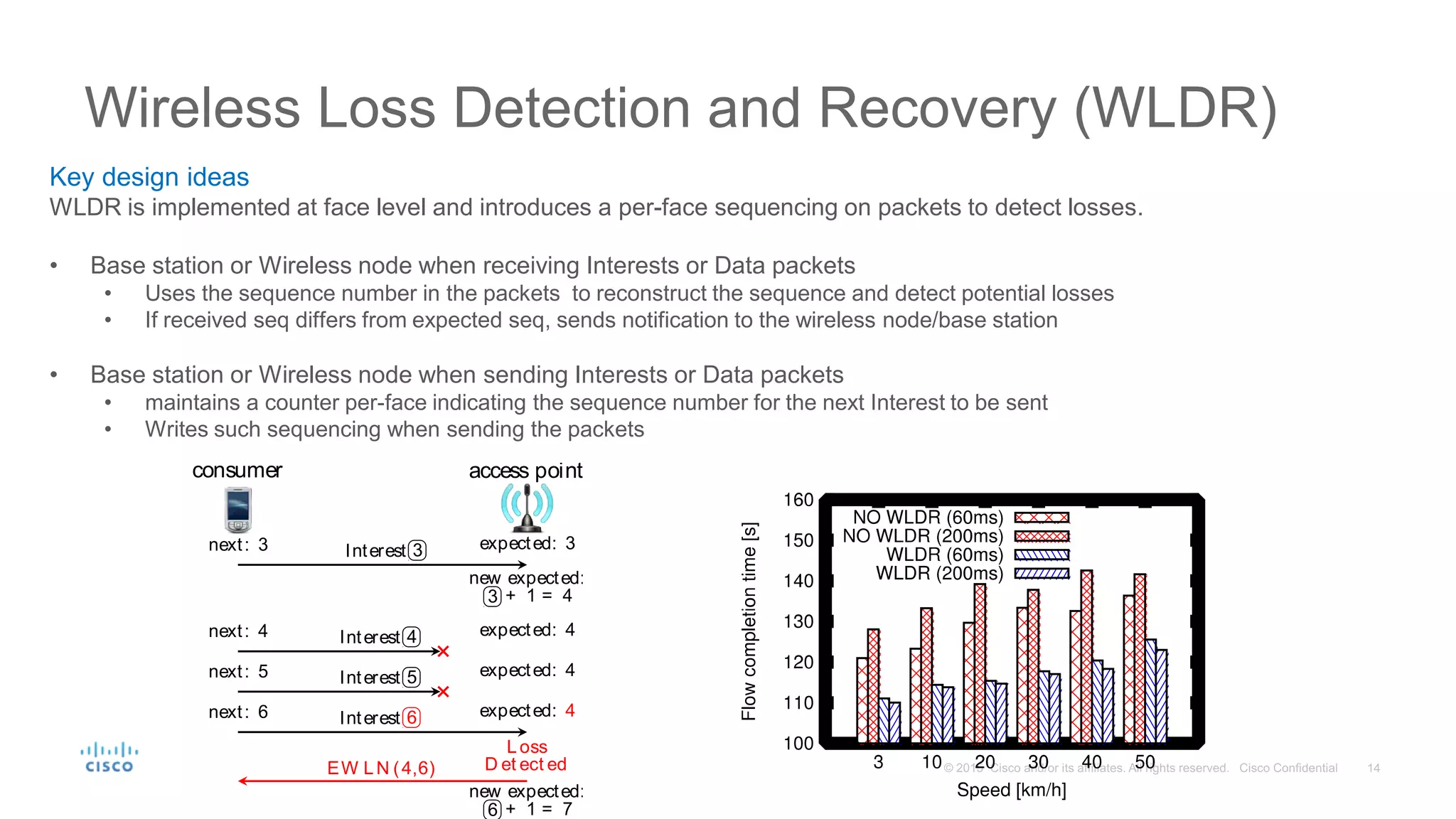
Wireless Loss Detection and Recovery (WLDR)
consumer access point
next: 3 expected: 3Interest 3
new expected:
3 + 1 = 4
next: 4 expected: 4Interest 4
next: 5 expected: 4Interest 5
next: 6 expected: 4Interest 6
Loss
D et ect edEW LN (4,6)
new expected:
6 + 1 = 7
Key design ideas
WLDR is implemented at face level and introduces a per-face sequencing on packets to detect losses.
• Base station or Wireless node when receiving Interests or Data packets
• Uses the sequence number in the packets to reconstruct the sequence and detect potential losses
• If received seq differs from expected seq, sends notification to the wireless node/base station
• Base station or Wireless node when sending Interests or Data packets
• maintains a counter per-face indicating the sequence number for the next Interest to be sent
• Writes such sequencing when sending the packets
Key features and advantages
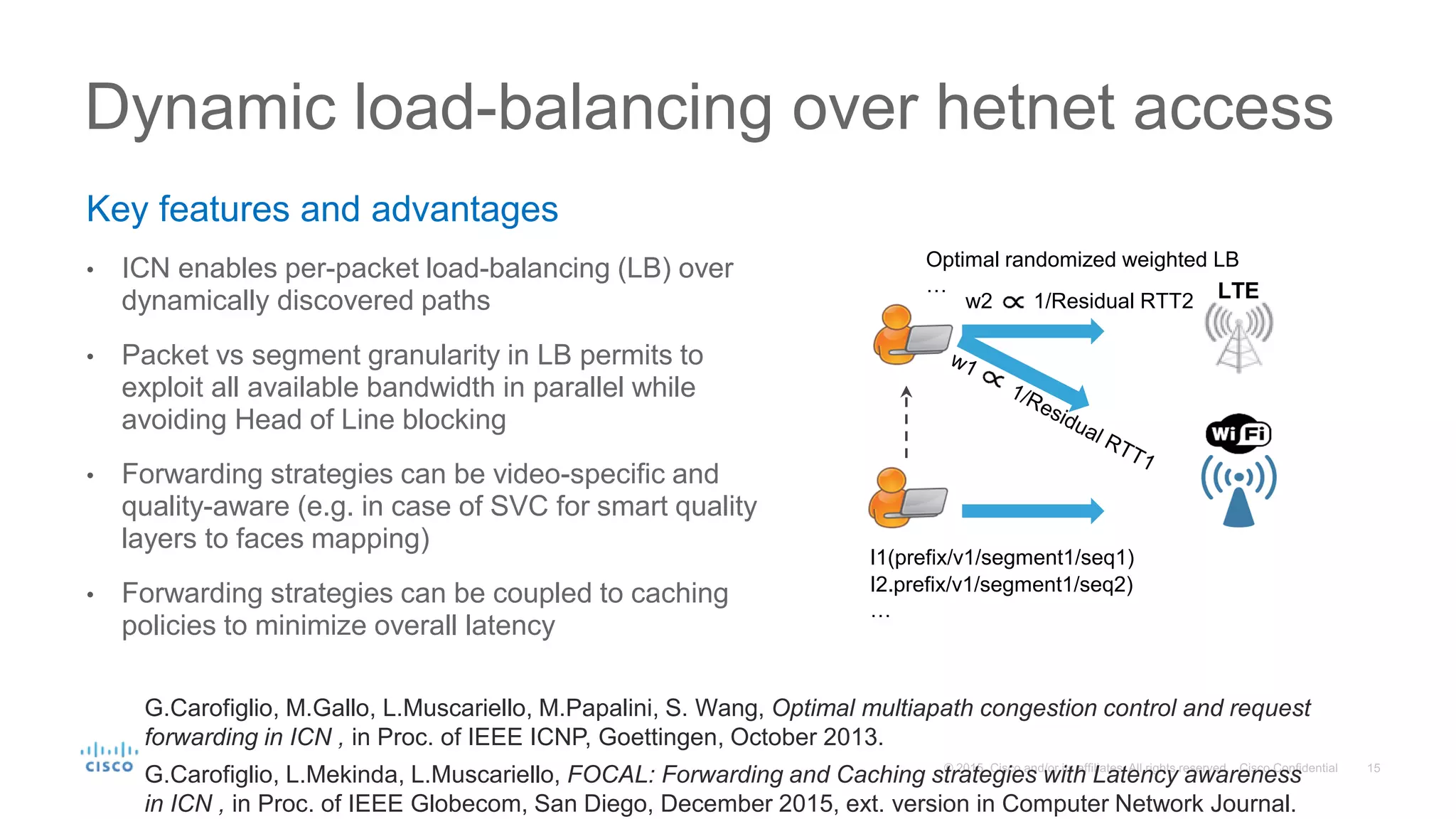
• ICN enables per-packet load-balancing (LB) over
dynamically discovered paths
• Packet vs segment granularity in LB permits to
exploit all available bandwidth in parallel while
avoiding Head of Line blocking
• Forwarding strategies can be video-specific and
quality-aware (e.g. in case of SVC for smart quality
layers to faces mapping)
• Forwarding strategies can be coupled to caching
policies to minimize overall latency
Dynamic load-balancing over hetnet access
w2 1/Residual RTT2 LTE
I1(prefix/v1/segment1/seq1)
I2.prefix/v1/segment1/seq2)
…
Optimal randomized weighted LB
…
G.Carofiglio, M.Gallo, L.Muscariello, M.Papalini, S. Wang, Optimal multiapath congestion control and request
forwarding in ICN , in Proc. of IEEE ICNP, Goettingen, October 2013.
G.Carofiglio, L.Mekinda, L.Muscariello, FOCAL: Forwarding and Caching strategies with Latency awareness
in ICN , in Proc. of IEEE Globecom, San Diego, December 2015, ext. version in Computer Network Journal.
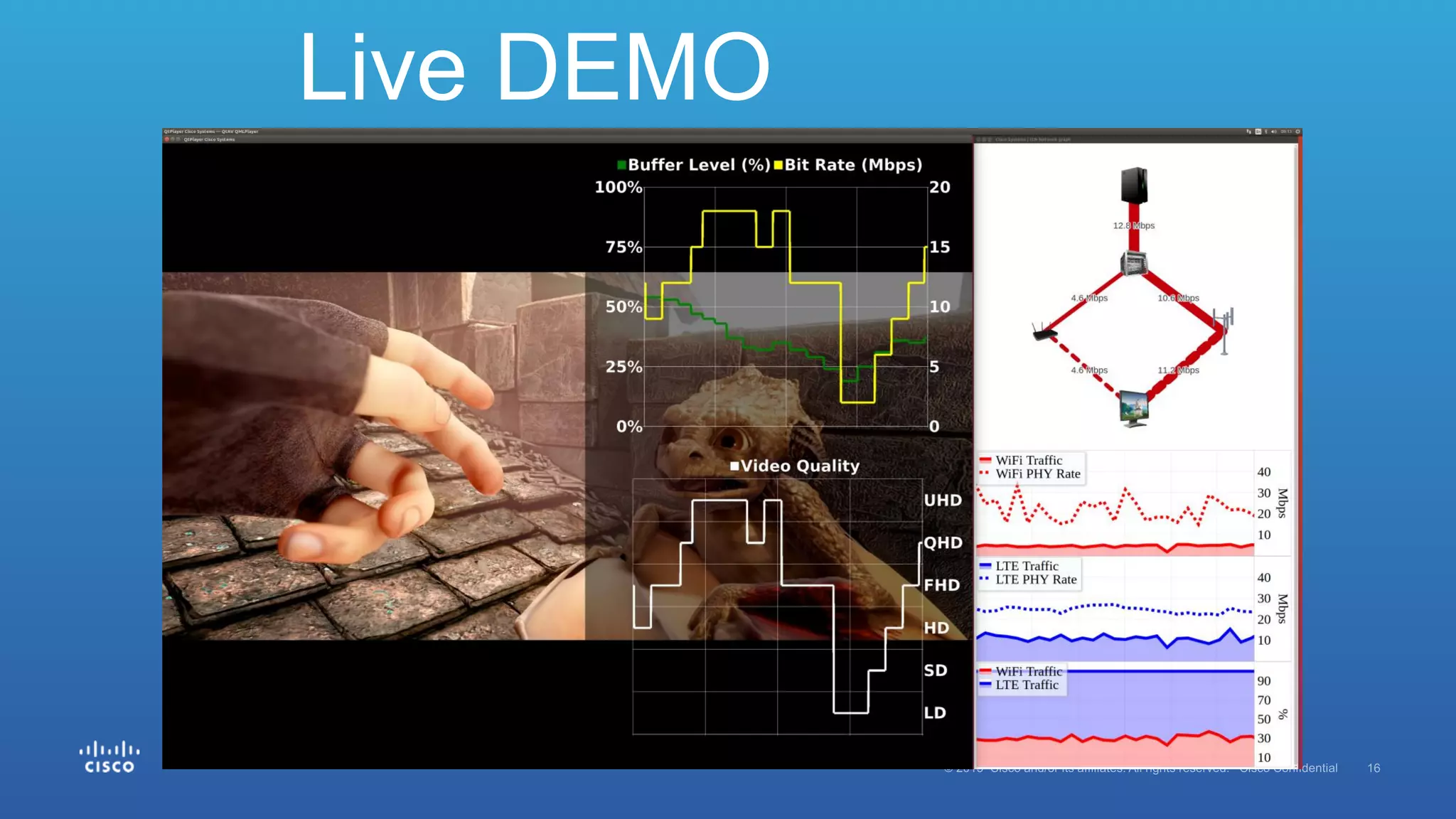
Live DEMO
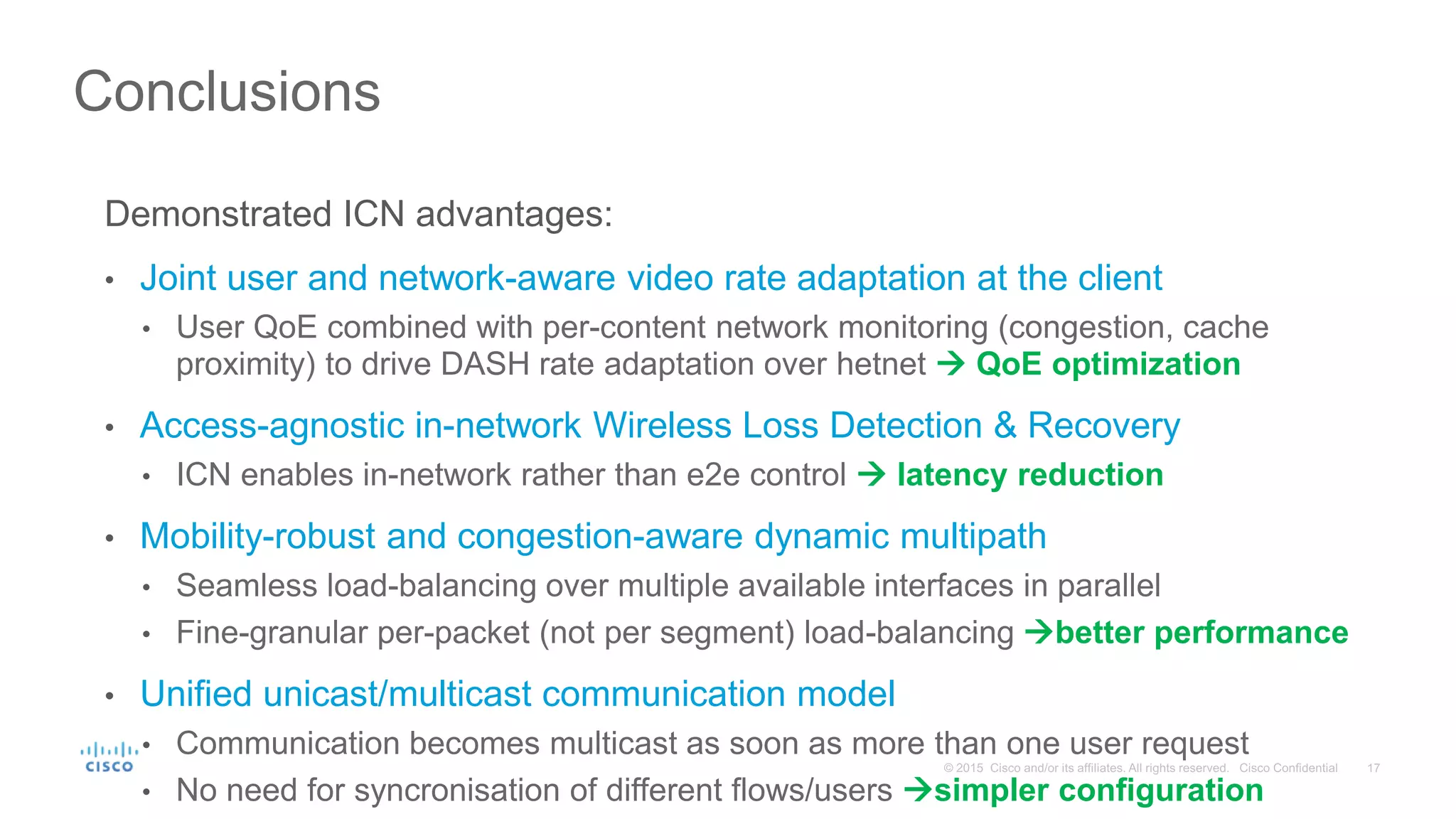
Demonstrated ICN advantages:
• Joint user and network-aware video rate adaptation at the client
• User QoE combined with per-content network monitoring (congestion, cache
proximity) to drive DASH rate adaptation over hetnet  QoE optimization
• Access-agnostic in-network Wireless Loss Detection & Recovery
• ICN enables in-network rather than e2e control  latency reduction
• Mobility-robust and congestion-aware dynamic multipath
• Seamless load-balancing over multiple available interfaces in parallel
• Fine-granular per-packet (not per segment) load-balancing better performance
• Unified unicast/multicast communication model
• Communication becomes multicast as soon as more than one user request
• No need for syncronisation of different flows/users simpler configuration
Conclusions
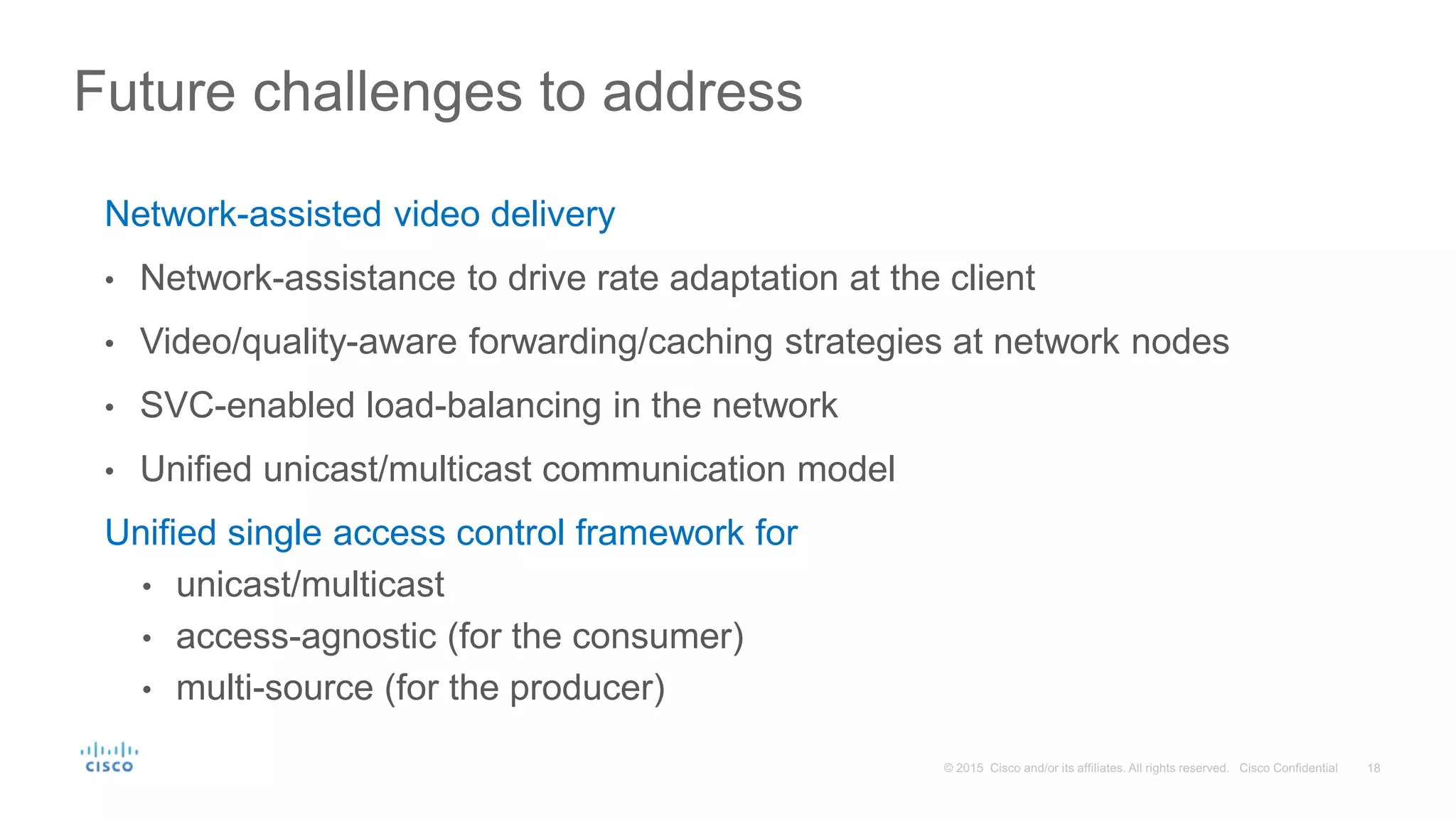
Network-assisted video delivery
• Network-assistance to drive rate adaptation at the client
• Video/quality-aware forwarding/caching strategies at network nodes
• SVC-enabled load-balancing in the network
• Unified unicast/multicast communication model
Unified single access control framework for
• unicast/multicast
• access-agnostic (for the consumer)
• multi-source (for the producer)
Future challenges to address
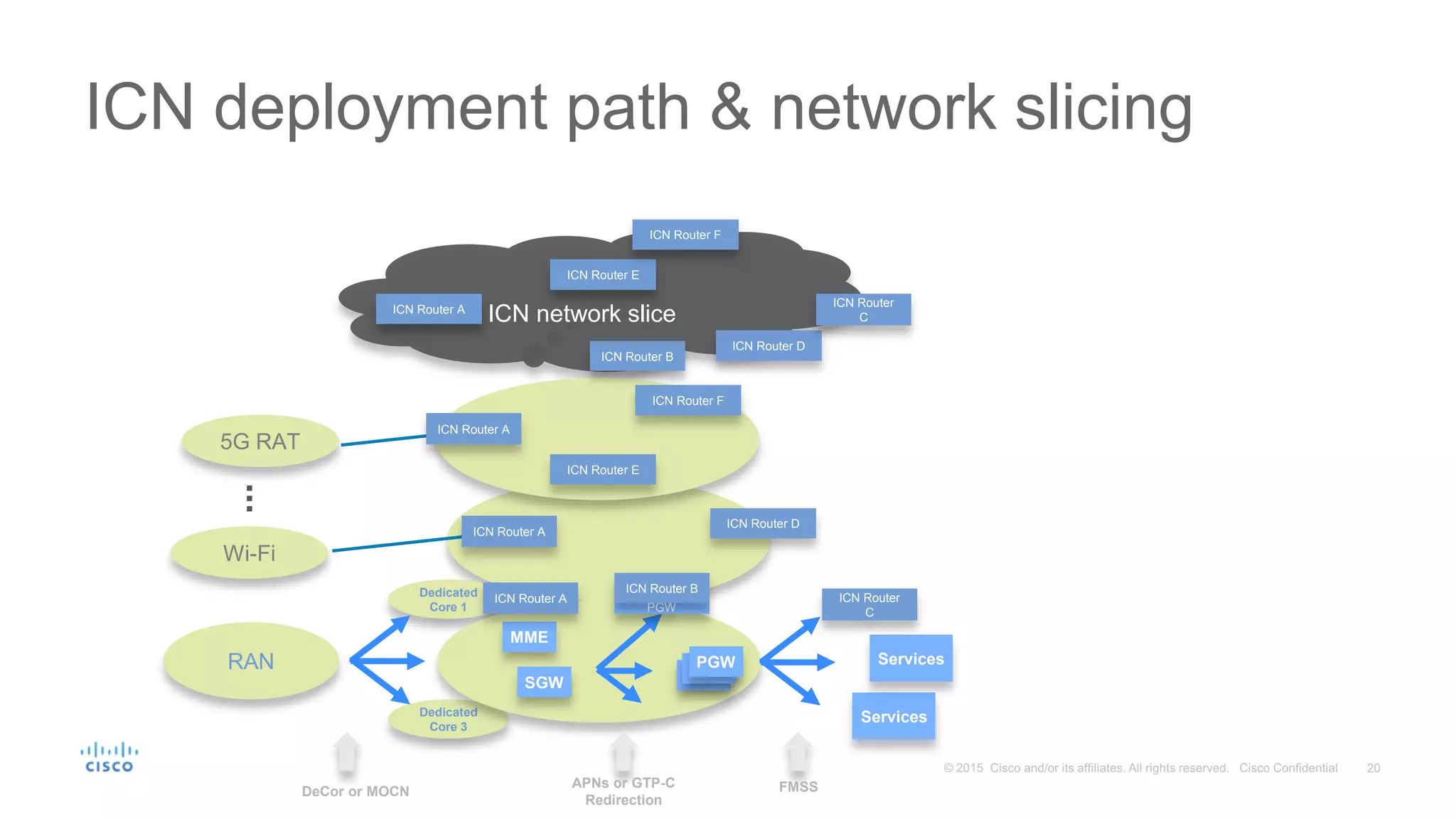
ICN deployment path & network slicing
Dedicated
Core 3
Dedicated
Core 1
RAN
MME
SGW PGWPGWPGW
Services
Services
DeCor or MOCN
APNs or GTP-C
Redirection
FMSS
ICN Router A ICN Router
CPGW
ICN Router B
ICN network slice
5G RAT
Wi-Fi
...
ICN Router E
ICN Router D
ICN Router F
ICN Router A
ICN Router E
ICN Router F
ICN Router
C
ICN Router D
ICN Router B
ICN Router A
ICN Router A

Using ICN to simplify data delivery, mobility management and secure transmission

  • 1.
    Mobile video deliveryusing ICN Giovanna Carofiglio, Cisco Distinguished Engineer Michele Papalini, Jacques Samain et al. FG IMT-2020 Workshop and Demo Day December 7, 2016
  • 2.
    Mobility Overlay Security Overlay Transform the OverlaidIP Transport Network Storage Overlay To an Integrated Mobile, Secured, Distributed Storage Network Deliver services using a new communication model that addresses modern Internet usage & Exploits latest Future Internet Architecture research  Mobility – eliminate need for special mobility overlays  Security – guarantee the integrity of every data object  Storage – dynamic placement of information anywhere in the network Information Centric Networking Providing a New Foundation Collapsetosinglelayer
  • 3.
    What Information CentricNetworking brings NAMED CONTENT Slice Content into discrete namable chunks THREE MAJOR COMPONENTS NAME BASED ROUTING A name could refer to any number of entities TRANSPORT ENHANCEMENTS • Improved object-based security) • Secure in-path caching • Supports multipath / multicast capabilities • Enables dynamic content-based routing • Network based “DNS equivalent” • User / Application identity no longer tied to IP address supporting mobility, multipath / multicast • Pull-based at network layer (not HTTP) • Connectionless (robust to mobility) • Exploits local cache for reuse or error recovery • Unified unicast/multicast model
  • 4.
    • Simplified corenetwork architecture through built-in L2-agnostic anchorless mobility support • Seamless communication over an heterogenous and mobile access through connectionless receiver-driven natively multipath transport • Latency-reduction via in-network control and hop-by-hop dynamic forwarding • Better user experience with transport cost reduction via edge caching/processing • Unified unicast/multicast communication • Improved security/confidentiality, flexibility to support different models • Richer network-aware content analytics ICN advantages for 5G
  • 5.
    Mobility management approaches •Consumer mobility is natively supported, in virtue of the connectionless and pull-based communication model. • Producer mobility is more challenging. Different categories of approaches: Global Routing (GR) requiring all routers to be updated, or Resolution-based (DNS-like) Anchor-Based or Trace-based in ICN Anchor-Less
  • 6.
    MAP-Me, an anchorlessmobility management protocol for data delivery in ICN that: • is access-agnostic, in order to cope with highly heterogeneous wireless access and multi-homed/mobile users • works at network layer and at forwarding timescale to be reactive enough to support real-time applications between mobile consumers/producers • leverages core ICN features like distributed hop-by-hop stateful forwarding, connectionless communications, object-based security • doesn’t require any control/management plane operations • has low overhead in terms of signaling, additional state at routers and computational complexity in order to scale with large network size Our contribution: an anchorless solution https://www.youtube.com/watch?v=p26GODPxG GE Cisco Mobility demo @ MWC’16 J.Augé, G. Carofiglio, G. Grassi, L. Muscariello, G. Pau, X. Zeng, MAP-Me: Managing Anchor-less Producer Mobility in ICN, under submission, accessible at http://arxiv.org/abs/1611.06785
  • 7.
    Video PoC architectureand components ULTRA eNB Client Access LTE Backhaul/Cor e Server DASH players w ICN rate adaptation, load- balancing and trasport ICN-enabled network monitoring analytics 4K VoD & Live DASH ICN server 1 (h)ICN-enabled video player (Infinite Home) 2 3 4 Hetnet Access (WiFI,LTE over wire) ICN forwarders and vICN (virtualized ICN or ICN in a container) ICN-enabled video server Network slices
  • 8.
    PoC components 1 2 3 ICN-enabled DASHvideo client Hetnet Access (WiFi, LTE) Virtualized ICN forwarders (vICN) 4 ICN-enabled DASH video server
  • 9.
    ICN DASH Videoclient architecture Segment scheduler ICN transport layer Rate-based Buffer-based Hybrid RB-b ABR Rate adaptation logic Delay-based AIMD, Remote AQM, Multipath path(s) bandwidth estimate playout buffer ICN forwarder Interest Data HTTP DASH Video player Load-balancer f1 f2 f3 faces prefix face, monit p/seg1/# (f1,d1) … … • DASH video is partitioned into 2s segments that the player may ask at different encoding bitrates depending of network conditions • The birate adaptation logic can be • Rate-based • Buffer-based • Mixed Rate and Buffer based ICN advantages: • Receiver-based transport model, with less throughput oscillations and smaller retx delays via in-network retransmission (WLDR) • Fine granular per-packet network view to feed rate adaptation logic • Multipath-capable transport layer that does not require a-priori knowledge of sources/paths
  • 10.
    Heterogeneous access MME SGW PGW EPC eNB Linux process tapinterface UE UE UE tap interface PDSCH PUSCH Channels LTE access Pedestrian outdoor propagation AP tap interface Linux process STA STA STA 802.11n Pedestrian outdoor propagation tap interface 4G over wire WiFi over wire
  • 11.
    Virtualized ICN architecture(vICN) RESOURCE PROVIDER Linux-based cluster w. LXC/LXD, OVS ORCHESTRATOR RESOURCE MODELS: • nodes & interfaces • channels (WiFi, etc.) • applications • mobility models… • … ICN MODULES: • workload : consumer/producers • forwarder • face and route mgt. vICN: CONTROL, MANAGEMENT & MONITORING PLANE interfaces GUI CLI API Config. YANG modelconfigure interact monitor SHADOW RESOURCE MODEL • secure access / slicing • consistency check • deployment plan & sync. • monitoring USER DATA PLANE DASH server ICN-enabled layer2 virtual network with real, emulated & simulated nodes and links ADMIN NETWORK VIEW { DASH player USER VIEW
  • 12.
    ICN DASH Videoserver architecture ICN socket API HTTP server video boxing MPD creation data path data path Content creation Live feed packetization naming signature prefix p/seg1/# (f1,d1) … … ICN forwarder HTTP DASH Video server
  • 13.
    A result ofconnectionless request-reply ICN transport model • Why a powerful feature: • Standard TCP/IP congestion control poorly performs in presence of wireless losses and does not handle mobile • End-to-end control even loop is slow (at least 1 RTT) • ICN enables sub-RTT loss detection and recovery by delegation at key network nodes (consumer/producer/access points) of • WLDR, MLDR (Wireless, Mobility Loss Detection and Recovery) mechanisms, the latter generalized to congestion case. In-network loss detection and recovery wireless mobility congestion N.Rozhnova, G.Carofiglio, L.Muscariello, M.Papalini, Leveraging ICN in-network Control for Loss Detection and Recovery in Wireless Mobile Networks , in Proc. of ACM ICN 2016, Kyoto, September 2016.
  • 14.
    Wireless Loss Detectionand Recovery (WLDR) consumer access point next: 3 expected: 3Interest 3 new expected: 3 + 1 = 4 next: 4 expected: 4Interest 4 next: 5 expected: 4Interest 5 next: 6 expected: 4Interest 6 Loss D et ect edEW LN (4,6) new expected: 6 + 1 = 7 Key design ideas WLDR is implemented at face level and introduces a per-face sequencing on packets to detect losses. • Base station or Wireless node when receiving Interests or Data packets • Uses the sequence number in the packets to reconstruct the sequence and detect potential losses • If received seq differs from expected seq, sends notification to the wireless node/base station • Base station or Wireless node when sending Interests or Data packets • maintains a counter per-face indicating the sequence number for the next Interest to be sent • Writes such sequencing when sending the packets
  • 15.
    Key features andadvantages • ICN enables per-packet load-balancing (LB) over dynamically discovered paths • Packet vs segment granularity in LB permits to exploit all available bandwidth in parallel while avoiding Head of Line blocking • Forwarding strategies can be video-specific and quality-aware (e.g. in case of SVC for smart quality layers to faces mapping) • Forwarding strategies can be coupled to caching policies to minimize overall latency Dynamic load-balancing over hetnet access w2 1/Residual RTT2 LTE I1(prefix/v1/segment1/seq1) I2.prefix/v1/segment1/seq2) … Optimal randomized weighted LB … G.Carofiglio, M.Gallo, L.Muscariello, M.Papalini, S. Wang, Optimal multiapath congestion control and request forwarding in ICN , in Proc. of IEEE ICNP, Goettingen, October 2013. G.Carofiglio, L.Mekinda, L.Muscariello, FOCAL: Forwarding and Caching strategies with Latency awareness in ICN , in Proc. of IEEE Globecom, San Diego, December 2015, ext. version in Computer Network Journal.
  • 16.
  • 17.
    Demonstrated ICN advantages: •Joint user and network-aware video rate adaptation at the client • User QoE combined with per-content network monitoring (congestion, cache proximity) to drive DASH rate adaptation over hetnet  QoE optimization • Access-agnostic in-network Wireless Loss Detection & Recovery • ICN enables in-network rather than e2e control  latency reduction • Mobility-robust and congestion-aware dynamic multipath • Seamless load-balancing over multiple available interfaces in parallel • Fine-granular per-packet (not per segment) load-balancing better performance • Unified unicast/multicast communication model • Communication becomes multicast as soon as more than one user request • No need for syncronisation of different flows/users simpler configuration Conclusions
  • 18.
    Network-assisted video delivery •Network-assistance to drive rate adaptation at the client • Video/quality-aware forwarding/caching strategies at network nodes • SVC-enabled load-balancing in the network • Unified unicast/multicast communication model Unified single access control framework for • unicast/multicast • access-agnostic (for the consumer) • multi-source (for the producer) Future challenges to address
  • 20.
    ICN deployment path& network slicing Dedicated Core 3 Dedicated Core 1 RAN MME SGW PGWPGWPGW Services Services DeCor or MOCN APNs or GTP-C Redirection FMSS ICN Router A ICN Router CPGW ICN Router B ICN network slice 5G RAT Wi-Fi ... ICN Router E ICN Router D ICN Router F ICN Router A ICN Router E ICN Router F ICN Router C ICN Router D ICN Router B ICN Router A ICN Router A