5G Infrastructure Division
Intel Confidential
Network Platforms Group
LegalNotices/disclaimer
Intel technologies’ features and benefits depend on system configuration and may require enabled hardware, software or service activation. Learn more at
intel.com, or from the OEM or retailer.
No computer system can be absolutely secure.
Software and workloads used in performance tests may have been optimized for performance only on Intel microprocessors.
Performance tests, such as SYSmark and MobileMark, are measured using specific computer systems, components, software, operations and functions. Any
change to any of those factors may cause the results to vary. You should consult other information and performance tests to assist you in fully evaluating your
contemplated purchases, including the performance of that product when combined with other products. For more complete information visit
http://www.intel.com/performance.
Tests document performance of components on a particular test, in specific systems. Differences in hardware, software, or configuration will affect actual
performance. Consult other sources of information to evaluate performance as you consider your purchase. For more complete information about performance
and benchmark results, visit http://www.intel.com/performance.
Cost reduction scenarios described are intended as examples of how a given Intel- based product, in the specified circumstances and configurations, may affect
future costs and provide cost savings. Circumstances will vary. Intel does not guarantee any costs or cost reduction.
Results have been estimated or simulated using internal Intel analysis or architecture simulation or modeling, and provided to you for informational purposes.
Any differences in your system hardware, software or configuration may affect your actual performance.
Intel does not control or audit third-party benchmark data or the web sites referenced in this document. You should visit the referenced web site and confirm
whether referenced data are accurate.
Intel, the Intel logo and others are trademarks of Intel Corporation in the U.S. and/or other countries. *Other names and brands may be claimed as the property
of others.
© 2016 Intel Corporation.
2
Intel Confidential – Internal Only
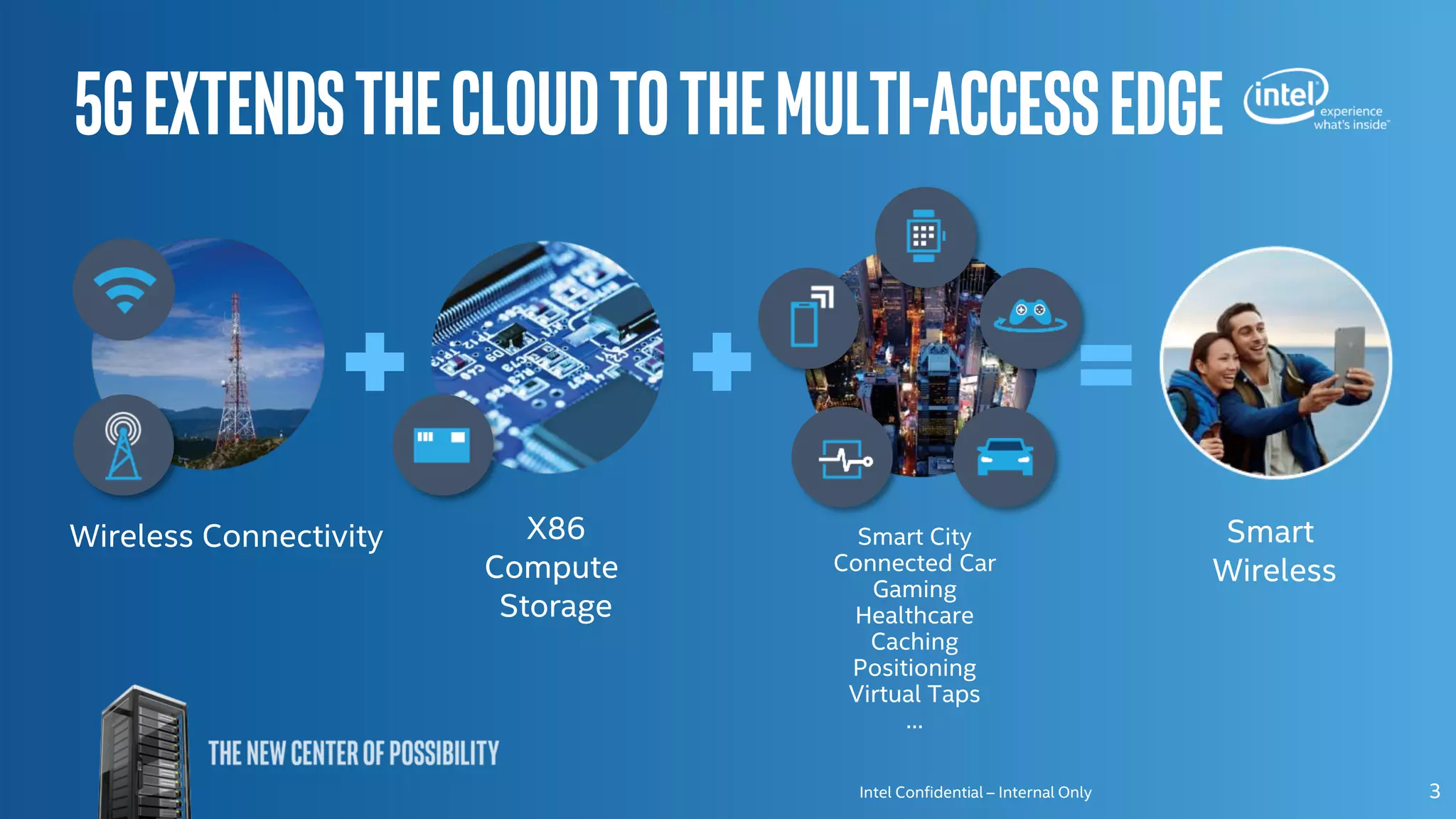
5Gextendsthecloudtothemulti-accessedge
3
Wireless Connectivity X86
Compute
Storage
Smart
Wireless
Smart City
Connected Car
Gaming
Healthcare
Caching
Positioning
Virtual Taps
…
5
Intel5GEnd-to-EndStrategy
OneArchitectureAcrosstheNetwork
Smart
Devices
RadioAccess
Technology
AccessandEdge
Network
Core
Network
Cloud
MM WAVE / LTE / NB-IOT / WIFI
NFV / SDN
Enablingonecomputeplatformfromedgetocloud
DATACENTERATTHETELCOEDGE
Implementation
• Distributed network of data centers in the last mile (i.e at the
base of telecom towers, in Cloud Radio Network Sites,
fiber…)
Benefits
• User Experience Impact
• Real Estate provides locations/reduced latency
• 5G => capacity, new spectrums/frequencies, lower
latency
• Network Slicing to favor content, specific
bandwidths, thruput
• Real time workload decisions based on actual latency and
radio frequency congestion
• Secured gateway for operator and enterprises (1st stop into
the network)
Mapping workloads for edge computing
Round trip communication only (sub) use-cases – automated
driving, IoT, gaming interactions
Latency = <5 ms
Latency = <10ms Round trip computation for use cases – AR, IoT (Smart
grids), Medical apps, FaaS
Latency = <40ms Round trip computation + storage for use cases – AR (relaxed), IoT
(non-stringent), Video analytics, FaaS (latency non-bound), caching
and accelerated browsing
Clients Cloud / OTT
+ Flexibility / +Capacity / + Latency / - Locality
Wireless
Local CO Regional CO
- Flexibility / -Capacity / - Latency / + Locality
CORE
Latency
Fiber
Cable Last mile/
access
Core Cloud/DATACENTER
CENTRAL
OFFICES REGIONAL
CENTRAL
OFFICES &
DATA
CENTERS
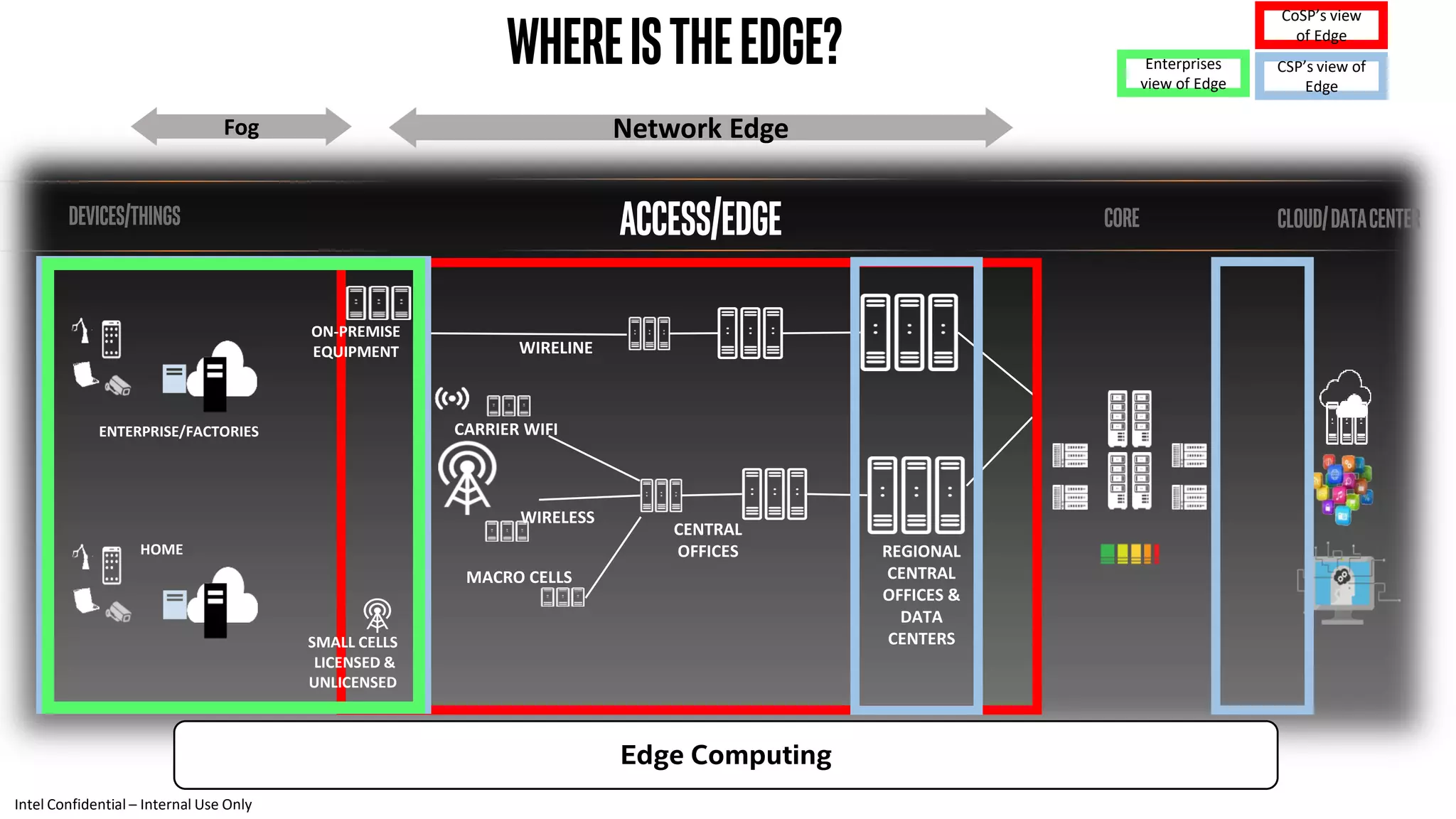
MACRO CELLS
WIRELINE
CARRIER WIFI
SMALL CELLS
LICENSED &
UNLICENSED
Network EdgeFog
ACCESS/EDGE
WhereistheEdge? CSP’s view of
Edge
CoSP’s view
of Edge
Enterprises
view of Edge
Devices/things
HOME
ENTERPRISE/FACTORIES
Edge Computing
ON-PREMISE
EQUIPMENT
WIRELESS
Intel Confidential – Internal Use Only
8BMG | INTEL CONFIDENTIAL, FOR INTERNAL USE ONLY
Key Drivers for Edge Compute
 Low latency that can not be achieved by using centralized cloud
 Reduction of movement of the massive amount data generated by IOT
devices to reduce cost and enable efficient use of resource
 Data Privacy and Data Sovereignty
 Context Awareness
 Scenarios where connectivity is unreliable or limited
BMG | INTEL CONFIDENTIAL, FOR INTERNAL USE ONLY
Network Platforms Group
NPG5GINFRASTRUCTUREBUILDINGBLOCKS
ACCESS Edge&CORE NFV/SDN
Cloud Ready Networks
Scalability&flexibilityfornetworkingworkloads
CapabilityENABLERS
VNFs
NFVi
MANO
IA
Linux
KVM
Optimized
Ingredients
Network Slicing
• 5GNR RAT @ 28GHz,
39Ghz and 3.5 GHz
• MIMO
• Custom Si for Baseband
and Radio
• FlexRAN Reference
Software
• vCCAP (Cable) Reference
Software
Intel® Xeon®
Processor
Intel® Ethernet
Controller
Altera®
FPGA
Intel®
3D XPoint
Intel® QuickAssist
Intel® Quick Sync
Video
Intel® AtomTM
Processor
Intel® Resource
Director
• FlexCore Reference
Software
• MEC Source Libraries
• Network Edge
Virtualization SDK for
developers
• Next Generation CO
Reference Architecture
• RSD
• Ciphering libraries
• CPRI over Ethernet FPGA
Reference
• Transport Interworking
software
• Visual Cloud (VCD)
Libraries
Intel® CORE®
Processor
MEC System Reference Architecture
11
MobileEdge
SystemLevelMobileEdgeServerLevel
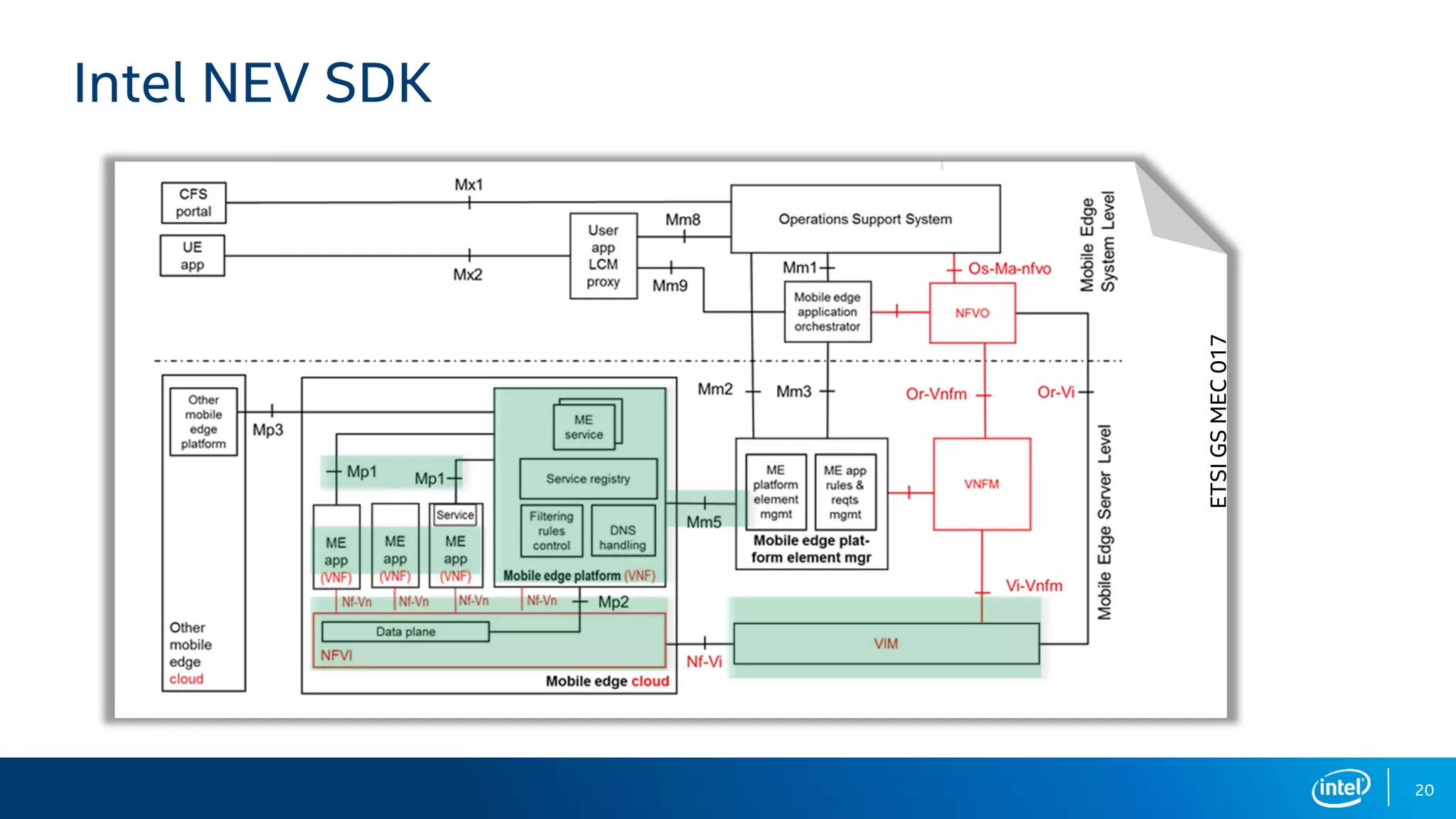
Mobile edge platform
Mobile edge Host
Virtualization Infrastructure
Data plane
UE
app
VIM
Other
mobile
edge
platform
Mobile edge platform
element mgmt
Mobile edge application
orchestrator
Mm3
Mm1
Mx2
Mm8
Mm9
Mp2
Mp1
ME
app
ME
app
Service
Mm2
Mm5
Filtering
rules
control
ME
service
Service registry
DNS
handling
ME
platform
element
mgmt
CFS
portal
Mx1
Mp3
Other
mobile
edge Host
ME app
rules &
reqts
mgmt
ME
app
lifecycle
mgmt
Mm7
User
app
LCM
proxy
Operations Support System
Mm4
Mm6
Reference Point names:
Mp: ME platform functionality
Mm: management
Mx: connections to external entities
Reference: ETSI ISG MEC GS MEC-003 “Framework and Reference Architecture”
remote
app
MEC Opportunities
12
MobileEdge
SystemLevelMobileEdgeServerLevel
Mobile edge platform
Mobile edge Host
Virtualization Infrastructure
Data plane
UE
app
VIM
Other
mobile
edge
platform
Mobile edge platform
element mgmt
Mobile edge application
orchestrator
Mm3
Mm1
Mx2
Mm8
Mm9
Mp2
Mp1
ME
app
ME
app
Service
Mm2
Mm5
Filtering
rules
control
ME
service
Service registry
DNS
handling
ME
platform
element
mgmt
CFS
portal
Mx1
Mp3
Other
mobile
edge Host
ME app
rules &
reqts
mgmt
ME
app
lifecycle
mgmt
Mm7
User
app
LCM
proxy
Operations Support System
Mm4
Mm6
Application
Developers
with UX
Skills
Virtualization and platform SW skills
(Hypervisor, Container Virtualization)
Orchestration
and
Operations
Management
Skills
MEC utilizes the NFV infrastructure; opportunities for adjacent VNF providers
AdjacentVNFs
AdjacentVNFs
13
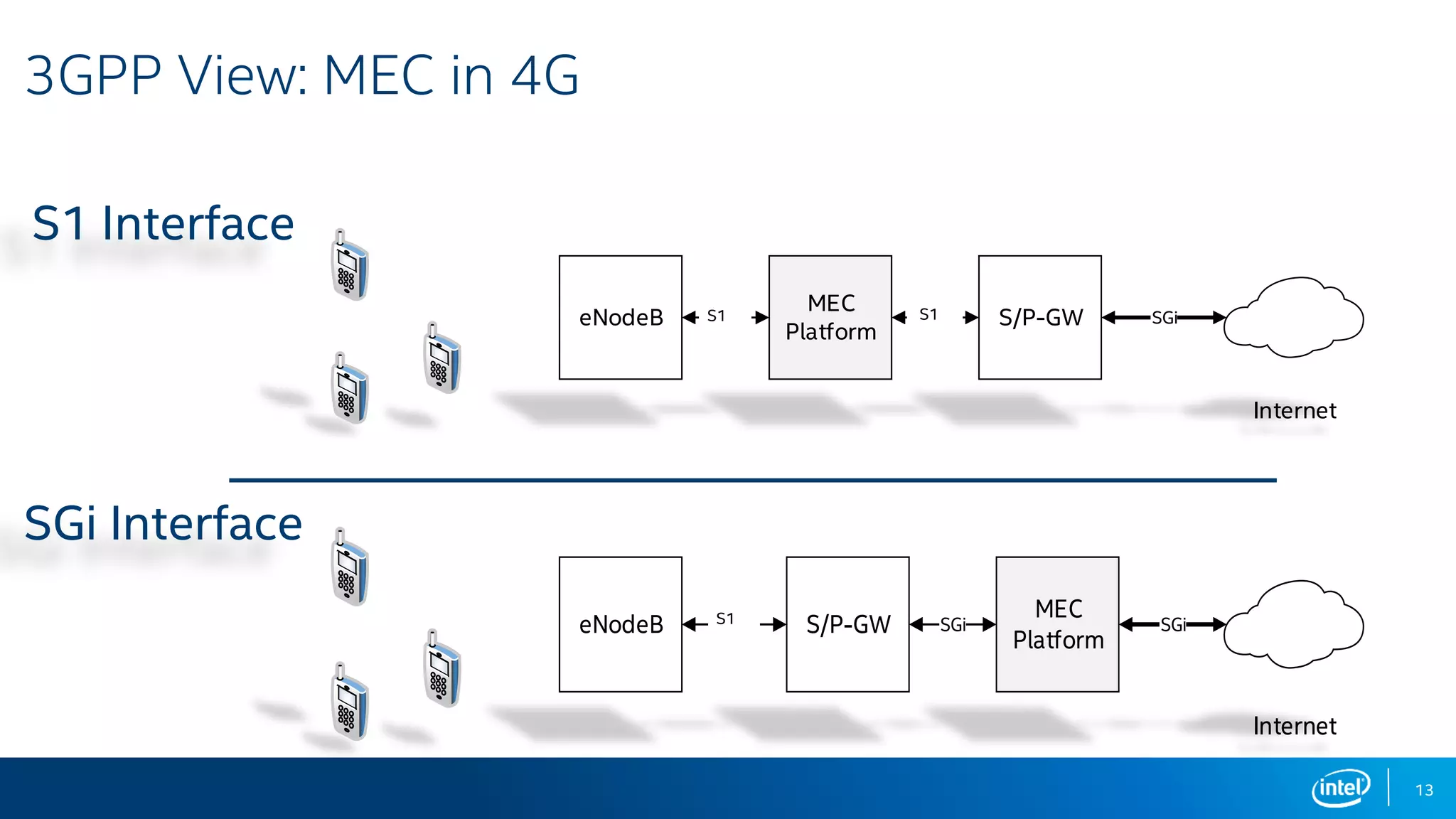
3GPP View: MEC in 4G
SGi Interface
S1 Interface
SGieNodeB
MEC
Platform
S/P-GWS1-AP
Internet
SGiS1APS1
SGieNodeB
MEC
Platform
S/P-GWS1-AP S1-AP
Internet
S1 S1
UE (R)AN UPF
AFAMF SMF
PCF NEF
DNN6
NRFUDM
N3
N2 N4
AUSF
Nausf Namf Nsmf
NpcfNnrfNudm Nnef
Naf
NSSF
Nnssf
MEC in 5G
14
MEC HOST (COMPUTE)
Control-plane
Orchestration
MEC Control
U-Plane
Apps
U-Plane
Apps
FFS
Management
APIs: REST-HTTP style + Data model + JSON[&XML] formats + Message Bus Hooks
Richardson maturity model level 2..3
ETSI-defined Mobile Edge Services
ME Application Development
© ETSI 2016. All rights reserved
15
Mobile edge platform / Mp1
ME app
1
ME app
2
ME app
3
MEC012
Radio Network
Information API
MEC013
Location
API
MEC014 UE
Identity API
MEC015
Bandwidth
Manager API
MEC011
App Enablement
MEC009APIPrinciples
ME app
n
Service
MEC0nn
Developer community
MEC0nn = ETSI MEC API specification API0nn = Third party ME service API specification
…ME app
4
Service
APInnn
Platform APIs
MEC deployment in mobile networks
16
MEC deployment option on S1 interface
MEC data plane
eNB #1
UE1
MEC
App 1
S1
MEC platform
Mp2
Mp1
S1
User plane -
GTP
Control plane – S1-AP
SGW PGW
MME
MEC Host #1 Centralized CN site
MEC data plane
eNB #2
MEC platform
Mp2
S1
User plane -
GTP
Control plane – S1-AP
MEC Host #2
MEC orchestrator
Mm3
MEC platform manager
MEC
platform
element
mgmt
MEC app
rules &
reqts
mgmt
MEC
app
lifecycle
mgmt
Mp3Mm5
Application
Server
Web
Mp3 interface
Mm5 interface
Mm3 interface
LEGEND
Mx2/Mm9/Mm3
interface
non-MEC interfaces
MEC
App 2
Mp1
18
Intel® Network Edge Virtualization (NEV) SDK
Multi-access Edge Computing (MEC) Software Development Kit
 MEC Reference Libraries
 Intel® System Studio Suite
 Wind River HW optimized modules
with SW only NEV SDK option
 Open Stack components
 S1, SGi (EPC), WiFi traffic
 Test Suites
 Programming Guide
 User Guide
 App Notes
 VLAN Tags processing
MEC Reference Libraries provide S1 / IP
traffic information to VMs
Real Time Virtualization, accelerated
vSwitch out of the box
Open standards-based solution delivers
flexibility, scalability and interoperability
Look Inside® Intel Kit
Release 1:
Hypervisor Wind River Titanium Server
Components (on the Host Platform)
Virtual
Machine 1
…
Release 2:
Your
Application
Goes Here!
Release 3:
CentOS-7
NEW
NEW
NEW
NEW
NEW
Intel ®Atom™
Processor C2000
Platform
Intel® XEON®
Platform
Software Only
Option
And
Here!
NEW
Intel Confidential
Intel® NEV-SDK & Mobile Edge Computing
Edge Computing is key technology for 5G which will address low latency and high
throughput requirements in 5G Networks. It provides a platform for deploying
intelligent applications at the edge of the network. NEV SDK is a key enabler to this
transformation, by providing an easy to use MEC reference platform focused on
application development.
Intel® NEV-SDK Release 3.0
The NEV SDK enables ISVs develop platform services on a feature rich MEC ready sandbox. This enables
TEMs & Operators alike trial and model the advantages of MEC deployment using Intel’s MEC reference
platform. Release 3.0 of the NEV SDK comes loaded with following new features;
• Software only version
• S1, SGi(EPC) and WiFi Traffic deployment Support
• GTP-U based on IPv4 / IPv4 / VLAN tagged IPv4 / VLAN tagged GTP-u
• Reference MEC Manager and MM5 API support
• Reference Service registry and Policy Support
• Out of the box support for 4 Types of MEC Apps services
• Logical Port abstraction and Driver (DPDK) Abstraction
For more information please visit: https://networkbuilders.intel.com/network-technologies/nev
Copyright © 2017 Intel Corporation.
Legal Notices. Other names and brands may be claimed as the property of others.
The contents of this newsletter are for internal use only.
MEC reference platform
Data Plane Development Kit
Network
Information
Services
Network Traffic Services
Wind River* Titanium Server
Advanced vSwitch
VM
MEC-like API
Mobile Edge Application
VM
MEC-like API
Mobile Edge Application
MEC server
Polaris
EPC
emulator
Polaris
LTE eNB
emulator
NEV SDK 3.0…
……A LOOK INSIDE
MEC Restful API
DNS Cache
Intel NEV SDK
20
ETSIGSMEC017
21
NEV-SDK v3.0 Bundle Options
Hardware Optimized NEV-SDK Software only NEV-SDK
22
NEV SDK Software Stack
Wind River Titanium Server with Accelerated Virtual Switch (AVS) (Control
Node and Compute Node)
CentOS Release 7.3.1611 (base environment)
Development and Creative Workstation
Development Tools Hardware
Monitor
Virtualization
Hypervisor
DPDK 16.07.2
Qemu 1.7.0
Redis 3.0.6+
Development libraries: Hiredis, Boost, JSON C++, OpenSSL, FastCGI)
Qemu 2.7.1
Nginx 1.9.9+ Nginx 1.10.3+Redis 3.2.8+NEV SDK 3.0.0 AVP 1.1.0 KLM
DPDK 16.07.2
NEV SDK 3.0.0
Additional tools (tcl, expect, Python 2.7.3 and
libraries, HTTPLIB2, websocket-client, lperf3)
Additional tools (tcl, expect, Python 2.7.3 and
libraries, HTTPLIB2, websocket-client, lperf3)
accelerated virtual
port (AVP)
corresponding to AVS
DPDK 1.7.1 (VM
acceleration
for AVS
acceleration in
VMs
Sample MEC Manager
Emulator
Sample MEC
Manager Emulator
Wind River Titanium OpenStack Shipped without virtualization environment, developers may
integrate (e.g., Community OpenStack)
HW Optimized WR Titanium 3.0 Bundle CentOS 7 (SW only) Bundle
Network Edge Services (NES)
REST API
Services Registry
Platform services
Network Traffic
Services (NTS)
23
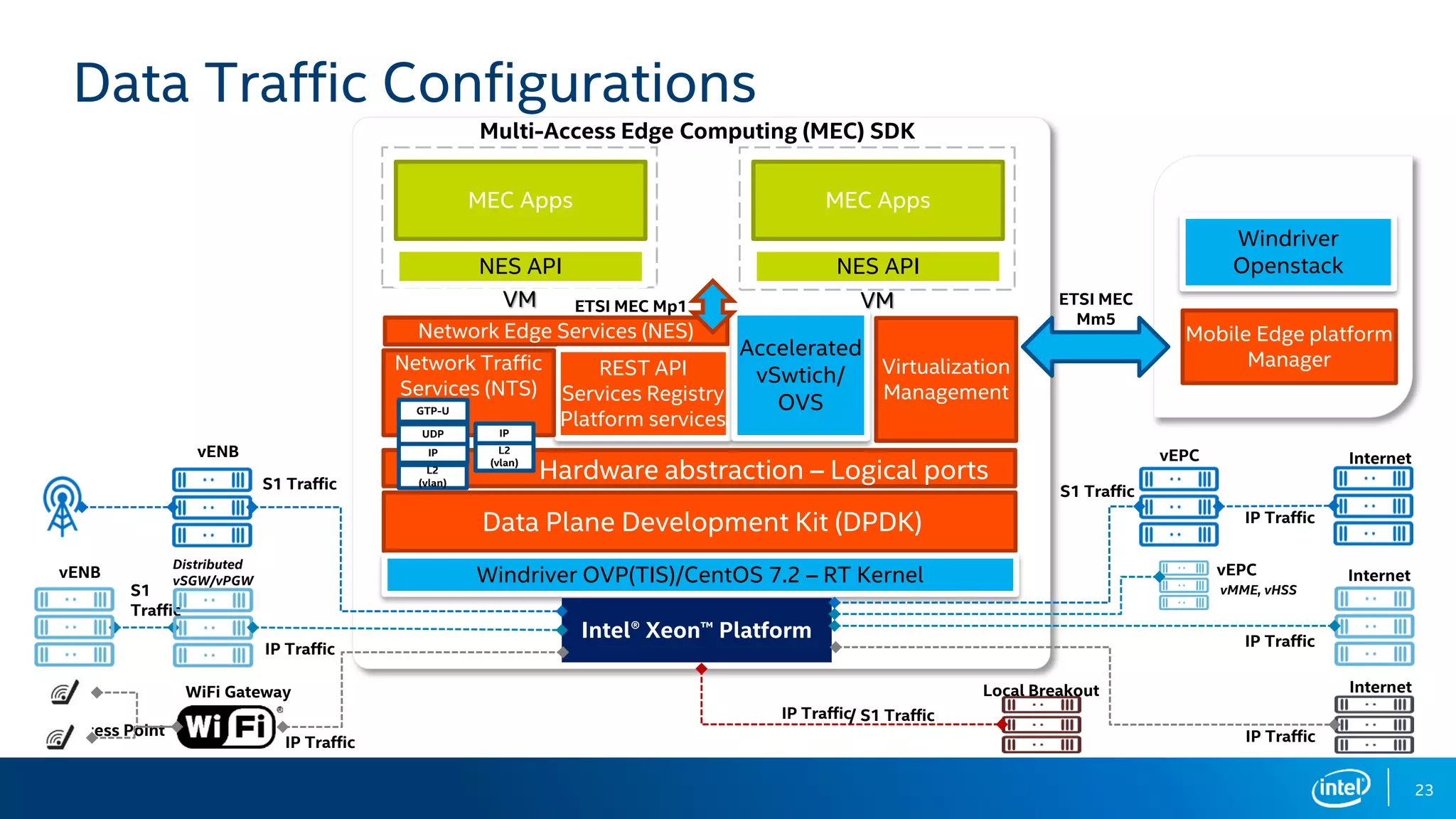
Data Traffic Configurations
Virtualization
Management
Accelerated
vSwtich/
OVS
VM
NES API
MEC Apps
VM
NES API
MEC Apps
Multi-Access Edge Computing (MEC) SDK
Windriver OVP(TIS)/CentOS 7.2 – RT Kernel
Data Plane Development Kit (DPDK)
Hardware abstraction – Logical ports
ETSI MEC Mp1
Intel® Xeon™ Platform
IP Traffic
S1 Traffic S1 Traffic
vENB vEPC Internet
IP TrafficIP Traffic
S1
Traffic
vENB Internet
Distributed
vSGW/vPGW
vEPC
vMME, vHSS
Access Point
IP Traffic IP Traffic
InternetWiFi Gateway Local Breakout
IP Traffic/ S1 Traffic
Control Node
Windriver
Openstack
Mobile Edge platform
Manager
ETSI MEC
Mm5
L2
(vlan)
IP
UDP
GTP-U
L2
(vlan)
IP
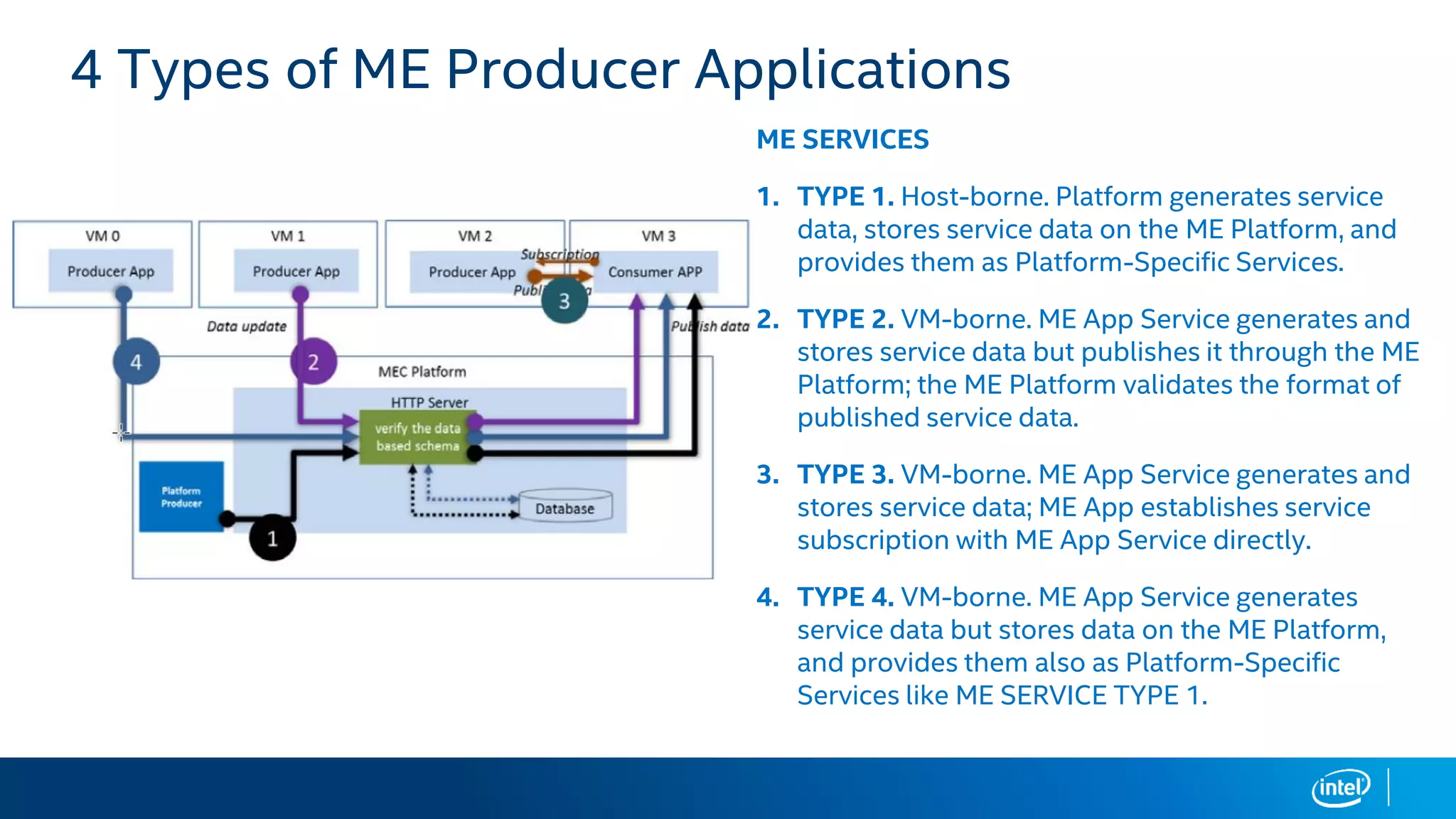
4 Types of ME Producer Applications
ME SERVICES
1. TYPE 1. Host-borne. Platform generates service
data, stores service data on the ME Platform, and
provides them as Platform-Specific Services.
2. TYPE 2. VM-borne. ME App Service generates and
stores service data but publishes it through the ME
Platform; the ME Platform validates the format of
published service data.
3. TYPE 3. VM-borne. ME App Service generates and
stores service data; ME App establishes service
subscription with ME App Service directly.
4. TYPE 4. VM-borne. ME App Service generates
service data but stores data on the ME Platform,
and provides them also as Platform-Specific
Services like ME SERVICE TYPE 1.
25
Edge Cloud Reference Architecture
Intel® Architecture Ingredients
Xeon-Server QATNetworking FPGA/accelerators
VIM
OpenStack
vRAN
L2
L1
L3
vEdge
Core
vSGW
/PGW
vSeG
W
WiFi
VNF Managers
(Service Orchestration)
VNFMs
Orchestrators
3rd party
Domain
Orchestrators
Wireline
vOLT
vFixed
Edge
vCPE
vBNG
Hosted
Service
s
MNO1
Edge
Azure
Stack
Green
Grass
Non-
MEC
Apps
APPS
1
APPS
2
Core
PG
W
SG
W
Mobile Edge
platform
Manager
Interface through
Local Breakout(LBP)
Interface through LBP/Internet
Interface through EPC Port
ETSI MEC mm5
Mobile Edge Compute Node(s) MEC Connected Cloud and Network Nodes Telco Edge Cloud Orchestration
and Management
Uplink
Traffic
Source
Message Flows
26
NEV SDK API Model
RESTful (MEC-like) API Overview
R3.0 provides an updated MP1 API over the previous release, based on API definition provided by Applied
Computer Solutions, in addition to the inclusion of a new MM5 API.
• MP1 for communication between ME App and ME Platform. R3.0, for the most part, implements ME
App lifecycle management.
• MM5 for communication between ME Manager and ME Platform.
ME PlatformME Manager
ME App/
ME App service
MM5 MP1
NOTE: More detailed API definition and use may be found in NEV_SDK_API_Programmer_Guide
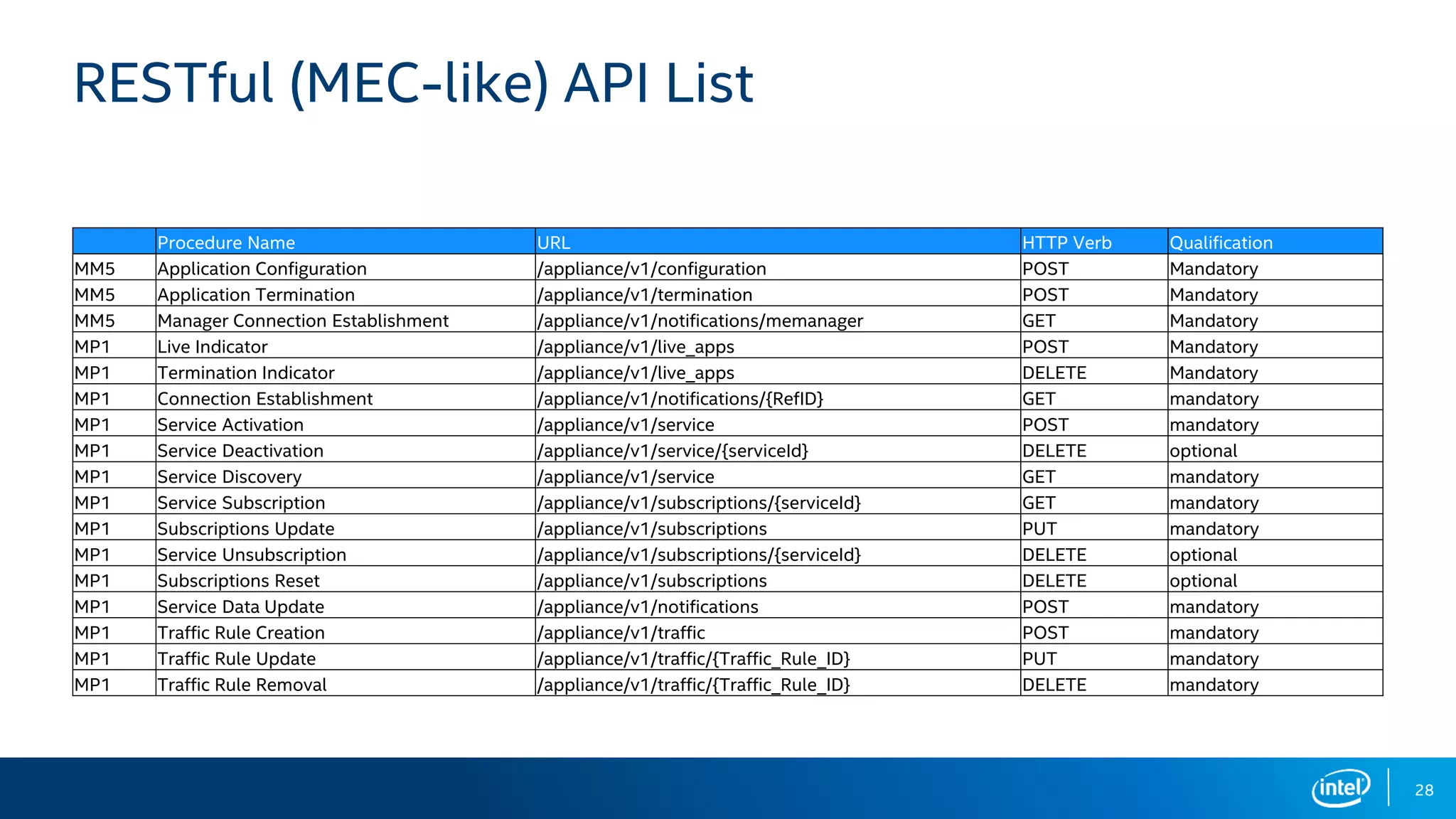
RESTful (MEC-like) API List
28
Procedure Name URL HTTP Verb Qualification
MM5 Application Configuration /appliance/v1/configuration POST Mandatory
MM5 Application Termination /appliance/v1/termination POST Mandatory
MM5 Manager Connection Establishment /appliance/v1/notifications/memanager GET Mandatory
MP1 Live Indicator /appliance/v1/live_apps POST Mandatory
MP1 Termination Indicator /appliance/v1/live_apps DELETE Mandatory
MP1 Connection Establishment /appliance/v1/notifications/{RefID} GET mandatory
MP1 Service Activation /appliance/v1/service POST mandatory
MP1 Service Deactivation /appliance/v1/service/{serviceId} DELETE optional
MP1 Service Discovery /appliance/v1/service GET mandatory
MP1 Service Subscription /appliance/v1/subscriptions/{serviceId} GET mandatory
MP1 Subscriptions Update /appliance/v1/subscriptions PUT mandatory
MP1 Service Unsubscription /appliance/v1/subscriptions/{serviceId} DELETE optional
MP1 Subscriptions Reset /appliance/v1/subscriptions DELETE optional
MP1 Service Data Update /appliance/v1/notifications POST mandatory
MP1 Traffic Rule Creation /appliance/v1/traffic POST mandatory
MP1 Traffic Rule Update /appliance/v1/traffic/{Traffic_Rule_ID} PUT mandatory
MP1 Traffic Rule Removal /appliance/v1/traffic/{Traffic_Rule_ID} DELETE mandatory
30
Getting Access to Intel NEV-SDK
• 3 Step process
1. Request access here:
https://networkbuilders.intel.com/network-technologies/nev
(If already a member@networkbuilders add via “Quick Links”)
2. Respond to following Intel questions (via email):
i. Project scope (success criterion and timelines/commitments)
ii. Which hardware (CPU/NIC)
iii. Lab location (GEO account team/support coordination)
iv. Context (engagements, contribute to Intel collateral, support requirement)
3. Accept licence to download from Intel portal
32
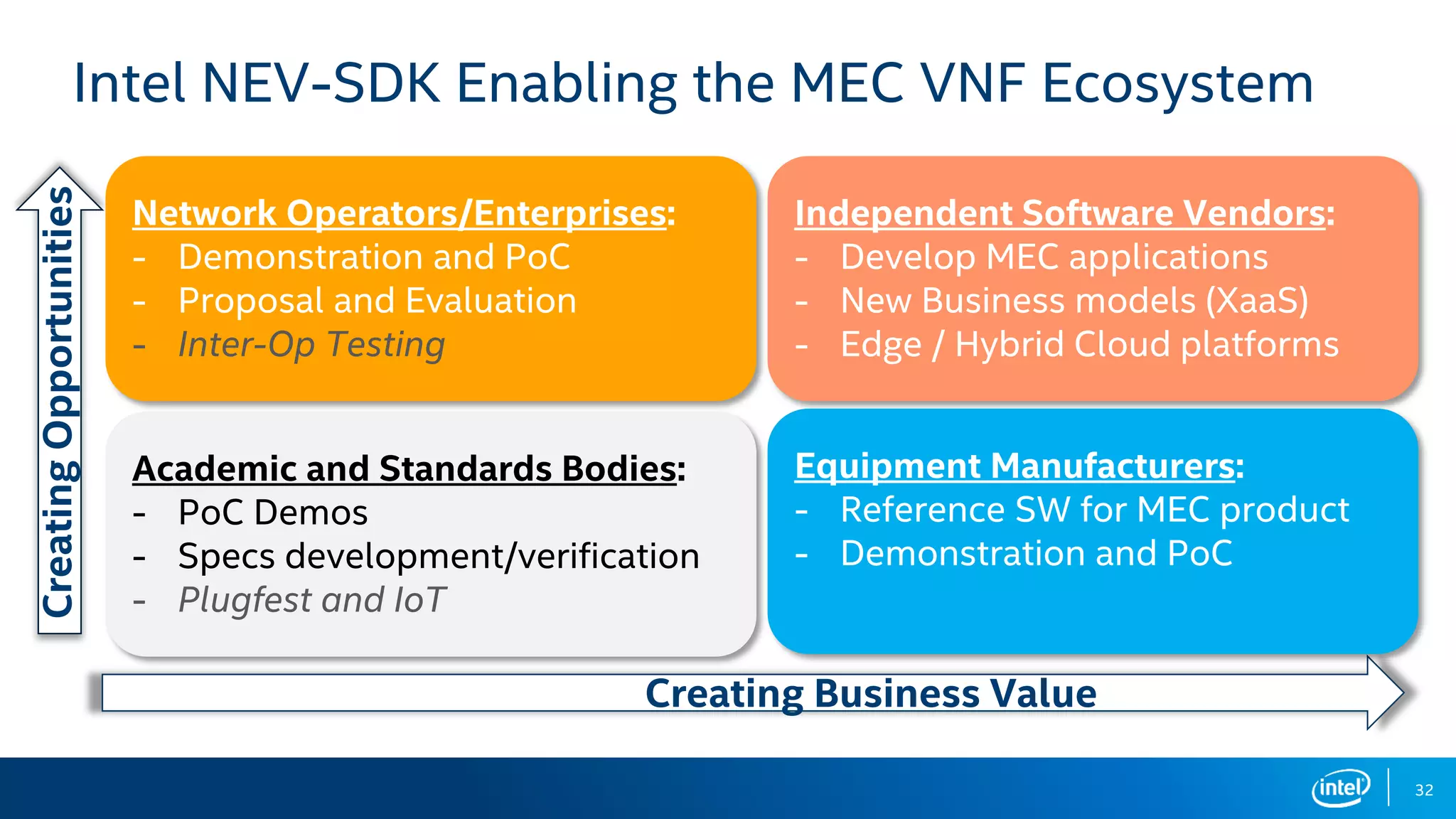
Intel NEV-SDK Enabling the MEC VNF Ecosystem
Network Operators/Enterprises:
- Demonstration and PoC
- Proposal and Evaluation
- Inter-Op Testing
Academic and Standards Bodies:
- PoC Demos
- Specs development/verification
- Plugfest and IoT
Independent Software Vendors:
- Develop MEC applications
- New Business models (XaaS)
- Edge / Hybrid Cloud platforms
Equipment Manufacturers:
- Reference SW for MEC product
- Demonstration and PoC
Creating Business Value
CreatingOpportunities
5G Multi-Access Edge Compute

5G Multi-Access Edge Compute

  • 1.
  • 2.
    Network Platforms Group LegalNotices/disclaimer Inteltechnologies’ features and benefits depend on system configuration and may require enabled hardware, software or service activation. Learn more at intel.com, or from the OEM or retailer. No computer system can be absolutely secure. Software and workloads used in performance tests may have been optimized for performance only on Intel microprocessors. Performance tests, such as SYSmark and MobileMark, are measured using specific computer systems, components, software, operations and functions. Any change to any of those factors may cause the results to vary. You should consult other information and performance tests to assist you in fully evaluating your contemplated purchases, including the performance of that product when combined with other products. For more complete information visit http://www.intel.com/performance. Tests document performance of components on a particular test, in specific systems. Differences in hardware, software, or configuration will affect actual performance. Consult other sources of information to evaluate performance as you consider your purchase. For more complete information about performance and benchmark results, visit http://www.intel.com/performance. Cost reduction scenarios described are intended as examples of how a given Intel- based product, in the specified circumstances and configurations, may affect future costs and provide cost savings. Circumstances will vary. Intel does not guarantee any costs or cost reduction. Results have been estimated or simulated using internal Intel analysis or architecture simulation or modeling, and provided to you for informational purposes. Any differences in your system hardware, software or configuration may affect your actual performance. Intel does not control or audit third-party benchmark data or the web sites referenced in this document. You should visit the referenced web site and confirm whether referenced data are accurate. Intel, the Intel logo and others are trademarks of Intel Corporation in the U.S. and/or other countries. *Other names and brands may be claimed as the property of others. © 2016 Intel Corporation. 2
  • 3.
    Intel Confidential –Internal Only 5Gextendsthecloudtothemulti-accessedge 3 Wireless Connectivity X86 Compute Storage Smart Wireless Smart City Connected Car Gaming Healthcare Caching Positioning Virtual Taps …
  • 5.
  • 6.
    DATACENTERATTHETELCOEDGE Implementation • Distributed networkof data centers in the last mile (i.e at the base of telecom towers, in Cloud Radio Network Sites, fiber…) Benefits • User Experience Impact • Real Estate provides locations/reduced latency • 5G => capacity, new spectrums/frequencies, lower latency • Network Slicing to favor content, specific bandwidths, thruput • Real time workload decisions based on actual latency and radio frequency congestion • Secured gateway for operator and enterprises (1st stop into the network) Mapping workloads for edge computing Round trip communication only (sub) use-cases – automated driving, IoT, gaming interactions Latency = <5 ms Latency = <10ms Round trip computation for use cases – AR, IoT (Smart grids), Medical apps, FaaS Latency = <40ms Round trip computation + storage for use cases – AR (relaxed), IoT (non-stringent), Video analytics, FaaS (latency non-bound), caching and accelerated browsing Clients Cloud / OTT + Flexibility / +Capacity / + Latency / - Locality Wireless Local CO Regional CO - Flexibility / -Capacity / - Latency / + Locality CORE Latency Fiber Cable Last mile/ access
  • 7.
    Core Cloud/DATACENTER CENTRAL OFFICES REGIONAL CENTRAL OFFICES& DATA CENTERS MACRO CELLS WIRELINE CARRIER WIFI SMALL CELLS LICENSED & UNLICENSED Network EdgeFog ACCESS/EDGE WhereistheEdge? CSP’s view of Edge CoSP’s view of Edge Enterprises view of Edge Devices/things HOME ENTERPRISE/FACTORIES Edge Computing ON-PREMISE EQUIPMENT WIRELESS Intel Confidential – Internal Use Only
  • 8.
    8BMG | INTELCONFIDENTIAL, FOR INTERNAL USE ONLY Key Drivers for Edge Compute  Low latency that can not be achieved by using centralized cloud  Reduction of movement of the massive amount data generated by IOT devices to reduce cost and enable efficient use of resource  Data Privacy and Data Sovereignty  Context Awareness  Scenarios where connectivity is unreliable or limited BMG | INTEL CONFIDENTIAL, FOR INTERNAL USE ONLY
  • 9.
    Network Platforms Group NPG5GINFRASTRUCTUREBUILDINGBLOCKS ACCESSEdge&CORE NFV/SDN Cloud Ready Networks Scalability&flexibilityfornetworkingworkloads CapabilityENABLERS VNFs NFVi MANO IA Linux KVM Optimized Ingredients Network Slicing • 5GNR RAT @ 28GHz, 39Ghz and 3.5 GHz • MIMO • Custom Si for Baseband and Radio • FlexRAN Reference Software • vCCAP (Cable) Reference Software Intel® Xeon® Processor Intel® Ethernet Controller Altera® FPGA Intel® 3D XPoint Intel® QuickAssist Intel® Quick Sync Video Intel® AtomTM Processor Intel® Resource Director • FlexCore Reference Software • MEC Source Libraries • Network Edge Virtualization SDK for developers • Next Generation CO Reference Architecture • RSD • Ciphering libraries • CPRI over Ethernet FPGA Reference • Transport Interworking software • Visual Cloud (VCD) Libraries Intel® CORE® Processor
  • 11.
    MEC System ReferenceArchitecture 11 MobileEdge SystemLevelMobileEdgeServerLevel Mobile edge platform Mobile edge Host Virtualization Infrastructure Data plane UE app VIM Other mobile edge platform Mobile edge platform element mgmt Mobile edge application orchestrator Mm3 Mm1 Mx2 Mm8 Mm9 Mp2 Mp1 ME app ME app Service Mm2 Mm5 Filtering rules control ME service Service registry DNS handling ME platform element mgmt CFS portal Mx1 Mp3 Other mobile edge Host ME app rules & reqts mgmt ME app lifecycle mgmt Mm7 User app LCM proxy Operations Support System Mm4 Mm6 Reference Point names: Mp: ME platform functionality Mm: management Mx: connections to external entities Reference: ETSI ISG MEC GS MEC-003 “Framework and Reference Architecture” remote app
  • 12.
    MEC Opportunities 12 MobileEdge SystemLevelMobileEdgeServerLevel Mobile edgeplatform Mobile edge Host Virtualization Infrastructure Data plane UE app VIM Other mobile edge platform Mobile edge platform element mgmt Mobile edge application orchestrator Mm3 Mm1 Mx2 Mm8 Mm9 Mp2 Mp1 ME app ME app Service Mm2 Mm5 Filtering rules control ME service Service registry DNS handling ME platform element mgmt CFS portal Mx1 Mp3 Other mobile edge Host ME app rules & reqts mgmt ME app lifecycle mgmt Mm7 User app LCM proxy Operations Support System Mm4 Mm6 Application Developers with UX Skills Virtualization and platform SW skills (Hypervisor, Container Virtualization) Orchestration and Operations Management Skills MEC utilizes the NFV infrastructure; opportunities for adjacent VNF providers AdjacentVNFs AdjacentVNFs
  • 13.
    13 3GPP View: MECin 4G SGi Interface S1 Interface SGieNodeB MEC Platform S/P-GWS1-AP Internet SGiS1APS1 SGieNodeB MEC Platform S/P-GWS1-AP S1-AP Internet S1 S1
  • 14.
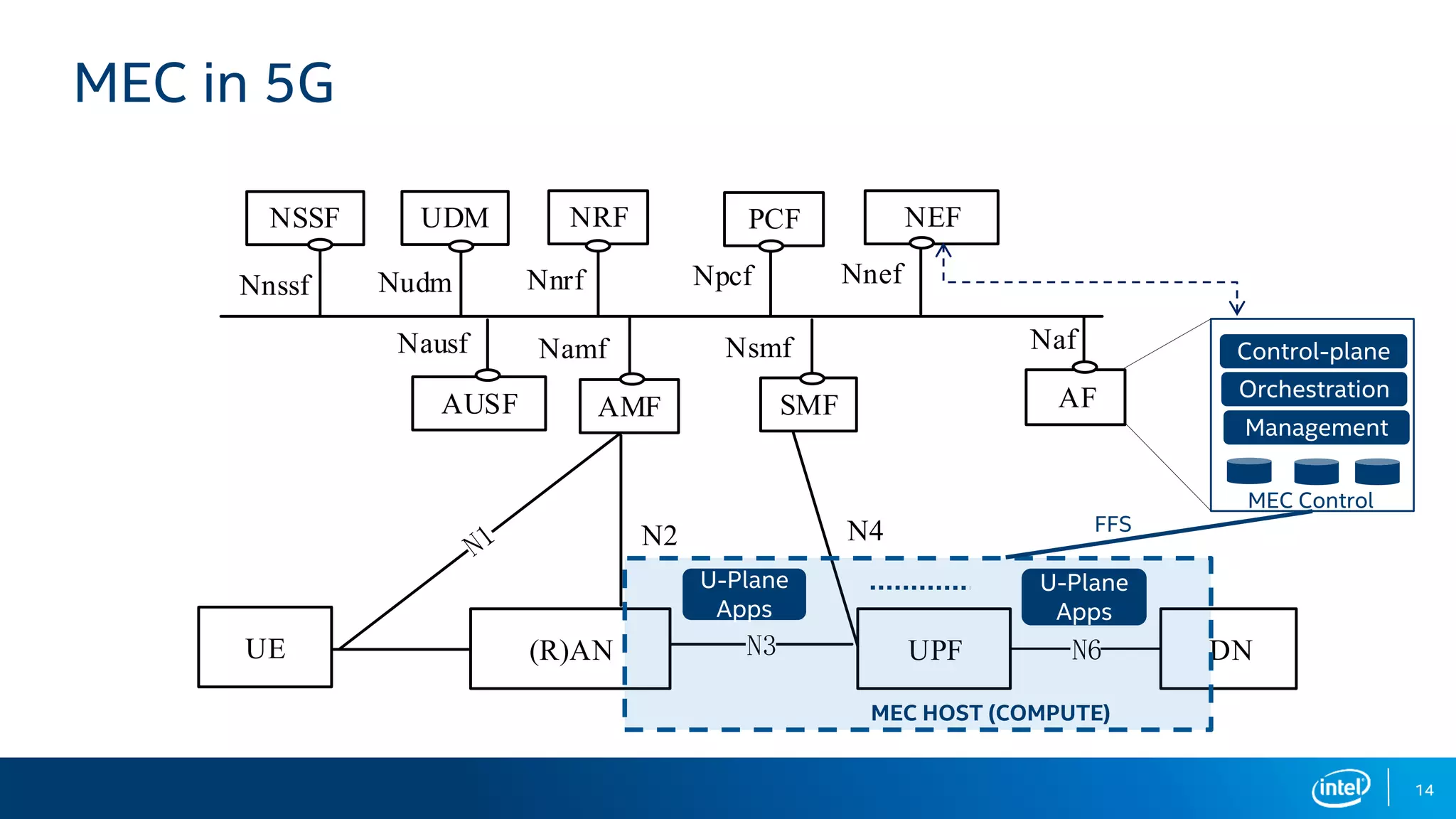
    UE (R)AN UPF AFAMFSMF PCF NEF DNN6 NRFUDM N3 N2 N4 AUSF Nausf Namf Nsmf NpcfNnrfNudm Nnef Naf NSSF Nnssf MEC in 5G 14 MEC HOST (COMPUTE) Control-plane Orchestration MEC Control U-Plane Apps U-Plane Apps FFS Management
  • 15.
    APIs: REST-HTTP style+ Data model + JSON[&XML] formats + Message Bus Hooks Richardson maturity model level 2..3 ETSI-defined Mobile Edge Services ME Application Development © ETSI 2016. All rights reserved 15 Mobile edge platform / Mp1 ME app 1 ME app 2 ME app 3 MEC012 Radio Network Information API MEC013 Location API MEC014 UE Identity API MEC015 Bandwidth Manager API MEC011 App Enablement MEC009APIPrinciples ME app n Service MEC0nn Developer community MEC0nn = ETSI MEC API specification API0nn = Third party ME service API specification …ME app 4 Service APInnn Platform APIs
  • 16.
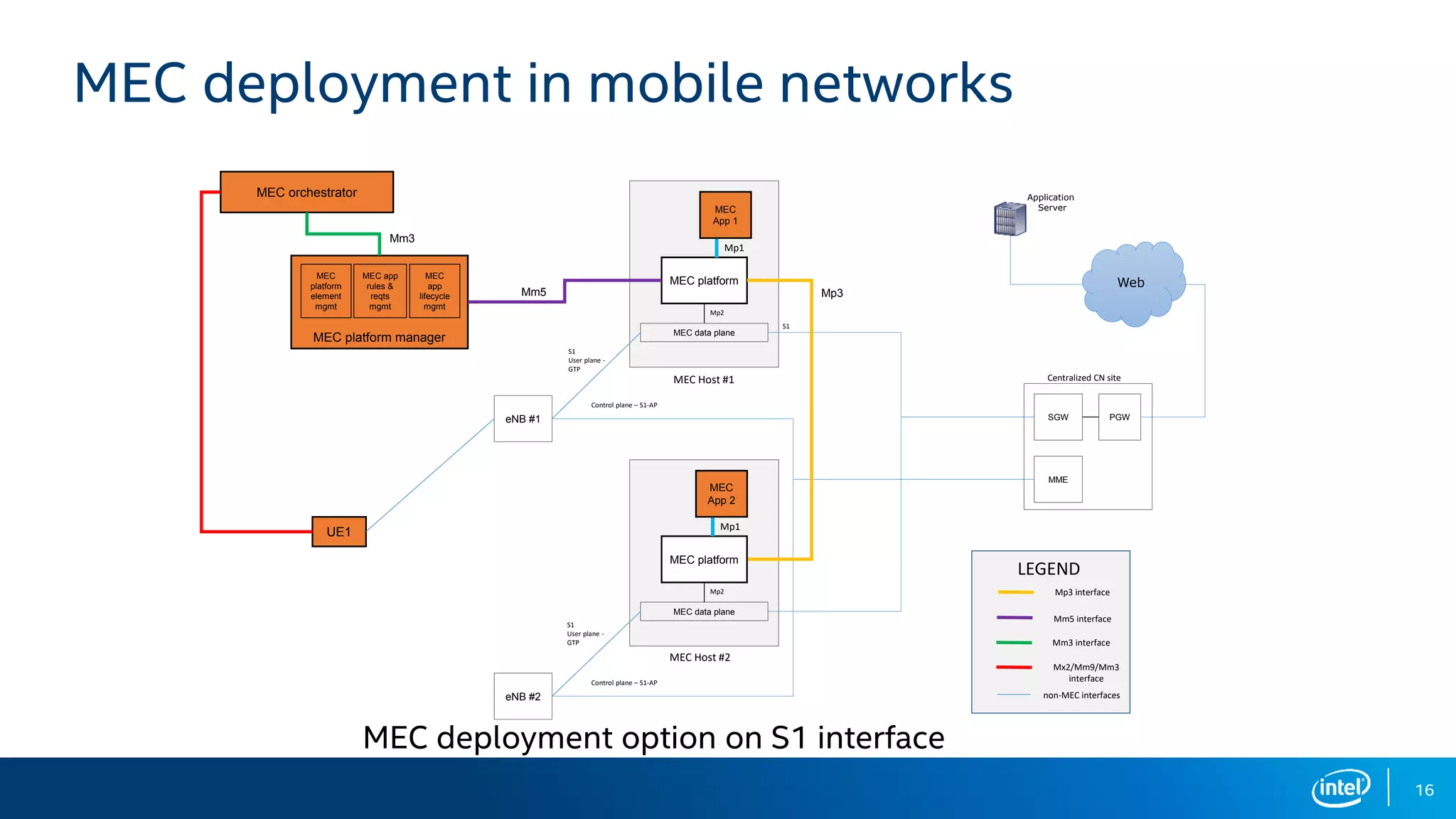
    MEC deployment inmobile networks 16 MEC deployment option on S1 interface MEC data plane eNB #1 UE1 MEC App 1 S1 MEC platform Mp2 Mp1 S1 User plane - GTP Control plane – S1-AP SGW PGW MME MEC Host #1 Centralized CN site MEC data plane eNB #2 MEC platform Mp2 S1 User plane - GTP Control plane – S1-AP MEC Host #2 MEC orchestrator Mm3 MEC platform manager MEC platform element mgmt MEC app rules & reqts mgmt MEC app lifecycle mgmt Mp3Mm5 Application Server Web Mp3 interface Mm5 interface Mm3 interface LEGEND Mx2/Mm9/Mm3 interface non-MEC interfaces MEC App 2 Mp1
  • 18.
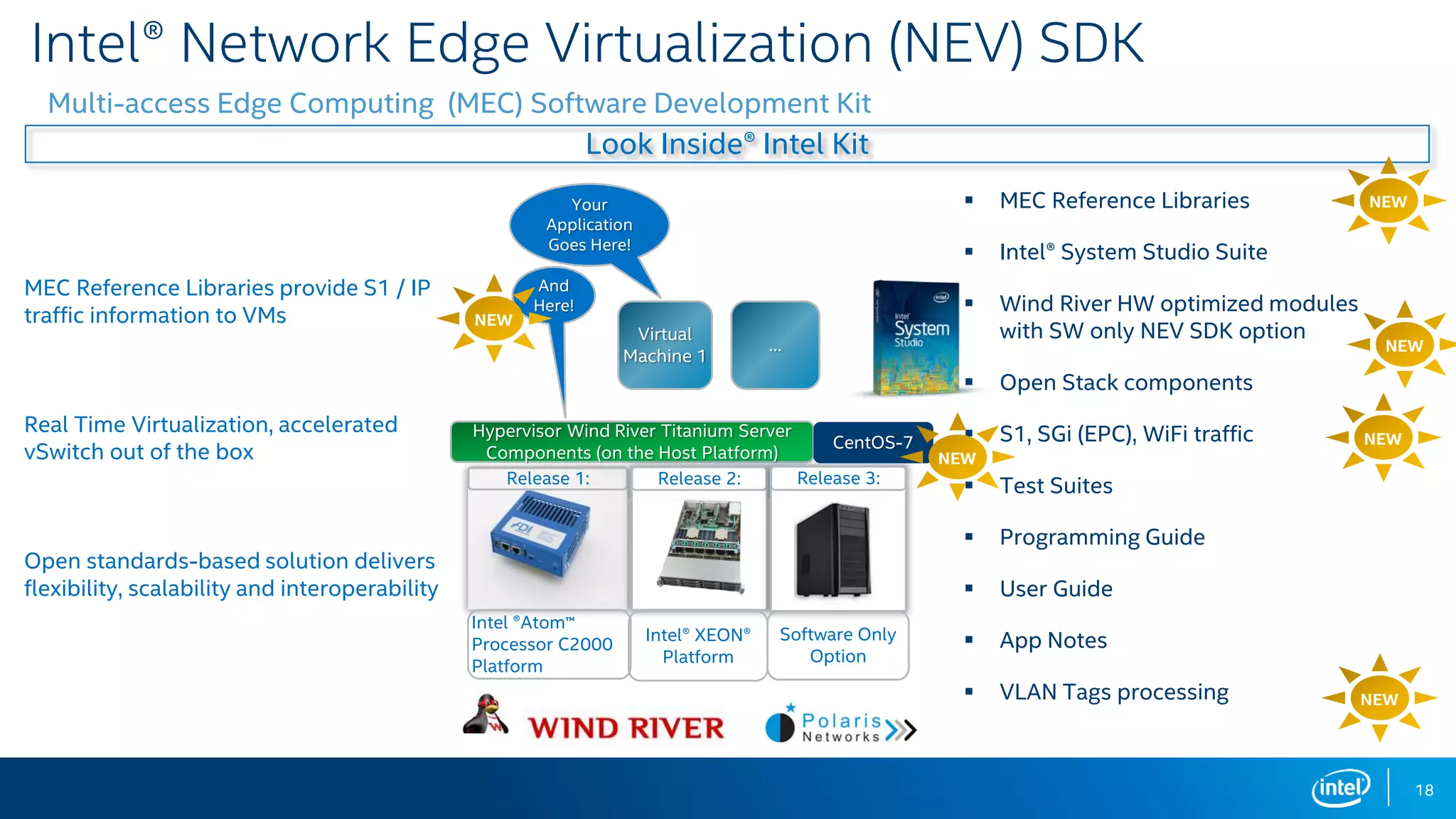
    18 Intel® Network EdgeVirtualization (NEV) SDK Multi-access Edge Computing (MEC) Software Development Kit  MEC Reference Libraries  Intel® System Studio Suite  Wind River HW optimized modules with SW only NEV SDK option  Open Stack components  S1, SGi (EPC), WiFi traffic  Test Suites  Programming Guide  User Guide  App Notes  VLAN Tags processing MEC Reference Libraries provide S1 / IP traffic information to VMs Real Time Virtualization, accelerated vSwitch out of the box Open standards-based solution delivers flexibility, scalability and interoperability Look Inside® Intel Kit Release 1: Hypervisor Wind River Titanium Server Components (on the Host Platform) Virtual Machine 1 … Release 2: Your Application Goes Here! Release 3: CentOS-7 NEW NEW NEW NEW NEW Intel ®Atom™ Processor C2000 Platform Intel® XEON® Platform Software Only Option And Here! NEW
  • 19.
    Intel Confidential Intel® NEV-SDK& Mobile Edge Computing Edge Computing is key technology for 5G which will address low latency and high throughput requirements in 5G Networks. It provides a platform for deploying intelligent applications at the edge of the network. NEV SDK is a key enabler to this transformation, by providing an easy to use MEC reference platform focused on application development. Intel® NEV-SDK Release 3.0 The NEV SDK enables ISVs develop platform services on a feature rich MEC ready sandbox. This enables TEMs & Operators alike trial and model the advantages of MEC deployment using Intel’s MEC reference platform. Release 3.0 of the NEV SDK comes loaded with following new features; • Software only version • S1, SGi(EPC) and WiFi Traffic deployment Support • GTP-U based on IPv4 / IPv4 / VLAN tagged IPv4 / VLAN tagged GTP-u • Reference MEC Manager and MM5 API support • Reference Service registry and Policy Support • Out of the box support for 4 Types of MEC Apps services • Logical Port abstraction and Driver (DPDK) Abstraction For more information please visit: https://networkbuilders.intel.com/network-technologies/nev Copyright © 2017 Intel Corporation. Legal Notices. Other names and brands may be claimed as the property of others. The contents of this newsletter are for internal use only. MEC reference platform Data Plane Development Kit Network Information Services Network Traffic Services Wind River* Titanium Server Advanced vSwitch VM MEC-like API Mobile Edge Application VM MEC-like API Mobile Edge Application MEC server Polaris EPC emulator Polaris LTE eNB emulator NEV SDK 3.0… ……A LOOK INSIDE MEC Restful API DNS Cache
  • 20.
  • 21.
    21 NEV-SDK v3.0 BundleOptions Hardware Optimized NEV-SDK Software only NEV-SDK
  • 22.
    22 NEV SDK SoftwareStack Wind River Titanium Server with Accelerated Virtual Switch (AVS) (Control Node and Compute Node) CentOS Release 7.3.1611 (base environment) Development and Creative Workstation Development Tools Hardware Monitor Virtualization Hypervisor DPDK 16.07.2 Qemu 1.7.0 Redis 3.0.6+ Development libraries: Hiredis, Boost, JSON C++, OpenSSL, FastCGI) Qemu 2.7.1 Nginx 1.9.9+ Nginx 1.10.3+Redis 3.2.8+NEV SDK 3.0.0 AVP 1.1.0 KLM DPDK 16.07.2 NEV SDK 3.0.0 Additional tools (tcl, expect, Python 2.7.3 and libraries, HTTPLIB2, websocket-client, lperf3) Additional tools (tcl, expect, Python 2.7.3 and libraries, HTTPLIB2, websocket-client, lperf3) accelerated virtual port (AVP) corresponding to AVS DPDK 1.7.1 (VM acceleration for AVS acceleration in VMs Sample MEC Manager Emulator Sample MEC Manager Emulator Wind River Titanium OpenStack Shipped without virtualization environment, developers may integrate (e.g., Community OpenStack) HW Optimized WR Titanium 3.0 Bundle CentOS 7 (SW only) Bundle
  • 23.
    Network Edge Services(NES) REST API Services Registry Platform services Network Traffic Services (NTS) 23 Data Traffic Configurations Virtualization Management Accelerated vSwtich/ OVS VM NES API MEC Apps VM NES API MEC Apps Multi-Access Edge Computing (MEC) SDK Windriver OVP(TIS)/CentOS 7.2 – RT Kernel Data Plane Development Kit (DPDK) Hardware abstraction – Logical ports ETSI MEC Mp1 Intel® Xeon™ Platform IP Traffic S1 Traffic S1 Traffic vENB vEPC Internet IP TrafficIP Traffic S1 Traffic vENB Internet Distributed vSGW/vPGW vEPC vMME, vHSS Access Point IP Traffic IP Traffic InternetWiFi Gateway Local Breakout IP Traffic/ S1 Traffic Control Node Windriver Openstack Mobile Edge platform Manager ETSI MEC Mm5 L2 (vlan) IP UDP GTP-U L2 (vlan) IP
  • 24.
    4 Types ofME Producer Applications ME SERVICES 1. TYPE 1. Host-borne. Platform generates service data, stores service data on the ME Platform, and provides them as Platform-Specific Services. 2. TYPE 2. VM-borne. ME App Service generates and stores service data but publishes it through the ME Platform; the ME Platform validates the format of published service data. 3. TYPE 3. VM-borne. ME App Service generates and stores service data; ME App establishes service subscription with ME App Service directly. 4. TYPE 4. VM-borne. ME App Service generates service data but stores data on the ME Platform, and provides them also as Platform-Specific Services like ME SERVICE TYPE 1.
  • 25.
    25 Edge Cloud ReferenceArchitecture Intel® Architecture Ingredients Xeon-Server QATNetworking FPGA/accelerators VIM OpenStack vRAN L2 L1 L3 vEdge Core vSGW /PGW vSeG W WiFi VNF Managers (Service Orchestration) VNFMs Orchestrators 3rd party Domain Orchestrators Wireline vOLT vFixed Edge vCPE vBNG Hosted Service s MNO1 Edge Azure Stack Green Grass Non- MEC Apps APPS 1 APPS 2 Core PG W SG W Mobile Edge platform Manager Interface through Local Breakout(LBP) Interface through LBP/Internet Interface through EPC Port ETSI MEC mm5 Mobile Edge Compute Node(s) MEC Connected Cloud and Network Nodes Telco Edge Cloud Orchestration and Management Uplink Traffic Source
  • 26.
  • 27.
    RESTful (MEC-like) APIOverview R3.0 provides an updated MP1 API over the previous release, based on API definition provided by Applied Computer Solutions, in addition to the inclusion of a new MM5 API. • MP1 for communication between ME App and ME Platform. R3.0, for the most part, implements ME App lifecycle management. • MM5 for communication between ME Manager and ME Platform. ME PlatformME Manager ME App/ ME App service MM5 MP1 NOTE: More detailed API definition and use may be found in NEV_SDK_API_Programmer_Guide
  • 28.
    RESTful (MEC-like) APIList 28 Procedure Name URL HTTP Verb Qualification MM5 Application Configuration /appliance/v1/configuration POST Mandatory MM5 Application Termination /appliance/v1/termination POST Mandatory MM5 Manager Connection Establishment /appliance/v1/notifications/memanager GET Mandatory MP1 Live Indicator /appliance/v1/live_apps POST Mandatory MP1 Termination Indicator /appliance/v1/live_apps DELETE Mandatory MP1 Connection Establishment /appliance/v1/notifications/{RefID} GET mandatory MP1 Service Activation /appliance/v1/service POST mandatory MP1 Service Deactivation /appliance/v1/service/{serviceId} DELETE optional MP1 Service Discovery /appliance/v1/service GET mandatory MP1 Service Subscription /appliance/v1/subscriptions/{serviceId} GET mandatory MP1 Subscriptions Update /appliance/v1/subscriptions PUT mandatory MP1 Service Unsubscription /appliance/v1/subscriptions/{serviceId} DELETE optional MP1 Subscriptions Reset /appliance/v1/subscriptions DELETE optional MP1 Service Data Update /appliance/v1/notifications POST mandatory MP1 Traffic Rule Creation /appliance/v1/traffic POST mandatory MP1 Traffic Rule Update /appliance/v1/traffic/{Traffic_Rule_ID} PUT mandatory MP1 Traffic Rule Removal /appliance/v1/traffic/{Traffic_Rule_ID} DELETE mandatory
  • 30.
    30 Getting Access toIntel NEV-SDK • 3 Step process 1. Request access here: https://networkbuilders.intel.com/network-technologies/nev (If already a member@networkbuilders add via “Quick Links”) 2. Respond to following Intel questions (via email): i. Project scope (success criterion and timelines/commitments) ii. Which hardware (CPU/NIC) iii. Lab location (GEO account team/support coordination) iv. Context (engagements, contribute to Intel collateral, support requirement) 3. Accept licence to download from Intel portal
  • 32.
    32 Intel NEV-SDK Enablingthe MEC VNF Ecosystem Network Operators/Enterprises: - Demonstration and PoC - Proposal and Evaluation - Inter-Op Testing Academic and Standards Bodies: - PoC Demos - Specs development/verification - Plugfest and IoT Independent Software Vendors: - Develop MEC applications - New Business models (XaaS) - Edge / Hybrid Cloud platforms Equipment Manufacturers: - Reference SW for MEC product - Demonstration and PoC Creating Business Value CreatingOpportunities