PHYSIOLOGY BEHIND WATER USE EFFICIENCY
IN PLANTS
UJJWAL KUMAR
(M-PLPH-00741-BAC-2020-21)
Department of Plant Physiology and Biochemistry
Bihar Agricultural University
Sabour-81320, Bihar
Contents
Introduction
Importance in agriculture
Plant parts that influence WUE
Factors influencing WUE
Case Study – 01 (Physiological mechanism contributing to the increased
water-use efficiency in winter wheat under deficit irrigation.)
Case Study – 02 (Water use and water use efficiency of chick pea and
lentil in a Mediterranean environment.)
Conclusion
Future scope of research
Introduction
 Water use efficiency (WUE) is a concept introduced by Briggs and Shantz
(1913), depicting a relationship between plant productivity and water use.
 Efficiency means output of any substance or any material per unit input.
WUE can be described in the following two ways
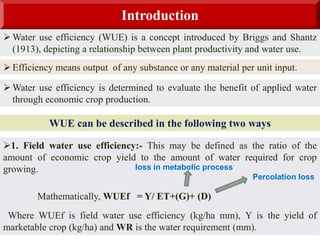
1. Field water use efficiency:- This may be defined as the ratio of the
amount of economic crop yield to the amount of water required for crop
growing.
Mathematically, WUEf = Y/ ET+(G)+ (D)
Where WUEf is field water use efficiency (kg/ha mm), Y is the yield of
marketable crop (kg/ha) and WR is the water requirement (mm).
 Water use efficiency is determined to evaluate the benefit of applied water
through economic crop production.
Percolation loss
loss in metabolic process
Contd….
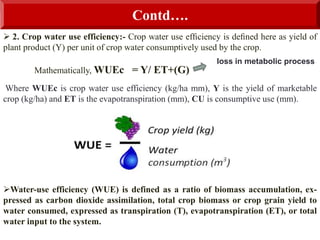
 2. Crop water use efficiency:- Crop water use efficiency is defined here as yield of
plant product (Y) per unit of crop water consumptively used by the crop.
Mathematically, WUEc = Y/ ET+(G)
Where WUEc is crop water use efficiency (kg/ha mm), Y is the yield of marketable
crop (kg/ha) and ET is the evapotranspiration (mm), CU is consumptive use (mm).
Water-use efficiency (WUE) is defined as a ratio of biomass accumulation, ex-
pressed as carbon dioxide assimilation, total crop biomass or crop grain yield to
water consumed, expressed as transpiration (T), evapotranspiration (ET), or total
water input to the system.
loss in metabolic process
The imbalance between rising food demand and insufficient
water supply for agriculture is a global issue.
The continuous growth of the world population poses a great
threat to global food supply and water security.
FAO has warned that global food production has to be
increased by 70% by 2050 to ensure food security while
increasing food production requires more agricultural water
use.
Water security is the foundation of food security, as water
shortage will directly lead to fluctuation of food production.
Importance in agriculture
Contd..
 It is possible to increase WUE in a field without increasing water
supply by altering the mechanisms that control WUE in plants
 Thus, improving plant water use efficiency (WUE) has become a
major goal for the near future.
 To save water for future generations and increase crop production by
using less water, water-use efficient crops/varieties are needed along
with integrated management techniques.
 The major objective of any agriculture-based research should be
maximum production per drop of water applied.
Agriculture is the major water consumption sector, accounting for
more than 70% of total water use worldwide. It is unsustainable to
increase food production simply by expanding agricultural water use,
hence saving water in agriculture becomes a necessary part of the
solution.
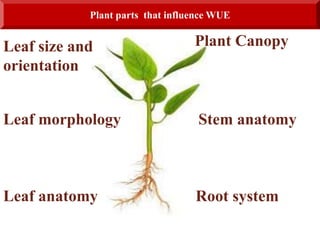
Plant parts that influence WUE
Leaf size and
orientation
Leaf morphology
Leaf anatomy
Plant Canopy
Stem anatomy
Root system
Canopy Size
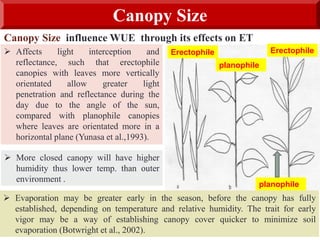
Canopy Size influence WUE through its effects on ET
 Affects light interception and
reflectance, such that erectophile
canopies with leaves more vertically
orientated allow greater light
penetration and reflectance during the
day due to the angle of the sun,
compared with planophile canopies
where leaves are orientated more in a
horizontal plane (Yunasa et al.,1993).
 More closed canopy will have higher
humidity thus lower temp. than outer
environment .
 Evaporation may be greater early in the season, before the canopy has fully
established, depending on temperature and relative humidity. The trait for early
vigor may be a way of establishing canopy cover quicker to minimize soil
evaporation (Botwright et al., 2002).
Erectophile
planophile
Erectophile
planophile
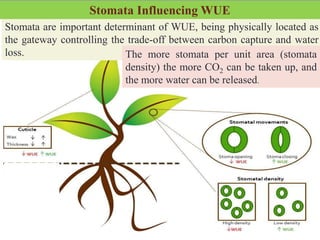
Stomata are important determinant of WUE, being physically located as
the gateway controlling the trade-off between carbon capture and water
loss. The more stomata per unit area (stomata
density) the more CO2 can be taken up, and
the more water can be released.
Stomata Influencing WUE
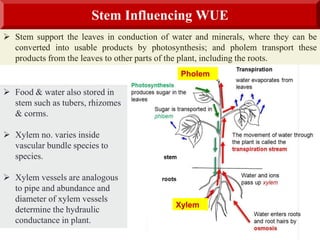
 Stem support the leaves in conduction of water and minerals, where they can be
converted into usable products by photosynthesis; and pholem transport these
products from the leaves to other parts of the plant, including the roots.
Stem Influencing WUE
Xylem
Pholem
 Food & water also stored in
stem such as tubers, rhizomes
& corms.
 Xylem no. varies inside
vascular bundle species to
species.
 Xylem vessels are analogous
to pipe and abundance and
diameter of xylem vessels
determine the hydraulic
conductance in plant.
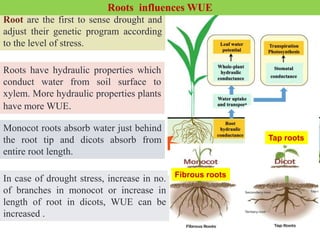
Root are the first to sense drought and
adjust their genetic program according
to the level of stress.
Roots have hydraulic properties which
conduct water from soil surface to
xylem. More hydraulic properties plants
have more WUE.
Monocot roots absorb water just behind
the root tip and dicots absorb from
entire root length.
In case of drought stress, increase in no.
of branches in monocot or increase in
length of root in dicots, WUE can be
increased .
Fibrous roots
Tap roots
Roots influences WUE
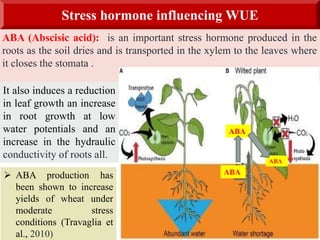
ABA (Abscisic acid): is an important stress hormone produced in the
roots as the soil dries and is transported in the xylem to the leaves where
it closes the stomata .
It also induces a reduction
in leaf growth an increase
in root growth at low
water potentials and an
increase in the hydraulic
conductivity of roots all.
 ABA production has
been shown to increase
yields of wheat under
moderate stress
conditions (Travaglia et
al., 2010)
Stress hormone influencing WUE
ABA
ABA
ABA
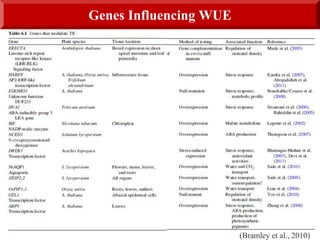
(Bramley et al., 2010)
Genes Influencing WUE
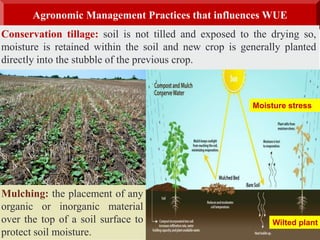
Agronomic Management Practices that influences WUE
Conservation tillage: soil is not tilled and exposed to the drying so,
moisture is retained within the soil and new crop is generally planted
directly into the stubble of the previous crop.
Mulching: the placement of any
organic or inorganic material
over the top of a soil surface to
protect soil moisture.
Moisture stress
Wilted plant
Contd….
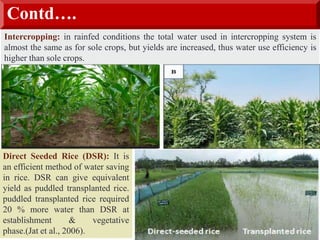
Intercropping: in rainfed conditions the total water used in intercropping system is
almost the same as for sole crops, but yields are increased, thus water use efficiency is
higher than sole crops.
Direct Seeded Rice (DSR): It is
an efficient method of water saving
in rice. DSR can give equivalent
yield as puddled transplanted rice.
puddled transplanted rice required
20 % more water than DSR at
establishment & vegetative
phase.(Jat et al., 2006).
Contd….
 Weed control: the water and nutrient requirement of weeds is greater
than that of crop plants.
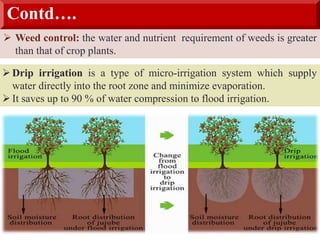
Drip irrigation is a type of micro-irrigation system which supply
water directly into the root zone and minimize evaporation.
It saves up to 90 % of water compression to flood irrigation.
Contd.
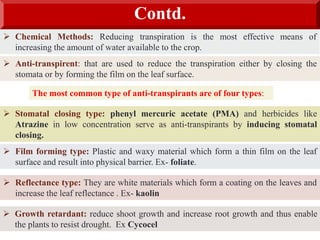
 Chemical Methods: Reducing transpiration is the most effective means of
increasing the amount of water available to the crop.
 Anti-transpirent: that are used to reduce the transpiration either by closing the
stomata or by forming the film on the leaf surface.
 Stomatal closing type: phenyl mercuric acetate (PMA) and herbicides like
Atrazine in low concentration serve as anti-transpirants by inducing stomatal
closing.
 Film forming type: Plastic and waxy material which form a thin film on the leaf
surface and result into physical barrier. Ex- foliate.
 Reflectance type: They are white materials which form a coating on the leaves and
increase the leaf reflectance . Ex- kaolin
 Growth retardant: reduce shoot growth and increase root growth and thus enable
the plants to resist drought. Ex Cycocel
The most common type of anti-transpirants are of four types:
Contd….
Crop
Water
requirement
(mm)
Grain Yield
(kg/ha.)
WUE (kg/ha.-
mm)
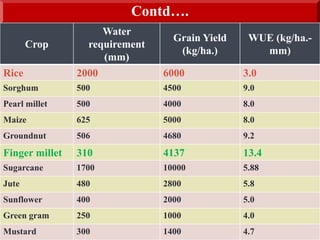
Rice 2000 6000 3.0
Sorghum 500 4500 9.0
Pearl millet 500 4000 8.0
Maize 625 5000 8.0
Groundnut 506 4680 9.2
Finger millet 310 4137 13.4
Sugarcane 1700 10000 5.88
Jute 480 2800 5.8
Sunflower 400 2000 5.0
Green gram 250 1000 4.0
Mustard 300 1400 4.7
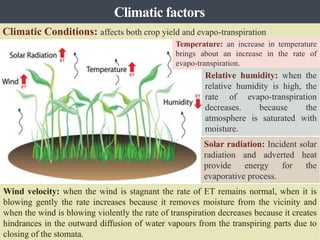
Climatic Conditions: affects both crop yield and evapo-transpiration
Temperature: an increase in temperature
brings about an increase in the rate of
evapo-transpiration.
Relative humidity: when the
relative humidity is high, the
rate of evapo-transpiration
decreases. because the
atmosphere is saturated with
moisture.
Solar radiation: Incident solar
radiation and adverted heat
provide energy for the
evaporative process.
Wind velocity: when the wind is stagnant the rate of ET remains normal, when it is
blowing gently the rate increases because it removes moisture from the vicinity and
when the wind is blowing violently the rate of transpiration decreases because it creates
hindrances in the outward diffusion of water vapours from the transpiring parts due to
closing of the stomata.
Climatic factors
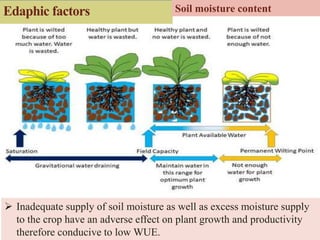
Edaphic factors
 Inadequate supply of soil moisture as well as excess moisture supply
to the crop have an adverse effect on plant growth and productivity
therefore conducive to low WUE.
Soil moisture content
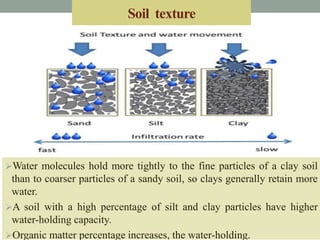
Soil texture
Water molecules hold more tightly to the fine particles of a clay soil
than to coarser particles of a sandy soil, so clays generally retain more
water.
A soil with a high percentage of silt and clay particles have higher
water-holding capacity.
Organic matter percentage increases, the water-holding.
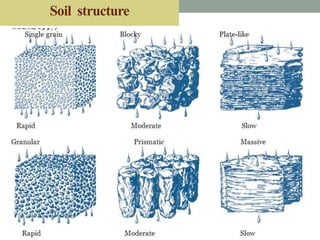
Soil structure
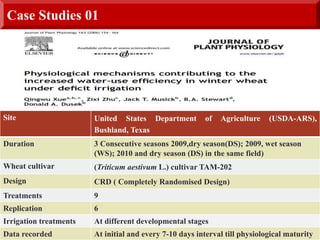
Case Studies 01
Site United States Department of Agriculture (USDA-ARS),
Bushland, Texas
Duration 3 Consecutive seasons 2009,dry season(DS); 2009, wet season
(WS); 2010 and dry season (DS) in the same field)
Wheat cultivar (Triticum aestivum L.) cultivar TAM-202
Design CRD ( Completely Randomised Design)
Treatments 9
Replication 6
Irrigation treatments At different developmental stages
Data recorded At initial and every 7-10 days interval till physiological maturity
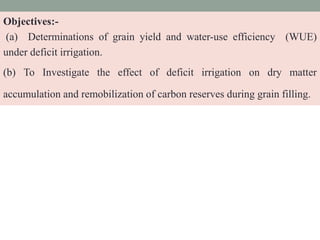
Objectives:-
(a) Determinations of grain yield and water-use efficiency (WUE)
under deficit irrigation.
(b) To Investigate the effect of deficit irrigation on dry matter
accumulation and remobilization of carbon reserves during grain filling.
Contd..
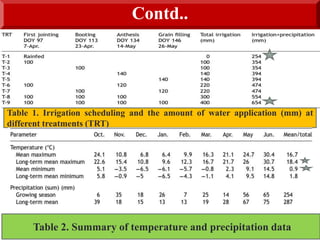
Table 1. Irrigation scheduling and the amount of water application (mm) at
different treatments (TRT)
Table 2. Summary of temperature and precipitation data
Contd..
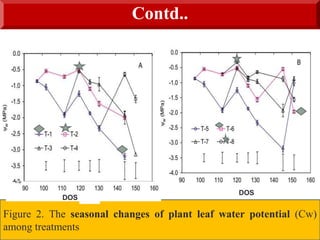
Figure 2. The seasonal changes of plant leaf water potential (Cw)
among treatments
DOS
DOS
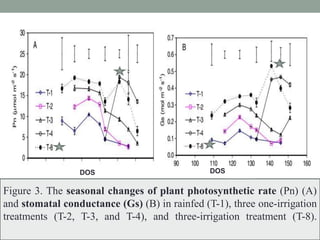
Figure 3. The seasonal changes of plant photosynthetic rate (Pn) (A)
and stomatal conductance (Gs) (B) in rainfed (T-1), three one-irrigation
treatments (T-2, T-3, and T-4), and three-irrigation treatment (T-8).
DOS DOS
Conclusions
It was observed that deficit irrigation significantly increased
grain yield and WUE as compared to rainfed.
The increment in the WUE under deficit irrigation was
contributed by increased HI and resultant was that photosynthesis
and biomass were reduced by water stress during grain filling.
Case Studies 02
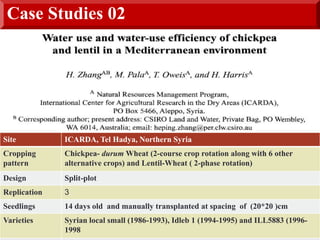
Site ICARDA, Tel Hadya, Northern Syria
Cropping
pattern
Chickpea- durum Wheat (2-course crop rotation along with 6 other
alternative crops) and Lentil-Wheat ( 2-phase rotation)
Design Split-plot
Replication 3
Seedlings 14 days old and manually transplanted at spacing of (20*20 )cm
Varieties Syrian local small (1986-1993), Idleb 1 (1994-1995) and ILL5883 (1996-
1998
Water use by Chickpea and lentil
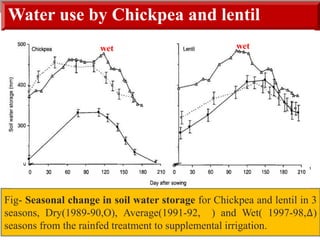
Fig- Seasonal change in soil water storage for Chickpea and lentil in 3
seasons, Dry(1989-90,O), Average(1991-92, ) and Wet( 1997-98,∆)
seasons from the rainfed treatment to supplemental irrigation.
wet wet
Contd…
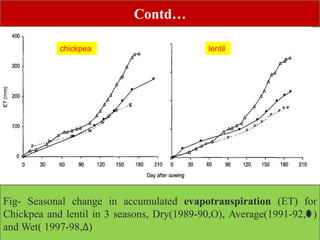
Fig- Seasonal change in accumulated evapotranspiration (ET) for
Chickpea and lentil in 3 seasons, Dry(1989-90,O), Average(1991-92, )
and Wet( 1997-98,∆)
chickpea lentil
Contd…
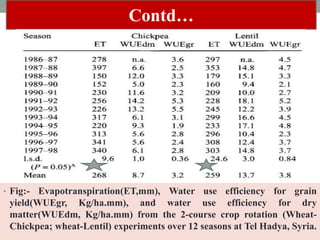
• Fig:- Evapotranspiration(ET,mm), Water use efficiency for grain
yield(WUEgr, Kg/ha.mm), and water use efficiency for dry
matter(WUEdm, Kg/ha.mm) from the 2-course crop rotation (Wheat-
Chickpea; wheat-Lentil) experiments over 12 seasons at Tel Hadya, Syria.
Conclusion
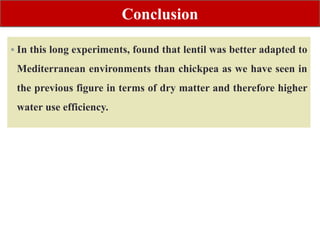
 In this long experiments, found that lentil was better adapted to
Mediterranean environments than chickpea as we have seen in
the previous figure in terms of dry matter and therefore higher
water use efficiency.
Conclusion
 The strategy is expected to save water, improve quality, and
increase efficiency, and be the approach for achieving
modern sustainable water-saving agriculture in the future.
 Water-efficient genotypes can be tailored based on well-
suited canopy size and orientation, leaf morphology,
orientation and anatomy, and root architecture to improve
WUE.
Future Scope of Research
 To identify crops’ drought tolerance genes to help screen out and
develop new varieties capable of saving water or high-efficient water
use.
 investigate the relations between WUE and various physiological
processes based to understand the key processes controlling crop
WUE.
 To examine the relationships and relative importance of WUE with
soil water, nutrients, gases, heat, and crop planting structure and
density, root-shoot ratio, and rhizosphere microorganisms to
coordinated WUE improvement solution.
In the future, further studies are needed in
Thank you
Yunasa IAM, Siddique KHM, Belford RK, Karimi MM (1993) Effect of canopy structure on
efficiency of radiation interception and use in spring wheat cultivars during the pre-anthesis
period in a Mediterranean-type environment. Field Crops Research 35:113–122.
Botwright TL, Condon AG, Rebetzke GJ, Richards RA (2002) Field evaluation of early vigour
for genetic improvement of grain yield in wheat. Australian Journal of Agricultural Research
53:1137–1145.
Kulkarni M, Deshpande U (2006) Comparative studies in stem anatomy and morphology in
relation to drought resistance in tomato (Lycopersicon esculentum). American Journal of Plant
Pathology 1:82–88.
Travaglia C, Reinoso H, Cohen A, Luna C, Tommasino E, Castillo C, Bottina R (2010)
Exogenous ABA increases yield in field-grown wheat with moderate water restriction. Journal of
Plant Growth Regulation 29:366–374.
Bramley H, Tyerman S (2010) Root water transport under waterlogged conditions and the roles
of aquaporins. In: Mancuso S, Shabala S (eds) Waterlogging signalling and tolerance in
plants.Springer, Berlin, pp 151–180.
Jat ML, Chandana P, Sharma SK, Gill MA and Gupta RK. 2006. Laser Land Leveling-A
Precursor Technology for Resource Conservation. Rice-Wheat Consortium Technical Bulletin
Series 7, Rice-Wheat Consortium for the Indo-Gangetic Plains, New Delhi.
References:

PHYSIOLOGY BEHIND WATER USE EFFICIENCY IN PLANTS

  • 1.
    PHYSIOLOGY BEHIND WATERUSE EFFICIENCY IN PLANTS UJJWAL KUMAR (M-PLPH-00741-BAC-2020-21) Department of Plant Physiology and Biochemistry Bihar Agricultural University Sabour-81320, Bihar
  • 2.
    Contents Introduction Importance in agriculture Plantparts that influence WUE Factors influencing WUE Case Study – 01 (Physiological mechanism contributing to the increased water-use efficiency in winter wheat under deficit irrigation.) Case Study – 02 (Water use and water use efficiency of chick pea and lentil in a Mediterranean environment.) Conclusion Future scope of research
  • 3.
    Introduction  Water useefficiency (WUE) is a concept introduced by Briggs and Shantz (1913), depicting a relationship between plant productivity and water use.  Efficiency means output of any substance or any material per unit input. WUE can be described in the following two ways 1. Field water use efficiency:- This may be defined as the ratio of the amount of economic crop yield to the amount of water required for crop growing. Mathematically, WUEf = Y/ ET+(G)+ (D) Where WUEf is field water use efficiency (kg/ha mm), Y is the yield of marketable crop (kg/ha) and WR is the water requirement (mm).  Water use efficiency is determined to evaluate the benefit of applied water through economic crop production. Percolation loss loss in metabolic process
  • 4.
    Contd….  2. Cropwater use efficiency:- Crop water use efficiency is defined here as yield of plant product (Y) per unit of crop water consumptively used by the crop. Mathematically, WUEc = Y/ ET+(G) Where WUEc is crop water use efficiency (kg/ha mm), Y is the yield of marketable crop (kg/ha) and ET is the evapotranspiration (mm), CU is consumptive use (mm). Water-use efficiency (WUE) is defined as a ratio of biomass accumulation, ex- pressed as carbon dioxide assimilation, total crop biomass or crop grain yield to water consumed, expressed as transpiration (T), evapotranspiration (ET), or total water input to the system. loss in metabolic process
  • 5.
    The imbalance betweenrising food demand and insufficient water supply for agriculture is a global issue. The continuous growth of the world population poses a great threat to global food supply and water security. FAO has warned that global food production has to be increased by 70% by 2050 to ensure food security while increasing food production requires more agricultural water use. Water security is the foundation of food security, as water shortage will directly lead to fluctuation of food production. Importance in agriculture
  • 6.
    Contd..  It ispossible to increase WUE in a field without increasing water supply by altering the mechanisms that control WUE in plants  Thus, improving plant water use efficiency (WUE) has become a major goal for the near future.  To save water for future generations and increase crop production by using less water, water-use efficient crops/varieties are needed along with integrated management techniques.  The major objective of any agriculture-based research should be maximum production per drop of water applied. Agriculture is the major water consumption sector, accounting for more than 70% of total water use worldwide. It is unsustainable to increase food production simply by expanding agricultural water use, hence saving water in agriculture becomes a necessary part of the solution.
  • 7.
    Plant parts thatinfluence WUE Leaf size and orientation Leaf morphology Leaf anatomy Plant Canopy Stem anatomy Root system
  • 8.
    Canopy Size Canopy Sizeinfluence WUE through its effects on ET  Affects light interception and reflectance, such that erectophile canopies with leaves more vertically orientated allow greater light penetration and reflectance during the day due to the angle of the sun, compared with planophile canopies where leaves are orientated more in a horizontal plane (Yunasa et al.,1993).  More closed canopy will have higher humidity thus lower temp. than outer environment .  Evaporation may be greater early in the season, before the canopy has fully established, depending on temperature and relative humidity. The trait for early vigor may be a way of establishing canopy cover quicker to minimize soil evaporation (Botwright et al., 2002). Erectophile planophile Erectophile planophile
  • 9.
    Stomata are importantdeterminant of WUE, being physically located as the gateway controlling the trade-off between carbon capture and water loss. The more stomata per unit area (stomata density) the more CO2 can be taken up, and the more water can be released. Stomata Influencing WUE
  • 10.
     Stem supportthe leaves in conduction of water and minerals, where they can be converted into usable products by photosynthesis; and pholem transport these products from the leaves to other parts of the plant, including the roots. Stem Influencing WUE Xylem Pholem  Food & water also stored in stem such as tubers, rhizomes & corms.  Xylem no. varies inside vascular bundle species to species.  Xylem vessels are analogous to pipe and abundance and diameter of xylem vessels determine the hydraulic conductance in plant.
  • 11.
    Root are thefirst to sense drought and adjust their genetic program according to the level of stress. Roots have hydraulic properties which conduct water from soil surface to xylem. More hydraulic properties plants have more WUE. Monocot roots absorb water just behind the root tip and dicots absorb from entire root length. In case of drought stress, increase in no. of branches in monocot or increase in length of root in dicots, WUE can be increased . Fibrous roots Tap roots Roots influences WUE
  • 12.
    ABA (Abscisic acid):is an important stress hormone produced in the roots as the soil dries and is transported in the xylem to the leaves where it closes the stomata . It also induces a reduction in leaf growth an increase in root growth at low water potentials and an increase in the hydraulic conductivity of roots all.  ABA production has been shown to increase yields of wheat under moderate stress conditions (Travaglia et al., 2010) Stress hormone influencing WUE ABA ABA ABA
  • 13.
    (Bramley et al.,2010) Genes Influencing WUE
  • 14.
    Agronomic Management Practicesthat influences WUE Conservation tillage: soil is not tilled and exposed to the drying so, moisture is retained within the soil and new crop is generally planted directly into the stubble of the previous crop. Mulching: the placement of any organic or inorganic material over the top of a soil surface to protect soil moisture. Moisture stress Wilted plant
  • 15.
    Contd…. Intercropping: in rainfedconditions the total water used in intercropping system is almost the same as for sole crops, but yields are increased, thus water use efficiency is higher than sole crops. Direct Seeded Rice (DSR): It is an efficient method of water saving in rice. DSR can give equivalent yield as puddled transplanted rice. puddled transplanted rice required 20 % more water than DSR at establishment & vegetative phase.(Jat et al., 2006).
  • 16.
    Contd….  Weed control:the water and nutrient requirement of weeds is greater than that of crop plants. Drip irrigation is a type of micro-irrigation system which supply water directly into the root zone and minimize evaporation. It saves up to 90 % of water compression to flood irrigation.
  • 17.
    Contd.  Chemical Methods:Reducing transpiration is the most effective means of increasing the amount of water available to the crop.  Anti-transpirent: that are used to reduce the transpiration either by closing the stomata or by forming the film on the leaf surface.  Stomatal closing type: phenyl mercuric acetate (PMA) and herbicides like Atrazine in low concentration serve as anti-transpirants by inducing stomatal closing.  Film forming type: Plastic and waxy material which form a thin film on the leaf surface and result into physical barrier. Ex- foliate.  Reflectance type: They are white materials which form a coating on the leaves and increase the leaf reflectance . Ex- kaolin  Growth retardant: reduce shoot growth and increase root growth and thus enable the plants to resist drought. Ex Cycocel The most common type of anti-transpirants are of four types:
  • 18.
    Contd…. Crop Water requirement (mm) Grain Yield (kg/ha.) WUE (kg/ha.- mm) Rice2000 6000 3.0 Sorghum 500 4500 9.0 Pearl millet 500 4000 8.0 Maize 625 5000 8.0 Groundnut 506 4680 9.2 Finger millet 310 4137 13.4 Sugarcane 1700 10000 5.88 Jute 480 2800 5.8 Sunflower 400 2000 5.0 Green gram 250 1000 4.0 Mustard 300 1400 4.7
  • 19.
    Climatic Conditions: affectsboth crop yield and evapo-transpiration Temperature: an increase in temperature brings about an increase in the rate of evapo-transpiration. Relative humidity: when the relative humidity is high, the rate of evapo-transpiration decreases. because the atmosphere is saturated with moisture. Solar radiation: Incident solar radiation and adverted heat provide energy for the evaporative process. Wind velocity: when the wind is stagnant the rate of ET remains normal, when it is blowing gently the rate increases because it removes moisture from the vicinity and when the wind is blowing violently the rate of transpiration decreases because it creates hindrances in the outward diffusion of water vapours from the transpiring parts due to closing of the stomata. Climatic factors
  • 20.
    Edaphic factors  Inadequatesupply of soil moisture as well as excess moisture supply to the crop have an adverse effect on plant growth and productivity therefore conducive to low WUE. Soil moisture content
  • 21.
    Soil texture Water moleculeshold more tightly to the fine particles of a clay soil than to coarser particles of a sandy soil, so clays generally retain more water. A soil with a high percentage of silt and clay particles have higher water-holding capacity. Organic matter percentage increases, the water-holding.
  • 22.
  • 23.
    Case Studies 01 SiteUnited States Department of Agriculture (USDA-ARS), Bushland, Texas Duration 3 Consecutive seasons 2009,dry season(DS); 2009, wet season (WS); 2010 and dry season (DS) in the same field) Wheat cultivar (Triticum aestivum L.) cultivar TAM-202 Design CRD ( Completely Randomised Design) Treatments 9 Replication 6 Irrigation treatments At different developmental stages Data recorded At initial and every 7-10 days interval till physiological maturity
  • 24.
    Objectives:- (a) Determinations ofgrain yield and water-use efficiency (WUE) under deficit irrigation. (b) To Investigate the effect of deficit irrigation on dry matter accumulation and remobilization of carbon reserves during grain filling.
  • 25.
    Contd.. Table 1. Irrigationscheduling and the amount of water application (mm) at different treatments (TRT) Table 2. Summary of temperature and precipitation data
  • 26.
    Contd.. Figure 2. Theseasonal changes of plant leaf water potential (Cw) among treatments DOS DOS
  • 27.
    Figure 3. Theseasonal changes of plant photosynthetic rate (Pn) (A) and stomatal conductance (Gs) (B) in rainfed (T-1), three one-irrigation treatments (T-2, T-3, and T-4), and three-irrigation treatment (T-8). DOS DOS
  • 28.
    Conclusions It was observedthat deficit irrigation significantly increased grain yield and WUE as compared to rainfed. The increment in the WUE under deficit irrigation was contributed by increased HI and resultant was that photosynthesis and biomass were reduced by water stress during grain filling.
  • 29.
    Case Studies 02 SiteICARDA, Tel Hadya, Northern Syria Cropping pattern Chickpea- durum Wheat (2-course crop rotation along with 6 other alternative crops) and Lentil-Wheat ( 2-phase rotation) Design Split-plot Replication 3 Seedlings 14 days old and manually transplanted at spacing of (20*20 )cm Varieties Syrian local small (1986-1993), Idleb 1 (1994-1995) and ILL5883 (1996- 1998
  • 30.
    Water use byChickpea and lentil Fig- Seasonal change in soil water storage for Chickpea and lentil in 3 seasons, Dry(1989-90,O), Average(1991-92, ) and Wet( 1997-98,∆) seasons from the rainfed treatment to supplemental irrigation. wet wet
  • 31.
    Contd… Fig- Seasonal changein accumulated evapotranspiration (ET) for Chickpea and lentil in 3 seasons, Dry(1989-90,O), Average(1991-92, ) and Wet( 1997-98,∆) chickpea lentil
  • 32.
    Contd… • Fig:- Evapotranspiration(ET,mm),Water use efficiency for grain yield(WUEgr, Kg/ha.mm), and water use efficiency for dry matter(WUEdm, Kg/ha.mm) from the 2-course crop rotation (Wheat- Chickpea; wheat-Lentil) experiments over 12 seasons at Tel Hadya, Syria.
  • 33.
    Conclusion  In thislong experiments, found that lentil was better adapted to Mediterranean environments than chickpea as we have seen in the previous figure in terms of dry matter and therefore higher water use efficiency.
  • 34.
    Conclusion  The strategyis expected to save water, improve quality, and increase efficiency, and be the approach for achieving modern sustainable water-saving agriculture in the future.  Water-efficient genotypes can be tailored based on well- suited canopy size and orientation, leaf morphology, orientation and anatomy, and root architecture to improve WUE.
  • 35.
    Future Scope ofResearch  To identify crops’ drought tolerance genes to help screen out and develop new varieties capable of saving water or high-efficient water use.  investigate the relations between WUE and various physiological processes based to understand the key processes controlling crop WUE.  To examine the relationships and relative importance of WUE with soil water, nutrients, gases, heat, and crop planting structure and density, root-shoot ratio, and rhizosphere microorganisms to coordinated WUE improvement solution. In the future, further studies are needed in
  • 36.
  • 37.
    Yunasa IAM, SiddiqueKHM, Belford RK, Karimi MM (1993) Effect of canopy structure on efficiency of radiation interception and use in spring wheat cultivars during the pre-anthesis period in a Mediterranean-type environment. Field Crops Research 35:113–122. Botwright TL, Condon AG, Rebetzke GJ, Richards RA (2002) Field evaluation of early vigour for genetic improvement of grain yield in wheat. Australian Journal of Agricultural Research 53:1137–1145. Kulkarni M, Deshpande U (2006) Comparative studies in stem anatomy and morphology in relation to drought resistance in tomato (Lycopersicon esculentum). American Journal of Plant Pathology 1:82–88. Travaglia C, Reinoso H, Cohen A, Luna C, Tommasino E, Castillo C, Bottina R (2010) Exogenous ABA increases yield in field-grown wheat with moderate water restriction. Journal of Plant Growth Regulation 29:366–374. Bramley H, Tyerman S (2010) Root water transport under waterlogged conditions and the roles of aquaporins. In: Mancuso S, Shabala S (eds) Waterlogging signalling and tolerance in plants.Springer, Berlin, pp 151–180. Jat ML, Chandana P, Sharma SK, Gill MA and Gupta RK. 2006. Laser Land Leveling-A Precursor Technology for Resource Conservation. Rice-Wheat Consortium Technical Bulletin Series 7, Rice-Wheat Consortium for the Indo-Gangetic Plains, New Delhi. References: