Explore, Check, Select, and Evaluate
Journals in Scopus
Explore
Evaluate
Select
Check
MSc. Nabeel Salih Ali
Lec. ECE Dept., Faculty of Engineering,
Member at ITRDC Center, University of Kufa.
ORCID: 0000-0001-9988-5619
Exploring
Journals
• Describes Types of Journals, Criteria
and Restriction, Indexing, Submission
System, and Authors Guidelines.
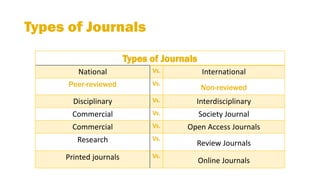
Types of Journals
Types of Journals
National Vs. International
Peer-reviewed Vs.
Non-reviewed
Disciplinary Vs. Interdisciplinary
Commercial Vs. Society Journal
Commercial Vs. Open Access Journals
Research Vs.
Review Journals
Printed journals Vs.
Online Journals
Article Submission
Article Submission
 Select your journal carefully
 Read the aims and scope
 Think about your target audience and the level of your work – do you have
a realistic chance of being accepted?
 Follow the guidelines in the notes for authors and include everything they
ask – it makes the editor’s job easier…
 Articles should not be submitted to more than one journal at a time
• See: Instructions to Authors in Health Sciences
• http://mulford.mco.edu/instr/
Article Submission
 Cover letter
o Article Submission
o Full address of corresponding author
o Addresses, e-mails and names of co-authors
o Title
o Nice text (Hello editor,…..why this journal)
 •Author statement
o Work is original and has been carried out by the authors
o All authors have contributed
o All authors agree with the text and its submission
o No part has been published elsewhere unless
acknowledged in the text
o Manuscript has not been submitted to another journal
 Potential referees
Online Submission
 Many publishers now offer a completely electronic
submission process
 Article is submitted online and all of the review procedure
also happens online
 Speeds up the editorial process
 Is invaluable for authors in low-income countries
After Submission
 Most journal editors will make an initial decision on a paper -
to review or to reject
 Most editors appoint two referees
 Refereeing speed varies tremendously between journals
 Authors should receive a decision of Accept, Accept with
Revision (Minor or Major), or Reject
 If a paper is rejected, most editors will write to you explaining
their decision
After Submission
 After rejection, authors have the option of submitting the
paper to another journal - editor’s suggestions should be
addressed
Overview of Peer Review Process
Paper Submitted
Initial Decision by Editor
Confirmation of Receipt
Rejection Decide to Review
Assign Reviewers
Reviewers Accept Invite
Reviews Completed
Reject
Accept
Notification to Author
Revise
Paper sent to Publisher
Accept
Revise
Revision Received
Revision Checked
Editor’s Decision
Reviewer #1 Reviewer #2 Editor Decision
Minor Revision Minor Revision Minor Revision
Major Revision Major Revision Major Revision
Major Revision Major Revision Rejected
Major Revision Minor Revision Major Revision
Major Revision Minor Revision Minor Revision
Rejected Minor Revision Rejected
Rejected Major Revision Rejected
Evaluate
Journal
Performance
• Lists Indicators of the Journal Performance
and their Problems.
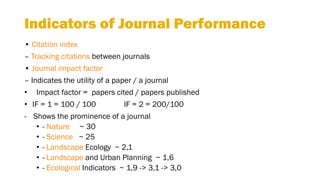
Indicators of Journal Performance
• Citation index
– Tracking citations between journals
• Journal impact factor
– Indicates the utility of a paper / a journal
• Impact factor = papers cited / papers published
• IF = 1 = 100 / 100 IF = 2 = 200/100
- Shows the prominence of a journal
• - Nature ~ 30
• - Science ~ 25
• - Landscape Ecology ~ 2,1
• - Landscape and Urban Planning ~ 1,6
• - Ecological Indicators ~ 1,9 -> 3,1 -> 3,0
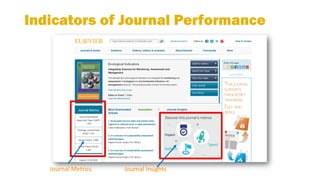
Indicators of Journal Performance
Journal Metrics Journal Insights
SNIP Metric SJR Metric
Impact
Factor
5 Years Impact Factor
Article Influence
& Eigen Factor
Indicators of Journal Performance
• Problems:
 Impact factor does not tell anything about the quality
 Only certain journals are investigated (observation procedure)
 Book publications mostly do not count (although important)
 Impact factors differ enormously in different disciplines
 Accounting period: only two years
Indicators of Journal Performance
• Problems:
 Is used by universities as indicator of research efficiency
 May be a factor for employment decisions
 Journals with high impact factors have high competition, limited space and
high rejection rates.
Exploring and Evaluating Scopus Journals
End First Lecture
Explore Evaluate Select Check
Selecting
Right Journal
• Define Strategies, Tactics, Online Tools to
Select the Right Journal in Scopus.
Author Priorities for Journal Selection
Key (Determining) factors: Marginal (Qualifying) factors:
• Impact Factor • Experience as a referee
• Reputation • Track record
• Access to the target audience • Quality and color illustrations
• Overall editorial standard • Service elements
• Publication speed
• International coverage
• Open Access participating publisher
Author Priorities for Journal Selection (INASP)
 Quality / prestige
 Collection / Specialization
 Habit / previous publication
 Speed / time delay
What is Right Journal?
 Increase the chance of getting accepted.
 Popular and respected in the field.
 High rank in the field
 High impact factor
 Fast
 No publication fees if possible
 My work is Read & Cited
Introduction
• Publication in a peer-reviewed journal is the obvious goal of most research
projects. It is through publication that your research reaches others in the
field, advancing knowledge and encouraging communication between
groups with similar research goals.
• One of the most important—and possibly the least well understood—
aspects of the publication process is the choice of a suitable journal that is
likely to accept your work.
Introduction
• Submitting a manuscript to an unsuitable journal is one of the most
common mistakes made by authors, and both novice and seasoned
researchers are capable of making this error.
Choose The Right Journal for Your
Research
What are the Aims and Scope of the Journal?
• This information is usually readily available on the journal’s homepage.
Look for a section titled “About the Journal”, “Full Aims and Scope”, or
something similar.
• Browsing through this page will provide you with key information about
whether your research might be a good match for the journal.
Choose The Right Journal for Your
Research
Has the Journal Published Articles that are
Similar to yours?
• Once you have identified a few journals that might be likely to publish your
manuscript based on their broad aims and scope, consider performing a
search with the keywords (or title) of your manuscript to determine whether
the journal has published work that is similar to yours. Aim to identify 3-5
papers published within the last 5 years and try to determine whether
these papers are similar to yours in quality and scope.
Choose The Right Journal for Your
Research
What are the Journal’s Restrictions?
• Submission to a journal that does not accept the type of article you’ve
written is a surefire way to be rejected immediately. For example, some
journals, such as the British Journal of Surgery, do not publish case reports.
Thus, it is essential to check the “Information for Authors” section of your
target journal to determine the journal’s restrictions. It is also important to
note restrictions related to word count.
Choose The Right Journal for Your
Research
What is the Impact Factor(IF) or CiteScore?
• The validity of the impact factor as a metric for journal quality is
controversial due to the many factors that can influence the rating achieved
and the fact that not all of these factors are directly related to the quality of
the publications within the journal. Nevertheless, the impact factor remains
the default method for determining the quality and reputation of a journal.
Online Journal Selectors
Top 7 Online Selector Tools Website
Elsevier Journal Finder http://journalfinder.elsevier.com
IEEE Publication Recommender http://publication-recommender.ieee.org/home
Springer Journal Suggester http://journalsuggester.springer.com
Edanz Journal Selector https://en-author-services.edanzgroup.com/journal-
selector
Journal Article Name Estimator (JANE) http://jane.biosemantics.org
Cofactor Journal Selector http://cofactorscience.com/journal-selector
Journal Guide https://www.journalguide.com
Top Reasons Why MSs is Rejected?
 Submission to the wrong journal.
 No originality.
 Poor English Grammar.
 Incomplete or outdated review of literature.
 Not clear methodology.
 Conclusions not support by data.
 Failing to address reviewer’s & editors comments and suggestions.
Response to reviewers comments
 Don’t get angry.
 Don’t take it personally.
 Be calm and objective.
 Take all comments seriously.
 Don’t ignore any comments.
 Try to make the majority of the changes requested.
 Negotiate the more radical suggestions are needed.
Response to Reviewers Comments
 Response to every comment, positive and negative.
 Make changes only if you agree with reviewers.
 Remember that the reviewer is not always right!!
 Response in an appropriate time- don’t miss the deadline!
•Try To Win The Editor!
Selecting the Right Scopus Journals
End Second Lecture
Explore Evaluate Select Check
Checking
Scopus
Journals
• Refer to the Notes Section below for
Guidelines on this Topic.
Checking Scopus Journals
End Third Lecture
Explore Select
Evaluate Check

Scopus Journals

  • 1.
    Explore, Check, Select,and Evaluate Journals in Scopus Explore Evaluate Select Check MSc. Nabeel Salih Ali Lec. ECE Dept., Faculty of Engineering, Member at ITRDC Center, University of Kufa. ORCID: 0000-0001-9988-5619
  • 2.
    Exploring Journals • Describes Typesof Journals, Criteria and Restriction, Indexing, Submission System, and Authors Guidelines.
  • 3.
    Types of Journals Typesof Journals National Vs. International Peer-reviewed Vs. Non-reviewed Disciplinary Vs. Interdisciplinary Commercial Vs. Society Journal Commercial Vs. Open Access Journals Research Vs. Review Journals Printed journals Vs. Online Journals
  • 4.
  • 5.
    Article Submission  Selectyour journal carefully  Read the aims and scope  Think about your target audience and the level of your work – do you have a realistic chance of being accepted?  Follow the guidelines in the notes for authors and include everything they ask – it makes the editor’s job easier…  Articles should not be submitted to more than one journal at a time • See: Instructions to Authors in Health Sciences • http://mulford.mco.edu/instr/
  • 6.
    Article Submission  Coverletter o Article Submission o Full address of corresponding author o Addresses, e-mails and names of co-authors o Title o Nice text (Hello editor,…..why this journal)  •Author statement o Work is original and has been carried out by the authors o All authors have contributed o All authors agree with the text and its submission o No part has been published elsewhere unless acknowledged in the text o Manuscript has not been submitted to another journal  Potential referees
  • 7.
    Online Submission  Manypublishers now offer a completely electronic submission process  Article is submitted online and all of the review procedure also happens online  Speeds up the editorial process  Is invaluable for authors in low-income countries
  • 8.
    After Submission  Mostjournal editors will make an initial decision on a paper - to review or to reject  Most editors appoint two referees  Refereeing speed varies tremendously between journals  Authors should receive a decision of Accept, Accept with Revision (Minor or Major), or Reject  If a paper is rejected, most editors will write to you explaining their decision
  • 9.
    After Submission  Afterrejection, authors have the option of submitting the paper to another journal - editor’s suggestions should be addressed
  • 10.
    Overview of PeerReview Process Paper Submitted Initial Decision by Editor Confirmation of Receipt Rejection Decide to Review Assign Reviewers Reviewers Accept Invite Reviews Completed Reject Accept Notification to Author Revise Paper sent to Publisher Accept Revise Revision Received Revision Checked
  • 11.
    Editor’s Decision Reviewer #1Reviewer #2 Editor Decision Minor Revision Minor Revision Minor Revision Major Revision Major Revision Major Revision Major Revision Major Revision Rejected Major Revision Minor Revision Major Revision Major Revision Minor Revision Minor Revision Rejected Minor Revision Rejected Rejected Major Revision Rejected
  • 12.
    Evaluate Journal Performance • Lists Indicatorsof the Journal Performance and their Problems.
  • 13.
    Indicators of JournalPerformance • Citation index – Tracking citations between journals • Journal impact factor – Indicates the utility of a paper / a journal • Impact factor = papers cited / papers published • IF = 1 = 100 / 100 IF = 2 = 200/100 - Shows the prominence of a journal • - Nature ~ 30 • - Science ~ 25 • - Landscape Ecology ~ 2,1 • - Landscape and Urban Planning ~ 1,6 • - Ecological Indicators ~ 1,9 -> 3,1 -> 3,0
  • 14.
    Indicators of JournalPerformance Journal Metrics Journal Insights
  • 15.
    SNIP Metric SJRMetric Impact Factor 5 Years Impact Factor Article Influence & Eigen Factor Indicators of Journal Performance
  • 16.
  • 17.
  • 18.
  • 19.
    Indicators of JournalPerformance • Problems:  Impact factor does not tell anything about the quality  Only certain journals are investigated (observation procedure)  Book publications mostly do not count (although important)  Impact factors differ enormously in different disciplines  Accounting period: only two years
  • 20.
    Indicators of JournalPerformance • Problems:  Is used by universities as indicator of research efficiency  May be a factor for employment decisions  Journals with high impact factors have high competition, limited space and high rejection rates.
  • 21.
    Exploring and EvaluatingScopus Journals End First Lecture Explore Evaluate Select Check
  • 22.
    Selecting Right Journal • DefineStrategies, Tactics, Online Tools to Select the Right Journal in Scopus.
  • 23.
    Author Priorities forJournal Selection Key (Determining) factors: Marginal (Qualifying) factors: • Impact Factor • Experience as a referee • Reputation • Track record • Access to the target audience • Quality and color illustrations • Overall editorial standard • Service elements • Publication speed • International coverage • Open Access participating publisher
  • 24.
    Author Priorities forJournal Selection (INASP)  Quality / prestige  Collection / Specialization  Habit / previous publication  Speed / time delay
  • 25.
    What is RightJournal?  Increase the chance of getting accepted.  Popular and respected in the field.  High rank in the field  High impact factor  Fast  No publication fees if possible  My work is Read & Cited
  • 26.
    Introduction • Publication ina peer-reviewed journal is the obvious goal of most research projects. It is through publication that your research reaches others in the field, advancing knowledge and encouraging communication between groups with similar research goals. • One of the most important—and possibly the least well understood— aspects of the publication process is the choice of a suitable journal that is likely to accept your work.
  • 27.
    Introduction • Submitting amanuscript to an unsuitable journal is one of the most common mistakes made by authors, and both novice and seasoned researchers are capable of making this error.
  • 28.
    Choose The RightJournal for Your Research What are the Aims and Scope of the Journal? • This information is usually readily available on the journal’s homepage. Look for a section titled “About the Journal”, “Full Aims and Scope”, or something similar. • Browsing through this page will provide you with key information about whether your research might be a good match for the journal.
  • 29.
    Choose The RightJournal for Your Research Has the Journal Published Articles that are Similar to yours? • Once you have identified a few journals that might be likely to publish your manuscript based on their broad aims and scope, consider performing a search with the keywords (or title) of your manuscript to determine whether the journal has published work that is similar to yours. Aim to identify 3-5 papers published within the last 5 years and try to determine whether these papers are similar to yours in quality and scope.
  • 30.
    Choose The RightJournal for Your Research What are the Journal’s Restrictions? • Submission to a journal that does not accept the type of article you’ve written is a surefire way to be rejected immediately. For example, some journals, such as the British Journal of Surgery, do not publish case reports. Thus, it is essential to check the “Information for Authors” section of your target journal to determine the journal’s restrictions. It is also important to note restrictions related to word count.
  • 31.
    Choose The RightJournal for Your Research What is the Impact Factor(IF) or CiteScore? • The validity of the impact factor as a metric for journal quality is controversial due to the many factors that can influence the rating achieved and the fact that not all of these factors are directly related to the quality of the publications within the journal. Nevertheless, the impact factor remains the default method for determining the quality and reputation of a journal.
  • 32.
    Online Journal Selectors Top7 Online Selector Tools Website Elsevier Journal Finder http://journalfinder.elsevier.com IEEE Publication Recommender http://publication-recommender.ieee.org/home Springer Journal Suggester http://journalsuggester.springer.com Edanz Journal Selector https://en-author-services.edanzgroup.com/journal- selector Journal Article Name Estimator (JANE) http://jane.biosemantics.org Cofactor Journal Selector http://cofactorscience.com/journal-selector Journal Guide https://www.journalguide.com
  • 33.
    Top Reasons WhyMSs is Rejected?  Submission to the wrong journal.  No originality.  Poor English Grammar.  Incomplete or outdated review of literature.  Not clear methodology.  Conclusions not support by data.  Failing to address reviewer’s & editors comments and suggestions.
  • 34.
    Response to reviewerscomments  Don’t get angry.  Don’t take it personally.  Be calm and objective.  Take all comments seriously.  Don’t ignore any comments.  Try to make the majority of the changes requested.  Negotiate the more radical suggestions are needed.
  • 35.
    Response to ReviewersComments  Response to every comment, positive and negative.  Make changes only if you agree with reviewers.  Remember that the reviewer is not always right!!  Response in an appropriate time- don’t miss the deadline! •Try To Win The Editor!
  • 36.
    Selecting the RightScopus Journals End Second Lecture Explore Evaluate Select Check
  • 37.
    Checking Scopus Journals • Refer tothe Notes Section below for Guidelines on this Topic.
  • 38.
    Checking Scopus Journals EndThird Lecture Explore Select Evaluate Check