IV. The American Civil War 1861-1865
1. The Situation before the War Three Great Tides: 1840-1860 The “Western Movement” Economic Systems of the North and South Growth of the Working Class
The “Westward Movement” “Manifest Destiny”- "to over spread and to possess" the whole continent, to develop liberty and self-government to all Poor living conditions led to the westward movement
The economic systems  of the North and South North Manufacturing output x3 1840-1869 American Industry ranked 3 rd  in the world =The Industrial North South Little industry in cotton and tobacco Plantations dependant on slave labor =The Agricultural South
Growth of the working class Trade Union: Workers organized into a voluntary association, or union, to further their mutual interests with respect to wages, hours, working conditions and other matters of interest to the workers.
2. The Slavery Problem Slaves first brought to America in the beginning of the 17 th  century Slave labor done away with in the North because it was unprofitable Slaves vital to the South The Underground Railroad: the network of people, routes, and safe houses that helped escaped slaves find their way to freedom
“ Uncle Tom’s Cabin” (1852) –Harriet Beecher Stowe “ I’ve always had a prejudice against negroes…and it’s a fact, I never could bear to have that child touch me; but, I didn’t think she knew it.”  But as to putting them on any sort of equality with us, you know, as if we could be compared, why, it’ impossible! Now, St. Clare rally has talked to me as if keeping Mammy from her husband was like keeping me from mine.  There’s no comparing in this way.  Mammy couldn’t have the feelings that I should.  It’s a different thing altogether, - of course, it is, - and yet St. Clare pretends not to see it.  And just as if Mammy could lover her little dirty babies as much as I love Eva!”
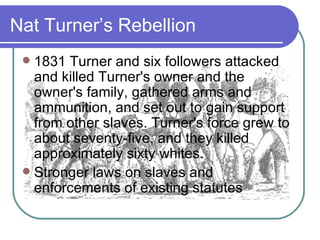
Nat Turner’s Rebellion 1831 Turner and six followers attacked and killed Turner's owner and the owner's family, gathered arms and ammunition, and set out to gain support from other slaves. Turner's force grew to about seventy-five, and they killed approximately sixty whites.  Stronger laws on slaves and enforcements of existing statutes
3. The Political Conflicts 1854 Kansas-Nebraska Act: made slavery possible in new territories such as Kansas and Nebraska Kansas enters Union without slavery
The Republican and Democratic Party Political turmoil caused by slavery causes: Whig Party to dissolve forms the Republican party-opposed to slavery Southern Whigs become Democrats =the birth of the two-party system
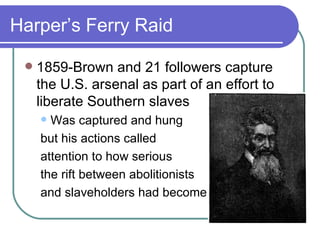
Harper’s Ferry Raid 1859-Brown and 21 followers capture the U.S. arsenal as part of an effort to liberate Southern slaves Was captured and hung  but his actions called  attention to how serious  the rift between abolitionists  and slaveholders had become.
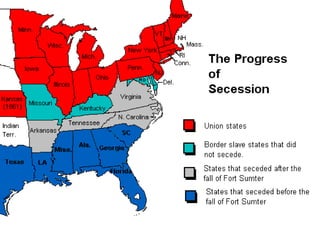
The Confederate States of America 1860-Alabama, Florida, Georgia, Louisiana, Mississippi, South Carolina, and Texas secede from the Union, after the fall of Fort Sumter in 1861, Arkansas, North Carolina, Tennessee, and Virginia also secede  Secede from the U.S. to preserve slavery and states’ rights Progressive vs. Backward
 
 
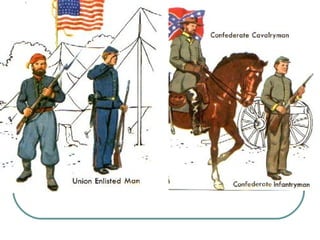
Progress of the Civil War: Breakout of the Civil War 1861 Fort Sumter taken by the Confederates The Union raises an army of 75,000 Confederacy raises an army of 10,000 April 1861-Lincoln blockades the Atlantic coast from South Carolina to Florida
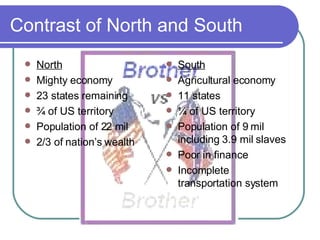
Contrast of North and South North Mighty economy 23 states remaining ¾ of US territory Population of 22 mil 2/3 of nation’s wealth South Agricultural economy 11 states ¼ of US territory Population of 9 mil including 3.9 mil slaves Poor in finance Incomplete transportation system
3. The Progress of the War July, 1861-The Battle of Bull Run: Gen. McDowell leads 30,000 men against Gen. Johnston's 22,000 Southern troops in an attempt to crush the rebels and go "On to Richmond." South scores victory as Union troops flee back to Washington in disarray. McDowell replaced by Gen. McClellan
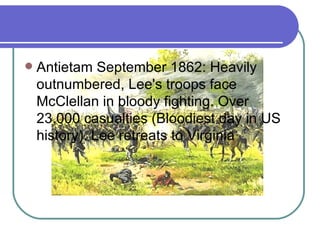
Antietam September 1862: Heavily outnumbered, Lee's troops face McClellan in bloody fighting. Over 23,000 casualties (Bloodiest day in US history). Lee retreats to Virginia
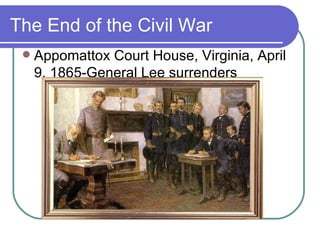
The End of the Civil War Appomattox Court House, Virginia, April 9, 1865-General Lee surrenders
4. The Homestead Bill and the Emancipation Proclamation Homestead Act:1862 gave 160 acres of free land in the West to anyone who would go there and live on the land for five years. Some 400,000 families, including thousands of black settlers, became homesteaders.
Emancipation Proclamation Freed slaves in the Confederate States  Lincoln could not enforce this order since he did not control the Confederate States Was a clear statement that Slavery would end Making slavery the issue of the war helped keep Britain from siding with the South
“Manifest Destiny” Trade Union Underground Rail Road Harriet Beecher Stowe-Uncle Tom’s Cabin 1854-Kansas-Nebraska Act 1859-Harper’s Ferry Raid 1861 Fort Sumter 1862 Homestead Act 1862 Emancipation Proclamation 1865 Appomattox Court House

The American Civil War

  • 1.
    IV. The AmericanCivil War 1861-1865
  • 2.
    1. The Situationbefore the War Three Great Tides: 1840-1860 The “Western Movement” Economic Systems of the North and South Growth of the Working Class
  • 3.
    The “Westward Movement”“Manifest Destiny”- "to over spread and to possess" the whole continent, to develop liberty and self-government to all Poor living conditions led to the westward movement
  • 4.
    The economic systems of the North and South North Manufacturing output x3 1840-1869 American Industry ranked 3 rd in the world =The Industrial North South Little industry in cotton and tobacco Plantations dependant on slave labor =The Agricultural South
  • 5.
    Growth of theworking class Trade Union: Workers organized into a voluntary association, or union, to further their mutual interests with respect to wages, hours, working conditions and other matters of interest to the workers.
  • 6.
    2. The SlaveryProblem Slaves first brought to America in the beginning of the 17 th century Slave labor done away with in the North because it was unprofitable Slaves vital to the South The Underground Railroad: the network of people, routes, and safe houses that helped escaped slaves find their way to freedom
  • 7.
    “ Uncle Tom’sCabin” (1852) –Harriet Beecher Stowe “ I’ve always had a prejudice against negroes…and it’s a fact, I never could bear to have that child touch me; but, I didn’t think she knew it.” But as to putting them on any sort of equality with us, you know, as if we could be compared, why, it’ impossible! Now, St. Clare rally has talked to me as if keeping Mammy from her husband was like keeping me from mine.  There’s no comparing in this way.  Mammy couldn’t have the feelings that I should.  It’s a different thing altogether, - of course, it is, - and yet St. Clare pretends not to see it.  And just as if Mammy could lover her little dirty babies as much as I love Eva!”
  • 8.
    Nat Turner’s Rebellion1831 Turner and six followers attacked and killed Turner's owner and the owner's family, gathered arms and ammunition, and set out to gain support from other slaves. Turner's force grew to about seventy-five, and they killed approximately sixty whites. Stronger laws on slaves and enforcements of existing statutes
  • 9.
    3. The PoliticalConflicts 1854 Kansas-Nebraska Act: made slavery possible in new territories such as Kansas and Nebraska Kansas enters Union without slavery
  • 10.
    The Republican andDemocratic Party Political turmoil caused by slavery causes: Whig Party to dissolve forms the Republican party-opposed to slavery Southern Whigs become Democrats =the birth of the two-party system
  • 11.
    Harper’s Ferry Raid1859-Brown and 21 followers capture the U.S. arsenal as part of an effort to liberate Southern slaves Was captured and hung but his actions called attention to how serious the rift between abolitionists and slaveholders had become.
  • 12.
    The Confederate Statesof America 1860-Alabama, Florida, Georgia, Louisiana, Mississippi, South Carolina, and Texas secede from the Union, after the fall of Fort Sumter in 1861, Arkansas, North Carolina, Tennessee, and Virginia also secede Secede from the U.S. to preserve slavery and states’ rights Progressive vs. Backward
  • 13.
  • 14.
  • 15.
    Progress of theCivil War: Breakout of the Civil War 1861 Fort Sumter taken by the Confederates The Union raises an army of 75,000 Confederacy raises an army of 10,000 April 1861-Lincoln blockades the Atlantic coast from South Carolina to Florida
  • 16.
    Contrast of Northand South North Mighty economy 23 states remaining ¾ of US territory Population of 22 mil 2/3 of nation’s wealth South Agricultural economy 11 states ¼ of US territory Population of 9 mil including 3.9 mil slaves Poor in finance Incomplete transportation system
  • 17.
    3. The Progressof the War July, 1861-The Battle of Bull Run: Gen. McDowell leads 30,000 men against Gen. Johnston's 22,000 Southern troops in an attempt to crush the rebels and go "On to Richmond." South scores victory as Union troops flee back to Washington in disarray. McDowell replaced by Gen. McClellan
  • 18.
    Antietam September 1862:Heavily outnumbered, Lee's troops face McClellan in bloody fighting. Over 23,000 casualties (Bloodiest day in US history). Lee retreats to Virginia
  • 19.
    The End ofthe Civil War Appomattox Court House, Virginia, April 9, 1865-General Lee surrenders
  • 20.
    4. The HomesteadBill and the Emancipation Proclamation Homestead Act:1862 gave 160 acres of free land in the West to anyone who would go there and live on the land for five years. Some 400,000 families, including thousands of black settlers, became homesteaders.
  • 21.
    Emancipation Proclamation Freedslaves in the Confederate States Lincoln could not enforce this order since he did not control the Confederate States Was a clear statement that Slavery would end Making slavery the issue of the war helped keep Britain from siding with the South
  • 22.
    “Manifest Destiny” TradeUnion Underground Rail Road Harriet Beecher Stowe-Uncle Tom’s Cabin 1854-Kansas-Nebraska Act 1859-Harper’s Ferry Raid 1861 Fort Sumter 1862 Homestead Act 1862 Emancipation Proclamation 1865 Appomattox Court House