U.S. Government 
Chapter 3 – Section 2
 Amendment 
 Formal Amendment 
 Bill of Rights
 Section Objectives: 
 Identify the four different ways by which the 
Constitution may be formally changed (amended). 
 Explain how the formal amendment process illustrates 
the principles of federalism and popular sovereignty. 
 4.6 – Understand the concept of federalism 
 5.4 – Understand the U.S. Constitution as a living 
document in both principle and practice
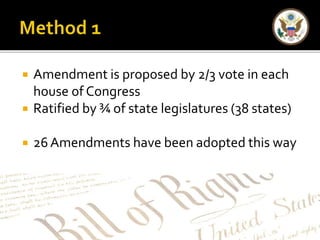
 Amendment is proposed by 2/3 vote in each 
house of Congress 
 Ratified by ¾ of state legislatures (38 states) 
 26 Amendments have been adopted this way
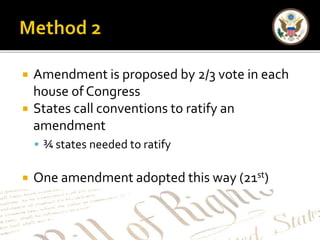
 Amendment is proposed by 2/3 vote in each 
house of Congress 
 States call conventions to ratify an 
amendment 
 ¾ states needed to ratify 
 One amendment adopted this way (21st)
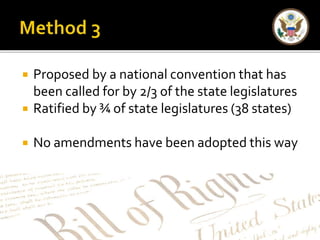
 Proposed by a national convention that has 
been called for by 2/3 of the state legislatures 
 Ratified by ¾ of state legislatures (38 states) 
 No amendments have been adopted this way
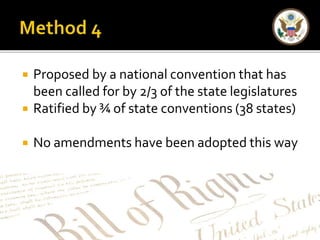
 Proposed by a national convention that has 
been called for by 2/3 of the state legislatures 
 Ratified by ¾ of state conventions (38 states) 
 No amendments have been adopted this way
 Amendments are always proposed at the 
national level and ratified at the state level 
 2/3 votes to propose, ¾ votes to ratify
 Nearly 15,000 joint resolutions have called for 
amendments to Constitution since 1789 
 Only 33 have been sent to the states for ratification 
 Of those, only 27 have passed. 
 That is 1 out of every 555 resolutions that ends up 
going to the states for ratification. 
(In other words, a proposed amendment has 1/5 of 1% 
chance of success – about the odds of catching a ball 
at a major league baseball game)
 Each of you will create a poster to illustrate 
an amendment. 
 Be creative. Use your imagination and artistic 
ability. 
 This will count as a test grade.

U.S. Government -- Chapter 3, Section 2 "Methods of Formal Constitutional Amendment"

  • 1.
    U.S. Government Chapter3 – Section 2
  • 2.
     Amendment Formal Amendment  Bill of Rights
  • 3.
     Section Objectives:  Identify the four different ways by which the Constitution may be formally changed (amended).  Explain how the formal amendment process illustrates the principles of federalism and popular sovereignty.  4.6 – Understand the concept of federalism  5.4 – Understand the U.S. Constitution as a living document in both principle and practice
  • 4.
     Amendment isproposed by 2/3 vote in each house of Congress  Ratified by ¾ of state legislatures (38 states)  26 Amendments have been adopted this way
  • 5.
     Amendment isproposed by 2/3 vote in each house of Congress  States call conventions to ratify an amendment  ¾ states needed to ratify  One amendment adopted this way (21st)
  • 6.
     Proposed bya national convention that has been called for by 2/3 of the state legislatures  Ratified by ¾ of state legislatures (38 states)  No amendments have been adopted this way
  • 7.
     Proposed bya national convention that has been called for by 2/3 of the state legislatures  Ratified by ¾ of state conventions (38 states)  No amendments have been adopted this way
  • 8.
     Amendments arealways proposed at the national level and ratified at the state level  2/3 votes to propose, ¾ votes to ratify
  • 9.
     Nearly 15,000joint resolutions have called for amendments to Constitution since 1789  Only 33 have been sent to the states for ratification  Of those, only 27 have passed.  That is 1 out of every 555 resolutions that ends up going to the states for ratification. (In other words, a proposed amendment has 1/5 of 1% chance of success – about the odds of catching a ball at a major league baseball game)
  • 10.
     Each ofyou will create a poster to illustrate an amendment.  Be creative. Use your imagination and artistic ability.  This will count as a test grade.