U.S. Government 
Chapter 3 – Section 3
 Executive agreement 
 Treaty 
 Electoral college 
 Cabinet 
 Senatorial courtesy
 Section Objectives: 
 Identify how basic legislation changed the Constitution 
over time. 
 Describe the ways in which the Constitution has been 
altered by executive and judicial decisions. 
 4.6 – Understand the concept of federalism 
 5.4 – Understand the U.S. Constitution as a living 
document in both principle and practice
 Many changes have been made over time to 
the Constitution not in writing (or formal 
amendment) but rather by the day-to-day 
experiences of government under the 
Constitution 
 Many changes have been made, but not to 
the written word
 Five basic ways to “informally” change the 
Constitution 
1. basic Legislation 
2. executive action 
3. court decisions 
4. party practices 
5. custom
 Over time Congress has “added the flesh to the 
bones” of the Constitution 
 Congress passes laws to spell out the details of 
provisions that were purposefully left “skeletal” 
by the framers 
 Ex. The structure of the federal court system 
 The Constitution says that if the office of president is 
left open, the vice president is to fill the position. 
Laws passed by Congress give more details.
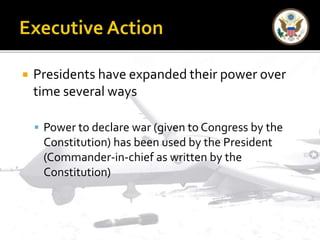
 Presidents have expanded their power over 
time several ways 
 Power to declare war (given to Congress by the 
Constitution) has been used by the President 
(Commander-in-chief as written by the 
Constitution)
 Executive agreements can be made between 
presidents and other foreign leaders 
 Executive agreements do not have to be approved 
by congress
 The Supreme Court has the ability to 
interpret and apply the Constitution in cases 
they hear. 
 “A constitutional convention in continuous 
session.” Woodrow Wilson
 The Constitution does not mention political 
parties but they have played a major role in 
the shaping of the government and its 
processes. 
 Political parties hold conventions which are 
not written into the Constitution
 Political parties have converted the electoral 
college from what the Framers intended into 
a “rubber stamp” for each state’s popular 
vote in presidential elections
 Upholding long-held customs as 
constitutional necessity 
 Unwritten custom may be as strong as 
written law 
 By custom, not because of the Constitution, 
the heads of the 15 executive departments 
make up the president’s Cabinet

Chapter 3, Section 3 "Constitution Change by Other Means"

  • 1.
    U.S. Government Chapter3 – Section 3
  • 2.
     Executive agreement  Treaty  Electoral college  Cabinet  Senatorial courtesy
  • 3.
     Section Objectives:  Identify how basic legislation changed the Constitution over time.  Describe the ways in which the Constitution has been altered by executive and judicial decisions.  4.6 – Understand the concept of federalism  5.4 – Understand the U.S. Constitution as a living document in both principle and practice
  • 4.
     Many changeshave been made over time to the Constitution not in writing (or formal amendment) but rather by the day-to-day experiences of government under the Constitution  Many changes have been made, but not to the written word
  • 5.
     Five basicways to “informally” change the Constitution 1. basic Legislation 2. executive action 3. court decisions 4. party practices 5. custom
  • 6.
     Over timeCongress has “added the flesh to the bones” of the Constitution  Congress passes laws to spell out the details of provisions that were purposefully left “skeletal” by the framers  Ex. The structure of the federal court system  The Constitution says that if the office of president is left open, the vice president is to fill the position. Laws passed by Congress give more details.
  • 7.
     Presidents haveexpanded their power over time several ways  Power to declare war (given to Congress by the Constitution) has been used by the President (Commander-in-chief as written by the Constitution)
  • 8.
     Executive agreementscan be made between presidents and other foreign leaders  Executive agreements do not have to be approved by congress
  • 9.
     The SupremeCourt has the ability to interpret and apply the Constitution in cases they hear.  “A constitutional convention in continuous session.” Woodrow Wilson
  • 10.
     The Constitutiondoes not mention political parties but they have played a major role in the shaping of the government and its processes.  Political parties hold conventions which are not written into the Constitution
  • 11.
     Political partieshave converted the electoral college from what the Framers intended into a “rubber stamp” for each state’s popular vote in presidential elections
  • 12.
     Upholding long-heldcustoms as constitutional necessity  Unwritten custom may be as strong as written law  By custom, not because of the Constitution, the heads of the 15 executive departments make up the president’s Cabinet