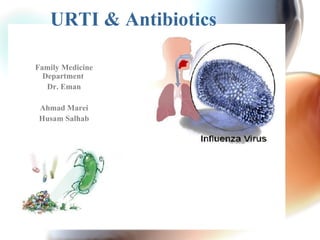
Family Medicine Department  Dr. Eman Ahmad Marei Husam Salhab URTI & Antibiotics
بسم الله الرحمن الرحيم  Definition Epidemiology Types and causative agents Management principles Effects of Rx Antibiotic in specific URTI Factors affect prescription Objectives
Definition URTI inflammation of respiratory mucosa from the nose to the lower respiratory tree not including the alveoli.
Symptoms Sore throat Rhinorrhea Facial fullness and Pain Headache Cough Fever Tender lymph nodes Ear Pain
Epidemiology In average Children will have 5 URTI/Year, & adults 2-3/Year Acute rhinitis is by far the most common cause of doctors visit. Otitis media is the most common cause for a child under age 15 to visit a physician. Acute Otitis Media, the most common condition for antibiotics (50%). Group A beta-hemolytic streptococcus  is only found in 15% to 36% of children with sore throat.
Types and causative agents
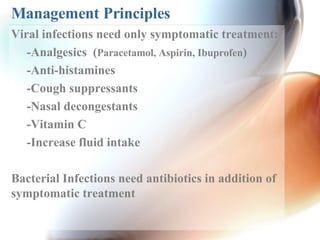
Management Principles Viral infections need only symptomatic treatment:  -Analgesics  ( Paracetamol, Aspirin, Ibuprofen )  -Anti-histamines  -Cough suppressants  -Nasal decongestants  - Vitamin C -Increase fluid intake Bacterial Infections need antibiotics in addition of symptomatic treatment
Management Principles Viral (Don’t Use Antibiotics) Why? -Promotes antibiotic resistance -Adverse reactions such as allergy and anaphylaxis -Costly -Patients do not need antibiotics to feel satisfied Bacterial (Use antibiotics) Why? - To prevent rheumatic fever - To prevent suppurative complications (e.g., peritonsillar abscess) - To speed up recovery - To reduce spread to others
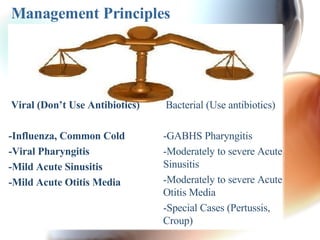
Management Principles Viral (Don’t Use Antibiotics) -Influenza, Common Cold -Viral Pharyngitis -Mild Acute Sinusitis -Mild Acute Otitis Media Bacterial (Use antibiotics) -GABHS Pharyngitis -Moderately to severe Acute Sinusitis -Moderately to severe Acute Otitis Media -Special Cases (Pertussis, Croup)
But how can we differentiate between Viral and Bacterial Pharyngitis, Sinusitis &  Otitis Media?
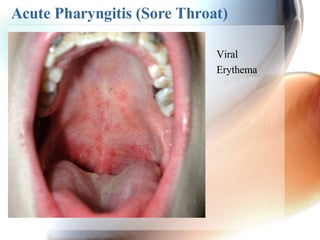
Acute Pharyngitis (Sore Throat) Viral  Erythema
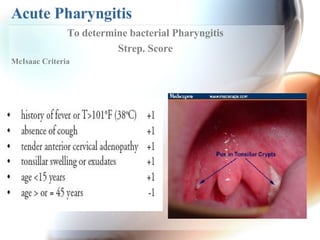
Acute Pharyngitis -No Evidence that bacterial sore throat are more severe than viral ones or that the duration of the illness is significantly different in either cases. -Based on symptoms , bacterial and viral sore throat are limited to be distinguished. Clinical examination should not be relied upon to differentiate between viral and bacterial sore throat.  -Sensitivity and Specificity suggest that reliance on clinical diagnoses will miss 25-50% of GABHS Pharyngitis cases.
Acute Pharyngitis  To determine bacterial Pharyngitis Strep. Score McIsaac Criteria
 
Acute Pharyngitis Rapid Antigen Test (RAT) Sensitivity of RAT against culture varies between 61-95%. Specificity of RAT 88-100% Takes 10 min to be performed -ve results should be confirmed by culture. Not found in Jordan
Acute Pharyngitis Throat Culture 20-40% of those with negative throat culture will be labeled as having GABHS.  +ve culture makes the Dx of GABHS likely , but  –Ve culture does not rule out.
Acute Pharyngitis  (Drug Of choice) -Oral penicillin or erythromycin (in penicillin-allergic individuals), given for 10 days. -Fortunately, no resistance to penicillin has been reported, so far, among GABHS-related Pharyngitis patients.
Complication Rheumatic Fever - Major Criteria: - polyarithritis - carditis - sydenham chorea  - subcutaneous nodules - erythema marginatum - Minor Criteria: - fever  - leukocytosis - elevated ESR,CRP - arthralgia with evidence of recent group A strep infection
Case A 25 year old man comes to your office with the complaint of a bad sore throat for 2 days.  He has felt chills and fever today but has not measured his temperature.  He has some pain on swallowing. He has a slight runny nose and denies cough and other symptoms. He was previously healthy. T= 38.5 ears - TM's normal nose – clear neck - no cervical adenopathy lungs – clear
How many points does our patient have? 1 1 0 1 0 0 Fever over 38 C Absence of cough Tender ant. cervical adenopathy Tonsillar swelling or exudate Age< 15 y Age> 45 Total = 3
What are the tests? Rapid strep test  -ve Throat culture + ve Give  Penicillin + Symptomatic treatment
Acute otitis media
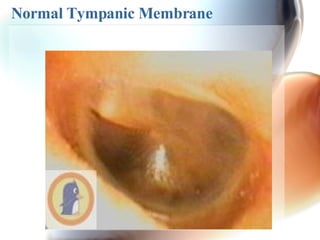
Normal Tympanic Membrane
Acute otitis media Redness Bulging
Acute otitis media Bullae Perforation
Acute otitis media Dutch Guidelines   -Dutch study found no difference in outcome between antibiotics, myringotomy, antibiotics combined with myringotomy and placebo.  -Only 1 in 7  children under 2 year old with 1 st  episode of A.O.M derived significant benefit  from antibiotic treatment. -Although it reduce fever faster , it does not reduce duration of pain or crying.
Acute otitis media Dutch Guidelines  Diagnostic criteria  - Recent perforation of the tympanic membrane  with discharging pus - Inflamed and bulging tympanic membrane -  One ear drum redder than the other - Bullae on tympanic membrane
TREATMENT  GUIDELINES Symptomatic treatment is provided in all cases The patient or the parents are instructed to contact the general practitioner if there is an abnormal clinical course, in other words: - increasing illness or earache, decreased drinking - no improvement within 3 days
TREATMENT GUIDELINES (cont.) Antibiotics Children < 6 months Children 6 months - 2 years + abnormal clinical course  For children >2 years,  + recurrent  within 12 months or Down's syndrome,  cleft palate,  compromised immune  system
Treatment :  - Amoxcillin – Cluv acid 80-90 mg/kg per day - Clarithromycin 15 mg/kg twice per day Complication: -   meningitis  - brain abscess - mastoiditis - cholesteatoma
Acute sinusitis
Acute sinusitis Antibiotics Moderate symptoms  not improving  after 10 days Moderate symptoms   that worsen after 5 to 7 days Severe symptoms -Oral amoxicillin, trimethoprim-sulfamethoxazole, or doxycycline, given for 3 to 10 days are the favored antibiotics for treatment.
Influenza - Antibiotics are ineffective - Amantadine and rimantadine (Antiviral) should not be used for the treatment of influenza because of widespread resistance. - Rx :  Symptomatic treatment only
Common cold
Common cold -No significant difference between antibiotics and placebo in cure or general improvement at 6–14 days in people with colds. -In a subgroup of people (20%) with nasopharyngeal culture positive Haemophilus influenzae, Moraxella catarrhalis, or Streptococcus pneumoniae, antibiotics increased recovery at 5 days compared with placebo. -However, we have no methods currently of easily identifying such people at first consultation. -Rx: Symptomatic treatment only
Pertussis (Whooping Cough)
Pertussis -Treating acute tracheobronchitis with antibiotics is not recommended, since most cases are viral, and thus resolve spontaneously. -In adults who report exposure to a patient with confirmed or suspected pertussis, erythromycin or trimethoprim-sulfamethoxazole should be administered for 14 days. This will decrease contagion from bacterial shedding, but is not expected to improve resolution of symptoms, unless started within 10 days of the onset of illness
Croup Inflammation of the  larynx  and  upper airway .
Croup No systematic review, RCTs, or observational studies of sufficient quality on antibiotics in children with moderate to severe croup. Antibiotics do not shorten the clinical course of a disease that is predominantly viral in origin. This does not apply if bacterial tracheitis is suspected. Rx:  - Racemic epinephine - Oral dexamethazone
Factors affect prescription -Patient expectation and satisfaction. -Severity. -Duration of illness -Parents demands. -Concerns about secondary bacterial infection. -Time.
Thank You تمت بحمد الله

Urti Antibiotics

  • 1.
    Family Medicine Department Dr. Eman Ahmad Marei Husam Salhab URTI & Antibiotics
  • 2.
    بسم الله الرحمنالرحيم Definition Epidemiology Types and causative agents Management principles Effects of Rx Antibiotic in specific URTI Factors affect prescription Objectives
  • 3.
    Definition URTI inflammationof respiratory mucosa from the nose to the lower respiratory tree not including the alveoli.
  • 4.
    Symptoms Sore throatRhinorrhea Facial fullness and Pain Headache Cough Fever Tender lymph nodes Ear Pain
  • 5.
    Epidemiology In averageChildren will have 5 URTI/Year, & adults 2-3/Year Acute rhinitis is by far the most common cause of doctors visit. Otitis media is the most common cause for a child under age 15 to visit a physician. Acute Otitis Media, the most common condition for antibiotics (50%). Group A beta-hemolytic streptococcus is only found in 15% to 36% of children with sore throat.
  • 6.
  • 7.
    Management Principles Viralinfections need only symptomatic treatment: -Analgesics ( Paracetamol, Aspirin, Ibuprofen ) -Anti-histamines -Cough suppressants -Nasal decongestants - Vitamin C -Increase fluid intake Bacterial Infections need antibiotics in addition of symptomatic treatment
  • 8.
    Management Principles Viral(Don’t Use Antibiotics) Why? -Promotes antibiotic resistance -Adverse reactions such as allergy and anaphylaxis -Costly -Patients do not need antibiotics to feel satisfied Bacterial (Use antibiotics) Why? - To prevent rheumatic fever - To prevent suppurative complications (e.g., peritonsillar abscess) - To speed up recovery - To reduce spread to others
  • 9.
    Management Principles Viral(Don’t Use Antibiotics) -Influenza, Common Cold -Viral Pharyngitis -Mild Acute Sinusitis -Mild Acute Otitis Media Bacterial (Use antibiotics) -GABHS Pharyngitis -Moderately to severe Acute Sinusitis -Moderately to severe Acute Otitis Media -Special Cases (Pertussis, Croup)
  • 10.
    But how canwe differentiate between Viral and Bacterial Pharyngitis, Sinusitis & Otitis Media?
  • 11.
    Acute Pharyngitis (SoreThroat) Viral Erythema
  • 12.
    Acute Pharyngitis -NoEvidence that bacterial sore throat are more severe than viral ones or that the duration of the illness is significantly different in either cases. -Based on symptoms , bacterial and viral sore throat are limited to be distinguished. Clinical examination should not be relied upon to differentiate between viral and bacterial sore throat. -Sensitivity and Specificity suggest that reliance on clinical diagnoses will miss 25-50% of GABHS Pharyngitis cases.
  • 13.
    Acute Pharyngitis To determine bacterial Pharyngitis Strep. Score McIsaac Criteria
  • 14.
  • 15.
    Acute Pharyngitis RapidAntigen Test (RAT) Sensitivity of RAT against culture varies between 61-95%. Specificity of RAT 88-100% Takes 10 min to be performed -ve results should be confirmed by culture. Not found in Jordan
  • 16.
    Acute Pharyngitis ThroatCulture 20-40% of those with negative throat culture will be labeled as having GABHS. +ve culture makes the Dx of GABHS likely , but –Ve culture does not rule out.
  • 17.
    Acute Pharyngitis (Drug Of choice) -Oral penicillin or erythromycin (in penicillin-allergic individuals), given for 10 days. -Fortunately, no resistance to penicillin has been reported, so far, among GABHS-related Pharyngitis patients.
  • 18.
    Complication Rheumatic Fever- Major Criteria: - polyarithritis - carditis - sydenham chorea - subcutaneous nodules - erythema marginatum - Minor Criteria: - fever - leukocytosis - elevated ESR,CRP - arthralgia with evidence of recent group A strep infection
  • 19.
    Case A 25year old man comes to your office with the complaint of a bad sore throat for 2 days. He has felt chills and fever today but has not measured his temperature. He has some pain on swallowing. He has a slight runny nose and denies cough and other symptoms. He was previously healthy. T= 38.5 ears - TM's normal nose – clear neck - no cervical adenopathy lungs – clear
  • 20.
    How many pointsdoes our patient have? 1 1 0 1 0 0 Fever over 38 C Absence of cough Tender ant. cervical adenopathy Tonsillar swelling or exudate Age< 15 y Age> 45 Total = 3
  • 21.
    What are thetests? Rapid strep test -ve Throat culture + ve Give Penicillin + Symptomatic treatment
  • 22.
  • 23.
  • 24.
    Acute otitis mediaRedness Bulging
  • 25.
    Acute otitis mediaBullae Perforation
  • 26.
    Acute otitis mediaDutch Guidelines -Dutch study found no difference in outcome between antibiotics, myringotomy, antibiotics combined with myringotomy and placebo. -Only 1 in 7 children under 2 year old with 1 st episode of A.O.M derived significant benefit from antibiotic treatment. -Although it reduce fever faster , it does not reduce duration of pain or crying.
  • 27.
    Acute otitis mediaDutch Guidelines Diagnostic criteria - Recent perforation of the tympanic membrane with discharging pus - Inflamed and bulging tympanic membrane - One ear drum redder than the other - Bullae on tympanic membrane
  • 28.
    TREATMENT GUIDELINESSymptomatic treatment is provided in all cases The patient or the parents are instructed to contact the general practitioner if there is an abnormal clinical course, in other words: - increasing illness or earache, decreased drinking - no improvement within 3 days
  • 29.
    TREATMENT GUIDELINES (cont.)Antibiotics Children < 6 months Children 6 months - 2 years + abnormal clinical course For children >2 years, + recurrent within 12 months or Down's syndrome, cleft palate, compromised immune system
  • 30.
    Treatment : - Amoxcillin – Cluv acid 80-90 mg/kg per day - Clarithromycin 15 mg/kg twice per day Complication: - meningitis - brain abscess - mastoiditis - cholesteatoma
  • 31.
  • 32.
    Acute sinusitis AntibioticsModerate symptoms not improving after 10 days Moderate symptoms that worsen after 5 to 7 days Severe symptoms -Oral amoxicillin, trimethoprim-sulfamethoxazole, or doxycycline, given for 3 to 10 days are the favored antibiotics for treatment.
  • 33.
    Influenza - Antibioticsare ineffective - Amantadine and rimantadine (Antiviral) should not be used for the treatment of influenza because of widespread resistance. - Rx : Symptomatic treatment only
  • 34.
  • 35.
    Common cold -Nosignificant difference between antibiotics and placebo in cure or general improvement at 6–14 days in people with colds. -In a subgroup of people (20%) with nasopharyngeal culture positive Haemophilus influenzae, Moraxella catarrhalis, or Streptococcus pneumoniae, antibiotics increased recovery at 5 days compared with placebo. -However, we have no methods currently of easily identifying such people at first consultation. -Rx: Symptomatic treatment only
  • 36.
  • 37.
    Pertussis -Treating acutetracheobronchitis with antibiotics is not recommended, since most cases are viral, and thus resolve spontaneously. -In adults who report exposure to a patient with confirmed or suspected pertussis, erythromycin or trimethoprim-sulfamethoxazole should be administered for 14 days. This will decrease contagion from bacterial shedding, but is not expected to improve resolution of symptoms, unless started within 10 days of the onset of illness
  • 38.
    Croup Inflammation ofthe larynx and upper airway .
  • 39.
    Croup No systematicreview, RCTs, or observational studies of sufficient quality on antibiotics in children with moderate to severe croup. Antibiotics do not shorten the clinical course of a disease that is predominantly viral in origin. This does not apply if bacterial tracheitis is suspected. Rx: - Racemic epinephine - Oral dexamethazone
  • 40.
    Factors affect prescription-Patient expectation and satisfaction. -Severity. -Duration of illness -Parents demands. -Concerns about secondary bacterial infection. -Time.
  • 41.
    Thank You تمتبحمد الله