Essential Questions: What conditions did cities experience at the turn of the century? How did electricity and steel change the urban environment? Why is “How The Other Half Lives” important in regards to urban living and working conditions?
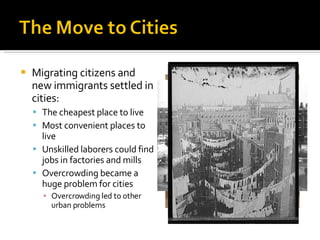
Migrating citizens and new immigrants settled in cities:  The cheapest place to live Most convenient places to live Unskilled laborers could find jobs in factories and mills Overcrowding became a huge problem for cities Overcrowding led to other urban problems
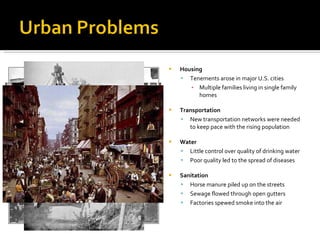
Housing Tenements arose in major U.S. cities Multiple families living in single family homes Transportation New transportation networks were needed to keep pace with the rising population Water Little control over quality of drinking water Poor quality led to the spread of diseases Sanitation Horse manure piled up on the streets Sewage flowed through open gutters Factories spewed smoke into the air
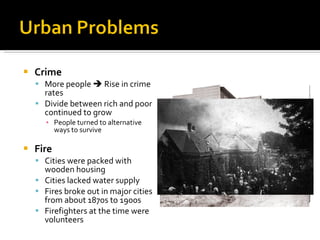
Crime  More people    Rise in crime rates Divide between rich and poor continued to grow People turned to alternative ways to survive Fire Cities were packed with wooden housing Cities lacked water supply Fires broke out in major cities from about 1870s to 1900s Firefighters at the time were volunteers
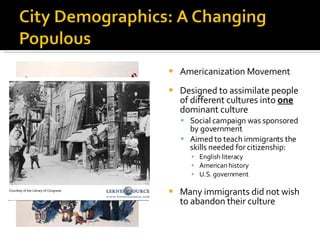
Americanization Movement Designed to assimilate people of different cultures into  one  dominant culture Social campaign was sponsored by government Aimed to teach immigrants the skills needed for citizenship: English literacy American history U.S. government Many immigrants did not wish to abandon their culture
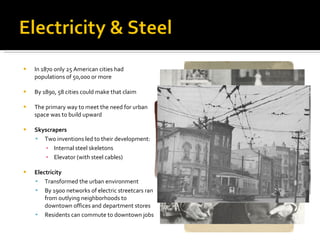
In 1870 only 25 American cities had populations of 50,000 or more By 1890, 58 cities could make that claim The primary way to meet the need for urban space was to build upward Skyscrapers Two inventions led to their development: Internal steel skeletons Elevator (with steel cables) Electricity Transformed the urban environment By 1900 networks of electric streetcars ran from outlying neighborhoods to downtown offices and department stores Residents can commute to downtown jobs
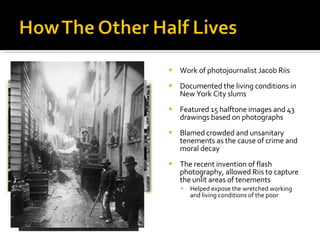
Work of photojournalist Jacob Riis Documented the living conditions in New York City slums Featured 15 halftone images and 43 drawings based on photographs Blamed crowded and unsanitary tenements as the cause of crime and moral decay The recent invention of flash photography, allowed Riis to capture the unlit areas of tenements Helped expose the wretched working and living conditions of the poor
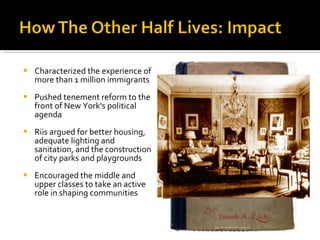
Characterized the experience of more than 1 million immigrants Pushed tenement reform to the front of New York's political agenda Riis argued for better housing, adequate lighting and sanitation, and the construction of city parks and playgrounds Encouraged the middle and upper classes to take an active role in shaping communities

Urbanization

  • 1.
    Essential Questions: Whatconditions did cities experience at the turn of the century? How did electricity and steel change the urban environment? Why is “How The Other Half Lives” important in regards to urban living and working conditions?
  • 2.
    Migrating citizens andnew immigrants settled in cities: The cheapest place to live Most convenient places to live Unskilled laborers could find jobs in factories and mills Overcrowding became a huge problem for cities Overcrowding led to other urban problems
  • 3.
    Housing Tenements arosein major U.S. cities Multiple families living in single family homes Transportation New transportation networks were needed to keep pace with the rising population Water Little control over quality of drinking water Poor quality led to the spread of diseases Sanitation Horse manure piled up on the streets Sewage flowed through open gutters Factories spewed smoke into the air
  • 4.
    Crime Morepeople  Rise in crime rates Divide between rich and poor continued to grow People turned to alternative ways to survive Fire Cities were packed with wooden housing Cities lacked water supply Fires broke out in major cities from about 1870s to 1900s Firefighters at the time were volunteers
  • 5.
    Americanization Movement Designedto assimilate people of different cultures into one dominant culture Social campaign was sponsored by government Aimed to teach immigrants the skills needed for citizenship: English literacy American history U.S. government Many immigrants did not wish to abandon their culture
  • 6.
    In 1870 only25 American cities had populations of 50,000 or more By 1890, 58 cities could make that claim The primary way to meet the need for urban space was to build upward Skyscrapers Two inventions led to their development: Internal steel skeletons Elevator (with steel cables) Electricity Transformed the urban environment By 1900 networks of electric streetcars ran from outlying neighborhoods to downtown offices and department stores Residents can commute to downtown jobs
  • 7.
    Work of photojournalistJacob Riis Documented the living conditions in New York City slums Featured 15 halftone images and 43 drawings based on photographs Blamed crowded and unsanitary tenements as the cause of crime and moral decay The recent invention of flash photography, allowed Riis to capture the unlit areas of tenements Helped expose the wretched working and living conditions of the poor
  • 8.
    Characterized the experienceof more than 1 million immigrants Pushed tenement reform to the front of New York's political agenda Riis argued for better housing, adequate lighting and sanitation, and the construction of city parks and playgrounds Encouraged the middle and upper classes to take an active role in shaping communities