PROF. PRITI THAKKAR
SIES COLLEGE OF COMMERCE
AND ECONOMICS
India’sIndia’s
HistoryHistory
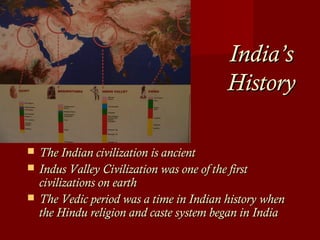
 The Indian civilization is ancientThe Indian civilization is ancient
 Indus Valley Civilization was one of the firstIndus Valley Civilization was one of the first
civilizations on earthcivilizations on earth
 The Vedic period was a time in Indian history whenThe Vedic period was a time in Indian history when
the Hindu religion and caste system began in Indiathe Hindu religion and caste system began in India
Indian CultureIndian Culture
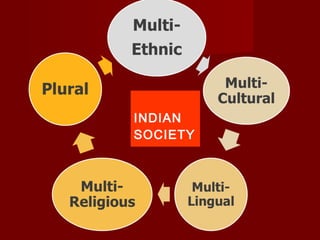
INDIAN
SOCIETY
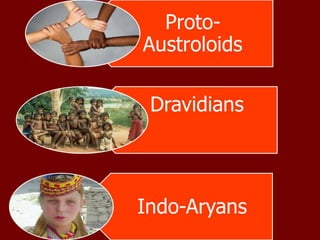
Proto-AustroloidsProto-Austroloids
Primitive tribes.Primitive tribes.
Contributions to art of pottery.Contributions to art of pottery.
Still uncivilised.Still uncivilised.
Kols, Santhals of ChotaKols, Santhals of Chota
Nagpur,Bhils of Rajasthan,Nagpur,Bhils of Rajasthan,
Todas of Nilgiris and Gonds ofTodas of Nilgiris and Gonds of
MPMP
Indo-AryansIndo-Aryans
Tall-statured.Tall-statured.
Long-headedLong-headed
Fine long- nosedFine long- nosed
Contributed to vedic literatureContributed to vedic literature
North-west part of India fromNorth-west part of India from
Kashmir to RajputanaKashmir to Rajputana
DravidiansDravidians
 Short-statured.Short-statured.
 Black / Dark complexion.Black / Dark complexion.
 Dark eyes .Dark eyes .
 Plentiful hairs.Plentiful hairs.
 Broad nose.Broad nose.
 Developed the city cultureDeveloped the city culture
 Southern India and Deccan Plateau.Southern India and Deccan Plateau.
Indo-MongoliansIndo-Mongolians
Short staturedShort statured
Yellow colouredYellow coloured
Snub- nosedSnub- nosed
Flat faceFlat face
Sikkim, Bhutan ,Almora andSikkim, Bhutan ,Almora and
Assam hillsAssam hills
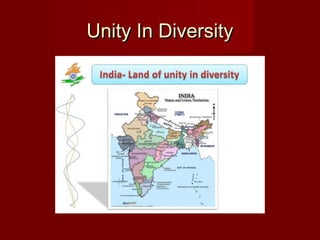
Unity In DiversityUnity In Diversity
Multi-CulturalMulti-Cultural
 Dress, crafts, Food, Arts, LuxuriesDress, crafts, Food, Arts, Luxuries
 Houses, diff building materialsHouses, diff building materials
 Music and DanceMusic and Dance
 Proto-Austroloids- art of pottery andProto-Austroloids- art of pottery and
totemismtotemism
 Dravidian-city culture and religiousDravidian-city culture and religious
practicespractices
 Indo-Aryan- vedic literatueIndo-Aryan- vedic literatue
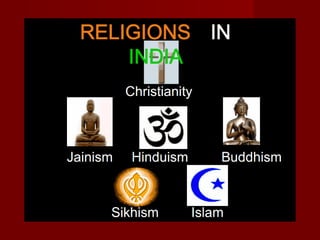
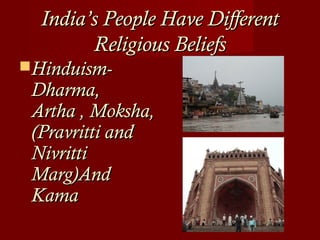
India’s People Have DifferentIndia’s People Have Different
Religious BeliefsReligious Beliefs
Hinduism-Hinduism-
Dharma,Dharma,
Artha , Moksha,Artha , Moksha,
(Pravritti and(Pravritti and
NivrittiNivritti
Marg)AndMarg)And
KamaKama
 Christianity- 10 commandmentsChristianity- 10 commandments
 Islam (Muslims)- 5 duties- belief in Allah, 5 timesIslam (Muslims)- 5 duties- belief in Allah, 5 times
prayers, giving Alms, Ramzan fasting, pilgimage toprayers, giving Alms, Ramzan fasting, pilgimage to
MeccaMecca
 Sikkhism- 5 Ks- Kesh, Kangha, Kara, Kirpan, andSikkhism- 5 Ks- Kesh, Kangha, Kara, Kirpan, and
KachhaKachha
 Buddhism- 85% buddhists in Maharashtra, GujaratBuddhism- 85% buddhists in Maharashtra, Gujarat
And RajasthanAnd Rajasthan
 Jainism- Followers of Lord MahaviraJainism- Followers of Lord Mahavira
 Judaism- Torah is holiest book of Jews as told to MosesJudaism- Torah is holiest book of Jews as told to Moses
on Mount Sinai. 50% lives in Manipur and Mizoramon Mount Sinai. 50% lives in Manipur and Mizoram
 Zorastrianism – Zend Avesta is holy book of ParseesZorastrianism – Zend Avesta is holy book of Parsees
Demographic CompositionDemographic Composition
 2.4% (32.9 lakh sq km ) land area2.4% (32.9 lakh sq km ) land area
 17.5% of world population17.5% of world population
 60% lives in UP, Maharashtra, Bihar, West60% lives in UP, Maharashtra, Bihar, West
bengal, MP and Tamilnadu.bengal, MP and Tamilnadu.
 50% is below 25years and 65% is below50% is below 25years and 65% is below
35 years35 years
 UP tops with 199.6 million followed byUP tops with 199.6 million followed by
Maharashtra with 112.4, followed by BiharMaharashtra with 112.4, followed by Bihar
Linguistic DiversityLinguistic Diversity
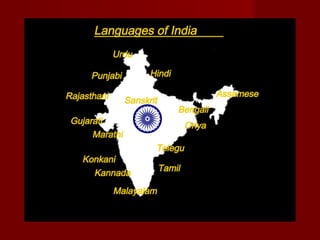
 1652 Languages Are There But Constitution1652 Languages Are There But Constitution
Recognised 22 Major Languages.Recognised 22 Major Languages.
 Indo- Aryan Family : North And Western India-Indo- Aryan Family : North And Western India-
Hindi, Marathi, Gujarati,punjabi, SindhiHindi, Marathi, Gujarati,punjabi, Sindhi
 Dravidian Family: Southern India- Kannada,Dravidian Family: Southern India- Kannada,
Malayalam, Tamil, TelguMalayalam, Tamil, Telgu
 Sino- Tibetan: North Bihar, North Bengal, AndSino- Tibetan: North Bihar, North Bengal, And
North Assam- Sikkimese, Ladakhi, Sherpa,North Assam- Sikkimese, Ladakhi, Sherpa,
Bodo, Manipuri, TipraBodo, Manipuri, Tipra
 Austric: Munda Or Kol Group- Central, EasternAustric: Munda Or Kol Group- Central, Eastern
And North- Eastern India- Khasi, Nicobarese,And North- Eastern India- Khasi, Nicobarese,
Santhali, MundariSanthali, Mundari
Regional VariationsRegional Variations
 Literacy- High In Kerala(94%) Mizoram, TripuraLiteracy- High In Kerala(94%) Mizoram, Tripura
And Goa And Low In Bihar(64%) ArunachalAnd Goa And Low In Bihar(64%) Arunachal
Pradesh, Rajasthan And Jharkhand.Pradesh, Rajasthan And Jharkhand.
 Birth Rate And Death Rate- High Birth AndBirth Rate And Death Rate- High Birth And
Death Rate In Bimaru StatesDeath Rate In Bimaru States
 Urbanisation- High Rates In Goa And MizoramUrbanisation- High Rates In Goa And Mizoram
And Low In Madhya Pradesh And BiharAnd Low In Madhya Pradesh And Bihar
 Poverty – 37% Lives Below Poverty Line NowPoverty – 37% Lives Below Poverty Line Now
Declined To 21.9%- High In Orissa, Bihar AndDeclined To 21.9%- High In Orissa, Bihar And
Madhya PradeshMadhya Pradesh
 Infrastructural Development – Transport, Banking,Infrastructural Development – Transport, Banking,
Communication Etc . Lack Of 50% In BIMARU StatesCommunication Etc . Lack Of 50% In BIMARU States
 Unemployment – Over 10% In Most Literate Staes OfUnemployment – Over 10% In Most Literate Staes Of
Kerala , Goa, And TamilnaduKerala , Goa, And Tamilnadu
 Industrialisation – Good Progress In Maharashtra,Industrialisation – Good Progress In Maharashtra,
Gujarat, Tamil Nadu And Karnataka. Weak In KeralaGujarat, Tamil Nadu And Karnataka. Weak In Kerala
And Andra Pradesh.And Andra Pradesh.
 Income Inequalities- High In Bihar, Madhya Pradesh,Income Inequalities- High In Bihar, Madhya Pradesh,
Rajashtan And UpRajashtan And Up
 Gender Ratio- In Favour Of Males. Kerala Females OutGender Ratio- In Favour Of Males. Kerala Females Out
Number Males.Number Males.
 Life Expectancy- Bihar, Mp And Up – Low For FemalesLife Expectancy- Bihar, Mp And Up – Low For Females
And Andra Pradesh, Tamilnadu Karnataka is highAnd Andra Pradesh, Tamilnadu Karnataka is high
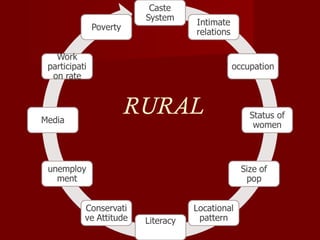
RURAL
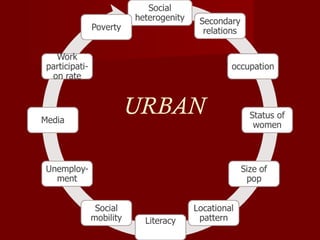
URBAN
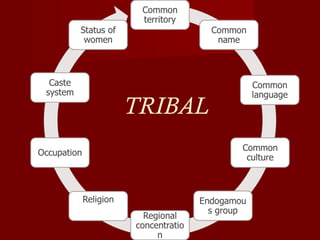
TRIBAL
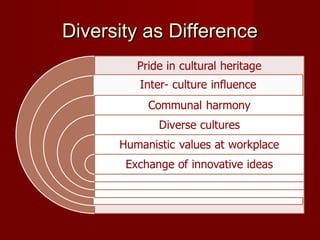
Diversity as DifferenceDiversity as Difference
India’s GovernmentIndia’s Government
India is theIndia is the
world’sworld’s
largestlargest
democracydemocracy
Indian society

Indian society

  • 1.
    PROF. PRITI THAKKAR SIESCOLLEGE OF COMMERCE AND ECONOMICS
  • 2.
    India’sIndia’s HistoryHistory  The Indiancivilization is ancientThe Indian civilization is ancient  Indus Valley Civilization was one of the firstIndus Valley Civilization was one of the first civilizations on earthcivilizations on earth  The Vedic period was a time in Indian history whenThe Vedic period was a time in Indian history when the Hindu religion and caste system began in Indiathe Hindu religion and caste system began in India
  • 3.
  • 4.
  • 6.
    Proto-AustroloidsProto-Austroloids Primitive tribes.Primitive tribes. Contributionsto art of pottery.Contributions to art of pottery. Still uncivilised.Still uncivilised. Kols, Santhals of ChotaKols, Santhals of Chota Nagpur,Bhils of Rajasthan,Nagpur,Bhils of Rajasthan, Todas of Nilgiris and Gonds ofTodas of Nilgiris and Gonds of MPMP
  • 7.
    Indo-AryansIndo-Aryans Tall-statured.Tall-statured. Long-headedLong-headed Fine long- nosedFinelong- nosed Contributed to vedic literatureContributed to vedic literature North-west part of India fromNorth-west part of India from Kashmir to RajputanaKashmir to Rajputana
  • 8.
    DravidiansDravidians  Short-statured.Short-statured.  Black/ Dark complexion.Black / Dark complexion.  Dark eyes .Dark eyes .  Plentiful hairs.Plentiful hairs.  Broad nose.Broad nose.  Developed the city cultureDeveloped the city culture  Southern India and Deccan Plateau.Southern India and Deccan Plateau.
  • 9.
    Indo-MongoliansIndo-Mongolians Short staturedShort statured YellowcolouredYellow coloured Snub- nosedSnub- nosed Flat faceFlat face Sikkim, Bhutan ,Almora andSikkim, Bhutan ,Almora and Assam hillsAssam hills
  • 10.
  • 12.
    Multi-CulturalMulti-Cultural  Dress, crafts,Food, Arts, LuxuriesDress, crafts, Food, Arts, Luxuries  Houses, diff building materialsHouses, diff building materials  Music and DanceMusic and Dance  Proto-Austroloids- art of pottery andProto-Austroloids- art of pottery and totemismtotemism  Dravidian-city culture and religiousDravidian-city culture and religious practicespractices  Indo-Aryan- vedic literatueIndo-Aryan- vedic literatue
  • 14.
    India’s People HaveDifferentIndia’s People Have Different Religious BeliefsReligious Beliefs Hinduism-Hinduism- Dharma,Dharma, Artha , Moksha,Artha , Moksha, (Pravritti and(Pravritti and NivrittiNivritti Marg)AndMarg)And KamaKama
  • 15.
     Christianity- 10commandmentsChristianity- 10 commandments  Islam (Muslims)- 5 duties- belief in Allah, 5 timesIslam (Muslims)- 5 duties- belief in Allah, 5 times prayers, giving Alms, Ramzan fasting, pilgimage toprayers, giving Alms, Ramzan fasting, pilgimage to MeccaMecca  Sikkhism- 5 Ks- Kesh, Kangha, Kara, Kirpan, andSikkhism- 5 Ks- Kesh, Kangha, Kara, Kirpan, and KachhaKachha  Buddhism- 85% buddhists in Maharashtra, GujaratBuddhism- 85% buddhists in Maharashtra, Gujarat And RajasthanAnd Rajasthan  Jainism- Followers of Lord MahaviraJainism- Followers of Lord Mahavira  Judaism- Torah is holiest book of Jews as told to MosesJudaism- Torah is holiest book of Jews as told to Moses on Mount Sinai. 50% lives in Manipur and Mizoramon Mount Sinai. 50% lives in Manipur and Mizoram  Zorastrianism – Zend Avesta is holy book of ParseesZorastrianism – Zend Avesta is holy book of Parsees
  • 16.
    Demographic CompositionDemographic Composition 2.4% (32.9 lakh sq km ) land area2.4% (32.9 lakh sq km ) land area  17.5% of world population17.5% of world population  60% lives in UP, Maharashtra, Bihar, West60% lives in UP, Maharashtra, Bihar, West bengal, MP and Tamilnadu.bengal, MP and Tamilnadu.  50% is below 25years and 65% is below50% is below 25years and 65% is below 35 years35 years  UP tops with 199.6 million followed byUP tops with 199.6 million followed by Maharashtra with 112.4, followed by BiharMaharashtra with 112.4, followed by Bihar
  • 18.
    Linguistic DiversityLinguistic Diversity 1652 Languages Are There But Constitution1652 Languages Are There But Constitution Recognised 22 Major Languages.Recognised 22 Major Languages.  Indo- Aryan Family : North And Western India-Indo- Aryan Family : North And Western India- Hindi, Marathi, Gujarati,punjabi, SindhiHindi, Marathi, Gujarati,punjabi, Sindhi  Dravidian Family: Southern India- Kannada,Dravidian Family: Southern India- Kannada, Malayalam, Tamil, TelguMalayalam, Tamil, Telgu  Sino- Tibetan: North Bihar, North Bengal, AndSino- Tibetan: North Bihar, North Bengal, And North Assam- Sikkimese, Ladakhi, Sherpa,North Assam- Sikkimese, Ladakhi, Sherpa, Bodo, Manipuri, TipraBodo, Manipuri, Tipra  Austric: Munda Or Kol Group- Central, EasternAustric: Munda Or Kol Group- Central, Eastern And North- Eastern India- Khasi, Nicobarese,And North- Eastern India- Khasi, Nicobarese, Santhali, MundariSanthali, Mundari
  • 19.
    Regional VariationsRegional Variations Literacy- High In Kerala(94%) Mizoram, TripuraLiteracy- High In Kerala(94%) Mizoram, Tripura And Goa And Low In Bihar(64%) ArunachalAnd Goa And Low In Bihar(64%) Arunachal Pradesh, Rajasthan And Jharkhand.Pradesh, Rajasthan And Jharkhand.  Birth Rate And Death Rate- High Birth AndBirth Rate And Death Rate- High Birth And Death Rate In Bimaru StatesDeath Rate In Bimaru States  Urbanisation- High Rates In Goa And MizoramUrbanisation- High Rates In Goa And Mizoram And Low In Madhya Pradesh And BiharAnd Low In Madhya Pradesh And Bihar  Poverty – 37% Lives Below Poverty Line NowPoverty – 37% Lives Below Poverty Line Now Declined To 21.9%- High In Orissa, Bihar AndDeclined To 21.9%- High In Orissa, Bihar And Madhya PradeshMadhya Pradesh
  • 20.
     Infrastructural Development– Transport, Banking,Infrastructural Development – Transport, Banking, Communication Etc . Lack Of 50% In BIMARU StatesCommunication Etc . Lack Of 50% In BIMARU States  Unemployment – Over 10% In Most Literate Staes OfUnemployment – Over 10% In Most Literate Staes Of Kerala , Goa, And TamilnaduKerala , Goa, And Tamilnadu  Industrialisation – Good Progress In Maharashtra,Industrialisation – Good Progress In Maharashtra, Gujarat, Tamil Nadu And Karnataka. Weak In KeralaGujarat, Tamil Nadu And Karnataka. Weak In Kerala And Andra Pradesh.And Andra Pradesh.  Income Inequalities- High In Bihar, Madhya Pradesh,Income Inequalities- High In Bihar, Madhya Pradesh, Rajashtan And UpRajashtan And Up  Gender Ratio- In Favour Of Males. Kerala Females OutGender Ratio- In Favour Of Males. Kerala Females Out Number Males.Number Males.  Life Expectancy- Bihar, Mp And Up – Low For FemalesLife Expectancy- Bihar, Mp And Up – Low For Females And Andra Pradesh, Tamilnadu Karnataka is highAnd Andra Pradesh, Tamilnadu Karnataka is high
  • 21.
  • 22.
  • 23.
  • 24.
  • 25.
    India’s GovernmentIndia’s Government Indiais theIndia is the world’sworld’s largestlargest democracydemocracy