PLACEMAKING IN THE
DIGITAL AGE
Susana Smith Bautista, Ph,D.
University of Southern California
November 22, 2013
How digital technology enables museums to mark their places in
new and innovative ways.
Technology frees us from the burden of identifying place as
permanent, fixed, and physical to embrace a new notion of place
as mobile, intangible, experiential, and changing.

Questions
• What are the new places that museums are occupying in
the digital age?
• How do museums act with their visitors in these new
places? How do these “new” places connect with the “old”
places?
• What are the new places that museum audiences are
occupying, and what are they doing there?
• How do museums “make” place, and is there a
homebase?
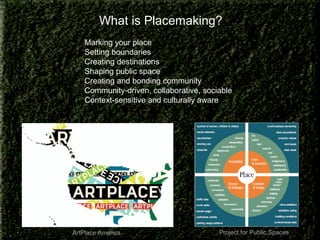
What is Placemaking?
1.
2.
3.
4.
5.
6.
7.

Marking your place
Setting boundaries
Creating destinations
Shaping public space
Creating and bonding community
Community-driven, collaborative, sociable
Context-sensitive and culturally aware

ArtPlace America

Project for Public Spaces
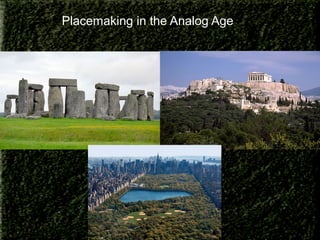
Placemaking in the Analog Age
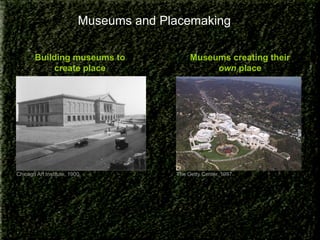
Museums and Placemaking
Building museums to
create place

Chicago Art Institute, 1900

Museums creating their
own place

The Getty Center, 1997
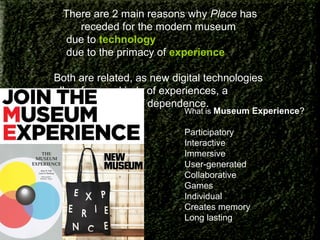
There are 2 main reasons why Place has
receded for the modern museum
1) due to technology
2) due to the primacy of experience
Both are related, as new digital technologies
allow for new kinds of experiences, a
continuous cycle of dependence.

What is Museum Experience?

Participatory
Interactive
Immersive
User-generated
Collaborative
Games
Individual
Creates memory
Long lasting
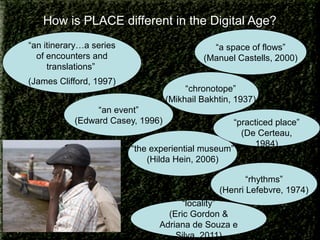
How is PLACE different in the Digital Age?
“an itinerary…a series
of encounters and
translations”

“a space of flows”
(Manuel Castells, 2000)

(James Clifford, 1997)

“chronotope”
(Mikhail Bakhtin, 1937)

“an event”
(Edward Casey, 1996)

“practiced place”
(De Certeau,
1984)
“the experiential museum”
(Hilda Hein, 2006)
“rhythms”
(Henri Lefebvre, 1974)
“locality”
(Eric Gordon &
Adriana de Souza e
Silva, 2011)
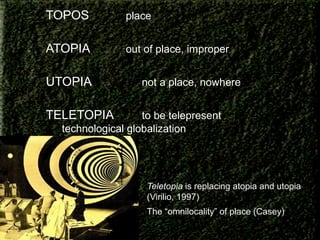
TOPOS

place

ATOPIA

out of place, improper

UTOPIA

not a place, nowhere

TELETOPIA

to be telepresent
technological globalization

Teletopia is replacing atopia and utopia
(Virilio, 1997)
The “omnilocality” of place (Casey)
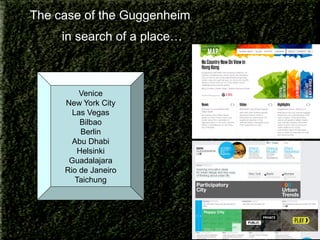
The case of the Guggenheim
in search of a place…

Venice
New York City
Las Vegas
Bilbao
Berlin
Abu Dhabi
Helsinki
Guadalajara
Rio de Janeiro
Taichung
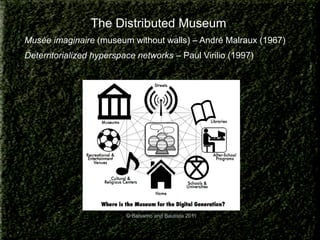
The Distributed Museum
Musée imaginaire (museum without walls) – André Malraux (1967)
Deterritorialized hyperspace networks – Paul Virilio (1997)

© Balsamo and Bautista 2011
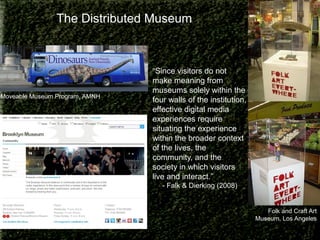
The Distributed Museum

Moveable Museum Program, AMNH

“Since visitors do not
make meaning from
museums solely within the
four walls of the institution,
effective digital media
experiences require
situating the experience
within the broader context
of the lives, the
community, and the
society in which visitors
live and interact.”
- Falk & Dierking (2008)

Folk and Craft Art
Museum, Los Angeles
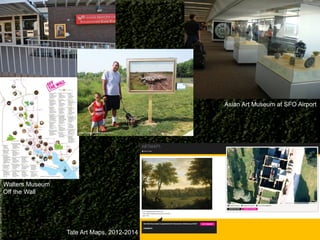
Asian Art Museum at SFO Airport

Walters Museum
Off the Wall

Tate Art Maps, 2012-2014
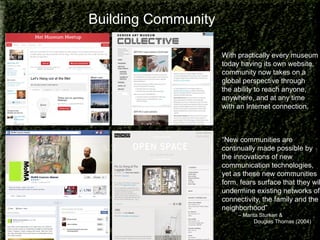
Building Community
With practically every museum
today having its own website,
community now takes on a
global perspective through
the ability to reach anyone,
anywhere, and at any time
with an Internet connection.

“New communities are
continually made possible by
the innovations of new
communication technologies,
yet as these new communities
form, fears surface that they wil
undermine existing networks of
connectivity, the family and the
neighborhood”
– Marita Sturken &
Douglas Thomas (2004)
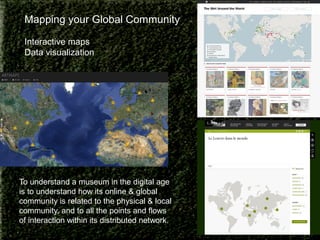
Mapping your Global Community
Interactive maps
Data visualization

To understand a museum in the digital age
is to understand how its online & global
community is related to the physical & local
community, and to all the points and flows
of interaction within its distributed network.
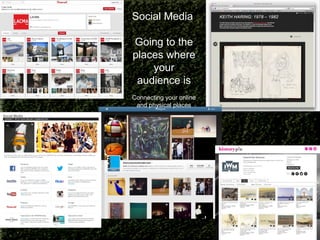
Social Media
Going to the
places where
your
audience is
Connecting your online
and physical places
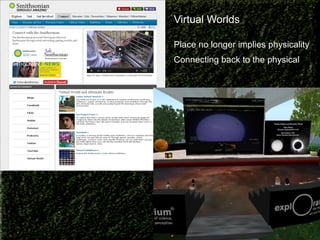
Virtual Worlds
Place no longer implies physicality
Connecting back to the physical
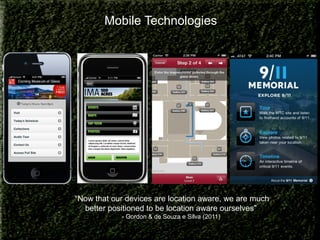
Mobile Technologies

“Now that our devices are location aware, we are much
better positioned to be location aware ourselves”
- Gordon & de Souza e Silva (2011)
The re-emergence of Place in the
Digital Age as Experience

“People still want a sense of place, a sense of
belonging, in a physical way”
– Katie Hafner (2004), Technological Visions

The re-materialization of digital techniques
(Bruno Latour, 2011)
“The expansion of digitality has enormously increased the
material dimension of networks: The more digital, the less
virtual and the more material a given activity becomes”
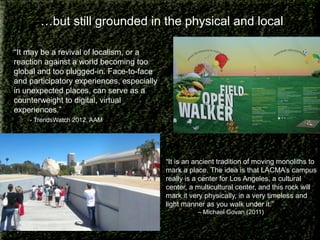
…but still grounded in the physical and local
“It may be a revival of localism, or a
reaction against a world becoming too
global and too plugged-in. Face-to-face
and participatory experiences, especially
in unexpected places, can serve as a
counterweight to digital, virtual
experiences.”
- TrendsWatch 2012, AAM

“It is an ancient tradition of moving monoliths to
mark a place. The idea is that LACMA’s campus
really is a center for Los Angeles, a cultural
center, a multicultural center, and this rock will
mark it very physically, in a very timeless and
light manner as you walk under it.”
– Michael Govan (2011)
Susana Smith Bautista, Ph.D.
ssbautista@yahoo.com
www.susanasmithbautista.com

Placemaking in the Digital Age

  • 1.
    PLACEMAKING IN THE DIGITALAGE Susana Smith Bautista, Ph,D. University of Southern California November 22, 2013
  • 2.
    How digital technologyenables museums to mark their places in new and innovative ways. Technology frees us from the burden of identifying place as permanent, fixed, and physical to embrace a new notion of place as mobile, intangible, experiential, and changing. Questions • What are the new places that museums are occupying in the digital age? • How do museums act with their visitors in these new places? How do these “new” places connect with the “old” places? • What are the new places that museum audiences are occupying, and what are they doing there? • How do museums “make” place, and is there a homebase?
  • 4.
    What is Placemaking? 1. 2. 3. 4. 5. 6. 7. Markingyour place Setting boundaries Creating destinations Shaping public space Creating and bonding community Community-driven, collaborative, sociable Context-sensitive and culturally aware ArtPlace America Project for Public Spaces
  • 5.
  • 6.
    Museums and Placemaking Buildingmuseums to create place Chicago Art Institute, 1900 Museums creating their own place The Getty Center, 1997
  • 7.
    There are 2main reasons why Place has receded for the modern museum 1) due to technology 2) due to the primacy of experience Both are related, as new digital technologies allow for new kinds of experiences, a continuous cycle of dependence. What is Museum Experience? Participatory Interactive Immersive User-generated Collaborative Games Individual Creates memory Long lasting
  • 8.
    How is PLACEdifferent in the Digital Age? “an itinerary…a series of encounters and translations” “a space of flows” (Manuel Castells, 2000) (James Clifford, 1997) “chronotope” (Mikhail Bakhtin, 1937) “an event” (Edward Casey, 1996) “practiced place” (De Certeau, 1984) “the experiential museum” (Hilda Hein, 2006) “rhythms” (Henri Lefebvre, 1974) “locality” (Eric Gordon & Adriana de Souza e Silva, 2011)
  • 9.
    TOPOS place ATOPIA out of place,improper UTOPIA not a place, nowhere TELETOPIA to be telepresent technological globalization Teletopia is replacing atopia and utopia (Virilio, 1997) The “omnilocality” of place (Casey)
  • 10.
    The case ofthe Guggenheim in search of a place… Venice New York City Las Vegas Bilbao Berlin Abu Dhabi Helsinki Guadalajara Rio de Janeiro Taichung
  • 11.
    The Distributed Museum Muséeimaginaire (museum without walls) – André Malraux (1967) Deterritorialized hyperspace networks – Paul Virilio (1997) © Balsamo and Bautista 2011
  • 12.
    The Distributed Museum MoveableMuseum Program, AMNH “Since visitors do not make meaning from museums solely within the four walls of the institution, effective digital media experiences require situating the experience within the broader context of the lives, the community, and the society in which visitors live and interact.” - Falk & Dierking (2008) Folk and Craft Art Museum, Los Angeles
  • 13.
    Asian Art Museumat SFO Airport Walters Museum Off the Wall Tate Art Maps, 2012-2014
  • 14.
    Building Community With practicallyevery museum today having its own website, community now takes on a global perspective through the ability to reach anyone, anywhere, and at any time with an Internet connection. “New communities are continually made possible by the innovations of new communication technologies, yet as these new communities form, fears surface that they wil undermine existing networks of connectivity, the family and the neighborhood” – Marita Sturken & Douglas Thomas (2004)
  • 15.
    Mapping your GlobalCommunity Interactive maps Data visualization To understand a museum in the digital age is to understand how its online & global community is related to the physical & local community, and to all the points and flows of interaction within its distributed network.
  • 16.
    Social Media Going tothe places where your audience is Connecting your online and physical places
  • 17.
    Virtual Worlds Place nolonger implies physicality Connecting back to the physical
  • 18.
    Mobile Technologies “Now thatour devices are location aware, we are much better positioned to be location aware ourselves” - Gordon & de Souza e Silva (2011)
  • 19.
    The re-emergence ofPlace in the Digital Age as Experience “People still want a sense of place, a sense of belonging, in a physical way” – Katie Hafner (2004), Technological Visions The re-materialization of digital techniques (Bruno Latour, 2011) “The expansion of digitality has enormously increased the material dimension of networks: The more digital, the less virtual and the more material a given activity becomes”
  • 20.
    …but still groundedin the physical and local “It may be a revival of localism, or a reaction against a world becoming too global and too plugged-in. Face-to-face and participatory experiences, especially in unexpected places, can serve as a counterweight to digital, virtual experiences.” - TrendsWatch 2012, AAM “It is an ancient tradition of moving monoliths to mark a place. The idea is that LACMA’s campus really is a center for Los Angeles, a cultural center, a multicultural center, and this rock will mark it very physically, in a very timeless and light manner as you walk under it.” – Michael Govan (2011)
  • 21.
    Susana Smith Bautista,Ph.D. ssbautista@yahoo.com www.susanasmithbautista.com