Segmentation, Targeting, Positioning
Urban Ladder
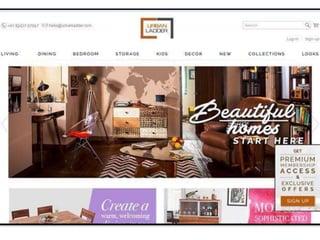
 Urban Ladder is a startup based out of Bangalore, India. The
furniture and home decor online store is headed by co-
founders CEO Ashish Goel, and COO Rajiv Srivatsa.
 The idea behind Urban Ladder is to make it easier
for customers to seek out and buy great furniture and home
decor.
 It currently offers an eclectic range comprising coffee tables,
side tables, dining tables, balcony sets, book-racks, display
units, wall racks, and a host of other products.
 The company is also a private label and makes its own
products. Most products are pre-built. Logistics and services
are handled directly by the company.
 It delivers in 29 cities across India, Tier1 and Tier 2.
 It started out with pan-India operations in July 2012 but
quickly rolled back to limited cities with a trained delivery and
Founders
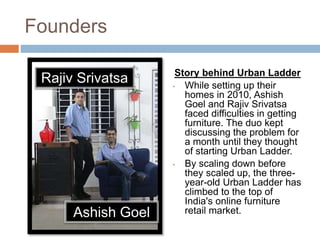
Story behind Urban Ladder
• While setting up their
homes in 2010, Ashish
Goel and Rajiv Srivatsa
faced difficulties in getting
furniture. The duo kept
discussing the problem for
a month until they thought
of starting Urban Ladder.
• By scaling down before
they scaled up, the three-
year-old Urban Ladder has
climbed to the top of
India's online furniture
retail market.Ashish Goel
Rajiv Srivatsa
Segmentation
Profile of the Target Customer
 Anyone buying a home in the Rs 40-50 lakh range, will
go for furniture in the Rs 4-5 lakh range, including
kitchen. That’s their target consumer.
 Anyone in the renovation cycle, who bought a house
several years ago, might want to re-do a room or several
rooms because they are bored of it. That is a big second
audience.
 And a big third audience is anyone moving cities among
the top 30 cities, who’s probably married but have still
not bought a home where they are looking to do-up
some part of their house. All these three are audiences
that span across the board.
Profile of the Target Customer
 Demographic: They are well-read, educated, earning
well, between ages of 23-45, who will buy online, and are
used to shopping online.
 Psychographic: They are design conscious, socially
aware and active, digitally buy stuff, including lifestyle
purchases from the likes of Myntra or Jabong.
 Behavioral: They are willing to buy big ticket items at a
single click and are finding it far more convenient to shop
online, as it ensures them to check out how the furniture
would look in their home settings.
 During the festive and wedding season, there is an
impressive surge in the number of buyers as this is the
time when people like to renovate their homes and buy
new furniture.
Targeting
Evaluating Market Segment:
Segment size and growth
 Furniture and Furnishings market in India has been
growing at a compounded annual rate of 6-8%.
 80% of this market is unorganized, with a large number
of unbranded players and local carpenters. The branded
organized retail segment account for 15% of the market
and 0.5% of the market is captured by online retailers, so
there is significant headroom for Urban Ladder to grow.
 India’s furniture market is estimated at $15-20 billion
(Rs.93,000-1,24,000 Cr.) in India alone.
 The furniture category is big and offers a great
opportunity as there isn’t a single player who is valued
for more than $100 million.
Segment Structural Attractiveness:
Level of Competition
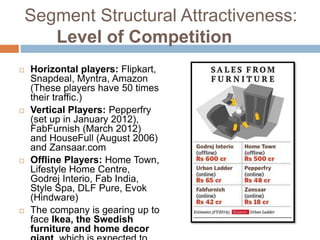
 Horizontal players: Flipkart,
Snapdeal, Myntra, Amazon
(These players have 50 times
their traffic.)
 Vertical Players: Pepperfry
(set up in January 2012),
FabFurnish (March 2012)
and HouseFull (August 2006)
and Zansaar.com
 Offline Players: Home Town,
Lifestyle Home Centre,
Godrej Interio, Fab India,
Style Spa, DLF Pure, Evok
(Hindware)
 The company is gearing up to
face Ikea, the Swedish
furniture and home decor
Segment Structural Attractiveness:
Company Objectives and
Resources
 Unlike competitors which operate as marketplaces,
Urban Ladder own processes end-to-end, which means
they control everything from selection of wood and
designing the furniture to the delivery of the purchase.
 While competitors offer wide product ranges, particularly
in home décor, they have stuck to a smaller offering and
kept inventory light, using buying behaviour data to
determine stock keeping units (SKU) and cross-promote
products.
 Strong supply chain understanding and distinctive
product differentiates them vis a vis their competitors.
Furniture is a complex product which the horizontal
players take as one more category, but, Urban Ladder
works on design, sourcing and quality of product.
 Today they have the highest consumer satisfaction score
in the industry.
Targeting Digitally Savvy, Urbane and
Design Concious Niche Audience through
technology
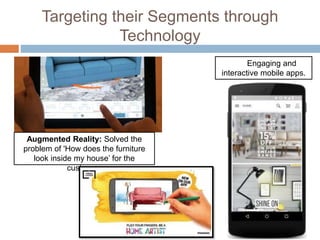
 To cater to the digitally savvy, urbane, design concious TG,
Urban Ladder has launched three apps – Urban Storage,
Living Spaces and Core Catalogue app, through which it
provides home trials, consultation and augmented reality of
5,000+ furniture.
 Furniture is a complicated product to buy. It’s a high touch
and feel product, and is non-standard. It’s also a higher ticket
purchase than most other purchases. The front-end
experience of the website and mobile apps help the
consumers easily discover, navigate and browse the selection
of products.
 It also helps consumers get true and rich information around
each product, and make them get a sense of both how the
product looks and fits in their house. Last but not the least it
gives them a sense of trust.
 Thus, the company is investing a lot on mobile technologies
to provide a great experience on areas like visualisation,
Targeting their Segments through
Technology
Augmented Reality: Solved the
problem of 'How does the furniture
look inside my house’ for the
customer.
Engaging and
interactive mobile apps.
Targeting for Mattress
Targeting Kids
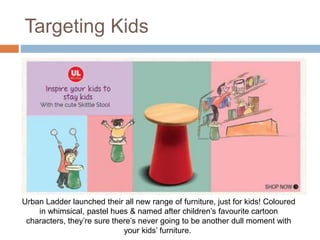
Urban Ladder launched their all new range of furniture, just for kids! Coloured
in whimsical, pastel hues & named after children’s favourite cartoon
characters, they’re sure there’s never going to be another dull moment with
your kids’ furniture.
POSITIONING
Positioning
 Ashish Goyal, Founder wants “Urban Ladder to
be the reason why homes across India look
beautiful.”
 They intend to be a complete home solutions
provider in the coming days. They want to
strengthen their décor portfolio to graduate from
an online furniture store to a one-stop home
furnishings provider.
 To position themselves, Urban Ladder had only
recently jumped into TV, but its initial efforts were
focused on broad-reaching demography.
 Founders believe organic growth coupled with
social media marketing and positive word-of-
mouth are sufficient for them.
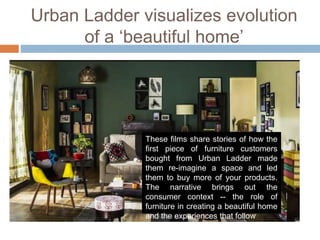
Urban Ladder visualizes evolution
of a ‘beautiful home’
These films share stories of how the
first piece of furniture customers
bought from Urban Ladder made
them re-imagine a space and led
them to buy more of your products.
The narrative brings out the
consumer context -- the role of
furniture in creating a beautiful home
and the experiences that follow
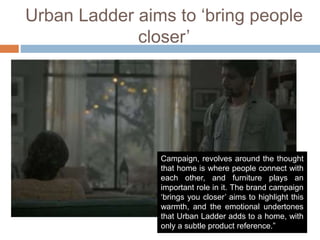
Urban Ladder aims to ‘bring people
closer’
Campaign, revolves around the thought
that home is where people connect with
each other, and furniture plays an
important role in it. The brand campaign
‘brings you closer’ aims to highlight this
warmth, and the emotional undertones
that Urban Ladder adds to a home, with
only a subtle product reference.”
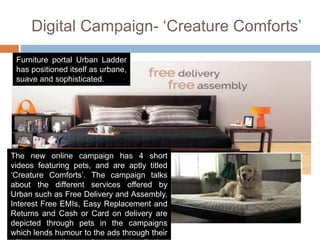
Digital Campaign- ‘Creature Comforts’
Furniture portal Urban Ladder
has positioned itself as urbane,
suave and sophisticated.
The new online campaign has 4 short
videos featuring pets, and are aptly titled
‘Creature Comforts’. The campaign talks
about the different services offered by
Urban such as Free Delivery and Assembly,
Interest Free EMIs, Easy Replacement and
Returns and Cash or Card on delivery are
depicted through pets in the campaigns
which lends humour to the ads through their
CSR Initiative
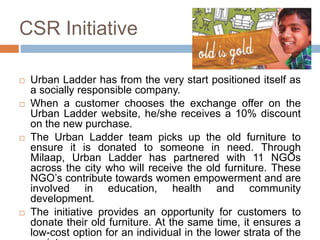
 Urban Ladder has from the very start positioned itself as
a socially responsible company.
 When a customer chooses the exchange offer on the
Urban Ladder website, he/she receives a 10% discount
on the new purchase.
 The Urban Ladder team picks up the old furniture to
ensure it is donated to someone in need. Through
Milaap, Urban Ladder has partnered with 11 NGOs
across the city who will receive the old furniture. These
NGO’s contribute towards women empowerment and are
involved in education, health and community
development.
 The initiative provides an opportunity for customers to
donate their old furniture. At the same time, it ensures a
low-cost option for an individual in the lower strata of the
Future Outlook
 The company is also setting up a comprehensive
team of design consultants to advise consumers
on furniture purchases and doing up their homes,
a service offered by smaller rivals HomeLane and
Livspace.
 Home buyers will be the initial targets for the new
categories.
 “They (home buyers) will give us the keys to their
houses and then 15 to 20 days later, allow us to
give them the experience of walking into their
dream home.”
Thank You

Urban Ladder

  • 1.
  • 3.
    Urban Ladder  UrbanLadder is a startup based out of Bangalore, India. The furniture and home decor online store is headed by co- founders CEO Ashish Goel, and COO Rajiv Srivatsa.  The idea behind Urban Ladder is to make it easier for customers to seek out and buy great furniture and home decor.  It currently offers an eclectic range comprising coffee tables, side tables, dining tables, balcony sets, book-racks, display units, wall racks, and a host of other products.  The company is also a private label and makes its own products. Most products are pre-built. Logistics and services are handled directly by the company.  It delivers in 29 cities across India, Tier1 and Tier 2.  It started out with pan-India operations in July 2012 but quickly rolled back to limited cities with a trained delivery and
  • 4.
    Founders Story behind UrbanLadder • While setting up their homes in 2010, Ashish Goel and Rajiv Srivatsa faced difficulties in getting furniture. The duo kept discussing the problem for a month until they thought of starting Urban Ladder. • By scaling down before they scaled up, the three- year-old Urban Ladder has climbed to the top of India's online furniture retail market.Ashish Goel Rajiv Srivatsa
  • 5.
  • 6.
    Profile of theTarget Customer  Anyone buying a home in the Rs 40-50 lakh range, will go for furniture in the Rs 4-5 lakh range, including kitchen. That’s their target consumer.  Anyone in the renovation cycle, who bought a house several years ago, might want to re-do a room or several rooms because they are bored of it. That is a big second audience.  And a big third audience is anyone moving cities among the top 30 cities, who’s probably married but have still not bought a home where they are looking to do-up some part of their house. All these three are audiences that span across the board.
  • 7.
    Profile of theTarget Customer  Demographic: They are well-read, educated, earning well, between ages of 23-45, who will buy online, and are used to shopping online.  Psychographic: They are design conscious, socially aware and active, digitally buy stuff, including lifestyle purchases from the likes of Myntra or Jabong.  Behavioral: They are willing to buy big ticket items at a single click and are finding it far more convenient to shop online, as it ensures them to check out how the furniture would look in their home settings.  During the festive and wedding season, there is an impressive surge in the number of buyers as this is the time when people like to renovate their homes and buy new furniture.
  • 8.
  • 9.
    Evaluating Market Segment: Segmentsize and growth  Furniture and Furnishings market in India has been growing at a compounded annual rate of 6-8%.  80% of this market is unorganized, with a large number of unbranded players and local carpenters. The branded organized retail segment account for 15% of the market and 0.5% of the market is captured by online retailers, so there is significant headroom for Urban Ladder to grow.  India’s furniture market is estimated at $15-20 billion (Rs.93,000-1,24,000 Cr.) in India alone.  The furniture category is big and offers a great opportunity as there isn’t a single player who is valued for more than $100 million.
  • 10.
    Segment Structural Attractiveness: Levelof Competition  Horizontal players: Flipkart, Snapdeal, Myntra, Amazon (These players have 50 times their traffic.)  Vertical Players: Pepperfry (set up in January 2012), FabFurnish (March 2012) and HouseFull (August 2006) and Zansaar.com  Offline Players: Home Town, Lifestyle Home Centre, Godrej Interio, Fab India, Style Spa, DLF Pure, Evok (Hindware)  The company is gearing up to face Ikea, the Swedish furniture and home decor
  • 11.
    Segment Structural Attractiveness: CompanyObjectives and Resources  Unlike competitors which operate as marketplaces, Urban Ladder own processes end-to-end, which means they control everything from selection of wood and designing the furniture to the delivery of the purchase.  While competitors offer wide product ranges, particularly in home décor, they have stuck to a smaller offering and kept inventory light, using buying behaviour data to determine stock keeping units (SKU) and cross-promote products.  Strong supply chain understanding and distinctive product differentiates them vis a vis their competitors. Furniture is a complex product which the horizontal players take as one more category, but, Urban Ladder works on design, sourcing and quality of product.  Today they have the highest consumer satisfaction score in the industry.
  • 12.
    Targeting Digitally Savvy,Urbane and Design Concious Niche Audience through technology  To cater to the digitally savvy, urbane, design concious TG, Urban Ladder has launched three apps – Urban Storage, Living Spaces and Core Catalogue app, through which it provides home trials, consultation and augmented reality of 5,000+ furniture.  Furniture is a complicated product to buy. It’s a high touch and feel product, and is non-standard. It’s also a higher ticket purchase than most other purchases. The front-end experience of the website and mobile apps help the consumers easily discover, navigate and browse the selection of products.  It also helps consumers get true and rich information around each product, and make them get a sense of both how the product looks and fits in their house. Last but not the least it gives them a sense of trust.  Thus, the company is investing a lot on mobile technologies to provide a great experience on areas like visualisation,
  • 13.
    Targeting their Segmentsthrough Technology Augmented Reality: Solved the problem of 'How does the furniture look inside my house’ for the customer. Engaging and interactive mobile apps.
  • 14.
  • 15.
    Targeting Kids Urban Ladderlaunched their all new range of furniture, just for kids! Coloured in whimsical, pastel hues & named after children’s favourite cartoon characters, they’re sure there’s never going to be another dull moment with your kids’ furniture.
  • 16.
  • 17.
    Positioning  Ashish Goyal,Founder wants “Urban Ladder to be the reason why homes across India look beautiful.”  They intend to be a complete home solutions provider in the coming days. They want to strengthen their décor portfolio to graduate from an online furniture store to a one-stop home furnishings provider.  To position themselves, Urban Ladder had only recently jumped into TV, but its initial efforts were focused on broad-reaching demography.  Founders believe organic growth coupled with social media marketing and positive word-of- mouth are sufficient for them.
  • 18.
    Urban Ladder visualizesevolution of a ‘beautiful home’ These films share stories of how the first piece of furniture customers bought from Urban Ladder made them re-imagine a space and led them to buy more of your products. The narrative brings out the consumer context -- the role of furniture in creating a beautiful home and the experiences that follow
  • 19.
    Urban Ladder aimsto ‘bring people closer’ Campaign, revolves around the thought that home is where people connect with each other, and furniture plays an important role in it. The brand campaign ‘brings you closer’ aims to highlight this warmth, and the emotional undertones that Urban Ladder adds to a home, with only a subtle product reference.”
  • 20.
    Digital Campaign- ‘CreatureComforts’ Furniture portal Urban Ladder has positioned itself as urbane, suave and sophisticated. The new online campaign has 4 short videos featuring pets, and are aptly titled ‘Creature Comforts’. The campaign talks about the different services offered by Urban such as Free Delivery and Assembly, Interest Free EMIs, Easy Replacement and Returns and Cash or Card on delivery are depicted through pets in the campaigns which lends humour to the ads through their
  • 21.
    CSR Initiative  UrbanLadder has from the very start positioned itself as a socially responsible company.  When a customer chooses the exchange offer on the Urban Ladder website, he/she receives a 10% discount on the new purchase.  The Urban Ladder team picks up the old furniture to ensure it is donated to someone in need. Through Milaap, Urban Ladder has partnered with 11 NGOs across the city who will receive the old furniture. These NGO’s contribute towards women empowerment and are involved in education, health and community development.  The initiative provides an opportunity for customers to donate their old furniture. At the same time, it ensures a low-cost option for an individual in the lower strata of the
  • 22.
    Future Outlook  Thecompany is also setting up a comprehensive team of design consultants to advise consumers on furniture purchases and doing up their homes, a service offered by smaller rivals HomeLane and Livspace.  Home buyers will be the initial targets for the new categories.  “They (home buyers) will give us the keys to their houses and then 15 to 20 days later, allow us to give them the experience of walking into their dream home.”
  • 23.