IKEA’s Business
IKEA is an international home product
company that designs and sells ready to
assemble furniture appliances and home
accessories
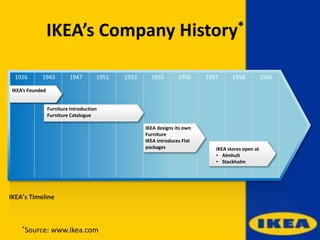
IKEA’s Founded
Furniture Introduction
Furniture Catalogue
196519581957195619551953194719431926 1951
IKEA designs its own
Furniture
IKEA introduces Flat
packages IKEA stores open at
• Almhult
• Stockholm
IKEA’s Timeline
IKEA’s Company History*
*Source: www.ikea.com
MARKETING ANALYSIS
SWOT, PEST and the Marketing Mix
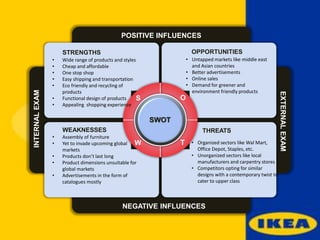
INTERNALEXAM
EXTERNALEXAM
SWOT
W
O
T
S
STRENGTHS
• Wide range of products and styles
• Cheap and affordable
• One stop shop
• Easy shipping and transportation
• Eco friendly and recycling of
products
• Functional design of products
• Appealing shopping experience
OPPORTUNITIES
• Untapped markets like middle east
and Asian countries
• Better advertisements
• Online sales
• Demand for greener and
environment friendly products
WEAKNESSES
• Assembly of furniture
• Yet to invade upcoming global
markets
• Products don’t last long
• Product dimensions unsuitable for
global markets
• Advertisements in the form of
catalogues mostly
THREATS
• Organized sectors like Wal Mart,
Office Depot, Staples, etc.
• Unorganized sectors like local
manufacturers and carpentry stores
• Competitors opting for similar
designs with a contemporary twist to
cater to upper class
POSITIVE INFLUENCES
NEGATIVE INFLUENCES
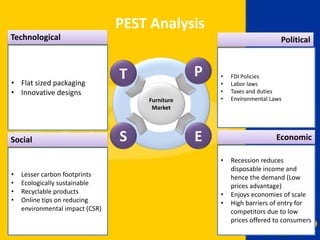
• FDI Policies
• Labor laws
• Taxes and duties
• Environmental LawsFurniture
Market
Political
P
• Recession reduces
disposable income and
hence the demand (Low
prices advantage)
• Enjoys economies of scale
• High barriers of entry for
competitors due to low
prices offered to consumers
EconomicE
• Lesser carbon footprints
• Ecologically sustainable
• Recyclable products
• Online tips on reducing
environmental impact (CSR)
Social S
• Flat sized packaging
• Innovative designs
Technological
T
PEST Analysis
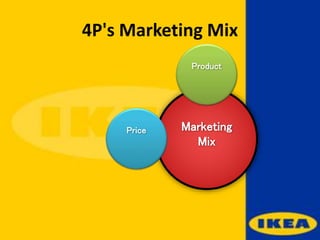
4P's Marketing Mix
Marketing
Mix
Product
Price
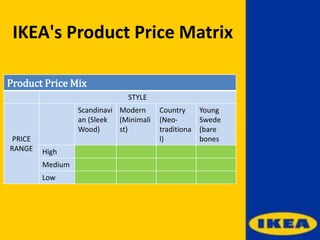
Product Price Mix
STYLE
PRICE
RANGE
Scandinavi
an (Sleek
Wood)
Modern
(Minimali
st)
Country
(Neo-
traditiona
l)
Young
Swede
(bare
bones
High
Medium
Low
IKEA's Product Price Matrix
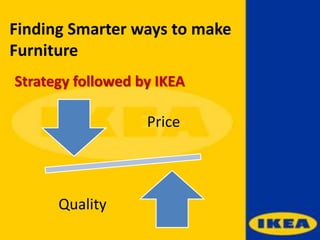
Finding Smarter ways to make
Furniture
Strategy followed by IKEA
Price
Quality
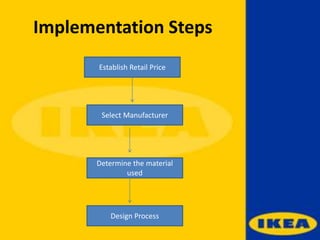
Implementation Steps
Establish Retail Price
Select Manufacturer
Determine the material
used
Design Process
Step 1: Establish Retail Price
• Using the matrix, IKEA would set the
price range.
• It would survey the competition to
establish a benchmark and then sets
its own price point 30-50% lower than
rivals.
Step 2: Select Manufacturer
• More than 1800 manufacturers in more
than 50 countries
• Build long term relationships
• IKEA circulates a description of proposed
product's specifications and target cost
and encouraged them to compete for the
production package
• Sometimes it might have different

product component from different
supplier
Step 3: Determine the material used
• Done by IKEA engineers
• Focus on cost efficiency
• Using different types of wood for a
single wooden product
• Using high quality materials on
furniture surfaces that were visible
and most likely undergo stress
• Using low quality material on surfaces
that were low stress and less visible to
the customer
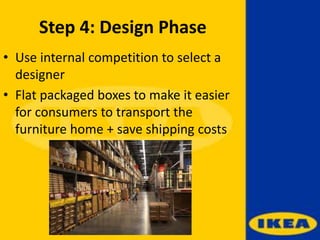
Step 4: Design Phase
• Use internal competition to select a
designer
• Flat packaged boxes to make it easier
for consumers to transport the
furniture home + save shipping costs
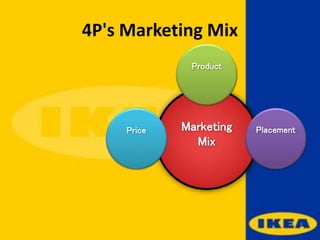
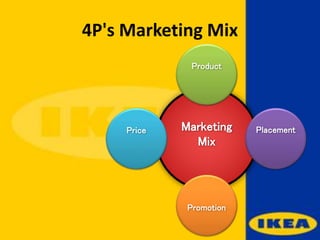
4P's Marketing Mix
Marketing
Mix
Product
Price Placement
Customer Experience at IKEA
• Bright and inviting experience for
customers
• Resembles Modern Theme park with
childcare centers
• Restaurants serving various delicacies
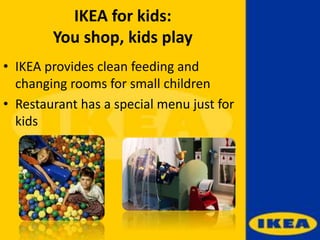
IKEA for kids:
You shop, kids play
• IKEA provides clean feeding and
changing rooms for small children
• Restaurant has a special menu just for
kids
4P's Marketing Mix
Marketing
Mix
Product
Promotion
Price Placement
Communication Strategy
for America
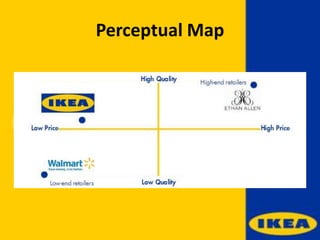
Perceptual Map
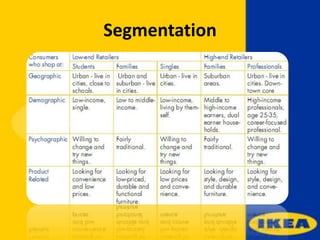
Segmentation
Video 1
Video 2
Video 3
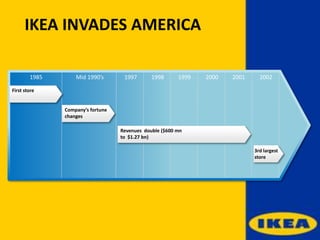
IKEA INVADES AMERICA
2002200120001999199819971985 Mid 1990’s
First store
Company’s fortune
changes
Revenues double ($600 mn
to $1.27 bn)
3rd largest
store
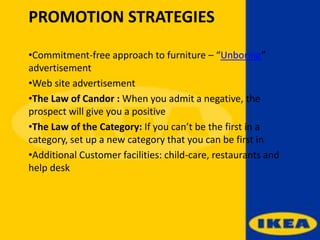
PROMOTION STRATEGIES
•Commitment-free approach to furniture – “Unboring”
advertisement
•Web site advertisement
•The Law of Candor : When you admit a negative, the
prospect will give you a positive
•The Law of the Category: If you can’t be the first in a
category, set up a new category that you can be first in
•Additional Customer facilities: child-care, restaurants and
help desk
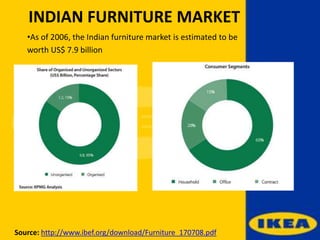
INDIAN FURNITURE MARKET
•As of 2006, the Indian furniture market is estimated to be
worth US$ 7.9 billion
Source: http://www.ibef.org/download/Furniture_170708.pdf
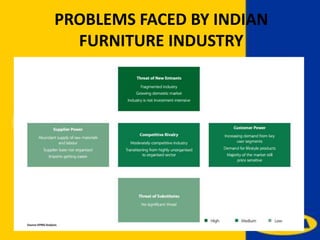
PROBLEMS FACED BY INDIAN
FURNITURE INDUSTRY
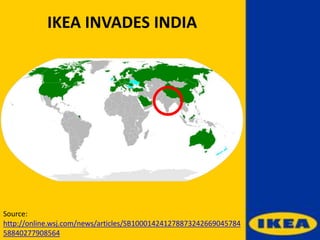
Source:
http://online.wsj.com/news/articles/SB100014241278873242669045784
58840277908564
IKEA INVADES INDIA
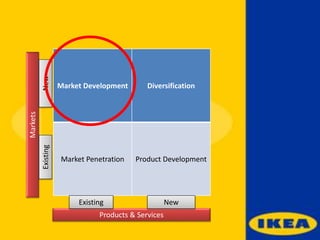
Market Development Diversification
Market Penetration Product Development
Products & Services
Markets
Existing New
ExistingNew
IKEA’S INITIAL COMMUNICATION
STRATEGY IN INDIA
Integrated Communications Strategy
IKEA’s communication strategy*
• Media Channels covered
– TVC
– Print
– Digital
• Pull Strategy
• CSR initiatives
Source:
http://www.livemint.com/Money/jI27GvmsK5stzTn61yyWUN/Ikeas-
consumer-challenge-in-India.html
IKEA Marketing Strategy Presentaion

IKEA Marketing Strategy Presentaion

  • 2.
    IKEA’s Business IKEA isan international home product company that designs and sells ready to assemble furniture appliances and home accessories
  • 3.
    IKEA’s Founded Furniture Introduction FurnitureCatalogue 196519581957195619551953194719431926 1951 IKEA designs its own Furniture IKEA introduces Flat packages IKEA stores open at • Almhult • Stockholm IKEA’s Timeline IKEA’s Company History* *Source: www.ikea.com
  • 4.
    MARKETING ANALYSIS SWOT, PESTand the Marketing Mix
  • 5.
    INTERNALEXAM EXTERNALEXAM SWOT W O T S STRENGTHS • Wide rangeof products and styles • Cheap and affordable • One stop shop • Easy shipping and transportation • Eco friendly and recycling of products • Functional design of products • Appealing shopping experience OPPORTUNITIES • Untapped markets like middle east and Asian countries • Better advertisements • Online sales • Demand for greener and environment friendly products WEAKNESSES • Assembly of furniture • Yet to invade upcoming global markets • Products don’t last long • Product dimensions unsuitable for global markets • Advertisements in the form of catalogues mostly THREATS • Organized sectors like Wal Mart, Office Depot, Staples, etc. • Unorganized sectors like local manufacturers and carpentry stores • Competitors opting for similar designs with a contemporary twist to cater to upper class POSITIVE INFLUENCES NEGATIVE INFLUENCES
  • 6.
    • FDI Policies •Labor laws • Taxes and duties • Environmental LawsFurniture Market Political P • Recession reduces disposable income and hence the demand (Low prices advantage) • Enjoys economies of scale • High barriers of entry for competitors due to low prices offered to consumers EconomicE • Lesser carbon footprints • Ecologically sustainable • Recyclable products • Online tips on reducing environmental impact (CSR) Social S • Flat sized packaging • Innovative designs Technological T PEST Analysis
  • 7.
  • 8.
    Product Price Mix STYLE PRICE RANGE Scandinavi an(Sleek Wood) Modern (Minimali st) Country (Neo- traditiona l) Young Swede (bare bones High Medium Low IKEA's Product Price Matrix
  • 9.
    Finding Smarter waysto make Furniture Strategy followed by IKEA Price Quality
  • 10.
    Implementation Steps Establish RetailPrice Select Manufacturer Determine the material used Design Process
  • 11.
    Step 1: EstablishRetail Price • Using the matrix, IKEA would set the price range. • It would survey the competition to establish a benchmark and then sets its own price point 30-50% lower than rivals.
  • 12.
    Step 2: SelectManufacturer • More than 1800 manufacturers in more than 50 countries • Build long term relationships • IKEA circulates a description of proposed product's specifications and target cost and encouraged them to compete for the production package • Sometimes it might have different product component from different supplier

  • 13.
    Step 3: Determinethe material used • Done by IKEA engineers • Focus on cost efficiency • Using different types of wood for a single wooden product • Using high quality materials on furniture surfaces that were visible and most likely undergo stress • Using low quality material on surfaces that were low stress and less visible to the customer
  • 14.
    Step 4: DesignPhase • Use internal competition to select a designer • Flat packaged boxes to make it easier for consumers to transport the furniture home + save shipping costs
  • 15.
  • 16.
    Customer Experience atIKEA • Bright and inviting experience for customers • Resembles Modern Theme park with childcare centers • Restaurants serving various delicacies
  • 17.
    IKEA for kids: Youshop, kids play • IKEA provides clean feeding and changing rooms for small children • Restaurant has a special menu just for kids
  • 19.
  • 20.
  • 21.
  • 22.
  • 23.
  • 25.
  • 27.
  • 29.
    IKEA INVADES AMERICA 2002200120001999199819971985Mid 1990’s First store Company’s fortune changes Revenues double ($600 mn to $1.27 bn) 3rd largest store
  • 30.
    PROMOTION STRATEGIES •Commitment-free approachto furniture – “Unboring” advertisement •Web site advertisement •The Law of Candor : When you admit a negative, the prospect will give you a positive •The Law of the Category: If you can’t be the first in a category, set up a new category that you can be first in •Additional Customer facilities: child-care, restaurants and help desk
  • 31.
    INDIAN FURNITURE MARKET •Asof 2006, the Indian furniture market is estimated to be worth US$ 7.9 billion Source: http://www.ibef.org/download/Furniture_170708.pdf
  • 32.
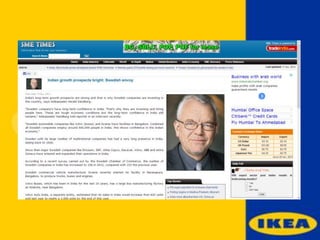
    PROBLEMS FACED BYINDIAN FURNITURE INDUSTRY
  • 33.
  • 34.
    Market Development Diversification MarketPenetration Product Development Products & Services Markets Existing New ExistingNew
  • 35.
    IKEA’S INITIAL COMMUNICATION STRATEGYIN INDIA Integrated Communications Strategy
  • 39.
    IKEA’s communication strategy* •Media Channels covered – TVC – Print – Digital • Pull Strategy • CSR initiatives Source: http://www.livemint.com/Money/jI27GvmsK5stzTn61yyWUN/Ikeas- consumer-challenge-in-India.html

Editor's Notes

  • #30 1985: problems beds and kitchen cabinets did not fit American sheets and appliances, sofas were too hard, dimensions in centimeters and not inches and kitchenware was too small for American serving-size Mid 1990’s 1997-2001 2002: 14 stores in USA serving 30 mn customers