








Management Skills
Change Management
Cagri Can Kaynak
Mahesa Krishna Raditya
Muhammad Umer Razi
Nils Niederheide
November 30, 2012
Introduction
Problem
Change
Conclusion
Introduction
Problem
Change
Conclusion
Introduction Problem
Change
Conclusion
Introduction Problem Change
Conclusion
Introduction Problem Change Conclusion
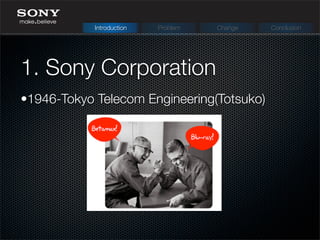
1. Sony Corporation
Introduction Problem Change Conclusion
•1946-Tokyo Telecom Engineering(Totsuko)
1. Sony Corporation
Introduction Problem Change Conclusion
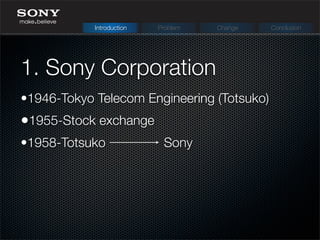
1. Sony Corporation
Introduction Problem Change Conclusion
•1946-Tokyo Telecom Engineering (Totsuko)
•1955-Stock exchange
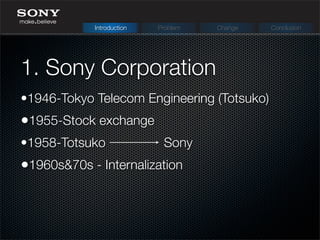
1. Sony Corporation
Introduction Problem Change Conclusion
•1946-Tokyo Telecom Engineering (Totsuko)
•1955-Stock exchange
•1958-Totsuko Sony
1. Sony Corporation
Introduction Problem Change Conclusion
•1946-Tokyo Telecom Engineering (Totsuko)
•1955-Stock exchange
•1958-Totsuko Sony
•1960s&70s - Internalization
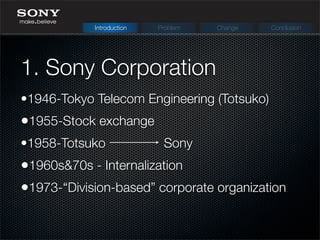
1. Sony Corporation
Introduction Problem Change Conclusion
•1946-Tokyo Telecom Engineering (Totsuko)
•1955-Stock exchange
•1958-Totsuko Sony
•1960s&70s - Internalization
•1973-“Division-based” corporate organization
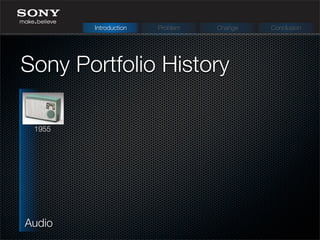
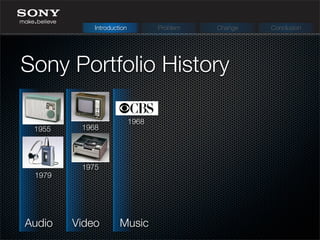
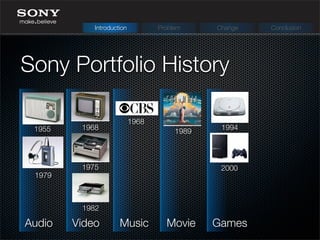
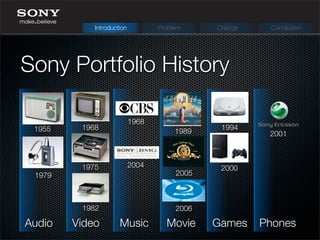
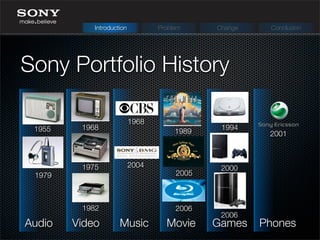
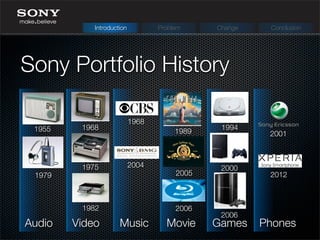
Sony Portfolio History
Introduction Problem Change Conclusion
Sony Portfolio History
Introduction Problem Change Conclusion
Audio
1955
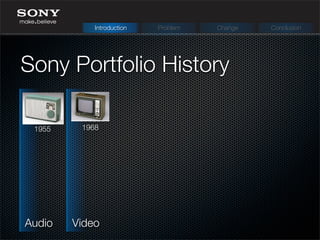
Sony Portfolio History
Introduction Problem Change Conclusion
Audio Video
1955 1968
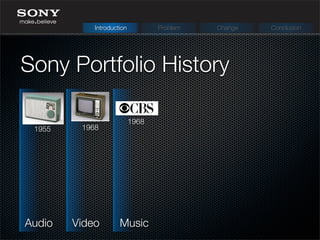
Sony Portfolio History
Introduction Problem Change Conclusion
Audio Video Music
1955 1968
1968
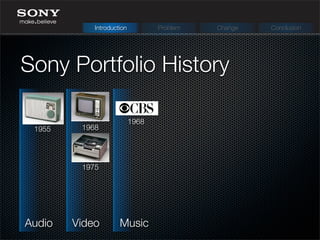
Sony Portfolio History
Introduction Problem Change Conclusion
Audio Video Music
1955 1968
1975
1968
Sony Portfolio History
Introduction Problem Change Conclusion
Audio Video Music
1955 1968
1975
1979
1968
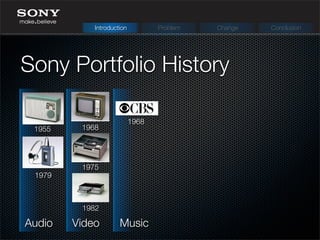
Sony Portfolio History
Introduction Problem Change Conclusion
Audio Video Music
1955 1968
1975
1979
1982
1968
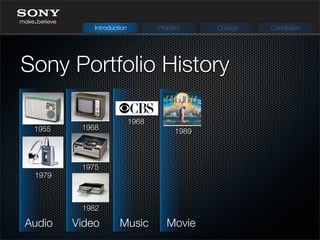
Sony Portfolio History
Introduction Problem Change Conclusion
Audio Video Music Movie
1955 1968
1975
1979
1982
1968
1989
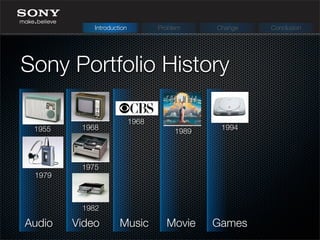
Sony Portfolio History
Introduction Problem Change Conclusion
Audio Video Music Movie Games
1955 1968
1975
1979
1982
1968
1989
1994
Sony Portfolio History
Introduction Problem Change Conclusion
Audio Video Music Movie Games
1955 1968
1975
1979
1982
1968
1989
1994
2000
Sony Portfolio History
Introduction Problem Change Conclusion
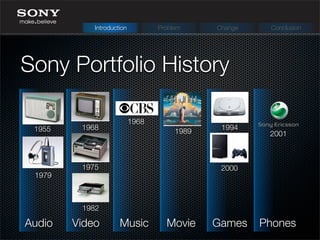
Audio Video Music Movie Games Phones
1955 1968
1975
1979
1982
1968
1989
1994
2000
2001
Sony Portfolio History
Introduction Problem Change Conclusion
Audio Video Music Movie Games Phones
1955 1968
1975
1979
1982
1968
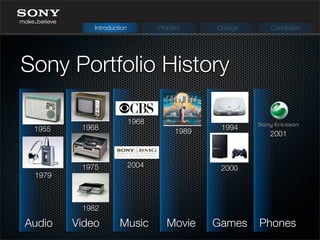
2004
1989
1994
2000
2001
Sony Portfolio History
Introduction Problem Change Conclusion
Audio Video Music Movie Games Phones
1955 1968
1975
1979
1982
1968
2004
1989
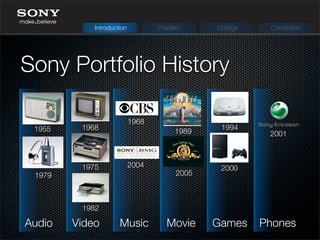
2005
1994
2000
2001
Sony Portfolio History
Introduction Problem Change Conclusion
Audio Video Music Movie Games Phones
1955 1968
1975
1979
1982
1968
2004
1989
2005
2006
1994
2000
2001
Sony Portfolio History
Introduction Problem Change Conclusion
Audio Video Music Movie Games Phones
1955 1968
1975
1979
1982
1968
2004
1989
2005
2006
1994
2000
2006
2001
Sony Portfolio History
Introduction Problem Change Conclusion
Audio Video Music Movie Games Phones
1955 1968
1975
1979
1982
1968
2004
1989
2005
2006
1994
2000
2006
2001
2012
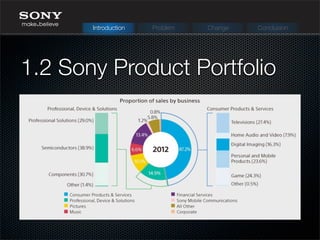
1.2 Sony Product Portfolio
Introduction Problem Change Conclusion
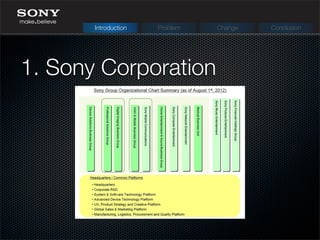
1. Sony Corporation
Introduction Problem Change Conclusion
•Work-life balance
•Hierarchical
•Centralized
•Think globally! Act locally!
1. Sony Corporation
Introduction Problem Change Conclusion
Introduction Change ConclusionIntroduction Problem
Introduction
2.1 External Forces
2.2 Internal Forces
2. Problem Analysis
Introduction Problem Change Conclusion
2.1 External Forces
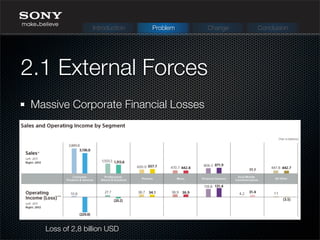
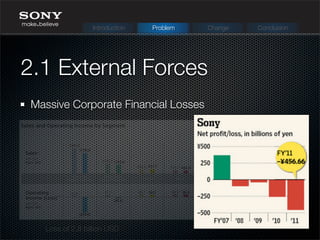
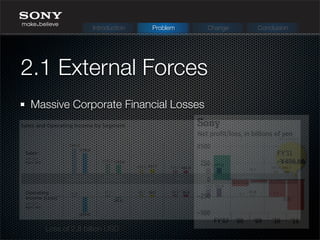
Massive Corporate Financial Losses
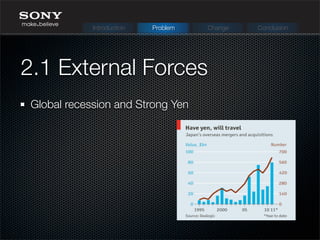
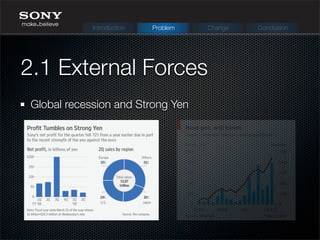
Global Recession and Strong Yen
Strong Competition
Introduction Problem Change Conclusion
Massive Corporate Financial Losses
2.1 External Forces
Loss of 2,8 billion USD
Introduction Problem Change Conclusion
Massive Corporate Financial Losses
2.1 External Forces
Loss of 2,8 billion USD
Introduction Problem Change Conclusion
Massive Corporate Financial Losses
2.1 External Forces
Loss of 2,8 billion USD
Introduction Problem Change Conclusion
Global recession and Strong Yen
2.1 External Forces
Introduction Problem Change Conclusion
Global recession and Strong Yen
2.1 External Forces
Introduction Problem Change Conclusion
Global Recession and Strong Yen
2.1 External Forces
Mr. Nobuyuki Oneda (2008)
Chief Financial Officer and Executive Vice President
Introduction Problem Change Conclusion
Global Recession and Strong Yen
2.1 External Forces
Mr. Nobuyuki Oneda (2008)
Chief Financial Officer and Executive Vice President
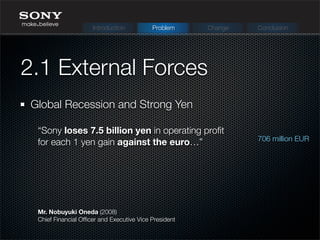
“Sony loses 7.5 billion yen in operating profit
for each 1 yen gain against the euro…”
Introduction Problem Change Conclusion
706 million EUR
Global Recession and Strong Yen
2.1 External Forces
Mr. Nobuyuki Oneda (2008)
Chief Financial Officer and Executive Vice President
“Sony loses 7.5 billion yen in operating profit
for each 1 yen gain against the euro…”
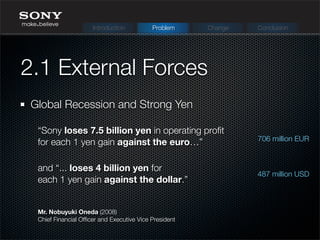
and “... loses 4 billion yen for
each 1 yen gain against the dollar.”
Introduction Problem Change Conclusion
487 million USD
706 million EUR
2.1 External Forces
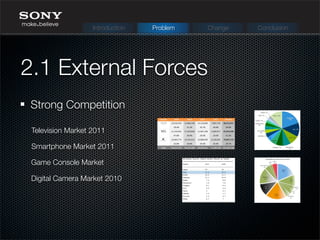
Strong Competition
Introduction Problem Change Conclusion
Digital Camera Market 2010
Game Console Market
Smartphone Market 2011
Television Market 2011
2.1 External Forces
Strong Competition
Introduction Problem Change Conclusion
Digital Camera Market 2010
Game Console Market
Smartphone Market 2011
Television Market 2011
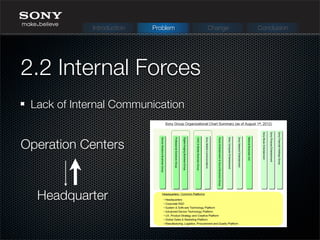
2.2 Internal Forces
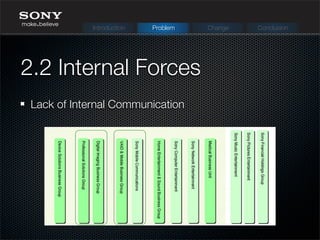
Lack of Internal Communication
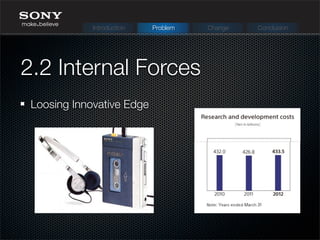
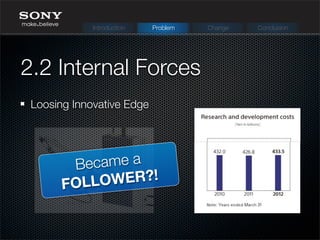
Loosing Innovative Edge
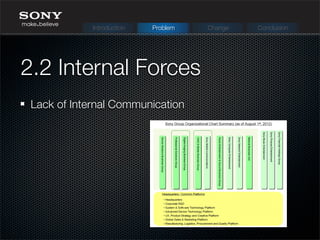
Lack of Internal Communication
2.2 Internal Forces
Introduction Problem Change Conclusion
Lack of Internal Communication
2.2 Internal Forces
Operation Centers
Headquarter
Introduction Problem Change Conclusion
Lack of Internal Communication
2.2 Internal Forces
Introduction Problem Change Conclusion
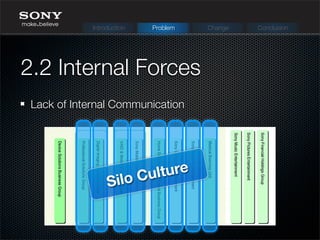
Lack of Internal Communication
2.2 Internal Forces
Silo Culture
Introduction Problem Change Conclusion
Loosing Innovative Edge
2.2 Internal Forces
Introduction Problem Change Conclusion
Loosing Innovative Edge
2.2 Internal Forces
Became a
FOLLOWER?!
Introduction Problem Change Conclusion
3. Change Management
3.1 Sony’s CEOs
3.2 8-Step Process for Leading Change
3.3 Current Situation / CEO
Introduction Problem Change Conclusion
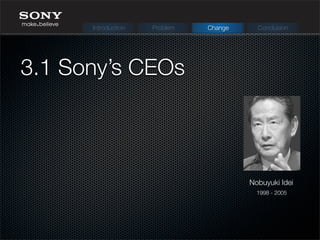
3.1 Sony’s CEOs
Introduction Problem Change Conclusion
3.1 Sony’s CEOs
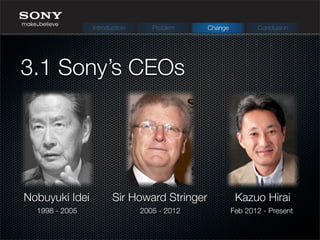
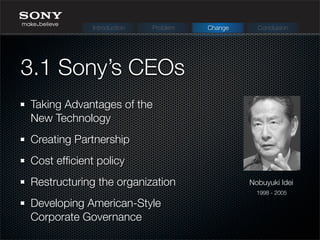
Nobuyuki Idei
1998 - 2005
Sir Howard Stringer
2005 - 2012
Kazuo Hirai
Feb 2012 - Present
Introduction Problem Change Conclusion
3.1 Sony’s CEOs
Nobuyuki Idei
1998 - 2005
Introduction Problem Change Conclusion
Taking Advantages of the
New Technology
Creating Partnership
Cost efficient policy
Restructuring the organization
Developing American-Style
Corporate Governance
3.1 Sony’s CEOs
Nobuyuki Idei
1998 - 2005
Introduction Problem Change Conclusion
Taking Advantages of the
New Technology
Creating Partnership
Cost efficient policy
Restructuring the organization
Developing American-Style
Corporate Governance
3.1 Sony’s CEOs
Nobuyuki Idei
1998 - 2005
Introduction Problem Change Conclusion
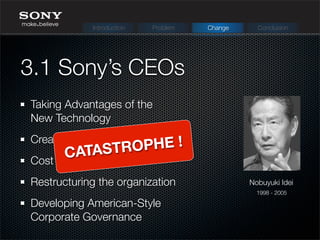
CATASTROPHE !
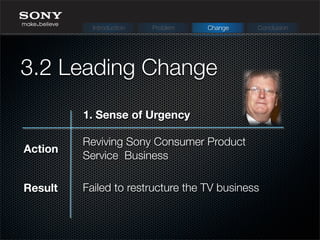
1. Sense of Urgency
Action
Result
3.2 Leading Change
Introduction Problem Change Conclusion
1. Sense of Urgency
Reviving Sony Consumer Product
Service Business
Failed to restructure the TV business
Action
Result
3.2 Leading Change
Introduction Problem Change Conclusion
2. Creating the
Guideline Coalition
Action
Result
3.2 Leading Change
Introduction Problem Change Conclusion
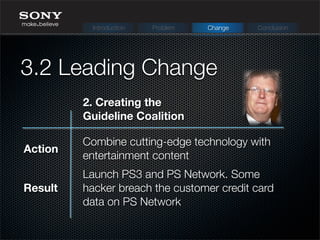
2. Creating the
Guideline Coalition
Combine cutting-edge technology with
entertainment content
Launch PS3 and PS Network. Some
hacker breach the customer credit card
data on PS Network
Action
Result
3.2 Leading Change
Introduction Problem Change Conclusion
Action
Result
3.2 Leading Change
Introduction Problem Change Conclusion
3. Developing a
Change Vision
Restructuring plan
Cut 10,000 jobs and shed a number of
unprofitable devision & product
Action
Result
3.2 Leading Change
Introduction Problem Change Conclusion
3. Developing a
Change Vision
Action
Result
3.2 Leading Change
Introduction Problem Change Conclusion
4. Communicating
the Vision for Buy-in
Focus on three core sector: Electronic,
Games & Entertainment
Success at Blue Ray Disk, PS3 and
Movie Picture
Action
Result
3.2 Leading Change
Introduction Problem Change Conclusion
4. Communicating
the Vision for Buy-in
Action
Result
3.2 Leading Change
Introduction Problem Change Conclusion
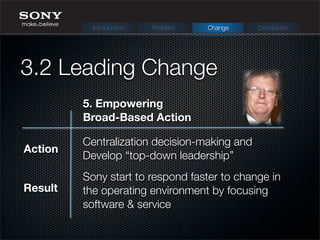
5. Empowering
Broad-Based Action
Centralization decision-making and
Develop “top-down leadership”
Sony start to respond faster to change in
the operating environment by focusing
software & service
Action
Result
3.2 Leading Change
Introduction Problem Change Conclusion
5. Empowering
Broad-Based Action
Action
Result
3.2 Leading Change
Introduction Problem Change Conclusion
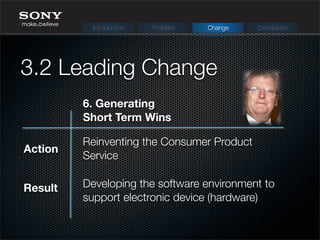
6. Generating
Short Term Wins
Reinventing the Consumer Product
Service
Developing the software environment to
support electronic device (hardware)
Action
Result
3.2 Leading Change
Introduction Problem Change Conclusion
6. Generating
Short Term Wins
Action
Result
3.2 Leading Change
Introduction Problem Change Conclusion
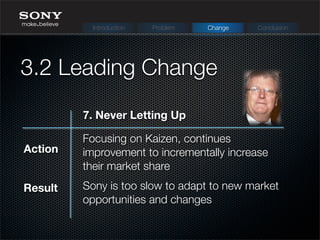
7. Never Letting Up
Focusing on Kaizen, continues
improvement to incrementally increase
their market share
Sony is too slow to adapt to new market
opportunities and changes
Action
Result
3.2 Leading Change
Introduction Problem Change Conclusion
7. Never Letting Up
Action
Result
3.2 Leading Change
Introduction Problem Change Conclusion
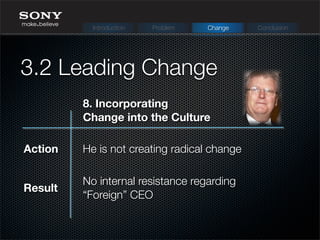
8. Incorporating
Change into the Culture
He is not creating radical change
No internal resistance regarding
“Foreign” CEO
Action
Result
3.2 Leading Change
Introduction Problem Change Conclusion
8. Incorporating
Change into the Culture
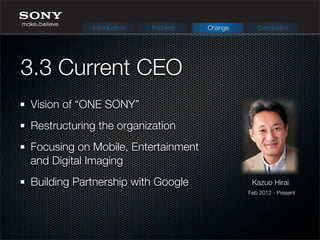
Vision of “ONE SONY”
Restructuring the organization
Focusing on Mobile, Entertainment
and Digital Imaging
Building Partnership with Google
3.3 Current CEO
Kazuo Hirai
Feb 2012 - Present
Introduction Problem Change Conclusion
4. Conclusion
4.1 Change Obstacle
4.2 Recommendations
Introduction Problem Change Conclusion
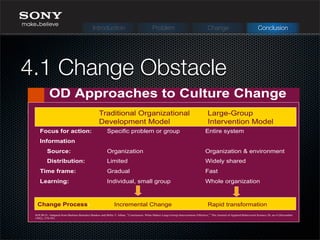
4.1 Change Obstacle
Copyright © 2005 by South-Western, a division of Thomson Learning. All rights reserved.
28
OD Approaches to Culture Change
Traditional Organizational
Development Model
Large-Group
Intervention Model
Change Process: Incremental Change Rapid transformation
Focus for action:
Information
Source:
Distribution:
Time frame:
Learning:
Specific problem or group
Organization
Limited
Gradual
Individual, small group
Entire system
Organization & environment
Widely shared
Fast
Whole organization
SOURCE: Adapted from Barbara Benedict Bunker and Billie T. Alban, Conclusion: What Makes Large Group Interventions Effective, The Journal of Applied Behavioral Science 28, no 4 (December
1992), 579-591.
Introduction Problem Change Conclusion
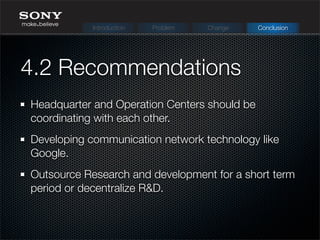
4.2 Recommendations
Headquarter and Operation Centers should be
coordinating with each other.
Developing communication network technology like
Google.
Outsource Research and development for a short term
period or decentralize R&D.
Introduction Problem Change Conclusion
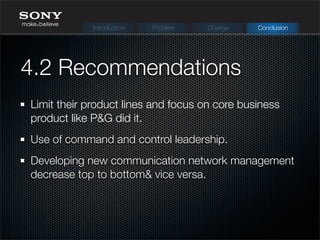
4.2 Recommendations
Limit their product lines and focus on core business
product like P&G did it.
Use of command and control leadership.
Developing new communication network management
decrease top to bottom& vice versa.
Introduction Problem Change Conclusion
Thank You!
November 30, 2012
Cagri Can Kaynak
Mahesa Krishna Raditya
Muhammad Umer Razi
Nils Niederheide

SONY - Change Management