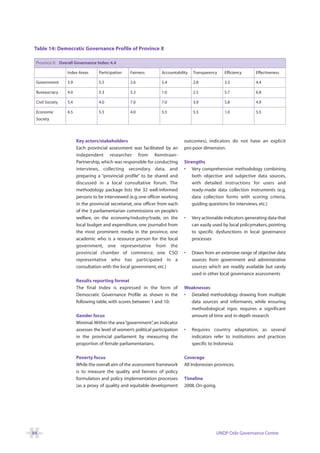
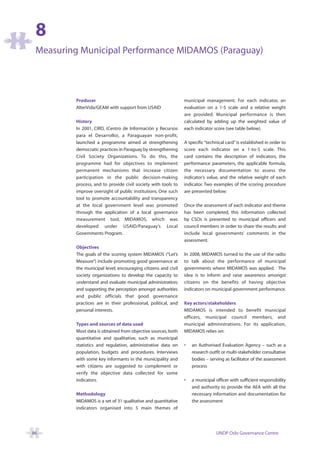
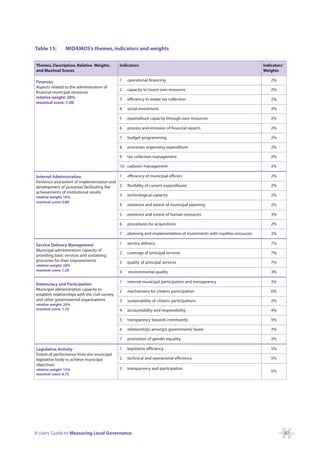
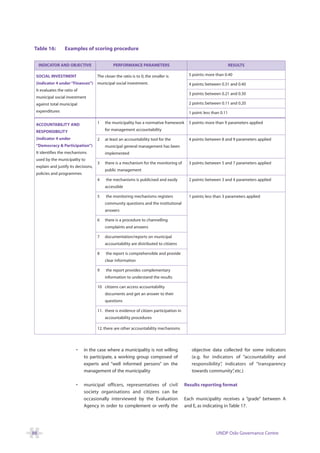
Measuring Local Governance
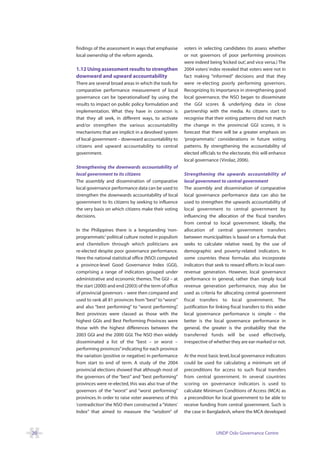
A Users’ Guide to


   A Users’ Guide to Measuring Local Governance   UNDP Oslo Governance Centre


                                                                          UNDP Oslo Governance Centre
A Users’ Guide to
Measuring Local Governance


UNDP Oslo Governance Centre
Contents

Acknowledgements                                                                     v


Acronyms                                                                            vi


Introduction                                                                        1


Chapter 1: Assessments of Local Governance                                          5

1.1    What is local governance?                                                    5
1.2    Universal priorities for local governance                                    6
1.3    Measuring local governance                                                   7
1.4    Why assessing local governance?                                              7
1.5    What can the assessment focus on?                                            8
1.6    Understanding the normative foundation of assessments                        9
1.7    Ensuring multi-stakeholder participation                                     11
1.8    What kinds of indicators should be used?                                     13
1.9    Selecting gender and poverty sensitive indicators                            14
1.10   What kinds of data should be used?                                           16
1.11   Key contextual factors influencing the policy impact of assessment results   18
1.12   Using assessment results to strengthen downward and upward accountability    20
1.13   Institutional opportunities for policy uptake                                22


Chapter 2: Voices from the Trenches                                                 27

2.1    Choosing an appropriate assessment framework                                 27
2.2    Dealing with complex methodologies                                           27
2.3    Adapting tools to local contexts                                             28
2.4    Managing a multiplicity of purposes                                          28
2.5    Maximizing participation in assessments                                      29
2.6    Incentives and sustainability                                                30


Chapter 3: Case Studies                                                             35

Case Study 1:   Facilitating commitment and involvement:
                The role of a local government official                             35
Case Study 2:   Moving from government to the concept of governance:
                The role of a civil society activist                                37
Case Study 3:   Balancing comparability with local relevance:
                The role of a representative from a local government association    39
Case Study 4:   Ensuring uptake of assessment findings in local policy-making:
                The role of a local elected government official                     41


References                                                                          43
Contents                          (continued)


Source Guide                                                                           45


How to use the Source Guide                                                            46


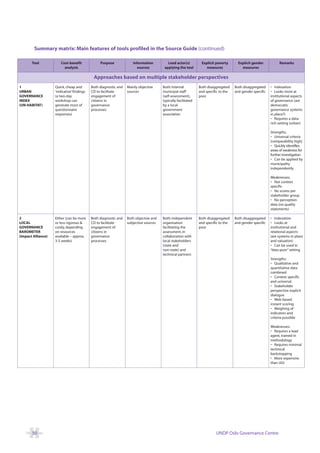
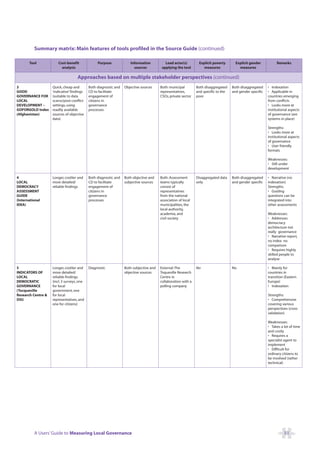
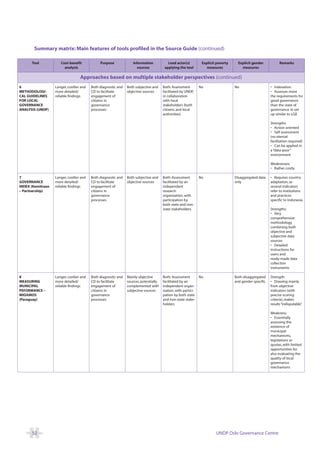
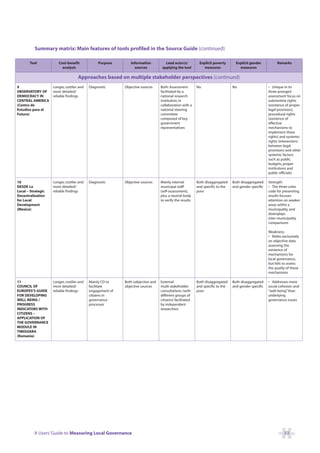
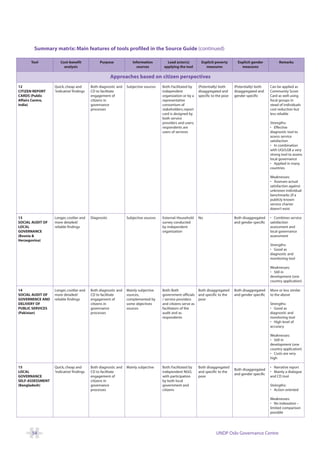
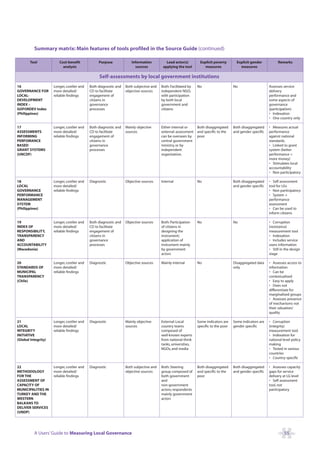
Summary matrix: Main features of tools profiled in the Source Guide                    49


Individual profiles of tools

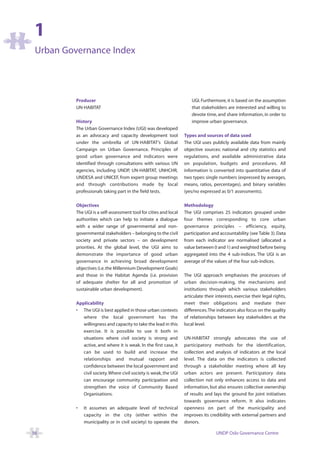
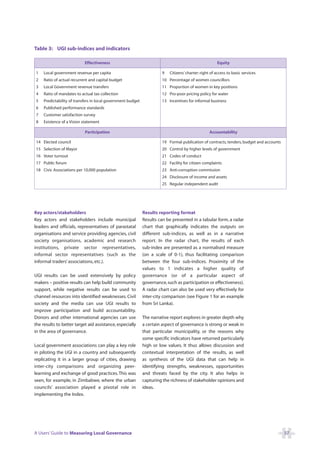
1.    Urban Governance Index (UN-HABITAT)                                              52
2.    Local Governance Barometer (Impact Alliance)                                     60
3.    Good Governance for Local Development – GOFORGOLD Index (Afghanistan)            66
4.    Local Democracy Assessment Guide (International IDEA)                            70
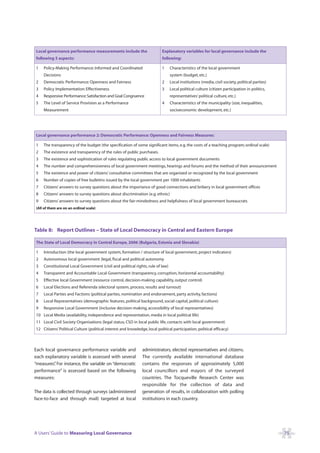
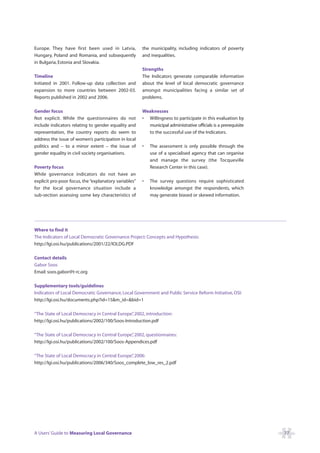
5.    Indicators of Local Democratic Governance (Tocqueville Research Centre & OSI)    74
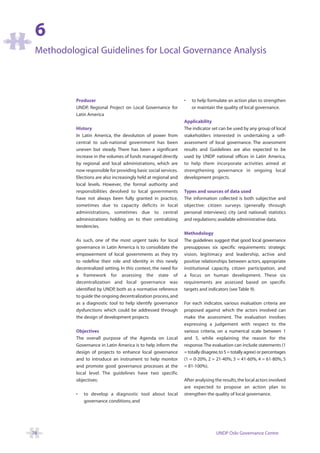
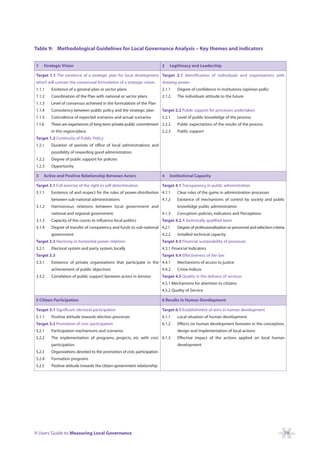
6.    Methodological Guidelines for Local Governance Analysis (UNDP)                   78
7.    Governance Index (Indonesia, Kemitraan - Partnership)                            81
8.    Measuring Municipal Performance – MIDAMOS (Paraguay)                             86
9.    Observatory of Democracy in Central America:
      System of Legal and Institutional Governance Indicators for
      Central America (Centro Estudios para el Futuro)                                 90
10.   Desde lo Local – Strategic Decentralization for Local Development (Mexico)       94
11.   Council of Europe’s Guide to Developing Well-Being & Progress Indicators with
      Citizens - Application of the Governance Module in Timisoara (Romania)           99
12.   Citizen Report Cards (Public Affairs Centre, India)                             103
13.   Social Audit of Local Governance (Bosnia and Herzegovina)                       107
14.   Social Audit of Governance and Delivery of Public Services (Pakistan)           111
15.   Local Governance Self-Assessment (Bangladesh)                                   117
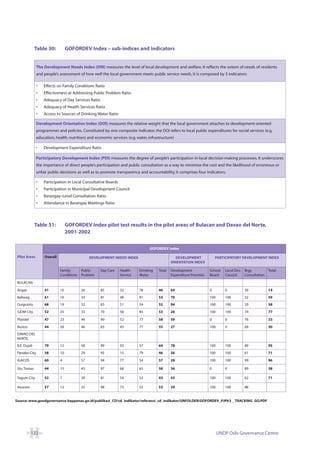
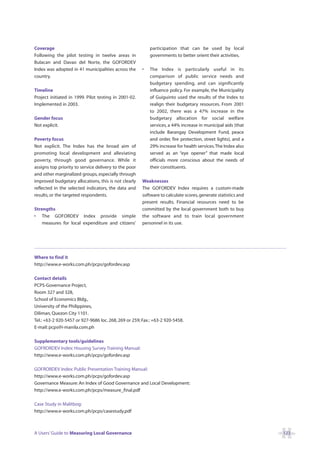
16.   Governance for Local Development Index - GOFORDEV Index (Philippines)           121
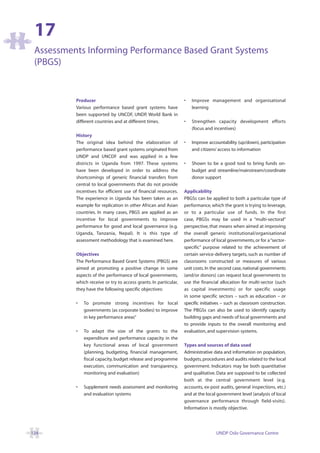
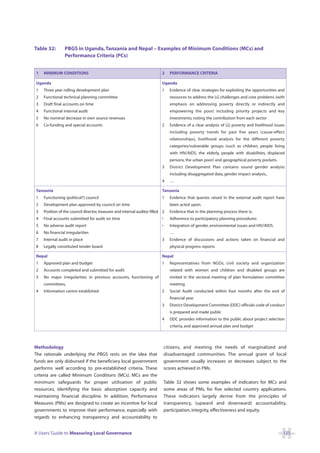
17.   Assessments Informing Performance Based Grant Systems (UNCDF)                   124
18.   Local Governance Performance Management System (Philippines)                    130
19.   Index of Responsibility, Transparency and Accountability (Macedonia)            135
20.   Standards of Municipal Transparency (Chile)                                     138
21.   Local Integrity Initiative (Global Integrity)                                   141
22.   Methodology for the Assessment of Capacity of Municipalities in
      Turkey and the Western Balkans to Deliver Basic Services (UNDP)                 146
Acknowledgements

AUTHORS
Alexandra Wilde
Shipra Narang
Marie Laberge
Luisa Moretto


EDITOR
Joachim Nahem, UNDP Oslo Governance Centre


ACKNOWLEDGEMENTS
We are indebted to Nenad Rava and Andrew Nickson who contributed to earlier versions of this guide,
and to Paul van Hoof (IDASA) who served as peer reviewer. We are also grateful to Lenni Montiel, UNDP
(Democratic Governance Group) and Henrik Fredborg Larsen, UNDP (Bangkok Regional Centre) for their
valuable contributions.

Finally, this Guide could not have been written without cooperation from our interviewees. We are grate-
ful for their insights and honesty in speaking with us.


LIST OF INTERVIEWEES
• Bishnu Puri, National Programme Manager, UNCDF-Decentralized Financing and Development
   Programme (DFDP) Nepal
• Daniel Cravacuore, La Universidad Nacional de Quilmes, Argentina
• Edgardo Bilsky, United Cities and Local Governments
• Fatmir Musa, UNDP Macedonia
• Gould Margot, Democracy Assessment and Analysis, International IDEA
• Ieva Lazareviciute, UNDP Brasil
• Irman Lanti, Indonesia Democracy Index. UNDP Indonesia
• Janey Lawry-White, Bureau for Crisis Prevention and Recovery, UNDP NY
• Krenar Loshi, UNDP Kosovo
• Laura Soria, Jefa Del Programo Urbano
• Nirinjaka Ramasinjatovo, Researcher/Trainer for the Local Governance Barometer
• Patrick Breard, expert on governance
• Sugumi Tanaka, Urban Development Branch, UN-HABITAT
• Tomislav Novovic UNDP Serbia
• Tony Verheijen, World Bank
• Velibor Popovic, UNDP Serbia


A Users’ Guide to Measuring Local Governance                                                               v
Acronyms

     CRC          Citizen Report Card

     CSO          Civil Society Organization

     DFID         Department for International Development

     FAO          UN Food and Agriculture Agency

     GOFORDEV     Governance for Local Development

     GGI          Good Governance Index

     GOFORGOLD    Good Governance for Local Development

     IDEA         International Institute for Democracy and Electoral Assistance

     LGB          Local Governance Barometer

     LGPMS        Local Governance Performance Management System

     LGSA         Local Governance Self-Assessment

     LGU          local government unit

     MCA          Minimum Conditions of Access

     MDG          Millennium Development Goal

     NGO          Non-Governmental Organization

     NSO          National Statistical Office

     OECD         Organisation for Economic Cooperation and Development

     OECD-DAC     OECD-Development Assistance Committee

     OGC          Oslo Governance Centre

     OSI          Open Society Institute

     PBGS         Performance Based Grant System

     PM           Performance Measure

     RRA          Rapid Rural Appraisal

     UCLG         United Cities and Local Governments

     UGI          Urban Governance Index

     UN           United Nations

     UNCDF        United Nations Capital Development Fund

     UNDP         United Nations Development Programme

     UN-HABITAT   United Nations Human Settlements Programme

     USAID        United States Agency for International Development


vi                                                               UNDP Oslo Governance Centre
Introduction

This Guide is intended to respond to an                       methodologies. At present, there is no resource
increasing demand from UNDP Country Offices                   that offers a global overview bringing together all
and a wide range of national stakeholders for                 existing approaches, tools and methods in this
guidance on the multiplicity of tools and                     area. The Source Guide is structured in a way to
methods that are being used to measure, assess                provide detailed information on each tool,
and monitor governance at the local level. The                including: history, objectives, applicability, the
Guide uses the term ‘local governance’ to cover the           types and sources of data used, methodology
range of governance issues that exist at the local            used, key actors/stakeholders involved, the results
level, including decentralisation of policies and             reporting format, the gender and poverty focus (if
processes, the roles and inter-relationships of               it has one), strengths and weaknesses, the
different actors and institutions, local democracy            coverage, timeline, the assumptions in the method,
and local government performance.                             contact details and any supplementary
                                                              tools/guidelines related to the particular
The Guide combines a discussion of theoretical/               instrument. The purpose of compiling and
conceptual issues relating to local governance                organising this information is to provide local
with a review of past and ongoing local                       governance actors and other stakeholders
governance assessment initiatives. The proliferation          engaged in strengthening governance at the local
of different assessments and indicators has                   level with a resource that can be drawn on for
resulted in some confusion about which tools to               developing new assessment tools or adapting
use, how they should be applied and their                     existing assessment approaches to their specific
weaknesses and strengths.                                     contexts. It is important to note that the Guide
                                                              does not provide a new measurement or
The Guide is essentially made up of two parts;                assessment methodology and it does not propose
the first part outlines what is meant by local                any kind of a blueprint.
governance and describes the kinds of issues,
concepts and priorities for local governance that             The Guide is an important component of UNDP’s
existing measurement and assessment tools tend                body of guidance on measuring and assessing
to focus on. This first part also provides guidance           democratic governance, developed as part of
on challenges and opportunities for assessing                 UNDP’s programme on Governance Assessments.1
local governance. The guidance is based on direct             This programme supports nationally owned
feedback from users of assessment tools, a                    processes for assessing and measuring democratic
distillation of good practices, and four illustrative         governance and aims to facilitate the
case study examples.                                          development of tools which have broad-based
                                                              national ownership, are pro-poor and gender-
The second part is the Source Guide, which is an              sensitive, and are designed to identify governance
inventory of existing assessment tools and                    weaknesses and capacity gaps.


1
    http://www.undp.org/oslocentre/flagship/democratic_governance_assessments.html


A Users’ Guide to Measuring Local Governance                                                                        1
What is the purpose of the Guide?                                   Who is the Guide for?
    The purpose of this Guide is to compile existing                    This Guide is primarily for local and national
    knowledge on decentralization and local                             stakeholders that are involved in local assessment
    governance measurement and provide a platform                       initiatives, and those who are working for relevant
    for understanding and navigating the array of                       international, national and local development
    assessment tools that exist, focusing on particular                 partners involved in such endeavors. 2 These
    issues such how to select amongst the existing (or                  include government officials, civil society
    decide to design a new set of ) local governance                    organizations, media          organizations, and
    indicators; how to deal with the preparation and                    multilateral and bilateral agencies.
    launching of an assessment; how to ensure the
    most inclusive process in implementing an
    assessment; how to ensure that the assessment is
    rigorous and scientifically sound; what to do with
    the results; and how to address problems of
    sustainability.


    2
        A particular category is the one including various researchers and analysts. As our analysis indicated, depending on the case and
        their personal competencies, they can be considered specialist and/or simply more actively involved stakeholders. For instance,
        some of them are involved in data collection and analysis, but either through group discussions or by compiling existing data –
        none of which requires deep knowledge and understanding of complex research techniques. Therefore, it is up to each one of
        them to evaluate the value of this Guide for their current and future work.


2                                                                                           UNDP Oslo Governance Centre
1
Assessments of Local Governance
1
Assessments of Local Governance

1.1 What is local governance?                                    needs, mediate their differences and exercise their
Governance is about the processes by which                       rights and obligations.
public policy decisions are made and
implemented. It is the result of interactions,                   The concepts of local governance and
relationships and networks between the different                 decentralization, at times used interchangeably,

sectors (government, public sector, private sector               are related but different concepts. Decentralization
and civil society) and involves decisions,                       is primarily a national political, legislative,
negotiation, and different power relations                       institutional and fiscal process. While local
between stakeholders to determine who gets                       governance can be affected by decentralization
what, when and how. The relationships between                    processes - for example, if local governments are
government and different sectors of society                      expected to provide services formerly offered
determine how things are done, and how services                  through national organisations - it may or may or
are provided. Governance is therefore much more                  may not be accompanied by decentralization,
than government or ‘good government’ and                         representative or participatory democratic
shapes the way a service or set of services are                  processes, transparency, accountability or other
planned, managed and regulated within a set of                   defining characteristics of ‘good’ local governance.
political social and economic systems.
                                                                 Local governance and decentralization evolve in a
In the last decade, the concept of ‘democratic local             constantly shifting political and social context.
governance’ has become an integral part of local                 Holistic methods of analysis—such as the open
development approaches, and has provided a                       systems approach - can yield a sense of how many
basic rationale for donors’ support to                           different elements interact and affect each other.
decentralization reforms and local governments’                  This approach entails prioritizing political analysis;
capacity building. The very concept of ‘good                     drawing connections across different aspects of
governance’ at local levels denotes quality,                     local governance and decentralization, as well as to
effectiveness and efficiency of local administration             related political and public reform processes; and
and public service delivery; the quality of local                encouraging coordinated action by development
public policy and decision-making procedures,                    partners.3
their inclusiveness, their transparency, and their
accountability; and the manner in which power                    UNDP has a holistic approach to defining the field
and authority are exercised at the local level.                  of local governance and decentralisation by using
                                                                 the concept of decentralized governance for
While local government is the essential                          development.4 Decentralized governance is not a
institutional building block for local governance,               panacea or a quick fix. The key to human
the wider governance sphere comprises a set of                   development-friendly decentralized governance is
state and non-state institutions, mechanisms and                 to ensure that the voices and concerns of the poor,
processes, through which public goods and                        especially women, help guide its design,
services are delivered to citizens and through                   implementation and monitoring.”5
which citizens can articulate their interests and


3
    “A Guide to Local Governance and Decentralization: Programme Experiences and Strategies from a UNDP E-Discussion” UNDP
                                                                                                                        ,
    (draft 2008)
4
    “Decentralized Governance for Development – A Combined Practice Note on Decentralization, Local Governance and Urban/Rural
    Development” UNDP, 2004
                  ,
5
    ““Decentralized Governance for Development – A Combined Practice Note on Decentralization, Local Governance and Urban/Rural
    Development” UNDP, 2004
                  ,


A Users’ Guide to Measuring Local Governance                                                                                      5
Decentralized governance for development is                               principle in decision-making, implementation
    considered to be a key area of democratic                                 and follow-up at the local level.
    governance which in turn is crucial to attaining
    human development and the Millennium                                 •    Local authorities should recognize the
    Development Goals (MDGs). For development                                 different constituencies within civil society and
    and governance to be fully responsive and                                 should strive to ensure that all are involved in
    representational, people and institutions must be                         the progressive development of their
    empowered at every level of society – national,                           communities and neighbourhoods.
    provincial, district, city, town and village.6
                                                                         •    The principle of non-discrimination should
    1.2 Universal priorities for local governance                             apply to all partners and to the collaboration
    There is growing interest among local authorities                         between national and regional governments,
    and international organizations in the definition of                      local authorities and civil society organizations.
    universal principles that can serve as a reference
    for decentralisation and local governance reform                     •    Representation of citizens in the management
    on a worldwide scale.7 These universal principles                         of local authority affairs should be reinforced
    and positions are salient to the development and                          by participation at all stages of the policy
    application of assessments in this area.                                  process, wherever practicable.

    The approval by UN Habitat of the Guidelines on                      •    With a view to consolidating civil engagement,
    Decentralisation and the Strengthening of Local                           local authorities should strive to adopt new
    Authorities in April 2007 was a major step forward                        forms of participation such as neighbourhood
    in this direction. The Guidelines draw their                              councils, community councils, e-democracy,
    inspiration from the European Charter of Local Self                       participatory budgeting, civil initiatives and
    Government (1985)8 and recognize that                                     referendums in as far as they are applicable in
    sustainable development is made possible by “the                          their specific context.
    effective decentralization of responsibilities, policy
    management, decision-making authority and                            •    Records and information should be
    sufficient resources, to local authorities, closest to,                   maintained and in principle made publicly
    and most representative of, their constituencies.”                        available not only to increase the efficiency of
                                                                              local authorities but also to make it possible for
    The guidelines integrate notions of governance                            citizens to enjoy their full rights and to ensure
    and democracy, representative democracy and                               their participation in local decision-making.
    participative democracy; they define the principles
    that govern the mandate of locally elected                           •    An increase in the functions allocated to local
    authorities and the powers and responsibilities of                        authorities should be accompanied by
    local authorities, based on the principle of                              measures to build up their capacity to exercise
    subsidiarity. In particular, it is stated that:                           those functions.

    •   The process of decentralization requires                         These universal and internationally recognized
        concerted efforts in capacity-building and                       imperatives for local governance reform should
        institutional reform and should therefore be                     act as a major anchor and reference for any
        associated with the strengthening of local                       assessment tool that purports to assess
        authorities.                                                     governance at the local level. The following
                                                                         sections explore the opportunities to meet this
    •   Participation through inclusiveness and                          challenge.
        empowerment of citizens shall be an underlying


    6
        “Decentralized Governance for Development – A Combined Practice Note on Decentralization, Local Governance and Urban/Rural
        Development” UNDP, 2004
                       ,
    7
        “First Global Report on Decentralization and Local Democracy” United Cities and Local Governments (UCLG) 2007
                                                                        ,
    8
        The Charter was adopted in 1985 by the Council of Europe and is ratified by 46 countries. It is the first document of a legal nature
        at an international level concerning the status and rights of local authorities.


6                                                                                             UNDP Oslo Governance Centre
1.3 Measuring local governance
There has been a significant growth in the types                •    To identify potential gaps and constraints in
of methods and tools that can improve                                local policy implementation;
understanding of governance deficits and
weaknesses and their relationship to development                •    To identify specific capacity development
outcomes.9 Local governance is not immune from                       needs and to monitor the results of capacity
this development and the Source Guide provides                       development efforts;
an overview of 22 globally applied tools focused
on the field of local governance alone. These                   •    To formulate change plans and solicit donor or
include assessment tools with complex sets of                        peer assistance for improving specific aspects
indicators, as well as less structured assessments of                of local governance;
a more descriptive nature.
                                                                •    To engage civil society and private sector in
Assessments in general can be an important tool                      local governance; and
for systemising information and data on a local
governance issue in particular or on the quality                •    To provide an objective account of achieve
of local governance in general. Furthermore,                         ments of local elected leaders (especially at
assessments provide a foundation for evidence                        times of re-elections), and thus building
based policy making and can empower reformers                        accountability.
within local government and civil society to
mobilise public opinion for reform.                             There are four main objectives to undertaking an
                                                                assessment of governance at the local level:
It is important to understand that assessing
local governance is not simply a subset or a                    1    Diagnostic: an assessment will be done to
disaggregated form of national governance                            identify a problem and its scope;
assessments. Assessments of local governance
provide important information on issues specific                2    Monitoring: an assessment will be done at
to the local level, such as policies vis-à-vis                       regular intervals to keep a check on the success
decentralisation, participation          and    local                or failure of an initiative, policy or programme;
accountability. One of the main differences
between a national and local governance                         3    Evaluation: an assessment will be done to
assessment is the greater proximity to the                           assess whether an initiative, policy or
real-world issues. In contrast to national                           programme has achieved its pre-defined
governance which often deals with systemic                           results and outcomes;
policies, the local level is in a daily and intensive
interaction with the citizens. Therefore, local                 4    Dialogue: an assessment will also serve to
assessments need to be much more sensitive to                        engage citizens and communities in informed
the particular needs of groups of stakeholders and                   discussions about shared goals and priorities.
certain segments in the local community.
                                                                Related to this, there are also different approaches
1.4 Why assessing local governance?                             in the use of an assessment. Some assessments are
The purpose for undertaking an assessment of local              based on an index in which dimensions or aspects
governance is of utmost importance as it is the                 of local governance are measured, aggregated,
purpose that decides the scope of the assessment,               weighted and recorded in an index. Multiple
the methodology and the indicators to be applied,               municipalities might be included in an index and
and not vice versa. Conducting an assessment                    can then be compared with each other. A useful
with vague objectives fails to provide proper                   example of this can be found in Indonesia’s
development outcomes and can be a waste of                      Governance Index calculated for each province
time and resources.                                             (see page 81 of the Source Guide).

Assessments of local governance are undertaken                  There are trade-offs with the different approaches.
for multiple purposes and reasons:                              A significant trade off is between comparability

9
    Christiane Arndt and Charles Oman,“Uses and Abuses of Governance Indicators” Development Centre Studies, OECD, 2006
                                                                               ,


A Users’ Guide to Measuring Local Governance                                                                              7
and local specificity. In order to assess multiple                      such as mayors, councils, committees, and
    municipalities on the same indicators, there is a risk                  administrative services; and in the organizations
    that the common indicators do not reflect or                            and activities of civil society.”10 It is characterized
    address issues that are particular to specific                          by regular and genuine elections, the rights of
    municipalities. However, a significant advantage                        majority, minority and opposition groups to
    with comparability is that it can act as a driver and                   influence policy-making processes, and
    an incentive for municipalities to out perform each                     respect for basic civil and political rights. The
    other and for pooling of know-how and learning.                         two major forms of local democracy are
                                                                            participatory (or direct) democracy, and
    1.5 What can the assessment focus on?                                   representative democracy. Local democracy
    In terms of measuring local governance, there are                       measurements should include both the formal
    four broad focus areas which an assessment might                        mechanisms that are in place for enabling
    address: local governance, decentralisation                             transparent, representative and accountable
    processes; local democracy, and local government.                       government, and the experiences and
                                                                            perceptions of citizens on these issues. Most of
    •    Decentralization indicators cut across quite                       the existing measurement frameworks (see the
         different issues reflecting the different kinds                    Source Guide) are still not supported by tested,
         of decentralisation processes and the varying                      verified and widely used methodologies. In
         degrees of devolution, deconcentration and                         many cases these are basically a variant of
         delegation that are related to those processes.                    broader (global) democracy indicators,
         For example, there are indicators for measuring                    disaggregated to apply to the local level.
         fiscal and administrative decentralization,
         indicators for measuring political decentralisation            •   Local government and local government
         and indicators focused on the enabling                             performance usually refers to outputs or results
         environment for decentralisation (institutions,                    achieved by local governments in service
         actors, laws and policies). The Guidelines on                      delivery, income and expenditure. Along those
         Local Governance and Decentralisation is a key                     lines, measuring municipal performance
         reference document for creating and formulating                    means assessing how well a municipality
         indicators on assessing decentralisation.                          performs when delivering goods and services
                                                                            to the public. The performance measures often
    •    Local governance assessments, especially the                       include the volume, quality, efficiency and out
         examples included in the Source Guide, aim to                      comes of providing these goods and
         be comprehensive in capturing the principal                        services11.” They might also include measures
         dimensions and determinants of governance                          focused on the institutional, financial and
         at the local level, such as the local political                    human resource capacities to develop,
         system (elections, human rights, rule of law,                      implement and monitor/evaluate its policies
         civil society, freedom of information),                            and programmes. Some of the measures may
         institutional issues (corruption, public                           address “multi-sectoral” aspects of performance,
         administration, financial management, public                       while others focus on particular sectors (the
         procurement, etc); social and cross-cutting                        first category being much more used around
         issues (the policy process, the budget process,                    the globe). There are numerous assessment
         revenue mobilization, service delivery, gender,                    tools for assessing local government
         environmental sustainability etc) and the                          performance,       service      delivery     and
         business/trade environment.                                        benchmarking.12 While there is a large volume
                                                                            of information available on these approaches,
    •    Local democracy, or democracy at the local                         these represent a totally different area of work
         level, is a concept to be understood in two                        from the work on indicators of decentralization
         ways – “in the institutions of local government,                   and local democracy.

    10
         International IDEA: “Democracy at the Local Level - The International IDEA Handbook on Participation, Representation, Conflict
         Management, and Governance” 2001
                                        ,
    11
         Bracegirdle:“International Experience in Municipal Performance Measurement” 3rd International Conference on Decentralization,
                                                                                          ,
         Manila, 2003
    12
         A number of these initiatives are listed in the paper titled “International Experience in Municipal Performance Measurement” by
         Peter Bracegirdle.


8                                                                                           UNDP Oslo Governance Centre
Box 1.        Financial performance systems in the Philippines

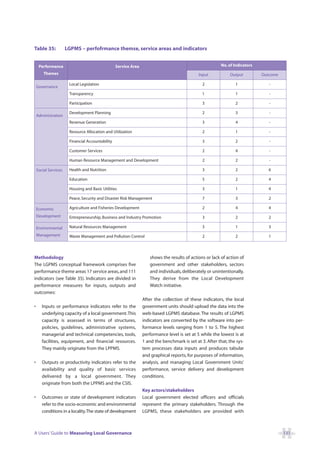
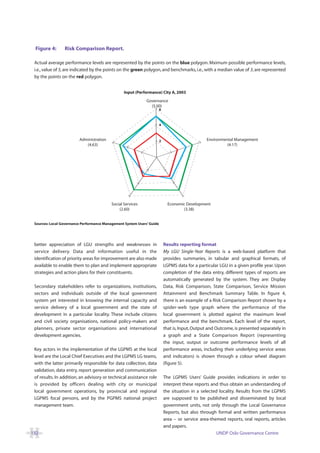
     The Philippines intends to roll out a national Local Governance Performance Management System and a Local
     Government Financial Performance Management System. The first is a web-based, self-diagnostic tool with 107
     indicators covering good governance, administration, delivery of social services, economic development and
     environmental management.The financial performance system has 14 indicators covering the quality and efficiency of
     revenue generation from both traditional and non-traditional sources, the quality and sustainability of expenditures,
     and debt management.


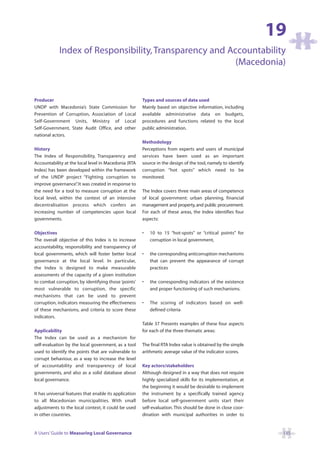
     Box 2.        Measuring responsibility, transparency and accountability at municipal level in Macedonia
                   to combat corruption13

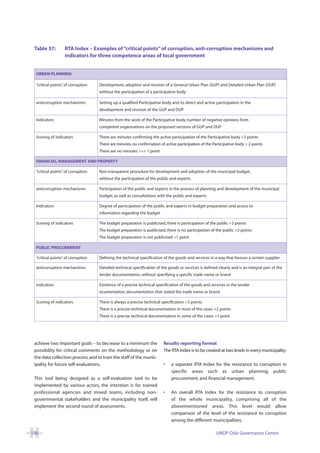
     In Macedonia, a methodology for measuring responsibility, transparency and accountability in the local self-
     government units was developed with the support of UNDP. This instrument assesses the “vulnerability” of local
     governments to unethical and corrupt practices by measuring their resistance to such practices. Compared with
     ‘traditional’ local corruption assessments measuring the incidence of corrupt practices, which is both politically
     sensitive and methodologically challenging, the Macedonian instrument diagnoses the effectiveness of anti-
     corruption mechanisms in three main areas of competence of local governments: 1) financial management, 2) urban
     planning, and 3) public procurement. The data generated is therefore highly “actionable” and policy relevant, which
     makes it attractive to local policymakers.

     Local stakeholders with responsibility and/or power for tackling corruption had a key role to play in the design of the
     instrument. This early involvement of relevant stakeholders was instrumental in securing their ownership of the
     assessment process and of the data generated, and in ensuring uptake of results in local policy-making.

     Users of public services, including citizens and CSOs, were also consulted in the process of designing the instrument, to
     identify corruption “hot spots” based on their experience and perceptions of corruption. Such inputs by citizens in the
     design phase allows for the instrument to have a focus on poverty and gender, through the identification of corruption
     hot spots of particular relevance to the poor, women and vulnerable groups. Citizens’ participation also enhances the
     potential for the assessment to serve as an effective accountability mechanisms between local governments and their
     constituencies.


Finally, an assessment of local governance might                  of governance at one point (baseline) and its
focus on a specific sector (health, education,                    desired state at another point (target). In that
business environment) or on a specific theme                      regard, indicators are used when there are two
(human rights, corruption etc). Although these                    things to compare: what is happening now and
assessments might not be holistic in covering the                 what should be happening. Every governance
full scope of local governance issues, many of the                assessment is therefore based on certain
good practice principles, in terms of method and                  assumptions about what is good and what is bad.
approaches outlined in this Guide, are still relevant.            This normative bias becomes clear after carefully
                                                                  examining the emphasis the assessment puts on
1.6 Understanding the normative                                   different governance principles (e.g. equity,
foundation of assessments                                         transparency, accountability) over other
A governance indicator is a measure that shows                    governance principles. .
the degree of alignment between the actual state

13
     Methodology for Measuring the Index of Responsibility, Transparency and Accountability at Local Level, UNDP Macedonia, 2009
     (http://europeandcis.undp.org/governance/show/E0665B63-F203-1EE9-B2237737A3E4BC48)


A Users’ Guide to Measuring Local Governance                                                                                       9
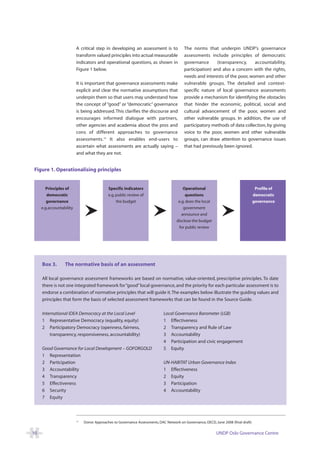
A critical step in developing an assessment is to               The norms that underpin UNDP’s governance
                          transform valued principles into actual measurable              assessments include principles of democratic
                          indicators and operational questions, as shown in               governance       (transparency,    accountability,
                          Figure 1 below.                                                 participation) and also a concern with the rights,
                                                                                          needs and interests of the poor, women and other
                          It is important that governance assessments make                vulnerable groups. The detailed and context-
                          explicit and clear the normative assumptions that               specific nature of local governance assessments
                          underpin them so that users may understand how                  provide a mechanism for identifying the obstacles
                          the concept of “good” or “democratic” governance                that hinder the economic, political, social and
                          is being addressed. This clarifies the discourse and            cultural advancement of the poor, women and
                          encourages informed dialogue with partners,                     other vulnerable groups. In addition, the use of
                          other agencies and academia about the pros and                  participatory methods of data collection, by giving
                          cons of different approaches to governance                      voice to the poor, women and other vulnerable
                          assessments.14 It also enables end-users to                     groups, can draw attention to governance issues
                          ascertain what assessments are actually saying –                that had previously been ignored.
                          and what they are not.


Figure 1. Operationalising principles


       Principles of                         Specific indicators                          Operational                                  Profile of
        democratic                           e.g. public review of                         questions                                  democratic
        governance                                the budget                           e.g. does the local                            governance
     e.g.accountability                                                                   government
                                                                                         announce and
                                                                                      disclose the budget
                                                                                       for public review


     Box 3.       The normative basis of an assessment

     All local governance assessment frameworks are based on normative, value-oriented, prescriptive principles. To date
     there is not one integrated framework for “good” local governance, and the priority for each particular assessment is to
     endorse a combination of normative principles that will guide it. The examples below illustrate the guiding values and
     principles that form the basis of selected assessment frameworks that can be found in the Source Guide.

     International IDEA Democracy at the Local Level                          Local Governance Barometer (LGB)
     1 Representative Democracy (equality, equity)                            1 Effectiveness
     2 Participatory Democracy (openness, fairness,                           2 Transparency and Rule of Law
         transparency, responsiveness, accountability)                        3 Accountability
                                                                              4 Participation and civic engagement
     Good Governance for Local Development – GOFORGOLD                        5 Equity
     1 Representation
     2 Participation                                                          UN-HABITAT Urban Governance Index
     3 Accountability                                                         1 Effectiveness
     4 Transparency                                                           2 Equity
     5 Effectiveness                                                          3 Participation
     6 Security                                                               4 Accountability
     7 Equity


                          14
                               Donor Approaches to Governance Assessments, DAC Network on Governance, OECD, June 2008 (final draft)

10                                                                                                           UNDP Oslo Governance Centre
Box 4.      The Normative basis of the Good Governance for Local Development (GOFORGOLD) tool in
                Afghanistan

    The GOFORGOLD tool (see page 66 of the Source Guide) aims to provide a snapshot of governance at the sub-national
    level, and more specifically, to help in monitoring the governance situation in the provinces, districts, municipalities, and
    villages against benchmarks and governance indicators.

    The GOFORGOLD indicators and reporting system is based in large measure on the UN-Habitat Urban Governance
    Index (UGI), but has been customised in order to respond to the current national and local governance context in
    Afghanistan. It is composed of 25 indicators, grouped under seven principles of good governance (representation,
    participation, accountability, transparency, effectiveness, security and equity). These principles have been adopted by
    Afghanistan’s Independent Directorate for Local Governance as part of its strategic framework. The overall conceptual
    framework is provided by the MDGs.


1.7 Ensuring multi-stakeholder participation            results into its local government monitoring
Assessments differ considerably in regard to the        mandate.
actors involved, as well as their different roles and
responsibilities in phases of the assessment            Local government associations: these are comprised
process. These phases are outlined in Box 5.            of local councils and express their collective voice
Stakeholders will be more active in some phases         in the national arena. Some illustrative examples of
than in others, depending on the assessment             their roles and objectives include: shaping public
approach and the origins and purposes of the            debate on local government issues, influencing
assessment. For each assessment tool in the             policy at the national level, supporting capacity
Source Guide, there is a description of the main        development that enables councils and their
stakeholder roles.                                      partnerships to deliver services, and working to
                                                        enhance      democratic      accountability     and
Common stakeholders in most assessments of              transparency in local government institutions.
local governance will include:                          Where these exist, they represent an important
                                                        stakeholder in assessments, especially in the
Local government representatives: local political       partnership promotion, development and policy
and administrative leaders are crucial for              implementation phases.
launching, implementing and using governance
assessments. In many cases, local government will       Civil society organisations: the existence of a vibrant
be in the driving seat of the assessment process.       and diverse civil society is an important indicator
Local government representatives are especially         of good local governance. CSOs also need to play
active in the partnership promoting, development,       a role in the assessment process including
action planning/dissemination and policy                identifying and drawing attention to local
implementation phases.                                  governance deficits as well as using their expertise
                                                        in data collection and analysis in the
Central government representatives: central             implementation of the assessment. CSOs are
government (e.g. the ministry/department                potentially active in every phase of the assessment
responsible for local government) is important in       process.
assessments as it has a significant role to play in
capacity development of local authorities               Community based organisations (CBO): these are a
including in the setting and maintaining of             form of organised citizens and have a role in
standards of performance, monitoring, ensuring          mobilising local people around community
the establishment of mechanisms of accountability,      development actions and to act as a watchdog.
and in the formulation and approval of local            CBOs are also important for reflecting the views,
government policy frameworks. The central               rights and interests of vulnerable or marginalised
government may be especially active in the policy       groups in communities.
implementation phase, integrating the assessment

A Users’ Guide to Measuring Local Governance                                                                                        11
Box 5.       Key phases in a governance assessment

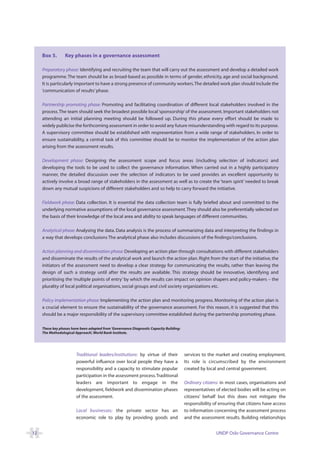
     Preparatory phase: Identifying and recruiting the team that will carry out the assessment and develop a detailed work
     programme. The team should be as broad-based as possible in terms of gender, ethnicity, age and social background.
     It is particularly important to have a strong presence of community workers.The detailed work plan should include the
     ‘communication of results’ phase.

     Partnership promoting phase: Promoting and facilitating coordination of different local stakeholders involved in the
     process. The team should seek the broadest possible local ‘sponsorship’ of the assessment. Important stakeholders not
     attending an initial planning meeting should be followed up. During this phase every effort should be made to
     widely publicise the forthcoming assessment in order to avoid any future misunderstanding with regard to its purpose.
     A supervisory committee should be established with respresentation from a wide range of stakeholders. In order to
     ensure sustainability, a central task of this committee should be to monitor the implementation of the action plan
     arising from the assessment results.

     Development phase: Designing the assessment scope and focus areas (including selection of indicators) and
     developing the tools to be used to collect the governance information. When carried out in a highly participatory
     manner, the detailed discussion over the selection of indicators to be used provides an excellent opportunity to
     actively involve a broad range of stakeholders in the assessment as well as to create the ‘team spirit’ needed to break
     down any mutual suspicions of different stakeholders and so help to carry forward the initiative.

     Fieldwork phase: Data collection. It is essential the data collection team is fully briefed about and committed to the
     underlying normative assumptions of the local governance assessment. They should also be preferentially selected on
     the basis of their knowledge of the local area and ability to speak languages of different communities.

     Analytical phase: Analysing the data. Data analysis is the process of summarizing data and interpreting the findings in
     a way that develops conclusions The analytical phase also includes discussions of the findings/conclusions.

     Action planning and dissemination phase: Developing an action plan through consultations with different stakeholders
     and disseminate the results of the analytical work and launch the action plan. Right from the start of the initiative, the
     initiators of the assessment need to develop a clear strategy for communicating the results, rather than leaving the
     design of such a strategy until after the results are available. This strategy should be innovative, identifying and
     prioritising the ‘multiple points of entry’ by which the results can impact on opinion shapers and policy-makers – the
     plurality of local political organisations, social groups and civil society organizations etc.

     Policy implementation phase: Implementing the action plan and monitoring progress. Monitoring of the action plan is
     a crucial element to ensure the sustainability of the governance assessment. For this reason, it is suggested that this
     should be a major responsibility of the supervisory committee established during the partnership promoting phase.

     These key phases have been adapted from ‘Governance Diagnostic Capacity Building:
     The Methodological Approach’, World Bank Institute.


                        Traditional leaders/institutions: by virtue of their             services to the market and creating employment.
                        powerful influence over local people they have a                 Its role is circumscribed by the environment
                        responsibility and a capacity to stimulate popular               created by local and central government.
                        participation in the assessment process.Traditional
                        leaders are important to engage in the                           Ordinary citizens: in most cases, organisations and
                        development, fieldwork and dissemination phases                  representatives of elected bodies will be acting on
                        of the assessment.                                               citizens’ behalf but this does not mitigate the
                                                                                         responsibility of ensuring that citizens have access
                        Local businesses: the private sector has an                      to information concerning the assessment process
                        economic role to play by providing goods and                     and the assessment results. Building relationships


12                                                                                                       UNDP Oslo Governance Centre
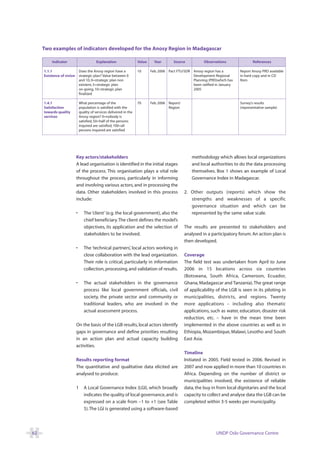
Box 6.         Different stakeholder roles in the Local Governance Barometer (LGB)

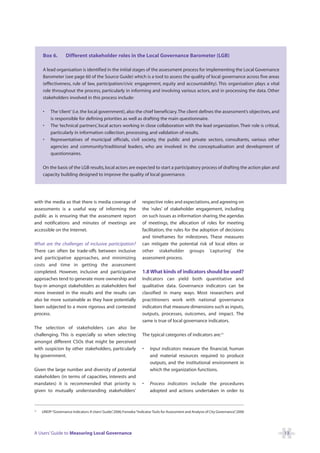
     A lead organisation is identified in the initial stages of the assessment process for implementing the Local Governance
     Barometer (see page 60 of the Source Guide) which is a tool to assess the quality of local governance across five areas
     (effectiveness, rule of law, participation/civic engagement, equity and accountability). This organisation plays a vital
     role throughout the process, particularly in informing and involving various actors, and in processing the data. Other
     stakeholders involved in this process include:

     •    The ‘client’ (i.e. the local government), also the chief beneficiary. The client defines the assessment’s objectives, and
          is responsible for defining priorities as well as drafting the main questionnaire.
     •    The ‘technical partners’, local actors working in close collaboration with the lead organization. Their role is critical,
          particularly in information collection, processing, and validation of results.
     •    Representatives of municipal officials, civil society, the public and private sectors, consultants, various other
          agencies and community/traditional leaders, who are involved in the conceptualisation and development of
          questionnaires.

     On the basis of the LGB results, local actors are expected to start a participatory process of drafting the action plan and
     capacity building designed to improve the quality of local governance.


with the media so that there is media coverage of                   respective roles and expectations, and agreeing on
assessments is a useful way of informing the                        the ‘rules’ of stakeholder engagement, including
public as is ensuring that the assessment report                    on such issues as information sharing, the agendas
and notifications and minutes of meetings are                       of meetings, the allocation of roles for meeting
accessible on the Internet.                                         facilitation, the rules for the adoption of decisions
                                                                    and timeframes for milestones. These measures
What are the challenges of inclusive participation?                 can mitigate the potential risk of local elites or
There can often be trade-offs between inclusive                     other stakeholder groups ‘capturing’ the
and participative approaches, and minimizing                        assessment process.
costs and time in getting the assessment
completed. However, inclusive and participative                     1.8 What kinds of indicators should be used?
approaches tend to generate more ownership and                      Indicators can yield both quantitative and
buy-in amongst stakeholders as stakeholders feel                    qualitative data. Governance indicators can be
more invested in the results and the results can                    classified in many ways. Most researchers and
also be more sustainable as they have potentially                   practitioners work with national governance
been subjected to a more rigorous and contested                     indicators that measure dimensions such as inputs,
process.                                                            outputs, processes, outcomes, and impact. The
                                                                    same is true of local governance indicators.
The selection of stakeholders can also be
challenging. This is especially so when selecting                   The typical categories of indicators are:15
amongst different CSOs that might be perceived
with suspicion by other stakeholders, particularly                  •   Input indicators measure the financial, human
by government.                                                          and material resources required to produce
                                                                        outputs, and the institutional environment in
Given the large number and diversity of potential                       which the organization functions.
stakeholders (in terms of capacities, interests and
mandates) it is recommended that priority is                        •   Process indicators include the procedures
given to mutually understanding stakeholders’                           adopted and actions undertaken in order to


15
     UNDP:“Governance Indicators: A Users’Guide” 2006; Fonseka:“Indicator Tools for Assessment and Analysis of City Governance” 2000
                                               ,                                                                              ,


A Users’ Guide to Measuring Local Governance                                                                                           13
achieve the results. These can include the             An index is constructed by combining individual
         functioning and quality of administrative              ratings on several different scales into one number.
         systems, planning and policy-making                    Constructing meaningful indexes can be difficult
         procedures and implementation mechanisms.              because the number of components to include,
         However, measuring the processes (and                  how they are to be weighted and combined,
         quality) of engagement between the state, civil        influences the final index. Also if an index uses
         society and private sector, including aspects          complex formulas, it leaves little room for
         such as participation, transparency and                adaptation or variation of indicators.
         accountability, or equity, is easier said than done.
                                                                Regardless of the form of analysis and the manner
     •   Output indicators show the externally visible          in which results are presented, the local
         results of the inputs and processes. These             governance assessment must be used to inform
         include goods and services that satisfy citizen        policy, build capacity and empower the
         needs, for example, water stand-pipes installed,       community. For example, data related to the
         information counters, number of permits                existence of citizens’ charters for public services
         processed, etc. Input and output indicators do         can lead to (a) a demand for citizens’ charters
         not assess the behavioural or procedural               where they do not exist; (b) greater awareness
         aspects but focus on the investments made              about the existence and the importance of
         and the results achieved.                              citizens’ charters, where they do exist; and/or, (c) a
                                                                demand for increased compliance with the
     •   Perception indicators assess the citizens’             provisions of the citizens’ charter, as well as more
         perceptions or opinions on various issues such         accountability.
         as basic services delivery, accountability,
         responsiveness and corruption.                         Most assessments use a mix of different
                                                                approaches. Cross-fertilization is, thus, an important
     •   Outcome and impact indicators measure the              principle to be used when designing a methodology.
         long-term goals achieved or benefits derived           For instance, combining input-based and output-
         from a process, usually in the form of satisfied       based indicators is always much more effective
         needs, or achievement of broader development           than using only one of those two. Integrated
         goals.                                                 assessment strategies always provide a stronger
                                                                factual basis and a much more sound foundation
     There are a number of alternative ways of collating,       for development planning, and policy making than
     analyzing and presenting data on governance                an assessment with a strict emphasis on only one
     indicators. They range from a simple scorecard to a        type of indicator or only one measurement
     scale, and an index. Each has its strengths and            approach.
     limitations.
                                                                1.9 Selecting gender and poverty sensitive
     A scorecard answers “yes or no” to a series of             indicators
     questions, each of which captures a different              Indicators that capture the perspectives, needs and
     dimension of the characteristic or component to            rights of poorer groups in society, as well as
     be measured. However, it does not differentiate            vulnerable groups such as women, are critical in
     between different types of improvements and may            informing not only policies relating particularly
     also fail to capture temporal variations.                  to these groups, but also promoting equity,
                                                                enhancing participation and building greater
     A scale is a rating device that presents a range of        inclusiveness at the local level.
     responses from excellent/high at one end of the
     scale to poorly done/low at the other end of the           There is a growing emphasis on understanding
     scale. While such a tool can be used to gather             poverty as a direct result of inadequate policies
     information on “soft” dimensions of local                  and ill-designed development programmes, such
     governance, it represents the views of individuals,        as those preventing sustainable access to social
     which makes the results quite subjective.                  services or control over productive assets (e.g. land


14                                                                               UNDP Oslo Governance Centre
and financial resources) and those hampering                     3    Poverty as insecure livelihood and vulnerability
political empowerment.16                                              to environmental risks and poor access to
                                                                      infrastructure. The general concept of
This has two implications: the first is the                           ‘insecurity’ refers to insecure access to, use of
importance of governance assessments for                              and control over productive resources and
providing a much better information base on the                       income-generating activities. This dimension
situation of the poor so as to feed into policy and                   of poverty, which is characteristic of rural areas,
decision making. In order to be effective, policies                   basically concerns assets (i.e., tangible and
have to combine sound technical analysis with the                     intangible stores of wealth) and commodities
political support and legitimacy that emanates                        (i.e., products which are exchanged or sold) as
from the poor themselves.                                             well as poor access to basic infrastructure (such
                                                                      as markets, roads, etc.).
The second implication is the need for governance
assessments to explicitly include measures and                   Box 7 below provides some examples of pro-poor
indicators that will capture the specific governance             measures in assessments.
deficits that adversely impact the poor. In this
regard, there are three major dimensions of                      Unfortunately very few assessments of local
poverty that assessments of local governance                     governance, including those in the Source Guide,
should try to address through the design and                     use measures that are explicitly focused on the
selection of appropriate indicators:17                           poor. For example, the Urban Governance Index (see
                                                                 page 56), includes just two out of 25 indicators
1    Poverty as a lack of power – this refers to the             (“existence of a pro-poor pricing policy for water” ,
     lack of a voice in decision making and public               and “incentives for informal business”) that
     policy choices and in the access to resources               explicitly focus on the poor. Several of the sources
     required to rise out of poverty; lack of basic              in the Source Guide have broad stated aims of
     political freedoms; social exclusion and lack of            promoting local development and alleviating
     social rights; and limited capacity to access and           poverty but do not reflect or integrate this concern
     influence state institutions and/or social                  by selecting indicators focused on the poor. That
     processes.                                                  being said, most of the sources do allow for the
2    Poverty as inadequate access to social services –           data to be disaggregated by income levels to
     This form of deprivation is characterized by                provide information on the relationship between
     poor access to services (such as education and              poverty and local governance but this is not the
     health facilities).                                         same as indicators that are specifically selected or
                                                                 defined around the poor.


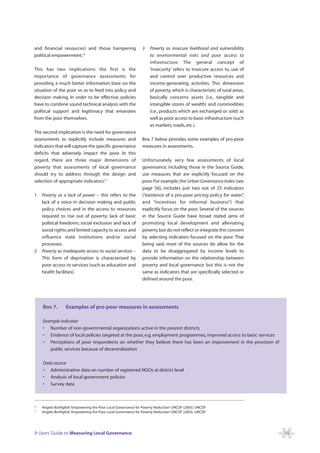
     Box 7.        Examples of pro-poor measures in assessments

     Example indicator
     • Number of non-governmental organizations active in the poorest districts
     • Evidence of local policies targeted at the poor, e.g. employment programmes, improved access to basic services
     • Perceptions of poor respondents on whether they believe there has been an improvement in the provision of
        public services because of decentralization

     Data source
     • Administrative data on number of registered NGOs at district level
     • Analysis of local government policies
     • Survey data


16
     Angelo Bonfiglioli ‘Empowering the Poor Local Governance for Poverty Reduction’ UNCDF (2003). UNCDF
17
     Angelo Bonfiglioli ‘Empowering the Poor Local Governance for Poverty Reduction’ UNCDF (2003). UNCDF


A Users’ Guide to Measuring Local Governance                                                                                15
Gender-sensitivity in governance is intended to               facilitate women’s participation and stimulate the
                     increase women’s participation in politics – not              defense of gender interests. This approach
                     only in formal political structures but also in civic         emphasizes an important role for civil society in
                     engagement. It is also meant to strengthen gender             promoting gender-sensitive local development
                     awareness and capacities among both male and                  and governance and highlights the need to look
                     female politicians and civil servants; deliver                deeper for operational measures beyond simply
                     services addressing the specific needs and                    numbers of female representatives in public
                     interests of women and men in the community                   institutions. Gender analysis of the budget process
                     and create awareness of women’s rights. Gender                at the local level is also an area around which gender
                     specific measures are therefore an important part             specific measures in a governance assessment
                     of governance assessments including local                     might focus. Box 9 provides some examples of
                     assessments.                                                  gender sensitive indicators in assessments.

                     The most common gender sensitive measures in                  1.10 What kinds of data should be used?
                     governance assessments are ones based on the                  The choice of an assessment methodology is
                     number of women in a specific office (e.g. The                influenced by the availability of data. Even the best
                     Local Democracy Assessment Guide by IDEA on                   methodology is meaningless if the data required
                     page 70 proposes to measure the percentage                    for the indicators is not available – or although
                     of women candidates in elections and gender                   available but not in the form required by the
                     representation in voter turnout. Similarly, the               methodology (e.g. when it cannot be properly
                     MIDAMOS initiative in Paraguay on page 86                     disaggregated).
                     proposes an indicator measuring whether there is
                     “at least 30% of women amongst municipal                      There are many kinds of governance data
                     officers.”). An important resource for these kinds of         including:
                     indicators is the United Cities and Local
                     Governance (UCLG) programme’s database on                     •    Fact-based evidence: policy and legal
                     women in local decision-making, which provides                     documents (including legally defined
                     an overview of the percentages of female elected                   competences, institutional framework and
                     representatives at global, regional and national                   performance standards); organizational set-up
                     levels in 54 countries. 18                                         and management systems (including consultative
                                                                                        mechanisms and decision-making);
                     However it is arguable whether female politicians
                     and civil servants do automatically give priority to          •    Statistical data and various indexes; expenditure
                     gender issues and so increasingly more attention is                tracking and budgetary information; previous
                     being given to the role of organizations that                      organizational audit report; etc.


     Box 8.     Developing poverty profiles in Colombo

     In Colombo, Sri Lanka, citizen report cards on poverty and governance were developed by the Sevanatha Urban
     Resource Centre and the Colombo Municipal Council (CMC) that provided the basis for the poverty reduction strategy
     of the city. Sevanatha successfully used a report card method to conduct a citizen survey based on carefully defined
     determinants of poverty. The report card highlights the poverty situation of low-income settlements in Colombo and
     was found to be an effective method to show the problems as well as the positive experiences of people - enabling the
     measurement of levels of community satisfaction with services provided by the Municipality. Furthermore, the survey
     has created a useful database for the Colombo Municipality, and also influenced CMC staff to work in partnership with
     civil society organizations and be responsive to needs identified through a participatory process.


                     18
                          www.cities-localgovernments.org/uclg/index.asp?pag=wldmstatistics.asp&type=&L=EN&pon=1.


16                                                                                                    UNDP Oslo Governance Centre
•   Perception-based    evidence:      individual,    skills for conducting such activities. To overcome
    households, and other kinds of surveys; report    these constraints, International IDEA proposes that
    cards; etc.                                       small teams be established for their local
                                                      democracy assessment (see page 70), consisting of
•   Mixed evidence: information from interviews,      a representative of the national association of local
    focus groups and consultations; quality and       municipalities, a member of the local authority,
    performance evaluation, etc.                      an academic with an expertise in public
                                                      administration, and an individual from civil society.
In general though, local governance data, like
other governance data, can be obtained in two         UN-HABITAT also recommends the establishment
ways – first-hand or primary data, which are          of a core group of individuals who would lead the
generated especially for the indicators developed     process of data collection, analysis and report
(through individual, family/household, or             writing, comprising representatives of the
institutional surveys, report cards, or focus         local government, civil society and research
groups/community dialogues that discuss issues        organisations.
such as participation, responsiveness and
accountability of local governments, for example);    A major challenge is the lack of local capacity for
and second-hand or secondary data, which utilize      data production and collection. Beside weak
already collected and published information (for      statistical systems, there is often a lack of
instance, those produced by various local             specialised capacity in conducting particular data
government departments, service providers such        collection through surveys and facilitating focus
as water supply boards, local NGOs, local arms of     groups. When particular data is not available, there
national bodies such as the census office, the        are three possible remedies:
election commission, etc.)
                                                      1   Introduce capacity development measures
Most of the sources included in the Source Guide          prior to the implementation of the methodology
utilize secondary data already available. However,
information on citizens’ attitudes and perceptions,   2   Adjust the initial methodology to the
expectations, and levels of satisfaction and trust        possibilities for data collection – and modify
may not be available from secondary sources. To           the expectations
obtain these, well-designed focus groups or
community dialogues should be used, involving a       3   Introduce new and innovative methods or
small number of representatives from the general          shortcuts in data collection. An example of
public and/or key informants who would come               such a method is Rapid Rural Appraisal (RRA)19
together to discuss various issues. (UN-HABITAT           which consists of a series of techniques for
2007; UNDP and University of Essex 2007).                 “quick and dirty” research that can generate
                                                          results of less apparent precision, but greater
Participatory ways of collecting data are extremely       evidential value, than classic quantitative
important for assessments of local governance. At         survey techniques. RRA activities can include
the same time, they pose enormous challenges for          review of secondary sources, observation,
local government officials and civil society              group interviews, workshops.
organizations, which may not have the requisite


    Box 9.     Examples of gender sensitive indicators in assessments

    •   Is gender sensitive budgeting practiced at local level?
    •   Are local civil servants and local government Ministers accountable to local assemblies/councils?
    •   How many local authorities had staff who undertook gender-sensitivity training in the last 12 months?
    •   Are pro-poor and gender sensitive non-governmental organizations active in the poorest districts?
    •   Are women adequately represented among members of local assemblies/ councils, senior office holders in local
        government and the civil service at local level?


A Users’ Guide to Measuring Local Governance                                                                           17
1.11 Key contextual factors influencing the                       Secondly, the more the local governance system in
     policy impact of assessment results                               general is open to reform the more likely will the
     The collection, assembly and publication of results               particular assessment proposals themselves be
     for local governance performance serve little                     better received and the reform process itself will
     purpose if they do not have an impact on public                   be easier to initiate, implement and maintain. The
     policy-making at the local (and national) level. If it            impulse to carry out a local government
     is exclusively donor-driven, there is the real danger             assessment is often associated with some sort of
     that such an initiative will be reduced to a one-off              crisis of governability, popular dissatisfaction or
     exercise. But even when there is an element of                    disquiet about the political status quo. In many
     local financial support, the issue of policy uptake               countries, the ‘trigger’ for carrying out an
     and sustainability is still a serious challenge. This             assessment is precisely the recognition that a
     section examines the contextual factors that need                 recent decentralization programme has not
     to be considered in order to ensure that policy                   generated the expected improvements in local
     uptake occurs and that this uptake is sustainable.                governance and service delivery.

     The context of the assessment varies greatly across               While the above two contextual factors
     countries, according to three main factors20: i) the              influencing the probability of an assessment
     main agent that carries out the assessment, ii) the               leading to significant reform are relatively rigid, the
     relative openness of the political process to reform,             third factor – the relative public presence that the
     and iii) the voice that the assessment achieves in                assessment itself achieves – provides the agent
     the local public domain. Differences across these                 carrying out the assessment with greater possibility
     contextual features of each assessment will have                  of direct influence on policy uptake.
     an impact on the character of the assessment itself
     and the degree to which local governance reform                   There is a growing recognition that the failure of
     is possible in the future.                                        research to influence policy formulation is often
                                                                       the result of the absence of a clear communication
     First, the nature of the main agent carrying out the              strategy targeted at policy-makers.This is as true of
     assessment initiative is of major significance. The               local governance performance measurement as of
     key distinction is between those assessments that                 any other area of research in the social sciences. For
     are government-led and those that are civil                       this reason, right from the start of the initiative,
     society-led. Government endorsement adds                          the agent carrying out the assessment needs to
     official legitimacy to the exercise but in some                   develop a clear strategy for communicating the
     contexts may negatively affect perceptions of its                 results, rather than leaving the design of such a
     independence and validity. In addition, there are                 strategy until after the results are available. This
     related issues, particularly in deeply divided                    is because working with communications
     societies, concerning the ideological or political                organisations, networks, and knowledge brokers
     affiliation of the agent, the composition and the                 early on increases the likelihood of take-up by
     representativeness of the team actually carrying                  target stakeholder groups later on. This strategy
     out the assessment. Clearly, in order to maximise                 should be innovative, identifying and prioritising
     the political space for influencing policy uptake, an             the ‘multiple points of entry’ by which the results
     assessment team should be as broadly based                        can impact on opinion shapers and policy-makers
     as possible in order to bring all major local                     – the plurality of local political organisations, social
     stakeholders and different sets of interests on                   groups and civil society organizations, secondary
     board. A team that is too narrow or one that is                   schools and universities, as well as print media
     unbalanced or biased in some way can affect the                   outlets, local television and community radio
     legitimacy of the assessment and ultimately the                   stations and via the Internet (webpage, blog,
     possibility for reform.                                           youtube, etc). This strategy should also include an
                                                                       agreed minimum spend in the overall budget on
                                                                       research communication.


     19
          See the UN Food and Agriculture (FAO) website for resources related to RRA - http://www.fao.org/docrep/W3241E/w3241e09.htm.
     20
          From “Assessing the Quality of Democracy – A Practical Guide” Part 4: From Assessment to reform: influencing the democratic
                                                                          ,
          process, IDEA (2008)


18                                                                                        UNDP Oslo Governance Centre
Box 10. Self assessing local governance in Bangladesh

    In Bangladesh, a Local Governance Self-Assessment (LGSA) has been developed and applied in a number of
    geographical areas in Rajshahi and Sunamganj. The programme aims to reduce poverty through participatory and
    accountable local governance. The tool is intended to have an educational value for citizens who participate, in order
    to understand better what local governance is concerned with. Furthermore, it allows the participants to voice their
    opinion in regard to the current situation of governance in their Union and finally encourages the citizens and the
    Union Parishad to take action to improve on the current situation of local governance functioning. The main objective
    of the community level local governance-assessment is an educational one. However, the Self-Assessment exercise is
    also meant to mobilize the people and contribute to better functioning of governance in their Union. Evaluation of
    local governance issues at both the community and province levels takes place in small groups of maximum 8 persons.
    Such assessment is undertaken against a set of core key issues (20 for the community LGSA and 28 for the Union LGSA
    organised into the demand and supply sides of local governance). Once participants in each group all agree on what
    the question means and what the ideal situation would look like, they make their individual ranking regarding the
    current situation. The ranking is done on a common poster paper on a score from 1 to 6.


    Box 11. The use of household surveys for local governance assessments in Bosnia and Herzegovina

    The Social Audit of Local Governance, a tool introduced in Bosnia and Herzegovina through World Bank support,
    collects information on local governance through household surveys focusing mainly on respondents’ experience of
    10 essential public services (housing conditions, local roads, transport, waste removal, water supply, sanitation, heating
    of households, electricity, health facilities, education – including preschool education); and on citizens’ participation in
    the area under consideration. The queries focus on the technical details of each service, citizens’ access and usage and
    citizens’ satisfaction with the quality of services.


Of course, in many countries the concentration of        There are different potential audiences for the
media ownership, underdeveloped civil society            results of a local governance assessment. There is
organizations, and concentrated areas of political       the danger of limiting the target audience to ‘the
power and deep patron–client networks, necessarily       usual suspects’, namely influential citizens and
limit the ‘political space’ for disseminating the        stakeholder organisations in the private and public
assessment results. For this reason, there is often an   sector, as well as representatives of international
implicit trade-off when contemplating the policy         non-governmental organizations, many of whom
uptake of a local governance assessment. On the          may well have been involved in the assessment
one hand, official government-led assessments            itself.This comprises that ‘typical’ audience that will
may have more formal voice, but they need to be          be exposed to the final outputs through report
careful to ensure that they are representative, valid    launches at large public events, official speeches,
and legitimate exercises that include broad              media interviews. However, it is essential to
representation of key stakeholders. On the other         communicate the results beyond ‘the usual
hand, assessments led by civil society                   suspects’ to as diverse and broad an audience as
organisations or academic/think-tanks may                possible. This will often require innovative
benefit from a certain autonomy, independence            repackaging of the results in a more easily
and validity, but may well have to compete for           understandable and accessible format and the
control of the public space in communicating their       use of spots on community radio in order to
results and will need to achieve consensus with          communicate with low-income citizens. These
government actors in order to bring about a              mechanisms should incorporate concrete
reform process.                                          proposals for governance reform that draw on the


A Users’ Guide to Measuring Local Governance                                                                                       19
findings of the assessment in ways that emphasise        voters in selecting candidates (to assess whether
     local ownership of the reform agenda.                    or not governors of poor performing provinces
                                                              were indeed being ‘kicked out’, and vice versa.) The
     1.12 Using assessment results to strengthen              2004 voters’ index revealed that voters were not in
     downward and upward accountability                       fact making “informed” decisions and that they
     There are several broad areas in which the tools for     were re-electing poorly performing governors.
     comparative performance measurement of local             Recognizing its importance in strengthening good
     governance can be ‘operationalised’ by using the         local governance, the NSO began to disseminate
     results to impact on public policy formulation and       the GGI scores & underlying data in close
     implementation. What they have in common is              partnership with the media. As citizens start to
     that they all seek, in different ways, to activate       recognise that their voting patterns did not match
     and/or strengthen the various accountability             the change in the provincial GGI scores, it is
     mechanisms that are implicit in a devolved system        forecast that there will be a greater emphasis on
     of local government – downward accountability to         ‘programmatic’ considerations in future voting
     citizens and upward accountability to central            patterns. By strengthening the accountability of
     government.                                              elected officials to the electorate, this will enhance
                                                              local governance (Virolaz, 2006).
     Strengthening the downwards accountability of
     local government to its citizens                         Strengthening the upwards accountability of
     The assembly and dissemination of comparative            local government to central government
     local governance performance data can be used to         The assembly and dissemination of comparative
     strengthen the downwards accountability of local         local governance performance data can also be
     government to its citizens by seeking to influence       used to strengthen the upwards accountability of
     the very basis on which citizens make their voting       local government to central government by
     decisions.                                               influencing the allocation of the fiscal transfers
                                                              from central to local government. Ideally, the
     In the Philippines there is a longstanding ‘non-         allocation of central government transfers
     programmatic’ political culture rooted in populism       between municipalities is based on a formula that
     and clientelism through which politicians are            seeks to calculate relative need, by the use of
     re-elected despite poor governance performance.          demographic and poverty-related indicators. In
     Here the national statistical office (NSO) computed      some countries these formulas also incorporate
     a province-level Good Governance Index (GGI),            indicators that seek to reward efforts in local own-
     comprising a range of indicators grouped under           revenue generation. However, local governance
     administrative and economic themes. The GGI – at         performance in general, rather than simply local
     the start (2000) and end (2003) of the term of office    revenue generation performance, may also be
     of provincial governors – were then compared and         used as criteria for allocating central government
     used to rank all 81 provinces from “best” to “worst”     fiscal transfers to local government. The
     and also “best performing” to “worst performing”     .   justification for linking fiscal transfers to this wider
     Best provinces were classed as those with the            local governance performance is simple – the
     highest GGIs and Best Performing Provinces were          better is the local governance performance in
     those with the highest differences between the           general, the greater is the probability that the
     2003 GGI and the 2000 GGI. The NSO then widely           transferred funds will be used effectively,
     disseminated a list of the “best – or worst –            irrespective of whether they are ear-marked or not.
     performing provinces”indicating for each province
     the variation (positive or negative) in performance      At the most basic level, local governance indicators
     from start to end of term. A study of the 2004           could be used for calculating a minimum set of
     provincial elections showed that although most of        preconditions for access to such fiscal transfers
     the governors of the “best” and “best performing”        from central government. In several countries
     provinces were re-elected, this was also true of the     scoring on governance indicators is used to
     governors of the “worst” and “worst performing”          calculate Minimum Conditions of Access (MCA) as
     provinces. In order to raise voter awareness of this     a precondition for local government to be able to
     ‘contradiction’ the NSO then constructed a “Voters’      receive funding from central government. Such is
     Index” that aimed to measure the “wisdom” of             the case in Bangladesh, where the MCA developed


20                                                                             UNDP Oslo Governance Centre
Box 12. Communicating research

     Research on its own cannot bring about change. Research must be communicated in an appropriate form if new
     knowledge is to bring about improvements in the lives of the world’s poorest people. The research must also be useful
     and accessible to people, who may require additional skills and capacity to enable this. Experience tells us that
     nless communication of research is planned for throughout a research programme, including once it’s completed, then
     research uptake and impact may be limited21. A top-down, linear approach to communication, where a homogenous
     group of end users receive information, is unlikely to lead to change. Communication of research should be an
     iterative, interactive and multi-directional process that involves a wide range of stakeholders from planning, through to
     design, implementation and monitoring and evaluation. The shortcomings of the linear model are widely recognised,
     and the question that is asked instead concerns research uptake pathways:‘Why are some of the ideas that circulate in
     the research/policy networks picked up and acted on, while others are ignored and disappear?’ Or, to phrase it from the
     perspective of those engaged in research:‘How can we market our ideas so that they are noticed? What do we have to
     do to influence policy in a pro-poor and evidence-based direction?


     Box 13. Translating assessment results into recommendations

     Here are six pointers for translating assessment results into recommendations for improvements in local governance:

     1   Identify the most urgent priorities for making improvements in local governance and craft recommendations that
         can help address these most urgent issues from an immediate, medium-term and long-term perspective.

     2   Isolate those aspects of local governance which municipal authorities and administrators can address on their own
         and those that require the involvement of other stakeholders (such as national or regional officials).

     3   Build on the strengths that are identified in the assessment and do not focus only on the shortcomings that the
         evaluation has brought to the surface or highlighted.

     4   Separate out problems that require major institutional change, those that involve personalities or individuals, and
         those than can be addressed through policy change.

     5   Develop an approach to making recommendations that links systemic problems with an integrated effort to
         ameliorate them over time. That is, rather than developing a simple list of things that could be done to improve
         local level governance, participants are asked to think through a strategy that first addresses why the problems
         have occurred and then comes up with a series of steps involving political leaders, civic actors and citizens.

     6. Sketch out a way in which these steps can unfold over a defined period of time (with the most critical concerns
        addressed immediately while at the same time developing a longer-term approach) and identify methods for
        monitoring progress on improving democracy.

     Source: Adapted from IDEA (2002) Local Democracy Assessment Guide
     http://www.idea.int/democracy/upload/Local_Dem_Assessment_Guide.pdf


21
     From United Kingdom Department for International Development (DFID) Research on Communication and Getting Research into
     Use http://www.dfid.gov.uk/consultations/crd/section5.pdf


A Users’ Guide to Measuring Local Governance                                                                                     21
for union parishads (UPs) comprise a range of                   bodies to allocate these limited resources in a
                         governance indicators, as shown in Table 1.                     more efficient manner by concentrating efforts on
                                                                                         the poorer performing local governments. Such
                         However, more commonly MCAs can be matched                      assessments also provide evidence to identify
                         with performance measurements (PMs) as a twin                   those high-performing local governments, which
                         element in tying funding to performance. Rather                 may play a supportive role in ‘knowledge
                         than determining absolute access, PMs determine                 transfer’ and technical assistance to their weaker
                         supplements to (or subtractions from) the basic                 counterparts.
                         allocation amount, based on more qualitative
                         measures of past performance. UNCDF experience                  1.13 Institutional opportunities for policy
                         has shown that the use of PMs can provide a                     uptake
                         powerful incentive for building LG capacity and                 Irrespective of the particular area for which the
                         improving LG performance. A good example is                     results of an assessment may be used, reformers
                         Uganda, where a transparent formula, based on                   face a major challenge to ensure that policy uptake
                         eight performance measurement themes (such as                   actually occurs and that it is sustained. They must
                         “Communication and Accountability Performance”    ,             ensure that the political space is secured for these
                         “Gender Mainstreaming Performance” “Procurement
                                                             ,                           new policy initiatives, that they are not seen as
                         Performance” etc.) comprising 24 indicators was
                                      ,                                                  threatening to powerful stakeholders, so that they
                         used to allocate central government grants to local             can be endorsed. UN-HABITAT22 has identified a
                         governments. Performance on each set of                         range of institutional mechanisms that strengthen
                         indicators is scored and used to determine                      local governance by promoting transparency and
                         whether the local government is eligible for                    accountability. Some of these provide convenient
                         a 20% top-up, a 20% reduction, or simply the basic              ‘entry points’ by which the assessment results of
                         allocation derived from the formula (see page 124               local governance performance can be fed into the
                         of the Source Guide).                                           policy-making arena. These include:

                         The measurement of governance performance                       Public meetings and public hearings: In some
                         also helps to identify deficiencies in the internal             countries, especially in Latin America, the local
                         management of local government. Such measures                   government executive head is required by law to
                         provide a practical means to identify those local               convene open public meetings as a mechanism to
                         governments in need of special assistance in                    improve downward accountability. Regular public
                         capacity building. In many countries central                    meetings tend to focus on budgetary concerns
                         government support for capacity-building in local               while public hearings may be convened to debate
                         governance is limited by shortage of financial and              issues for which controversy exists, such as new
                         human resources. Such measures enable training                  municipal investment projects. As well as


Table 1:     Minimum Conditions of Access (MCA) in Bangladesh


 Minimum Conditions of Access                                               Indicators

 Transparency, Accountability & Fulfilment of Basic Functions               • UP meetings held in UP offices (not chairperson’s house!)
                                                                            • Past FY accounts inspected and approved
                                                                            • Minimum effort at local tax collection

 Involvement of Elected Women Members                                       • Women members invited to UP meetings and involved in
                                                                               UP committees – LG circular

 Project-Specific Conditions                                                • Establishment of ward & union development committees to
                                                                               widen public input into UP planning, budgeting and monitoring


Source: Shotton (2005) Delivering the goods: Building local government capacity to achieve the Millennium Development Goals.
A practitioner’s guide from UNCDF experience in least developed countries.


22                                                                                                           UNDP Oslo Governance Centre
imparting information, these meetings also serve                   community/grassroots outreach programme is a
as an important mechanism to solicit the views of                  key element of such local anti-corruption agencies.
the public on issues of importance to local                        The dissemination by such agencies of the results
government. Such meetings may help both to                         of governance assessments can play a major part
disseminate governance assessment results and to                   in raising citizen awareness of major deficiencies in
provide a mechanism for citizens to draw attention                 local governance.
to deficiencies and to propose measures to raise
governance performance.                                            Participatory Budgeting: Participatory Budgeting is
                                                                   a significant innovative practice that can help to
Oversight committees and citizen advisory boards:                  enhance participation and improve downward
Oversight committees are external committees                       accountability in the administration of financial
that oversee the operations and activities of                      matters. In particular, by raising citizen participation
specific local government committees such as                       beyond the electoral process through the
finance, public works, health and education. These                 mechanism of thematic and neighbourhood
committees perform an important role in                            meetings, participatory budgeting can help to
gathering information on the functioning of                        enhance local democratic culture, nurture civic
individual departments and ensuring, through                       engagement, and stimulate the development of
their oversight and questioning of management                      social capital. Although concerned primarily with
officials, that corrupt practices do not take place.               ensuring that there is a better fit between the
Citizen advisory boards are also structured around                 allocation of local financial resources and citizens
specific issues but have a looser advisory role than               expressed needs, the participatory mechanisms
the more formalised role of the oversight                          employed can also help to address deficiencies as
committee, with members who are less likely to be                  expressed by the results of local governance
employees of the authority. Members of these                       performance assessment.
committees and boards combine relevant
expertise of the subject with active participation in
                                                                   This chapter highlights the most pressing issues
the local community. For these reasons, they are
                                                                   that users of assessments of local governance have
ideally suited to dissemination and response to
                                                                   identified. Its content is based on telephone
governance assessment results.
                                                                   interviews with more than twenty representatives
                                                                   from the practitioner community, including
Local Anti-Corruption Agencies: In response to the
                                                                   intergovernmental, donor, government, research
growth of local government responsibilities
                                                                   and civil society communities (see interviewees’
associated with decentralization programmes,
                                                                   list in acknowledgements section). The semi-
anti-corruption agencies have often been created
                                                                   structured interviews covered the assessments
at the local level. These can serve as watchdog for
                                                                   and indicators that they made use of, the role of
local government entities; to provide an effective
                                                                   these in development policy and planning
vehicle to disseminate information regarding
                                                                   processes, and their major strengths and
the ethics rules and regulations pertaining to
                                                                   weaknesses. Six major issues were highlighted by
government employment; to study and draft good
                                                                   the interviewees and are presented here, in each
governance policies and to ensure that those in
                                                                   case with an associated checklist of ‘good practice’
government who breach the public trust are held
                                                                   guidelines.
accountable for their actions. A proactive


22
     From Framework for Promoting Transparency at the Local Level, UN-HABITAT
     http://ww2.unhabitat.org/cdrom/TRANSPARENCY/html/transpl.html


A Users’ Guide to Measuring Local Governance                                                                                  23
Box 14. Short-, Medium- and Long-Term Options

     Local government will appreciate recommendations that are grounded in the findings of the assessment and
     practice-oriented in their application. Recommendations should be feasible, that is, they should be clearly defined
     in terms of their duration, complexity, outputs and cost. In this regard, it may be helpful to separate out the
     recommendations in the following way.

     •   Short-Term Options: Those steps or actions which are simple and low-cost, require few major policy or statutory
         changes, and are immediately feasible in the current context.
     •   Medium-Term Options: Those steps which may require reforms of existing policies and laws, that require major
         administrative changes, or for which substantial resources will need to be rallied.
     •   Long-Term Options: Those that require significant reform or restructuring of city-level institutions, significant cost,
         national approval, or major administrative or financing reforms.

     Source: Adapted from IDEA (2002) Local democracy assessment guide
     http://www.idea.int/democracy/upload/Local_Dem_Assessment_Guide.pdf


24                                                                                             UNDP Oslo Governance Centre
2
Voices from the Trenches
2
Voices from the Trenches

                                                            sensitive measures – without which the
2.1 Choosing an appropriate assessment                      assessment will not serve as a basis for
framework                                                   equitable local development.
 The most common issue raised by almost all of the
interviewees is the limited number of assessments       2.2 Dealing with complex methodologies
carried out to date and the associated lack of a        There was widespread concern amongst those
robust, comprehensive and tested methodology            interviewed that there are “too many indicators
for local governance assessment. There was a            floating around” and “too many offers to local
consensus that the frameworks currently used for        authorities” The proliferation of indicators created
                                                                    .
local governance assessments are not really             a situation in which local stakeholders are flooded
normative systems for “good” or “democratic” local      with proposals for different assessments. Each time
governance. Instead, there are diverse and              there is an argument that a particular set of
sometimes weakly integrated “compilations of            indicators is the most important and that its
preferences and values” Despite an increasing
                          .                             application should be prioritized over all other
emphasis on democracy in the discourse on local         governance assessments. Experts and international
governance, there is still an absence of tested         organizations also often send mixed signals on
indicators for the organization of political            what the very notion of governance represents. As
parties and for mechanisms of accountability and        a result, local stakeholders may find it difficult to
responsiveness at the local level. It is noteworthy     reconcile between different approaches and
that most national associations of local                derive meaningful conclusions for follow-up
governments do not yet promote particular               actions and development strategies. The
normative frameworks that would serve as the            multiplicity of sources of indicators and the relative
foundation for their development work at the            divergence of methodological approaches
local level.                                            sometimes lead to confusion, inefficient use of
                                                        scarce capacities and “fatigue” with governance
Good practice checklist                                 assessments.
• Define the specific purpose, focus and expected

   scope of the entire assessment process.
• Map key stakeholders and identify their needs,        Sometimes, when concepts related to governance
   preferences and interests in local governance        are explained in a too simplified manner there is a
   assessment.                                          danger that local stakeholders start to believe that
                                                        “almost anything can be assessed” (and, primarily,
•   Ensure focus, while facilitating incorporation of   by quantitative measures). The challenge of
    a holistic concept of governance (i.e. not only     agreeing on what to assess is also connected to the
    formal structures and services, but also on         complexity of the concept of governance. The
    processes and relationships).                       focus can be placed on outputs, relations,
                                                        perceptions, means and tools for service delivery.
•   Derive the assessment objectives from the           Nevertheless, assessments often need to
    local development needs and the strategic           incorporate a combination of different focuses. A
    policy agenda.                                      critical challenge is to agree on what dimensions
                                                        (or combination of dimensions) should be
•   Ensure that there is a focus on the needs of the    considered relevant and prioritised.
    poor, women, children and other disadvantaged
    groups. Use all opportunities (and create new       The most successful methodologies are those that
    ones) for integrating pro-poor and gender-          have a high degree of transparency: in the process


A Users’ Guide to Measuring Local Governance                                                                     27
of design, implementation and dissemination of           particular understanding of           good     local
     results. This is usually enabled by regularly            governance by local stakeholders.
     informing all stakeholders on procedures,
     indicators and measurement tools as well as by           Another lesson learned is that the period of
     involving the media throughout the process.              preparation and design (or customization) of a
     Indicators are more reliable when the methodology        methodology should be sufficiently long. This
     used to devise them is transparent.                      phase should be used as an opportunity for
                                                              learning and capacity development and it should
     Data collection is another challenge. Weak statistical   involve as many as possible of the stakeholders to
     capacity of municipalities (and even national            be later involved in its implementation.
     institutions) makes data collection time-                Consultative workshops such as those applied in
     consuming. Often the necessary data either does          the Local Democracy Assessment of International
     not exist or is not well structured, disaggregated       IDEA (see page 66 of the Source Guide) are a good
     and/or systematized. The capacity of local data          method for facilitating design and incorporating
     collectors is rarely adequate because the existing       local contextual factors.
     organizations rarely possess the technical skills
     and are not networked. This situation is particularly    Good practice checklist
     problematic when assessments are being done in           • Map existing assessment tools (such as those
     more than one municipality (region) at the same             included in the Source Guide) and select a
     time. Therefore, it is sometimes more effective to          methodology that is suited to the purpose of
     invest resources into training existing individuals         undertaking the assessment and the
     (researchers, officials or activists) or organizations      normative foundation.
     and so ensure more credible data collection
     and analysis.                                            •   Weight pros and cons of different approaches
                                                                  to assessment regarding implementation
     Good practice checklist                                      arrangements (external, peer review, self-
     • Make your methodology as transparent as                    assessment) and decide which one is best suited.
        possible.
     • Identify data requirements in advance and              •   Never underestimate the need for customization
        address data problems before they take place              and localization. Give priority to ensuring
        by investing in capacity development or by                conceptual clarity and relevance of the
        adjusting indicators.                                     normative framework to the context-specific
     • There will never be enough time, money and                 local governance issues.
        people so be cost-efficient and adjust
        ambitions to the capacities available.

     2.3 Adapting tools to local contexts                     •   Use more than one source of data and
     Methodologies that are applied through rigid                 combine various types of indicators (input,
     procedures (in particular, global indexes that have          output, process, outcome indicators). No one
     not or cannot be adapted to the local context)               kind of data is sufficient to give information on
     usually result in “great measurement errors”and do           such complex phenomena as local governance
     not give workable results. For this reason,                  so integrate objective and subjective
     interviewees highlighted the importance of                   indicators from both primary and secondary
     continuous adjustments and improvements of                   sources.
     methodologies to the local context – even during
     the     implementation       phase. Appropriate          2.4 Managing a multiplicity of purposes
     methodologies are usually those that derive from         Identifying and ensuring consensus on the key
     “localized solutions” which are based on                 purpose of an assessment is a significant
     identification of well defined characteristics of        challenge. Often there is a multitude of different
     local governance that should be measured. For            and sometime conflicting purposes due to the
     instance, in the Local Governance Barometer (see         variety of needs of the numerous stakeholders.
     page 60 of the Source Guide), a “universal model” is     Groups consisting of representative of international
     transformed into a “local model” on the basis of a       organizations, national governments, local


28                                                                            UNDP Oslo Governance Centre
governments, and representatives of civil society       2.5 Maximising participation in
may face a major challenge in formulating one or        assessments
more clear objectives of the assessment that            Governance assessments in general (both the
would come out of a shared understanding of the         processes and the results) can be threatening to
objective.                                              many stakeholders, especially those stakeholders
                                                        who are resistant to change. Assessments of local
Most practitioners and experts strongly promote         governance can be particularly politically sensitive.
the idea that an assessment is a development            Several interviewees suggested that emphasis
tool and not merely a technocratic exercise in          needs to be placed on working with local
operationalising a set of indicators. In that sense,    authorities to reduce their fears and to mobilize
the assessment should inform development plans          the support of officials. Being much closer to
and strategies, identify capacity gaps and areas for    citizens and under potentially more intensive
governance reform, and set a factual baseline for       scrutiny, local political leaders realize that the
policy analysis. Moreover, assessments should be        assessment can have a major impact on the local
used for social and resource mobilization, raising      community. In this respect, there is a greater need
awareness of stakeholders, advocacy, and                to invest in building partnerships, trust and
facilitating a consensus on future priorities.          understanding at the outset of an assessment
                                                        process. A minimal, basic capacity in local
In cases when local governance indicators are           government for local governance assessment is
applied for comparing the quality of local              sometimes not available. Finding even one person
governance across different localities, success was     to talk to in depth about governance indicators
ensured when the following conditions exist:            remains a challenge in many municipalities around
                                                        the world. Therefore, the search for a “champion”
1   There is a clear normative framework for the        who would later create a critical mass of
    assessment that is agreed by all involved local     supporters (and “believers”) should be a top priority.
    governments / communities and that is then
    sufficiently institutionalized.                     The number of stakeholders involved as well as the
                                                        identification of their respective roles and
2   There is a shared agreement that comparisons        responsibilities are also major issues. A crucial
    should facilitate exchange of experience            question is which stakeholder should lead the
    amongst municipalities to promote policy and        process. Practical experiences indicate quite
    institutional change through raising awareness      different answers. While almost all interviewees
    – not merely for the purpose of ranking. In this    argued that the central actor should be local
    case, citizens need to also mobilize to put         government, some thought that it should not
    pressure on their municipalities to generate a      implement the assessment due to a potential
    wide popular support base for using                 conflict of interest. Similarly, while there was a
    assessment results for concrete follow-up           consensus view that civil society organizations
    actions.                                            must play a key role, some argued that they should
                                                        not conduct assessments without strong backing
Good practice checklist                                 from the local government. Several interviewees
• Secure common understanding and sound                 also agreed that there should be a role for central
   consensus on the purpose of the assessment.          government – but not a leadership one. Central
                                                        authorities are considered very important, in
•   Make the assessment purpose – oriented. The         particular when the issues addressed in the
    expected results should be the main reference       assessment refer to a framework broader than one
    framework for the organization and                  municipality (e.g. decentralization).
    implementation of the methodology.
                                                        So who should lead the assessment process? Some
•   Maximise the credibility, relevance and usability   interviewees proposed associations of local
    of the assessment by enabling a comparison          governments as the most appropriate
    between the current state of affairs and a          organization due to their wide network, their
    preferable one in the future.


A Users’ Guide to Measuring Local Governance                                                                     29
overview of the scope of local governance issues,      2.6 Incentives and sustainability
     their level of capacity, and their potentially more    Many of those interviewed considered that
     independent posture. However, it was argued that       financial and capacity development incentives
     assessments led by local government associations       were a sine qua non for a successful assessment
     are most effective when these have sufficient          because they have a major influence in ensuring
     influence over and credibility amongst local and       both the launch of an assessment and the active
     national authorities. International organizations      involvement of key stakeholders. Without
     and other external actors also have an important       incentives geared towards the needs and interests
     role to play in promoting, advising and actively       of particular stakeholders, it is difficult to ensure
     supporting local governance assessments. This is       buy-in, support and ownership. Such incentives
     especially true of those organizations continually     may include financial support, development
     present on the ground and/or those with large          support and capacity development programmes.
     international and regional networks (e.g. the          However, others considered that there is already so
     United Cities and Local Governments and the            many financial and capacity development offers
     world and regional networks of Local                   (particularly in large cities) that finance and
     Governments Associations).                             development assistance no longer really represent
                                                            major incentives.
     Good practice checklist
     • Identify ‘champions’ who create enthusiasm           The commitment of political and civil society
        and commitment for the assessment. The              leaders has been greatest in those cases in which
        champion is the engine behind the whole             there has been a powerful demonstration of
        exercise and s/he has to be able to work with       practical, tangible results and a clear political value
        all different actors and keep them committed        of an assessment. Hence, it was suggested that a
        to the original purpose of the assessment, so       genuine understanding of the purpose and the
        preventing anyone “going astray” .                  method of assessment is the most critical
                                                            incentivizing factor. Assessments should certainly
     •   Pay sufficient attention to targeting political    not be initiated only as a result of donor-
         leaders to ensure the political will and support   driven pressure or as another “check-mark or
         for the success of an assessment.                  shopping list”.

     •   Promote active participation by assigning          All interviewees agree that there needs to be at
         particular roles and responsibilities to each      least a minimum continuity and that the periodicity
         group of stakeholders involved.                    with which assessments take place should be
                                                            determined on the basis of the specificities of

     •   Be as inclusive as possible by including all
         relevant organizations and individuals – even      particular aspects of governance being analyzed. If
         those that might not be the usual partners in      the result of an assessment is expected to induce
         governance assessments (e.g. religious and         immediate changes, subsequent exercises should
         youth organizations, foreign investors, the        be more regular and integrated into monitoring
         media).                                            and evaluation systems.

     •   The lack of adequate understanding of the          Developing local capacities from the outset is
         purpose of the assessment and lack of shared       crucial for ensuring that the assessment is
         norms related to local governance are often        repeated (to enable monitoring over time) and
         major    impediments      to    stakeholder        for ensuring its institutionalization. Capacity
         involvement so invest time and resources in        development should be integrated into the
         awareness raising and capacity development         methodology even in the case of externally
         of targeted groups through appropriate             conducted assessments. It was recommended that
         communication strategies.                          concrete practical actions should take place during


30                                                                           UNDP Oslo Governance Centre
the assessment – in terms of social mobilization,     Good practice checklist
policy-making and consensus building – to ensure      • Ensure that incentives to stakeholders are
sustainability. Moreover, broad inclusion of local       positive, transparent and strong enough to
actors yield shared ownership which is a key driver      mobilize engagement.
for ensuring uptake of the assessment results.
Upon the finalization of an assessment, a concrete    •   Take care to ensure that any external
and widely shared reform agenda should be based           assistance does not undermine the credibility
on a consensus of all those involved and broadly          of the results and that it does not impede the
promoted in the local community. At the same              local ownership of the process.
time, information on the results of the assessment
and the proposal for a follow-up should be            •   Ensure a sustained focus on developing local
disseminated to the largest number of stakeholders.       capacities.


A Users’ Guide to Measuring Local Governance                                                               31
3
Case Studies
3
Case Studies

The following four fictional case studies demon-            the role of a representative from a local
strate key concepts and themes raised in earlier            government association
chapters of this Guide and cover such issues as:
                                                        •   Ensuring uptake of assessment findings in
•   Facilitating commitment and involvement –               local policy-making – the role of a local elected
    the role of a local government official                 government official

•   Moving from government to the concept of            Although the names are fictitious, examples have
    governance – the role of a civil society activist   been drawn to approximate real-life scenarios
                                                        based on actual country experiences.
•   Balancing comparability with local relevance –


    Case study 1:       Facilitating commitment and involvement: The role of a local government official

    Svetlana has recently been appointed as the head of the policy unit in her municipality. She has a university degree in
    social sciences and has been working for an international development agency for a couple years. However, Svetlana
    has never been a local government official and her insight into the everyday practices and the specific organizational
    culture in the municipal administration was limited.

    The major strategic responsibilities of Svetlana were to steer the development agenda, coordinate most critical policies
    and mobilize external resources. In her unit, there were only three persons and none of them had considerable
    experience in development cooperation.

    After spending a couple of months trying to find her way though the rigid, poorly organized, and highly inefficient
    municipal administration, Svetlana decided to initiate an assessment of local governance for her municipality.The main
    purpose of the assessment was to identify development needs, mobilize support from civil society organizations, and
    set a factual foundation for more strategic organizational change. She prepared a brief for the president of the
    municipality and managed to secure the participation of all key local officials at the initial meeting.

    The meeting ended up quite differently from Svetlana’s original expectations. First, few officials understood the notion
    of governance. She spent most of the time trying to explain to them that local governance is not only about how much
    money central level transfers, the cost of particular local public services, division of post in the local assembly, etc. but
    also includes capacity development and empowerment of local communities, and facilitating the participation of
    citizens and groups in decision making.

    Second, she faced great resistance from those that became concerned that conducting an assessment would produce
    a bad image of local officials.They argued that providing the local community a chance to express their concerns would
    publicly expose “dirty laundry” as well as weakness and failures of the local administration. Finally, Svetlana was
    strongly criticized for not being able to say “how much money this would bring us” and what other concrete benefits
    would come from conducting such an assessment.


A Users’ Guide to Measuring Local Governance                                                                                        35
Case study 1:      Facilitating commitment and involvement: The role of a local government official
                        (continued)

     Frustrated with the reactions from her colleagues, Svetlana decided to build a “coalition of willing” partners for local
     governance assessment – this time starting with external stakeholders. Moreover, she decided to combine positive
     incentives with public pressure to ensure the commitment and involvement of local officials.

     Svetlana paired up with a local NGO that promotes poverty reduction and social inclusion. They decided that the NGO
     will use a part of the funds from an ongoing project to organize a public campaign. The campaign would steer public
     pressure for addressing most critical weaknesses and problems in local governance. At two public workshops, various
     organizations would have a chance to discuss the overall governance performance (not only that of the local
     government) and propose possible new solutions.

     At the same time, Svetlana contacted her previous employer – the international development organization – and
     managed to persuade them to bring in two municipal representatives from another country where a successful local
     governance assessment had just been finalized. That case study would be presented at a large conference.

     Svetlana also organized her staff to conduct research into the existing methodologies of local governance assessment.
     They used internet sources and also contacted people in regional and global think-tanks that deal with good
     governance.

     After all that, and close to the mid-year period when budgets are being prepared for the following year, Svetlana
     organized a conference and ensured wide media coverage. Participants included local officials, representatives of civil
     society organizations, representatives of international and bilateral development agencies, key local and regional
     businesses, and officials from central government agency dealing with decentralization.

     The conference started with a speech by the president (actually the one already used in the previous elections) on the
     need for democratization and sustainable development of the local community. Central government officials briefly
     informed the audience about the agenda for decentralization and Svetlana’s staff made a presentation of comparative
     methodologies on local governance assessment. After a very heated discussion amongst civil society organizations
     and local officials, the case study of a successful assessment from another country was presented. Finally, a
     representative of a bilateral development agency (eager to re-active an old project) pledged funds and advisory
     support for implementation of the assessment.

     The conference had a great impact. The local government endorsed Svetlana’s plan for local governance assessment.
     A bilateral donor provided the resources, and a local expert group was formed with the involvement of Svetlana’s staff,
     two international advisors, one representative of the municipality where an assessment was conducted successfully,
     and the local (umbrella) policy-advocacy NGO. Moreover, an advisory group was established with participation of all
     relevant civil society organizations, representatives of the private sector and media, one official from central-level
     government and several local officials. Finally, there was a public commitment that, if the assessment was conducted
     successfully and if its results were integrated into a new local development strategic plan, considerable financial
     support would be provided for future development projects.


36                                                                                           UNDP Oslo Governance Centre
Case Study 2:      Moving from government to the concept of governance:
                      The role of a civil society activist

   Mehtab is the director of an organization promoting local economic development that operates in a medium-size
   municipality. He returned from an international conference on good local governance where he had been very inspired
   by a speech on the link between governance assessment and development planning. Upon his return, Mehtab
   decided to initiate a comprehensive assessment in his own municipality.

   Using contacts that he had established at the international conference, Mehtab managed to collect several documents
   that present different cases and different methodologies for governance assessment. On the basis of those, as well as
   in consultations with his colleagues, he designed a project proposal and presented it to a development foundation. His
   proposal was welcomed and financial resources were made available.

   The main purpose of the assessment would be to build consensus on local development priorities through promoting
   the need for a more comprehensive local governance reform. Mehtab expected that, once everyone realized what the
   main problems were, an agreement on priorities would be much easier – maybe the priorities would even derive
   directly from the assessment recommendations.

   Mehtab realized that a proper assessment would require a new kind of understanding amongst the local community
   and a new mindset that would be broadly shared. He did not want a “government” but “governance” assessment –
                                                                                        ,
   however, “governance” was an alien notion for almost everyone in the municipality. Therefore, Mehtab made a small
   flyer (cheap, but in many copies) where he presented some of the usual definitions of local governance as well as a
   particular one that he thought would be most appropriate for his municipality. Moreover, he included a couple of
   examples on good local governance in other countries and an explanation of the implications that the new concept
   would have on the existing structures, relationships and processes in the municipality. Most importantly, the flyer was
   written in the local language and used plain, simple words.

   Another major issue was who should lead the whole assessment – an assessment of governance, not of government.
   This meant that the leadership of the process could not involve only local government officials. Moreover, the scope of
   the assessment included issues that are not the competence of any of particular civil society organization (there was
   no “NGO on good local governance”). A further problem was that many such organizations existed – and, normally,
   good local governance concerned all of them.

   Mehtab organized a meeting with an advisor to the president of the municipality. They took the list of all local civil
   society organizations and agreed on a particular strategy. First, there would be an Expert Task Force comprising
   representatives of all civil society organizations that were directly related to the purpose of the local governance
   assessment. The Expert Council would be chaired by the president’s advisor and would meet on a monthly basis (plus,
   whenever there was a need for urgent consultations).The main role of the Expert Task Force would be to supervise the
   work of experts and consultants, discuss and decide upon methodological issues, monitor the implementation of the
   project, and endorse interim and final reports.

   Second, there would be a Consultative Committee including all civil society organizations, as well as a representative
   of the local business association and several media representatives. It would be chaired by the president of the
   municipality and would meet only twice: at the beginning of the assessment and at the end. In addition, the members
   of the Consultative Committee would be kept informed about the progress of the assessment through brief monthly
   written updates.

   While it was clear who should participate in the Consultative Committee, the problem with the membership of
   the Expert Task Force remained. There was no central organization that could select the members with sufficient
   legitimacy and credibility – and the whole point was that local government itself should not be leading the process
   (even though its representatives would chair the Task Force and the Consultative Committee).


A Users’ Guide to Measuring Local Governance                                                                                 37
Case Study 2:      Moving from government to the concept of governance:
                        The role of a civil society activist (continued)

     Mehtab suggested to map all civil society organizations using a specific matrix.The matrix would derive from concrete
     indicators of local governance assessment and would seek to identify which organizations had direct or indirect
     interest and an optimal capacity for becoming involved in the Expert Task Force. Such a selection method would be
     very transparent and would secure the credibility of the decision on the final list of members. Moreover, it would have
     an additional benefit - raising public awareness about the assessment itself.

     A specific questionnaire was prepared – basically, a table with the list of indicators, on one side, and a limited number
     of answers, on the other. Each organization would be asked to identify the extent to which its activities were related
     to a particular indicator. Moreover, it would need to self-assess its capacity for assuming an active role (and
     responsibility) in the assessment.

     Soon, the list was ready. There were a couple of organizations that did not qualify, but were of great relevance for the
     Task Force. Those included, amongst others, a local religious organization, an organization dealing with a small
     minority community, an organization for the disabled and handicapped, and a recent initiative providing counselling
     services to women affected by family violence. Including those additional organizations on the list of members did not
     present a problem, because it was fully justifiable and Mehtab and the President’s advisor continued to act in a very
     transparent manner.

     Although several of these organizations did not have the capacity to take on a leadership role in the Task Force, Mehtab
     and the President’s advisor valued their engagement at a less active level. After all, by being part of the Task Force they
     would strengthen their capacity and be exposed to intensive learning.

     At the end, Mehtab prepared instructions on how the work of the Expert Task Force and Consultative Committee
     should be organized. This document included a set of procedures (setting the agenda for meetings, invitation to and
     organization of meetings, discussion and decision-making rules) and this was approved at the first meeting of both the
     Task Force and the Committee.

     Interestingly, one of the findings identified by the local governance assessment was precisely the lack of structures and
     capacities for continual consultations amongst local stakeholders. Given the effectiveness of the Task Force and the
     Committee, a plan was made to transform them into more institutionalized structures for local governance policy
     consultations and development planning.


38                                                                                             UNDP Oslo Governance Centre
Case Study 3:      Balancing comparability with local relevance:
                      The role of a representative from a local government association

   In the last couple of years there had been many different local assessments, evaluations and audits but Lia realized that
   something had to be done to make them more relevant for development purposes as well as the need to address their
   increasing conceptual and methodological confusion. She was working as a local government advisor for the local
   government association that covered the whole country. From her point of view, there was an urgent need for
   standardization and national coordination of various local governance assessments.

   Establishing a methodology common to all sub-national units would produce many benefits. First, it would enable
   inter-municipal comparison and help identify systemic needs for the sub-national governmental system as a whole.
   Such an approach would also provide a sound factual basis for the design of new national and sub-national
   development projects, the promotion of comprehensive policies, and an enhancement of the legal framework.

   Second, the opportunity to publicly present the results of the assessment of all sub-national units would enable the
   sharing of experiences and also enable benchmarking amongst sub-national units. Furthermore, it would mobilise
   public pressure for governance reforms and facilitate the sharing of knowledge and experience on standards of good
   governance.

   Finally, the new initiative would help address the increasing confusion produced by the use of the different
   methodologies that various international and bilateral organizations applied. For instance, in several municipalities a
   team of international experts had conducted “assessment of accountable and responsive local government” based on
   public perception surveys.When the reports were finalised, the experts left and it became obvious that there was weak
   local ownership of the findings and even weaker capacity to deal with the recommendations.

   Elsewhere, in selected municipalities, a regional institute funded by a bilateral donor had introduced an index on
   democratization. The methodology included some consultative workshops, but there were problems of localization of
   the global indicators. Many local stakeholders argued that the findings were either irrelevant for their local context or
   that they could not use them for development purposes. In addition, there were also several assessments focusing
   on local service delivery – but many of these were conducted without a clear normative framework for good local
   governance.

   Lia received the endorsement of the leadership of the association to establish a new standing committee on local good
   governance. The standing committee was chaired by herself and comprised a representative group of sub-national
   units (from urban to rural, from small to medium to large population size, and from small to medium to large
   territorial size). Moreover, officials from central government ministries and agencies were included on a permanent
   basis. In addition, there were researchers and analysts from national non-governmental organizations dealing with
   decentralization and local development.

   The committee prepared a work plan that included:

   •   Development of a national concept on principles and norms of good local governance – based on comparative
       research and localization of the existing universal “models” and frameworks used in other countries – as well as the
       previous indigenous practice regarding good local governance

   •   Mapping of all local governance assessments conducted in the previous three years (methodologies, reports,
       identification of weakness and strengths)

   •   Design of a standardized methodology for local good governance assessment


A Users’ Guide to Measuring Local Governance                                                                                   39
Case Study 3:      Balancing comparability with local relevance:
                        The role of a representative from a local government association
                        (continued)

     •   Training of local stakeholders on the implementation of the methodology

     •   Creation of pool of permanent and “on-call” experts to coach and provide advisory services to sub-national units in
         the implementation of the methodology

     •   Introduction of a system for financial and non-financial incentives for sub-national units regarding implementation
         of an assessment

     •   Endorsement of an annual cycle for a local good governance assessment on a regular basis and for better
         coordination and alignment amongst assessments conducted in different sub-national units

     •   Establishment of a donor trust-fund for local good governance to coordinate and improve the cost-efficiency of
         different donor funds

     The work plan was also endorsed by the national government and the international donor community.

     Special emphasis was placed on the need to balance comparability and local relevance of assessments.The methodol-
     ogy had to be sufficiently standardized to reflect the agreed principles and norms of good local government in each
     particular sub-national case. Moreover, that concept needed to be aligned with international best practices and some
     of the existing normative frameworks.

     At the same time, the methodology had to be sufficiently flexible to allow for incorporation of local specificities and to
     ensure relevance for local development planning and policy making. The differences between sub-national units were
     considerable, and the same framework could not necessarily be identically applied everywhere.

     Therefore, it was decided to proceed on the basis on three principles:

     1   First, standardized processes, procedures and roles and responsibilities

     2   Second, a set of common indicators

     3   Third, and most important, a national assessment framework, localized and customized through the use of
         particular sub-indicators. In other words, each sub-national unit was allowed to modify a limited number of
         indicators to reflect its particular local context. Moreover, if need be, sub-national units were allowed to add other
         indicators that they considered relevant. It was also important that, before application of the customized
         methodology, each sub-national unit sought endorsement by the committee for the proposed modification
         introduced into the standardized methodology.

     Of course, Lia’s initiative was not flawless. However, in the course of three years, continuous modifications and
     enhancements brought about a framework that now satisfies a large set of objectives – including the balancing of
     national comparability with local relevance. Moreover, donor money is being spent more effectively and local
     assessments are now used for genuine developmental purposes.


40                                                                                            UNDP Oslo Governance Centre
Case Study 4:      Ensuring uptake of assessment findings in local policy-making:
                      The role of a local elected government official

   Davron has recently been elected to the municipal council with responsibility for the promotion of local democratic
   governance. His first priorities were to better understand the relationships amongst the key stakeholders in local
   governance and to try to improve the local governance capacity for strategic planning and policy making.

   At that time there was a new initiative developed by an international development partner for an assessment of local
   governance. Davron immediately understood that such an analysis would be perfect for setting a foundation for
   achievement of his priorities. However, Davron also understood from the comments of his more experienced
   colleagues that it would not be an easy exercise and that there had been failed attempts in the past. Therefore, Davron
   was cautious, but also proactive. He took on the role as focal point for the whole endeavor, as it offered him an
   opportunity to impact on the way that it was conducted and on the way that the results of the analysis would be used.

   After a series of discussions with international partners, the local government and civil society organizations that would
   be involved in the assessment, Davron proposed the following:

   •   He and two other local politicians would become permanent members of the Steering Committee on the
       assessment, thus ensuring local political ownership and continual support for the methodology and the results.
       Their role would be to continually ensure that the assessment was aligned with local strategic priorities and the
       policy agenda, and to ensure that the assessment results were relevant and applicable.

   •   He would oversee the establishment of mechanisms for external and internal communication to keep the political
       parties, the public, and the central-level political representatives informed about progress and the preliminary
       findings. Davron would prepare monthly plans and disseminate them to local and central-level politicians, as well
       as regular press-releases for the local media.

   •   There would be three public workshops for open and transparent discussion about progress of the assessment.
       Beside local stakeholders, the events would involve representatives of the main political parties and central-
       government officials who would provide critical input on the interdependence of the local governance reforms
       with the process of decentralization.

   Davron organized two consultative meetings with broad participation from local and national stakeholders that
   facilitated endorsement of a normative agenda for local governance reforms. A document that had been developed in
   a neighboring country and that had been shared with Davron was discussed and considerably adjusted to the case of
   Davron’s municipality. Some aspects of that normative agenda were used to formulate several policy documents.
   Davron understood that local development should be closely linked to the political agenda that his party promoted in
   the previous elections.This included, amongst other, reshaping of mechanisms for the provision of local administrative
   and public services towards a greater citizen orientation, more gender-sensitivity and more focus on marginalized
   groups.

   It took a lot of personal initiative by Davron and his colleagues to ensure an understanding of the assessment by a
   majority of members of the local assembly. However, once approved, this new framework ensured a sound foundation
   for the local governance assessment as well as clear guidance for the local government regarding the priorities for
   reform. In addition, the new framework envisaged the continual and active participation of civil society organizations
   in local policy making, as well as regular public consultations.

   A number of challenges were faced in carrying out the assessment. Most problems related to data collection because
   of the weak local statistical system. The methodology was adjusted a couple of times but at the end it was successfully
   implemented. Already, in the course of the assessment, several members of local assembly were able to use preliminary


A Users’ Guide to Measuring Local Governance                                                                                    41
Case Study 4:     Ensuring uptake of assessment findings in local policy-making:
                       The role of a local elected government official (continued)

     results in order to put forward new legislation.They simply saw an opportunity to apply the evidence produced by the
     assessment to promote new policies that had already received public support, given the participation of local
     stakeholders in the assessment,.

     After the assessment, Davron initiated the establishment of a cross-sector committee in the local assembly on local
     governance reforms. The first task of the committee was to prepare a local governance strategy based on the
     recommendations of the assessment. Realizing the potential that the assessment could yield for the future, the
     committee also decided that similar exercises would be conducted on an annual basis – as an input in the evaluation
     of the implementation of the local governance strategy.


42                                                                                        UNDP Oslo Governance Centre
References

•   Aberbach, J.D. and Rockman, B.A (2006) “Governance and Outcomes” in Brown, B.E, ed., Comparative Politics – Notes and Readings,
                                                                   ,
    Thomson Wadsworth
•   Angelo Bonfiglioli ‘Empowering the Poor Local Governance for Poverty Reduction’ UNCDF (2003)
•   Arndt, C. and Oman, C.:“Uses and Abuses of Governance Indicators” Development Centre Studies, OECD, 2006
                                                                    ,
•   Council of Europe. Recommendations on local governance: No. (95) 19: On the implementation of the principle of subsidiary, 1995; No. (2007)
    12: On capacity building at local and regional level, 2007; No. (2007) 4 On Local and regional services, 2007 (including: Guidelines on local
    and regional public services)
•   European Union.“European Charter on development cooperation in support of local governance” Draft of 26 May
                                                                                              ,
•   Government of Nepal.“Manual for Assessment of Minimum Conditions and Performance Measure (MCs and PMs) for DDCs in Nepal” Local
                                                                                                                            ,
    Body Fiscal Commission, Ministry of Local Development, Government of Nepal, May 2008
•   Grindle, S. Merilee.“Good Enough Governance Revisited” Harvard University. February 2005.
                                                         .
•   Grindle, S. Merilee. “Good Enough Governance: Poverty Reduction and Reform in Developing Countries” Harvard University. November
                                                                                                      .
    2002.
•   ICLEI.“Building capacity for Local Sustainability: The Fano Guideliness” Governing Sustainable Cities, 2004
                                                                           ,
•   IDEA (2008) Assessing the Quality of Democracy – A Practical Guide. Stockholm: International Institute for Democracy and Electoral
    Assistance.
•   IDEA (2002) Local democracy assessment guide. Stockholm: International Institute for Democracy and Electoral Assistance.
•   IDEA. “Democracy at the Local Level: The International IDEA Handbook on Representation, Participation, Conflict Management and
    Governance” 2001
              ,
•   Kaufmann, D., Kraay, A. and Zoido-Lobaton, P.: “Governance Matters” Policy Research Working Paper, The World Bank and the World Bank
                                                                      ,
    Institute, October 1999
•   OECD.“Donor Approaches to Governance Assessments” DAC Network on Governance, June 2008 (final draft)
                                                    ,
•   Pierre, J. and Peters, B.G (2000) “Governance, Politics and State” Basingstoke: Macmillan
                                                                     ,
•   SHARIQUE.“Local Governance Self-Assessment: guidelines for practitioners” , 2007
                                                                            ,
•   Shotton, R. (2005) Delivering the goods: Building local government capacity to achieve the Millennium Development Goals. A practitioner’s
    guide from UNCDF experience in least developed countries. New York: United Nations Capital Development Fund.
•   Steffensen, J. and Larsen, H.F.:“Conceptual basis for performance based grant systems and selected international experiences” Background
                                                                                                                                ,
    Paper for the National Stakeholder Workshop in Nepal, 2005
•   UCLG.“First Global Report on Decentralization and Local Democracy” United Cities and Local Governments (UCLG) 2007
                                                                     ,
    UNDP.“A Guide to Local Governance and Decentralization: Programme Experiences and Strategies from a UNDP E-Discussion” UNDP (draft
                                                                                                                         ,
    2008)
•   UNDP.“Decentralized Governance for Development – A Combined Practice Note on Decentralization, Local Governance and Urban/Rural
    Development” UNDP, 2004
               ,
•   UNDP.“Methodology for design and implementation of the Instrument for Measuring Responsibility, Transparency and Accountability in
    the Local Self-Government Units, UNDP Macedonia, 2007
•   UNDP. “Performance Based Funding to Local Bodies in Nepal: Safeguards and Incentives in Decentralized Governance” UNDP Regional
                                                                                                                    ,
    Centre in Bangkok, July, 2005
•   UNDP.“Supporting Country-led Democratic Governance Assessments - A Practice Note” UNDP, 2004
                                                                                    ,
•   UNDP.“Users’ Guide on Measuring Corruption” UNDP (2008)
                                              ,
•   UNDP. Consolidated Reply (DGPN): E-discussion: Towards a Local Governance and Development Agenda: Lessons and Challenges (27
    August - 16 October 2007) [released on 08 November 2008]
•   UNDP. Indonesia Democracy Index, UNDP project document, November 2007
•   UNDP:“Governance Indicators: A Users’ Guide” 2nd Edition, UNDP Oslo Governance Center, 2007
                                               ,
•   UN-HABITAT.“Draft Guidelines on decentralization and the strengthening of local authorities” 2006
                                                                                               ,


A Users’ Guide to Measuring Local Governance                                                                                                   43
•    UN-HABITAT. Framework For Promoting Transparency At The Local Level,
     http://ww2.unhabitat.org/cdrom/TRANSPARENCY/html/transpl.html
•    USAID/LGSP.“Local Governance Assessment Tool: A Gauge for Good Governance” 2008
                                                                              ,
•    Virolaz, R. (2006) Empowering And Challenging Voters Through Governance Indicators: The Philippine Experience. Paper presented in the
     session on “The Construction and Use of Indicator Sets: Lessons to Build Modern Democracies” during the OECD’s 2nd World Forum on
     Statistics, •   Knowledge and Policy “Measuring and Fostering the Progress of Societies” 27 -30 Istanbul, Turkey.
                                                                                            ,
     http://www.oecd.org/dataoecd/48/22/38799205.pdf?contentId=38799206
•    Westfall, M.S. and De Villa, V.A. (eds.):“Urban indicators for managing cities” Asian Development Bank, 2001
                                                                                   ,


44                                                                                                       UNDP Oslo Governance Centre
Source Guide
How to use the Source Guide

     The following Guide includes 22 assessment methodologies for decentralised governance. These
     methodologies have been compiled to provide users with a resource to draw on for developing new
     assessment tools or for adapting existing assessment approaches to specific contexts. The sources are
     grouped into three categories:

     1   Comprehensive local governance assessment approaches based on multiple stakeholder perspectives
     2   Local governance assessments based on citizen (or single stakeholder) perspectives
     3   Local governance and performance self-assessments by local government institutions

     The matrix below summarizes the main features of each tool, and can be used to narrow down a subset
     of tools offering the best ‘fit’ for a given assessment context. This selection process can proceed in three
     steps:

     1   First, users need to clarify the scope of their assessment and select one of the three categories of tools
         listed above. For instance, in settings with a poor functioning democracy at the local level or in a
         context in which the decentralisation process has only recently started, users may want to focus on
         the third category of tools assessing local government performance, instead of registering low scores
         on almost all aspects of local democracy measured by tools of the first category.The point here is that
         not all democratic governance deficits can be addressed simultaneously therefore it is important to
         identify priority areas to focus on, and select a tool accordingly.

     2   Second, users can refine their search within any of the three categories of tools by examining various
         features of each tool (such as financial and time investments required, specific purpose served by the
         tool, data sources used by the tool, main stakeholders involved, and poverty/gender focus). Based on
         these features, users can identify the two or three tools which seem to be most appropriate to their
         assessment needs and to the local context.

     3   Users can then flip directly to the more detailed profiles of these shortlisted tools and make their final
         selection.

     The summary matrix has a column on “cost/benefit analysis” to help users select a tool that is
     appropriate for the capacity level of local stakeholders and that matches the timeframe and financial
     resources available for the assessment. Every instrument can be used more or less intensively including
     more or less primary data collection, while more primary data collection might be required in “data-poor”
     settings. Nevertheless certain methodologies will be more expensive and time consuming than
     others (but likely to generate more reliable results), while others will be quicker and less costly (but
     generating results that are more ‘indicative’.)

     The purpose of the assessment will also influence the choice of instrument: is the objective of the
     assessment to inform policy makers, or is it also (or mainly) meant to serve as a learning/capacity
     development effort contributing to an improved dialogue between local government and citizens? The
     summary matrix has a “purpose” column which distinguishes between 1) “diagnostic” to inform
     policymaking and priority-setting, and 2) capacity development to facilitate engagement of citizens in
     governance processes.


46                                                                            UNDP Oslo Governance Centre
The summary matrix also indicates what type of data sources is used by each tool (objective and/or
subjective), which actors should lead the application of the tool (internal vs. external to local
government), and the extent to which the methodology is sensitive to women and to poor and
marginalized groups (merely disaggregating indicators by income/sex vs. proposing indicators that are
‘specific to the poor/women’).

We will now briefly describe each one of the three categories of tools featured in the Source Guide.

1 Comprehensive local governance assessment approaches based on multiple
  stakeholder perspectives
This category is distinguished by its emphasis on applying a comprehensive framework for capturing the
principal dimensions and determinants of governance at the local level such as the local political system
(i.e. elections, human rights, rule of law, civil society, freedom of information), institutional issues (i.e.
corruption, public administration, financial management, public procurement), social and cross-cutting
issues (i.e. the policy process, the budget process, revenue mobilization, service delivery, gender,
environmental sustainability) and market governance (i.e. the business/trade environment).

In this category, the source guide includes the following:
1 Urban Governance Index (UN-HABITAT)
2 Local Governance Barometer (Impact Alliance)
3 Good Governance for Local Development – GOFORGOLD Index (Afghanistan)
4 Local Democracy Assessment Guide (International IDEA)
5 Indicators of Local Democratic Governance (Tocqueville Research Centre & OSI)
6 Methodological Guidelines for Local Governance Analysis (UNDP)
7 Governance Index (Indonesia, Kemitraan – Partnership)
8 Measuring Municipal Performance – MIDAMOS (Paraguay)
9 Observatory of Democracy in Central America: System of Legal and Institutional Governance
    Indicators for Central America (Centro Estudios para el Futuro)
10 Desde lo Local – Strategic Decentralization for Local Development (Mexico)
11 Council of Europe’s Guide to Developing Well-Being & Progress Indicators with Citizens – Application
    of the Governance Module in Timisoara (Romania)

2 Local governance assessments based on citizen (or single stakeholder) perspectives
This category is distinguished by its emphasis on citizens’ perceptions and experiences based on an
assumption that the quality of local governance is determined by local stakeholders.The identification of
expectations, experiences and perceptions is carried out by different data collection methods including
direct surveying and focus groups. The most often cited instruments and approaches are Citizen Report
Cards originally developed in Bangalore, India.

In this category, the source guide includes the following:
12 Citizen Report Cards (Public Affairs Centre, India)
13 Social Audit of Local Governance (Bosnia and Herzegovina)
14 Social Audit of governance and delivery of public services (Pakistan)
15 Local Governance Self-Assessment (Bangladesh)

3 Local governance and performance self-assessments by local government institutions
This category is distinguished by its emphasis on outputs or results achieved by local governments in
service delivery, income and expenditure. Along those lines, measuring municipal performance means
assessing how well a municipality performs when delivering goods and services to the public. The
performance measures often include the volume, quality, efficiency and outcomes of providing these
goods and services. They might also include measures focused on the institutional, financial and human
resource capacities to develop, implement and monitor/evaluate its policies and programmes. Most of


A Users’ Guide to Measuring Local Governance                                                                     47
these measures address “multi-sectoral” aspects of performance, while only a few others focus on
     particular sectors. There are numerous assessment tools for assessing local government performance,
     service delivery and benchmarking.23 While there is a large volume of information available on
     these approaches, these represent a totally different area of work from the work on indicators of
     decentralization and local democracy.

     In this category, the source guide includes the following:
     16 Governance for Local Development Index – GOFORDEV Index (Philippines)
     17 Assessments Informing Performance Based Grant Systems (UNCDF)
     18 Local Governance Performance Management System (Philippines)
     19 Index of Responsibility, Transparency and Accountability (Macedonia)
     20 Standards of Municipal Transparency (Chile)
     21 Local Integrity Initiative (Global Integrity)
     22 Methodology for the Assessment of Capacity of Municipalities in Turkey and the Western Balkans to
         deliver basic services (UNDP)


48                                                                     UNDP Oslo Governance Centre
Summary matrix:
                                               Main features of tools profiled in
                                                              the Source Guide


Tool           Cost-benefit             Purpose               Information      Lead actor(s)         Explicit poverty         Explicit gender     Remarks
                 analysis                                       sources      applying the tool          measures                measures

          1) Quick, cheap &       1) Diagnostic to        1) Objective      1) Internal to local   1) Disaggregated by      1) Disaggregated by
          ‘indicative’ findings   inform policy-                            government             income groups            gender
                                  making & priority-      and/or
          or                      setting                                   or                     and/or                   and/or
                                                          2) Subjective
          2) Longer, costlier &   or                                        2) External to local   2) Indicators specific   2) Gender-specific
          more detailed/                                                    government             to the poor              indicators
          reliable findings       2) Capacity
                                  development to
                                  facilitate
                                  engagement of
                                  citizen in governance
                                  processes


 A Users’ Guide to Measuring Local Governance                                                                                                       49
Summary matrix: Main features of tools profiled in the Source Guide (continued)

       Tool             Cost-benefit             Purpose             Information          Lead actor(s)         Explicit poverty       Explicit gender          Remarks
                          analysis                                     sources          applying the tool          measures              measures

                                             Approaches based on multiple stakeholder perspectives
1                   Quick, cheap and        Both diagnostic and   Mainly objective     Both: Internal          Both disaggregated    Both disaggregated    • Indexation
URBAN               ‘indicative’ findings   CD to facilitate      sources              municipal staff         and specific to the   and gender specific   • Looks more at
GOVERNANCE          (a two-day              engagement of                              (self-assessment),      poor                                        institutional aspects
INDEX               workshop can            citizens in                                typically facilitated                                               of governance (are
(UN-HABITAT)        generate most of        governance                                 by a local                                                          democratic
                    questionnaire           processes                                  government                                                          governance systems
                    responses)                                                         association                                                         in place?)
                                                                                                                                                           • Requires a data-
                                                                                                                                                           rich setting (urban)

                                                                                                                                                           Strengths:
                                                                                                                                                           • Universal criteria
                                                                                                                                                           (comparability high)
                                                                                                                                                           • Quickly identifies
                                                                                                                                                           areas of weakness for
                                                                                                                                                           further investigation
                                                                                                                                                           • Can be applied by
                                                                                                                                                           municipality
                                                                                                                                                           independently

                                                                                                                                                           Weaknesses:
                                                                                                                                                           • Not context
                                                                                                                                                           specific
                                                                                                                                                           • No scores per
                                                                                                                                                           stakeholder group
                                                                                                                                                           • No perception
                                                                                                                                                           data (no quality
                                                                                                                                                           statements)

2                   Either (can be more     Both diagnostic and   Both objective and   Both: independent       Both disaggregated    Both disaggregated    • Indexation
LOCAL               or less rigorous &      CD to facilitate      subjective sources   organisation            and specific to the   and gender specific   • Looks at
GOVERNANCE          costly, depending       engagement of                              facilitating the        poor                                        institutional and
BAROMETER           on resources            citizens in                                assessment, in                                                      relational aspects
(Impact Alliance)   available – approx.     governance                                 collaboration with                                                  (are systems in place
                    3-5 weeks)              processes                                  local stakeholders                                                  and valuation)
                                                                                       (state and                                                          • Can be used in
                                                                                       non-state) and                                                      “data-poor” setting
                                                                                       technical partners
                                                                                                                                                           Strengths:
                                                                                                                                                           • Qualitative and
                                                                                                                                                           quantitative data
                                                                                                                                                           combined
                                                                                                                                                           • Context specific
                                                                                                                                                           and universal
                                                                                                                                                           • Stakeholder
                                                                                                                                                           perspective explicit
                                                                                                                                                           dialogue
                                                                                                                                                           • Web-based
                                                                                                                                                           instant scoring
                                                                                                                                                           • Weighing of
                                                                                                                                                           indicators and
                                                                                                                                                           criteria possible

                                                                                                                                                           Weaknesses:
                                                                                                                                                           • Requires a lead
                                                                                                                                                           agent, trained in
                                                                                                                                                           methodology
                                                                                                                                                           • Requires minimal
                                                                                                                                                           technical
                                                                                                                                                           backstopping
                                                                                                                                                           • More expensive
                                                                                                                                                           than UGI


       50                                                                                                                UNDP Oslo Governance Centre
Summary matrix: Main features of tools profiled in the Source Guide (continued)

       Tool            Cost-benefit              Purpose             Information           Lead actor(s)        Explicit poverty       Explicit gender          Remarks
                         analysis                                      sources           applying the tool         measures              measures

                                    Approaches based on multiple stakeholder perspectives (continued)
3                   Quick, cheap and        Both diagnostic and   Objective sources     Both: municipal        Both disaggregated    Both disaggregated    • Indexation
GOOD                ‘indicative’ findings   CD to facilitate                            representatives,       and specific to the   and gender specific   • Applicable in
GOVERNANCE FOR      (suitable to data       engagement of                               CSOs, private sector   poor                                        countries emerging
LOCAL               scarce/post-conflict    citizens in                                                                                                    from conflicts
DEVELOPMENT –       settings, using         governance                                                                                                     • Looks more at
GOFORGOLD Index     readily available       processes                                                                                                      institutional aspects
(Afghanistan)       sources of objective                                                                                                                   of governance (are
                    data)                                                                                                                                  systems in place)

                                                                                                                                                           Strengths:
                                                                                                                                                           • Looks more at
                                                                                                                                                           institutional aspects
                                                                                                                                                           of governance
                                                                                                                                                           • User friendly
                                                                                                                                                           formats

                                                                                                                                                           Weaknesses:
                                                                                                                                                           • Still under
                                                                                                                                                           development

4                   Longer, costlier and    Both diagnostic and   Both objective and    Both: Assessment       Disaggregated data    Both disaggregated    • Narrative (no
LOCAL               more detailed/          CD to facilitate      subjective sources    teams typically        only                  and gender specific   indexation)
DEMOCRACY           reliable findings       engagement of                               consist of                                                         Strengths:
ASSESSMENT                                  citizens in                                 representatives                                                    • Guiding
GUIDE                                       governance                                  from the national                                                  questions can be
(International                              processes                                   association of local                                               integrated into
IDEA)                                                                                   municipalities, the                                                other assessments
                                                                                        local authority,
                                                                                        academia, and                                                      Weaknesses:
                                                                                        civil society                                                      • Addresses
                                                                                                                                                           democracy
                                                                                                                                                           architecture not
                                                                                                                                                           really governance
                                                                                                                                                           • Narrative report,
                                                                                                                                                           no index no
                                                                                                                                                           comparison
                                                                                                                                                           • Requires highly
                                                                                                                                                           skilled people to
                                                                                                                                                           analyse

5                   Longer, costlier and    Diagnostic            Both subjective and   External: The          No                    No                    • Mainly for
INDICATORS OF       more detailed/                                objective sources     Toqueville Research                                                countries in
LOCAL               reliable findings                                                   Centre in                                                          transition (Eastern
DEMOCRATIC          (incl. 3 surveys, one                                               collaboration with a                                               Europe)
GOVERNANCE          for local                                                           polling company                                                    • Indexation
(Tocqueville        government, one
Research Centre &   for local                                                                                                                              Strengths:
OSI)                representatives, and                                                                                                                   • Comprehensive
                    one for citizens)                                                                                                                      covering various
                                                                                                                                                           perspectives (cross
                                                                                                                                                           validation)

                                                                                                                                                           Weaknesses:
                                                                                                                                                           • Takes a lot of time
                                                                                                                                                           and costly
                                                                                                                                                           • Requires a
                                                                                                                                                           specialist agent to
                                                                                                                                                           implement
                                                                                                                                                           • Difficult for
                                                                                                                                                           ordinary citizens to
                                                                                                                                                           be involved (rather
                                                                                                                                                           technical)


          A Users’ Guide to Measuring Local Governance                                                                                                               51
Summary matrix: Main features of tools profiled in the Source Guide (continued)

      Tool            Cost-benefit             Purpose             Information            Lead actor(s)        Explicit poverty     Explicit gender           Remarks
                        analysis                                     sources            applying the tool         measures            measures

                                   Approaches based on multiple stakeholder perspectives (continued)
6                  Longer, costlier and   Both diagnostic and   Both subjective and    Both: Assessment       No                  No                    • Indexation
METHODOLOGI-       more detailed/         CD to facilitate      objective sources      facilitated by UNDP,                                             • Assesses more
CAL GUIDELINES     reliable findings      engagement of                                in collaboration                                                 the requirements for
FOR LOCAL                                 citizens in                                  with local                                                       good governance
GOVERNANCE                                governance                                   stakeholders (both                                               than the state of
ANALYSIS (UNDP)                           processes                                    citizens and local                                               governance. In set
                                                                                       authorities)                                                     up similar to LGB

                                                                                                                                                        Strengths:
                                                                                                                                                        • Action oriented
                                                                                                                                                        • Self assessment
                                                                                                                                                        (no eternal
                                                                                                                                                        facilitation required)
                                                                                                                                                        • Can be applied in
                                                                                                                                                        a “data-poor”
                                                                                                                                                        environment

                                                                                                                                                        Weaknesses:
                                                                                                                                                        • Rather costly

7                  Longer, costlier and   Both diagnostic and   Both subjective and    Both: Assessment       No                  Disaggregated data    • Requires country
GOVERNANCE         more detailed/         CD to facilitate      objective sources      facilitated by an                          only                  adaptation, as
INDEX (Kemitraan   reliable findings      engagement of                                independent                                                      several indicators
– Partnership)                            citizens in                                  research                                                         refer to institutions
                                          governance                                   organization, with                                               and practices
                                          processes                                    participation by                                                 specific to Indonesia
                                                                                       both state and non-
                                                                                       state stakeholders                                               Strengths:
                                                                                                                                                        • Very
                                                                                                                                                        comprehensive
                                                                                                                                                        methodology
                                                                                                                                                        combining both
                                                                                                                                                        objective and
                                                                                                                                                        subjective data
                                                                                                                                                        sources
                                                                                                                                                        • Detailed
                                                                                                                                                        instructions for
                                                                                                                                                        users and
                                                                                                                                                        ready-made data
                                                                                                                                                        collection
                                                                                                                                                        instruments

8                  Longer, costlier and   Both diagnostic and   Mainly objective       Both: Assessment       No                  Both disaggregated    Strength:
MEASURING          more detailed/         CD to facilitate      sources, potentially   facilitated by an                          and gender specific   • Drawing mainly
MUNICIPAL          reliable findings      engagement of         complemented with      independent organ-                                               from objective
PEFORMANCE –                              citizens in           subjective sources     ization, with partici-                                           indicators (with
MIDAMOS                                   governance                                   pation by both state                                             precise scoring
(Paraguay)                                processes                                    and non-state stake-                                             criteria), makes
                                                                                       holders                                                          results “indisputable”
                                                                                                                                                                             .

                                                                                                                                                        Weakness:
                                                                                                                                                        • Essentially
                                                                                                                                                        assessing the
                                                                                                                                                        existence of
                                                                                                                                                        municipal
                                                                                                                                                        mechanisms,
                                                                                                                                                        legislations or
                                                                                                                                                        quotas, with limited
                                                                                                                                                        opportunities for
                                                                                                                                                        also evaluating the
                                                                                                                                                        quality of local
                                                                                                                                                        governance
                                                                                                                                                        mechanisms


      52                                                                                                               UNDP Oslo Governance Centre
Summary matrix: Main features of tools profiled in the Source Guide (continued)

       Tool            Cost-benefit             Purpose       Information           Lead actor(s)         Explicit poverty       Explicit gender          Remarks
                         analysis                               sources           applying the tool          measures              measures

                                    Approaches based on multiple stakeholder perspectives (continued)
9                   Longer, costlier and   Diagnostic      Objective sources     Both: Assessment        No                    No                    • Unique in its
OBSERVATORY OF      more detailed/                                               facilitated by a                                                    three-pronged
DEMOCRACY IN        reliable findings                                            national research                                                   assessment focus on
CENTRAL AMERICA                                                                  institution, in                                                     substantive rights
(Centro de                                                                       collaboration with a                                                (existence of proper
Estudios para el                                                                 national steering                                                   legal provision),
Futuro)                                                                          committee                                                           procedural rights
                                                                                 composed of key                                                     (existence of
                                                                                 government                                                          effective
                                                                                 representatives                                                     mechanisms to
                                                                                                                                                     implement these
                                                                                                                                                     rights) and systemic
                                                                                                                                                     rights (interactions
                                                                                                                                                     between legal
                                                                                                                                                     provisions and other
                                                                                                                                                     systemic factors
                                                                                                                                                     such as public
                                                                                                                                                     budgets, proper
                                                                                                                                                     institutions and
                                                                                                                                                     public officials)

10                  Longer, costlier and   Diagnostic      Objective sources     Mainly internal         Both disaggregated    Both disaggregated    Strength:
DESDE Lo            more detailed/                                               municipal staff         and specific to the   and gender specific   • The three-color
Local – Strategic   reliable findings                                            (self-assessment),      poor                                        code for presenting
Decentralization                                                                 plus a neutral body                                                 results focuses
for Local                                                                        to verify the results                                               attention on weaker
Development                                                                                                                                          areas within a
(Mexico)                                                                                                                                             municipality, and
                                                                                                                                                     downplays
                                                                                                                                                     inter-municipality
                                                                                                                                                     comparisons

                                                                                                                                                     Weakness:
                                                                                                                                                     • Relies exclusively
                                                                                                                                                     on objective data
                                                                                                                                                     assessing the
                                                                                                                                                     existence of
                                                                                                                                                     mechanisms for
                                                                                                                                                     local governance,
                                                                                                                                                     but fails to assess
                                                                                                                                                     the quality of these
                                                                                                                                                     mechanisms

11                  Longer, costlier and   Mainly CD to    Both subjective and   External:               Both disaggregated    Both disaggregated    • Addresses more
COUNCIL OF          more detailed/         facilitate      objective sources     multi-stakeholder       and specific to the   and gender specific   social cohesion and
EUROPES’S GUIDE     reliable findings      engagement of                         consultations (with     poor                                        “well-being” than
FOR DEVELOPING                             citizens in                           different groups of                                                 underlying
WELL BEING /                               governance                            citizens) facilitated                                               governance issues
PROGRESS                                   processes                             by independent
INDICATORS WITH                                                                  researchers
CITIZENS –
APPLICATION OF
THE GOVERNANCE
MODULE IN
TIMISOARA
(Romania)


          A Users’ Guide to Measuring Local Governance                                                                                                         53
Summary matrix: Main features of tools profiled in the Source Guide (continued)

       Tool           Cost-benefit             Purpose             Information          Lead actor(s)        Explicit poverty        Explicit gender          Remarks
                        analysis                                     sources          applying the tool         measures               measures

                                                       Approaches based on citizen perspectives
12                Quick, cheap and        Both diagnostic and   Subjective sources   Both: Facilitated by   (Potentially) both     (Potentially) both    Can be applied as
CITIZEN REPORT    ‘indicative’ findings   CD to facilitate                           independent            disaggregated and      disaggregated and     Community Score
CARDS (Public                             engagement of                              organization or by a   specific to the poor   gender specific       Card as well using
Affairs Centre,                           citizens in                                representative                                                      focal groups in
India)                                    governance                                 consortium of                                                       stead of individuals
                                          processes                                  stakeholders; report                                                cost reduction but
                                                                                     card is designed by                                                 less reliable
                                                                                     both service
                                                                                     providers and users;                                                Strengths:
                                                                                     respondents are                                                     • Effective
                                                                                     users of services                                                   diagnostic tool to
                                                                                                                                                         assess service
                                                                                                                                                         satisfaction
                                                                                                                                                         • In combination
                                                                                                                                                         with UGI/LGB a very
                                                                                                                                                         strong tool to assess
                                                                                                                                                         local governance
                                                                                                                                                         • Applied in many
                                                                                                                                                         countries

                                                                                                                                                         Weaknesses:
                                                                                                                                                         • Assesses actual
                                                                                                                                                         satisfaction against
                                                                                                                                                         unknown individual
                                                                                                                                                         benchmarks (if a
                                                                                                                                                         publicly known
                                                                                                                                                         service charter
                                                                                                                                                         doesn’t exist

13                Longer, costlier and    Diagnostic            Subjective sources   External: Household    No                     Both disaggregated    • Combines service
SOCIAL AUDIT OF   more detailed/                                                     survey conducted                              and gender specific   satisfaction
LOCAL             reliable findings                                                  by independent                                                      assessment and
GOVERNANCE                                                                           organization                                                        local governance
(Bosnia &                                                                                                                                                assessment
Herzegovina)
                                                                                                                                                         Strengths:
                                                                                                                                                         • Good as
                                                                                                                                                         diagnostic and
                                                                                                                                                         monitoring tool

                                                                                                                                                         Weaknesses:
                                                                                                                                                         • Still in
                                                                                                                                                         development (one
                                                                                                                                                         country application)

14                Longer, costlier and    Both diagnostic and   Mainly subjective    Both: Both            Both disaggregated      Both disaggregated    More or less similar
SOCIAL AUDIT OF   more detailed/          CD to facilitate      sources,             government officials and specific to the      and gender specific   to the above
GOVERNENCE AND    reliable findings       engagement of         complemented by      / service providers   poor
DELIVERY OF                               citizens in           some objectives      and citizens serve as                                               Strengths:
PUBLIC SERVICES                           governance            sources              facilitators of the                                                 • Good as
(Pakistan)                                processes                                  audit and as                                                        diagnostic and
                                                                                     respondents                                                         monitoring tool
                                                                                                                                                         • High level of
                                                                                                                                                         accuracy

                                                                                                                                                         Weaknesses:
                                                                                                                                                         • Still in
                                                                                                                                                         development (one
                                                                                                                                                         country application)
                                                                                                                                                         • Costs are very
                                                                                                                                                         high

15                Quick, cheap and        Both diagnostic and   Mainly subjective    Both: Facilitated by   Both disaggregated                           • Narrative report
                                                                                                                                   Both disaggregated
LOCAL             ‘indicative’ findings   CD to facilitate                           independent NGO,       and specific to the                          • Mainly a dialogue
                                                                                                                                   and gender specific
GOVERNANCE                                engagement of                              with participation     poor                                         and CD tool
SELF-ASSESSMENT                           citizens in                                by both local
(Bangladesh)                              governance                                 government and                                                      Strengths:
                                          processes                                  citizens                                                            • Action oriented

                                                                                                                                                         Weaknesses:
                                                                                                                                                         • No indexation –
                                                                                                                                                         limited comparison
                                                                                                                                                         possible


       54                                                                                                              UNDP Oslo Governance Centre
Summary matrix: Main features of tools profiled in the Source Guide (continued)

        Tool            Cost-benefit             Purpose             Information           Lead actor(s)        Explicit poverty        Explicit gender           Remarks
                          analysis                                     sources           applying the tool         measures               measures

                                                 Self-assessments by local government institutions
16                   Longer, costlier and   Both diagnostic and   Both subjective and   Both: Facilitated by   No                     No                    Assesses service
GOVERNANCE FOR       more detailed/         CD to facilitate      objective sources     independent NGO,                                                    delivery
LOCAL-               reliable findings      engagement of                               with participation                                                  performance and
DEVELOPMENT                                 citizens in                                 by both local                                                       some aspects of
INDEX –                                     governance                                  government and                                                      governance
GOFORDEV Index                              processes                                   citizens                                                            (participation)
(Philippines)                                                                                                                                               • Indexation
                                                                                                                                                            • One country only

17                   Longer, costlier and   Both diagnostic and   Mainly objective      Either internal or   Both disaggregated       Both disaggregated    • Measures actual
ASSESSMENTS          more detailed/         CD to facilitate      sources               external: assessment and specific to the      and gender specific   performance
INFORMING            reliable findings      engagement of                               can be overseen by poor                                             against national
PERFOMANCE                                  citizens in                                 central government                                                  standards.
BASED                                       governance                                  ministry, or by                                                     • Linked to grant
GRANT SYSTEMS                               processes                                   independent                                                         system (better
(UNCDF)                                                                                 organization.                                                       performance =
                                                                                                                                                            more money)
                                                                                                                                                            • Stimulates local
                                                                                                                                                            accountability
                                                                                                                                                            • Non participatory

18                   Longer, costlier and   Diagnostic            Objective sources     Internal               No                     Both disaggregated    • Self assessment
LOCAL                more detailed/                                                                                                   and gender specific   tool for LGs
GOVERNANCE           reliable findings                                                                                                                      • Non participatory
PERFORMANCE                                                                                                                                                 • System +
MANAGEMENT                                                                                                                                                  performance
SYSTEM                                                                                                                                                      assessment
(Philippines)                                                                                                                                               • Can be used to
                                                                                                                                                            inform citizens

19                   Longer, costlier and   Both diagnostic and   Objective sources     Both: Participation    No                     No                    • Corruption
INDEX OF             more detailed/         CD to facilitate                            of citizens in                                                      (resistance)
RESPONSIBILITY,      reliable findings      engagement of                               designing the                                                       measurement tool
TRANSPARENCY                                citizens in                                 instrument;                                                         • Indexation
AND                                         governance                                  application of                                                      • Includes service
ACCOUNTABILITY                              processes                                   instrument mainly                                                   users information
(Macedonia)                                                                             by government                                                       • Still in the design
                                                                                        actors                                                              stage

20                   Longer, costlier and   Diagnostic            Objective sources     Mainly internal        No                     Disaggregated data    • Assesses access to
STANDARDS OF         more detailed/                                                                                                   only                  information
MUNICIPAL            reliable findings                                                                                                                      • Can be
TRANSPARENCY                                                                                                                                                contextualised
(Chile)                                                                                                                                                     • Easy to apply
                                                                                                                                                            • Does not
                                                                                                                                                            differentiate for
                                                                                                                                                            marginalised groups
                                                                                                                                                            • Assesses presence
                                                                                                                                                            of mechanisms not
                                                                                                                                                            their valuation/
                                                                                                                                                            quality

21                   Longer, costlier and   Diagnostic            Mainly objective      External: Local        Some indicators are    Some indicators are   • Corruption
LOCAL                more detailed/                               sources               country teams          specific to the poor   gender specific       (integrity)
INTEGRITY            reliable findings                                                  composed of                                                         measurement tool
INITIATIVE                                                                              well-known experts                                                  • Indexation for
(Global Integrity)                                                                      from national think                                                 national level policy
                                                                                        tanks, universities,                                                making
                                                                                        NGOs, and media                                                     • Tested in various
                                                                                                                                                            countries
                                                                                                                                                            • Country specific

22                   Longer, costlier and   Diagnostic            Both subjective and   Both: Steering         Both disaggregated     Both disaggregated    • Assesses capacity
METHODOLOGY          more detailed/                               objective sources     group composed of      and specific to the    and gender specific   gaps for service
FOR THE              reliable findings                                                  both government        poor                                         delivery at LG level
ASSESSMENT OF                                                                           and                                                                 • Self assessment
CAPACITY OF                                                                             non-government                                                      tool, not
MUNICIPALITIES IN                                                                       actors; respondents                                                 participatory
TURKEY AND THE                                                                          mainly government
WESTERN                                                                                 actors
BALKANS TO
DELIVER SERVICES
(UNDP)


          A Users’ Guide to Measuring Local Governance                                                                                                                55
1
 Urban Governance Index


          Producer                                                     UGI. Furthermore, it is based on the assumption
          UN-HABITAT                                                   that stakeholders are interested and willing to
                                                                       devote time, and share information, in order to
          History                                                      improve urban governance.
          The Urban Governance Index (UGI) was developed
          as an advocacy and capacity development tool             Types and sources of data used
          under the umbrella of UN-HABITAT’s Global                The UGI uses publicly available data from mainly
          Campaign on Urban Governance. Principles of              objective sources: national and city statistics and
          good urban governance and indicators were                regulations, and available administrative data
          identified through consultations with various UN         on population, budgets and procedures. All
          agencies, including UNDP, UN-HABITAT, UNHCHR,            information is converted into quantitative data of
          UNDESA and UNICEF, from expert group meetings            two types: single numbers (expressed by averages,
          and through contributions made by local                  means, ratios, percentages), and binary variables
          professionals taking part in the field tests.            (yes/no expressed as 0/1 assessments).

          Objectives                                               Methodology
          The UGI is a self-assessment tool for cities and local   The UGI comprises 25 indicators grouped under
          authorities which can help to initiate a dialogue        four themes corresponding to core urban
          with a wider range of governmental and non-              governance principles – efficiency, equity,
          governmental stakeholders – belonging to the civil       participation and accountability (see Table 3). Data
          society and private sectors – on development             from each indicator are normalised (allocated a
          priorities. At the global level, the UGI aims to         value between 0 and 1) and weighted before being
          demonstrate the importance of good urban                 aggregated into the 4 sub-indices. The UGI is an
          governance in achieving broad development                average of the values of the four sub-indices.
          objectives (i.e. the Millennium Development Goals)
          and those in the Habitat Agenda (i.e. provision          The UGI approach emphasises the processes of
          of adequate shelter for all and promotion of             urban decision-making, the mechanisms and
          sustainable urban development).                          institutions through which various stakeholders
                                                                   articulate their interests, exercise their legal rights,
          Applicability                                            meet their obligations and mediate their
          • The UGI is best applied in those urban contexts        differences.The indicators also focus on the quality
             where the local government has the                    of relationships between key stakeholders at the
             willingness and capacity to take the lead in this     local level.
             exercise. It is possible to use it both in
             situations where civil society is strong and          UN-HABITAT strongly advocates the use of
             active, and where it is weak. In the first case, it   participatory methods for the identification,
             can be used to build and increase the                 collection and analysis of indicators at the local
             relationships and mutual rapport and                  level. The data on the indicators is collected
             confidence between the local government and           through a stakeholder meeting where all key
             civil society.Where civil society is weak, the UGI    urban actors are present. Participatory data
             can encourage community participation and             collection not only enhances access to data and
             strengthen the voice of Community Based               information, but also ensures collective ownership
             Organisations.                                        of results and lays the ground for joint initiatives
                                                                   towards governance reform. It also indicates
          •   It assumes an adequate level of technical            openness on part of the municipality and
              capacity in the city (either within the              improves its credibility with external partners and
              municipality or in civil society) to operate the     donors.

56                                                                                  UNDP Oslo Governance Centre
Table 3: UGI sub-indices and indicators

                            Effectiveness                                                               Equity

1    Local government revenue per capita                                9   Citizens’ charter: right of access to basic services
2    Ratio of actual recurrent and capital budget                       10 Percentage of women councillors
3    Local Government revenue transfers                                 11 Proportion of women in key positions
4    Ratio of mandates to actual tax collection                         12 Pro-poor pricing policy for water
5    Predictability of transfers in local government budget             13 Incentives for informal business
6    Published performance standards
7    Customer satisfaction survey
8    Existence of a Vision statement

                            Participation                                                           Accountability

14 Elected council                                                      19 Formal publication of contracts, tenders, budget and accounts
15 Selection of Mayor                                                   20 Control by higher levels of government
16 Voter turnout                                                        21 Codes of conduct
17 Public forum                                                         22 Facility for citizen complaints
18 Civic Associations per 10,000 population                             23 Anti-corruption commission
                                                                        24 Disclosure of income and assets
                                                                        25 Regular independent audit


Key actors/stakeholders                                       Results reporting format
Key actors and stakeholders include municipal                 Results can be presented in a tabular form, a radar
leaders and officials, representatives of parastatal          chart that graphically indicates the outputs on
organisations and service providing agencies, civil           different sub-indices, as well as in a narrative
society organisations, academic and research                  report. In the radar chart, the results of each
institutions, private sector representatives,                 sub-index are presented as a normalised measure
informal sector representatives (such as the                  (on a scale of 0-1), thus facilitating comparison
informal traders’ associations, etc.).                        between the four sub-indices. Proximity of the
                                                              values to 1 indicates a higher quality of
UGI results can be used extensively by policy                 governance (or of a particular aspect of
makers – positive results can help build community            governance, such as participation or effectiveness).
support, while negative results can be used to                A radar chart can also be used very effectively for
channel resources into identified weaknesses. Civil           inter-city comparison (see Figure 1 for an example
society and the media can use UGI results to                  from Sri Lanka).
improve participation and build accountability.
Donors and other international agencies can use               The narrative report explores in greater depth why
the results to better target aid assistance, especially       a certain aspect of governance is strong or weak in
in the area of governance.                                    that particular municipality, or the reasons why
                                                              some specific indicators have returned particularly
Local government associations can play a key role             high or low values. It thus allows discussion and
in piloting the UGI in a country and subsequently             contextual interpretation of the results, as well
replicating it in a larger group of cities, drawing           as synthesis of the UGI data that can help in
inter-city comparisons and organizing peer-                   identifying strengths, weaknesses, opportunities
learning and exchange of good practices. This was             and threats faced by the city. It also helps in
seen, for example, in Zimbabwe, where the urban               capturing the richness of stakeholder opinions and
councils’ association played a pivotal role in                ideas.
implementing the Index.


A Users’ Guide to Measuring Local Governance                                                                                               57
Figure 1:      UGI Radar Chart for six in Sri Lanka

                                                     Effectiveness Sub-Index
                                                            1.00

                                                            0.80

                                                            0.60

                                                            0.40

                                                            0.20

                                                            0.00
        Accountability Sub-Index                                                                    Equity Sub-Index

                                                           -0.20
                                                                                                            Colombo
                                                           -0.40
                                                                                                            Kandy
                                                           -0.60
                                                                                                            Kotte
                                                           -0.80                                            Moratuwa
                                                                                                            Matale
                                                           -1.00

                                                     Participation Sub-Index                                Negombo


Source: http://www.undp.org/oslocentre/docs05/cross/4.%20Creatiog%20Local%20governance%20Measurements%20-%20shipra%20Narang.ppt


                     Gender focus                                                  precise weaknesses in local governance, and
                     Two indicators specifically address issues relating           determine policy reforms and capacity
                     to gender: “proportion of women councillors” and              building needs in consultation with stakeholders.
                     “proportion of women in key positions” .                      It can also be used to seek peer or donor
                                                                                   assistance for improving specific aspects of
                     Poverty focus                                                 governance.
                     The Global Campaign on Urban Governance aims
                     explicitly at contributing to the eradication of          •   The UGI does not need extensive financial
                     poverty through improved urban governance. The                resources or time to implement. A two-day
                     UGI is a tool to further this goal. Two indicators            stakeholder workshop can generate most of
                     under equity – “existence of a pro-poor pricing               the questionnaire responses. However, it does
                     policy for water” and “incentives for informal
                                        ,                                          require a core group of committed
                     business” – explicitly focus on the poor. However,            stakeholders who are willing to finalise the
                     other indicators portray the general situation at             questionnaire, calculate the results, put
                     the municipal level, without emphasising the                  together the narrative report and share it with
                     situation of poor communities or citizens.                    sother actors.

                     Strengths                                                 •   The quantitative approach can help to
                     • The UGI is a self-assessment tool that can be               objectively review and monitor progress over
                         used to initiate a dialogue among key urban               time. UN-HABITAT suggests that the UGI
                         actors and stakeholders on development                    indicators be collected at regular intervals of
                         priorities.                                               two years, and be used as part of a city
                                                                                   monitoring and evaluation framework.
                     •   By providing separate assessments for each                However, there is no evidence that this has
                         sub-index as well as normalised values for each           happened in the cities where the Index has
                         indicator, the UGI can be used to identify                been applied.


58                                                                                             UNDP Oslo Governance Centre
Weaknesses                                                consultation could include information on the
• While the UGI helps in assessing whether                percentage of female participants. Another
  mechanisms and processes of participatory               example could be that the indicator
  and equitable urban governance exist, it does           concerning “customer satisfaction survey” also
  not dig deeper to see how well these work, for          examines whether some questions of this
  instance, how effective the public                      survey are specially targeting women.
  consultations are, or how frequently citizens’
  surveys are undertaken, etc.                         Coverage
                                                       The Urban Governance Index was field-tested in 24
•   Since the UGI uses complex formulas to             cities around the world: Douala, Yaounde, Louga,
    normalise the results of each indicator (i.e.      Dakar, Ibadan and Enugu (Africa), Amman, Tanta,
    obtain a value between 0 and 1), it is not easy    Ismailia (Arab States), Naga City, Colombo,
    to change the indicators or develop context-       Moratuwa, Negombo, Matale, Kandy, Kotte (Asia
    specific indicators.                               and Pacific), Pristina (Europe), Montreal, Vancouver
                                                       (North America), Montevideo, Quito, Santo Andre,
•   The UGI only has two gender-focused                Bayamo, Guadalajara (Latin America and
    indicators. These indicators measure gender        Caribbean). Since 2004, it has been applied in
    representation, but fail to measure a broader      various cities in Zimbabwe, Somalia, Mongolia and
    range of gender inequality issues, particularly    Kosovo.
    in terms of access to basic services. UN-HABITAT
    advocates further gender disaggregation            Timeline
    when expanding and locally adapting the            Initiated in 2000. Field tested in 2003-04.
    index. For instance, the indicator concerning      Application ongoing.
    the existence (yes/no) of public fora for


Where to find it
http://ww2.unhabitat.org/campaigns/governance/activities_6.asp
http://www.unhabitat.org/campaigns/governance

Contact details
Global Campaign on Urban Governance
UN-HABITAT, P.O. Box 30030, Nairobi, Kenya
Tel: +254-20-7623216, Fax: +254-20-7624264
E-mail: governance@unhabitat.org

Supplementary tools/guidelines
Urban Governance Index workshop and self-assessment guidelines:
http://www.icnrd5-mongolia.mn/pdf/UGI%20self-assessment%20guidelines.doc
http://www.unhabitat.org/downloads/docs/2232_55927_Addendum%20-%20Methodology%20Guidelines.doc

UGI spreadsheet and calculation:
http://www.unhabitat.org/downloads/docs/2232_24121_ugi-final-sheet%20may05.xls

Other general information:
http://www.unchs.org/downloads/docs/2232_80907_UGIndex.doc
http://info.worldbank.org/etools/mdfdb/docs/WP_Janette1.pdf
http://www.undp.org/oslocentre/docs05/cross/4.%20Creating%20Local%20Governance%20Measurements%20-%
    20Shipra%20Narang.ppt
http://ww2.unhabitat.org/campaigns/governance/documents/Pres2Index.pdf


A Users’ Guide to Measuring Local Governance                                                                  59
2
 Local Governance Barometer (LGB)


          Producer                                                Applicability
          Impact Alliance (including PACT; IDASA – The            The LGB can be used in any local governance
          Institute for Democracy in Southern Africa; and         context with or without reliable quantitative
          SNV – Netherlands Development Organisation).            baseline and performance data, to assess (a) how
                                                                  the government delivers its services to the local
          History                                                 population, and (b) how the local government
          The Local Governance Barometer was initiated in         relates to citizens and other service providers. It
          2005 during a Local Governance Laboratory in            can be used as part of the process of localising the
          Pretoria, where the three partners active in            Millennium Development Goals. The universal
          capacity development for good governance and            governance model provided can easily be adapted
          improved service delivery at the local level            to different situations and contexts.
          identified the need to develop an instrument
          which will assist them in assessing the state of        Types and sources of data used
          governance at local level and in identifying            Input data can be qualitative and/or quantitative,
          capacity needs for improved governance. The             subjective and objective, derived from multiple
          initial tool was developed in 2006 and was tested       data sources (review of available primary or
          in various countries and settings in Africa. Based on   secondary data and reports, interviews and
          these experiences the tool was revised in 2007 and      surveys with sectoral experts, persons
          has since than been applied in more than 10             well-informed on local and regional governance
          countries in partnership with local NGOs.               issues, focal group discussions and citizens at large
                                                                  – relying on a stratified random sample). Data
          Objectives                                              collection is outsourced to local organizations that
          The overall objective of the LGB is to describe,        have the required skills and capacity. The criteria
          analyse and understand local governance                 used should ideally provide a combination of
          situations, in order to develop the capacity of local   criteria measuring the performance of formal
          actors to promote and sustain good governance           mechanisms against national standards as well as
          and improved service delivery. By applying the          criteria measuring the perception of the various
          instrument in a participatory manner, it is both an     stakeholders against their ideal definition of “good
          assessment and capacity building tool for local         governance” For example, a municipal government
                                                                                .
          level democratic dialogue. In particular, the Local     in South Africa might allocate itself a high score on
          Governance Barometer aims to:                           “participation” since it has adhered the national
                                                                  guidelines to consult the population before
          •   Arrive at quantitative measures for good            adopting its Integrated Development Plan, while
              governance indicators to enable a comparative       Civil Society might give the same municipal
              analysis between different situations, an           government a low score because the formal
              understanding of the evolution of factors of        consultation exercise was a mere formality and
              governance, and to evaluate the impact of           didn’t influence the actual decision-making
              interventions; and                                  process. The LGB helps to facilitate a dialogue
                                                                  about the different interpretations of “meaningful
          •   Ensure the participation of principal actors        participation” between stakeholders.
              during the design of governance models, as
              well as the collection, processing, and analysis
              of the information collected.


60                                                                                UNDP Oslo Governance Centre
Table 4: Local Governance Barometer: Criteria and sub-criteria

                             Effectiveness                                                Transparency and Rule of Law

1    Existence of a clear vision and strategic/operational plans       6    The existence and application of an institutional legal
2    Leadership                                                             framework
3    Good management of financial resources                            7    Citizen access to justice
4    Relevant decision-making process based on reliable                8    The availability and access to information
     information                                                       9    Corruption incidence
5    Satisfaction of the population vis-à-vis the access and the
     quality of service delivery

                            Accountability                                             Participation and Civic Engagement

10 Transparency: accessibility and availability of information 15 Institutional framework
     related to service delivery, planning and utilisation of 16 Citizen engagement
     resources, achieved results                                       17 Civic engagement
11 Checks and balances
12 Recourse (existence of objective audits)
13 Government’s responsiveness
14 Integrity

                                                                   Equity

18 The existence of a charter or a legal framework recognising the rights of whole citizens
19 Equal opportunity to basic services
20 Equal opportunity to power
21 Equal opportunity to resources
22 Equal opportunity to livelihoods


Methodology                                                  The “local model” is organized like a tree. At the
The LGB introduces a “Universal Local Governance             highest level is the Local Governance Index,
Model” that comprises 22 sub-criteria grouped                followed by the 5 main criteria. Under each
under five main criteria of good governance:                 criterion are the sub-criteria. At the lowest level are
effectiveness, transparency and rule of law,                 the indicators. Depending on context specificities,
accountability,    participation       and     civic         the local models developed in different countries
engagement, and equity (see Table 4). Specific               may vary in terms of the number of levels in the
indicators with a scoring scale are provided for             tree.
each one of the 22 sub-criteria (see Table 5).
                                                             Scores at the lowest level are calculated by
Although this universal model remains valid in any           comparing real values (data inputs) with reference
country context, it is essential that it is transformed      values (norms, standards, local references). Scores
into a “specific/local model” reflecting the local           at the higher levels are obtained by an arithmetic
context and local priorities. The development of             calculation of the scores at the lower level using
the specific model is undertaken by local experts            weighing criteria. All scores have the same value
and local stakeholders during an initial workshop.           range: 0 to 100. The following table presents two
                                                             examples of indicators developed for the Anosy
                                                             Region in Madagascar.


A Users’ Guide to Measuring Local Governance                                                                                          61
Two examples of indicators developed for the Anosy Region in Madagascar

         Indicator                     Explanation                 Value     Year       Source           Observations               References

     1.1.1               Does the Anosy region have a              10      Feb. 2006 Pact FTU/SDR Anosy region has a         Report Anosy PRD available
     Existence of vision strategic plan? Value between 0                                          Development Regional       in hard copy and in CD
                         and 10, 0=strategic plan non                                             Planning (PRD)which has    Rom
                         existent, 5=strategic plan                                               been ratified in January
                         on-going, 10=strategic plan                                              2005
                         finalized

     1.4.1                  What percentage of the                 70      Feb. 2006 Report/                                 Survey’s results
     Satisfaction           population is satisfied with the                         Region                                  (representative sample)
     towards quality        quality of services delivered in the
     services               Anosy region? 0=nobody is
                            satisfied, 50=half of the persons
                            inquired are satisfied, 100=all
                            persons inquired are satisfied


                        Key actors/stakeholders                                                    methodology which allows local organizations
                        A lead organisation is identified in the initial stages                    and local authorities to do the data processing
                        of the process. This organisation plays a vital role                       themselves. Box 1 shows an example of Local
                        throughout the process, particularly in informing                          Governance Index in Madagascar.
                        and involving various actors, and in processing the
                        data. Other stakeholders involved in this process                      2. Other outputs (reports) which show the
                        include:                                                                  strengths and weaknesses of a specific
                                                                                                  governance situation and which can be
                        •      The ‘client’ (e.g. the local government), also the                 represented by the same value scale.
                               chief beneficiary.The client defines the model’s
                               objectives, its application and the selection of                The results are presented to stakeholders and
                               stakeholders to be involved.                                    analysed in a participatory forum. An action plan is
                                                                                               then developed.
                        •      The ‘technical partners’, local actors working in
                               close collaboration with the lead organization.                 Coverage
                               Their role is critical, particularly in information             The field test was undertaken from April to June
                               collection, processing, and validation of results.              2006 in 15 locations across six countries
                                                                                               (Botswana, South Africa, Cameroon, Ecuador,
                        •      The actual stakeholders in the governance                       Ghana, Madagascar and Tanzania). The great range
                               process like local government officials, civil                  of applicability of the LGB is seen in its piloting in
                               society, the private sector and community or                    municipalities, districts, and regions. Twenty
                               traditional leaders, who are involved in the                    more applications – including also thematic
                               actual assessment process.                                      applications, such as water, education, disaster risk
                                                                                               reduction, etc. – have in the mean time been
                        On the basis of the LGB results, local actors identify                 implemented in the above countries as well as in
                        gaps in governance and define priorities resulting                     Ethiopia, Mozambique, Malawi, Lesotho and South
                        in an action plan and actual capacity building                         East Asia.
                        activities.
                                                                                               Timeline
                        Results reporting format                                               Initiated in 2005. Field tested in 2006. Revised in
                        The quantitative and qualitative data elicited are                     2007 and now applied in more than 10 countries in
                        analysed to produce:                                                   Africa. Depending on the number of district or
                                                                                               municipalities involved, the existence of reliable
                        1      A Local Governance Index (LGI), which broadly                   data, the buy in from local dignitaries and the local
                               indicates the quality of local governance, and is               capacity to collect and analyse data the LGB can be
                               expressed on a scale from –1 to +1 (see Table                   completed within 3-5 weeks per municipality.
                               5). The LGI is generated using a software-based


62                                                                                                              UNDP Oslo Governance Centre
Table 5: Scale to assess local governance              •   The LGB thus finds the right balance between
                                                           comparability and local specificity. In practice
          Value                 Governance                 most applications use a model that is specific
                                Performance                for a certain country as most practices,
              +1                    Perfect                procedures and standards are defined at that
                                                           level (applications in a federal system might
           +0.75                 Very Good
                                                           have to go one level lower).
             +0.5                     Good

           +0.25                Fairly Good            •   It can be applied in situations in which reliable
                                                           baseline and performance data are lacking but
               0                   Neutral
                                                           also in settings where such data are
            -0.25                Fairly Poor               abundantly available. Recent applications of
              -0.5                     Poor                the LGB in combination with Citizen/
                                                           Community Report Cards exercises turned out
            -0.75                 Very Poor
                                                           to be very successful.
               -1              Non-existent
                                                       •   The LGB is a participatory tool that involves
                                                           representatives from all sections of society
                                                           throughout the process, enhancing dialogue
Gender focus                                               and building consensus among the various
The LGB includes an equity criterion, while it could       actors. In addition, it uses contextualised
also include sub-criteria with a gender perspective        indicators that speak to the local population.
under each theme. In addition, recommendations             Both factors contribute to a high level of local
are made in respect to the inclusion of a gender           ownership. It is action oriented and therefore
balance in the sample to be interviewed.                   an assessment and capacity building tool at
                                                           the same time, creating understanding and
Poverty focus                                              improved cooperation between stakeholders
The LGB is focused on poverty as it assesses the           in local governance settings.
access to services for different groups in society
and can be used as part of the process of localising   •   From a cost-benefit perspective, the instrument
the Millennium Development Goals, and so to                can be applied in a resource poor setting
reduce poverty.                                            (resulting in lower levels of reliability and
                                                           representation) or in situations that require
Strengths                                                  higher levels of reliability and therefore more
• The LGB integrates quantitative data with                intensive primary data collection thus increasing
    qualitative observations. It comes with a              the costs of the application.
    user-friendly interface based on a common
    database, spreadsheets and a word-processing       •   Since 2008, the localised specific model can be
    software.                                              easily translated into a web-based version,
                                                           making instant scoring and feedback to the
•   The LGB allows the comparison of results               various stakeholder groups possible.
    between stakeholder groups (contributing to
    very interesting dialogues between stakeholders    Weaknesses
    why they perceive elements of governance           • It requires a lead agent that is conversant with
    differently), between municipalities and over        the methodology and trained and approved by
    time.                                                the Impact Alliance. The agent needs to have a
                                                         good understanding of governance in the local
•   It can be easily adapted to specific situations      context in order to be able to localise the
    and contexts: it is applicable to national,          instrument successfully.
    regional or local administrative levels and it
    can be adapted to different themes and             •   It requires a minimal technical support from
    sectors (such as decentralisation, environment,        Impact Alliance to translate the localised model
    public service provision, etc.)                        into a web-based model for instant scoring.


A Users’ Guide to Measuring Local Governance                                                                   63
Box 1: The use of Local Governance Barometer in two regions of Madagascar

     “In 2004, 22 regions were established in Madagascar with the goal of decentralizing public services, administrative
     power, and resource management. Reinforcement of governance at the regional level is of the highest priority to the
     Malagasy government and the donor community. For this reason, there is an urgent need for tools able to objectively
     assess and compare Regional governance performances in order to determine the level of capacity building efforts.
     The objective of this case study is to measure the quality of governance at the level of two regions, while
     simultaneously identifying capacity reinforcement needs to improve regional governance.”

          LGI main criterias A and B Regions in 2005                                                Region A in 2004: Accountability Criterias


 0.700                                                                                     0.200

 0.600
                                                                                           0.100
 0.500

 0.400                                                                                     0.000

 0.300
                                                                                           -0.100
 0.200
                                                                                           -0.200
 0.100

 0.000                                                                                     -0.300

-0.100
                                                                                           -0.400
-0.200

-0.300                                                                                     -0.500
            Effectiveness


                            Rule of Law


                                          Accountability


                                                           Participation


                                                                             Equity


                                                                                                            Transparency


                                                                                                                            Control


                                                                                                                                       Recourse


                                                                           Region A 2005
                                                                           Region B 2005


     Source: http://www.impactalliance.org/even.php?ID=11625201&ID2=DOTOPIC


Where to find it
http://www.pact.mg/lgb/
http://www.pact.mg/lgb/lgb/interface/
http://www.impactalliance.org/ev_en.php?ID=12698_201&ID2=DO_TOPIC
http://www.idasa.org.za/index.asp?page=output_details.asp%3FRID%3D931%26OTID%3D4%26PID%3D50

Contact details
LGB Core Development Team:
Paul van Hoof, IDASA (South Africa) – pvanhoof@idasa.org.za
Benjy Mautjane, IDASA (South Africa) – bmautjane@idasa.org.za


64                                                                                                                         UNDP Oslo Governance Centre
Jean-Michel Dufils, PACT (Madagascar) – jmd@pact.mg
Nirinjaka Ramasinjatovo, PACT (Madagascar) – nirinjaka@pact.mg
Jeff Kwaterski, Impact Alliance (USA) – jkwaterski@impactalliance.org

Supplementary tools/guidelines
Local Governance Barometer Overview:
http://www.afdb.org/pls/portal/docs/PAGE/JAI/RESOURCE_MATERIALS/COURSE_MATERIALS/LOCAL%20GOVENANCE%20PR
O-POOR%20OUTCOME%2C%20KIGALI%2C%20RWANDA%2C%20%202006/IA%20LOCAL%20GOVERNANCE%20BAROMETER
%20JAI%20KIGALI.PPT
http://www.afdb.org/pls/portal/docs/PAGE/JAI/RESOURCE_MATERIALS/COURSE_MATERIALS/LOCAL%20GOVENANCE%20PR
O-POOR%20OUTCOME%2C%20KIGALI%2C%20RWANDA%2C%20%202006/LG%20BAROMETER_PRESENTATION.PPT

Implementation process handbook for the LGB:
http://www.pactworld.org/galleries/resource-center/local_gov_barometer_handbook.pdf

Local Governance Index applications and usefulness:
http://www.impactalliance.org/ev_es.php?ID=12700_201&ID2=DO_TOPIC
http://www.pact.mg/lgb/lgb/interface/pages/library/LGB%20Pact.ppt
http://www.pact.mg/lgb/lgb/interface/pages/library/ANOSY%20FORM.xls

The LGB and the Millennium Development Goals:
http://www.impactalliance.org/ev_en.php?ID=11625_201&ID2=DO_TOPIC

Addressing and Strengthening Local Governance:
http://www.impactalliance.org/ev_en.php?ID=44902_201&ID2=DO_TOPIC


A Users’ Guide to Measuring Local Governance                                                          65
3
 Good Governance for Local Development – GOFORGOLD Index


         Producer                                                government to demonstrate accountability to
         Independent Directorate for Local Governance            citizens and to communicate its performance to
         (IDLG), Afghanistan                                     citizens and to the central government. Finally,
                                                                 development partners and donors can use
         History                                                 the Index to track sub-national government
         A rapid assessment of the state of reporting            performance and the impact of capacity building
         systems at the sub-national level in Afghanistan        initiatives, as well as to focus assistance to
         was conducted in October 2007. Findings from this       sub-national governments recording low scores on
         assessment revealed, inter alia, that reporting is      the Index.
         along vertical lines only, without horizontal sharing
         of reports; that there is a standard format for         Applicability
         financial and revenue reports, but that this format     GOFORGOLD is expected to be applicable to all
         does not prevent under-reporting of revenues;           sub-national levels of government in Afghanistan.
         that existing reporting formats do not reflect          More generally, it could be applied in any country
         principles of good governance; that reports are         emerging from conflict, given a distinctive focus on
         activity-oriented rather than performance- or           the local security conditions as one section of the
         results-oriented; that existing reporting systems       methodology.
         do not allow for analysis of sub-national
         performance and for local governments to be held        Types and sources of data used
         accountable to local development goals and              GOFORGOLD will use objective data such as
         priorities; and, that there has been limited donor      national and city statistics and regulations, and
         support to sub-national governments on reforming        available administrative data on population,
         reporting mechanisms for improved governance.           budgets and procedures. All data will be converted
         The GOFORGOLD indicators and reporting system           into quantitative data of two types – single
         are being developed in response to these findings.      numbers (expressed by averages, means, ratios,
                                                                 percentages) and binary variables (expressed by
         Objectives                                              0/1 assessments).
         This tool aims to provide a snapshot of governance
         at the sub-national level, and more specifically, to    Methodology
         help monitor the governance situation in the            The GOFORGOLD Index comprises 25 indicators
         provinces, districts, municipalities, and villages      (and 60 operational questions) grouped under
         against benchmarks and governance indicators.           seven ‘good governance’ themes – representation,
                                                                 participation, accountability, transparency,
         More specifically, the national government can use      effectiveness, security, and equity (see Table 6).
         the GOFORGOLD Index to benchmark sub-national           Each indicator is complemented by a set of
         government performance, improve resource                operational questions. For instance, the indicator
         allocation and justify department budgets or            measuring the existence of a formal mechanism
         services, as a basis for strategic assistance to        for citizen participation in decision-making is
         sub-national government and to identify good            complemented by an operational question
         local governance and sustainable development            assessing the decision-making level (municipality/
         practices. Provinces, districts, and municipalities     district/province) at which these mechanisms are
         will be able to indicate where local government         operating (to assess the actual impact of citizen
         has made progress and where improvement and             inputs in the decision-making process).
         support is necessary. It can also be used by a local


66                                                                               UNDP Oslo Governance Centre
Table 6: Principles and indicators for the GOFORGOLD Index

                           Representation                                                              Participation

1   Elected Councils                                                      5     Public Forum for Women, Youth and PWDs
2   Elected Village Leaders / Municipal Mayors                            6     Existence of Civic Groups
3   Voter Turn-out and Voter Participation by Sex                         7     Citizen’s Capacity to Engage in Decision-making
4   Women Councillors

                           Accountability                                                              Transparency

8   Control by Central Government                                         12 Facilities for Citizens Complaints
9   Anti-Corruption Policy                                                13 Right to Public Information
10 Independent Audit                                                      14 Public Review of Budget and Financial Reports
11 Codes of Conduct                                                       15 Formal Publication of contracts/tenders

                             Effectiveness                                                                  Security

16 Total Sub-National Budget and Expenditure                              20 Conflict Resolution
17 Predictability of transfers in Local Government Budget                 21 Protection Against Crime and Violence
18 Total number of Civil Servants                                         22 Territorial Boundaries
19 Published performance Delivery Standards                               23 Security of Land Tenure and Land Use

                                                                      Equity

24 Affirmative Action for the Poor
25 Affirmative Action for Women


Figure 2: GOFORGOLD Dashboards


                                                                                    Overall State of Sub-National Governance by Province

                                                                              100
                                                                               90
      Accountability 65%                      Transparency 46%
                                                                               80
                                                                               70
                                                                               60
                                 Low
                                                                               50
                                 Medium
                                                                               40
                                 High
         Equity 56%                           Effectiveness 53%
                                                                               30
                                                                               20
                                                                               10
                                                                                0
                                                                                      Mazar Maimana Herat         Kandahar Kunduz      Etc
      Participation 38%                             Total 53%


Key actors/stakeholders                                         civil society organisations, private sector
The data collection and analysis process is                     representatives and informal sector representatives.
expected to involve a broad range of stakeholders.              It is recommended that the data collected be
Data will be collected with the support of                      verified with municipal officers, CSOs and local
stakeholders such as municipal representatives,                 communities.


A Users’ Guide to Measuring Local Governance                                                                                                 67
Results reporting format                                  programmes which take into account the needs of
     The data can be aggregated in one index score or          poor households, such as a pro-poor pricing policy
     disaggregated into the seven principle-based              (e.g. subsidy or cross-subsidy). In addition, for some
     sub-indices, presented in a “dashboard” format            indicators, results can be disaggregated by income
     (Figure 2).                                               levels to provide information on the relationship
                                                               between poverty and local governance.
     Coverage
     The initiative has been developed for all sub-            Strengths
     national governments in Afghanistan. However,             The format of the reporting questionnaire is very
     the GOFORGOLD is still under construction and             user-friendly, presenting each indicator based on
     has not yet been rolled-out.                              1) the good governance principles monitored by
                                                               this indicator; 2) its definition; 3) its significance
     Timeline                                                  vis-à-vis the IDLG strategic framework, the national
     Initiated in 2007. Currently being developed.             development strategy, and the MDGs; and 4) its
                                                               methodology.
     Gender focus
     A few specific indicators on gender equality have         Each indicator is complemented by a number of
     been included in GOFORGOLD. These include                 “operational questions” thus allowing for a more
                                                                                        ,
     “percentage of women councillors” (with a sub-            holistic assessment. For instance, the indicator
     indicator assessing the proportion of positions           assessing the existence (yes/no) of a facility for
     occupied by women which bear ‘real’ influence on          citizen complaints is complemented by questions
     local decision-making processes) and “affirmative         on whether any official has been appointed to
     action for women,” i.e. the existence of policies or      receive and respond to complaints (since the mere
     programmes that advocate for equal rights                 existence of a facility is no guarantee that it is in
     between men and women, notably in employment              operation), and by another question on the
     and training opportunities. In addition, wherever         percentage of complaints filed which have been
     possible, GOFORGOLD indicators are disaggregated          addressed (since the mere existence of a facility is
     by sex (e.g. voter participation, number of civil         no guarantee that it is taking action to redress
     servants, etc.) Other indicators propose gender-          citizen grievances.) These operational questions
     sensitive sub-indicators on mechanisms/                   can easily be tailored to specific country contexts.
     procedures that are of particular interest to
     women. For example, the indicator on “protection          This methodology also has a distinctive section
     against crime and violence” measured in terms
                                     ,                         assessing the principle of “security” which will be
                                                                                                    ,
     of “the number of police staff per 100,000                useful to other countries in post-war settings.
     population” also has a sub-indicator assessing the
                 ,                                             Indicators are proposed to measure the quality
     “existence of a policy protecting women against           of conflict resolution mechanisms, the level of
     violence” Similarly, the indicator on “security of land
              .                                                protection against crime and violence, and
     tenure and land use” also asks whether women’s            security concerns related to territorial boundaries,
     property rights are recognized.                           land use and land tenure.

     Poverty focus                                             Weaknesses
     There is a specific indicator related to poverty          Not identified, as tool has not been piloted yet.
     which aims to assess the existence of policies or


68                                                                              UNDP Oslo Governance Centre
Where to find it
The initiative is currently being developed and the only documents available are internal drafts which are
not yet available online. A copy of the draft methodology can be found on the Governance Assessment
Portal (www.gaportal.org) or else the UNDP Oslo Governance Centre can be contacted directly (oslo.
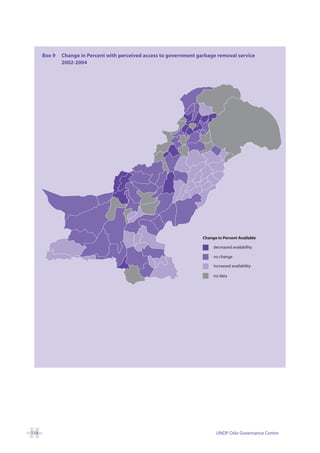
governance.centre@undp.org).

Contact details
Afghanistan National Development Strategy (ANDS)
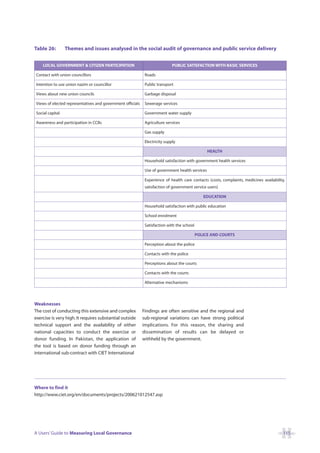
Gulkhana Palace, Sedarat,
Kabul, Afghanistan
Email: info@ands.gov.af
Phone: 0093.(75).2014821

Supplementary tools/guidelines
Not yet available.


A Users’ Guide to Measuring Local Governance                                                                 69
4
 Local Democracy Assessment Guide


          Producer                                               •   give outsiders, such as peer reviewers, a tool by
          International IDEA                                         which to conduct independent and impartial
                                                                     evaluations of democratic governance at the
          History                                                    city level.
          In 2001, IDEA published a handbook titled
          “Democracy at the Local Level: The International       Applicability
          IDEA Handbook on Representation, Participation,        It is currently being applied mainly in Africa and in
          Conflict Management and Governance.”This was a         the Arab region, but can be used anywhere in the
          comprehensive guide for local authorities, civil       world.
          society, and the international donor community on
          the subject of local democracy. As part of its         Types and sources of data used
          thematic work on democracy at the local level,         The information needed for this assessment is
          IDEA has also developed a number of tools              both objective and subjective. Primary data
          designed to assist practitioners and assistance        collection is through meetings, workshops,
          providers in supporting democratic development         interviews and discussions conducted by local
          at the local level.The Local Democracy Assessment      teams. Publicly available data collected though
          methodology is one such tool, developed in             documentary sources is used to double-check
          2002-03.                                               subjective information.

          Objectives                                             Methodology
          The purpose of the Local Democracy Assessment          The Local Democracy Assessment comprises 15
          Guide is to systematically review and catalogue the    ‘assessment areas’ grouped under three themes:
          quality of representative as well as participatory     the city in context, the quality of representative
          democracy in a city. In particular, it aims to:        democracy, and the quality of participatory
                                                                 democracy (see Table 7). Each one of the 15
          •   provide municipal officials, administrators,       assessment areas is assessed based on a detailed
              partners     (such      as     non-government      list of questions. The Guide is an interactive
              organizations), and civic leaders with a           questionnaire applied through participatory
              practical tool to conduct self-evaluations of      research and which relies on an intimate
              democratic life in their city;                     knowledge of local situations. Each theme is
                                                                 assessed based on a fairly comprehensive set of
          •   identify the principal strengths and weaknesses    questions.
              of democratic life and ways to further
              consolidate strengths and to rectify weaknesses;   Assessment teams typically consist of a representative
                                                                 of the national association of local municipalities, a
          •   investigate the contributions that local or city   representative of the local authority, an academic
              level democracy makes toward overall               with an expertise in public administration, and an
              consolidation of democracy in democratizing        individual from civil society. After completing the
              societies;                                         questionnaire, the assessment team synthesises
                                                                 the findings in a report and discusses them
          •   stimulate further thinking on the ways to          critically, identifying areas where consensus exists
              define and describe the best ways to structure     and where it does not. The most significant
              and practice local democracy; and                  problems are identified in each area, and
                                                                 recommendations are made by the team in
                                                                 the form of an “action plan” for improving local
                                                                 democracy.


70                                                                                UNDP Oslo Governance Centre
Table 7: Local Democracy Assessment themes and indicators


    THE CITY IN CONTEXT

    1    geography and spatial features
    2   demography, social relations, and human development indicators
    3   economic structure and municipal finance
    4   human rights and human security

    REPRESENTATIVE DEMOCRACY

    5   national and legal frameworks
    6    electoral system design and performance
    7   party system
    8    evaluating elected officials
    9   election administration
    10 evaluating voter participation

    PARTICIPATORY DEMOCRACY

    11 local authorities and participatory democracy (openness, fairness, transparency, responsiveness, accountability)
    12 civil society, the private sector, the international community and the media
    13 forms and methods of citizen outreach
    14 evaluating citizen outreach
    15 referenda and citizen’s initiatives


Key actors/stakeholders                                        Box 2 presents an extract from the narrative report
The guide is primarily designed for use by those               in Lusaka, Zambia.
well-versed in the issues and concepts of local
governance. The assessment usually is facilitated              Coverage
by an external independent organization.                       Pilot tested in four cities in East and Southern
Assessment teams typically consist of a                        Africa: Gaborone (Botswana), Lusaka (Zambia),
representative of the national association of local            Mwanza (Tanzania) and Nairobi (Kenya), and in
municipalities, a representative of the local                  selected cities in four Arab countries: Egypt,
authority, an academic with an expertise in public             Morocco, Yemen and Jordan.
administration, and an individual from civil society.
                                                               Timeline
Results reporting format                                       Initiated and pilot tested between 2002 – 2004.
Results of the questionnaire are presented in a                Ongoing.
narrative report comprising four main sections:
                                                               Gender focus
•       city in context (including geography and               The Guide gives a special attention to gender
        spatial features, demography and social                issues with respect to the existence of norms and
        relations, economic base and municipal                 measures guaranteeing gender representation
        finance, human rights and human security)              and inclusion in local government institutions
                                                               (section 5 on national and legal frameworks); the
•       representative democracy (including institutions       percentage of women candidates in elections
        and processes)                                         (section 7. on party system); and gender
                                                               representation in voter turnout (section 10. on
•       participatory democracy (including institutions        evaluating voter participation). In addition, data
        and processes)                                         on demography, social relations and human
                                                               development indicators, as well as the economic
•       conclusions and recommendations                        structure (in the section focusing on the city context)
                                                               is expected to be disaggregated by gender.


A Users’ Guide to Measuring Local Governance                                                                              71
Box 2: Report extract – Local Democracy Assessment in Lusaka, Zambia

     The sections below concern the form and methods of citizen outreach (13) and the evaluation of citizen outreach (14)
     (participatory democracy).


                                                                                                        Rating Please mark with an X
                        Which of the following forms of citizen
                   outreach have been used in the past 12 months?                            Not used     Used between one    Used more than
                                                                                              at all       and three times      three times

                                                                 Public Information

      13.1    Distribution of printed materials (leaflets, newsletters etc.) to the public                                             X

      13.2    Regular media briefing                                                                                                   X

      13.3    Public presentation and exhibitions                                                                 X

      13.4     Scheduled programmes in local media                                                                                     X

      13.5    Computer-based applications, such as websites and e-mail                                                                 X

      13.6    Others: motorized broadcast on the eradication and prevention of
              diseases, such as cholera

                                                                  Public Constation

      13.7    Consultative meetings                                                                                                    X

      13.8    Community forums                                                                                    X

      13.9    Public surveys                                                                                      X

      13.10   Others: None

                                                              Public Decision Making

      13.11   Working groups and focus groups                                                                                          X

      13.12   Public workshops                                                                                                         X

                                                           Cooperative Implementation

      13.13   Public–private partnerships or public–non-governmental partnerships                                 X

      13.14   Others: Involvement of NGOs


     Community outreach processes are very important to the city council’s operations. The most effective means of
     community outreach is the community participatory process that is built into CBO/NGO programmes. The community
     is not only involved directly in decision-making, but it also participates in the implementation and monitoring of
     programmes. In short, it is a bottom-up approach. The least effective was the now abandoned method under which all
     decisions were taken by civic centres without consultation with affected people. This invariably resulted in lack of
     ownership of the programmes or projects and hence vandalism and indifference towards the payment of fees and
     charges. CBOs/NGOs now work together with local authorities.The rate of citizen participation in community outreach
     is relatively good, but CBOs/NGOs are striving hard to ensure a much higher level.The basic barrier to citizen participation
     is poverty, which, in turn, contributes to illiteracy and lack of interest in community activities.The mission of Lusaka City
     Council is to ‘provide high quality services and an enabling environment, with stakeholder participation, in order to
     improve the quality of life for all those who live, work visit or conduct business in Lusaka’. The five-year strategic plan is
     supposed to enhance the prospects of achieving this vision. It was developed through broad consultations with a
     cross-section of the Lusaka community. This was done to ensure that the objectives of the city take into account the
     priorities of local communities, especially with respect to service delivery.
     Source: http://www.idea.int/publications/dll_africa/upload/Full_Report.pdf


72                                                                                                            UNDP Oslo Governance Centre
Poverty focus                                            The guide also provides useful step-by-step
Not explicit. The only indicator explicitly addressing   guidance on how to translate the findings of the
poverty is in the “city in context” section, and         assessment questionnaire into recommendations
measures the percentage of the city’s population         for improvement in local democracy.
living below the poverty line.
                                                         Weaknesses
Strengths                                                The guide focuses on assessing local democracy
Despite the level of detail in the questionnaire,        architectures (with a focus on elections, political
producers of the Local Democracy Assessment              parties, civic engagement, etc.) As such, this
Guide suggest that it can also be implemented in a       methodology has a more limited scope than broader
less time-consuming manner, focusing on a subset         local governance assessment methodologies.
of questions only. For example, in Gaborone, the
mapping of the state of local democracy was              Results of the pilot tests suggest that the local
reportedly the product of a two-day stakeholder          democracy assessment exercise should identify
workshop.                                                more clearly and specifically how an improvement
                                                         in the quality of democracy can lead directly to an
                                                         improvement in the quality of life.


Where to find it
http://www.idea.int/democracy/upload/Local_Dem_Assessment_Guide.pdf

Contact details
International Institute for Democracy and Electoral Assistance (International IDEA)
Strömsborg SE-103 34 Stockholm
Sweden
Tel: +46 8 698 3700, Fax: +46 8 20 24 22
E-mail: info@idea.int

Supplementary tools/guidelines
Democracy at the Local Level in East and Southern Africa: Profiles in Governance
http://www.idea.int/publications/dll_africa/upload/Full_Report.pdf

Democracy at the Local Level: A Guide for the South Caucasus
http://www.idea.int/publications/dll_caucasus/upload/English_text.pdf

Democracy at the Local Level: The International IDEA Handbook on Representation, Participation, Conflict Management and
Governance:
http://www.idea.int/publications/dll/upload/DLL_full_book.pdf

“Indicators for Local Governance in Africa: Findings from Recent Evaluations – IDEA Experience” (Workshop on Local
Governance and Poverty Reduction in Africa, 2005, Tunis):
http://www.afdb.org/pls/portal/docs/PAGE/JAI/RESOURCE_MATERIALS/COURSE_MATERIALS/LOCAL%20GOVERNANCE%20A
ND%20POVERTY%20REDUCTION%20CD/HAMDOK%20PP%20REVISED%20EN.PPT


A Users’ Guide to Measuring Local Governance                                                                         73
5
 Indicators of Local Democratic Governance


          Producer                                                   of Central and Eastern Europe, but can in fact be
          Local Government and Public Service Reform                 used by any country in transition.They can be used
          Initiative of the Open Society Institute, in partnership   to compare the progress of local democratic
          with the Tocqueville Research Center                       governance within the same country, or amongst
                                                                     different countries.
          History
          The Local Government and Public Service Reform             Types and sources of data used
          Initiative (LGI), and the Tocqueville Research Center      Data are collected using three types of surveys,
          (T-RC), Budapest initiated a project titled                which use both objective and subjective information:
          “Indicators of Local Democratic Governance” in             the Local Government Survey (LGS), the Local
          2000. The project aims to help decision-makers             Representative Survey (LRS), and the citizen survey.
          and researchers to assess and explain the state of         The questionnaires were developed on the basis of
          local democracy in the countries of Central and            the paper “The Indicators of Local Democratic
          Eastern Europe, which have adopted new local               Governance Project: Concepts and Hypothesis”
          government structures since the fall of communism          (see supplementary tools/guidelines).
          in 1989-90.
                                                                     The LGS collects factual information about the
          Objectives                                                 activities of local government and the organisation
          The Project aims to help decision-makers and               of civil society. The survey includes questions
          researchers assess and explain local government            related to the administrative staff, the budget, the
          performance.The overarching goal of the Project is         decision-making process, polices, democratic
          to develop a set of operational, flexible, and             activities and local governments, local parties, local
          adaptable indicators based on internationally              civil society, local media, local social life, etc. The
          recognized definitions of local democracy and              LRS survey focuses on elected representatives’
          governance. It is a monitoring programme that              perceptions on local government performance. It
          offers comprehensive, longitudinal and cross-              provides an assessment of the relationship
          nationally comparable information on local                 between local government and the citizens. The
          democratic governance in Central and Eastern               LRS investigates relations of trust and power
          Europe. Specifically, the Project aims to:                 within the political elite, party and NGO
                                                                     membership, as well as the respect of democratic
          •   generate original survey data and collect other        values. The citizen survey address almost all issues
              relevant statistical data;                             examined in the two other surveys.
          •   regularly report on the state of local democracy
              in Central and Eastern Europe;                         Methodology
          •   disseminate results and standardized datasets          The project uses a wide variety of variables
              to inform developmental and policy reform              to gauge the variance of local governance
              initiatives.                                           performance on the one hand, and its roots in
                                                                     economic, political, legal, cultural and social factors
          Applicability                                              on the other:
          The Indicators of Local Democratic Governance
          have mainly been developed for use by countries


74                                                                                    UNDP Oslo Governance Centre
Local governance performance measurements include the                      Explanatory variables for local governance include the
following 5 aspects:                                                       following:

1   Policy-Making Performance: Informed and Coordinated                    1    Characteristics of the local government
    Decisions                                                                   system (budget, etc.)
2   Democratic Performance: Openness and Fairness                          2    Local institutions (media, civil society, political parties)
3   Policy Implementation: Effectiveness                                   3    Local political culture (citizen participation in politics,
4   Responsive Performance: Satisfaction and Goal Congruence                    representatives’ political culture, etc.)
5   The Level of Service Provision as a Performance                        4    Characteristics of the municipality (size, inequalities,
    Measurement                                                                 socioeconomic development, etc.)


Local governance performance 2: Democratic Performance: Openness and Fairness Measures:

1   The transparency of the budget (the specification of some significant items, e.g. the costs of a teaching program; ordinal scale)
2   The existence and transparency of the rules of public purchases.
3   The existence and sophistication of rules regulating public access to local government documents
4   The number and comprehensiveness of local government meetings, hearings and forums and the method of their announcement
5   The existence and power of citizens’ consultative committees that are organized or recognized by the local government
6   Number of copies of free bulletins issued by the local government per 1000 inhabitants
7   Citizens’ answers to survey questions about the importance of good connections and bribery in local government offices
8   Citizens’ answers to survey questions about discrimination (e.g. ethnic)
9   Citizens’ answers to survey questions about the fair-mindedness and helpfulness of local government bureaucrats
(All of them are on an ordinal scale)


Table 8: Report Outlines – State of Local Democracy in Central and Eastern Europe

The State of Local Democracy in Central Europe, 2006 (Bulgaria, Estonia and Slovakia)

1   Introduction (the local government system, formation / structure of local government, project indicators)
2   Autonomous local government (legal, fiscal and political autonomy
3   Constitutional Local Government (civil and political rights, rule of law)
4   Transparent and Accountable Local Government (transparency, corruption, horizontal accountability)
5   Effective local Government (resource control, decision-making capability, output control)
6   Local Elections and Referenda (electoral system, process, results and turnout)
7   Local Parties and Factions (political parties, nomination and endorsement, party activity, factions)
8   Local Representatives (demographic features, political background, social capital, political culture)
9   Responsive Local Government (inclusive decision-making, accessibility of local representatives)
10 Local Media (availability, independence and representation, media in local political life)
11 Local Civil Society Organisations (legal status, CSO in local public life, contacts with local government)
12 Citizens’ Political Culture (political interest and knowledge, local political participation, political efficacy)


Each local governance performance variable and                  administrators, elected representatives and citizens.
each explanatory variable is assessed with several              The currently available international database
“measures” For instance, the variable on “democratic
          .                                                     contains the responses of approximately 5,000
performance” is assessed based on the following                 local councillors and mayors of the surveyed
measures:                                                       countries. The Tocqueville Research Center was
                                                                responsible for the collection of data and
The data is collected through surveys (administered             generation of results, in collaboration with polling
face-to-face and through mail) targeted at local                institutions in each country.


A Users’ Guide to Measuring Local Governance                                                                                                   75
Box 3:         Report extract – Bulgaria country report using Indicators of Local Democratic Governance

     The Bulgaria country report is included in the book “The State of Local Democracy in Central Europe” published in 2006.
                                                                                                        ,
     Data was collected between 2002 and 2003. The tables below present two examples of the information used to
     produce the country report, based on the Indicators of Local Democratic Governance. The first table is related to the
     sources of municipal e-government, within the area of local democracy assessment related to the “Transparent and
     Accountable Government” The second table shows the level of education of Local Representatives, within the area of
                               .
     local democracy assessment related to the “Local Representatives”   .


      Sources of Municipal E-government [%]:                                                      Yes               No     Total

      Municipal government has a website (N 183)                                                 67.2             32.8     100.0

      Local government provision of information by e-mail (N 183)                                58.5             41.5     100.0

      E-mail usage by local representatives (N 953)                                              28.2             71.8     100.0

      Internet usage by local representatives (N 950)                                            39.1             60.9     100.0


     Source: face-to-face interview with Local Chief Administrative Officials


      Level of Education of Local Representatives:

                           Not Completed            Primary          Trade School   Secondary            Higher          Total
                               Primary                                                                  Education

         Councillors               1                    6                  147         36                 662            852
                                 0.1%                 0.7%                17.3%       4.2%               77.7%           100%

           Mayors                                                           8           3                  84             95
                                                                          8.4%        3.2%               88.4%           100%

            Total                  1                    6                  155         39                 746            947
                                 0.1%                 0.6%                16.4%       4.1%               78.8%           100%


     Source: LRS 2003.
     Source: http://lqi.osi.hu/publications/2006/340/Soos_complete_low_res_2.pdf


                         Key actors/stakeholders                                    country report on local democracy. The country
                         The central actors in this exercise are the chief          report addresses three main areas: local
                         administrators of municipalities, elected                  governance performance, representation in local
                         representatives, including Mayors and Councillors,         government and local civil society. Each area is
                         and citizens. The primary beneficiaries and target         further divided into sub-themes and a general
                         audience of this initiative are national policy- and       leading question is elaborated for each sub-theme.
                         decision-makers. Results can also be useful to             Table 8 shows the manner in which the reports are
                         donors and policy analysts for assessing technical         organised and Box 3 provides an extract from the
                         assistance needs for improving local governance.           Bulgaria country report published in 2006.

                         Results reporting format                                   Coverage
                         Results are represented by two outputs: a dataset          The Indicators of Local Democratic Governance
                         compiling responses from the two surveys, and a            focus on transition countries of Central and Eastern


76                                                                                                  UNDP Oslo Governance Centre
Europe. They have first been used in Latvia,           the municipality, including indicators of poverty
Hungary, Poland and Romania, and subsequently          and inequalities.
in Bulgaria, Estonia and Slovakia.
                                                       Strengths
Timeline                                               The Indicators generate comparable information
Initiated in 2001. Follow-up data collection and       about the level of local democratic governance
expansion to more countries between 2002-03.           amongst municipalities facing a similar set of
Reports published in 2002 and 2006.                    problems.

Gender focus                                           Weaknesses
Not explicit. While the questionnaires do not          • Willingness to participate in this evaluation by
include indicators relating to gender equality and       municipal administrative officials is a prerequisite
representation, the country reports do seem to           to the successful use of the Indicators.
address the issue of women’s participation in local
politics and – to a minor extent – the issue of        •   The assessment is only possible through the
gender equality in civil society organisations.            use of a specialised agency that can organise
                                                           and manage the survey (the Tocqueville
Poverty focus                                              Research Center in this case).
While governance indicators do not have an
explicit pro-poor focus, the “explanatory variables”   •   The survey questions require sophisticated
for the local governance situation include a               knowledge amongst the respondents, which
sub-section assessing some key characteristics of          may generate biased or skewed information.


Where to find it
The Indicators of Local Democratic Governance Project: Concepts and Hypothesis:
http://lgi.osi.hu/publications/2001/22/IOLDG.PDF

Contact details
Gabor Soos
Email: soos.gabor@t-rc.org

Supplementary tools/guidelines
Indicators of Local Democratic Governance, Local Government and Public Service Reform Initiative, OSI:
http://lgi.osi.hu/documents.php?id=15&m_id=&bid=1

“The State of Local Democracy in Central Europe” 2002, introduction:
                                                 ,
http://lgi.osi.hu/publications/2002/100/Soos-Introduction.pdf

“The State of Local Democracy in Central Europe” 2002, questionnaires:
                                                ,
http://lgi.osi.hu/publications/2002/100/Soos-Appendices.pdf

“The State of Local Democracy in Central Europe” 2006:
                                               ,
http://lgi.osi.hu/publications/2006/340/Soos_complete_low_res_2.pdf


A Users’ Guide to Measuring Local Governance                                                                    77
6
 Methodological Guidelines for Local Governance Analysis


          Producer                                               •   to help formulate an action plan to strengthen
          UNDP, Regional Project on Local Governance for             or maintain the quality of local governance.
          Latin America
                                                                 Applicability
          History                                                The indicator set can be used by any group of local
          In Latin America, the devolution of power from         stakeholders interested in undertaking a self-
          central to sub-national government has been            assessment of local governance. The assessment
          uneven but steady. There has been a significant        results and Guidelines are also expected to be
          increase in the volumes of funds managed directly      used by UNDP national offices in Latin America,
          by regional and local administrations, which are       to help them incorporate activities aimed at
          now responsible for providing basic social services.   strengthening governance in ongoing local
          Elections are also increasingly held at regional and   development projects.
          local levels. However, the formal authority and
          responsibilities devolved to local governments         Types and sources of data used
          have not always been fully granted in practice,        The information collected is both subjective and
          sometimes due to capacity deficits in local            objective: citizen surveys (generally through
          administrations, sometimes due to central              personal interviews); city (and national) statistics
          administrations holding on to their centralizing       and regulations; available administrative data.
          tendencies.
                                                                 Methodology
          As such, one of the most urgent tasks for local        The guidelines suggest that good local governance
          governance in Latin America is to consolidate the      presupposes six specific requirements: strategic
          empowerment of local governments as they try           vision, legitimacy and leadership, active and
          to redefine their role and identity in this newly      positive relationships between actors, appropriate
          decentralized setting. In this context, the need for   institutional capacity, citizen participation, and
          a framework for assessing the state of                 a focus on human development. These six
          decentralization and local governance was              requirements are assessed based on specific
          identified by UNDP, both as a normative reference      targets and indicators (see Table 9).
          to guide the ongoing decentralization process, and
          as a diagnostic tool to help identify governance       For each indicator, various evaluation criteria are
          dysfunctions which could be addressed through          proposed against which the actors involved can
          the design of development projects.                    make the assessment. The evaluation involves
                                                                 expressing a judgement with respect to the
          Objectives                                             various criteria, on a numerical scale between 1
          The overall purpose of the Agenda on Local             and 5, while explaining the reason for the
          Governance in Latin America is to help inform the      response.The evaluation can include statements (1
          design of projects to enhance local governance         = totally disagree,to 5 = totally agree) or percentages
          and to introduce an instrument to help monitor         (1 = 0-20%, 2 = 21-40%, 3 = 41-60%, 4 = 61-80%, 5
          and promote good governance processes at the           = 81-100%).
          local level. The guidelines have two specific
          objectives:                                            After analysing the results, the local actors involved
                                                                 are expected to propose an action plan to
          •   to develop a diagnostic tool about local           strengthen the quality of local governance.
              governance conditions; and


78                                                                                UNDP Oslo Governance Centre
Table 9: Methodological Guidelines for Local Governance Analysis – Key themes and indicators


1   Strategic Vision                                                    2   Legitimacy and Leadership

Target 1.1 The existence of a strategic plan for local development Target 2.1 Identification of individuals and organizations with
which will contain the consensual formulation of a strategic vision.    drawing power.
1.1.1   Existence of a general plan or sector plans                     2.1.1    Degree of confidence in institutions (opinion polls)
1.1.2   Coordination of the Plan with national or sector plans          2.1.2    The individuals attitude to the future
1.1.3   Level of consensus achieved in the formulation of the Plan
1.1.4   Consistency between public policy and the strategic plan        Target 2.2 Public support for processes undertaken
1.1.5   Coincidence of expected scenarios and actual scenarios          2.2.1    Level of public knowledge of the process
1.1.6   There are experiences of long-term private-public commitment 2.2.2       Public expectations of the results of the process
        in this region/place                                            2.2.3    Public support
Target 1.2 Continuity of Public Policy
1.2.1   Duration of periods of office of local administrations and
        possibility of rewarding good administration.
1.2.2   Degree of public support for policies
1.2.3   Opportunity

3   Active and Positive Relationship Between Actors                     4   Institutional Capacity

Target 3.1 Full exercise of the right to self-determination             Target 4.1 Transparency in public administration
3.1.1   Existence of and respect for the rules of power-distribution 4.1.1       Clear rules of the game in administration processes
        between sub-national administrations                            4.1.2    Existence of mechanisms of control by society and public
3.1.2   Harmonious relations between local government and                        knowledge public administration
        national and regional government.                               4.1.3    Corruption: policies, indicators and Perceptions
3.1.3   Capacity of the courts to influence local politics              Target 4.2 A technically qualified team
3.1.4   Degree of transfer of competency and funds to sub-national 4.2.1         Degree of professionalization or personnel and selection criteria
        government                                                      4.2.2    Installed technical capacity
Target 3.2 Harmony in horizontal power relations                        Target 4.3 Financial sustainability of processes
3.2.1   Electoral system and party system, locally                      4.3.1 Financial Indicators
Target 3.3                                                              Target 4.4 Effectiveness of the law
3.3.1   Existence of private organizations that participate in the 4.4.1         Mechanisms of access to justice
        achievement of public objectives                                4.4.2    Crime Indices
3.3.2   Correlation of public support between actors in tension         Target 4.5 Quality in the delivery of services
                                                                        4.5.1 Mechanisms for attention to citizens
                                                                        4.5.2 Quality of Service

5 Citizen Participation                                                 6 Results in Human Development

Target 5.1 Significant electoral participation                          Target 6.1 Establishment of aims in human development
5.1.1   Positive attitude towards election processes                    6.1.1    Local situation of human development
Target 5.2 Promotion of civic participation                             6.1.2    Effects on human development foreseen in the conception,
5.2.1   Participation mechanisms and scenarios                                   design and implementation of local actions
5.2.2   The implementation of programs, projects, etc with civic 6.1.3           Effective impact of the actions applied on local human
        participation                                                            development
5.2.3   Organizations devoted to the promotion of civic participation
5.2.4   Formation programs
5.2.5   Positive attitude towards the citizen-government relationship


A Users’ Guide to Measuring Local Governance                                                                                                     79
Key actors/stakeholders                                 Poverty focus
                    Citizens have a fundamental role in this                The Agenda and the Guidelines for assessing Local
                    assessment process since the diagnosis is largely       Governance aim to contribute to the eradication
                    based on their perceptions of their representatives     of poverty and the promotion of human
                    and local policies. UNDP (or any other                  development by promoting good governance.
                    development partner wanting to act as a facilitator     However, governance-poverty linkages are not
                    for such an assessment) also plays a central role in    explicitly addressed, except for one indicator
                    the process, by identifying and bringing together       measuring the “percentage of population who are
                    local actors, ensuring objectivity, promoting           above the poverty line” under the section “results
                                                                                                  ,
                    dialogue, supporting the development of action          in human development”   .
                    plans, and guaranteeing the continuity and
                    sustainability of the process, especially with          Strengths
                    regards to action plan implementation.                  The Agenda and the guidelines for assessing local
                                                                            governance have the twin advantages of providing
                    Coverage                                                specific indicators of local governance and offering
                    Urban areas of Latin America. The tool was first        tools to be applied in programmes and projects
                    applied in Cartagena.                                   that will enhance the quality of local governance.

                    Timeline                                                Weaknesses
                    Initiated in 2004. Applied in Cartagena in 2007.        The only poverty-focused indicator “percentage of
                    Ongoing.                                                population who are above the poverty line” does
                                                                            not seem to take into consideration non-income
                    Gender focus                                            poverty, the intensity and depth of poverty, nor
                    Not explicit. No reference to gender issues either in   how to foster pro-poor governance.
                    the Agenda or in the guidelines for assessing Local
                    Governance.


Where to find it
http://www.logos.undp.org/fileadmin/docs/Gobernabilidad_Local/presetnacion_ODM/Agenda_Ingles.pdf

Contact details
Programa de las Naciones Unidas para el Desarrollo
Proyecto Regional de Gobernabilidad Local para América Latina
Av. 82 No. 10-62 Piso 3
Bogotá, Colombia
Tel: 57 1 488 9000 Ext. 234/244
Website: info.logos@undp.org.co

Supplementary tools/guidelines
More information about the initiative:
www.logos.undp.org

Methodological Guidelines for the analysis of Local Governance (in Spanish):
http://www.logos.undp.org/fileadmin/docs/Gobernabilidad_Local/Guia_Metodologica_pa_Analisis_Gob_Local.pdf

Methodological Guidelines for the development of a country/province/state profile concerning Local Governance:
http://www.logos.undp.org/fileadmin/docs/Gobernabilidad_Local/Tors_y_guia_Metodologica_pa_Elaboracion_de_Marcos_
de_Pais.pdf

Example of a perception survey in Cartagena, Colombia:
http://www.logos.undp.org/fileadmin/docs/Gobernabilidad_Local/Cartagena/I-7894_-Gobernabilidad_Cartagena_
FINAL_PNUD.ppt#691,10,Visión Estratégica


80                                                                                          UNDP Oslo Governance Centre
7
                                                                    Governance Index (Indonesia)


Producer                                                Types and sources of data used
Kemitraan Partnership, an independent Indonesian        Information is mainly quantitative. It is made up of
research institution                                    both subjective and objective data. Subjective
                                                        data is obtained through structured interviews of
History                                                 well-informed persons (guidelines for interview
The Index has been developed in Indonesia in the        supplied in the methodology package), which fall
context of the regional autonomy policy and             into two groups: those who are the very actors of
decentralisation process, which resulted in             the governance processes assessed (representatives
significant variations in the “quality” of local        from government, bureaucracy, economic society
governments. The lack of comprehensive and              and civil society) and those who are not direct
rigorous data to investigate such variations in the     actors but have some interaction with them, or are
quality of governance across provinces led              concerned with the quality of governance
Kemitraan develop a Governance index that would         (academics and journalists).
be applied in each province, thus allowing not only
for comparisons across provinces, but also for          Objective data consists of statistical data, budgetary
cross-learning and dissemination of good                data, local development plan, local legislation
practices.                                              programme, websites, records of coordination
                                                        meeting, audits, human development index, etc.
Objectives                                              More specifically, for the government area, data is
The Governance Index has the overall objectives to      collected from the provincial secretariat and the
                                                        provincial parliament. For the bureaucracy area,
•   provide a comprehensive and methodologically        data is collected from the local health, education,
    sound assessment of governance performance          social affairs and revenue collection offices, the
    in all Indonesia provinces;                         local planning agency, the local anti-corruption
                                                        office, the local statistics office, etc.
•   rank governance performance in all
    Indonesian provinces based on separate              Methodology
    assessments in 4 “areas of governance”:             The Index is organised into 4 areas, 8 functions, 6
    government, bureaucracy, civil society and          principles and 75 indicators. Table 10 presents the
    economic society;                                   distribution of indicators according to the different
                                                        areas and functions.
•   provide an evidence base to the local
    governments, the communities and other              The number of indicators varies from for each
    relevant stakeholders (including the central        function, as only those good governance
    government) to help inform governance               principles which are most relevant to the function
    policies and capacity development programmes        assessed have been translated into indicators. The
    at the local level                                  following table provides an example of indicators
                                                        for each one of the 6 principles, while showing the
Applicability                                           area and the function it aims to assess:
This method is applicable where stakeholders
would like to assess “governance” defined as the
interactions at the local level between the political
office, the bureaucracy, civil society and the
economic society.


A Users’ Guide to Measuring Local Governance                                                                     81
Table 10:       Distribution of indicators according to the different areas and functions


                    AREAS                                          FUNCTIONS                      NUMBER OF INDICATORS

 Government                                 Regulatory framework                                             9

                                            Budget allocation                                                14

                                            Coordination of development                                      10

                                            Revenue collection                                               6
 Bureaucracy
                                            Public services                                                  8

                                            Regulating the economy                                           6

 Economic society                           Government tender and project implementation                     9

 Civil society                              Advocacy                                                         13

 Total                                                                                                       75


Table 11:        Example of one indicator for each one of the 6 principles, with reference to the area and
                 function it aims to assess


 PRINCIPLE            INDICATOR                           AREA                             FUNCTION

 Participation        Level of the community’s            Civil Society                    Advocacy
                      monitoring of the
                      implementation of government
                      project tenders

 Fairness             Level of discrimination in terms    Government                       Coordination of development
                      of coordination by the governor
                      with the district/cities

 Accountability       Compliance of companies to          Economic Society                 Government tender and project
                      manpower regulations in the                                          implementation
                      implementation of government
                      projects, i.e. labour wage meets
                      the minimum wage standard

 Transparency         The publication of Local            Government                       Regulatory framework
                      Regulations and Governor
                      Regulations can be accessed
                      completely through the web

 Efficiency           Completion of government            Economic Society                 Government tender and project
                      project within agreed timelines                                      implementation

 Effectiveness        Presence / absence of               Government                       Coordination of development
                      agreements emerging from the
                      coordination meetings between
                      the provincial governor and
                      district heads


82                                                                                         UNDP Oslo Governance Centre
Table 12:       Example of form for collecting objective data


No.   Code                   Indicator               Data Item               Data                  Score                   Reference

1.    C1A1 (Civil society/   The presence or         Audit of CSO 1          Present/Absent        1 = for the three
      principle of           absence of regular      financial report                              there is no financial
      accountability)        audit of financial                                                    audit
                             report for 3 biggest    Audit of CSO 2          Present/Absent        2 = only one CSO
                             CSOs working in the financial report                                  has a financial audit
                             field of community
                             empowerment             Audit of CSO 3          Present/Absent        3 = only two CSOs
                                                     financial report                              have financial audits


                                                                                                   4 = the three CSOs
                                                                                                   have financial audits


Table 13: example of question for interviewing well informed people


No.   Code                       Indicator                    Question                    Answer                       Summary of
                                                                                                                       Answers/Reasons

3     G3A1 (Government/          Level of implementation      1. One of the functions     Has been implemented
      principle of               of the provincial            of the provincial           Has not been
      accountability)            parliament’s control         parliament is to exercise   implemented yet
                                 functions over the           control over the
                                 Governor                     government in the
                                                              province. What is your
                                                              opinion about the
                                                              control exerted by the
                                                              provincial parliament?
                                                              Has it been
                                                              implemented or not yet?


                                                              2. If it has been           1 = no control function
                                                              implemented, what is
                                                              the quality/effectiveness 2 = some control
                                                              of this control? Has the    function but with low
                                                              provincial parliament       objectivity
                                                              exercised this control
                                                              function in an objective    3 = control function with
                                                              manner?                     medium objectivity


                                                                                          4 = control function with
                                                                                          good/high objectivity


A Users’ Guide to Measuring Local Governance                                                                                             83
Table 14: Democratic Governance Profile of Province X

 Province X: Overall Governance Index: 4.4

                 Index Areas      Participation    Fairness        Accountability   Transparency    Efficiency      Effectiveness

 Government      3.9              5.5              2.6             5.4              2.8             3.3             4.4

 Bureaucracy     4.0              5.3              5.3             1.0              2.5             5.7             6.8

 Civil Society   5.4              4.0              7.0             7.0              3.9             5.8             4.9

 Economic        4.5              5.5              4.0             5.5              5.5             1.0             5.5
 Society


                       Key actors/stakeholders                                 outcomes), indicators do not have an explicit
                       Each provincial assessment was facilitated by an        pro-poor dimension.
                       independent researcher from Kemitraan-
                       Partnership, which was responsible for conducting       Strengths
                       interviews, collecting secondary data, and              • Very comprehensive methodology combining
                       preparing a “provincial profile” to be shared and           both objective and subjective data sources,
                       discussed in a local consultative forum. The                with detailed instructions for users and
                       methodology package lists the 32 well-informed              ready-made data collection instruments (e.g.
                       persons to be interviewed (e.g. one officer working         data collection forms with scoring criteria,
                       in the provincial secretariat, one officer from each        guiding questions for interviews, etc.)
                       of the 3 parliamentarian commissionx on people’s
                       welfare, on the economy/industry/trade, on the          •    Very actionable indicators generating data that
                       local budget and expenditure, one journalist from            can easily used by local policymakers, pointing
                       the most prominent media in the province, one                to specific dysfunctions in local governance
                       academic who is a resource person for the local              processes
                       government, one representative from the
                       provincial chamber of commerce, one CSO                 •    Draws from an extensive range of objective data
                       representative who has participated in a                     sources from government and administrative
                       consultation with the local government, etc.)                sources which are readily available but rarely
                                                                                    used in other local governance assessments
                       Results reporting format
                       The final Index is expressed in the form of             Weaknesses
                       Democratic Governance Profile as shown in the           • Detailed methodology drawing from multiple
                       following table, with scores between 1 and 10:            data sources and informants, while ensuring
                                                                                 methodological rigor, requires a significant
                       Gender focus                                              amount of time and in-depth research
                       Minimal.Within the area “government” an indicator
                                                               ,
                       assesses the level of women’s political participation   •    Requires country adaptation, as several
                       in the provincial parliament by measuring the                indicators refer to institutions and practices
                       proportion of female parliamentarians.                       specific to Indonesia

                       Poverty focus                                           Coverage
                       While the overall aim of the assessment framework       All Indonesian provinces.
                       is to measure the quality and fairness of policy
                       formulation and policy implementation processes         Timeline
                       (as a proxy of quality and equitable development        2008. On-going.


84                                                                                               UNDP Oslo Governance Centre
Where to find it
   The initiative is not yet available online. A copy of the draft methodology can be found on the Governance Assessment
   Portal (www.gaportal.org) or else the UNDP Oslo Governance Centre can be contacted directly (oslo.governance.
   centre@undp.org).

   Contact details
   Kemitraan Partnership
   Jl. Brawijaya VIII No. 7
   Kebayoran Baru, Jakarta 12160
   Phone: +62-21-727 99566
   Fax: +62-21-722 5667
   Email : info@kemitraan.or.id


A Users’ Guide to Measuring Local Governance                                                                               85
8
 Measuring Municipal Performance MIDAMOS (Paraguay)


         Producer                                              municipal management. For each indicator, an
         AlterVida/GEAM with support from USAID                evaluation on a 1-5 scale and a relative weight
                                                               are provided. Municipal performance is then
         History                                               calculated by adding up the weighted value of
         In 2001, CIRD, (Centro de Información y Recursos      each indicator score (see table below).
         para el Desarrollo), a Paraguayan non-profit,
         launched a programme aimed at strengthening           A specific “technical card” is established in order to
         democratic practices in Paraguay by strengthening     score each indicator on a 1-to-5 scale. This
         Civil Society Organizations. To do this, the          card contains the description of indicators, the
         programme had for objectives to implement             performance parameters, the applicable formula,
         permanent mechanisms that increase citizen            the necessary documentation to assess the
         participation in the public decision-making           indicator’s value, and the relative weight of each
         process, and to provide civil society with tools to   indicator. Two examples of the scoring procedure
         improve oversight of public institutions. One such    are presented below:
         tool to promote accountability and transparency
         at the local government level was promoted            Once the assessment of each indicator and theme
         through the application of a local governance         has been completed, this information collected
         measurement tool, MIDAMOS, which was                  by CSOs is presented to municipal officers and
         developed under USAID/Paraguay’s Local                council members in order to share the results and
         Governments Program.                                  include local governments’ comments in the
                                                               assessment.
         Objectives
         The goals of the scoring system MIDAMOS (“Let’s       In 2008, MIDAMOS turned to the use of the radio
         Measure”) include promoting good governance at        to talk about the performance of municipal
         the municipal level; encouraging citizens and civil   governments where MIDAMOS was applied. The
         society organizations to develop the capacity to      idea is to inform and raise awareness amongst
         understand and evaluate municipal administration;     citizens on the benefits of having objective
         and supporting the perception amongst authorities     indicators on municipal government performance.
         and public officials that good governance
         practices are in their professional, political, and   Key actors/stakeholders
         personal interests.                                   MIDAMOS is intended to benefit municipal
                                                               officers, municipal council members, and
         Types and sources of data used                        municipal administrations. For its application,
         Most data is obtained from objective sources, both    MIDAMOS relies on:
         quantitative and qualitative, such as municipal
         statistics and regulation, administrative data on     •   an Authorised Evaluation Agency – such as a
         population, budgets and procedures. Interviews            research outfit or multi-stakeholder consultative
         with some key informants in the municipality and          bodies – serving as facilitator of the assessment
         with citizens are suggested to complement or              process
         verify the objective data collected for some
         indicators.                                           •   a municipal officer with sufficient responsibility
                                                                   and authority to provide the AEA with all the
         Methodology                                               necessary information and documentation for
         MIDAMOS is a set of 31 qualitative and quantitative       the assessment
         indicators organised into 5 main themes of


86                                                                              UNDP Oslo Governance Centre
Table 15:        MIDAMOS’s themes, indicators and weights


Themes, Description, Relative Weights            Indicators                                                                Indicators’
and Maximal Scores                                                                                                         Weights

Finances                                         1   operational financing                                                     2%
Aspects related to the administration of
                                                 2   capacity to invest own resources                                          2%
financial municipal resources
relative weight: 20%                             3   efficiency in estate tax collection                                       2%
maximal score: 1.00
                                                 4   social investment                                                         2%

                                                 5   expenditure capacity through own resources                                2%

                                                 6   process and emission of financial reports                                 2%

                                                 7   budget programming                                                        2%

                                                 8   processes organising expenditure                                          2%

                                                 9   tax collection management                                                 2%

                                                 10 cadaster management                                                        2%

Internal Administration                    1         efficiency of municipal officers                                          2%
Existence and extent of implementation and
development of processes facilitating the  2         flexibility of current expenditures                                       2%
achievements of institutional results
relative weight: 16%
                                           3         technological capacity                                                    2%
maximal score: 0.80
                                                 4   existence and extent of municipal planning                                2%

                                                 5   existence and extent of human resources                                   3%

                                                 6   procedures for acquisitions                                               2%

                                                 7   planning and implementation of investments with royalties resources       3%

Service Delivery Management                      1   service delivery                                                          7%
Municipal administration capacity of
                                                 2   coverage of principal services                                            7%
providing basic services and sustaining
processes for their improvements                 3   quality of principal services                                             7%
relative weight: 24%
maximal score: 1.20                              4   environmental quality                                                     3%

                                                 1   internal municipal participation and transparency                         3%
Democracy and Participation
Municipal administration capacity to             2   mechanisms for citizens participation                                     6%
establish relationships with the civil society
and other governmental organisations             3   sustainability of citizens participations                                 2%
relative weight: 25%
maximal score: 1.25                              4   accountability and responsibility                                         4%

                                                 5   transparency towards community                                            5%

                                                 6   relationships amongst governments’ levels                                 3%

                                                 7   promotion of gender equality                                              2%

Legislative Activity                             1   legislative efficiency                                                    5%
Extent of performance from the municipal
legislative body to achieve municipal            2   technical and operacional efficiency                                      5%
objectives
relative weight: 15%                             3   transparency and participation
                                                                                                                               5%
maximal score: 0.75


A Users’ Guide to Measuring Local Governance                                                                                             87
Table 16:         Examples of scoring procedure


     INDICATOR AND OBJECTIVE                   PERFORMANCE PARAMETERS                                                 RESULTS

 SOCIAL INVESTMENT                    The closer the ratio is to 0, the smaller is          5 points: more than 0.40
 (indicator 4 under “Finances”) municipal social investment.                                4 points: between 0.31 and 0.40
 It evaluates the ratio of
                                                                                            3 points: between 0.21 and 0.30
 municipal social investment
 against total municipal                                                                    2 points: between 0.11 and 0.20
 expenditures                                                                               1 point: less than 0.11

 ACCOUNTABILITY AND                   1   the municipality has a normative framework        5 points: more than 9 parameters applied

 RESPONSIBILITY                           for management accountability

 (indicator 4 under                   2   at least an accountability tool for the           4 points: between 8 and 9 parameters applied
 “Democracy & Participation”)             municipal general management has been
 It identifies the mechanisms             implemented
 used by the municipality to
                                      3   there is a mechanism for the monitoring of        3 points: between 5 and 7 parameters applied
 explain and justify its decisions,
                                          public management
 policies and programmes
                                      4    the mechanisms is publicised and easily          2 points: between 3 and 4 parameters applied
                                          accessible

                                      5    the monitoring mechanisms registers              1 points: less than 3 parameters applied
                                          community questions and the institutional
                                          answers

                                      6   there is a procedure to channelling
                                          complaints and answers

                                      7   documentation/reports on municipal
                                          accountability are distributed to citizens

                                      8    the report is comprehensible and provide
                                          clear information

                                      9    the report provides complementary
                                          information to understand the results

                                      10 citizens can access accountability
                                          documents and get an answer to their
                                          questions

                                      11. there is evidence of citizen participation in
                                          accountability procedures

                                      12. there are other accountability mechanisms


                         •   in the case where a municipality is not willing                 objective data collected for some indicators
                             to participate, a working group composed of                     (e.g. for indicators of “accountability and
                             experts and “well informed persons” on the                      responsibility” indicators of “transparency
                                                                                                           ,
                             management of the municipality                                  towards community” etc.)
                                                                                                                 ,

                         •   municipal officers, representatives of civil                 Results reporting format
                             society organisations and citizens can be
                             occasionally interviewed by the Evaluation                   Each municipality receives a “grade” between A
                             Agency in order to complement or verify the                  and E, as indicating in Table 17.


88                                                                                                          UNDP Oslo Governance Centre
Table 17: Grading System

 Qualification A   between 4,6 and 5        Very good performance

 Qualification B   Between 3,6 and 4,5      Good performance with some shortcomings

 Qualification C   Between 2,6 and 3,5      Difficulties in municipal managements, especially in some key indicators

 Qualification D   Between 2 and 2,5        Severe administrative problems

 Qualification E   less than 1,9            Very bad performance


Gender focus                                            •   The tool’s methodology, drawing mainly from
A specific indicator is related to the promotion of         objective indicators, makes results “indisputable”
                                                                                                             .
gender equality based on the following elements:            The MIDAMOS methodology is also very
existence of a municipal officer dealing with gender        rigorous, offering precise scoring criteria for
issues; existence a municipal norm recognising –            each indicator.
formally or informally – the participation of
women associations; existence of municipal              Weaknesses
actions or programmes promoting the development         MIDAMOS indicators rely mostly on objective data
of women associations; presence of at least 30% of      assessing the existence of municipal mechanisms,
women municipal officers; etc.                          programmes, legislations or quotas. The marginal
                                                        participation of citizens in the assessment process
Poverty focus                                           (i.e. as data sources) limits opportunities for
Not explicit.                                           also evaluating the quality of local governance
                                                        mechanisms.
Strengths
• MIDAMOS is a comprehensive assessment                 Coverage
    covering both aspects of local democracy            As of October 2008, the assessment had been
    and aspects related to local government             implemented in 150 municipalities in Paraguay.
    performance, such as service delivery and
    internal administration.                            Timeline
                                                        Started in 2006. On-going. Pilot projects realised in
                                                        2005-2006. Ongoing.


Where to find it
http://www.midamos.org.py/

Contact details
MIDAMOS
Mcal. López 2029 e/ Acá Caraya
Asunción, Paraguay
Teléfonos: (595 21) 212540/ 207373
midamos@cird.org.py
www.midamos.org.py

Supplementary tools/guidelines
MIDAMOS manual:
http://www.midamos.org.py/docs/MANUAL_MIDAMOS_version_1.2.pdf
Power point presentation of the MIDAMOS initiative:
http://www.intrac.org/docs.php/3362/Alvaro%20Caballero%20Paraguay%20PAIC%20INTRAC.ppt


A Users’ Guide to Measuring Local Governance                                                                           89
9
Observatory of Democracy in Central America: System of
Legal and Institutional Governance Indicators for Central
America

          Producer                                              Applicability
          Centro Estudios para el Futuro                        The tool is best suited to Central American countries.

          History                                               Types and sources of data used
          During 2000-2003, the Observatory (a network of 9     Objective data only, mainly from constitutions,
          research institutions based in 5 Central American     secondary laws, decrees, and other provisions,
          countries) generated extensive research on            budget data, etc.
          legal/institutional governance and the practice,
          evolution and requirements of rule of law in 5        Methodology
          Central American countries: Guatemala, El             The module on Local Government and
          Salvador, Nicaragua, Honduras and Costa Rica.         Decentralisation includes 8 variables and 43 legal
          From 2004 to 2007, the Observatory documented         indicators. The value assigned to each indicator is
          normative best practices from 16 OECD countries       0, 100 or an intermediate value. The great majority
          with regards to their juridical, institutional and    of indicators are of an IF or NOT (existence) type.
          legal frameworks, and applied these best practices
          to the design of a System of Indicators on Legal      The following table presents the framework of the
          and Institutional Governance for Central America.     module on “Local Government and Decentralisation”:
          This assessment methodology was applied to the 5
          above mentioned Central American countries, and       Indicators are selected on the basis of three
          generated detailed recommendations for legal          analytical categories:
          and institutional reforms.
                                                                •   Parameters of legal existence (yes/no) (weight:
          The 99 variables and 475 indicators composing             25% of indicator value)
          the System of Legal and Institutional Indicators
          of Democratic Governance cover five broad             •   Parameters of standard typology (consistency
          dimensions of institutional building, legal               of this norm/disposition with international
          organization and public policies in contemporary          “benchmark”) (weight: 25% of indicator value)
          societies: 1. Constitutional Framework, Legal
          Regime and Institutional Structure of the State; 2.   •   Parameters of systemic efficacy or implementation
          Electoral System, Political Representation and            (efficacy of system at implementing this
          Participation; 3. Financial and Public Fund System;       norm/disposition, looking at 8 factors which
          4. Public Investment on Democratic Institutions; 5.       were identified as being key for enabling or
          Local Government and Decentralisation.                    interfering in the achievement of the goals and
                                                                    objectives of the legal provision e.g. legal
          Given the focus of this guide on decentralised            systemic contradictions and overlaps,
          governance, only the module on “Local Government          insufficient budget or financial support,
          and Decentralisation” is presented here.                  inadequate civil service, partial/differentiated
                                                                    application of the law in the same territory,
          Objectives                                                etc.) (weight: 50% of indicator value)
          The Project Observatory of Democracy in Central
          America proposes a system of indicators of legal      The table below shows this breakdown for each
          and institutional governance for Central American     indicator (25% for existence; 25% for benchmarking;
          countries. The idea is to provide State bodies and    50% for system efficacy), and shows how different
          their institutions with benchmarks for legal and      weights are assigned to different indicators
          organisational performance at the national and        making up one ‘variable’ (see column ‘value’).
          sub-national levels.


90                                                                               UNDP Oslo Governance Centre
Table 18:       Framework of module on “Local Government and Decentralisation” and
                examples of indicators


AREAS OF VARIABLES                          VARIABLES                                    NUMBER AND EXAMPLE OF INDICATORS

1   local government     1   Constitutional and legal recognition of the       6   indicators e.g.: Existence of constitutional norms that regu
    and its attributes       frame of competitions and the operations of           late the organization and operation of the local
                             the local governments                                 governments.

                         2   Characteristics of the municipal                  8   indicators e.g.: There are annual programs of qualification
                             management and performing of services                 and training which facilitate the promotion of the skills and
                                                                                   the knowledge of the municipal civil employees.

                         3   Nature and elements of the Municipal              11 indicators e.g.: Constitutional and/or legal norm that forces
                             Finances and Patrimony                                the transfer (transference of national rents) of resources to
                                                                                   the local governments.

                         4   Coordination levels                               2   indicators e.g.: The municipality has capacity for:
                                                                               •   Co fraternize and external relations with municipalities of
                                                                                   other countries
                                                                               •   Reception of cooperation of international agencies or
                                                                                   bilateral from other countries
                                                                               •   Inter-institutional agreements.


                         1   The Municipalities as spaces of democracy         6   indicators e.g.: In the last municipal election, parity in
2   proximity of the
                             close to the citizens, election processes and         gender representation was reached.
    power to the
                             electoral system and municipal representation
    citizen, system of
    election,            2   Existence of forms, organisations and spaces      4   indicators e.g.: Existence in the law or electoral code of
    participation and        of citizen participation at the municipal level   a   Consultative assembly
    accountability                                                             b   Public hearings
                                                                               c   Municipal council
                                                                               d   Open municipal council
                                                                               e   Plebiscite
                                                                               f   Referendum
                                                                               g   Citizen consultation

                         3   Existence of mechanisms of accountability,        3   indicators e.g.: Forms or mechanisms to communicate the
                             municipal information and citizens complaints         situation of the Municipality with regard to profits, advances
                                                                                   and plans.

3   nature,              1   Citizen health and environmental municipal        3 indicators e.g.: Existence of control of waters
    environment and          competences
    the decentralised
    government


A Users’ Guide to Measuring Local Governance                                                                                                        91
Table 19:         Example of an indicator set for one variable & scoring based on 3 parameters (existence;
                  benchmarking; system efficacy)


 LOCAL GOVERNMENT AND DECENTRALISATION – El Salvador

 Dimension I: LOCAL GOVERNMENT AND ITS ATTRIBUTES

 Variable I: Constitutional and legal recognition of the frame of competitions and the operation of the local governments

 Code                                          Indicator                                           Value Existence of Bench  System Total
                                                                                                         the norm or Marking Efficacy %
                                                                                                         disposition 0.25%   0.50%
                                                                                                         0.25%

 d1/     Existence of constitutional norms that regulate the organization and opera-               10%      0,125        0,125     0,5     15
 v1/i1   tion of the local governments

 d1/     Norm with which they are governed::                                                       10%      0,1875      0,1875    0,375   7,50
 v1/i2   • Law or Municipal Code
         • Municipal tributary laws (amnesties, real estate, patents, taxes to economic
            activities)
         • Law of municipal budgetary regime
         • Laws of authorization on the disposition of goods
         • Law of municipal transferences
         • Law of census (catastro)
         • Organic regulations
         • Ordinances
         • Statutory regime of civil employees

 d1/     Legal recognition of competitions of the municipal corporations                           20%          0,25     0,125     0,25   12,50
 v1/i3   • Municipal service of electricity
         • Cable or Internet municipal service
         • Municipal service of potable water
         • Municipal service of pluvial and residual drainage
         • Services of cleaning and garbage collection
         • Management of educative centers
         • Municipal Service of rural health
         • Construction and maintenance of roads and bridges
         • Promotion of sports and recreation
         • Civil Registry of the people
         • Campaigns that favor the conservation and environment
         • Scholarships and subsidies to homes in conditions of poverty
         • Attention of emergencies
         • Administration of marine-terrestrial zone or border (for the ones that
             have this condition)
         • Administration of slaughterhouse, market, cemetery or quarry
         • Control and regulation of the use of the ground and urban growth.
         • Municipal service of collective transport and traffic
         • Municipal Service of security

 d1/     Legal recognition of the organic structure of the local governments                       10%      0,1675      0,1875    0,375   7,30
 v1/i4   • Municipal council
         • Municipal Mayor
         • Municipal Commissions
         • Companies and municipal societies of services
         • Small territorial organs or organizations
         • Engineering and management Organs
         • Technical –Administrative organs

 d1/     Normative and jurisprudential recognition of the principle of municipal                   20%          0,25     0,25     0,375   17,50
 v1/i5   autonomy as basic organization of the territorial organization of the State

 d1/     Municipal jurisdiction in its quality of public administration of territorial character   30%   0,25          0,25      0,5      30,00
 v1/i6   • Reglamentary and self-organización power
         • Tributary and financial power
         • Power of programming or planning
         • power of expropriation and total disposition of goods
         • Power of forced and sanctioning execution
         • Power of revision of office of its acts and agreements

 Total of the Variable                                                                             20%                                    16,96


92                                                                                                              UNDP Oslo Governance Centre
Key actors/stakeholders                                     to the Central American debate on democracy
The initial assessment was led by national research         and to development assistance for straightening
institutions, in conjunction with a national steering       democratic institutions.
committee composed on key government
stakeholders. Results were shared and validated at      •   The tool is unique in its three-pronged
multi-stakeholder national workshops, and the               assessment focus on substantive rights
national steering committee selected priorities for         (existence of proper legal provision), procedural
reform from the assessment results.                         rights (existence of effective mechanisms and
                                                            procedure to implement these rights) and
Results reporting format                                    systemic rights (interactions between legal
See table 19.                                               provisions and other systemic factors – such as
                                                            public budgets, proper institutions and public
Gender focus                                                officials).
Not explicit in the module concerning “Local
Governments and Decentralisation”
                                .                       Weaknesses
                                                        The exclusive reliance on objective data makes
Poverty focus                                           results ‘indisputable’ but falls short of describing
Not explicit in the module concerning “Local            the quality of these mechanisms.
Governments and Decentralisation”
                                .
                                                        Coverage
Strengths                                               Guatemala, El Salvador, Honduras, Nicaragua, Costa
• This new system of indicators is considered           Rica.
    by some international experts to be the most
    extensive effort to date for the development of     Timeline
    a fine-grained measure of juridical governance      Initiated in 2002. On-going.
    for Central America and a major contribution


Where to find it
http://www.epfcentroamerica.org/proyecto.htm

Contact details
Estudios para el Futuro
300 meters on the east of Universidad Veritas,
Carretera a Zapote
Apartado postal 2324-1000 San José,
Costa Rica
Teléfonos: (506) 225-7512 y (506) 281-2026
Fax (506) 224-9549
epf@epfcentroamerica.org
www.epfcentroamerica.org

Supplementary tools/guidelines
Country results and indicator matrices can be accessed at http://www.epfcentroamerica.org/matriz.htm

An English translation of indicator matrices can be found on the Governance Assessment Portal (www.gaportal.org) or else the
UNDP Oslo Governance Centre can be contacted directly (oslo.governance.centre@undp.org).


A Users’ Guide to Measuring Local Governance                                                                              93
10
Desde lo Local
(Strategic Decentralisation for Local Development – Mexico)


          Producer                                              levels (national, federal and municipal) in
          Instituto Nacional para el Federalismo y el           providing specific solutions to the daily problems
          Desarrollo Municipal – INFAED                         of citizens and local authorities. The self-
                                                                assessment tool corresponds to the first step of the
          History                                               Agenda Desde lo Local.The following steps are the
          The agenda Desde lo Local is a programme              verification of the municipal self-evaluation, the
          developed by the Mexican Government Secretary         proposal and implementation of solutions for
          (SEGOB), through INAFED, in order to ensure an        areas where indicators scores were low, and the
          equal level of capacity and quality of governance     emission of certificates acknowledging municipal
          across Mexican municipalities. Within the Agenda,     improvements.
          a self-evaluation tool has been created, based on 4
          categories:                                           Types and sources of data used
                                                                Objective data, based on municipal statistics and
          1   Institutional   Development      for   a   Good   regulation, administrative data on population,
              Government                                        budgets, provisions of public services and
                                                                procedures.
          2   Sustainable Economic Development
                                                                Methodology
          3   Socially Inclusive Development                    The entire self-assessment tool is composed of 39
                                                                indicators organised in the 4 above-mentioned
          4   Environmentally Sustainable Development           categories, along with 257 “parameters” The two
                                                                                                         .
                                                                categories of Institutional Development for a Good
          The initiative Desde lo Local forms part of a wider   Government and the Socially Inclusive
          international initiative for local government         Development include the following indicators:
          performance measurement, based on an adaptation
          of the ISO9001 quality standard to local government   The following table presents an example of the
          (called International Working Agreement 4 –           ‘parameters’ and ‘means of verification’ defined for
          IWA4), which has been strongly influenced by the      indicator 1.4. on ‘participatory municipality’.
          UN Local Agenda 21 objectives and gives to the
          tool a wider acknowledgement.                         There are three levels of evaluation for each indicator:
                                                                Green = municipal practices of high quality
          The indicators making up the self-assessment tool     Yellow = municipal practices under acceptable
          were elaborated through several meeting                           quality;
          with academicians, representatives of municipal       Red     = municipal practices not acceptable.
          associations and municipal as well as federal
          officials. These indicators were tested and further   The following table provides two examples of scoring
          refined after the pilot project.                      criteria based on the “evaluation colours”
                                                                                                         .

          Given the focus of this guide on decentralised        In order to obtain a “green evaluation” for a specific
          governance, only the categories on Institutional      indicator, all the parameters belonging to it must
          Development for a Good Government and Socially        be green. If only one parameter is yellow or red, the
          Inclusive Development are here described.             indicator will be yellow or red, respectively.

          Objectives                                            The self-evaluation of the municipality is then
          The purpose of Desde lo Local is to provide a         verified by a third independent entity – such as an
          diagnostic tool to support the three government       academic institution or research outfit, recognised


94                                                                               UNDP Oslo Governance Centre
Table 20:       Indicators belonging to the categories “Institutional Development for a Good Government”
                and “Socially Inclusive Development”

  INSTITUTIONAL DEVELOPMENT FOR A GOOD GOVERNMENT                                        SOCIALLY INCLUSIVE DEVELOPMENT

1.1 Administration with responsibility and quality                       3.1 Municipalities delivering public services

1.2 Municipality associated and interlinked (with other                  3.2 Municipality promoting sport and recreational activities
    municipalities or government levels)

1.3 Municipality with professional system of public officers             3.3 Inclusive municipality (ethnically and socially vulnerable groups)

1.4 Participatory municipality                                           3.4 Municipality promoting gender equality

1.5 Municipality fiscally responsible                                    3.5 Municipality responsible for population with possible social risks

1.6 Municipality leader in Civil defence and supporter of a culture of 3.6 Healthy municipality
    Civil defence

1.7 Municipality provided with internet facilities                       3.7 Municipality promoting basic quality education

1.8 Municipality legally compliant                                       3.8 Municipality with dignified housing

1.9 Municipality observing the rule of law                               3.9 Municipality promoting citizenship

1.10 Transparent municipality                                            3.10 Municipality promoting culture and archaeological, historical
                                                                             and paleontological heritage

1.11 Municipality with sound finances                                    3.11Municipality responsible for fighting poverty

1.12 Safe municipality


Table 21:       Parameters and means of verification defined for indicator 1.4 on participatory municipality


   INDICATOR                               PARAMETERS                                               MEANS OF VERIFICATION

PARTICIPATORY       1.4.1   System of democratic participation                      Is there a committee for municipal planning?
MUNICIPALITY        1.4.2   Number and type of citizen participation bodies         Which are the existing commissions and councils in the
                                                                                    municipality?

                    1.4.3   Mechanisms of citizens consultation for the             Are there mechanisms of citizens consultation for the
                            implementation of policies and programmes               implementation of policies and programmes

                    1.4.4   Areas or instances promoting citizens participation     Are there areas or instances promoting citizens participation?

                    1.4.5   Collaboration with civil society organisations          Are there any means of collaborating with civil society
                                                                                    organisations? Of what kind?

                    1.4.6   The municipality organises citizens consultations       Is the municipality organising citizens consultations for
                            for evaluating municipal management                     the management evaluation?

                    1.4.7   Mechanisms and bodies for social controllership         Are there mechanisms and bodies for social controllership?
                                                                                    Of which kind? What is their role?

                    1.4.8   Procedures for the collection of citizens’ petitions,   Are there any procedures for the collection of citizens’
                            complaints, denounces and suggestion, with an           petitions, complaints and suggestions, with an
                            institutional follow up                                 institutional follow up?


A Users’ Guide to Measuring Local Governance                                                                                                     95
Table 22:        two examples of scoring criteria based on the “evaluation colours”


                                                                DESDE LO LOCAL
                               PRIMER CUADRANTE: DESARROLLO INSTITUCIONAL PARA UN BUEN GOBIERNO
                                                         1.4 MUNICIPIO PARTICIPATIVO

        PARAMETER              MEANS OF VERIFICATION                   RED                 YELLOW                       GREEN

 1.4.1 System of democratic 1.4.1 Is there a committee No evidence.               There are some processes Yes, there is a committee
 participation                 for municipal planning?                            to establish it.            for municipal planning.

                         EVIDENCE                            No committee.        Institutional act for the   Act for the establishment
                                                                                  establishment of a          of a committee, sessions’
                                                                                  committee and sessions’     programmes and minutes,
                                                                                  programmes.                 follow up of decisions, etc.

 Self-evaluation location

 Verification location

 1.4.5 Collaboration with      1.4.5 Are there any means There are none.          The municipality has        There is a registry of
 civil society organisations   of collaborating with civil                        contacts with some          CSOs; projects and
                               society organisations? Of                          organisations, but no       seminars have been
                               what kind?                                         joint actions.              realised with CSOs.

                         EVIDENCE                            There is none.       List of CSOs in the         Registry of CSOs, joint
                                                                                  municipality.               projects and seminars.

                 Self-evaluation location

                   Verification location


Figure 3:        DESDE LO LOCAL: Desarrollo Institucional para un Buen Gobierno


96                                                                                                   UNDP Oslo Governance Centre
by the State and the municipality as an impartial       collective credit schemes for women, to recruitment
and competent reviewer. Once the evaluation             of women in public administrations, etc.
is completed, municipalities that present red
indicators choose at least three areas where the        Poverty focus
three levels of government will coordinate actions      There is a poverty-focused indicator (indicator
and programmes to bring improvements and                3.11) assessing whether the municipality runs
achieve green scores, and obtain a certificate of       specific programmes to fight poverty, in the
quality.                                                category “Socially Inclusive Development” This .
                                                        indicator introduces 22 different parameters
Key actors/stakeholders                                 to assess municipal capacity to fight poverty,
The municipality represents the main actor of the       including the existence of municipal programmes
assessment process as it is a self-evaluation           of training and education for low-income adult
instrument: at least four officials belonging to        population, of job creation, credit and food
different ‘sections’ of municipal government and        security for the poorest, as well as the existence of
administration should apply the diagnostic tool.        coordination mechanisms amongst different levels
For the category of Institutional Development for a     governments and with civil society to fight poverty.
Good Government, one key official is the City
Council Treasury Secretary. Ideally, members of the     Strengths
administration, town hall and wider population          • The self-evaluation tool can be used by
should also participate in the assessment.                  Mexican municipalities as guidelines on how
                                                            to carry out decentralization, and how to foster
The town hall approves the results in order to              coordination amongst the different levels of
formalise the process of evaluation and certification       government.
of municipal improvements.
                                                        •   The results can be easily communicated to the
A third neutral body, such as an NGO, is also               population given the simple presentation of
involved in the assessment process, notably in              results using the three-color code, which
verifying the results of the self-evaluation.               fosters downwards accountability.

The national and state governments promote              •   The three-color code for presenting results
the application of the Agenda and provide                   focuses attention on weaker areas within a
the necessary coordination, information and                 municipality, and downplays inter-municipality
administrative support to municipalities                    comparisons, which makes the assessment less
implementing the tool. National and state                   politically threatening to individual municipal
governments also help identify programmes and               governments. In other words, the tool is not
actions that can help municipalities to move from           meant to evaluate or rank municipalities, but to
red to green practices.                                     help them identify areas for improvements and
                                                            take concrete action to improve performance
Results reporting format                                    in these areas.
At the end of the assessment process, the
municipality has to fill a “summary sheet” for each     •   Involvement of a third independent party to
category according to the format shown in figure 3:         cross-check results.

Gender focus                                            Weaknesses
There is a gender-focused indicator (indicator 3.4.)    • The tool relies exclusively on objective data
assessing whether the municipality promotes               assessing the existence of mechanisms and
gender equity in the category “Socially Inclusive         processes for local governance, but fails to
Development” This indicator introduces 22
              .                                           assess the quality of these mechanisms.
different parameters to assess municipal capacity
to promote gender equity, including the existence       •   Gender and poverty disaggregation could
of municipal programmes in relation to day                  have been mainstreamed across all indicators,
nursery, institutional and entrepreneurial                  instead of having specific indicators measuring
awareness in gender recruiting, individual and              gender equality and the “fight against poverty”.


A Users’ Guide to Measuring Local Governance                                                                    97
Coverage                                                  Timeline
     At the beginning of 2008, the self-evaluation had         Pilot project undertaken in 26 municipalities of the
     been undertaken by 464 of the 2440 Mexican                Nuevo Leon State between 2002 and 2003. Agenda
     municipalities.Only 57 municipalities, out of 464, have   “Desde lo Local” endorsed in 2004. Nationwide
     reached a “green”evaluation for all 39 indicators.        roll-out on-going.


     Where to find it
     Agenda “Desde lo Local”: “Descentralizacion Estrategica para el Desarrollo do lo Local” Programa del
                                                                                           ,
     Gobierno Federal para el Desarrollo Integral de los Municipios Mexicanos:
     http://www.inafed.gob.mx/work/resources/LocalContent/8600/1/AGENDA%202008%20III.pdf

     Database on the Agenda:
     http://egobierno.aguascalientes.gob.mx/seplade/siglags/Login_datos.aspx

     Contact details
     INAFED
     Roma 41, casi esq. Insurgentes, Col. Juárez, Del. Cuauhtémoc,
     C.P. 06600 México, D.F.
     Tel. Conmutador +52(55) 5062.2000
     inafedwebmaster@segob.gob.mx

     Supplementary tools/guidelines
     Power point presentation on the Agenda Desde lo Local:
     http://www.iacipgto.org.mx/web/cont/Agenda_desde_lo_local_Felipe_de_Jesus%20_Romo_INAFED.pdf

     The relevant website of the ISO9001 quality standard to local government (called International Working
     Agreement 4 – IWA4) is:
     http://www.gobiernosconfiables.org/queesiwa.html


98                                                                             UNDP Oslo Governance Centre
11
Council of Europe’s Guide to Developing Well-Being / Progress
Indicators with Citizens – Application of the Governance
Module in Timisoara (Romania)

Producer                                                 school establishments and private companies (to
Council of Europe, Inter-réseau Européen des             analyse the impact of human activities on
Initiatives Ethiques et Solidaires, Territoire           well-being.)
Responsable: Groupe de Coordination Timisoara,
European Commission.                                     Types and sources of data used
                                                         Data (both subjective and objective information)
History                                                  are collected through statistical records, studies,
The Council of Europe published in 2005 a                activity reports, well-informed persons and
methodological guide entitled “Concerted                 citizens’ surveys.
development of social cohesion indicators” which
                                               ,
sets out the broad concepts and methods and              Methodology
proposes a database of possible indicators. In the       The Indicators were elaborated and measured
wake of this publication, at the suggestion of the       through a five-stage process, involving about 250
Congress of Local and Regional Authorities, various      citizens. In the first stage, different citizens’
experiments in applying the principles set out in        categories were organised in small, homogeneous
the guide were carried out at local level, in order to   groups of eight to ten people. These groups were
construct indicators of progress / well-being with       invited to consider well-being issues individually
citizens. In these applications, eight dimensions of     (by writing “post it” notes) and then collectively
well-being were systematically reflected in the          (taking stock of their thoughts together) in light of
criteria put forward by citizens: Feelings (subjective   three simple and completely open questions:
well-being), Social balances, Relations between
persons, Access to essential resources, Personal         1) What do you understand as “well-being” in
balance, Commitment/participation, Relations                Timisoara?
with institutions, Living environment.                   2) What you understand as “ill-being” in
                                                            Timisoara?
The Well-being Indicators have been used in              3) What do you do to ensure your own well-being
Timisoara as an experimental application of the             in Timisoara?
guide of the Council of Europe. Given the focus of
this guide on decentralised governance, only the         This generated almost 300 highly varied criteria for
governance module of the indicators system               well-being. In the second phase, these criteria were
developed in Timisoara will be considered.               pooled and organised according to the main facets
                                                         of well-being, so as to produce a consolidated,
Objectives                                               inclusive set of 31 indicators organised along 7
The well-being indicators aim to foster, among           principal dimensions. The following table presents
those concerned in a particular area or institution,     the indicators chosen for the dimension on
shared responsibility for the well-being of all and      governance.
ensure that the parties concerned actually take
part in fulfilling this responsibility.                  Each indicator of progress/well-being can be
                                                         evaluated on the basis of a 5-point scoring scale
Applicability                                            expressing the existent situation with respect to
The indicators are applicable to a variety of            each indicator: from 0 = very bad situation to 5 =
different local contexts, ranging from municipalities    ideal situation. The following table provides an
and districts (where citizens are involved in the        example of such a scoring scale for the governance
assessment process to obtain data that are often         indicator “institutional relations with citizens.”
not available from statistical departments) to


A Users’ Guide to Measuring Local Governance                                                                      99
Table 23:       Indicators chosen for the dimension on governance


  DIMENSION                           INDICATORS

  GOVERNANCE                          institutional relations with citizens

                                      non-discrimination in rights

                                      rule of law

                                      social services

                                      civic dialogue and public consultation in decision-making process


 Table 24:       Scoring scale for the indicator on “Institutional relations with citizens”


  SCORINGS                         DEFINITION OF SITUATIONS

  0 – nothing                      Absence of communication between public authorities and citizens as well as absence of aid efficiency,
                                   corruption and favouritism

  1- Very bad situation            Information on public services superficial and/or wrong, disinterest from public authorities towards
                                   citizens, absence of aid efficiency, corruption and favouritism, high local taxes

  2 – Bad situation                Information on public services superficial and/or wrong, disinterest from public authorities towards
                                   citizens, lack of public consultations, bureaucracy and long waiting-time for aids, corruption, favouritism,
                                   reduced capacities of public officers, high local taxes

  3 – Average situation            Correct and complete information but lack of transparency for decisions, disinterest, formal organisation
                                   of public consultations, long waiting-time for aids, equal access for everybody, reduced capacities of
                                   public officers, high local taxes

  4 – Good situation               Information with transparency for decisions, public authorities open to citizens, organisation of public
                                   consultations with support for citizen participation, bureaucratic simplification, equal access for
                                   everybody, good capacities of public officers, reasonable local taxes

  5 – Ideal situation              Information with transparency for decisions, citizens’ opinions are taken into account. Public authorities
                                   interested and proactive for citizens participation, bureaucratic simplification, on-line services, equal
                                   access for everybody, good capacities of public officers, reasonable local taxes


                          In the third phase, the indicators and the scoring           (formulation of well-being criteria, validation of
                          scales were validated by citizens groups. Statistical        well-being criteria, and evaluation of the well-
                          and objective data were then collected, as well as           being indicators in each location): groups of young
                          citizens’ perceptions. At the end of this process,           people, elderly people, housewives, people with
                          citizens were also asked to reflect critically on any        disabilities, migrants, members of a particular
                          missing and/or misleading information in order to            ethnic group, entrepreneurs, civil servants,
                          identify any supplementary data needed.                      representatives of associative structures, women,
                                                                                       and low-income groups. The meetings with
                          Key actors/stakeholders                                      citizens can be facilitated by local groups of
                          This tool rests on a collective definition of                researchers and students, for instance.
                          “well-being” and on a shared understanding of
                          how progress in well-being can be measured in a              Results reporting format
                          joint manner, involving different population                 Objective and subjective information is reported in
                          groups. As such, different categories of actors can          the column corresponding to the evaluation (from
                          intervene in the different phases of the process             0 to 5) and comments can be included for each


100                                                                                                        UNDP Oslo Governance Centre
Table 25:       Evaluation and comments for the indicator “Institutional relations with citizens”


SCORING                   EVALUATION

0 – nothing               /

1 – Very bad situation    /

2 – Bad situation         /

3 – Average situation     •    All public institutions have a programme for relations with the public; 95% of positive responses to
                               requests for public information (national level)
                          •    According to the opinion of a juridical officer: institutional mechanisms are formal, to underline the
                               legitimacy of their action; formality, long waiting-time, lack of public officers efficiency and capacities
                          •    According the opinion of an handicapped person: more that 30 days to receive an answer to a petition,
                               long waiting-time and to obtain services (authorisation to build); formal organisation of public debates

4 – Good situation        •    The municipality put on the website all the Municipal Council meetings reports and all the public
                               debates (2007)
                          •    600 people participated to public debates (2007)

5 – Ideal situation       /

                          COMMENTS

                          Access to public information:
                          •    statistics related to the number of requests to access public information
                          •    statistics on public meetings and debates organised by the municipality
                          •    information about the extent of citizens’ recommendation included into municipal projects and decisions


                          Citizens said that they lack information related to the quality of public information, to the connection between
                          statistics and reality, to efficiency of authorities to solve citizens’ problems, to the legality of authorisations for
                          construction work, to the number of people sanctioned for violating the law.


indicator. Table 25 presents a summary of the                •    The process proposed to identify and measure
evaluation and comments made on the indicator                     indicators is carried out in collaboration with a
“Institutional relations with citizens”
                                      .                           wide diversity of citizens groups, thus fostering
                                                                  braod-based ownership of the assessment
Gender focus                                                      process and results.
In the case of the application in Timisoara, a specific
women group was formed to evaluate all indicators.           Weaknesses
                                                             • For some other dimensions – such as relationships
Poverty focus                                                  between persons as well as personal and social
In the case of Timisoara, a specific Roma group was            balance – it is not always easy to identify
formed to evaluate all indicators. Furthermore,                criteria/indicators.
some indicators take into account the level of
family revenues such as the indicator on the                 •    Specialists are not always used to such a
purchasing power (access to essential resources                   multidisciplinary and extremely participatory
dimension).                                                       approach

Strengths                                                    •    Citizens may not always understand statistics,
• These indicators are constantly redefined for                   and as a result, they sometimes do not
    each application allowing for a ample                         recognise them as a reliable source.
    adaptation to local situations.


A Users’ Guide to Measuring Local Governance                                                                                                        101
Coverage                                             Timeline
                     Application of the Council of Europe’s guide         This application started at the end of 2007 and in
                     “Concerted development of Social Cohesion            July 2008, the first working group meeting was
                     Indicators” were also undertaken in the town of      organised in order to present the indicators.
                     Mulhouse (Romania), in Trento (Italy), in the 14th   On-going.
                     district of Paris, in the Stracel company in
                     Strasbourg and the Albert Schweitzer secondary
                     school in Mulhouse.


 Where to find it
 The initiative is not yet available online. A copy of the draft methodology can be found on the Governance Assessment Portal
 (www.gaportal.org) or else the UNDP Oslo Governance Centre can be contacted directly (oslo.governance.centre@undp.org).

 Contact details
 Mihaela Vetan
 Iris Network
 mihaela.vetan@iris-network.eu

 Supplementary tools/guidelines
 “Concerted development of Social Cohesion Indicators”:
 http://www.coe.int/t/dg3/socialpolicies/socialcohesiondev/source/GUIDE_EN.pdf


102                                                                                       UNDP Oslo Governance Centre
12
                                                                             Citizen Report Cards (CRC)


Producer                                                 society activism. In other words, it works best when
PAC – Public Affairs Centre (Bangalore, India)           governmental bodies are more willing to accept
                                                         feedback from citizens as well as to take action,
History                                                  and where respondents are already familiar with
Citizen Report Cards were first developed in 1994        survey exercises.
by the Public Affairs Centre, a Bangalore-based
not-for-profit organisation. The first report card on    Types and sources of data used
Bangalore’s public agencies covered municipal            Information is subjective as data are usually
services, water supply, electricity, telecom, and        collected through household surveys, or, if more
transport. Since then, PAC has brought out report        appropriate, through surveys of individuals,
cards on several other cities, rural services and also   organisations or groups. Respondents are
on social services such as health care.With support      normally selected using a probability random
from the Asian Development Bank, it has also             sample. The focus of the survey remains the
prepared a self-learning web-based course                experience of different groups of users with
through which interested organisations could             particular service providers.
learn how to apply the Citizen Report Cards and
develop their own questionnaires.                        Methodology
                                                         Citizen Report Cards are a means to assess the
Objectives                                               public services of a city from the perspective of
The Citizen Report Cards aim to:                         users. It is possible to focus the CRC on one or more
                                                         services, as well as on one or more aspects of
•   Collect citizen feedback on public services          service delivery (such as availability, access, quality
    from actual users of a service (and not opinions     of service, incidence and resolution of problems
    from the general public) such as drinking            and complaints, interaction with staff, corruption).
    water, health, transportation and education;         A focus group discussion involving both service
                                                         providers and users is organised in order to help in
•   Assess the performance of individual service         identifying the services and aspects of service
    providers and/or compare performance across          delivery that should be included in the CRC. Data is
    service providers;                                   collected through a random, representative
                                                         sample of respondents. However, it is also
•   Generate a database of feedback on services          recommended to include respondents from
    that is placed in the public domain.                 various sub-groups, for instance, both slum and
                                                         non-slum households, in order to capture the
Applicability                                            experiences of both the poor and better-off
The CRC is usually used by civil society organizations   sections of society. Therefore, stratified sampling is
to monitor the performance of service delivery           also used to some extent. Typically, respondents
agencies in cities such as the municipal water           give information on aspects of government
supply company, the police department, and the           services on a numeric scale (e.g. –5 to +5, or 1 to 7).
electricity provider. Although it can be applied in      These ratings are then aggregated and averaged,
any urban context and to any service-providing           and a summary measure is produced. The exercise
organisation, it appears to be more effective in         is repeated regularly. Results are disseminated
influencing policy and improving performance in          through the media and a follow-up meeting
those situations where there is a tradition of civil     between the citizens and service providers.


A Users’ Guide to Measuring Local Governance                                                                        103
Key actors/stakeholders                                 offers ample scope for assessing gender specific
      Different actors can drive or manage the Citizen        aspects of service delivery, as relevant.
      Report Cards process. Usually, a prominent local
      NGO takes the lead in initiating the CRC.               Poverty focus
      Independent consortia, consisting of government         The results obtained from Citizens Report Cards
      officials, civil society representatives, academics     are usually disaggregated into poor and non-poor
      and the media, can also provide an alternative to       categories, in order to demonstrate the level of
      lead the process. It is also important, although not    access, as well as the quality of service provided to
      essential, to secure the buy-in of the service-         the poorer and marginalised sections of the
      providers.                                              community. The customization of CRC to the local
                                                              context also offers ample scope for assessing
      CRCs are of interest to a variety of stakeholders.      aspects of service delivery which are of specific
      Civil society organizations can use the CRC to          interest to poor and marginalized groups, as
      demand improvements in service provision.               relevant.
      Governments can use the CRC to strengthen
      public agencies that provide services; to find out      Strengths
      where private providers are performing below            • The CRC provides a quantitative, simple and
      expectations (when the service is contracted out);          unambiguous measure of satisfaction with
      to evaluate the quality of local service provision          public services, determined through feedback
      (when the service is decentralised); or to check the        directly provided by citizens (especially the
      effectiveness of public spending. Anti-corruption           poor). It is thus an effective diagnostic tool that
      bodies can use the CRC to pinpoint areas that are           can help in identifying gaps and inequalities in
      prone to corruption and to adopt appropriate                service delivery.
      measures to combat the same.
                                                              •   It can also help in assessing and improving
      Results reporting format                                    citizens’ awareness of their rights and
      Results are expressed quantitatively – for instance,        responsibilities vis-à-vis various public services
      the percentage of users satisfied with the services,        and service-providing agencies, both public
      the percentage of users who encounter                       and private.
      corruption, the average speed money (bribe) paid.
      Results may be presented as the average of all          •   It can be a means to improve accountability by
      respondents, or they may be broken down by                  revealing where the institutions responsible
      sub-groups (e.g. poor and non-poor respondents,             for service provision have not fulfilled their
      women and men). Box 5 presents an illustration              obligations, especially when the monitoring
      from a CRC. application in Bangalore, India.                and evaluation are weak.

      Coverage                                                •   It is a benchmarking tool that can monitor
      Citizen Report Cards were first used in India in the        improvements or deterioration in service
      cities of Ahmedabad, Pune and Bangalore. They               quality over time.
      were later applied in other Indian cities including
      Delhi, Kolkata, Mumbai, Bhubaneswar and                 •   It is a tool to reveal hidden costs, such as bribes
      Chennai. The CRC has also been used in Ukraine,             or private resources, which are spent to
      China, Bangladesh, Nepal, Sri Lanka, Vietnam,               compensate for poor service provision.
      Philippines and Indonesia in the Asian continent;
      Ethiopia, Gambia, Ghana, Nigeria, Rwanda and            •   The CRC can increase direct communication
      Uganda in Africa; and Peru and Argentina in South           and dialogue on needs and priorities between
      America.                                                    users and service-providers, without
                                                                  intermediation and/or bias by (elected or
      Timeline                                                    other) representatives. It is thus a tool for
      Initiated and tested in 1993-94. Application ongoing.       supporting direct democracy.

      Gender focus                                            •   The CRC can trigger further studies and the
      CRC results can easily be disaggregated by gender.          formulation of strategies for internal reform or
      The customization of CRC to the local context also          the need for privatisation.

104                                                                            UNDP Oslo Governance Centre
Box 5: Citizen Report Card application in Bangalore, India

    The Bangalore Report Cards evaluated user satisfaction for nine key public services/agencies. Useful inputs in
    designing the questionnaire were collected through focus group discussions, visits by investigators to offices of
    service providers to assess the extent to which information was provided or denied to the public, and interviews with
    a limited number of lower and middle level staff from selected public agencies. The CRC data collection was based on
    a stratified random sample survey of nearly 1140 households in the 1994 exercise (including the poor) and 1339
    general households, and 839 slum dwellers, in the 1999 exercise.

    The CRC assessment covered the following aspects: a) Overall public satisfaction (by agency); b) Dimensions of public
    satisfaction with respect to staff behaviour, quality of service, information provided; c) Speed money actually paid; d)
    The cost of compensatory investments made by citizens. After assessing different services, the agencies involved
    were ranked in terms of their service performance. The graph shows the results for the level of satisfaction of general
    households with respect to staff behaviour of the nine analysed key public services/agencies. The exercise was carried
    out three times – in 1994, 1999 and 2003.

    Satisfaction with Staff Behaviour: General Households


                            100                92                 93                                                            98
                                                                                88           89                  84                                                               89
                                                                                                                                             80           80
                             80
              % Satisfied


                                                                                                                                                                    61
                             60        54                51
                             40                                                      31 26              33                           34 31
                                  26                                                                                  24 28                                    27
                                                    18
                             20                                                                                                                   11 15
                                                                       n/a                        n/a
                              0
                                       BWSSB


                                                         BESCOM


                                                                         BMTC


                                                                                       BMP


                                                                                                        Police


                                                                                                                         BSNL


                                                                                                                                       RTO


                                                                                                                                                    BDA


                                                                                                                                                                    G. Hospital
                                                                                                  Agency


                                                                                     1994          1999               2003


    Agencies: BWSSB: Bangalore Water Supply and Sewerage Board; BESCOM: Agency for Telecommunication; BMTC:
    Bangalore Metropolitan Transport Corporation; BMC: Bangalore Metropolitan Corporation; BSNL: Bharat Sanchar Nigam
    Limited; RTO: Regional Transport Office; BDA: Bangalore Development Authority.

    Sources:
    http://lnweb18.worldbank.org/oed/oeddoclib.nsf/b57456d58aba40e585256ad400736404/d241684df81fce2785256e
    ad0062de10/$FILE/ecd_wp_12.pdf


Weaknesses                                                                                   through a citizens’ charter, or the views of the
• CRC applications can face difficulties when                                                service providers themselves. Citizen satisfaction
  applied in societies that are not open to                                                  with respect to services can be a product of
  feedback and change, or where a tradition of                                               their experience, their perceptions as well as
   civil society activism does not exist.                                                    their expectations from the service-providing
                                                                                             agency. Therefore the final assessment may be
•   The CRC does not take into account the levels                                            biased and may actually underestimate (or
    of service promised by the agency, for instance                                          under-report) the quality of services provided.


A Users’ Guide to Measuring Local Governance                                                                                                                                           105
Where to find it
 http://www.pacindia.org
 http://www.serd.ait.ac.th/ump/newsletter99vol2%20no3.pdf#search=’Opportunities%20and%20Challenges%20in%20Asses
 sing%20Governance%20and%20Human’

 Contact details
 Public Affairs Centre
 No.15, KIADB Industrial Area
 Bommasandra – Jigani Link Road,
 Bangalore – 562 106, INDIA.
 Tel: (+9180) 27834918/19/20, +918110415054
 Email: mail@pacindia.org

 For queries on the CRC course: queries@citizenreportcard.com
 For support on the implementation of a CRC: support@citizenreportcard.com
 For submission of feedback and evaluation forms: feedback@citizenreportcard.com

 Supplementary tools/guidelines
 General information about the Citizen Report Cards:
 http://www.capacity.org/en/content/pdf/2899
 http://www.adb.org/Projects/e-toolkit/CRC-qc-final.pdf
 http://paf.mahiti.info/pdfs/CRC_Profile_eamonedit_.pdf

 “An Assessment of the Impact of Bangalore Citizen Report Cards on the Performance of Public Agencies”:
 http://lnweb18.worldbank.org/oed/oeddoclib.nsf/b57456d58aba40e585256ad400736404/d241684df81fce2785256ead0062
 de10/$FILE/ecd_wp_12.pdf

 The following websites provides the Web based Self-Learning course and toolkit on Citizen Report Card:
 www.citizenreportcard.com
 http://www.citizenreportcard.com/crc/pdf/manual.pdf


106                                                                                      UNDP Oslo Governance Centre
13
       Social Audit of Local Governance (Bosnia and Herzegovina)


Producer                                              in-depth interviews are also used. The information
The World Bank Institute, the Bank’s ECA (Europe      relative to the first part of the programme
and Central Asia) Region and the Government of        (household surveys) is subjective.
Austria
                                                      Methodology
History                                               The Social Audit of Local Governance is conducted
A questionnaire for conducting a Social Audit of      through household surveys organised in three
Local Governance was developed at the end of          parts: the first one concerns basic household
2006 for Bosnia and Herzegovina (BiH). It was         information; the second one is related to
applied in twenty municipalities in the country in    respondents’ experience of 10 essential public
order to provide the WBI with information related     services (housing conditions, local roads, transport,
to the provision of public goods and services by      waste removal, water supply, sanitation, heating,
local governments and, eventually, to support         electricity, health facilities, education – including
the development of baseline measures for local        pre-school education); the third one deals
governance in the country.                            with local governance while focusing on local
                                                      government authorities and citizen participation
Objectives                                            in the municipality. The questions relate to the
The Social Audit of Local Governance is the first     technical details of various services provided,
step of a World Bank programme aimed at               citizens’ access and usage, and citizens’ satisfaction
strengthening the capacity of local governments       with service delivery. A total of 1997 face-to-face
in Bosnia and Herzegovina (BiH) and improving         interviews (one respondent per household) were
the accountability of municipalities to their         carried out in 343 settlements communities across
citizens. This first phase aimed to obtain specific   20 municipalities in Bosnia and Herzegovina.
information on the degree of citizen participation
and transparency in the public management cycle       Key actors/stakeholders
and on citizen satisfaction with the delivery of      Citizens are the main stakeholder in this process as
essential municipal services. The second phase of     information is collected directly from them
this programme will collect fiscal and financial      through household surveys. The results of the
information in each municipality. The result of the   audit are expected to be used by the WBI and by
two phases will contribute to the creation of         local governments to design a capacity building
baseline measures for local governance indicators     programme at the municipal level.
against which progress can be monitored.
                                                      Results reporting format
Applicability                                         Boxes 6 and 7 show some results from the
This tool has been primarily developed for local      preliminary qualitative survey organised in four
governments in Bosnia and Herzegovina (BiH).          municipalities; and examples of two questions
While helping local governments to design             related to the local governance theme and taken
relevant capacity building programmes, it would       from the survey questionnaire. Results from the
also assist the World Bank in defining lending        first survey in the twenty municipalities are not yet
operations in the same area. It could also be used    publicly available.
as a template for other countries wishing to
improve the quality of local governance.              Coverage
                                                      20 selected municipalities across Bosnia and
Types and sources of data used                        Herzegovina.
Data collection is mainly through household
surveys. Focus group discussions and face-to-face


A Users’ Guide to Measuring Local Governance                                                                    107
Box 6:          Preliminary research in four municipalities to support the development of the Social Audit
                      on Local Governance for Bosnia and Herzegovina

      This qualitative research was conducted by Prism Research in 2006 and involved 4 municipalities in BiH. The goal was
      to obtain information about specific characteristics of services financed by the local municipality and to generate
      indicators that measure citizens’ satisfaction with the quality of services, along with providers’ self-evaluation of
      service provision. In each municipality a different sector was investigated:

      •       Local governance (satisfaction with local government, its quality and reliability; transparency; access to decision
              making processes and participation; responsiveness of local government; social capital; public finances)

      •       Local roads (local road building; local road maintenance; winter road maintenance; signalization and drainage; work
              and communal inspection services)

      •       Services of day-care centres (infrastructure; personnel; educational program; hygiene; medical services; evaluation
              of the quality of services; collection of charges and financing)

      •       Waste collection and removal (work of the service provider and its infrastructure; municipal coverage; frequency of
              solid waste removal; unregulated rubbish dumping; financing of solid waste collection services

      The information was collected from citizens, civil society organizations, local governments, community representatives,
      and local service providers. Data collection was done through focus group discussion and face-to-face in-depth
      interviews. The table below shows the indicators generated by users and providers during the research in the
      Municipality of Donji Vakuf, on the theme of local governance, and the results from the community performance score-
      card and providers’ self-evaluation scorecard.


                                                            Indicator                                                      Group Grade

          No.                         Users                                             Providers                         Users   Providers

          1     Satisfaction with the work of the local authorities Satisfaction with the work of the local authorities    2         5
                and municipal agencies                              and municipal agencies

          2     Engagement by local community representatives Engagement by local community representatives                1         2

          3     Citizens’ participation in MZ (Neighbourhood        Citizens’ participation in MZ sessions                 2         2
                council - Mjesna zajednica) sessions

          4     -                                                   Citizens’ Participation in NGOs                        2         4

          5     Dispersion of municipal councillors (their place of Dispersion of municipal councillors (their place of    2         5
                residence) throughout the municipality              residence) throughout the municipality

          6     -                                                   Proportion of those who receive and who are            2         5
                                                                    (concerned with information MEANING?)

          7     Number of formal requests for information           Number of formal requests for information              1         1


      Source: http://siteresources.worldbank.org/INTSOCACCDEMSIDEGOV/Resources/Prism_SocialAuditofLGinBiH_QualitativeReport.pdf


108                                                                                                          UNDP Oslo Governance Centre
Box 7:       Sample indicators for Social Audit of Local Governance

   V131.To what extend do you agree with the following statements? (1) Strongly disagree, (2) Disagree, (3) Neither agree
   nor disagree, (4) Agree, or (5) Strongly agree.


                                                                      Strongly   Disagree   Neither    Agree   Strongly    Don’t
                                                                      disagree              agree              agree       know
                                                                                            nor
                                                                                            disagree

    a   Local elections are free and fair                                1          2          3          4        5          8

    b   Civil society organizations are independent                      1          2          3          4        5          8

    c   People fell free to express their opinion in public              1          2          3          4        5          8

    d   People are aware that they can participate in local              1          2          3          4        5          8
        government, write petitions, etc

    e   You live in a municipality which has a culture of peace and      1          2          3          4        5          8
        tolerance for diversity, e.g. minorities

    f   You feel safe to live in your municipality                       1          2          3          4        5          8

    g   Vulnerable people, and the poor are protected against            1          2          3          4        5          8
        abuses

    h   Local administration is prepared to react in case of a           1          2          3          4        5          8
        natural or human-made disaster, e.g. fire, flood


   V132. To what extent does the local government consult with its citizens to include their priorities in the development
   of the municipality?
   1 Never
   2 Almost never
   3 Only in some areas
   4 To a large extent s
   5 Completely
   8 Don’t know
   9 No answer

   Source: http://siteresources.worldbank.org/INTSOCACCDEMSIDEGOV/Resources/Prism_SocialAuditinBiH_SurveyQuestionnaire_final.pdf


A Users’ Guide to Measuring Local Governance                                                                                       109
Timeline                                                    undertaken at municipal level in post-
                    Initiated in 2006. Conducted in the 20 municipalities       war Bosnia and Herzegovina, with the
                    in BiH in 2007. Ongoing.                                    purpose to be applied in the whole country.

                    Gender focus                                            •   It allows cross-sectoral and cross-municipality
                    In the section on “local governance”the questionnaire
                                                       ,                        comparisons.
                    includes two questions about the degree of
                    gender equity:“Do you think that women and men          Weaknesses
                    have equal access and influence to the decisions        • The questionnaire does not include questions
                    taken by local authorities?” and “To what extent          which specifically address Bosnia’s post-war
                    do women have sufficient positions/seats to               context, such as access of different communities
                    represent themselves in the local government?”            to public services and decision-making
                                                                              processes.
                    Poverty focus
                    Not explicit.                                           •   There is little emphasis on disaggregation of
                                                                                data and results to allow for comparison
                    Strengths                                                   between various sections of the community
                    • The Social Audit of Local Governance is                   (for example women and men, poor and
                        developing baseline indicators against which            non-poor, and the different ethnic communities
                        improvements can be measured and capacity               including Bosniaks, Serbs, Croats and others).
                        gaps identified. It is the first assessment


 Where to find it
 http://siteresources.worldbank.org/INTSOCACCDEMSIDEGOV/Resources/Prism_SocialAuditinBiH_SurveyQuestionnaire_final.pdf

 Contact details
 Task Manager: Mary L. McNeil,
 Email: Mmcneil@worldbank.org
 Task Administrator: Damon C. Luciano, Email: dluciano@worldbank.org

 Supplementary tools/guidelines
 Information about the dissemination workshop:
 http://web.worldbank.org/WBSITE/EXTERNAL/WBI/EXTSOCACCDEMSIDEGOV/0,,contentMDK:21241045~pagePK:64168445~
 piPK:64168309~theSitePK:2872075,00.html
 http://web.worldbank.org/WBSITE/EXTERNAL/WBI/WBIPROGRAMS/CMUDLP/0,,contentMDK:21124070~pagePK:64156158~p
 iPK:64152884~theSitePK:461754,00.html

 Social accountability capacity building programme on BIH:
 http://web.worldbank.org/WBSITE/EXTERNAL/WBI/EXTSOCACCDEMSIDEGOV/0,,contentMDK:21339390~pagePK:64168445~
 piPK:64168309~theSitePK:2872075,00.html

 Qualitative research for the development of quantitative survey instruments:
 http://siteresources.worldbank.org/INTSOCACCDEMSIDEGOV/Resources/Prism_SocialAuditofLGinBiH_QualitativeReport.pdf


110                                                                                         UNDP Oslo Governance Centre
14
        Social Audit of Governance and Delivery of Public Services
                                                        (Pakistan)


Producer                                                 willing and interested in monitoring their own
Community Information, Empowerment and                   performance and accepting feedback from citizens.
Transparency (CIET) – a Pakistani NGO
                                                         Types and sources of data used
History                                                  Qualitative and quantitative data are used, collected
The social audit of governance and public service        through household questionnaires, community
delivery was developed essentially to monitor the        profile questionnaires, published and available
devolution process initiated in Pakistan in 2001.        administrative data, interviews with elected
The devolution reform is intended to improve             representatives and service providers, and focus
access to public services, encourage sustainability      group discussions. Most of the information is
of local development initiatives, and enhance            subjective, although objective information resting
public sector resources through community                on published and available administrative data is
mobilization, increased transparency and reduced         also used.
leakages of resources out of the system.
                                                         Methodology
The social audit of governance and public service        Within each district, representative communities are
delivery in Pakistan was developed in two phases.        selected by a two-stage stratified random sampling
An initial social audit was undertaken in 2001-02.       process. The sampling frame in each district is
The second phase (2004 – 2009) further develops          represented by the official list of union councils
this approach.The first social audit in 2002 focused     within the district, which are stratified in rural and
on overall satisfaction with public services while       urban types in order to include a proportion of urban
that of 2004/5 also included an emphasis on local        and rural sites according to the urban and rural
government and citizen participation.                    population proportions in the census. The allocated
                                                         number of union councils for the district is then
Objectives                                               picked randomly from the list of urban and rural union
The social audit of governance and public service        councils for the district. For each of the randomly
delivery has the following key objectives:               selected union councils, a list of communities and
                                                         villages is obtained and a random selection of one
•   to monitor the effects of, and inform policy         community from each list is obtained.
    makers about, the devolution of public service
    delivery and local governance;                       The household questionnaire (organised into four
                                                         section: general, public services, local government
•   to assess the views of citizens about public         and community participation) together with the
    services, measure citizens’ knowledge about          community profile questionnaire focus on the use,
    local governance,and evaluate their participation;   experience and perception of public services. These
    and                                                  findings are linked to the data collected from the
                                                         service providers, the elected representatives and
•   to increase the informed interaction between         government officials,and analysed in order to identify
    communities and public service providers.            actions for improving service delivery. The findings
                                                         are discussed with communities through focus
Applicability                                            groups in order to develop possible solutions that
The social audit of governance and public service        would be discussed and implemented jointly by
delivery can be used at any local government level.      service providers, planners and community
However, it is best used in situations where public      representatives.This cycle is expected to be repeated
services have been devolved to lower levels of           regularly. Table 26 presents the two main themes
government, and where the local governments are          and the specific issues analysed in the social audit of
                                                         governance and public service delivery in 2004-05.

A Users’ Guide to Measuring Local Governance                                                                        111
Key actors/stakeholders                                 Coverage
      A national core group has been formed to support        This initiative has been launched only in Pakistan.
      the social audit process at the highest level. The      The first social audit covered ten districts, involving
      group includes representatives from each focus          more than ten thousand households in 2001. In the
      district as well as from provincial governments,        first part of 2002, 89 districts belonging to four
      rural development departments, the National             provinces of Pakistan were included in the audit,
      Reconstruction Bureau and the CIET which                involving about 47,000 additional households. The
      provides technical support.                             second social audit was completed in October
                                                              2004 by including all districts – except Kohlu and
      Field teams are recruited in each province to           Dera Bugti, which could not be surveyed for
      undertake the survey. People recruited into the         security reasons, and Islamabad, which is not yet
      field teams include government employees                included in the new local government system –
      (for example teachers, bureau of statistic staff ),     and involving 53,000 households throughout the
      members of NGOs and other community based               country.
      associations and senior university students as well
      as recent graduates.                                    Timeline
                                                              Initiated in 2001-02. Repeated twice so far (2001-02
      The social audit integrates the view of citizens as     and 2004-05), allowing comparisons in citizens’
      well as those from local elected representatives        views, use and experiences of public services.
      (union councillors) and service providers (especially   Expected to be conducted every alternate year,
      in the health and education sectors) at the district    although in 2008 it has been delayed because of
      and sub-district government levels. The CIET plays      elections. Ongoing.
      a central role as the lead organization. The results
      are used by the National Reconstruction Bureau          Gender focus
      for policy discussion and actions related to            In the first exercise, two sets of gender-based focus
      devolution. In the Lasbela district, after the first    group discussions were conducted. The social
      social audit, the CIET team, Citizen Community          audit also gives particular attention to women in
      Boards (CCBs), other community based associations       analysing and organising the results, as also
      and government bodies initiated a programme to          demonstrated in the report extract presented in
      build capacity for collecting, analysing and using      Box 14.
      information to plan and implement priority
      improvements for key public services.                   Poverty focus
                                                              The social audit gives particular attention to poor,
      Results reporting format                                vulnerable and marginalised groups; most results
      Reports on the baseline social audit are produced       are also disaggregated to highlight the particular
      for each district and also as a summary measure at      experiences of these sub-groups.
      the national level. In order to take into account
      the disproportion in the sample population              Strengths
      distribution amongst the different districts, a         • If the social audit is repeated regularly, it can be
      weight is attached to each district according to its        a powerful tool to check whether the devolution
      relative over or under representation in the                process has had the desired effects.
      sample. Box 8 presents an extract from the social
      audit report of Pakistan, 2004-05.                      •   It provides feedback about problem areas and
                                                                  generates ideas to improve the effectiveness of
      For the follow up social audit, the CIET produced           the devolution process.
      maps showing the changes in outcomes between
      2001/2 and 2004. These maps give an at-a-glance         •   The number of households covered is quite
      view of the way the situation for an outcome has            extensive, which enhances accuracy and
      changed, not only whether it has improved overall           facilitates inter-district and inter-province
      but also in which areas the change has been more            comparison. The importance accorded to
      or less marked. Box 9 provides an example of the            community voices increases the confidence of
      changes in the perceived access to government               civil society and encourages it to participate
      garbage services.                                           actively in local governance.


112                                                                            UNDP Oslo Governance Centre
Box 8: Report extract – The Social Audit of governance and public service delivery in Pakistan

   The following extract is taken from the report titled “Social audit of governance and delivery of public services” which
   shows the results – at the national level – for the social audit which took place in Pakistan in 2004-05.These results deal
   with the issue of “contacts with union council members” within the theme related to the “Opinions and use of local
   government”  .

   “In 2002, we found a striking difference between male and female household respondents in reporting whether
   someone in the household had contacted a member of the union council.This was still present in 2004 (Figure 2) when
   24.6% of male respondents and 12.5% of female respondents reported a household contact with a union council
   member in the last 12 months. The actual level of household contacts with union councillors is probably close to that
   reported by male household respondents; the under-reporting by women reflects their lack of involvement in
   interactions between the household and the local councillors.”


              Figure 3 Percent households with contact with a union councillor in last 12 months (male respondents)


                                     Sindh                                          25.1
                                                                              23

                                     B’stan                                                    31.8
                                                                               23.7
                                                                                                           2004
                                     NWFP                                     23
                                                                              23.2                         2002


                                    Punjab                                         24.3
                                                                            21.1

                                   Pakistan                                         25.2
                                                                            21.7

                                              0           10           20                 30          40


         Figure 2 Percent male and female respondents reporting households contact with a union councillor (2004)


                                     Sindh                      11.8
                                                                                    25.1

                                     B’stan                    11.2
                                                                                               31.8
                                                                                                           Women
                                     NWFP                       11.9
                                                                              23                           Men


                                    Punjab                       13
                                                                                   24.3

                                   Pakistan                     12.5
                                                                                   24.6

                                              0           10           20                 30          40


   Source: http://www.ciet.org/en/documents/projects_library_docs/2006224175348.pdf


A Users’ Guide to Measuring Local Governance                                                                                     113
Box 9   Change in Percent with perceived access to government garbage removal service
              2002-2004


                                                                      Change in Percent Available

                                                                           decreased availability

                                                                           no change

                                                                           increased availability

                                                                           no data


114                                                                         UNDP Oslo Governance Centre
Table 26:        Themes and issues analysed in the social audit of governance and public service delivery


    LOCAL GOVERNMENT & CITIZEN PARTICIPATION                                 PUBLIC SATISFACTION WITH BASIC SERVICES

Contact with union councillors                               Roads

Intention to use union nazim or councillor                   Public transport

Views about new union councils                               Garbage disposal

Views of elected representatives and government officials    Sewerage services

Social capital                                               Government water supply

Awareness and participation in CCBs                          Agriculture services

                                                             Gas supply

                                                             Electricity supply

                                                                                                 HEALTH

                                                             Household satisfaction with government health services

                                                             Use of government health services

                                                             Experience of health care contacts (costs, complaints, medicines availability,
                                                             satisfaction of government service users)

                                                                                               EDUCATION

                                                             Household satisfaction with public education

                                                             School enrolment

                                                             Satisfaction with the school

                                                                                            POLICE AND COURTS

                                                             Perception about the police

                                                             Contacts with the police

                                                             Perceptions about the courts

                                                             Contacts with the courts

                                                             Alternative mechanisms


Weaknesses
The cost of conducting this extensive and complex           Findings are often sensitive and the regional and
exercise is very high. It requires substantial outside      sub-regional variations can have strong political
technical support and the availability of either            implications. For this reason, the sharing and
national capacities to conduct the exercise or              dissemination of results can be delayed or
donor funding. In Pakistan, the application of              withheld by the government.
the tool is based on donor funding through an
international sub-contract with CIET International


Where to find it
http://www.ciet.org/en/documents/projects/200621012547.asp


A Users’ Guide to Measuring Local Governance                                                                                              115
Contact details
 CIET Europe
 Dr. Anne Cockcroft
 P.O. Box 8636, London SW6 2ZB, U.K.
 Tel: 44 171 736 7534
 Fax: 44 171 731 8922
 Email: cieteurope@ciet.org

 CIET Pakistan
 House # 11(B), Street # 7
 Sector F-8/3
 PO Box 1621
 Islamabad, Pakistan
 Email: cietpakistan@ciet.org

 Supplementary tools/guidelines
 Survey baseline reports for 2002 and 2004/2005:
 http://www.ciet.org/en/documents/projects_library_docs/2006224174624.pdf
 http://www.ciet.org/en/documents/projects_library_docs/2006224175348.pdf
 http://www.ciet.org/en/documents/projects_library_docs/200622417568.pdf


116                                                                         UNDP Oslo Governance Centre
15
                            Local Governance Self-Assessment (Bangladesh)


Producer                                              different local governance issues and to encourage
Inter-cooperation (Swiss Foundation for development   the Union Parishad (UP) to take initiatives to
and International Cooperation) and CARE               improve local governance functioning. Apart from
Bangladesh.                                           these objectives the results of the assessment can
                                                      be used as baseline information for the Union
History                                               Parishad itself as well as for projects.
The Local Governance Self-Assessment (LGSA) is a
tool piloted by SHARIQUE – a Local Governance         Applicability
Programme initiated in 2006, in the areas of          The tool is designed to be used at community and
Rajshahi and Sunamganj, Bangladesh. This              Union Parishad levels.
programme aims to reduce poverty through
participatory and accountable local governance,       Types and sources of data used
leading to equitable local development for all        Quantitative and qualitative outputs from the
segments of the society, especially the poor,         discussions undertaken as well as the questionnaire
women and other marginal groups.                      presented and filled during the meetings held
                                                      at the community and UP levels. Information is
Objectives                                            mainly subjective given the focus on local actors’
The main objective of the community level local       perceptions.
governance self-assessment is educational.
However, the Self-Assessment exercise is also         Methodology
meant to mobilize action by the people and            The Local Governance Self-Assessment exercise is
contribute to better functioning of governance in     conducted through stakeholders’ meetings at two
their Union Parishad (local governments), through     different levels: at the ward/citizen/community
the following specific objectives:                    level, and at the Union Parishad level.The meetings
                                                      follow some common steps: Identify and
•   Make the people of the communities aware of       discuss roles of different actors regarding local
    local governance issues;                          governance; Identify key local governance issues
                                                      (demand and supply sides issues); Evaluate local
•   Give the people the opportunity to voice their    governance issues; Define priorities that
    opinion;                                          need improvement; Assign responsibilities for
                                                      forwarding assessment results (at the community
•   Influence the Union Parishad’s           Local    level) or Elaborate Local Governance Improvement
    Governance Improvement Plan;                      Plan (at the UP level); Feedback and closing.

•   Mobilize citizens to get active in initiating     The first stage aims to help participants (at the
    and supporting activities to improve local        community and UP level separately) understand
    governance;                                       that local governance is not only about the Union
                                                      Parishad but that there are many more actors in
Use the outcome as baseline information for the       the Union that play an important role in regard to
community, the Union and projects.                    local governance. Flashcards with pictures of all
                                                      important categories of actors should be displayed
At the Union Parishad level, the LGSA main            and the participants invited to explain what
objectives are to raise the level of awareness and    different roles these actors play in the Union
understanding of the participants in regard to        regarding local governance. The following are the


A Users’ Guide to Measuring Local Governance                                                                 117
groups of actors that feature on flashcards: the (i)         Key actors/stakeholders
      Union Parishad, (ii) community organizations/                COMMUNITY LEVEL LGSA: Participants at the
      citizens, (iii) traditional leaders/institutions (e.g. the   meeting should include: community Based
      elite, religious leaders), (iv) government line agencies,    Organisations representatives, local business
      (v) private sector, (vi) support organizations               people, youth, traditional leaders, ordinary citizens
      (NGOs).                                                      (farmers, housewives, etc.), Union Parishad
                                                                   member of the ward (as guest, not participant) and
      Participants are invited to discuss these two questions:     Union Parishad women member of the greater
                                                                   ward (as guest, not participant). It is recommended
      1   Demand for good local governance: How well               to leave the invitation process to a CBO interested
          is the citizens’ participation in regard to              in organising the citizens’ LGSA and not to any
          governance?                                              member of the Union council. Facilitators for the
                                                                   meetings are represented by community members
      2   Supply of good local governance: How well                oriented and trained in advance.
          does the local government function?
                                                                   Community meetings can be held at different
      The evaluation of local governance issues, at both           levels, at village, ward or greater ward level. The
      the community and UP levels, takes place in                  meetings aim to give the opportunity to be
      several small groups of maximum 8 persons (see               involved in assessing local governance functioning
      Key actors/stakeholders session as well). Such an            to different actors and a wider public, particularly
      assessment is undertaken through a questionnaire             those belonging to the most vulnerable groups.
      examining some “core governance issues” (20 for
      the community LGSA and 28 for the UP LGSA,                   UNION PARISHAD LGSA: Participants should
      organised into the demand and supply sides of                represent different actors at the Union Parishad
      local governance). Once participants in each group           level: the Union Parishad chairman, Union Parishad
      all agree on what the question means and what                members and secretary, as well as some
      the ideal situation would look like, they make their         representatives from community organizations,
      individual ranking regarding the current situation.          the private sector and traditional leaders. One or
      The ranking is done on a common poster paper                 more Partner NGOs facilitate the meeting.
      on a score from 1 to 6. Table 27 provides
      some examples of “core governance issues”                    Gender focus
      covered in the community questionnaire, and the              The LGSA strongly encourage the participation
      scoring system.                                              of women in the decision-making process. In
                                                                   particular, during the assessment’s phase concerning
      Once all issues are assessed, each group should              the evaluation of governance issues, a particular
      decide on a maximum of four issues that they                 group for women is expected to be constituted for
      would like to see improved; these issues will be             both the community and UP LGSA in order to allow
      further discussed with the other groups in order to          them to express their opinions freely. Furthermore,
      draw up a final list of priority issues that have to be      in the (community LGSA questionnaire, a
      improved. At the community level LGSA, these                 key question concerns the extent of women
      priorities can be expected to be improved either             participation in the UP meetings; while, in the UP
      by community groups or by the Union Parishad;                level assessment, specific questions are formulated
      while, at the UP level LGSA, the priority issues             about the voice of women members in UP
      identified in the meeting will only be the                   meetings as well as the participation of women in
      responsibility of the Union Parishad that is meant           the decision-making of the village court and in the
      to develop a Local Governance Improvement Plan               coordination meetings.
      accordingly. Results from the community
      self-assessment are expected to be presented to              Poverty focus
      the Union Parishad in order to be integrated in the          The participation of the poor and other
      Local Governance Improvement Plan.                           marginalised groups in the decision-making


118                                                                                UNDP Oslo Governance Centre
Table 27:           EXAMPLES OF KEY ISSUES FROM THE QUESTIONNAIRE AT THE COMMUNITY LEVEL
                    (supply side of local government)


                                                      6               5             4             3            2               1

    Do elected members fulfill their roles and        fully           mostly        partly        hardly       not at all      I do not
    responsibilities?                                                                                                          know

    Are UP meetings held regularly?                   always:         most of       rarely:       sometimes:   never:          I do not
                                                      each month      the times:    1-5           6-9          0               know
                                                                      10-11

    Does your women member participate in the UP      takes           takes most    takes         takes        takes           I do not
    meetings?                                         always part     of the time   sometimes     hardly       never           know
                                                                      part          part          part         part

    Are UP office hours maintained?                   open every      open four     open          mostly       always          I do not
                                                      day and         days a        irregularly   closed       closed          know
                                                      timely          week

    Does the UP notice board have up to date          always          mostly        Sometimes     hardly       not at all up   I do not
    information?                                      up to date      up to date    up to date    up to date   do date         know


    How satisfied are you with services provided by   very high       high          medium        low          not at all      I do not
    the UP in regard to awarding certificates,                                                                                 know
    registration, etc.?


process and in the community self-assessment is                     means to support local governments in taking
strongly requested. In addition, specific questions                 action to improve local governance.
are formulated in both the community and UP
LGSA about the extent of representation and voice             Weaknesses
of the poor and marginalised in CBOs and in the               • Because of the nature of the self-assessment
coordination meetings as well as the level of                   exercise, which tries to capture the perceptions
participation of poor/marginalised in general                   of participants, results might always be an
public meetings (e.g. To what extent are poor and               accurate reflection of ‘reality’.
marginalised well represented and have a voice in
these CBOs? What is the level of participation                •     Given the unavoidable presence of authoritative
of poor/marginalized groups in coordination                         figures in the groups, there is a risk that
meetings?)                                                          participants might not feel comfortable
                                                                    publicly expressing their opinions.
Strengths
• The same evaluation process is undertaken at                Coverage
    the both the community and Union Parishad                 35 Union Parishad in the geographical areas
    levels in order to facilitate the understanding           of Rajshahi and Sunamganjto, Bangladesh. 5,700
    that local governance is not only about what              participants were involved into the LGSA exercise,
    the Union Parishad does but also about how                both citizens and Union Parishad representatives.
    the people fulfill their responsibilities as citizens.
                                                              Timeline
•      The LGSA is not only an assessment tool for the        2007. On-going.
       functioning of local governance but also a


Where to find it
Guidelines for Facilitators:
http://www.sdc.org.bd/ressources/resource_en_167178.pdf


A Users’ Guide to Measuring Local Governance                                                                                              119
Contact details
      SHARIQUE
      National Coordination Unit
      House No. 2F NE (D)
      Road No. 73 (G)
      Gulshan-2, Dhaka-1212
      Bangladesh
      Tel: 8815688, 8827633
      pticcare@bol-online.com

      Supplementary tools/guidelines
      About the SHARIQUE programme:
      http://www.sdc.org.bd/en/Home/Local_Governance/SHARIQUE
      http://igs-bracu.ac.bd/UserFiles/File/archive_file/SHARIQUE_Keynote_Final.pdf

      The State of Local Governance in Rajshahi and Sunamganj: A study conducted in selected Unions:
      http://www.intercooperation-bd.org/PDF/sharique%20doc%20-%20the%20state%20of%20local%20
      governance%20in%20rajshahi%20and%20sunamganj.pdf?PHPSESSID=91bf3c3af7749975e071cb66f5a
      9d93c


120                                                                       UNDP Oslo Governance Centre
16
  Governance for Local Development Index (GOFORDEV Index)


Producer                                                surveys. Qualitative data as well as quantitative
Philippines Center for Policy Studies (PCPS) –          measures are also obtained from available public
Governance Project                                      documents such as minutes of the meetings of the
                                                        local consultative bodies and the annual audited
History                                                 financial report of the local government.
The Governance Project of the Philippines Center        Information is both subjective and objective.
for Policy Studies (PCPS) was initiated in 1999 to
support the implementation of the country’s fiscal      Methodology
decentralization program. This was to be achieved       The GOFORDEV Index is a simple average of three
through the development, adoption and                   sub-indices – the Development Needs Index, the
institutionalization of a performance assessment        Development Orientation Index, and the
system for urban municipal governments. The             Participatory Development Index. Each of these in
Governance for Local Development (GOFORDEV)             turn comprise a total of 10 indicators (see Table
Index was developed during the first two phases of      30). Each indicator provides a result that can be a
the project. Indicators were selected to provide the    percentage or a score between 0 and 1 (0 =
essential information required for a reasonable         absence; 1 = existence).The data collected are then
assessment of local governance. The initial list of     processed using the GOFORDEV Index encoding
indicators was validated in two focus group             software. The software is a Windows-based
discussions held in January 2001 which were             programme that calculates the scores, generates
attended by 22 local stakeholders. Comments and         statistical tables, and prints the presentation
suggestions on the conceptual framework, the            materials. The final score ranges from 0 to 100. The
initial list of proposed indicators and the survey      proximity of the score to 100 indicates how close
questionnaire were incorporated in the final            the LGU is to “good governance”  .
indicator set and survey questionnaire.
                                                        Key actors/stakeholders
Objectives                                              The implementation of the GOFORDEV Index is
The GOFORDEV Index is a set of indicators that          undertaken by the local governments, other
measures the quality of governance at the municipal     government offices and civil society organizations,
level. Moreover, it provides an opportunity for         with the support of the Philippines Center for
greater and more focused interactions between           Policy Studies. Local governments have a central
citizens and local officials. Once adopted, the Index   role as they provide much of the information
is expected to promote local development                requested and are also responsible for the
through more transparent, accountable and               follow-up.
participatory governance.
                                                        Results reporting format
Applicability                                           The results are tabulated and communicated
The Index has been applied in 41 municipalities         through public presentations. Local partners
across the Philippines. It can be used in both urban    implementing the Index are invited to organise
and rural areas, and also with local governments        public meetings involving peoples’ organizations,
that have limited capacities.                           NGOs, church groups, business groups, and local
                                                        officials, to elicit feedback and suggestions on the
Types and sources of data used                          scores. This also helps in identifying priority areas
Both qualitative and quantitative data are used.        for intervention. Table 31 presents the results for
Qualitative data are collected through household        the GOFORDEV Index in two pilot areas for 2001.


A Users’ Guide to Measuring Local Governance                                                                     121
Table 30:          GOFORDEV Index – sub-indices and indicators


               The Development Needs Index (DNI) measures the level of local development and welfare. It reflects the extent of needs of residents
               and people’s assessment of how well the local government meets public service needs. It is composed by 5 indicators:

               •   Effects on Family Conditions Ratio
               •   Effectiveness at Addressing Public Problem Ratio
               •   Adequacy of Day Services Ratio
               •   Adequacy of Health Services Ratio
               •   Access to Sources of Drinking Water Ratio

               Development Orientation Index (DOI) measures the relative weight that the local government attaches to development-oriented
               programmes and policies. Constituted by one composite indicator, the DOI refers to local public expenditures for social services (e.g.
               education, health, nutrition) and economic services (e.g. water, infrastructure)

               •   Development Expenditure Ratio

               Participatory Development Index (PDI) measures the degree of people’s participation in local decision-making processes. It underscores
               the importance of direct people’s participation and public consultation as a way to minimise the cost and the likelihood of erroneous or
               unfair public decisions as well as to promote transparency and accountability. It comprises four indicators:

               •   Participation in Local Consultative Boards
               •   Participation in Municipal Development Council
               •   Barangay–Level Consultation Ratio
               •   Attendance in Barangay Meetings Ratio


               Table 31:          GOFORDEV Index pilot test results in the pilot areas of Bulacan and Davao del Norte,
                                  2001-2002


                                                                                GOFORDEV Index

 Pilot Areas       Overall                     DEVELOPMENT NEEDS INDEX                          DEVELOPMENT                PARTICIPATORY DEVELOPMENT INDEX
                                                                                              ORIENTATION INDEX

                             Family       Public    Day Care    Health    Drinking    Total   Development              School   Local Dev. Brgy         Total
                             Conditions   Problem               Service   Water               Expenditure Priorities   Board    Council    Consultation

 BULACAN
 Angat             41        10           26        85          32        78          46      64                       0        0          39           14
 Baliwag           61        10           33        81          48        91          53      70                       100      100        32           59
 Guiguinto         68        19           52        83          51        54          52      94                       100      100        20           58
 SJDM City         52        25           33        70          50        85          53      26                       100      100        74           77

 Plaridel          47        23           49        90          52        77          58      59                       0        0          76           23
 Bustos            44        26           46        83          43        77          55      27                       100      0          69           50
 DAVAO DEL
 NORTE
 B.E. Dujali       79        12           58        99          93        57          64      78                       100      100        89           95
 Panabo City       58        10           29        95          15        79          46      56                       100      100        61           71
 IGACOS            60        4            57        94          77        54          57      28                       100      100        99           96

 Sto. Tomas        44        15           43        97          68        65          58      36                       0        0          89           38

 Tagum City        52        7            20        81          54        53          43      43                       100      100        62           71

 Asucion           57        12           32        98          73        52          53      29                       100      100        88


Source: www.goodgovernance-bappenas.go.id/publikasi_CD/cd_indikator/referensi_cd_indikator/UNFOLDER/GOFORDEV_PJPA3__TRACKING_GO.PDF


            122                                                                                                              UNDP Oslo Governance Centre
Coverage                                                   participation that can be used by local
Following the pilot testing in twelve areas in             governments to better orient their activities.
Bulacan and Davao del Norte, the GOFORDEV
Index was adopted in 41 municipalities across the      •   The Index is particularly useful in its
country.                                                   comparison of public service needs and
                                                           budgetary spending, and can significantly
Timeline                                                   influence policy. For example, the Municipality
Project initiated in 1999. Pilot testing in 2001-02.       of Guiguinto used the results of the Index to
Implemented in 2003.                                       realign their budgetary resources. From 2001
                                                           to 2002, there was a 47% increase in the
Gender focus                                               budgetary allocation for social welfare
Not explicit.                                              services, a 44% increase in municipal aids (that
                                                           include Barangay Development Fund, peace
Poverty focus                                              and order, fire protection, street lights), and a
Not explicit. The Index has the broad aim of               29% increase for health services.The Index also
promoting local development and alleviating                served as an “eye opener” that made local
poverty, through good governance. While it                 officials more conscious about the needs of
assigns top priority to service delivery to the poor       their constituents.
and other marginalized groups, especially through
improved budgetary allocations, this is not clearly    Weaknesses
reflected in the selected indicators, the data and     The GOFORDEV Index requires a custom-made
results, or the targeted respondents.                  software to calculate scores, generate statistics and
                                                       present results. Financial resources need to be
Strengths                                              committed by the local government both to buy
• The GOFORDEV Index provide simple                    the software and to train local government
    measures for local expenditure and citizens’       personnel in its use.


Where to find it
http://www.e-works.com.ph/pcps/gofordev.asp

Contact details
PCPS-Governance Project,
Room 327 and 328,
School of Economics Bldg.,
University of the Philippines,
Diliman, Quezon City 1101.
Tel.: +63-2 920-5457 or 927-9686 loc. 268, 269 or 259; Fax.: +63-2 920-5458.
E-mail: pcps@i-manila.com.ph

Supplementary tools/guidelines
GOFRORDEV Index: Housing Survey Training Manual:
http://www.e-works.com.ph/pcps/gofordev.asp

GOFRORDEV Index: Public Presentation Training Manual:
http://www.e-works.com.ph/pcps/gofordev.asp
Governance Measure: An Index of Good Governance and Local Development:
http://www.e-works.com.ph/pcps/measure_final.pdf

Case Study in Malitbog:
http://www.e-works.com.ph/pcps/casestudy.pdf


A Users’ Guide to Measuring Local Governance                                                                   123
17
 Assessments Informing Performance Based Grant Systems
 (PBGS)


          Producer                                                •   Improve management and organisational
          Various performance based grant systems have                learning
          been supported by UNCDF, UNDP, World Bank in
          different countries and at different times.             •   Strengthen capacity development efforts
                                                                      (focus and incentives)
          History
          The original idea behind the elaboration of             •   Improve accountability (up/down), participation
          performance based grant systems originated from             and citizens’ access to information
          UNDP and UNCDF and was applied in a few
          districts in Uganda from 1997. These systems            •   Shown to be a good tool to bring funds on-
          have been developed in order to address the                 budget and streamline/mainstream/coordinate
          shortcomings of generic financial transfers from            donor support
          central to local governments that do not provide
          incentives for efficient use of financial resources.    Applicability
          The experience in Uganda has been taken as an           PBGSs can be applied to both a particular type of
          example for replication in other African and Asian      performance, which the grant is trying to leverage,
          countries. In many cases, PBGS are applied as an        or to a particular use of funds. In the first
          incentive for local governments to improve              case, PBGSs may be used in a “multi-sectoral”
          performance for good and local governance (e.g.         perspective, that means when aimed at improving
          Uganda, Tanzania, Nepal). It is this type of            the overall generic institutional/organisational
          assessment methodology that is examined here.           performance of local governments, or for a “sector-
                                                                  specific” purpose related to the achievement of
          Objectives                                              certain service-delivery targets, such as number of
          The Performance Based Grant Systems (PBGS) are          classrooms constructed or measures of various
          aimed at promoting a positive change in some            unit costs. In the second case, national governments
          aspects of the performance of local governments,        (and/or donors) can request local governments to
          which receive or try to access grants. In particular,   use the financial allocation for multi-sector (such
          they have the following specific objectives:            as capital investments) or for specific usage
                                                                  in some specific sectors – such as education – or
          •   To promote strong incentives for local              specific initiatives – such as classroom construction.
              governments (as corporate bodies) to improve        The PBGSs can also be used to identify capacity
              in key performance areas”                           building gaps and needs of local governments and
                                                                  to provide inputs to the overall monitoring and
          •   To adapt the size of the grants to the              evaluation, and supervision systems.
              expenditure and performance capacity in the
              key functional areas of local government            Types and sources of data used
              (planning, budgeting, financial management,         Administrative data and information on population,
              fiscal capacity, budget release and programme       budgets, procedures and audits related to the local
              execution, communication and transparency,          government. Indicators may be both quantitative
              monitoring and evaluation)                          and qualitative. Data are supposed to be collected
                                                                  both at the central government level (e.g.
          •   Supplement needs assessment and monitoring          accounts, ex-post audits, general inspections, etc.)
              and evaluation systems                              and at the local government level (analysis of local
                                                                  governance performance through field-visits).
                                                                  Information is mostly objective.


124                                                                                UNDP Oslo Governance Centre
Table 32:       PBGS in Uganda, Tanzania and Nepal – Examples of Minimum Conditions (MCs) and
                Performance Criteria (PCs)


1   MINIMUM CONDITIONS                                                     2     PERFORMANCE CRITERIA

Uganda                                                                     Uganda
1   Three year rolling development plan                                    1     Evidence of clear strategies for exploiting the opportunities and
2   Functional technical planning committee                                      resources to address the LG challenges and core problems (with
3   Draft final accounts on time                                                 emphasis on addressing poverty directly or indirectly and
4   Functional internal audit                                                    empowering the poor) including priority projects and key
5   No nominal decrease in own source revenues                                   investments, noting the contribution from each sector
6   Co-funding and special accounts                                        2     Evidence of a clear analysis of LG poverty and livelihood issues
                                                                                 including poverty trends for past five years (cause-effect
                                                                                 relationships), livelihood analysis for the different poverty
                                                                                 categories/vulnerable groups (such as children, people living
                                                                                 with HIV/AIDS, the elderly, people with disabilities, displaced
                                                                                 persons, the urban poor) and geographical poverty pockets.
                                                                           3     District Development Plan contains sound gender analysis
                                                                                 including disaggregated data, gender impact analysis,.
                                                                           4     …

Tanzania                                                                   Tanzania
1   Functioning (political?) council                                       1     Evidence that queries raised in the external audit report have
2   Development plan approved by council on time                                 been acted upon.
3   Position of the council director, treasurer and internal auditor filled 2    Evidence that in the planning process there is:
4   Final accounts submitted for audit on time                             •     Adherence to participatory planning procedures
5   No adverse audit report                                                •     Integration of gender, environmental issues and HIV/AIDS.
6   No financial irregularities                                                  …
7   Internal audit in place                                                3     Evidence of discussions and actions taken on financial and
8   Legally constituted tender board                                             physical progress reports

Nepal                                                                      Nepal
1   Approved plan and budget                                               1     Representatives from NGOs, civil society and organization
2   Accounts completed and submitted for audit                                   related with women and children and disabled groups are
3   No major irregularities in previous accounts, functioning of                 invited in the sectoral meeting of plan formulation committee
    committees,                                                                  meeting
4   Information centre established                                         2     Social Audit conducted within four months after the end of
                                                                                 financial year
                                                                           3     District Development Committee (DDC) officials code of conduct
                                                                                 is prepared and made public
                                                                           4     DDC provides information to the public about project selection
                                                                                 criteria, and approved annual plan and budget


Methodology                                                                    citizens, and meeting the needs of marginalized and
The rationale underlying the PBGS rests on the idea that                       disadvantaged communities. The annual grant of local
funds are only disbursed if the beneficiary local government                   government usually increases or decreases subject to the
performs well according to pre-established criteria. These                     scores achieved in PMs.
criteria are called Minimum Conditions (MCs). MCs are the
minimum safeguards for proper utilisation of public                            Table 32 shows some examples of indicators for MCs and
resources, identifying the basic absorption capacity and                       some areas of PMs, for five selected country applications.
maintaining financial discipline. In addition, Performance                     These indicators largely derive from the principles of
Measures (PMs) are designed to create an incentive for local                   transparency, (upward and downward) accountability,
governments to improve their performance, especially with                      participation, integrity, effectiveness and equity.
regards to enhancing transparency and accountability to


A Users’ Guide to Measuring Local Governance                                                                                                     125
Table 33:        Tanzania – Calculation method for the size of the local government Capacity Building Grant


  Performance “rating”                                                   Reward/Sanction

  Acceptable performance (Complied with Minimum Conditions and Receives basic Capital Development Gants (CDG) allocation for next
  attained minimum score in all functional areas to receive basic        financial year (FY)
  allocation)

  Very good performance (Complied with Minimum Conditions and + 20% CDG allocation for next FY
  attained scores in all functional areas above the stated minimum for
  a bonus)

  Poor Performance (Complied with Minimum Conditions but in one or - 20% CDG allocation for next FY
  more functional area scored below the minimum to receive basic)

  Non-compliance with Minimum Conditions for access to CDG               No CDG

  Compliance with Minimum Conditions to access CBG                       Receives Capacity Building Grants (CBG)

  Non – Compliance with Minimum Conditions to access CBG                 No CBG


                        Results for both the assessments may be obtained              Key actors/stakeholders
                        through the evaluation of the fulfilment of existing          PBGS are usually managed and overseen by a
                        statutory requirements/legal frameworks to                    central government ministry or department, such
                        promote local government compliance and/or the                as the Department of Finance or Local
                        comparison with realistic benchmarks for good                 Government, or a sector ministry if the
                        institutional performance, good governance and                assessments are sector oriented. Performance
                        accountability.                                               grants can also be carried out through an external
                                                                                      assessment (contracting out solely or combined
                        In order to allocate funds, a clear formula is often          with stakeholders from various places co-opted
                        applied in order to define the amount of the                  in the teams), self-assessment by the local
                        transfer, which also takes into account some                  governments in dialogue with the citizens (social
                        characteristics of local governments, such as                 audit) or combined external and internal
                        population, size of the local government, number              participatory assessment (external agency + local
                        of people below the poverty line, human                       self-assessment).
                        development index.
                                                                                      Results reporting format
                        Minimum Criteria and Performance Measures are                 Minimum Conditions have usually to be fulfilled
                        assessed against the above criteria that are                  100% in order to be eligible for grants (on/off
                        generally defined in country based manuals,                   conditions), while Performance Measures are
                        providing the explanation of these indicators, the            more qualitative measures of local government
                        guidelines for their measurement, the scoring                 performance (scoring values). It is recommended
                        system and a detailed outline of the entire                   that results be published – through radio,
                        assessment process. With respect to the PMs, there            newspapers and workshops – and discussed. Table
                        exist two levels for each functional area, a                  34 shows a summary of the status of Minimum
                        minimum score that must be attained to attract a              Conditions and the level of Performance Measure
                        performance bonus and the minimum score below                 for 20 districts in Nepal for 2006.
                        which a local government attracts a penalty for
                        poor performance. To qualify for a bonus a council            Coverage
                        must score higher than the minimum mark for a                 Examples of how these systems have been tested
                        performance bonus in all functional areas.Table 33            and applied in recent years are available for some
                        summarises the scheme applied in the assessment               Asian and African countries, such as Uganda,
                        to determine the size of the grant to be received in          Kenya, Tanzania, Bangladesh and Nepal.
                        the ensuing financial year in Tanzania.


126                                                                                                   UNDP Oslo Governance Centre
Table 34:           Nepal – Summary of the status of Minimum Conditions and the level of Performance Measure
                    for 20 districts, 2006


 No.              District           Minimum conditions                            Performance                                Previous Status

                                 Met/Unmet Status             Average        Minimum       Less than      Status       2005           2004
                                                              Score          and above     Minimum        2006
                                                                             in all        in some
                                                                             indicators    indicators

 1     Achham                    M              q             51                                          s            p              p

 2     Bajhang                   M              q             52                                          s            b              p

 3     Baitadi                   M              q             48                                          s            p              p

 4     Darchula                  M              q             51                                          s            p              p

 5     Kailali                   M              q             57                                          s            p              p

 6     Jumla                     M              q             39                                          p            p              p

 7     Humla                     M              q             46                                          p            p              p

 8     Mugu                      NM             dq            33                                          p            p              p

 9     Rukum                     M              q             57                                          s            p              p

 10    Jajarkot                  M              q             62                                          b            p              p

 11    Salyan                    M              q             68                                          b            s              p

 12    Rupandehi                 M              q             65                                          b            p              p

 13    Dolakha                   NM             dq            54                                          p            p              p

 14    Dhanusha                  M              q             50                                          s            p              p

 15    Kaski                     M              q             56                                          p            p              p

 16    Kavre                     M              q             66                                          b            p              p

 17    Udayapur                  M              q             57                                          s            s              p

 18    Tehrathum                 M              q             64                                          b            s              p

 19    Taplejung                 M              q             56                                          s            p              p

 20    Solukhumbu                M              q             58                                          s            p              s


Note:“q”= qualify for grants,“dq”= disqualify for grants “M”= Met “NM” = Not Met “p”= Penalty,“s”= Static,“b”= Bonus


Timeline                                                       Gender focus
By way of example, these systems were applied as               In countries such as Uganda, Nepal and Tanzania,
follows: in Uganda starting in 1997 as a pilot test in         gender is considered as one of the areas for
a few districts and then nationwide from 2003; in              performance measurement. For instance, in
Kenya from 2000/2001; in Tanzania from 2004 and                Tanzania, gender is one of the issues that needs to
covering all local governments by 2005; and in                 be integrated in planning and budgeting; in
Nepal starting from 2004/2005 and extended to all              Uganda, a specific performance area is related to
local governments by 2008.                                     “Gender Mainstreaming Performance” addressing
                                                                                                      ,
                                                               the gender disaggregation of budgets, strategies
The assessments related to performance based                   and planning in local government; in Nepal, it is
grant systems should be carried out regularly,                 requested that the annual plan, the annual
possibly on an annual basis, as grants are usually             accounts and the budgets duly considers the need
disbursed on annual basis.                                     and concerns of women, children, adults, ethnic
                                                               groups, disabled and old people.


A Users’ Guide to Measuring Local Governance                                                                                                    127
Poverty focus                                               of revenue mobilisation, administrative
                    PBGSs pro-poor indicators are incorporated under            performance accountability, good governance.
                    Performance Measures, such as the determination             In countries such as Uganda and Kenya, local
                    of the allocation of the development expenditure            development plans and budgets are now
                    in order to assess the proportion applied to                being elaborated with a larger involvement
                    the pro-poor sectors – education, heath, water,             of the citizens, more transparency and
                    agriculture and roads (Tanzania); the analysis of           inclusiveness than prior to the introduction of
                    Local Government poverty and livelihood                     the system. Improvements were also realised
                    issues including poverty trends (cause-effect               on the strengthening of accountability
                    relationships), livelihood analysis for the different       procedures, the establishment of internal
                    poverty categories/vulnerable groups (like                  audits, the functioning of tender boards,
                    children, people living with HIV/AIDS, the elderly,         councils and committees. In many countries,
                    people with disabilities, displaced persons, the            PBGSs are supported by systemic reforms
                    urban poor etc.) and geographical poverty pockets           especially in the field of decentralisation and
                    – related to performance measure for the quality of         financial management.
                    the Development Plan, of the Investment Plan
                    (Uganda); the mention of pro-poor policy, national      •   PBGSs have proved to be a tool for improved
                    and district development priorities, criteria for           dialogue between citizens and public
                    selecting projects by municipalities within the LG          administration officials, while providing a way
                    activities concerning budget ceilings and planning          to address the local challenges more efficiently.
                    guidelines (Nepal).
                                                                            •   PBGS applying clear criteria (formula-based)
                    In addition, PBGSs can be adapted in order to               for transfers are more transparent, predictable
                    overcome the potential tension that can arise               and equitable than ad hoc transfers, and more
                    between the focus on performance and the                    suitable for the local planning process.
                    objective of poverty reduction. First, they might be
                    restricted to the poorer rather than richer local       Weaknesses
                    governments. Second, performance grants                 Given that the performance-based grants are
                    systems can be designed focusing on lower               usually administered by ministerial bodies, the
                    capacity local governments.Third, they can include      process of assessment and delivery of these grants
                    poverty or poverty proxy measures in the basic          can be subject to political pressures, in order to
                    allocation criteria prior to the adjustment to the      manipulate the assessment’s results. In this case,
                    results on the performance measures.                    it seems preferable to involve in this process
                                                                            other local government representatives and/or
                    Strengths                                               stakeholders, in order to guarantee transparency
                    • PBGSs improve local administration performance        and independent judgement.
                        by linking transfers to performance in terms


 Where to find it
 http://regionalcentrebangkok.undp.or.th/practices/governance/documents/uncdf_nepal-int2005.pdf

 Supplementary tools/guidelines
 Conceptual Basis for Performance Based Grant Systems and Selected International Experiences:
 http://regionalcentrebangkok.undp.or.th/practices/governance/documents/uncdf_nepal-int2005.pdf

 Performance Based Grant Systems – Using Grants as Incentives; Concept and Lessons Learned:
 http://www.kl.dk/_bin/7dbb8d72-4a58-47c8-b0ba-26d123226395.ppt


128                                                                                         UNDP Oslo Governance Centre
Manual for assessment of Minimum Conditions and Performance Measures for District Development Committees in Nepal:
http://www.afdb.org/pls/portal/docs/PAGE/JAI/RESOURCE_MATERIALS/COURSE_MATERIALS/LOCAL%20GOVENANCE%20PR
O-POOR%20OUTCOME%2C%20KIGALI%2C%20RWANDA%2C%20%202006/ANNEX%204-%20PERFORMANCE%20ASSESS-
MENT%20MANUAL%20-%20FINAL%20DRAFT-%202006.DOC

Manual for assessment of Minimum Conditions and Performance Measures in Tanzania:
http://www.afdb.org/pls/portal/docs/PAGE/JAI/RESOURCE_MATERIALS/COURSE_MATERIALS/LOCAL%20GOVENANCE%20PROPO
OR%20OUTCOME%2C%20KIGALI%2C%20RWANDA%2C%20%202006/REVISED%20ASSESSMENT%20MANUAL%20FINAL.PDF

Manual for assessment of Minimum Conditions and Performance Measures in Uganda:
http://www.afdb.org/pls/portal/docs/PAGE/JAI/RESOURCE_MATERIALS/COURSE_MATERIALS/LOCAL%20GOVENANCE%20PR
O-POOR%20OUTCOME%2C%20KIGALI%2C%20RWANDA%2C%20%202006/ASSESSMENT%20MANUAL%20REVISED%20-
%20UGANDA-%20SECTORS.DOC


A Users’ Guide to Measuring Local Governance                                                                    129
18
 Local Governance Performance Management System
 (LGPMS) (Philippines)


         Producer                                                Applicability
         Department of the Interior and Local Government         LGPMS results can be applied at both the national
         (DILG), through the Bureau of Local Government          and local levels. At the national level, they can be
         Supervision and DILG Regional Offices, Philippines.     used in a capacity-building perspective, as a base
                                                                 for the delivery of recognitions, awards and
         History                                                 strategic funding to local governments, to identify
         The LGPMS follows on from several previous              best practices, to re-classify local governments, to
         initiatives in the Philippines aimed at measuring       develop a forum concerning local governance
         and evaluating local development (the Local             amongst stakeholders.
         Productivity and Performance Measurement
         System (LPPMS – 1982), the Citizens’ Satisfaction       At the local level, LGPMS results can help to
         Index System (CSIS – 2000) and the Local                identify priority performance areas, determining
         Development Watch (DevWatch – 2001). The                priority service areas and taking action.
         LGPMS tries to address two specific shortcomings
         of these previous initiatives. First, information was   Types and sources of data used
         basically limited to service delivery capabilities      There are two sets of Data Capture Forms (DCF),
         and limitations, without providing information          one for the provincial government and another
         on overall administrative capabilities and              one for the municipal government. Both forms
         development conditions obtained in a local              collect two types of information. The first part of
         government. Second, they did not address                these forms is related to general Information about
         the imperatives of effectively managing the             the local government, its major income source(s),
         information for development and change at the           income and applicable service areas, as well as
         local level. Considering the lessons learned, and       other basic data. The second part concerns LGPMS
         aware of the evolving notion of governance, the         indicators and their corresponding performance
         Local Governance Performance Management                 elements.There are four types of indicators, namely
         System was developed.
                                                                 •   List indicators: descriptive attributes; data is
         Objectives                                                  provided simply by making a check mark ( )
         The LGPMS is a self-assessment, management and
         development tool that enables provincial, city          •   Percentage indicators: two numeric values, one
         and municipal governments to determine their                serving as numerator and the other as
         capabilities and limitations in the delivery of             denominator. The formula to compute the
         essential public services. The LGPMS serves three           percentage is provided, the result of which
         primary purposes:                                           becomes the basis for the LGU performance
                                                                     level for that indicator.
         •   Supporting the development of a local
             government through the improved use of              •   Value indicators: exact numeric values as data
             financial and human resources;                          input

         •   Benchmarking local government performance           •   Exclusive List indicators: descriptive attributes
             against established standards; and                      that are mutually exclusive, i.e., only one of the
                                                                     attributes can be true for a local government at
         •   Informing national policy-makers on the state           any given time
             of development in local governments.


130                                                                              UNDP Oslo Governance Centre
Table 35:             LGPMS – perfofrmance themse, service areas and indicators


     Performance                                  Service Area                                            No. of Indicators
        Themes                                                                                Input           Output          Outcome

                       Local Legislation                                                        2                1               -
    Governance
                       Transparency                                                             1                1               -

                       Participation                                                            3                2               -

                       Development Planning                                                     2                3               -
    Administration
                       Revenue Generation                                                       3                4               -

                       Resource Allocation and Utilization                                      2                1               -

                       Financial Accountability                                                 3                2               -

                       Customer Services                                                        2                4               -

                       Human Resource Management and Development                                2                2               -

    Social Services    Health and Nutrition                                                     3                2               6

                       Education                                                                5                2               4

                       Housing and Basic Utilities                                              3                1               4

                       Peace, Security and Disaster Risk Management                             7                3               2

    Economic           Agriculture and Fisheries Development                                    2                4               4
    Development        Entrepreneurship, Business and Industry Promotion                        3                2               2

    Environmental      Natural Resources Management                                             3                1               3
    Management         Waste Management and Pollution Control                                   2                2               1


Methodology                                                         shows the results of actions or lack of action of
The LGPMS conceptual framework comprises five                       government and other stakeholders, sectors
performance theme areas 17 service areas, and 111                   and individuals, deliberately or unintentionally.
indicators (see Table 35). Indicators are divided in                They derive from the Local Development
performance measures for inputs, outputs and                        Watch initiative.
outcomes:
                                                                 After the collection of these indicators, the local
•      Inputs or performance indicators refer to the             government units should upload the data into the
       underlying capacity of a local government.This            web-based LGPMS database. The results of LGPMS
       capacity is assessed in terms of structures,              indicators are converted by the software into per-
       policies, guidelines, administrative systems,             formance levels ranging from 1 to 5. The highest
       managerial and technical competencies, tools,             performance level is set at 5 while the lowest is at
       facilities, equipment, and financial resources.           1 and the benchmark is set at 3. After that, the sys-
       They mainly originate from the LPPMS.                     tem processes data inputs and produces tabular
                                                                 and graphical reports, for purposes of information,
•      Outputs or productivity indicators refer to the           analysis, and managing Local Government Units’
       availability and quality of basic services                performance, service delivery and development
       delivered by a local government. They                     conditions.
       originate from both the LPPMS and the CSIS.
                                                                 Key actors/stakeholders
•      Outcomes or state of development indicators               Local government elected officers and officials
       refer to the socio-economic and environmental             represent the primary stakeholders. Through the
       conditions in a locality.The state of development         LGPMS, these stakeholders are provided with


A Users’ Guide to Measuring Local Governance                                                                                            131
Figure 4:       Risk Comparison Report.

 Actual average performance levels are represented by the points on the blue polygon. Mximum possible performance levels,
 i.e., value of 5, are indicated by the points on the green polygon, and benchmarks, i.e., with a median value of 3, are represented
 by the points on the red polygon.


                                                  Input (Performance) City A, 2003
                                                              Governance
                                                                (5.00)
                                                                        6


                                                                        4


                         Administration                                 2                        Environmental Management
                            (4.63)                                                                         (4.17)


                                           Social Services                    Economic Development
                                               (2.60)                                (3.38)


 Sources: Local Governance Performance Management System Users’ Guide


 better appreciation of LGU strengths and weaknesses in                     Results reporting format
 service delivery. Data and information useful in the                       My LGU Single-Year Reports is a web-based platform that
 identification of priority areas for improvement are also made             provides summaries, in tabular and graphical formats, of
 available to enable them to plan and implement appropriate                 LGPMS data for a particular LGU in a given profile year. Upon
 strategies and action plans for their constituents.                        completion of the data entry, different types of reports are
                                                                            automatically generated by the system. They are: Display
 Secondary stakeholders refer to organizations, institutions,               Data, Risk Comparison, State Comparison, Service Mission
 sectors and individuals outside of the local government                    Attainment and Benchmark Summary Table. In figure 4,
 system yet interested in knowing the internal capacity and                 there is an example of a Risk Comparison Report shown by a
 service delivery of a local government and the state of                    spider-web type graph where the performance of the
 development in a particular locality. These include citizens               local government is plotted against the maximum level
 and civil society organisations, national policy-makers and                performance and the benchmark. Each level of the report,
 planners, private sector organisations and international                   that is, Input, Output and Outcome, is presented separately in
 development agencies.                                                      a graph and a State Comparison Report (representing
                                                                            the input, output or outcome performance levels of all
 Key actors in the implementation of the LGPMS at the local                 performance areas, including their underlying service areas
 level are the Local Chief Executives and the LGPMS LG teams,               and indicators) is shown through a colour wheel diagram
 with the latter primarily responsible for data collection, data            (figure 5).
 validation, data entry, report generation and communication
 of results. In addition, an advisory or technical assistance role          The LGPMS Users’ Guide provides indications in order to
 is provided by officers dealing with city or municipal                     interpret these reports and thus obtain an understanding of
 local government operations, by provincial and regional                    the situation in a selected locality. Results from the LGPMS
 LGPMS focal persons, and by the PGPMS national project                     are supposed to be published and disseminated by local
 management team.                                                           government units, not only through the Local Governance
                                                                            Reports, but also through formal and written performance
                                                                            area – or service area-themed reports, oral reports, articles
                                                                            and papers.
132                                                                                                    UNDP Oslo Governance Centre
Coverage                                               Strengths
The LGPMS was field-tested in 113 Local                • Although the LGPMS can be an internet-based
Governance Units in the Philippines, from February         tool, a local government unit without an
to October 2004. It is intended to cover all               Internet connection may opt to use an “upload
79 Philippine provinces, 117 cities and 1,501              sheet” in MS Excel Format in order to use it.
municipalities.
                                                       •   The LGPMS provides practical benefits for all
Timeline                                                   actors involved in local governance, such as
Tested in 2004. Implemented from 2005. On-going.           information and benchmarks about local
The process of data collection usually takes place         government performance, productivity and
during March – April of each year.                         state of development, ways to improve the
                                                           quality of services and better manage local
Gender focus                                               concerns, the stimulation of transparency,
This initiative has a strong gender-focus in all its       accountability, equity and participation in local
parts. For instance, it verifies the existence of a        governance.
“gender and development code”within ordinances
or resolutions in support of social development,       Weaknesses
economic development and environmental                 Many stakeholders may not have the sufficient
management; it assesses the quality of the gender      time or skills to appreciate and understand the
and development plan; and it evaluate the gender-      value of the various LGPMS reports. For instance,
sensitivity of human resource policies, plans and      the specific framework and performance level
support materials.                                     scheme of the standard on-line LGPMS
                                                       reports may not be of common knowledge to all
Poverty focus                                          interested users. For this reason the interpretation
Not explicit.                                          and publication of results carry a great importance.


Figure 5        Input (Performance) Municipality, Province, 2004


      Legend

            Excellent                                                              Indicator Rating

            Good
                                                                                   Services Area Average Rating
            Fair
                                                                                   Performance Area Average Rating
            Bad

            Poor                                                                   Overall Input, Output, and Outcome Average
                                                                                   Area Average Rating
            No Data


A Users’ Guide to Measuring Local Governance                                                                                    133
Where to find it
 http://blgs.gov.ph/lgpms/

 Contact details
 LGPMS National Project Management Team
 Bureau of Local Government Supervision
 3/F A. Francisco Gold Condominium II
 Mapagmahal Sreet, Diliman,
 Quezon City. Philippines
 Phone: (02) 925-1153 or 925-0377
 Fax: (02) 928-9181

 Supplementary tools/guidelines
 More information about the tool:
 http://www.blgs.gov.ph/lgpms/about.php?about1_id=1

 Local Governance Performance Management System Users’ Guide:
 http://www.blgs.gov.ph/lgpms/lgpms_manual.pdf

 LGPMS database:
 http://www.blgs.gov.ph/lgpms_live/v1.3d.001/default/login.php


134                                                              UNDP Oslo Governance Centre
19
             Index of Responsibility, Transparency and Accountability
                                                         (Macedonia)


Producer                                                Types and sources of data used
UNDP with Macedonia’s State Commission for              Mainly based on objective information, including
Prevention of Corruption, Association of Local          available administrative data on budgets,
Self-Government Units, Ministry of Local                procedures and functions related to the local
Self-Government, State Audit Office, and other          public administration.
national actors.
                                                        Methodology
History                                                 Perceptions from experts and users of municipal
The Index of Responsibility, Transparency and           services have been used as an important
Accountability at the local level in Macedonia (RTA     source in the design of the tool, namely to identify
Index) has been developed within the framework          corruption “hot spots” which need to be
of the UNDP project “Fighting corruption to             monitored.
improve governance” It was created in response to
                     .
the need for a tool to measure corruption at the        The Index covers three main areas of competence
local level, within the context of an intensive         of local government: urban planning, financial
decentralisation process which confers an               management and property, and public procurement.
increasing number of competencies upon local            For each of these areas, the Index identifies four
governments.                                            aspects:

Objectives                                              •   10 to 15 “hot-spots” or “critical points” for
The overall objective of this Index is to increase          corruption in local government,
accountability, responsibility and transparency of
local governments, which will foster better local       •   the corresponding anticorruption mechanisms
governance at the local level. In particular,               that can prevent the appearance of corrupt
the Index is designed to make measurable                    practices
assessments of the capacity of a given institution
to combat corruption, by identifying those ‘points’     •   the corresponding indicators of the existence
most vulnerable to corruption, the specific                 and proper functioning of such mechanisms.
mechanisms that can be used to prevent
corruption, indicators measuring the effectiveness      •   The scoring of indicators based on well-
of these mechanisms, and criteria to score these            defined criteria
indicators.
                                                        Table 37 Presents examples of these four aspects
Applicability                                           for each of the three thematic areas:
The Index can be used as a mechanism for
self-evaluation by the local government, as a tool      The final RTA Index value is obtained by the simple
used to identify the points that are vulnerable to      arithmetic average value of the indicator scores.
corrupt behaviour, as a way to increase the level
of accountability and transparency of local             Key actors/stakeholders
governments, and also as a solid database about         Although designed in a way that does not require
local governance.                                       highly specialized skills for its implementation, at
                                                        the beginning it would be desirable to implement
It has universal features that enable its application   the instrument by a specifically trained agency
to all Macedonian municipalities. With small            before local self-government units start their
adjustments to the local context, it could be used      self-evaluation. This should be done in close coor-
in other countries.                                     dination with municipal authorities in order to


A Users’ Guide to Measuring Local Governance                                                                    135
Table 37:         RTA Index – Examples of “critical points” of corruption, anti-corruption mechanisms and
                   indicators for three competence areas of local government


  URBAN PLANNING

  “critical points” of corruption   Development, adoption and revision of a General Urban Plan (GUP) and Detailed Urban Plan (DUP)
                                    without the participation of a participative body

  anticorruption mechanisms         Setting up a qualified Participative body and its direct and active participation in the
                                    development and revision of the GUP and DUP

  Indicators                        Minutes from the work of the Participative body, number of negative opinions from
                                    competent organisations on the proposed versions of GUP and DUP

  Scoring of indicators             There are minutes confirming the active participation of the Participative body >3 points
                                    There are minutes, no confirmation of active participation of the Participative body > 2 points
                                    There are no minutes >>> 1 point

  FINANCIAL MANAGEMENT AND PROPERTY

  “critical points” of corruption   Non-transparent procedure for development and adoption of the municipal budget,
                                    without the participation of the public and experts

  anticorruption mechanisms         Participation of the public and experts in the process of planning and development of the municipal
                                    budget, as well as consultations with the public and experts

  Indicators                        Degree of participation of the public and experts in budget preparation and access to
                                    information regarding the budget

  Scoring of indicators             The budget preparation is publicised, there is participation of the public >3 points
                                    The budget preparation is publicised, there is no participation of the public >2 points
                                    The budget preparation is not publicised >1 point

  PUBLIC PROCUREMENT

  “critical points” of corruption   Defining the technical specification of the goods and services in a way that favours a certain supplier

  anticorruption mechanisms         Detailed technical specification of the goods or services is defined clearly and is an integral part of the
                                    tender documentation, without specifying a specific trade name or brand

  Indicators                        Existence of a precise technical specification of the goods and services in the tender
                                    ocumentation, documentation that stated the trade name or brand

  Scoring of indicators             There is always a precise technical specification >3 points
                                    There is a precise technical documentation in most of the cases >2 points
                                    There is a precise technical documentation in some of the cases >1 point


 achieve two important goals – to decrease to a minimum the              Results reporting format
 possibility for critical comments on the methodology or on              The RTA Index is to be created at two levels in every municipality:
 the data collection process, and to train the staff of the munic-
 ipality for future self-evaluations.                                    •    a separate RTA Index for the resistance to corruption in
                                                                              specific areas such as urban planning, public
 This tool being designed as a self-evaluation tool to be                     procurement, and financial management.
 implemented by various actors, the intention is for trained
 professional agencies and mixed teams, including non-                   •    An overall RTA Index for the resistance to corruption
 governmental stakeholders and the municipality itself, will                  of the whole municipality, comprising all of the
 implement the second round of assessments.                                   abovementioned areas. This level would allow
                                                                              comparison of the level of the resistance to corruption
                                                                              among the different municipalities.

136                                                                                                     UNDP Oslo Governance Centre
Gender focus                                            •   Innovative use of perceptions in the design of
Not explicit.                                               the methodology: Corruption perceptions
                                                            from citizens and local officials, instead of
Poverty focus                                               being used as indicators, are used to design the
Not explicit.                                               methodology, i.e to identify corruption hot
                                                            spots and appropriate anti-corruption
Strengths                                                   mechanisms in the local context.This approach
Based on the first results from the field test, the         ensures that people’s inputs are sought, while
methodology is proving to be very practical                 not compromising the objectivity of all
and simple to implement; it gives objective,                (fact-based) indicators.
indisputable results.
                                                        Weaknesses
•   Instead of measuring the perceptions or             Not explicit, given that the tool is still in a pilot
    prevalence of corruption as most corruption         phase.
    assessment methods do, the Index is
    pragmatically oriented towards measuring            Coverage
    resistance to corruption. This makes it possible    To date the Index has been tested in four
    to take into account the sensitivities related to   municipalities.
    combating corruption by not declaring
    municipalities as corrupt, but rather measuring     Timeline
    the efforts invested in preventing corruption.      2008, on going.


Where to find it
http://europeandcis.undp.org/governance/show/E0665B63-F203-1EE9-B2237737A3E4BC48
UNDP – Macedonia
Address: 8-ma Udarna Brigada Str.2,
1000 Skopje, Macedonia
Tel: + 389 - 2 - 3249 500
Fax: + 389 – 2 – 3249 505
Web Site: www.undp.org.mk
E-mail: registry.mk@undp.org


A Users’ Guide to Measuring Local Governance                                                                    137
20
 Standards of Municipal Transparency (Chile)


 Producer                                                for     the      standards      of     municipal
 Asociación Chilena de Municipalidades and Chile         transparency, and provides an example of indicator
 Transparente                                            for each dimension:

 History                                                 The third dimension related to “Information on
 The “standards of municipal transparency”               municipal management and the decision-making
 elaborated for Chile are the result of a study          process” has the highest number of indicators (64)
 consisting in several steps: the investigation of the   as it assesses the availability of information on the
 process of function and management of                   municipal council, on public hearings, on human
 municipalities, the selection of the pieces of          resources, on the municipal budget, on municipal
 information on municipal management that have           development planning, on subsidies and social
 to be divulgated (on the basis of their importance,     programmes, and on decentralised services.
 relevance and feasibility in sharing the
 information), collection         of    international    The indicators require a simple yes/no answer.
 experiences on municipal transparency. The first        They are divided into three categories: those that
 proposal of standards has been analysed and             represent a basic standard that any municipality
 debated by an expert group and applied in three         should be able to comply with, those that require
 Chilean municipalities: Santiago, Recoleta, Maipù.      additional effort (intermediate), and those that are
                                                         most demanding in terms of compliance
 Objectives                                              (advanced). The municipalities are then divided
 The objective of the standards of municipal             into three groups, according to an assessment of
 transparency is to provide a model guaranteeing         their capacity to meet the three levels of
 access to information in all municipalities of Chile.   ‘standards’. An example of some indicators and
 The “standards of municipal transparency”focus on       their classification is provided in table 40:
 “active transparency” i.e. on the availability and
                        ,
 clarity of information that a municipality should
 provide to citizens on a continuous basis, through      Given the heterogeneity of Chilean municipalities,
 a webpage and government offices in each                the 345 Chilean local governments are divided into
 municipality (as opposed to information provided        3 different groups according to their population,
 on the basis of citizen requests.)                      socio-economic situation, technological conditions
                                                         (number of computers in the municipal officers)
 Types and sources of data used                          and access to IT (number of households with
 Objective only. The data used are represented           internet access). These groups represent the more
 by municipal standards, procedures, norms and           (group 1) or less (group 3) municipal favourable
 regulations as well as municipal and national laws.     conditions to implement transparent practices.
                                                         On the basis of these groups, the Chilean
 Methodology                                             municipalities have to comply with all the
 95 indicators have been identified according to the     advanced standards (groups 1), at least with all the
 following criteria: fundamental information on the      intermediate or basic standards (group 2) or at
 municipality; complete information on municipal         least with all the basic standards (group 3).
 norms and regulation, on municipal management
 and orientations, on the management of public           Key actors/stakeholders
 financial resources; information useful for citizens’   The project is at the inception stage and has not
 participation in municipal programmes of benefits;      been tested on the ground yet. It is therefore too
 necessary information to access other municipal         early to tell which stakeholders will be involved.
 information. Table 39 outlines the 11 dimensions


138                                                                                            UNDP Oslo Governance Centre
Table 39:       Dimensions for the standards of municipal transparency

                DIMENSIONS                      NUMBER OF STANDARDS/INDICATORS                                  EXAMPLE

1   Standards of transparency defined by                       1                           Publication of a document comprising the
    Chile Transparente                                                                     listing of standards proposed by Chile
                                                                                           Transparente as to make citizens aware of
                                                                                           the information they can demand at the
                                                                                           municipal level

2   information on municipal structure,                        12                          Polices and general regulation for the granting
    organisation and regulation                                                            subsides

3   information on municipal management                        64                          The nomination of all the councilors and the
    and the decision–making process                                                        Mayor, mentioning the political party they
                                                                                           belong to and their contact details

4   Denounces and complaints                                   1                           Monthly statistics on denounces and complaints
                                                                                           according to their location, interested municipal
                                                                                           department, kind of complaint

5   Informational on municipal management                      6                           Public budgets of the last three years

6   list of available documents                                1                           Structured listing of available categories
                                                                                           of information (both in the website and
                                                                                           municipal offices)

7   corporations                                               3                           Monthly report of activates

8   urban security                                             1                           Emergency phone numbers as well as number
                                                                                           and kinds of vehicles used for security and
                                                                                           controls

9   legal activity                                             3                           Listing of judgements where the municipality
                                                                                           is involved

10 prescription of the General                                 1                           Opinions of the General Controllership
    Controllership of the Republic                                                         affecting the Municipality

11 Access to the reactive or passive                           2                           Creation and publication of a document on
    information                                                                            municipal procedures to access information


Table 40:       Example of some indicators and their classification


 NUMBER INDICATOR        BASIC       INTERMEDIATE   ADVANCED                                  DESCRIPTION

          14              YES             YES          YES         The nomination of all the councilors and the Mayor, mentioning the
                                                                   political party they belong to and their contact details

          75              NO              YES          YES         The monthly municipal transfer for the sectors of health, and the
                                                                   transfer received by the State through the Heath Service

          20              NO              NO           YES         Publication of the date and subject of public hearings


A Users’ Guide to Measuring Local Governance                                                                                                   139
Results reporting format                                      information programmes, such as ethnic
                    No results reporting format up to now.                        minority groups and the poor. For instance, the
                                                                                  standards do not refer to the percentage of
                    Gender focus                                                  publicly available government information
                    Standard 21 assesses the gender breakdown of                  that is accessible in local/ethnic minority
                    municipal human resources.                                    languages, to whether the means of
                                                                                  communication used are utilised by women
                    Poverty focus                                                 and the poor (such as the radio), or whether
                    Not explicit.                                                 systematic channels of communication exist
                                                                                  between government agencies and women’s
                    Strengths                                                     and pro-poor groups.
                    The tool has been conceived to suit the great
                    heterogeneity of Chilean municipalities: different        •   The standards focus primarily on “active
                    standards have been set (basic/intermediate/                  transparency” (i.e. on the proactive dissemination
                    advanced), which Chilean municipalities have to               of information by the municipal government);
                    meet based on their more or less “favourable                  standards on “passive transparency” are
                    conditions to implement transparent practices”                minimal, mainly assessing whether procedures
                    (based on population, socio-economic situation,               for responding to public information requests
                    technological conditions, and IT access) Instead of           from citizens exist.
                    applying a “blanket methodology” with one set
                    of standards to be met by all, three groups of            •   The tool draws exclusively from objective data,
                    municipalities have to meet three different sets of           which is used to assess the existence of
                    standards. Such a contextualized approach                     programmes and mechanisms for local
                    fosters a sense of fairness, especially amongst               transparency, but which falls short of assessing
                    municipalities where “conditions” are less                    the quality of these mechanisms.
                    favourable, which increases local buy-in and
                    likelihood that results are used by local policymakers.   Coverage
                                                                              The project is at the inception stage and has not
                    Weaknesses                                                been tested on the ground yet, but the intention is
                    • The standards aim to guarantee access to                to implement it nationwide.
                      information to an “average citizen” but have a
                      minimal focus on groups who are more likely             Timeline
                      to be excluded from the reach of public                 Started in December 2007. On-going.


 Where to find it
 http://www.munitel.cl/eventos/otros/chiletransparente/propuestatransparencia.pdf

 Contact details
 Chile Transparente
 Rancagua 535, Providencia
 Santiago, Chile
 Fono fax: 56-2-2743627
 www.chiletransparente

 Supplementary tools/guidelines
 Power point presentation of the standards for municipal transparency:
 http://www.munitel.cl/eventos/escuela2008/Documentos/sede_valdivia/concejales/concejal03.pdf


140                                                                                           UNDP Oslo Governance Centre
21
                                                                                  Local Integrity Initiative


Producer                                                 actual corruption, considered virtually impossible
Global Integrity                                         by experts, the tool quantitatively assesses the
                                                         opposite of corruption, that is, the access that
History                                                  citizens and businesses have to a country’s
The Local Integrity Initiative is an extension of the    provincial, regional or state government; their
nationally-focused Global Integrity Reports, aiming      ability to monitor its behaviour; and their ability
to realise a collection of unique projects assessing     to seek redress and advocate for improved
anti-corruption and governance at the sub-national       governance. The sub-national Integrity Indicators
and sector levels, within countries.                     break down that “access” into a number of
                                                         categories and indicators. In table 42 it is possible
Objectives                                               to see the categories and sub-categories in which
The Local Integrity Initiative has the objective to      indicators are organised in the pilot study in
meet a demand in the development community               Liberia.
for actionable data at the sub-national level,
in order to inform policy choices and priorities at      Each sub-category is assessed through scorecards
the county, state, provincial, or regional level in a    that contain indicators are assessing the following
country. The Local Integrity Initiative applies a        three different conditions:
series of rigorous quantitative indicators to states,
counties, or provinces within a country to assess        •   The existence of public integrity mechanisms,
the strengths and weaknesses of sub-national anti-           including laws and institutions, which promote
corruption and good governance mechanisms.                   public accountability and limit corruption
                                                             (indicators assessing the laws, regulations, and
The goals of the Local Integrity Initiative are              agency/enteritis that are place at the
to generate credible and actionable data                     sub-national level.
assessing the existence and effectiveness of
key governance and anti-corruption mechanisms            •   The effectiveness of those mechanisms
at the county-level and designing an evidence-               (indicators assessing such aspects of public
based advocacy and outreach campaigns.                       integrity as those same mechanisms’
                                                             protection from political interference;
Applicability                                                appointments that support the independence
County, state, provincial, or regional administrative        of an agency; professional, full-time staffing
levels in a country.                                         and funding; independently initiated
                                                             investigations; and regular imposition of
Types and sources of data used                               penalties).
Information is primarily objective (e.g. a web link to
a relevant report, or reference to a specific law        •   The access that citizens have to those
or institution), drawing sometimes from more                 mechanisms (indicators assessing the availability
subjective sources (e.g. an interview conducted              of public reports to citizens, or publicly
with a knowledgeable individual), but always                 available information, within a reasonable time
backed up with evidence.                                     period and at a reasonable cost).

Methodology                                              All indicators, regardless of type, are scored on the
The sub-national Integrity Indicators, like their        same ordinal scale of 0 to 100 with zero being the
national counterparts, are based on a simple yet         worst possible score and 100 perfect. “In law”
powerful concept. Rather than trying to measure          indicators provide an objective assessment of


A Users’ Guide to Measuring Local Governance                                                                          141
Table 41:         Indicators and questions relative to the Liberia pilot project for the sub-category
                   “Sub-National Civil Society Organizations” category “Sub-National Civil Society,
                                                              ,
                   Public Information and Media”


  INDICATORS                      QUESTIONS                                                                                       SCORE

                                  1a: In law, citizens have a right to form civil society organizations (CSOs) focused on         Yes/no
  1 Are anti-corruption/
                                  anti-corruption or good governance at the sub-national level.
  good governance CSOs at
  the sub-national level          1b: In law, anti-corruption/good governance CSOs at the sub-national level are free to          Yes/no
  legally protected?              accept funding from any foreign or domestic sources.

                                  1c: In law, anti-corruption/good governance CSOs at the sub-national level are required         100 – 75 – 50 –
                                  to disclose their sources of funding.                                                           25 – 0

                                  2a: In practice, the government does not create barriers to the organization of new             100 – 75 – 50 –
  2 Are good governance/
                                  anti-corruption/good governance CSOs at the sub-national level.                                 25 – 0
  anti-corruption CSOs at
  the sub-national level able     2b: In practice, anti-corruption/good governance CSOs at the sub-national level actively 100 – 75 – 50 –
  to operate freely?              engage in the political and policymaking process.                                               25 – 0

                                  2c: In practice, no anti-corruption/good governance CSOs at the sub-national level have Yes/no
                                  been shut down by the government for their work on corruption-related issues during
                                  the study period.

                                  3a: In practice, in the past year, no civil society activists at the sub-national level         Yes/no
  3 Are civil society activists
                                  working on corruption issues have been imprisoned.
  at the sub-national level
  safe when working on            3b: In practice, in the past year, no civil society activists working on corruption issues at   Yes/no
  corruption issues?              the sub-national level have been physically harmed.

                                  3c: In practice, in the past year, no civil society activists working on corruption issues at   Yes/no
                                  the sub-national level have been killed.

  4 Can citizens organize         4a: In law, citizens have a right to organize into trade unions at the sub-national level.      Yes/no
  into trade unions at the        4b: In practice, citizens are able to organize into trade unions at the sub-national level.     100 – 75 – 50 –
  sub-national level?                                                                                                             25 – 0


                           whether certain legal codes, fundamental rights,                  tors and questions for the sub-category “Sub-
                           government institutions, and regulations exist.                   National Civil Society Organizations”
                                                                                                                                 .
                           These “de jure” indicators are scored with a simple
                           “yes” or “no” with “yes” receiving a 100 score and                For the purpose of producing the scorecards for
                           “no” receiving a zero. “In practice” indicators                   each sub-national unit, a simple aggregation
                           address de facto issues such as implementation,                   method is used. Original indicator and sub-
                           effectiveness enforcement, and citizen access. As                 indicator values are assigned by the lead
                           these usually require a more nuanced assessment,                  researcher (those scores are adjusted following
                           these “in practice” indicators are scored along an                the peer review process; see more below). Each
                           ordinal scale of zero to 100 with possible scores at              indicator score is then averaged within its parent
                           0, 25, 50, 75 and 100. Well-defined criteria are set to           subcategory, which produces a subcategory score.
                           score indicators.                                                 The subcategory score is in turn averaged with the
                                                                                             other subcategory scores in a parent category.
                           The above table provides an example taken from                    Category scores are then averaged to produce a
                           the Liberia pilot project and showing the indica-                 county score.


142                                                                                                             UNDP Oslo Governance Centre
Table 42:        Integrity Indicator scorecards for the Lofa county in Liberia


Overall Score: 61 – Weak

CATEGORY                    SUB-CATEGORY                                                                 SCORE

Category LIB-1              Sub-National Civil Society, Public Information and Media                     82      Strong

LIB-1-1                     Sub-National Civil Society Organizations                                     96      Very Strong

LIB-1-2                     Sub-National Media                                                           86      Strong

LIB-1-3                     Sub-National Public Access to Information                                    63      Weak

Category LIB-2              Sub-National Government Accountability                                       67      Weak

LIB-2-1                     Sub-National Executive Accountability                                        69      Weak

LIB-2-2                     Sub-National Judicial Accountability                                         60      Weak

LIB-2-3                     Sub-National Budget Processes                                                72      Moderate

Category LIB-3              Sub-National Administration and Civil Service                                41      Very Weak

LIB-3-1                     Sub-National Civil Service Regulations                                       38      Very Weak

LIB-3-2                     Sub-National Whistle-blowing Measures                                        0       Very Weak

LIB-3-3                     Sub-National Procurement                                                     82      Strong

LIB-3-4                     Sub-National Property Rights                                                 45      Very Weak

Category LIB-4              Sub-National Oversight and Regulation                                        72      Moderate

LIB-4-1                     Sub-National Audit Institution                                               78      Moderate

LIB-4-2                     Sub-National Business Licensing and Regulation                               65      Weak

Category LIB-5              Sub-National Anti-Corruption and Rule of Law                                 44      Very Weak

LIB-5-1                     Sub-National Anti-Corruption Law                                             0       Very Weak

LIB-5-2                     Sub-National Rule of Law                                                     74      Moderate

LIB-5-3                     Sub-National Law Enforcement                                                 59      Very Weak


Key actors/stakeholders                                 evidence-based reform programs; grassroots
All data and reporting is home-grown, bottom-up         advocates that want to sharpen their message
information generated and peer reviewed by              when calling for reform; journalists seeking insight
in-country local experts, so that there is no need      into where corruption is more or less likely to occur
for an external executive agency but rather for a       in a country; researchers and academics interested
sufficiently qualified research team in the country.    in exploring the relationship between anti-
Local country teams are responsible for the scoring     corruption safeguards and other variables; and
of indicators and have to be composed by                businesses (especially investors focused on
recognised experts from think tanks, universities,      emerging markets) seeking to assess risk and
public policy research centres, NGOs, and media         opportunity.
organisations who have attained expertise in the
nuances of governance and corruption issues.            Results reporting format
Local teams should be composed by a lead                The Integrity scorecards report is composed by the
researcher, a small team of research assistants,        scoring attached to indicators, sub-categories,
three to five peer reviewers (a mix of other in-        categories and the final total score, additional
country experts and out of-country experts).            comments from researchers to support their score
                                                        and reference for a particular indicator (e.g. to
There are five groups of target audience:               capture the nuances of complex situations,
government policymakers seeking to design               especially the “Yes, but…” phenomena) and,


A Users’ Guide to Measuring Local Governance                                                                                   143
optionally, the peer review comments. The               •   Transparency, both in terms of our methodology
      figure 6 shows the Scorecard Summary for the                and findings, characterises the Global Integrity
      Lofa county in Liberia; while the following table           approach while enhancing the robustness and
      presents the Integrity Indicator scorecards for             credibility of the findings.
      the Lofa county in Liberia.
                                                              •   The methodology is continuously revised on
      Gender focus                                                the basis of fieldwork experiences.
      Within the sub-category “Sub National rule of law” ,
      in the set of indicators developed for the Liberian     •   To minimise the interferences of personality,
      pilot project, there are two indicators assessing           language and culture, and maximise
      whether women have full access to the formal                inter-coder reliability, a codebook defining
      sub-national as well as customary justice system.           indicator scoring criteria is provided.

      Poverty focus                                           Weaknesses
      Not explicit. However, in the set of indicators         • Given that the set of indicators is country-
      developed for the Liberian pilot project, within the      specific, it is important to foresee the necessary
      sub-category “Sub National rule of law” there some
                                               ,                time and capacities to allow adaptations.
      indicators poverty-related: is an indicator assessing
      that judicial decisions in the formal sub-national as   •   Although the tool is applicable at the county,
      well as customary justice system are not affected           state, provincial, or regional administrative levels,
      by racial, ethnic, and religious bias, an indicator         a country-level approach is recommendable (e.g.
      assessing whether the sub-national government               having a set of “core indicators” common to all,
      provides adequate legal counsel for defendants in           complemented by some “satellite indicators”)
      criminal cases who cannot afford it, an indicator
      assessing whether citizens earning the median           •   This Sub-national Integrity Indicators are not a
      yearly income can afford to bring a legal suit.             tool to assess reduced corruption and
      Furthermore, within the sub-category “Sub                   increased government accountability. Positive
      National Law Enforcement” there is an indicator
                                    ,                             results for indicators should simply be
      assessing whether all citizens regardless of their          understood to reflect circumstances where key
      race, ethnicity, and religion have equal access to          anti-corruption safeguards exist and have
      the law enforcement agency acting on the                    been enforced, which while one would hope
      sub-national level.                                         reduces corruption may not eliminate it entirely.
                                                                  In simple terms, corruption can still occur even
      Strengths                                                   where local communities have implemented
      • The Sub-National Integrity Indicators and                 what are understood to be ideal reforms.
          scorecards for each county, like their national
          Integrity Indicators counterparts, are              •   The sub-national Integrity Indicators focus
          characterized by an innovative, award-winning           heavily on formal institutions, although it is
          research methodology; a robust peer review              possible to recognise functional equivalences
          process; and start-to-finish transparency.              with the more informal practices and
                                                                  relationships even in the absence of a specific,
      •   Some sub-national Integrity Indicators are              sought-after institution or mechanism.
          replicated from Global Integrity’s master
          national level Integrity Indicators. However, not   Coverage
          all of those indicators are applicable at the       The first Local Governance Toolkit (pilot project)
          sub-national level in a given; hence new            was applied in 15 counties in Liberia. Three other
          indicators are developed for each new               toolkits are foreseen for Argentina, Peru and
          application to take into account country-           Ecuador.
          specific concerns in each country covered
          under our Local Integrity Initiative.               Timeline
                                                              2007. On-going.
      •   The richness of the data set enables a
          discussion of how best to allocate limited
          political and financial capital when the
          challenges are many and the resources few.
144                                                                             UNDP Oslo Governance Centre
Figure 6:          2008 Scorecard Summary: Lofa

Countries are scored on an absolute scale from 0 to 100, based on many indicators. See the full Scorecard for source data and
methodology.

Red line is this county’s category score, and gray lines are other Liberian county scores

            1 Civil Society, Access to Info, Media


            2 Government Accountability


            3 Civil Service


            4 Oversight and Regulation


            5 Anti-corruption and Rule of Law


            0                       20                           40         60                    80           100
                <<             Negative Score               >>                   <<         Positive Score   >>


Source: Liberia local integrity toolkit: http://local.globalintegrity.org


Where to find it
http://local.lr2007.globalintegrity.org/

Contact details
Global Integrity
1029 Vermont Ave NW, Suite 600,
Washington DC 20005 USA
Phone: +1 202.449.4100
Fax: +1 866.681.8047
Email: info@globalintegrity.org
Website: www.globalintegrity.org

Supplementary tools/guidelines
Methodology White Paper:
http://local.lr2007.globalintegrity.org/Liberial%20Local%20Governance%20Toolkit%20Methodology.pdf


A Users’ Guide to Measuring Local Governance                                                                               145
22
 Methodology for the Assessment of Capacity of Municipalities
 in Turkey and the Western Balkans to Deliver Services


           Producer                                                 implementing the methodology and translating
           UNDP – Capacity Development Practice, Bratislava         the results into follow-on actions, the idea is to
           Regional Centre                                          develop and embed sustainable capacity in Turkey
                                                                    and each country belonging to the Western
           History                                                  Balkans to carry out subsequent rounds of
           This capacity assessment methodology has been            capacity assessment in other thematic areas,
           developed in response to a need identified by EU         relying increasingly on national expertise and
           member states, and EU candidate and potential            resources, systems, processes, and procedures, and
           candidate countries to enhance the capacities of         less on external support. Eventually, the process is
           the two latter to achieve development goals. It          intended to be owned and steered by national
           responds, in particular, to the need for improved        stakeholders, including central, regional, and local
           local capacities of local administrative structures in   authorities, NGOs, and local citizens.
           the Western Balkans and Turkey in order to provide
           services effectively, especially following the recent    Types and sources of data used
           fiscal, planning and operational decentralisation        Data are mainly obtained through a questionnaire
           that has transferred much responsibility to local        and the information collected is both subjective
           governments.                                             and objective.The verification of survey results can
                                                                    be undertaken through focus groups and/or
           Objectives                                               follow-up interviews.
           This capacity assessment it is intended to identify
           and address strategic issues within each country         Methodology
           that will have the most impact overall on the            The capacity assessment exercise consists of
           delivery of five basic services in each country,         several steps: the capacity assessment survey
           taking into account the limited resources available      undertaken through a questionnaire, the analysis
           for capacity development responses: drinking             and interpretation of the survey feedback, the
           water supply, liquid waste management, solid             verification of the survey results (e.g. by means of
           waste management, basic healthcare and primary           focus groups and/or follow-up interviews),
           education. In particular, the results of capacity        the benchmarking, the gap identification and
           assessment are intended to be used jointly by            prioritisation (mainly at the national level). The
           central, regional, and local stakeholders in each        capacity assessment exercise is supposed to be
           country to:                                              followed by the identification and the design of
                                                                    capacity development responses.
           •   Identify and prioritise capacity gaps;
                                                                    The questionnaire consists of three parts.
           •   Identify, design, implement, and review              • Part 1 covers background information about
               appropriate capacity development responses;             the municipality (14 questions).

           •   Support capacity development funding                 •   Part 2 covers services that are the sole
               requests by demonstrating a clear link                   responsibility of the municipality (22 questions).
               between capacity development project
               proposals and real, evidence-based needs that        •   Part 3 covers services where responsibility is
               are well defined and documented.                         shared by the municipality with one or more
                                                                        other service delivery organisations (6 questions).
           Applicability
           While it is expected that UNDP country offices will      The following table provides two examples of
           initially play a prominent facilitating role in          questions belonging to the Part 2:


146                                                                                  UNDP Oslo Governance Centre
Table 43:        Two examples of questions belonging to the Part 2


Question 26: To what extent are specialist gender and human rights staff, departments, and other bodies (e.g. councils and committees) involved
in policy, strategy, and service development activities for the five services?

                                                                         Frequently      Sometimes     Rarely        Never          Not sure

Drinking water

Liquid waste management

Solid waste management

Basic healthcare

Primary education

Example 2: Overall, how do you rate the capacity of the municipal administration to translate the findings of monitoring and evaluation into serv-
ice improvements for the following groups?

                                                                         Strong          Moderate      Weak          No capacity    Not sure

The general public

Women

Minorities

People with disabilities

People with low income

Other typically socially excluded groups


17 additional and optional questions can be added in                             public and private sector service delivery organisations; NGO
Part 3 and 125 in part 2, organised into 5 categories:                           sector (including groups representing the interest of
Mobilizing, informing, and involving stakeholders in service                     marginalised population). These key stakeholders are
delivery; Analysing statistics and issues affecting service                      supposed to be included throughout the assessment
delivery; Policy and strategy formulation for effective service                  process, in order to ensure the relevance of the exercise, to
delivery; Financial resources, budgeting, and managing                           gain their trust, ensure their ownership and thus
implementation of service delivery; Monitoring and                               commitment to subsequent capacity development
evaluation of service delivery.                                                  responses.

Questionnaires should be circulated to municipalities                            The target audience for this user guide is primarily staff of
through a national body, such as an association of                               UNDP country offices in Turkey and the Western Balkans
municipalities, or relevant government ministry. The                             who are currently involved, or may become involved, in the
questionnaires should be completed by mayors and/or their                        assessment of municipal capacities. The guide is also
municipal administrations, and signed by the mayor after                         intended for other parties that have a role or interest in any
her/his review of the answers to ensure the correctness of the                   assessment of municipal capacities in EU candidate and
responses.                                                                       potential candidate countries, and these will include, among
                                                                                 others: Central, regional, and provincial authorities;
Key actors/stakeholders                                                          Associations of municipalities; Groupings of other public and
A steering group should be established in order to provide                       private sector service delivery organisations; Local and
consultative inputs, act as a channel of communication with a                    national non-governmental organisations (NGO); Citizens’
wider range of stakeholders and as a driving force to assure                     representatives; European Commission Delegations.
the follow-up of the assessment. It should be composed
by central government ministries; regional development                           Results reporting format
agencies; regional, provincial and district authorities;                         Not yet available as the tool is currently being piloted.
association of municipalities; grouping of other relevant


A Users’ Guide to Measuring Local Governance                                                                                                     147
Gender focus                                             service delivery (e.g.“Which of the following issues
      A specific attention is given to the gender              are important when selecting service delivery
      aspect of social exclusion in the region due to the      partners: Partner’s services meet pro-poor
      particularly bad conditions of women’s access to         requirements (affordability), regarding setting of
      assets, poverty and political representation,            tariffs, users fees, payment methods etc.”).
      together with higher levels of poverty and
      unemployment amongst women than for men. As              Strengths
      a result, the questionnaire aims, at a minimum, to       • The capacity assessment exercise is not
      consider the situation of women in economic and              conceived to be a measurement tool per se,
      political participation, and how they relate to the          but to be followed by the implementation of
      functions and services of the municipality.                  capacity response strategies on the ground.

      Questions have been included in the                      •   The questionnaire is intended to be used as it
      questionnaire to assess the ability of the municipal         stands. Thus there should be no need for
      administration to implement gender-mainstreaming             significant modification. Nevertheless, if it is
      measures efficiently. Questions also cover specific          considered desirable and feasible, some
      actions, such as encouraging women to apply for              supplementary questions formulated by the
      vacancies, and measures to increase the number of            assessment team may be added or may be
      women in public and private decision-making                  taken directly from the list of supplementary
      bodies, and the quality of their participation (e.g.         questions annexed to this user guide.
      “Does the municipal administration use any of the
      following special methods (Interviews with               Weaknesses
      individuals, Specially targeted surveys, Focus           • The methodology is limited to services that are
      group discussions, Advisory panels, Working                delivered exclusively by municipalities, and to a
      groups or Committees, Separate public meetings)            lesser extent, services that are delivered with
      to ensure that women, minorities and typically             the involvement of other service delivery
      socially excluded groups are participating                 organisations. It does not cover services for
      effectively in public consultations regarding              which municipalities have no responsibility, or
      drinking water supply, liquid waste management,            for which they have minimal responsibility.
      solid waste management, basic healthcare, and              Thus, in some countries, the methodology may
      primary education?” or “If there are specific
                            ,                                    not cover all five of the above services, where
      guidelines / procedures covering the integration           municipalities have little or no involvement the
      gender and human rights issues into policies,              delivery of one or other of these services.
      strategies, and services, to what extent are they
      actually implemented with respect to drinking            •   A wide range of human and institutional
      water supply, liquid waste management, solid                 resources are required to manage, implement
      waste management, basic healthcare, and primary              and follow-up the capacity assessment
      education?”).                                                exercise: UNDP country offices, national
                                                                   central, regional, and local administrations,
      Poverty focus                                                associations of municipalities, national,
      The tool explicitly focuses on the capacity of               regional, and local NGO, citizen representatives,
      municipal administrations to deliver services to all         national public administration academies, EC
      sectors of the community, in particular those                Delegations, independent experts, etc.
      members of the community facing increased risk
      of poverty and social exclusion. The questionnaire       Coverage
      therefore includes questions that directly address       It is envisaged that all the municipalities of Turkey
      the accessibility of public services to these groups     and the Western Balkans will be covered by the
      (women, ethnic and religious minorities, old             survey.
      people, people with disabilities, migrants, etc.) with
      respect to their needs, their participation in           Timeline
      defining these services, and their participation in      2008. On-going.


148                                                                              UNDP Oslo Governance Centre
Where to find it
Users’ Guide & supplementary questions: http://europeandcis.undp.org/cd/show/68567553-F203-1EE9-
B0F61CC5775E3F9E

Capacity assessment questions:
http://europeandcis.undp.org/cd/show/B1FC1F8E-F203-1EE9-B06F342DB5E4E9C9

Contact details
UNDP RBEC Bratislava Regional Centre
Mailing address
Grosslingova 35
811 09 Bratislava
Slovak Republic
Telephone: +421 (2) 59337 111
Fax: +421 (2) 59337 450
E-mail: webeditor.rbec@undp.org


A Users’ Guide to Measuring Local Governance                                                       149
A Users’ Guide to


                                       A Users’ Guide to Measuring Local Governance
                                                                                      Measuring Local Governance


                                              UNDP Oslo Governance Centre


UNDP Oslo Governance Centre
United Nations Development Programme
UNDP Oslo Governance Centre
Borgatta 2B
N-0650 Oslo, Norway
www.undp.org/oslocentre
oslo.governance.centre@undp.org

A Users' Guide to Measuring Local Governance, english

  • 1.
    Measuring Local Governance AUsers’ Guide to A Users’ Guide to Measuring Local Governance UNDP Oslo Governance Centre UNDP Oslo Governance Centre
  • 3.
    A Users’ Guideto Measuring Local Governance UNDP Oslo Governance Centre
  • 5.
    Contents Acknowledgements v Acronyms vi Introduction 1 Chapter 1: Assessments of Local Governance 5 1.1 What is local governance? 5 1.2 Universal priorities for local governance 6 1.3 Measuring local governance 7 1.4 Why assessing local governance? 7 1.5 What can the assessment focus on? 8 1.6 Understanding the normative foundation of assessments 9 1.7 Ensuring multi-stakeholder participation 11 1.8 What kinds of indicators should be used? 13 1.9 Selecting gender and poverty sensitive indicators 14 1.10 What kinds of data should be used? 16 1.11 Key contextual factors influencing the policy impact of assessment results 18 1.12 Using assessment results to strengthen downward and upward accountability 20 1.13 Institutional opportunities for policy uptake 22 Chapter 2: Voices from the Trenches 27 2.1 Choosing an appropriate assessment framework 27 2.2 Dealing with complex methodologies 27 2.3 Adapting tools to local contexts 28 2.4 Managing a multiplicity of purposes 28 2.5 Maximizing participation in assessments 29 2.6 Incentives and sustainability 30 Chapter 3: Case Studies 35 Case Study 1: Facilitating commitment and involvement: The role of a local government official 35 Case Study 2: Moving from government to the concept of governance: The role of a civil society activist 37 Case Study 3: Balancing comparability with local relevance: The role of a representative from a local government association 39 Case Study 4: Ensuring uptake of assessment findings in local policy-making: The role of a local elected government official 41 References 43
  • 6.
    Contents (continued) Source Guide 45 How to use the Source Guide 46 Summary matrix: Main features of tools profiled in the Source Guide 49 Individual profiles of tools 1. Urban Governance Index (UN-HABITAT) 52 2. Local Governance Barometer (Impact Alliance) 60 3. Good Governance for Local Development – GOFORGOLD Index (Afghanistan) 66 4. Local Democracy Assessment Guide (International IDEA) 70 5. Indicators of Local Democratic Governance (Tocqueville Research Centre & OSI) 74 6. Methodological Guidelines for Local Governance Analysis (UNDP) 78 7. Governance Index (Indonesia, Kemitraan - Partnership) 81 8. Measuring Municipal Performance – MIDAMOS (Paraguay) 86 9. Observatory of Democracy in Central America: System of Legal and Institutional Governance Indicators for Central America (Centro Estudios para el Futuro) 90 10. Desde lo Local – Strategic Decentralization for Local Development (Mexico) 94 11. Council of Europe’s Guide to Developing Well-Being & Progress Indicators with Citizens - Application of the Governance Module in Timisoara (Romania) 99 12. Citizen Report Cards (Public Affairs Centre, India) 103 13. Social Audit of Local Governance (Bosnia and Herzegovina) 107 14. Social Audit of Governance and Delivery of Public Services (Pakistan) 111 15. Local Governance Self-Assessment (Bangladesh) 117 16. Governance for Local Development Index - GOFORDEV Index (Philippines) 121 17. Assessments Informing Performance Based Grant Systems (UNCDF) 124 18. Local Governance Performance Management System (Philippines) 130 19. Index of Responsibility, Transparency and Accountability (Macedonia) 135 20. Standards of Municipal Transparency (Chile) 138 21. Local Integrity Initiative (Global Integrity) 141 22. Methodology for the Assessment of Capacity of Municipalities in Turkey and the Western Balkans to Deliver Basic Services (UNDP) 146
  • 7.
    Acknowledgements AUTHORS Alexandra Wilde Shipra Narang MarieLaberge Luisa Moretto EDITOR Joachim Nahem, UNDP Oslo Governance Centre ACKNOWLEDGEMENTS We are indebted to Nenad Rava and Andrew Nickson who contributed to earlier versions of this guide, and to Paul van Hoof (IDASA) who served as peer reviewer. We are also grateful to Lenni Montiel, UNDP (Democratic Governance Group) and Henrik Fredborg Larsen, UNDP (Bangkok Regional Centre) for their valuable contributions. Finally, this Guide could not have been written without cooperation from our interviewees. We are grate- ful for their insights and honesty in speaking with us. LIST OF INTERVIEWEES • Bishnu Puri, National Programme Manager, UNCDF-Decentralized Financing and Development Programme (DFDP) Nepal • Daniel Cravacuore, La Universidad Nacional de Quilmes, Argentina • Edgardo Bilsky, United Cities and Local Governments • Fatmir Musa, UNDP Macedonia • Gould Margot, Democracy Assessment and Analysis, International IDEA • Ieva Lazareviciute, UNDP Brasil • Irman Lanti, Indonesia Democracy Index. UNDP Indonesia • Janey Lawry-White, Bureau for Crisis Prevention and Recovery, UNDP NY • Krenar Loshi, UNDP Kosovo • Laura Soria, Jefa Del Programo Urbano • Nirinjaka Ramasinjatovo, Researcher/Trainer for the Local Governance Barometer • Patrick Breard, expert on governance • Sugumi Tanaka, Urban Development Branch, UN-HABITAT • Tomislav Novovic UNDP Serbia • Tony Verheijen, World Bank • Velibor Popovic, UNDP Serbia A Users’ Guide to Measuring Local Governance v
  • 8.
    Acronyms CRC Citizen Report Card CSO Civil Society Organization DFID Department for International Development FAO UN Food and Agriculture Agency GOFORDEV Governance for Local Development GGI Good Governance Index GOFORGOLD Good Governance for Local Development IDEA International Institute for Democracy and Electoral Assistance LGB Local Governance Barometer LGPMS Local Governance Performance Management System LGSA Local Governance Self-Assessment LGU local government unit MCA Minimum Conditions of Access MDG Millennium Development Goal NGO Non-Governmental Organization NSO National Statistical Office OECD Organisation for Economic Cooperation and Development OECD-DAC OECD-Development Assistance Committee OGC Oslo Governance Centre OSI Open Society Institute PBGS Performance Based Grant System PM Performance Measure RRA Rapid Rural Appraisal UCLG United Cities and Local Governments UGI Urban Governance Index UN United Nations UNCDF United Nations Capital Development Fund UNDP United Nations Development Programme UN-HABITAT United Nations Human Settlements Programme USAID United States Agency for International Development vi UNDP Oslo Governance Centre
  • 9.
    Introduction This Guide isintended to respond to an methodologies. At present, there is no resource increasing demand from UNDP Country Offices that offers a global overview bringing together all and a wide range of national stakeholders for existing approaches, tools and methods in this guidance on the multiplicity of tools and area. The Source Guide is structured in a way to methods that are being used to measure, assess provide detailed information on each tool, and monitor governance at the local level. The including: history, objectives, applicability, the Guide uses the term ‘local governance’ to cover the types and sources of data used, methodology range of governance issues that exist at the local used, key actors/stakeholders involved, the results level, including decentralisation of policies and reporting format, the gender and poverty focus (if processes, the roles and inter-relationships of it has one), strengths and weaknesses, the different actors and institutions, local democracy coverage, timeline, the assumptions in the method, and local government performance. contact details and any supplementary tools/guidelines related to the particular The Guide combines a discussion of theoretical/ instrument. The purpose of compiling and conceptual issues relating to local governance organising this information is to provide local with a review of past and ongoing local governance actors and other stakeholders governance assessment initiatives. The proliferation engaged in strengthening governance at the local of different assessments and indicators has level with a resource that can be drawn on for resulted in some confusion about which tools to developing new assessment tools or adapting use, how they should be applied and their existing assessment approaches to their specific weaknesses and strengths. contexts. It is important to note that the Guide does not provide a new measurement or The Guide is essentially made up of two parts; assessment methodology and it does not propose the first part outlines what is meant by local any kind of a blueprint. governance and describes the kinds of issues, concepts and priorities for local governance that The Guide is an important component of UNDP’s existing measurement and assessment tools tend body of guidance on measuring and assessing to focus on. This first part also provides guidance democratic governance, developed as part of on challenges and opportunities for assessing UNDP’s programme on Governance Assessments.1 local governance. The guidance is based on direct This programme supports nationally owned feedback from users of assessment tools, a processes for assessing and measuring democratic distillation of good practices, and four illustrative governance and aims to facilitate the case study examples. development of tools which have broad-based national ownership, are pro-poor and gender- The second part is the Source Guide, which is an sensitive, and are designed to identify governance inventory of existing assessment tools and weaknesses and capacity gaps. 1 http://www.undp.org/oslocentre/flagship/democratic_governance_assessments.html A Users’ Guide to Measuring Local Governance 1
  • 10.
    What is thepurpose of the Guide? Who is the Guide for? The purpose of this Guide is to compile existing This Guide is primarily for local and national knowledge on decentralization and local stakeholders that are involved in local assessment governance measurement and provide a platform initiatives, and those who are working for relevant for understanding and navigating the array of international, national and local development assessment tools that exist, focusing on particular partners involved in such endeavors. 2 These issues such how to select amongst the existing (or include government officials, civil society decide to design a new set of ) local governance organizations, media organizations, and indicators; how to deal with the preparation and multilateral and bilateral agencies. launching of an assessment; how to ensure the most inclusive process in implementing an assessment; how to ensure that the assessment is rigorous and scientifically sound; what to do with the results; and how to address problems of sustainability. 2 A particular category is the one including various researchers and analysts. As our analysis indicated, depending on the case and their personal competencies, they can be considered specialist and/or simply more actively involved stakeholders. For instance, some of them are involved in data collection and analysis, but either through group discussions or by compiling existing data – none of which requires deep knowledge and understanding of complex research techniques. Therefore, it is up to each one of them to evaluate the value of this Guide for their current and future work. 2 UNDP Oslo Governance Centre
  • 11.
  • 13.
    1 Assessments of LocalGovernance 1.1 What is local governance? needs, mediate their differences and exercise their Governance is about the processes by which rights and obligations. public policy decisions are made and implemented. It is the result of interactions, The concepts of local governance and relationships and networks between the different decentralization, at times used interchangeably, sectors (government, public sector, private sector are related but different concepts. Decentralization and civil society) and involves decisions, is primarily a national political, legislative, negotiation, and different power relations institutional and fiscal process. While local between stakeholders to determine who gets governance can be affected by decentralization what, when and how. The relationships between processes - for example, if local governments are government and different sectors of society expected to provide services formerly offered determine how things are done, and how services through national organisations - it may or may or are provided. Governance is therefore much more may not be accompanied by decentralization, than government or ‘good government’ and representative or participatory democratic shapes the way a service or set of services are processes, transparency, accountability or other planned, managed and regulated within a set of defining characteristics of ‘good’ local governance. political social and economic systems. Local governance and decentralization evolve in a In the last decade, the concept of ‘democratic local constantly shifting political and social context. governance’ has become an integral part of local Holistic methods of analysis—such as the open development approaches, and has provided a systems approach - can yield a sense of how many basic rationale for donors’ support to different elements interact and affect each other. decentralization reforms and local governments’ This approach entails prioritizing political analysis; capacity building. The very concept of ‘good drawing connections across different aspects of governance’ at local levels denotes quality, local governance and decentralization, as well as to effectiveness and efficiency of local administration related political and public reform processes; and and public service delivery; the quality of local encouraging coordinated action by development public policy and decision-making procedures, partners.3 their inclusiveness, their transparency, and their accountability; and the manner in which power UNDP has a holistic approach to defining the field and authority are exercised at the local level. of local governance and decentralisation by using the concept of decentralized governance for While local government is the essential development.4 Decentralized governance is not a institutional building block for local governance, panacea or a quick fix. The key to human the wider governance sphere comprises a set of development-friendly decentralized governance is state and non-state institutions, mechanisms and to ensure that the voices and concerns of the poor, processes, through which public goods and especially women, help guide its design, services are delivered to citizens and through implementation and monitoring.”5 which citizens can articulate their interests and 3 “A Guide to Local Governance and Decentralization: Programme Experiences and Strategies from a UNDP E-Discussion” UNDP , (draft 2008) 4 “Decentralized Governance for Development – A Combined Practice Note on Decentralization, Local Governance and Urban/Rural Development” UNDP, 2004 , 5 ““Decentralized Governance for Development – A Combined Practice Note on Decentralization, Local Governance and Urban/Rural Development” UNDP, 2004 , A Users’ Guide to Measuring Local Governance 5
  • 14.
    Decentralized governance fordevelopment is principle in decision-making, implementation considered to be a key area of democratic and follow-up at the local level. governance which in turn is crucial to attaining human development and the Millennium • Local authorities should recognize the Development Goals (MDGs). For development different constituencies within civil society and and governance to be fully responsive and should strive to ensure that all are involved in representational, people and institutions must be the progressive development of their empowered at every level of society – national, communities and neighbourhoods. provincial, district, city, town and village.6 • The principle of non-discrimination should 1.2 Universal priorities for local governance apply to all partners and to the collaboration There is growing interest among local authorities between national and regional governments, and international organizations in the definition of local authorities and civil society organizations. universal principles that can serve as a reference for decentralisation and local governance reform • Representation of citizens in the management on a worldwide scale.7 These universal principles of local authority affairs should be reinforced and positions are salient to the development and by participation at all stages of the policy application of assessments in this area. process, wherever practicable. The approval by UN Habitat of the Guidelines on • With a view to consolidating civil engagement, Decentralisation and the Strengthening of Local local authorities should strive to adopt new Authorities in April 2007 was a major step forward forms of participation such as neighbourhood in this direction. The Guidelines draw their councils, community councils, e-democracy, inspiration from the European Charter of Local Self participatory budgeting, civil initiatives and Government (1985)8 and recognize that referendums in as far as they are applicable in sustainable development is made possible by “the their specific context. effective decentralization of responsibilities, policy management, decision-making authority and • Records and information should be sufficient resources, to local authorities, closest to, maintained and in principle made publicly and most representative of, their constituencies.” available not only to increase the efficiency of local authorities but also to make it possible for The guidelines integrate notions of governance citizens to enjoy their full rights and to ensure and democracy, representative democracy and their participation in local decision-making. participative democracy; they define the principles that govern the mandate of locally elected • An increase in the functions allocated to local authorities and the powers and responsibilities of authorities should be accompanied by local authorities, based on the principle of measures to build up their capacity to exercise subsidiarity. In particular, it is stated that: those functions. • The process of decentralization requires These universal and internationally recognized concerted efforts in capacity-building and imperatives for local governance reform should institutional reform and should therefore be act as a major anchor and reference for any associated with the strengthening of local assessment tool that purports to assess authorities. governance at the local level. The following sections explore the opportunities to meet this • Participation through inclusiveness and challenge. empowerment of citizens shall be an underlying 6 “Decentralized Governance for Development – A Combined Practice Note on Decentralization, Local Governance and Urban/Rural Development” UNDP, 2004 , 7 “First Global Report on Decentralization and Local Democracy” United Cities and Local Governments (UCLG) 2007 , 8 The Charter was adopted in 1985 by the Council of Europe and is ratified by 46 countries. It is the first document of a legal nature at an international level concerning the status and rights of local authorities. 6 UNDP Oslo Governance Centre
  • 15.
    1.3 Measuring localgovernance There has been a significant growth in the types • To identify potential gaps and constraints in of methods and tools that can improve local policy implementation; understanding of governance deficits and weaknesses and their relationship to development • To identify specific capacity development outcomes.9 Local governance is not immune from needs and to monitor the results of capacity this development and the Source Guide provides development efforts; an overview of 22 globally applied tools focused on the field of local governance alone. These • To formulate change plans and solicit donor or include assessment tools with complex sets of peer assistance for improving specific aspects indicators, as well as less structured assessments of of local governance; a more descriptive nature. • To engage civil society and private sector in Assessments in general can be an important tool local governance; and for systemising information and data on a local governance issue in particular or on the quality • To provide an objective account of achieve of local governance in general. Furthermore, ments of local elected leaders (especially at assessments provide a foundation for evidence times of re-elections), and thus building based policy making and can empower reformers accountability. within local government and civil society to mobilise public opinion for reform. There are four main objectives to undertaking an assessment of governance at the local level: It is important to understand that assessing local governance is not simply a subset or a 1 Diagnostic: an assessment will be done to disaggregated form of national governance identify a problem and its scope; assessments. Assessments of local governance provide important information on issues specific 2 Monitoring: an assessment will be done at to the local level, such as policies vis-à-vis regular intervals to keep a check on the success decentralisation, participation and local or failure of an initiative, policy or programme; accountability. One of the main differences between a national and local governance 3 Evaluation: an assessment will be done to assessment is the greater proximity to the assess whether an initiative, policy or real-world issues. In contrast to national programme has achieved its pre-defined governance which often deals with systemic results and outcomes; policies, the local level is in a daily and intensive interaction with the citizens. Therefore, local 4 Dialogue: an assessment will also serve to assessments need to be much more sensitive to engage citizens and communities in informed the particular needs of groups of stakeholders and discussions about shared goals and priorities. certain segments in the local community. Related to this, there are also different approaches 1.4 Why assessing local governance? in the use of an assessment. Some assessments are The purpose for undertaking an assessment of local based on an index in which dimensions or aspects governance is of utmost importance as it is the of local governance are measured, aggregated, purpose that decides the scope of the assessment, weighted and recorded in an index. Multiple the methodology and the indicators to be applied, municipalities might be included in an index and and not vice versa. Conducting an assessment can then be compared with each other. A useful with vague objectives fails to provide proper example of this can be found in Indonesia’s development outcomes and can be a waste of Governance Index calculated for each province time and resources. (see page 81 of the Source Guide). Assessments of local governance are undertaken There are trade-offs with the different approaches. for multiple purposes and reasons: A significant trade off is between comparability 9 Christiane Arndt and Charles Oman,“Uses and Abuses of Governance Indicators” Development Centre Studies, OECD, 2006 , A Users’ Guide to Measuring Local Governance 7
  • 16.
    and local specificity.In order to assess multiple such as mayors, councils, committees, and municipalities on the same indicators, there is a risk administrative services; and in the organizations that the common indicators do not reflect or and activities of civil society.”10 It is characterized address issues that are particular to specific by regular and genuine elections, the rights of municipalities. However, a significant advantage majority, minority and opposition groups to with comparability is that it can act as a driver and influence policy-making processes, and an incentive for municipalities to out perform each respect for basic civil and political rights. The other and for pooling of know-how and learning. two major forms of local democracy are participatory (or direct) democracy, and 1.5 What can the assessment focus on? representative democracy. Local democracy In terms of measuring local governance, there are measurements should include both the formal four broad focus areas which an assessment might mechanisms that are in place for enabling address: local governance, decentralisation transparent, representative and accountable processes; local democracy, and local government. government, and the experiences and perceptions of citizens on these issues. Most of • Decentralization indicators cut across quite the existing measurement frameworks (see the different issues reflecting the different kinds Source Guide) are still not supported by tested, of decentralisation processes and the varying verified and widely used methodologies. In degrees of devolution, deconcentration and many cases these are basically a variant of delegation that are related to those processes. broader (global) democracy indicators, For example, there are indicators for measuring disaggregated to apply to the local level. fiscal and administrative decentralization, indicators for measuring political decentralisation • Local government and local government and indicators focused on the enabling performance usually refers to outputs or results environment for decentralisation (institutions, achieved by local governments in service actors, laws and policies). The Guidelines on delivery, income and expenditure. Along those Local Governance and Decentralisation is a key lines, measuring municipal performance reference document for creating and formulating means assessing how well a municipality indicators on assessing decentralisation. performs when delivering goods and services to the public. The performance measures often • Local governance assessments, especially the include the volume, quality, efficiency and out examples included in the Source Guide, aim to comes of providing these goods and be comprehensive in capturing the principal services11.” They might also include measures dimensions and determinants of governance focused on the institutional, financial and at the local level, such as the local political human resource capacities to develop, system (elections, human rights, rule of law, implement and monitor/evaluate its policies civil society, freedom of information), and programmes. Some of the measures may institutional issues (corruption, public address “multi-sectoral” aspects of performance, administration, financial management, public while others focus on particular sectors (the procurement, etc); social and cross-cutting first category being much more used around issues (the policy process, the budget process, the globe). There are numerous assessment revenue mobilization, service delivery, gender, tools for assessing local government environmental sustainability etc) and the performance, service delivery and business/trade environment. benchmarking.12 While there is a large volume of information available on these approaches, • Local democracy, or democracy at the local these represent a totally different area of work level, is a concept to be understood in two from the work on indicators of decentralization ways – “in the institutions of local government, and local democracy. 10 International IDEA: “Democracy at the Local Level - The International IDEA Handbook on Participation, Representation, Conflict Management, and Governance” 2001 , 11 Bracegirdle:“International Experience in Municipal Performance Measurement” 3rd International Conference on Decentralization, , Manila, 2003 12 A number of these initiatives are listed in the paper titled “International Experience in Municipal Performance Measurement” by Peter Bracegirdle. 8 UNDP Oslo Governance Centre
  • 17.
    Box 1. Financial performance systems in the Philippines The Philippines intends to roll out a national Local Governance Performance Management System and a Local Government Financial Performance Management System. The first is a web-based, self-diagnostic tool with 107 indicators covering good governance, administration, delivery of social services, economic development and environmental management.The financial performance system has 14 indicators covering the quality and efficiency of revenue generation from both traditional and non-traditional sources, the quality and sustainability of expenditures, and debt management. Box 2. Measuring responsibility, transparency and accountability at municipal level in Macedonia to combat corruption13 In Macedonia, a methodology for measuring responsibility, transparency and accountability in the local self- government units was developed with the support of UNDP. This instrument assesses the “vulnerability” of local governments to unethical and corrupt practices by measuring their resistance to such practices. Compared with ‘traditional’ local corruption assessments measuring the incidence of corrupt practices, which is both politically sensitive and methodologically challenging, the Macedonian instrument diagnoses the effectiveness of anti- corruption mechanisms in three main areas of competence of local governments: 1) financial management, 2) urban planning, and 3) public procurement. The data generated is therefore highly “actionable” and policy relevant, which makes it attractive to local policymakers. Local stakeholders with responsibility and/or power for tackling corruption had a key role to play in the design of the instrument. This early involvement of relevant stakeholders was instrumental in securing their ownership of the assessment process and of the data generated, and in ensuring uptake of results in local policy-making. Users of public services, including citizens and CSOs, were also consulted in the process of designing the instrument, to identify corruption “hot spots” based on their experience and perceptions of corruption. Such inputs by citizens in the design phase allows for the instrument to have a focus on poverty and gender, through the identification of corruption hot spots of particular relevance to the poor, women and vulnerable groups. Citizens’ participation also enhances the potential for the assessment to serve as an effective accountability mechanisms between local governments and their constituencies. Finally, an assessment of local governance might of governance at one point (baseline) and its focus on a specific sector (health, education, desired state at another point (target). In that business environment) or on a specific theme regard, indicators are used when there are two (human rights, corruption etc). Although these things to compare: what is happening now and assessments might not be holistic in covering the what should be happening. Every governance full scope of local governance issues, many of the assessment is therefore based on certain good practice principles, in terms of method and assumptions about what is good and what is bad. approaches outlined in this Guide, are still relevant. This normative bias becomes clear after carefully examining the emphasis the assessment puts on 1.6 Understanding the normative different governance principles (e.g. equity, foundation of assessments transparency, accountability) over other A governance indicator is a measure that shows governance principles. . the degree of alignment between the actual state 13 Methodology for Measuring the Index of Responsibility, Transparency and Accountability at Local Level, UNDP Macedonia, 2009 (http://europeandcis.undp.org/governance/show/E0665B63-F203-1EE9-B2237737A3E4BC48) A Users’ Guide to Measuring Local Governance 9
  • 18.
    A critical stepin developing an assessment is to The norms that underpin UNDP’s governance transform valued principles into actual measurable assessments include principles of democratic indicators and operational questions, as shown in governance (transparency, accountability, Figure 1 below. participation) and also a concern with the rights, needs and interests of the poor, women and other It is important that governance assessments make vulnerable groups. The detailed and context- explicit and clear the normative assumptions that specific nature of local governance assessments underpin them so that users may understand how provide a mechanism for identifying the obstacles the concept of “good” or “democratic” governance that hinder the economic, political, social and is being addressed. This clarifies the discourse and cultural advancement of the poor, women and encourages informed dialogue with partners, other vulnerable groups. In addition, the use of other agencies and academia about the pros and participatory methods of data collection, by giving cons of different approaches to governance voice to the poor, women and other vulnerable assessments.14 It also enables end-users to groups, can draw attention to governance issues ascertain what assessments are actually saying – that had previously been ignored. and what they are not. Figure 1. Operationalising principles Principles of Specific indicators Operational Profile of democratic e.g. public review of questions democratic governance the budget e.g. does the local governance e.g.accountability government announce and disclose the budget for public review Box 3. The normative basis of an assessment All local governance assessment frameworks are based on normative, value-oriented, prescriptive principles. To date there is not one integrated framework for “good” local governance, and the priority for each particular assessment is to endorse a combination of normative principles that will guide it. The examples below illustrate the guiding values and principles that form the basis of selected assessment frameworks that can be found in the Source Guide. International IDEA Democracy at the Local Level Local Governance Barometer (LGB) 1 Representative Democracy (equality, equity) 1 Effectiveness 2 Participatory Democracy (openness, fairness, 2 Transparency and Rule of Law transparency, responsiveness, accountability) 3 Accountability 4 Participation and civic engagement Good Governance for Local Development – GOFORGOLD 5 Equity 1 Representation 2 Participation UN-HABITAT Urban Governance Index 3 Accountability 1 Effectiveness 4 Transparency 2 Equity 5 Effectiveness 3 Participation 6 Security 4 Accountability 7 Equity 14 Donor Approaches to Governance Assessments, DAC Network on Governance, OECD, June 2008 (final draft) 10 UNDP Oslo Governance Centre
  • 19.
    Box 4. The Normative basis of the Good Governance for Local Development (GOFORGOLD) tool in Afghanistan The GOFORGOLD tool (see page 66 of the Source Guide) aims to provide a snapshot of governance at the sub-national level, and more specifically, to help in monitoring the governance situation in the provinces, districts, municipalities, and villages against benchmarks and governance indicators. The GOFORGOLD indicators and reporting system is based in large measure on the UN-Habitat Urban Governance Index (UGI), but has been customised in order to respond to the current national and local governance context in Afghanistan. It is composed of 25 indicators, grouped under seven principles of good governance (representation, participation, accountability, transparency, effectiveness, security and equity). These principles have been adopted by Afghanistan’s Independent Directorate for Local Governance as part of its strategic framework. The overall conceptual framework is provided by the MDGs. 1.7 Ensuring multi-stakeholder participation results into its local government monitoring Assessments differ considerably in regard to the mandate. actors involved, as well as their different roles and responsibilities in phases of the assessment Local government associations: these are comprised process. These phases are outlined in Box 5. of local councils and express their collective voice Stakeholders will be more active in some phases in the national arena. Some illustrative examples of than in others, depending on the assessment their roles and objectives include: shaping public approach and the origins and purposes of the debate on local government issues, influencing assessment. For each assessment tool in the policy at the national level, supporting capacity Source Guide, there is a description of the main development that enables councils and their stakeholder roles. partnerships to deliver services, and working to enhance democratic accountability and Common stakeholders in most assessments of transparency in local government institutions. local governance will include: Where these exist, they represent an important stakeholder in assessments, especially in the Local government representatives: local political partnership promotion, development and policy and administrative leaders are crucial for implementation phases. launching, implementing and using governance assessments. In many cases, local government will Civil society organisations: the existence of a vibrant be in the driving seat of the assessment process. and diverse civil society is an important indicator Local government representatives are especially of good local governance. CSOs also need to play active in the partnership promoting, development, a role in the assessment process including action planning/dissemination and policy identifying and drawing attention to local implementation phases. governance deficits as well as using their expertise in data collection and analysis in the Central government representatives: central implementation of the assessment. CSOs are government (e.g. the ministry/department potentially active in every phase of the assessment responsible for local government) is important in process. assessments as it has a significant role to play in capacity development of local authorities Community based organisations (CBO): these are a including in the setting and maintaining of form of organised citizens and have a role in standards of performance, monitoring, ensuring mobilising local people around community the establishment of mechanisms of accountability, development actions and to act as a watchdog. and in the formulation and approval of local CBOs are also important for reflecting the views, government policy frameworks. The central rights and interests of vulnerable or marginalised government may be especially active in the policy groups in communities. implementation phase, integrating the assessment A Users’ Guide to Measuring Local Governance 11
  • 20.
    Box 5. Key phases in a governance assessment Preparatory phase: Identifying and recruiting the team that will carry out the assessment and develop a detailed work programme. The team should be as broad-based as possible in terms of gender, ethnicity, age and social background. It is particularly important to have a strong presence of community workers.The detailed work plan should include the ‘communication of results’ phase. Partnership promoting phase: Promoting and facilitating coordination of different local stakeholders involved in the process. The team should seek the broadest possible local ‘sponsorship’ of the assessment. Important stakeholders not attending an initial planning meeting should be followed up. During this phase every effort should be made to widely publicise the forthcoming assessment in order to avoid any future misunderstanding with regard to its purpose. A supervisory committee should be established with respresentation from a wide range of stakeholders. In order to ensure sustainability, a central task of this committee should be to monitor the implementation of the action plan arising from the assessment results. Development phase: Designing the assessment scope and focus areas (including selection of indicators) and developing the tools to be used to collect the governance information. When carried out in a highly participatory manner, the detailed discussion over the selection of indicators to be used provides an excellent opportunity to actively involve a broad range of stakeholders in the assessment as well as to create the ‘team spirit’ needed to break down any mutual suspicions of different stakeholders and so help to carry forward the initiative. Fieldwork phase: Data collection. It is essential the data collection team is fully briefed about and committed to the underlying normative assumptions of the local governance assessment. They should also be preferentially selected on the basis of their knowledge of the local area and ability to speak languages of different communities. Analytical phase: Analysing the data. Data analysis is the process of summarizing data and interpreting the findings in a way that develops conclusions The analytical phase also includes discussions of the findings/conclusions. Action planning and dissemination phase: Developing an action plan through consultations with different stakeholders and disseminate the results of the analytical work and launch the action plan. Right from the start of the initiative, the initiators of the assessment need to develop a clear strategy for communicating the results, rather than leaving the design of such a strategy until after the results are available. This strategy should be innovative, identifying and prioritising the ‘multiple points of entry’ by which the results can impact on opinion shapers and policy-makers – the plurality of local political organisations, social groups and civil society organizations etc. Policy implementation phase: Implementing the action plan and monitoring progress. Monitoring of the action plan is a crucial element to ensure the sustainability of the governance assessment. For this reason, it is suggested that this should be a major responsibility of the supervisory committee established during the partnership promoting phase. These key phases have been adapted from ‘Governance Diagnostic Capacity Building: The Methodological Approach’, World Bank Institute. Traditional leaders/institutions: by virtue of their services to the market and creating employment. powerful influence over local people they have a Its role is circumscribed by the environment responsibility and a capacity to stimulate popular created by local and central government. participation in the assessment process.Traditional leaders are important to engage in the Ordinary citizens: in most cases, organisations and development, fieldwork and dissemination phases representatives of elected bodies will be acting on of the assessment. citizens’ behalf but this does not mitigate the responsibility of ensuring that citizens have access Local businesses: the private sector has an to information concerning the assessment process economic role to play by providing goods and and the assessment results. Building relationships 12 UNDP Oslo Governance Centre
  • 21.
    Box 6. Different stakeholder roles in the Local Governance Barometer (LGB) A lead organisation is identified in the initial stages of the assessment process for implementing the Local Governance Barometer (see page 60 of the Source Guide) which is a tool to assess the quality of local governance across five areas (effectiveness, rule of law, participation/civic engagement, equity and accountability). This organisation plays a vital role throughout the process, particularly in informing and involving various actors, and in processing the data. Other stakeholders involved in this process include: • The ‘client’ (i.e. the local government), also the chief beneficiary. The client defines the assessment’s objectives, and is responsible for defining priorities as well as drafting the main questionnaire. • The ‘technical partners’, local actors working in close collaboration with the lead organization. Their role is critical, particularly in information collection, processing, and validation of results. • Representatives of municipal officials, civil society, the public and private sectors, consultants, various other agencies and community/traditional leaders, who are involved in the conceptualisation and development of questionnaires. On the basis of the LGB results, local actors are expected to start a participatory process of drafting the action plan and capacity building designed to improve the quality of local governance. with the media so that there is media coverage of respective roles and expectations, and agreeing on assessments is a useful way of informing the the ‘rules’ of stakeholder engagement, including public as is ensuring that the assessment report on such issues as information sharing, the agendas and notifications and minutes of meetings are of meetings, the allocation of roles for meeting accessible on the Internet. facilitation, the rules for the adoption of decisions and timeframes for milestones. These measures What are the challenges of inclusive participation? can mitigate the potential risk of local elites or There can often be trade-offs between inclusive other stakeholder groups ‘capturing’ the and participative approaches, and minimizing assessment process. costs and time in getting the assessment completed. However, inclusive and participative 1.8 What kinds of indicators should be used? approaches tend to generate more ownership and Indicators can yield both quantitative and buy-in amongst stakeholders as stakeholders feel qualitative data. Governance indicators can be more invested in the results and the results can classified in many ways. Most researchers and also be more sustainable as they have potentially practitioners work with national governance been subjected to a more rigorous and contested indicators that measure dimensions such as inputs, process. outputs, processes, outcomes, and impact. The same is true of local governance indicators. The selection of stakeholders can also be challenging. This is especially so when selecting The typical categories of indicators are:15 amongst different CSOs that might be perceived with suspicion by other stakeholders, particularly • Input indicators measure the financial, human by government. and material resources required to produce outputs, and the institutional environment in Given the large number and diversity of potential which the organization functions. stakeholders (in terms of capacities, interests and mandates) it is recommended that priority is • Process indicators include the procedures given to mutually understanding stakeholders’ adopted and actions undertaken in order to 15 UNDP:“Governance Indicators: A Users’Guide” 2006; Fonseka:“Indicator Tools for Assessment and Analysis of City Governance” 2000 , , A Users’ Guide to Measuring Local Governance 13
  • 22.
    achieve the results.These can include the An index is constructed by combining individual functioning and quality of administrative ratings on several different scales into one number. systems, planning and policy-making Constructing meaningful indexes can be difficult procedures and implementation mechanisms. because the number of components to include, However, measuring the processes (and how they are to be weighted and combined, quality) of engagement between the state, civil influences the final index. Also if an index uses society and private sector, including aspects complex formulas, it leaves little room for such as participation, transparency and adaptation or variation of indicators. accountability, or equity, is easier said than done. Regardless of the form of analysis and the manner • Output indicators show the externally visible in which results are presented, the local results of the inputs and processes. These governance assessment must be used to inform include goods and services that satisfy citizen policy, build capacity and empower the needs, for example, water stand-pipes installed, community. For example, data related to the information counters, number of permits existence of citizens’ charters for public services processed, etc. Input and output indicators do can lead to (a) a demand for citizens’ charters not assess the behavioural or procedural where they do not exist; (b) greater awareness aspects but focus on the investments made about the existence and the importance of and the results achieved. citizens’ charters, where they do exist; and/or, (c) a demand for increased compliance with the • Perception indicators assess the citizens’ provisions of the citizens’ charter, as well as more perceptions or opinions on various issues such accountability. as basic services delivery, accountability, responsiveness and corruption. Most assessments use a mix of different approaches. Cross-fertilization is, thus, an important • Outcome and impact indicators measure the principle to be used when designing a methodology. long-term goals achieved or benefits derived For instance, combining input-based and output- from a process, usually in the form of satisfied based indicators is always much more effective needs, or achievement of broader development than using only one of those two. Integrated goals. assessment strategies always provide a stronger factual basis and a much more sound foundation There are a number of alternative ways of collating, for development planning, and policy making than analyzing and presenting data on governance an assessment with a strict emphasis on only one indicators. They range from a simple scorecard to a type of indicator or only one measurement scale, and an index. Each has its strengths and approach. limitations. 1.9 Selecting gender and poverty sensitive A scorecard answers “yes or no” to a series of indicators questions, each of which captures a different Indicators that capture the perspectives, needs and dimension of the characteristic or component to rights of poorer groups in society, as well as be measured. However, it does not differentiate vulnerable groups such as women, are critical in between different types of improvements and may informing not only policies relating particularly also fail to capture temporal variations. to these groups, but also promoting equity, enhancing participation and building greater A scale is a rating device that presents a range of inclusiveness at the local level. responses from excellent/high at one end of the scale to poorly done/low at the other end of the There is a growing emphasis on understanding scale. While such a tool can be used to gather poverty as a direct result of inadequate policies information on “soft” dimensions of local and ill-designed development programmes, such governance, it represents the views of individuals, as those preventing sustainable access to social which makes the results quite subjective. services or control over productive assets (e.g. land 14 UNDP Oslo Governance Centre
  • 23.
    and financial resources)and those hampering 3 Poverty as insecure livelihood and vulnerability political empowerment.16 to environmental risks and poor access to infrastructure. The general concept of This has two implications: the first is the ‘insecurity’ refers to insecure access to, use of importance of governance assessments for and control over productive resources and providing a much better information base on the income-generating activities. This dimension situation of the poor so as to feed into policy and of poverty, which is characteristic of rural areas, decision making. In order to be effective, policies basically concerns assets (i.e., tangible and have to combine sound technical analysis with the intangible stores of wealth) and commodities political support and legitimacy that emanates (i.e., products which are exchanged or sold) as from the poor themselves. well as poor access to basic infrastructure (such as markets, roads, etc.). The second implication is the need for governance assessments to explicitly include measures and Box 7 below provides some examples of pro-poor indicators that will capture the specific governance measures in assessments. deficits that adversely impact the poor. In this regard, there are three major dimensions of Unfortunately very few assessments of local poverty that assessments of local governance governance, including those in the Source Guide, should try to address through the design and use measures that are explicitly focused on the selection of appropriate indicators:17 poor. For example, the Urban Governance Index (see page 56), includes just two out of 25 indicators 1 Poverty as a lack of power – this refers to the (“existence of a pro-poor pricing policy for water” , lack of a voice in decision making and public and “incentives for informal business”) that policy choices and in the access to resources explicitly focus on the poor. Several of the sources required to rise out of poverty; lack of basic in the Source Guide have broad stated aims of political freedoms; social exclusion and lack of promoting local development and alleviating social rights; and limited capacity to access and poverty but do not reflect or integrate this concern influence state institutions and/or social by selecting indicators focused on the poor. That processes. being said, most of the sources do allow for the 2 Poverty as inadequate access to social services – data to be disaggregated by income levels to This form of deprivation is characterized by provide information on the relationship between poor access to services (such as education and poverty and local governance but this is not the health facilities). same as indicators that are specifically selected or defined around the poor. Box 7. Examples of pro-poor measures in assessments Example indicator • Number of non-governmental organizations active in the poorest districts • Evidence of local policies targeted at the poor, e.g. employment programmes, improved access to basic services • Perceptions of poor respondents on whether they believe there has been an improvement in the provision of public services because of decentralization Data source • Administrative data on number of registered NGOs at district level • Analysis of local government policies • Survey data 16 Angelo Bonfiglioli ‘Empowering the Poor Local Governance for Poverty Reduction’ UNCDF (2003). UNCDF 17 Angelo Bonfiglioli ‘Empowering the Poor Local Governance for Poverty Reduction’ UNCDF (2003). UNCDF A Users’ Guide to Measuring Local Governance 15
  • 24.
    Gender-sensitivity in governanceis intended to facilitate women’s participation and stimulate the increase women’s participation in politics – not defense of gender interests. This approach only in formal political structures but also in civic emphasizes an important role for civil society in engagement. It is also meant to strengthen gender promoting gender-sensitive local development awareness and capacities among both male and and governance and highlights the need to look female politicians and civil servants; deliver deeper for operational measures beyond simply services addressing the specific needs and numbers of female representatives in public interests of women and men in the community institutions. Gender analysis of the budget process and create awareness of women’s rights. Gender at the local level is also an area around which gender specific measures are therefore an important part specific measures in a governance assessment of governance assessments including local might focus. Box 9 provides some examples of assessments. gender sensitive indicators in assessments. The most common gender sensitive measures in 1.10 What kinds of data should be used? governance assessments are ones based on the The choice of an assessment methodology is number of women in a specific office (e.g. The influenced by the availability of data. Even the best Local Democracy Assessment Guide by IDEA on methodology is meaningless if the data required page 70 proposes to measure the percentage for the indicators is not available – or although of women candidates in elections and gender available but not in the form required by the representation in voter turnout. Similarly, the methodology (e.g. when it cannot be properly MIDAMOS initiative in Paraguay on page 86 disaggregated). proposes an indicator measuring whether there is “at least 30% of women amongst municipal There are many kinds of governance data officers.”). An important resource for these kinds of including: indicators is the United Cities and Local Governance (UCLG) programme’s database on • Fact-based evidence: policy and legal women in local decision-making, which provides documents (including legally defined an overview of the percentages of female elected competences, institutional framework and representatives at global, regional and national performance standards); organizational set-up levels in 54 countries. 18 and management systems (including consultative mechanisms and decision-making); However it is arguable whether female politicians and civil servants do automatically give priority to • Statistical data and various indexes; expenditure gender issues and so increasingly more attention is tracking and budgetary information; previous being given to the role of organizations that organizational audit report; etc. Box 8. Developing poverty profiles in Colombo In Colombo, Sri Lanka, citizen report cards on poverty and governance were developed by the Sevanatha Urban Resource Centre and the Colombo Municipal Council (CMC) that provided the basis for the poverty reduction strategy of the city. Sevanatha successfully used a report card method to conduct a citizen survey based on carefully defined determinants of poverty. The report card highlights the poverty situation of low-income settlements in Colombo and was found to be an effective method to show the problems as well as the positive experiences of people - enabling the measurement of levels of community satisfaction with services provided by the Municipality. Furthermore, the survey has created a useful database for the Colombo Municipality, and also influenced CMC staff to work in partnership with civil society organizations and be responsive to needs identified through a participatory process. 18 www.cities-localgovernments.org/uclg/index.asp?pag=wldmstatistics.asp&type=&L=EN&pon=1. 16 UNDP Oslo Governance Centre
  • 25.
    Perception-based evidence: individual, skills for conducting such activities. To overcome households, and other kinds of surveys; report these constraints, International IDEA proposes that cards; etc. small teams be established for their local democracy assessment (see page 70), consisting of • Mixed evidence: information from interviews, a representative of the national association of local focus groups and consultations; quality and municipalities, a member of the local authority, performance evaluation, etc. an academic with an expertise in public administration, and an individual from civil society. In general though, local governance data, like other governance data, can be obtained in two UN-HABITAT also recommends the establishment ways – first-hand or primary data, which are of a core group of individuals who would lead the generated especially for the indicators developed process of data collection, analysis and report (through individual, family/household, or writing, comprising representatives of the institutional surveys, report cards, or focus local government, civil society and research groups/community dialogues that discuss issues organisations. such as participation, responsiveness and accountability of local governments, for example); A major challenge is the lack of local capacity for and second-hand or secondary data, which utilize data production and collection. Beside weak already collected and published information (for statistical systems, there is often a lack of instance, those produced by various local specialised capacity in conducting particular data government departments, service providers such collection through surveys and facilitating focus as water supply boards, local NGOs, local arms of groups. When particular data is not available, there national bodies such as the census office, the are three possible remedies: election commission, etc.) 1 Introduce capacity development measures Most of the sources included in the Source Guide prior to the implementation of the methodology utilize secondary data already available. However, information on citizens’ attitudes and perceptions, 2 Adjust the initial methodology to the expectations, and levels of satisfaction and trust possibilities for data collection – and modify may not be available from secondary sources. To the expectations obtain these, well-designed focus groups or community dialogues should be used, involving a 3 Introduce new and innovative methods or small number of representatives from the general shortcuts in data collection. An example of public and/or key informants who would come such a method is Rapid Rural Appraisal (RRA)19 together to discuss various issues. (UN-HABITAT which consists of a series of techniques for 2007; UNDP and University of Essex 2007). “quick and dirty” research that can generate results of less apparent precision, but greater Participatory ways of collecting data are extremely evidential value, than classic quantitative important for assessments of local governance. At survey techniques. RRA activities can include the same time, they pose enormous challenges for review of secondary sources, observation, local government officials and civil society group interviews, workshops. organizations, which may not have the requisite Box 9. Examples of gender sensitive indicators in assessments • Is gender sensitive budgeting practiced at local level? • Are local civil servants and local government Ministers accountable to local assemblies/councils? • How many local authorities had staff who undertook gender-sensitivity training in the last 12 months? • Are pro-poor and gender sensitive non-governmental organizations active in the poorest districts? • Are women adequately represented among members of local assemblies/ councils, senior office holders in local government and the civil service at local level? A Users’ Guide to Measuring Local Governance 17
  • 26.
    1.11 Key contextualfactors influencing the Secondly, the more the local governance system in policy impact of assessment results general is open to reform the more likely will the The collection, assembly and publication of results particular assessment proposals themselves be for local governance performance serve little better received and the reform process itself will purpose if they do not have an impact on public be easier to initiate, implement and maintain. The policy-making at the local (and national) level. If it impulse to carry out a local government is exclusively donor-driven, there is the real danger assessment is often associated with some sort of that such an initiative will be reduced to a one-off crisis of governability, popular dissatisfaction or exercise. But even when there is an element of disquiet about the political status quo. In many local financial support, the issue of policy uptake countries, the ‘trigger’ for carrying out an and sustainability is still a serious challenge. This assessment is precisely the recognition that a section examines the contextual factors that need recent decentralization programme has not to be considered in order to ensure that policy generated the expected improvements in local uptake occurs and that this uptake is sustainable. governance and service delivery. The context of the assessment varies greatly across While the above two contextual factors countries, according to three main factors20: i) the influencing the probability of an assessment main agent that carries out the assessment, ii) the leading to significant reform are relatively rigid, the relative openness of the political process to reform, third factor – the relative public presence that the and iii) the voice that the assessment achieves in assessment itself achieves – provides the agent the local public domain. Differences across these carrying out the assessment with greater possibility contextual features of each assessment will have of direct influence on policy uptake. an impact on the character of the assessment itself and the degree to which local governance reform There is a growing recognition that the failure of is possible in the future. research to influence policy formulation is often the result of the absence of a clear communication First, the nature of the main agent carrying out the strategy targeted at policy-makers.This is as true of assessment initiative is of major significance. The local governance performance measurement as of key distinction is between those assessments that any other area of research in the social sciences. For are government-led and those that are civil this reason, right from the start of the initiative, society-led. Government endorsement adds the agent carrying out the assessment needs to official legitimacy to the exercise but in some develop a clear strategy for communicating the contexts may negatively affect perceptions of its results, rather than leaving the design of such a independence and validity. In addition, there are strategy until after the results are available. This related issues, particularly in deeply divided is because working with communications societies, concerning the ideological or political organisations, networks, and knowledge brokers affiliation of the agent, the composition and the early on increases the likelihood of take-up by representativeness of the team actually carrying target stakeholder groups later on. This strategy out the assessment. Clearly, in order to maximise should be innovative, identifying and prioritising the political space for influencing policy uptake, an the ‘multiple points of entry’ by which the results assessment team should be as broadly based can impact on opinion shapers and policy-makers as possible in order to bring all major local – the plurality of local political organisations, social stakeholders and different sets of interests on groups and civil society organizations, secondary board. A team that is too narrow or one that is schools and universities, as well as print media unbalanced or biased in some way can affect the outlets, local television and community radio legitimacy of the assessment and ultimately the stations and via the Internet (webpage, blog, possibility for reform. youtube, etc). This strategy should also include an agreed minimum spend in the overall budget on research communication. 19 See the UN Food and Agriculture (FAO) website for resources related to RRA - http://www.fao.org/docrep/W3241E/w3241e09.htm. 20 From “Assessing the Quality of Democracy – A Practical Guide” Part 4: From Assessment to reform: influencing the democratic , process, IDEA (2008) 18 UNDP Oslo Governance Centre
  • 27.
    Box 10. Selfassessing local governance in Bangladesh In Bangladesh, a Local Governance Self-Assessment (LGSA) has been developed and applied in a number of geographical areas in Rajshahi and Sunamganj. The programme aims to reduce poverty through participatory and accountable local governance. The tool is intended to have an educational value for citizens who participate, in order to understand better what local governance is concerned with. Furthermore, it allows the participants to voice their opinion in regard to the current situation of governance in their Union and finally encourages the citizens and the Union Parishad to take action to improve on the current situation of local governance functioning. The main objective of the community level local governance-assessment is an educational one. However, the Self-Assessment exercise is also meant to mobilize the people and contribute to better functioning of governance in their Union. Evaluation of local governance issues at both the community and province levels takes place in small groups of maximum 8 persons. Such assessment is undertaken against a set of core key issues (20 for the community LGSA and 28 for the Union LGSA organised into the demand and supply sides of local governance). Once participants in each group all agree on what the question means and what the ideal situation would look like, they make their individual ranking regarding the current situation. The ranking is done on a common poster paper on a score from 1 to 6. Box 11. The use of household surveys for local governance assessments in Bosnia and Herzegovina The Social Audit of Local Governance, a tool introduced in Bosnia and Herzegovina through World Bank support, collects information on local governance through household surveys focusing mainly on respondents’ experience of 10 essential public services (housing conditions, local roads, transport, waste removal, water supply, sanitation, heating of households, electricity, health facilities, education – including preschool education); and on citizens’ participation in the area under consideration. The queries focus on the technical details of each service, citizens’ access and usage and citizens’ satisfaction with the quality of services. Of course, in many countries the concentration of There are different potential audiences for the media ownership, underdeveloped civil society results of a local governance assessment. There is organizations, and concentrated areas of political the danger of limiting the target audience to ‘the power and deep patron–client networks, necessarily usual suspects’, namely influential citizens and limit the ‘political space’ for disseminating the stakeholder organisations in the private and public assessment results. For this reason, there is often an sector, as well as representatives of international implicit trade-off when contemplating the policy non-governmental organizations, many of whom uptake of a local governance assessment. On the may well have been involved in the assessment one hand, official government-led assessments itself.This comprises that ‘typical’ audience that will may have more formal voice, but they need to be be exposed to the final outputs through report careful to ensure that they are representative, valid launches at large public events, official speeches, and legitimate exercises that include broad media interviews. However, it is essential to representation of key stakeholders. On the other communicate the results beyond ‘the usual hand, assessments led by civil society suspects’ to as diverse and broad an audience as organisations or academic/think-tanks may possible. This will often require innovative benefit from a certain autonomy, independence repackaging of the results in a more easily and validity, but may well have to compete for understandable and accessible format and the control of the public space in communicating their use of spots on community radio in order to results and will need to achieve consensus with communicate with low-income citizens. These government actors in order to bring about a mechanisms should incorporate concrete reform process. proposals for governance reform that draw on the A Users’ Guide to Measuring Local Governance 19
  • 28.
    findings of theassessment in ways that emphasise voters in selecting candidates (to assess whether local ownership of the reform agenda. or not governors of poor performing provinces were indeed being ‘kicked out’, and vice versa.) The 1.12 Using assessment results to strengthen 2004 voters’ index revealed that voters were not in downward and upward accountability fact making “informed” decisions and that they There are several broad areas in which the tools for were re-electing poorly performing governors. comparative performance measurement of local Recognizing its importance in strengthening good governance can be ‘operationalised’ by using the local governance, the NSO began to disseminate results to impact on public policy formulation and the GGI scores & underlying data in close implementation. What they have in common is partnership with the media. As citizens start to that they all seek, in different ways, to activate recognise that their voting patterns did not match and/or strengthen the various accountability the change in the provincial GGI scores, it is mechanisms that are implicit in a devolved system forecast that there will be a greater emphasis on of local government – downward accountability to ‘programmatic’ considerations in future voting citizens and upward accountability to central patterns. By strengthening the accountability of government. elected officials to the electorate, this will enhance local governance (Virolaz, 2006). Strengthening the downwards accountability of local government to its citizens Strengthening the upwards accountability of The assembly and dissemination of comparative local government to central government local governance performance data can be used to The assembly and dissemination of comparative strengthen the downwards accountability of local local governance performance data can also be government to its citizens by seeking to influence used to strengthen the upwards accountability of the very basis on which citizens make their voting local government to central government by decisions. influencing the allocation of the fiscal transfers from central to local government. Ideally, the In the Philippines there is a longstanding ‘non- allocation of central government transfers programmatic’ political culture rooted in populism between municipalities is based on a formula that and clientelism through which politicians are seeks to calculate relative need, by the use of re-elected despite poor governance performance. demographic and poverty-related indicators. In Here the national statistical office (NSO) computed some countries these formulas also incorporate a province-level Good Governance Index (GGI), indicators that seek to reward efforts in local own- comprising a range of indicators grouped under revenue generation. However, local governance administrative and economic themes. The GGI – at performance in general, rather than simply local the start (2000) and end (2003) of the term of office revenue generation performance, may also be of provincial governors – were then compared and used as criteria for allocating central government used to rank all 81 provinces from “best” to “worst” fiscal transfers to local government. The and also “best performing” to “worst performing” . justification for linking fiscal transfers to this wider Best provinces were classed as those with the local governance performance is simple – the highest GGIs and Best Performing Provinces were better is the local governance performance in those with the highest differences between the general, the greater is the probability that the 2003 GGI and the 2000 GGI. The NSO then widely transferred funds will be used effectively, disseminated a list of the “best – or worst – irrespective of whether they are ear-marked or not. performing provinces”indicating for each province the variation (positive or negative) in performance At the most basic level, local governance indicators from start to end of term. A study of the 2004 could be used for calculating a minimum set of provincial elections showed that although most of preconditions for access to such fiscal transfers the governors of the “best” and “best performing” from central government. In several countries provinces were re-elected, this was also true of the scoring on governance indicators is used to governors of the “worst” and “worst performing” calculate Minimum Conditions of Access (MCA) as provinces. In order to raise voter awareness of this a precondition for local government to be able to ‘contradiction’ the NSO then constructed a “Voters’ receive funding from central government. Such is Index” that aimed to measure the “wisdom” of the case in Bangladesh, where the MCA developed 20 UNDP Oslo Governance Centre
  • 29.
    Box 12. Communicatingresearch Research on its own cannot bring about change. Research must be communicated in an appropriate form if new knowledge is to bring about improvements in the lives of the world’s poorest people. The research must also be useful and accessible to people, who may require additional skills and capacity to enable this. Experience tells us that nless communication of research is planned for throughout a research programme, including once it’s completed, then research uptake and impact may be limited21. A top-down, linear approach to communication, where a homogenous group of end users receive information, is unlikely to lead to change. Communication of research should be an iterative, interactive and multi-directional process that involves a wide range of stakeholders from planning, through to design, implementation and monitoring and evaluation. The shortcomings of the linear model are widely recognised, and the question that is asked instead concerns research uptake pathways:‘Why are some of the ideas that circulate in the research/policy networks picked up and acted on, while others are ignored and disappear?’ Or, to phrase it from the perspective of those engaged in research:‘How can we market our ideas so that they are noticed? What do we have to do to influence policy in a pro-poor and evidence-based direction? Box 13. Translating assessment results into recommendations Here are six pointers for translating assessment results into recommendations for improvements in local governance: 1 Identify the most urgent priorities for making improvements in local governance and craft recommendations that can help address these most urgent issues from an immediate, medium-term and long-term perspective. 2 Isolate those aspects of local governance which municipal authorities and administrators can address on their own and those that require the involvement of other stakeholders (such as national or regional officials). 3 Build on the strengths that are identified in the assessment and do not focus only on the shortcomings that the evaluation has brought to the surface or highlighted. 4 Separate out problems that require major institutional change, those that involve personalities or individuals, and those than can be addressed through policy change. 5 Develop an approach to making recommendations that links systemic problems with an integrated effort to ameliorate them over time. That is, rather than developing a simple list of things that could be done to improve local level governance, participants are asked to think through a strategy that first addresses why the problems have occurred and then comes up with a series of steps involving political leaders, civic actors and citizens. 6. Sketch out a way in which these steps can unfold over a defined period of time (with the most critical concerns addressed immediately while at the same time developing a longer-term approach) and identify methods for monitoring progress on improving democracy. Source: Adapted from IDEA (2002) Local Democracy Assessment Guide http://www.idea.int/democracy/upload/Local_Dem_Assessment_Guide.pdf 21 From United Kingdom Department for International Development (DFID) Research on Communication and Getting Research into Use http://www.dfid.gov.uk/consultations/crd/section5.pdf A Users’ Guide to Measuring Local Governance 21
  • 30.
    for union parishads(UPs) comprise a range of bodies to allocate these limited resources in a governance indicators, as shown in Table 1. more efficient manner by concentrating efforts on the poorer performing local governments. Such However, more commonly MCAs can be matched assessments also provide evidence to identify with performance measurements (PMs) as a twin those high-performing local governments, which element in tying funding to performance. Rather may play a supportive role in ‘knowledge than determining absolute access, PMs determine transfer’ and technical assistance to their weaker supplements to (or subtractions from) the basic counterparts. allocation amount, based on more qualitative measures of past performance. UNCDF experience 1.13 Institutional opportunities for policy has shown that the use of PMs can provide a uptake powerful incentive for building LG capacity and Irrespective of the particular area for which the improving LG performance. A good example is results of an assessment may be used, reformers Uganda, where a transparent formula, based on face a major challenge to ensure that policy uptake eight performance measurement themes (such as actually occurs and that it is sustained. They must “Communication and Accountability Performance” , ensure that the political space is secured for these “Gender Mainstreaming Performance” “Procurement , new policy initiatives, that they are not seen as Performance” etc.) comprising 24 indicators was , threatening to powerful stakeholders, so that they used to allocate central government grants to local can be endorsed. UN-HABITAT22 has identified a governments. Performance on each set of range of institutional mechanisms that strengthen indicators is scored and used to determine local governance by promoting transparency and whether the local government is eligible for accountability. Some of these provide convenient a 20% top-up, a 20% reduction, or simply the basic ‘entry points’ by which the assessment results of allocation derived from the formula (see page 124 local governance performance can be fed into the of the Source Guide). policy-making arena. These include: The measurement of governance performance Public meetings and public hearings: In some also helps to identify deficiencies in the internal countries, especially in Latin America, the local management of local government. Such measures government executive head is required by law to provide a practical means to identify those local convene open public meetings as a mechanism to governments in need of special assistance in improve downward accountability. Regular public capacity building. In many countries central meetings tend to focus on budgetary concerns government support for capacity-building in local while public hearings may be convened to debate governance is limited by shortage of financial and issues for which controversy exists, such as new human resources. Such measures enable training municipal investment projects. As well as Table 1: Minimum Conditions of Access (MCA) in Bangladesh Minimum Conditions of Access Indicators Transparency, Accountability & Fulfilment of Basic Functions • UP meetings held in UP offices (not chairperson’s house!) • Past FY accounts inspected and approved • Minimum effort at local tax collection Involvement of Elected Women Members • Women members invited to UP meetings and involved in UP committees – LG circular Project-Specific Conditions • Establishment of ward & union development committees to widen public input into UP planning, budgeting and monitoring Source: Shotton (2005) Delivering the goods: Building local government capacity to achieve the Millennium Development Goals. A practitioner’s guide from UNCDF experience in least developed countries. 22 UNDP Oslo Governance Centre
  • 31.
    imparting information, thesemeetings also serve community/grassroots outreach programme is a as an important mechanism to solicit the views of key element of such local anti-corruption agencies. the public on issues of importance to local The dissemination by such agencies of the results government. Such meetings may help both to of governance assessments can play a major part disseminate governance assessment results and to in raising citizen awareness of major deficiencies in provide a mechanism for citizens to draw attention local governance. to deficiencies and to propose measures to raise governance performance. Participatory Budgeting: Participatory Budgeting is a significant innovative practice that can help to Oversight committees and citizen advisory boards: enhance participation and improve downward Oversight committees are external committees accountability in the administration of financial that oversee the operations and activities of matters. In particular, by raising citizen participation specific local government committees such as beyond the electoral process through the finance, public works, health and education. These mechanism of thematic and neighbourhood committees perform an important role in meetings, participatory budgeting can help to gathering information on the functioning of enhance local democratic culture, nurture civic individual departments and ensuring, through engagement, and stimulate the development of their oversight and questioning of management social capital. Although concerned primarily with officials, that corrupt practices do not take place. ensuring that there is a better fit between the Citizen advisory boards are also structured around allocation of local financial resources and citizens specific issues but have a looser advisory role than expressed needs, the participatory mechanisms the more formalised role of the oversight employed can also help to address deficiencies as committee, with members who are less likely to be expressed by the results of local governance employees of the authority. Members of these performance assessment. committees and boards combine relevant expertise of the subject with active participation in This chapter highlights the most pressing issues the local community. For these reasons, they are that users of assessments of local governance have ideally suited to dissemination and response to identified. Its content is based on telephone governance assessment results. interviews with more than twenty representatives from the practitioner community, including Local Anti-Corruption Agencies: In response to the intergovernmental, donor, government, research growth of local government responsibilities and civil society communities (see interviewees’ associated with decentralization programmes, list in acknowledgements section). The semi- anti-corruption agencies have often been created structured interviews covered the assessments at the local level. These can serve as watchdog for and indicators that they made use of, the role of local government entities; to provide an effective these in development policy and planning vehicle to disseminate information regarding processes, and their major strengths and the ethics rules and regulations pertaining to weaknesses. Six major issues were highlighted by government employment; to study and draft good the interviewees and are presented here, in each governance policies and to ensure that those in case with an associated checklist of ‘good practice’ government who breach the public trust are held guidelines. accountable for their actions. A proactive 22 From Framework for Promoting Transparency at the Local Level, UN-HABITAT http://ww2.unhabitat.org/cdrom/TRANSPARENCY/html/transpl.html A Users’ Guide to Measuring Local Governance 23
  • 32.
    Box 14. Short-,Medium- and Long-Term Options Local government will appreciate recommendations that are grounded in the findings of the assessment and practice-oriented in their application. Recommendations should be feasible, that is, they should be clearly defined in terms of their duration, complexity, outputs and cost. In this regard, it may be helpful to separate out the recommendations in the following way. • Short-Term Options: Those steps or actions which are simple and low-cost, require few major policy or statutory changes, and are immediately feasible in the current context. • Medium-Term Options: Those steps which may require reforms of existing policies and laws, that require major administrative changes, or for which substantial resources will need to be rallied. • Long-Term Options: Those that require significant reform or restructuring of city-level institutions, significant cost, national approval, or major administrative or financing reforms. Source: Adapted from IDEA (2002) Local democracy assessment guide http://www.idea.int/democracy/upload/Local_Dem_Assessment_Guide.pdf 24 UNDP Oslo Governance Centre
  • 33.
  • 35.
    2 Voices from theTrenches sensitive measures – without which the 2.1 Choosing an appropriate assessment assessment will not serve as a basis for framework equitable local development. The most common issue raised by almost all of the interviewees is the limited number of assessments 2.2 Dealing with complex methodologies carried out to date and the associated lack of a There was widespread concern amongst those robust, comprehensive and tested methodology interviewed that there are “too many indicators for local governance assessment. There was a floating around” and “too many offers to local consensus that the frameworks currently used for authorities” The proliferation of indicators created . local governance assessments are not really a situation in which local stakeholders are flooded normative systems for “good” or “democratic” local with proposals for different assessments. Each time governance. Instead, there are diverse and there is an argument that a particular set of sometimes weakly integrated “compilations of indicators is the most important and that its preferences and values” Despite an increasing . application should be prioritized over all other emphasis on democracy in the discourse on local governance assessments. Experts and international governance, there is still an absence of tested organizations also often send mixed signals on indicators for the organization of political what the very notion of governance represents. As parties and for mechanisms of accountability and a result, local stakeholders may find it difficult to responsiveness at the local level. It is noteworthy reconcile between different approaches and that most national associations of local derive meaningful conclusions for follow-up governments do not yet promote particular actions and development strategies. The normative frameworks that would serve as the multiplicity of sources of indicators and the relative foundation for their development work at the divergence of methodological approaches local level. sometimes lead to confusion, inefficient use of scarce capacities and “fatigue” with governance Good practice checklist assessments. • Define the specific purpose, focus and expected scope of the entire assessment process. • Map key stakeholders and identify their needs, Sometimes, when concepts related to governance preferences and interests in local governance are explained in a too simplified manner there is a assessment. danger that local stakeholders start to believe that “almost anything can be assessed” (and, primarily, • Ensure focus, while facilitating incorporation of by quantitative measures). The challenge of a holistic concept of governance (i.e. not only agreeing on what to assess is also connected to the formal structures and services, but also on complexity of the concept of governance. The processes and relationships). focus can be placed on outputs, relations, perceptions, means and tools for service delivery. • Derive the assessment objectives from the Nevertheless, assessments often need to local development needs and the strategic incorporate a combination of different focuses. A policy agenda. critical challenge is to agree on what dimensions (or combination of dimensions) should be • Ensure that there is a focus on the needs of the considered relevant and prioritised. poor, women, children and other disadvantaged groups. Use all opportunities (and create new The most successful methodologies are those that ones) for integrating pro-poor and gender- have a high degree of transparency: in the process A Users’ Guide to Measuring Local Governance 27
  • 36.
    of design, implementationand dissemination of particular understanding of good local results. This is usually enabled by regularly governance by local stakeholders. informing all stakeholders on procedures, indicators and measurement tools as well as by Another lesson learned is that the period of involving the media throughout the process. preparation and design (or customization) of a Indicators are more reliable when the methodology methodology should be sufficiently long. This used to devise them is transparent. phase should be used as an opportunity for learning and capacity development and it should Data collection is another challenge. Weak statistical involve as many as possible of the stakeholders to capacity of municipalities (and even national be later involved in its implementation. institutions) makes data collection time- Consultative workshops such as those applied in consuming. Often the necessary data either does the Local Democracy Assessment of International not exist or is not well structured, disaggregated IDEA (see page 66 of the Source Guide) are a good and/or systematized. The capacity of local data method for facilitating design and incorporating collectors is rarely adequate because the existing local contextual factors. organizations rarely possess the technical skills and are not networked. This situation is particularly Good practice checklist problematic when assessments are being done in • Map existing assessment tools (such as those more than one municipality (region) at the same included in the Source Guide) and select a time. Therefore, it is sometimes more effective to methodology that is suited to the purpose of invest resources into training existing individuals undertaking the assessment and the (researchers, officials or activists) or organizations normative foundation. and so ensure more credible data collection and analysis. • Weight pros and cons of different approaches to assessment regarding implementation Good practice checklist arrangements (external, peer review, self- • Make your methodology as transparent as assessment) and decide which one is best suited. possible. • Identify data requirements in advance and • Never underestimate the need for customization address data problems before they take place and localization. Give priority to ensuring by investing in capacity development or by conceptual clarity and relevance of the adjusting indicators. normative framework to the context-specific • There will never be enough time, money and local governance issues. people so be cost-efficient and adjust ambitions to the capacities available. 2.3 Adapting tools to local contexts • Use more than one source of data and Methodologies that are applied through rigid combine various types of indicators (input, procedures (in particular, global indexes that have output, process, outcome indicators). No one not or cannot be adapted to the local context) kind of data is sufficient to give information on usually result in “great measurement errors”and do such complex phenomena as local governance not give workable results. For this reason, so integrate objective and subjective interviewees highlighted the importance of indicators from both primary and secondary continuous adjustments and improvements of sources. methodologies to the local context – even during the implementation phase. Appropriate 2.4 Managing a multiplicity of purposes methodologies are usually those that derive from Identifying and ensuring consensus on the key “localized solutions” which are based on purpose of an assessment is a significant identification of well defined characteristics of challenge. Often there is a multitude of different local governance that should be measured. For and sometime conflicting purposes due to the instance, in the Local Governance Barometer (see variety of needs of the numerous stakeholders. page 60 of the Source Guide), a “universal model” is Groups consisting of representative of international transformed into a “local model” on the basis of a organizations, national governments, local 28 UNDP Oslo Governance Centre
  • 37.
    governments, and representativesof civil society 2.5 Maximising participation in may face a major challenge in formulating one or assessments more clear objectives of the assessment that Governance assessments in general (both the would come out of a shared understanding of the processes and the results) can be threatening to objective. many stakeholders, especially those stakeholders who are resistant to change. Assessments of local Most practitioners and experts strongly promote governance can be particularly politically sensitive. the idea that an assessment is a development Several interviewees suggested that emphasis tool and not merely a technocratic exercise in needs to be placed on working with local operationalising a set of indicators. In that sense, authorities to reduce their fears and to mobilize the assessment should inform development plans the support of officials. Being much closer to and strategies, identify capacity gaps and areas for citizens and under potentially more intensive governance reform, and set a factual baseline for scrutiny, local political leaders realize that the policy analysis. Moreover, assessments should be assessment can have a major impact on the local used for social and resource mobilization, raising community. In this respect, there is a greater need awareness of stakeholders, advocacy, and to invest in building partnerships, trust and facilitating a consensus on future priorities. understanding at the outset of an assessment process. A minimal, basic capacity in local In cases when local governance indicators are government for local governance assessment is applied for comparing the quality of local sometimes not available. Finding even one person governance across different localities, success was to talk to in depth about governance indicators ensured when the following conditions exist: remains a challenge in many municipalities around the world. Therefore, the search for a “champion” 1 There is a clear normative framework for the who would later create a critical mass of assessment that is agreed by all involved local supporters (and “believers”) should be a top priority. governments / communities and that is then sufficiently institutionalized. The number of stakeholders involved as well as the identification of their respective roles and 2 There is a shared agreement that comparisons responsibilities are also major issues. A crucial should facilitate exchange of experience question is which stakeholder should lead the amongst municipalities to promote policy and process. Practical experiences indicate quite institutional change through raising awareness different answers. While almost all interviewees – not merely for the purpose of ranking. In this argued that the central actor should be local case, citizens need to also mobilize to put government, some thought that it should not pressure on their municipalities to generate a implement the assessment due to a potential wide popular support base for using conflict of interest. Similarly, while there was a assessment results for concrete follow-up consensus view that civil society organizations actions. must play a key role, some argued that they should not conduct assessments without strong backing Good practice checklist from the local government. Several interviewees • Secure common understanding and sound also agreed that there should be a role for central consensus on the purpose of the assessment. government – but not a leadership one. Central authorities are considered very important, in • Make the assessment purpose – oriented. The particular when the issues addressed in the expected results should be the main reference assessment refer to a framework broader than one framework for the organization and municipality (e.g. decentralization). implementation of the methodology. So who should lead the assessment process? Some • Maximise the credibility, relevance and usability interviewees proposed associations of local of the assessment by enabling a comparison governments as the most appropriate between the current state of affairs and a organization due to their wide network, their preferable one in the future. A Users’ Guide to Measuring Local Governance 29
  • 38.
    overview of thescope of local governance issues, 2.6 Incentives and sustainability their level of capacity, and their potentially more Many of those interviewed considered that independent posture. However, it was argued that financial and capacity development incentives assessments led by local government associations were a sine qua non for a successful assessment are most effective when these have sufficient because they have a major influence in ensuring influence over and credibility amongst local and both the launch of an assessment and the active national authorities. International organizations involvement of key stakeholders. Without and other external actors also have an important incentives geared towards the needs and interests role to play in promoting, advising and actively of particular stakeholders, it is difficult to ensure supporting local governance assessments. This is buy-in, support and ownership. Such incentives especially true of those organizations continually may include financial support, development present on the ground and/or those with large support and capacity development programmes. international and regional networks (e.g. the However, others considered that there is already so United Cities and Local Governments and the many financial and capacity development offers world and regional networks of Local (particularly in large cities) that finance and Governments Associations). development assistance no longer really represent major incentives. Good practice checklist • Identify ‘champions’ who create enthusiasm The commitment of political and civil society and commitment for the assessment. The leaders has been greatest in those cases in which champion is the engine behind the whole there has been a powerful demonstration of exercise and s/he has to be able to work with practical, tangible results and a clear political value all different actors and keep them committed of an assessment. Hence, it was suggested that a to the original purpose of the assessment, so genuine understanding of the purpose and the preventing anyone “going astray” . method of assessment is the most critical incentivizing factor. Assessments should certainly • Pay sufficient attention to targeting political not be initiated only as a result of donor- leaders to ensure the political will and support driven pressure or as another “check-mark or for the success of an assessment. shopping list”. • Promote active participation by assigning All interviewees agree that there needs to be at particular roles and responsibilities to each least a minimum continuity and that the periodicity group of stakeholders involved. with which assessments take place should be determined on the basis of the specificities of • Be as inclusive as possible by including all relevant organizations and individuals – even particular aspects of governance being analyzed. If those that might not be the usual partners in the result of an assessment is expected to induce governance assessments (e.g. religious and immediate changes, subsequent exercises should youth organizations, foreign investors, the be more regular and integrated into monitoring media). and evaluation systems. • The lack of adequate understanding of the Developing local capacities from the outset is purpose of the assessment and lack of shared crucial for ensuring that the assessment is norms related to local governance are often repeated (to enable monitoring over time) and major impediments to stakeholder for ensuring its institutionalization. Capacity involvement so invest time and resources in development should be integrated into the awareness raising and capacity development methodology even in the case of externally of targeted groups through appropriate conducted assessments. It was recommended that communication strategies. concrete practical actions should take place during 30 UNDP Oslo Governance Centre
  • 39.
    the assessment –in terms of social mobilization, Good practice checklist policy-making and consensus building – to ensure • Ensure that incentives to stakeholders are sustainability. Moreover, broad inclusion of local positive, transparent and strong enough to actors yield shared ownership which is a key driver mobilize engagement. for ensuring uptake of the assessment results. Upon the finalization of an assessment, a concrete • Take care to ensure that any external and widely shared reform agenda should be based assistance does not undermine the credibility on a consensus of all those involved and broadly of the results and that it does not impede the promoted in the local community. At the same local ownership of the process. time, information on the results of the assessment and the proposal for a follow-up should be • Ensure a sustained focus on developing local disseminated to the largest number of stakeholders. capacities. A Users’ Guide to Measuring Local Governance 31
  • 41.
  • 43.
    3 Case Studies The followingfour fictional case studies demon- the role of a representative from a local strate key concepts and themes raised in earlier government association chapters of this Guide and cover such issues as: • Ensuring uptake of assessment findings in • Facilitating commitment and involvement – local policy-making – the role of a local elected the role of a local government official government official • Moving from government to the concept of Although the names are fictitious, examples have governance – the role of a civil society activist been drawn to approximate real-life scenarios based on actual country experiences. • Balancing comparability with local relevance – Case study 1: Facilitating commitment and involvement: The role of a local government official Svetlana has recently been appointed as the head of the policy unit in her municipality. She has a university degree in social sciences and has been working for an international development agency for a couple years. However, Svetlana has never been a local government official and her insight into the everyday practices and the specific organizational culture in the municipal administration was limited. The major strategic responsibilities of Svetlana were to steer the development agenda, coordinate most critical policies and mobilize external resources. In her unit, there were only three persons and none of them had considerable experience in development cooperation. After spending a couple of months trying to find her way though the rigid, poorly organized, and highly inefficient municipal administration, Svetlana decided to initiate an assessment of local governance for her municipality.The main purpose of the assessment was to identify development needs, mobilize support from civil society organizations, and set a factual foundation for more strategic organizational change. She prepared a brief for the president of the municipality and managed to secure the participation of all key local officials at the initial meeting. The meeting ended up quite differently from Svetlana’s original expectations. First, few officials understood the notion of governance. She spent most of the time trying to explain to them that local governance is not only about how much money central level transfers, the cost of particular local public services, division of post in the local assembly, etc. but also includes capacity development and empowerment of local communities, and facilitating the participation of citizens and groups in decision making. Second, she faced great resistance from those that became concerned that conducting an assessment would produce a bad image of local officials.They argued that providing the local community a chance to express their concerns would publicly expose “dirty laundry” as well as weakness and failures of the local administration. Finally, Svetlana was strongly criticized for not being able to say “how much money this would bring us” and what other concrete benefits would come from conducting such an assessment. A Users’ Guide to Measuring Local Governance 35
  • 44.
    Case study 1: Facilitating commitment and involvement: The role of a local government official (continued) Frustrated with the reactions from her colleagues, Svetlana decided to build a “coalition of willing” partners for local governance assessment – this time starting with external stakeholders. Moreover, she decided to combine positive incentives with public pressure to ensure the commitment and involvement of local officials. Svetlana paired up with a local NGO that promotes poverty reduction and social inclusion. They decided that the NGO will use a part of the funds from an ongoing project to organize a public campaign. The campaign would steer public pressure for addressing most critical weaknesses and problems in local governance. At two public workshops, various organizations would have a chance to discuss the overall governance performance (not only that of the local government) and propose possible new solutions. At the same time, Svetlana contacted her previous employer – the international development organization – and managed to persuade them to bring in two municipal representatives from another country where a successful local governance assessment had just been finalized. That case study would be presented at a large conference. Svetlana also organized her staff to conduct research into the existing methodologies of local governance assessment. They used internet sources and also contacted people in regional and global think-tanks that deal with good governance. After all that, and close to the mid-year period when budgets are being prepared for the following year, Svetlana organized a conference and ensured wide media coverage. Participants included local officials, representatives of civil society organizations, representatives of international and bilateral development agencies, key local and regional businesses, and officials from central government agency dealing with decentralization. The conference started with a speech by the president (actually the one already used in the previous elections) on the need for democratization and sustainable development of the local community. Central government officials briefly informed the audience about the agenda for decentralization and Svetlana’s staff made a presentation of comparative methodologies on local governance assessment. After a very heated discussion amongst civil society organizations and local officials, the case study of a successful assessment from another country was presented. Finally, a representative of a bilateral development agency (eager to re-active an old project) pledged funds and advisory support for implementation of the assessment. The conference had a great impact. The local government endorsed Svetlana’s plan for local governance assessment. A bilateral donor provided the resources, and a local expert group was formed with the involvement of Svetlana’s staff, two international advisors, one representative of the municipality where an assessment was conducted successfully, and the local (umbrella) policy-advocacy NGO. Moreover, an advisory group was established with participation of all relevant civil society organizations, representatives of the private sector and media, one official from central-level government and several local officials. Finally, there was a public commitment that, if the assessment was conducted successfully and if its results were integrated into a new local development strategic plan, considerable financial support would be provided for future development projects. 36 UNDP Oslo Governance Centre
  • 45.
    Case Study 2: Moving from government to the concept of governance: The role of a civil society activist Mehtab is the director of an organization promoting local economic development that operates in a medium-size municipality. He returned from an international conference on good local governance where he had been very inspired by a speech on the link between governance assessment and development planning. Upon his return, Mehtab decided to initiate a comprehensive assessment in his own municipality. Using contacts that he had established at the international conference, Mehtab managed to collect several documents that present different cases and different methodologies for governance assessment. On the basis of those, as well as in consultations with his colleagues, he designed a project proposal and presented it to a development foundation. His proposal was welcomed and financial resources were made available. The main purpose of the assessment would be to build consensus on local development priorities through promoting the need for a more comprehensive local governance reform. Mehtab expected that, once everyone realized what the main problems were, an agreement on priorities would be much easier – maybe the priorities would even derive directly from the assessment recommendations. Mehtab realized that a proper assessment would require a new kind of understanding amongst the local community and a new mindset that would be broadly shared. He did not want a “government” but “governance” assessment – , however, “governance” was an alien notion for almost everyone in the municipality. Therefore, Mehtab made a small flyer (cheap, but in many copies) where he presented some of the usual definitions of local governance as well as a particular one that he thought would be most appropriate for his municipality. Moreover, he included a couple of examples on good local governance in other countries and an explanation of the implications that the new concept would have on the existing structures, relationships and processes in the municipality. Most importantly, the flyer was written in the local language and used plain, simple words. Another major issue was who should lead the whole assessment – an assessment of governance, not of government. This meant that the leadership of the process could not involve only local government officials. Moreover, the scope of the assessment included issues that are not the competence of any of particular civil society organization (there was no “NGO on good local governance”). A further problem was that many such organizations existed – and, normally, good local governance concerned all of them. Mehtab organized a meeting with an advisor to the president of the municipality. They took the list of all local civil society organizations and agreed on a particular strategy. First, there would be an Expert Task Force comprising representatives of all civil society organizations that were directly related to the purpose of the local governance assessment. The Expert Council would be chaired by the president’s advisor and would meet on a monthly basis (plus, whenever there was a need for urgent consultations).The main role of the Expert Task Force would be to supervise the work of experts and consultants, discuss and decide upon methodological issues, monitor the implementation of the project, and endorse interim and final reports. Second, there would be a Consultative Committee including all civil society organizations, as well as a representative of the local business association and several media representatives. It would be chaired by the president of the municipality and would meet only twice: at the beginning of the assessment and at the end. In addition, the members of the Consultative Committee would be kept informed about the progress of the assessment through brief monthly written updates. While it was clear who should participate in the Consultative Committee, the problem with the membership of the Expert Task Force remained. There was no central organization that could select the members with sufficient legitimacy and credibility – and the whole point was that local government itself should not be leading the process (even though its representatives would chair the Task Force and the Consultative Committee). A Users’ Guide to Measuring Local Governance 37
  • 46.
    Case Study 2: Moving from government to the concept of governance: The role of a civil society activist (continued) Mehtab suggested to map all civil society organizations using a specific matrix.The matrix would derive from concrete indicators of local governance assessment and would seek to identify which organizations had direct or indirect interest and an optimal capacity for becoming involved in the Expert Task Force. Such a selection method would be very transparent and would secure the credibility of the decision on the final list of members. Moreover, it would have an additional benefit - raising public awareness about the assessment itself. A specific questionnaire was prepared – basically, a table with the list of indicators, on one side, and a limited number of answers, on the other. Each organization would be asked to identify the extent to which its activities were related to a particular indicator. Moreover, it would need to self-assess its capacity for assuming an active role (and responsibility) in the assessment. Soon, the list was ready. There were a couple of organizations that did not qualify, but were of great relevance for the Task Force. Those included, amongst others, a local religious organization, an organization dealing with a small minority community, an organization for the disabled and handicapped, and a recent initiative providing counselling services to women affected by family violence. Including those additional organizations on the list of members did not present a problem, because it was fully justifiable and Mehtab and the President’s advisor continued to act in a very transparent manner. Although several of these organizations did not have the capacity to take on a leadership role in the Task Force, Mehtab and the President’s advisor valued their engagement at a less active level. After all, by being part of the Task Force they would strengthen their capacity and be exposed to intensive learning. At the end, Mehtab prepared instructions on how the work of the Expert Task Force and Consultative Committee should be organized. This document included a set of procedures (setting the agenda for meetings, invitation to and organization of meetings, discussion and decision-making rules) and this was approved at the first meeting of both the Task Force and the Committee. Interestingly, one of the findings identified by the local governance assessment was precisely the lack of structures and capacities for continual consultations amongst local stakeholders. Given the effectiveness of the Task Force and the Committee, a plan was made to transform them into more institutionalized structures for local governance policy consultations and development planning. 38 UNDP Oslo Governance Centre
  • 47.
    Case Study 3: Balancing comparability with local relevance: The role of a representative from a local government association In the last couple of years there had been many different local assessments, evaluations and audits but Lia realized that something had to be done to make them more relevant for development purposes as well as the need to address their increasing conceptual and methodological confusion. She was working as a local government advisor for the local government association that covered the whole country. From her point of view, there was an urgent need for standardization and national coordination of various local governance assessments. Establishing a methodology common to all sub-national units would produce many benefits. First, it would enable inter-municipal comparison and help identify systemic needs for the sub-national governmental system as a whole. Such an approach would also provide a sound factual basis for the design of new national and sub-national development projects, the promotion of comprehensive policies, and an enhancement of the legal framework. Second, the opportunity to publicly present the results of the assessment of all sub-national units would enable the sharing of experiences and also enable benchmarking amongst sub-national units. Furthermore, it would mobilise public pressure for governance reforms and facilitate the sharing of knowledge and experience on standards of good governance. Finally, the new initiative would help address the increasing confusion produced by the use of the different methodologies that various international and bilateral organizations applied. For instance, in several municipalities a team of international experts had conducted “assessment of accountable and responsive local government” based on public perception surveys.When the reports were finalised, the experts left and it became obvious that there was weak local ownership of the findings and even weaker capacity to deal with the recommendations. Elsewhere, in selected municipalities, a regional institute funded by a bilateral donor had introduced an index on democratization. The methodology included some consultative workshops, but there were problems of localization of the global indicators. Many local stakeholders argued that the findings were either irrelevant for their local context or that they could not use them for development purposes. In addition, there were also several assessments focusing on local service delivery – but many of these were conducted without a clear normative framework for good local governance. Lia received the endorsement of the leadership of the association to establish a new standing committee on local good governance. The standing committee was chaired by herself and comprised a representative group of sub-national units (from urban to rural, from small to medium to large population size, and from small to medium to large territorial size). Moreover, officials from central government ministries and agencies were included on a permanent basis. In addition, there were researchers and analysts from national non-governmental organizations dealing with decentralization and local development. The committee prepared a work plan that included: • Development of a national concept on principles and norms of good local governance – based on comparative research and localization of the existing universal “models” and frameworks used in other countries – as well as the previous indigenous practice regarding good local governance • Mapping of all local governance assessments conducted in the previous three years (methodologies, reports, identification of weakness and strengths) • Design of a standardized methodology for local good governance assessment A Users’ Guide to Measuring Local Governance 39
  • 48.
    Case Study 3: Balancing comparability with local relevance: The role of a representative from a local government association (continued) • Training of local stakeholders on the implementation of the methodology • Creation of pool of permanent and “on-call” experts to coach and provide advisory services to sub-national units in the implementation of the methodology • Introduction of a system for financial and non-financial incentives for sub-national units regarding implementation of an assessment • Endorsement of an annual cycle for a local good governance assessment on a regular basis and for better coordination and alignment amongst assessments conducted in different sub-national units • Establishment of a donor trust-fund for local good governance to coordinate and improve the cost-efficiency of different donor funds The work plan was also endorsed by the national government and the international donor community. Special emphasis was placed on the need to balance comparability and local relevance of assessments.The methodol- ogy had to be sufficiently standardized to reflect the agreed principles and norms of good local government in each particular sub-national case. Moreover, that concept needed to be aligned with international best practices and some of the existing normative frameworks. At the same time, the methodology had to be sufficiently flexible to allow for incorporation of local specificities and to ensure relevance for local development planning and policy making. The differences between sub-national units were considerable, and the same framework could not necessarily be identically applied everywhere. Therefore, it was decided to proceed on the basis on three principles: 1 First, standardized processes, procedures and roles and responsibilities 2 Second, a set of common indicators 3 Third, and most important, a national assessment framework, localized and customized through the use of particular sub-indicators. In other words, each sub-national unit was allowed to modify a limited number of indicators to reflect its particular local context. Moreover, if need be, sub-national units were allowed to add other indicators that they considered relevant. It was also important that, before application of the customized methodology, each sub-national unit sought endorsement by the committee for the proposed modification introduced into the standardized methodology. Of course, Lia’s initiative was not flawless. However, in the course of three years, continuous modifications and enhancements brought about a framework that now satisfies a large set of objectives – including the balancing of national comparability with local relevance. Moreover, donor money is being spent more effectively and local assessments are now used for genuine developmental purposes. 40 UNDP Oslo Governance Centre
  • 49.
    Case Study 4: Ensuring uptake of assessment findings in local policy-making: The role of a local elected government official Davron has recently been elected to the municipal council with responsibility for the promotion of local democratic governance. His first priorities were to better understand the relationships amongst the key stakeholders in local governance and to try to improve the local governance capacity for strategic planning and policy making. At that time there was a new initiative developed by an international development partner for an assessment of local governance. Davron immediately understood that such an analysis would be perfect for setting a foundation for achievement of his priorities. However, Davron also understood from the comments of his more experienced colleagues that it would not be an easy exercise and that there had been failed attempts in the past. Therefore, Davron was cautious, but also proactive. He took on the role as focal point for the whole endeavor, as it offered him an opportunity to impact on the way that it was conducted and on the way that the results of the analysis would be used. After a series of discussions with international partners, the local government and civil society organizations that would be involved in the assessment, Davron proposed the following: • He and two other local politicians would become permanent members of the Steering Committee on the assessment, thus ensuring local political ownership and continual support for the methodology and the results. Their role would be to continually ensure that the assessment was aligned with local strategic priorities and the policy agenda, and to ensure that the assessment results were relevant and applicable. • He would oversee the establishment of mechanisms for external and internal communication to keep the political parties, the public, and the central-level political representatives informed about progress and the preliminary findings. Davron would prepare monthly plans and disseminate them to local and central-level politicians, as well as regular press-releases for the local media. • There would be three public workshops for open and transparent discussion about progress of the assessment. Beside local stakeholders, the events would involve representatives of the main political parties and central- government officials who would provide critical input on the interdependence of the local governance reforms with the process of decentralization. Davron organized two consultative meetings with broad participation from local and national stakeholders that facilitated endorsement of a normative agenda for local governance reforms. A document that had been developed in a neighboring country and that had been shared with Davron was discussed and considerably adjusted to the case of Davron’s municipality. Some aspects of that normative agenda were used to formulate several policy documents. Davron understood that local development should be closely linked to the political agenda that his party promoted in the previous elections.This included, amongst other, reshaping of mechanisms for the provision of local administrative and public services towards a greater citizen orientation, more gender-sensitivity and more focus on marginalized groups. It took a lot of personal initiative by Davron and his colleagues to ensure an understanding of the assessment by a majority of members of the local assembly. However, once approved, this new framework ensured a sound foundation for the local governance assessment as well as clear guidance for the local government regarding the priorities for reform. In addition, the new framework envisaged the continual and active participation of civil society organizations in local policy making, as well as regular public consultations. A number of challenges were faced in carrying out the assessment. Most problems related to data collection because of the weak local statistical system. The methodology was adjusted a couple of times but at the end it was successfully implemented. Already, in the course of the assessment, several members of local assembly were able to use preliminary A Users’ Guide to Measuring Local Governance 41
  • 50.
    Case Study 4: Ensuring uptake of assessment findings in local policy-making: The role of a local elected government official (continued) results in order to put forward new legislation.They simply saw an opportunity to apply the evidence produced by the assessment to promote new policies that had already received public support, given the participation of local stakeholders in the assessment,. After the assessment, Davron initiated the establishment of a cross-sector committee in the local assembly on local governance reforms. The first task of the committee was to prepare a local governance strategy based on the recommendations of the assessment. Realizing the potential that the assessment could yield for the future, the committee also decided that similar exercises would be conducted on an annual basis – as an input in the evaluation of the implementation of the local governance strategy. 42 UNDP Oslo Governance Centre
  • 51.
    References • Aberbach, J.D. and Rockman, B.A (2006) “Governance and Outcomes” in Brown, B.E, ed., Comparative Politics – Notes and Readings, , Thomson Wadsworth • Angelo Bonfiglioli ‘Empowering the Poor Local Governance for Poverty Reduction’ UNCDF (2003) • Arndt, C. and Oman, C.:“Uses and Abuses of Governance Indicators” Development Centre Studies, OECD, 2006 , • Council of Europe. Recommendations on local governance: No. (95) 19: On the implementation of the principle of subsidiary, 1995; No. (2007) 12: On capacity building at local and regional level, 2007; No. (2007) 4 On Local and regional services, 2007 (including: Guidelines on local and regional public services) • European Union.“European Charter on development cooperation in support of local governance” Draft of 26 May , • Government of Nepal.“Manual for Assessment of Minimum Conditions and Performance Measure (MCs and PMs) for DDCs in Nepal” Local , Body Fiscal Commission, Ministry of Local Development, Government of Nepal, May 2008 • Grindle, S. Merilee.“Good Enough Governance Revisited” Harvard University. February 2005. . • Grindle, S. Merilee. “Good Enough Governance: Poverty Reduction and Reform in Developing Countries” Harvard University. November . 2002. • ICLEI.“Building capacity for Local Sustainability: The Fano Guideliness” Governing Sustainable Cities, 2004 , • IDEA (2008) Assessing the Quality of Democracy – A Practical Guide. Stockholm: International Institute for Democracy and Electoral Assistance. • IDEA (2002) Local democracy assessment guide. Stockholm: International Institute for Democracy and Electoral Assistance. • IDEA. “Democracy at the Local Level: The International IDEA Handbook on Representation, Participation, Conflict Management and Governance” 2001 , • Kaufmann, D., Kraay, A. and Zoido-Lobaton, P.: “Governance Matters” Policy Research Working Paper, The World Bank and the World Bank , Institute, October 1999 • OECD.“Donor Approaches to Governance Assessments” DAC Network on Governance, June 2008 (final draft) , • Pierre, J. and Peters, B.G (2000) “Governance, Politics and State” Basingstoke: Macmillan , • SHARIQUE.“Local Governance Self-Assessment: guidelines for practitioners” , 2007 , • Shotton, R. (2005) Delivering the goods: Building local government capacity to achieve the Millennium Development Goals. A practitioner’s guide from UNCDF experience in least developed countries. New York: United Nations Capital Development Fund. • Steffensen, J. and Larsen, H.F.:“Conceptual basis for performance based grant systems and selected international experiences” Background , Paper for the National Stakeholder Workshop in Nepal, 2005 • UCLG.“First Global Report on Decentralization and Local Democracy” United Cities and Local Governments (UCLG) 2007 , UNDP.“A Guide to Local Governance and Decentralization: Programme Experiences and Strategies from a UNDP E-Discussion” UNDP (draft , 2008) • UNDP.“Decentralized Governance for Development – A Combined Practice Note on Decentralization, Local Governance and Urban/Rural Development” UNDP, 2004 , • UNDP.“Methodology for design and implementation of the Instrument for Measuring Responsibility, Transparency and Accountability in the Local Self-Government Units, UNDP Macedonia, 2007 • UNDP. “Performance Based Funding to Local Bodies in Nepal: Safeguards and Incentives in Decentralized Governance” UNDP Regional , Centre in Bangkok, July, 2005 • UNDP.“Supporting Country-led Democratic Governance Assessments - A Practice Note” UNDP, 2004 , • UNDP.“Users’ Guide on Measuring Corruption” UNDP (2008) , • UNDP. Consolidated Reply (DGPN): E-discussion: Towards a Local Governance and Development Agenda: Lessons and Challenges (27 August - 16 October 2007) [released on 08 November 2008] • UNDP. Indonesia Democracy Index, UNDP project document, November 2007 • UNDP:“Governance Indicators: A Users’ Guide” 2nd Edition, UNDP Oslo Governance Center, 2007 , • UN-HABITAT.“Draft Guidelines on decentralization and the strengthening of local authorities” 2006 , A Users’ Guide to Measuring Local Governance 43
  • 52.
    UN-HABITAT. Framework For Promoting Transparency At The Local Level, http://ww2.unhabitat.org/cdrom/TRANSPARENCY/html/transpl.html • USAID/LGSP.“Local Governance Assessment Tool: A Gauge for Good Governance” 2008 , • Virolaz, R. (2006) Empowering And Challenging Voters Through Governance Indicators: The Philippine Experience. Paper presented in the session on “The Construction and Use of Indicator Sets: Lessons to Build Modern Democracies” during the OECD’s 2nd World Forum on Statistics, • Knowledge and Policy “Measuring and Fostering the Progress of Societies” 27 -30 Istanbul, Turkey. , http://www.oecd.org/dataoecd/48/22/38799205.pdf?contentId=38799206 • Westfall, M.S. and De Villa, V.A. (eds.):“Urban indicators for managing cities” Asian Development Bank, 2001 , 44 UNDP Oslo Governance Centre
  • 53.
  • 54.
    How to usethe Source Guide The following Guide includes 22 assessment methodologies for decentralised governance. These methodologies have been compiled to provide users with a resource to draw on for developing new assessment tools or for adapting existing assessment approaches to specific contexts. The sources are grouped into three categories: 1 Comprehensive local governance assessment approaches based on multiple stakeholder perspectives 2 Local governance assessments based on citizen (or single stakeholder) perspectives 3 Local governance and performance self-assessments by local government institutions The matrix below summarizes the main features of each tool, and can be used to narrow down a subset of tools offering the best ‘fit’ for a given assessment context. This selection process can proceed in three steps: 1 First, users need to clarify the scope of their assessment and select one of the three categories of tools listed above. For instance, in settings with a poor functioning democracy at the local level or in a context in which the decentralisation process has only recently started, users may want to focus on the third category of tools assessing local government performance, instead of registering low scores on almost all aspects of local democracy measured by tools of the first category.The point here is that not all democratic governance deficits can be addressed simultaneously therefore it is important to identify priority areas to focus on, and select a tool accordingly. 2 Second, users can refine their search within any of the three categories of tools by examining various features of each tool (such as financial and time investments required, specific purpose served by the tool, data sources used by the tool, main stakeholders involved, and poverty/gender focus). Based on these features, users can identify the two or three tools which seem to be most appropriate to their assessment needs and to the local context. 3 Users can then flip directly to the more detailed profiles of these shortlisted tools and make their final selection. The summary matrix has a column on “cost/benefit analysis” to help users select a tool that is appropriate for the capacity level of local stakeholders and that matches the timeframe and financial resources available for the assessment. Every instrument can be used more or less intensively including more or less primary data collection, while more primary data collection might be required in “data-poor” settings. Nevertheless certain methodologies will be more expensive and time consuming than others (but likely to generate more reliable results), while others will be quicker and less costly (but generating results that are more ‘indicative’.) The purpose of the assessment will also influence the choice of instrument: is the objective of the assessment to inform policy makers, or is it also (or mainly) meant to serve as a learning/capacity development effort contributing to an improved dialogue between local government and citizens? The summary matrix has a “purpose” column which distinguishes between 1) “diagnostic” to inform policymaking and priority-setting, and 2) capacity development to facilitate engagement of citizens in governance processes. 46 UNDP Oslo Governance Centre
  • 55.
    The summary matrixalso indicates what type of data sources is used by each tool (objective and/or subjective), which actors should lead the application of the tool (internal vs. external to local government), and the extent to which the methodology is sensitive to women and to poor and marginalized groups (merely disaggregating indicators by income/sex vs. proposing indicators that are ‘specific to the poor/women’). We will now briefly describe each one of the three categories of tools featured in the Source Guide. 1 Comprehensive local governance assessment approaches based on multiple stakeholder perspectives This category is distinguished by its emphasis on applying a comprehensive framework for capturing the principal dimensions and determinants of governance at the local level such as the local political system (i.e. elections, human rights, rule of law, civil society, freedom of information), institutional issues (i.e. corruption, public administration, financial management, public procurement), social and cross-cutting issues (i.e. the policy process, the budget process, revenue mobilization, service delivery, gender, environmental sustainability) and market governance (i.e. the business/trade environment). In this category, the source guide includes the following: 1 Urban Governance Index (UN-HABITAT) 2 Local Governance Barometer (Impact Alliance) 3 Good Governance for Local Development – GOFORGOLD Index (Afghanistan) 4 Local Democracy Assessment Guide (International IDEA) 5 Indicators of Local Democratic Governance (Tocqueville Research Centre & OSI) 6 Methodological Guidelines for Local Governance Analysis (UNDP) 7 Governance Index (Indonesia, Kemitraan – Partnership) 8 Measuring Municipal Performance – MIDAMOS (Paraguay) 9 Observatory of Democracy in Central America: System of Legal and Institutional Governance Indicators for Central America (Centro Estudios para el Futuro) 10 Desde lo Local – Strategic Decentralization for Local Development (Mexico) 11 Council of Europe’s Guide to Developing Well-Being & Progress Indicators with Citizens – Application of the Governance Module in Timisoara (Romania) 2 Local governance assessments based on citizen (or single stakeholder) perspectives This category is distinguished by its emphasis on citizens’ perceptions and experiences based on an assumption that the quality of local governance is determined by local stakeholders.The identification of expectations, experiences and perceptions is carried out by different data collection methods including direct surveying and focus groups. The most often cited instruments and approaches are Citizen Report Cards originally developed in Bangalore, India. In this category, the source guide includes the following: 12 Citizen Report Cards (Public Affairs Centre, India) 13 Social Audit of Local Governance (Bosnia and Herzegovina) 14 Social Audit of governance and delivery of public services (Pakistan) 15 Local Governance Self-Assessment (Bangladesh) 3 Local governance and performance self-assessments by local government institutions This category is distinguished by its emphasis on outputs or results achieved by local governments in service delivery, income and expenditure. Along those lines, measuring municipal performance means assessing how well a municipality performs when delivering goods and services to the public. The performance measures often include the volume, quality, efficiency and outcomes of providing these goods and services. They might also include measures focused on the institutional, financial and human resource capacities to develop, implement and monitor/evaluate its policies and programmes. Most of A Users’ Guide to Measuring Local Governance 47
  • 56.
    these measures address“multi-sectoral” aspects of performance, while only a few others focus on particular sectors. There are numerous assessment tools for assessing local government performance, service delivery and benchmarking.23 While there is a large volume of information available on these approaches, these represent a totally different area of work from the work on indicators of decentralization and local democracy. In this category, the source guide includes the following: 16 Governance for Local Development Index – GOFORDEV Index (Philippines) 17 Assessments Informing Performance Based Grant Systems (UNCDF) 18 Local Governance Performance Management System (Philippines) 19 Index of Responsibility, Transparency and Accountability (Macedonia) 20 Standards of Municipal Transparency (Chile) 21 Local Integrity Initiative (Global Integrity) 22 Methodology for the Assessment of Capacity of Municipalities in Turkey and the Western Balkans to deliver basic services (UNDP) 48 UNDP Oslo Governance Centre
  • 57.
    Summary matrix: Main features of tools profiled in the Source Guide Tool Cost-benefit Purpose Information Lead actor(s) Explicit poverty Explicit gender Remarks analysis sources applying the tool measures measures 1) Quick, cheap & 1) Diagnostic to 1) Objective 1) Internal to local 1) Disaggregated by 1) Disaggregated by ‘indicative’ findings inform policy- government income groups gender making & priority- and/or or setting or and/or and/or 2) Subjective 2) Longer, costlier & or 2) External to local 2) Indicators specific 2) Gender-specific more detailed/ government to the poor indicators reliable findings 2) Capacity development to facilitate engagement of citizen in governance processes A Users’ Guide to Measuring Local Governance 49
  • 58.
    Summary matrix: Mainfeatures of tools profiled in the Source Guide (continued) Tool Cost-benefit Purpose Information Lead actor(s) Explicit poverty Explicit gender Remarks analysis sources applying the tool measures measures Approaches based on multiple stakeholder perspectives 1 Quick, cheap and Both diagnostic and Mainly objective Both: Internal Both disaggregated Both disaggregated • Indexation URBAN ‘indicative’ findings CD to facilitate sources municipal staff and specific to the and gender specific • Looks more at GOVERNANCE (a two-day engagement of (self-assessment), poor institutional aspects INDEX workshop can citizens in typically facilitated of governance (are (UN-HABITAT) generate most of governance by a local democratic questionnaire processes government governance systems responses) association in place?) • Requires a data- rich setting (urban) Strengths: • Universal criteria (comparability high) • Quickly identifies areas of weakness for further investigation • Can be applied by municipality independently Weaknesses: • Not context specific • No scores per stakeholder group • No perception data (no quality statements) 2 Either (can be more Both diagnostic and Both objective and Both: independent Both disaggregated Both disaggregated • Indexation LOCAL or less rigorous & CD to facilitate subjective sources organisation and specific to the and gender specific • Looks at GOVERNANCE costly, depending engagement of facilitating the poor institutional and BAROMETER on resources citizens in assessment, in relational aspects (Impact Alliance) available – approx. governance collaboration with (are systems in place 3-5 weeks) processes local stakeholders and valuation) (state and • Can be used in non-state) and “data-poor” setting technical partners Strengths: • Qualitative and quantitative data combined • Context specific and universal • Stakeholder perspective explicit dialogue • Web-based instant scoring • Weighing of indicators and criteria possible Weaknesses: • Requires a lead agent, trained in methodology • Requires minimal technical backstopping • More expensive than UGI 50 UNDP Oslo Governance Centre
  • 59.
    Summary matrix: Mainfeatures of tools profiled in the Source Guide (continued) Tool Cost-benefit Purpose Information Lead actor(s) Explicit poverty Explicit gender Remarks analysis sources applying the tool measures measures Approaches based on multiple stakeholder perspectives (continued) 3 Quick, cheap and Both diagnostic and Objective sources Both: municipal Both disaggregated Both disaggregated • Indexation GOOD ‘indicative’ findings CD to facilitate representatives, and specific to the and gender specific • Applicable in GOVERNANCE FOR (suitable to data engagement of CSOs, private sector poor countries emerging LOCAL scarce/post-conflict citizens in from conflicts DEVELOPMENT – settings, using governance • Looks more at GOFORGOLD Index readily available processes institutional aspects (Afghanistan) sources of objective of governance (are data) systems in place) Strengths: • Looks more at institutional aspects of governance • User friendly formats Weaknesses: • Still under development 4 Longer, costlier and Both diagnostic and Both objective and Both: Assessment Disaggregated data Both disaggregated • Narrative (no LOCAL more detailed/ CD to facilitate subjective sources teams typically only and gender specific indexation) DEMOCRACY reliable findings engagement of consist of Strengths: ASSESSMENT citizens in representatives • Guiding GUIDE governance from the national questions can be (International processes association of local integrated into IDEA) municipalities, the other assessments local authority, academia, and Weaknesses: civil society • Addresses democracy architecture not really governance • Narrative report, no index no comparison • Requires highly skilled people to analyse 5 Longer, costlier and Diagnostic Both subjective and External: The No No • Mainly for INDICATORS OF more detailed/ objective sources Toqueville Research countries in LOCAL reliable findings Centre in transition (Eastern DEMOCRATIC (incl. 3 surveys, one collaboration with a Europe) GOVERNANCE for local polling company • Indexation (Tocqueville government, one Research Centre & for local Strengths: OSI) representatives, and • Comprehensive one for citizens) covering various perspectives (cross validation) Weaknesses: • Takes a lot of time and costly • Requires a specialist agent to implement • Difficult for ordinary citizens to be involved (rather technical) A Users’ Guide to Measuring Local Governance 51
  • 60.
    Summary matrix: Mainfeatures of tools profiled in the Source Guide (continued) Tool Cost-benefit Purpose Information Lead actor(s) Explicit poverty Explicit gender Remarks analysis sources applying the tool measures measures Approaches based on multiple stakeholder perspectives (continued) 6 Longer, costlier and Both diagnostic and Both subjective and Both: Assessment No No • Indexation METHODOLOGI- more detailed/ CD to facilitate objective sources facilitated by UNDP, • Assesses more CAL GUIDELINES reliable findings engagement of in collaboration the requirements for FOR LOCAL citizens in with local good governance GOVERNANCE governance stakeholders (both than the state of ANALYSIS (UNDP) processes citizens and local governance. In set authorities) up similar to LGB Strengths: • Action oriented • Self assessment (no eternal facilitation required) • Can be applied in a “data-poor” environment Weaknesses: • Rather costly 7 Longer, costlier and Both diagnostic and Both subjective and Both: Assessment No Disaggregated data • Requires country GOVERNANCE more detailed/ CD to facilitate objective sources facilitated by an only adaptation, as INDEX (Kemitraan reliable findings engagement of independent several indicators – Partnership) citizens in research refer to institutions governance organization, with and practices processes participation by specific to Indonesia both state and non- state stakeholders Strengths: • Very comprehensive methodology combining both objective and subjective data sources • Detailed instructions for users and ready-made data collection instruments 8 Longer, costlier and Both diagnostic and Mainly objective Both: Assessment No Both disaggregated Strength: MEASURING more detailed/ CD to facilitate sources, potentially facilitated by an and gender specific • Drawing mainly MUNICIPAL reliable findings engagement of complemented with independent organ- from objective PEFORMANCE – citizens in subjective sources ization, with partici- indicators (with MIDAMOS governance pation by both state precise scoring (Paraguay) processes and non-state stake- criteria), makes holders results “indisputable” . Weakness: • Essentially assessing the existence of municipal mechanisms, legislations or quotas, with limited opportunities for also evaluating the quality of local governance mechanisms 52 UNDP Oslo Governance Centre
  • 61.
    Summary matrix: Mainfeatures of tools profiled in the Source Guide (continued) Tool Cost-benefit Purpose Information Lead actor(s) Explicit poverty Explicit gender Remarks analysis sources applying the tool measures measures Approaches based on multiple stakeholder perspectives (continued) 9 Longer, costlier and Diagnostic Objective sources Both: Assessment No No • Unique in its OBSERVATORY OF more detailed/ facilitated by a three-pronged DEMOCRACY IN reliable findings national research assessment focus on CENTRAL AMERICA institution, in substantive rights (Centro de collaboration with a (existence of proper Estudios para el national steering legal provision), Futuro) committee procedural rights composed of key (existence of government effective representatives mechanisms to implement these rights) and systemic rights (interactions between legal provisions and other systemic factors such as public budgets, proper institutions and public officials) 10 Longer, costlier and Diagnostic Objective sources Mainly internal Both disaggregated Both disaggregated Strength: DESDE Lo more detailed/ municipal staff and specific to the and gender specific • The three-color Local – Strategic reliable findings (self-assessment), poor code for presenting Decentralization plus a neutral body results focuses for Local to verify the results attention on weaker Development areas within a (Mexico) municipality, and downplays inter-municipality comparisons Weakness: • Relies exclusively on objective data assessing the existence of mechanisms for local governance, but fails to assess the quality of these mechanisms 11 Longer, costlier and Mainly CD to Both subjective and External: Both disaggregated Both disaggregated • Addresses more COUNCIL OF more detailed/ facilitate objective sources multi-stakeholder and specific to the and gender specific social cohesion and EUROPES’S GUIDE reliable findings engagement of consultations (with poor “well-being” than FOR DEVELOPING citizens in different groups of underlying WELL BEING / governance citizens) facilitated governance issues PROGRESS processes by independent INDICATORS WITH researchers CITIZENS – APPLICATION OF THE GOVERNANCE MODULE IN TIMISOARA (Romania) A Users’ Guide to Measuring Local Governance 53
  • 62.
    Summary matrix: Mainfeatures of tools profiled in the Source Guide (continued) Tool Cost-benefit Purpose Information Lead actor(s) Explicit poverty Explicit gender Remarks analysis sources applying the tool measures measures Approaches based on citizen perspectives 12 Quick, cheap and Both diagnostic and Subjective sources Both: Facilitated by (Potentially) both (Potentially) both Can be applied as CITIZEN REPORT ‘indicative’ findings CD to facilitate independent disaggregated and disaggregated and Community Score CARDS (Public engagement of organization or by a specific to the poor gender specific Card as well using Affairs Centre, citizens in representative focal groups in India) governance consortium of stead of individuals processes stakeholders; report cost reduction but card is designed by less reliable both service providers and users; Strengths: respondents are • Effective users of services diagnostic tool to assess service satisfaction • In combination with UGI/LGB a very strong tool to assess local governance • Applied in many countries Weaknesses: • Assesses actual satisfaction against unknown individual benchmarks (if a publicly known service charter doesn’t exist 13 Longer, costlier and Diagnostic Subjective sources External: Household No Both disaggregated • Combines service SOCIAL AUDIT OF more detailed/ survey conducted and gender specific satisfaction LOCAL reliable findings by independent assessment and GOVERNANCE organization local governance (Bosnia & assessment Herzegovina) Strengths: • Good as diagnostic and monitoring tool Weaknesses: • Still in development (one country application) 14 Longer, costlier and Both diagnostic and Mainly subjective Both: Both Both disaggregated Both disaggregated More or less similar SOCIAL AUDIT OF more detailed/ CD to facilitate sources, government officials and specific to the and gender specific to the above GOVERNENCE AND reliable findings engagement of complemented by / service providers poor DELIVERY OF citizens in some objectives and citizens serve as Strengths: PUBLIC SERVICES governance sources facilitators of the • Good as (Pakistan) processes audit and as diagnostic and respondents monitoring tool • High level of accuracy Weaknesses: • Still in development (one country application) • Costs are very high 15 Quick, cheap and Both diagnostic and Mainly subjective Both: Facilitated by Both disaggregated • Narrative report Both disaggregated LOCAL ‘indicative’ findings CD to facilitate independent NGO, and specific to the • Mainly a dialogue and gender specific GOVERNANCE engagement of with participation poor and CD tool SELF-ASSESSMENT citizens in by both local (Bangladesh) governance government and Strengths: processes citizens • Action oriented Weaknesses: • No indexation – limited comparison possible 54 UNDP Oslo Governance Centre
  • 63.
    Summary matrix: Mainfeatures of tools profiled in the Source Guide (continued) Tool Cost-benefit Purpose Information Lead actor(s) Explicit poverty Explicit gender Remarks analysis sources applying the tool measures measures Self-assessments by local government institutions 16 Longer, costlier and Both diagnostic and Both subjective and Both: Facilitated by No No Assesses service GOVERNANCE FOR more detailed/ CD to facilitate objective sources independent NGO, delivery LOCAL- reliable findings engagement of with participation performance and DEVELOPMENT citizens in by both local some aspects of INDEX – governance government and governance GOFORDEV Index processes citizens (participation) (Philippines) • Indexation • One country only 17 Longer, costlier and Both diagnostic and Mainly objective Either internal or Both disaggregated Both disaggregated • Measures actual ASSESSMENTS more detailed/ CD to facilitate sources external: assessment and specific to the and gender specific performance INFORMING reliable findings engagement of can be overseen by poor against national PERFOMANCE citizens in central government standards. BASED governance ministry, or by • Linked to grant GRANT SYSTEMS processes independent system (better (UNCDF) organization. performance = more money) • Stimulates local accountability • Non participatory 18 Longer, costlier and Diagnostic Objective sources Internal No Both disaggregated • Self assessment LOCAL more detailed/ and gender specific tool for LGs GOVERNANCE reliable findings • Non participatory PERFORMANCE • System + MANAGEMENT performance SYSTEM assessment (Philippines) • Can be used to inform citizens 19 Longer, costlier and Both diagnostic and Objective sources Both: Participation No No • Corruption INDEX OF more detailed/ CD to facilitate of citizens in (resistance) RESPONSIBILITY, reliable findings engagement of designing the measurement tool TRANSPARENCY citizens in instrument; • Indexation AND governance application of • Includes service ACCOUNTABILITY processes instrument mainly users information (Macedonia) by government • Still in the design actors stage 20 Longer, costlier and Diagnostic Objective sources Mainly internal No Disaggregated data • Assesses access to STANDARDS OF more detailed/ only information MUNICIPAL reliable findings • Can be TRANSPARENCY contextualised (Chile) • Easy to apply • Does not differentiate for marginalised groups • Assesses presence of mechanisms not their valuation/ quality 21 Longer, costlier and Diagnostic Mainly objective External: Local Some indicators are Some indicators are • Corruption LOCAL more detailed/ sources country teams specific to the poor gender specific (integrity) INTEGRITY reliable findings composed of measurement tool INITIATIVE well-known experts • Indexation for (Global Integrity) from national think national level policy tanks, universities, making NGOs, and media • Tested in various countries • Country specific 22 Longer, costlier and Diagnostic Both subjective and Both: Steering Both disaggregated Both disaggregated • Assesses capacity METHODOLOGY more detailed/ objective sources group composed of and specific to the and gender specific gaps for service FOR THE reliable findings both government poor delivery at LG level ASSESSMENT OF and • Self assessment CAPACITY OF non-government tool, not MUNICIPALITIES IN actors; respondents participatory TURKEY AND THE mainly government WESTERN actors BALKANS TO DELIVER SERVICES (UNDP) A Users’ Guide to Measuring Local Governance 55
  • 64.
    1 Urban GovernanceIndex Producer UGI. Furthermore, it is based on the assumption UN-HABITAT that stakeholders are interested and willing to devote time, and share information, in order to History improve urban governance. The Urban Governance Index (UGI) was developed as an advocacy and capacity development tool Types and sources of data used under the umbrella of UN-HABITAT’s Global The UGI uses publicly available data from mainly Campaign on Urban Governance. Principles of objective sources: national and city statistics and good urban governance and indicators were regulations, and available administrative data identified through consultations with various UN on population, budgets and procedures. All agencies, including UNDP, UN-HABITAT, UNHCHR, information is converted into quantitative data of UNDESA and UNICEF, from expert group meetings two types: single numbers (expressed by averages, and through contributions made by local means, ratios, percentages), and binary variables professionals taking part in the field tests. (yes/no expressed as 0/1 assessments). Objectives Methodology The UGI is a self-assessment tool for cities and local The UGI comprises 25 indicators grouped under authorities which can help to initiate a dialogue four themes corresponding to core urban with a wider range of governmental and non- governance principles – efficiency, equity, governmental stakeholders – belonging to the civil participation and accountability (see Table 3). Data society and private sectors – on development from each indicator are normalised (allocated a priorities. At the global level, the UGI aims to value between 0 and 1) and weighted before being demonstrate the importance of good urban aggregated into the 4 sub-indices. The UGI is an governance in achieving broad development average of the values of the four sub-indices. objectives (i.e. the Millennium Development Goals) and those in the Habitat Agenda (i.e. provision The UGI approach emphasises the processes of of adequate shelter for all and promotion of urban decision-making, the mechanisms and sustainable urban development). institutions through which various stakeholders articulate their interests, exercise their legal rights, Applicability meet their obligations and mediate their • The UGI is best applied in those urban contexts differences.The indicators also focus on the quality where the local government has the of relationships between key stakeholders at the willingness and capacity to take the lead in this local level. exercise. It is possible to use it both in situations where civil society is strong and UN-HABITAT strongly advocates the use of active, and where it is weak. In the first case, it participatory methods for the identification, can be used to build and increase the collection and analysis of indicators at the local relationships and mutual rapport and level. The data on the indicators is collected confidence between the local government and through a stakeholder meeting where all key civil society.Where civil society is weak, the UGI urban actors are present. Participatory data can encourage community participation and collection not only enhances access to data and strengthen the voice of Community Based information, but also ensures collective ownership Organisations. of results and lays the ground for joint initiatives towards governance reform. It also indicates • It assumes an adequate level of technical openness on part of the municipality and capacity in the city (either within the improves its credibility with external partners and municipality or in civil society) to operate the donors. 56 UNDP Oslo Governance Centre
  • 65.
    Table 3: UGIsub-indices and indicators Effectiveness Equity 1 Local government revenue per capita 9 Citizens’ charter: right of access to basic services 2 Ratio of actual recurrent and capital budget 10 Percentage of women councillors 3 Local Government revenue transfers 11 Proportion of women in key positions 4 Ratio of mandates to actual tax collection 12 Pro-poor pricing policy for water 5 Predictability of transfers in local government budget 13 Incentives for informal business 6 Published performance standards 7 Customer satisfaction survey 8 Existence of a Vision statement Participation Accountability 14 Elected council 19 Formal publication of contracts, tenders, budget and accounts 15 Selection of Mayor 20 Control by higher levels of government 16 Voter turnout 21 Codes of conduct 17 Public forum 22 Facility for citizen complaints 18 Civic Associations per 10,000 population 23 Anti-corruption commission 24 Disclosure of income and assets 25 Regular independent audit Key actors/stakeholders Results reporting format Key actors and stakeholders include municipal Results can be presented in a tabular form, a radar leaders and officials, representatives of parastatal chart that graphically indicates the outputs on organisations and service providing agencies, civil different sub-indices, as well as in a narrative society organisations, academic and research report. In the radar chart, the results of each institutions, private sector representatives, sub-index are presented as a normalised measure informal sector representatives (such as the (on a scale of 0-1), thus facilitating comparison informal traders’ associations, etc.). between the four sub-indices. Proximity of the values to 1 indicates a higher quality of UGI results can be used extensively by policy governance (or of a particular aspect of makers – positive results can help build community governance, such as participation or effectiveness). support, while negative results can be used to A radar chart can also be used very effectively for channel resources into identified weaknesses. Civil inter-city comparison (see Figure 1 for an example society and the media can use UGI results to from Sri Lanka). improve participation and build accountability. Donors and other international agencies can use The narrative report explores in greater depth why the results to better target aid assistance, especially a certain aspect of governance is strong or weak in in the area of governance. that particular municipality, or the reasons why some specific indicators have returned particularly Local government associations can play a key role high or low values. It thus allows discussion and in piloting the UGI in a country and subsequently contextual interpretation of the results, as well replicating it in a larger group of cities, drawing as synthesis of the UGI data that can help in inter-city comparisons and organizing peer- identifying strengths, weaknesses, opportunities learning and exchange of good practices. This was and threats faced by the city. It also helps in seen, for example, in Zimbabwe, where the urban capturing the richness of stakeholder opinions and councils’ association played a pivotal role in ideas. implementing the Index. A Users’ Guide to Measuring Local Governance 57
  • 66.
    Figure 1: UGI Radar Chart for six in Sri Lanka Effectiveness Sub-Index 1.00 0.80 0.60 0.40 0.20 0.00 Accountability Sub-Index Equity Sub-Index -0.20 Colombo -0.40 Kandy -0.60 Kotte -0.80 Moratuwa Matale -1.00 Participation Sub-Index Negombo Source: http://www.undp.org/oslocentre/docs05/cross/4.%20Creatiog%20Local%20governance%20Measurements%20-%20shipra%20Narang.ppt Gender focus precise weaknesses in local governance, and Two indicators specifically address issues relating determine policy reforms and capacity to gender: “proportion of women councillors” and building needs in consultation with stakeholders. “proportion of women in key positions” . It can also be used to seek peer or donor assistance for improving specific aspects of Poverty focus governance. The Global Campaign on Urban Governance aims explicitly at contributing to the eradication of • The UGI does not need extensive financial poverty through improved urban governance. The resources or time to implement. A two-day UGI is a tool to further this goal. Two indicators stakeholder workshop can generate most of under equity – “existence of a pro-poor pricing the questionnaire responses. However, it does policy for water” and “incentives for informal , require a core group of committed business” – explicitly focus on the poor. However, stakeholders who are willing to finalise the other indicators portray the general situation at questionnaire, calculate the results, put the municipal level, without emphasising the together the narrative report and share it with situation of poor communities or citizens. sother actors. Strengths • The quantitative approach can help to • The UGI is a self-assessment tool that can be objectively review and monitor progress over used to initiate a dialogue among key urban time. UN-HABITAT suggests that the UGI actors and stakeholders on development indicators be collected at regular intervals of priorities. two years, and be used as part of a city monitoring and evaluation framework. • By providing separate assessments for each However, there is no evidence that this has sub-index as well as normalised values for each happened in the cities where the Index has indicator, the UGI can be used to identify been applied. 58 UNDP Oslo Governance Centre
  • 67.
    Weaknesses consultation could include information on the • While the UGI helps in assessing whether percentage of female participants. Another mechanisms and processes of participatory example could be that the indicator and equitable urban governance exist, it does concerning “customer satisfaction survey” also not dig deeper to see how well these work, for examines whether some questions of this instance, how effective the public survey are specially targeting women. consultations are, or how frequently citizens’ surveys are undertaken, etc. Coverage The Urban Governance Index was field-tested in 24 • Since the UGI uses complex formulas to cities around the world: Douala, Yaounde, Louga, normalise the results of each indicator (i.e. Dakar, Ibadan and Enugu (Africa), Amman, Tanta, obtain a value between 0 and 1), it is not easy Ismailia (Arab States), Naga City, Colombo, to change the indicators or develop context- Moratuwa, Negombo, Matale, Kandy, Kotte (Asia specific indicators. and Pacific), Pristina (Europe), Montreal, Vancouver (North America), Montevideo, Quito, Santo Andre, • The UGI only has two gender-focused Bayamo, Guadalajara (Latin America and indicators. These indicators measure gender Caribbean). Since 2004, it has been applied in representation, but fail to measure a broader various cities in Zimbabwe, Somalia, Mongolia and range of gender inequality issues, particularly Kosovo. in terms of access to basic services. UN-HABITAT advocates further gender disaggregation Timeline when expanding and locally adapting the Initiated in 2000. Field tested in 2003-04. index. For instance, the indicator concerning Application ongoing. the existence (yes/no) of public fora for Where to find it http://ww2.unhabitat.org/campaigns/governance/activities_6.asp http://www.unhabitat.org/campaigns/governance Contact details Global Campaign on Urban Governance UN-HABITAT, P.O. Box 30030, Nairobi, Kenya Tel: +254-20-7623216, Fax: +254-20-7624264 E-mail: governance@unhabitat.org Supplementary tools/guidelines Urban Governance Index workshop and self-assessment guidelines: http://www.icnrd5-mongolia.mn/pdf/UGI%20self-assessment%20guidelines.doc http://www.unhabitat.org/downloads/docs/2232_55927_Addendum%20-%20Methodology%20Guidelines.doc UGI spreadsheet and calculation: http://www.unhabitat.org/downloads/docs/2232_24121_ugi-final-sheet%20may05.xls Other general information: http://www.unchs.org/downloads/docs/2232_80907_UGIndex.doc http://info.worldbank.org/etools/mdfdb/docs/WP_Janette1.pdf http://www.undp.org/oslocentre/docs05/cross/4.%20Creating%20Local%20Governance%20Measurements%20-% 20Shipra%20Narang.ppt http://ww2.unhabitat.org/campaigns/governance/documents/Pres2Index.pdf A Users’ Guide to Measuring Local Governance 59
  • 68.
    2 Local GovernanceBarometer (LGB) Producer Applicability Impact Alliance (including PACT; IDASA – The The LGB can be used in any local governance Institute for Democracy in Southern Africa; and context with or without reliable quantitative SNV – Netherlands Development Organisation). baseline and performance data, to assess (a) how the government delivers its services to the local History population, and (b) how the local government The Local Governance Barometer was initiated in relates to citizens and other service providers. It 2005 during a Local Governance Laboratory in can be used as part of the process of localising the Pretoria, where the three partners active in Millennium Development Goals. The universal capacity development for good governance and governance model provided can easily be adapted improved service delivery at the local level to different situations and contexts. identified the need to develop an instrument which will assist them in assessing the state of Types and sources of data used governance at local level and in identifying Input data can be qualitative and/or quantitative, capacity needs for improved governance. The subjective and objective, derived from multiple initial tool was developed in 2006 and was tested data sources (review of available primary or in various countries and settings in Africa. Based on secondary data and reports, interviews and these experiences the tool was revised in 2007 and surveys with sectoral experts, persons has since than been applied in more than 10 well-informed on local and regional governance countries in partnership with local NGOs. issues, focal group discussions and citizens at large – relying on a stratified random sample). Data Objectives collection is outsourced to local organizations that The overall objective of the LGB is to describe, have the required skills and capacity. The criteria analyse and understand local governance used should ideally provide a combination of situations, in order to develop the capacity of local criteria measuring the performance of formal actors to promote and sustain good governance mechanisms against national standards as well as and improved service delivery. By applying the criteria measuring the perception of the various instrument in a participatory manner, it is both an stakeholders against their ideal definition of “good assessment and capacity building tool for local governance” For example, a municipal government . level democratic dialogue. In particular, the Local in South Africa might allocate itself a high score on Governance Barometer aims to: “participation” since it has adhered the national guidelines to consult the population before • Arrive at quantitative measures for good adopting its Integrated Development Plan, while governance indicators to enable a comparative Civil Society might give the same municipal analysis between different situations, an government a low score because the formal understanding of the evolution of factors of consultation exercise was a mere formality and governance, and to evaluate the impact of didn’t influence the actual decision-making interventions; and process. The LGB helps to facilitate a dialogue about the different interpretations of “meaningful • Ensure the participation of principal actors participation” between stakeholders. during the design of governance models, as well as the collection, processing, and analysis of the information collected. 60 UNDP Oslo Governance Centre
  • 69.
    Table 4: LocalGovernance Barometer: Criteria and sub-criteria Effectiveness Transparency and Rule of Law 1 Existence of a clear vision and strategic/operational plans 6 The existence and application of an institutional legal 2 Leadership framework 3 Good management of financial resources 7 Citizen access to justice 4 Relevant decision-making process based on reliable 8 The availability and access to information information 9 Corruption incidence 5 Satisfaction of the population vis-à-vis the access and the quality of service delivery Accountability Participation and Civic Engagement 10 Transparency: accessibility and availability of information 15 Institutional framework related to service delivery, planning and utilisation of 16 Citizen engagement resources, achieved results 17 Civic engagement 11 Checks and balances 12 Recourse (existence of objective audits) 13 Government’s responsiveness 14 Integrity Equity 18 The existence of a charter or a legal framework recognising the rights of whole citizens 19 Equal opportunity to basic services 20 Equal opportunity to power 21 Equal opportunity to resources 22 Equal opportunity to livelihoods Methodology The “local model” is organized like a tree. At the The LGB introduces a “Universal Local Governance highest level is the Local Governance Index, Model” that comprises 22 sub-criteria grouped followed by the 5 main criteria. Under each under five main criteria of good governance: criterion are the sub-criteria. At the lowest level are effectiveness, transparency and rule of law, the indicators. Depending on context specificities, accountability, participation and civic the local models developed in different countries engagement, and equity (see Table 4). Specific may vary in terms of the number of levels in the indicators with a scoring scale are provided for tree. each one of the 22 sub-criteria (see Table 5). Scores at the lowest level are calculated by Although this universal model remains valid in any comparing real values (data inputs) with reference country context, it is essential that it is transformed values (norms, standards, local references). Scores into a “specific/local model” reflecting the local at the higher levels are obtained by an arithmetic context and local priorities. The development of calculation of the scores at the lower level using the specific model is undertaken by local experts weighing criteria. All scores have the same value and local stakeholders during an initial workshop. range: 0 to 100. The following table presents two examples of indicators developed for the Anosy Region in Madagascar. A Users’ Guide to Measuring Local Governance 61
  • 70.
    Two examples ofindicators developed for the Anosy Region in Madagascar Indicator Explanation Value Year Source Observations References 1.1.1 Does the Anosy region have a 10 Feb. 2006 Pact FTU/SDR Anosy region has a Report Anosy PRD available Existence of vision strategic plan? Value between 0 Development Regional in hard copy and in CD and 10, 0=strategic plan non Planning (PRD)which has Rom existent, 5=strategic plan been ratified in January on-going, 10=strategic plan 2005 finalized 1.4.1 What percentage of the 70 Feb. 2006 Report/ Survey’s results Satisfaction population is satisfied with the Region (representative sample) towards quality quality of services delivered in the services Anosy region? 0=nobody is satisfied, 50=half of the persons inquired are satisfied, 100=all persons inquired are satisfied Key actors/stakeholders methodology which allows local organizations A lead organisation is identified in the initial stages and local authorities to do the data processing of the process. This organisation plays a vital role themselves. Box 1 shows an example of Local throughout the process, particularly in informing Governance Index in Madagascar. and involving various actors, and in processing the data. Other stakeholders involved in this process 2. Other outputs (reports) which show the include: strengths and weaknesses of a specific governance situation and which can be • The ‘client’ (e.g. the local government), also the represented by the same value scale. chief beneficiary.The client defines the model’s objectives, its application and the selection of The results are presented to stakeholders and stakeholders to be involved. analysed in a participatory forum. An action plan is then developed. • The ‘technical partners’, local actors working in close collaboration with the lead organization. Coverage Their role is critical, particularly in information The field test was undertaken from April to June collection, processing, and validation of results. 2006 in 15 locations across six countries (Botswana, South Africa, Cameroon, Ecuador, • The actual stakeholders in the governance Ghana, Madagascar and Tanzania). The great range process like local government officials, civil of applicability of the LGB is seen in its piloting in society, the private sector and community or municipalities, districts, and regions. Twenty traditional leaders, who are involved in the more applications – including also thematic actual assessment process. applications, such as water, education, disaster risk reduction, etc. – have in the mean time been On the basis of the LGB results, local actors identify implemented in the above countries as well as in gaps in governance and define priorities resulting Ethiopia, Mozambique, Malawi, Lesotho and South in an action plan and actual capacity building East Asia. activities. Timeline Results reporting format Initiated in 2005. Field tested in 2006. Revised in The quantitative and qualitative data elicited are 2007 and now applied in more than 10 countries in analysed to produce: Africa. Depending on the number of district or municipalities involved, the existence of reliable 1 A Local Governance Index (LGI), which broadly data, the buy in from local dignitaries and the local indicates the quality of local governance, and is capacity to collect and analyse data the LGB can be expressed on a scale from –1 to +1 (see Table completed within 3-5 weeks per municipality. 5). The LGI is generated using a software-based 62 UNDP Oslo Governance Centre
  • 71.
    Table 5: Scaleto assess local governance • The LGB thus finds the right balance between comparability and local specificity. In practice Value Governance most applications use a model that is specific Performance for a certain country as most practices, +1 Perfect procedures and standards are defined at that level (applications in a federal system might +0.75 Very Good have to go one level lower). +0.5 Good +0.25 Fairly Good • It can be applied in situations in which reliable baseline and performance data are lacking but 0 Neutral also in settings where such data are -0.25 Fairly Poor abundantly available. Recent applications of -0.5 Poor the LGB in combination with Citizen/ Community Report Cards exercises turned out -0.75 Very Poor to be very successful. -1 Non-existent • The LGB is a participatory tool that involves representatives from all sections of society throughout the process, enhancing dialogue Gender focus and building consensus among the various The LGB includes an equity criterion, while it could actors. In addition, it uses contextualised also include sub-criteria with a gender perspective indicators that speak to the local population. under each theme. In addition, recommendations Both factors contribute to a high level of local are made in respect to the inclusion of a gender ownership. It is action oriented and therefore balance in the sample to be interviewed. an assessment and capacity building tool at the same time, creating understanding and Poverty focus improved cooperation between stakeholders The LGB is focused on poverty as it assesses the in local governance settings. access to services for different groups in society and can be used as part of the process of localising • From a cost-benefit perspective, the instrument the Millennium Development Goals, and so to can be applied in a resource poor setting reduce poverty. (resulting in lower levels of reliability and representation) or in situations that require Strengths higher levels of reliability and therefore more • The LGB integrates quantitative data with intensive primary data collection thus increasing qualitative observations. It comes with a the costs of the application. user-friendly interface based on a common database, spreadsheets and a word-processing • Since 2008, the localised specific model can be software. easily translated into a web-based version, making instant scoring and feedback to the • The LGB allows the comparison of results various stakeholder groups possible. between stakeholder groups (contributing to very interesting dialogues between stakeholders Weaknesses why they perceive elements of governance • It requires a lead agent that is conversant with differently), between municipalities and over the methodology and trained and approved by time. the Impact Alliance. The agent needs to have a good understanding of governance in the local • It can be easily adapted to specific situations context in order to be able to localise the and contexts: it is applicable to national, instrument successfully. regional or local administrative levels and it can be adapted to different themes and • It requires a minimal technical support from sectors (such as decentralisation, environment, Impact Alliance to translate the localised model public service provision, etc.) into a web-based model for instant scoring. A Users’ Guide to Measuring Local Governance 63
  • 72.
    Box 1: Theuse of Local Governance Barometer in two regions of Madagascar “In 2004, 22 regions were established in Madagascar with the goal of decentralizing public services, administrative power, and resource management. Reinforcement of governance at the regional level is of the highest priority to the Malagasy government and the donor community. For this reason, there is an urgent need for tools able to objectively assess and compare Regional governance performances in order to determine the level of capacity building efforts. The objective of this case study is to measure the quality of governance at the level of two regions, while simultaneously identifying capacity reinforcement needs to improve regional governance.” LGI main criterias A and B Regions in 2005 Region A in 2004: Accountability Criterias 0.700 0.200 0.600 0.100 0.500 0.400 0.000 0.300 -0.100 0.200 -0.200 0.100 0.000 -0.300 -0.100 -0.400 -0.200 -0.300 -0.500 Effectiveness Rule of Law Accountability Participation Equity Transparency Control Recourse Region A 2005 Region B 2005 Source: http://www.impactalliance.org/even.php?ID=11625201&ID2=DOTOPIC Where to find it http://www.pact.mg/lgb/ http://www.pact.mg/lgb/lgb/interface/ http://www.impactalliance.org/ev_en.php?ID=12698_201&ID2=DO_TOPIC http://www.idasa.org.za/index.asp?page=output_details.asp%3FRID%3D931%26OTID%3D4%26PID%3D50 Contact details LGB Core Development Team: Paul van Hoof, IDASA (South Africa) – pvanhoof@idasa.org.za Benjy Mautjane, IDASA (South Africa) – bmautjane@idasa.org.za 64 UNDP Oslo Governance Centre
  • 73.
    Jean-Michel Dufils, PACT(Madagascar) – jmd@pact.mg Nirinjaka Ramasinjatovo, PACT (Madagascar) – nirinjaka@pact.mg Jeff Kwaterski, Impact Alliance (USA) – jkwaterski@impactalliance.org Supplementary tools/guidelines Local Governance Barometer Overview: http://www.afdb.org/pls/portal/docs/PAGE/JAI/RESOURCE_MATERIALS/COURSE_MATERIALS/LOCAL%20GOVENANCE%20PR O-POOR%20OUTCOME%2C%20KIGALI%2C%20RWANDA%2C%20%202006/IA%20LOCAL%20GOVERNANCE%20BAROMETER %20JAI%20KIGALI.PPT http://www.afdb.org/pls/portal/docs/PAGE/JAI/RESOURCE_MATERIALS/COURSE_MATERIALS/LOCAL%20GOVENANCE%20PR O-POOR%20OUTCOME%2C%20KIGALI%2C%20RWANDA%2C%20%202006/LG%20BAROMETER_PRESENTATION.PPT Implementation process handbook for the LGB: http://www.pactworld.org/galleries/resource-center/local_gov_barometer_handbook.pdf Local Governance Index applications and usefulness: http://www.impactalliance.org/ev_es.php?ID=12700_201&ID2=DO_TOPIC http://www.pact.mg/lgb/lgb/interface/pages/library/LGB%20Pact.ppt http://www.pact.mg/lgb/lgb/interface/pages/library/ANOSY%20FORM.xls The LGB and the Millennium Development Goals: http://www.impactalliance.org/ev_en.php?ID=11625_201&ID2=DO_TOPIC Addressing and Strengthening Local Governance: http://www.impactalliance.org/ev_en.php?ID=44902_201&ID2=DO_TOPIC A Users’ Guide to Measuring Local Governance 65
  • 74.
    3 Good Governancefor Local Development – GOFORGOLD Index Producer government to demonstrate accountability to Independent Directorate for Local Governance citizens and to communicate its performance to (IDLG), Afghanistan citizens and to the central government. Finally, development partners and donors can use History the Index to track sub-national government A rapid assessment of the state of reporting performance and the impact of capacity building systems at the sub-national level in Afghanistan initiatives, as well as to focus assistance to was conducted in October 2007. Findings from this sub-national governments recording low scores on assessment revealed, inter alia, that reporting is the Index. along vertical lines only, without horizontal sharing of reports; that there is a standard format for Applicability financial and revenue reports, but that this format GOFORGOLD is expected to be applicable to all does not prevent under-reporting of revenues; sub-national levels of government in Afghanistan. that existing reporting formats do not reflect More generally, it could be applied in any country principles of good governance; that reports are emerging from conflict, given a distinctive focus on activity-oriented rather than performance- or the local security conditions as one section of the results-oriented; that existing reporting systems methodology. do not allow for analysis of sub-national performance and for local governments to be held Types and sources of data used accountable to local development goals and GOFORGOLD will use objective data such as priorities; and, that there has been limited donor national and city statistics and regulations, and support to sub-national governments on reforming available administrative data on population, reporting mechanisms for improved governance. budgets and procedures. All data will be converted The GOFORGOLD indicators and reporting system into quantitative data of two types – single are being developed in response to these findings. numbers (expressed by averages, means, ratios, percentages) and binary variables (expressed by Objectives 0/1 assessments). This tool aims to provide a snapshot of governance at the sub-national level, and more specifically, to Methodology help monitor the governance situation in the The GOFORGOLD Index comprises 25 indicators provinces, districts, municipalities, and villages (and 60 operational questions) grouped under against benchmarks and governance indicators. seven ‘good governance’ themes – representation, participation, accountability, transparency, More specifically, the national government can use effectiveness, security, and equity (see Table 6). the GOFORGOLD Index to benchmark sub-national Each indicator is complemented by a set of government performance, improve resource operational questions. For instance, the indicator allocation and justify department budgets or measuring the existence of a formal mechanism services, as a basis for strategic assistance to for citizen participation in decision-making is sub-national government and to identify good complemented by an operational question local governance and sustainable development assessing the decision-making level (municipality/ practices. Provinces, districts, and municipalities district/province) at which these mechanisms are will be able to indicate where local government operating (to assess the actual impact of citizen has made progress and where improvement and inputs in the decision-making process). support is necessary. It can also be used by a local 66 UNDP Oslo Governance Centre
  • 75.
    Table 6: Principlesand indicators for the GOFORGOLD Index Representation Participation 1 Elected Councils 5 Public Forum for Women, Youth and PWDs 2 Elected Village Leaders / Municipal Mayors 6 Existence of Civic Groups 3 Voter Turn-out and Voter Participation by Sex 7 Citizen’s Capacity to Engage in Decision-making 4 Women Councillors Accountability Transparency 8 Control by Central Government 12 Facilities for Citizens Complaints 9 Anti-Corruption Policy 13 Right to Public Information 10 Independent Audit 14 Public Review of Budget and Financial Reports 11 Codes of Conduct 15 Formal Publication of contracts/tenders Effectiveness Security 16 Total Sub-National Budget and Expenditure 20 Conflict Resolution 17 Predictability of transfers in Local Government Budget 21 Protection Against Crime and Violence 18 Total number of Civil Servants 22 Territorial Boundaries 19 Published performance Delivery Standards 23 Security of Land Tenure and Land Use Equity 24 Affirmative Action for the Poor 25 Affirmative Action for Women Figure 2: GOFORGOLD Dashboards Overall State of Sub-National Governance by Province 100 90 Accountability 65% Transparency 46% 80 70 60 Low 50 Medium 40 High Equity 56% Effectiveness 53% 30 20 10 0 Mazar Maimana Herat Kandahar Kunduz Etc Participation 38% Total 53% Key actors/stakeholders civil society organisations, private sector The data collection and analysis process is representatives and informal sector representatives. expected to involve a broad range of stakeholders. It is recommended that the data collected be Data will be collected with the support of verified with municipal officers, CSOs and local stakeholders such as municipal representatives, communities. A Users’ Guide to Measuring Local Governance 67
  • 76.
    Results reporting format programmes which take into account the needs of The data can be aggregated in one index score or poor households, such as a pro-poor pricing policy disaggregated into the seven principle-based (e.g. subsidy or cross-subsidy). In addition, for some sub-indices, presented in a “dashboard” format indicators, results can be disaggregated by income (Figure 2). levels to provide information on the relationship between poverty and local governance. Coverage The initiative has been developed for all sub- Strengths national governments in Afghanistan. However, The format of the reporting questionnaire is very the GOFORGOLD is still under construction and user-friendly, presenting each indicator based on has not yet been rolled-out. 1) the good governance principles monitored by this indicator; 2) its definition; 3) its significance Timeline vis-à-vis the IDLG strategic framework, the national Initiated in 2007. Currently being developed. development strategy, and the MDGs; and 4) its methodology. Gender focus A few specific indicators on gender equality have Each indicator is complemented by a number of been included in GOFORGOLD. These include “operational questions” thus allowing for a more , “percentage of women councillors” (with a sub- holistic assessment. For instance, the indicator indicator assessing the proportion of positions assessing the existence (yes/no) of a facility for occupied by women which bear ‘real’ influence on citizen complaints is complemented by questions local decision-making processes) and “affirmative on whether any official has been appointed to action for women,” i.e. the existence of policies or receive and respond to complaints (since the mere programmes that advocate for equal rights existence of a facility is no guarantee that it is in between men and women, notably in employment operation), and by another question on the and training opportunities. In addition, wherever percentage of complaints filed which have been possible, GOFORGOLD indicators are disaggregated addressed (since the mere existence of a facility is by sex (e.g. voter participation, number of civil no guarantee that it is taking action to redress servants, etc.) Other indicators propose gender- citizen grievances.) These operational questions sensitive sub-indicators on mechanisms/ can easily be tailored to specific country contexts. procedures that are of particular interest to women. For example, the indicator on “protection This methodology also has a distinctive section against crime and violence” measured in terms , assessing the principle of “security” which will be , of “the number of police staff per 100,000 useful to other countries in post-war settings. population” also has a sub-indicator assessing the , Indicators are proposed to measure the quality “existence of a policy protecting women against of conflict resolution mechanisms, the level of violence” Similarly, the indicator on “security of land . protection against crime and violence, and tenure and land use” also asks whether women’s security concerns related to territorial boundaries, property rights are recognized. land use and land tenure. Poverty focus Weaknesses There is a specific indicator related to poverty Not identified, as tool has not been piloted yet. which aims to assess the existence of policies or 68 UNDP Oslo Governance Centre
  • 77.
    Where to findit The initiative is currently being developed and the only documents available are internal drafts which are not yet available online. A copy of the draft methodology can be found on the Governance Assessment Portal (www.gaportal.org) or else the UNDP Oslo Governance Centre can be contacted directly (oslo. governance.centre@undp.org). Contact details Afghanistan National Development Strategy (ANDS) Gulkhana Palace, Sedarat, Kabul, Afghanistan Email: info@ands.gov.af Phone: 0093.(75).2014821 Supplementary tools/guidelines Not yet available. A Users’ Guide to Measuring Local Governance 69
  • 78.
    4 Local DemocracyAssessment Guide Producer • give outsiders, such as peer reviewers, a tool by International IDEA which to conduct independent and impartial evaluations of democratic governance at the History city level. In 2001, IDEA published a handbook titled “Democracy at the Local Level: The International Applicability IDEA Handbook on Representation, Participation, It is currently being applied mainly in Africa and in Conflict Management and Governance.”This was a the Arab region, but can be used anywhere in the comprehensive guide for local authorities, civil world. society, and the international donor community on the subject of local democracy. As part of its Types and sources of data used thematic work on democracy at the local level, The information needed for this assessment is IDEA has also developed a number of tools both objective and subjective. Primary data designed to assist practitioners and assistance collection is through meetings, workshops, providers in supporting democratic development interviews and discussions conducted by local at the local level.The Local Democracy Assessment teams. Publicly available data collected though methodology is one such tool, developed in documentary sources is used to double-check 2002-03. subjective information. Objectives Methodology The purpose of the Local Democracy Assessment The Local Democracy Assessment comprises 15 Guide is to systematically review and catalogue the ‘assessment areas’ grouped under three themes: quality of representative as well as participatory the city in context, the quality of representative democracy in a city. In particular, it aims to: democracy, and the quality of participatory democracy (see Table 7). Each one of the 15 • provide municipal officials, administrators, assessment areas is assessed based on a detailed partners (such as non-government list of questions. The Guide is an interactive organizations), and civic leaders with a questionnaire applied through participatory practical tool to conduct self-evaluations of research and which relies on an intimate democratic life in their city; knowledge of local situations. Each theme is assessed based on a fairly comprehensive set of • identify the principal strengths and weaknesses questions. of democratic life and ways to further consolidate strengths and to rectify weaknesses; Assessment teams typically consist of a representative of the national association of local municipalities, a • investigate the contributions that local or city representative of the local authority, an academic level democracy makes toward overall with an expertise in public administration, and an consolidation of democracy in democratizing individual from civil society. After completing the societies; questionnaire, the assessment team synthesises the findings in a report and discusses them • stimulate further thinking on the ways to critically, identifying areas where consensus exists define and describe the best ways to structure and where it does not. The most significant and practice local democracy; and problems are identified in each area, and recommendations are made by the team in the form of an “action plan” for improving local democracy. 70 UNDP Oslo Governance Centre
  • 79.
    Table 7: LocalDemocracy Assessment themes and indicators THE CITY IN CONTEXT 1 geography and spatial features 2 demography, social relations, and human development indicators 3 economic structure and municipal finance 4 human rights and human security REPRESENTATIVE DEMOCRACY 5 national and legal frameworks 6 electoral system design and performance 7 party system 8 evaluating elected officials 9 election administration 10 evaluating voter participation PARTICIPATORY DEMOCRACY 11 local authorities and participatory democracy (openness, fairness, transparency, responsiveness, accountability) 12 civil society, the private sector, the international community and the media 13 forms and methods of citizen outreach 14 evaluating citizen outreach 15 referenda and citizen’s initiatives Key actors/stakeholders Box 2 presents an extract from the narrative report The guide is primarily designed for use by those in Lusaka, Zambia. well-versed in the issues and concepts of local governance. The assessment usually is facilitated Coverage by an external independent organization. Pilot tested in four cities in East and Southern Assessment teams typically consist of a Africa: Gaborone (Botswana), Lusaka (Zambia), representative of the national association of local Mwanza (Tanzania) and Nairobi (Kenya), and in municipalities, a representative of the local selected cities in four Arab countries: Egypt, authority, an academic with an expertise in public Morocco, Yemen and Jordan. administration, and an individual from civil society. Timeline Results reporting format Initiated and pilot tested between 2002 – 2004. Results of the questionnaire are presented in a Ongoing. narrative report comprising four main sections: Gender focus • city in context (including geography and The Guide gives a special attention to gender spatial features, demography and social issues with respect to the existence of norms and relations, economic base and municipal measures guaranteeing gender representation finance, human rights and human security) and inclusion in local government institutions (section 5 on national and legal frameworks); the • representative democracy (including institutions percentage of women candidates in elections and processes) (section 7. on party system); and gender representation in voter turnout (section 10. on • participatory democracy (including institutions evaluating voter participation). In addition, data and processes) on demography, social relations and human development indicators, as well as the economic • conclusions and recommendations structure (in the section focusing on the city context) is expected to be disaggregated by gender. A Users’ Guide to Measuring Local Governance 71
  • 80.
    Box 2: Reportextract – Local Democracy Assessment in Lusaka, Zambia The sections below concern the form and methods of citizen outreach (13) and the evaluation of citizen outreach (14) (participatory democracy). Rating Please mark with an X Which of the following forms of citizen outreach have been used in the past 12 months? Not used Used between one Used more than at all and three times three times Public Information 13.1 Distribution of printed materials (leaflets, newsletters etc.) to the public X 13.2 Regular media briefing X 13.3 Public presentation and exhibitions X 13.4 Scheduled programmes in local media X 13.5 Computer-based applications, such as websites and e-mail X 13.6 Others: motorized broadcast on the eradication and prevention of diseases, such as cholera Public Constation 13.7 Consultative meetings X 13.8 Community forums X 13.9 Public surveys X 13.10 Others: None Public Decision Making 13.11 Working groups and focus groups X 13.12 Public workshops X Cooperative Implementation 13.13 Public–private partnerships or public–non-governmental partnerships X 13.14 Others: Involvement of NGOs Community outreach processes are very important to the city council’s operations. The most effective means of community outreach is the community participatory process that is built into CBO/NGO programmes. The community is not only involved directly in decision-making, but it also participates in the implementation and monitoring of programmes. In short, it is a bottom-up approach. The least effective was the now abandoned method under which all decisions were taken by civic centres without consultation with affected people. This invariably resulted in lack of ownership of the programmes or projects and hence vandalism and indifference towards the payment of fees and charges. CBOs/NGOs now work together with local authorities.The rate of citizen participation in community outreach is relatively good, but CBOs/NGOs are striving hard to ensure a much higher level.The basic barrier to citizen participation is poverty, which, in turn, contributes to illiteracy and lack of interest in community activities.The mission of Lusaka City Council is to ‘provide high quality services and an enabling environment, with stakeholder participation, in order to improve the quality of life for all those who live, work visit or conduct business in Lusaka’. The five-year strategic plan is supposed to enhance the prospects of achieving this vision. It was developed through broad consultations with a cross-section of the Lusaka community. This was done to ensure that the objectives of the city take into account the priorities of local communities, especially with respect to service delivery. Source: http://www.idea.int/publications/dll_africa/upload/Full_Report.pdf 72 UNDP Oslo Governance Centre
  • 81.
    Poverty focus The guide also provides useful step-by-step Not explicit. The only indicator explicitly addressing guidance on how to translate the findings of the poverty is in the “city in context” section, and assessment questionnaire into recommendations measures the percentage of the city’s population for improvement in local democracy. living below the poverty line. Weaknesses Strengths The guide focuses on assessing local democracy Despite the level of detail in the questionnaire, architectures (with a focus on elections, political producers of the Local Democracy Assessment parties, civic engagement, etc.) As such, this Guide suggest that it can also be implemented in a methodology has a more limited scope than broader less time-consuming manner, focusing on a subset local governance assessment methodologies. of questions only. For example, in Gaborone, the mapping of the state of local democracy was Results of the pilot tests suggest that the local reportedly the product of a two-day stakeholder democracy assessment exercise should identify workshop. more clearly and specifically how an improvement in the quality of democracy can lead directly to an improvement in the quality of life. Where to find it http://www.idea.int/democracy/upload/Local_Dem_Assessment_Guide.pdf Contact details International Institute for Democracy and Electoral Assistance (International IDEA) Strömsborg SE-103 34 Stockholm Sweden Tel: +46 8 698 3700, Fax: +46 8 20 24 22 E-mail: info@idea.int Supplementary tools/guidelines Democracy at the Local Level in East and Southern Africa: Profiles in Governance http://www.idea.int/publications/dll_africa/upload/Full_Report.pdf Democracy at the Local Level: A Guide for the South Caucasus http://www.idea.int/publications/dll_caucasus/upload/English_text.pdf Democracy at the Local Level: The International IDEA Handbook on Representation, Participation, Conflict Management and Governance: http://www.idea.int/publications/dll/upload/DLL_full_book.pdf “Indicators for Local Governance in Africa: Findings from Recent Evaluations – IDEA Experience” (Workshop on Local Governance and Poverty Reduction in Africa, 2005, Tunis): http://www.afdb.org/pls/portal/docs/PAGE/JAI/RESOURCE_MATERIALS/COURSE_MATERIALS/LOCAL%20GOVERNANCE%20A ND%20POVERTY%20REDUCTION%20CD/HAMDOK%20PP%20REVISED%20EN.PPT A Users’ Guide to Measuring Local Governance 73
  • 82.
    5 Indicators ofLocal Democratic Governance Producer of Central and Eastern Europe, but can in fact be Local Government and Public Service Reform used by any country in transition.They can be used Initiative of the Open Society Institute, in partnership to compare the progress of local democratic with the Tocqueville Research Center governance within the same country, or amongst different countries. History The Local Government and Public Service Reform Types and sources of data used Initiative (LGI), and the Tocqueville Research Center Data are collected using three types of surveys, (T-RC), Budapest initiated a project titled which use both objective and subjective information: “Indicators of Local Democratic Governance” in the Local Government Survey (LGS), the Local 2000. The project aims to help decision-makers Representative Survey (LRS), and the citizen survey. and researchers to assess and explain the state of The questionnaires were developed on the basis of local democracy in the countries of Central and the paper “The Indicators of Local Democratic Eastern Europe, which have adopted new local Governance Project: Concepts and Hypothesis” government structures since the fall of communism (see supplementary tools/guidelines). in 1989-90. The LGS collects factual information about the Objectives activities of local government and the organisation The Project aims to help decision-makers and of civil society. The survey includes questions researchers assess and explain local government related to the administrative staff, the budget, the performance.The overarching goal of the Project is decision-making process, polices, democratic to develop a set of operational, flexible, and activities and local governments, local parties, local adaptable indicators based on internationally civil society, local media, local social life, etc. The recognized definitions of local democracy and LRS survey focuses on elected representatives’ governance. It is a monitoring programme that perceptions on local government performance. It offers comprehensive, longitudinal and cross- provides an assessment of the relationship nationally comparable information on local between local government and the citizens. The democratic governance in Central and Eastern LRS investigates relations of trust and power Europe. Specifically, the Project aims to: within the political elite, party and NGO membership, as well as the respect of democratic • generate original survey data and collect other values. The citizen survey address almost all issues relevant statistical data; examined in the two other surveys. • regularly report on the state of local democracy in Central and Eastern Europe; Methodology • disseminate results and standardized datasets The project uses a wide variety of variables to inform developmental and policy reform to gauge the variance of local governance initiatives. performance on the one hand, and its roots in economic, political, legal, cultural and social factors Applicability on the other: The Indicators of Local Democratic Governance have mainly been developed for use by countries 74 UNDP Oslo Governance Centre
  • 83.
    Local governance performancemeasurements include the Explanatory variables for local governance include the following 5 aspects: following: 1 Policy-Making Performance: Informed and Coordinated 1 Characteristics of the local government Decisions system (budget, etc.) 2 Democratic Performance: Openness and Fairness 2 Local institutions (media, civil society, political parties) 3 Policy Implementation: Effectiveness 3 Local political culture (citizen participation in politics, 4 Responsive Performance: Satisfaction and Goal Congruence representatives’ political culture, etc.) 5 The Level of Service Provision as a Performance 4 Characteristics of the municipality (size, inequalities, Measurement socioeconomic development, etc.) Local governance performance 2: Democratic Performance: Openness and Fairness Measures: 1 The transparency of the budget (the specification of some significant items, e.g. the costs of a teaching program; ordinal scale) 2 The existence and transparency of the rules of public purchases. 3 The existence and sophistication of rules regulating public access to local government documents 4 The number and comprehensiveness of local government meetings, hearings and forums and the method of their announcement 5 The existence and power of citizens’ consultative committees that are organized or recognized by the local government 6 Number of copies of free bulletins issued by the local government per 1000 inhabitants 7 Citizens’ answers to survey questions about the importance of good connections and bribery in local government offices 8 Citizens’ answers to survey questions about discrimination (e.g. ethnic) 9 Citizens’ answers to survey questions about the fair-mindedness and helpfulness of local government bureaucrats (All of them are on an ordinal scale) Table 8: Report Outlines – State of Local Democracy in Central and Eastern Europe The State of Local Democracy in Central Europe, 2006 (Bulgaria, Estonia and Slovakia) 1 Introduction (the local government system, formation / structure of local government, project indicators) 2 Autonomous local government (legal, fiscal and political autonomy 3 Constitutional Local Government (civil and political rights, rule of law) 4 Transparent and Accountable Local Government (transparency, corruption, horizontal accountability) 5 Effective local Government (resource control, decision-making capability, output control) 6 Local Elections and Referenda (electoral system, process, results and turnout) 7 Local Parties and Factions (political parties, nomination and endorsement, party activity, factions) 8 Local Representatives (demographic features, political background, social capital, political culture) 9 Responsive Local Government (inclusive decision-making, accessibility of local representatives) 10 Local Media (availability, independence and representation, media in local political life) 11 Local Civil Society Organisations (legal status, CSO in local public life, contacts with local government) 12 Citizens’ Political Culture (political interest and knowledge, local political participation, political efficacy) Each local governance performance variable and administrators, elected representatives and citizens. each explanatory variable is assessed with several The currently available international database “measures” For instance, the variable on “democratic . contains the responses of approximately 5,000 performance” is assessed based on the following local councillors and mayors of the surveyed measures: countries. The Tocqueville Research Center was responsible for the collection of data and The data is collected through surveys (administered generation of results, in collaboration with polling face-to-face and through mail) targeted at local institutions in each country. A Users’ Guide to Measuring Local Governance 75
  • 84.
    Box 3: Report extract – Bulgaria country report using Indicators of Local Democratic Governance The Bulgaria country report is included in the book “The State of Local Democracy in Central Europe” published in 2006. , Data was collected between 2002 and 2003. The tables below present two examples of the information used to produce the country report, based on the Indicators of Local Democratic Governance. The first table is related to the sources of municipal e-government, within the area of local democracy assessment related to the “Transparent and Accountable Government” The second table shows the level of education of Local Representatives, within the area of . local democracy assessment related to the “Local Representatives” . Sources of Municipal E-government [%]: Yes No Total Municipal government has a website (N 183) 67.2 32.8 100.0 Local government provision of information by e-mail (N 183) 58.5 41.5 100.0 E-mail usage by local representatives (N 953) 28.2 71.8 100.0 Internet usage by local representatives (N 950) 39.1 60.9 100.0 Source: face-to-face interview with Local Chief Administrative Officials Level of Education of Local Representatives: Not Completed Primary Trade School Secondary Higher Total Primary Education Councillors 1 6 147 36 662 852 0.1% 0.7% 17.3% 4.2% 77.7% 100% Mayors 8 3 84 95 8.4% 3.2% 88.4% 100% Total 1 6 155 39 746 947 0.1% 0.6% 16.4% 4.1% 78.8% 100% Source: LRS 2003. Source: http://lqi.osi.hu/publications/2006/340/Soos_complete_low_res_2.pdf Key actors/stakeholders country report on local democracy. The country The central actors in this exercise are the chief report addresses three main areas: local administrators of municipalities, elected governance performance, representation in local representatives, including Mayors and Councillors, government and local civil society. Each area is and citizens. The primary beneficiaries and target further divided into sub-themes and a general audience of this initiative are national policy- and leading question is elaborated for each sub-theme. decision-makers. Results can also be useful to Table 8 shows the manner in which the reports are donors and policy analysts for assessing technical organised and Box 3 provides an extract from the assistance needs for improving local governance. Bulgaria country report published in 2006. Results reporting format Coverage Results are represented by two outputs: a dataset The Indicators of Local Democratic Governance compiling responses from the two surveys, and a focus on transition countries of Central and Eastern 76 UNDP Oslo Governance Centre
  • 85.
    Europe. They havefirst been used in Latvia, the municipality, including indicators of poverty Hungary, Poland and Romania, and subsequently and inequalities. in Bulgaria, Estonia and Slovakia. Strengths Timeline The Indicators generate comparable information Initiated in 2001. Follow-up data collection and about the level of local democratic governance expansion to more countries between 2002-03. amongst municipalities facing a similar set of Reports published in 2002 and 2006. problems. Gender focus Weaknesses Not explicit. While the questionnaires do not • Willingness to participate in this evaluation by include indicators relating to gender equality and municipal administrative officials is a prerequisite representation, the country reports do seem to to the successful use of the Indicators. address the issue of women’s participation in local politics and – to a minor extent – the issue of • The assessment is only possible through the gender equality in civil society organisations. use of a specialised agency that can organise and manage the survey (the Tocqueville Poverty focus Research Center in this case). While governance indicators do not have an explicit pro-poor focus, the “explanatory variables” • The survey questions require sophisticated for the local governance situation include a knowledge amongst the respondents, which sub-section assessing some key characteristics of may generate biased or skewed information. Where to find it The Indicators of Local Democratic Governance Project: Concepts and Hypothesis: http://lgi.osi.hu/publications/2001/22/IOLDG.PDF Contact details Gabor Soos Email: soos.gabor@t-rc.org Supplementary tools/guidelines Indicators of Local Democratic Governance, Local Government and Public Service Reform Initiative, OSI: http://lgi.osi.hu/documents.php?id=15&m_id=&bid=1 “The State of Local Democracy in Central Europe” 2002, introduction: , http://lgi.osi.hu/publications/2002/100/Soos-Introduction.pdf “The State of Local Democracy in Central Europe” 2002, questionnaires: , http://lgi.osi.hu/publications/2002/100/Soos-Appendices.pdf “The State of Local Democracy in Central Europe” 2006: , http://lgi.osi.hu/publications/2006/340/Soos_complete_low_res_2.pdf A Users’ Guide to Measuring Local Governance 77
  • 86.
    6 Methodological Guidelinesfor Local Governance Analysis Producer • to help formulate an action plan to strengthen UNDP, Regional Project on Local Governance for or maintain the quality of local governance. Latin America Applicability History The indicator set can be used by any group of local In Latin America, the devolution of power from stakeholders interested in undertaking a self- central to sub-national government has been assessment of local governance. The assessment uneven but steady. There has been a significant results and Guidelines are also expected to be increase in the volumes of funds managed directly used by UNDP national offices in Latin America, by regional and local administrations, which are to help them incorporate activities aimed at now responsible for providing basic social services. strengthening governance in ongoing local Elections are also increasingly held at regional and development projects. local levels. However, the formal authority and responsibilities devolved to local governments Types and sources of data used have not always been fully granted in practice, The information collected is both subjective and sometimes due to capacity deficits in local objective: citizen surveys (generally through administrations, sometimes due to central personal interviews); city (and national) statistics administrations holding on to their centralizing and regulations; available administrative data. tendencies. Methodology As such, one of the most urgent tasks for local The guidelines suggest that good local governance governance in Latin America is to consolidate the presupposes six specific requirements: strategic empowerment of local governments as they try vision, legitimacy and leadership, active and to redefine their role and identity in this newly positive relationships between actors, appropriate decentralized setting. In this context, the need for institutional capacity, citizen participation, and a framework for assessing the state of a focus on human development. These six decentralization and local governance was requirements are assessed based on specific identified by UNDP, both as a normative reference targets and indicators (see Table 9). to guide the ongoing decentralization process, and as a diagnostic tool to help identify governance For each indicator, various evaluation criteria are dysfunctions which could be addressed through proposed against which the actors involved can the design of development projects. make the assessment. The evaluation involves expressing a judgement with respect to the Objectives various criteria, on a numerical scale between 1 The overall purpose of the Agenda on Local and 5, while explaining the reason for the Governance in Latin America is to help inform the response.The evaluation can include statements (1 design of projects to enhance local governance = totally disagree,to 5 = totally agree) or percentages and to introduce an instrument to help monitor (1 = 0-20%, 2 = 21-40%, 3 = 41-60%, 4 = 61-80%, 5 and promote good governance processes at the = 81-100%). local level. The guidelines have two specific objectives: After analysing the results, the local actors involved are expected to propose an action plan to • to develop a diagnostic tool about local strengthen the quality of local governance. governance conditions; and 78 UNDP Oslo Governance Centre
  • 87.
    Table 9: MethodologicalGuidelines for Local Governance Analysis – Key themes and indicators 1 Strategic Vision 2 Legitimacy and Leadership Target 1.1 The existence of a strategic plan for local development Target 2.1 Identification of individuals and organizations with which will contain the consensual formulation of a strategic vision. drawing power. 1.1.1 Existence of a general plan or sector plans 2.1.1 Degree of confidence in institutions (opinion polls) 1.1.2 Coordination of the Plan with national or sector plans 2.1.2 The individuals attitude to the future 1.1.3 Level of consensus achieved in the formulation of the Plan 1.1.4 Consistency between public policy and the strategic plan Target 2.2 Public support for processes undertaken 1.1.5 Coincidence of expected scenarios and actual scenarios 2.2.1 Level of public knowledge of the process 1.1.6 There are experiences of long-term private-public commitment 2.2.2 Public expectations of the results of the process in this region/place 2.2.3 Public support Target 1.2 Continuity of Public Policy 1.2.1 Duration of periods of office of local administrations and possibility of rewarding good administration. 1.2.2 Degree of public support for policies 1.2.3 Opportunity 3 Active and Positive Relationship Between Actors 4 Institutional Capacity Target 3.1 Full exercise of the right to self-determination Target 4.1 Transparency in public administration 3.1.1 Existence of and respect for the rules of power-distribution 4.1.1 Clear rules of the game in administration processes between sub-national administrations 4.1.2 Existence of mechanisms of control by society and public 3.1.2 Harmonious relations between local government and knowledge public administration national and regional government. 4.1.3 Corruption: policies, indicators and Perceptions 3.1.3 Capacity of the courts to influence local politics Target 4.2 A technically qualified team 3.1.4 Degree of transfer of competency and funds to sub-national 4.2.1 Degree of professionalization or personnel and selection criteria government 4.2.2 Installed technical capacity Target 3.2 Harmony in horizontal power relations Target 4.3 Financial sustainability of processes 3.2.1 Electoral system and party system, locally 4.3.1 Financial Indicators Target 3.3 Target 4.4 Effectiveness of the law 3.3.1 Existence of private organizations that participate in the 4.4.1 Mechanisms of access to justice achievement of public objectives 4.4.2 Crime Indices 3.3.2 Correlation of public support between actors in tension Target 4.5 Quality in the delivery of services 4.5.1 Mechanisms for attention to citizens 4.5.2 Quality of Service 5 Citizen Participation 6 Results in Human Development Target 5.1 Significant electoral participation Target 6.1 Establishment of aims in human development 5.1.1 Positive attitude towards election processes 6.1.1 Local situation of human development Target 5.2 Promotion of civic participation 6.1.2 Effects on human development foreseen in the conception, 5.2.1 Participation mechanisms and scenarios design and implementation of local actions 5.2.2 The implementation of programs, projects, etc with civic 6.1.3 Effective impact of the actions applied on local human participation development 5.2.3 Organizations devoted to the promotion of civic participation 5.2.4 Formation programs 5.2.5 Positive attitude towards the citizen-government relationship A Users’ Guide to Measuring Local Governance 79
  • 88.
    Key actors/stakeholders Poverty focus Citizens have a fundamental role in this The Agenda and the Guidelines for assessing Local assessment process since the diagnosis is largely Governance aim to contribute to the eradication based on their perceptions of their representatives of poverty and the promotion of human and local policies. UNDP (or any other development by promoting good governance. development partner wanting to act as a facilitator However, governance-poverty linkages are not for such an assessment) also plays a central role in explicitly addressed, except for one indicator the process, by identifying and bringing together measuring the “percentage of population who are local actors, ensuring objectivity, promoting above the poverty line” under the section “results , dialogue, supporting the development of action in human development” . plans, and guaranteeing the continuity and sustainability of the process, especially with Strengths regards to action plan implementation. The Agenda and the guidelines for assessing local governance have the twin advantages of providing Coverage specific indicators of local governance and offering Urban areas of Latin America. The tool was first tools to be applied in programmes and projects applied in Cartagena. that will enhance the quality of local governance. Timeline Weaknesses Initiated in 2004. Applied in Cartagena in 2007. The only poverty-focused indicator “percentage of Ongoing. population who are above the poverty line” does not seem to take into consideration non-income Gender focus poverty, the intensity and depth of poverty, nor Not explicit. No reference to gender issues either in how to foster pro-poor governance. the Agenda or in the guidelines for assessing Local Governance. Where to find it http://www.logos.undp.org/fileadmin/docs/Gobernabilidad_Local/presetnacion_ODM/Agenda_Ingles.pdf Contact details Programa de las Naciones Unidas para el Desarrollo Proyecto Regional de Gobernabilidad Local para América Latina Av. 82 No. 10-62 Piso 3 Bogotá, Colombia Tel: 57 1 488 9000 Ext. 234/244 Website: info.logos@undp.org.co Supplementary tools/guidelines More information about the initiative: www.logos.undp.org Methodological Guidelines for the analysis of Local Governance (in Spanish): http://www.logos.undp.org/fileadmin/docs/Gobernabilidad_Local/Guia_Metodologica_pa_Analisis_Gob_Local.pdf Methodological Guidelines for the development of a country/province/state profile concerning Local Governance: http://www.logos.undp.org/fileadmin/docs/Gobernabilidad_Local/Tors_y_guia_Metodologica_pa_Elaboracion_de_Marcos_ de_Pais.pdf Example of a perception survey in Cartagena, Colombia: http://www.logos.undp.org/fileadmin/docs/Gobernabilidad_Local/Cartagena/I-7894_-Gobernabilidad_Cartagena_ FINAL_PNUD.ppt#691,10,Visión Estratégica 80 UNDP Oslo Governance Centre
  • 89.
    7 Governance Index (Indonesia) Producer Types and sources of data used Kemitraan Partnership, an independent Indonesian Information is mainly quantitative. It is made up of research institution both subjective and objective data. Subjective data is obtained through structured interviews of History well-informed persons (guidelines for interview The Index has been developed in Indonesia in the supplied in the methodology package), which fall context of the regional autonomy policy and into two groups: those who are the very actors of decentralisation process, which resulted in the governance processes assessed (representatives significant variations in the “quality” of local from government, bureaucracy, economic society governments. The lack of comprehensive and and civil society) and those who are not direct rigorous data to investigate such variations in the actors but have some interaction with them, or are quality of governance across provinces led concerned with the quality of governance Kemitraan develop a Governance index that would (academics and journalists). be applied in each province, thus allowing not only for comparisons across provinces, but also for Objective data consists of statistical data, budgetary cross-learning and dissemination of good data, local development plan, local legislation practices. programme, websites, records of coordination meeting, audits, human development index, etc. Objectives More specifically, for the government area, data is The Governance Index has the overall objectives to collected from the provincial secretariat and the provincial parliament. For the bureaucracy area, • provide a comprehensive and methodologically data is collected from the local health, education, sound assessment of governance performance social affairs and revenue collection offices, the in all Indonesia provinces; local planning agency, the local anti-corruption office, the local statistics office, etc. • rank governance performance in all Indonesian provinces based on separate Methodology assessments in 4 “areas of governance”: The Index is organised into 4 areas, 8 functions, 6 government, bureaucracy, civil society and principles and 75 indicators. Table 10 presents the economic society; distribution of indicators according to the different areas and functions. • provide an evidence base to the local governments, the communities and other The number of indicators varies from for each relevant stakeholders (including the central function, as only those good governance government) to help inform governance principles which are most relevant to the function policies and capacity development programmes assessed have been translated into indicators. The at the local level following table provides an example of indicators for each one of the 6 principles, while showing the Applicability area and the function it aims to assess: This method is applicable where stakeholders would like to assess “governance” defined as the interactions at the local level between the political office, the bureaucracy, civil society and the economic society. A Users’ Guide to Measuring Local Governance 81
  • 90.
    Table 10: Distribution of indicators according to the different areas and functions AREAS FUNCTIONS NUMBER OF INDICATORS Government Regulatory framework 9 Budget allocation 14 Coordination of development 10 Revenue collection 6 Bureaucracy Public services 8 Regulating the economy 6 Economic society Government tender and project implementation 9 Civil society Advocacy 13 Total 75 Table 11: Example of one indicator for each one of the 6 principles, with reference to the area and function it aims to assess PRINCIPLE INDICATOR AREA FUNCTION Participation Level of the community’s Civil Society Advocacy monitoring of the implementation of government project tenders Fairness Level of discrimination in terms Government Coordination of development of coordination by the governor with the district/cities Accountability Compliance of companies to Economic Society Government tender and project manpower regulations in the implementation implementation of government projects, i.e. labour wage meets the minimum wage standard Transparency The publication of Local Government Regulatory framework Regulations and Governor Regulations can be accessed completely through the web Efficiency Completion of government Economic Society Government tender and project project within agreed timelines implementation Effectiveness Presence / absence of Government Coordination of development agreements emerging from the coordination meetings between the provincial governor and district heads 82 UNDP Oslo Governance Centre
  • 91.
    Table 12: Example of form for collecting objective data No. Code Indicator Data Item Data Score Reference 1. C1A1 (Civil society/ The presence or Audit of CSO 1 Present/Absent 1 = for the three principle of absence of regular financial report there is no financial accountability) audit of financial audit report for 3 biggest Audit of CSO 2 Present/Absent 2 = only one CSO CSOs working in the financial report has a financial audit field of community empowerment Audit of CSO 3 Present/Absent 3 = only two CSOs financial report have financial audits 4 = the three CSOs have financial audits Table 13: example of question for interviewing well informed people No. Code Indicator Question Answer Summary of Answers/Reasons 3 G3A1 (Government/ Level of implementation 1. One of the functions Has been implemented principle of of the provincial of the provincial Has not been accountability) parliament’s control parliament is to exercise implemented yet functions over the control over the Governor government in the province. What is your opinion about the control exerted by the provincial parliament? Has it been implemented or not yet? 2. If it has been 1 = no control function implemented, what is the quality/effectiveness 2 = some control of this control? Has the function but with low provincial parliament objectivity exercised this control function in an objective 3 = control function with manner? medium objectivity 4 = control function with good/high objectivity A Users’ Guide to Measuring Local Governance 83
  • 92.
    Table 14: DemocraticGovernance Profile of Province X Province X: Overall Governance Index: 4.4 Index Areas Participation Fairness Accountability Transparency Efficiency Effectiveness Government 3.9 5.5 2.6 5.4 2.8 3.3 4.4 Bureaucracy 4.0 5.3 5.3 1.0 2.5 5.7 6.8 Civil Society 5.4 4.0 7.0 7.0 3.9 5.8 4.9 Economic 4.5 5.5 4.0 5.5 5.5 1.0 5.5 Society Key actors/stakeholders outcomes), indicators do not have an explicit Each provincial assessment was facilitated by an pro-poor dimension. independent researcher from Kemitraan- Partnership, which was responsible for conducting Strengths interviews, collecting secondary data, and • Very comprehensive methodology combining preparing a “provincial profile” to be shared and both objective and subjective data sources, discussed in a local consultative forum. The with detailed instructions for users and methodology package lists the 32 well-informed ready-made data collection instruments (e.g. persons to be interviewed (e.g. one officer working data collection forms with scoring criteria, in the provincial secretariat, one officer from each guiding questions for interviews, etc.) of the 3 parliamentarian commissionx on people’s welfare, on the economy/industry/trade, on the • Very actionable indicators generating data that local budget and expenditure, one journalist from can easily used by local policymakers, pointing the most prominent media in the province, one to specific dysfunctions in local governance academic who is a resource person for the local processes government, one representative from the provincial chamber of commerce, one CSO • Draws from an extensive range of objective data representative who has participated in a sources from government and administrative consultation with the local government, etc.) sources which are readily available but rarely used in other local governance assessments Results reporting format The final Index is expressed in the form of Weaknesses Democratic Governance Profile as shown in the • Detailed methodology drawing from multiple following table, with scores between 1 and 10: data sources and informants, while ensuring methodological rigor, requires a significant Gender focus amount of time and in-depth research Minimal.Within the area “government” an indicator , assesses the level of women’s political participation • Requires country adaptation, as several in the provincial parliament by measuring the indicators refer to institutions and practices proportion of female parliamentarians. specific to Indonesia Poverty focus Coverage While the overall aim of the assessment framework All Indonesian provinces. is to measure the quality and fairness of policy formulation and policy implementation processes Timeline (as a proxy of quality and equitable development 2008. On-going. 84 UNDP Oslo Governance Centre
  • 93.
    Where to findit The initiative is not yet available online. A copy of the draft methodology can be found on the Governance Assessment Portal (www.gaportal.org) or else the UNDP Oslo Governance Centre can be contacted directly (oslo.governance. centre@undp.org). Contact details Kemitraan Partnership Jl. Brawijaya VIII No. 7 Kebayoran Baru, Jakarta 12160 Phone: +62-21-727 99566 Fax: +62-21-722 5667 Email : info@kemitraan.or.id A Users’ Guide to Measuring Local Governance 85
  • 94.
    8 Measuring MunicipalPerformance MIDAMOS (Paraguay) Producer municipal management. For each indicator, an AlterVida/GEAM with support from USAID evaluation on a 1-5 scale and a relative weight are provided. Municipal performance is then History calculated by adding up the weighted value of In 2001, CIRD, (Centro de Información y Recursos each indicator score (see table below). para el Desarrollo), a Paraguayan non-profit, launched a programme aimed at strengthening A specific “technical card” is established in order to democratic practices in Paraguay by strengthening score each indicator on a 1-to-5 scale. This Civil Society Organizations. To do this, the card contains the description of indicators, the programme had for objectives to implement performance parameters, the applicable formula, permanent mechanisms that increase citizen the necessary documentation to assess the participation in the public decision-making indicator’s value, and the relative weight of each process, and to provide civil society with tools to indicator. Two examples of the scoring procedure improve oversight of public institutions. One such are presented below: tool to promote accountability and transparency at the local government level was promoted Once the assessment of each indicator and theme through the application of a local governance has been completed, this information collected measurement tool, MIDAMOS, which was by CSOs is presented to municipal officers and developed under USAID/Paraguay’s Local council members in order to share the results and Governments Program. include local governments’ comments in the assessment. Objectives The goals of the scoring system MIDAMOS (“Let’s In 2008, MIDAMOS turned to the use of the radio Measure”) include promoting good governance at to talk about the performance of municipal the municipal level; encouraging citizens and civil governments where MIDAMOS was applied. The society organizations to develop the capacity to idea is to inform and raise awareness amongst understand and evaluate municipal administration; citizens on the benefits of having objective and supporting the perception amongst authorities indicators on municipal government performance. and public officials that good governance practices are in their professional, political, and Key actors/stakeholders personal interests. MIDAMOS is intended to benefit municipal officers, municipal council members, and Types and sources of data used municipal administrations. For its application, Most data is obtained from objective sources, both MIDAMOS relies on: quantitative and qualitative, such as municipal statistics and regulation, administrative data on • an Authorised Evaluation Agency – such as a population, budgets and procedures. Interviews research outfit or multi-stakeholder consultative with some key informants in the municipality and bodies – serving as facilitator of the assessment with citizens are suggested to complement or process verify the objective data collected for some indicators. • a municipal officer with sufficient responsibility and authority to provide the AEA with all the Methodology necessary information and documentation for MIDAMOS is a set of 31 qualitative and quantitative the assessment indicators organised into 5 main themes of 86 UNDP Oslo Governance Centre
  • 95.
    Table 15: MIDAMOS’s themes, indicators and weights Themes, Description, Relative Weights Indicators Indicators’ and Maximal Scores Weights Finances 1 operational financing 2% Aspects related to the administration of 2 capacity to invest own resources 2% financial municipal resources relative weight: 20% 3 efficiency in estate tax collection 2% maximal score: 1.00 4 social investment 2% 5 expenditure capacity through own resources 2% 6 process and emission of financial reports 2% 7 budget programming 2% 8 processes organising expenditure 2% 9 tax collection management 2% 10 cadaster management 2% Internal Administration 1 efficiency of municipal officers 2% Existence and extent of implementation and development of processes facilitating the 2 flexibility of current expenditures 2% achievements of institutional results relative weight: 16% 3 technological capacity 2% maximal score: 0.80 4 existence and extent of municipal planning 2% 5 existence and extent of human resources 3% 6 procedures for acquisitions 2% 7 planning and implementation of investments with royalties resources 3% Service Delivery Management 1 service delivery 7% Municipal administration capacity of 2 coverage of principal services 7% providing basic services and sustaining processes for their improvements 3 quality of principal services 7% relative weight: 24% maximal score: 1.20 4 environmental quality 3% 1 internal municipal participation and transparency 3% Democracy and Participation Municipal administration capacity to 2 mechanisms for citizens participation 6% establish relationships with the civil society and other governmental organisations 3 sustainability of citizens participations 2% relative weight: 25% maximal score: 1.25 4 accountability and responsibility 4% 5 transparency towards community 5% 6 relationships amongst governments’ levels 3% 7 promotion of gender equality 2% Legislative Activity 1 legislative efficiency 5% Extent of performance from the municipal legislative body to achieve municipal 2 technical and operacional efficiency 5% objectives relative weight: 15% 3 transparency and participation 5% maximal score: 0.75 A Users’ Guide to Measuring Local Governance 87
  • 96.
    Table 16: Examples of scoring procedure INDICATOR AND OBJECTIVE PERFORMANCE PARAMETERS RESULTS SOCIAL INVESTMENT The closer the ratio is to 0, the smaller is 5 points: more than 0.40 (indicator 4 under “Finances”) municipal social investment. 4 points: between 0.31 and 0.40 It evaluates the ratio of 3 points: between 0.21 and 0.30 municipal social investment against total municipal 2 points: between 0.11 and 0.20 expenditures 1 point: less than 0.11 ACCOUNTABILITY AND 1 the municipality has a normative framework 5 points: more than 9 parameters applied RESPONSIBILITY for management accountability (indicator 4 under 2 at least an accountability tool for the 4 points: between 8 and 9 parameters applied “Democracy & Participation”) municipal general management has been It identifies the mechanisms implemented used by the municipality to 3 there is a mechanism for the monitoring of 3 points: between 5 and 7 parameters applied explain and justify its decisions, public management policies and programmes 4 the mechanisms is publicised and easily 2 points: between 3 and 4 parameters applied accessible 5 the monitoring mechanisms registers 1 points: less than 3 parameters applied community questions and the institutional answers 6 there is a procedure to channelling complaints and answers 7 documentation/reports on municipal accountability are distributed to citizens 8 the report is comprehensible and provide clear information 9 the report provides complementary information to understand the results 10 citizens can access accountability documents and get an answer to their questions 11. there is evidence of citizen participation in accountability procedures 12. there are other accountability mechanisms • in the case where a municipality is not willing objective data collected for some indicators to participate, a working group composed of (e.g. for indicators of “accountability and experts and “well informed persons” on the responsibility” indicators of “transparency , management of the municipality towards community” etc.) , • municipal officers, representatives of civil Results reporting format society organisations and citizens can be occasionally interviewed by the Evaluation Each municipality receives a “grade” between A Agency in order to complement or verify the and E, as indicating in Table 17. 88 UNDP Oslo Governance Centre
  • 97.
    Table 17: GradingSystem Qualification A between 4,6 and 5 Very good performance Qualification B Between 3,6 and 4,5 Good performance with some shortcomings Qualification C Between 2,6 and 3,5 Difficulties in municipal managements, especially in some key indicators Qualification D Between 2 and 2,5 Severe administrative problems Qualification E less than 1,9 Very bad performance Gender focus • The tool’s methodology, drawing mainly from A specific indicator is related to the promotion of objective indicators, makes results “indisputable” . gender equality based on the following elements: The MIDAMOS methodology is also very existence of a municipal officer dealing with gender rigorous, offering precise scoring criteria for issues; existence a municipal norm recognising – each indicator. formally or informally – the participation of women associations; existence of municipal Weaknesses actions or programmes promoting the development MIDAMOS indicators rely mostly on objective data of women associations; presence of at least 30% of assessing the existence of municipal mechanisms, women municipal officers; etc. programmes, legislations or quotas. The marginal participation of citizens in the assessment process Poverty focus (i.e. as data sources) limits opportunities for Not explicit. also evaluating the quality of local governance mechanisms. Strengths • MIDAMOS is a comprehensive assessment Coverage covering both aspects of local democracy As of October 2008, the assessment had been and aspects related to local government implemented in 150 municipalities in Paraguay. performance, such as service delivery and internal administration. Timeline Started in 2006. On-going. Pilot projects realised in 2005-2006. Ongoing. Where to find it http://www.midamos.org.py/ Contact details MIDAMOS Mcal. López 2029 e/ Acá Caraya Asunción, Paraguay Teléfonos: (595 21) 212540/ 207373 midamos@cird.org.py www.midamos.org.py Supplementary tools/guidelines MIDAMOS manual: http://www.midamos.org.py/docs/MANUAL_MIDAMOS_version_1.2.pdf Power point presentation of the MIDAMOS initiative: http://www.intrac.org/docs.php/3362/Alvaro%20Caballero%20Paraguay%20PAIC%20INTRAC.ppt A Users’ Guide to Measuring Local Governance 89
  • 98.
    9 Observatory of Democracyin Central America: System of Legal and Institutional Governance Indicators for Central America Producer Applicability Centro Estudios para el Futuro The tool is best suited to Central American countries. History Types and sources of data used During 2000-2003, the Observatory (a network of 9 Objective data only, mainly from constitutions, research institutions based in 5 Central American secondary laws, decrees, and other provisions, countries) generated extensive research on budget data, etc. legal/institutional governance and the practice, evolution and requirements of rule of law in 5 Methodology Central American countries: Guatemala, El The module on Local Government and Salvador, Nicaragua, Honduras and Costa Rica. Decentralisation includes 8 variables and 43 legal From 2004 to 2007, the Observatory documented indicators. The value assigned to each indicator is normative best practices from 16 OECD countries 0, 100 or an intermediate value. The great majority with regards to their juridical, institutional and of indicators are of an IF or NOT (existence) type. legal frameworks, and applied these best practices to the design of a System of Indicators on Legal The following table presents the framework of the and Institutional Governance for Central America. module on “Local Government and Decentralisation”: This assessment methodology was applied to the 5 above mentioned Central American countries, and Indicators are selected on the basis of three generated detailed recommendations for legal analytical categories: and institutional reforms. • Parameters of legal existence (yes/no) (weight: The 99 variables and 475 indicators composing 25% of indicator value) the System of Legal and Institutional Indicators of Democratic Governance cover five broad • Parameters of standard typology (consistency dimensions of institutional building, legal of this norm/disposition with international organization and public policies in contemporary “benchmark”) (weight: 25% of indicator value) societies: 1. Constitutional Framework, Legal Regime and Institutional Structure of the State; 2. • Parameters of systemic efficacy or implementation Electoral System, Political Representation and (efficacy of system at implementing this Participation; 3. Financial and Public Fund System; norm/disposition, looking at 8 factors which 4. Public Investment on Democratic Institutions; 5. were identified as being key for enabling or Local Government and Decentralisation. interfering in the achievement of the goals and objectives of the legal provision e.g. legal Given the focus of this guide on decentralised systemic contradictions and overlaps, governance, only the module on “Local Government insufficient budget or financial support, and Decentralisation” is presented here. inadequate civil service, partial/differentiated application of the law in the same territory, Objectives etc.) (weight: 50% of indicator value) The Project Observatory of Democracy in Central America proposes a system of indicators of legal The table below shows this breakdown for each and institutional governance for Central American indicator (25% for existence; 25% for benchmarking; countries. The idea is to provide State bodies and 50% for system efficacy), and shows how different their institutions with benchmarks for legal and weights are assigned to different indicators organisational performance at the national and making up one ‘variable’ (see column ‘value’). sub-national levels. 90 UNDP Oslo Governance Centre
  • 99.
    Table 18: Framework of module on “Local Government and Decentralisation” and examples of indicators AREAS OF VARIABLES VARIABLES NUMBER AND EXAMPLE OF INDICATORS 1 local government 1 Constitutional and legal recognition of the 6 indicators e.g.: Existence of constitutional norms that regu and its attributes frame of competitions and the operations of late the organization and operation of the local the local governments governments. 2 Characteristics of the municipal 8 indicators e.g.: There are annual programs of qualification management and performing of services and training which facilitate the promotion of the skills and the knowledge of the municipal civil employees. 3 Nature and elements of the Municipal 11 indicators e.g.: Constitutional and/or legal norm that forces Finances and Patrimony the transfer (transference of national rents) of resources to the local governments. 4 Coordination levels 2 indicators e.g.: The municipality has capacity for: • Co fraternize and external relations with municipalities of other countries • Reception of cooperation of international agencies or bilateral from other countries • Inter-institutional agreements. 1 The Municipalities as spaces of democracy 6 indicators e.g.: In the last municipal election, parity in 2 proximity of the close to the citizens, election processes and gender representation was reached. power to the electoral system and municipal representation citizen, system of election, 2 Existence of forms, organisations and spaces 4 indicators e.g.: Existence in the law or electoral code of participation and of citizen participation at the municipal level a Consultative assembly accountability b Public hearings c Municipal council d Open municipal council e Plebiscite f Referendum g Citizen consultation 3 Existence of mechanisms of accountability, 3 indicators e.g.: Forms or mechanisms to communicate the municipal information and citizens complaints situation of the Municipality with regard to profits, advances and plans. 3 nature, 1 Citizen health and environmental municipal 3 indicators e.g.: Existence of control of waters environment and competences the decentralised government A Users’ Guide to Measuring Local Governance 91
  • 100.
    Table 19: Example of an indicator set for one variable & scoring based on 3 parameters (existence; benchmarking; system efficacy) LOCAL GOVERNMENT AND DECENTRALISATION – El Salvador Dimension I: LOCAL GOVERNMENT AND ITS ATTRIBUTES Variable I: Constitutional and legal recognition of the frame of competitions and the operation of the local governments Code Indicator Value Existence of Bench System Total the norm or Marking Efficacy % disposition 0.25% 0.50% 0.25% d1/ Existence of constitutional norms that regulate the organization and opera- 10% 0,125 0,125 0,5 15 v1/i1 tion of the local governments d1/ Norm with which they are governed:: 10% 0,1875 0,1875 0,375 7,50 v1/i2 • Law or Municipal Code • Municipal tributary laws (amnesties, real estate, patents, taxes to economic activities) • Law of municipal budgetary regime • Laws of authorization on the disposition of goods • Law of municipal transferences • Law of census (catastro) • Organic regulations • Ordinances • Statutory regime of civil employees d1/ Legal recognition of competitions of the municipal corporations 20% 0,25 0,125 0,25 12,50 v1/i3 • Municipal service of electricity • Cable or Internet municipal service • Municipal service of potable water • Municipal service of pluvial and residual drainage • Services of cleaning and garbage collection • Management of educative centers • Municipal Service of rural health • Construction and maintenance of roads and bridges • Promotion of sports and recreation • Civil Registry of the people • Campaigns that favor the conservation and environment • Scholarships and subsidies to homes in conditions of poverty • Attention of emergencies • Administration of marine-terrestrial zone or border (for the ones that have this condition) • Administration of slaughterhouse, market, cemetery or quarry • Control and regulation of the use of the ground and urban growth. • Municipal service of collective transport and traffic • Municipal Service of security d1/ Legal recognition of the organic structure of the local governments 10% 0,1675 0,1875 0,375 7,30 v1/i4 • Municipal council • Municipal Mayor • Municipal Commissions • Companies and municipal societies of services • Small territorial organs or organizations • Engineering and management Organs • Technical –Administrative organs d1/ Normative and jurisprudential recognition of the principle of municipal 20% 0,25 0,25 0,375 17,50 v1/i5 autonomy as basic organization of the territorial organization of the State d1/ Municipal jurisdiction in its quality of public administration of territorial character 30% 0,25 0,25 0,5 30,00 v1/i6 • Reglamentary and self-organización power • Tributary and financial power • Power of programming or planning • power of expropriation and total disposition of goods • Power of forced and sanctioning execution • Power of revision of office of its acts and agreements Total of the Variable 20% 16,96 92 UNDP Oslo Governance Centre
  • 101.
    Key actors/stakeholders to the Central American debate on democracy The initial assessment was led by national research and to development assistance for straightening institutions, in conjunction with a national steering democratic institutions. committee composed on key government stakeholders. Results were shared and validated at • The tool is unique in its three-pronged multi-stakeholder national workshops, and the assessment focus on substantive rights national steering committee selected priorities for (existence of proper legal provision), procedural reform from the assessment results. rights (existence of effective mechanisms and procedure to implement these rights) and Results reporting format systemic rights (interactions between legal See table 19. provisions and other systemic factors – such as public budgets, proper institutions and public Gender focus officials). Not explicit in the module concerning “Local Governments and Decentralisation” . Weaknesses The exclusive reliance on objective data makes Poverty focus results ‘indisputable’ but falls short of describing Not explicit in the module concerning “Local the quality of these mechanisms. Governments and Decentralisation” . Coverage Strengths Guatemala, El Salvador, Honduras, Nicaragua, Costa • This new system of indicators is considered Rica. by some international experts to be the most extensive effort to date for the development of Timeline a fine-grained measure of juridical governance Initiated in 2002. On-going. for Central America and a major contribution Where to find it http://www.epfcentroamerica.org/proyecto.htm Contact details Estudios para el Futuro 300 meters on the east of Universidad Veritas, Carretera a Zapote Apartado postal 2324-1000 San José, Costa Rica Teléfonos: (506) 225-7512 y (506) 281-2026 Fax (506) 224-9549 epf@epfcentroamerica.org www.epfcentroamerica.org Supplementary tools/guidelines Country results and indicator matrices can be accessed at http://www.epfcentroamerica.org/matriz.htm An English translation of indicator matrices can be found on the Governance Assessment Portal (www.gaportal.org) or else the UNDP Oslo Governance Centre can be contacted directly (oslo.governance.centre@undp.org). A Users’ Guide to Measuring Local Governance 93
  • 102.
    10 Desde lo Local (StrategicDecentralisation for Local Development – Mexico) Producer levels (national, federal and municipal) in Instituto Nacional para el Federalismo y el providing specific solutions to the daily problems Desarrollo Municipal – INFAED of citizens and local authorities. The self- assessment tool corresponds to the first step of the History Agenda Desde lo Local.The following steps are the The agenda Desde lo Local is a programme verification of the municipal self-evaluation, the developed by the Mexican Government Secretary proposal and implementation of solutions for (SEGOB), through INAFED, in order to ensure an areas where indicators scores were low, and the equal level of capacity and quality of governance emission of certificates acknowledging municipal across Mexican municipalities. Within the Agenda, improvements. a self-evaluation tool has been created, based on 4 categories: Types and sources of data used Objective data, based on municipal statistics and 1 Institutional Development for a Good regulation, administrative data on population, Government budgets, provisions of public services and procedures. 2 Sustainable Economic Development Methodology 3 Socially Inclusive Development The entire self-assessment tool is composed of 39 indicators organised in the 4 above-mentioned 4 Environmentally Sustainable Development categories, along with 257 “parameters” The two . categories of Institutional Development for a Good The initiative Desde lo Local forms part of a wider Government and the Socially Inclusive international initiative for local government Development include the following indicators: performance measurement, based on an adaptation of the ISO9001 quality standard to local government The following table presents an example of the (called International Working Agreement 4 – ‘parameters’ and ‘means of verification’ defined for IWA4), which has been strongly influenced by the indicator 1.4. on ‘participatory municipality’. UN Local Agenda 21 objectives and gives to the tool a wider acknowledgement. There are three levels of evaluation for each indicator: Green = municipal practices of high quality The indicators making up the self-assessment tool Yellow = municipal practices under acceptable were elaborated through several meeting quality; with academicians, representatives of municipal Red = municipal practices not acceptable. associations and municipal as well as federal officials. These indicators were tested and further The following table provides two examples of scoring refined after the pilot project. criteria based on the “evaluation colours” . Given the focus of this guide on decentralised In order to obtain a “green evaluation” for a specific governance, only the categories on Institutional indicator, all the parameters belonging to it must Development for a Good Government and Socially be green. If only one parameter is yellow or red, the Inclusive Development are here described. indicator will be yellow or red, respectively. Objectives The self-evaluation of the municipality is then The purpose of Desde lo Local is to provide a verified by a third independent entity – such as an diagnostic tool to support the three government academic institution or research outfit, recognised 94 UNDP Oslo Governance Centre
  • 103.
    Table 20: Indicators belonging to the categories “Institutional Development for a Good Government” and “Socially Inclusive Development” INSTITUTIONAL DEVELOPMENT FOR A GOOD GOVERNMENT SOCIALLY INCLUSIVE DEVELOPMENT 1.1 Administration with responsibility and quality 3.1 Municipalities delivering public services 1.2 Municipality associated and interlinked (with other 3.2 Municipality promoting sport and recreational activities municipalities or government levels) 1.3 Municipality with professional system of public officers 3.3 Inclusive municipality (ethnically and socially vulnerable groups) 1.4 Participatory municipality 3.4 Municipality promoting gender equality 1.5 Municipality fiscally responsible 3.5 Municipality responsible for population with possible social risks 1.6 Municipality leader in Civil defence and supporter of a culture of 3.6 Healthy municipality Civil defence 1.7 Municipality provided with internet facilities 3.7 Municipality promoting basic quality education 1.8 Municipality legally compliant 3.8 Municipality with dignified housing 1.9 Municipality observing the rule of law 3.9 Municipality promoting citizenship 1.10 Transparent municipality 3.10 Municipality promoting culture and archaeological, historical and paleontological heritage 1.11 Municipality with sound finances 3.11Municipality responsible for fighting poverty 1.12 Safe municipality Table 21: Parameters and means of verification defined for indicator 1.4 on participatory municipality INDICATOR PARAMETERS MEANS OF VERIFICATION PARTICIPATORY 1.4.1 System of democratic participation Is there a committee for municipal planning? MUNICIPALITY 1.4.2 Number and type of citizen participation bodies Which are the existing commissions and councils in the municipality? 1.4.3 Mechanisms of citizens consultation for the Are there mechanisms of citizens consultation for the implementation of policies and programmes implementation of policies and programmes 1.4.4 Areas or instances promoting citizens participation Are there areas or instances promoting citizens participation? 1.4.5 Collaboration with civil society organisations Are there any means of collaborating with civil society organisations? Of what kind? 1.4.6 The municipality organises citizens consultations Is the municipality organising citizens consultations for for evaluating municipal management the management evaluation? 1.4.7 Mechanisms and bodies for social controllership Are there mechanisms and bodies for social controllership? Of which kind? What is their role? 1.4.8 Procedures for the collection of citizens’ petitions, Are there any procedures for the collection of citizens’ complaints, denounces and suggestion, with an petitions, complaints and suggestions, with an institutional follow up institutional follow up? A Users’ Guide to Measuring Local Governance 95
  • 104.
    Table 22: two examples of scoring criteria based on the “evaluation colours” DESDE LO LOCAL PRIMER CUADRANTE: DESARROLLO INSTITUCIONAL PARA UN BUEN GOBIERNO 1.4 MUNICIPIO PARTICIPATIVO PARAMETER MEANS OF VERIFICATION RED YELLOW GREEN 1.4.1 System of democratic 1.4.1 Is there a committee No evidence. There are some processes Yes, there is a committee participation for municipal planning? to establish it. for municipal planning. EVIDENCE No committee. Institutional act for the Act for the establishment establishment of a of a committee, sessions’ committee and sessions’ programmes and minutes, programmes. follow up of decisions, etc. Self-evaluation location Verification location 1.4.5 Collaboration with 1.4.5 Are there any means There are none. The municipality has There is a registry of civil society organisations of collaborating with civil contacts with some CSOs; projects and society organisations? Of organisations, but no seminars have been what kind? joint actions. realised with CSOs. EVIDENCE There is none. List of CSOs in the Registry of CSOs, joint municipality. projects and seminars. Self-evaluation location Verification location Figure 3: DESDE LO LOCAL: Desarrollo Institucional para un Buen Gobierno 96 UNDP Oslo Governance Centre
  • 105.
    by the Stateand the municipality as an impartial collective credit schemes for women, to recruitment and competent reviewer. Once the evaluation of women in public administrations, etc. is completed, municipalities that present red indicators choose at least three areas where the Poverty focus three levels of government will coordinate actions There is a poverty-focused indicator (indicator and programmes to bring improvements and 3.11) assessing whether the municipality runs achieve green scores, and obtain a certificate of specific programmes to fight poverty, in the quality. category “Socially Inclusive Development” This . indicator introduces 22 different parameters Key actors/stakeholders to assess municipal capacity to fight poverty, The municipality represents the main actor of the including the existence of municipal programmes assessment process as it is a self-evaluation of training and education for low-income adult instrument: at least four officials belonging to population, of job creation, credit and food different ‘sections’ of municipal government and security for the poorest, as well as the existence of administration should apply the diagnostic tool. coordination mechanisms amongst different levels For the category of Institutional Development for a governments and with civil society to fight poverty. Good Government, one key official is the City Council Treasury Secretary. Ideally, members of the Strengths administration, town hall and wider population • The self-evaluation tool can be used by should also participate in the assessment. Mexican municipalities as guidelines on how to carry out decentralization, and how to foster The town hall approves the results in order to coordination amongst the different levels of formalise the process of evaluation and certification government. of municipal improvements. • The results can be easily communicated to the A third neutral body, such as an NGO, is also population given the simple presentation of involved in the assessment process, notably in results using the three-color code, which verifying the results of the self-evaluation. fosters downwards accountability. The national and state governments promote • The three-color code for presenting results the application of the Agenda and provide focuses attention on weaker areas within a the necessary coordination, information and municipality, and downplays inter-municipality administrative support to municipalities comparisons, which makes the assessment less implementing the tool. National and state politically threatening to individual municipal governments also help identify programmes and governments. In other words, the tool is not actions that can help municipalities to move from meant to evaluate or rank municipalities, but to red to green practices. help them identify areas for improvements and take concrete action to improve performance Results reporting format in these areas. At the end of the assessment process, the municipality has to fill a “summary sheet” for each • Involvement of a third independent party to category according to the format shown in figure 3: cross-check results. Gender focus Weaknesses There is a gender-focused indicator (indicator 3.4.) • The tool relies exclusively on objective data assessing whether the municipality promotes assessing the existence of mechanisms and gender equity in the category “Socially Inclusive processes for local governance, but fails to Development” This indicator introduces 22 . assess the quality of these mechanisms. different parameters to assess municipal capacity to promote gender equity, including the existence • Gender and poverty disaggregation could of municipal programmes in relation to day have been mainstreamed across all indicators, nursery, institutional and entrepreneurial instead of having specific indicators measuring awareness in gender recruiting, individual and gender equality and the “fight against poverty”. A Users’ Guide to Measuring Local Governance 97
  • 106.
    Coverage Timeline At the beginning of 2008, the self-evaluation had Pilot project undertaken in 26 municipalities of the been undertaken by 464 of the 2440 Mexican Nuevo Leon State between 2002 and 2003. Agenda municipalities.Only 57 municipalities, out of 464, have “Desde lo Local” endorsed in 2004. Nationwide reached a “green”evaluation for all 39 indicators. roll-out on-going. Where to find it Agenda “Desde lo Local”: “Descentralizacion Estrategica para el Desarrollo do lo Local” Programa del , Gobierno Federal para el Desarrollo Integral de los Municipios Mexicanos: http://www.inafed.gob.mx/work/resources/LocalContent/8600/1/AGENDA%202008%20III.pdf Database on the Agenda: http://egobierno.aguascalientes.gob.mx/seplade/siglags/Login_datos.aspx Contact details INAFED Roma 41, casi esq. Insurgentes, Col. Juárez, Del. Cuauhtémoc, C.P. 06600 México, D.F. Tel. Conmutador +52(55) 5062.2000 inafedwebmaster@segob.gob.mx Supplementary tools/guidelines Power point presentation on the Agenda Desde lo Local: http://www.iacipgto.org.mx/web/cont/Agenda_desde_lo_local_Felipe_de_Jesus%20_Romo_INAFED.pdf The relevant website of the ISO9001 quality standard to local government (called International Working Agreement 4 – IWA4) is: http://www.gobiernosconfiables.org/queesiwa.html 98 UNDP Oslo Governance Centre
  • 107.
    11 Council of Europe’sGuide to Developing Well-Being / Progress Indicators with Citizens – Application of the Governance Module in Timisoara (Romania) Producer school establishments and private companies (to Council of Europe, Inter-réseau Européen des analyse the impact of human activities on Initiatives Ethiques et Solidaires, Territoire well-being.) Responsable: Groupe de Coordination Timisoara, European Commission. Types and sources of data used Data (both subjective and objective information) History are collected through statistical records, studies, The Council of Europe published in 2005 a activity reports, well-informed persons and methodological guide entitled “Concerted citizens’ surveys. development of social cohesion indicators” which , sets out the broad concepts and methods and Methodology proposes a database of possible indicators. In the The Indicators were elaborated and measured wake of this publication, at the suggestion of the through a five-stage process, involving about 250 Congress of Local and Regional Authorities, various citizens. In the first stage, different citizens’ experiments in applying the principles set out in categories were organised in small, homogeneous the guide were carried out at local level, in order to groups of eight to ten people. These groups were construct indicators of progress / well-being with invited to consider well-being issues individually citizens. In these applications, eight dimensions of (by writing “post it” notes) and then collectively well-being were systematically reflected in the (taking stock of their thoughts together) in light of criteria put forward by citizens: Feelings (subjective three simple and completely open questions: well-being), Social balances, Relations between persons, Access to essential resources, Personal 1) What do you understand as “well-being” in balance, Commitment/participation, Relations Timisoara? with institutions, Living environment. 2) What you understand as “ill-being” in Timisoara? The Well-being Indicators have been used in 3) What do you do to ensure your own well-being Timisoara as an experimental application of the in Timisoara? guide of the Council of Europe. Given the focus of this guide on decentralised governance, only the This generated almost 300 highly varied criteria for governance module of the indicators system well-being. In the second phase, these criteria were developed in Timisoara will be considered. pooled and organised according to the main facets of well-being, so as to produce a consolidated, Objectives inclusive set of 31 indicators organised along 7 The well-being indicators aim to foster, among principal dimensions. The following table presents those concerned in a particular area or institution, the indicators chosen for the dimension on shared responsibility for the well-being of all and governance. ensure that the parties concerned actually take part in fulfilling this responsibility. Each indicator of progress/well-being can be evaluated on the basis of a 5-point scoring scale Applicability expressing the existent situation with respect to The indicators are applicable to a variety of each indicator: from 0 = very bad situation to 5 = different local contexts, ranging from municipalities ideal situation. The following table provides an and districts (where citizens are involved in the example of such a scoring scale for the governance assessment process to obtain data that are often indicator “institutional relations with citizens.” not available from statistical departments) to A Users’ Guide to Measuring Local Governance 99
  • 108.
    Table 23: Indicators chosen for the dimension on governance DIMENSION INDICATORS GOVERNANCE institutional relations with citizens non-discrimination in rights rule of law social services civic dialogue and public consultation in decision-making process Table 24: Scoring scale for the indicator on “Institutional relations with citizens” SCORINGS DEFINITION OF SITUATIONS 0 – nothing Absence of communication between public authorities and citizens as well as absence of aid efficiency, corruption and favouritism 1- Very bad situation Information on public services superficial and/or wrong, disinterest from public authorities towards citizens, absence of aid efficiency, corruption and favouritism, high local taxes 2 – Bad situation Information on public services superficial and/or wrong, disinterest from public authorities towards citizens, lack of public consultations, bureaucracy and long waiting-time for aids, corruption, favouritism, reduced capacities of public officers, high local taxes 3 – Average situation Correct and complete information but lack of transparency for decisions, disinterest, formal organisation of public consultations, long waiting-time for aids, equal access for everybody, reduced capacities of public officers, high local taxes 4 – Good situation Information with transparency for decisions, public authorities open to citizens, organisation of public consultations with support for citizen participation, bureaucratic simplification, equal access for everybody, good capacities of public officers, reasonable local taxes 5 – Ideal situation Information with transparency for decisions, citizens’ opinions are taken into account. Public authorities interested and proactive for citizens participation, bureaucratic simplification, on-line services, equal access for everybody, good capacities of public officers, reasonable local taxes In the third phase, the indicators and the scoring (formulation of well-being criteria, validation of scales were validated by citizens groups. Statistical well-being criteria, and evaluation of the well- and objective data were then collected, as well as being indicators in each location): groups of young citizens’ perceptions. At the end of this process, people, elderly people, housewives, people with citizens were also asked to reflect critically on any disabilities, migrants, members of a particular missing and/or misleading information in order to ethnic group, entrepreneurs, civil servants, identify any supplementary data needed. representatives of associative structures, women, and low-income groups. The meetings with Key actors/stakeholders citizens can be facilitated by local groups of This tool rests on a collective definition of researchers and students, for instance. “well-being” and on a shared understanding of how progress in well-being can be measured in a Results reporting format joint manner, involving different population Objective and subjective information is reported in groups. As such, different categories of actors can the column corresponding to the evaluation (from intervene in the different phases of the process 0 to 5) and comments can be included for each 100 UNDP Oslo Governance Centre
  • 109.
    Table 25: Evaluation and comments for the indicator “Institutional relations with citizens” SCORING EVALUATION 0 – nothing / 1 – Very bad situation / 2 – Bad situation / 3 – Average situation • All public institutions have a programme for relations with the public; 95% of positive responses to requests for public information (national level) • According to the opinion of a juridical officer: institutional mechanisms are formal, to underline the legitimacy of their action; formality, long waiting-time, lack of public officers efficiency and capacities • According the opinion of an handicapped person: more that 30 days to receive an answer to a petition, long waiting-time and to obtain services (authorisation to build); formal organisation of public debates 4 – Good situation • The municipality put on the website all the Municipal Council meetings reports and all the public debates (2007) • 600 people participated to public debates (2007) 5 – Ideal situation / COMMENTS Access to public information: • statistics related to the number of requests to access public information • statistics on public meetings and debates organised by the municipality • information about the extent of citizens’ recommendation included into municipal projects and decisions Citizens said that they lack information related to the quality of public information, to the connection between statistics and reality, to efficiency of authorities to solve citizens’ problems, to the legality of authorisations for construction work, to the number of people sanctioned for violating the law. indicator. Table 25 presents a summary of the • The process proposed to identify and measure evaluation and comments made on the indicator indicators is carried out in collaboration with a “Institutional relations with citizens” . wide diversity of citizens groups, thus fostering braod-based ownership of the assessment Gender focus process and results. In the case of the application in Timisoara, a specific women group was formed to evaluate all indicators. Weaknesses • For some other dimensions – such as relationships Poverty focus between persons as well as personal and social In the case of Timisoara, a specific Roma group was balance – it is not always easy to identify formed to evaluate all indicators. Furthermore, criteria/indicators. some indicators take into account the level of family revenues such as the indicator on the • Specialists are not always used to such a purchasing power (access to essential resources multidisciplinary and extremely participatory dimension). approach Strengths • Citizens may not always understand statistics, • These indicators are constantly redefined for and as a result, they sometimes do not each application allowing for a ample recognise them as a reliable source. adaptation to local situations. A Users’ Guide to Measuring Local Governance 101
  • 110.
    Coverage Timeline Application of the Council of Europe’s guide This application started at the end of 2007 and in “Concerted development of Social Cohesion July 2008, the first working group meeting was Indicators” were also undertaken in the town of organised in order to present the indicators. Mulhouse (Romania), in Trento (Italy), in the 14th On-going. district of Paris, in the Stracel company in Strasbourg and the Albert Schweitzer secondary school in Mulhouse. Where to find it The initiative is not yet available online. A copy of the draft methodology can be found on the Governance Assessment Portal (www.gaportal.org) or else the UNDP Oslo Governance Centre can be contacted directly (oslo.governance.centre@undp.org). Contact details Mihaela Vetan Iris Network mihaela.vetan@iris-network.eu Supplementary tools/guidelines “Concerted development of Social Cohesion Indicators”: http://www.coe.int/t/dg3/socialpolicies/socialcohesiondev/source/GUIDE_EN.pdf 102 UNDP Oslo Governance Centre
  • 111.
    12 Citizen Report Cards (CRC) Producer society activism. In other words, it works best when PAC – Public Affairs Centre (Bangalore, India) governmental bodies are more willing to accept feedback from citizens as well as to take action, History and where respondents are already familiar with Citizen Report Cards were first developed in 1994 survey exercises. by the Public Affairs Centre, a Bangalore-based not-for-profit organisation. The first report card on Types and sources of data used Bangalore’s public agencies covered municipal Information is subjective as data are usually services, water supply, electricity, telecom, and collected through household surveys, or, if more transport. Since then, PAC has brought out report appropriate, through surveys of individuals, cards on several other cities, rural services and also organisations or groups. Respondents are on social services such as health care.With support normally selected using a probability random from the Asian Development Bank, it has also sample. The focus of the survey remains the prepared a self-learning web-based course experience of different groups of users with through which interested organisations could particular service providers. learn how to apply the Citizen Report Cards and develop their own questionnaires. Methodology Citizen Report Cards are a means to assess the Objectives public services of a city from the perspective of The Citizen Report Cards aim to: users. It is possible to focus the CRC on one or more services, as well as on one or more aspects of • Collect citizen feedback on public services service delivery (such as availability, access, quality from actual users of a service (and not opinions of service, incidence and resolution of problems from the general public) such as drinking and complaints, interaction with staff, corruption). water, health, transportation and education; A focus group discussion involving both service providers and users is organised in order to help in • Assess the performance of individual service identifying the services and aspects of service providers and/or compare performance across delivery that should be included in the CRC. Data is service providers; collected through a random, representative sample of respondents. However, it is also • Generate a database of feedback on services recommended to include respondents from that is placed in the public domain. various sub-groups, for instance, both slum and non-slum households, in order to capture the Applicability experiences of both the poor and better-off The CRC is usually used by civil society organizations sections of society. Therefore, stratified sampling is to monitor the performance of service delivery also used to some extent. Typically, respondents agencies in cities such as the municipal water give information on aspects of government supply company, the police department, and the services on a numeric scale (e.g. –5 to +5, or 1 to 7). electricity provider. Although it can be applied in These ratings are then aggregated and averaged, any urban context and to any service-providing and a summary measure is produced. The exercise organisation, it appears to be more effective in is repeated regularly. Results are disseminated influencing policy and improving performance in through the media and a follow-up meeting those situations where there is a tradition of civil between the citizens and service providers. A Users’ Guide to Measuring Local Governance 103
  • 112.
    Key actors/stakeholders offers ample scope for assessing gender specific Different actors can drive or manage the Citizen aspects of service delivery, as relevant. Report Cards process. Usually, a prominent local NGO takes the lead in initiating the CRC. Poverty focus Independent consortia, consisting of government The results obtained from Citizens Report Cards officials, civil society representatives, academics are usually disaggregated into poor and non-poor and the media, can also provide an alternative to categories, in order to demonstrate the level of lead the process. It is also important, although not access, as well as the quality of service provided to essential, to secure the buy-in of the service- the poorer and marginalised sections of the providers. community. The customization of CRC to the local context also offers ample scope for assessing CRCs are of interest to a variety of stakeholders. aspects of service delivery which are of specific Civil society organizations can use the CRC to interest to poor and marginalized groups, as demand improvements in service provision. relevant. Governments can use the CRC to strengthen public agencies that provide services; to find out Strengths where private providers are performing below • The CRC provides a quantitative, simple and expectations (when the service is contracted out); unambiguous measure of satisfaction with to evaluate the quality of local service provision public services, determined through feedback (when the service is decentralised); or to check the directly provided by citizens (especially the effectiveness of public spending. Anti-corruption poor). It is thus an effective diagnostic tool that bodies can use the CRC to pinpoint areas that are can help in identifying gaps and inequalities in prone to corruption and to adopt appropriate service delivery. measures to combat the same. • It can also help in assessing and improving Results reporting format citizens’ awareness of their rights and Results are expressed quantitatively – for instance, responsibilities vis-à-vis various public services the percentage of users satisfied with the services, and service-providing agencies, both public the percentage of users who encounter and private. corruption, the average speed money (bribe) paid. Results may be presented as the average of all • It can be a means to improve accountability by respondents, or they may be broken down by revealing where the institutions responsible sub-groups (e.g. poor and non-poor respondents, for service provision have not fulfilled their women and men). Box 5 presents an illustration obligations, especially when the monitoring from a CRC. application in Bangalore, India. and evaluation are weak. Coverage • It is a benchmarking tool that can monitor Citizen Report Cards were first used in India in the improvements or deterioration in service cities of Ahmedabad, Pune and Bangalore. They quality over time. were later applied in other Indian cities including Delhi, Kolkata, Mumbai, Bhubaneswar and • It is a tool to reveal hidden costs, such as bribes Chennai. The CRC has also been used in Ukraine, or private resources, which are spent to China, Bangladesh, Nepal, Sri Lanka, Vietnam, compensate for poor service provision. Philippines and Indonesia in the Asian continent; Ethiopia, Gambia, Ghana, Nigeria, Rwanda and • The CRC can increase direct communication Uganda in Africa; and Peru and Argentina in South and dialogue on needs and priorities between America. users and service-providers, without intermediation and/or bias by (elected or Timeline other) representatives. It is thus a tool for Initiated and tested in 1993-94. Application ongoing. supporting direct democracy. Gender focus • The CRC can trigger further studies and the CRC results can easily be disaggregated by gender. formulation of strategies for internal reform or The customization of CRC to the local context also the need for privatisation. 104 UNDP Oslo Governance Centre
  • 113.
    Box 5: CitizenReport Card application in Bangalore, India The Bangalore Report Cards evaluated user satisfaction for nine key public services/agencies. Useful inputs in designing the questionnaire were collected through focus group discussions, visits by investigators to offices of service providers to assess the extent to which information was provided or denied to the public, and interviews with a limited number of lower and middle level staff from selected public agencies. The CRC data collection was based on a stratified random sample survey of nearly 1140 households in the 1994 exercise (including the poor) and 1339 general households, and 839 slum dwellers, in the 1999 exercise. The CRC assessment covered the following aspects: a) Overall public satisfaction (by agency); b) Dimensions of public satisfaction with respect to staff behaviour, quality of service, information provided; c) Speed money actually paid; d) The cost of compensatory investments made by citizens. After assessing different services, the agencies involved were ranked in terms of their service performance. The graph shows the results for the level of satisfaction of general households with respect to staff behaviour of the nine analysed key public services/agencies. The exercise was carried out three times – in 1994, 1999 and 2003. Satisfaction with Staff Behaviour: General Households 100 92 93 98 88 89 84 89 80 80 80 % Satisfied 61 60 54 51 40 31 26 33 34 31 26 24 28 27 18 20 11 15 n/a n/a 0 BWSSB BESCOM BMTC BMP Police BSNL RTO BDA G. Hospital Agency 1994 1999 2003 Agencies: BWSSB: Bangalore Water Supply and Sewerage Board; BESCOM: Agency for Telecommunication; BMTC: Bangalore Metropolitan Transport Corporation; BMC: Bangalore Metropolitan Corporation; BSNL: Bharat Sanchar Nigam Limited; RTO: Regional Transport Office; BDA: Bangalore Development Authority. Sources: http://lnweb18.worldbank.org/oed/oeddoclib.nsf/b57456d58aba40e585256ad400736404/d241684df81fce2785256e ad0062de10/$FILE/ecd_wp_12.pdf Weaknesses through a citizens’ charter, or the views of the • CRC applications can face difficulties when service providers themselves. Citizen satisfaction applied in societies that are not open to with respect to services can be a product of feedback and change, or where a tradition of their experience, their perceptions as well as civil society activism does not exist. their expectations from the service-providing agency. Therefore the final assessment may be • The CRC does not take into account the levels biased and may actually underestimate (or of service promised by the agency, for instance under-report) the quality of services provided. A Users’ Guide to Measuring Local Governance 105
  • 114.
    Where to findit http://www.pacindia.org http://www.serd.ait.ac.th/ump/newsletter99vol2%20no3.pdf#search=’Opportunities%20and%20Challenges%20in%20Asses sing%20Governance%20and%20Human’ Contact details Public Affairs Centre No.15, KIADB Industrial Area Bommasandra – Jigani Link Road, Bangalore – 562 106, INDIA. Tel: (+9180) 27834918/19/20, +918110415054 Email: mail@pacindia.org For queries on the CRC course: queries@citizenreportcard.com For support on the implementation of a CRC: support@citizenreportcard.com For submission of feedback and evaluation forms: feedback@citizenreportcard.com Supplementary tools/guidelines General information about the Citizen Report Cards: http://www.capacity.org/en/content/pdf/2899 http://www.adb.org/Projects/e-toolkit/CRC-qc-final.pdf http://paf.mahiti.info/pdfs/CRC_Profile_eamonedit_.pdf “An Assessment of the Impact of Bangalore Citizen Report Cards on the Performance of Public Agencies”: http://lnweb18.worldbank.org/oed/oeddoclib.nsf/b57456d58aba40e585256ad400736404/d241684df81fce2785256ead0062 de10/$FILE/ecd_wp_12.pdf The following websites provides the Web based Self-Learning course and toolkit on Citizen Report Card: www.citizenreportcard.com http://www.citizenreportcard.com/crc/pdf/manual.pdf 106 UNDP Oslo Governance Centre
  • 115.
    13 Social Audit of Local Governance (Bosnia and Herzegovina) Producer in-depth interviews are also used. The information The World Bank Institute, the Bank’s ECA (Europe relative to the first part of the programme and Central Asia) Region and the Government of (household surveys) is subjective. Austria Methodology History The Social Audit of Local Governance is conducted A questionnaire for conducting a Social Audit of through household surveys organised in three Local Governance was developed at the end of parts: the first one concerns basic household 2006 for Bosnia and Herzegovina (BiH). It was information; the second one is related to applied in twenty municipalities in the country in respondents’ experience of 10 essential public order to provide the WBI with information related services (housing conditions, local roads, transport, to the provision of public goods and services by waste removal, water supply, sanitation, heating, local governments and, eventually, to support electricity, health facilities, education – including the development of baseline measures for local pre-school education); the third one deals governance in the country. with local governance while focusing on local government authorities and citizen participation Objectives in the municipality. The questions relate to the The Social Audit of Local Governance is the first technical details of various services provided, step of a World Bank programme aimed at citizens’ access and usage, and citizens’ satisfaction strengthening the capacity of local governments with service delivery. A total of 1997 face-to-face in Bosnia and Herzegovina (BiH) and improving interviews (one respondent per household) were the accountability of municipalities to their carried out in 343 settlements communities across citizens. This first phase aimed to obtain specific 20 municipalities in Bosnia and Herzegovina. information on the degree of citizen participation and transparency in the public management cycle Key actors/stakeholders and on citizen satisfaction with the delivery of Citizens are the main stakeholder in this process as essential municipal services. The second phase of information is collected directly from them this programme will collect fiscal and financial through household surveys. The results of the information in each municipality. The result of the audit are expected to be used by the WBI and by two phases will contribute to the creation of local governments to design a capacity building baseline measures for local governance indicators programme at the municipal level. against which progress can be monitored. Results reporting format Applicability Boxes 6 and 7 show some results from the This tool has been primarily developed for local preliminary qualitative survey organised in four governments in Bosnia and Herzegovina (BiH). municipalities; and examples of two questions While helping local governments to design related to the local governance theme and taken relevant capacity building programmes, it would from the survey questionnaire. Results from the also assist the World Bank in defining lending first survey in the twenty municipalities are not yet operations in the same area. It could also be used publicly available. as a template for other countries wishing to improve the quality of local governance. Coverage 20 selected municipalities across Bosnia and Types and sources of data used Herzegovina. Data collection is mainly through household surveys. Focus group discussions and face-to-face A Users’ Guide to Measuring Local Governance 107
  • 116.
    Box 6: Preliminary research in four municipalities to support the development of the Social Audit on Local Governance for Bosnia and Herzegovina This qualitative research was conducted by Prism Research in 2006 and involved 4 municipalities in BiH. The goal was to obtain information about specific characteristics of services financed by the local municipality and to generate indicators that measure citizens’ satisfaction with the quality of services, along with providers’ self-evaluation of service provision. In each municipality a different sector was investigated: • Local governance (satisfaction with local government, its quality and reliability; transparency; access to decision making processes and participation; responsiveness of local government; social capital; public finances) • Local roads (local road building; local road maintenance; winter road maintenance; signalization and drainage; work and communal inspection services) • Services of day-care centres (infrastructure; personnel; educational program; hygiene; medical services; evaluation of the quality of services; collection of charges and financing) • Waste collection and removal (work of the service provider and its infrastructure; municipal coverage; frequency of solid waste removal; unregulated rubbish dumping; financing of solid waste collection services The information was collected from citizens, civil society organizations, local governments, community representatives, and local service providers. Data collection was done through focus group discussion and face-to-face in-depth interviews. The table below shows the indicators generated by users and providers during the research in the Municipality of Donji Vakuf, on the theme of local governance, and the results from the community performance score- card and providers’ self-evaluation scorecard. Indicator Group Grade No. Users Providers Users Providers 1 Satisfaction with the work of the local authorities Satisfaction with the work of the local authorities 2 5 and municipal agencies and municipal agencies 2 Engagement by local community representatives Engagement by local community representatives 1 2 3 Citizens’ participation in MZ (Neighbourhood Citizens’ participation in MZ sessions 2 2 council - Mjesna zajednica) sessions 4 - Citizens’ Participation in NGOs 2 4 5 Dispersion of municipal councillors (their place of Dispersion of municipal councillors (their place of 2 5 residence) throughout the municipality residence) throughout the municipality 6 - Proportion of those who receive and who are 2 5 (concerned with information MEANING?) 7 Number of formal requests for information Number of formal requests for information 1 1 Source: http://siteresources.worldbank.org/INTSOCACCDEMSIDEGOV/Resources/Prism_SocialAuditofLGinBiH_QualitativeReport.pdf 108 UNDP Oslo Governance Centre
  • 117.
    Box 7: Sample indicators for Social Audit of Local Governance V131.To what extend do you agree with the following statements? (1) Strongly disagree, (2) Disagree, (3) Neither agree nor disagree, (4) Agree, or (5) Strongly agree. Strongly Disagree Neither Agree Strongly Don’t disagree agree agree know nor disagree a Local elections are free and fair 1 2 3 4 5 8 b Civil society organizations are independent 1 2 3 4 5 8 c People fell free to express their opinion in public 1 2 3 4 5 8 d People are aware that they can participate in local 1 2 3 4 5 8 government, write petitions, etc e You live in a municipality which has a culture of peace and 1 2 3 4 5 8 tolerance for diversity, e.g. minorities f You feel safe to live in your municipality 1 2 3 4 5 8 g Vulnerable people, and the poor are protected against 1 2 3 4 5 8 abuses h Local administration is prepared to react in case of a 1 2 3 4 5 8 natural or human-made disaster, e.g. fire, flood V132. To what extent does the local government consult with its citizens to include their priorities in the development of the municipality? 1 Never 2 Almost never 3 Only in some areas 4 To a large extent s 5 Completely 8 Don’t know 9 No answer Source: http://siteresources.worldbank.org/INTSOCACCDEMSIDEGOV/Resources/Prism_SocialAuditinBiH_SurveyQuestionnaire_final.pdf A Users’ Guide to Measuring Local Governance 109
  • 118.
    Timeline undertaken at municipal level in post- Initiated in 2006. Conducted in the 20 municipalities war Bosnia and Herzegovina, with the in BiH in 2007. Ongoing. purpose to be applied in the whole country. Gender focus • It allows cross-sectoral and cross-municipality In the section on “local governance”the questionnaire , comparisons. includes two questions about the degree of gender equity:“Do you think that women and men Weaknesses have equal access and influence to the decisions • The questionnaire does not include questions taken by local authorities?” and “To what extent which specifically address Bosnia’s post-war do women have sufficient positions/seats to context, such as access of different communities represent themselves in the local government?” to public services and decision-making processes. Poverty focus Not explicit. • There is little emphasis on disaggregation of data and results to allow for comparison Strengths between various sections of the community • The Social Audit of Local Governance is (for example women and men, poor and developing baseline indicators against which non-poor, and the different ethnic communities improvements can be measured and capacity including Bosniaks, Serbs, Croats and others). gaps identified. It is the first assessment Where to find it http://siteresources.worldbank.org/INTSOCACCDEMSIDEGOV/Resources/Prism_SocialAuditinBiH_SurveyQuestionnaire_final.pdf Contact details Task Manager: Mary L. McNeil, Email: Mmcneil@worldbank.org Task Administrator: Damon C. Luciano, Email: dluciano@worldbank.org Supplementary tools/guidelines Information about the dissemination workshop: http://web.worldbank.org/WBSITE/EXTERNAL/WBI/EXTSOCACCDEMSIDEGOV/0,,contentMDK:21241045~pagePK:64168445~ piPK:64168309~theSitePK:2872075,00.html http://web.worldbank.org/WBSITE/EXTERNAL/WBI/WBIPROGRAMS/CMUDLP/0,,contentMDK:21124070~pagePK:64156158~p iPK:64152884~theSitePK:461754,00.html Social accountability capacity building programme on BIH: http://web.worldbank.org/WBSITE/EXTERNAL/WBI/EXTSOCACCDEMSIDEGOV/0,,contentMDK:21339390~pagePK:64168445~ piPK:64168309~theSitePK:2872075,00.html Qualitative research for the development of quantitative survey instruments: http://siteresources.worldbank.org/INTSOCACCDEMSIDEGOV/Resources/Prism_SocialAuditofLGinBiH_QualitativeReport.pdf 110 UNDP Oslo Governance Centre
  • 119.
    14 Social Audit of Governance and Delivery of Public Services (Pakistan) Producer willing and interested in monitoring their own Community Information, Empowerment and performance and accepting feedback from citizens. Transparency (CIET) – a Pakistani NGO Types and sources of data used History Qualitative and quantitative data are used, collected The social audit of governance and public service through household questionnaires, community delivery was developed essentially to monitor the profile questionnaires, published and available devolution process initiated in Pakistan in 2001. administrative data, interviews with elected The devolution reform is intended to improve representatives and service providers, and focus access to public services, encourage sustainability group discussions. Most of the information is of local development initiatives, and enhance subjective, although objective information resting public sector resources through community on published and available administrative data is mobilization, increased transparency and reduced also used. leakages of resources out of the system. Methodology The social audit of governance and public service Within each district, representative communities are delivery in Pakistan was developed in two phases. selected by a two-stage stratified random sampling An initial social audit was undertaken in 2001-02. process. The sampling frame in each district is The second phase (2004 – 2009) further develops represented by the official list of union councils this approach.The first social audit in 2002 focused within the district, which are stratified in rural and on overall satisfaction with public services while urban types in order to include a proportion of urban that of 2004/5 also included an emphasis on local and rural sites according to the urban and rural government and citizen participation. population proportions in the census. The allocated number of union councils for the district is then Objectives picked randomly from the list of urban and rural union The social audit of governance and public service councils for the district. For each of the randomly delivery has the following key objectives: selected union councils, a list of communities and villages is obtained and a random selection of one • to monitor the effects of, and inform policy community from each list is obtained. makers about, the devolution of public service delivery and local governance; The household questionnaire (organised into four section: general, public services, local government • to assess the views of citizens about public and community participation) together with the services, measure citizens’ knowledge about community profile questionnaire focus on the use, local governance,and evaluate their participation; experience and perception of public services. These and findings are linked to the data collected from the service providers, the elected representatives and • to increase the informed interaction between government officials,and analysed in order to identify communities and public service providers. actions for improving service delivery. The findings are discussed with communities through focus Applicability groups in order to develop possible solutions that The social audit of governance and public service would be discussed and implemented jointly by delivery can be used at any local government level. service providers, planners and community However, it is best used in situations where public representatives.This cycle is expected to be repeated services have been devolved to lower levels of regularly. Table 26 presents the two main themes government, and where the local governments are and the specific issues analysed in the social audit of governance and public service delivery in 2004-05. A Users’ Guide to Measuring Local Governance 111
  • 120.
    Key actors/stakeholders Coverage A national core group has been formed to support This initiative has been launched only in Pakistan. the social audit process at the highest level. The The first social audit covered ten districts, involving group includes representatives from each focus more than ten thousand households in 2001. In the district as well as from provincial governments, first part of 2002, 89 districts belonging to four rural development departments, the National provinces of Pakistan were included in the audit, Reconstruction Bureau and the CIET which involving about 47,000 additional households. The provides technical support. second social audit was completed in October 2004 by including all districts – except Kohlu and Field teams are recruited in each province to Dera Bugti, which could not be surveyed for undertake the survey. People recruited into the security reasons, and Islamabad, which is not yet field teams include government employees included in the new local government system – (for example teachers, bureau of statistic staff ), and involving 53,000 households throughout the members of NGOs and other community based country. associations and senior university students as well as recent graduates. Timeline Initiated in 2001-02. Repeated twice so far (2001-02 The social audit integrates the view of citizens as and 2004-05), allowing comparisons in citizens’ well as those from local elected representatives views, use and experiences of public services. (union councillors) and service providers (especially Expected to be conducted every alternate year, in the health and education sectors) at the district although in 2008 it has been delayed because of and sub-district government levels. The CIET plays elections. Ongoing. a central role as the lead organization. The results are used by the National Reconstruction Bureau Gender focus for policy discussion and actions related to In the first exercise, two sets of gender-based focus devolution. In the Lasbela district, after the first group discussions were conducted. The social social audit, the CIET team, Citizen Community audit also gives particular attention to women in Boards (CCBs), other community based associations analysing and organising the results, as also and government bodies initiated a programme to demonstrated in the report extract presented in build capacity for collecting, analysing and using Box 14. information to plan and implement priority improvements for key public services. Poverty focus The social audit gives particular attention to poor, Results reporting format vulnerable and marginalised groups; most results Reports on the baseline social audit are produced are also disaggregated to highlight the particular for each district and also as a summary measure at experiences of these sub-groups. the national level. In order to take into account the disproportion in the sample population Strengths distribution amongst the different districts, a • If the social audit is repeated regularly, it can be weight is attached to each district according to its a powerful tool to check whether the devolution relative over or under representation in the process has had the desired effects. sample. Box 8 presents an extract from the social audit report of Pakistan, 2004-05. • It provides feedback about problem areas and generates ideas to improve the effectiveness of For the follow up social audit, the CIET produced the devolution process. maps showing the changes in outcomes between 2001/2 and 2004. These maps give an at-a-glance • The number of households covered is quite view of the way the situation for an outcome has extensive, which enhances accuracy and changed, not only whether it has improved overall facilitates inter-district and inter-province but also in which areas the change has been more comparison. The importance accorded to or less marked. Box 9 provides an example of the community voices increases the confidence of changes in the perceived access to government civil society and encourages it to participate garbage services. actively in local governance. 112 UNDP Oslo Governance Centre
  • 121.
    Box 8: Reportextract – The Social Audit of governance and public service delivery in Pakistan The following extract is taken from the report titled “Social audit of governance and delivery of public services” which shows the results – at the national level – for the social audit which took place in Pakistan in 2004-05.These results deal with the issue of “contacts with union council members” within the theme related to the “Opinions and use of local government” . “In 2002, we found a striking difference between male and female household respondents in reporting whether someone in the household had contacted a member of the union council.This was still present in 2004 (Figure 2) when 24.6% of male respondents and 12.5% of female respondents reported a household contact with a union council member in the last 12 months. The actual level of household contacts with union councillors is probably close to that reported by male household respondents; the under-reporting by women reflects their lack of involvement in interactions between the household and the local councillors.” Figure 3 Percent households with contact with a union councillor in last 12 months (male respondents) Sindh 25.1 23 B’stan 31.8 23.7 2004 NWFP 23 23.2 2002 Punjab 24.3 21.1 Pakistan 25.2 21.7 0 10 20 30 40 Figure 2 Percent male and female respondents reporting households contact with a union councillor (2004) Sindh 11.8 25.1 B’stan 11.2 31.8 Women NWFP 11.9 23 Men Punjab 13 24.3 Pakistan 12.5 24.6 0 10 20 30 40 Source: http://www.ciet.org/en/documents/projects_library_docs/2006224175348.pdf A Users’ Guide to Measuring Local Governance 113
  • 122.
    Box 9 Change in Percent with perceived access to government garbage removal service 2002-2004 Change in Percent Available decreased availability no change increased availability no data 114 UNDP Oslo Governance Centre
  • 123.
    Table 26: Themes and issues analysed in the social audit of governance and public service delivery LOCAL GOVERNMENT & CITIZEN PARTICIPATION PUBLIC SATISFACTION WITH BASIC SERVICES Contact with union councillors Roads Intention to use union nazim or councillor Public transport Views about new union councils Garbage disposal Views of elected representatives and government officials Sewerage services Social capital Government water supply Awareness and participation in CCBs Agriculture services Gas supply Electricity supply HEALTH Household satisfaction with government health services Use of government health services Experience of health care contacts (costs, complaints, medicines availability, satisfaction of government service users) EDUCATION Household satisfaction with public education School enrolment Satisfaction with the school POLICE AND COURTS Perception about the police Contacts with the police Perceptions about the courts Contacts with the courts Alternative mechanisms Weaknesses The cost of conducting this extensive and complex Findings are often sensitive and the regional and exercise is very high. It requires substantial outside sub-regional variations can have strong political technical support and the availability of either implications. For this reason, the sharing and national capacities to conduct the exercise or dissemination of results can be delayed or donor funding. In Pakistan, the application of withheld by the government. the tool is based on donor funding through an international sub-contract with CIET International Where to find it http://www.ciet.org/en/documents/projects/200621012547.asp A Users’ Guide to Measuring Local Governance 115
  • 124.
    Contact details CIETEurope Dr. Anne Cockcroft P.O. Box 8636, London SW6 2ZB, U.K. Tel: 44 171 736 7534 Fax: 44 171 731 8922 Email: cieteurope@ciet.org CIET Pakistan House # 11(B), Street # 7 Sector F-8/3 PO Box 1621 Islamabad, Pakistan Email: cietpakistan@ciet.org Supplementary tools/guidelines Survey baseline reports for 2002 and 2004/2005: http://www.ciet.org/en/documents/projects_library_docs/2006224174624.pdf http://www.ciet.org/en/documents/projects_library_docs/2006224175348.pdf http://www.ciet.org/en/documents/projects_library_docs/200622417568.pdf 116 UNDP Oslo Governance Centre
  • 125.
    15 Local Governance Self-Assessment (Bangladesh) Producer different local governance issues and to encourage Inter-cooperation (Swiss Foundation for development the Union Parishad (UP) to take initiatives to and International Cooperation) and CARE improve local governance functioning. Apart from Bangladesh. these objectives the results of the assessment can be used as baseline information for the Union History Parishad itself as well as for projects. The Local Governance Self-Assessment (LGSA) is a tool piloted by SHARIQUE – a Local Governance Applicability Programme initiated in 2006, in the areas of The tool is designed to be used at community and Rajshahi and Sunamganj, Bangladesh. This Union Parishad levels. programme aims to reduce poverty through participatory and accountable local governance, Types and sources of data used leading to equitable local development for all Quantitative and qualitative outputs from the segments of the society, especially the poor, discussions undertaken as well as the questionnaire women and other marginal groups. presented and filled during the meetings held at the community and UP levels. Information is Objectives mainly subjective given the focus on local actors’ The main objective of the community level local perceptions. governance self-assessment is educational. However, the Self-Assessment exercise is also Methodology meant to mobilize action by the people and The Local Governance Self-Assessment exercise is contribute to better functioning of governance in conducted through stakeholders’ meetings at two their Union Parishad (local governments), through different levels: at the ward/citizen/community the following specific objectives: level, and at the Union Parishad level.The meetings follow some common steps: Identify and • Make the people of the communities aware of discuss roles of different actors regarding local local governance issues; governance; Identify key local governance issues (demand and supply sides issues); Evaluate local • Give the people the opportunity to voice their governance issues; Define priorities that opinion; need improvement; Assign responsibilities for forwarding assessment results (at the community • Influence the Union Parishad’s Local level) or Elaborate Local Governance Improvement Governance Improvement Plan; Plan (at the UP level); Feedback and closing. • Mobilize citizens to get active in initiating The first stage aims to help participants (at the and supporting activities to improve local community and UP level separately) understand governance; that local governance is not only about the Union Parishad but that there are many more actors in Use the outcome as baseline information for the the Union that play an important role in regard to community, the Union and projects. local governance. Flashcards with pictures of all important categories of actors should be displayed At the Union Parishad level, the LGSA main and the participants invited to explain what objectives are to raise the level of awareness and different roles these actors play in the Union understanding of the participants in regard to regarding local governance. The following are the A Users’ Guide to Measuring Local Governance 117
  • 126.
    groups of actorsthat feature on flashcards: the (i) Key actors/stakeholders Union Parishad, (ii) community organizations/ COMMUNITY LEVEL LGSA: Participants at the citizens, (iii) traditional leaders/institutions (e.g. the meeting should include: community Based elite, religious leaders), (iv) government line agencies, Organisations representatives, local business (v) private sector, (vi) support organizations people, youth, traditional leaders, ordinary citizens (NGOs). (farmers, housewives, etc.), Union Parishad member of the ward (as guest, not participant) and Participants are invited to discuss these two questions: Union Parishad women member of the greater ward (as guest, not participant). It is recommended 1 Demand for good local governance: How well to leave the invitation process to a CBO interested is the citizens’ participation in regard to in organising the citizens’ LGSA and not to any governance? member of the Union council. Facilitators for the meetings are represented by community members 2 Supply of good local governance: How well oriented and trained in advance. does the local government function? Community meetings can be held at different The evaluation of local governance issues, at both levels, at village, ward or greater ward level. The the community and UP levels, takes place in meetings aim to give the opportunity to be several small groups of maximum 8 persons (see involved in assessing local governance functioning Key actors/stakeholders session as well). Such an to different actors and a wider public, particularly assessment is undertaken through a questionnaire those belonging to the most vulnerable groups. examining some “core governance issues” (20 for the community LGSA and 28 for the UP LGSA, UNION PARISHAD LGSA: Participants should organised into the demand and supply sides of represent different actors at the Union Parishad local governance). Once participants in each group level: the Union Parishad chairman, Union Parishad all agree on what the question means and what members and secretary, as well as some the ideal situation would look like, they make their representatives from community organizations, individual ranking regarding the current situation. the private sector and traditional leaders. One or The ranking is done on a common poster paper more Partner NGOs facilitate the meeting. on a score from 1 to 6. Table 27 provides some examples of “core governance issues” Gender focus covered in the community questionnaire, and the The LGSA strongly encourage the participation scoring system. of women in the decision-making process. In particular, during the assessment’s phase concerning Once all issues are assessed, each group should the evaluation of governance issues, a particular decide on a maximum of four issues that they group for women is expected to be constituted for would like to see improved; these issues will be both the community and UP LGSA in order to allow further discussed with the other groups in order to them to express their opinions freely. Furthermore, draw up a final list of priority issues that have to be in the (community LGSA questionnaire, a improved. At the community level LGSA, these key question concerns the extent of women priorities can be expected to be improved either participation in the UP meetings; while, in the UP by community groups or by the Union Parishad; level assessment, specific questions are formulated while, at the UP level LGSA, the priority issues about the voice of women members in UP identified in the meeting will only be the meetings as well as the participation of women in responsibility of the Union Parishad that is meant the decision-making of the village court and in the to develop a Local Governance Improvement Plan coordination meetings. accordingly. Results from the community self-assessment are expected to be presented to Poverty focus the Union Parishad in order to be integrated in the The participation of the poor and other Local Governance Improvement Plan. marginalised groups in the decision-making 118 UNDP Oslo Governance Centre
  • 127.
    Table 27: EXAMPLES OF KEY ISSUES FROM THE QUESTIONNAIRE AT THE COMMUNITY LEVEL (supply side of local government) 6 5 4 3 2 1 Do elected members fulfill their roles and fully mostly partly hardly not at all I do not responsibilities? know Are UP meetings held regularly? always: most of rarely: sometimes: never: I do not each month the times: 1-5 6-9 0 know 10-11 Does your women member participate in the UP takes takes most takes takes takes I do not meetings? always part of the time sometimes hardly never know part part part part Are UP office hours maintained? open every open four open mostly always I do not day and days a irregularly closed closed know timely week Does the UP notice board have up to date always mostly Sometimes hardly not at all up I do not information? up to date up to date up to date up to date do date know How satisfied are you with services provided by very high high medium low not at all I do not the UP in regard to awarding certificates, know registration, etc.? process and in the community self-assessment is means to support local governments in taking strongly requested. In addition, specific questions action to improve local governance. are formulated in both the community and UP LGSA about the extent of representation and voice Weaknesses of the poor and marginalised in CBOs and in the • Because of the nature of the self-assessment coordination meetings as well as the level of exercise, which tries to capture the perceptions participation of poor/marginalised in general of participants, results might always be an public meetings (e.g. To what extent are poor and accurate reflection of ‘reality’. marginalised well represented and have a voice in these CBOs? What is the level of participation • Given the unavoidable presence of authoritative of poor/marginalized groups in coordination figures in the groups, there is a risk that meetings?) participants might not feel comfortable publicly expressing their opinions. Strengths • The same evaluation process is undertaken at Coverage the both the community and Union Parishad 35 Union Parishad in the geographical areas levels in order to facilitate the understanding of Rajshahi and Sunamganjto, Bangladesh. 5,700 that local governance is not only about what participants were involved into the LGSA exercise, the Union Parishad does but also about how both citizens and Union Parishad representatives. the people fulfill their responsibilities as citizens. Timeline • The LGSA is not only an assessment tool for the 2007. On-going. functioning of local governance but also a Where to find it Guidelines for Facilitators: http://www.sdc.org.bd/ressources/resource_en_167178.pdf A Users’ Guide to Measuring Local Governance 119
  • 128.
    Contact details SHARIQUE National Coordination Unit House No. 2F NE (D) Road No. 73 (G) Gulshan-2, Dhaka-1212 Bangladesh Tel: 8815688, 8827633 pticcare@bol-online.com Supplementary tools/guidelines About the SHARIQUE programme: http://www.sdc.org.bd/en/Home/Local_Governance/SHARIQUE http://igs-bracu.ac.bd/UserFiles/File/archive_file/SHARIQUE_Keynote_Final.pdf The State of Local Governance in Rajshahi and Sunamganj: A study conducted in selected Unions: http://www.intercooperation-bd.org/PDF/sharique%20doc%20-%20the%20state%20of%20local%20 governance%20in%20rajshahi%20and%20sunamganj.pdf?PHPSESSID=91bf3c3af7749975e071cb66f5a 9d93c 120 UNDP Oslo Governance Centre
  • 129.
    16 Governancefor Local Development Index (GOFORDEV Index) Producer surveys. Qualitative data as well as quantitative Philippines Center for Policy Studies (PCPS) – measures are also obtained from available public Governance Project documents such as minutes of the meetings of the local consultative bodies and the annual audited History financial report of the local government. The Governance Project of the Philippines Center Information is both subjective and objective. for Policy Studies (PCPS) was initiated in 1999 to support the implementation of the country’s fiscal Methodology decentralization program. This was to be achieved The GOFORDEV Index is a simple average of three through the development, adoption and sub-indices – the Development Needs Index, the institutionalization of a performance assessment Development Orientation Index, and the system for urban municipal governments. The Participatory Development Index. Each of these in Governance for Local Development (GOFORDEV) turn comprise a total of 10 indicators (see Table Index was developed during the first two phases of 30). Each indicator provides a result that can be a the project. Indicators were selected to provide the percentage or a score between 0 and 1 (0 = essential information required for a reasonable absence; 1 = existence).The data collected are then assessment of local governance. The initial list of processed using the GOFORDEV Index encoding indicators was validated in two focus group software. The software is a Windows-based discussions held in January 2001 which were programme that calculates the scores, generates attended by 22 local stakeholders. Comments and statistical tables, and prints the presentation suggestions on the conceptual framework, the materials. The final score ranges from 0 to 100. The initial list of proposed indicators and the survey proximity of the score to 100 indicates how close questionnaire were incorporated in the final the LGU is to “good governance” . indicator set and survey questionnaire. Key actors/stakeholders Objectives The implementation of the GOFORDEV Index is The GOFORDEV Index is a set of indicators that undertaken by the local governments, other measures the quality of governance at the municipal government offices and civil society organizations, level. Moreover, it provides an opportunity for with the support of the Philippines Center for greater and more focused interactions between Policy Studies. Local governments have a central citizens and local officials. Once adopted, the Index role as they provide much of the information is expected to promote local development requested and are also responsible for the through more transparent, accountable and follow-up. participatory governance. Results reporting format Applicability The results are tabulated and communicated The Index has been applied in 41 municipalities through public presentations. Local partners across the Philippines. It can be used in both urban implementing the Index are invited to organise and rural areas, and also with local governments public meetings involving peoples’ organizations, that have limited capacities. NGOs, church groups, business groups, and local officials, to elicit feedback and suggestions on the Types and sources of data used scores. This also helps in identifying priority areas Both qualitative and quantitative data are used. for intervention. Table 31 presents the results for Qualitative data are collected through household the GOFORDEV Index in two pilot areas for 2001. A Users’ Guide to Measuring Local Governance 121
  • 130.
    Table 30: GOFORDEV Index – sub-indices and indicators The Development Needs Index (DNI) measures the level of local development and welfare. It reflects the extent of needs of residents and people’s assessment of how well the local government meets public service needs. It is composed by 5 indicators: • Effects on Family Conditions Ratio • Effectiveness at Addressing Public Problem Ratio • Adequacy of Day Services Ratio • Adequacy of Health Services Ratio • Access to Sources of Drinking Water Ratio Development Orientation Index (DOI) measures the relative weight that the local government attaches to development-oriented programmes and policies. Constituted by one composite indicator, the DOI refers to local public expenditures for social services (e.g. education, health, nutrition) and economic services (e.g. water, infrastructure) • Development Expenditure Ratio Participatory Development Index (PDI) measures the degree of people’s participation in local decision-making processes. It underscores the importance of direct people’s participation and public consultation as a way to minimise the cost and the likelihood of erroneous or unfair public decisions as well as to promote transparency and accountability. It comprises four indicators: • Participation in Local Consultative Boards • Participation in Municipal Development Council • Barangay–Level Consultation Ratio • Attendance in Barangay Meetings Ratio Table 31: GOFORDEV Index pilot test results in the pilot areas of Bulacan and Davao del Norte, 2001-2002 GOFORDEV Index Pilot Areas Overall DEVELOPMENT NEEDS INDEX DEVELOPMENT PARTICIPATORY DEVELOPMENT INDEX ORIENTATION INDEX Family Public Day Care Health Drinking Total Development School Local Dev. Brgy Total Conditions Problem Service Water Expenditure Priorities Board Council Consultation BULACAN Angat 41 10 26 85 32 78 46 64 0 0 39 14 Baliwag 61 10 33 81 48 91 53 70 100 100 32 59 Guiguinto 68 19 52 83 51 54 52 94 100 100 20 58 SJDM City 52 25 33 70 50 85 53 26 100 100 74 77 Plaridel 47 23 49 90 52 77 58 59 0 0 76 23 Bustos 44 26 46 83 43 77 55 27 100 0 69 50 DAVAO DEL NORTE B.E. Dujali 79 12 58 99 93 57 64 78 100 100 89 95 Panabo City 58 10 29 95 15 79 46 56 100 100 61 71 IGACOS 60 4 57 94 77 54 57 28 100 100 99 96 Sto. Tomas 44 15 43 97 68 65 58 36 0 0 89 38 Tagum City 52 7 20 81 54 53 43 43 100 100 62 71 Asucion 57 12 32 98 73 52 53 29 100 100 88 Source: www.goodgovernance-bappenas.go.id/publikasi_CD/cd_indikator/referensi_cd_indikator/UNFOLDER/GOFORDEV_PJPA3__TRACKING_GO.PDF 122 UNDP Oslo Governance Centre
  • 131.
    Coverage participation that can be used by local Following the pilot testing in twelve areas in governments to better orient their activities. Bulacan and Davao del Norte, the GOFORDEV Index was adopted in 41 municipalities across the • The Index is particularly useful in its country. comparison of public service needs and budgetary spending, and can significantly Timeline influence policy. For example, the Municipality Project initiated in 1999. Pilot testing in 2001-02. of Guiguinto used the results of the Index to Implemented in 2003. realign their budgetary resources. From 2001 to 2002, there was a 47% increase in the Gender focus budgetary allocation for social welfare Not explicit. services, a 44% increase in municipal aids (that include Barangay Development Fund, peace Poverty focus and order, fire protection, street lights), and a Not explicit. The Index has the broad aim of 29% increase for health services.The Index also promoting local development and alleviating served as an “eye opener” that made local poverty, through good governance. While it officials more conscious about the needs of assigns top priority to service delivery to the poor their constituents. and other marginalized groups, especially through improved budgetary allocations, this is not clearly Weaknesses reflected in the selected indicators, the data and The GOFORDEV Index requires a custom-made results, or the targeted respondents. software to calculate scores, generate statistics and present results. Financial resources need to be Strengths committed by the local government both to buy • The GOFORDEV Index provide simple the software and to train local government measures for local expenditure and citizens’ personnel in its use. Where to find it http://www.e-works.com.ph/pcps/gofordev.asp Contact details PCPS-Governance Project, Room 327 and 328, School of Economics Bldg., University of the Philippines, Diliman, Quezon City 1101. Tel.: +63-2 920-5457 or 927-9686 loc. 268, 269 or 259; Fax.: +63-2 920-5458. E-mail: pcps@i-manila.com.ph Supplementary tools/guidelines GOFRORDEV Index: Housing Survey Training Manual: http://www.e-works.com.ph/pcps/gofordev.asp GOFRORDEV Index: Public Presentation Training Manual: http://www.e-works.com.ph/pcps/gofordev.asp Governance Measure: An Index of Good Governance and Local Development: http://www.e-works.com.ph/pcps/measure_final.pdf Case Study in Malitbog: http://www.e-works.com.ph/pcps/casestudy.pdf A Users’ Guide to Measuring Local Governance 123
  • 132.
    17 Assessments InformingPerformance Based Grant Systems (PBGS) Producer • Improve management and organisational Various performance based grant systems have learning been supported by UNCDF, UNDP, World Bank in different countries and at different times. • Strengthen capacity development efforts (focus and incentives) History The original idea behind the elaboration of • Improve accountability (up/down), participation performance based grant systems originated from and citizens’ access to information UNDP and UNCDF and was applied in a few districts in Uganda from 1997. These systems • Shown to be a good tool to bring funds on- have been developed in order to address the budget and streamline/mainstream/coordinate shortcomings of generic financial transfers from donor support central to local governments that do not provide incentives for efficient use of financial resources. Applicability The experience in Uganda has been taken as an PBGSs can be applied to both a particular type of example for replication in other African and Asian performance, which the grant is trying to leverage, countries. In many cases, PBGS are applied as an or to a particular use of funds. In the first incentive for local governments to improve case, PBGSs may be used in a “multi-sectoral” performance for good and local governance (e.g. perspective, that means when aimed at improving Uganda, Tanzania, Nepal). It is this type of the overall generic institutional/organisational assessment methodology that is examined here. performance of local governments, or for a “sector- specific” purpose related to the achievement of Objectives certain service-delivery targets, such as number of The Performance Based Grant Systems (PBGS) are classrooms constructed or measures of various aimed at promoting a positive change in some unit costs. In the second case, national governments aspects of the performance of local governments, (and/or donors) can request local governments to which receive or try to access grants. In particular, use the financial allocation for multi-sector (such they have the following specific objectives: as capital investments) or for specific usage in some specific sectors – such as education – or • To promote strong incentives for local specific initiatives – such as classroom construction. governments (as corporate bodies) to improve The PBGSs can also be used to identify capacity in key performance areas” building gaps and needs of local governments and to provide inputs to the overall monitoring and • To adapt the size of the grants to the evaluation, and supervision systems. expenditure and performance capacity in the key functional areas of local government Types and sources of data used (planning, budgeting, financial management, Administrative data and information on population, fiscal capacity, budget release and programme budgets, procedures and audits related to the local execution, communication and transparency, government. Indicators may be both quantitative monitoring and evaluation) and qualitative. Data are supposed to be collected both at the central government level (e.g. • Supplement needs assessment and monitoring accounts, ex-post audits, general inspections, etc.) and evaluation systems and at the local government level (analysis of local governance performance through field-visits). Information is mostly objective. 124 UNDP Oslo Governance Centre
  • 133.
    Table 32: PBGS in Uganda, Tanzania and Nepal – Examples of Minimum Conditions (MCs) and Performance Criteria (PCs) 1 MINIMUM CONDITIONS 2 PERFORMANCE CRITERIA Uganda Uganda 1 Three year rolling development plan 1 Evidence of clear strategies for exploiting the opportunities and 2 Functional technical planning committee resources to address the LG challenges and core problems (with 3 Draft final accounts on time emphasis on addressing poverty directly or indirectly and 4 Functional internal audit empowering the poor) including priority projects and key 5 No nominal decrease in own source revenues investments, noting the contribution from each sector 6 Co-funding and special accounts 2 Evidence of a clear analysis of LG poverty and livelihood issues including poverty trends for past five years (cause-effect relationships), livelihood analysis for the different poverty categories/vulnerable groups (such as children, people living with HIV/AIDS, the elderly, people with disabilities, displaced persons, the urban poor) and geographical poverty pockets. 3 District Development Plan contains sound gender analysis including disaggregated data, gender impact analysis,. 4 … Tanzania Tanzania 1 Functioning (political?) council 1 Evidence that queries raised in the external audit report have 2 Development plan approved by council on time been acted upon. 3 Position of the council director, treasurer and internal auditor filled 2 Evidence that in the planning process there is: 4 Final accounts submitted for audit on time • Adherence to participatory planning procedures 5 No adverse audit report • Integration of gender, environmental issues and HIV/AIDS. 6 No financial irregularities … 7 Internal audit in place 3 Evidence of discussions and actions taken on financial and 8 Legally constituted tender board physical progress reports Nepal Nepal 1 Approved plan and budget 1 Representatives from NGOs, civil society and organization 2 Accounts completed and submitted for audit related with women and children and disabled groups are 3 No major irregularities in previous accounts, functioning of invited in the sectoral meeting of plan formulation committee committees, meeting 4 Information centre established 2 Social Audit conducted within four months after the end of financial year 3 District Development Committee (DDC) officials code of conduct is prepared and made public 4 DDC provides information to the public about project selection criteria, and approved annual plan and budget Methodology citizens, and meeting the needs of marginalized and The rationale underlying the PBGS rests on the idea that disadvantaged communities. The annual grant of local funds are only disbursed if the beneficiary local government government usually increases or decreases subject to the performs well according to pre-established criteria. These scores achieved in PMs. criteria are called Minimum Conditions (MCs). MCs are the minimum safeguards for proper utilisation of public Table 32 shows some examples of indicators for MCs and resources, identifying the basic absorption capacity and some areas of PMs, for five selected country applications. maintaining financial discipline. In addition, Performance These indicators largely derive from the principles of Measures (PMs) are designed to create an incentive for local transparency, (upward and downward) accountability, governments to improve their performance, especially with participation, integrity, effectiveness and equity. regards to enhancing transparency and accountability to A Users’ Guide to Measuring Local Governance 125
  • 134.
    Table 33: Tanzania – Calculation method for the size of the local government Capacity Building Grant Performance “rating” Reward/Sanction Acceptable performance (Complied with Minimum Conditions and Receives basic Capital Development Gants (CDG) allocation for next attained minimum score in all functional areas to receive basic financial year (FY) allocation) Very good performance (Complied with Minimum Conditions and + 20% CDG allocation for next FY attained scores in all functional areas above the stated minimum for a bonus) Poor Performance (Complied with Minimum Conditions but in one or - 20% CDG allocation for next FY more functional area scored below the minimum to receive basic) Non-compliance with Minimum Conditions for access to CDG No CDG Compliance with Minimum Conditions to access CBG Receives Capacity Building Grants (CBG) Non – Compliance with Minimum Conditions to access CBG No CBG Results for both the assessments may be obtained Key actors/stakeholders through the evaluation of the fulfilment of existing PBGS are usually managed and overseen by a statutory requirements/legal frameworks to central government ministry or department, such promote local government compliance and/or the as the Department of Finance or Local comparison with realistic benchmarks for good Government, or a sector ministry if the institutional performance, good governance and assessments are sector oriented. Performance accountability. grants can also be carried out through an external assessment (contracting out solely or combined In order to allocate funds, a clear formula is often with stakeholders from various places co-opted applied in order to define the amount of the in the teams), self-assessment by the local transfer, which also takes into account some governments in dialogue with the citizens (social characteristics of local governments, such as audit) or combined external and internal population, size of the local government, number participatory assessment (external agency + local of people below the poverty line, human self-assessment). development index. Results reporting format Minimum Criteria and Performance Measures are Minimum Conditions have usually to be fulfilled assessed against the above criteria that are 100% in order to be eligible for grants (on/off generally defined in country based manuals, conditions), while Performance Measures are providing the explanation of these indicators, the more qualitative measures of local government guidelines for their measurement, the scoring performance (scoring values). It is recommended system and a detailed outline of the entire that results be published – through radio, assessment process. With respect to the PMs, there newspapers and workshops – and discussed. Table exist two levels for each functional area, a 34 shows a summary of the status of Minimum minimum score that must be attained to attract a Conditions and the level of Performance Measure performance bonus and the minimum score below for 20 districts in Nepal for 2006. which a local government attracts a penalty for poor performance. To qualify for a bonus a council Coverage must score higher than the minimum mark for a Examples of how these systems have been tested performance bonus in all functional areas.Table 33 and applied in recent years are available for some summarises the scheme applied in the assessment Asian and African countries, such as Uganda, to determine the size of the grant to be received in Kenya, Tanzania, Bangladesh and Nepal. the ensuing financial year in Tanzania. 126 UNDP Oslo Governance Centre
  • 135.
    Table 34: Nepal – Summary of the status of Minimum Conditions and the level of Performance Measure for 20 districts, 2006 No. District Minimum conditions Performance Previous Status Met/Unmet Status Average Minimum Less than Status 2005 2004 Score and above Minimum 2006 in all in some indicators indicators 1 Achham M q 51 s p p 2 Bajhang M q 52 s b p 3 Baitadi M q 48 s p p 4 Darchula M q 51 s p p 5 Kailali M q 57 s p p 6 Jumla M q 39 p p p 7 Humla M q 46 p p p 8 Mugu NM dq 33 p p p 9 Rukum M q 57 s p p 10 Jajarkot M q 62 b p p 11 Salyan M q 68 b s p 12 Rupandehi M q 65 b p p 13 Dolakha NM dq 54 p p p 14 Dhanusha M q 50 s p p 15 Kaski M q 56 p p p 16 Kavre M q 66 b p p 17 Udayapur M q 57 s s p 18 Tehrathum M q 64 b s p 19 Taplejung M q 56 s p p 20 Solukhumbu M q 58 s p s Note:“q”= qualify for grants,“dq”= disqualify for grants “M”= Met “NM” = Not Met “p”= Penalty,“s”= Static,“b”= Bonus Timeline Gender focus By way of example, these systems were applied as In countries such as Uganda, Nepal and Tanzania, follows: in Uganda starting in 1997 as a pilot test in gender is considered as one of the areas for a few districts and then nationwide from 2003; in performance measurement. For instance, in Kenya from 2000/2001; in Tanzania from 2004 and Tanzania, gender is one of the issues that needs to covering all local governments by 2005; and in be integrated in planning and budgeting; in Nepal starting from 2004/2005 and extended to all Uganda, a specific performance area is related to local governments by 2008. “Gender Mainstreaming Performance” addressing , the gender disaggregation of budgets, strategies The assessments related to performance based and planning in local government; in Nepal, it is grant systems should be carried out regularly, requested that the annual plan, the annual possibly on an annual basis, as grants are usually accounts and the budgets duly considers the need disbursed on annual basis. and concerns of women, children, adults, ethnic groups, disabled and old people. A Users’ Guide to Measuring Local Governance 127
  • 136.
    Poverty focus of revenue mobilisation, administrative PBGSs pro-poor indicators are incorporated under performance accountability, good governance. Performance Measures, such as the determination In countries such as Uganda and Kenya, local of the allocation of the development expenditure development plans and budgets are now in order to assess the proportion applied to being elaborated with a larger involvement the pro-poor sectors – education, heath, water, of the citizens, more transparency and agriculture and roads (Tanzania); the analysis of inclusiveness than prior to the introduction of Local Government poverty and livelihood the system. Improvements were also realised issues including poverty trends (cause-effect on the strengthening of accountability relationships), livelihood analysis for the different procedures, the establishment of internal poverty categories/vulnerable groups (like audits, the functioning of tender boards, children, people living with HIV/AIDS, the elderly, councils and committees. In many countries, people with disabilities, displaced persons, the PBGSs are supported by systemic reforms urban poor etc.) and geographical poverty pockets especially in the field of decentralisation and – related to performance measure for the quality of financial management. the Development Plan, of the Investment Plan (Uganda); the mention of pro-poor policy, national • PBGSs have proved to be a tool for improved and district development priorities, criteria for dialogue between citizens and public selecting projects by municipalities within the LG administration officials, while providing a way activities concerning budget ceilings and planning to address the local challenges more efficiently. guidelines (Nepal). • PBGS applying clear criteria (formula-based) In addition, PBGSs can be adapted in order to for transfers are more transparent, predictable overcome the potential tension that can arise and equitable than ad hoc transfers, and more between the focus on performance and the suitable for the local planning process. objective of poverty reduction. First, they might be restricted to the poorer rather than richer local Weaknesses governments. Second, performance grants Given that the performance-based grants are systems can be designed focusing on lower usually administered by ministerial bodies, the capacity local governments.Third, they can include process of assessment and delivery of these grants poverty or poverty proxy measures in the basic can be subject to political pressures, in order to allocation criteria prior to the adjustment to the manipulate the assessment’s results. In this case, results on the performance measures. it seems preferable to involve in this process other local government representatives and/or Strengths stakeholders, in order to guarantee transparency • PBGSs improve local administration performance and independent judgement. by linking transfers to performance in terms Where to find it http://regionalcentrebangkok.undp.or.th/practices/governance/documents/uncdf_nepal-int2005.pdf Supplementary tools/guidelines Conceptual Basis for Performance Based Grant Systems and Selected International Experiences: http://regionalcentrebangkok.undp.or.th/practices/governance/documents/uncdf_nepal-int2005.pdf Performance Based Grant Systems – Using Grants as Incentives; Concept and Lessons Learned: http://www.kl.dk/_bin/7dbb8d72-4a58-47c8-b0ba-26d123226395.ppt 128 UNDP Oslo Governance Centre
  • 137.
    Manual for assessmentof Minimum Conditions and Performance Measures for District Development Committees in Nepal: http://www.afdb.org/pls/portal/docs/PAGE/JAI/RESOURCE_MATERIALS/COURSE_MATERIALS/LOCAL%20GOVENANCE%20PR O-POOR%20OUTCOME%2C%20KIGALI%2C%20RWANDA%2C%20%202006/ANNEX%204-%20PERFORMANCE%20ASSESS- MENT%20MANUAL%20-%20FINAL%20DRAFT-%202006.DOC Manual for assessment of Minimum Conditions and Performance Measures in Tanzania: http://www.afdb.org/pls/portal/docs/PAGE/JAI/RESOURCE_MATERIALS/COURSE_MATERIALS/LOCAL%20GOVENANCE%20PROPO OR%20OUTCOME%2C%20KIGALI%2C%20RWANDA%2C%20%202006/REVISED%20ASSESSMENT%20MANUAL%20FINAL.PDF Manual for assessment of Minimum Conditions and Performance Measures in Uganda: http://www.afdb.org/pls/portal/docs/PAGE/JAI/RESOURCE_MATERIALS/COURSE_MATERIALS/LOCAL%20GOVENANCE%20PR O-POOR%20OUTCOME%2C%20KIGALI%2C%20RWANDA%2C%20%202006/ASSESSMENT%20MANUAL%20REVISED%20- %20UGANDA-%20SECTORS.DOC A Users’ Guide to Measuring Local Governance 129
  • 138.
    18 Local GovernancePerformance Management System (LGPMS) (Philippines) Producer Applicability Department of the Interior and Local Government LGPMS results can be applied at both the national (DILG), through the Bureau of Local Government and local levels. At the national level, they can be Supervision and DILG Regional Offices, Philippines. used in a capacity-building perspective, as a base for the delivery of recognitions, awards and History strategic funding to local governments, to identify The LGPMS follows on from several previous best practices, to re-classify local governments, to initiatives in the Philippines aimed at measuring develop a forum concerning local governance and evaluating local development (the Local amongst stakeholders. Productivity and Performance Measurement System (LPPMS – 1982), the Citizens’ Satisfaction At the local level, LGPMS results can help to Index System (CSIS – 2000) and the Local identify priority performance areas, determining Development Watch (DevWatch – 2001). The priority service areas and taking action. LGPMS tries to address two specific shortcomings of these previous initiatives. First, information was Types and sources of data used basically limited to service delivery capabilities There are two sets of Data Capture Forms (DCF), and limitations, without providing information one for the provincial government and another on overall administrative capabilities and one for the municipal government. Both forms development conditions obtained in a local collect two types of information. The first part of government. Second, they did not address these forms is related to general Information about the imperatives of effectively managing the the local government, its major income source(s), information for development and change at the income and applicable service areas, as well as local level. Considering the lessons learned, and other basic data. The second part concerns LGPMS aware of the evolving notion of governance, the indicators and their corresponding performance Local Governance Performance Management elements.There are four types of indicators, namely System was developed. • List indicators: descriptive attributes; data is Objectives provided simply by making a check mark ( ) The LGPMS is a self-assessment, management and development tool that enables provincial, city • Percentage indicators: two numeric values, one and municipal governments to determine their serving as numerator and the other as capabilities and limitations in the delivery of denominator. The formula to compute the essential public services. The LGPMS serves three percentage is provided, the result of which primary purposes: becomes the basis for the LGU performance level for that indicator. • Supporting the development of a local government through the improved use of • Value indicators: exact numeric values as data financial and human resources; input • Benchmarking local government performance • Exclusive List indicators: descriptive attributes against established standards; and that are mutually exclusive, i.e., only one of the attributes can be true for a local government at • Informing national policy-makers on the state any given time of development in local governments. 130 UNDP Oslo Governance Centre
  • 139.
    Table 35: LGPMS – perfofrmance themse, service areas and indicators Performance Service Area No. of Indicators Themes Input Output Outcome Local Legislation 2 1 - Governance Transparency 1 1 - Participation 3 2 - Development Planning 2 3 - Administration Revenue Generation 3 4 - Resource Allocation and Utilization 2 1 - Financial Accountability 3 2 - Customer Services 2 4 - Human Resource Management and Development 2 2 - Social Services Health and Nutrition 3 2 6 Education 5 2 4 Housing and Basic Utilities 3 1 4 Peace, Security and Disaster Risk Management 7 3 2 Economic Agriculture and Fisheries Development 2 4 4 Development Entrepreneurship, Business and Industry Promotion 3 2 2 Environmental Natural Resources Management 3 1 3 Management Waste Management and Pollution Control 2 2 1 Methodology shows the results of actions or lack of action of The LGPMS conceptual framework comprises five government and other stakeholders, sectors performance theme areas 17 service areas, and 111 and individuals, deliberately or unintentionally. indicators (see Table 35). Indicators are divided in They derive from the Local Development performance measures for inputs, outputs and Watch initiative. outcomes: After the collection of these indicators, the local • Inputs or performance indicators refer to the government units should upload the data into the underlying capacity of a local government.This web-based LGPMS database. The results of LGPMS capacity is assessed in terms of structures, indicators are converted by the software into per- policies, guidelines, administrative systems, formance levels ranging from 1 to 5. The highest managerial and technical competencies, tools, performance level is set at 5 while the lowest is at facilities, equipment, and financial resources. 1 and the benchmark is set at 3. After that, the sys- They mainly originate from the LPPMS. tem processes data inputs and produces tabular and graphical reports, for purposes of information, • Outputs or productivity indicators refer to the analysis, and managing Local Government Units’ availability and quality of basic services performance, service delivery and development delivered by a local government. They conditions. originate from both the LPPMS and the CSIS. Key actors/stakeholders • Outcomes or state of development indicators Local government elected officers and officials refer to the socio-economic and environmental represent the primary stakeholders. Through the conditions in a locality.The state of development LGPMS, these stakeholders are provided with A Users’ Guide to Measuring Local Governance 131
  • 140.
    Figure 4: Risk Comparison Report. Actual average performance levels are represented by the points on the blue polygon. Mximum possible performance levels, i.e., value of 5, are indicated by the points on the green polygon, and benchmarks, i.e., with a median value of 3, are represented by the points on the red polygon. Input (Performance) City A, 2003 Governance (5.00) 6 4 Administration 2 Environmental Management (4.63) (4.17) Social Services Economic Development (2.60) (3.38) Sources: Local Governance Performance Management System Users’ Guide better appreciation of LGU strengths and weaknesses in Results reporting format service delivery. Data and information useful in the My LGU Single-Year Reports is a web-based platform that identification of priority areas for improvement are also made provides summaries, in tabular and graphical formats, of available to enable them to plan and implement appropriate LGPMS data for a particular LGU in a given profile year. Upon strategies and action plans for their constituents. completion of the data entry, different types of reports are automatically generated by the system. They are: Display Secondary stakeholders refer to organizations, institutions, Data, Risk Comparison, State Comparison, Service Mission sectors and individuals outside of the local government Attainment and Benchmark Summary Table. In figure 4, system yet interested in knowing the internal capacity and there is an example of a Risk Comparison Report shown by a service delivery of a local government and the state of spider-web type graph where the performance of the development in a particular locality. These include citizens local government is plotted against the maximum level and civil society organisations, national policy-makers and performance and the benchmark. Each level of the report, planners, private sector organisations and international that is, Input, Output and Outcome, is presented separately in development agencies. a graph and a State Comparison Report (representing the input, output or outcome performance levels of all Key actors in the implementation of the LGPMS at the local performance areas, including their underlying service areas level are the Local Chief Executives and the LGPMS LG teams, and indicators) is shown through a colour wheel diagram with the latter primarily responsible for data collection, data (figure 5). validation, data entry, report generation and communication of results. In addition, an advisory or technical assistance role The LGPMS Users’ Guide provides indications in order to is provided by officers dealing with city or municipal interpret these reports and thus obtain an understanding of local government operations, by provincial and regional the situation in a selected locality. Results from the LGPMS LGPMS focal persons, and by the PGPMS national project are supposed to be published and disseminated by local management team. government units, not only through the Local Governance Reports, but also through formal and written performance area – or service area-themed reports, oral reports, articles and papers. 132 UNDP Oslo Governance Centre
  • 141.
    Coverage Strengths The LGPMS was field-tested in 113 Local • Although the LGPMS can be an internet-based Governance Units in the Philippines, from February tool, a local government unit without an to October 2004. It is intended to cover all Internet connection may opt to use an “upload 79 Philippine provinces, 117 cities and 1,501 sheet” in MS Excel Format in order to use it. municipalities. • The LGPMS provides practical benefits for all Timeline actors involved in local governance, such as Tested in 2004. Implemented from 2005. On-going. information and benchmarks about local The process of data collection usually takes place government performance, productivity and during March – April of each year. state of development, ways to improve the quality of services and better manage local Gender focus concerns, the stimulation of transparency, This initiative has a strong gender-focus in all its accountability, equity and participation in local parts. For instance, it verifies the existence of a governance. “gender and development code”within ordinances or resolutions in support of social development, Weaknesses economic development and environmental Many stakeholders may not have the sufficient management; it assesses the quality of the gender time or skills to appreciate and understand the and development plan; and it evaluate the gender- value of the various LGPMS reports. For instance, sensitivity of human resource policies, plans and the specific framework and performance level support materials. scheme of the standard on-line LGPMS reports may not be of common knowledge to all Poverty focus interested users. For this reason the interpretation Not explicit. and publication of results carry a great importance. Figure 5 Input (Performance) Municipality, Province, 2004 Legend Excellent Indicator Rating Good Services Area Average Rating Fair Performance Area Average Rating Bad Poor Overall Input, Output, and Outcome Average Area Average Rating No Data A Users’ Guide to Measuring Local Governance 133
  • 142.
    Where to findit http://blgs.gov.ph/lgpms/ Contact details LGPMS National Project Management Team Bureau of Local Government Supervision 3/F A. Francisco Gold Condominium II Mapagmahal Sreet, Diliman, Quezon City. Philippines Phone: (02) 925-1153 or 925-0377 Fax: (02) 928-9181 Supplementary tools/guidelines More information about the tool: http://www.blgs.gov.ph/lgpms/about.php?about1_id=1 Local Governance Performance Management System Users’ Guide: http://www.blgs.gov.ph/lgpms/lgpms_manual.pdf LGPMS database: http://www.blgs.gov.ph/lgpms_live/v1.3d.001/default/login.php 134 UNDP Oslo Governance Centre
  • 143.
    19 Index of Responsibility, Transparency and Accountability (Macedonia) Producer Types and sources of data used UNDP with Macedonia’s State Commission for Mainly based on objective information, including Prevention of Corruption, Association of Local available administrative data on budgets, Self-Government Units, Ministry of Local procedures and functions related to the local Self-Government, State Audit Office, and other public administration. national actors. Methodology History Perceptions from experts and users of municipal The Index of Responsibility, Transparency and services have been used as an important Accountability at the local level in Macedonia (RTA source in the design of the tool, namely to identify Index) has been developed within the framework corruption “hot spots” which need to be of the UNDP project “Fighting corruption to monitored. improve governance” It was created in response to . the need for a tool to measure corruption at the The Index covers three main areas of competence local level, within the context of an intensive of local government: urban planning, financial decentralisation process which confers an management and property, and public procurement. increasing number of competencies upon local For each of these areas, the Index identifies four governments. aspects: Objectives • 10 to 15 “hot-spots” or “critical points” for The overall objective of this Index is to increase corruption in local government, accountability, responsibility and transparency of local governments, which will foster better local • the corresponding anticorruption mechanisms governance at the local level. In particular, that can prevent the appearance of corrupt the Index is designed to make measurable practices assessments of the capacity of a given institution to combat corruption, by identifying those ‘points’ • the corresponding indicators of the existence most vulnerable to corruption, the specific and proper functioning of such mechanisms. mechanisms that can be used to prevent corruption, indicators measuring the effectiveness • The scoring of indicators based on well- of these mechanisms, and criteria to score these defined criteria indicators. Table 37 Presents examples of these four aspects Applicability for each of the three thematic areas: The Index can be used as a mechanism for self-evaluation by the local government, as a tool The final RTA Index value is obtained by the simple used to identify the points that are vulnerable to arithmetic average value of the indicator scores. corrupt behaviour, as a way to increase the level of accountability and transparency of local Key actors/stakeholders governments, and also as a solid database about Although designed in a way that does not require local governance. highly specialized skills for its implementation, at the beginning it would be desirable to implement It has universal features that enable its application the instrument by a specifically trained agency to all Macedonian municipalities. With small before local self-government units start their adjustments to the local context, it could be used self-evaluation. This should be done in close coor- in other countries. dination with municipal authorities in order to A Users’ Guide to Measuring Local Governance 135
  • 144.
    Table 37: RTA Index – Examples of “critical points” of corruption, anti-corruption mechanisms and indicators for three competence areas of local government URBAN PLANNING “critical points” of corruption Development, adoption and revision of a General Urban Plan (GUP) and Detailed Urban Plan (DUP) without the participation of a participative body anticorruption mechanisms Setting up a qualified Participative body and its direct and active participation in the development and revision of the GUP and DUP Indicators Minutes from the work of the Participative body, number of negative opinions from competent organisations on the proposed versions of GUP and DUP Scoring of indicators There are minutes confirming the active participation of the Participative body >3 points There are minutes, no confirmation of active participation of the Participative body > 2 points There are no minutes >>> 1 point FINANCIAL MANAGEMENT AND PROPERTY “critical points” of corruption Non-transparent procedure for development and adoption of the municipal budget, without the participation of the public and experts anticorruption mechanisms Participation of the public and experts in the process of planning and development of the municipal budget, as well as consultations with the public and experts Indicators Degree of participation of the public and experts in budget preparation and access to information regarding the budget Scoring of indicators The budget preparation is publicised, there is participation of the public >3 points The budget preparation is publicised, there is no participation of the public >2 points The budget preparation is not publicised >1 point PUBLIC PROCUREMENT “critical points” of corruption Defining the technical specification of the goods and services in a way that favours a certain supplier anticorruption mechanisms Detailed technical specification of the goods or services is defined clearly and is an integral part of the tender documentation, without specifying a specific trade name or brand Indicators Existence of a precise technical specification of the goods and services in the tender ocumentation, documentation that stated the trade name or brand Scoring of indicators There is always a precise technical specification >3 points There is a precise technical documentation in most of the cases >2 points There is a precise technical documentation in some of the cases >1 point achieve two important goals – to decrease to a minimum the Results reporting format possibility for critical comments on the methodology or on The RTA Index is to be created at two levels in every municipality: the data collection process, and to train the staff of the munic- ipality for future self-evaluations. • a separate RTA Index for the resistance to corruption in specific areas such as urban planning, public This tool being designed as a self-evaluation tool to be procurement, and financial management. implemented by various actors, the intention is for trained professional agencies and mixed teams, including non- • An overall RTA Index for the resistance to corruption governmental stakeholders and the municipality itself, will of the whole municipality, comprising all of the implement the second round of assessments. abovementioned areas. This level would allow comparison of the level of the resistance to corruption among the different municipalities. 136 UNDP Oslo Governance Centre
  • 145.
    Gender focus • Innovative use of perceptions in the design of Not explicit. the methodology: Corruption perceptions from citizens and local officials, instead of Poverty focus being used as indicators, are used to design the Not explicit. methodology, i.e to identify corruption hot spots and appropriate anti-corruption Strengths mechanisms in the local context.This approach Based on the first results from the field test, the ensures that people’s inputs are sought, while methodology is proving to be very practical not compromising the objectivity of all and simple to implement; it gives objective, (fact-based) indicators. indisputable results. Weaknesses • Instead of measuring the perceptions or Not explicit, given that the tool is still in a pilot prevalence of corruption as most corruption phase. assessment methods do, the Index is pragmatically oriented towards measuring Coverage resistance to corruption. This makes it possible To date the Index has been tested in four to take into account the sensitivities related to municipalities. combating corruption by not declaring municipalities as corrupt, but rather measuring Timeline the efforts invested in preventing corruption. 2008, on going. Where to find it http://europeandcis.undp.org/governance/show/E0665B63-F203-1EE9-B2237737A3E4BC48 UNDP – Macedonia Address: 8-ma Udarna Brigada Str.2, 1000 Skopje, Macedonia Tel: + 389 - 2 - 3249 500 Fax: + 389 – 2 – 3249 505 Web Site: www.undp.org.mk E-mail: registry.mk@undp.org A Users’ Guide to Measuring Local Governance 137
  • 146.
    20 Standards ofMunicipal Transparency (Chile) Producer for the standards of municipal Asociación Chilena de Municipalidades and Chile transparency, and provides an example of indicator Transparente for each dimension: History The third dimension related to “Information on The “standards of municipal transparency” municipal management and the decision-making elaborated for Chile are the result of a study process” has the highest number of indicators (64) consisting in several steps: the investigation of the as it assesses the availability of information on the process of function and management of municipal council, on public hearings, on human municipalities, the selection of the pieces of resources, on the municipal budget, on municipal information on municipal management that have development planning, on subsidies and social to be divulgated (on the basis of their importance, programmes, and on decentralised services. relevance and feasibility in sharing the information), collection of international The indicators require a simple yes/no answer. experiences on municipal transparency. The first They are divided into three categories: those that proposal of standards has been analysed and represent a basic standard that any municipality debated by an expert group and applied in three should be able to comply with, those that require Chilean municipalities: Santiago, Recoleta, Maipù. additional effort (intermediate), and those that are most demanding in terms of compliance Objectives (advanced). The municipalities are then divided The objective of the standards of municipal into three groups, according to an assessment of transparency is to provide a model guaranteeing their capacity to meet the three levels of access to information in all municipalities of Chile. ‘standards’. An example of some indicators and The “standards of municipal transparency”focus on their classification is provided in table 40: “active transparency” i.e. on the availability and , clarity of information that a municipality should provide to citizens on a continuous basis, through Given the heterogeneity of Chilean municipalities, a webpage and government offices in each the 345 Chilean local governments are divided into municipality (as opposed to information provided 3 different groups according to their population, on the basis of citizen requests.) socio-economic situation, technological conditions (number of computers in the municipal officers) Types and sources of data used and access to IT (number of households with Objective only. The data used are represented internet access). These groups represent the more by municipal standards, procedures, norms and (group 1) or less (group 3) municipal favourable regulations as well as municipal and national laws. conditions to implement transparent practices. On the basis of these groups, the Chilean Methodology municipalities have to comply with all the 95 indicators have been identified according to the advanced standards (groups 1), at least with all the following criteria: fundamental information on the intermediate or basic standards (group 2) or at municipality; complete information on municipal least with all the basic standards (group 3). norms and regulation, on municipal management and orientations, on the management of public Key actors/stakeholders financial resources; information useful for citizens’ The project is at the inception stage and has not participation in municipal programmes of benefits; been tested on the ground yet. It is therefore too necessary information to access other municipal early to tell which stakeholders will be involved. information. Table 39 outlines the 11 dimensions 138 UNDP Oslo Governance Centre
  • 147.
    Table 39: Dimensions for the standards of municipal transparency DIMENSIONS NUMBER OF STANDARDS/INDICATORS EXAMPLE 1 Standards of transparency defined by 1 Publication of a document comprising the Chile Transparente listing of standards proposed by Chile Transparente as to make citizens aware of the information they can demand at the municipal level 2 information on municipal structure, 12 Polices and general regulation for the granting organisation and regulation subsides 3 information on municipal management 64 The nomination of all the councilors and the and the decision–making process Mayor, mentioning the political party they belong to and their contact details 4 Denounces and complaints 1 Monthly statistics on denounces and complaints according to their location, interested municipal department, kind of complaint 5 Informational on municipal management 6 Public budgets of the last three years 6 list of available documents 1 Structured listing of available categories of information (both in the website and municipal offices) 7 corporations 3 Monthly report of activates 8 urban security 1 Emergency phone numbers as well as number and kinds of vehicles used for security and controls 9 legal activity 3 Listing of judgements where the municipality is involved 10 prescription of the General 1 Opinions of the General Controllership Controllership of the Republic affecting the Municipality 11 Access to the reactive or passive 2 Creation and publication of a document on information municipal procedures to access information Table 40: Example of some indicators and their classification NUMBER INDICATOR BASIC INTERMEDIATE ADVANCED DESCRIPTION 14 YES YES YES The nomination of all the councilors and the Mayor, mentioning the political party they belong to and their contact details 75 NO YES YES The monthly municipal transfer for the sectors of health, and the transfer received by the State through the Heath Service 20 NO NO YES Publication of the date and subject of public hearings A Users’ Guide to Measuring Local Governance 139
  • 148.
    Results reporting format information programmes, such as ethnic No results reporting format up to now. minority groups and the poor. For instance, the standards do not refer to the percentage of Gender focus publicly available government information Standard 21 assesses the gender breakdown of that is accessible in local/ethnic minority municipal human resources. languages, to whether the means of communication used are utilised by women Poverty focus and the poor (such as the radio), or whether Not explicit. systematic channels of communication exist between government agencies and women’s Strengths and pro-poor groups. The tool has been conceived to suit the great heterogeneity of Chilean municipalities: different • The standards focus primarily on “active standards have been set (basic/intermediate/ transparency” (i.e. on the proactive dissemination advanced), which Chilean municipalities have to of information by the municipal government); meet based on their more or less “favourable standards on “passive transparency” are conditions to implement transparent practices” minimal, mainly assessing whether procedures (based on population, socio-economic situation, for responding to public information requests technological conditions, and IT access) Instead of from citizens exist. applying a “blanket methodology” with one set of standards to be met by all, three groups of • The tool draws exclusively from objective data, municipalities have to meet three different sets of which is used to assess the existence of standards. Such a contextualized approach programmes and mechanisms for local fosters a sense of fairness, especially amongst transparency, but which falls short of assessing municipalities where “conditions” are less the quality of these mechanisms. favourable, which increases local buy-in and likelihood that results are used by local policymakers. Coverage The project is at the inception stage and has not Weaknesses been tested on the ground yet, but the intention is • The standards aim to guarantee access to to implement it nationwide. information to an “average citizen” but have a minimal focus on groups who are more likely Timeline to be excluded from the reach of public Started in December 2007. On-going. Where to find it http://www.munitel.cl/eventos/otros/chiletransparente/propuestatransparencia.pdf Contact details Chile Transparente Rancagua 535, Providencia Santiago, Chile Fono fax: 56-2-2743627 www.chiletransparente Supplementary tools/guidelines Power point presentation of the standards for municipal transparency: http://www.munitel.cl/eventos/escuela2008/Documentos/sede_valdivia/concejales/concejal03.pdf 140 UNDP Oslo Governance Centre
  • 149.
    21 Local Integrity Initiative Producer actual corruption, considered virtually impossible Global Integrity by experts, the tool quantitatively assesses the opposite of corruption, that is, the access that History citizens and businesses have to a country’s The Local Integrity Initiative is an extension of the provincial, regional or state government; their nationally-focused Global Integrity Reports, aiming ability to monitor its behaviour; and their ability to realise a collection of unique projects assessing to seek redress and advocate for improved anti-corruption and governance at the sub-national governance. The sub-national Integrity Indicators and sector levels, within countries. break down that “access” into a number of categories and indicators. In table 42 it is possible Objectives to see the categories and sub-categories in which The Local Integrity Initiative has the objective to indicators are organised in the pilot study in meet a demand in the development community Liberia. for actionable data at the sub-national level, in order to inform policy choices and priorities at Each sub-category is assessed through scorecards the county, state, provincial, or regional level in a that contain indicators are assessing the following country. The Local Integrity Initiative applies a three different conditions: series of rigorous quantitative indicators to states, counties, or provinces within a country to assess • The existence of public integrity mechanisms, the strengths and weaknesses of sub-national anti- including laws and institutions, which promote corruption and good governance mechanisms. public accountability and limit corruption (indicators assessing the laws, regulations, and The goals of the Local Integrity Initiative are agency/enteritis that are place at the to generate credible and actionable data sub-national level. assessing the existence and effectiveness of key governance and anti-corruption mechanisms • The effectiveness of those mechanisms at the county-level and designing an evidence- (indicators assessing such aspects of public based advocacy and outreach campaigns. integrity as those same mechanisms’ protection from political interference; Applicability appointments that support the independence County, state, provincial, or regional administrative of an agency; professional, full-time staffing levels in a country. and funding; independently initiated investigations; and regular imposition of Types and sources of data used penalties). Information is primarily objective (e.g. a web link to a relevant report, or reference to a specific law • The access that citizens have to those or institution), drawing sometimes from more mechanisms (indicators assessing the availability subjective sources (e.g. an interview conducted of public reports to citizens, or publicly with a knowledgeable individual), but always available information, within a reasonable time backed up with evidence. period and at a reasonable cost). Methodology All indicators, regardless of type, are scored on the The sub-national Integrity Indicators, like their same ordinal scale of 0 to 100 with zero being the national counterparts, are based on a simple yet worst possible score and 100 perfect. “In law” powerful concept. Rather than trying to measure indicators provide an objective assessment of A Users’ Guide to Measuring Local Governance 141
  • 150.
    Table 41: Indicators and questions relative to the Liberia pilot project for the sub-category “Sub-National Civil Society Organizations” category “Sub-National Civil Society, , Public Information and Media” INDICATORS QUESTIONS SCORE 1a: In law, citizens have a right to form civil society organizations (CSOs) focused on Yes/no 1 Are anti-corruption/ anti-corruption or good governance at the sub-national level. good governance CSOs at the sub-national level 1b: In law, anti-corruption/good governance CSOs at the sub-national level are free to Yes/no legally protected? accept funding from any foreign or domestic sources. 1c: In law, anti-corruption/good governance CSOs at the sub-national level are required 100 – 75 – 50 – to disclose their sources of funding. 25 – 0 2a: In practice, the government does not create barriers to the organization of new 100 – 75 – 50 – 2 Are good governance/ anti-corruption/good governance CSOs at the sub-national level. 25 – 0 anti-corruption CSOs at the sub-national level able 2b: In practice, anti-corruption/good governance CSOs at the sub-national level actively 100 – 75 – 50 – to operate freely? engage in the political and policymaking process. 25 – 0 2c: In practice, no anti-corruption/good governance CSOs at the sub-national level have Yes/no been shut down by the government for their work on corruption-related issues during the study period. 3a: In practice, in the past year, no civil society activists at the sub-national level Yes/no 3 Are civil society activists working on corruption issues have been imprisoned. at the sub-national level safe when working on 3b: In practice, in the past year, no civil society activists working on corruption issues at Yes/no corruption issues? the sub-national level have been physically harmed. 3c: In practice, in the past year, no civil society activists working on corruption issues at Yes/no the sub-national level have been killed. 4 Can citizens organize 4a: In law, citizens have a right to organize into trade unions at the sub-national level. Yes/no into trade unions at the 4b: In practice, citizens are able to organize into trade unions at the sub-national level. 100 – 75 – 50 – sub-national level? 25 – 0 whether certain legal codes, fundamental rights, tors and questions for the sub-category “Sub- government institutions, and regulations exist. National Civil Society Organizations” . These “de jure” indicators are scored with a simple “yes” or “no” with “yes” receiving a 100 score and For the purpose of producing the scorecards for “no” receiving a zero. “In practice” indicators each sub-national unit, a simple aggregation address de facto issues such as implementation, method is used. Original indicator and sub- effectiveness enforcement, and citizen access. As indicator values are assigned by the lead these usually require a more nuanced assessment, researcher (those scores are adjusted following these “in practice” indicators are scored along an the peer review process; see more below). Each ordinal scale of zero to 100 with possible scores at indicator score is then averaged within its parent 0, 25, 50, 75 and 100. Well-defined criteria are set to subcategory, which produces a subcategory score. score indicators. The subcategory score is in turn averaged with the other subcategory scores in a parent category. The above table provides an example taken from Category scores are then averaged to produce a the Liberia pilot project and showing the indica- county score. 142 UNDP Oslo Governance Centre
  • 151.
    Table 42: Integrity Indicator scorecards for the Lofa county in Liberia Overall Score: 61 – Weak CATEGORY SUB-CATEGORY SCORE Category LIB-1 Sub-National Civil Society, Public Information and Media 82 Strong LIB-1-1 Sub-National Civil Society Organizations 96 Very Strong LIB-1-2 Sub-National Media 86 Strong LIB-1-3 Sub-National Public Access to Information 63 Weak Category LIB-2 Sub-National Government Accountability 67 Weak LIB-2-1 Sub-National Executive Accountability 69 Weak LIB-2-2 Sub-National Judicial Accountability 60 Weak LIB-2-3 Sub-National Budget Processes 72 Moderate Category LIB-3 Sub-National Administration and Civil Service 41 Very Weak LIB-3-1 Sub-National Civil Service Regulations 38 Very Weak LIB-3-2 Sub-National Whistle-blowing Measures 0 Very Weak LIB-3-3 Sub-National Procurement 82 Strong LIB-3-4 Sub-National Property Rights 45 Very Weak Category LIB-4 Sub-National Oversight and Regulation 72 Moderate LIB-4-1 Sub-National Audit Institution 78 Moderate LIB-4-2 Sub-National Business Licensing and Regulation 65 Weak Category LIB-5 Sub-National Anti-Corruption and Rule of Law 44 Very Weak LIB-5-1 Sub-National Anti-Corruption Law 0 Very Weak LIB-5-2 Sub-National Rule of Law 74 Moderate LIB-5-3 Sub-National Law Enforcement 59 Very Weak Key actors/stakeholders evidence-based reform programs; grassroots All data and reporting is home-grown, bottom-up advocates that want to sharpen their message information generated and peer reviewed by when calling for reform; journalists seeking insight in-country local experts, so that there is no need into where corruption is more or less likely to occur for an external executive agency but rather for a in a country; researchers and academics interested sufficiently qualified research team in the country. in exploring the relationship between anti- Local country teams are responsible for the scoring corruption safeguards and other variables; and of indicators and have to be composed by businesses (especially investors focused on recognised experts from think tanks, universities, emerging markets) seeking to assess risk and public policy research centres, NGOs, and media opportunity. organisations who have attained expertise in the nuances of governance and corruption issues. Results reporting format Local teams should be composed by a lead The Integrity scorecards report is composed by the researcher, a small team of research assistants, scoring attached to indicators, sub-categories, three to five peer reviewers (a mix of other in- categories and the final total score, additional country experts and out of-country experts). comments from researchers to support their score and reference for a particular indicator (e.g. to There are five groups of target audience: capture the nuances of complex situations, government policymakers seeking to design especially the “Yes, but…” phenomena) and, A Users’ Guide to Measuring Local Governance 143
  • 152.
    optionally, the peerreview comments. The • Transparency, both in terms of our methodology figure 6 shows the Scorecard Summary for the and findings, characterises the Global Integrity Lofa county in Liberia; while the following table approach while enhancing the robustness and presents the Integrity Indicator scorecards for credibility of the findings. the Lofa county in Liberia. • The methodology is continuously revised on Gender focus the basis of fieldwork experiences. Within the sub-category “Sub National rule of law” , in the set of indicators developed for the Liberian • To minimise the interferences of personality, pilot project, there are two indicators assessing language and culture, and maximise whether women have full access to the formal inter-coder reliability, a codebook defining sub-national as well as customary justice system. indicator scoring criteria is provided. Poverty focus Weaknesses Not explicit. However, in the set of indicators • Given that the set of indicators is country- developed for the Liberian pilot project, within the specific, it is important to foresee the necessary sub-category “Sub National rule of law” there some , time and capacities to allow adaptations. indicators poverty-related: is an indicator assessing that judicial decisions in the formal sub-national as • Although the tool is applicable at the county, well as customary justice system are not affected state, provincial, or regional administrative levels, by racial, ethnic, and religious bias, an indicator a country-level approach is recommendable (e.g. assessing whether the sub-national government having a set of “core indicators” common to all, provides adequate legal counsel for defendants in complemented by some “satellite indicators”) criminal cases who cannot afford it, an indicator assessing whether citizens earning the median • This Sub-national Integrity Indicators are not a yearly income can afford to bring a legal suit. tool to assess reduced corruption and Furthermore, within the sub-category “Sub increased government accountability. Positive National Law Enforcement” there is an indicator , results for indicators should simply be assessing whether all citizens regardless of their understood to reflect circumstances where key race, ethnicity, and religion have equal access to anti-corruption safeguards exist and have the law enforcement agency acting on the been enforced, which while one would hope sub-national level. reduces corruption may not eliminate it entirely. In simple terms, corruption can still occur even Strengths where local communities have implemented • The Sub-National Integrity Indicators and what are understood to be ideal reforms. scorecards for each county, like their national Integrity Indicators counterparts, are • The sub-national Integrity Indicators focus characterized by an innovative, award-winning heavily on formal institutions, although it is research methodology; a robust peer review possible to recognise functional equivalences process; and start-to-finish transparency. with the more informal practices and relationships even in the absence of a specific, • Some sub-national Integrity Indicators are sought-after institution or mechanism. replicated from Global Integrity’s master national level Integrity Indicators. However, not Coverage all of those indicators are applicable at the The first Local Governance Toolkit (pilot project) sub-national level in a given; hence new was applied in 15 counties in Liberia. Three other indicators are developed for each new toolkits are foreseen for Argentina, Peru and application to take into account country- Ecuador. specific concerns in each country covered under our Local Integrity Initiative. Timeline 2007. On-going. • The richness of the data set enables a discussion of how best to allocate limited political and financial capital when the challenges are many and the resources few. 144 UNDP Oslo Governance Centre
  • 153.
    Figure 6: 2008 Scorecard Summary: Lofa Countries are scored on an absolute scale from 0 to 100, based on many indicators. See the full Scorecard for source data and methodology. Red line is this county’s category score, and gray lines are other Liberian county scores 1 Civil Society, Access to Info, Media 2 Government Accountability 3 Civil Service 4 Oversight and Regulation 5 Anti-corruption and Rule of Law 0 20 40 60 80 100 << Negative Score >> << Positive Score >> Source: Liberia local integrity toolkit: http://local.globalintegrity.org Where to find it http://local.lr2007.globalintegrity.org/ Contact details Global Integrity 1029 Vermont Ave NW, Suite 600, Washington DC 20005 USA Phone: +1 202.449.4100 Fax: +1 866.681.8047 Email: info@globalintegrity.org Website: www.globalintegrity.org Supplementary tools/guidelines Methodology White Paper: http://local.lr2007.globalintegrity.org/Liberial%20Local%20Governance%20Toolkit%20Methodology.pdf A Users’ Guide to Measuring Local Governance 145
  • 154.
    22 Methodology forthe Assessment of Capacity of Municipalities in Turkey and the Western Balkans to Deliver Services Producer implementing the methodology and translating UNDP – Capacity Development Practice, Bratislava the results into follow-on actions, the idea is to Regional Centre develop and embed sustainable capacity in Turkey and each country belonging to the Western History Balkans to carry out subsequent rounds of This capacity assessment methodology has been capacity assessment in other thematic areas, developed in response to a need identified by EU relying increasingly on national expertise and member states, and EU candidate and potential resources, systems, processes, and procedures, and candidate countries to enhance the capacities of less on external support. Eventually, the process is the two latter to achieve development goals. It intended to be owned and steered by national responds, in particular, to the need for improved stakeholders, including central, regional, and local local capacities of local administrative structures in authorities, NGOs, and local citizens. the Western Balkans and Turkey in order to provide services effectively, especially following the recent Types and sources of data used fiscal, planning and operational decentralisation Data are mainly obtained through a questionnaire that has transferred much responsibility to local and the information collected is both subjective governments. and objective.The verification of survey results can be undertaken through focus groups and/or Objectives follow-up interviews. This capacity assessment it is intended to identify and address strategic issues within each country Methodology that will have the most impact overall on the The capacity assessment exercise consists of delivery of five basic services in each country, several steps: the capacity assessment survey taking into account the limited resources available undertaken through a questionnaire, the analysis for capacity development responses: drinking and interpretation of the survey feedback, the water supply, liquid waste management, solid verification of the survey results (e.g. by means of waste management, basic healthcare and primary focus groups and/or follow-up interviews), education. In particular, the results of capacity the benchmarking, the gap identification and assessment are intended to be used jointly by prioritisation (mainly at the national level). The central, regional, and local stakeholders in each capacity assessment exercise is supposed to be country to: followed by the identification and the design of capacity development responses. • Identify and prioritise capacity gaps; The questionnaire consists of three parts. • Identify, design, implement, and review • Part 1 covers background information about appropriate capacity development responses; the municipality (14 questions). • Support capacity development funding • Part 2 covers services that are the sole requests by demonstrating a clear link responsibility of the municipality (22 questions). between capacity development project proposals and real, evidence-based needs that • Part 3 covers services where responsibility is are well defined and documented. shared by the municipality with one or more other service delivery organisations (6 questions). Applicability While it is expected that UNDP country offices will The following table provides two examples of initially play a prominent facilitating role in questions belonging to the Part 2: 146 UNDP Oslo Governance Centre
  • 155.
    Table 43: Two examples of questions belonging to the Part 2 Question 26: To what extent are specialist gender and human rights staff, departments, and other bodies (e.g. councils and committees) involved in policy, strategy, and service development activities for the five services? Frequently Sometimes Rarely Never Not sure Drinking water Liquid waste management Solid waste management Basic healthcare Primary education Example 2: Overall, how do you rate the capacity of the municipal administration to translate the findings of monitoring and evaluation into serv- ice improvements for the following groups? Strong Moderate Weak No capacity Not sure The general public Women Minorities People with disabilities People with low income Other typically socially excluded groups 17 additional and optional questions can be added in public and private sector service delivery organisations; NGO Part 3 and 125 in part 2, organised into 5 categories: sector (including groups representing the interest of Mobilizing, informing, and involving stakeholders in service marginalised population). These key stakeholders are delivery; Analysing statistics and issues affecting service supposed to be included throughout the assessment delivery; Policy and strategy formulation for effective service process, in order to ensure the relevance of the exercise, to delivery; Financial resources, budgeting, and managing gain their trust, ensure their ownership and thus implementation of service delivery; Monitoring and commitment to subsequent capacity development evaluation of service delivery. responses. Questionnaires should be circulated to municipalities The target audience for this user guide is primarily staff of through a national body, such as an association of UNDP country offices in Turkey and the Western Balkans municipalities, or relevant government ministry. The who are currently involved, or may become involved, in the questionnaires should be completed by mayors and/or their assessment of municipal capacities. The guide is also municipal administrations, and signed by the mayor after intended for other parties that have a role or interest in any her/his review of the answers to ensure the correctness of the assessment of municipal capacities in EU candidate and responses. potential candidate countries, and these will include, among others: Central, regional, and provincial authorities; Key actors/stakeholders Associations of municipalities; Groupings of other public and A steering group should be established in order to provide private sector service delivery organisations; Local and consultative inputs, act as a channel of communication with a national non-governmental organisations (NGO); Citizens’ wider range of stakeholders and as a driving force to assure representatives; European Commission Delegations. the follow-up of the assessment. It should be composed by central government ministries; regional development Results reporting format agencies; regional, provincial and district authorities; Not yet available as the tool is currently being piloted. association of municipalities; grouping of other relevant A Users’ Guide to Measuring Local Governance 147
  • 156.
    Gender focus service delivery (e.g.“Which of the following issues A specific attention is given to the gender are important when selecting service delivery aspect of social exclusion in the region due to the partners: Partner’s services meet pro-poor particularly bad conditions of women’s access to requirements (affordability), regarding setting of assets, poverty and political representation, tariffs, users fees, payment methods etc.”). together with higher levels of poverty and unemployment amongst women than for men. As Strengths a result, the questionnaire aims, at a minimum, to • The capacity assessment exercise is not consider the situation of women in economic and conceived to be a measurement tool per se, political participation, and how they relate to the but to be followed by the implementation of functions and services of the municipality. capacity response strategies on the ground. Questions have been included in the • The questionnaire is intended to be used as it questionnaire to assess the ability of the municipal stands. Thus there should be no need for administration to implement gender-mainstreaming significant modification. Nevertheless, if it is measures efficiently. Questions also cover specific considered desirable and feasible, some actions, such as encouraging women to apply for supplementary questions formulated by the vacancies, and measures to increase the number of assessment team may be added or may be women in public and private decision-making taken directly from the list of supplementary bodies, and the quality of their participation (e.g. questions annexed to this user guide. “Does the municipal administration use any of the following special methods (Interviews with Weaknesses individuals, Specially targeted surveys, Focus • The methodology is limited to services that are group discussions, Advisory panels, Working delivered exclusively by municipalities, and to a groups or Committees, Separate public meetings) lesser extent, services that are delivered with to ensure that women, minorities and typically the involvement of other service delivery socially excluded groups are participating organisations. It does not cover services for effectively in public consultations regarding which municipalities have no responsibility, or drinking water supply, liquid waste management, for which they have minimal responsibility. solid waste management, basic healthcare, and Thus, in some countries, the methodology may primary education?” or “If there are specific , not cover all five of the above services, where guidelines / procedures covering the integration municipalities have little or no involvement the gender and human rights issues into policies, delivery of one or other of these services. strategies, and services, to what extent are they actually implemented with respect to drinking • A wide range of human and institutional water supply, liquid waste management, solid resources are required to manage, implement waste management, basic healthcare, and primary and follow-up the capacity assessment education?”). exercise: UNDP country offices, national central, regional, and local administrations, Poverty focus associations of municipalities, national, The tool explicitly focuses on the capacity of regional, and local NGO, citizen representatives, municipal administrations to deliver services to all national public administration academies, EC sectors of the community, in particular those Delegations, independent experts, etc. members of the community facing increased risk of poverty and social exclusion. The questionnaire Coverage therefore includes questions that directly address It is envisaged that all the municipalities of Turkey the accessibility of public services to these groups and the Western Balkans will be covered by the (women, ethnic and religious minorities, old survey. people, people with disabilities, migrants, etc.) with respect to their needs, their participation in Timeline defining these services, and their participation in 2008. On-going. 148 UNDP Oslo Governance Centre
  • 157.
    Where to findit Users’ Guide & supplementary questions: http://europeandcis.undp.org/cd/show/68567553-F203-1EE9- B0F61CC5775E3F9E Capacity assessment questions: http://europeandcis.undp.org/cd/show/B1FC1F8E-F203-1EE9-B06F342DB5E4E9C9 Contact details UNDP RBEC Bratislava Regional Centre Mailing address Grosslingova 35 811 09 Bratislava Slovak Republic Telephone: +421 (2) 59337 111 Fax: +421 (2) 59337 450 E-mail: webeditor.rbec@undp.org A Users’ Guide to Measuring Local Governance 149
  • 160.
    A Users’ Guideto A Users’ Guide to Measuring Local Governance Measuring Local Governance UNDP Oslo Governance Centre UNDP Oslo Governance Centre United Nations Development Programme UNDP Oslo Governance Centre Borgatta 2B N-0650 Oslo, Norway www.undp.org/oslocentre oslo.governance.centre@undp.org