University of California, San Francisco | Bixby Center for Global Reproductive Health
All students should ask for this
on their campuses!
Ushma Upadhyay, PhD, MPH
February 20, 2020
Medication Abortion 101
 Medication abortion
 Also known as the abortion pill, medical abortion, or RU486
 Different from Emergency Contraception
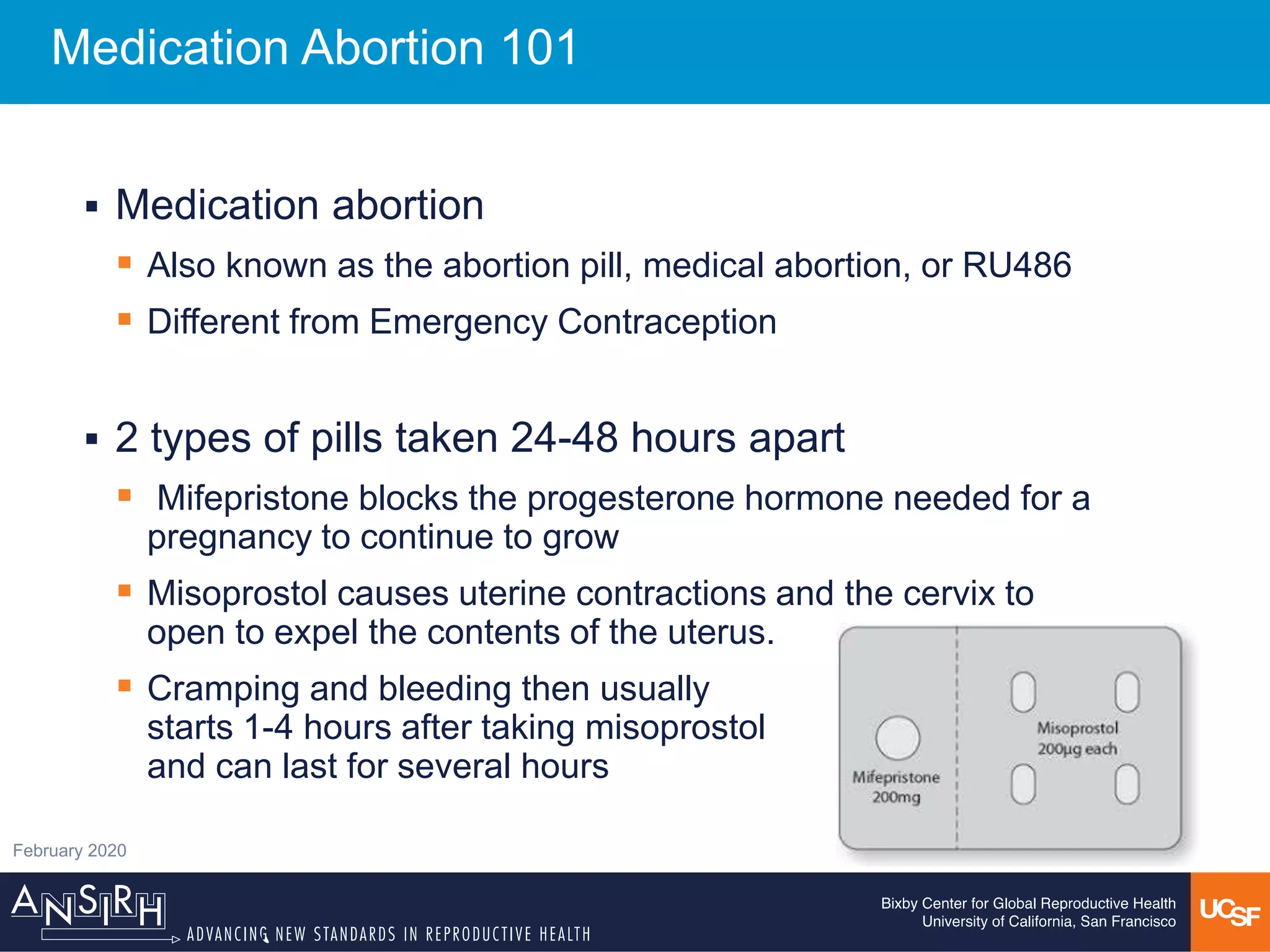
 2 types of pills taken 24-48 hours apart
 Mifepristone blocks the progesterone hormone needed for a
pregnancy to continue to grow
 Misoprostol causes uterine contractions and the cervix to
open to expel the contents of the uterus.
 Cramping and bleeding then usually
starts 1-4 hours after taking misoprostol
and can last for several hours
February 2020
Role of Women’s Policy Institute
February 2020
◼ Two cohorts of WPI
Fellows worked on the bill
Data sources and methodology
 Information maintained by ANSIRH about abortion facilities in
California
 Distance calculations using Google Maps – driving and public
transportation
 US World & News Reports for demographic information about
campus populations
 Mystery calls to determine types of abortion offered, Medi-Cal
and insurance acceptance, and wait times until first available
appointment
February 2020
CA incidence of medication abortion:
Low estimate
[Campus population] x [% female] x 0.023 x 1.34 x 0.31
National age-
specific abortion
rate 18-24
Adjusting for
higher abortion
rate in California
% of abortions
that are
medication
Low Estimate:
322 per month
February 2020
CA incidence of medication abortion:
High estimate
[Campus population] x [% female] x 0.023 x 1.34 x 0.50
National age-
specific abortion
rate 18-24
Adjusting for
higher abortion
rate in California
% of abortions
that are
medication
High Estimate:
519 per month
February 2020
Results: Travel time to obtain abortion by public transit
27,081
105,081
234,641
37,503
0
50,000
100,000
150,000
200,000
250,000
<20 min 20-29 min 30-59 min 60+ min
# of Female
Students
Upadhyay UD, Cartwright AF, Johns NE. Access to Medication Abortion Among California's Public
University Students. J Adolesc Health. 2018;63(2):249-252.February 2020
Travel time
 5 campuses are > 1 hour from the nearest
abortion provider
 2 visits = 4 hours of travel time
Campuses > 1 hour away
• CSU Bakersfield
• CSU Channel Islands
• CSU Fullerton
• CSU Maritime Academy
• CSU Stanislaus
February 2020
Weekend Services and Wait Times
◼ 5 of the 34 abortion facilities
closest to UC and CSU
campuses (15%)
are ever open on weekends.
◼ The average wait time until first
available appointment at the
facilities closest to campus was
7 days (range 1-20 days).
February 2020
The main issue: Barriers to abortion care
for college students
◼ 2 visits for medication abortion
◼ Limited mobility
◼ College students are usually low income
◼ Paying for abortion out of pocket
◼ Navigating a new/different health care system
◼ Scheduling and time off from class
February 2020
Concerns from within the health care community
February 2020
◼ Quality of care
◼ Evening/weekend complications
Governor Brown’s Veto of SB320
“According to a study…the average
distance to abortion providers in
campus communities varies from
five to seven miles, not an
unreasonable distance.”
February 2020
Part II
February 2020
Testifying
February 2020
CA State Assembly
Committee on Higher Education
June 2019
February 2020
“I don’t want to get into the pro choice or prolife question issue, but related to liability
issues and costs, I wonder who is going to be in charge of medical waste from the
chemical abortions performed on UC and CSU campuses since the law clearly
states that the universities are responsible for the health and welfare of the students
on the campus. Do you have any expectations of how they would handle them?”
UC’s journey in their positioning on this bill
February 2020
University of California, San Francisco | Bixby Center for Global Reproductive Health
Thank you!

Upadhyay 02202020

  • 1.
    University of California,San Francisco | Bixby Center for Global Reproductive Health All students should ask for this on their campuses! Ushma Upadhyay, PhD, MPH February 20, 2020
  • 2.
    Medication Abortion 101 Medication abortion  Also known as the abortion pill, medical abortion, or RU486  Different from Emergency Contraception  2 types of pills taken 24-48 hours apart  Mifepristone blocks the progesterone hormone needed for a pregnancy to continue to grow  Misoprostol causes uterine contractions and the cervix to open to expel the contents of the uterus.  Cramping and bleeding then usually starts 1-4 hours after taking misoprostol and can last for several hours February 2020
  • 3.
    Role of Women’sPolicy Institute February 2020 ◼ Two cohorts of WPI Fellows worked on the bill
  • 4.
    Data sources andmethodology  Information maintained by ANSIRH about abortion facilities in California  Distance calculations using Google Maps – driving and public transportation  US World & News Reports for demographic information about campus populations  Mystery calls to determine types of abortion offered, Medi-Cal and insurance acceptance, and wait times until first available appointment February 2020
  • 5.
    CA incidence ofmedication abortion: Low estimate [Campus population] x [% female] x 0.023 x 1.34 x 0.31 National age- specific abortion rate 18-24 Adjusting for higher abortion rate in California % of abortions that are medication Low Estimate: 322 per month February 2020
  • 6.
    CA incidence ofmedication abortion: High estimate [Campus population] x [% female] x 0.023 x 1.34 x 0.50 National age- specific abortion rate 18-24 Adjusting for higher abortion rate in California % of abortions that are medication High Estimate: 519 per month February 2020
  • 7.
    Results: Travel timeto obtain abortion by public transit 27,081 105,081 234,641 37,503 0 50,000 100,000 150,000 200,000 250,000 <20 min 20-29 min 30-59 min 60+ min # of Female Students Upadhyay UD, Cartwright AF, Johns NE. Access to Medication Abortion Among California's Public University Students. J Adolesc Health. 2018;63(2):249-252.February 2020
  • 8.
    Travel time  5campuses are > 1 hour from the nearest abortion provider  2 visits = 4 hours of travel time Campuses > 1 hour away • CSU Bakersfield • CSU Channel Islands • CSU Fullerton • CSU Maritime Academy • CSU Stanislaus February 2020
  • 9.
    Weekend Services andWait Times ◼ 5 of the 34 abortion facilities closest to UC and CSU campuses (15%) are ever open on weekends. ◼ The average wait time until first available appointment at the facilities closest to campus was 7 days (range 1-20 days). February 2020
  • 10.
    The main issue:Barriers to abortion care for college students ◼ 2 visits for medication abortion ◼ Limited mobility ◼ College students are usually low income ◼ Paying for abortion out of pocket ◼ Navigating a new/different health care system ◼ Scheduling and time off from class February 2020
  • 11.
    Concerns from withinthe health care community February 2020 ◼ Quality of care ◼ Evening/weekend complications
  • 12.
    Governor Brown’s Vetoof SB320 “According to a study…the average distance to abortion providers in campus communities varies from five to seven miles, not an unreasonable distance.” February 2020
  • 13.
  • 14.
    Testifying February 2020 CA StateAssembly Committee on Higher Education June 2019
  • 15.
    February 2020 “I don’twant to get into the pro choice or prolife question issue, but related to liability issues and costs, I wonder who is going to be in charge of medical waste from the chemical abortions performed on UC and CSU campuses since the law clearly states that the universities are responsible for the health and welfare of the students on the campus. Do you have any expectations of how they would handle them?”
  • 16.
    UC’s journey intheir positioning on this bill February 2020
  • 17.
    University of California,San Francisco | Bixby Center for Global Reproductive Health Thank you!

Editor's Notes

  • #2 I first became involved in August 2016 when I heard that students at Berkeley, including Adiba Kahn, were trying to get their student health center to start offering medication abortion. The earl
  • #4 My involvement in this bill began in September 2017 with a presentation to the Women’s Policy Institute. WPI is a program of the Women’s Foundation of California. It brings in fellows each year to work on a new policy idea. I think this on the left was the 2016 cohort that started working on this bill requiring college campuses to offer medication abortion. The second cohort continued the efforts. Early on, when the bill was SB 320, the Women’s Policy Institute was the backbone of the policy, galvanizing the different sponsors of the bill to move it through the committees and a final vote. Then in the second year, the student groups organized by JustCare really took on a greater role. I was presenting some of my team’s research on the distance Medi-Cal beneficiaries must travel to obtain an abortion and I was asked if I could provide similar estimates on the distance students have to travel to the closest abortion provider as well as document other barriers that students face in accessing an abortion.
  • #6 So my team, including a couple of UC students, set out to develop estimates of the number of abortions currently on college campuses. For you demographers in the audience, here is the formula we used to develop our estimates.
  • #7 And we used a high estimate of 50% based on what we have seen in studies done in California. The high estimate is about 519 medication abortions per month.
  • #8 And then we also estimated distances in miles and travel time. Most students are over 30 minutes to an abortion provider each way. Though many campuses have a nearby provider, distance is a greater burden for the student population CSU Stanislaus, CSU Fullerton, CSU Maritime Academy, CSU Channel Islands, CSU Bakersfield, UC Davis is almost an hour away (55 minutes)
  • #9 Many university students do not own cars 28% UC students 63% of CSU students
  • #11  Really need the stories.
  • #12 There were some concerns from within the abortion providing community that really stemmed from fear of what if something goes horribly wrong! I wanted to raise concerns about SB320.  I am very pro-choice and have worked my entire career to increase access to abortion.    I really do think this is a GREAT idea; I just think we are just a little ahead of ourselves.   Medical abortion is very safe and effective in studies because the studies are done by experts in the field.  Medical abortion is very safe and effective in clinical practice because it is provided by persons committed to providing the care.  Most providers/clinics provide surgical abortion as well...part of that commitment.   Mandating that a college health service provide this care without providers who have that same level of commitment, as a group, might not work as well.  Providing medical abortion can be learned but it needs to be learned by the group, not just one provider.  Who is going to see the patient when she presents two days after using the medications with a problem?  If there is just one provider, that doesn’t work.  Who is going to handle her call at 2 in the morning when she is having heavy bleeding?  Providing medical abortion requires a service with staff and providers that can handle patient issues 24 hours a day.  Yes, women can go to a local emergency room; but the goal is to provide the highest level of care, not just some care.   I do think we can get there.  I believe strongly that funds/effort toward the ideas in this bill, and successfully dealing with opposition, will come from a study.  I would be happy to work with funders (with whom I am certain I can arrange such funding) to do a study that involves educating providers at a college campus on how to provide this service, and demonstrate the costs, learning curves, and success rates.   I am afraid if we just thrust this mandate on college health services without knowing exactly what will need to be involved in the rollout (which we will learn best from studying the issue) could result in bad stories.  What we don’t want is a state school in a rural area reporting a death from a college student who bled to death because they really didn’t know the nuances of providing this service.  
  • #13 So after the bill passed both the Senate and Assembly by a 2-1 margin, in September 2018 Governor Jerry Brown vetoed it. And he had the audacity to cite our team’s research while doing so! And I just couldn’t hold back a fiery tweet at him.
  • #15 McKenna Fester, Senior at UC Berkeley The bill was reintroduced and I had the honor of testifying at the California State Assembly on Higher Education, after an incredibly brave student testified about her challenging experience trying to obtain a medication abortion as a student.
  • #16 I don’t want to get into the pro choice or prolife question issue, but related to liability issues and costs, I wonder who is going to be in charge of medical waste from the chemical abortions performed on UC and CSU campuses since the law clearly states that the universities are responsible for the health and welfare of the students on the campus. Do you have any expectations of how they would handle them?
  • #18  This is graphic that Jason Harless in our Communications group developed.