NOVEMBER 2013 
HOUSEHOLD DECISIONMAKING 
AND CONTRACEPTIVE USE IN ZAMBIA 
Family planning services promote a wide range 
of health and socioeconomic benefits to women, 
men, and their families. Still, many barriers prevent 
women from using contraception (see box, page 3). 
Despite efforts to increase awareness and improve 
access to these family planning services, unmet 
need for family planning and unwanted pregnan-cies 
remains high in many low- and middle-income 
countries, suggesting that other factors may be 
driving contraceptive use. One such factor relates 
to household decisionmaking about fertility. Spe-cifically, 
disagreements between a husband and 
wife about family planning may influence decisions 
about contraceptive use. Common sources of 
disagreements between partners include: 
•• Preferences for whether or not to use family 
planning. 
••What contraceptive method to use. 
••Mismatches in ideal family size. 
Where spouses voice different preferences and 
attitudes toward family planning, there is specu-lation 
that many women might not use modern 
contraceptives because their partners disapprove 
of such methods. Or, alternatively, that they might 
obtain family planning services secretly and use 
concealable methods of contraception. Secret use 
of contraceptives has drawbacks for a marriage 
that may or may not outweigh the family planning 
benefits for women. Secret use of contraceptives 
may introduce mistrust in the marriage, though it 
could also improve the welfare of women and their 
children by, for example, increasing the amount of 
time between each birth. Using contraception in 
secret, or completely forgoing its use, may detract 
from agreements that couples have about spacing 
and limits on family size, with the result that the 
couple either has more children or has them more 
frequently than either one wants. 
This brief presents findings and policy implica-tions 
from a study by Nava Ashraf, Erica Field, 
and Jean Lee. They investigated the husband’s 
role in family planning decisions and presented 
evidence that couples’ behavior regarding deci-sions 
about contraceptive use produce less than 
ideal fertility outcomes.1 The study randomly 
assigned individuals to three groups: individuals 
chosen to receive a voucher, granting immedi-ate 
and free access to a range of contraceptive 
methods, including concealable contraceptives 
such as implants or injectables, in the presence 
of their husband (couples treatment); women 
chosen to receive the same voucher, except in 
private (individual treatment); and women who 
did not receive a voucher (control group). The 
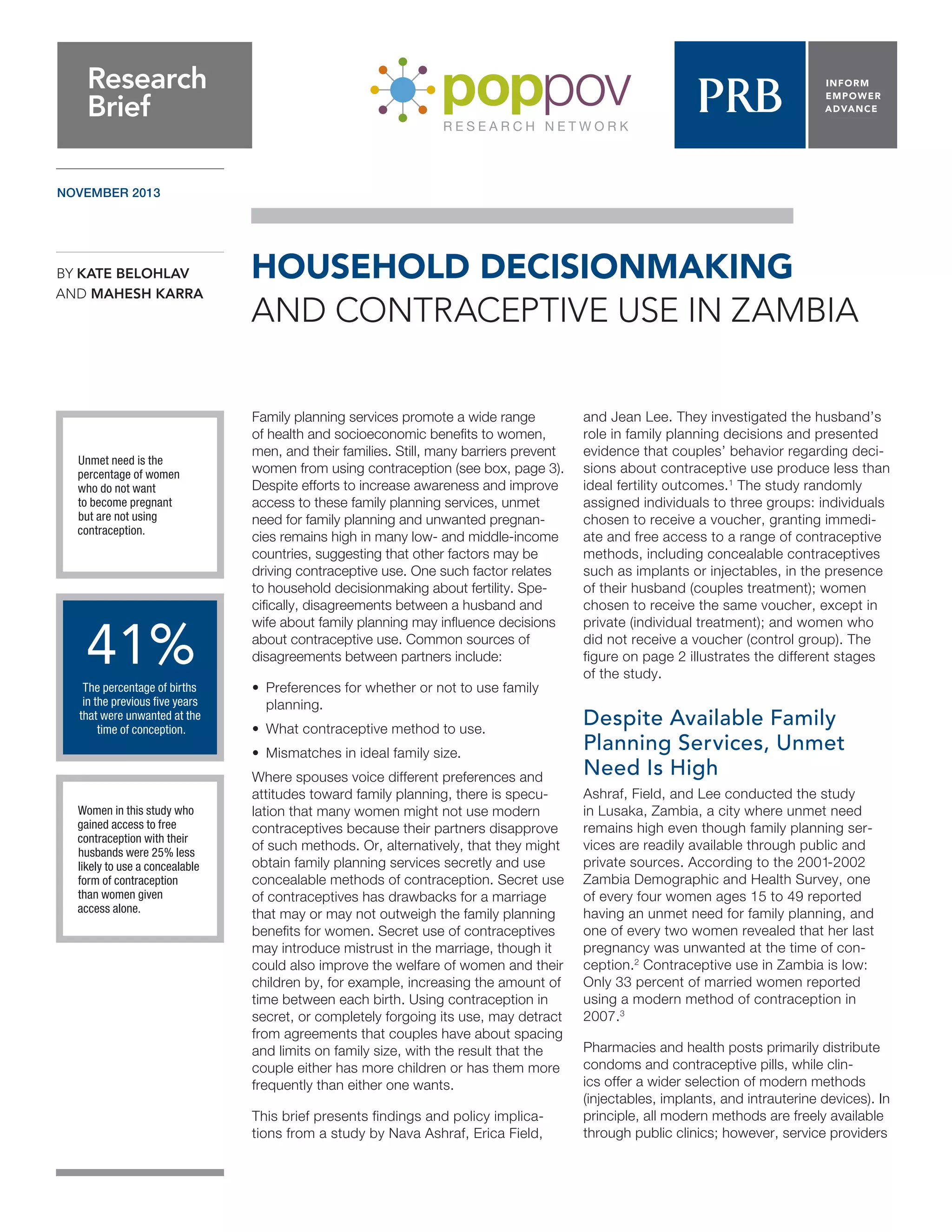
figure on page 2 illustrates the different stages 
of the study. 
Despite Available Family 
Planning Services, Unmet 
Need Is High 
Ashraf, Field, and Lee conducted the study 
in Lusaka, Zambia, a city where unmet need 
remains high even though family planning ser-vices 
are readily available through public and 
private sources. According to the 2001-2002 
Zambia Demographic and Health Survey, one 
of every four women ages 15 to 49 reported 
having an unmet need for family planning, and 
one of every two women revealed that her last 
pregnancy was unwanted at the time of con-ception. 
2 Contraceptive use in Zambia is low: 
Only 33 percent of married women reported 
using a modern method of contraception in 
2007.3 
Pharmacies and health posts primarily distribute 
condoms and contraceptive pills, while clin-ics 
offer a wider selection of modern methods 
(injectables, implants, and intrauterine devices). In 
principle, all modern methods are freely available 
through public clinics; however, service providers 
Research 
Brief 
BY KATE BELOHLAV 
AND MAHESH KARRA 
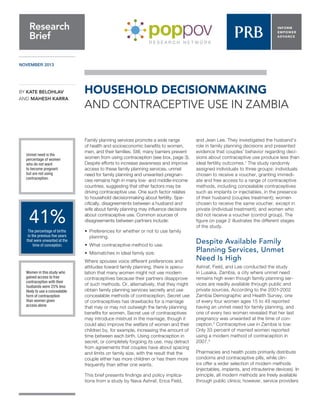
Unmet need is the 
percentage of women 
who do not want 
to become pregnant 
but are not using 
contraception. 
41% 
The percentage of births 
in the previous five years 
that were unwanted at the 
time of conception. 
Women in this study who 
gained access to free 
contraception with their 
husbands were 25% less 
likely to use a concealable 
form of contraception 
than women given 
access alone.
experience frequent stockouts and patients often have to 
wait a long time for an appointment. 
Until 2005, Zambian law required women to obtain 
explicit permission from their husbands in order to acquire 
publicly distributed contraceptives. Anecdotal evidence 
indicates, however, that many health care providers, 
particularly in rural regions of Zambia, still refuse to dis-tribute 
contraceptives to women without their husbands’ 
consent. Earlier studies as well as qualitative reports from 
this study also indicate that men are generally suspicious 
of their wives using contraception without their knowing, 
which has contributed to increasing marital tension in 
households. One woman from the study noted, “women 
are ever worried, especially those on pills because it’s not 
easy to hide pills in these small houses of ours. For the 
injectables, they are less worried because a man cannot 
easily tell unless he pushes/pressures you as to why you 
are not conceiving.” 
Study Background 
Women were recruited to the study from the area served 
by the Chipata Clinic, a large government clinic that pro-vides 
services to low- and middle-income neighborhoods in 
Lusaka. Married women ages 18 to 40 were invited to partici-pate 
in the study if they satisfied the following six criteria: 
•• They currently lived with their husband. 
•• They had last given birth between January 2004 and 
December 2006. 
•• They were not currently pregnant. 
•• They had neither been sterilized nor had a hysterectomy. 
•• They were not known to have health conditions that would 
preclude the use of hormonal contraceptives. 
•• They agreed to participate in an initial recruitment survey 
and information session about family planning together 
with their husband. 
Recruited Married Women, Ages 18-40 
1. Collected basic information. 
2. Randomized women into treatment and control groups. 
Treatment Group Women 
1. Survey teams interviewed women. 
2. Health care workers distributed 
condoms and provided information. 
Assignment to Couples or 
Individual Treatment 
Stages of the Study 
Couples Treatment 
Recruitment 
Visit and Initial 
Treatment 
First Visit 
1. Survey teams interviewed husband. 
2. Voucher for contraceptives 
given to couple together. 
3. Survey teams interviewed wife. 
Follow-Up 
Interviews With 
Wives 
Individual Treatment 
1. Survey teams interviewed husband. 
2. Voucher for contraceptives given 
to wife alone. 
3. Survey teams interviewed wife. 
Control Group Women 
Second Visit 
Follow-up 
Follow-Up 
Interviews With 
Wives 
Follow-Up 
Interviews With 
Wives 
Source: Adapted from Nava Ashraf, Erica Field, and Jean Lee, “Household Bargaining and Excess Fertility: An Experimental Study in Zambia,” 2nd revision requested, American Economic 
Review (December 2012). 
www.prb.org HOUSEHOLD DECISIONMAKING AND CONTRACEPTIVE 2 USE IN ZAMBIA
During the initial stage of the study, researchers deter-mined 
that a total of 1,799 women met the six crite-ria, 
and then randomly assigned 1,031 women to the 
treatment group and 768 women to the control group. 
Participants assigned to the treatment group (either in 
the presence of their husband or in private) received a 
voucher for free and immediate access to a wide range of 
contraceptives at the Chipata Clinic. The voucher guar-anteed 
a maximum wait time of one hour and guaranteed 
access to injectables and contraceptive implants, two 
methods known to be frequently out of stock. 
Women in the treatment and control groups provided 
health, social, and family information, including marriage 
and childbearing history, school enrollment of children, 
fertility preferences, decisionmaking in the household, 
and current contraceptive use. 
Information collected during this first visit indicated that 
a high proportion of women hide contraceptive use 
from their husbands. Among the one in four men in the 
sample who claimed that they were “not doing anything 
to prevent pregnancy,” almost 60 percent had wives who 
separately reported that they were using some method 
of family planning. After the interviews, community health 
workers delivered information about family planning and 
the prevention of sexually transmitted diseases (STDs). 
At the end of the first visit, participants received a three-pack 
of condoms. Husbands were not present when the 
women answered questions, nor when they received the 
health information. 
To answer the question about the husband’s role in the 
family planning decisionmaking process, researchers var-ied 
the manner in which they distributed vouchers to par-ticipants 
in the treatment group. Prior to the second visit, 
about one-half of the women in the treatment group were 
randomly assigned to receive the voucher in the presence 
of their husband (couples treatment), while the rest were 
given the voucher in private (individual treatment). In the 
couples treatment, the husband was first surveyed alone, 
and then husband and wife were brought back together 
to receive the voucher. (The couples treatment emulates 
the family planning decisionmaking process in many 
low- and middle-income countries, allowing the husband 
to veto decisions regarding contraceptive choice.) In 
contrast, women assigned to the individual treatment 
received the voucher during a private session with the 
community health worker. 
Data from clinic records and logs kept by the regis-tered 
nurse on participants’ family planning visits and 
contraceptive use were used for short-run analysis. 
A follow-up visit and survey of women administered 
two years after the intervention were used for long-run 
analysis. 
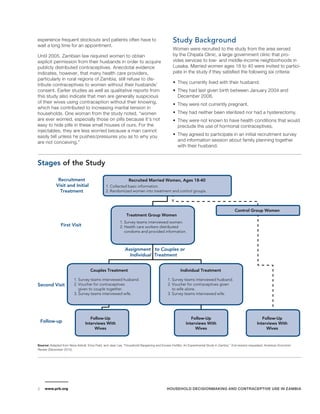
Barriers to Contraceptive Use 
Zambian women face many barriers to family planning and 
contraceptive use, most of which relate to their ability to 
access them or their knowledge of the contraceptives. 
Access 
• Lack of access due to physical/geographical barriers 
between households and service providers (e.g., large 
distances between households and clinics, poor access to 
transportation). 
• Poor access to contraceptives due to frequent shortages 
(stockouts) in clinics and health centers. 
• Long waiting times for service appointments or counseling. 
• High costs of contraceptives. 
• Limited choice of contraceptive methods. 
Information/Awareness 
• Fear of side effects. 
• Misinformation or lack of information about family planning 
and contraception. 
Involving Husbands Decreases 
Voucher Redemption and 
Contraceptive Use 
Almost half of all women (48 percent) who received a voucher 
for family planning services traded in the voucher to receive 
free contraceptives. Fifty-three percent of women in the 
individual treatment group redeemed the voucher, compared 
with only 43 percent of women in the couples treatment 
group, implying that giving husbands the opportunity to 
participate in family planning decisions decreased voucher 
redemption rates. 
The researchers predicted that couples who do not agree 
on the number of children they want will respond differ-ently 
depending on whether vouchers were given to the wife 
individually or to the couple together. Assignment to the 
individual treatment provided wives with an opportunity to 
hide contraceptives. The researchers found that women in the 
study who desired fewer children than their husbands desired 
were 25 percent less likely to redeem a voucher for contra-ception 
when they received the voucher with their husbands. 
Researchers conducted in-depth interviews in conjunction 
with follow-up surveys to verify that the difference in redemp-tion 
rate was the result of a woman’s desire for a concealable 
form of contraception. Their analysis suggests that greater 
use of the vouchers by the individual treatment group may 
HOUSEHOLD DECISIONMAKING AND CONTRACEPTIVE USE IN ZAMBIA www.prb.org 3
be largely attributable to women trying to circumvent their 
husband’s control of family planning decisions. 
The research also showed a difference in redemption rates for 
injectable contraceptives, considered to be more concealable 
than other forms of contraception. Women in the couples 
treatment group were 25 percent less likely to opt for inject-able 
contraceptives than women in the individual treatment. 
Among the subgroup of couples in which men desired more 
children than their wives, the difference between the two 
treatment groups was even greater: Women were 48 percent 
less likely to choose injectable contraceptives when their 
husbands were present. 
Husband’s Involvement Influences Use 
of Contraception, Even When Couples 
Agree on Short-Term Fertility 
The study results have shown that when couples do not 
agree on their desired number of children, women who gain 
access to family planning by themselves are more likely to 
access it and to use concealable forms of contraception. 
In contrast, the researchers looked at those households in 
which neither the husband nor the wife wanted children dur-ing 
the next two years to determine whether a disagreement 
about their long-term fertility desires affects a husband’s 
preference for contraception. One would expect these 
couples, who agree about the number of children they want 
in the short term, to choose the most effective and cheapest 
form of family planning. 
The analysis reveals that use of family planning services and 
preference for injectables is significantly higher when women 
in this group access family planning services without their 
husbands present. When couples agree on their desired num-ber 
of children, however, the treatment assignment has no 
effect on their redemption of the voucher, nor on their prefer-ence 
for injectable contraceptives. These results imply that 
men are reluctant to have their wives use injectable contra-ceptives, 
a cheaper and more effective form of birth control, 
in order to maintain control over household reproductive 
health outcomes. The analyses and their implications point to 
strong evidence that there are household dynamics that may 
lead couples to less-than-ideal fertility outcomes. 
Hiding Contraceptive Decisions Can 
Complicate Household Dynamics 
In general, simply increasing access to contraception does 
not necessarily lead to an increase in its use. In this study, 
however, women who gained access to contraception alone 
were more likely to use it. In addition to increased voucher 
redemption and use of concealable contraceptives, the 
researchers found that use of family planning services dur-ing 
the study was associated with a 27 percent reduction in 
births, concentrated among those women who wanted to 
limit childbearing and believed that their husbands desired 
more children than they did. 
While the results highlight that women receiving family plan-ning 
services alone are better able to use a concealable 
form of contraception and meet their own fertility goals, the 
researchers also found evidence that suggested mistrust and 
suspicion among these couples. A husband may become 
suspicious of his wife if she goes for a long time without get-ting 
pregnant, which could lead to friction or conflict within 
a marriage. In this study, among those couples in which the 
husband wanted to have more children than his wife, those 
in the couples treatment group reported being happier and 
healthier than women in the individual treatment group. 
A trade-off thus exists when providing a woman the opportu-nity 
to opt into family planning in private rather than with her 
husband present. There is the potential for increased use of 
contraceptives, which could improve health outcomes, but 
accessing family planning in private could also lead to more 
unhappiness between husband and wife. 
Policy Implications 
Household decisions about contraceptive use have implica-tions 
for achieving the desired number of births and for mari-tal 
relationships. Increasing access to contraception will not 
necessarily lead to increased use of contraception or lower 
fertility. Providing concealable contraceptives to a married 
woman without her husband knowing may improve access; 
however, it may have detrimental consequences for her mar-riage, 
regardless of whether it reduces unwanted pregnancies 
in the short term. 
While male involvement in family planning decisionmaking is 
important for the welfare of the couple, simply making men 
aware of family planning opportunities or increasing their role 
in the decisionmaking process may actually decrease con-traceptive 
use among their wives. Successful interventions 
must help men better understand the costs of childbearing 
and child care—the costs to women and the costs to their 
families. Policies that aim to improve access to family plan-ning 
and to educate men may be most effective in increasing 
contraceptive prevalence, reducing unwanted pregnancies, 
and alleviating unmet need for family planning. 
www.prb.org HOUSEHOLD DECISIONMAKING AND CONTRACEPTIVE 4 USE IN ZAMBIA
POPULATION REFERENCE BUREAU 
The Population Reference Bureau INFORMS people around the world about 
population, health, and the environment, and EMPOWERS them to use that 
information to ADVANCE the well-being of current and future generations. 
www.prb.org 
POPULATION REFERENCE BUREAU 
202 483 1100 PHONE 
202 328 3937 FAX 
popref@prb.org E-MAIL 
1875 Connecticut Ave., NW 
Suite 520 
Washington, DC 20009 USA 
Acknowledgments 
This summary was prepared by Kate Belohlav, research associ-ate 
in International Programs, and Mahesh Karra, former policy 
analyst in International Programs, at PRB. This publication is 
made possible by the generous support of the William and Flora 
Hewlett Foundation, as part of the foundation’s Population and 
Poverty Research Network (PopPov). The authors wish to thank 
Marlene Lee of the Population Reference Bureau and Nava 
Ashraf of the Harvard Business School for their comments and 
contributions to this brief. 
© 2013 Population Reference Bureau. All rights reserved. 
References 
1 Nava Ashraf, Erica Field, and Jean Lee, “Household Bargaining and Excess 
Fertility: An Experimental Study in Zambia,” 2nd revision requested, American 
Economic Review (December 2012). 
2 Zambia Central Statistical Office, Zambia Central Board of Health, and ORC 
Macro, Zambia Demographic and Health Survey 2001-2002 (Calverton, MD: 
Central Statistical Office and Macro International Inc., 2003). 
3 Zambia Central Statistical Office, Zambia Ministry of Health, Tropical Diseases 
Research Centre, University of Zambia, and Macro International Inc., Zambia 
Demographic and Health Survey 2007 (Calverton, MD: Central Statistical Office 
and Macro International Inc., 2009).

Household Decisionmaking and Contraceptive Use in Zambia

  • 1.
    NOVEMBER 2013 HOUSEHOLDDECISIONMAKING AND CONTRACEPTIVE USE IN ZAMBIA Family planning services promote a wide range of health and socioeconomic benefits to women, men, and their families. Still, many barriers prevent women from using contraception (see box, page 3). Despite efforts to increase awareness and improve access to these family planning services, unmet need for family planning and unwanted pregnan-cies remains high in many low- and middle-income countries, suggesting that other factors may be driving contraceptive use. One such factor relates to household decisionmaking about fertility. Spe-cifically, disagreements between a husband and wife about family planning may influence decisions about contraceptive use. Common sources of disagreements between partners include: •• Preferences for whether or not to use family planning. ••What contraceptive method to use. ••Mismatches in ideal family size. Where spouses voice different preferences and attitudes toward family planning, there is specu-lation that many women might not use modern contraceptives because their partners disapprove of such methods. Or, alternatively, that they might obtain family planning services secretly and use concealable methods of contraception. Secret use of contraceptives has drawbacks for a marriage that may or may not outweigh the family planning benefits for women. Secret use of contraceptives may introduce mistrust in the marriage, though it could also improve the welfare of women and their children by, for example, increasing the amount of time between each birth. Using contraception in secret, or completely forgoing its use, may detract from agreements that couples have about spacing and limits on family size, with the result that the couple either has more children or has them more frequently than either one wants. This brief presents findings and policy implica-tions from a study by Nava Ashraf, Erica Field, and Jean Lee. They investigated the husband’s role in family planning decisions and presented evidence that couples’ behavior regarding deci-sions about contraceptive use produce less than ideal fertility outcomes.1 The study randomly assigned individuals to three groups: individuals chosen to receive a voucher, granting immedi-ate and free access to a range of contraceptive methods, including concealable contraceptives such as implants or injectables, in the presence of their husband (couples treatment); women chosen to receive the same voucher, except in private (individual treatment); and women who did not receive a voucher (control group). The figure on page 2 illustrates the different stages of the study. Despite Available Family Planning Services, Unmet Need Is High Ashraf, Field, and Lee conducted the study in Lusaka, Zambia, a city where unmet need remains high even though family planning ser-vices are readily available through public and private sources. According to the 2001-2002 Zambia Demographic and Health Survey, one of every four women ages 15 to 49 reported having an unmet need for family planning, and one of every two women revealed that her last pregnancy was unwanted at the time of con-ception. 2 Contraceptive use in Zambia is low: Only 33 percent of married women reported using a modern method of contraception in 2007.3 Pharmacies and health posts primarily distribute condoms and contraceptive pills, while clin-ics offer a wider selection of modern methods (injectables, implants, and intrauterine devices). In principle, all modern methods are freely available through public clinics; however, service providers Research Brief BY KATE BELOHLAV AND MAHESH KARRA Unmet need is the percentage of women who do not want to become pregnant but are not using contraception. 41% The percentage of births in the previous five years that were unwanted at the time of conception. Women in this study who gained access to free contraception with their husbands were 25% less likely to use a concealable form of contraception than women given access alone.
  • 2.
    experience frequent stockoutsand patients often have to wait a long time for an appointment. Until 2005, Zambian law required women to obtain explicit permission from their husbands in order to acquire publicly distributed contraceptives. Anecdotal evidence indicates, however, that many health care providers, particularly in rural regions of Zambia, still refuse to dis-tribute contraceptives to women without their husbands’ consent. Earlier studies as well as qualitative reports from this study also indicate that men are generally suspicious of their wives using contraception without their knowing, which has contributed to increasing marital tension in households. One woman from the study noted, “women are ever worried, especially those on pills because it’s not easy to hide pills in these small houses of ours. For the injectables, they are less worried because a man cannot easily tell unless he pushes/pressures you as to why you are not conceiving.” Study Background Women were recruited to the study from the area served by the Chipata Clinic, a large government clinic that pro-vides services to low- and middle-income neighborhoods in Lusaka. Married women ages 18 to 40 were invited to partici-pate in the study if they satisfied the following six criteria: •• They currently lived with their husband. •• They had last given birth between January 2004 and December 2006. •• They were not currently pregnant. •• They had neither been sterilized nor had a hysterectomy. •• They were not known to have health conditions that would preclude the use of hormonal contraceptives. •• They agreed to participate in an initial recruitment survey and information session about family planning together with their husband. Recruited Married Women, Ages 18-40 1. Collected basic information. 2. Randomized women into treatment and control groups. Treatment Group Women 1. Survey teams interviewed women. 2. Health care workers distributed condoms and provided information. Assignment to Couples or Individual Treatment Stages of the Study Couples Treatment Recruitment Visit and Initial Treatment First Visit 1. Survey teams interviewed husband. 2. Voucher for contraceptives given to couple together. 3. Survey teams interviewed wife. Follow-Up Interviews With Wives Individual Treatment 1. Survey teams interviewed husband. 2. Voucher for contraceptives given to wife alone. 3. Survey teams interviewed wife. Control Group Women Second Visit Follow-up Follow-Up Interviews With Wives Follow-Up Interviews With Wives Source: Adapted from Nava Ashraf, Erica Field, and Jean Lee, “Household Bargaining and Excess Fertility: An Experimental Study in Zambia,” 2nd revision requested, American Economic Review (December 2012). www.prb.org HOUSEHOLD DECISIONMAKING AND CONTRACEPTIVE 2 USE IN ZAMBIA
  • 3.
    During the initialstage of the study, researchers deter-mined that a total of 1,799 women met the six crite-ria, and then randomly assigned 1,031 women to the treatment group and 768 women to the control group. Participants assigned to the treatment group (either in the presence of their husband or in private) received a voucher for free and immediate access to a wide range of contraceptives at the Chipata Clinic. The voucher guar-anteed a maximum wait time of one hour and guaranteed access to injectables and contraceptive implants, two methods known to be frequently out of stock. Women in the treatment and control groups provided health, social, and family information, including marriage and childbearing history, school enrollment of children, fertility preferences, decisionmaking in the household, and current contraceptive use. Information collected during this first visit indicated that a high proportion of women hide contraceptive use from their husbands. Among the one in four men in the sample who claimed that they were “not doing anything to prevent pregnancy,” almost 60 percent had wives who separately reported that they were using some method of family planning. After the interviews, community health workers delivered information about family planning and the prevention of sexually transmitted diseases (STDs). At the end of the first visit, participants received a three-pack of condoms. Husbands were not present when the women answered questions, nor when they received the health information. To answer the question about the husband’s role in the family planning decisionmaking process, researchers var-ied the manner in which they distributed vouchers to par-ticipants in the treatment group. Prior to the second visit, about one-half of the women in the treatment group were randomly assigned to receive the voucher in the presence of their husband (couples treatment), while the rest were given the voucher in private (individual treatment). In the couples treatment, the husband was first surveyed alone, and then husband and wife were brought back together to receive the voucher. (The couples treatment emulates the family planning decisionmaking process in many low- and middle-income countries, allowing the husband to veto decisions regarding contraceptive choice.) In contrast, women assigned to the individual treatment received the voucher during a private session with the community health worker. Data from clinic records and logs kept by the regis-tered nurse on participants’ family planning visits and contraceptive use were used for short-run analysis. A follow-up visit and survey of women administered two years after the intervention were used for long-run analysis. Barriers to Contraceptive Use Zambian women face many barriers to family planning and contraceptive use, most of which relate to their ability to access them or their knowledge of the contraceptives. Access • Lack of access due to physical/geographical barriers between households and service providers (e.g., large distances between households and clinics, poor access to transportation). • Poor access to contraceptives due to frequent shortages (stockouts) in clinics and health centers. • Long waiting times for service appointments or counseling. • High costs of contraceptives. • Limited choice of contraceptive methods. Information/Awareness • Fear of side effects. • Misinformation or lack of information about family planning and contraception. Involving Husbands Decreases Voucher Redemption and Contraceptive Use Almost half of all women (48 percent) who received a voucher for family planning services traded in the voucher to receive free contraceptives. Fifty-three percent of women in the individual treatment group redeemed the voucher, compared with only 43 percent of women in the couples treatment group, implying that giving husbands the opportunity to participate in family planning decisions decreased voucher redemption rates. The researchers predicted that couples who do not agree on the number of children they want will respond differ-ently depending on whether vouchers were given to the wife individually or to the couple together. Assignment to the individual treatment provided wives with an opportunity to hide contraceptives. The researchers found that women in the study who desired fewer children than their husbands desired were 25 percent less likely to redeem a voucher for contra-ception when they received the voucher with their husbands. Researchers conducted in-depth interviews in conjunction with follow-up surveys to verify that the difference in redemp-tion rate was the result of a woman’s desire for a concealable form of contraception. Their analysis suggests that greater use of the vouchers by the individual treatment group may HOUSEHOLD DECISIONMAKING AND CONTRACEPTIVE USE IN ZAMBIA www.prb.org 3
  • 4.
    be largely attributableto women trying to circumvent their husband’s control of family planning decisions. The research also showed a difference in redemption rates for injectable contraceptives, considered to be more concealable than other forms of contraception. Women in the couples treatment group were 25 percent less likely to opt for inject-able contraceptives than women in the individual treatment. Among the subgroup of couples in which men desired more children than their wives, the difference between the two treatment groups was even greater: Women were 48 percent less likely to choose injectable contraceptives when their husbands were present. Husband’s Involvement Influences Use of Contraception, Even When Couples Agree on Short-Term Fertility The study results have shown that when couples do not agree on their desired number of children, women who gain access to family planning by themselves are more likely to access it and to use concealable forms of contraception. In contrast, the researchers looked at those households in which neither the husband nor the wife wanted children dur-ing the next two years to determine whether a disagreement about their long-term fertility desires affects a husband’s preference for contraception. One would expect these couples, who agree about the number of children they want in the short term, to choose the most effective and cheapest form of family planning. The analysis reveals that use of family planning services and preference for injectables is significantly higher when women in this group access family planning services without their husbands present. When couples agree on their desired num-ber of children, however, the treatment assignment has no effect on their redemption of the voucher, nor on their prefer-ence for injectable contraceptives. These results imply that men are reluctant to have their wives use injectable contra-ceptives, a cheaper and more effective form of birth control, in order to maintain control over household reproductive health outcomes. The analyses and their implications point to strong evidence that there are household dynamics that may lead couples to less-than-ideal fertility outcomes. Hiding Contraceptive Decisions Can Complicate Household Dynamics In general, simply increasing access to contraception does not necessarily lead to an increase in its use. In this study, however, women who gained access to contraception alone were more likely to use it. In addition to increased voucher redemption and use of concealable contraceptives, the researchers found that use of family planning services dur-ing the study was associated with a 27 percent reduction in births, concentrated among those women who wanted to limit childbearing and believed that their husbands desired more children than they did. While the results highlight that women receiving family plan-ning services alone are better able to use a concealable form of contraception and meet their own fertility goals, the researchers also found evidence that suggested mistrust and suspicion among these couples. A husband may become suspicious of his wife if she goes for a long time without get-ting pregnant, which could lead to friction or conflict within a marriage. In this study, among those couples in which the husband wanted to have more children than his wife, those in the couples treatment group reported being happier and healthier than women in the individual treatment group. A trade-off thus exists when providing a woman the opportu-nity to opt into family planning in private rather than with her husband present. There is the potential for increased use of contraceptives, which could improve health outcomes, but accessing family planning in private could also lead to more unhappiness between husband and wife. Policy Implications Household decisions about contraceptive use have implica-tions for achieving the desired number of births and for mari-tal relationships. Increasing access to contraception will not necessarily lead to increased use of contraception or lower fertility. Providing concealable contraceptives to a married woman without her husband knowing may improve access; however, it may have detrimental consequences for her mar-riage, regardless of whether it reduces unwanted pregnancies in the short term. While male involvement in family planning decisionmaking is important for the welfare of the couple, simply making men aware of family planning opportunities or increasing their role in the decisionmaking process may actually decrease con-traceptive use among their wives. Successful interventions must help men better understand the costs of childbearing and child care—the costs to women and the costs to their families. Policies that aim to improve access to family plan-ning and to educate men may be most effective in increasing contraceptive prevalence, reducing unwanted pregnancies, and alleviating unmet need for family planning. www.prb.org HOUSEHOLD DECISIONMAKING AND CONTRACEPTIVE 4 USE IN ZAMBIA
  • 5.
    POPULATION REFERENCE BUREAU The Population Reference Bureau INFORMS people around the world about population, health, and the environment, and EMPOWERS them to use that information to ADVANCE the well-being of current and future generations. www.prb.org POPULATION REFERENCE BUREAU 202 483 1100 PHONE 202 328 3937 FAX popref@prb.org E-MAIL 1875 Connecticut Ave., NW Suite 520 Washington, DC 20009 USA Acknowledgments This summary was prepared by Kate Belohlav, research associ-ate in International Programs, and Mahesh Karra, former policy analyst in International Programs, at PRB. This publication is made possible by the generous support of the William and Flora Hewlett Foundation, as part of the foundation’s Population and Poverty Research Network (PopPov). The authors wish to thank Marlene Lee of the Population Reference Bureau and Nava Ashraf of the Harvard Business School for their comments and contributions to this brief. © 2013 Population Reference Bureau. All rights reserved. References 1 Nava Ashraf, Erica Field, and Jean Lee, “Household Bargaining and Excess Fertility: An Experimental Study in Zambia,” 2nd revision requested, American Economic Review (December 2012). 2 Zambia Central Statistical Office, Zambia Central Board of Health, and ORC Macro, Zambia Demographic and Health Survey 2001-2002 (Calverton, MD: Central Statistical Office and Macro International Inc., 2003). 3 Zambia Central Statistical Office, Zambia Ministry of Health, Tropical Diseases Research Centre, University of Zambia, and Macro International Inc., Zambia Demographic and Health Survey 2007 (Calverton, MD: Central Statistical Office and Macro International Inc., 2009).