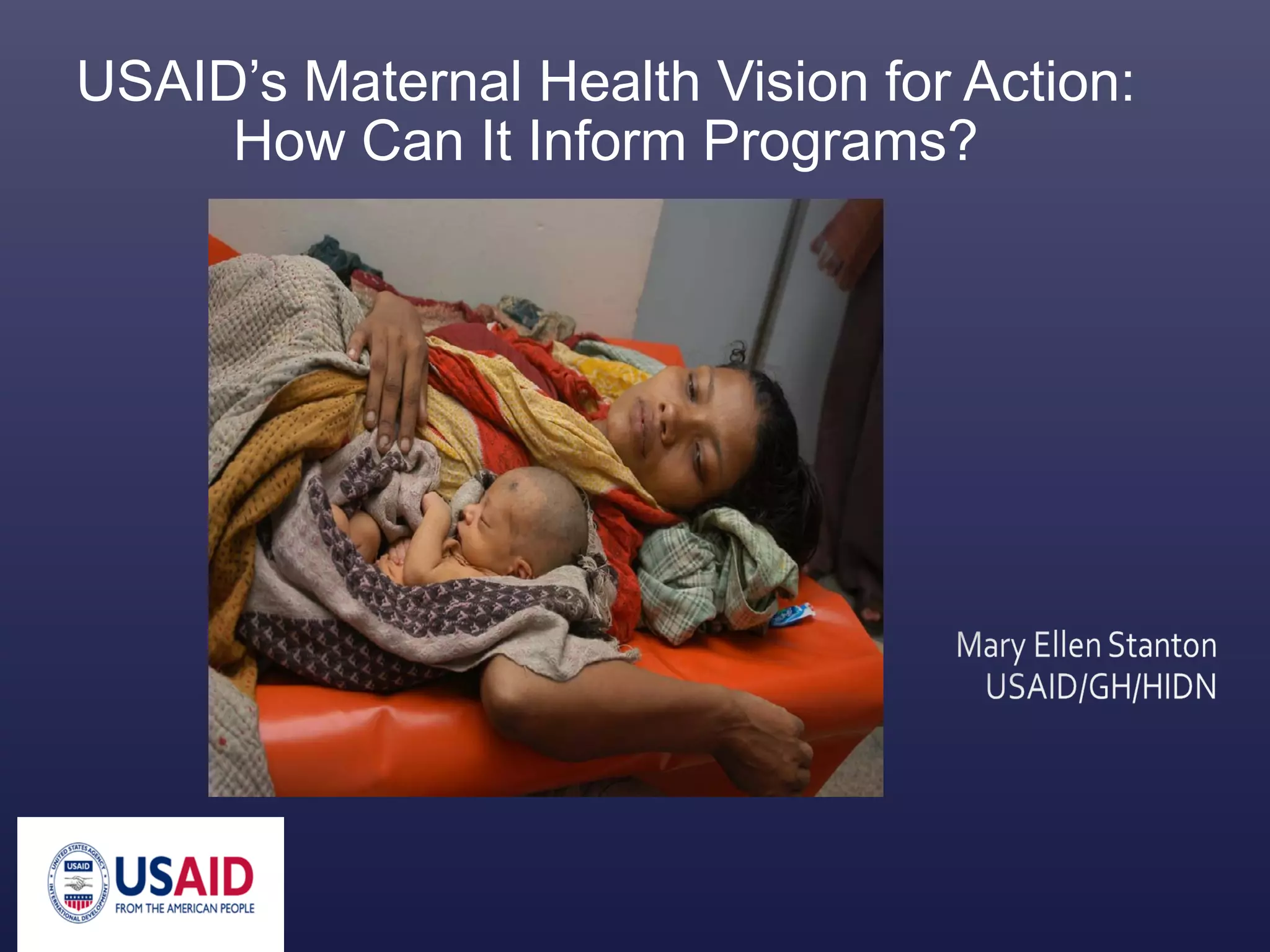
USAID’s Maternal Health Vision for Action:
How Can It Inform Programs?
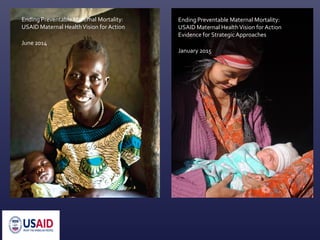
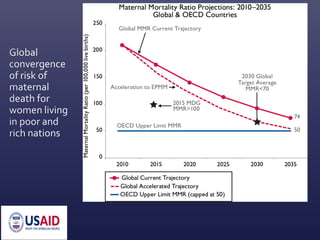
Ending Preventable Maternal Mortality:
USAID Maternal HealthVision for Action
June 2014
Ending Preventable Maternal Mortality:
USAID Maternal HealthVision for Action
Evidence for Strategic Approaches
January 2015
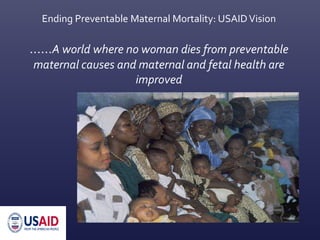
Ending Preventable Maternal Mortality: USAIDVision
A world where no woman dies from preventable
maternal causes and maternal and fetal health are
improved
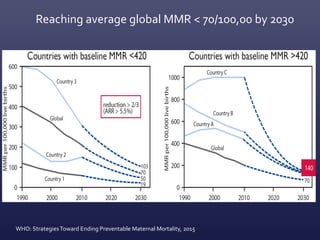
Reaching average global MMR < 70/100,00 by 2030
WHO: StrategiesToward Ending Preventable Maternal Mortality, 2015
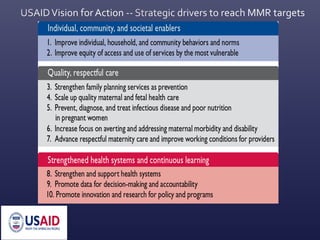
1.Improve Individual,
household and
community behaviors
and norms —including
community mobilization
to hold health systems
accountable
2. Improve equity of
access to and use of
services by the most
vulnerable
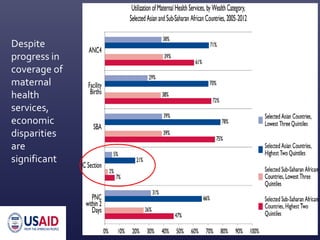
Despite
progress in
coverage of
maternal
health
services,
economic
disparities
are
significant
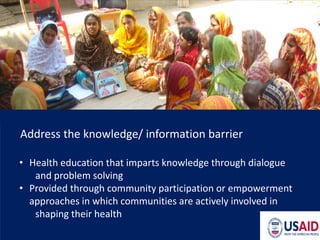
Address the knowledge/ information barrier
• Health education that imparts knowledge through dialogue
and problem solving
• Provided through community participation or empowerment
approaches in which communities are actively involved in
shaping their health
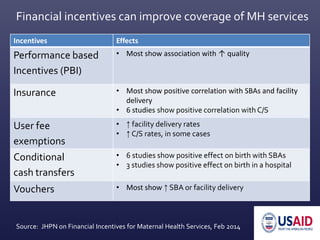
Financial incentives can improve coverage of MH services
Incentives Effects
Performance based
Incentives (PBI)
• Most show association with ↑ quality
Insurance • Most show positive correlation with SBAs and facility
delivery
• 6 studies show positive correlation with C/S
User fee
exemptions
• ↑ facility delivery rates
• ↑ C/S rates, in some cases
Conditional
cash transfers
• 6 studies show positive effect on birth with SBAs
• 3 studies show positive effect on birth in a hospital
Vouchers • Most show ↑ SBA or facility delivery
Source: JHPN on Financial Incentives for Maternal Health Services, Feb 2014
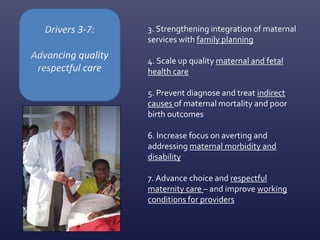
3. Strengthening integration of maternal
services with family planning
4. Scale up quality maternal and fetal
health care
5. Prevent diagnose and treat indirect
causes of maternal mortality and poor
birth outcomes
6. Increase focus on averting and
addressing maternal morbidity and
disability
7. Advance choice and respectful
maternity care – and improve working
conditions for providers
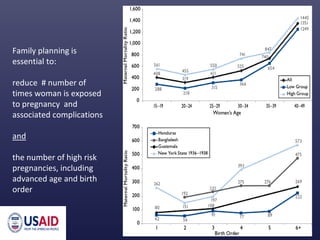
Family planning is
essential to:
reduce # number of
times woman is exposed
to pregnancy and
associated complications
and
the number of high risk
pregnancies, including
advanced age and birth
order
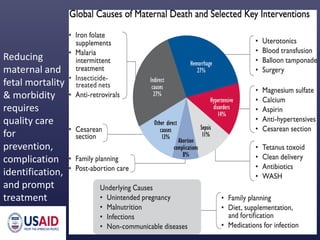
Reducing
maternal and
fetal mortality
& morbidity
requires
quality care
for
prevention,
complication
identification,
and prompt
treatment
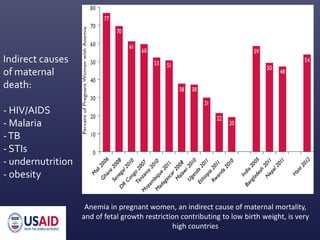
Indirect causes
of maternal
death:
- HIV/AIDS
- Malaria
-TB
- STIs
- undernutrition
- obesity
Anemia in pregnant women, an indirect cause of maternal mortality,
and of fetal growth restriction contributing to low birth weight, is very
high countries
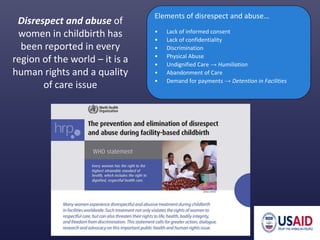
Elements of disrespect and abuse…
• Lack of informed consent
• Lack of confidentiality
• Discrimination
• Physical Abuse
• Undignified Care → Humiliation
• Abandonment of Care
• Demand for payments → Detention in Facilities
Disrespect and abuse of
women in childbirth has
been reported in every
region of the world – it is a
human rights and a quality
of care issue
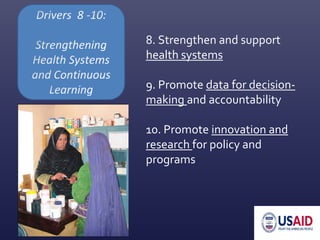
8. Strengthen and support
health systems
9. Promote data for decision-
making and accountability
10. Promote innovation and
research for policy and
programs
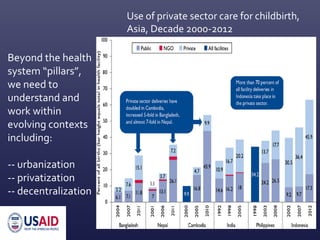
Use of private sector care for childbirth,
Asia, Decade 2000-2012
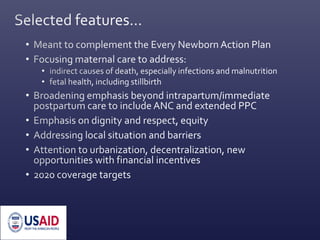
Beyond the health
system “pillars”,
we need to
understand and
work within
evolving contexts
including:
-- urbanization
-- privatization
-- decentralization
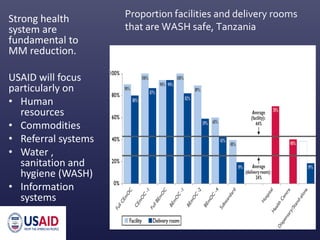
Proportion facilities and delivery rooms
that are WASH safe, Tanzania
Strong health
system are
fundamental to
MM reduction.
USAID will focus
particularly on
• Human
resources
• Commodities
• Referral systems
• Water ,
sanitation and
hygiene (WASH)
• Information
systems
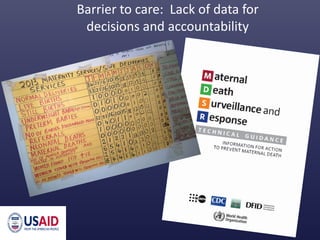
Barrier to care: Lack of data for
decisions and accountability
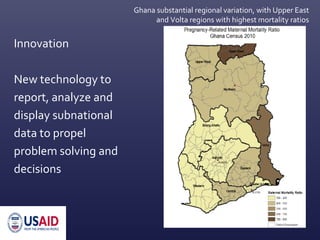
Ghana substantial regional variation, with Upper East
and Volta regions with highest mortality ratios
Innovation
New technology to
report, analyze and
display subnational
data to propel
problem solving and
decisions
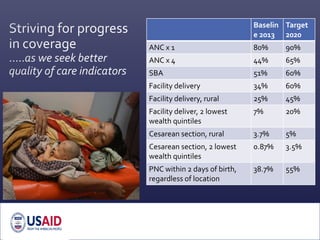
Baselin
e 2013
Target
2020
ANC x 1 80% 90%
ANC x 4 44% 65%
SBA 51% 60%
Facility delivery 34% 60%
Facility delivery, rural 25% 45%
Facility deliver, 2 lowest
wealth quintiles
7% 20%
Cesarean section, rural 3.7% 5%
Cesarean section, 2 lowest
wealth quintiles
0.87% 3.5%
PNC within 2 days of birth,
regardless of location
38.7% 55%
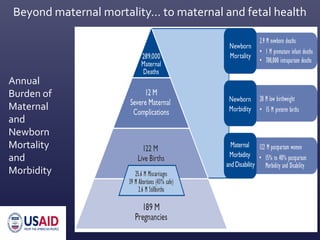
Annual
Burden of
Maternal
and
Newborn
Mortality
and
Morbidity
Beyond maternal mortality… to maternal and fetal health
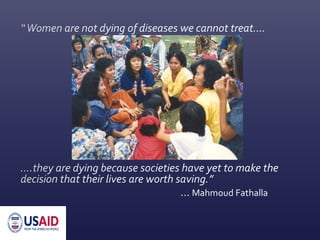
… Mahmoud Fathalla

Prevention of Maternal Mortality_Stanton

  • 1.
    USAID’s Maternal HealthVision for Action: How Can It Inform Programs?
  • 2.
    Ending Preventable MaternalMortality: USAID Maternal HealthVision for Action June 2014 Ending Preventable Maternal Mortality: USAID Maternal HealthVision for Action Evidence for Strategic Approaches January 2015
  • 3.
    Ending Preventable MaternalMortality: USAIDVision A world where no woman dies from preventable maternal causes and maternal and fetal health are improved
  • 5.
    Reaching average globalMMR < 70/100,00 by 2030 WHO: StrategiesToward Ending Preventable Maternal Mortality, 2015
  • 8.
    1.Improve Individual, household and communitybehaviors and norms —including community mobilization to hold health systems accountable 2. Improve equity of access to and use of services by the most vulnerable
  • 9.
  • 10.
    Address the knowledge/information barrier • Health education that imparts knowledge through dialogue and problem solving • Provided through community participation or empowerment approaches in which communities are actively involved in shaping their health
  • 11.
    Financial incentives canimprove coverage of MH services Incentives Effects Performance based Incentives (PBI) • Most show association with ↑ quality Insurance • Most show positive correlation with SBAs and facility delivery • 6 studies show positive correlation with C/S User fee exemptions • ↑ facility delivery rates • ↑ C/S rates, in some cases Conditional cash transfers • 6 studies show positive effect on birth with SBAs • 3 studies show positive effect on birth in a hospital Vouchers • Most show ↑ SBA or facility delivery Source: JHPN on Financial Incentives for Maternal Health Services, Feb 2014
  • 12.
    3. Strengthening integrationof maternal services with family planning 4. Scale up quality maternal and fetal health care 5. Prevent diagnose and treat indirect causes of maternal mortality and poor birth outcomes 6. Increase focus on averting and addressing maternal morbidity and disability 7. Advance choice and respectful maternity care – and improve working conditions for providers
  • 13.
    Family planning is essentialto: reduce # number of times woman is exposed to pregnancy and associated complications and the number of high risk pregnancies, including advanced age and birth order
  • 14.
    Reducing maternal and fetal mortality &morbidity requires quality care for prevention, complication identification, and prompt treatment
  • 15.
    Indirect causes of maternal death: -HIV/AIDS - Malaria -TB - STIs - undernutrition - obesity Anemia in pregnant women, an indirect cause of maternal mortality, and of fetal growth restriction contributing to low birth weight, is very high countries
  • 16.
    Elements of disrespectand abuse… • Lack of informed consent • Lack of confidentiality • Discrimination • Physical Abuse • Undignified Care → Humiliation • Abandonment of Care • Demand for payments → Detention in Facilities Disrespect and abuse of women in childbirth has been reported in every region of the world – it is a human rights and a quality of care issue
  • 17.
    8. Strengthen andsupport health systems 9. Promote data for decision- making and accountability 10. Promote innovation and research for policy and programs
  • 18.
    Use of privatesector care for childbirth, Asia, Decade 2000-2012 Beyond the health system “pillars”, we need to understand and work within evolving contexts including: -- urbanization -- privatization -- decentralization
  • 19.
    Proportion facilities anddelivery rooms that are WASH safe, Tanzania Strong health system are fundamental to MM reduction. USAID will focus particularly on • Human resources • Commodities • Referral systems • Water , sanitation and hygiene (WASH) • Information systems
  • 20.
    Barrier to care:Lack of data for decisions and accountability
  • 21.
    Ghana substantial regionalvariation, with Upper East and Volta regions with highest mortality ratios Innovation New technology to report, analyze and display subnational data to propel problem solving and decisions
  • 22.
    Baselin e 2013 Target 2020 ANC x1 80% 90% ANC x 4 44% 65% SBA 51% 60% Facility delivery 34% 60% Facility delivery, rural 25% 45% Facility deliver, 2 lowest wealth quintiles 7% 20% Cesarean section, rural 3.7% 5% Cesarean section, 2 lowest wealth quintiles 0.87% 3.5% PNC within 2 days of birth, regardless of location 38.7% 55%
  • 23.
  • 24.