Reproductive Health of 
Young Women in Los 
Angeles County Probation 
Camps
Hailey Jures 
UCLA Bixby Lecture Series – February 21, 2017
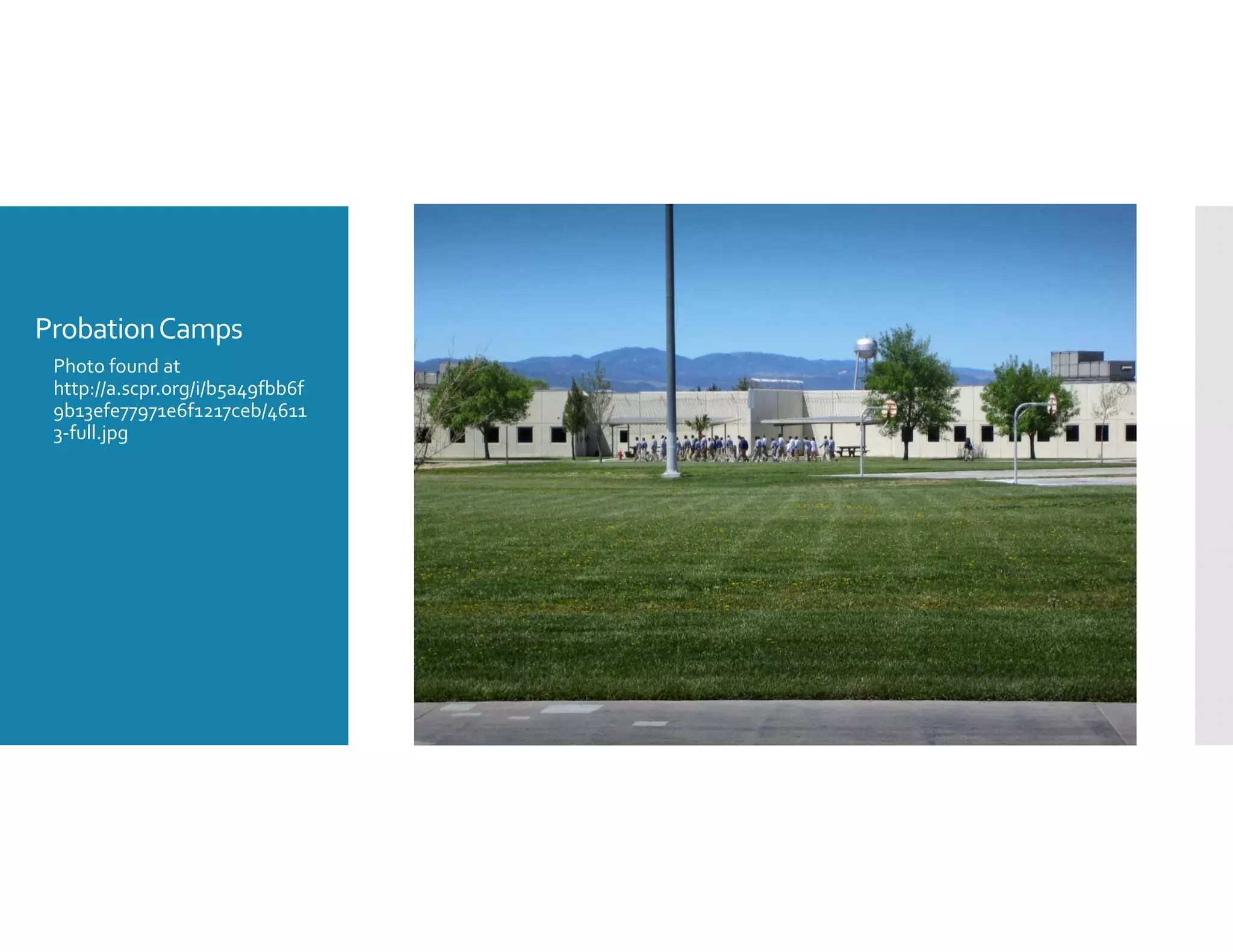
Probation Camps
 Photo found at 
http://a.scpr.org/i/b5a49fbb6f
9b13efe77971e6f1217ceb/4611
3‐full.jpg
Probation Camps
 Photo found at 
http://advancementprojectca.
org/wp/wp‐
content/uploads/2015/09/imce
/probation%20image.jpg
Demographics
 Conducted 104 semi‐structured interviews with youth at 12 
Probation Camps
 Average youth age: 16.9 years old, Range: 14‐19 years old
 88 males, 15 females, 1 decline to answer (at male camp)
 59% Latino, 29% Black, 6% Multi‐racial, 2% American Indian, 2% 
White, and 1% API
 70% in their first camp program
 Average interview time was 70 minutes, 31 seconds
Living 
Conditions
 Dorms & bathrooms are generally uncomfortable, no privacy 
 Food generally reviewed well at open camps, poorly at Challenger
 Concerns about portion size and available food to eat
 Water quality concerns at Camps McNair & Onizuka
 Girls had issues with paper underwear, feminine hygiene pads, & 
ill‐fitting bras 
Education
 Most youth liked school, the teachers, and the curriculum
 Youth at certain camps have access to woodshop, cooking classes, 
college online courses, and other electives
 Credit recovery programs made graduating high school a reality 
Programs
 Mixed reviews of group therapies, seemed to depend on 
connection with counselors 
 Most youth were indifferent to or critiqued the substance abuse 
program 
 Youth with jobs generally enjoyed them due to either the work 
(mainly seen in office orderlies and kitchen patrol) or the perks 
(extra food, extra phone calls, etc.) 
 Specialized camp programs, FLOW (rapping and music writing 
courses), and LA Dads were the best reviewed programs
Support 
 80% of youth had at least one visit while incarcerated, only 16% 
indicated weekly visits
 Phone calls are a weekly occurrence by policy, however length and 
frequency vary by camp and PO
 Interestingly, some youth disclosed not wanting family or children 
to visit as it would destabilize them. Some also indicated lying to 
younger siblings or children telling them they were on vacation or 
in boarding school
Probation 
Staff
 78% of youth had good relationships with their assigned PO
 81% of youth had positive experiences with POs in general
 63% of youth had negative experiences with POs ranging from 
minor disagreements to inappropriate behavior to verbal and/or 
physical assault
Safety & 
Discipline
 63% of youth felt that the rules of camp were enforced fairly
 Youth identified unfair practices to include group punishment, 
favoritism by staff, militaristic practices, and denial of bathroom 
access
 Youth discussed fights and riots in the camp as a normal 
occurrence, but not a frequent one
 Many youth discussed instances of being pepper sprayed and/or 
physical aggressiveness by staff after pepper spray use
Safety & 
Discipline
 At the girls’ camps, many youth discussed sexual misconduct as 
against the rules, but they also discussed couples in the camps and 
how staff let certain couples get away with ‘sexual misconduct’
 74% of youth had been to the SHU; most stating experiences of 
indifference as most stayed 24 hours or less 
 Some stated liking the SHU because it was the only private time 
they ever had
 It seemed that the girls were sent to the SHU for much longer times, 
for the reason of ‘punishment,’ and for less serious offenses 
 Later validated by the Probation Department as well 
Social 
Dynamics
 52% of youth made friends in camp and 38% did not, 10% gave 
mixed responses
 23% said they had ‘associates’ or ‘acquaintances’ at camp
 28% had friends or family members from the outs in camp with 
them
 Race is a leading cause of tension at many camps, both with the 
youth and the staff. 
 31% of youth also discussed how gang activity (intertwined with 
racial dynamics) affected daily life at camp
Plans After 
Release
 44% of youth wanted to go to college 
 18% of youth planned to go to a trade school 
 29% wanted to finished high school, with no plans of further 
education 
 9% either had no plans or were unsure of their plans
Health 
Services
 Overwhelmingly, youth like their individual therapists and mental 
health services 
 11% were currently or previously on (while under the care of 
Probation) medication for depression  and/or anxiety 
 31% were currently or previously on (while under the care of 
Probation) sleeping medication
Health 
Services
 Birth control policy is not given equitably to young girls as 
reactions were varied around access 
 A few girls disclosed pasts with miscarriages and/or stillborn 
children, some while under care of Probation
Promoting 
Dignity for 
Young Women 
& Girls in the 
Probation 
Camps & 
Juvenile Halls
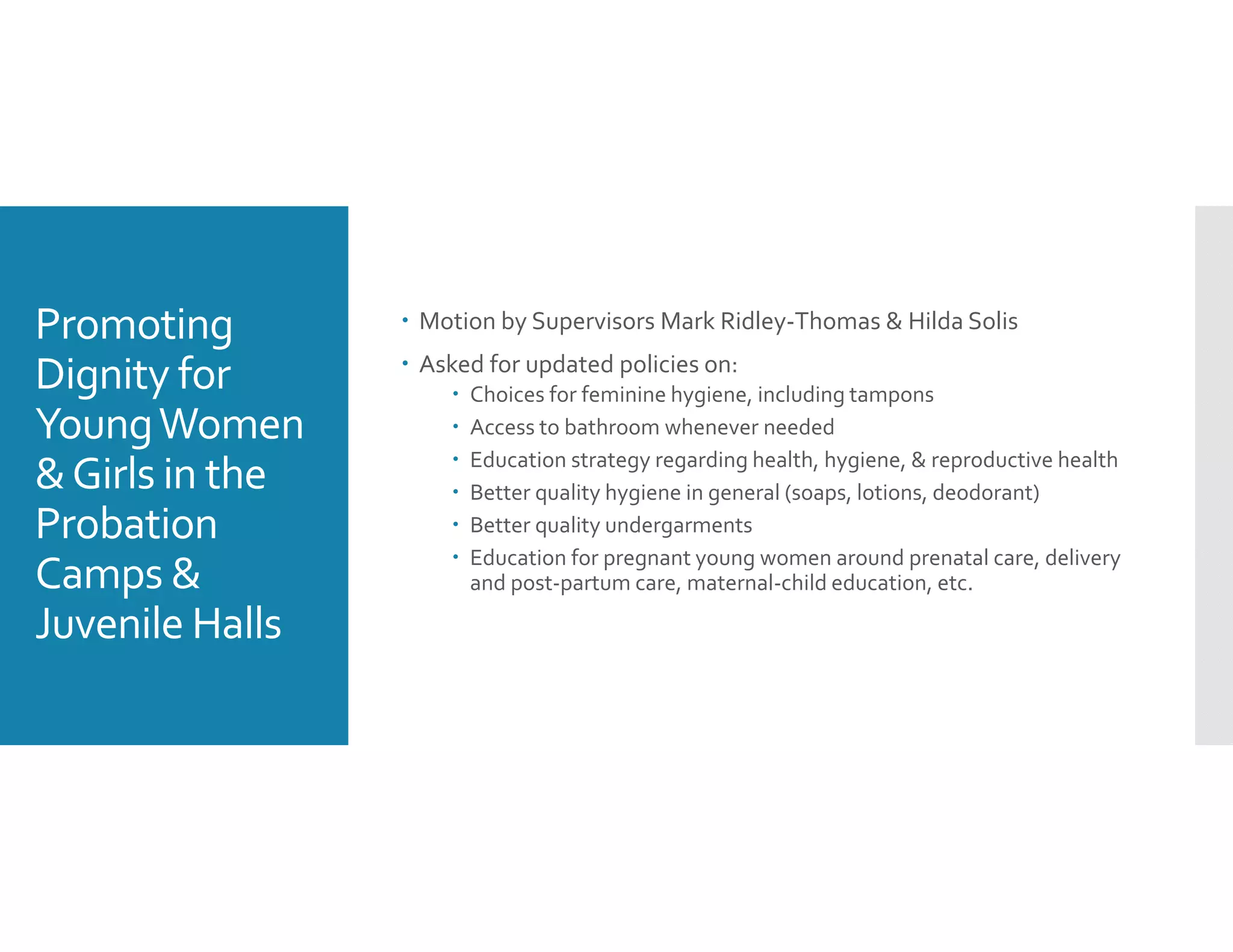
 Motion by Supervisors Mark Ridley‐Thomas & Hilda Solis
 Asked for updated policies on: 
 Choices for feminine hygiene, including tampons
 Access to bathroom whenever needed 
 Education strategy regarding health, hygiene, & reproductive health
 Better quality hygiene in general (soaps, lotions, deodorant) 
 Better quality undergarments 
 Education for pregnant young women around prenatal care, delivery 
and post‐partum care, maternal‐child education, etc. 
Questions, 
Comments?
 “Recently I’m writing about my experience being incarcerated. So 
yeah I’m writing about that, how it’s changed me, it’s looking 
forward for a better future.”
 Full Report can be found at http://bit.ly/2fWvqUj

Jures hailey lecture_2-21-2017