Kathleen Ludewig Omollo
University of Michigan - Open.Michigan Initiative
Audience: University of Nairobi School of Public Health
Download slides: http://openmi.ch/uon-aug2013
Except where otherwise noted, this work is available under a Creative Commons Attribution 3.0 License.
Copyright 2013 The Regents of the University of Michigan.
1
Introduction to
Open Licenses
Open Education for Collaboration,
Flexibility, and Global Visibility
Pop quiz
True or false: If a work is freely
available online, then it is not
copyrighted
False.
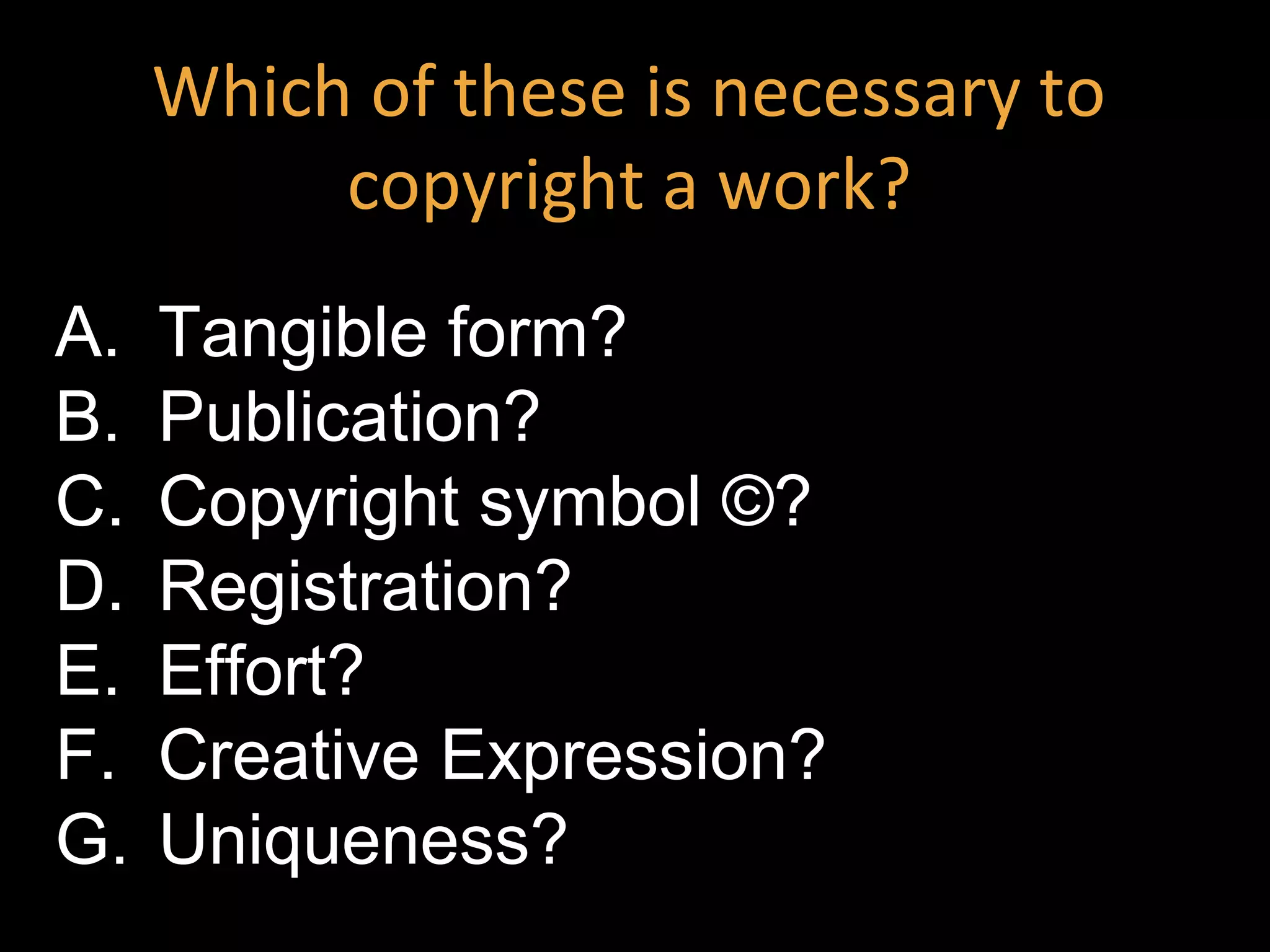
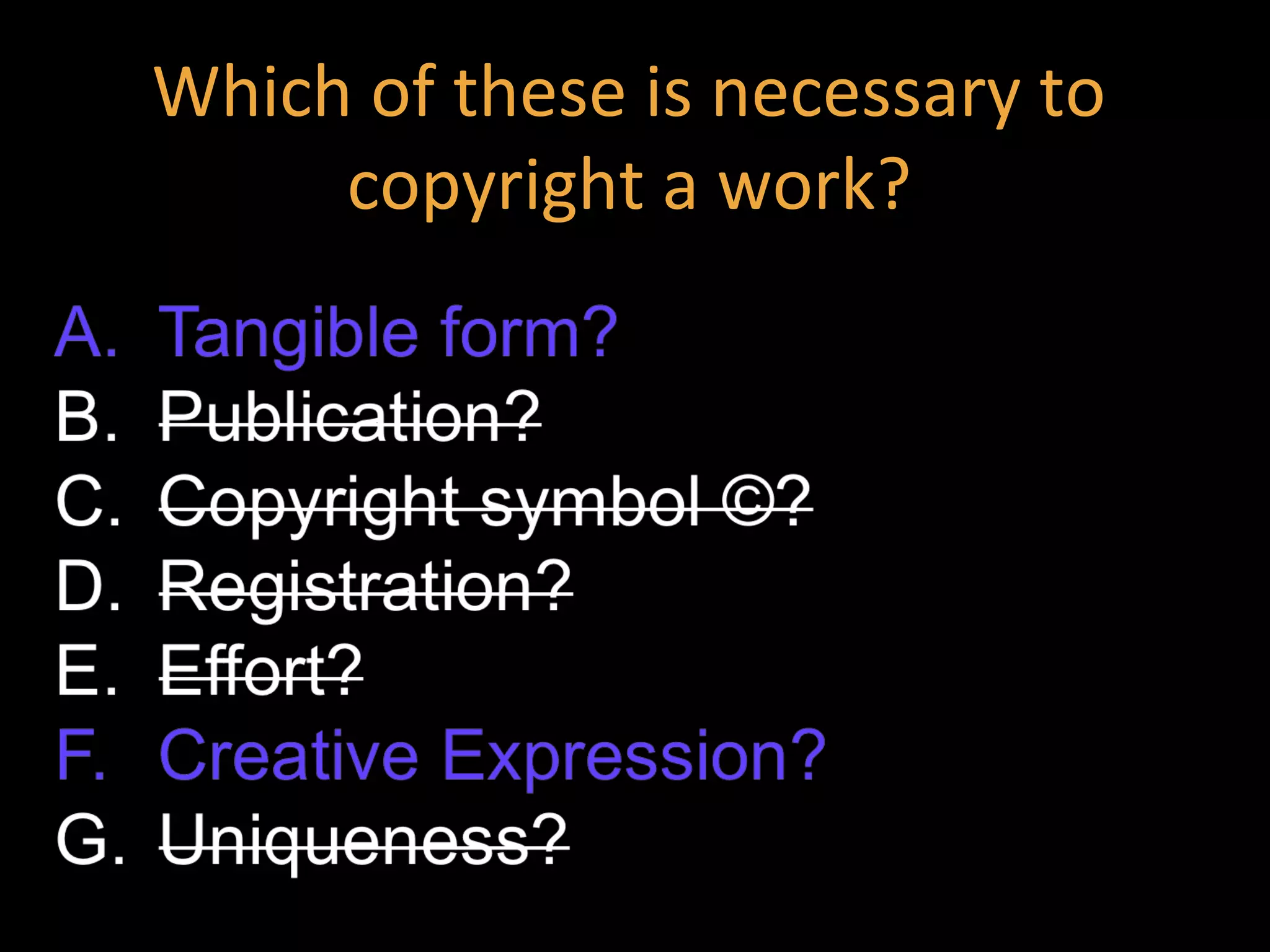
A. Tangible form?
B. Publication?
C. Copyright symbol ©?
D. Registration?
E. Effort?
F. Creative Expression?
G. Uniqueness?
Which of these is necessary to
copyright a work?
Which of these is necessary to
copyright a work?
Image CC:BY Ute Hagen (Flickr)
What rights are
included in
copyright?
(hint: there are 5)
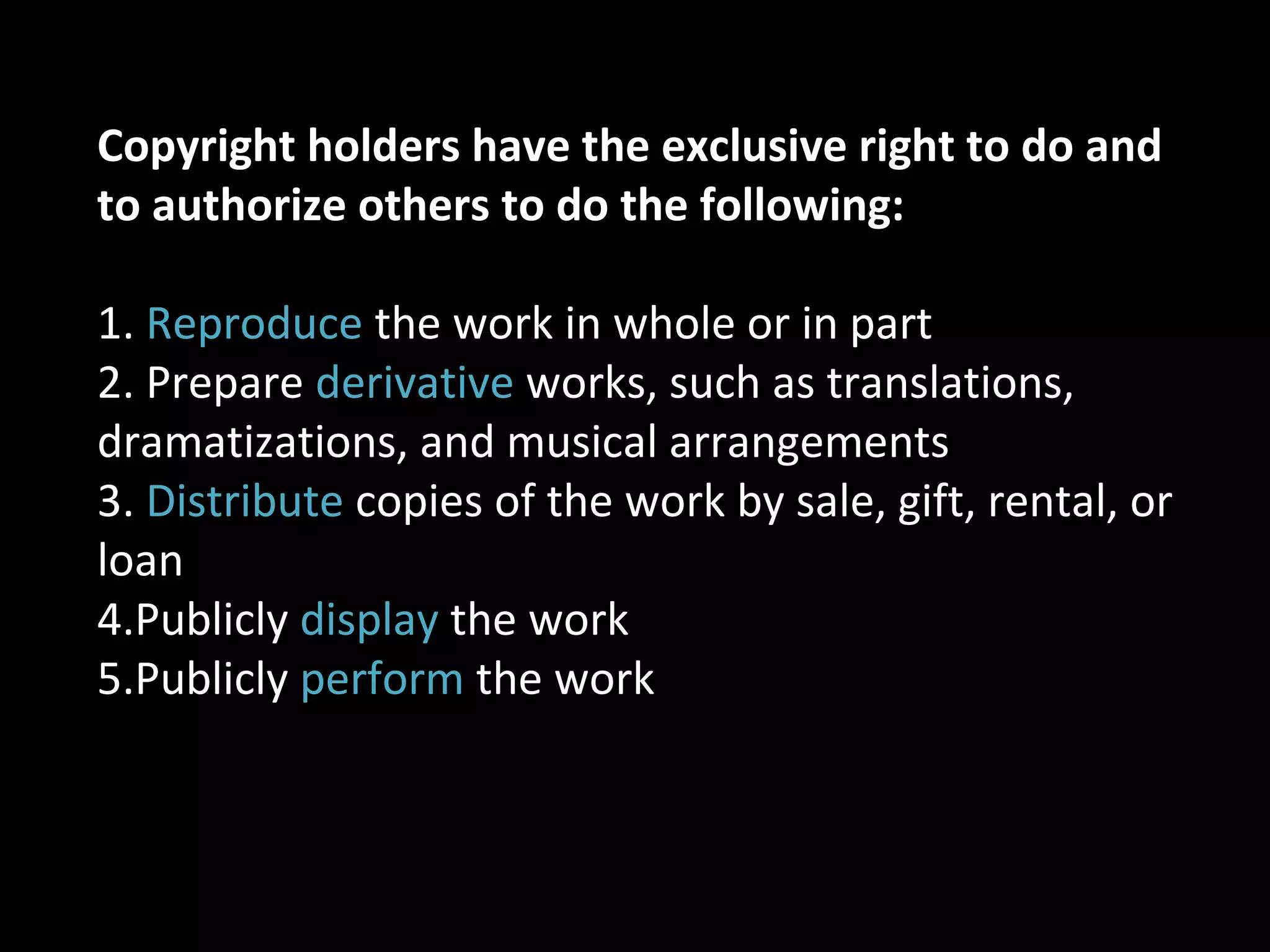
Copyright holders have the exclusive right to do and
to authorize others to do the following:
1. Reproduce the work in whole or in part
2. Prepare derivative works, such as translations,
dramatizations, and musical arrangements
3. Distribute copies of the work by sale, gift, rental, or
loan
4.Publicly display the work
5.Publicly perform the work
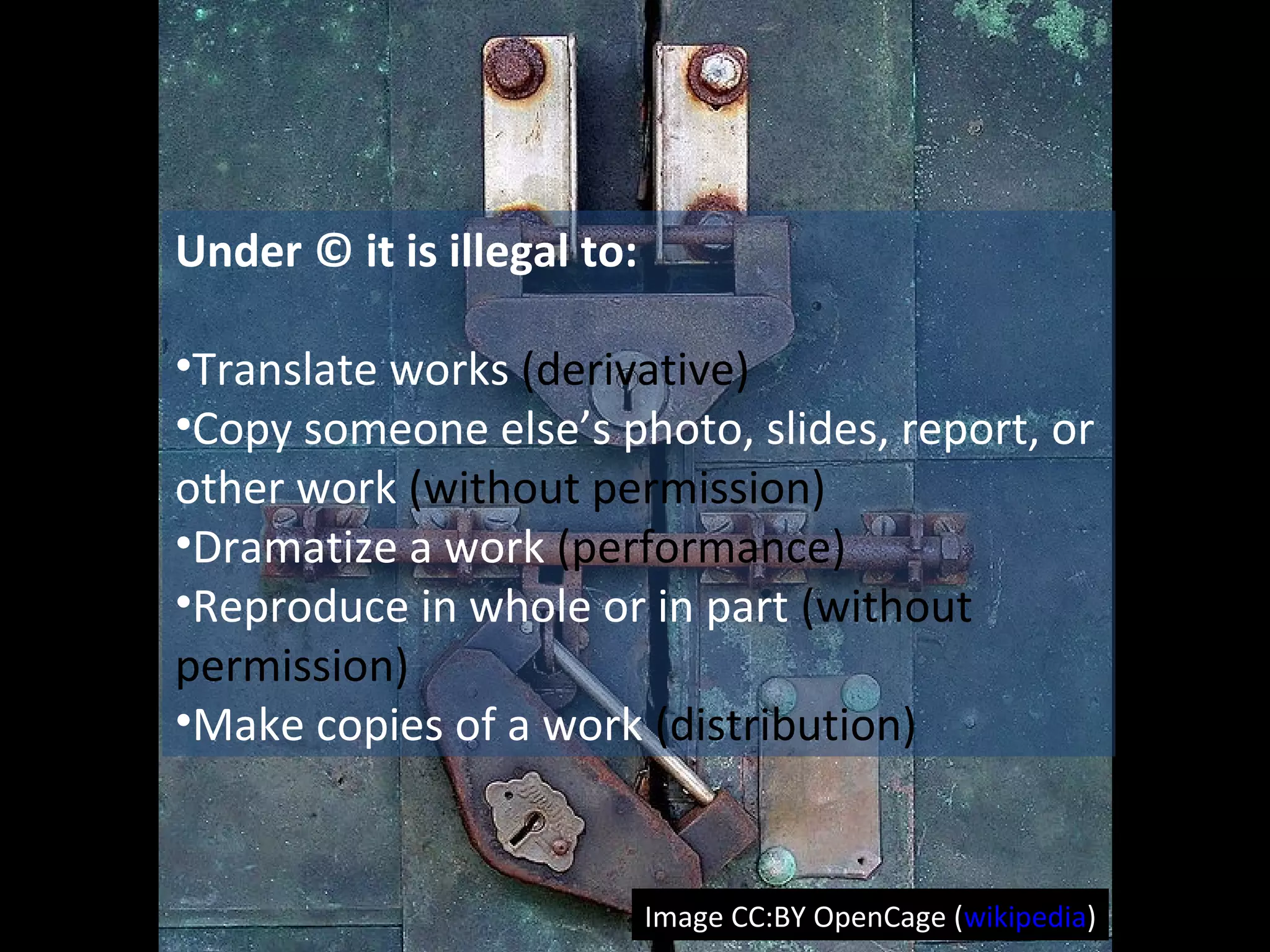
Under © it is illegal to:
•Translate works (derivative)
•Copy someone else’s photo, slides, report, or
other work (without permission)
•Dramatize a work (performance)
•Reproduce in whole or in part (without
permission)
•Make copies of a work (distribution)
Image CC:BY OpenCage (wikipedia)
End pop quiz
Image CC:BY OpenCage (Wikimedia Commons
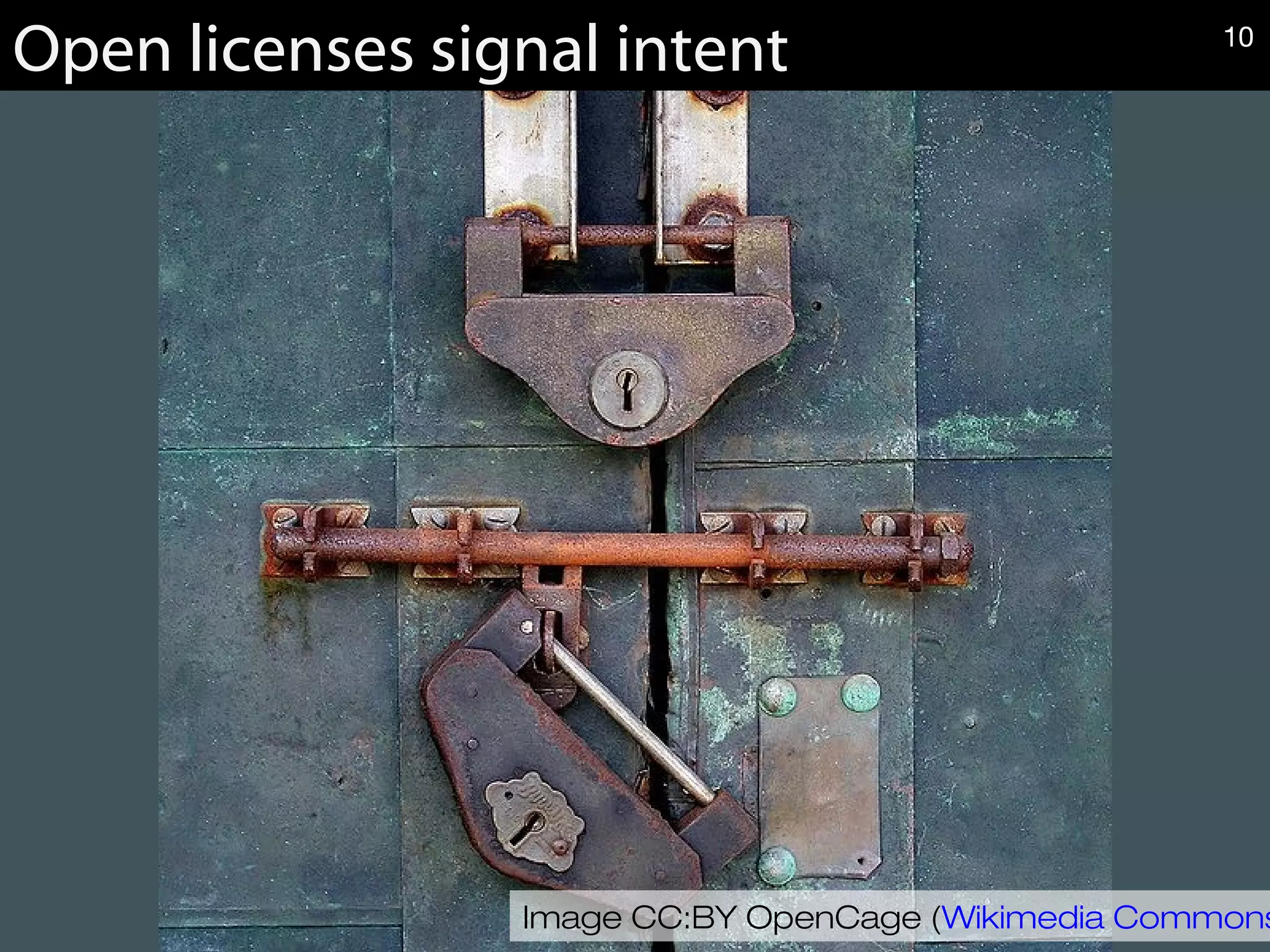
Open licenses signal intent 10
Image CC:BY Orin Zebest (Flickr)
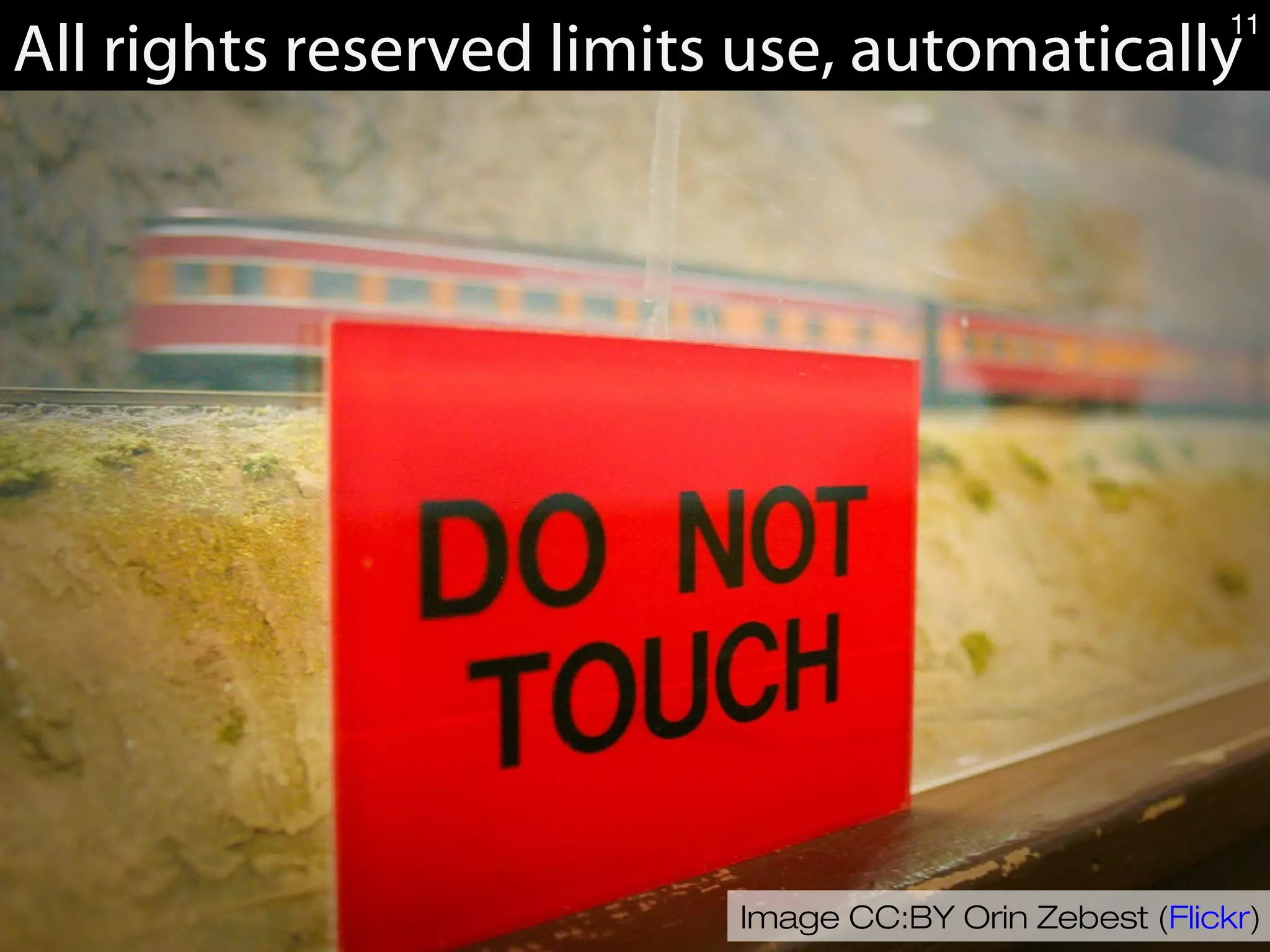
All rights reserved limits use, automatically
11
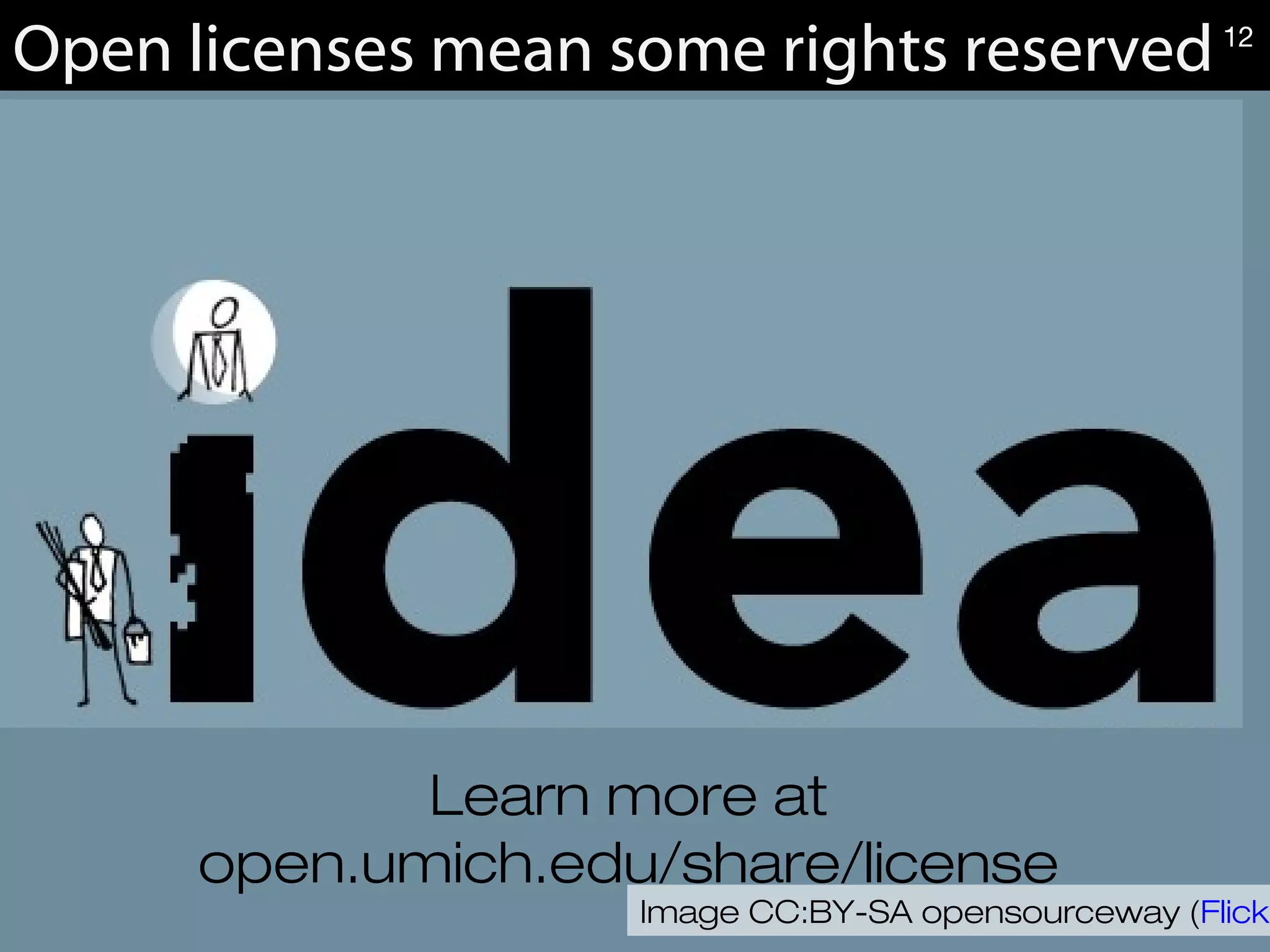
Open licenses mean some rights reserved
Image CC:BY-SA opensourceway (Flickr
Learn more at
open.umich.edu/share/license
12
All Rights Reserved
(default)
13
“All rights reserved” is the default. 13
Option: Creative Commons
(two C’s instead of 1 C)
(www.creativecommons.org/licen
ses/)
14
“Some rights reserved” is an alternative. 14
Image CC:BY Paul Albertella (Flickr)
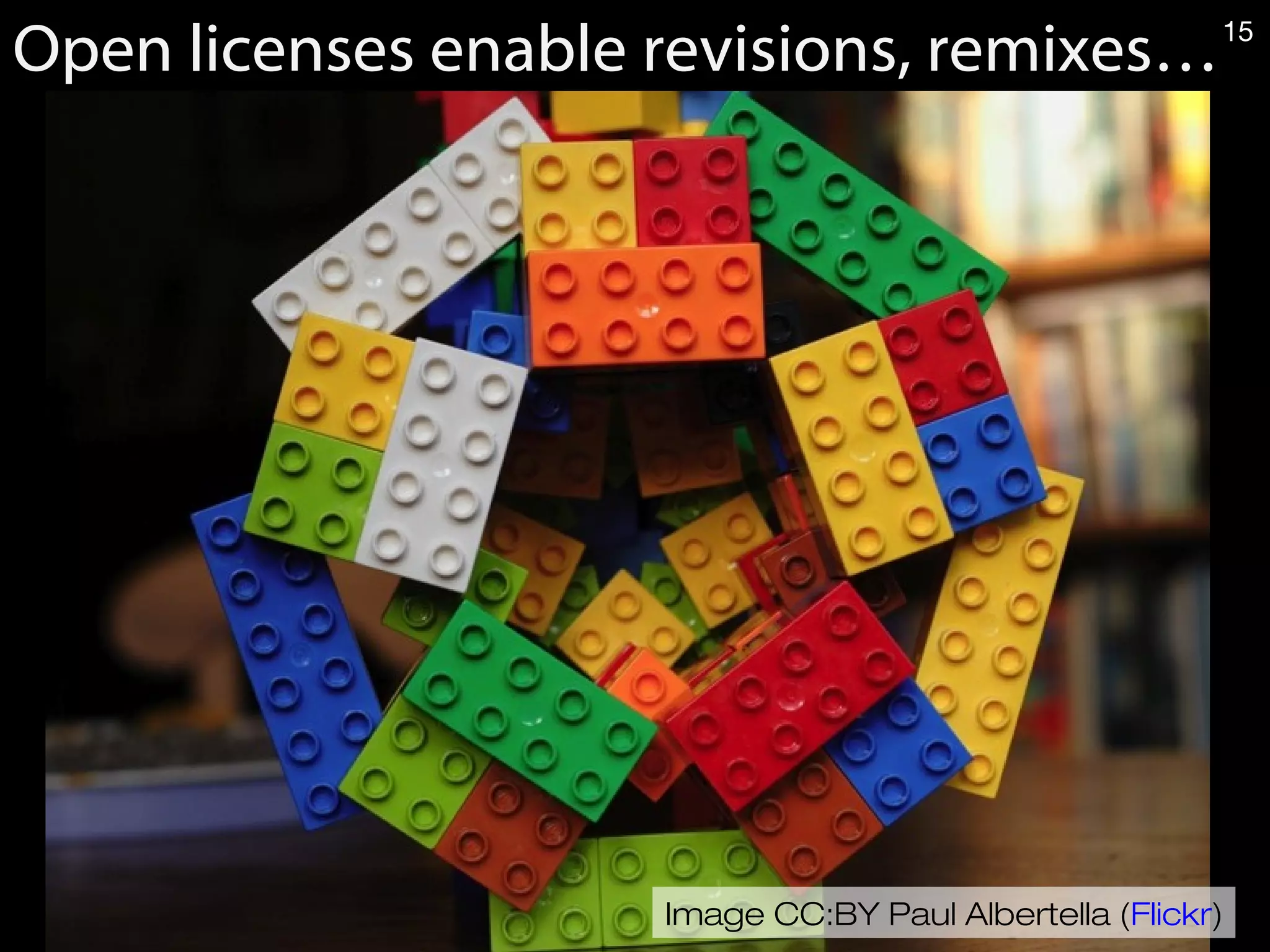
Open licenses enable revisions, remixes…15
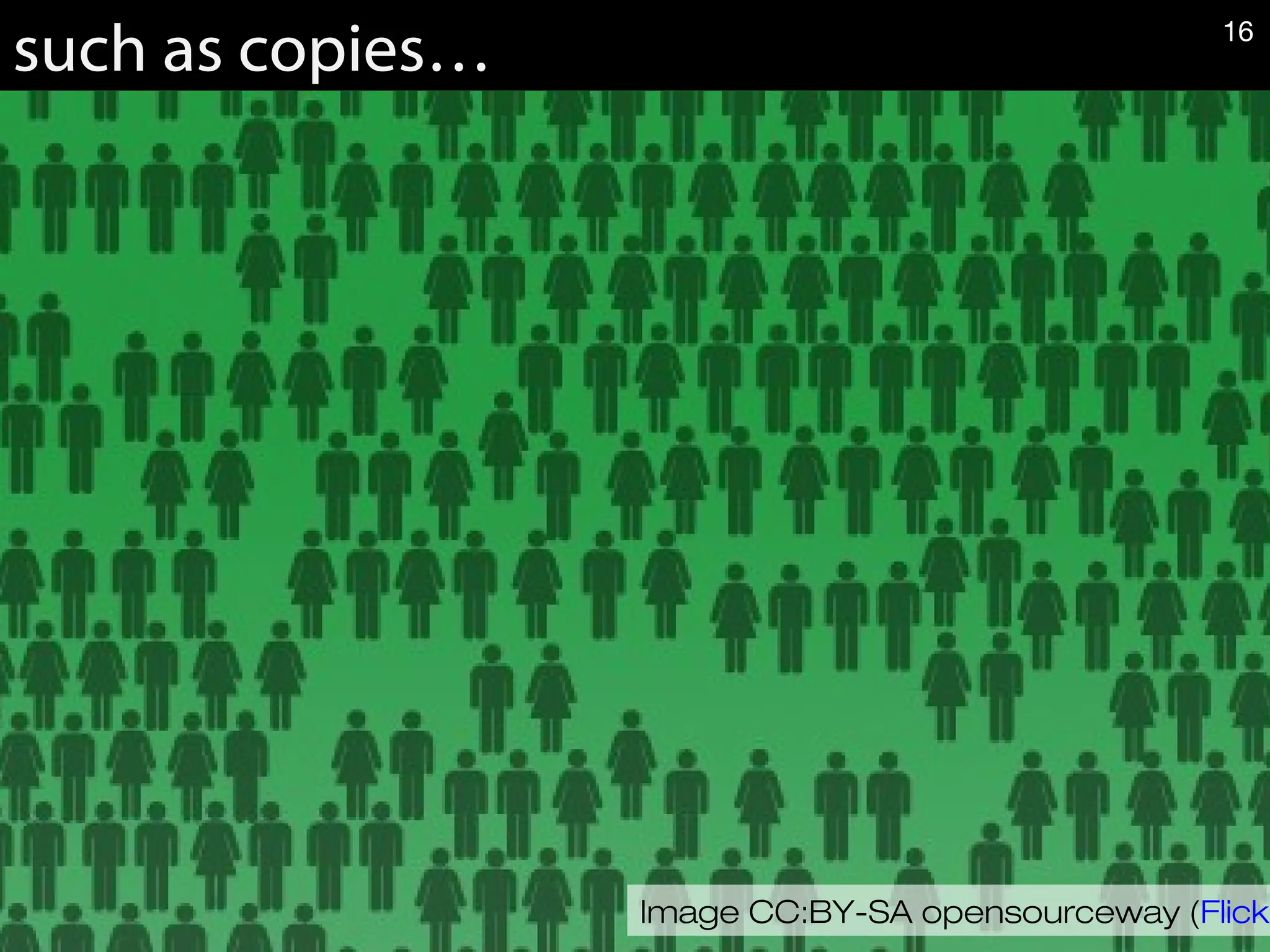
such as copies…
Image CC:BY-SA opensourceway (Flickr
16
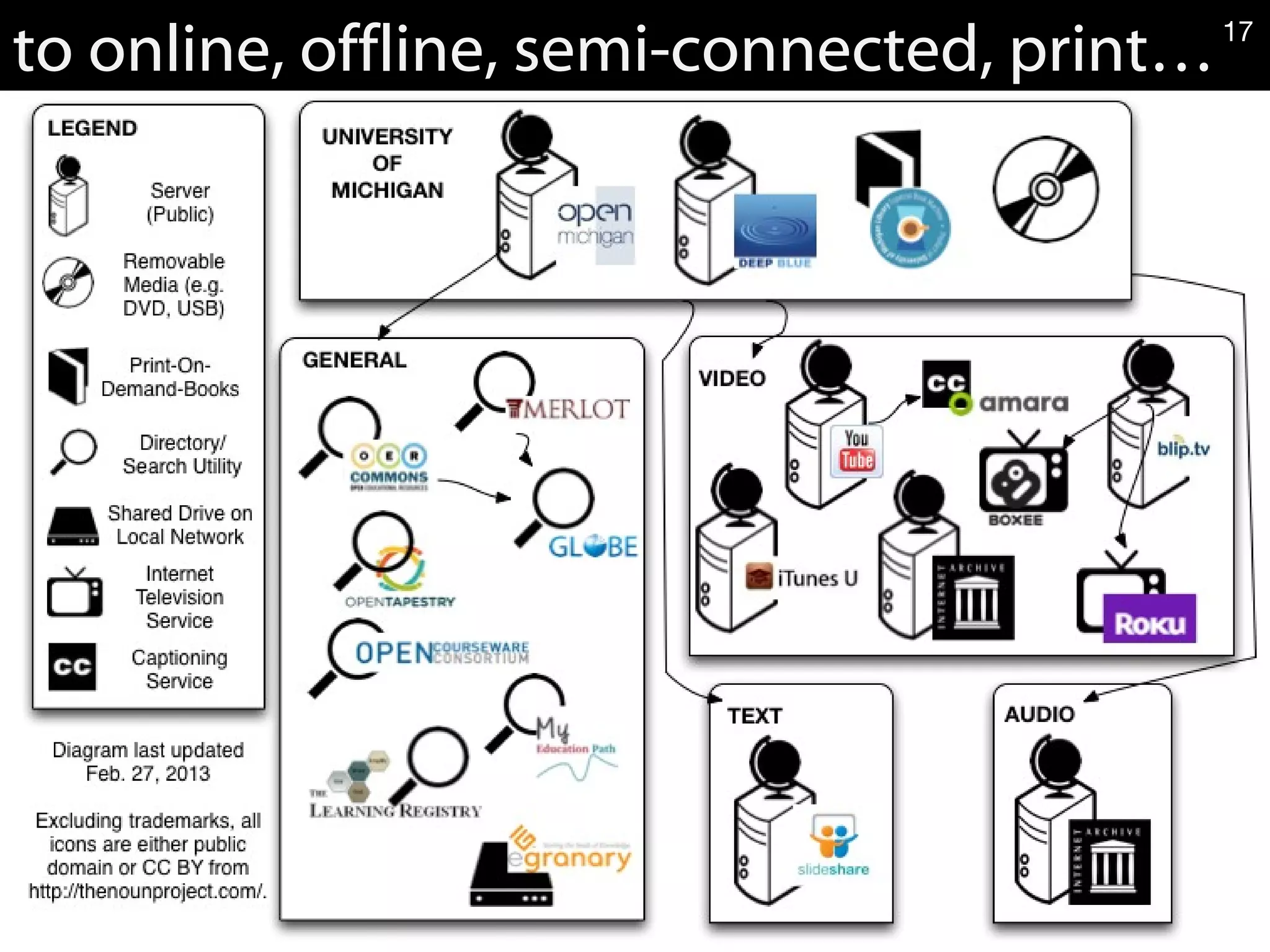
to online, offline, semi-connected, print…17
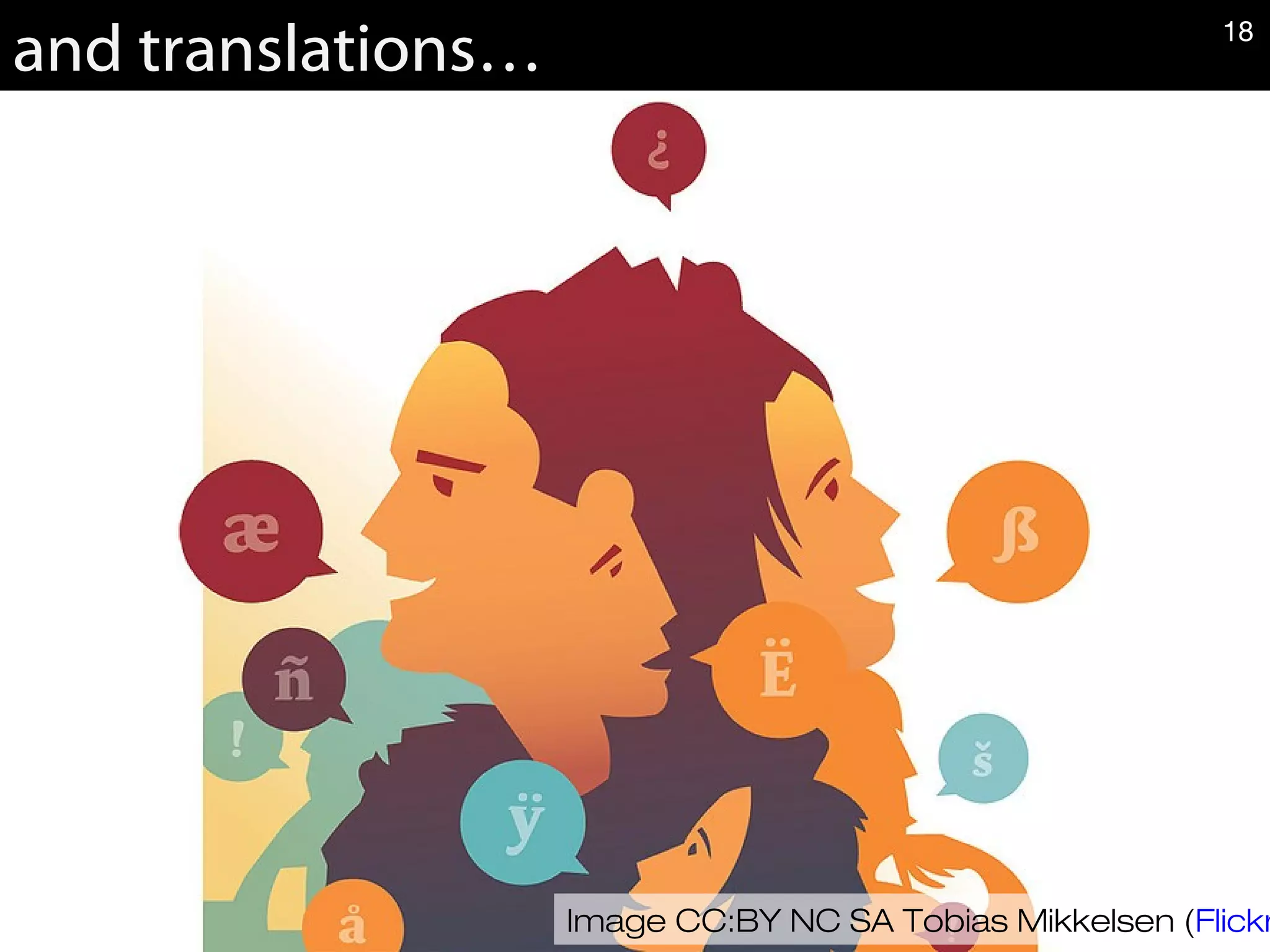
and translations…
Image CC:BY NC SA Tobias Mikkelsen (Flickr
18
Image CC:BY Tome Loh (Flickr)
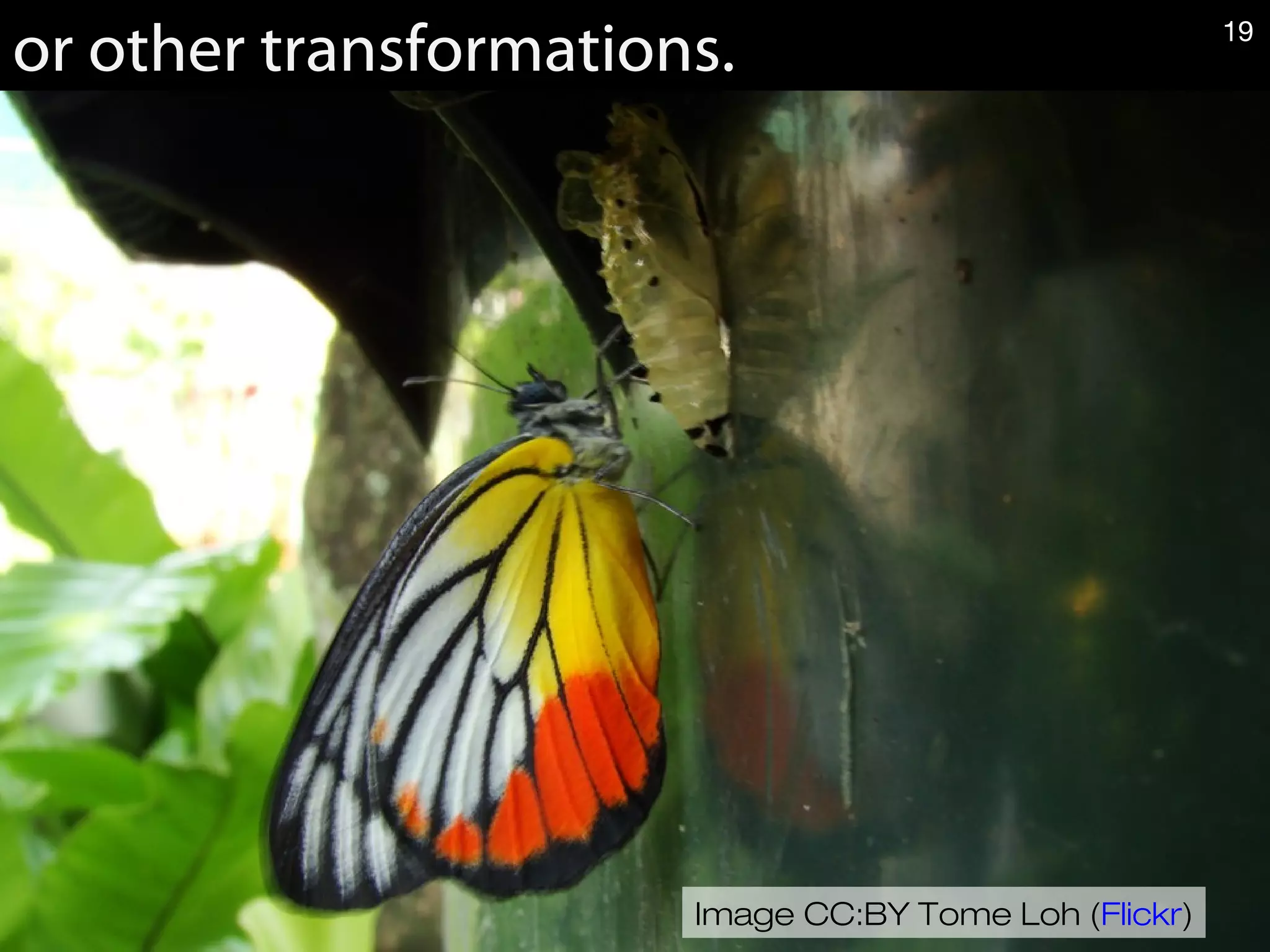
or other transformations. 19
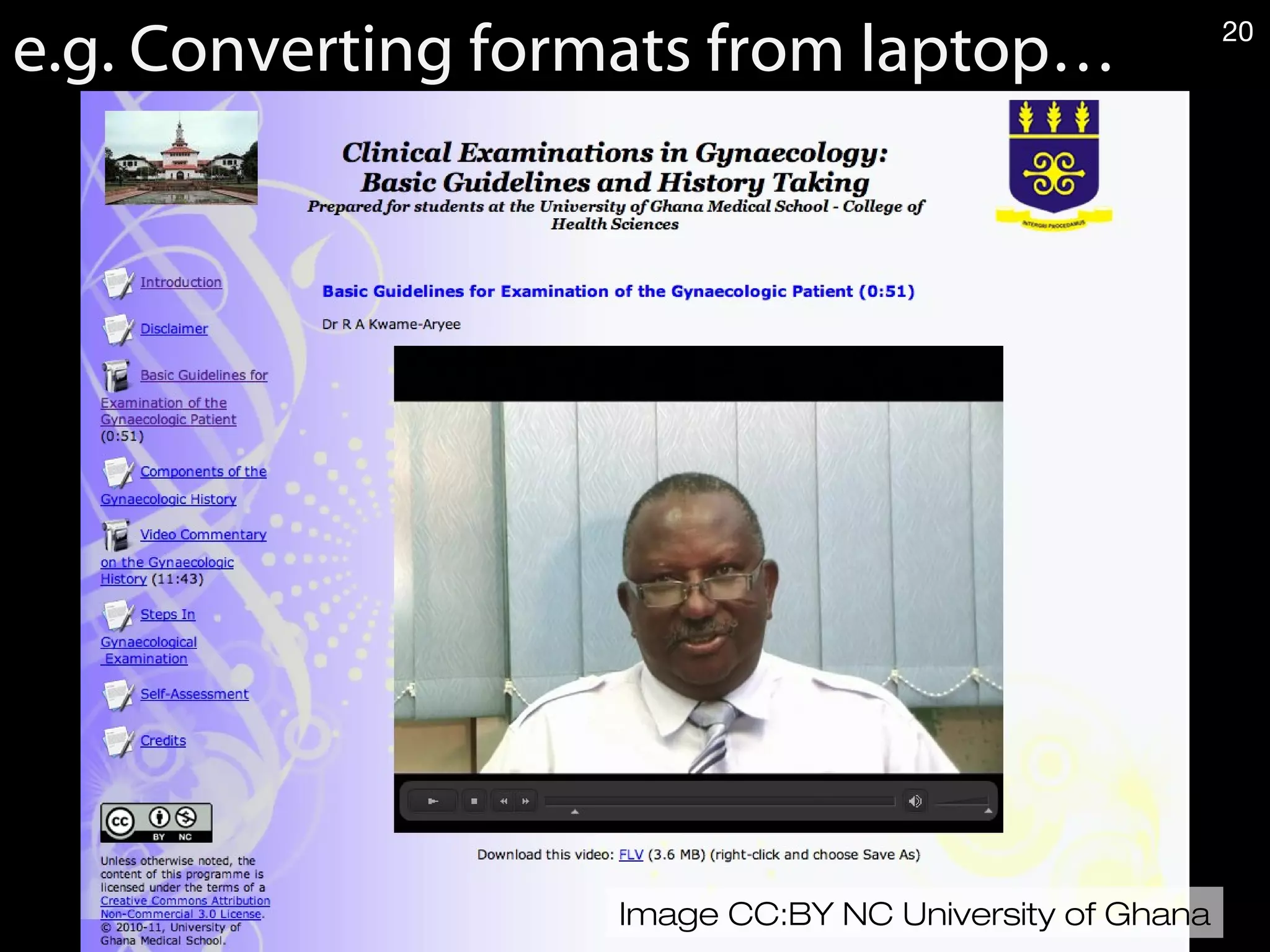
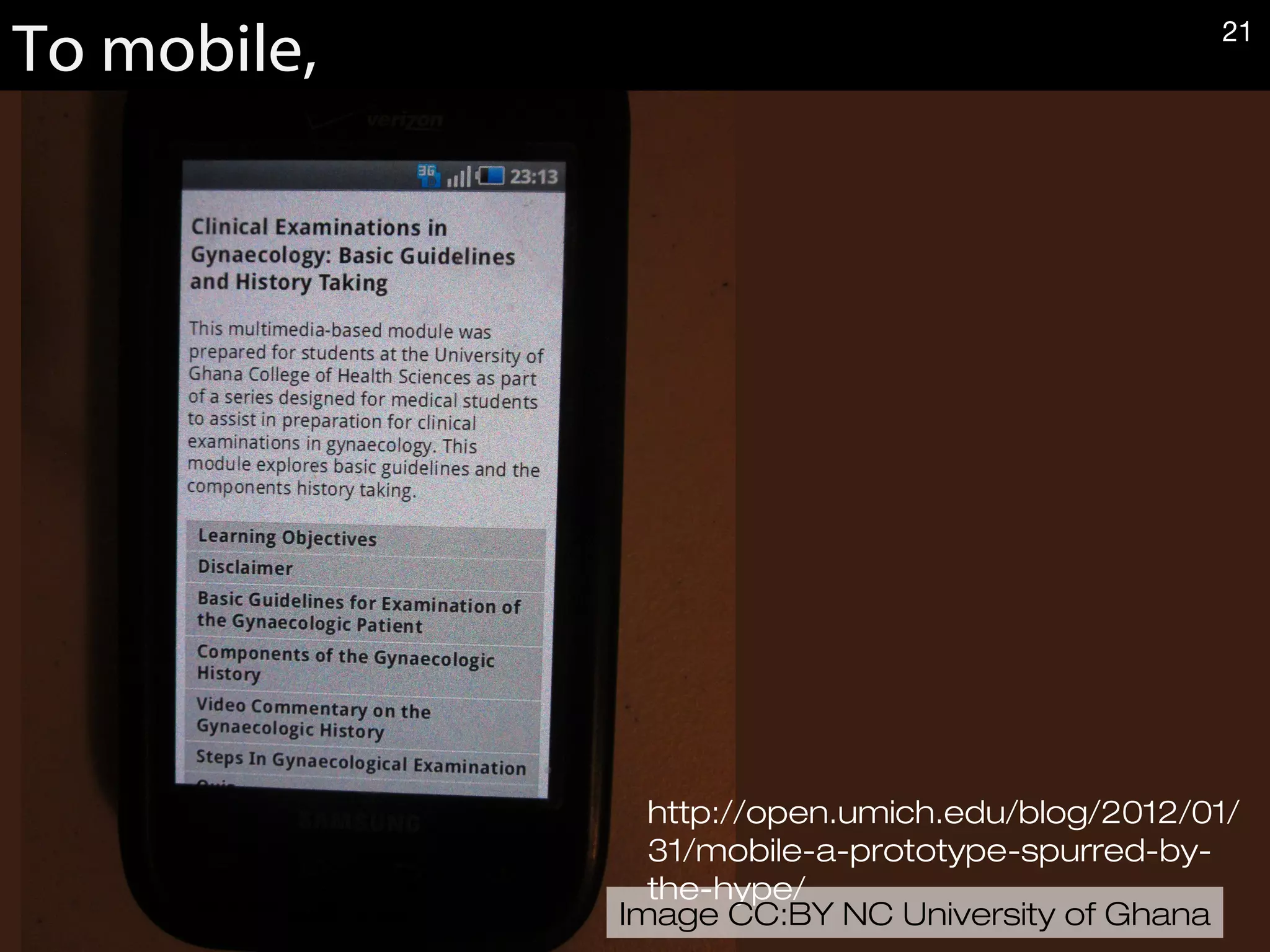
e.g. Converting formats from laptop…
Image CC:BY NC University of Ghana
20
http://open.umich.edu/blog/2012/01/
31/mobile-a-prototype-spurred-by-
the-hype/
To mobile,
Image CC:BY NC University of Ghana
21
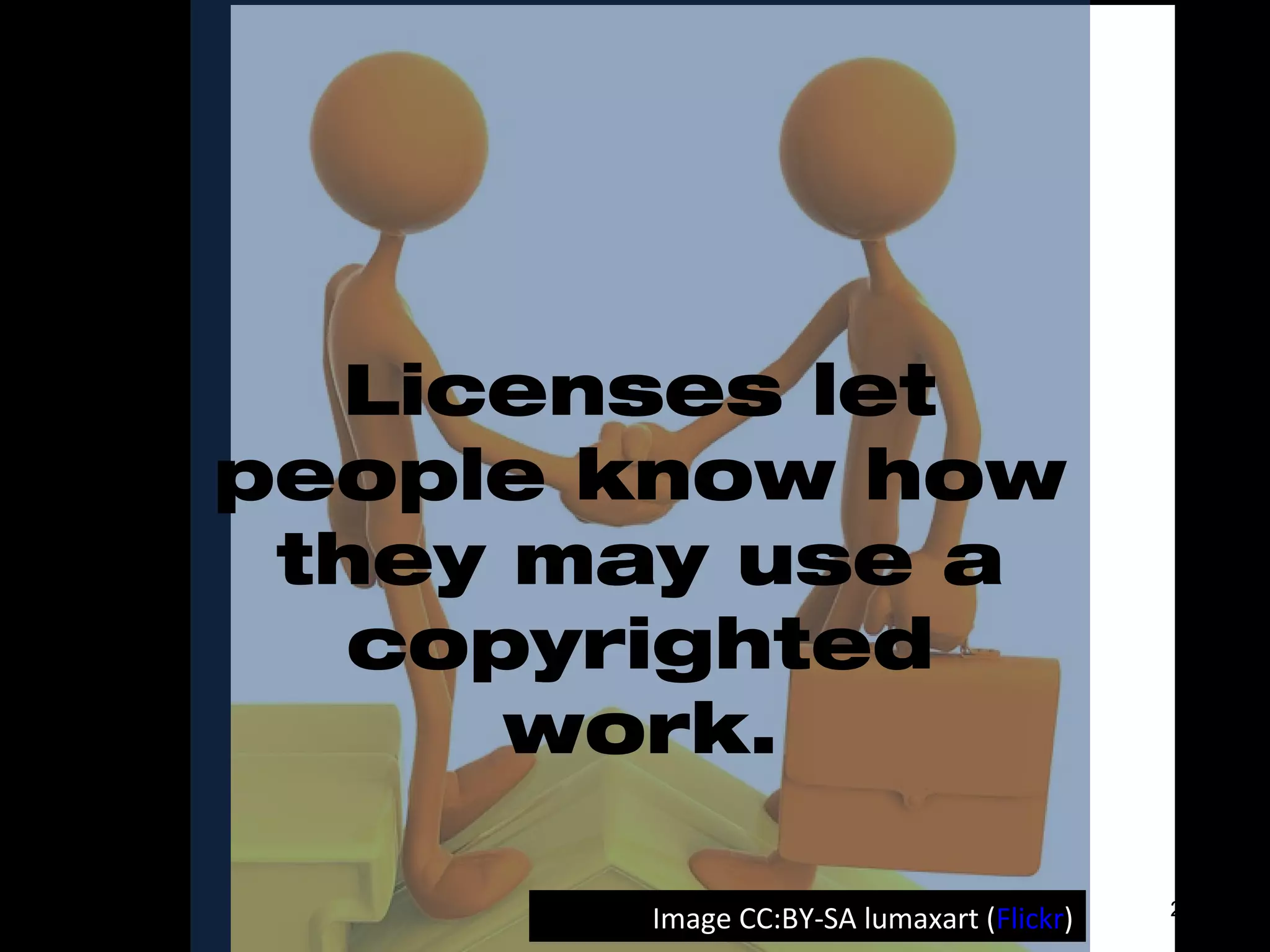
What is a license?
Licenses let
people know how
they may use a
copyrighted
work.
Image CC:BY-SA lumaxart (Flickr) 22
You let others copy, distribute, display, and
perform your copyrighted work but only if
they give you credit.
BY :: Attribution
23
You let others copy, distribute, display, and
perform your copyrighted work but for
noncommercial purposes only.
NC :: Noncommercial
24
You let others copy, distribute, display, and
perform your copyrighted work as long as
any derivative work is licensed under the
same license.
SA :: Share Alike
25
You let others copy, distribute, and display
your copyrighted work only if no changes,
derivatives, are made.
ND :: No derivatives
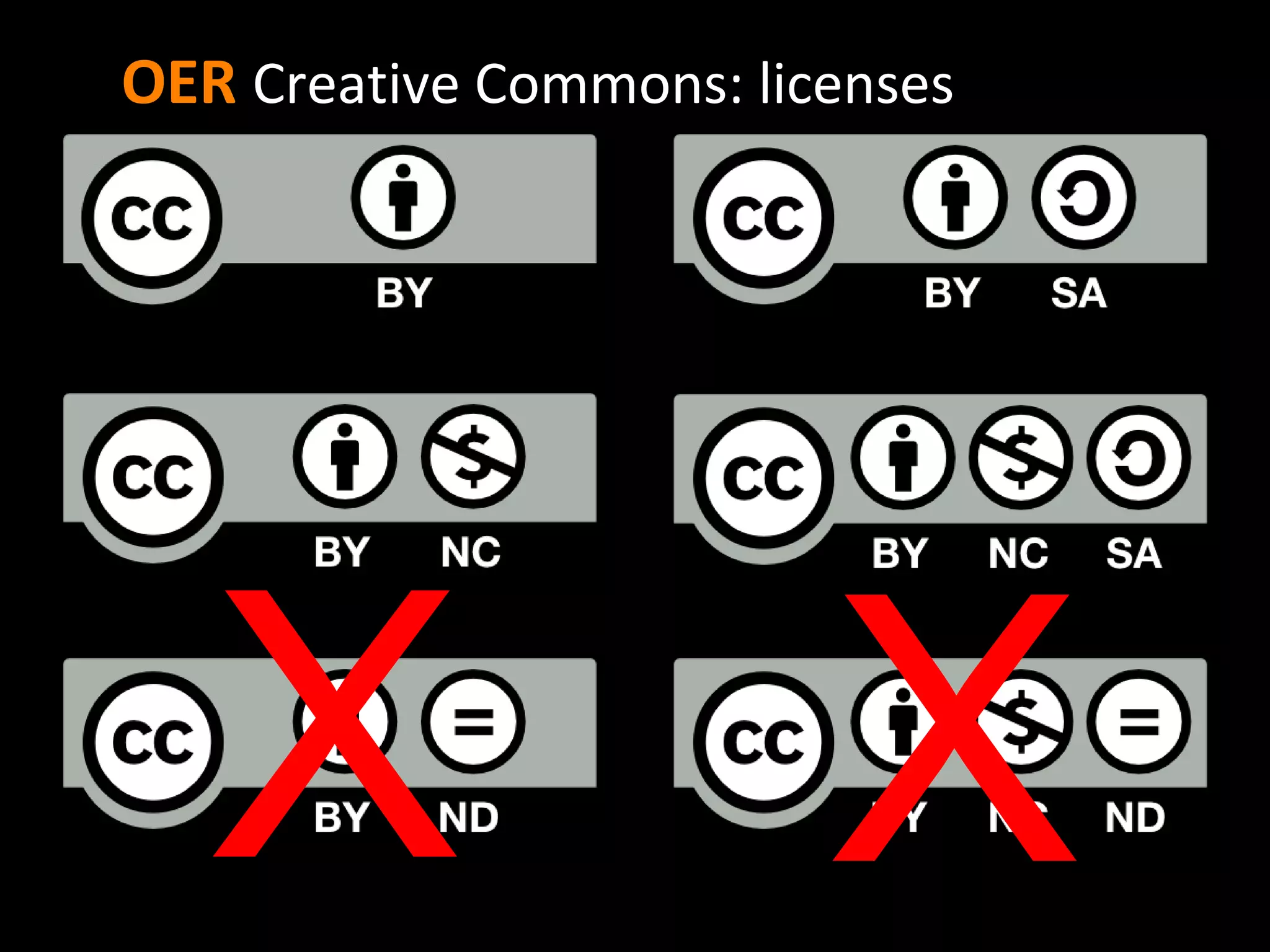
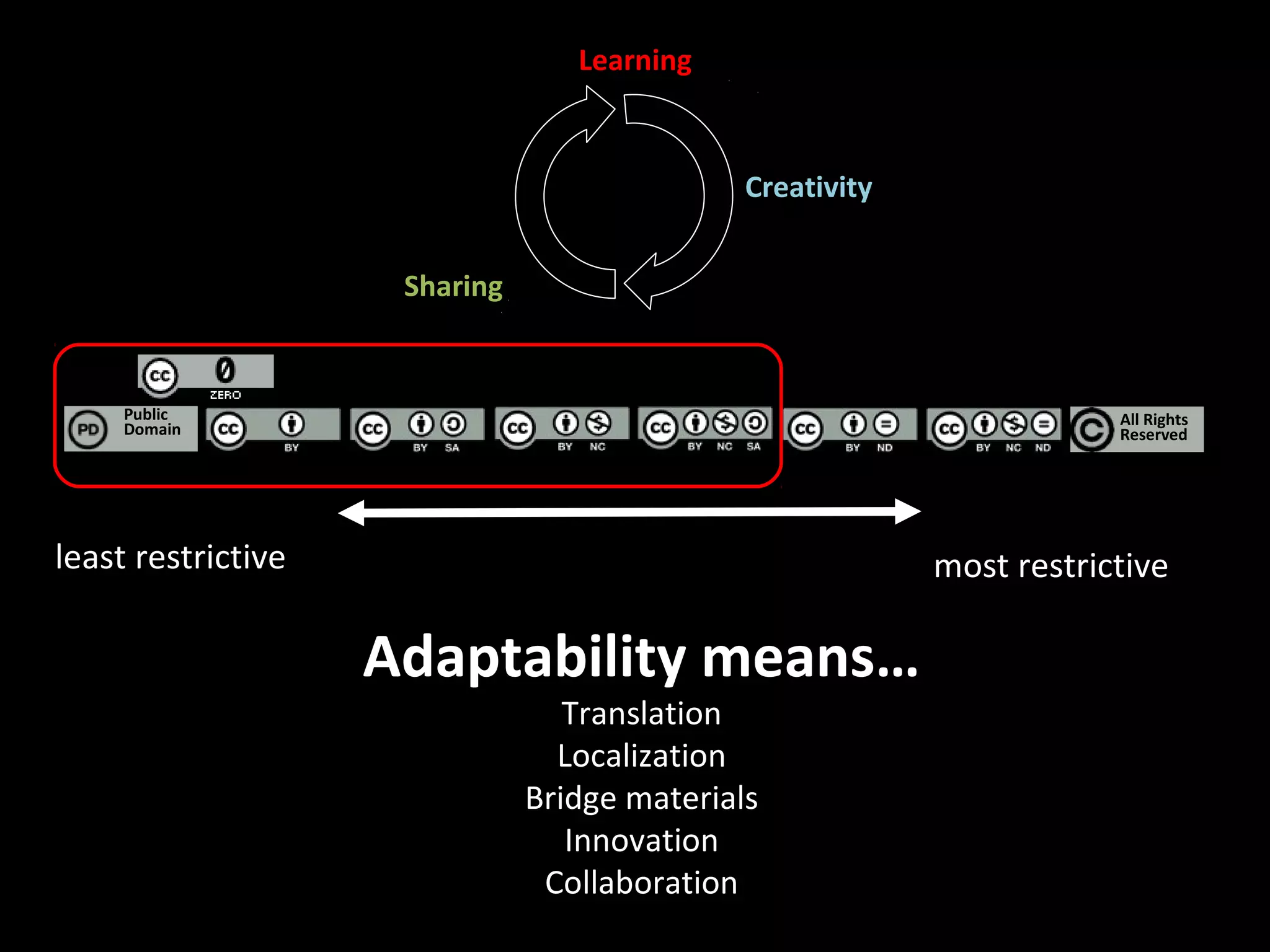
OER Creative Commons: licenses
X X
What does this
mean for authors?
Adaptability means…
Translation
Localization
Bridge materials
Innovation
Collaboration
Sharing
Learning
Creativity
Public
Domain
least restrictive most restrictive
All Rights
Reserved
It's easiest to create open
content from the start.
30
Start now by making a small
change in how you create your
own content.
31
What does this mean for you?
32
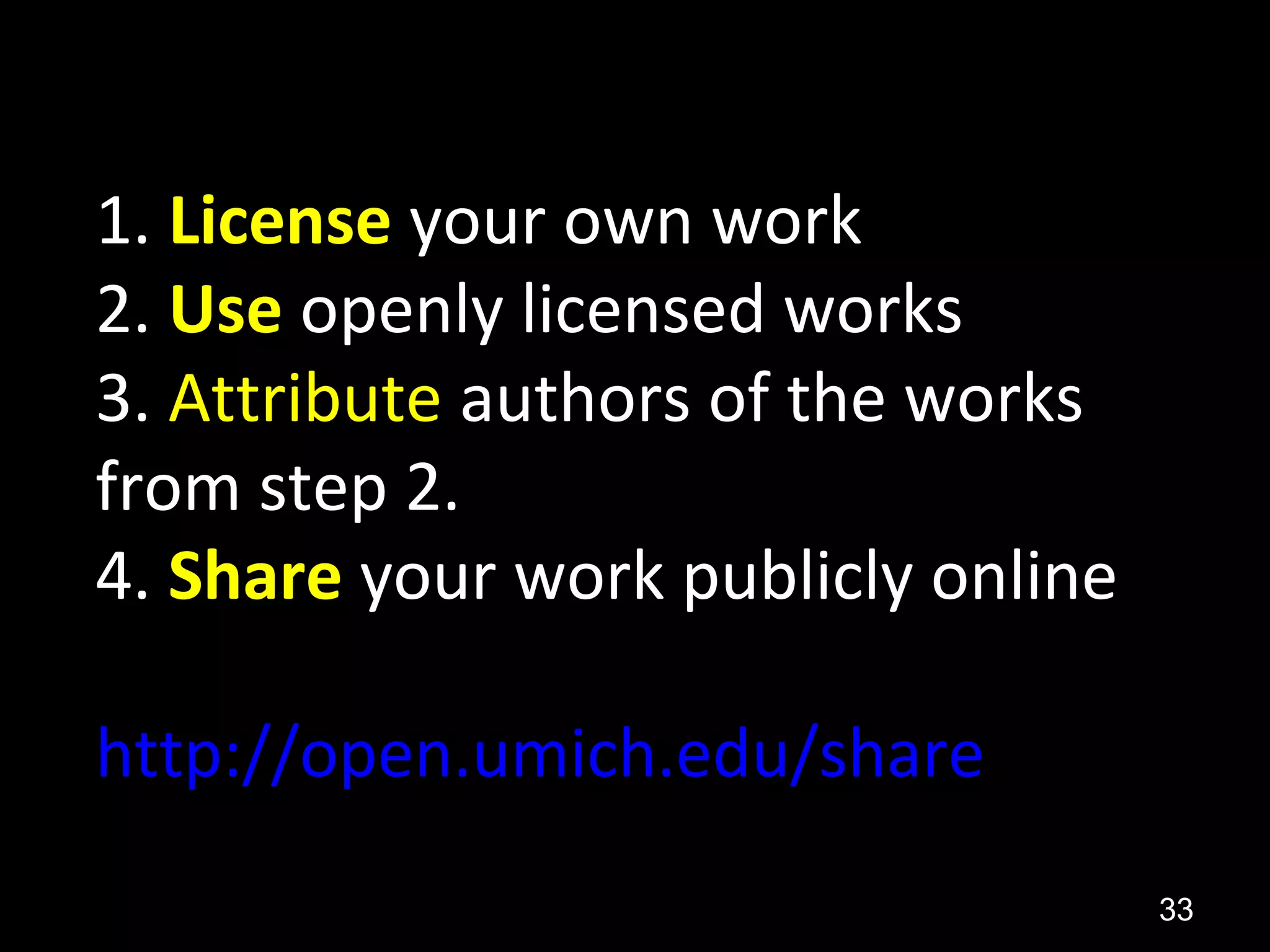
1. License your own work
2. Use openly licensed works
3. Attribute authors of the works
from step 2.
4. Share your work publicly online
http://open.umich.edu/share
33
Kathleen Ludewig Omollo
University of Michigan - Open.Michigan Initiative
Audience: University of Nairobi School of Public Health
Download slides: http://openmi.ch/uon-aug2013
Except where otherwise noted, this work is available under a Creative Commons Attribution 3.0 License.
Copyright 2013 The Regents of the University of Michigan.
34
Introduction to
Open Licenses
Open Education for Collaboration,
Flexibility, and Global Visibility
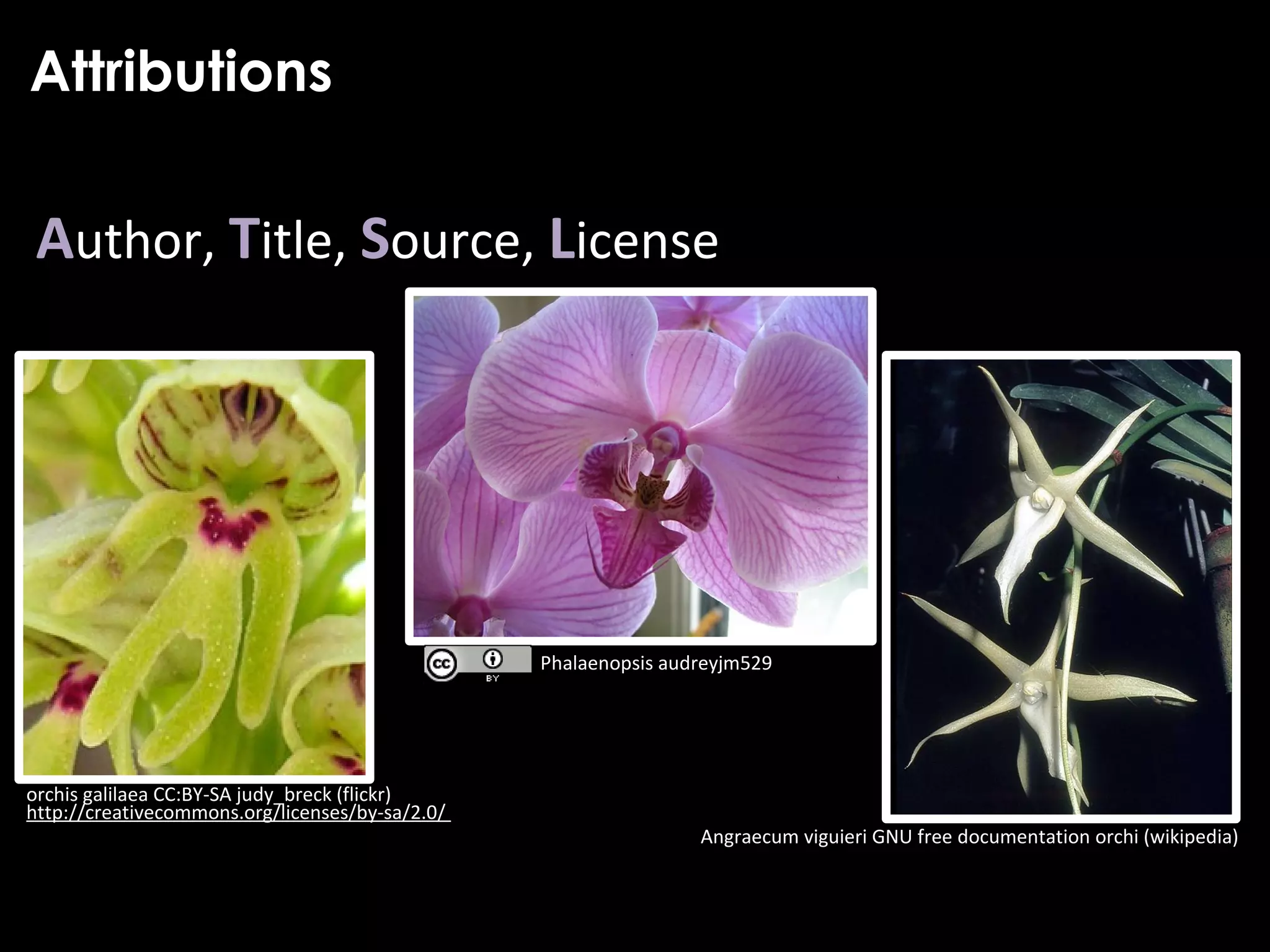
Phalaenopsis audreyjm529
orchis galilaea CC:BY-SA judy_breck (flickr)
http://creativecommons.org/licenses/by-sa/2.0/
Angraecum viguieri GNU free documentation orchi (wikipedia)
Attributions
Author, Title, Source, License
Attributions page at end
Title slide: CC: Seo2 | Relativo & Absoluto (flickr)
http://www.flickr.com/photos/seo2/2446816477/ |
http://creativecommons.org/licenses/by/2.0/deed.en
Slide 1 CC:BY-SA Jot Powers (wikimedia commons)
http://commons.wikimedia.org/wiki/File:Bounty_hunter_2.JPG |
http://creativecommons.org/licenses/by-sa/2.0/
Slide 2 CC: BY-NC Brent and MariLynn (flickr)
http://www.flickr.com/photos/brent_nashville/2960420853/ |
http://creativecommons.org/licenses/by-nc/2.0/deed.en
Slide 3 http://www.newvideo.com/productdetail.html?productid=NV-AAE-71919
Slide 4 Public Domain: http://en.wikipedia.org/wiki/File:Hummer-H3.JPG
Slide 5 Source: Undetermined from a variety of searches on Monster Truck Documentary
Slide 6 Source: Mega-RC.com http://www.mega-
rc.com/MRCImages/Asscd_Mnstr_GT_ShockOPT.jpg
Slide 7 CC:BY-NC GregRob (flickr) http://www.flickr.com/photos/gregrob/2139442260/ |
http://creativecommons.org/licenses/by-nc/2.0/deed.en
Slide 8 CC:BY metaphor91 (flickr) http://creativecommons.org/licenses/by/2.0/deed.en
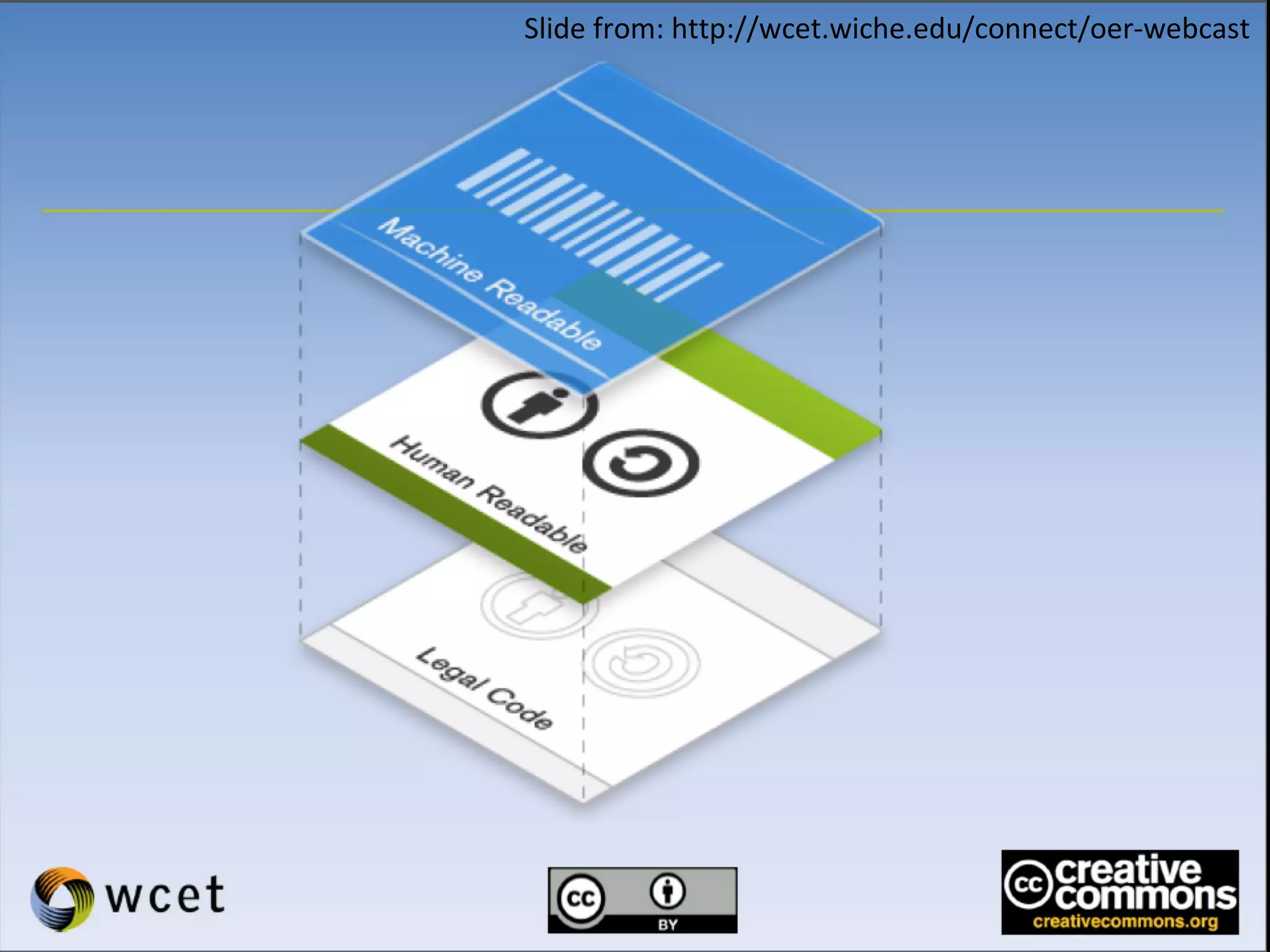
What does this
mean for users?
Slide from: http://wcet.wiche.edu/connect/oer-webcast
What if you want to make your
*existing* work available under
an open license?
What types of third-party
(i.e. created by someone other
than you) objects might you
encounter?
What should you do with them?
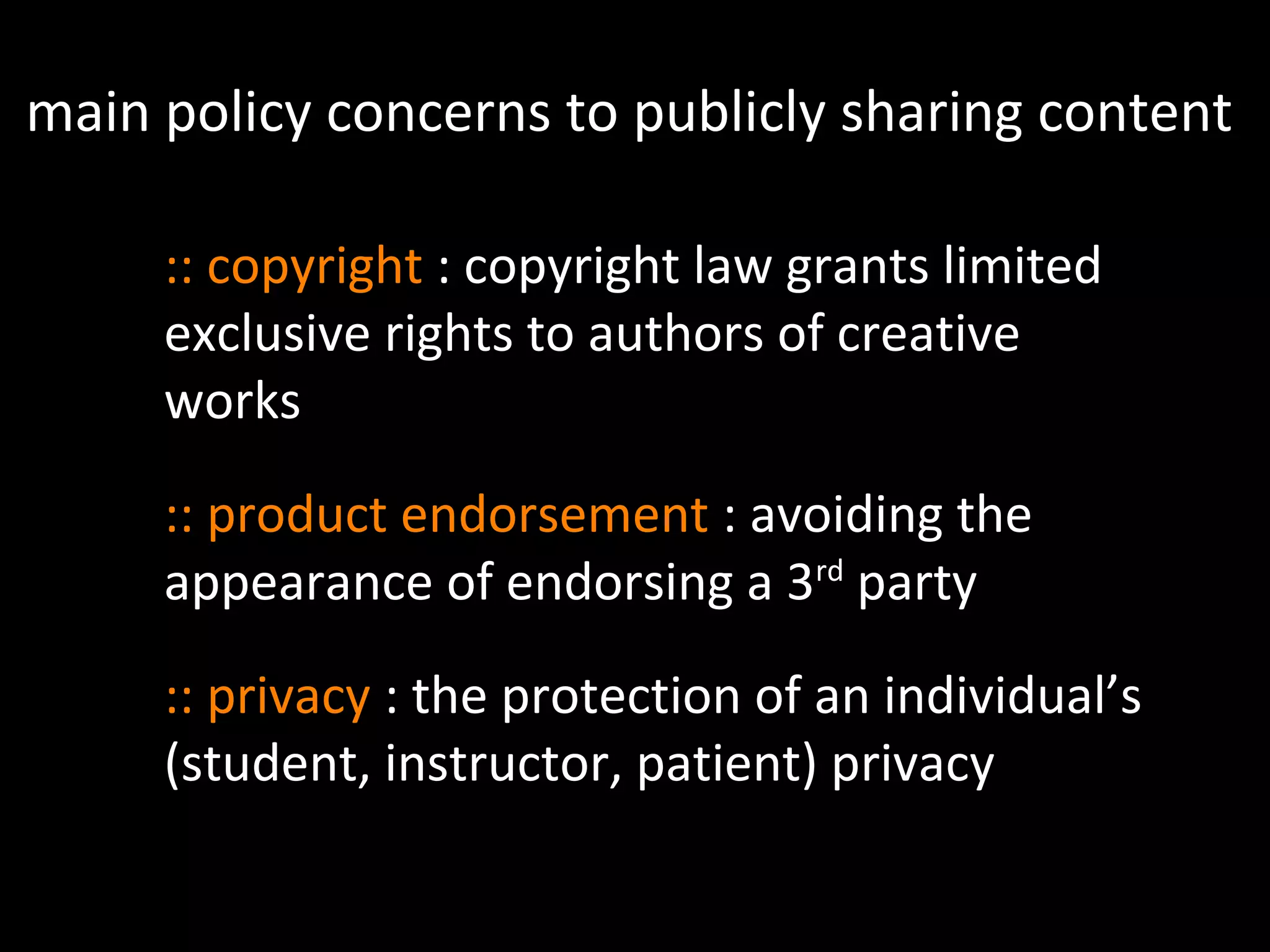
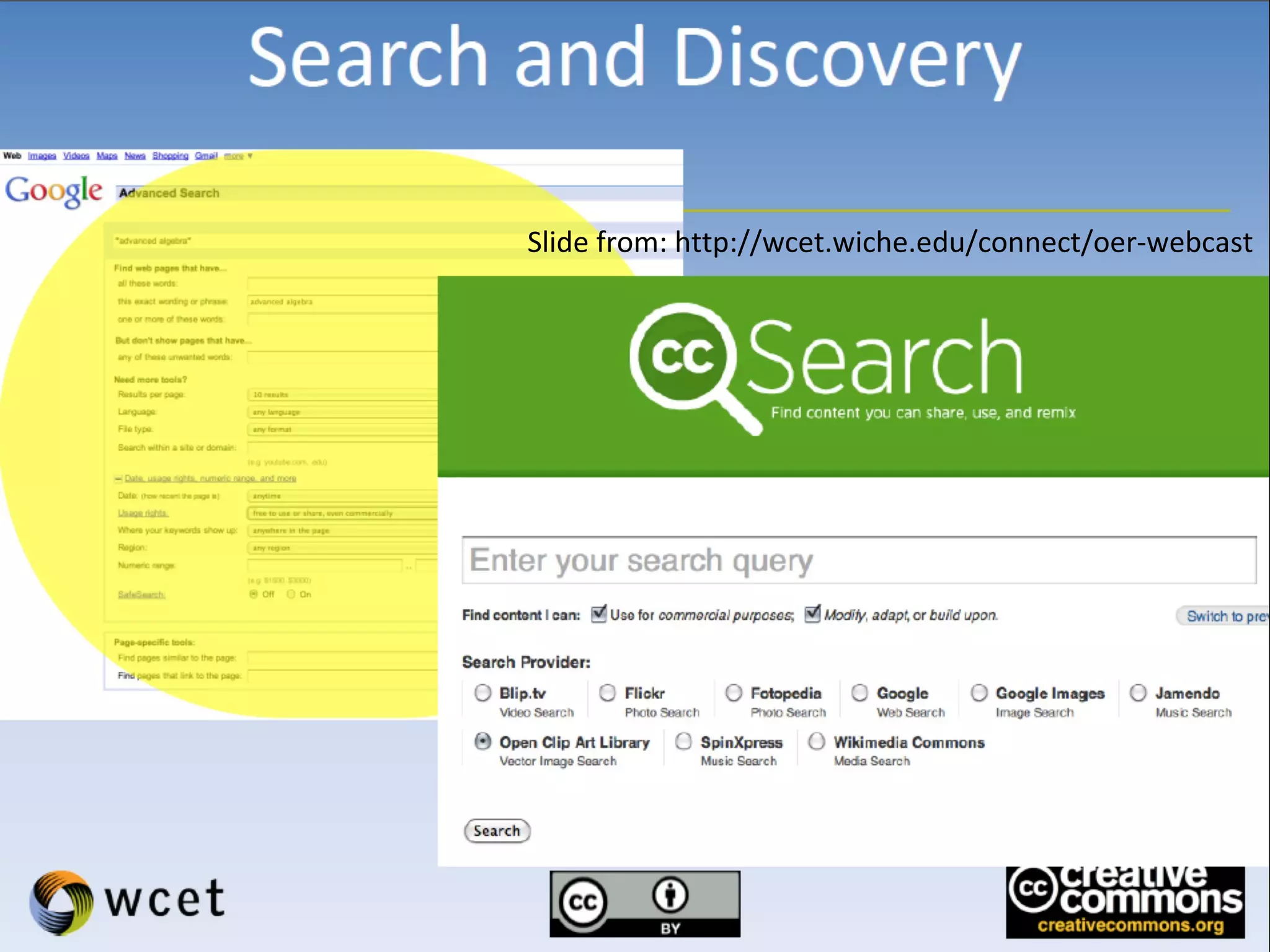
main policy concerns to publicly sharing content
:: copyright : copyright law grants limited
exclusive rights to authors of creative
works
:: product endorsement : avoiding the
appearance of endorsing a 3rd
party
:: privacy : the protection of an individual’s
(student, instructor, patient) privacy
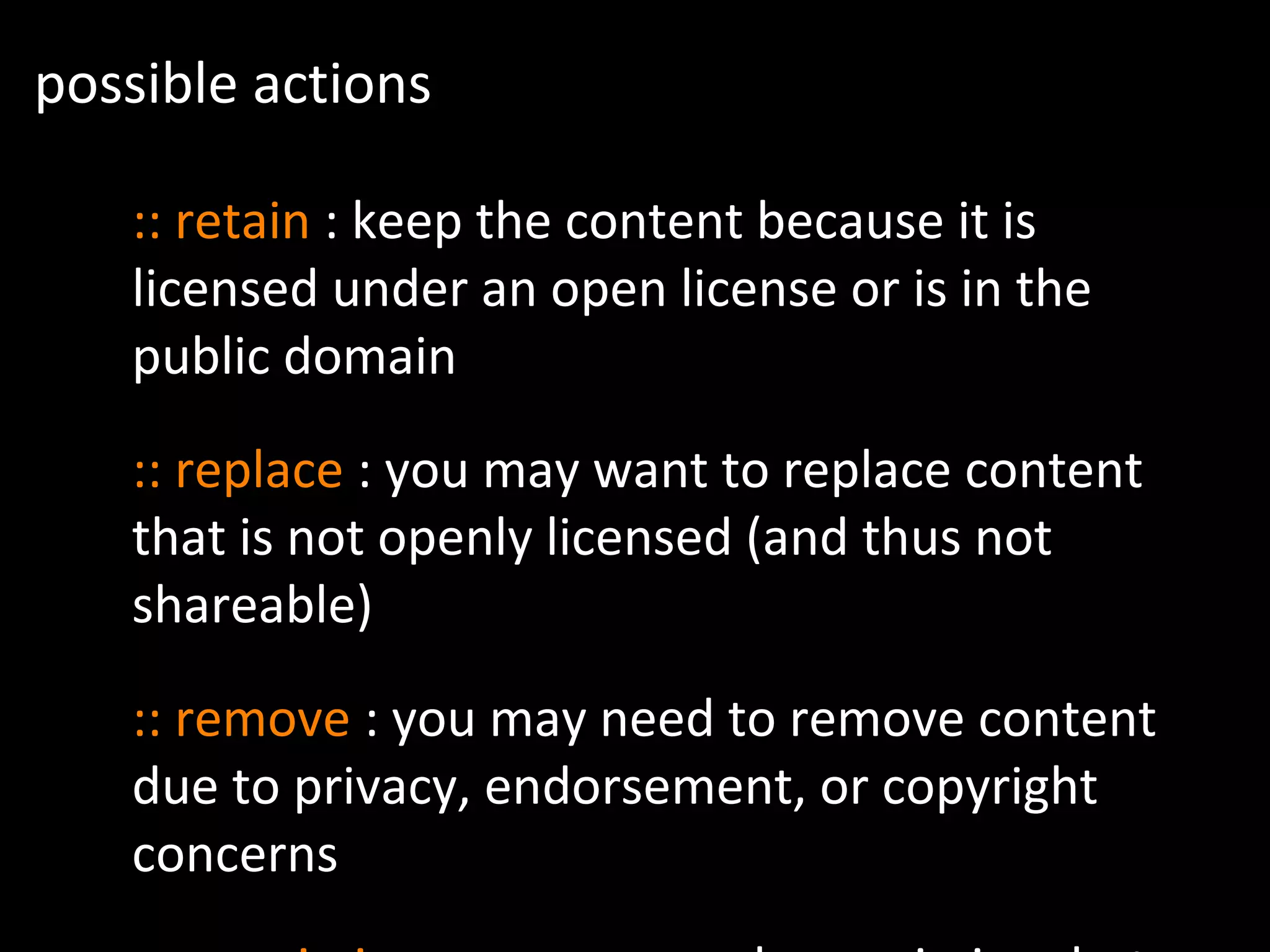
possible actions
:: retain : keep the content because it is
licensed under an open license or is in the
public domain
:: replace : you may want to replace content
that is not openly licensed (and thus not
shareable)
:: remove : you may need to remove content
due to privacy, endorsement, or copyright
concerns
possible actions
:: permission : you may seek permission, but
it may take a while to hear back.
Questions? 46

UON SPH OER Workshop - Intro to Open Licenses

  • 1.
    Kathleen Ludewig Omollo Universityof Michigan - Open.Michigan Initiative Audience: University of Nairobi School of Public Health Download slides: http://openmi.ch/uon-aug2013 Except where otherwise noted, this work is available under a Creative Commons Attribution 3.0 License. Copyright 2013 The Regents of the University of Michigan. 1 Introduction to Open Licenses Open Education for Collaboration, Flexibility, and Global Visibility
  • 2.
  • 3.
    True or false:If a work is freely available online, then it is not copyrighted False.
  • 4.
    A. Tangible form? B.Publication? C. Copyright symbol ©? D. Registration? E. Effort? F. Creative Expression? G. Uniqueness? Which of these is necessary to copyright a work?
  • 5.
    Which of theseis necessary to copyright a work?
  • 6.
    Image CC:BY UteHagen (Flickr) What rights are included in copyright? (hint: there are 5)
  • 7.
    Copyright holders havethe exclusive right to do and to authorize others to do the following: 1. Reproduce the work in whole or in part 2. Prepare derivative works, such as translations, dramatizations, and musical arrangements 3. Distribute copies of the work by sale, gift, rental, or loan 4.Publicly display the work 5.Publicly perform the work
  • 8.
    Under © itis illegal to: •Translate works (derivative) •Copy someone else’s photo, slides, report, or other work (without permission) •Dramatize a work (performance) •Reproduce in whole or in part (without permission) •Make copies of a work (distribution) Image CC:BY OpenCage (wikipedia)
  • 9.
  • 10.
    Image CC:BY OpenCage(Wikimedia Commons Open licenses signal intent 10
  • 11.
    Image CC:BY OrinZebest (Flickr) All rights reserved limits use, automatically 11
  • 12.
    Open licenses meansome rights reserved Image CC:BY-SA opensourceway (Flickr Learn more at open.umich.edu/share/license 12
  • 13.
    All Rights Reserved (default) 13 “Allrights reserved” is the default. 13
  • 14.
    Option: Creative Commons (twoC’s instead of 1 C) (www.creativecommons.org/licen ses/) 14 “Some rights reserved” is an alternative. 14
  • 15.
    Image CC:BY PaulAlbertella (Flickr) Open licenses enable revisions, remixes…15
  • 16.
    such as copies… ImageCC:BY-SA opensourceway (Flickr 16
  • 17.
    to online, offline,semi-connected, print…17
  • 18.
    and translations… Image CC:BYNC SA Tobias Mikkelsen (Flickr 18
  • 19.
    Image CC:BY TomeLoh (Flickr) or other transformations. 19
  • 20.
    e.g. Converting formatsfrom laptop… Image CC:BY NC University of Ghana 20
  • 21.
  • 22.
    What is alicense? Licenses let people know how they may use a copyrighted work. Image CC:BY-SA lumaxart (Flickr) 22
  • 23.
    You let otherscopy, distribute, display, and perform your copyrighted work but only if they give you credit. BY :: Attribution 23
  • 24.
    You let otherscopy, distribute, display, and perform your copyrighted work but for noncommercial purposes only. NC :: Noncommercial 24
  • 25.
    You let otherscopy, distribute, display, and perform your copyrighted work as long as any derivative work is licensed under the same license. SA :: Share Alike 25
  • 26.
    You let otherscopy, distribute, and display your copyrighted work only if no changes, derivatives, are made. ND :: No derivatives
  • 27.
  • 28.
    What does this meanfor authors?
  • 29.
  • 30.
    It's easiest tocreate open content from the start. 30
  • 31.
    Start now bymaking a small change in how you create your own content. 31
  • 32.
    What does thismean for you? 32
  • 33.
    1. License yourown work 2. Use openly licensed works 3. Attribute authors of the works from step 2. 4. Share your work publicly online http://open.umich.edu/share 33
  • 34.
    Kathleen Ludewig Omollo Universityof Michigan - Open.Michigan Initiative Audience: University of Nairobi School of Public Health Download slides: http://openmi.ch/uon-aug2013 Except where otherwise noted, this work is available under a Creative Commons Attribution 3.0 License. Copyright 2013 The Regents of the University of Michigan. 34 Introduction to Open Licenses Open Education for Collaboration, Flexibility, and Global Visibility
  • 35.
    Phalaenopsis audreyjm529 orchis galilaeaCC:BY-SA judy_breck (flickr) http://creativecommons.org/licenses/by-sa/2.0/ Angraecum viguieri GNU free documentation orchi (wikipedia) Attributions Author, Title, Source, License
  • 36.
    Attributions page atend Title slide: CC: Seo2 | Relativo & Absoluto (flickr) http://www.flickr.com/photos/seo2/2446816477/ | http://creativecommons.org/licenses/by/2.0/deed.en Slide 1 CC:BY-SA Jot Powers (wikimedia commons) http://commons.wikimedia.org/wiki/File:Bounty_hunter_2.JPG | http://creativecommons.org/licenses/by-sa/2.0/ Slide 2 CC: BY-NC Brent and MariLynn (flickr) http://www.flickr.com/photos/brent_nashville/2960420853/ | http://creativecommons.org/licenses/by-nc/2.0/deed.en Slide 3 http://www.newvideo.com/productdetail.html?productid=NV-AAE-71919 Slide 4 Public Domain: http://en.wikipedia.org/wiki/File:Hummer-H3.JPG Slide 5 Source: Undetermined from a variety of searches on Monster Truck Documentary Slide 6 Source: Mega-RC.com http://www.mega- rc.com/MRCImages/Asscd_Mnstr_GT_ShockOPT.jpg Slide 7 CC:BY-NC GregRob (flickr) http://www.flickr.com/photos/gregrob/2139442260/ | http://creativecommons.org/licenses/by-nc/2.0/deed.en Slide 8 CC:BY metaphor91 (flickr) http://creativecommons.org/licenses/by/2.0/deed.en
  • 37.
  • 38.
  • 39.
  • 40.
    What if youwant to make your *existing* work available under an open license?
  • 41.
    What types ofthird-party (i.e. created by someone other than you) objects might you encounter?
  • 42.
    What should youdo with them?
  • 43.
    main policy concernsto publicly sharing content :: copyright : copyright law grants limited exclusive rights to authors of creative works :: product endorsement : avoiding the appearance of endorsing a 3rd party :: privacy : the protection of an individual’s (student, instructor, patient) privacy
  • 44.
    possible actions :: retain: keep the content because it is licensed under an open license or is in the public domain :: replace : you may want to replace content that is not openly licensed (and thus not shareable) :: remove : you may need to remove content due to privacy, endorsement, or copyright concerns
  • 45.
    possible actions :: permission: you may seek permission, but it may take a while to hear back.
  • 46.

Editor's Notes

  • #4 01/26/10 01/26/10
  • #5 01/26/10 01/26/10
  • #6 01/26/10 01/26/10
  • #7 01/26/10 01/26/10
  • #8 01/26/10 01/26/10
  • #9 01/26/10 01/26/10
  • #11 01/26/10 01/26/10 Signal intent. Did you know that by default, the things you create are automatically copyrighted at the time of creation and others who want to copy, adapt, or build on your work need your permission, each time?
  • #12 01/26/10 01/26/10 Signal intent. Copyright holders have the exclusive right to do and to authorize others to do the following: Reproduce the work in whole or in part Prepare derivative works, such as translations, dramatizations, and musical arrangements Distribute copies of the work by sale, gift, rental, or loan Publicly display the work Publicly perform the work Image If you want people to use and build on your work, open licenses are a way to let others know, in simple language, how they can use it. For example, the M1 Anatomy Course has a comprehensive website, much of it is free to access, but All Rights Reserved. We’ve received requests from several partner institutions abroad who want to build on it, including multiple medical schools and the ministry of the health in Ethiopia. Since it’s All Rights Reserved, we need to negotiate a copy for each new institution.
  • #13 01/26/10 01/26/10 When using an open license, you retain the copyright to your original work but give permission to others to copy and distribute your materials, provided they give you credit — and only on the conditions you specify. There are multiple open licenses that you can choose. We’re in the process of adding a license to the anatomy website now, which will remove the need to ask for permission each time while still acknowledging the authors and using it how in a way that they approve.
  • #15 Two C’s, as opposed to one C
  • #16 01/26/10 01/26/10 Enable others to make marginal improvements or enhancements, to build on your work.
  • #17 01/26/10 01/26/10
  • #19 01/26/10 01/26/10
  • #20 01/26/10 01/26/10
  • #23 01/26/10 01/26/10 Copyright holders may keep their rights, and license some or all of those 5 rights to individuals or groups. They may also sign over all of their rights completely.
  • #24 Creative Commons licenses are legal contracts, and have been upheld in court: http://wiki.creativecommons.org/Case_Law
  • #30 This is where open licenses address the gaps in our current system.   As content creators, you take more control over how you want others to use and share your materials and you help other people do this by giving them permission ahead of time.   Open sharing practices encourage the cycle of creativity, learning and ultimately innovation by allowing others to legally build upon each other’s work.   In this way, we allow others to take control over the way they learn and what they learn, curating their own collections of materials and adapting those materials to suit their needs. Licensing provides even more opportunities for sharing and for using these materials in a variety of settings outside of the protected 4 walls of closed education systems allows for teaching and learning to happen formally and informally. Creative Commons are the most used licenses for content but there are software licenses (GNU) that can be used. Share online legally, throughout the world Choose how you would like to share Many of the license allow for adaptation You can choose how you want to share and easily show others how they can use your work. You take an active step toward sharing and making your materials more useful to others. “ Realizing the full potential of the internet — universal access to research, education, full participation in culture, and driving a new era of development, growth, and productivity.” ~Creative Commons mission
  • #31 When creating new learning materials… Start now by making a small change in how you create your own content.
  • #45 Public domain – 1923 clearest cut-off for U.S. works in public domain. For years 1923 – 1989 is a grey area, depending on whether work has copyright notice, was registered and/or renewed http://www.librarycopyright.net/digitalslider/ We build upon the work of others and make use of content whose rights are held by individuals, corporations, and organizations around the world. Respecting the copyright of those who we borrow and build from is an essential component of strengthening the culture of sharing. Why don’t we include seeking permission? That is only advisable if you have a connection to the author, as you can spend months waiting on permission.
  • #46 Public domain – 1923 clearest cut-off for U.S. works in public domain. For years 1923 – 1989 is a grey area, depending on whether work has copyright notice, was registered and/or renewed http://www.librarycopyright.net/digitalslider/ We build upon the work of others and make use of content whose rights are held by individuals, corporations, and organizations around the world. Respecting the copyright of those who we borrow and build from is an essential component of strengthening the culture of sharing. Why don’t we include seeking permission? That is only advisable if you have a connection to the author, as you can spend months waiting on permission.
  • #47 Throughout our experience with OER – whether on campus in Michigan or our international collaborations, we have shared our resources, lessons, and results – all under open licenses. We’ve found OER and open licenses to be an effective tool to support collaboration, active participation, and transparency in education efforts on campus and with our international partners. Thank you for your attention. We have also established ourselves as a national model for OER production and alongside our local community engagement efforts, we've participated in conferences and other activities that support the development of open educational practices.   We're a sustaining member of the OpenCourseWare Consortium and former Open.Michigan team members have gone on to work for Creative Commons, manage ISKME's OER Commons, Wikipedia, and work for Microsoft Research.