Overview of the basic licenses 
applied to open software
Rights 
Accrue on the very creation fact. 
● property; 
● non-property;
Intellectual property 
Are products of creative activities in 
the science, literature, production or 
artistic sphere, bearing the intangible 
nature.
The objects of the intellectual property 
rights are: 
● patents for the 
inventions, 
● utility models, 
● trademarks, 
● industrial Designs, 
● computer programs, 
● brand names, 
● know-how, 
● trade secrets, 
● copyright and related 
rights, 
● Etc.
License – what is it? 
License – give the rights for something. 
It's an agreement of the parties in which 
one of the parties gives any rights to the 
other party. 
Means to be able to legally prevent 
unauthorized copying, use or 
distribution of the product.
Why do we need it? 
➢ For copyright protection. To be able to 
legally suppress an unauthorized copying, 
use or distribution of anything. 
➢ To identify the authorship.
Components... 
The license for the intellectual property normally 
consists of the next components (except for the 
right itself): duration term, territory, upgrade 
regulations and etc. 
Duration term – the license is valid through some 
definite period of time. 
Territory – the license is valid on the definite 
territory (say, the license is valid in US only).
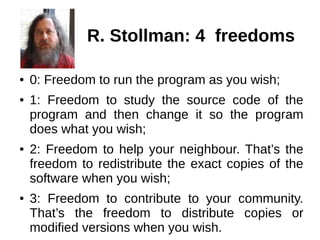
R. Stollman: 4 freedoms 
● 0: Freedom to run the program as you wish; 
● 1: Freedom to study the source code of the 
program and then change it so the program 
does what you wish; 
● 2: Freedom to help your neighbour. That’s the 
freedom to redistribute the exact copies of the 
software when you wish; 
● 3: Freedom to contribute to your community. 
That’s the freedom to distribute copies or 
modified versions when you wish.
Do not confuse open-source 
and free (!) 
open-source – means open source code, not its 
free usage. 
There are licenses, which accept to use the code 
for free on conditions that it should remain closed: 
● Free Solaris Binary License 
● Free for non-commercial use – i.e. you should 
pay for the commercial use :)
What I really want from it? 
Or how to choose?
I want it simple and permissive 
Permissive licenses – licenses which practically 
do not limit the freedom of action of users and 
software developers working with the source 
code. On it's nature the destribution of the work 
under the permissive license is similar to the 
placement of the work into the public domain, but 
does not require the rejection of the copyright. 
BSD, MIT and Apache are permissive licenses.
I care about sharing improvements 
Get for free → are to provide further for free (copyleft) 
Copyleft – is a conception and practice to use the laws of 
the copyright to make it impossible to restrict the right to 
use, modify or distribute the starting product and all the 
prodcuts derived from it for any person. 
The idea of copyleft is that anyone who distributes the 
programm with or without any modifications, can not limit 
the freedom of its further distribution or modification.
Strong and weak copyleft 
● Strong copyleft license gives the permission to 
use its code only to the programs created 
under the same license. 
● Weak copyleft license gives the permission to 
make any modifications to the program. 
Assuming that the modified programm will be 
built with the indication of the first one as a 
library. Then the new program can go under 
any other license.
Full and partial copyleft 
● Full copyleft – all parts of the program (except 
for the license itself) can be modified and 
distributed only under copyleft license. 
● Partial copyleft – a program may eliminate 
some conditions of the copyleeft license and 
also include modifications within any non-copyleft 
license.
Copyleft examples 
●GNU GPL v2; 
●GNU GPL v3; 
●Creative Commons ShareAlike; 
● .......... 
Linux, Git and WordPress use GPL.
And now the tastiest thing ;)))
GPL (General Public License) 
The purpose GNU GPL is to provide the user with 
the rights to copy, modify and distribute (including 
commercial) programs (which is disabled by 
default copyright law), and also guarantee that all 
users of derivative programs receive these rights.
Structure analysis: 
0. The scope of the license 
✔ Copying
Structure analysis: 
0. The scope of the license 
✔ Copying 
✔ Distribution
Structure analysis: 
0. The scope of the license 
✔ Copying 
✔ Distribution 
✔ Modification
Structure analysis: 
0. The scope of the license 
✔ Copying 
✔ Distribution 
✔ Modification 
✔ And bonus!
Structure analysis: 
1. The right for copying and distribution: 
All the actions permitted (both copying and 
distribution), 
IF we leave everything as it was.
Structure analysis: 
2. Modification of the program: 
Yes, you can modify... But (!) I have 3 conditions!!! 
1) specify what has been changed; 
2) convey the right to use; 
3) specify how to distribute further.
Structure analysis: 
3. The requirement to provide source code: 
a) distributing along with the source code, or
Structure analysis: 
3. The requirement to provide source code: 
a) distributing along with the source code, or 
b) distributing along with the guarantee of 
providing of source code, or
Structure analysis: 
3. The requirement to provide source code: 
a) distributing along with the source code, or 
b) distributing along with the guarantee of 
providing of source code, or 
c) (for non-commercial use) distributing along 
with such a guarantee was given from the third 
party.
Structure analysis: 
3. Требование предоставления исходного 
кода: 
a) distributing along with the source 
code, or 
b) distributing along with the guarantee of 
providing of source code, or 
c) (для некоммерческого использования) 
распространение вместе с такой гарантией, 
полученной от третьего лица.
Structure analysis: 
4. Termination of the license in violation of its 
terms. 
Were you told how to do?
Structure analysis: 
4. Termination of the license in violation of its 
terms. 
Were you told how to do? 
There you are! Do as you were told to!
Structure analysis: 
4. Termination of the license in violation of its 
terms. 
Were you told how to do? 
There you are! Do as you were told to! 
And all the rest should do the same as well.
Structure analysis: 
5. Acts, signifying acceptance of the license. 

You do not have to agree to this License as you 
did not sign it. 
But if you modified or distributed the Program, 
then you know everything and agreed to all that, 
=> i.e. are to obey.
Structure analysis: 
6. Prohibition of additional restrictions on 
further distribution. 
● can not restrict the rights of other people on the 
Program; 
● do not need to be responsible for other people's 
actions.
Structure analysis: 
7. External constraints do not remove the 
obligation to fulfill the conditions of the license. 
If you can't keep distribution the way to satisfy both 
the requisitions of this License and all the other 
requisitions, then you should not distribute the 
Program.
REMEMBER!!! NO 
GUARANTEES!!!
LGPL (Lesser General Public 
License) 
Compromise between BSD and permissive 
licenses. 
The main difference between GPL and LGPL is 
LGPL allows linking the library with any program, 
not necessarily free. 
LGPL places the copyleft restrictions on the 
program itself, although does not apply this 
restrictions on the other software that is just 
linking to the program.
AGPL (Affero General Public 
License) 
Intensified GPL especially for web applications. 
Service providers are obliged to provide the source 
code to their users.
BSD (Berkley Software 
Distribution) 
BSD License imposes no restrictions on the 
use of software (including commercial). 
Works based on such software may be 
distributed under a commercial license (but 
still have to meet the requirements of the 
license).
The lost one... 
Point 3. All advertising materials mentioning 
features or use of this software must display the 
following acknowledgement: 
This product includes software developed by 
the University of California, Berkeley and its 
contributors.
MIT 
One more permissive license. 
Разрешено делать всё, что угодно, при 
условии, что текст лицензии предоставляется 
вместе с этим ПО и помещается копирайт. 
Лицензия является GPL-совместимой, то есть 
разрешает программистам комбинировать и 
распространять GPL-продукты с программным 
обеспечением под лицензией MIT.
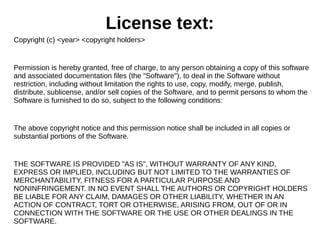
License text: 
Copyright (c) <year> <copyright holders> 
Permission is hereby granted, free of charge, to any person obtaining a copy of this software 
and associated documentation files (the "Software"), to deal in the Software without 
restriction, including without limitation the rights to use, copy, modify, merge, publish, 
distribute, sublicense, and/or sell copies of the Software, and to permit persons to whom the 
Software is furnished to do so, subject to the following conditions: 
The above copyright notice and this permission notice shall be included in all copies or 
substantial portions of the Software. 
THE SOFTWARE IS PROVIDED "AS IS", WITHOUT WARRANTY OF ANY KIND, 
EXPRESS OR IMPLIED, INCLUDING BUT NOT LIMITED TO THE WARRANTIES OF 
MERCHANTABILITY, FITNESS FOR A PARTICULAR PURPOSE AND 
NONINFRINGEMENT. IN NO EVENT SHALL THE AUTHORS OR COPYRIGHT HOLDERS 
BE LIABLE FOR ANY CLAIM, DAMAGES OR OTHER LIABILITY, WHETHER IN AN 
ACTION OF CONTRACT, TORT OR OTHERWISE, ARISING FROM, OUT OF OR IN 
CONNECTION WITH THE SOFTWARE OR THE USE OR OTHER DEALINGS IN THE 
SOFTWARE.
Mozilla Public License 
MPL is used as a license for Mozilla Suite, 
Mozilla Firefox, Mozilla Thunderbird and other 
programs developed by Mozilla. 
MPL license provides weak partial copyleft. In 
contrast to the more stringent of free licenses, 
code under the MPL can be combined in one 
program with commercial files.
Apache Software License 
Лицензия Apache разрешает использовать и 
изменять всё, за исключением названия. 
Единственным условием, накладываемым 
лицензией Apache, является информирование 
получателя о факте использования исходного 
кода. 
В противоположность copyleft-лицензиям, 
получатель модифицированной версии не 
обязательно получает все права, изначально 
предоставляемые лицензией Apache.
Use Apache? 
To use it you need to place the next files to the 
root directory: 
● LICENSE 
● NOTICE 
In each licensing file there should be all the 
background information about copyrights or 
patents. In each modified file the information must 
be added about the changes carried out.
Creative Commons 
Creative Commons — is a group of standardized 
texts describing conditions of usage of the works 
to which they are attached. 
Currently there are 6 modern Creative Commons 
licenses.
Licenses features 
● Creative Commons licenses are non-exclusive. 
● Creative Commons licenses are valid for the 
entire duration of the rights received (in most 
countries - 70 years after the author's death). 
● Licensor enters into a separate contract with 
each user license (the licensee).
Licenses features 
● Creative Commons® organization is not a 
party of the license agreement and can't be a 
не может выступать guarantor of the quality 
of the licensed work. 
● All licenses require copyright (previously there 
were licenses did not require this, but 
Creative Commons ceased to support them).
Common features СС: 
Each license: 
● Keeps copyright; 
● reports that the fair use of other people, the 
first sale and the right to freedom of 
expression are not affected by this license.
Common features СС: 
Each license requires from users of the works: 
● receive permission from the author to any of the things 
that the author decides to limit - for example, 
commercial use, create derivative works 
● retain any copyright notice intact on all copies of the 
works 
● Place the link to the license from all copies of the work 
● preserve conditions of the license 
● do not use technology to limit the legitimate use of the 
work other recipients of the license
Common features СС: 
Each license allows users of the work, if they 
follow your conditions, at least non-commercial: 
● copy the work 
● distribute it 
● show or execute it publicly 
● make digital public performances of it (for 
example, web casting) 
● translate the work into another format as an 
exact copy of it
Common features СС: 
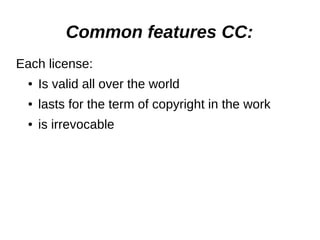
Each license: 
● Is valid all over the world 
● lasts for the term of copyright in the work 
● is irrevocable
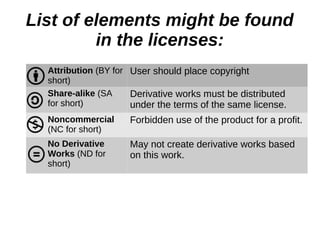
List of elements might be found 
in the licenses: 
Attribution (BY for 
short) 
User should place copyright 
Share-alike (SA 
for short) 
Derivative works must be distributed 
under the terms of the same license. 
Noncommercial 
(NC for short) 
Forbidden use of the product for a profit. 
No Derivative 
Works (ND for 
short) 
May not create derivative works based 
on this work.
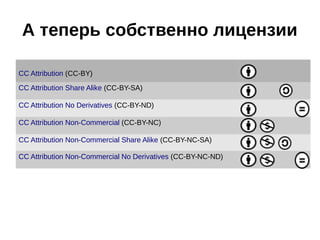
А теперь собственно лицензии 
CC Attribution (CC-BY) 
CC Attribution Share Alike (CC-BY-SA) 
CC Attribution No Derivatives (CC-BY-ND) 
CC Attribution Non-Commercial (CC-BY-NC) 
CC Attribution Non-Commercial Share Alike (CC-BY-NC-SA) 
CC Attribution Non-Commercial No Derivatives (CC-BY-NC-ND)
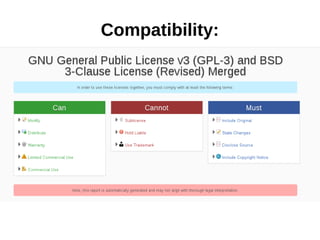
Compatibility:
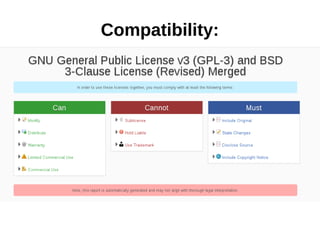
http://www.tldrlegal.com/compare – link to the 
utility which allows to look at the result of the 
merge of 2 licenses from quite a large list. 
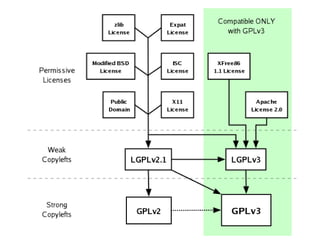
One more picture about the compatibility:
Compatibility:
Thank you!

Overview of basic open-source licenses

  • 1.
    Overview of thebasic licenses applied to open software
  • 2.
    Rights Accrue onthe very creation fact. ● property; ● non-property;
  • 3.
    Intellectual property Areproducts of creative activities in the science, literature, production or artistic sphere, bearing the intangible nature.
  • 4.
    The objects ofthe intellectual property rights are: ● patents for the inventions, ● utility models, ● trademarks, ● industrial Designs, ● computer programs, ● brand names, ● know-how, ● trade secrets, ● copyright and related rights, ● Etc.
  • 5.
    License – whatis it? License – give the rights for something. It's an agreement of the parties in which one of the parties gives any rights to the other party. Means to be able to legally prevent unauthorized copying, use or distribution of the product.
  • 6.
    Why do weneed it? ➢ For copyright protection. To be able to legally suppress an unauthorized copying, use or distribution of anything. ➢ To identify the authorship.
  • 7.
    Components... The licensefor the intellectual property normally consists of the next components (except for the right itself): duration term, territory, upgrade regulations and etc. Duration term – the license is valid through some definite period of time. Territory – the license is valid on the definite territory (say, the license is valid in US only).
  • 8.
    R. Stollman: 4freedoms ● 0: Freedom to run the program as you wish; ● 1: Freedom to study the source code of the program and then change it so the program does what you wish; ● 2: Freedom to help your neighbour. That’s the freedom to redistribute the exact copies of the software when you wish; ● 3: Freedom to contribute to your community. That’s the freedom to distribute copies or modified versions when you wish.
  • 9.
    Do not confuseopen-source and free (!) open-source – means open source code, not its free usage. There are licenses, which accept to use the code for free on conditions that it should remain closed: ● Free Solaris Binary License ● Free for non-commercial use – i.e. you should pay for the commercial use :)
  • 10.
    What I reallywant from it? Or how to choose?
  • 11.
    I want itsimple and permissive Permissive licenses – licenses which practically do not limit the freedom of action of users and software developers working with the source code. On it's nature the destribution of the work under the permissive license is similar to the placement of the work into the public domain, but does not require the rejection of the copyright. BSD, MIT and Apache are permissive licenses.
  • 12.
    I care aboutsharing improvements Get for free → are to provide further for free (copyleft) Copyleft – is a conception and practice to use the laws of the copyright to make it impossible to restrict the right to use, modify or distribute the starting product and all the prodcuts derived from it for any person. The idea of copyleft is that anyone who distributes the programm with or without any modifications, can not limit the freedom of its further distribution or modification.
  • 13.
    Strong and weakcopyleft ● Strong copyleft license gives the permission to use its code only to the programs created under the same license. ● Weak copyleft license gives the permission to make any modifications to the program. Assuming that the modified programm will be built with the indication of the first one as a library. Then the new program can go under any other license.
  • 14.
    Full and partialcopyleft ● Full copyleft – all parts of the program (except for the license itself) can be modified and distributed only under copyleft license. ● Partial copyleft – a program may eliminate some conditions of the copyleeft license and also include modifications within any non-copyleft license.
  • 15.
    Copyleft examples ●GNUGPL v2; ●GNU GPL v3; ●Creative Commons ShareAlike; ● .......... Linux, Git and WordPress use GPL.
  • 16.
    And now thetastiest thing ;)))
  • 17.
    GPL (General PublicLicense) The purpose GNU GPL is to provide the user with the rights to copy, modify and distribute (including commercial) programs (which is disabled by default copyright law), and also guarantee that all users of derivative programs receive these rights.
  • 18.
    Structure analysis: 0.The scope of the license ✔ Copying
  • 19.
    Structure analysis: 0.The scope of the license ✔ Copying ✔ Distribution
  • 20.
    Structure analysis: 0.The scope of the license ✔ Copying ✔ Distribution ✔ Modification
  • 21.
    Structure analysis: 0.The scope of the license ✔ Copying ✔ Distribution ✔ Modification ✔ And bonus!
  • 22.
    Structure analysis: 1.The right for copying and distribution: All the actions permitted (both copying and distribution), IF we leave everything as it was.
  • 23.
    Structure analysis: 2.Modification of the program: Yes, you can modify... But (!) I have 3 conditions!!! 1) specify what has been changed; 2) convey the right to use; 3) specify how to distribute further.
  • 24.
    Structure analysis: 3.The requirement to provide source code: a) distributing along with the source code, or
  • 25.
    Structure analysis: 3.The requirement to provide source code: a) distributing along with the source code, or b) distributing along with the guarantee of providing of source code, or
  • 26.
    Structure analysis: 3.The requirement to provide source code: a) distributing along with the source code, or b) distributing along with the guarantee of providing of source code, or c) (for non-commercial use) distributing along with such a guarantee was given from the third party.
  • 27.
    Structure analysis: 3.Требование предоставления исходного кода: a) distributing along with the source code, or b) distributing along with the guarantee of providing of source code, or c) (для некоммерческого использования) распространение вместе с такой гарантией, полученной от третьего лица.
  • 28.
    Structure analysis: 4.Termination of the license in violation of its terms. Were you told how to do?
  • 29.
    Structure analysis: 4.Termination of the license in violation of its terms. Were you told how to do? There you are! Do as you were told to!
  • 30.
    Structure analysis: 4.Termination of the license in violation of its terms. Were you told how to do? There you are! Do as you were told to! And all the rest should do the same as well.
  • 31.
    Structure analysis: 5.Acts, signifying acceptance of the license. You do not have to agree to this License as you did not sign it. But if you modified or distributed the Program, then you know everything and agreed to all that, => i.e. are to obey.
  • 32.
    Structure analysis: 6.Prohibition of additional restrictions on further distribution. ● can not restrict the rights of other people on the Program; ● do not need to be responsible for other people's actions.
  • 33.
    Structure analysis: 7.External constraints do not remove the obligation to fulfill the conditions of the license. If you can't keep distribution the way to satisfy both the requisitions of this License and all the other requisitions, then you should not distribute the Program.
  • 34.
  • 35.
    LGPL (Lesser GeneralPublic License) Compromise between BSD and permissive licenses. The main difference between GPL and LGPL is LGPL allows linking the library with any program, not necessarily free. LGPL places the copyleft restrictions on the program itself, although does not apply this restrictions on the other software that is just linking to the program.
  • 36.
    AGPL (Affero GeneralPublic License) Intensified GPL especially for web applications. Service providers are obliged to provide the source code to their users.
  • 37.
    BSD (Berkley Software Distribution) BSD License imposes no restrictions on the use of software (including commercial). Works based on such software may be distributed under a commercial license (but still have to meet the requirements of the license).
  • 38.
    The lost one... Point 3. All advertising materials mentioning features or use of this software must display the following acknowledgement: This product includes software developed by the University of California, Berkeley and its contributors.
  • 39.
    MIT One morepermissive license. Разрешено делать всё, что угодно, при условии, что текст лицензии предоставляется вместе с этим ПО и помещается копирайт. Лицензия является GPL-совместимой, то есть разрешает программистам комбинировать и распространять GPL-продукты с программным обеспечением под лицензией MIT.
  • 40.
    License text: Copyright(c) <year> <copyright holders> Permission is hereby granted, free of charge, to any person obtaining a copy of this software and associated documentation files (the "Software"), to deal in the Software without restriction, including without limitation the rights to use, copy, modify, merge, publish, distribute, sublicense, and/or sell copies of the Software, and to permit persons to whom the Software is furnished to do so, subject to the following conditions: The above copyright notice and this permission notice shall be included in all copies or substantial portions of the Software. THE SOFTWARE IS PROVIDED "AS IS", WITHOUT WARRANTY OF ANY KIND, EXPRESS OR IMPLIED, INCLUDING BUT NOT LIMITED TO THE WARRANTIES OF MERCHANTABILITY, FITNESS FOR A PARTICULAR PURPOSE AND NONINFRINGEMENT. IN NO EVENT SHALL THE AUTHORS OR COPYRIGHT HOLDERS BE LIABLE FOR ANY CLAIM, DAMAGES OR OTHER LIABILITY, WHETHER IN AN ACTION OF CONTRACT, TORT OR OTHERWISE, ARISING FROM, OUT OF OR IN CONNECTION WITH THE SOFTWARE OR THE USE OR OTHER DEALINGS IN THE SOFTWARE.
  • 41.
    Mozilla Public License MPL is used as a license for Mozilla Suite, Mozilla Firefox, Mozilla Thunderbird and other programs developed by Mozilla. MPL license provides weak partial copyleft. In contrast to the more stringent of free licenses, code under the MPL can be combined in one program with commercial files.
  • 42.
    Apache Software License Лицензия Apache разрешает использовать и изменять всё, за исключением названия. Единственным условием, накладываемым лицензией Apache, является информирование получателя о факте использования исходного кода. В противоположность copyleft-лицензиям, получатель модифицированной версии не обязательно получает все права, изначально предоставляемые лицензией Apache.
  • 43.
    Use Apache? Touse it you need to place the next files to the root directory: ● LICENSE ● NOTICE In each licensing file there should be all the background information about copyrights or patents. In each modified file the information must be added about the changes carried out.
  • 44.
    Creative Commons CreativeCommons — is a group of standardized texts describing conditions of usage of the works to which they are attached. Currently there are 6 modern Creative Commons licenses.
  • 45.
    Licenses features ●Creative Commons licenses are non-exclusive. ● Creative Commons licenses are valid for the entire duration of the rights received (in most countries - 70 years after the author's death). ● Licensor enters into a separate contract with each user license (the licensee).
  • 46.
    Licenses features ●Creative Commons® organization is not a party of the license agreement and can't be a не может выступать guarantor of the quality of the licensed work. ● All licenses require copyright (previously there were licenses did not require this, but Creative Commons ceased to support them).
  • 47.
    Common features СС: Each license: ● Keeps copyright; ● reports that the fair use of other people, the first sale and the right to freedom of expression are not affected by this license.
  • 48.
    Common features СС: Each license requires from users of the works: ● receive permission from the author to any of the things that the author decides to limit - for example, commercial use, create derivative works ● retain any copyright notice intact on all copies of the works ● Place the link to the license from all copies of the work ● preserve conditions of the license ● do not use technology to limit the legitimate use of the work other recipients of the license
  • 49.
    Common features СС: Each license allows users of the work, if they follow your conditions, at least non-commercial: ● copy the work ● distribute it ● show or execute it publicly ● make digital public performances of it (for example, web casting) ● translate the work into another format as an exact copy of it
  • 50.
    Common features СС: Each license: ● Is valid all over the world ● lasts for the term of copyright in the work ● is irrevocable
  • 51.
    List of elementsmight be found in the licenses: Attribution (BY for short) User should place copyright Share-alike (SA for short) Derivative works must be distributed under the terms of the same license. Noncommercial (NC for short) Forbidden use of the product for a profit. No Derivative Works (ND for short) May not create derivative works based on this work.
  • 52.
    А теперь собственнолицензии CC Attribution (CC-BY) CC Attribution Share Alike (CC-BY-SA) CC Attribution No Derivatives (CC-BY-ND) CC Attribution Non-Commercial (CC-BY-NC) CC Attribution Non-Commercial Share Alike (CC-BY-NC-SA) CC Attribution Non-Commercial No Derivatives (CC-BY-NC-ND)
  • 53.
  • 54.
    http://www.tldrlegal.com/compare – linkto the utility which allows to look at the result of the merge of 2 licenses from quite a large list. One more picture about the compatibility:
  • 55.
  • 57.