The Story of ‘Open’
RIDE conference, Centre for Distance Education, University
of London International Programmes, 2013
Alan Tait
Professor of Distance Education and Development
The Open University, UK

1

1
3 themes
• Openness
• Quality and drop-out
• Commoditisation

2
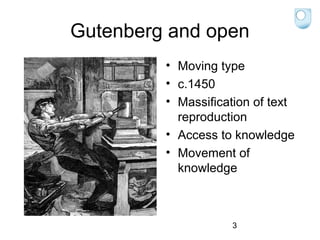
Gutenberg and open
• Moving type
• c.1450
• Massification of text
reproduction
• Access to knowledge
• Movement of
knowledge

3
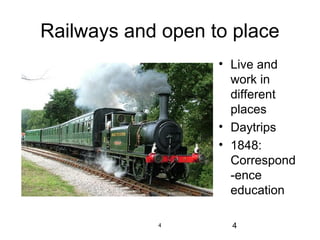
Railways and open to place
• Live and
work in
different
places
• Daytrips
• 1848:
Correspond
-ence
education
4

4
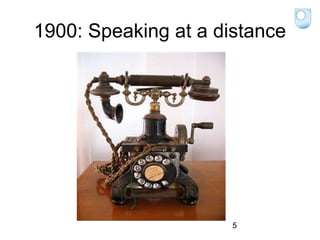
1900: Speaking at a distance

5
The search engine: opening up the
world
• 1990: Archie
McGill University, Montreal
• 1996: Altavista
DEC, California

• As important as Gutenberg’s printing
press?

6
University of London
• 1858: University of London External
Studies: first university to be open to place
• 1878: University of London: first university
to be open to women

7
‘The wireless university’
• 1926: J.C. ‘Jack’ Stobart, first Director of
Education at the BBC proposed
‘the wireless university’

8
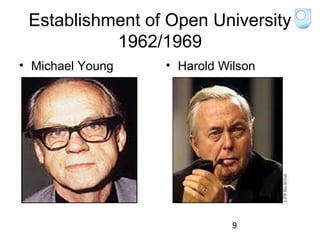
Establishment of Open University
1962/1969
• Michael Young

• Harold Wilson

9
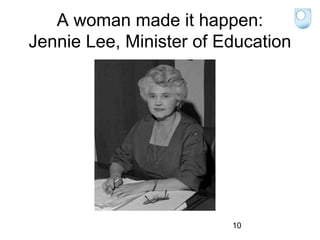
A woman made it happen:
Jennie Lee, Minister of Education

10
The Open University in 2013
•
•
•
•
•
•
•

240,000 students
Undergraduates: 185,000
Masters: 17,500
Doctoral: 500
Validated programmes 37,000
Qualifications: 320
Graduates: nearly 1 million qualifications
awarded
• Academic staff: 1100
• Tutors (Associate lecturers): 7000
11
Pushing at boundaries
•
•
•
•
•
•

Place
Social class
Gender
Disability
Wider or open entry to Higher Education
Always those who say
‘no point in educating them’
12
What has openness in education
meant?
• Attack on notion that quality means exclusion
• Reversal: quality means inclusion
• Element in democratisation of society since mid
19th C in Europe
• Disembedding of individual from the local

13

13
Quality and Distance and ELearning

The challenge of drop-out

14
Drop out UK, Higher Education, all
modes
• 21.6% failed to complete degree in
2010/11
• 32% at University of Highland and Islands
• 21.4% University of Bolton
• 1.4% University of Cambridge
• Improvement overall from previous year
HESA Non-continuation rates Table 3A and table 3E

15
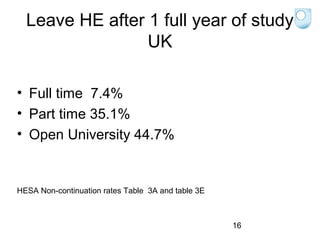
Leave HE after 1 full year of study
UK
• Full time 7.4%
• Part time 35.1%
• Open University 44.7%

HESA Non-continuation rates Table 3A and table 3E

16
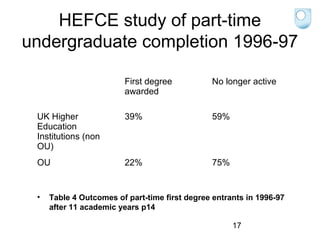
HEFCE study of part-time
undergraduate completion 1996-97
First degree
awarded

No longer active

UK Higher
Education
Institutions (non
OU)

39%

59%

OU

22%

75%

•

Table 4 Outcomes of part-time first degree entrants in 1996-97
after 11 academic years p14
17
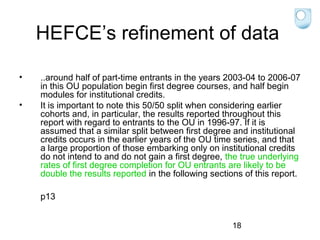
HEFCE’s refinement of data
•
•

..around half of part-time entrants in the years 2003-04 to 2006-07
in this OU population begin first degree courses, and half begin
modules for institutional credits.
It is important to note this 50/50 split when considering earlier
cohorts and, in particular, the results reported throughout this
report with regard to entrants to the OU in 1996-97. If it is
assumed that a similar split between first degree and institutional
credits occurs in the earlier years of the OU time series, and that
a large proportion of those embarking only on institutional credits
do not intend to and do not gain a first degree, the true underlying
rates of first degree completion for OU entrants are likely to be
double the results reported in the following sections of this report.
p13
18
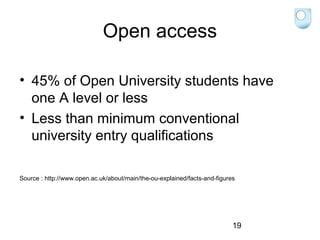
Open access
• 45% of Open University students have
one A level or less
• Less than minimum conventional
university entry qualifications
Source : http://www.open.ac.uk/about/main/the-ou-explained/facts-and-figures

19
Doing worse or doing more difficult
things?
• With busy working students
• With ethnic diversity
• With less or no demand for previous
Educational qualifications (OU)
• With less social and financial capital
• Less resilience
20
What does drop out represent?
• Not status of university
• Not Distance and on-line modes
• But risk and challenges of openness and
inclusion
• See Creelman and Reneland-Forsman:
EURODL 2013
• Combined with competence in learning design:
integration of curriculum and student support
21
What is to be done about drop out
in e-learning?
Respond to major factors in drop-out
•
•
•
•

Time pressure
Self-management
Family
Logistics and support (including technical
support)
• Curriculum relevance
Street H (2010) Online Journal of Distance Learning Administration, 13:4
• Plus educational preparedness
22
Three main student
support models at OU
• 1976-2000
Tutor-counsellor, embedded in local study centre
for whole qualification, plus tutor more or less
local, plus Regional Centre staff
• 2000-2012
Tutor, more or less local, plus Regional Centre
Advisory staff
• 2014 on
National Student Support Team on qualification
basis, plus tutor more or 23
less local
23
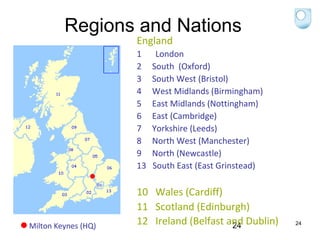
Regions and Nations
England

13 OU Regions/Nations

Milton Keynes (HQ)

1
2
3
4
5
6
7
8
9
13

London
South (Oxford)
South West (Bristol)
West Midlands (Birmingham)
East Midlands (Nottingham)
East (Cambridge)
Yorkshire (Leeds)
North West (Manchester)
North (Newcastle)
South East (East Grinstead)

10 Wales (Cardiff)
11 Scotland (Edinburgh)
12 Ireland (Belfast and Dublin)
24

24
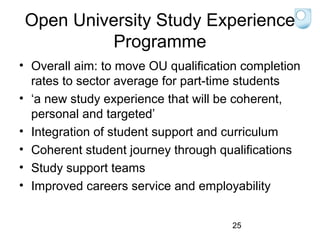
Open University Study Experience
Programme
• Overall aim: to move OU qualification completion
rates to sector average for part-time students
• ‘a new study experience that will be coherent,
personal and targeted’
• Integration of student support and curriculum
• Coherent student journey through qualifications
• Study support teams
• Improved careers service and employability
25
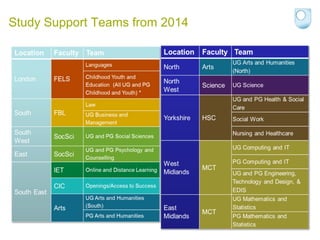
Study Support Teams from 2014

26

26
National Student Survey UK
• Feedback from ‘Final Year’
undergraduates
• ‘feedback on what is has been like to
study their course at their institution’
• Open University in top 3 universities in
2006-2012
• 2012 Open University ranked FIRST with
93% satisfied with taught course
27
Re-assessing student support in
ODL
• In second generation DE, place meant
separation of Student Support, curriculum
and assessment elements in some OU’s
• Technology now permits their reintegration
in curriculum lines
• Learning design subordinates ‘Student
Support’
• Learner analytics supports intervention in
radically improved ways
28
Is openness and inclusion worth it?
•
•
•
•
•

Is inclusion important?
Rights-based approach: Social justice
Skilled and knowledgeable society
Always pushing at boundaries
Often dismissed as ‘blithering nonsense’
(Ian Mcleod, Chancellor of the Exchequer 1970)
• No way back to elite
• Way forward through integrated curriculum and student
support reform
• ICT central for learning design and learning analytics

29
Other contemporary ‘opens’
• Open source software: anti proprietory
ethos
• Open access publishing
• Open educational resources
• MOOCs

30
Open access publishing
• Challenge to dominant journal business
model
• New entrants, IRRODL, EURODL,
TOJDE, JL4D
• Books published in both modes, e.g.
Weller on Digital Scholarship
• UK Government and publisher response
‘Green model’
• Uneasy settlement
31
Focus and Scope
The Journal of Learning for Development provides a forum for the
publication of research with a focus on innovation in learning, in
particular but not exclusively open and distance learning, and its
contribution to development. Content includes interventions that
change social and/or economic relations, especially in terms of
improving equity.
JL4D publishes research and case studies from researchers, scholars
and practitioners, and seeks to engage a broad audience across that
spectrum. It aims to encourage contributors starting their careers, as
well as to publish the work of established and senior scholars from
the Commonwealth and beyond.
www.jl4d.org
Editor-in-Chief Alan Tait

32
Open Educational Resources
• 2001: Creative Commons license
• 2012: UNESCO ‘OER’s as a means of
promoting access, equity and quality in the
spirit of the Universal Declaration of
Human Rights’
• 2005: OECD ‘Giving knowledge for free’
• Now thousands of OER’s
• Critique of quality and outcomes
33
Journeys from informal to formal learning
through open media

34

34
34
iTunes U
Open Learn

Visitors since launch: 22
million
Visitors 2011/12: 5.4 million

I Tunes

Visitors since start: 2.9
million
Visitors 2011/12: 63.3 million

You Tube

Visitors since start: 16.8
million video views
Visitors 2011/12: 2.7 million
video views
35
Observations on MOOCs
• Passion for learning on huge scale
• Drop out huge: but is universal completion the
aim?
• Quality of pedagogy improving
• Have created radical conversations in researchled universities about online learning
• Enhanced potential for ICT in higher education
futures
• Response to price barriers in USA and UK
36

36
http://futurelearn.com/
• Platform for Higher Education, mostly UK
research intensive universities
• Free
• Will be social in nature
• Facilities for discussion page by page
• Will embed notion of ‘followers’, relating to
students and tutors
• Designed from start for tablet and mobile
37
‘Closed’ continues
• Neo-liberal approach to higher education
as commodity and private good
• USA tuition fee debt: 1 billion $USD
• England: tuition fees now £8,600 per year
• England total residential experience for
BA/BSc: ? £50,000
38

38
Battle of ideas
• Education a contested domain as private
or public good
• Commodity or tax supported/free
• As locus for private for profit investment or
tax supported public service
• For those who can afford it or those who
want it
• ‘Market society or society with a market’
• Openness at heart of battle
39

39

RIDE2013 keynote: The Story of 'Open'

  • 1.
    The Story of‘Open’ RIDE conference, Centre for Distance Education, University of London International Programmes, 2013 Alan Tait Professor of Distance Education and Development The Open University, UK 1 1
  • 2.
    3 themes • Openness •Quality and drop-out • Commoditisation 2
  • 3.
    Gutenberg and open •Moving type • c.1450 • Massification of text reproduction • Access to knowledge • Movement of knowledge 3
  • 4.
    Railways and opento place • Live and work in different places • Daytrips • 1848: Correspond -ence education 4 4
  • 5.
    1900: Speaking ata distance 5
  • 6.
    The search engine:opening up the world • 1990: Archie McGill University, Montreal • 1996: Altavista DEC, California • As important as Gutenberg’s printing press? 6
  • 7.
    University of London •1858: University of London External Studies: first university to be open to place • 1878: University of London: first university to be open to women 7
  • 8.
    ‘The wireless university’ •1926: J.C. ‘Jack’ Stobart, first Director of Education at the BBC proposed ‘the wireless university’ 8
  • 9.
    Establishment of OpenUniversity 1962/1969 • Michael Young • Harold Wilson 9
  • 10.
    A woman madeit happen: Jennie Lee, Minister of Education 10
  • 11.
    The Open Universityin 2013 • • • • • • • 240,000 students Undergraduates: 185,000 Masters: 17,500 Doctoral: 500 Validated programmes 37,000 Qualifications: 320 Graduates: nearly 1 million qualifications awarded • Academic staff: 1100 • Tutors (Associate lecturers): 7000 11
  • 12.
    Pushing at boundaries • • • • • • Place Socialclass Gender Disability Wider or open entry to Higher Education Always those who say ‘no point in educating them’ 12
  • 13.
    What has opennessin education meant? • Attack on notion that quality means exclusion • Reversal: quality means inclusion • Element in democratisation of society since mid 19th C in Europe • Disembedding of individual from the local 13 13
  • 14.
    Quality and Distanceand ELearning The challenge of drop-out 14
  • 15.
    Drop out UK,Higher Education, all modes • 21.6% failed to complete degree in 2010/11 • 32% at University of Highland and Islands • 21.4% University of Bolton • 1.4% University of Cambridge • Improvement overall from previous year HESA Non-continuation rates Table 3A and table 3E 15
  • 16.
    Leave HE after1 full year of study UK • Full time 7.4% • Part time 35.1% • Open University 44.7% HESA Non-continuation rates Table 3A and table 3E 16
  • 17.
    HEFCE study ofpart-time undergraduate completion 1996-97 First degree awarded No longer active UK Higher Education Institutions (non OU) 39% 59% OU 22% 75% • Table 4 Outcomes of part-time first degree entrants in 1996-97 after 11 academic years p14 17
  • 18.
    HEFCE’s refinement ofdata • • ..around half of part-time entrants in the years 2003-04 to 2006-07 in this OU population begin first degree courses, and half begin modules for institutional credits. It is important to note this 50/50 split when considering earlier cohorts and, in particular, the results reported throughout this report with regard to entrants to the OU in 1996-97. If it is assumed that a similar split between first degree and institutional credits occurs in the earlier years of the OU time series, and that a large proportion of those embarking only on institutional credits do not intend to and do not gain a first degree, the true underlying rates of first degree completion for OU entrants are likely to be double the results reported in the following sections of this report. p13 18
  • 19.
    Open access • 45%of Open University students have one A level or less • Less than minimum conventional university entry qualifications Source : http://www.open.ac.uk/about/main/the-ou-explained/facts-and-figures 19
  • 20.
    Doing worse ordoing more difficult things? • With busy working students • With ethnic diversity • With less or no demand for previous Educational qualifications (OU) • With less social and financial capital • Less resilience 20
  • 21.
    What does dropout represent? • Not status of university • Not Distance and on-line modes • But risk and challenges of openness and inclusion • See Creelman and Reneland-Forsman: EURODL 2013 • Combined with competence in learning design: integration of curriculum and student support 21
  • 22.
    What is tobe done about drop out in e-learning? Respond to major factors in drop-out • • • • Time pressure Self-management Family Logistics and support (including technical support) • Curriculum relevance Street H (2010) Online Journal of Distance Learning Administration, 13:4 • Plus educational preparedness 22
  • 23.
    Three main student supportmodels at OU • 1976-2000 Tutor-counsellor, embedded in local study centre for whole qualification, plus tutor more or less local, plus Regional Centre staff • 2000-2012 Tutor, more or less local, plus Regional Centre Advisory staff • 2014 on National Student Support Team on qualification basis, plus tutor more or 23 less local 23
  • 24.
    Regions and Nations England 13OU Regions/Nations Milton Keynes (HQ) 1 2 3 4 5 6 7 8 9 13 London South (Oxford) South West (Bristol) West Midlands (Birmingham) East Midlands (Nottingham) East (Cambridge) Yorkshire (Leeds) North West (Manchester) North (Newcastle) South East (East Grinstead) 10 Wales (Cardiff) 11 Scotland (Edinburgh) 12 Ireland (Belfast and Dublin) 24 24
  • 25.
    Open University StudyExperience Programme • Overall aim: to move OU qualification completion rates to sector average for part-time students • ‘a new study experience that will be coherent, personal and targeted’ • Integration of student support and curriculum • Coherent student journey through qualifications • Study support teams • Improved careers service and employability 25
  • 26.
    Study Support Teamsfrom 2014 26 26
  • 27.
    National Student SurveyUK • Feedback from ‘Final Year’ undergraduates • ‘feedback on what is has been like to study their course at their institution’ • Open University in top 3 universities in 2006-2012 • 2012 Open University ranked FIRST with 93% satisfied with taught course 27
  • 28.
    Re-assessing student supportin ODL • In second generation DE, place meant separation of Student Support, curriculum and assessment elements in some OU’s • Technology now permits their reintegration in curriculum lines • Learning design subordinates ‘Student Support’ • Learner analytics supports intervention in radically improved ways 28
  • 29.
    Is openness andinclusion worth it? • • • • • Is inclusion important? Rights-based approach: Social justice Skilled and knowledgeable society Always pushing at boundaries Often dismissed as ‘blithering nonsense’ (Ian Mcleod, Chancellor of the Exchequer 1970) • No way back to elite • Way forward through integrated curriculum and student support reform • ICT central for learning design and learning analytics 29
  • 30.
    Other contemporary ‘opens’ •Open source software: anti proprietory ethos • Open access publishing • Open educational resources • MOOCs 30
  • 31.
    Open access publishing •Challenge to dominant journal business model • New entrants, IRRODL, EURODL, TOJDE, JL4D • Books published in both modes, e.g. Weller on Digital Scholarship • UK Government and publisher response ‘Green model’ • Uneasy settlement 31
  • 32.
    Focus and Scope TheJournal of Learning for Development provides a forum for the publication of research with a focus on innovation in learning, in particular but not exclusively open and distance learning, and its contribution to development. Content includes interventions that change social and/or economic relations, especially in terms of improving equity. JL4D publishes research and case studies from researchers, scholars and practitioners, and seeks to engage a broad audience across that spectrum. It aims to encourage contributors starting their careers, as well as to publish the work of established and senior scholars from the Commonwealth and beyond. www.jl4d.org Editor-in-Chief Alan Tait 32
  • 33.
    Open Educational Resources •2001: Creative Commons license • 2012: UNESCO ‘OER’s as a means of promoting access, equity and quality in the spirit of the Universal Declaration of Human Rights’ • 2005: OECD ‘Giving knowledge for free’ • Now thousands of OER’s • Critique of quality and outcomes 33
  • 34.
    Journeys from informalto formal learning through open media 34 34 34
  • 35.
    iTunes U Open Learn Visitorssince launch: 22 million Visitors 2011/12: 5.4 million I Tunes Visitors since start: 2.9 million Visitors 2011/12: 63.3 million You Tube Visitors since start: 16.8 million video views Visitors 2011/12: 2.7 million video views 35
  • 36.
    Observations on MOOCs •Passion for learning on huge scale • Drop out huge: but is universal completion the aim? • Quality of pedagogy improving • Have created radical conversations in researchled universities about online learning • Enhanced potential for ICT in higher education futures • Response to price barriers in USA and UK 36 36
  • 37.
    http://futurelearn.com/ • Platform forHigher Education, mostly UK research intensive universities • Free • Will be social in nature • Facilities for discussion page by page • Will embed notion of ‘followers’, relating to students and tutors • Designed from start for tablet and mobile 37
  • 38.
    ‘Closed’ continues • Neo-liberalapproach to higher education as commodity and private good • USA tuition fee debt: 1 billion $USD • England: tuition fees now £8,600 per year • England total residential experience for BA/BSc: ? £50,000 38 38
  • 39.
    Battle of ideas •Education a contested domain as private or public good • Commodity or tax supported/free • As locus for private for profit investment or tax supported public service • For those who can afford it or those who want it • ‘Market society or society with a market’ • Openness at heart of battle 39 39

Editor's Notes

  • #27 The aim has been to cause the minimum amount of disruption to colleagues’ work. (Talk through areas of the table that are relevant to your audience – a good point to check for understanding and opportunity to raise questions)