Using Twitter to build online
learning communities between
student/tutor and tutor/tutor
LAL Staff Conference
Manchester, April 2018
@OliviaKellyOU
#OUNLALC
Reason for interest in using Twitter as an AL
• Low use of TGFs, looking for alternative ways to connect with
students and fellow academics
• Perfect for working remotely
• Follow me @OliviaKellyOU
• Feel free to tweet during or after the workshop, use hashtag
#OUNLALC so others can see your tweets and build our
community!
But can Twitter…….
build online learning communities
between student/tutor and tutor/tutor?
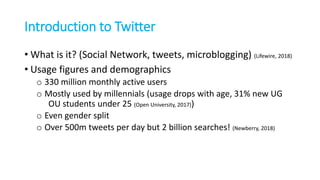
Introduction to Twitter
• What is it? (Social Network, tweets, microblogging) (Lifewire, 2018)
• Usage figures and demographics
o 330 million monthly active users
o Mostly used by millennials (usage drops with age, 31% new UG
OU students under 25 (Open University, 2017))
o Even gender split
o Over 500m tweets per day but 2 billion searches! (Newberry, 2018)
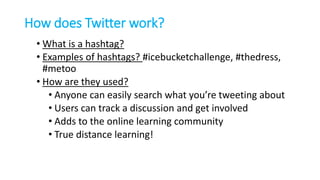
How does Twitter work?
• What is a hashtag?
• Examples of hashtags? #icebucketchallenge, #thedress,
#metoo
• How are they used?
• Anyone can easily search what you’re tweeting about
• Users can track a discussion and get involved
• Adds to the online learning community
• True distance learning!
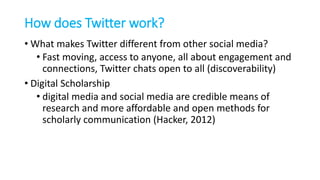
How does Twitter work?
• What makes Twitter different from other social media?
• Fast moving, access to anyone, all about engagement and
connections, Twitter chats open to all (discoverability)
• Digital Scholarship
• digital media and social media are credible means of
research and more affordable and open methods for
scholarly communication (Hacker, 2012)
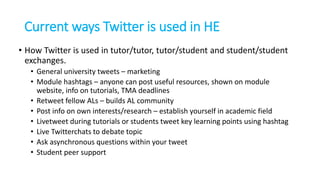
Current ways Twitter is used in HE
• How Twitter is used in tutor/tutor, tutor/student and student/student
exchanges.
• General university tweets – marketing
• Module hashtags – anyone can post useful resources, shown on module
website, info on tutorials, TMA deadlines
• Retweet fellow ALs – builds AL community
• Post info on own interests/research – establish yourself in academic field
• Livetweet during tutorials or students tweet key learning points using hashtag
• Live Twitterchats to debate topic
• Ask asynchronous questions within your tweet
• Student peer support
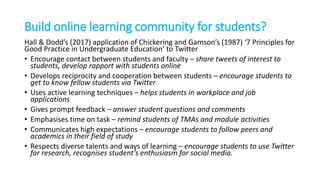
Build online learning community for students?
Hall & Dodd’s (2017) application of Chickering and Gamson’s (1987) ‘7 Principles for
Good Practice in Undergraduate Education’ to Twitter
• Encourage contact between students and faculty – share tweets of interest to
students, develop rapport with students online
• Develops reciprocity and cooperation between students – encourage students to
get to know fellow students via Twitter
• Uses active learning techniques – helps students in workplace and job
applications
• Gives prompt feedback – answer student questions and comments
• Emphasises time on task – remind students of TMAs and module activities
• Communicates high expectations – encourage students to follow peers and
academics in their field of study
• Respects diverse talents and ways of learning – encourage students to use Twitter
for research, recognises student’s enthusiasm for social media.
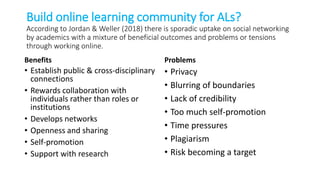
Build online learning community for ALs?
According to Jordan & Weller (2018) there is sporadic uptake on social networking
by academics with a mixture of beneficial outcomes and problems or tensions
through working online.
Benefits
• Establish public & cross-disciplinary
connections
• Rewards collaboration with
individuals rather than roles or
institutions
• Develops networks
• Openness and sharing
• Self-promotion
• Support with research
Problems
• Privacy
• Blurring of boundaries
• Lack of credibility
• Too much self-promotion
• Time pressures
• Plagiarism
• Risk becoming a target
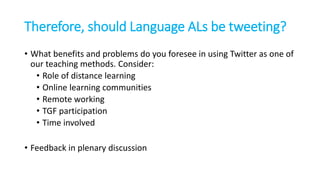
Therefore, should Language ALs be tweeting?
• What benefits and problems do you foresee in using Twitter as one of
our teaching methods. Consider:
• Role of distance learning
• Online learning communities
• Remote working
• TGF participation
• Time involved
• Feedback in plenary discussion
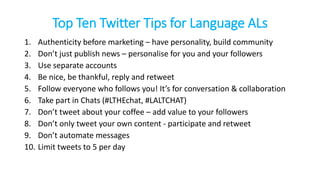
Top Ten Twitter Tips for Language ALs
1. Authenticity before marketing – have personality, build community
2. Don’t just publish news – personalise for you and your followers
3. Use separate accounts
4. Be nice, be thankful, reply and retweet
5. Follow everyone who follows you! It’s for conversation & collaboration
6. Take part in Chats (#LTHEchat, #LALTCHAT)
7. Don’t tweet about your coffee – add value to your followers
8. Don’t only tweet your own content - participate and retweet
9. Don’t automate messages
10. Limit tweets to 5 per day
Thanks for attending
• Handout – summary of key points, Top 10 Tips and references
• Following conference I will tweet a summary of key points written in
handouts. Follow me on @OliviaKellyOU
• Tweet photos from the workshop
• Please tweet your key learning point
• Use hashtag #OUNLALC
References
• Hacker, (2012) The Challenges of Digital Scholarship, https://www.chronicle.com/blogs/profhacker/the-
challenges-of-digital-scholarship/38103 (Accessed 12/04/2018)
• Hull, K. & Dodd, J.E. (2017) Faculty use of Twitter in higher education teaching, Journal of Applied Research
in Higher Education, Vol. 9 Issue: 1, pp.91-104, https://doi.org/10.1108/JARHE-05-2015-0038
• Jordan, K. and Weller, M. (2018) Academics and Social Networking Sites: Benefits, Problems and Tensions in
Professional Engagement with Online Networking. Journal of Interactive Media in Education, 2018(1): 1, pp.
1–9, https://doi.org/10.5334/jime.448
• Lifewire, (2018), What is microblogging?, https://www.lifewire.com/what-is-microblogging-3486200,
(Accessed 12/04/2018)
• Mansfield, H. (2009) 10 Twitter Tips for Higher Education, Universitybusiness.com, May 2009
https://www.universitybusiness.com/article/10-twitter-tips-higher-education (Accessed 14/02/18)
• Newberry, C. (2018), 28 Twitter Statistics all marketers need to know in 2018,
https://blog.hootsuite.com/twitter-statistics/ (Accessed 12/04/2018)
• The Open University, (2017), Facts and Figures 2015-2016,
https://www.open.ac.uk/about/main/sites/www.open.ac.uk.about.main/files/files/uk_fact_figures_1516_p
df(1).pdf
• Zhang, A, 2018, Top Five Tips that will help you build an online community,
https://medium.com/@aiaddysonzhang/top-five-tips-that-will-help-you-build-an-online-community-
3d0d6581f977 (Accessed 13/04/2018)

Using Twitter to build online learning communities

  • 1.
    Using Twitter tobuild online learning communities between student/tutor and tutor/tutor LAL Staff Conference Manchester, April 2018 @OliviaKellyOU #OUNLALC
  • 2.
    Reason for interestin using Twitter as an AL • Low use of TGFs, looking for alternative ways to connect with students and fellow academics • Perfect for working remotely • Follow me @OliviaKellyOU • Feel free to tweet during or after the workshop, use hashtag #OUNLALC so others can see your tweets and build our community!
  • 3.
    But can Twitter……. buildonline learning communities between student/tutor and tutor/tutor?
  • 4.
    Introduction to Twitter •What is it? (Social Network, tweets, microblogging) (Lifewire, 2018) • Usage figures and demographics o 330 million monthly active users o Mostly used by millennials (usage drops with age, 31% new UG OU students under 25 (Open University, 2017)) o Even gender split o Over 500m tweets per day but 2 billion searches! (Newberry, 2018)
  • 5.
    How does Twitterwork? • What is a hashtag? • Examples of hashtags? #icebucketchallenge, #thedress, #metoo • How are they used? • Anyone can easily search what you’re tweeting about • Users can track a discussion and get involved • Adds to the online learning community • True distance learning!
  • 6.
    How does Twitterwork? • What makes Twitter different from other social media? • Fast moving, access to anyone, all about engagement and connections, Twitter chats open to all (discoverability) • Digital Scholarship • digital media and social media are credible means of research and more affordable and open methods for scholarly communication (Hacker, 2012)
  • 7.
    Current ways Twitteris used in HE • How Twitter is used in tutor/tutor, tutor/student and student/student exchanges. • General university tweets – marketing • Module hashtags – anyone can post useful resources, shown on module website, info on tutorials, TMA deadlines • Retweet fellow ALs – builds AL community • Post info on own interests/research – establish yourself in academic field • Livetweet during tutorials or students tweet key learning points using hashtag • Live Twitterchats to debate topic • Ask asynchronous questions within your tweet • Student peer support
  • 8.
    Build online learningcommunity for students? Hall & Dodd’s (2017) application of Chickering and Gamson’s (1987) ‘7 Principles for Good Practice in Undergraduate Education’ to Twitter • Encourage contact between students and faculty – share tweets of interest to students, develop rapport with students online • Develops reciprocity and cooperation between students – encourage students to get to know fellow students via Twitter • Uses active learning techniques – helps students in workplace and job applications • Gives prompt feedback – answer student questions and comments • Emphasises time on task – remind students of TMAs and module activities • Communicates high expectations – encourage students to follow peers and academics in their field of study • Respects diverse talents and ways of learning – encourage students to use Twitter for research, recognises student’s enthusiasm for social media.
  • 9.
    Build online learningcommunity for ALs? According to Jordan & Weller (2018) there is sporadic uptake on social networking by academics with a mixture of beneficial outcomes and problems or tensions through working online. Benefits • Establish public & cross-disciplinary connections • Rewards collaboration with individuals rather than roles or institutions • Develops networks • Openness and sharing • Self-promotion • Support with research Problems • Privacy • Blurring of boundaries • Lack of credibility • Too much self-promotion • Time pressures • Plagiarism • Risk becoming a target
  • 10.
    Therefore, should LanguageALs be tweeting? • What benefits and problems do you foresee in using Twitter as one of our teaching methods. Consider: • Role of distance learning • Online learning communities • Remote working • TGF participation • Time involved • Feedback in plenary discussion
  • 11.
    Top Ten TwitterTips for Language ALs 1. Authenticity before marketing – have personality, build community 2. Don’t just publish news – personalise for you and your followers 3. Use separate accounts 4. Be nice, be thankful, reply and retweet 5. Follow everyone who follows you! It’s for conversation & collaboration 6. Take part in Chats (#LTHEchat, #LALTCHAT) 7. Don’t tweet about your coffee – add value to your followers 8. Don’t only tweet your own content - participate and retweet 9. Don’t automate messages 10. Limit tweets to 5 per day
  • 12.
    Thanks for attending •Handout – summary of key points, Top 10 Tips and references • Following conference I will tweet a summary of key points written in handouts. Follow me on @OliviaKellyOU • Tweet photos from the workshop • Please tweet your key learning point • Use hashtag #OUNLALC
  • 13.
    References • Hacker, (2012)The Challenges of Digital Scholarship, https://www.chronicle.com/blogs/profhacker/the- challenges-of-digital-scholarship/38103 (Accessed 12/04/2018) • Hull, K. & Dodd, J.E. (2017) Faculty use of Twitter in higher education teaching, Journal of Applied Research in Higher Education, Vol. 9 Issue: 1, pp.91-104, https://doi.org/10.1108/JARHE-05-2015-0038 • Jordan, K. and Weller, M. (2018) Academics and Social Networking Sites: Benefits, Problems and Tensions in Professional Engagement with Online Networking. Journal of Interactive Media in Education, 2018(1): 1, pp. 1–9, https://doi.org/10.5334/jime.448 • Lifewire, (2018), What is microblogging?, https://www.lifewire.com/what-is-microblogging-3486200, (Accessed 12/04/2018) • Mansfield, H. (2009) 10 Twitter Tips for Higher Education, Universitybusiness.com, May 2009 https://www.universitybusiness.com/article/10-twitter-tips-higher-education (Accessed 14/02/18) • Newberry, C. (2018), 28 Twitter Statistics all marketers need to know in 2018, https://blog.hootsuite.com/twitter-statistics/ (Accessed 12/04/2018) • The Open University, (2017), Facts and Figures 2015-2016, https://www.open.ac.uk/about/main/sites/www.open.ac.uk.about.main/files/files/uk_fact_figures_1516_p df(1).pdf • Zhang, A, 2018, Top Five Tips that will help you build an online community, https://medium.com/@aiaddysonzhang/top-five-tips-that-will-help-you-build-an-online-community- 3d0d6581f977 (Accessed 13/04/2018)