The European Commission’s
science and knowledge service
Joint Research Centre
Going Open in Europe:
Leveraging open education to enhance
teaching and learning in the digital age
Dr Andreia Inamorato
OE Global, 2018
Delft, Netherlands
24-26th April 2018
@aisantos
andreia-inamorato-dos.santos@ec.europa.eu
Openness: modernisation of
teaching and learning practices
• More access routes, content, pathways, etc
• Diverse pedagogical models
• Use of digital technologies
• Opportunities for innovation
• + challenges!
•
The European Commission and the
Open Education movement
 - Advisory role
 - No binding instruments: Member States are
autonomous regarding decisions about their
educational systems
 - Different directorates perform different roles:
EAC (DG EDUCATION AND CULTURE)
JRC ( DG JOINT RESEARCH CENTRE)
Agenda setting instrument:
Communications
A Communication sets out an Action Plan for the EC
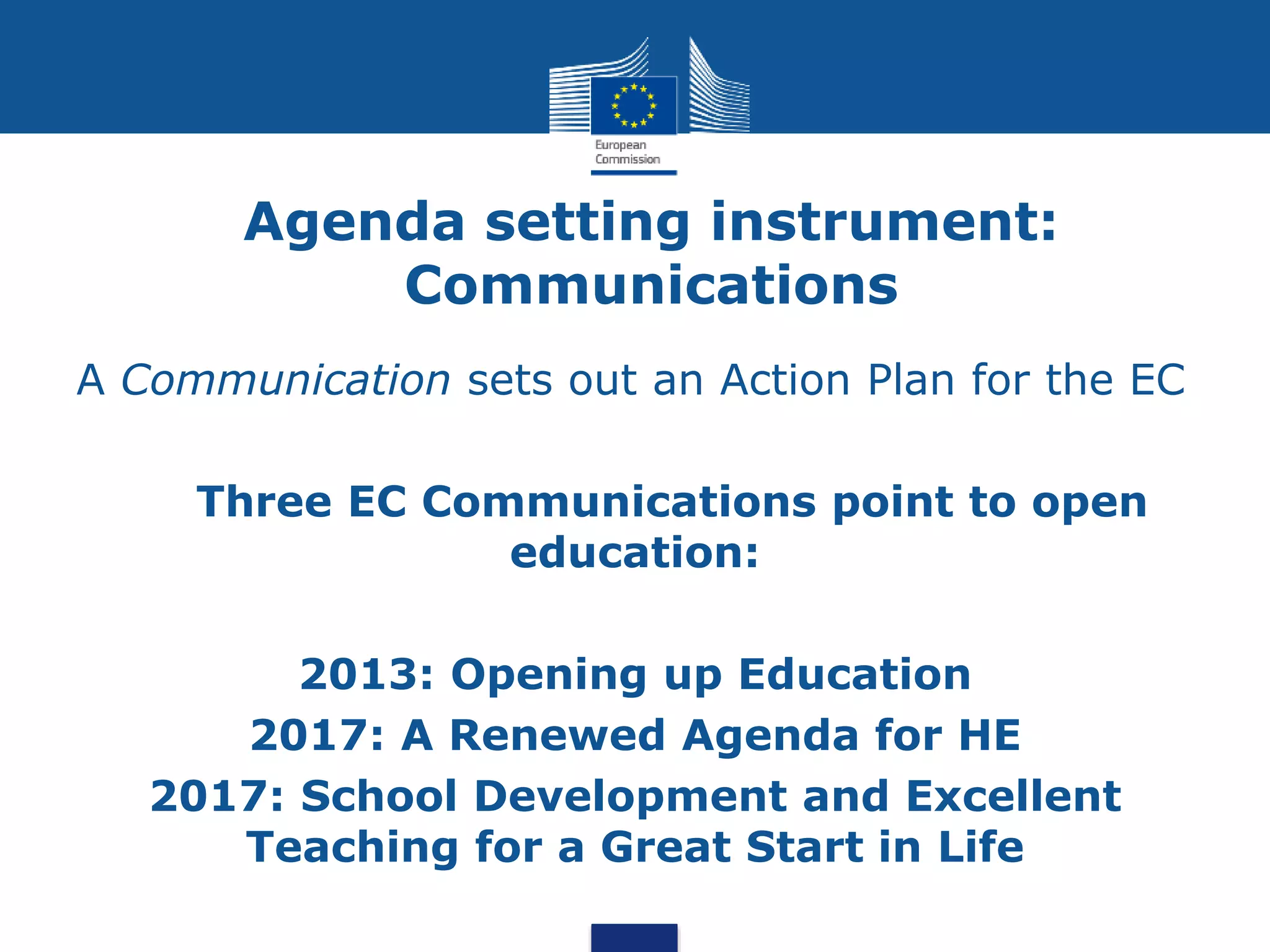
Three EC Communications point to open
education:
2013: Opening up Education
2017: A Renewed Agenda for HE
2017: School Development and Excellent
Teaching for a Great Start in Life
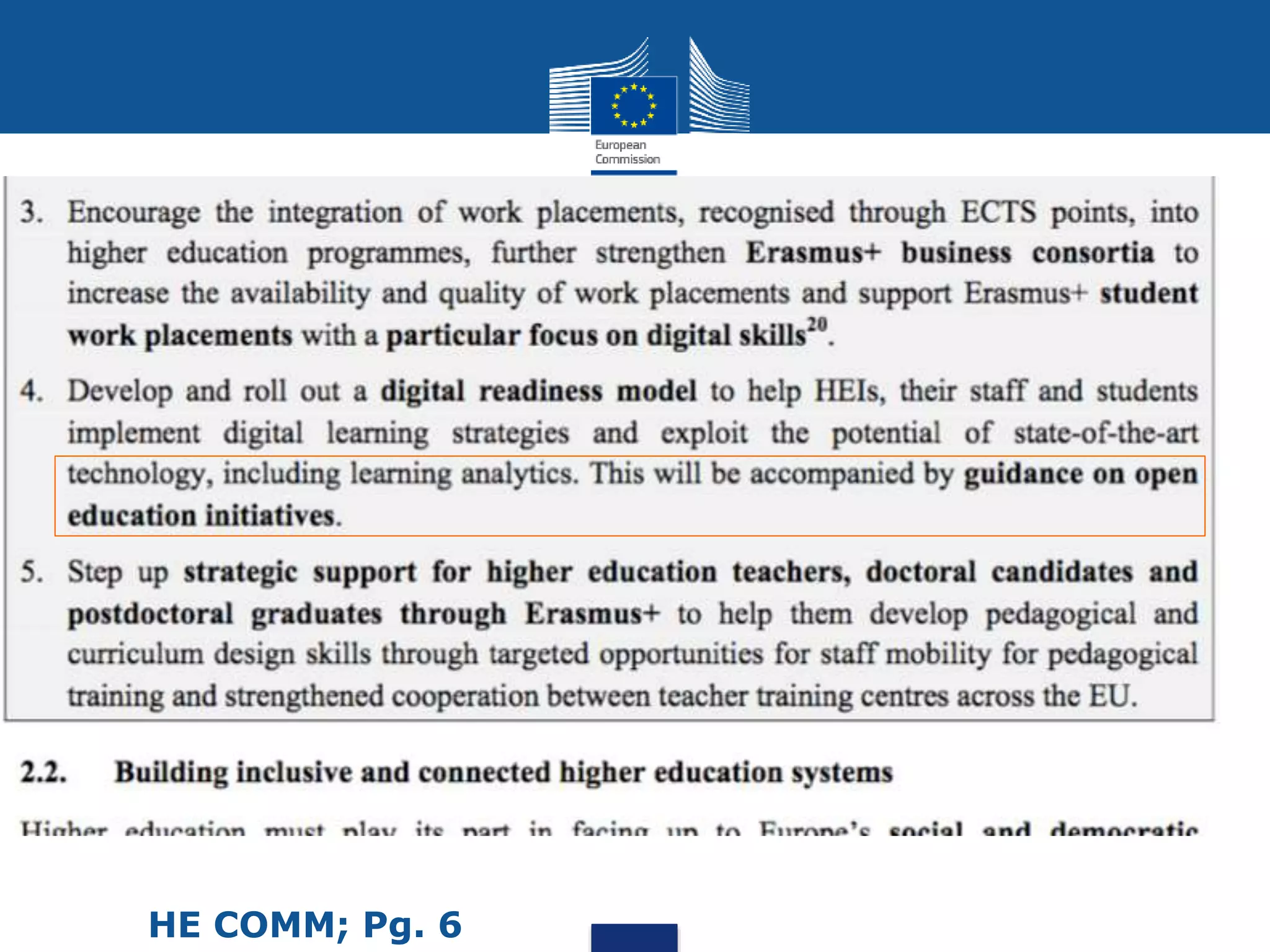
HE COMM; Pg. 6
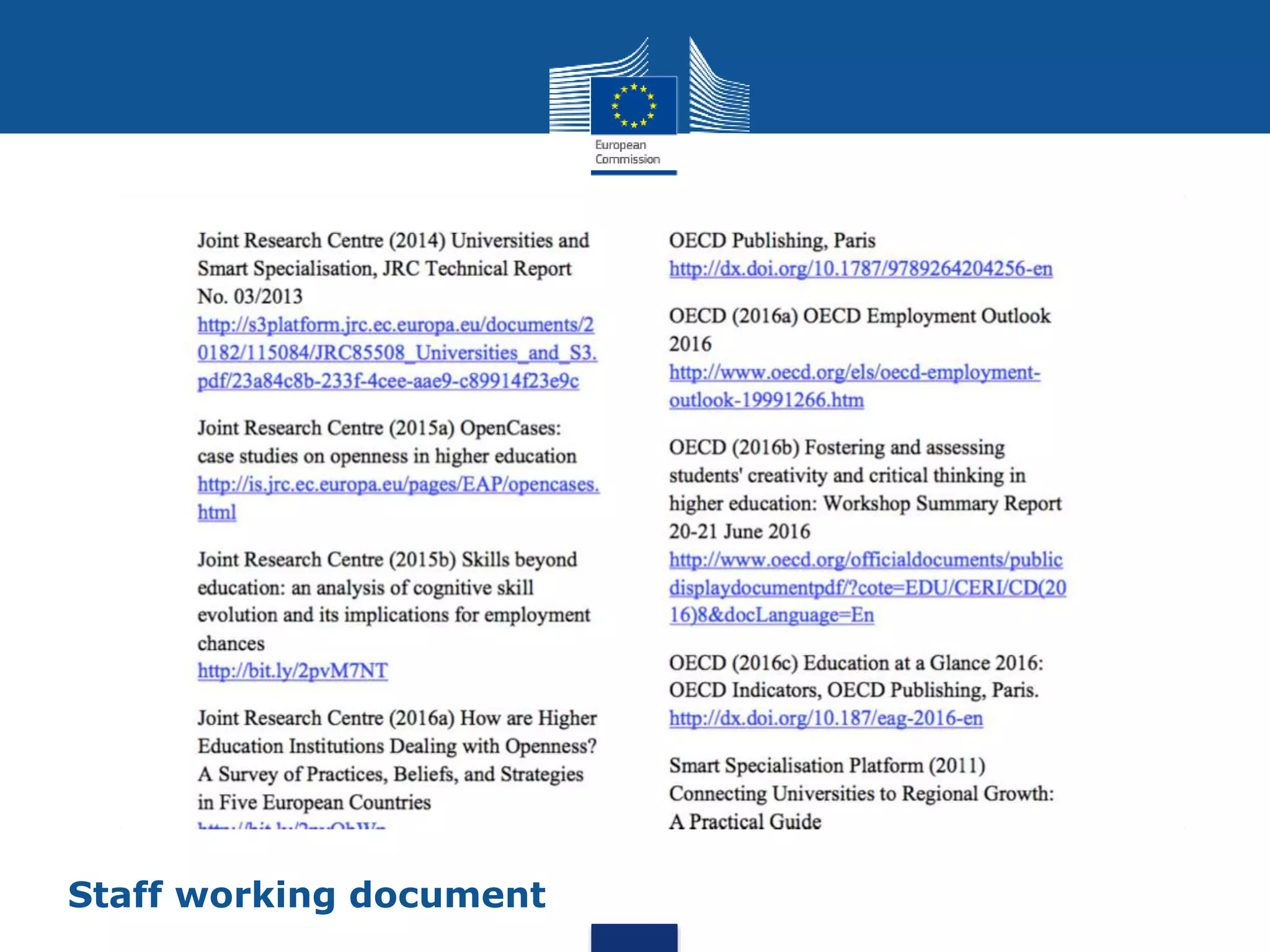
Staff working document
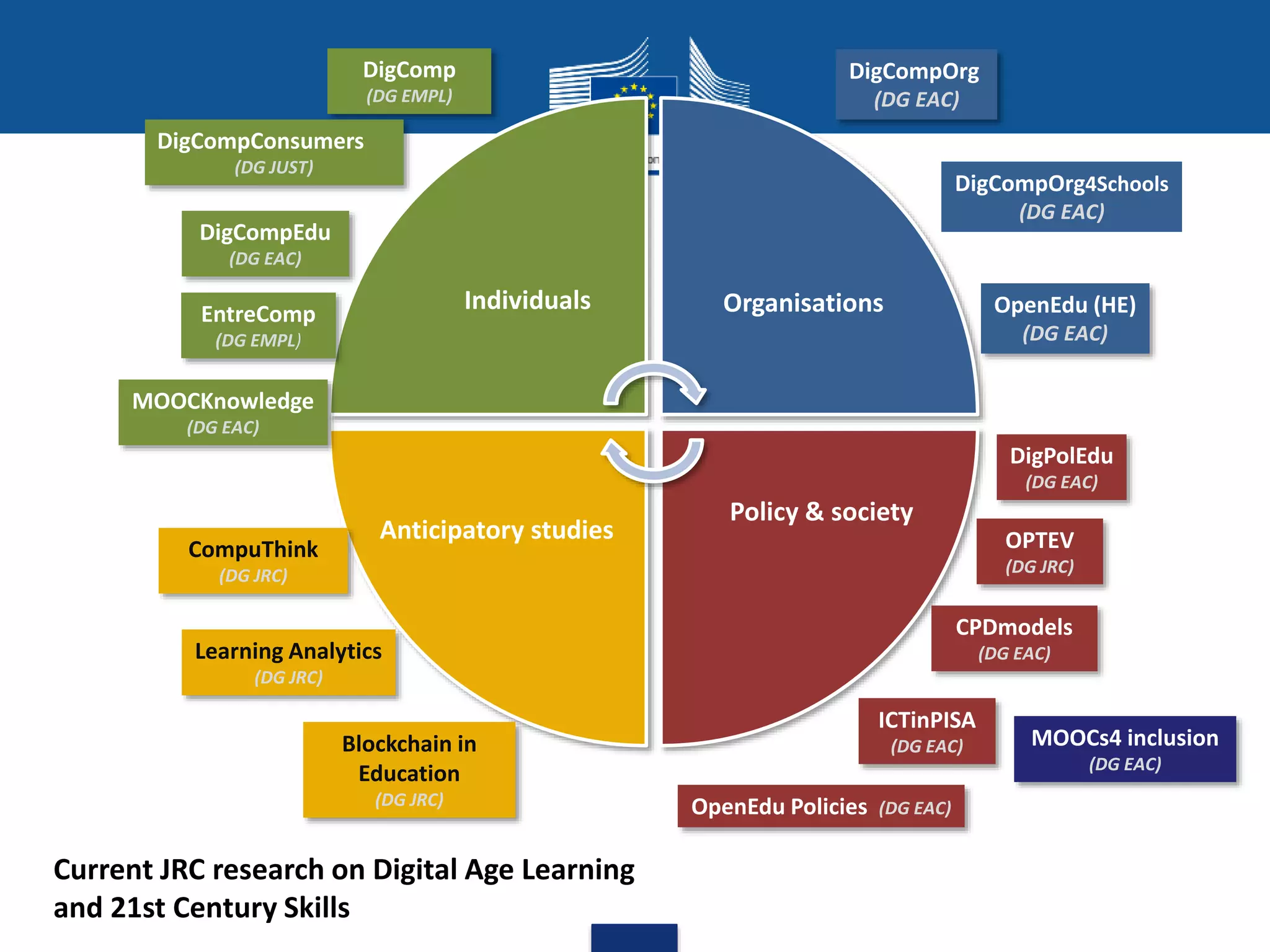
DigComp
(DG EMPL)
EntreComp
(DG EMPL)
DigCompConsumers
(DG JUST)
OpenEdu Policies (DG EAC)
MOOCKnowledge
(DG EAC)
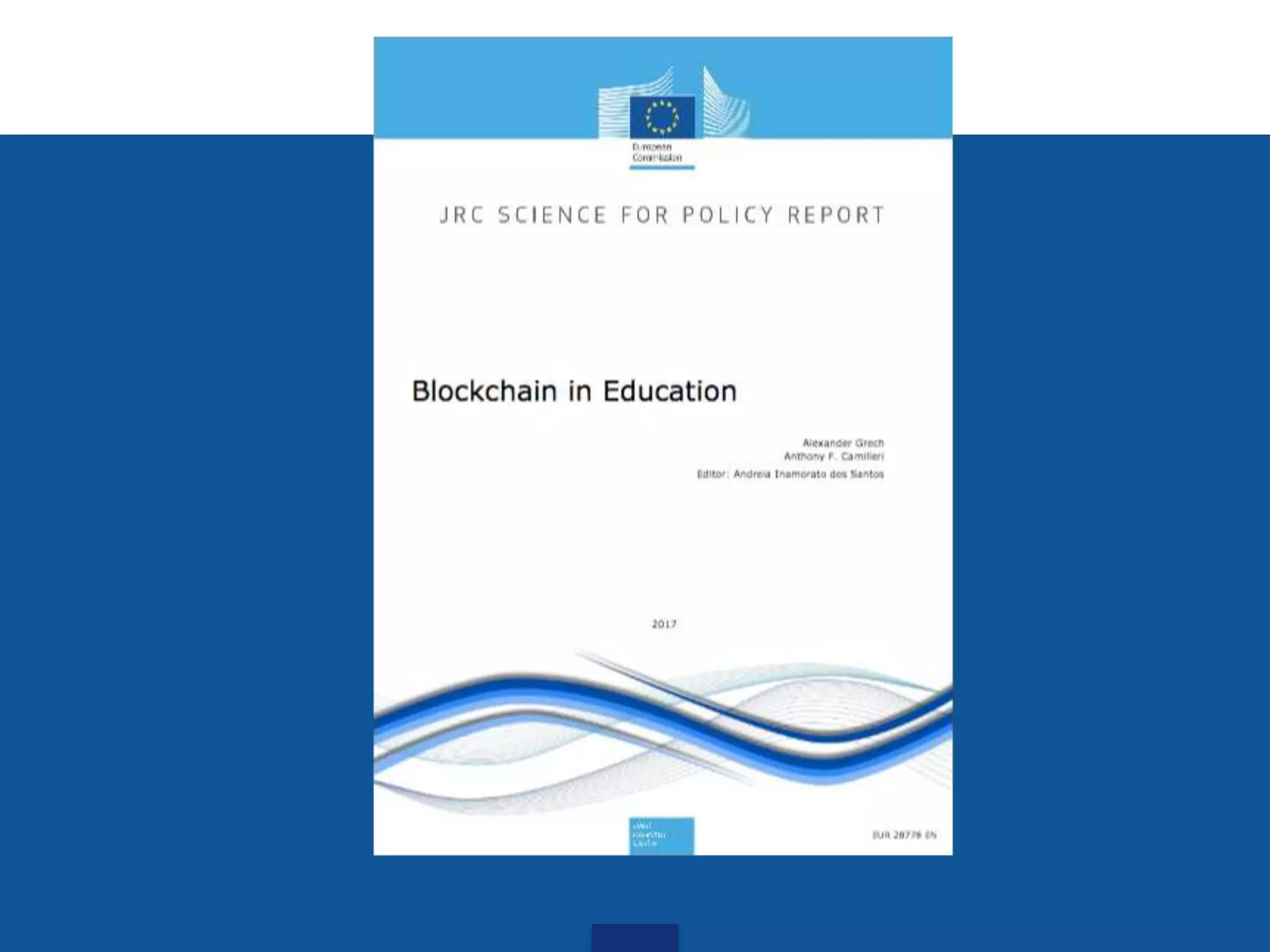
Blockchain in
Education
(DG JRC)
OPTEV
(DG JRC)
MOOCs4 inclusion
(DG EAC)
Learning Analytics
(DG JRC)
Anticipatory studies
Policy & society
OrganisationsIndividuals
DigCompEdu
(DG EAC)
DigPolEdu
(DG EAC)
CPDmodels
(DG EAC)
ICTinPISA
(DG EAC)
CompuThink
(DG JRC)
DigCompOrg4Schools
(DG EAC)
OpenEdu (HE)
(DG EAC)
DigCompOrg
(DG EAC)
Current JRC research on Digital Age Learning
and 21st Century Skills
Challenge #1
Promote a commom understanding for
contemporary open education
Openness as a core value
• Open education approaches education practices
through a set of core values, based on
transparency, sharing and collaboration. It
proposes a shift in mindset in order to allow the
implementation of a number of practices focused
on openness.
• Going Open Report, JRC 2017
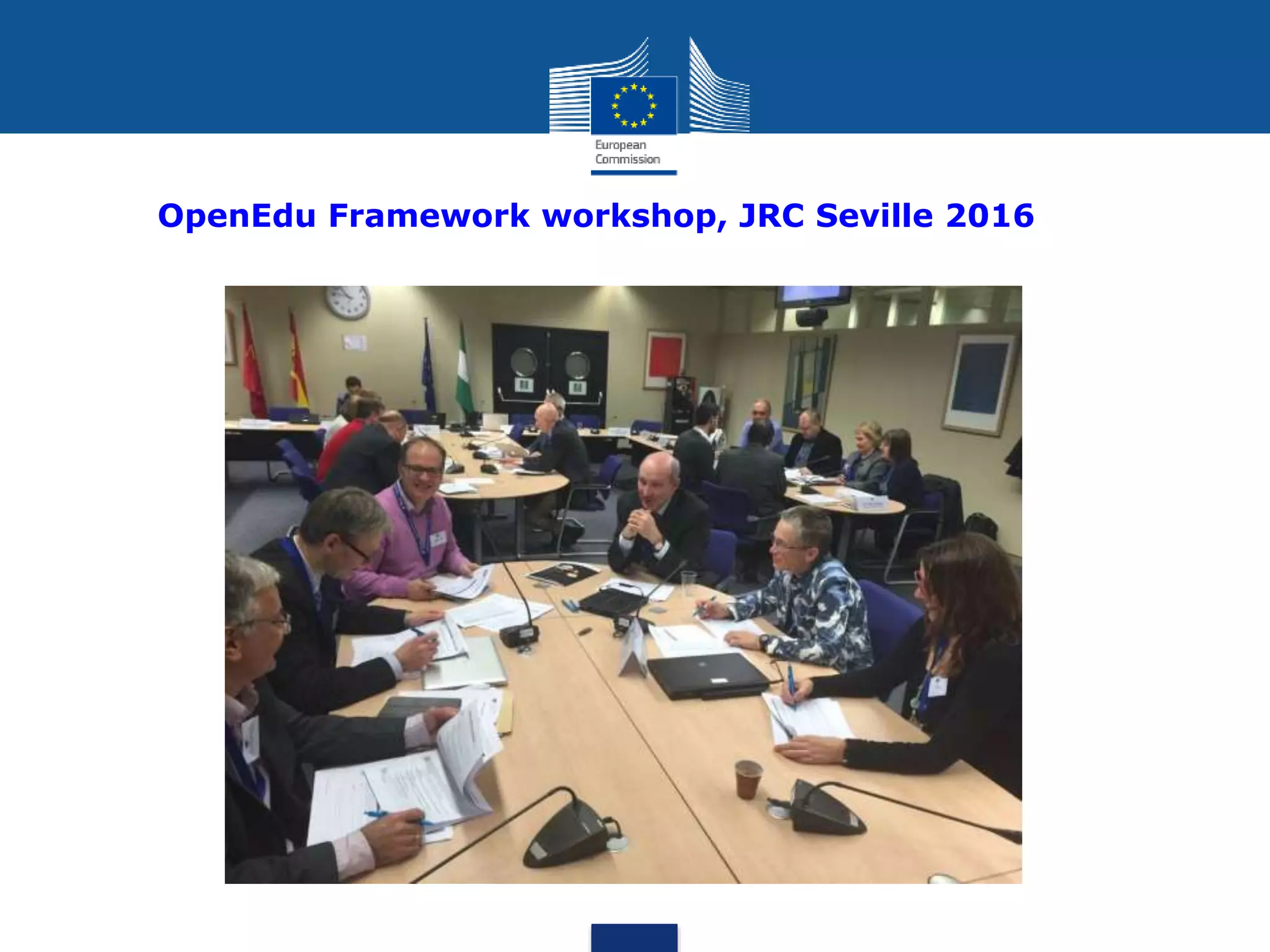
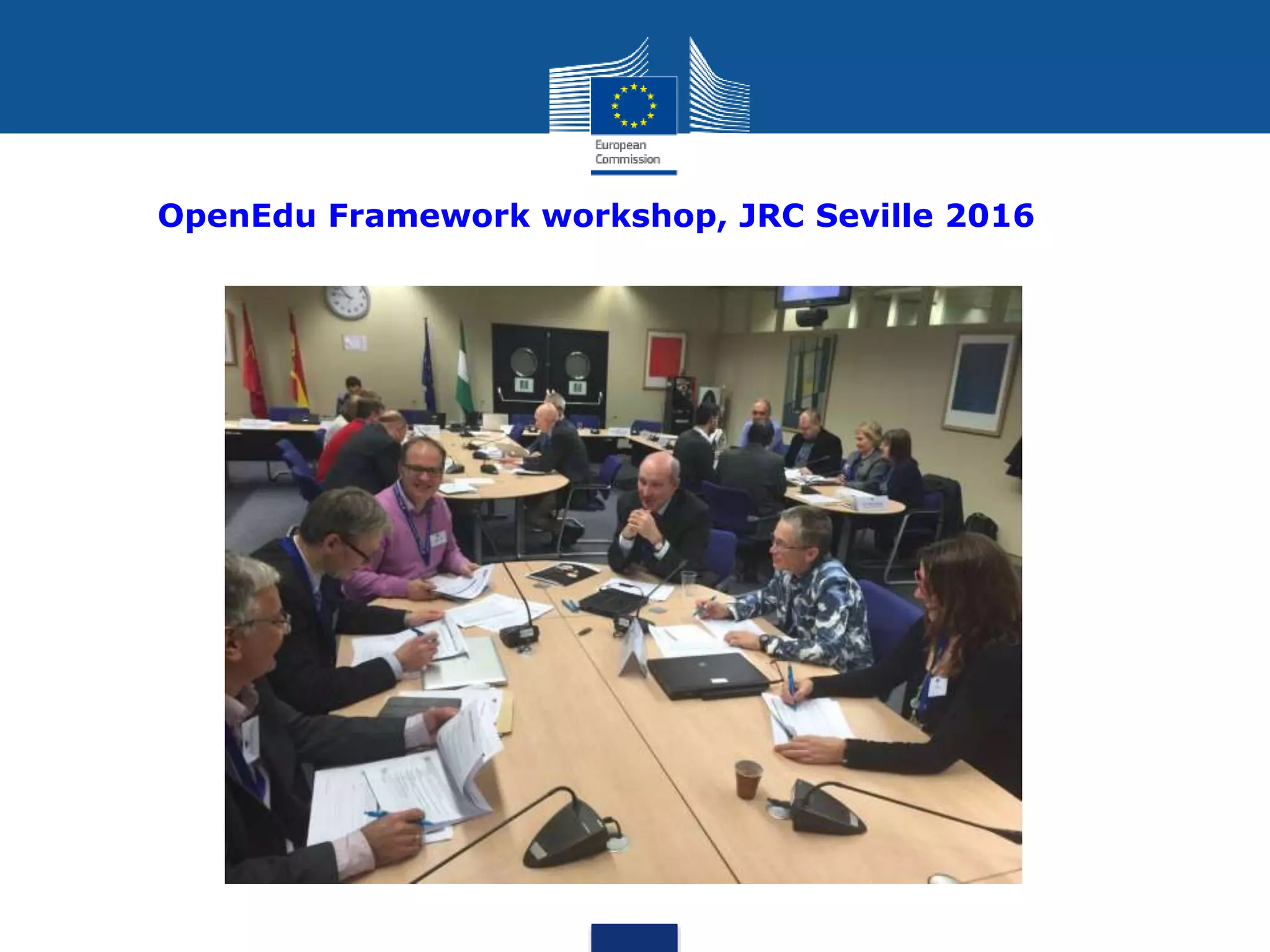
OpenEdu Framework workshop, JRC Seville 2016
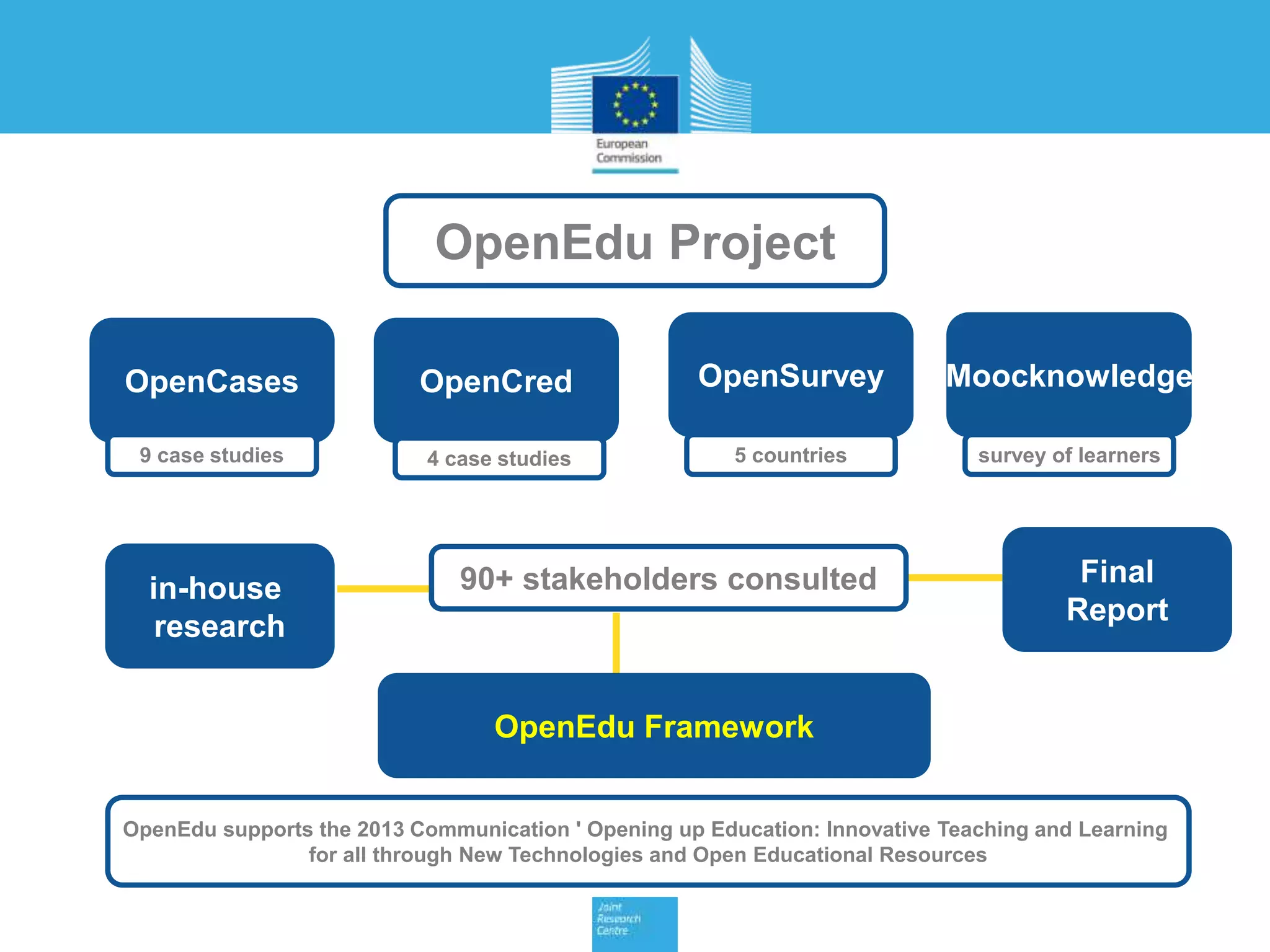
The OpenEdu
Project
2013-2016
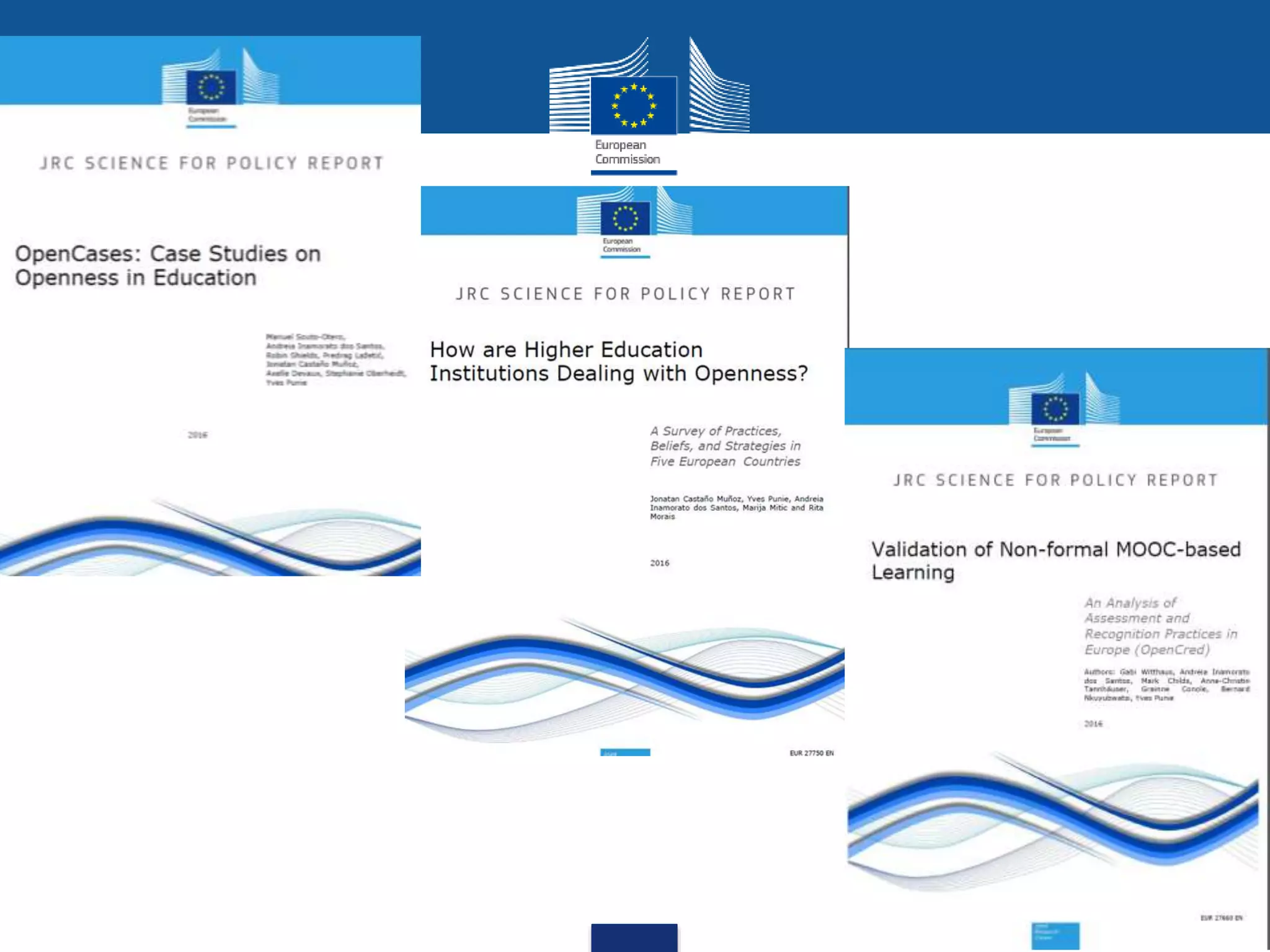
OpenCases OpenCred MoocknowledgeOpenSurvey
OpenEdu Project
OpenEdu Framework
90+ stakeholders consulted
9 case studies 4 case studies 5 countries survey of learners
OpenEdu supports the 2013 Communication ' Opening up Education: Innovative Teaching and Learning
for all through New Technologies and Open Educational Resources
in-house
research
Final
Report
OpenEdu Framework workshop, JRC Seville 2016
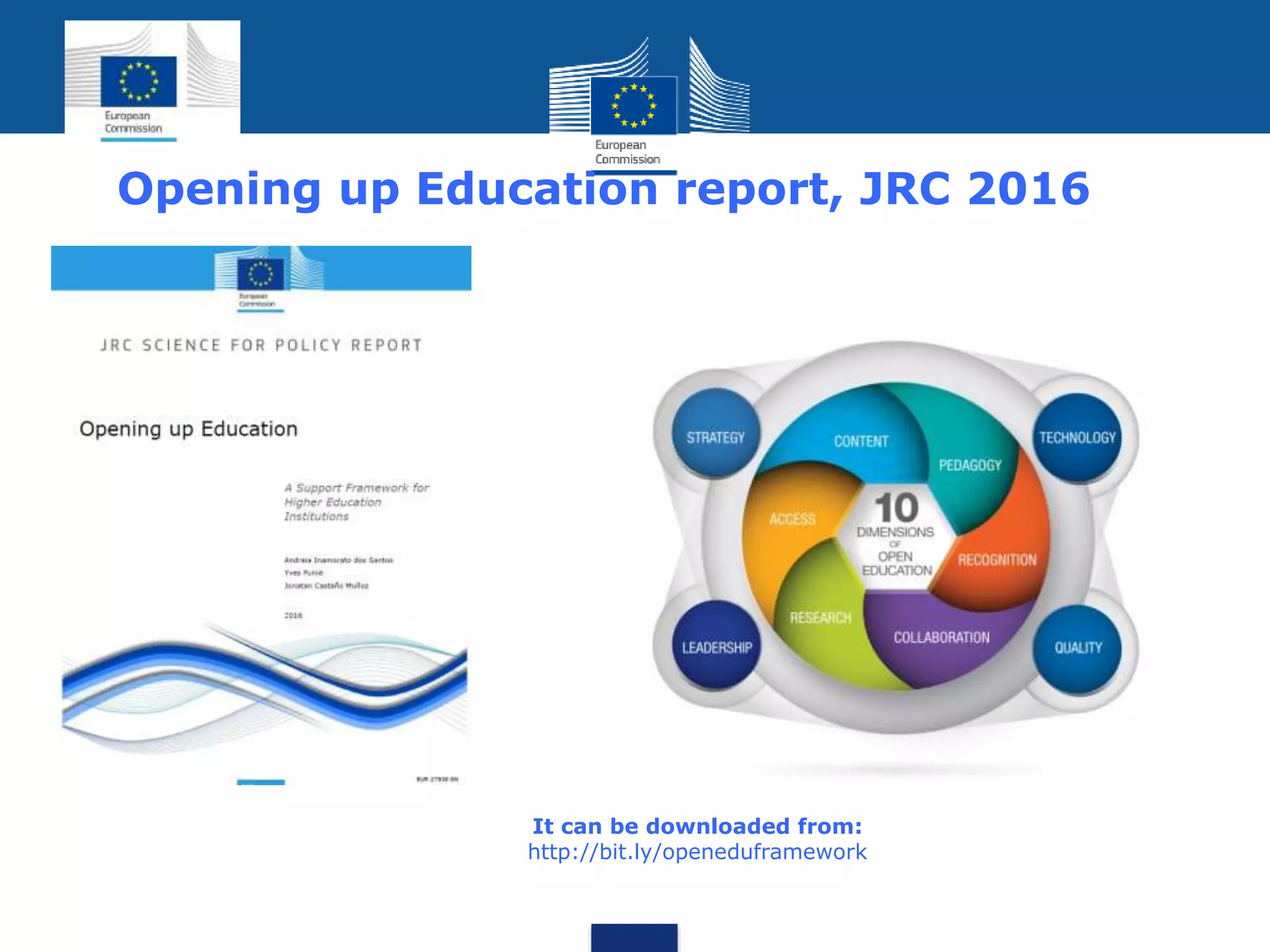
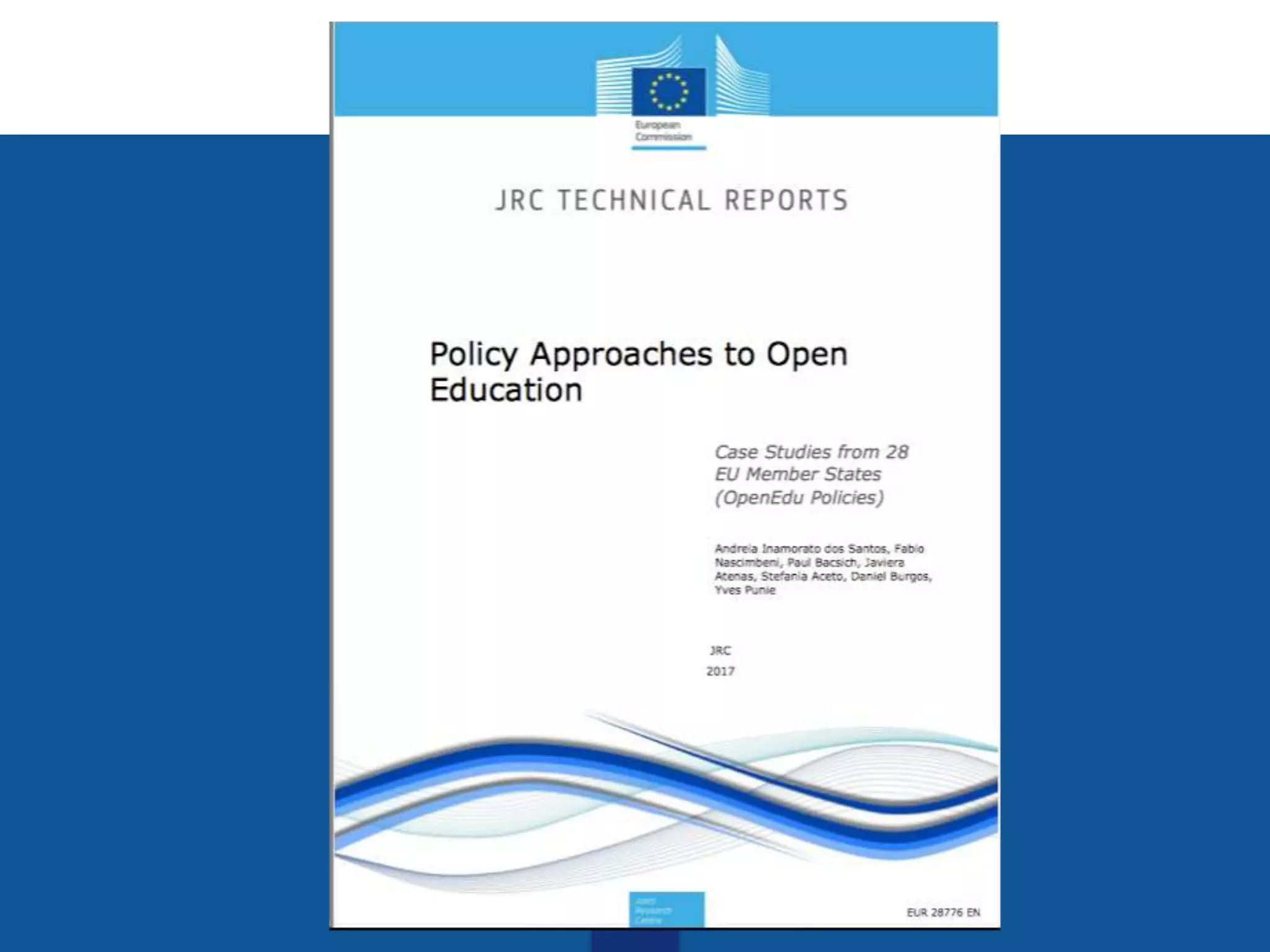
Opening up Education report, JRC 2016
It can be downloaded from:
http://bit.ly/openeduframework
Challenge # 2
• Focus on key areas in which little research
had been carried out
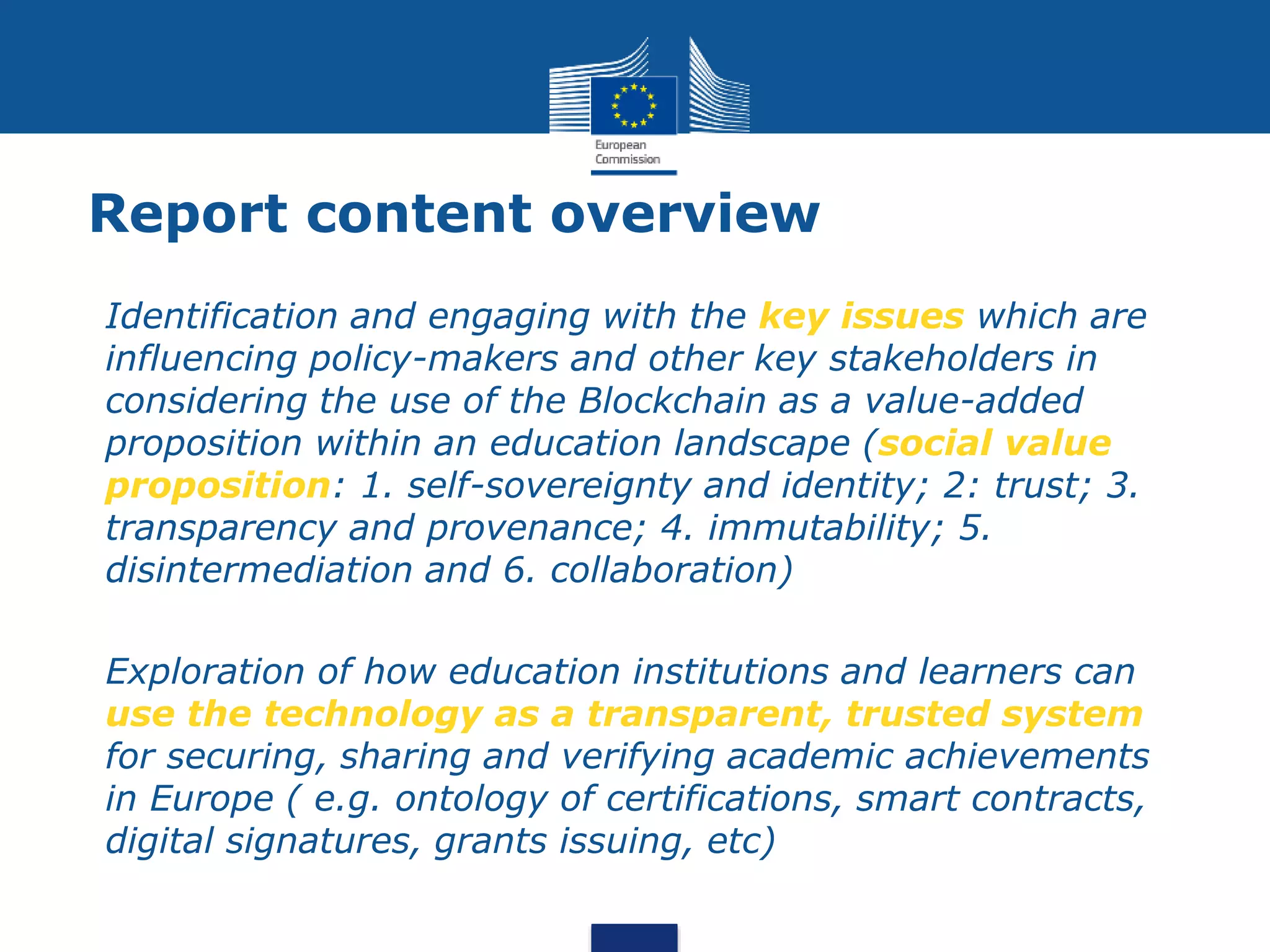
Report content overview
 Identification and engaging with the key issues which are
influencing policy-makers and other key stakeholders in
considering the use of the Blockchain as a value-added
proposition within an education landscape (social value
proposition: 1. self-sovereignty and identity; 2: trust; 3.
transparency and provenance; 4. immutability; 5.
disintermediation and 6. collaboration)
 Exploration of how education institutions and learners can
use the technology as a transparent, trusted system
for securing, sharing and verifying academic achievements
in Europe ( e.g. ontology of certifications, smart contracts,
digital signatures, grants issuing, etc)
Challenge # 3
• Make EU-based research evidence on open
education policies available for everyone
OpenEdu Policies
2016-2017
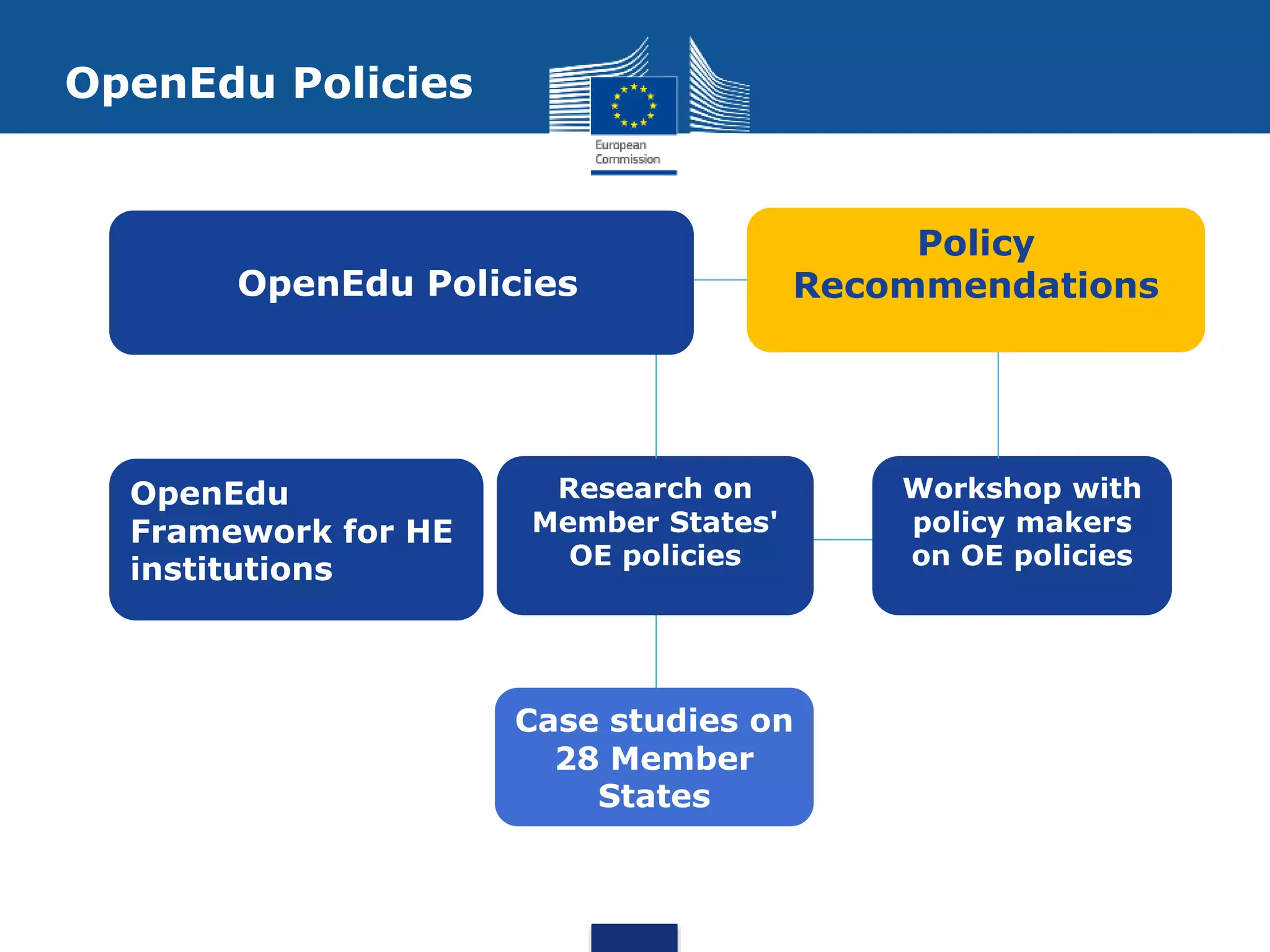
OpenEdu Policies
OpenEdu Policies
OpenEdu
Framework for HE
institutions
Research on
Member States'
OE policies
Workshop with
policy makers
on OE policies
Policy
Recommendations
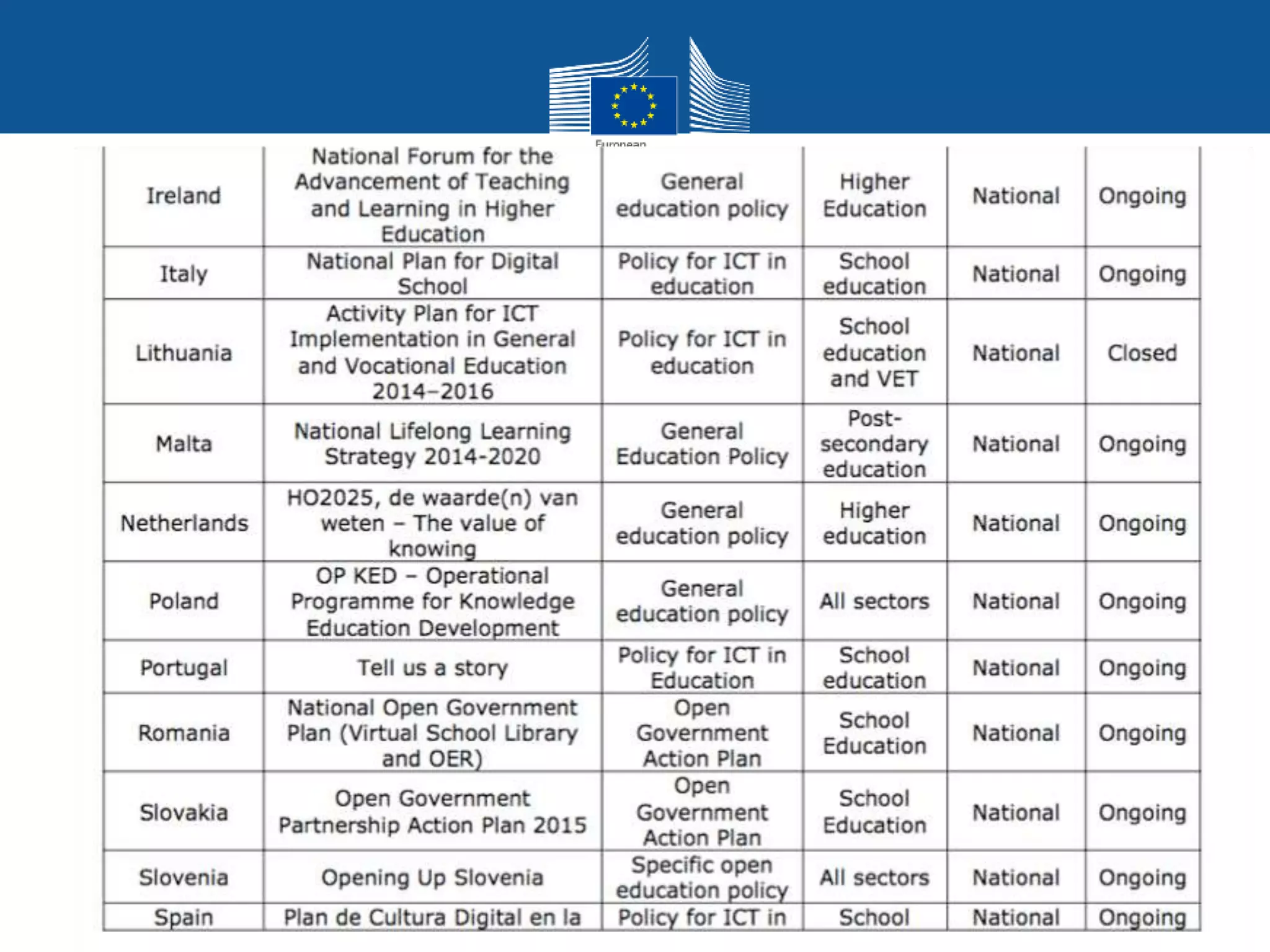
Case studies on
28 Member
States
Challenge # 4
• Make sense of those policies within the broad and
diverse educational landscape that we have in
Europe
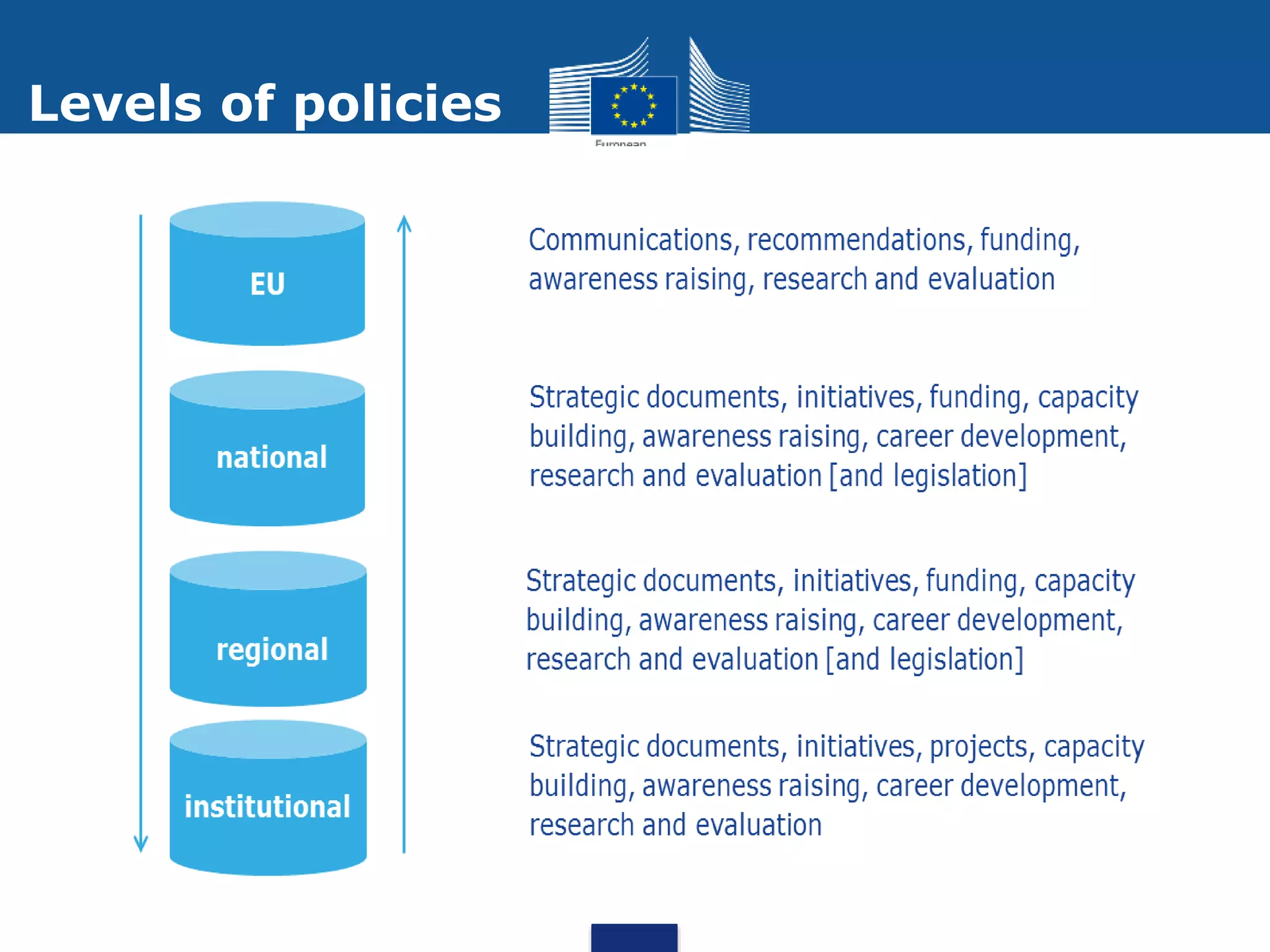
Levels of policies
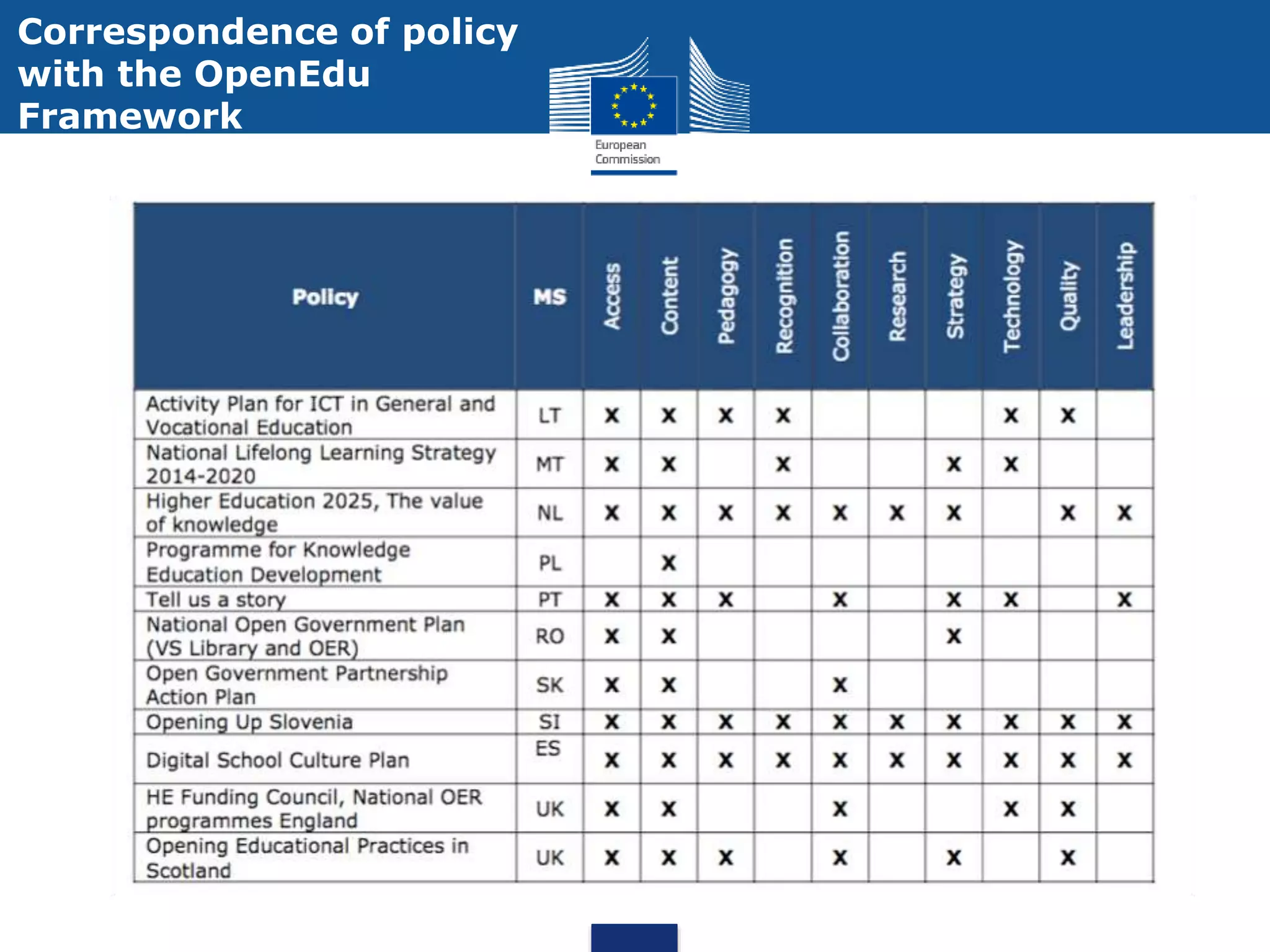
Correspondence of policy
with the OpenEdu
Framework
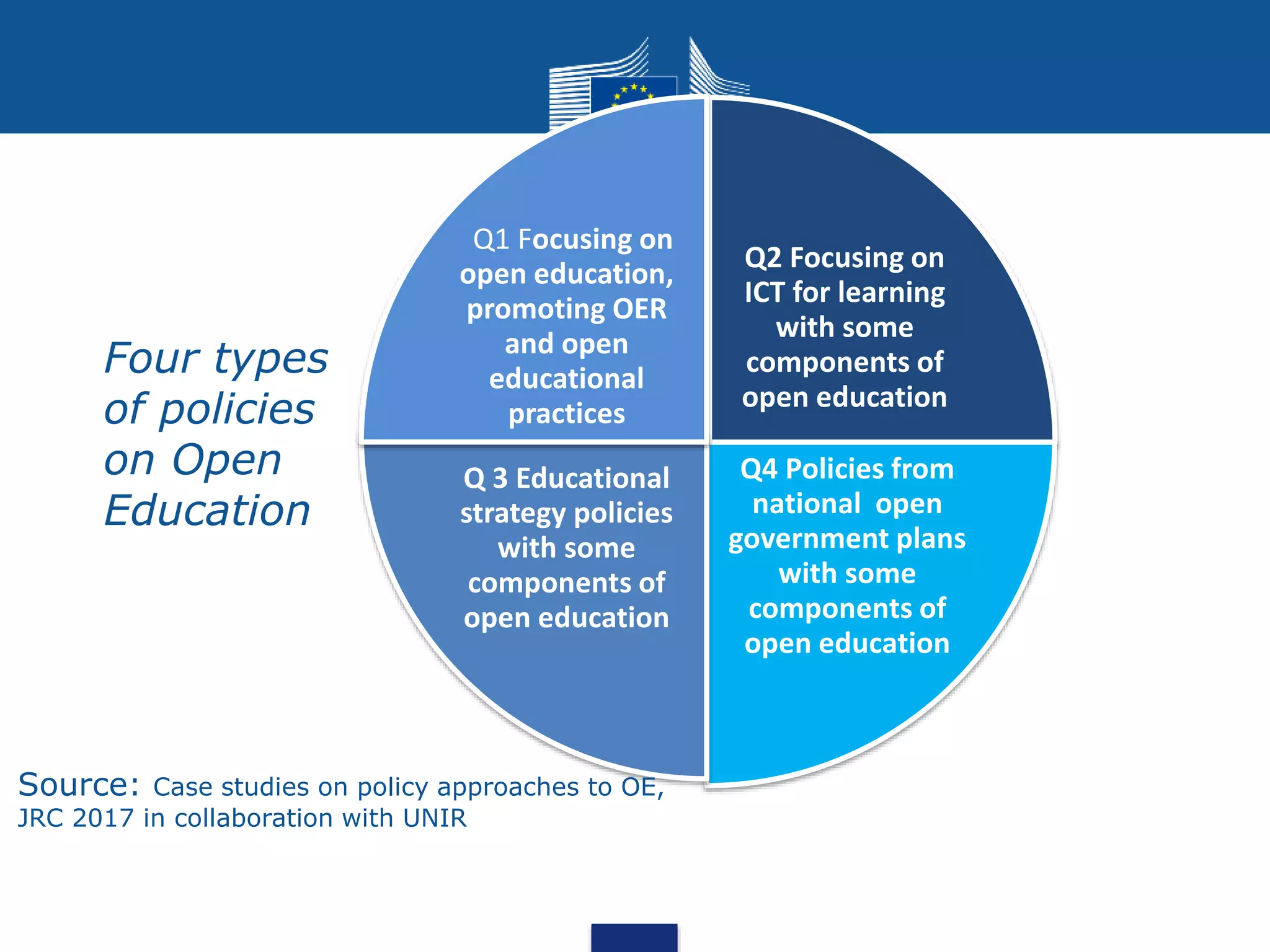
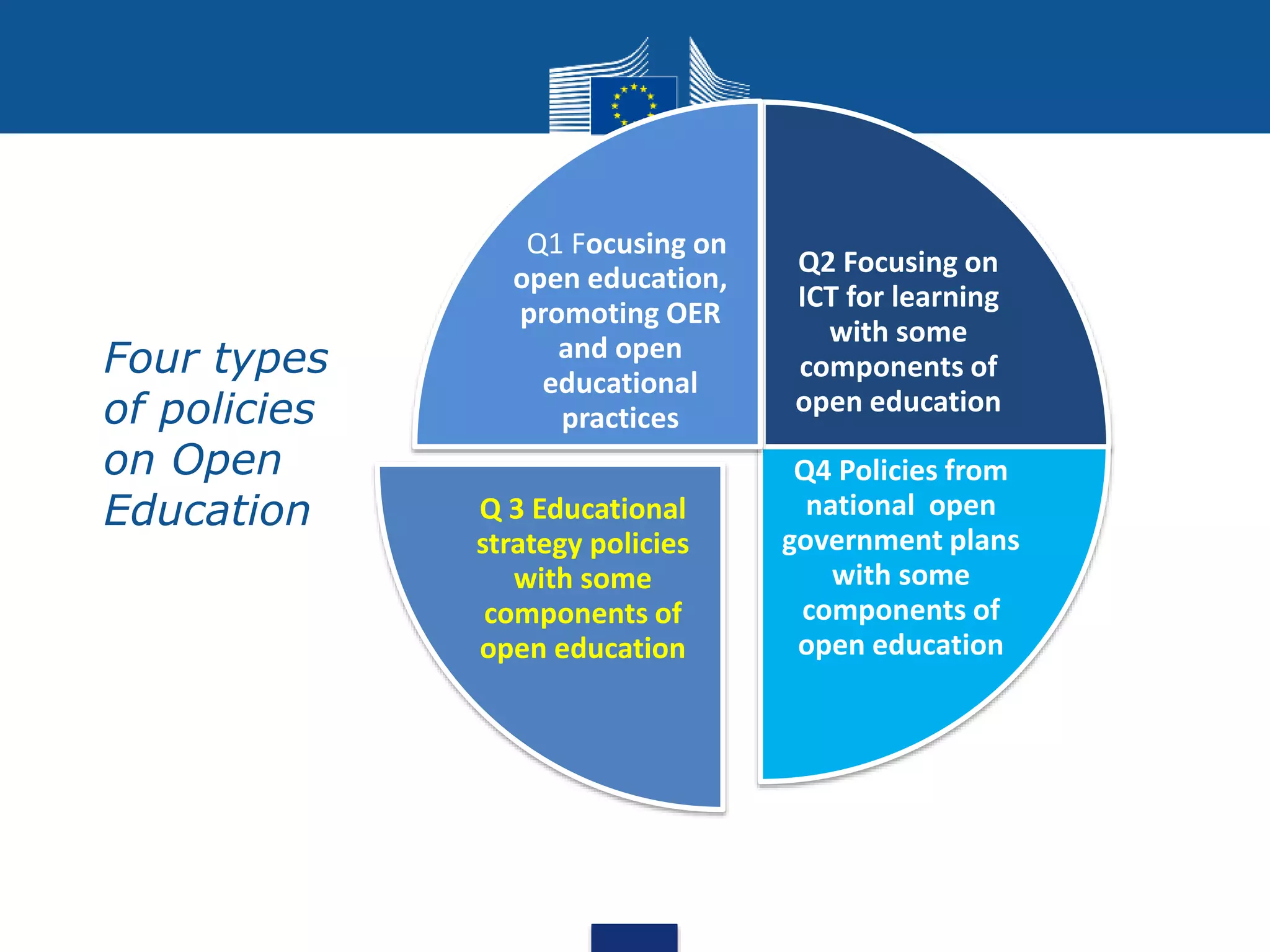
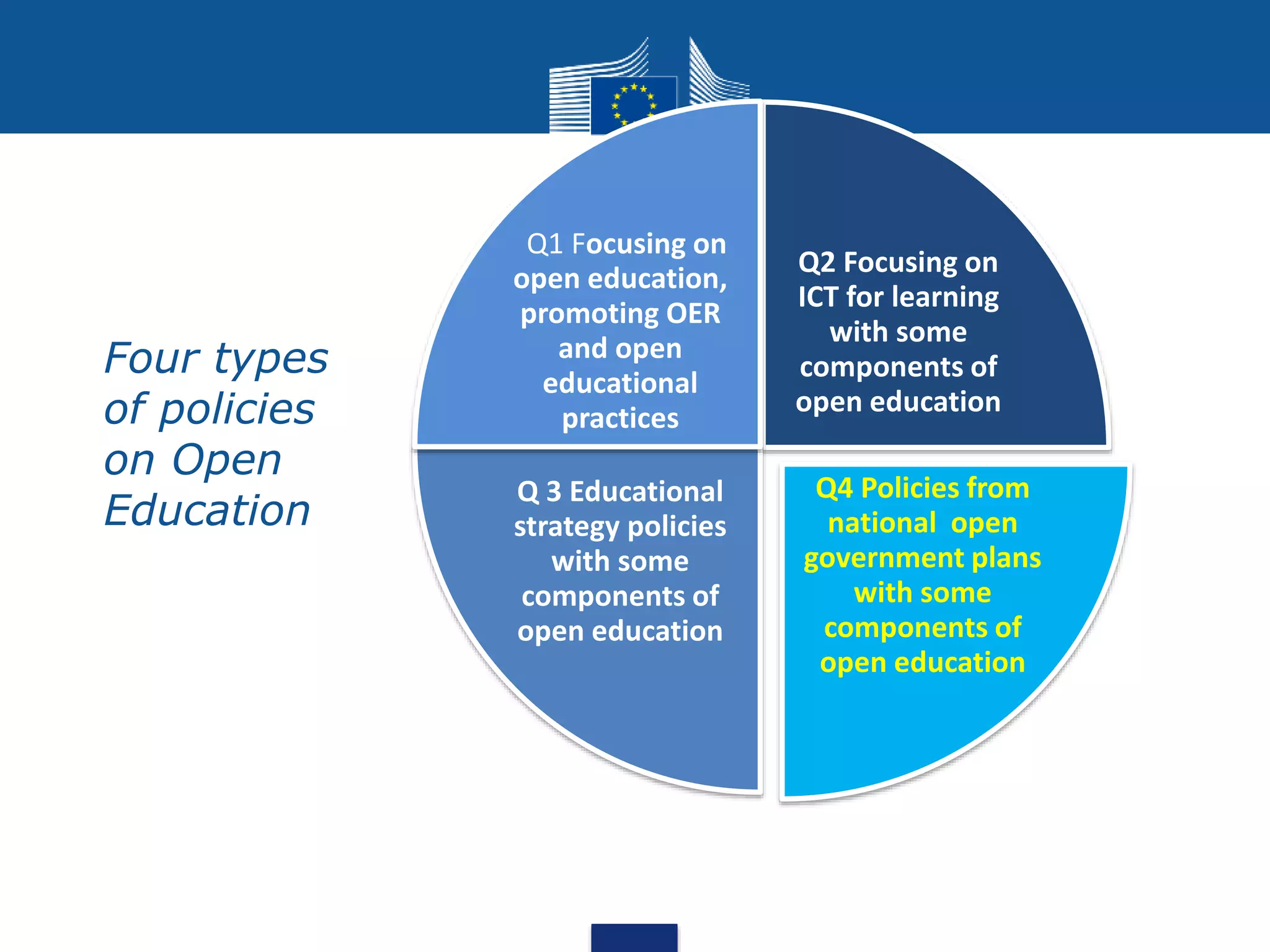
• Four types
of policies
on Open
Education
Q2 Focusing on
ICT for learning
with some
components of
open education
Q4 Policies from
national open
government plans
with some
components of
open education
Q 3 Educational
strategy policies
with some
components of
open education
Q1 Focusing on
open education,
promoting OER
and open
educational
practices
Source: Case studies on policy approaches to OE,
JRC 2017 in collaboration with UNIR
• Four types
of policies
on Open
Education
Q2 Focusing on
ICT for learning
with some
components of
open education
Q4 Policies from
national open
government plans
with some
components of
open education
Q 3 Educational
strategy policies
with some
components of
open education
Q1 Focusing on
open education,
promoting OER
and open
educational
practices
Policy examples
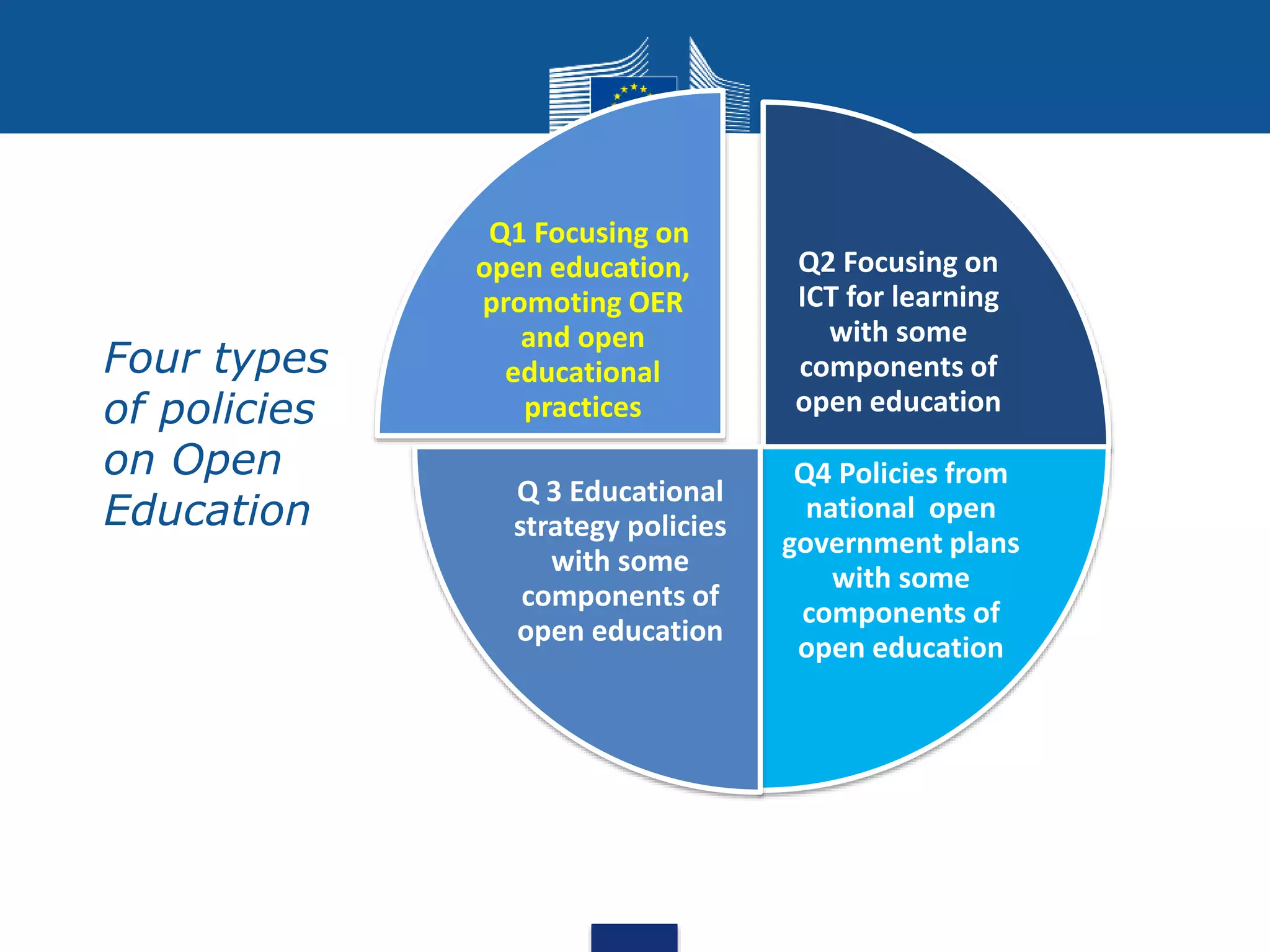
• France’s Fun MOOC (National, Quadrant 1:
OE; OER and OEP)
• “In FUN MOOC universities benefit from traffic, learners and visibility. It is known
that these three aspects are very important for a successful MOOC strategy.
University membership in FUN MOOC is optional, but it is beneficial to universities to
become members because apart from these three aspects previously mentioned,
there is no cost related to infrastructure building. All is ready and available for
universities to use as they wish when they become members. They also benefit from
the platform's marketing and communication strategies. Fun MOOCs has 29
members, but under the umbrella of a 'member' there can be a network of
universities. In total, FUN MOOC has over 200 institutions using the platform, plus
external partners, which are in the range of 40 to date. ”
• ( Extract from ‘Policy Approaches to Open Education – EU Member States’, JRC 2017)
• Four types
of policies
on Open
Education
Q2 Focusing on
ICT for learning
with some
components of
open education
Q4 Policies from
national open
government plans
with some
components of
open education
Q 3 Educational
strategy policies
with some
components of
open education
Q1 Focusing on
open education,
promoting OER
and open
educational
practices
Policy examples
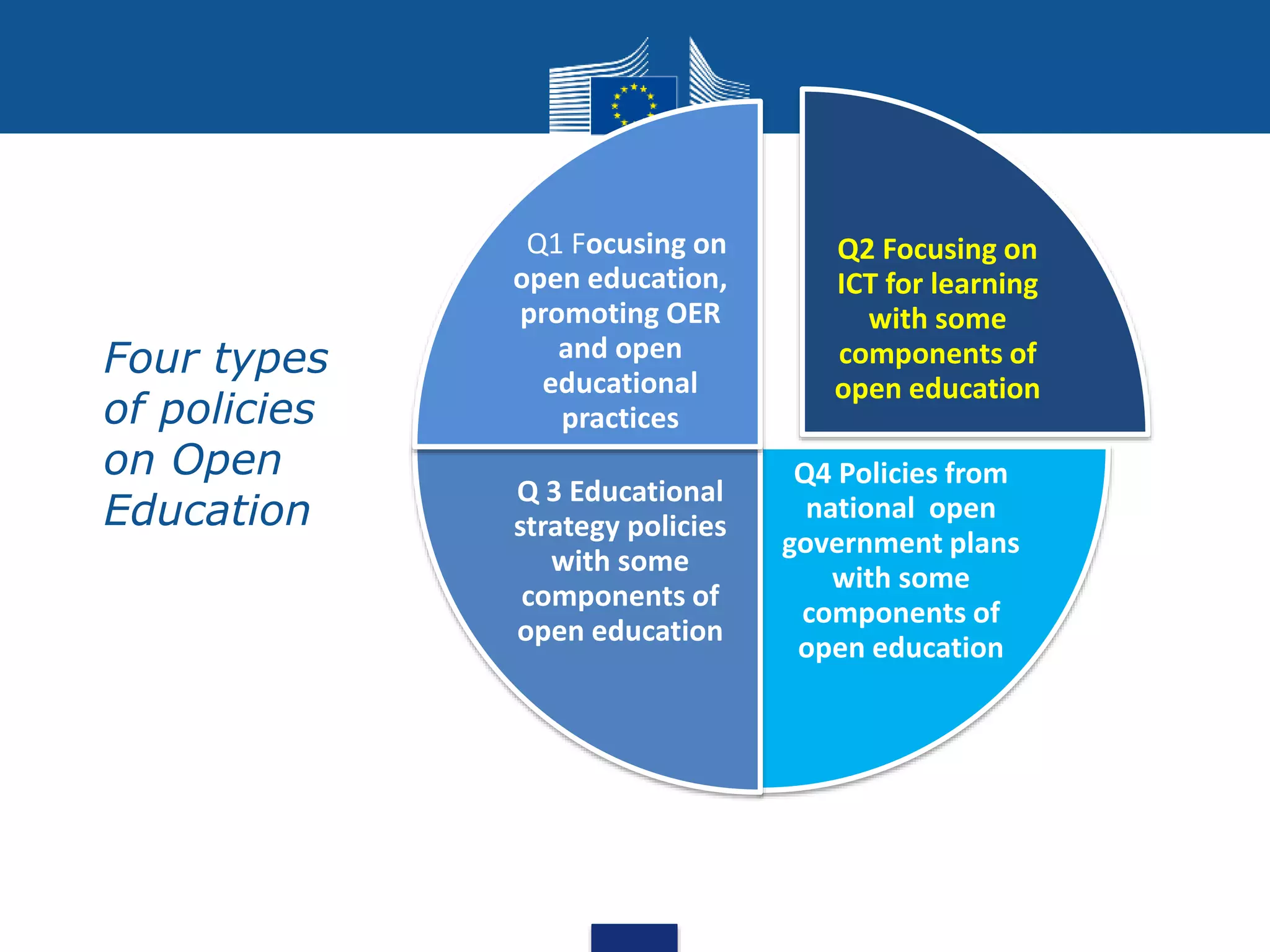
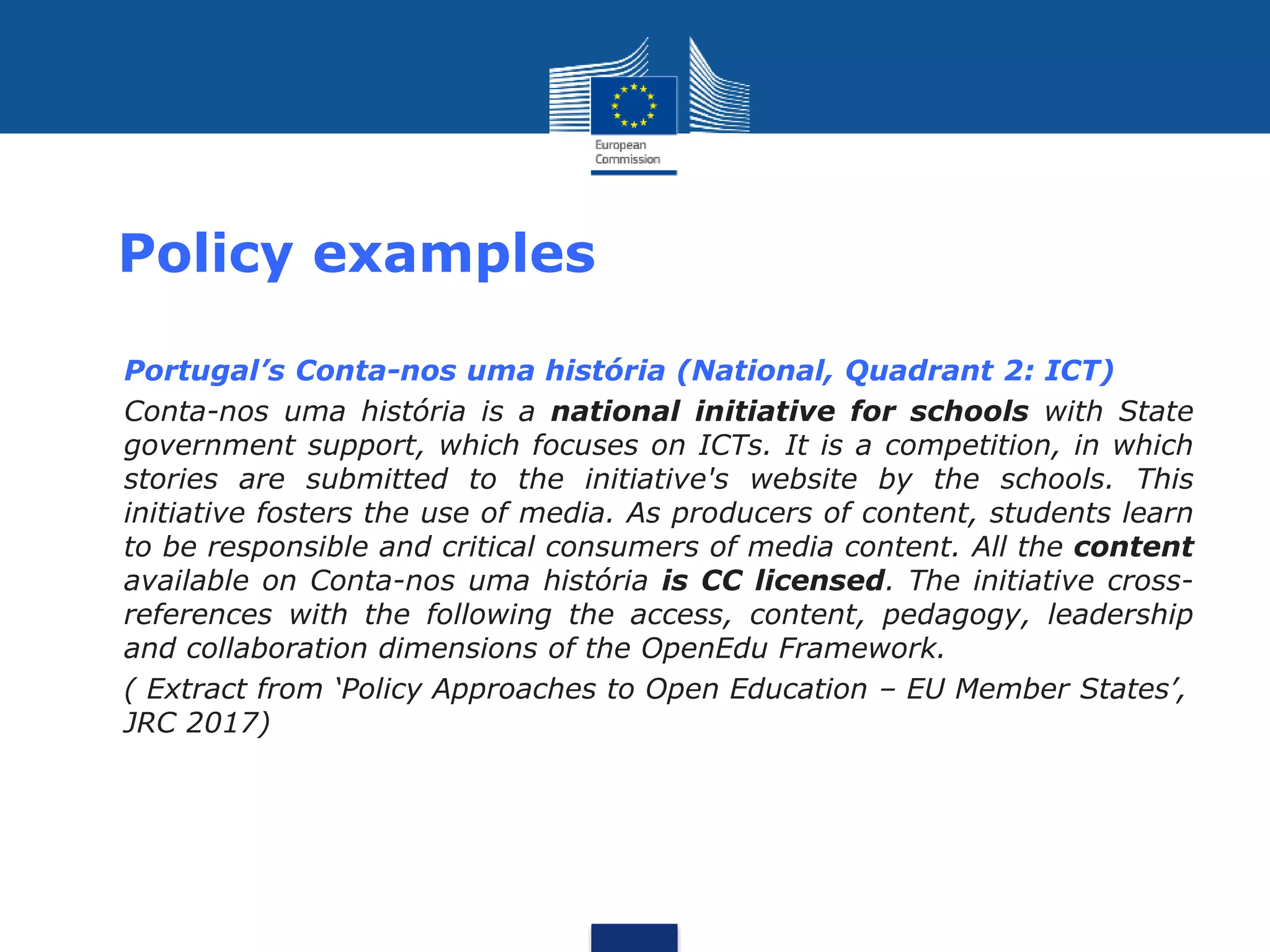
• Portugal’s Conta-nos uma história (National, Quadrant 2: ICT)
• Conta-nos uma história is a national initiative for schools with State
government support, which focuses on ICTs. It is a competition, in which
stories are submitted to the initiative's website by the schools. This
initiative fosters the use of media. As producers of content, students learn
to be responsible and critical consumers of media content. All the content
available on Conta-nos uma história is CC licensed. The initiative cross-
references with the following the access, content, pedagogy, leadership
and collaboration dimensions of the OpenEdu Framework.
• ( Extract from ‘Policy Approaches to Open Education – EU Member States’,
JRC 2017)
• Four types
of policies
on Open
Education
Q2 Focusing on
ICT for learning
with some
components of
open education
Q4 Policies from
national open
government plans
with some
components of
open education
Q 3 Educational
strategy policies
with some
components of
open education
Q1 Focusing on
open education,
promoting OER
and open
educational
practices
Policy Examples
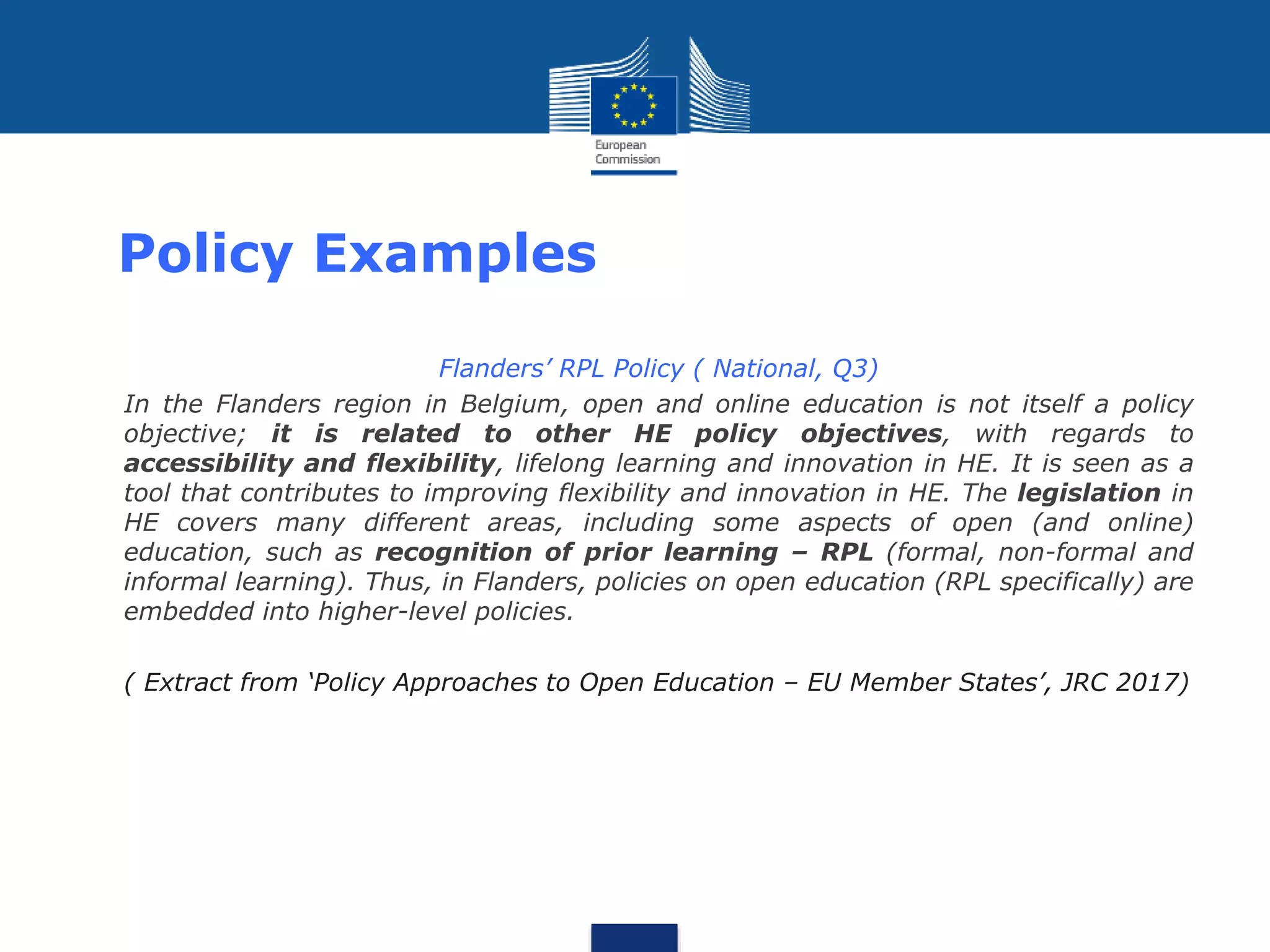
• Flanders’ RPL Policy ( National, Q3)
• In the Flanders region in Belgium, open and online education is not itself a policy
objective; it is related to other HE policy objectives, with regards to
accessibility and flexibility, lifelong learning and innovation in HE. It is seen as a
tool that contributes to improving flexibility and innovation in HE. The legislation in
HE covers many different areas, including some aspects of open (and online)
education, such as recognition of prior learning – RPL (formal, non-formal and
informal learning). Thus, in Flanders, policies on open education (RPL specifically) are
embedded into higher-level policies.
• ( Extract from ‘Policy Approaches to Open Education – EU Member States’, JRC 2017)
• Four types
of policies
on Open
Education
Q2 Focusing on
ICT for learning
with some
components of
open education
Q4 Policies from
national open
government plans
with some
components of
open education
Q 3 Educational
strategy policies
with some
components of
open education
Q1 Focusing on
open education,
promoting OER
and open
educational
practices
Policy examples
• Greece’s Action Plan on Open Government
(National, Q4)
• In Greece, the 3rd National Action Plan on Open Government 2016-2018 has a
clear commitment to open education.
• The two main projects (initiatives) of open education that were launched by the
Ministry as part of the Action Plan were Open Academic Lessons and the repository
Photodentro. These projects aimed to create open lessons on all academic levels
for everyone. Some of the policy dimensions of the 3rd National Action Plan on Open
Government 2016-2018 are: open data (access), open materials (OER), open
lessons (pedagogy), open collaboration, open research, and open source
(technology).
• ( Extract from ‘Policy Approaches to Open Education – EU Member States’, JRC 2017)
Challenge # 5
• How to create an ecosystem to foster
open education?
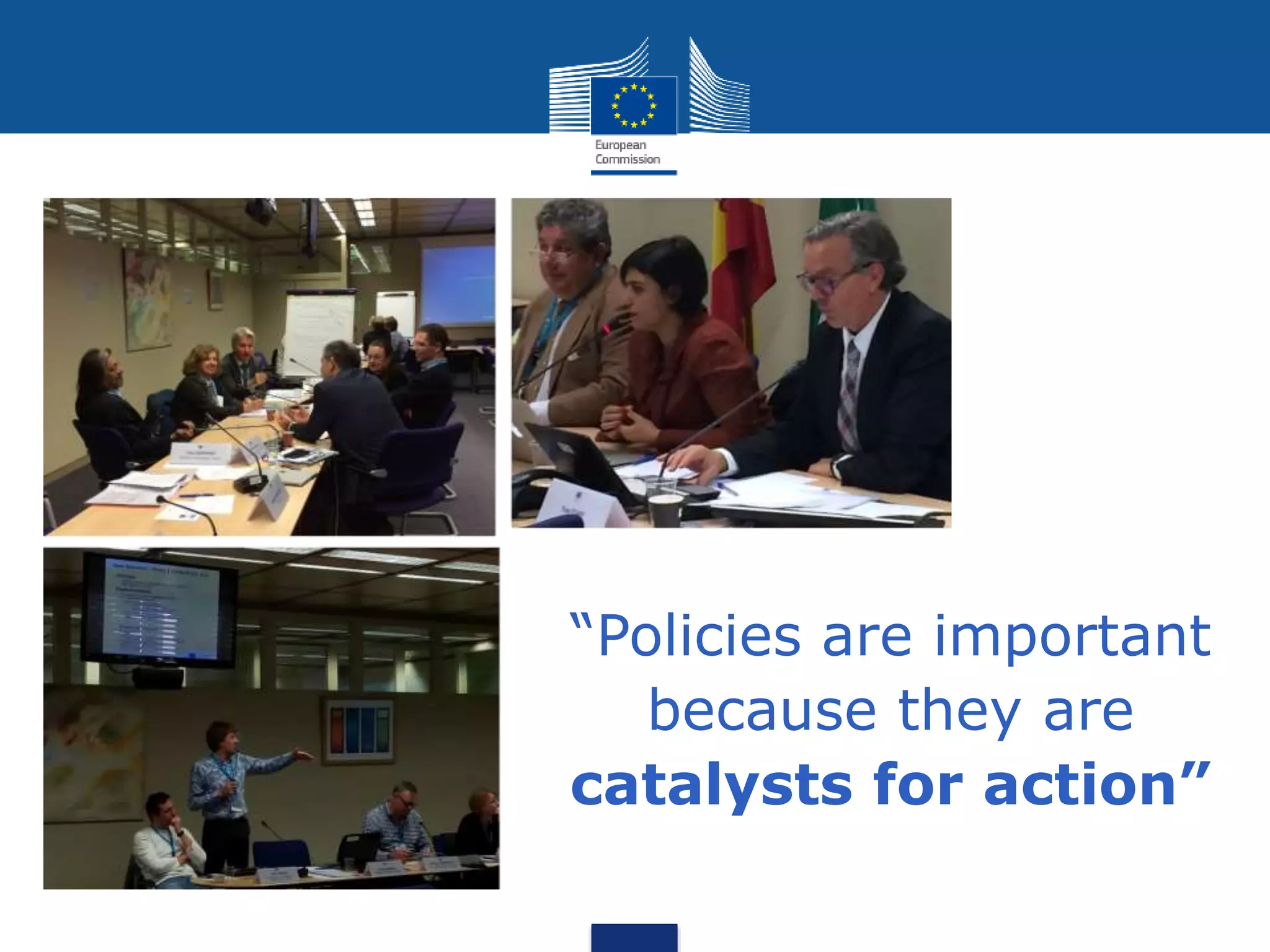
“Policies are important
because they are
catalysts for action”
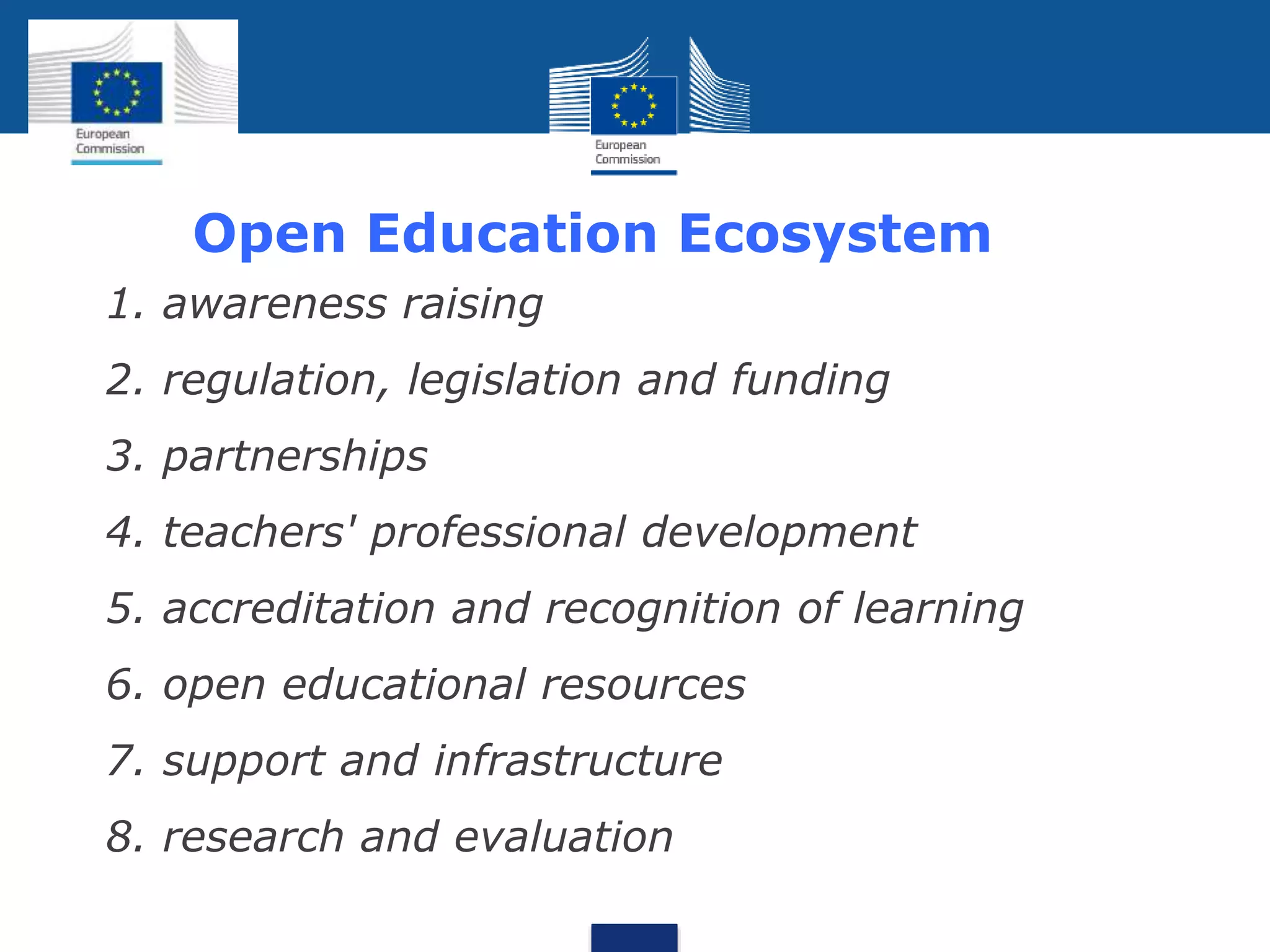
Open Education Ecosystem
 1. awareness raising
 2. regulation, legislation and funding
 3. partnerships
 4. teachers' professional development
 5. accreditation and recognition of learning
 6. open educational resources
 7. support and infrastructure
 8. research and evaluation
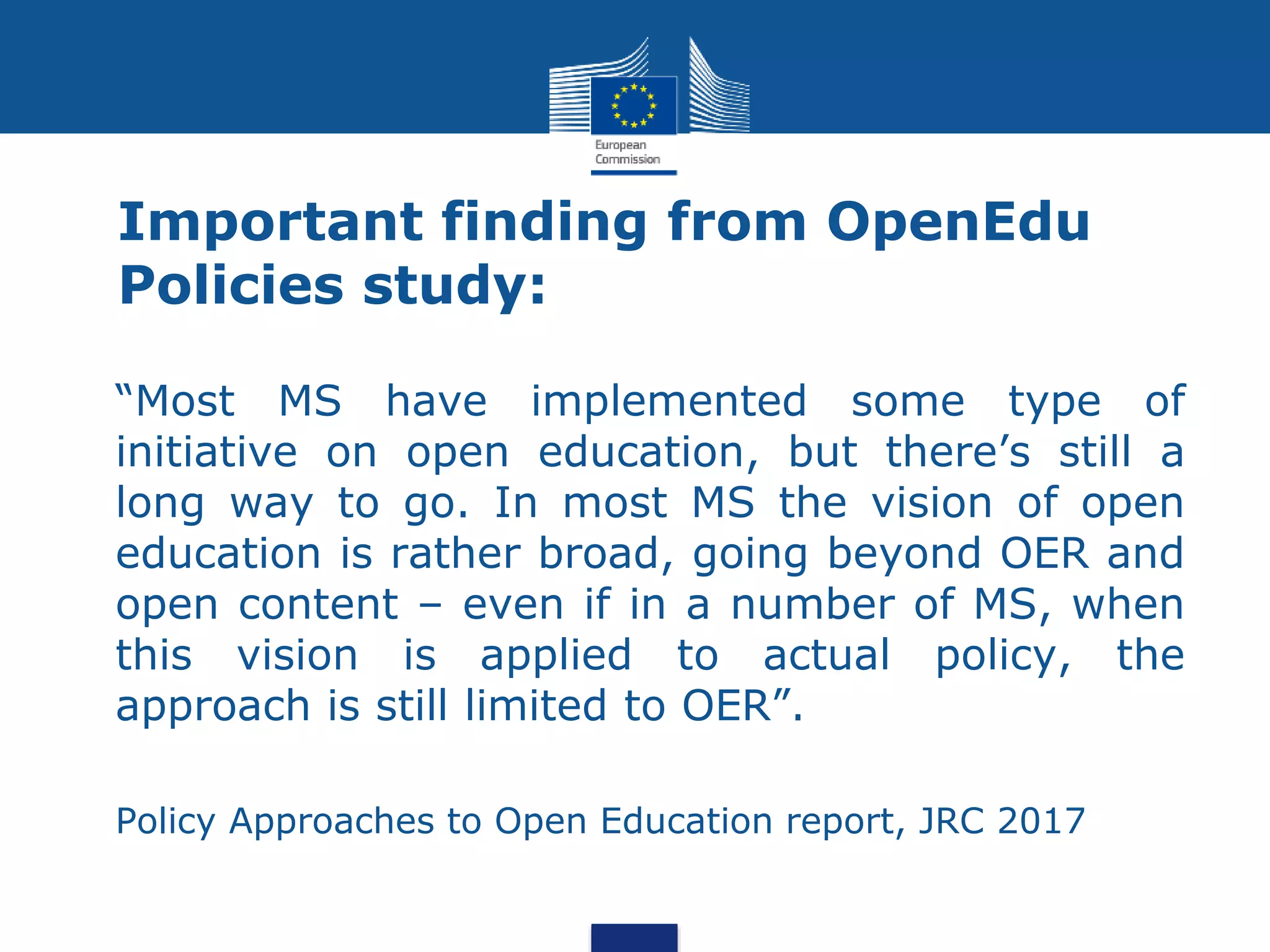
Important finding from OpenEdu
Policies study:
• “Most MS have implemented some type of
initiative on open education, but there’s still a
long way to go. In most MS the vision of open
education is rather broad, going beyond OER and
open content – even if in a number of MS, when
this vision is applied to actual policy, the
approach is still limited to OER”.
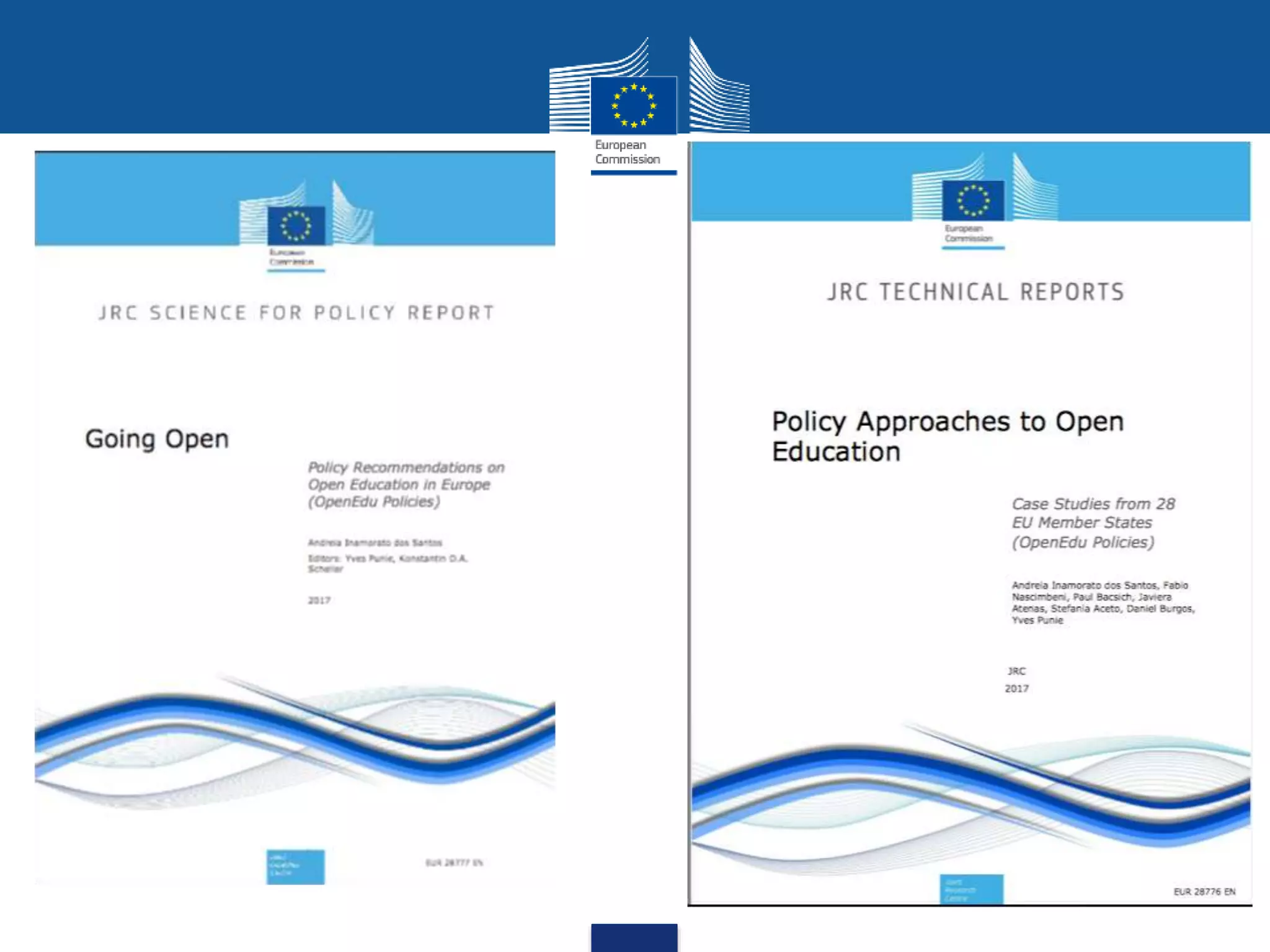
• Policy Approaches to Open Education report, JRC 2017
What’s next?
• …
• Challenge #6
• Strengthening institutional and national-level
leadership on open education
Current opportunities – policy
agenda:
 Creating the European Education Area by 2025
(Council REC, 2018)
 European Network of Universities (HE COMM, 2017)
 (Could we have OE contemplated in each network
sub-set?)
 New HE Plataform- one stop shop for HE
 New Europass Decision (accepted this month)
 How best integrate non-formal learning?
Communication on Mutual Recognition of
Diplomas (COMM,UPCOMING)
The most important shared understanding in
relation to open education is that it is not a case of
one size fits all. Flexibility is the key to operating
within this complex scenario, and it is also vital to
have a strategy in place.
Going Open report, JRC 2017
Bernard Shaw:
• “The reasonable man adapts himself to
the world; the unreasonable man persists
in trying to adapt the world to himself.
Therefore all progress depends on the
unreasonable man.”
Thank you
andreia-inamorato-dos.santos@ec.europa.eu
yves.punie@ec.europa.eu
https://ec.europa.eu/jrc/en/open-education

Going Open: Leveraging Open Education to Enhance Teaching and Learning in the Digital Age

  • 1.
    The European Commission’s scienceand knowledge service Joint Research Centre Going Open in Europe: Leveraging open education to enhance teaching and learning in the digital age Dr Andreia Inamorato OE Global, 2018 Delft, Netherlands 24-26th April 2018 @aisantos andreia-inamorato-dos.santos@ec.europa.eu
  • 2.
    Openness: modernisation of teachingand learning practices • More access routes, content, pathways, etc • Diverse pedagogical models • Use of digital technologies • Opportunities for innovation • + challenges! •
  • 3.
    The European Commissionand the Open Education movement  - Advisory role  - No binding instruments: Member States are autonomous regarding decisions about their educational systems  - Different directorates perform different roles: EAC (DG EDUCATION AND CULTURE) JRC ( DG JOINT RESEARCH CENTRE)
  • 4.
    Agenda setting instrument: Communications ACommunication sets out an Action Plan for the EC Three EC Communications point to open education: 2013: Opening up Education 2017: A Renewed Agenda for HE 2017: School Development and Excellent Teaching for a Great Start in Life
  • 6.
  • 7.
  • 8.
    DigComp (DG EMPL) EntreComp (DG EMPL) DigCompConsumers (DGJUST) OpenEdu Policies (DG EAC) MOOCKnowledge (DG EAC) Blockchain in Education (DG JRC) OPTEV (DG JRC) MOOCs4 inclusion (DG EAC) Learning Analytics (DG JRC) Anticipatory studies Policy & society OrganisationsIndividuals DigCompEdu (DG EAC) DigPolEdu (DG EAC) CPDmodels (DG EAC) ICTinPISA (DG EAC) CompuThink (DG JRC) DigCompOrg4Schools (DG EAC) OpenEdu (HE) (DG EAC) DigCompOrg (DG EAC) Current JRC research on Digital Age Learning and 21st Century Skills
  • 9.
    Challenge #1 Promote acommom understanding for contemporary open education
  • 10.
    Openness as acore value • Open education approaches education practices through a set of core values, based on transparency, sharing and collaboration. It proposes a shift in mindset in order to allow the implementation of a number of practices focused on openness. • Going Open Report, JRC 2017
  • 11.
  • 12.
  • 13.
    OpenCases OpenCred MoocknowledgeOpenSurvey OpenEduProject OpenEdu Framework 90+ stakeholders consulted 9 case studies 4 case studies 5 countries survey of learners OpenEdu supports the 2013 Communication ' Opening up Education: Innovative Teaching and Learning for all through New Technologies and Open Educational Resources in-house research Final Report
  • 14.
  • 15.
    Opening up Educationreport, JRC 2016 It can be downloaded from: http://bit.ly/openeduframework
  • 16.
    Challenge # 2 •Focus on key areas in which little research had been carried out
  • 19.
    Report content overview Identification and engaging with the key issues which are influencing policy-makers and other key stakeholders in considering the use of the Blockchain as a value-added proposition within an education landscape (social value proposition: 1. self-sovereignty and identity; 2: trust; 3. transparency and provenance; 4. immutability; 5. disintermediation and 6. collaboration)  Exploration of how education institutions and learners can use the technology as a transparent, trusted system for securing, sharing and verifying academic achievements in Europe ( e.g. ontology of certifications, smart contracts, digital signatures, grants issuing, etc)
  • 20.
    Challenge # 3 •Make EU-based research evidence on open education policies available for everyone
  • 21.
  • 22.
    OpenEdu Policies OpenEdu Policies OpenEdu Frameworkfor HE institutions Research on Member States' OE policies Workshop with policy makers on OE policies Policy Recommendations Case studies on 28 Member States
  • 24.
    Challenge # 4 •Make sense of those policies within the broad and diverse educational landscape that we have in Europe
  • 25.
  • 28.
    Correspondence of policy withthe OpenEdu Framework
  • 29.
    • Four types ofpolicies on Open Education Q2 Focusing on ICT for learning with some components of open education Q4 Policies from national open government plans with some components of open education Q 3 Educational strategy policies with some components of open education Q1 Focusing on open education, promoting OER and open educational practices Source: Case studies on policy approaches to OE, JRC 2017 in collaboration with UNIR
  • 30.
    • Four types ofpolicies on Open Education Q2 Focusing on ICT for learning with some components of open education Q4 Policies from national open government plans with some components of open education Q 3 Educational strategy policies with some components of open education Q1 Focusing on open education, promoting OER and open educational practices
  • 31.
    Policy examples • France’sFun MOOC (National, Quadrant 1: OE; OER and OEP) • “In FUN MOOC universities benefit from traffic, learners and visibility. It is known that these three aspects are very important for a successful MOOC strategy. University membership in FUN MOOC is optional, but it is beneficial to universities to become members because apart from these three aspects previously mentioned, there is no cost related to infrastructure building. All is ready and available for universities to use as they wish when they become members. They also benefit from the platform's marketing and communication strategies. Fun MOOCs has 29 members, but under the umbrella of a 'member' there can be a network of universities. In total, FUN MOOC has over 200 institutions using the platform, plus external partners, which are in the range of 40 to date. ” • ( Extract from ‘Policy Approaches to Open Education – EU Member States’, JRC 2017)
  • 32.
    • Four types ofpolicies on Open Education Q2 Focusing on ICT for learning with some components of open education Q4 Policies from national open government plans with some components of open education Q 3 Educational strategy policies with some components of open education Q1 Focusing on open education, promoting OER and open educational practices
  • 33.
    Policy examples • Portugal’sConta-nos uma história (National, Quadrant 2: ICT) • Conta-nos uma história is a national initiative for schools with State government support, which focuses on ICTs. It is a competition, in which stories are submitted to the initiative's website by the schools. This initiative fosters the use of media. As producers of content, students learn to be responsible and critical consumers of media content. All the content available on Conta-nos uma história is CC licensed. The initiative cross- references with the following the access, content, pedagogy, leadership and collaboration dimensions of the OpenEdu Framework. • ( Extract from ‘Policy Approaches to Open Education – EU Member States’, JRC 2017)
  • 34.
    • Four types ofpolicies on Open Education Q2 Focusing on ICT for learning with some components of open education Q4 Policies from national open government plans with some components of open education Q 3 Educational strategy policies with some components of open education Q1 Focusing on open education, promoting OER and open educational practices
  • 35.
    Policy Examples • Flanders’RPL Policy ( National, Q3) • In the Flanders region in Belgium, open and online education is not itself a policy objective; it is related to other HE policy objectives, with regards to accessibility and flexibility, lifelong learning and innovation in HE. It is seen as a tool that contributes to improving flexibility and innovation in HE. The legislation in HE covers many different areas, including some aspects of open (and online) education, such as recognition of prior learning – RPL (formal, non-formal and informal learning). Thus, in Flanders, policies on open education (RPL specifically) are embedded into higher-level policies. • ( Extract from ‘Policy Approaches to Open Education – EU Member States’, JRC 2017)
  • 36.
    • Four types ofpolicies on Open Education Q2 Focusing on ICT for learning with some components of open education Q4 Policies from national open government plans with some components of open education Q 3 Educational strategy policies with some components of open education Q1 Focusing on open education, promoting OER and open educational practices
  • 37.
    Policy examples • Greece’sAction Plan on Open Government (National, Q4) • In Greece, the 3rd National Action Plan on Open Government 2016-2018 has a clear commitment to open education. • The two main projects (initiatives) of open education that were launched by the Ministry as part of the Action Plan were Open Academic Lessons and the repository Photodentro. These projects aimed to create open lessons on all academic levels for everyone. Some of the policy dimensions of the 3rd National Action Plan on Open Government 2016-2018 are: open data (access), open materials (OER), open lessons (pedagogy), open collaboration, open research, and open source (technology). • ( Extract from ‘Policy Approaches to Open Education – EU Member States’, JRC 2017)
  • 38.
    Challenge # 5 •How to create an ecosystem to foster open education?
  • 40.
    “Policies are important becausethey are catalysts for action”
  • 41.
    Open Education Ecosystem 1. awareness raising  2. regulation, legislation and funding  3. partnerships  4. teachers' professional development  5. accreditation and recognition of learning  6. open educational resources  7. support and infrastructure  8. research and evaluation
  • 44.
    Important finding fromOpenEdu Policies study: • “Most MS have implemented some type of initiative on open education, but there’s still a long way to go. In most MS the vision of open education is rather broad, going beyond OER and open content – even if in a number of MS, when this vision is applied to actual policy, the approach is still limited to OER”. • Policy Approaches to Open Education report, JRC 2017
  • 45.
    What’s next? • … •Challenge #6 • Strengthening institutional and national-level leadership on open education
  • 46.
    Current opportunities –policy agenda:  Creating the European Education Area by 2025 (Council REC, 2018)  European Network of Universities (HE COMM, 2017)  (Could we have OE contemplated in each network sub-set?)  New HE Plataform- one stop shop for HE  New Europass Decision (accepted this month)  How best integrate non-formal learning? Communication on Mutual Recognition of Diplomas (COMM,UPCOMING)
  • 47.
    The most importantshared understanding in relation to open education is that it is not a case of one size fits all. Flexibility is the key to operating within this complex scenario, and it is also vital to have a strategy in place. Going Open report, JRC 2017
  • 48.
    Bernard Shaw: • “Thereasonable man adapts himself to the world; the unreasonable man persists in trying to adapt the world to himself. Therefore all progress depends on the unreasonable man.”
  • 49.

Editor's Notes

  • #3 Openness to enrich, not to replace
  • #10 Open Education (OE) is not only (or not just) about OER and MOOcs Open Education is about Opening up Education (OE), modernising and innovating our HE systems in Europe through the use of digital technologies There is no shared understanding what OE means (at all levels) Most universities do not seem to have an OE strategy If there is a strategy, it is usually not embedded within overall institutional strategy As a result: Ad-hoc, arbitrary and experimental activities Little collaboration and sharing of experiences
  • #50 European Network of universities: (Could we have OE contemplated in each network sub-set?) The research on open education carried out by the JRC is a contribution to the European Commission's Communication 'Opening up Education: Innovative Teaching and Learning for All Through New Technologies and OER' (EAC, 2013). It also contributes to the two most recent Communications "Renewed Agenda for Higher Education" and "School Development and Excellent Teaching for a Great Start in Life" (EAC, 2017). In addition, OpenEdu Policies aims to support the Education and Training 2020 agenda, the new priorities of which include open education. http://europa.eu/rapid/press-release_IP-13-859_en.htm http://europa.eu/rapid/press-release_IP-15-5568_en.htm