MT. NUSRAT JAHAN TOMA
ID: 1505EEE00076
BATCH:5TH
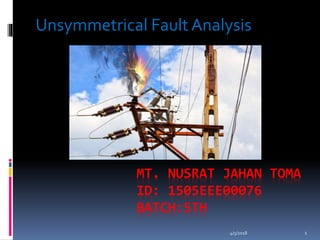
Unsymmetrical Fault Analysis
4/5/2018 1
CONTENTS
 Definition
 Types
 Description
 Problems
 Solution
4/5/2018 2
What is unsymmetrical fault?
Unsymmetrical faults are the faults which leads
unequal currents with unequal phase shifts in a
three phase system.
The unsymmetrical fault occurs in a system due
to presence of an open circuit or short circuit of
transmission or distribution line. It can occur
either by natural disturbances or by manual
errors.The natural disturbances are heavy wind
speed, ice loading on the lines, lightening strokes
and other natural disasters.
4/5/2018 3
Fault Types
 Balanced faults: (5%)
1.Three phase to ground
2.Three phase
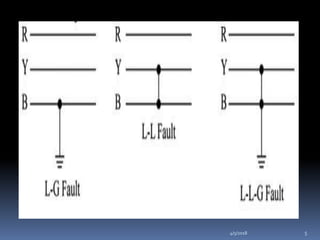
 Unbalanced faults:
1.Single line to ground (60-75%)
2.Double line to ground(15-25%)
3.Line to line (5-15%)
4/5/2018 4
4/5/2018 5
What happened when fault occurred……
 Change in the phase sequences
 The characteristic values (such as impedance) of the machines may
change from existing values to different values till the fault is
cleared.
 There may be lot of probabilities of faults to appear in the power
system network, including lighting, wind, tree falling on lines,
apparatus failure, etc.
 The faults in power system causes over current, under voltage,
unbalance of the phases, reversed power and high voltage surges.
This results in the interruption of the normal operation of the
network, failure of equipments, electrical fires, etc.
 Infinite current flows to the conductor and voltage becomes zero.
4/5/2018 6
How to get rid of this fault?
 Two methods are used to remove unsymmetrical
fault.
1.Kirchoff’s law
2.Symmetrical components
Symmetrical component method is preferred
because:
1.It is very simple method
2.It provides a useful tool for the protection
particularly in connection with tracking out of
fault currents.
4/5/2018 7
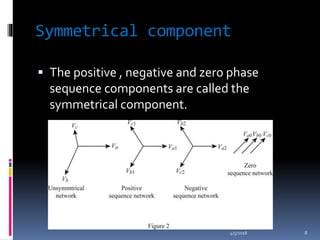
Symmetrical component
 The positive , negative and zero phase
sequence components are called the
symmetrical component.
4/5/2018 8
4/5/2018 9

Unsymmetrical fault analysis

  • 1.
    MT. NUSRAT JAHANTOMA ID: 1505EEE00076 BATCH:5TH Unsymmetrical Fault Analysis 4/5/2018 1
  • 2.
    CONTENTS  Definition  Types Description  Problems  Solution 4/5/2018 2
  • 3.
    What is unsymmetricalfault? Unsymmetrical faults are the faults which leads unequal currents with unequal phase shifts in a three phase system. The unsymmetrical fault occurs in a system due to presence of an open circuit or short circuit of transmission or distribution line. It can occur either by natural disturbances or by manual errors.The natural disturbances are heavy wind speed, ice loading on the lines, lightening strokes and other natural disasters. 4/5/2018 3
  • 4.
    Fault Types  Balancedfaults: (5%) 1.Three phase to ground 2.Three phase  Unbalanced faults: 1.Single line to ground (60-75%) 2.Double line to ground(15-25%) 3.Line to line (5-15%) 4/5/2018 4
  • 5.
  • 6.
    What happened whenfault occurred……  Change in the phase sequences  The characteristic values (such as impedance) of the machines may change from existing values to different values till the fault is cleared.  There may be lot of probabilities of faults to appear in the power system network, including lighting, wind, tree falling on lines, apparatus failure, etc.  The faults in power system causes over current, under voltage, unbalance of the phases, reversed power and high voltage surges. This results in the interruption of the normal operation of the network, failure of equipments, electrical fires, etc.  Infinite current flows to the conductor and voltage becomes zero. 4/5/2018 6
  • 7.
    How to getrid of this fault?  Two methods are used to remove unsymmetrical fault. 1.Kirchoff’s law 2.Symmetrical components Symmetrical component method is preferred because: 1.It is very simple method 2.It provides a useful tool for the protection particularly in connection with tracking out of fault currents. 4/5/2018 7
  • 8.
    Symmetrical component  Thepositive , negative and zero phase sequence components are called the symmetrical component. 4/5/2018 8
  • 9.