09/30/2024 1
Unsafe Abortion
Dr Zainab M Hassan
Department of Family Medicine FMCJ
09/30/2024 2
Outline
• Introduction
• Definition
• Epidemiology
• Abortion laws in Nigeria
• Risk factors
• Methods of unsafe abortion
• Clinical presentation
• Diagnosis
• Management
• Post Abortion Care (PAC)
• Prevention
• Conclusion
• References
09/30/2024 3
Pre Test
• 1. Providers of unsafe abortion includes
• a) Chemist
• b) Self
• c) Nurses
• d) All of the above
• e) None of the above
09/30/2024 4
Pre Test
• 2.The following are risk factors for unsafe abortion except
• a) Low socioeconomic status
• b) Stigma for unwanted pregnancy
• c) Knowledge about safe abortion services
• d) Desire to pursue education
• e) Avoiding parental disappointment
09/30/2024 5
Pre Test
• 3. Methods of unsafe abortion includes
• a) Oral toxic fluids
• b) Vaginal herbal preparations
• c) Intra-uterine foreign bodies
• d) None of the above
• e) All of the above
09/30/2024 6
Pre Test
• 4. Late complication of unsafe abortion include
• a) Bleeding
• b)Infertility
• c) sepsis
• d) perforation of the uterus
• e) Cervical tear
09/30/2024 7
Pre Test
• 5. Barriers to safe abortion includes
• a) Restricted abortion laws
• b) Cultural and religious misconceptions
• c) Poverty
• d) All of the above
• e) None of the above
09/30/2024 8
Pre Test
• 6. One of the following is a component of safe Post Abortion Care
• a) Restricted abortion laws
• b) Training of practitioners on safe abortion methods
• c) Health education on reproductive health in school
• d) Contraceptive and family planning services
• e) Better access to healthcare services
09/30/2024 9
Introduction
• Abortion is the expulsion or removal of the products of conception
before the age of viability.
• Abortion whether safe or unsafe is a common event globally.
• Unsafe abortion is one of the leading causes of maternal morbidity
and mortality that is preventable.
09/30/2024 10
Introduction
• In sub-Saharan Africa abortion is only legal when performed to save
the mother.
• Abortion remain clandestine in Nigeria as such the prevalence of
unsafe abortion is on rise.
• Therefore many women are treated for complications of unsafe
abortion
09/30/2024 11
Definition
• Unsafe abortion as a procedure of pregnancy termination either by
persons lacking the necessary skills or in an environment that does
not conform to minimal medical standards or both (WHO).
09/30/2024 12
Epidemiology
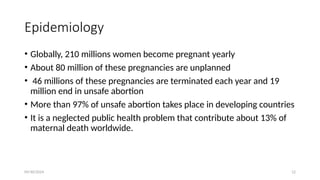
• Globally, 210 millions women become pregnant yearly
• About 80 million of these pregnancies are unplanned
• 46 millions of these pregnancies are terminated each year and 19
million end in unsafe abortion
• More than 97% of unsafe abortion takes place in developing countries
• It is a neglected public health problem that contribute about 13% of
maternal death worldwide.
09/30/2024 13
Epidemiology
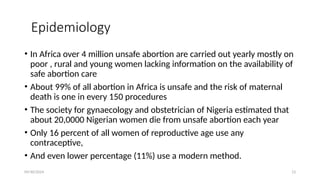
• In Africa over 4 million unsafe abortion are carried out yearly mostly on
poor , rural and young women lacking information on the availability of
safe abortion care
• About 99% of all abortion in Africa is unsafe and the risk of maternal
death is one in every 150 procedures
• The society for gynaecology and obstetrician of Nigeria estimated that
about 20,0000 Nigerian women die from unsafe abortion each year
• Only 16 percent of all women of reproductive age use any
contraceptive,
• And even lower percentage (11%) use a modern method.
09/30/2024 14
Epidemiology
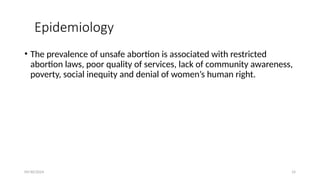
• The prevalence of unsafe abortion is associated with restricted
abortion laws, poor quality of services, lack of community awareness,
poverty, social inequity and denial of women’s human right.
09/30/2024 15
Abortion laws in Nigeria
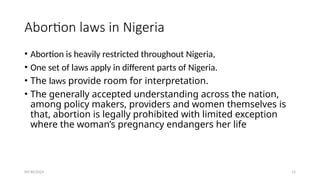
• Abortion is heavily restricted throughout Nigeria,
• One set of laws apply in different parts of Nigeria.
• The laws provide room for interpretation.
• The generally accepted understanding across the nation,
among policy makers, providers and women themselves is
that, abortion is legally prohibited with limited exception
where the woman’s pregnancy endangers her life
09/30/2024 16
Abortion laws in Nigeria
• In the Southern Nigeria, the relevant provisions are sections 228,
229, 230, 297, and 328 of the Criminal Code.18
• In the North, the relevant provisions are sections 232, 233, 234, 235
and 236 of the Penal Code.19
• For the states that have adopted the Sharia Legal System, abortion is
also criminalized by the Sharia penal code law.
09/30/2024 17
Risk factors for unsafe Abortion
• Lack of availability/knowledge of safe abortion services
• Socioeconomic conditions/status
 unemployment
 lack of partner support of pregnancy
 schooling
 non readiness to cater for a baby
• Religious/cultural misconception of safe abortion
• Stigma of unwanted pregnancy
09/30/2024 18
Risk factors
• Desire to bear children only after marriage
• Avoiding parental disappointment/resentment
• Desire to pursue education
09/30/2024 19
Methods of unsafe Abortion
• Oral toxic fluids like bleach
• Injectable medication
• Vaginal herbal preparation
• Intrauterine foreign bodies
• Trauma to the abdomen
• D and C by unskilled providers
09/30/2024 20
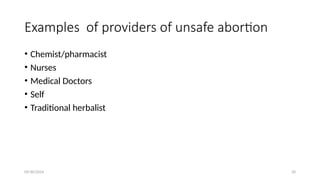
Examples of providers of unsafe abortion
• Chemist/pharmacist
• Nurses
• Medical Doctors
• Self
• Traditional herbalist
09/30/2024 21
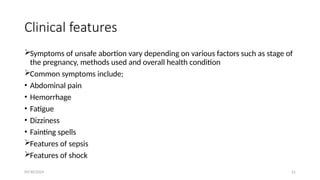
Clinical features
Symptoms of unsafe abortion vary depending on various factors such as stage of
the pregnancy, methods used and overall health condition
Common symptoms include;
• Abdominal pain
• Hemorrhage
• Fatigue
• Dizziness
• Fainting spells
Features of sepsis
Features of shock
09/30/2024 22
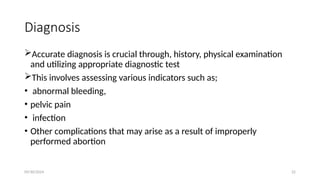
Diagnosis
Accurate diagnosis is crucial through, history, physical examination
and utilizing appropriate diagnostic test
This involves assessing various indicators such as;
• abnormal bleeding,
• pelvic pain
• infection
• Other complications that may arise as a result of improperly
performed abortion
09/30/2024 23
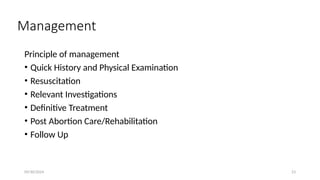
Management
Principle of management
• Quick History and Physical Examination
• Resuscitation
• Relevant Investigations
• Definitive Treatment
• Post Abortion Care/Rehabilitation
• Follow Up
09/30/2024 24
Management
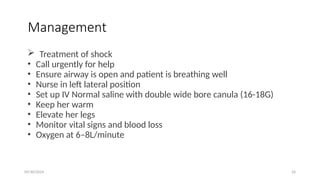
 Treatment of shock
• Call urgently for help
• Ensure airway is open and patient is breathing well
• Nurse in left lateral position
• Set up IV Normal saline with double wide bore canula (16-18G)
• Keep her warm
• Elevate her legs
• Monitor vital signs and blood loss
• Oxygen at 6–8L/minute
09/30/2024 25
Management
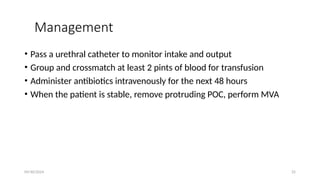
• Pass a urethral catheter to monitor intake and output
• Group and crossmatch at least 2 pints of blood for transfusion
• Administer antibiotics intravenously for the next 48 hours
• When the patient is stable, remove protruding POC, perform MVA
09/30/2024 26
Management
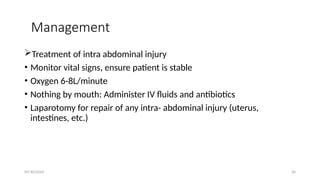
Treatment of intra abdominal injury
• Monitor vital signs, ensure patient is stable
• Oxygen 6 8L/minute
‑
• Nothing by mouth: Administer IV fluids and antibiotics
• Laparotomy for repair of any intra- abdominal injury (uterus,
intestines, etc.)
09/30/2024 27
Complications of unsafe abortion
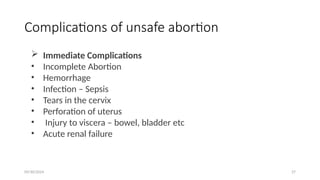
 Immediate Complications
• Incomplete Abortion
• Hemorrhage
• Infection – Sepsis
• Tears in the cervix
• Perforation of uterus
• Injury to viscera – bowel, bladder etc
• Acute renal failure
09/30/2024 28
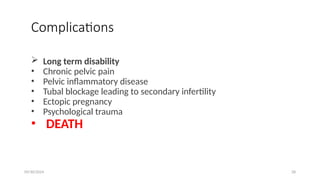
Complications
 Long term disability
• Chronic pelvic pain
• Pelvic inflammatory disease
• Tubal blockage leading to secondary infertility
• Ectopic pregnancy
• Psychological trauma
• DEATH
09/30/2024 29
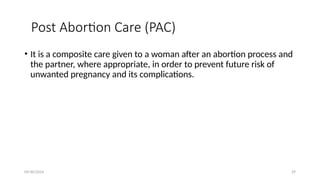
Post Abortion Care (PAC)
• It is a composite care given to a woman after an abortion process and
the partner, where appropriate, in order to prevent future risk of
unwanted pregnancy and its complications.
09/30/2024 30
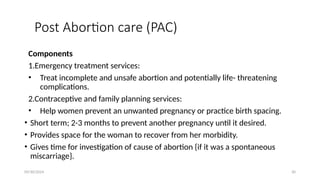
Post Abortion care (PAC)
Components
1.Emergency treatment services:
• Treat incomplete and unsafe abortion and potentially life- threatening
complications.
2.Contraceptive and family planning services:
• Help women prevent an unwanted pregnancy or practice birth spacing.
• Short term; 2-3 months to prevent another pregnancy until it desired.
• Provides space for the woman to recover from her morbidity.
• Gives time for investigation of cause of abortion {if it was a spontaneous
miscarriage}.
09/30/2024 31
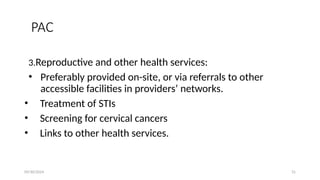
PAC
3.Reproductive and other health services:
• Preferably provided on-site, or via referrals to other
accessible facilities in providers’ networks.
• Treatment of STIs
• Screening for cervical cancers
• Links to other health services.
09/30/2024 32
PAC
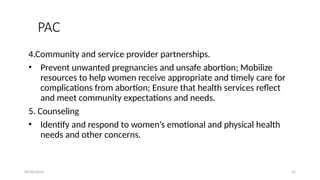
4.Community and service provider partnerships.
• Prevent unwanted pregnancies and unsafe abortion; Mobilize
resources to help women receive appropriate and timely care for
complications from abortion; Ensure that health services reflect
and meet community expectations and needs.
5. Counseling
• Identify and respond to women’s emotional and physical health
needs and other concerns.
09/30/2024 33
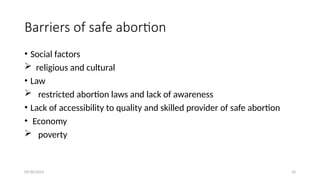
Barriers of safe abortion
• Social factors
 religious and cultural
• Law
 restricted abortion laws and lack of awareness
• Lack of accessibility to quality and skilled provider of safe abortion
• Economy
 poverty
09/30/2024 34
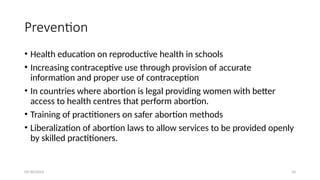
Prevention
• Health education on reproductive health in schools
• Increasing contraceptive use through provision of accurate
information and proper use of contraception
• In countries where abortion is legal providing women with better
access to health centres that perform abortion.
• Training of practitioners on safer abortion methods
• Liberalization of abortion laws to allow services to be provided openly
by skilled practitioners.
09/30/2024 35
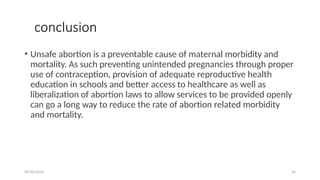
conclusion
• Unsafe abortion is a preventable cause of maternal morbidity and
mortality. As such preventing unintended pregnancies through proper
use of contraception, provision of adequate reproductive health
education in schools and better access to healthcare as well as
liberalization of abortion laws to allow services to be provided openly
can go a long way to reduce the rate of abortion related morbidity
and mortality.
09/30/2024 36
References
• Haddad LB, Nour NM, unsafe abortion; unnecessary maternal mortality Review in
Obstetric and Gynaecology, 2009,2(2); 122
• Gebremedlin M, Semahegin A, Usmael T, Tesforge G, unsafe abortion and
associated factors among reproductive aged women in sub-Saharan Africa;a
protocol for systematic review and meta analysis, systematic reviews 2018; 7;1-5
• Raufu A.unsafe abortion cause 20,0000 deaths a yearin Nigeria. BMJ, 2002;
325(737); 988.
• Okorie PC, Abayomi OA, Abortion laws in Nigeria; a case for reform. Annual
survey of international and comparative law. 2019, 23(1); 165.
• Helen Bickerstaff and Louisse C Kenny, Ten Teachers Gynaecology,20th
edition,
New York,2017.
09/30/2024 37
References
• Bankole, A., Adewole, I., Hussain, R., Awolude, O.,Singh, S., Akinyemi, J. (2015).
The incidence of abortion in Nigeria. International Perspectives on Sexual and
Reproductive Health, 41(4):170–181.
• World Health Organization. (2014). Trends in maternal mortality: 1990 to 2013.
Estimates by WHO, UNICEF,UNFPA, The World Bank and the United Nations
Population Division. Geneva: WHO.
• Unsafe Abortion: Global and Regional estimates of the incidence of Unsafe
Abortion and associated mortality in 2008, 3rd ed. Geneva, World Health
Organization, 2011.
09/30/2024 38
References
• Bamniya A, Verma S. The study of knowledge, attitude and practice about abortion and
technology at the tertiary centre in the region of Mewar, Rajasthan, India. Int J
ReprodContraception, Obstet Gynecol. 2018;7(8):3320–4.
• Ganatra B, Tunçalp Ö, Johnston HB, Johnson BR, Gülmezoglu AM, Temmerman M.From
concept to measurement: Operationalizing WHO’s definition of unsafe abor1.Ganatra B,
Tunçalp Ö, Johnston HB, Johnson BR, Gülmezoglu AM, Temmerman M.From concept to
measurement: Operationalizing WHO’s definition of unsafe abortion.Vol. 92, Bulletin. Bull
World Health Organ [Internet]. 2014;92(3):155. [cited 2020 04 23].Available from: doi:
http://dx.doi.org/10.2471/BLT.14.136333
09/30/2024 39
THANK YOU FOR
LISTENING

Unsafe Abortion . And post abortion care

  • 1.
    09/30/2024 1 Unsafe Abortion DrZainab M Hassan Department of Family Medicine FMCJ
  • 2.
    09/30/2024 2 Outline • Introduction •Definition • Epidemiology • Abortion laws in Nigeria • Risk factors • Methods of unsafe abortion • Clinical presentation • Diagnosis • Management • Post Abortion Care (PAC) • Prevention • Conclusion • References
  • 3.
    09/30/2024 3 Pre Test •1. Providers of unsafe abortion includes • a) Chemist • b) Self • c) Nurses • d) All of the above • e) None of the above
  • 4.
    09/30/2024 4 Pre Test •2.The following are risk factors for unsafe abortion except • a) Low socioeconomic status • b) Stigma for unwanted pregnancy • c) Knowledge about safe abortion services • d) Desire to pursue education • e) Avoiding parental disappointment
  • 5.
    09/30/2024 5 Pre Test •3. Methods of unsafe abortion includes • a) Oral toxic fluids • b) Vaginal herbal preparations • c) Intra-uterine foreign bodies • d) None of the above • e) All of the above
  • 6.
    09/30/2024 6 Pre Test •4. Late complication of unsafe abortion include • a) Bleeding • b)Infertility • c) sepsis • d) perforation of the uterus • e) Cervical tear
  • 7.
    09/30/2024 7 Pre Test •5. Barriers to safe abortion includes • a) Restricted abortion laws • b) Cultural and religious misconceptions • c) Poverty • d) All of the above • e) None of the above
  • 8.
    09/30/2024 8 Pre Test •6. One of the following is a component of safe Post Abortion Care • a) Restricted abortion laws • b) Training of practitioners on safe abortion methods • c) Health education on reproductive health in school • d) Contraceptive and family planning services • e) Better access to healthcare services
  • 9.
    09/30/2024 9 Introduction • Abortionis the expulsion or removal of the products of conception before the age of viability. • Abortion whether safe or unsafe is a common event globally. • Unsafe abortion is one of the leading causes of maternal morbidity and mortality that is preventable.
  • 10.
    09/30/2024 10 Introduction • Insub-Saharan Africa abortion is only legal when performed to save the mother. • Abortion remain clandestine in Nigeria as such the prevalence of unsafe abortion is on rise. • Therefore many women are treated for complications of unsafe abortion
  • 11.
    09/30/2024 11 Definition • Unsafeabortion as a procedure of pregnancy termination either by persons lacking the necessary skills or in an environment that does not conform to minimal medical standards or both (WHO).
  • 12.
    09/30/2024 12 Epidemiology • Globally,210 millions women become pregnant yearly • About 80 million of these pregnancies are unplanned • 46 millions of these pregnancies are terminated each year and 19 million end in unsafe abortion • More than 97% of unsafe abortion takes place in developing countries • It is a neglected public health problem that contribute about 13% of maternal death worldwide.
  • 13.
    09/30/2024 13 Epidemiology • InAfrica over 4 million unsafe abortion are carried out yearly mostly on poor , rural and young women lacking information on the availability of safe abortion care • About 99% of all abortion in Africa is unsafe and the risk of maternal death is one in every 150 procedures • The society for gynaecology and obstetrician of Nigeria estimated that about 20,0000 Nigerian women die from unsafe abortion each year • Only 16 percent of all women of reproductive age use any contraceptive, • And even lower percentage (11%) use a modern method.
  • 14.
    09/30/2024 14 Epidemiology • Theprevalence of unsafe abortion is associated with restricted abortion laws, poor quality of services, lack of community awareness, poverty, social inequity and denial of women’s human right.
  • 15.
    09/30/2024 15 Abortion lawsin Nigeria • Abortion is heavily restricted throughout Nigeria, • One set of laws apply in different parts of Nigeria. • The laws provide room for interpretation. • The generally accepted understanding across the nation, among policy makers, providers and women themselves is that, abortion is legally prohibited with limited exception where the woman’s pregnancy endangers her life
  • 16.
    09/30/2024 16 Abortion lawsin Nigeria • In the Southern Nigeria, the relevant provisions are sections 228, 229, 230, 297, and 328 of the Criminal Code.18 • In the North, the relevant provisions are sections 232, 233, 234, 235 and 236 of the Penal Code.19 • For the states that have adopted the Sharia Legal System, abortion is also criminalized by the Sharia penal code law.
  • 17.
    09/30/2024 17 Risk factorsfor unsafe Abortion • Lack of availability/knowledge of safe abortion services • Socioeconomic conditions/status  unemployment  lack of partner support of pregnancy  schooling  non readiness to cater for a baby • Religious/cultural misconception of safe abortion • Stigma of unwanted pregnancy
  • 18.
    09/30/2024 18 Risk factors •Desire to bear children only after marriage • Avoiding parental disappointment/resentment • Desire to pursue education
  • 19.
    09/30/2024 19 Methods ofunsafe Abortion • Oral toxic fluids like bleach • Injectable medication • Vaginal herbal preparation • Intrauterine foreign bodies • Trauma to the abdomen • D and C by unskilled providers
  • 20.
    09/30/2024 20 Examples ofproviders of unsafe abortion • Chemist/pharmacist • Nurses • Medical Doctors • Self • Traditional herbalist
  • 21.
    09/30/2024 21 Clinical features Symptomsof unsafe abortion vary depending on various factors such as stage of the pregnancy, methods used and overall health condition Common symptoms include; • Abdominal pain • Hemorrhage • Fatigue • Dizziness • Fainting spells Features of sepsis Features of shock
  • 22.
    09/30/2024 22 Diagnosis Accurate diagnosisis crucial through, history, physical examination and utilizing appropriate diagnostic test This involves assessing various indicators such as; • abnormal bleeding, • pelvic pain • infection • Other complications that may arise as a result of improperly performed abortion
  • 23.
    09/30/2024 23 Management Principle ofmanagement • Quick History and Physical Examination • Resuscitation • Relevant Investigations • Definitive Treatment • Post Abortion Care/Rehabilitation • Follow Up
  • 24.
    09/30/2024 24 Management  Treatmentof shock • Call urgently for help • Ensure airway is open and patient is breathing well • Nurse in left lateral position • Set up IV Normal saline with double wide bore canula (16-18G) • Keep her warm • Elevate her legs • Monitor vital signs and blood loss • Oxygen at 6–8L/minute
  • 25.
    09/30/2024 25 Management • Passa urethral catheter to monitor intake and output • Group and crossmatch at least 2 pints of blood for transfusion • Administer antibiotics intravenously for the next 48 hours • When the patient is stable, remove protruding POC, perform MVA
  • 26.
    09/30/2024 26 Management Treatment ofintra abdominal injury • Monitor vital signs, ensure patient is stable • Oxygen 6 8L/minute ‑ • Nothing by mouth: Administer IV fluids and antibiotics • Laparotomy for repair of any intra- abdominal injury (uterus, intestines, etc.)
  • 27.
    09/30/2024 27 Complications ofunsafe abortion  Immediate Complications • Incomplete Abortion • Hemorrhage • Infection – Sepsis • Tears in the cervix • Perforation of uterus • Injury to viscera – bowel, bladder etc • Acute renal failure
  • 28.
    09/30/2024 28 Complications  Longterm disability • Chronic pelvic pain • Pelvic inflammatory disease • Tubal blockage leading to secondary infertility • Ectopic pregnancy • Psychological trauma • DEATH
  • 29.
    09/30/2024 29 Post AbortionCare (PAC) • It is a composite care given to a woman after an abortion process and the partner, where appropriate, in order to prevent future risk of unwanted pregnancy and its complications.
  • 30.
    09/30/2024 30 Post Abortioncare (PAC) Components 1.Emergency treatment services: • Treat incomplete and unsafe abortion and potentially life- threatening complications. 2.Contraceptive and family planning services: • Help women prevent an unwanted pregnancy or practice birth spacing. • Short term; 2-3 months to prevent another pregnancy until it desired. • Provides space for the woman to recover from her morbidity. • Gives time for investigation of cause of abortion {if it was a spontaneous miscarriage}.
  • 31.
    09/30/2024 31 PAC 3.Reproductive andother health services: • Preferably provided on-site, or via referrals to other accessible facilities in providers’ networks. • Treatment of STIs • Screening for cervical cancers • Links to other health services.
  • 32.
    09/30/2024 32 PAC 4.Community andservice provider partnerships. • Prevent unwanted pregnancies and unsafe abortion; Mobilize resources to help women receive appropriate and timely care for complications from abortion; Ensure that health services reflect and meet community expectations and needs. 5. Counseling • Identify and respond to women’s emotional and physical health needs and other concerns.
  • 33.
    09/30/2024 33 Barriers ofsafe abortion • Social factors  religious and cultural • Law  restricted abortion laws and lack of awareness • Lack of accessibility to quality and skilled provider of safe abortion • Economy  poverty
  • 34.
    09/30/2024 34 Prevention • Healtheducation on reproductive health in schools • Increasing contraceptive use through provision of accurate information and proper use of contraception • In countries where abortion is legal providing women with better access to health centres that perform abortion. • Training of practitioners on safer abortion methods • Liberalization of abortion laws to allow services to be provided openly by skilled practitioners.
  • 35.
    09/30/2024 35 conclusion • Unsafeabortion is a preventable cause of maternal morbidity and mortality. As such preventing unintended pregnancies through proper use of contraception, provision of adequate reproductive health education in schools and better access to healthcare as well as liberalization of abortion laws to allow services to be provided openly can go a long way to reduce the rate of abortion related morbidity and mortality.
  • 36.
    09/30/2024 36 References • HaddadLB, Nour NM, unsafe abortion; unnecessary maternal mortality Review in Obstetric and Gynaecology, 2009,2(2); 122 • Gebremedlin M, Semahegin A, Usmael T, Tesforge G, unsafe abortion and associated factors among reproductive aged women in sub-Saharan Africa;a protocol for systematic review and meta analysis, systematic reviews 2018; 7;1-5 • Raufu A.unsafe abortion cause 20,0000 deaths a yearin Nigeria. BMJ, 2002; 325(737); 988. • Okorie PC, Abayomi OA, Abortion laws in Nigeria; a case for reform. Annual survey of international and comparative law. 2019, 23(1); 165. • Helen Bickerstaff and Louisse C Kenny, Ten Teachers Gynaecology,20th edition, New York,2017.
  • 37.
    09/30/2024 37 References • Bankole,A., Adewole, I., Hussain, R., Awolude, O.,Singh, S., Akinyemi, J. (2015). The incidence of abortion in Nigeria. International Perspectives on Sexual and Reproductive Health, 41(4):170–181. • World Health Organization. (2014). Trends in maternal mortality: 1990 to 2013. Estimates by WHO, UNICEF,UNFPA, The World Bank and the United Nations Population Division. Geneva: WHO. • Unsafe Abortion: Global and Regional estimates of the incidence of Unsafe Abortion and associated mortality in 2008, 3rd ed. Geneva, World Health Organization, 2011.
  • 38.
    09/30/2024 38 References • BamniyaA, Verma S. The study of knowledge, attitude and practice about abortion and technology at the tertiary centre in the region of Mewar, Rajasthan, India. Int J ReprodContraception, Obstet Gynecol. 2018;7(8):3320–4. • Ganatra B, Tunçalp Ö, Johnston HB, Johnson BR, Gülmezoglu AM, Temmerman M.From concept to measurement: Operationalizing WHO’s definition of unsafe abor1.Ganatra B, Tunçalp Ö, Johnston HB, Johnson BR, Gülmezoglu AM, Temmerman M.From concept to measurement: Operationalizing WHO’s definition of unsafe abortion.Vol. 92, Bulletin. Bull World Health Organ [Internet]. 2014;92(3):155. [cited 2020 04 23].Available from: doi: http://dx.doi.org/10.2471/BLT.14.136333
  • 39.