By Rashmi Luintel
BN,BA,MPH
Lecturer
National Open College
Pokhara University
Abortion
• Abortion is the expulsion of the product of
conception before 20 weeks of gestation, or a fetus
weighing less than 500g( a/c to WHO).
• An abortion that occurs without intervention is
known as a miscarriage or spontaneous abortion.
• When deliberate steps are taken to end a pregnancy, it
is called an induced abortion.
Key facts of abortion
An estimated 1 in 4 pregnancies end in an abortion
every year.
• Each year between 4.7% – 13.2% of maternal deaths
can be attributed to unsafe abortion.
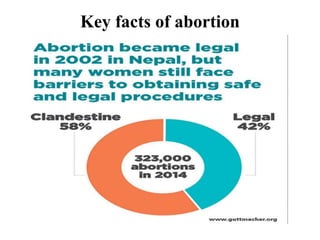
Key facts of abortion
Types of abortion
1. Spontaneous abortion
2. Induce abortion:
• Medical / safe abortion
• Unsafe abortion
Types of Spontaneous Abortion
• Complete abortion: All pregnancy tissues
have been expelled from your body.
• Incomplete abortion : You’ve passed
some tissue or placental material, but
some still remains in your body.
• Missed abortion : The embryo dies
without your knowledge, and you don’t
deliver it.
• Threatened abortion: Bleeding and
cramps accompanied possible upcoming
miscarriage.
• Inevitable abortion: The presence of
bleeding, cramping, and cervical dilation
indicates that a miscarriage is inevitable.
• Septic abortion: An infection has
occurred within your uterus
Causes of Abortion
• About 10% of all pregnancy ended in abortion.
• 75% of spontaneous abortions occur before the 16th
week of gestation and of these, 75% occur before 8
weeks of gestation.
• The causes of abortion are usually divided into:
 Fetal factor
 Maternal factor
 Paternal factor: genetic factor,
 Unknown
Causes of Abortion
Maternal factor
• Severe mental stress
• Infection.
• Exposure to high levels of radiation or toxic agents.
• Hormonal irregularities.
• Improper implantation of fertilized egg in the uterine lining.
• Maternal age.
• Uterine abnormalities.
• Incompetent cervix
• Lifestyle factors: smoking, drinking alcohol, drugs abuse.
• Autoimmune disease eg: lupus,
• Disease condition : Congenital heart disease, Uncontrolled
Diabetes, Thyroid disease, Severe kidney disease.
• Severe malnutrition.
Causes of Abortion
Fetal factor:
 Chromosomal anomalies accounts about 25% of early
abortion
 Multiple defects
 Multiple pregnancies
 Low lying placenta
Paternal Factor:
 Genetic
 Paternal age beyond 35 years
 lead exposure.
 Paternal BMI
Induce abortion
• Unsafe abortion
• Safe Abortion (Medical/ Surgical )
First trimester:
 Mifepristone orally, Misoprostole (orally/
vaginally), Methotrexate ( orally/ IM)
Manual Vacuum Aspiration( MVA)
Second trimester:
Dilation and Evacuation ( D&E)
Third trimester
Dilation and Extraction(D&X)
Unsafe Abortion
An abortion is unsafe when it is carried
out either by a person lacking the
necessary skills or in an environment that
does not conform to minimal medical
standards, or both.
Health effects of unsafe abortion
Immediate Complication
• incomplete abortion (failure to remove or expel all of
the pregnancy tissue from the uterus)
• haemorrhage (heavy bleeding)
• Infection/sepsis
• uterine perforation
• damage to the genital tract and internal organs by
inserting dangerous objects.
• Maternal death
Health effects of unsafe abortion
Long term complication
• Chronic pelvic pain
• Pelvic Inflammatory Disease (PID)
• Infertility
• Ectopic Pregnancy
• Premature Labour
• Abortion
• Psychological trauma
Health effects of unsafe abortion
Other problems
• Economic problems
• Legal problems
• Socio-cultural and religious problems
• Family relation problem etc.
Prevention and control
Unsafe abortion can be prevented through:
• Comprehensive reproductive health
education such as Preconception care,
Family planning method, knowledge
about safe abortion service.
• Prevention of unintended pregnancy
through use of effective contraception,
including emergency contraception.
• Availability and accessibility of family
planning services in the community.
• Scale up comprehensive abortion care to the
grassroots level.
• Coordinate with external development partners
( NGO/INGO) to introduce new technologies,
build the skills of staff including necessary
equipments and resources.
• Discourage sex selective abortion.
References
• D C Dutta’s textbook of Obstetrics, 7th edition.
• National Safe Abortion Policy, 2003 A D.
• Safe abortion service process 2060 B.S.
• https://www.who.int/news-room/fact-
sheets/detail/abortion.
• https://apps.who.int/iris/bitstream/handle/10
665/338768/factsheet-nepal-
eng.pdf?sequence=9&isAllowed=y

Concept of abortion

  • 1.
    By Rashmi Luintel BN,BA,MPH Lecturer NationalOpen College Pokhara University
  • 2.
    Abortion • Abortion isthe expulsion of the product of conception before 20 weeks of gestation, or a fetus weighing less than 500g( a/c to WHO). • An abortion that occurs without intervention is known as a miscarriage or spontaneous abortion. • When deliberate steps are taken to end a pregnancy, it is called an induced abortion.
  • 3.
    Key facts ofabortion An estimated 1 in 4 pregnancies end in an abortion every year. • Each year between 4.7% – 13.2% of maternal deaths can be attributed to unsafe abortion.
  • 4.
    Key facts ofabortion
  • 5.
    Types of abortion 1.Spontaneous abortion 2. Induce abortion: • Medical / safe abortion • Unsafe abortion
  • 6.
    Types of SpontaneousAbortion • Complete abortion: All pregnancy tissues have been expelled from your body. • Incomplete abortion : You’ve passed some tissue or placental material, but some still remains in your body. • Missed abortion : The embryo dies without your knowledge, and you don’t deliver it.
  • 7.
    • Threatened abortion:Bleeding and cramps accompanied possible upcoming miscarriage. • Inevitable abortion: The presence of bleeding, cramping, and cervical dilation indicates that a miscarriage is inevitable. • Septic abortion: An infection has occurred within your uterus
  • 8.
    Causes of Abortion •About 10% of all pregnancy ended in abortion. • 75% of spontaneous abortions occur before the 16th week of gestation and of these, 75% occur before 8 weeks of gestation. • The causes of abortion are usually divided into:  Fetal factor  Maternal factor  Paternal factor: genetic factor,  Unknown
  • 9.
    Causes of Abortion Maternalfactor • Severe mental stress • Infection. • Exposure to high levels of radiation or toxic agents. • Hormonal irregularities. • Improper implantation of fertilized egg in the uterine lining. • Maternal age. • Uterine abnormalities. • Incompetent cervix • Lifestyle factors: smoking, drinking alcohol, drugs abuse. • Autoimmune disease eg: lupus, • Disease condition : Congenital heart disease, Uncontrolled Diabetes, Thyroid disease, Severe kidney disease. • Severe malnutrition.
  • 10.
    Causes of Abortion Fetalfactor:  Chromosomal anomalies accounts about 25% of early abortion  Multiple defects  Multiple pregnancies  Low lying placenta Paternal Factor:  Genetic  Paternal age beyond 35 years  lead exposure.  Paternal BMI
  • 11.
    Induce abortion • Unsafeabortion • Safe Abortion (Medical/ Surgical ) First trimester:  Mifepristone orally, Misoprostole (orally/ vaginally), Methotrexate ( orally/ IM) Manual Vacuum Aspiration( MVA) Second trimester: Dilation and Evacuation ( D&E) Third trimester Dilation and Extraction(D&X)
  • 12.
    Unsafe Abortion An abortionis unsafe when it is carried out either by a person lacking the necessary skills or in an environment that does not conform to minimal medical standards, or both.
  • 13.
    Health effects ofunsafe abortion Immediate Complication • incomplete abortion (failure to remove or expel all of the pregnancy tissue from the uterus) • haemorrhage (heavy bleeding) • Infection/sepsis • uterine perforation • damage to the genital tract and internal organs by inserting dangerous objects. • Maternal death
  • 14.
    Health effects ofunsafe abortion Long term complication • Chronic pelvic pain • Pelvic Inflammatory Disease (PID) • Infertility • Ectopic Pregnancy • Premature Labour • Abortion • Psychological trauma
  • 15.
    Health effects ofunsafe abortion Other problems • Economic problems • Legal problems • Socio-cultural and religious problems • Family relation problem etc.
  • 16.
    Prevention and control Unsafeabortion can be prevented through: • Comprehensive reproductive health education such as Preconception care, Family planning method, knowledge about safe abortion service. • Prevention of unintended pregnancy through use of effective contraception, including emergency contraception.
  • 17.
    • Availability andaccessibility of family planning services in the community. • Scale up comprehensive abortion care to the grassroots level. • Coordinate with external development partners ( NGO/INGO) to introduce new technologies, build the skills of staff including necessary equipments and resources. • Discourage sex selective abortion.
  • 18.
    References • D CDutta’s textbook of Obstetrics, 7th edition. • National Safe Abortion Policy, 2003 A D. • Safe abortion service process 2060 B.S. • https://www.who.int/news-room/fact- sheets/detail/abortion. • https://apps.who.int/iris/bitstream/handle/10 665/338768/factsheet-nepal- eng.pdf?sequence=9&isAllowed=y