BY
MUHAMMAD HAMISU YUSUF
MODERATOR : DR. YAHYA
OUTLINE
ļ‚— INTRODUCTION
ļ‚— EPIDEMIOLOGY
ļ‚— DIAGNOSIS AND ASSESSMENT
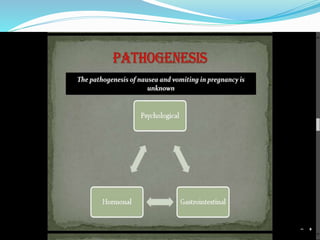
ļ‚— PATHOGENESIS
ļ‚— TREATMENT
ļ‚— MONITORING AND PREVENTION OF COMPLICATIONS
ļ‚— FURTHER TREATMENT
ļ‚— FOLLOW UP
ļ‚— CONCLUSION
ļ‚— REFERENCES
INTORDUCTION
ļ‚— Nausea and vomiting in pregnancy (also known as
morning sickness) are common complains.
ļ‚— NVP in pregnancy can have a significant impact on
jobs, activities, family relationships, and moods.
ļ‚— Nausea and vomiting are common in pregnancy,
affecting upto 70% to 85% of pregnant women.
EPIDEMIOLOGY
ļ‚— Nausea and vomiting in pregnancy are more
common in
-Primigravidae.
-Multiple pregnancy.
-History of previous hyperemesis gravidarum.
ļ‚— It is less common with increasing maternal age.
ļ‚— It tends to be a disease of Western society and is
less common in developing countries, especially in
rural communities.
ļ‚— The incidence of women with severe symptoms is
not well- documented; reports vary from 0.3 to 3.6
percent of pregnancies.
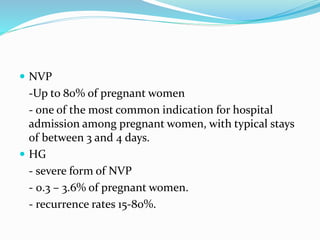
ļ‚— NVP
-Up to 80% of pregnant women
- one of the most common indication for hospital
admission among pregnant women, with typical stays
of between 3 and 4 days.
ļ‚— HG
- severe form of NVP
- 0.3 – 3.6% of pregnant women.
- recurrence rates 15-80%.
DIAGNOSIS AND ASSESSMENT
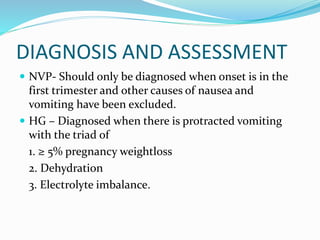
ļ‚— NVP- Should only be diagnosed when onset is in the
first trimester and other causes of nausea and
vomiting have been excluded.
ļ‚— HG – Diagnosed when there is protracted vomiting
with the triad of
1. ≄ 5% pregnancy weightloss
2. Dehydration
3. Electrolyte imbalance.
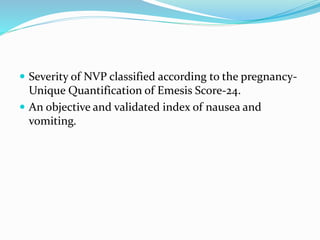
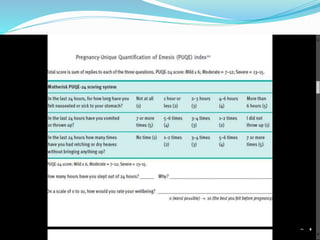
ļ‚— Severity of NVP classified according to the pregnancy-
Unique Quantification of Emesis Score-24.
ļ‚— An objective and validated index of nausea and
vomiting.
Initial clinical assessment
ļ‚— 1. History
-Previous history of NVP/HG
-Quantify severity using PUQE score
-nausea, vomiting, hypersalivation, spitting,
-loss of weight, inability to tolerate food and fluids,
effect on quality of life
ļ‚— History to exclude other causes: –
– abdominal pain
– urinary symptoms
– infection
– drug history
– chronic Helicobacter pylori infection
2. Examination
ļ‚— Temperature, Pulse, Blood pressure, Respiratory rate
ļ‚— Oxygen saturations
ļ‚— Weight
ļ‚— Signs of dehydration
ļ‚— Signs of muscle wasting
ļ‚— Abdominal examination
ļ‚— Other examination as guided by history
3. Investigation
ļ‚— Urine dipstick:
– quantify ketonuria as 1+ ketones or more
ļ‚— MSU
ļ‚— Urea and electrolytes:
– hypokalaemia/hyperkalaemia
– hyponatraemia
– dehydration
– renal disease
ļ‚— Full blood count:
– infection
– Anaemia
– haematocrit
ļ‚— Blood glucose monitoring:
– exclude diabetic ketoacidosis if diabetic
ļ‚— Ultrasound scan:
– confirm viable intrauterine pregnancy
– exclude multiple pregnancy and trophoblastic
disease
ļ‚— In refractory cases or history of previous admissions,
check:
– TFTs: hypothyroid/hyperthyroid
– LFTs: exclude other liver disease such as hepatitis or
gallstones, monitor malnutrition
– calcium and phosphate
– amylase: exclude pancreatitis
– ABG: exclude metabolic disturbances to monitor
severity
TREATMENT
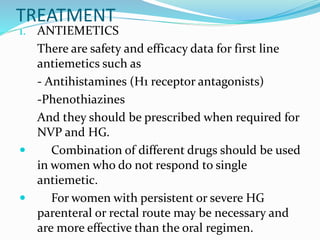
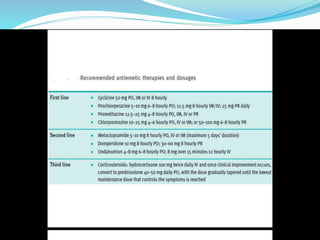
1. ANTIEMETICS
There are safety and efficacy data for first line
antiemetics such as
- Antihistamines (H1 receptor antagonists)
-Phenothiazines
And they should be prescribed when required for
NVP and HG.
ļ‚— Combination of different drugs should be used
in women who do not respond to single
antiemetic.
ļ‚— For women with persistent or severe HG
parenteral or rectal route may be necessary and
are more effective than the oral regimen.
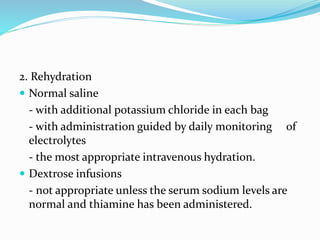
2. Rehydration
ļ‚— Normal saline
- with additional potassium chloride in each bag
- with administration guided by daily monitoring of
electrolytes
- the most appropriate intravenous hydration.
ļ‚— Dextrose infusions
- not appropriate unless the serum sodium levels are
normal and thiamine has been administered.
3. Complementary therapies
ļ‚— Ginger
may be used by women wishing to avoid antiemetic
therapies in mild to moderate NVP.
ļ‚— Acustimulations – acupressure and acupuncture
- safe in pregnancy.
- Acupressure may improve NVP.
ļ‚— Hypnosis
should not be recommended to manage NVP and HG.
{evidence was not sufficient to establish whether hypnosis
(trance induction) is effective}
COMPLICATION
ļ‚— MATERNAL
ļ‚— Dehydration
ļ‚— Electrolyte or acid base imbalance
ļ‚— Mallory Weiss tear
ļ‚— Wernickes encephalopathy
ļ‚— Death
ļ‚— Fetal consequences are rare but intrauterine growth
restriction (IUGR).
3. MONITORING AND PREVENTION OF
COMPLICATIONS
1. Urea and serum electrolyte levels
ļ‚— should be checked daily in women requiring intravenous
fluids.
2. Histamine H2 receptor antagonists or proton pump
inhibitors
ļ‚— may be used for women developing
-gastro-oesophageal reflux disease
-oesophagitis or
-gastritis.
3. Thiamine supplementation
ļ‚— Either oral or intravenous
ļ‚— should be given to all women admitted with
prolonged vomiting, especially
ļ‚— before administration of dextrose or parenteral
nutrition.
4. Women admitted with HG
Thromboprophylaxis:
ļ‚— low-molecular-weight heparin
ļ‚— unless there are specific contraindications such as
active bleeding.
ļ‚— can be discontinued upon discharge.
5. Women with previous or current NVP or HG should
consider avoiding iron-containing preparations if
these exacerbate the symptoms.
4. FURTHER MANAGEMENT
1. Multidisciplinary team
ļ‚— In women with severe NVP or HG,
ļ‚— midwives, nurses, dieticians, pharmacists,
endocrinologists, nutritionists and gastroenterologists,
mental health team, including a psychiatrist.
2. Enteral and parenteral nutrition When all other medical
therapies have failed
3. Termination of pregnancy. All therapeutic measures
should have been tried before offering termination of a
wanted pregnancy.
5. FOLLOW-UP
1. ANTENATAL
ļ‚— An individualised management plan in place when they are
discharged from hospital.
ļ‚— Women with severe NVP or HG who have continued
symptoms into the late second or the third trimester
should be offered serial scans to monitor fetal growth.
2. Postnatal
ļ‚— A woman’s quality of life can be adversely affected
ļ‚— Practitioners should assess a woman’s mental health status
during the pregnancy and postnatally
ļ‚— refer for psychological support if necessary.
3. Future pregnancies
ļ‚— Women with previous HG should be advised that
there is a risk of recurrence in future pregnancies.
ļ‚— Early use of
- lifestyle/dietary modifications and Antiemetics that
were found to be useful in the index pregnancy to
reduce the risk of NVP and HG in the current
pregnancy.
CONCLUSION
ļ‚— Vomiting in pregnancy is very common and is
multifactorial, therefore through history and
investigations are necessary to identify the etiologic
factor. About 50% of vomiting in pregnancy resolved
by the 14th week gestation and about 90% resolved by
22nd week of gestation however if left untreated can
lead to devastating consequences.
ļ‚—THANKS YOU
FOR LISTENING
REFERENCE
ļ‚— Agbola textbook of obstetric and gynaecology
ļ‚— Obstetric by ten teachers 19th Edition.
ļ‚— American journal of obstetric and gynaecology, 2002.
ļ‚— http://www.patient.co.uk/doctor/nausea-and- vomiting-
in-pregnancy-including-hyperemesis- gravidarum
ļ‚— http://ezproxy.squ.edu.om:2265/contents/clinical-
features-and-evaluation-of-nausea-and-vomiting-of-
pregnancy?source=search_result&search=hyperemesis
&selectedTitle=2%7E42
ļ‚— http://www.ncbi.nlm.nih.gov/pubmed/3341360

vomiting in pregnancy presentation.pptx

  • 1.
  • 2.
    OUTLINE ļ‚— INTRODUCTION ļ‚— EPIDEMIOLOGY ļ‚—DIAGNOSIS AND ASSESSMENT ļ‚— PATHOGENESIS ļ‚— TREATMENT ļ‚— MONITORING AND PREVENTION OF COMPLICATIONS ļ‚— FURTHER TREATMENT ļ‚— FOLLOW UP ļ‚— CONCLUSION ļ‚— REFERENCES
  • 3.
    INTORDUCTION ļ‚— Nausea andvomiting in pregnancy (also known as morning sickness) are common complains. ļ‚— NVP in pregnancy can have a significant impact on jobs, activities, family relationships, and moods. ļ‚— Nausea and vomiting are common in pregnancy, affecting upto 70% to 85% of pregnant women.
  • 4.
    EPIDEMIOLOGY ļ‚— Nausea andvomiting in pregnancy are more common in -Primigravidae. -Multiple pregnancy. -History of previous hyperemesis gravidarum. ļ‚— It is less common with increasing maternal age. ļ‚— It tends to be a disease of Western society and is less common in developing countries, especially in rural communities. ļ‚— The incidence of women with severe symptoms is not well- documented; reports vary from 0.3 to 3.6 percent of pregnancies.
  • 5.
    ļ‚— NVP -Up to80% of pregnant women - one of the most common indication for hospital admission among pregnant women, with typical stays of between 3 and 4 days. ļ‚— HG - severe form of NVP - 0.3 – 3.6% of pregnant women. - recurrence rates 15-80%.
  • 6.
    DIAGNOSIS AND ASSESSMENT ļ‚—NVP- Should only be diagnosed when onset is in the first trimester and other causes of nausea and vomiting have been excluded. ļ‚— HG – Diagnosed when there is protracted vomiting with the triad of 1. ≄ 5% pregnancy weightloss 2. Dehydration 3. Electrolyte imbalance.
  • 7.
    ļ‚— Severity ofNVP classified according to the pregnancy- Unique Quantification of Emesis Score-24. ļ‚— An objective and validated index of nausea and vomiting.
  • 9.
    Initial clinical assessment ļ‚—1. History -Previous history of NVP/HG -Quantify severity using PUQE score -nausea, vomiting, hypersalivation, spitting, -loss of weight, inability to tolerate food and fluids, effect on quality of life ļ‚— History to exclude other causes: – – abdominal pain – urinary symptoms – infection – drug history – chronic Helicobacter pylori infection
  • 10.
    2. Examination ļ‚— Temperature,Pulse, Blood pressure, Respiratory rate ļ‚— Oxygen saturations ļ‚— Weight ļ‚— Signs of dehydration ļ‚— Signs of muscle wasting ļ‚— Abdominal examination ļ‚— Other examination as guided by history
  • 11.
    3. Investigation ļ‚— Urinedipstick: – quantify ketonuria as 1+ ketones or more ļ‚— MSU ļ‚— Urea and electrolytes: – hypokalaemia/hyperkalaemia – hyponatraemia – dehydration – renal disease
  • 12.
    ļ‚— Full bloodcount: – infection – Anaemia – haematocrit ļ‚— Blood glucose monitoring: – exclude diabetic ketoacidosis if diabetic ļ‚— Ultrasound scan: – confirm viable intrauterine pregnancy – exclude multiple pregnancy and trophoblastic disease
  • 13.
    ļ‚— In refractorycases or history of previous admissions, check: – TFTs: hypothyroid/hyperthyroid – LFTs: exclude other liver disease such as hepatitis or gallstones, monitor malnutrition – calcium and phosphate – amylase: exclude pancreatitis – ABG: exclude metabolic disturbances to monitor severity
  • 15.
    TREATMENT 1. ANTIEMETICS There aresafety and efficacy data for first line antiemetics such as - Antihistamines (H1 receptor antagonists) -Phenothiazines And they should be prescribed when required for NVP and HG. ļ‚— Combination of different drugs should be used in women who do not respond to single antiemetic. ļ‚— For women with persistent or severe HG parenteral or rectal route may be necessary and are more effective than the oral regimen.
  • 17.
    2. Rehydration ļ‚— Normalsaline - with additional potassium chloride in each bag - with administration guided by daily monitoring of electrolytes - the most appropriate intravenous hydration. ļ‚— Dextrose infusions - not appropriate unless the serum sodium levels are normal and thiamine has been administered.
  • 18.
    3. Complementary therapies ļ‚—Ginger may be used by women wishing to avoid antiemetic therapies in mild to moderate NVP. ļ‚— Acustimulations – acupressure and acupuncture - safe in pregnancy. - Acupressure may improve NVP. ļ‚— Hypnosis should not be recommended to manage NVP and HG. {evidence was not sufficient to establish whether hypnosis (trance induction) is effective}
  • 19.
    COMPLICATION ļ‚— MATERNAL ļ‚— Dehydration ļ‚—Electrolyte or acid base imbalance ļ‚— Mallory Weiss tear ļ‚— Wernickes encephalopathy ļ‚— Death ļ‚— Fetal consequences are rare but intrauterine growth restriction (IUGR).
  • 20.
    3. MONITORING ANDPREVENTION OF COMPLICATIONS 1. Urea and serum electrolyte levels ļ‚— should be checked daily in women requiring intravenous fluids. 2. Histamine H2 receptor antagonists or proton pump inhibitors ļ‚— may be used for women developing -gastro-oesophageal reflux disease -oesophagitis or -gastritis.
  • 21.
    3. Thiamine supplementation ļ‚—Either oral or intravenous ļ‚— should be given to all women admitted with prolonged vomiting, especially ļ‚— before administration of dextrose or parenteral nutrition.
  • 22.
    4. Women admittedwith HG Thromboprophylaxis: ļ‚— low-molecular-weight heparin ļ‚— unless there are specific contraindications such as active bleeding. ļ‚— can be discontinued upon discharge. 5. Women with previous or current NVP or HG should consider avoiding iron-containing preparations if these exacerbate the symptoms.
  • 23.
    4. FURTHER MANAGEMENT 1.Multidisciplinary team ļ‚— In women with severe NVP or HG, ļ‚— midwives, nurses, dieticians, pharmacists, endocrinologists, nutritionists and gastroenterologists, mental health team, including a psychiatrist. 2. Enteral and parenteral nutrition When all other medical therapies have failed 3. Termination of pregnancy. All therapeutic measures should have been tried before offering termination of a wanted pregnancy.
  • 24.
    5. FOLLOW-UP 1. ANTENATAL ļ‚—An individualised management plan in place when they are discharged from hospital. ļ‚— Women with severe NVP or HG who have continued symptoms into the late second or the third trimester should be offered serial scans to monitor fetal growth. 2. Postnatal ļ‚— A woman’s quality of life can be adversely affected ļ‚— Practitioners should assess a woman’s mental health status during the pregnancy and postnatally ļ‚— refer for psychological support if necessary.
  • 25.
    3. Future pregnancies ļ‚—Women with previous HG should be advised that there is a risk of recurrence in future pregnancies. ļ‚— Early use of - lifestyle/dietary modifications and Antiemetics that were found to be useful in the index pregnancy to reduce the risk of NVP and HG in the current pregnancy.
  • 26.
    CONCLUSION ļ‚— Vomiting inpregnancy is very common and is multifactorial, therefore through history and investigations are necessary to identify the etiologic factor. About 50% of vomiting in pregnancy resolved by the 14th week gestation and about 90% resolved by 22nd week of gestation however if left untreated can lead to devastating consequences.
  • 27.
  • 28.
    REFERENCE ļ‚— Agbola textbookof obstetric and gynaecology ļ‚— Obstetric by ten teachers 19th Edition. ļ‚— American journal of obstetric and gynaecology, 2002. ļ‚— http://www.patient.co.uk/doctor/nausea-and- vomiting- in-pregnancy-including-hyperemesis- gravidarum ļ‚— http://ezproxy.squ.edu.om:2265/contents/clinical- features-and-evaluation-of-nausea-and-vomiting-of- pregnancy?source=search_result&search=hyperemesis &selectedTitle=2%7E42 ļ‚— http://www.ncbi.nlm.nih.gov/pubmed/3341360