4C16: Machine Learning with Applications in Media Engineering — 2017/2018
00 - Introduction
François Pitié
Ussher Assistant Professor in Media Signal Processing
Department of Electronic & Electrical Engineering, Trinity College Dublin
1
[4C16] Machine Learning with Applications in Media Engineering
This module is an introduction to Machine Learning and especially
Deep Neural Nets, which are disrupting all aspects of society today.
The material is constructed in collaboration with leading industrial
practitioners including Google, YouTube and Movidius/Intel.
Hands on labs will give you experience with these applications.
2
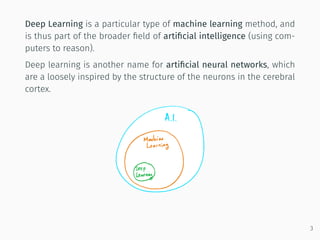
Deep Learning is a particular type of machine learning method, and
is thus part of the broader field of artificial intelligence (using com-
puters to reason).
Deep learning is another name for artificial neural networks, which
are a loosely inspired by the structure of the neurons in the cerebral
cortex.
3
The recent quantum leap in machine learning has solely been driven
by deep learning successes.
When you read or hear about AI or machine Learning successes in
recent years, it really means Deep Learning successes.
4
Machine Learning can be split into 3 main fields:
Supervised Learning:
From a labelled dataset (x , 𝑦 ), we want to infer 𝑓(x ) = 𝑦
Unsupervised Learning:
What can we learn about a dataset (x ) by just looking at it? (ie. with-
out any labelled information 𝑦 )
Reinforcement Learning:
How can an agent interact with its environment (the data) to get max-
imum reward (eg. game playing, robots learning to walk).
Deep Learning has made major breakthroughs in all three fields.
5
Deep Learning Successes
6
Image Recognition is one of the core applications of Computer Vi-
sion. ImageNet [www.image-net.org] runs an annual challenge where
software programs compete to correctly classify and detect objects
and scenes in images.
7
The error rate in object recognition for that challenge has massively
dropped since the introduction of deep neural networks in 2012 [1].
Machines can now do better than humans.
[1] ImageNet Classification with Deep Convolutional Neural Networks
A Krizhevsky, I Sutskever, G Hinton, 2012 [https://goo.gl/wxen2Y]
8
Neural nets are also advancing the state of the art in
Scene Understanding .
[1] Conditional Random Fields as Recurrent Neural Networks
S Zheng et al., 2015 [https://arxiv.org/abs/1502.03240]
9
Image models combined with language models make it possible to
automatically generate captions from images.
Google Research Blog [https://goo.gl/U88bDQ]
10
All major tech companies have changed their machine translation
systems to use Deep Learning.
Google used to average a yearly 0.4% improvement on their machine
translation system. Their first attempt at using Deep Learning yielded
an overnight 7% improvement! More than in an entire lifetime!
Several years of handcrafted development could not match a single
initial deep learning implementation.
New York Times, “The Great AI Awakening” [https://goo.gl/DPYp6d]
11
In 2014, Skype Translator was announced. It trains and optimises
speech recognition , automatic machine translation and speech syn-
thesis tasks, acting as the glue that holds these elements together.
Skype demo [https://www.youtube.com/embed/NhxCg2PA3ZI?start=0]
Microsoft blog post [https://goo.gl/eAuPcS]
12
Deep learning has also been introduced in reinforcement learning
to solve complex sequential decision making problems.
Recent successes include:
playing old Atari computer games,
programming real world Robots
and beating humans at Go.
demo: Robots Learning how to walk https://www.youtube.com/hx_bgoTF7bs
DeepMind [https://goo.gl/3TcCNA]
13
Reasons of a Success
14
Neural Networks have been around for decades. But is only now that
it surpasses all other machine learning techniques.
Deep Learning is now a disruptive technology that has been unex-
pectedly taking over operations of technology companies around the
world.
“The revolution in deep nets has been very profound, it definitely sur-
prised me, even though I was sitting right there.”
— Sergey Brin, Google co-founder
15
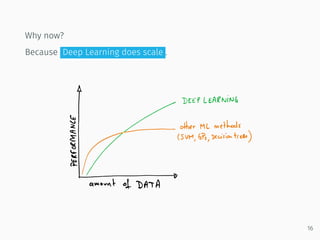
Why now?
Because Deep Learning does scale .
16
Neural Nets are the only ML technique whose performance scales ef-
ficiently with the training data size. Other ML popular techniques just
can’t scale that well.
The advent of big databases, combined with cheaper computing power
(Graphic Cards), meant that Deep Learning could take advantage of all
this, whilst other techniques stagnated. Instead of using thousands
of observations, Deep Learning can take advantage of billions.
The tipping point was 2012 in Computer Vision and around 2014 in
Machine Translation.
17
Deep Learning offers a (relatively) simple framework to define and
parametrise pretty much any kind of numerical method and then op-
timise it over massive databases.
By adopting an automated brute force approach to tuning algorithms,
Deep Learning is able to surpass hand-tailored algorithms of skilled
researchers.
It offers a systematic approach when before algorithms took years of
human efforts to design.
18
Reasons of a Success
Deep Learning is a (relatively) simple framework.
Good programmers train state of the art neural nets without having
done 10+ years of research in the domain.
It is an opportunity for start-ups and it has become a ubiquitous tool
in tech companies.
19
Democratisation
Reasons of a Success
It has been applied successfully to many fields of research, industry
and society:
self-driving cars, image recognition, detecting cancer, speech recog-
nition, speech synthesis, machine translation, drug discovery and tox-
icology, customer relationship management, recommendation sys-
tems, bioinformatics, advertising, controlling lasers, etc.
20
Global Reach
Impact
Here is a question for you:
How long before your future job gets replaced by an algorithm?
Probably much sooner than you think. You might feel safe if you are
an artist...
21
... but then again:
automatic style transfer [1]
[1] A Neural Algorithm of Artistic Style
L. Gatys, A. Ecker, M. Bethge, 2015 [https://arxiv.org/abs/1508.06576]
Does an AI need to make love to Rembrandt’s girlfriend to make art? [https://goo.gl/gi7rWE]
Intelligent Machines: AI art is taking on the experts [https://goo.gl/2kfyXd]
22
4C16: Course Structure
23
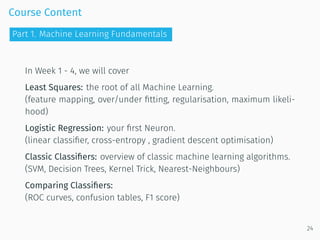
Course Content
In Week 1 - 4, we will cover
Least Squares: the root of all Machine Learning.
(feature mapping, over/under fitting, regularisation, maximum likeli-
hood)
Logistic Regression: your first Neuron.
(linear classifier, cross-entropy , gradient descent optimisation)
Classic Classifiers: overview of classic machine learning algorithms.
(SVM, Decision Trees, Kernel Trick, Nearest-Neighbours)
Comparing Classifiers:
(ROC curves, confusion tables, F1 score)
24
Part 1. Machine Learning Fundamentals
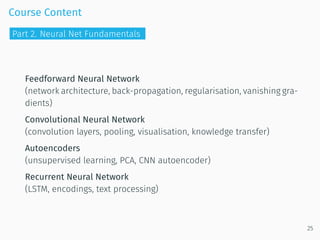
Course Content
Feedforward Neural Network
(network architecture, back-propagation, regularisation, vanishing gra-
dients)
Convolutional Neural Network
(convolution layers, pooling, visualisation, knowledge transfer)
Autoencoders
(unsupervised learning, PCA, CNN autoencoder)
Recurrent Neural Network
(LSTM, encodings, text processing)
25
Part 2. Neural Net Fundamentals
Assignments
Week 2 Least Squares lab [2% mark]
Week 3 Logistic Regression lab [2% mark]
Week 4 Classifiers lab [2% mark]
Week 5 Feed Forward Neural Net lab [2% mark]
Week 6 Convolutional Neural Net lab [2% mark]
Week 8 Quiz [5% mark]
Week 8-10 lab project [5% mark]
Week 9-11 lab project [5% mark]
End of term Exam [75% mark]
26
Labs
We have developed a fantastic environment specially for you, so that
you can learn best industry practices.
27
Labs
You will be programming in python 3 using Keras and TensorFlow. Ev-
erything will be running on the Google Cloud Platform, which gives
you on-demand scalable computing resources.
Your coding environment will be a combination of shell/terminal, ed-
itor, and Jupyter notebook.
You will use Git to checkpoint your progress and for continuous feed-
back on lab assignments.
28
[1] Deep Learning (MIT press)
Ian Goodfellow et al.
[https://www.deeplearningbook.org]
[2] Machine Learning on Cousera
Andrew Ng
[https://www.coursera.org/learn/machine-learning]
[3] Neural Networks and Deep Learning
Michael Nielsen
[http://neuralnetworksanddeeplearning.com/]
[4] Curated list of links https://github.com/ChristosChristofidis/awesome-deep-learning
[5] Brandon Rohrer’s YT channel https://www.youtube.com/user/BrandonRohrer
[6] Siraj Raval’s YT channel https://www.youtube.com/channel/UCWN3xxRkmTPmbKwht9FuE5A
29
Books & Resources

Null

  • 1.
    4C16: Machine Learningwith Applications in Media Engineering — 2017/2018 00 - Introduction François Pitié Ussher Assistant Professor in Media Signal Processing Department of Electronic & Electrical Engineering, Trinity College Dublin 1
  • 2.
    [4C16] Machine Learningwith Applications in Media Engineering This module is an introduction to Machine Learning and especially Deep Neural Nets, which are disrupting all aspects of society today. The material is constructed in collaboration with leading industrial practitioners including Google, YouTube and Movidius/Intel. Hands on labs will give you experience with these applications. 2
  • 3.
    Deep Learning isa particular type of machine learning method, and is thus part of the broader field of artificial intelligence (using com- puters to reason). Deep learning is another name for artificial neural networks, which are a loosely inspired by the structure of the neurons in the cerebral cortex. 3
  • 4.
    The recent quantumleap in machine learning has solely been driven by deep learning successes. When you read or hear about AI or machine Learning successes in recent years, it really means Deep Learning successes. 4
  • 5.
    Machine Learning canbe split into 3 main fields: Supervised Learning: From a labelled dataset (x , 𝑦 ), we want to infer 𝑓(x ) = 𝑦 Unsupervised Learning: What can we learn about a dataset (x ) by just looking at it? (ie. with- out any labelled information 𝑦 ) Reinforcement Learning: How can an agent interact with its environment (the data) to get max- imum reward (eg. game playing, robots learning to walk). Deep Learning has made major breakthroughs in all three fields. 5
  • 6.
  • 7.
    Image Recognition isone of the core applications of Computer Vi- sion. ImageNet [www.image-net.org] runs an annual challenge where software programs compete to correctly classify and detect objects and scenes in images. 7
  • 8.
    The error ratein object recognition for that challenge has massively dropped since the introduction of deep neural networks in 2012 [1]. Machines can now do better than humans. [1] ImageNet Classification with Deep Convolutional Neural Networks A Krizhevsky, I Sutskever, G Hinton, 2012 [https://goo.gl/wxen2Y] 8
  • 9.
    Neural nets arealso advancing the state of the art in Scene Understanding . [1] Conditional Random Fields as Recurrent Neural Networks S Zheng et al., 2015 [https://arxiv.org/abs/1502.03240] 9
  • 10.
    Image models combinedwith language models make it possible to automatically generate captions from images. Google Research Blog [https://goo.gl/U88bDQ] 10
  • 11.
    All major techcompanies have changed their machine translation systems to use Deep Learning. Google used to average a yearly 0.4% improvement on their machine translation system. Their first attempt at using Deep Learning yielded an overnight 7% improvement! More than in an entire lifetime! Several years of handcrafted development could not match a single initial deep learning implementation. New York Times, “The Great AI Awakening” [https://goo.gl/DPYp6d] 11
  • 12.
    In 2014, SkypeTranslator was announced. It trains and optimises speech recognition , automatic machine translation and speech syn- thesis tasks, acting as the glue that holds these elements together. Skype demo [https://www.youtube.com/embed/NhxCg2PA3ZI?start=0] Microsoft blog post [https://goo.gl/eAuPcS] 12
  • 13.
    Deep learning hasalso been introduced in reinforcement learning to solve complex sequential decision making problems. Recent successes include: playing old Atari computer games, programming real world Robots and beating humans at Go. demo: Robots Learning how to walk https://www.youtube.com/hx_bgoTF7bs DeepMind [https://goo.gl/3TcCNA] 13
  • 14.
    Reasons of aSuccess 14
  • 15.
    Neural Networks havebeen around for decades. But is only now that it surpasses all other machine learning techniques. Deep Learning is now a disruptive technology that has been unex- pectedly taking over operations of technology companies around the world. “The revolution in deep nets has been very profound, it definitely sur- prised me, even though I was sitting right there.” — Sergey Brin, Google co-founder 15
  • 16.
    Why now? Because DeepLearning does scale . 16
  • 17.
    Neural Nets arethe only ML technique whose performance scales ef- ficiently with the training data size. Other ML popular techniques just can’t scale that well. The advent of big databases, combined with cheaper computing power (Graphic Cards), meant that Deep Learning could take advantage of all this, whilst other techniques stagnated. Instead of using thousands of observations, Deep Learning can take advantage of billions. The tipping point was 2012 in Computer Vision and around 2014 in Machine Translation. 17
  • 18.
    Deep Learning offersa (relatively) simple framework to define and parametrise pretty much any kind of numerical method and then op- timise it over massive databases. By adopting an automated brute force approach to tuning algorithms, Deep Learning is able to surpass hand-tailored algorithms of skilled researchers. It offers a systematic approach when before algorithms took years of human efforts to design. 18
  • 19.
    Reasons of aSuccess Deep Learning is a (relatively) simple framework. Good programmers train state of the art neural nets without having done 10+ years of research in the domain. It is an opportunity for start-ups and it has become a ubiquitous tool in tech companies. 19 Democratisation
  • 20.
    Reasons of aSuccess It has been applied successfully to many fields of research, industry and society: self-driving cars, image recognition, detecting cancer, speech recog- nition, speech synthesis, machine translation, drug discovery and tox- icology, customer relationship management, recommendation sys- tems, bioinformatics, advertising, controlling lasers, etc. 20 Global Reach
  • 21.
    Impact Here is aquestion for you: How long before your future job gets replaced by an algorithm? Probably much sooner than you think. You might feel safe if you are an artist... 21
  • 22.
    ... but thenagain: automatic style transfer [1] [1] A Neural Algorithm of Artistic Style L. Gatys, A. Ecker, M. Bethge, 2015 [https://arxiv.org/abs/1508.06576] Does an AI need to make love to Rembrandt’s girlfriend to make art? [https://goo.gl/gi7rWE] Intelligent Machines: AI art is taking on the experts [https://goo.gl/2kfyXd] 22
  • 23.
  • 24.
    Course Content In Week1 - 4, we will cover Least Squares: the root of all Machine Learning. (feature mapping, over/under fitting, regularisation, maximum likeli- hood) Logistic Regression: your first Neuron. (linear classifier, cross-entropy , gradient descent optimisation) Classic Classifiers: overview of classic machine learning algorithms. (SVM, Decision Trees, Kernel Trick, Nearest-Neighbours) Comparing Classifiers: (ROC curves, confusion tables, F1 score) 24 Part 1. Machine Learning Fundamentals
  • 25.
    Course Content Feedforward NeuralNetwork (network architecture, back-propagation, regularisation, vanishing gra- dients) Convolutional Neural Network (convolution layers, pooling, visualisation, knowledge transfer) Autoencoders (unsupervised learning, PCA, CNN autoencoder) Recurrent Neural Network (LSTM, encodings, text processing) 25 Part 2. Neural Net Fundamentals
  • 26.
    Assignments Week 2 LeastSquares lab [2% mark] Week 3 Logistic Regression lab [2% mark] Week 4 Classifiers lab [2% mark] Week 5 Feed Forward Neural Net lab [2% mark] Week 6 Convolutional Neural Net lab [2% mark] Week 8 Quiz [5% mark] Week 8-10 lab project [5% mark] Week 9-11 lab project [5% mark] End of term Exam [75% mark] 26
  • 27.
    Labs We have developeda fantastic environment specially for you, so that you can learn best industry practices. 27
  • 28.
    Labs You will beprogramming in python 3 using Keras and TensorFlow. Ev- erything will be running on the Google Cloud Platform, which gives you on-demand scalable computing resources. Your coding environment will be a combination of shell/terminal, ed- itor, and Jupyter notebook. You will use Git to checkpoint your progress and for continuous feed- back on lab assignments. 28
  • 29.
    [1] Deep Learning(MIT press) Ian Goodfellow et al. [https://www.deeplearningbook.org] [2] Machine Learning on Cousera Andrew Ng [https://www.coursera.org/learn/machine-learning] [3] Neural Networks and Deep Learning Michael Nielsen [http://neuralnetworksanddeeplearning.com/] [4] Curated list of links https://github.com/ChristosChristofidis/awesome-deep-learning [5] Brandon Rohrer’s YT channel https://www.youtube.com/user/BrandonRohrer [6] Siraj Raval’s YT channel https://www.youtube.com/channel/UCWN3xxRkmTPmbKwht9FuE5A 29 Books & Resources