Downloaded 71 times




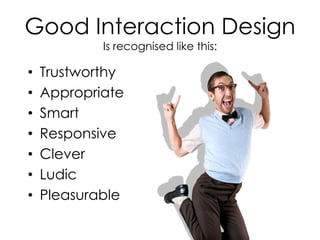



Interaction design aims to help people reach their goals by solving problems and creating interactions between humans and technology. It focuses on ensuring users do not feel stupid, irritated or discomforted when interacting with systems. There are four main approaches: user-centered design prioritizes users' goals and knowledge; activity-centered design examines users' activities and behaviors; systems design outlines technological components; and genius design assumes the designer knows best. Good interaction design creates experiences that are trustworthy, appropriate, smart, responsive, clever, pleasurable and avoid mistakes. The document outlines several principles and laws that guide interaction design, such as Moore's law, Fitt's law and Hick's law. It also discusses methods like cultural probes, user testing


