Md. Saifuddin Khalid
Assistant Professor
KANDIDATUDDANNELSEN I INFORMATIONSTEKNOLOGI,
IT OG LÆRING, MED SPECIALISERING I
ORGANISATORISK OMSTILLING
Modulets placering: 8. semester
Modulets omfang: 5 ECTS
Monday, 06 February, 2017
6 February 2017 Aalborg University 1
Interaction Design Course
Session 1: Lecture 2
About PACT Framework
 An essential part of our approach to designing
interactive systems is that it should put people first; it
should be human-centred.
 We use the acronym PACT (People, Activities,
Contexts, Technologies) as a useful framework for
thinking about a design situation.
6 February 2017 Aalborg University 2
(Benyon, 2010, p. 26)
Scoping a problem with PACT
analysis
 A PACT analysis is useful for both analysis and design
activities: understanding the current situation, seeing where
possible improvements can be made or envisioning future
situations.
 To do a PACT analysis the designer simply scopes out the
variety of Ps, As, Cs and Ts that are possible, or likely, in a
domain.
 PACT analysis can be viewed as the “preliminary
requirements analysis”, which is used as part of the first
phase in traditional software engineering process or “product
vision” in Scrum or Lean.
 This can be done by using various methods and tools. E.g.
brainstorming, observations, interviews and workshops.
6 February 2017 Aalborg University 3
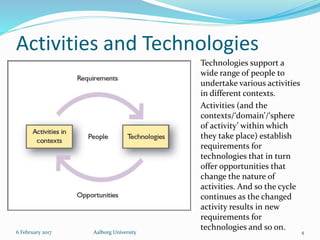
Activities and Technologies
Technologies support a
wide range of people to
undertake various activities
in different contexts.
Activities (and the
contexts/‘domain’/‘sphere
of activity’ within which
they take place) establish
requirements for
technologies that in turn
offer opportunities that
change the nature of
activities. And so the cycle
continues as the changed
activity results in new
requirements for
technologies and so on.6 February 2017 4Aalborg University
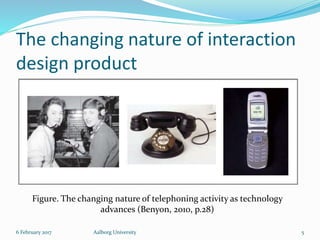
The changing nature of interaction
design product
6 February 2017 Aalborg University 5
Figure. The changing nature of telephoning activity as technology
advances (Benyon, 2010, p.28)
PEOPLE
 Interaction designers begin with the differences
among the users and their interactions.
 Physical Differences
 Ergonomics
 Mental models
 Psychological differences
 Social differences
Benyon (2010) discussed these in part IV of the book in
details. This lecture will cover these briefly.
6 February 2017 Aalborg University 6
People: Physical differences
 People differ in
 Physical characteristics, e.g. height and weight
 Five senses, i.e. sight, hearing, touch, smell and taste.
Case: International approaches to bicycle and pedestrian
facility design.
URL:
http://www.fhwa.dot.gov/publications/research/safety/p
edbike/05085/chapt23.cfm
6 February 2017 Aalborg University 7
People: Ergonomics
 The term ‘ergonomics’ was coined in 1948 to describe the
study of the relationships between people and their
environment.
 People: Anthropometrics, the measurement of
man/people. Example
 The environment
 Ambient environment (temperature, humidity,
atmospheric pressure, light levels, noise and so on)
 Working environment (the design of machines, health
and safety issues – e.g. hygiene, toxicology, exposure to
ionizing radiation, microwaves, etc.).
 Ergonomics draws on anatomy and physiology, various
aspects of psychology (e.g. physiological and experimental),
physics, engineering and work studies among others.
6 February 2017 Aalborg University 8
People: Ergonomics (Cont.)
 Ergonomic designs include but not limited to
 office furniture: chairs, desks, lights, footrests and so forth)
 office equipment, for example keyboards, monitor stands
and wrist rests.
 Search “ergonomic devices” in images.google.com for
examples.
 Possibilities are redefined with finding on ergonomics. E.g.
interactions with mobile resulted the use of thumbs to ring
doorbells, push doors and point.
6 February 2017 Aalborg University 9
People: Psychological differences
 Language differences: In the USA a tick is used for
acceptance and a cross for rejection, but in Britain a
tick or a cross can be used to show acceptance (e.g. a
cross on a voting paper).
 Individual differences. E.g. OCEAN: Openness to
Experience, Conscientiousness, Extraversion,
Agreeableness, and Neuroticism.
 Attention and memory in relation to individual needs
and abilities.
6 February 2017 Aalborg University 10
People: Mental models
 A person’s ‘mental model’ (e.g. Norman, 1998) of a
device: If something goes wrong they will not know
why and will not be able to recover.
 Designer must design things so that people will form
correct and useful mental models of how they work
and what they do.
6 February 2017 Aalborg University 11
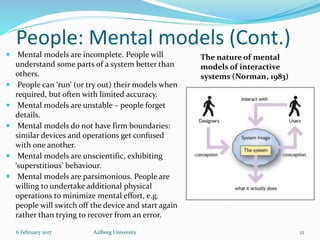
People: Mental models (Cont.)
 Mental models are incomplete. People will
understand some parts of a system better than
others.
 People can ‘run’ (or try out) their models when
required, but often with limited accuracy.
 Mental models are unstable – people forget
details.
 Mental models do not have firm boundaries:
similar devices and operations get confused
with one another.
 Mental models are unscientific, exhibiting
‘superstitious’ behaviour.
 Mental models are parsimonious. People are
willing to undertake additional physical
operations to minimize mental effort, e.g.
people will switch off the device and start again
rather than trying to recover from an error.
6 February 2017 Aalborg University 12
The nature of mental
models of interactive
systems (Norman, 1983)
People: Social differences
 Novice and expert users of a technology will typically
have very different levels of knowledge and hence
requirements for design feature
 Designing for homogeneous groups of people – groups
who are broadly similar and want to do much the same
things – is quite different from designing for
heterogeneous groups.
6 February 2017 Aalborg University 13
Activities
 10 important characteristics of activities that designers
need to consider. First and foremost, the overall
purpose of the activity.
 Temporal aspects, e.g. how regular or infrequent
activities are.
 Cooperation
 Complexity
 Safety-critical
 The nature of the content.
6 February 2017 Aalborg University 14
Context
Activities in contexts can be analyzed by three types of
contexts.
 Physical environment
 Social context
 Organizational context
6 February 2017 Aalborg University 15
Figure. Interactions in different working contexts
Technology
Last, analyzing technology requirements as part of
PACT analysis
 Input (i.e. data and instructions)
 Output (i.e. mainly vision, hearing and touch)
 Storage
 Connectivity
 Content (i.e. data and its forms)
6 February 2017 Aalborg University 16
References
 Benyon, David. (2010). Designing Interactive
Systems: A Comprehensive Guide to HCI and
Interaction Design. 2nd ed. Harlow, England ; N.Y:
Addison-Wesley.
6 February 2017 Aalborg University 17
Discussion
6 February 2017 Aalborg University 18
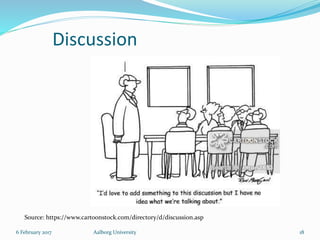
Source: https://www.cartoonstock.com/directory/d/discussion.asp

Session 1 Lecture 2 PACT A Framework for Designing Interactive Systems

  • 1.
    Md. Saifuddin Khalid AssistantProfessor KANDIDATUDDANNELSEN I INFORMATIONSTEKNOLOGI, IT OG LÆRING, MED SPECIALISERING I ORGANISATORISK OMSTILLING Modulets placering: 8. semester Modulets omfang: 5 ECTS Monday, 06 February, 2017 6 February 2017 Aalborg University 1 Interaction Design Course Session 1: Lecture 2
  • 2.
    About PACT Framework An essential part of our approach to designing interactive systems is that it should put people first; it should be human-centred.  We use the acronym PACT (People, Activities, Contexts, Technologies) as a useful framework for thinking about a design situation. 6 February 2017 Aalborg University 2 (Benyon, 2010, p. 26)
  • 3.
    Scoping a problemwith PACT analysis  A PACT analysis is useful for both analysis and design activities: understanding the current situation, seeing where possible improvements can be made or envisioning future situations.  To do a PACT analysis the designer simply scopes out the variety of Ps, As, Cs and Ts that are possible, or likely, in a domain.  PACT analysis can be viewed as the “preliminary requirements analysis”, which is used as part of the first phase in traditional software engineering process or “product vision” in Scrum or Lean.  This can be done by using various methods and tools. E.g. brainstorming, observations, interviews and workshops. 6 February 2017 Aalborg University 3
  • 4.
    Activities and Technologies Technologiessupport a wide range of people to undertake various activities in different contexts. Activities (and the contexts/‘domain’/‘sphere of activity’ within which they take place) establish requirements for technologies that in turn offer opportunities that change the nature of activities. And so the cycle continues as the changed activity results in new requirements for technologies and so on.6 February 2017 4Aalborg University
  • 5.
    The changing natureof interaction design product 6 February 2017 Aalborg University 5 Figure. The changing nature of telephoning activity as technology advances (Benyon, 2010, p.28)
  • 6.
    PEOPLE  Interaction designersbegin with the differences among the users and their interactions.  Physical Differences  Ergonomics  Mental models  Psychological differences  Social differences Benyon (2010) discussed these in part IV of the book in details. This lecture will cover these briefly. 6 February 2017 Aalborg University 6
  • 7.
    People: Physical differences People differ in  Physical characteristics, e.g. height and weight  Five senses, i.e. sight, hearing, touch, smell and taste. Case: International approaches to bicycle and pedestrian facility design. URL: http://www.fhwa.dot.gov/publications/research/safety/p edbike/05085/chapt23.cfm 6 February 2017 Aalborg University 7
  • 8.
    People: Ergonomics  Theterm ‘ergonomics’ was coined in 1948 to describe the study of the relationships between people and their environment.  People: Anthropometrics, the measurement of man/people. Example  The environment  Ambient environment (temperature, humidity, atmospheric pressure, light levels, noise and so on)  Working environment (the design of machines, health and safety issues – e.g. hygiene, toxicology, exposure to ionizing radiation, microwaves, etc.).  Ergonomics draws on anatomy and physiology, various aspects of psychology (e.g. physiological and experimental), physics, engineering and work studies among others. 6 February 2017 Aalborg University 8
  • 9.
    People: Ergonomics (Cont.) Ergonomic designs include but not limited to  office furniture: chairs, desks, lights, footrests and so forth)  office equipment, for example keyboards, monitor stands and wrist rests.  Search “ergonomic devices” in images.google.com for examples.  Possibilities are redefined with finding on ergonomics. E.g. interactions with mobile resulted the use of thumbs to ring doorbells, push doors and point. 6 February 2017 Aalborg University 9
  • 10.
    People: Psychological differences Language differences: In the USA a tick is used for acceptance and a cross for rejection, but in Britain a tick or a cross can be used to show acceptance (e.g. a cross on a voting paper).  Individual differences. E.g. OCEAN: Openness to Experience, Conscientiousness, Extraversion, Agreeableness, and Neuroticism.  Attention and memory in relation to individual needs and abilities. 6 February 2017 Aalborg University 10
  • 11.
    People: Mental models A person’s ‘mental model’ (e.g. Norman, 1998) of a device: If something goes wrong they will not know why and will not be able to recover.  Designer must design things so that people will form correct and useful mental models of how they work and what they do. 6 February 2017 Aalborg University 11
  • 12.
    People: Mental models(Cont.)  Mental models are incomplete. People will understand some parts of a system better than others.  People can ‘run’ (or try out) their models when required, but often with limited accuracy.  Mental models are unstable – people forget details.  Mental models do not have firm boundaries: similar devices and operations get confused with one another.  Mental models are unscientific, exhibiting ‘superstitious’ behaviour.  Mental models are parsimonious. People are willing to undertake additional physical operations to minimize mental effort, e.g. people will switch off the device and start again rather than trying to recover from an error. 6 February 2017 Aalborg University 12 The nature of mental models of interactive systems (Norman, 1983)
  • 13.
    People: Social differences Novice and expert users of a technology will typically have very different levels of knowledge and hence requirements for design feature  Designing for homogeneous groups of people – groups who are broadly similar and want to do much the same things – is quite different from designing for heterogeneous groups. 6 February 2017 Aalborg University 13
  • 14.
    Activities  10 importantcharacteristics of activities that designers need to consider. First and foremost, the overall purpose of the activity.  Temporal aspects, e.g. how regular or infrequent activities are.  Cooperation  Complexity  Safety-critical  The nature of the content. 6 February 2017 Aalborg University 14
  • 15.
    Context Activities in contextscan be analyzed by three types of contexts.  Physical environment  Social context  Organizational context 6 February 2017 Aalborg University 15 Figure. Interactions in different working contexts
  • 16.
    Technology Last, analyzing technologyrequirements as part of PACT analysis  Input (i.e. data and instructions)  Output (i.e. mainly vision, hearing and touch)  Storage  Connectivity  Content (i.e. data and its forms) 6 February 2017 Aalborg University 16
  • 17.
    References  Benyon, David.(2010). Designing Interactive Systems: A Comprehensive Guide to HCI and Interaction Design. 2nd ed. Harlow, England ; N.Y: Addison-Wesley. 6 February 2017 Aalborg University 17
  • 18.
    Discussion 6 February 2017Aalborg University 18 Source: https://www.cartoonstock.com/directory/d/discussion.asp