‫الرمحن‬ ‫هللا‬ ‫سم‬‫ب‬‫الرحمي‬
PERIOPERATIVE NURSING CARE
PREPARING BY:-
ASHRAF IBRAHIM
MOHANED ABDALL
NMARQ HAMDTOO
Surgery is any procedure performed on the
human body that uses instruments to alter
tissue or organ integrity.
Peroperative Nursing Phases
Preoperative phase – begins when the decision to have
surgery is made and ends when the client is transferred
to the OR table.
 Intraoperative phase – begins when the client is
transferred to the OR table and ends when the client is
admitted to the PACU.
Postoperative phase - begins with the admission of the
clientto the PACU and ends when the healing is
complete.
DefinitionPreoperative
Nursing care
Preoperative Nursing care is the preparation and
management of a patient prior to surgery. It
includes both physical and psychological
preparation.
Types of Surgeries
Diagnostic :-
Determination of the presence and or extent of the pathology.
Laparatomy.
Therapeutic :-
Elimination or repair of the pathology Removal of the appendix
when it's inflammed, removal of a localized cancer
Types of Surgeries
Palliative:-
Alleviation of symptoms without curing the underlying disease
Rhizotomy (cutting of a nerve root) to decrease pain.
Preventative:-
Surgery to remove tissue that has the potential to become
pathologic .
Types of Surgeries
Cosmetic :-
The surgery is preformed for aesthetic reasons
Repair of scars from burns or injuries, minor cleft palate
repairs, face lifts, breast augmentation
Types of Elective Admissions for
Surgery
Ambulatory Surgery :-
Usually outside a hospital setting Special prescreening.
Same-Day Surgery :-
Outpatient, can be in the hospital Go home the day of the
surgery
Early Hospital Admission :-
Patient comes in early (night before or earlier)Usually
patients with complex medical issues, and increased risk for poor
surgical outcomes.
Type of Surgery (Degree of Risk)
 Major – involves a high degree of risk.
 Minor – normally involves little risk.
 Age – very young and elder clients are greater surgical risks than
children and adult.
 General health- surgery is least risky when the clients general health
is good.
 Nutritional Status – required for normal tissue repair.
 Medications – regular use of certain medications can increase
surgical risk.
 Mental status – disorder that affect cognitive function.
assessment differs from those performed on the patient in
a medical-surgical unit and requires some alterations to
the formal nursing process that can challenge new
perioperative nurses. One reason for this difference is
due to the brief time a peroperative nurse has contact
with a conscious patient.
Assessment (Nursing History)
o Current health status.
o Allergies.
o Medications- list all current medications.
o Previous surgeries.
o Understanding of the surgical procedure and anesthesia.
o Smoking.
o Alcohol and other-altering substances.
o Social resources.
o Cultural considerations.
Cardiovascular system.
Respiratory system.
Renal system.
Neurological system.
Musculoskeletal system.
Nutritional status.
Level of anxiety.
Coping ability.
Support systems.
In emergency surgery, the principles of preoperative
assessment is the same as in elective surgery.
 Nature and intention of the surgery.
 Name and qualifications of the person performing the
surgery.
 Risks, including tissue damage, disfigurement, or even
death.
 Chances of success.
 Possible alternative measures.
 The right of the client to refuse consent or later withdraw
consent.
CBC,Blood grouping and X-match,
fasting blood sugar.
Serum Creatinine, and bilirubin,Serum albumin, and
Total protein.
Urinalysis,
Chest X-ray,ECG.
Anxiety:- r/t situational crisis, change in health
status, fear of unknown, fear of pain and/or
disfigurement.
Knowledge :-deficit r/t pre/post operative
procedures.
Disturbed Sleep:- r/t anxiety about upcoming
surgery.
interventions:-
 Diet Restrictions
 Historical guidelines to prevent aspiration were NPO after
midnight the night before.
 Educating the patient about the reason for NPO status may
help with adherence .
 Information of what to wear to the surgery
 Patient will likely need to be there 1 to 2 hours prior to
scheduled procedure.
Medications
 Sedatives/hypnotics- valium
 Opiate analgesics- morphine
 Anticholinergics-Atropine sulfate
 H2o blockers.- Zantac
 Antiemetic- Phenergan
Preoperative patient learning needs
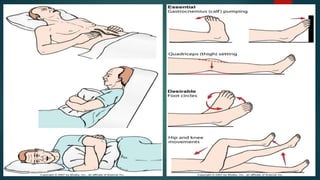
 Deep breathing (incentive spirometer), coughing, leg
exercises, ambulation.
 Pain control and medications.
 Cognitive control to decrease anxiety and enhance
relaxation (deep breathing).
 Recovery room orientation.
 Probable postoperative therapies.
Final Preparation for surgery
All personal belongings are identified and secured.
Jewelry is usually removed.
Dentures are removed, labeled and placed in a
denture cup.
Pt. to verbally confirm the surgical procedures and
the surgical site. This verification process is
documented in the medical record on the preop.
checklist.
 Surgeon-responsible for determining the preoperative
diagnosis, the choice and execution of the surgical procedure,
the explanation of the risks and benefits, obtaining inform
consent and the postoperative management of the patient’s
care.
 Scrub nurse- (RN or Scrub tech)- preparation of supplies and
equipment on the sterile field; maintenance of pt.s safety and
integrity: observation of the scrubbed team for breaks in the
sterile fields; provision of appropriate sterile instrumentation,
sutures, and supplies; sharps count.
Intraoperative Phase
Surgical Team
Circulating Nurse - responsible for creating a safe
environment, managing the activities outside the sterile
field, providing nursing care to the patient. Documenting
intraoperative nursing care and ensuring surgical
specimens are identified and place in the right media. In
charge of the instrument and sharps count and
communicating relevant information to individual outside
of the OR, such as family members.
Anesthesiologist and anesthetist- anesthetizing the pt.
providing appropriate levels of pain relief, monitoring the
pt’s physiologic status and providing the best operative
conditions for the surgeons.
Other personnel- pathologist, radiologist, perfusionist.
Nursing Roles:
 Staff education.
 Client/family teaching.
 Support and reassurance.
 Advocacy.
 Control of the environment.
 Provision of resources.
 Maintenance of asepsis.
 Monitoring of physiologic and psychological status.
 Ensure sterility.
 Alert for breaks.
Nursing Process Intraop Phase
Evaluation.
Expected.
Unexpected.
Documented.
Informing Client & Family.
Surgical Waiting Room.
Ongoing Updates by OR Team.
Proper Technique for scrubbing in to a surgical
field
 Team members fingers and hands should be scrubbed first
with progression to the forearm and elbows.
 The hands should be held away from the surgical attire.
 The hands should be held up once clean so that no suds or
other bacteria can drift down onto the clean area.
 When waterless gels are used for asepsis, you should first
wash you hands and forearms thoroughly with soap and
water, then dry before putting on the gel.
 Then you can enter the surgical area and put on the
surgical gown and gloves.
Patient Positioning
Supine
Prone
Lateral
Sitting
Definition of Anesthesia
Greek word- anesthesis, meaning “negative sensation.”
Artificially induced state of partial or total loss of sensation,
occurring with or without consciousness.
LEAD TO:-
Blocks transmission of nerve impulses.
Suppress reflexes.
Promotes muscle relaxation.
Controlled level of unconsciousness.
Types of Anesthesia
General- method use when the surgery requires that
the patient be unconscious and/or paralyzed.
A general anesthetic acts by blocking awareness
centers in the brain so that amnesia (loss of
memory), analgesia (insensibility to pain), hypnosis
(artificial sleep), and relaxation (rendering a part of
the body less tense) occur.
Stages of General Anesthesia
Stage 1- Analgesia and sedation, relaxation
Stage 2- Excitement, delirium
Stage 3- Operative anesthesia, surgical anesthesia
Stage 4- Danger
Complications of General Anesthesia
Overdose.
Hypoventilation.
Related to anesthetic agents.
Malignant hyperthermia.
Related to intubation.
Local or Regional Anesthesia
Temporarily interrupts the transmission of sensory
nerve impulses from a specific area or region.
Motor function may or may not be affected.
Client does not lose consciousness.
Gag reflex remains intact.
Supplemented with sedatives, opioids, or
hypnotics.
Complications of Local/Regional
Anesthesia
Anaphylaxis.
Administration technique.
Systemic absorption.
Overdosage.
Spinal Anesthesia
Indications:-
-surgical procedures below the diaphragm.
-patients with cardiac or respiratory disease.
Advantages:-
- mental status monitoring. - shorter recovery.
Disadvantages :-
-necessary extra expertise. -possible patient pain.
Contraindications:-
-coagulopathy. -uncorrected hypovolemia.
Complications
Hypotension.
Bradycardia.
urine retention.
postural puncture headache.
back pain.
Conscious Sedation
Produces a depressed level of consciousness.
Retains ability to maintain a patent airway.
Able to respond to verbal commands or physical
stimulation.
Used for relatively short procedures.
CONCLUSION
• The anticipated outcome of preoperative
preparation is a patient who is informed about the
surgical course, and copes with it successfully. The
goal is to decrease complications and promote
recovery.
• When patients are adequately prepared
psychologically and physically, and policies and
guidelines have been followed, the risk of
postoperative complications should be low, leading to
a quick recovery.
Thank you

Preoperative nursing care

  • 1.
    ‫الرمحن‬ ‫هللا‬ ‫سم‬‫ب‬‫الرحمي‬ PERIOPERATIVENURSING CARE PREPARING BY:- ASHRAF IBRAHIM MOHANED ABDALL NMARQ HAMDTOO
  • 2.
    Surgery is anyprocedure performed on the human body that uses instruments to alter tissue or organ integrity.
  • 3.
    Peroperative Nursing Phases Preoperativephase – begins when the decision to have surgery is made and ends when the client is transferred to the OR table.  Intraoperative phase – begins when the client is transferred to the OR table and ends when the client is admitted to the PACU. Postoperative phase - begins with the admission of the clientto the PACU and ends when the healing is complete.
  • 4.
    DefinitionPreoperative Nursing care Preoperative Nursingcare is the preparation and management of a patient prior to surgery. It includes both physical and psychological preparation.
  • 5.
    Types of Surgeries Diagnostic:- Determination of the presence and or extent of the pathology. Laparatomy. Therapeutic :- Elimination or repair of the pathology Removal of the appendix when it's inflammed, removal of a localized cancer
  • 6.
    Types of Surgeries Palliative:- Alleviationof symptoms without curing the underlying disease Rhizotomy (cutting of a nerve root) to decrease pain. Preventative:- Surgery to remove tissue that has the potential to become pathologic .
  • 7.
    Types of Surgeries Cosmetic:- The surgery is preformed for aesthetic reasons Repair of scars from burns or injuries, minor cleft palate repairs, face lifts, breast augmentation
  • 8.
    Types of ElectiveAdmissions for Surgery Ambulatory Surgery :- Usually outside a hospital setting Special prescreening. Same-Day Surgery :- Outpatient, can be in the hospital Go home the day of the surgery Early Hospital Admission :- Patient comes in early (night before or earlier)Usually patients with complex medical issues, and increased risk for poor surgical outcomes.
  • 9.
    Type of Surgery(Degree of Risk)  Major – involves a high degree of risk.  Minor – normally involves little risk.  Age – very young and elder clients are greater surgical risks than children and adult.  General health- surgery is least risky when the clients general health is good.  Nutritional Status – required for normal tissue repair.  Medications – regular use of certain medications can increase surgical risk.  Mental status – disorder that affect cognitive function.
  • 10.
    assessment differs fromthose performed on the patient in a medical-surgical unit and requires some alterations to the formal nursing process that can challenge new perioperative nurses. One reason for this difference is due to the brief time a peroperative nurse has contact with a conscious patient.
  • 11.
    Assessment (Nursing History) oCurrent health status. o Allergies. o Medications- list all current medications. o Previous surgeries. o Understanding of the surgical procedure and anesthesia. o Smoking. o Alcohol and other-altering substances. o Social resources. o Cultural considerations.
  • 12.
    Cardiovascular system. Respiratory system. Renalsystem. Neurological system. Musculoskeletal system. Nutritional status.
  • 13.
    Level of anxiety. Copingability. Support systems.
  • 14.
    In emergency surgery,the principles of preoperative assessment is the same as in elective surgery.
  • 15.
     Nature andintention of the surgery.  Name and qualifications of the person performing the surgery.  Risks, including tissue damage, disfigurement, or even death.  Chances of success.  Possible alternative measures.  The right of the client to refuse consent or later withdraw consent.
  • 16.
    CBC,Blood grouping andX-match, fasting blood sugar. Serum Creatinine, and bilirubin,Serum albumin, and Total protein. Urinalysis, Chest X-ray,ECG.
  • 17.
    Anxiety:- r/t situationalcrisis, change in health status, fear of unknown, fear of pain and/or disfigurement. Knowledge :-deficit r/t pre/post operative procedures. Disturbed Sleep:- r/t anxiety about upcoming surgery.
  • 18.
    interventions:-  Diet Restrictions Historical guidelines to prevent aspiration were NPO after midnight the night before.  Educating the patient about the reason for NPO status may help with adherence .  Information of what to wear to the surgery  Patient will likely need to be there 1 to 2 hours prior to scheduled procedure.
  • 19.
    Medications  Sedatives/hypnotics- valium Opiate analgesics- morphine  Anticholinergics-Atropine sulfate  H2o blockers.- Zantac  Antiemetic- Phenergan
  • 20.
    Preoperative patient learningneeds  Deep breathing (incentive spirometer), coughing, leg exercises, ambulation.  Pain control and medications.  Cognitive control to decrease anxiety and enhance relaxation (deep breathing).  Recovery room orientation.  Probable postoperative therapies.
  • 22.
    Final Preparation forsurgery All personal belongings are identified and secured. Jewelry is usually removed. Dentures are removed, labeled and placed in a denture cup. Pt. to verbally confirm the surgical procedures and the surgical site. This verification process is documented in the medical record on the preop. checklist.
  • 25.
     Surgeon-responsible fordetermining the preoperative diagnosis, the choice and execution of the surgical procedure, the explanation of the risks and benefits, obtaining inform consent and the postoperative management of the patient’s care.  Scrub nurse- (RN or Scrub tech)- preparation of supplies and equipment on the sterile field; maintenance of pt.s safety and integrity: observation of the scrubbed team for breaks in the sterile fields; provision of appropriate sterile instrumentation, sutures, and supplies; sharps count.
  • 26.
    Intraoperative Phase Surgical Team CirculatingNurse - responsible for creating a safe environment, managing the activities outside the sterile field, providing nursing care to the patient. Documenting intraoperative nursing care and ensuring surgical specimens are identified and place in the right media. In charge of the instrument and sharps count and communicating relevant information to individual outside of the OR, such as family members.
  • 27.
    Anesthesiologist and anesthetist-anesthetizing the pt. providing appropriate levels of pain relief, monitoring the pt’s physiologic status and providing the best operative conditions for the surgeons. Other personnel- pathologist, radiologist, perfusionist.
  • 28.
    Nursing Roles:  Staffeducation.  Client/family teaching.  Support and reassurance.  Advocacy.  Control of the environment.  Provision of resources.
  • 29.
     Maintenance ofasepsis.  Monitoring of physiologic and psychological status.  Ensure sterility.  Alert for breaks.
  • 30.
    Nursing Process IntraopPhase Evaluation. Expected. Unexpected. Documented. Informing Client & Family. Surgical Waiting Room. Ongoing Updates by OR Team.
  • 31.
    Proper Technique forscrubbing in to a surgical field  Team members fingers and hands should be scrubbed first with progression to the forearm and elbows.  The hands should be held away from the surgical attire.  The hands should be held up once clean so that no suds or other bacteria can drift down onto the clean area.  When waterless gels are used for asepsis, you should first wash you hands and forearms thoroughly with soap and water, then dry before putting on the gel.  Then you can enter the surgical area and put on the surgical gown and gloves.
  • 32.
  • 33.
    Definition of Anesthesia Greekword- anesthesis, meaning “negative sensation.” Artificially induced state of partial or total loss of sensation, occurring with or without consciousness. LEAD TO:- Blocks transmission of nerve impulses. Suppress reflexes. Promotes muscle relaxation. Controlled level of unconsciousness.
  • 34.
    Types of Anesthesia General-method use when the surgery requires that the patient be unconscious and/or paralyzed. A general anesthetic acts by blocking awareness centers in the brain so that amnesia (loss of memory), analgesia (insensibility to pain), hypnosis (artificial sleep), and relaxation (rendering a part of the body less tense) occur.
  • 35.
    Stages of GeneralAnesthesia Stage 1- Analgesia and sedation, relaxation Stage 2- Excitement, delirium Stage 3- Operative anesthesia, surgical anesthesia Stage 4- Danger
  • 36.
    Complications of GeneralAnesthesia Overdose. Hypoventilation. Related to anesthetic agents. Malignant hyperthermia. Related to intubation.
  • 37.
    Local or RegionalAnesthesia Temporarily interrupts the transmission of sensory nerve impulses from a specific area or region. Motor function may or may not be affected. Client does not lose consciousness. Gag reflex remains intact. Supplemented with sedatives, opioids, or hypnotics.
  • 38.
  • 39.
    Spinal Anesthesia Indications:- -surgical proceduresbelow the diaphragm. -patients with cardiac or respiratory disease. Advantages:- - mental status monitoring. - shorter recovery. Disadvantages :- -necessary extra expertise. -possible patient pain. Contraindications:- -coagulopathy. -uncorrected hypovolemia.
  • 40.
  • 41.
    Conscious Sedation Produces adepressed level of consciousness. Retains ability to maintain a patent airway. Able to respond to verbal commands or physical stimulation. Used for relatively short procedures.
  • 42.
    CONCLUSION • The anticipatedoutcome of preoperative preparation is a patient who is informed about the surgical course, and copes with it successfully. The goal is to decrease complications and promote recovery. • When patients are adequately prepared psychologically and physically, and policies and guidelines have been followed, the risk of postoperative complications should be low, leading to a quick recovery.
  • 44.