Project on
“ADAPTIVE FLEXIBLE HEADLIGHTS SYSTEM FOR FOUR WHEELER”
Submitted By
Nagesha Achari 4AL10ME066
Ganesha Naik 4AL10ME032
Jagadeesha 4AL10ME038
Marutesh Kurubar 4AL10ME061
Under the Guidance of
Mr.Kumarswamy M.C. Mr.Arunkumar D.T.
Asst.Professor Asst. Professor
DEPARTMENT OF MECHANICAL ENGINEERING
ALVA’S INSTITUTE OF ENGINEERING & TECHNOLOGY
MOODBIDRI – 574 225.
2013-2014
CONTENTS
INTRODUCTION
OBJECTIVES
LITERATURE SURVEY
IMPORTANT TECHNICAL CONSIDERATIONS
DESIGN ASPECTS
FABRICATION WORK
METHODOLOGY
CALCULATIONS
RESULT AND DISCUSSIONS
CONCLUSSION
FUTURE WORK
REFERENCE
COST ANALYSIS
INTRODUCTION
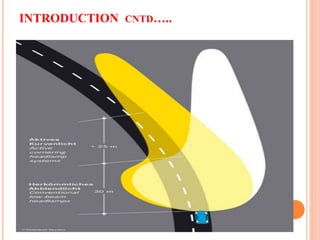
 Preventive and active safety of road vehicles is one of the
top priorities in car design and development nowadays.
 Lighting in modern vehicles has been steadily improving in
the last decades.
 An aim of development in active safety is to reduce the
reaction time of the driver by improving visibility and thus
achieve a significant increase in road safety and driving
comfort.
 The Adaptive Headlight System is the outcome of
engineering efforts in developing the next generation
lighting systems not only for drivers but also for all other
road users.
 That means these headlamps focus on the road in varying
manner.
INTRODUCTION CNTD…..
OBJECTIVE
• The project work is a solution over the present
mechanism, and includes building and
demonstration of adaptive flexible headlight
system for four wheeler.
LITERATURE SURVEY
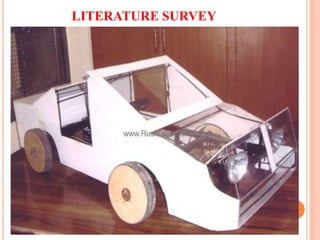
• The above prototype of flexible headlights
system is successfully done by the
students of Aligarh University
• But the mechanism adapted was the purely
mechanical one
• The project model is made up from
aluminum pipe,gears,wheels,flexible, links
nut and bolts, screws, wheels, studs,etc.
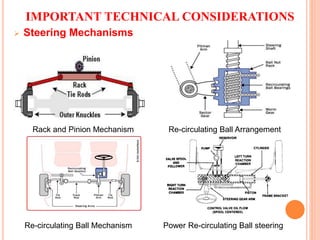
IMPORTANT TECHNICAL CONSIDERATIONS
 Steering Mechanisms
Rack and Pinion Mechanism Re-circulating Ball Arrangement
Re-circulating Ball Mechanism Power Re-circulating Ball steering
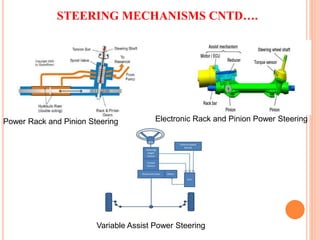
STEERING MECHANISMS CNTD….
Variable Assist Power Steering
Electronic Rack and Pinion Power SteeringPower Rack and Pinion Steering
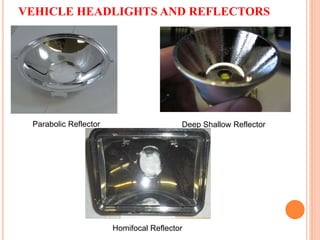
VEHICLE HEADLIGHTS AND REFLECTORS
Parabolic Reflector Deep Shallow Reflector
Homifocal Reflector
EFFECT OF INTEGRATED HEADLIGHTS
• Best combination of bulb, reflector and the
cover lens can give optimum illumination of
the road.
• That is effective long reaching focus and also
the stray focus.
• But almost any best combination of headlight
components cannot assist the best
comfortable vision for driver in very curvy
roads with smaller turning radius and U turns
DESIGN ASPECTS
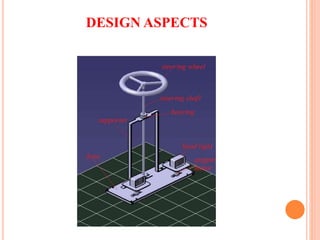
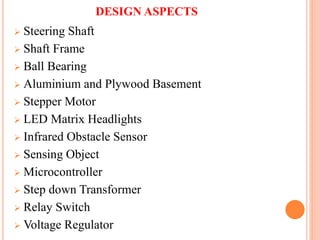
DESIGN ASPECTS
 Steering Shaft
 Shaft Frame
 Ball Bearing
 Aluminium and Plywood Basement
 Stepper Motor
 LED Matrix Headlights
 Infrared Obstacle Sensor
 Sensing Object
 Microcontroller
 Step down Transformer
 Relay Switch
 Voltage Regulator
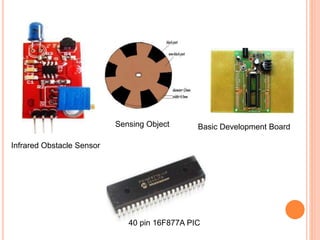
Sensing Object
Infrared Obstacle Sensor
40 pin 16F877A PIC
Basic Development Board
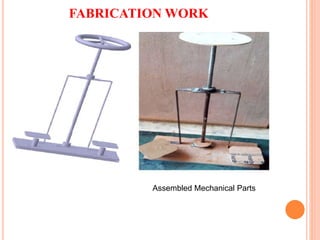
FABRICATION WORK
Assembled Mechanical Parts
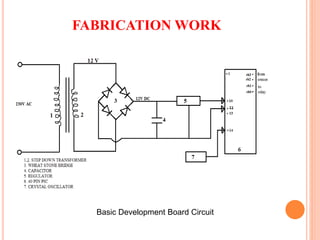
FABRICATION WORK
Basic Development Board Circuit
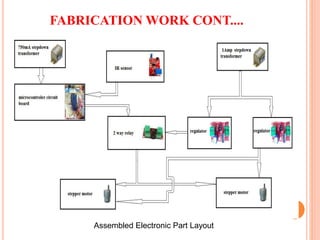
FABRICATION WORK CONT....
Assembled Electronic Part Layout
METHODOLOGY
• When steering wheel rotates, the sensing object fixed to it
rotates in same extent.
• At initial position two sensors IR1 and IR2 are in two ends of
one black region.
• Whenever sensing object rotates to left, the sensor IR1 comes
to white region first ant then the IR2. If sensing object turns to
right in the sense, IR2 comes to white region first than IR1.
• If both sensors faces white region then it sends the electrical
pulses to controller.
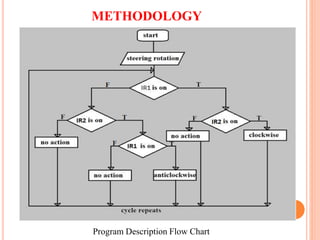
• If IR1faces white before IR2 then headlight turns to left and if
IR2 activate first than IR1 then headlight turns to right. It is
achieved by the programming the controller in the same
manner.
METHODOLOGY
Program Description Flow Chart
CALCULATIONS
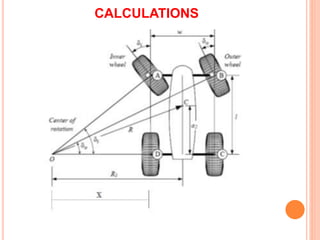
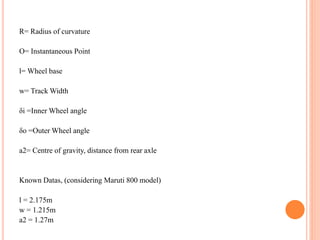
R= Radius of curvature
O= Instantaneous Point
l= Wheel base
w= Track Width
δi =Inner Wheel angle
δo =Outer Wheel angle
a2= Centre of gravity, distance from rear axle
Known Datas, (considering Maruti 800 model)
l = 2.175m
w = 1.215m
a2 = 1.27m
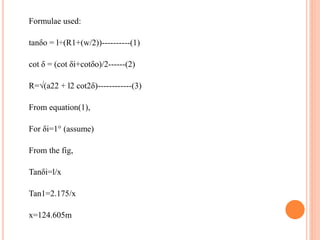
Formulae used:
tanδo = l÷(R1+(w/2))----------(1)
cot δ = (cot δi+cotδo)/2------(2)
R=√(a22 + l2 cot2δ)------------(3)
From equation(1),
For δi=1° (assume)
From the fig,
Tanδi=l/x
Tan1=2.175/x
x=124.605m
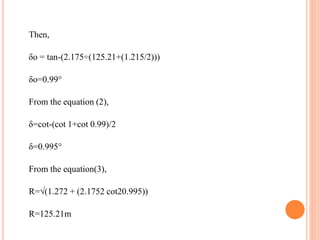
Then,
δo = tan-(2.175÷(125.21+(1.215/2)))
δo=0.99°
From the equation (2),
δ=cot-(cot 1+cot 0.99)/2
δ=0.995°
From the equation(3),
R=√(1.272 + (2.1752 cot20.995))
R=125.21m
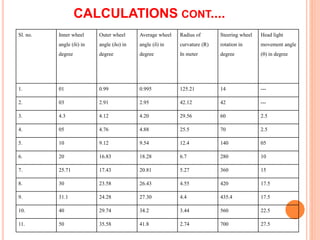
CALCULATIONS CONT....
Sl. no. Inner wheel
angle (δi) in
degree
Outer wheel
angle (δo) in
degree
Average wheel
angle (δ) in
degree
Radius of
curvature (R)
In meter
Steering wheel
rotation in
degree
Head light
movement angle
(θ) in degree
1. 01 0.99 0.995 125.21 14 ---
2. 03 2.91 2.95 42.12 42 ---
3. 4.3 4.12 4.20 29.56 60 2.5
4. 05 4.76 4.88 25.5 70 2.5
5. 10 9.12 9.54 12.4 140 05
6. 20 16.83 18.28 6.7 280 10
7. 25.71 17.43 20.81 5.27 360 15
8. 30 23.58 26.43 4.55 420 17.5
9. 31.1 24.28 27.30 4.4 435.4 17.5
10. 40 29.74 34.2 3.44 560 22.5
11. 50 35.58 41.8 2.74 700 27.5
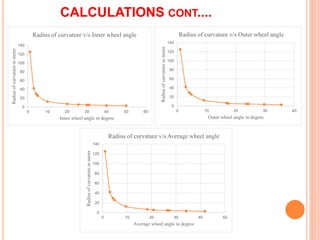
CALCULATIONS CONT....
0
20
40
60
80
100
120
140
0 10 20 30 40 50 60
Radiusofcurvatureinmeter
Inner wheel angle in degree
Radius of curvature v/s Inner wheel angle
0
20
40
60
80
100
120
140
0 10 20 30 40
Radiusofcurvatureinmeter
Outer wheel angle in degree
Radius of curvature v/s Outer wheel angle
0
20
40
60
80
100
120
140
0 10 20 30 40 50
Radiusofcurvatureinmeter
Average wheel angle in degree
Radius of curvature v/s Average wheel angle
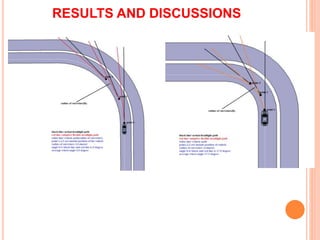
RESULTS AND DISCUSSIONS
CONCLUSION
• The Adaptive Headlight System will be an active safety
system.
• Implementation of this system results in good night time
visibility of side of road during turn and there by
comfortable night drive.
• Effective utilisation of the headlights and reduction in
night time road accidents.
• Increases SAFETY for drivers & pedestrians .
FUTURE WORK
• Real time calculation of wheel turning in
curvy roads with different vehicle speeds
• Extending the technology to dim dip
variations
• Direct attachment of sensor to wheel to sense
the turning angle of wheels
• Innovative sensing system for accuracy and
continuous turning of headlights .
REFERENCES
• Alexander, G. J. and Lunenfeld, H. (1990), Report No. FHWA-
SA-90-017, U.S. Department of Transportation, Federal
Highway Administration, Washington.
• http://www.bmwworld.com/technology/lighting.htm
• Automotive mechanics, william h crouse 10th adition
• U.S. National Highway Traffic Safety Admin. Traffic safety
facts (2000)
• Michigan Univ. Transportation Research Inst. Use of high-beam
headlamps (2006)
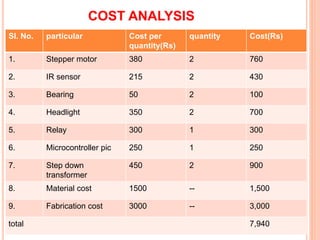
COST ANALYSIS
Sl. No. particular Cost per
quantity(Rs)
quantity Cost(Rs)
1. Stepper motor 380 2 760
2. IR sensor 215 2 430
3. Bearing 50 2 100
4. Headlight 350 2 700
5. Relay 300 1 300
6. Microcontroller pic 250 1 250
7. Step down
transformer
450 2 900
8. Material cost 1500 -- 1,500
9. Fabrication cost 3000 -- 3,000
total 7,940
THANK YOU

Presentation1 NEW

  • 1.
    Project on “ADAPTIVE FLEXIBLEHEADLIGHTS SYSTEM FOR FOUR WHEELER” Submitted By Nagesha Achari 4AL10ME066 Ganesha Naik 4AL10ME032 Jagadeesha 4AL10ME038 Marutesh Kurubar 4AL10ME061 Under the Guidance of Mr.Kumarswamy M.C. Mr.Arunkumar D.T. Asst.Professor Asst. Professor DEPARTMENT OF MECHANICAL ENGINEERING ALVA’S INSTITUTE OF ENGINEERING & TECHNOLOGY MOODBIDRI – 574 225. 2013-2014
  • 2.
    CONTENTS INTRODUCTION OBJECTIVES LITERATURE SURVEY IMPORTANT TECHNICALCONSIDERATIONS DESIGN ASPECTS FABRICATION WORK METHODOLOGY CALCULATIONS RESULT AND DISCUSSIONS CONCLUSSION FUTURE WORK REFERENCE COST ANALYSIS
  • 3.
    INTRODUCTION  Preventive andactive safety of road vehicles is one of the top priorities in car design and development nowadays.  Lighting in modern vehicles has been steadily improving in the last decades.  An aim of development in active safety is to reduce the reaction time of the driver by improving visibility and thus achieve a significant increase in road safety and driving comfort.  The Adaptive Headlight System is the outcome of engineering efforts in developing the next generation lighting systems not only for drivers but also for all other road users.  That means these headlamps focus on the road in varying manner.
  • 4.
  • 5.
    OBJECTIVE • The projectwork is a solution over the present mechanism, and includes building and demonstration of adaptive flexible headlight system for four wheeler.
  • 6.
  • 7.
    • The aboveprototype of flexible headlights system is successfully done by the students of Aligarh University • But the mechanism adapted was the purely mechanical one • The project model is made up from aluminum pipe,gears,wheels,flexible, links nut and bolts, screws, wheels, studs,etc.
  • 8.
    IMPORTANT TECHNICAL CONSIDERATIONS Steering Mechanisms Rack and Pinion Mechanism Re-circulating Ball Arrangement Re-circulating Ball Mechanism Power Re-circulating Ball steering
  • 9.
    STEERING MECHANISMS CNTD…. VariableAssist Power Steering Electronic Rack and Pinion Power SteeringPower Rack and Pinion Steering
  • 10.
    VEHICLE HEADLIGHTS ANDREFLECTORS Parabolic Reflector Deep Shallow Reflector Homifocal Reflector
  • 11.
    EFFECT OF INTEGRATEDHEADLIGHTS • Best combination of bulb, reflector and the cover lens can give optimum illumination of the road. • That is effective long reaching focus and also the stray focus. • But almost any best combination of headlight components cannot assist the best comfortable vision for driver in very curvy roads with smaller turning radius and U turns
  • 12.
  • 13.
    DESIGN ASPECTS  SteeringShaft  Shaft Frame  Ball Bearing  Aluminium and Plywood Basement  Stepper Motor  LED Matrix Headlights  Infrared Obstacle Sensor  Sensing Object  Microcontroller  Step down Transformer  Relay Switch  Voltage Regulator
  • 14.
    Sensing Object Infrared ObstacleSensor 40 pin 16F877A PIC Basic Development Board
  • 15.
  • 16.
  • 17.
  • 18.
    METHODOLOGY • When steeringwheel rotates, the sensing object fixed to it rotates in same extent. • At initial position two sensors IR1 and IR2 are in two ends of one black region. • Whenever sensing object rotates to left, the sensor IR1 comes to white region first ant then the IR2. If sensing object turns to right in the sense, IR2 comes to white region first than IR1. • If both sensors faces white region then it sends the electrical pulses to controller. • If IR1faces white before IR2 then headlight turns to left and if IR2 activate first than IR1 then headlight turns to right. It is achieved by the programming the controller in the same manner.
  • 19.
  • 20.
  • 21.
    R= Radius ofcurvature O= Instantaneous Point l= Wheel base w= Track Width δi =Inner Wheel angle δo =Outer Wheel angle a2= Centre of gravity, distance from rear axle Known Datas, (considering Maruti 800 model) l = 2.175m w = 1.215m a2 = 1.27m
  • 22.
    Formulae used: tanδo =l÷(R1+(w/2))----------(1) cot δ = (cot δi+cotδo)/2------(2) R=√(a22 + l2 cot2δ)------------(3) From equation(1), For δi=1° (assume) From the fig, Tanδi=l/x Tan1=2.175/x x=124.605m
  • 23.
    Then, δo = tan-(2.175÷(125.21+(1.215/2))) δo=0.99° Fromthe equation (2), δ=cot-(cot 1+cot 0.99)/2 δ=0.995° From the equation(3), R=√(1.272 + (2.1752 cot20.995)) R=125.21m
  • 24.
    CALCULATIONS CONT.... Sl. no.Inner wheel angle (δi) in degree Outer wheel angle (δo) in degree Average wheel angle (δ) in degree Radius of curvature (R) In meter Steering wheel rotation in degree Head light movement angle (θ) in degree 1. 01 0.99 0.995 125.21 14 --- 2. 03 2.91 2.95 42.12 42 --- 3. 4.3 4.12 4.20 29.56 60 2.5 4. 05 4.76 4.88 25.5 70 2.5 5. 10 9.12 9.54 12.4 140 05 6. 20 16.83 18.28 6.7 280 10 7. 25.71 17.43 20.81 5.27 360 15 8. 30 23.58 26.43 4.55 420 17.5 9. 31.1 24.28 27.30 4.4 435.4 17.5 10. 40 29.74 34.2 3.44 560 22.5 11. 50 35.58 41.8 2.74 700 27.5
  • 25.
    CALCULATIONS CONT.... 0 20 40 60 80 100 120 140 0 1020 30 40 50 60 Radiusofcurvatureinmeter Inner wheel angle in degree Radius of curvature v/s Inner wheel angle 0 20 40 60 80 100 120 140 0 10 20 30 40 Radiusofcurvatureinmeter Outer wheel angle in degree Radius of curvature v/s Outer wheel angle 0 20 40 60 80 100 120 140 0 10 20 30 40 50 Radiusofcurvatureinmeter Average wheel angle in degree Radius of curvature v/s Average wheel angle
  • 26.
  • 27.
    CONCLUSION • The AdaptiveHeadlight System will be an active safety system. • Implementation of this system results in good night time visibility of side of road during turn and there by comfortable night drive. • Effective utilisation of the headlights and reduction in night time road accidents. • Increases SAFETY for drivers & pedestrians .
  • 28.
    FUTURE WORK • Realtime calculation of wheel turning in curvy roads with different vehicle speeds • Extending the technology to dim dip variations • Direct attachment of sensor to wheel to sense the turning angle of wheels • Innovative sensing system for accuracy and continuous turning of headlights .
  • 29.
    REFERENCES • Alexander, G.J. and Lunenfeld, H. (1990), Report No. FHWA- SA-90-017, U.S. Department of Transportation, Federal Highway Administration, Washington. • http://www.bmwworld.com/technology/lighting.htm • Automotive mechanics, william h crouse 10th adition • U.S. National Highway Traffic Safety Admin. Traffic safety facts (2000) • Michigan Univ. Transportation Research Inst. Use of high-beam headlamps (2006)
  • 30.
    COST ANALYSIS Sl. No.particular Cost per quantity(Rs) quantity Cost(Rs) 1. Stepper motor 380 2 760 2. IR sensor 215 2 430 3. Bearing 50 2 100 4. Headlight 350 2 700 5. Relay 300 1 300 6. Microcontroller pic 250 1 250 7. Step down transformer 450 2 900 8. Material cost 1500 -- 1,500 9. Fabrication cost 3000 -- 3,000 total 7,940
  • 32.