Presentedby: Sir Malit
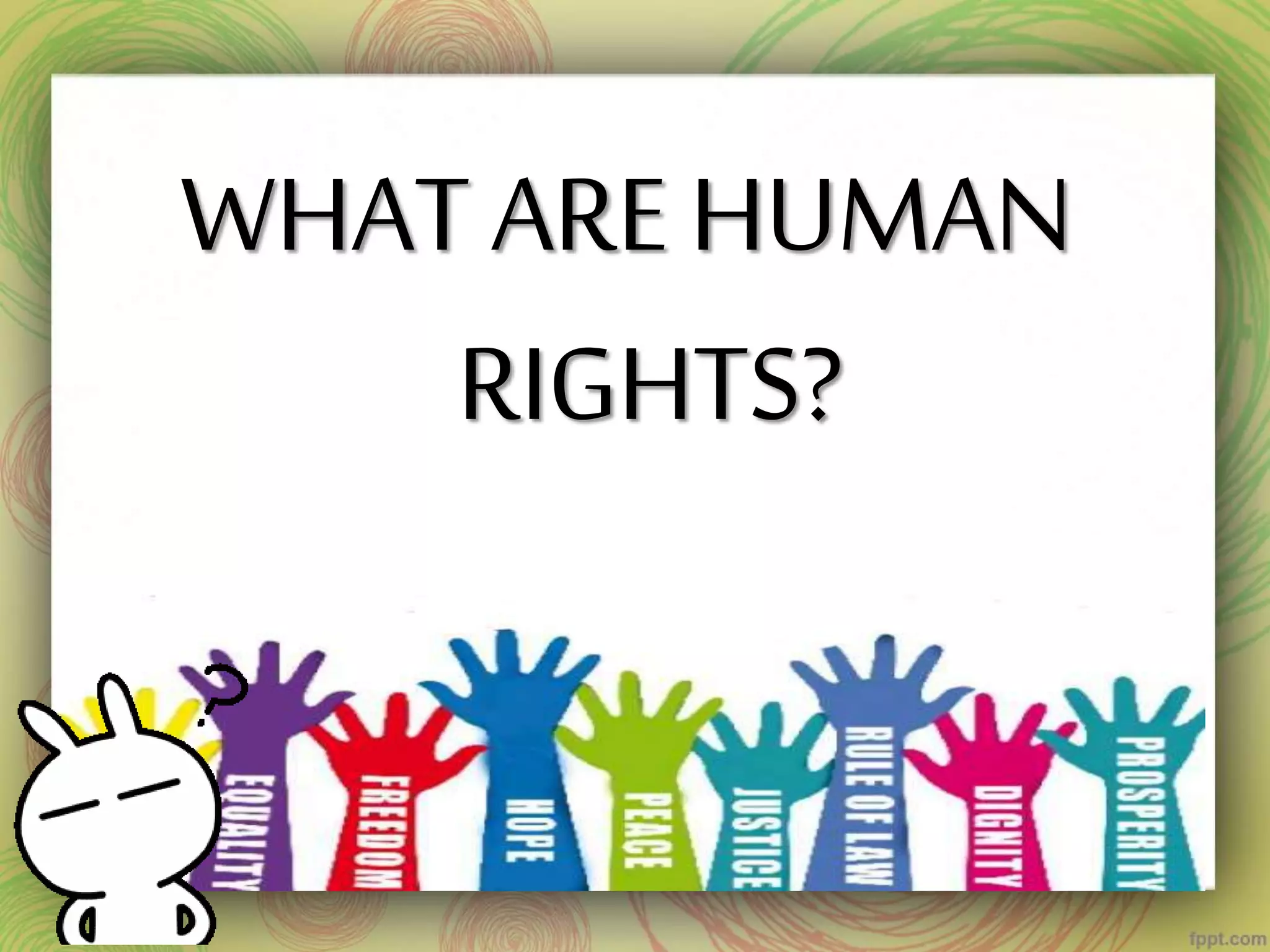
WHAT ARE HUMAN
RIGHTS?
Human Rights
 are rights inherent to all human
beings, whatever our nationality,
place of residence, sex, national or
ethnic origin, colour, religion,
language, or any other status.
Characteristics
 Universal and Inalienable
Interdependent and Indivisible
 Equal and Non-discriminatory
 Entail Both Rights and Obligations
Source: Universal Declaration of Human Rights
“InternationalMagna Carta for All
Mankind.”
The Universal Declaration of Human Rights was adopted and
proclaimed by the General Assembly
a common standard of achievement for all peoples and all
nations, to the end that every individual and every organ of
society, keeping this Declaration constantly in mind, shall strive
by teaching and education to promote respect for these rights and
freedoms and by progressive measures, national and
international, to secure their universal and effective recognition
and observance, both among, the peoples of Member States
themselves and among the peoples of territories under their
jurisdiction.
• Article I
All human beings are born free and equal
in dignity and rights. They are endowed
with reason and conscience and should
act towards one another in a spirit of
brotherhood.
• Article 2
Everyone is entitled to all the rights and freedoms set forth in
this Declaration, without distinction of any kind, such as race,
colour, sex, language, religion, political or other opinion,
national or social origin, property, birth or other status.
Furthermore, no distinction shall be made on the basis of the
political, jurisdictional or international status of the country or
territory to which a person belongs, whether it be independent,
trust, non-self-governing or under any other limitation of
sovereignty.
• Article 3
Everyone has the right to life, liberty and
security of person.
Articles 4-21
CIVIL & POLITICAL RIGHTS
ৡ Freedom from slavery and servitude
ৡ Freedom from torture and cruelty, inhuman or degrading
treatment or punishment
ৡ Right to recognition everywhere as a person before the
law
ৡ Right to an effective judicial remedy
ৡ Freedom from arbitrary arrest, detention or exile
ৡ Right to a fair trial and public hearing by an independent
and impartial tribunal
ৡ Right to be presumed innocent until proved guilty
ৡ Freedom from arbitrary interference with privacy,
family, home or correspondence
ৡ Freedom of movement or residence
ৡ Right of asylum
ৡ Right to a nationality
ৡ Right to marry and to found a family
ৡ Right to own property
ৡ Freedom of thought, conscience and religion
ৡ Freedom of opinion and expression
ৡ Right to peaceful assembly or association
ৡ Right to take part in the government of one’s country
ৡ Right to equal access to public service in one’s country
• Article 22
Everyone, as a member of society, has the right to social
security and is entitled to realization, through national
effort and international co-operation and in accordance
with the organization and resources of each State, of the
economic, social and cultural rights indispensable for his
dignity and the free development of his personality.
Article 23-27
Economic, Social and Cultural Rights
ৡ Right to social security
ৡ Right to work
ৡ Right to equal pay for equal work
ৡ Right to rest and leisure
ৡ Right to a standard of living adequate for health and well-being
ৡ Right to education
ৡ Right to participate in the cultural life of the community
• Article 28
Everyone is entitled to a social and
international order in which the rights
and freedoms set forth in this Declaration
can be fully realized.
Article 29
1. Everyone has duties to the community in which alone the free and full
development of his personality is possible.
2. In the exercise of his rights and freedoms, everyone shall be subject only to
such limitations as are determined by law solely for the purpose of securing
due recognition and respect for the rights and freedoms of others and of
meeting the just requirements of morality, public order and the general
welfare in a democratic society.
3. These rights and freedoms may in no case be exercised contrary to the
purposes and principles of the United Nations.
• Article 30
Nothing in this Declaration may be
interpreted as implying for any State, group
or person any right to engage in any activity
or to perform any act aimed at the destruction
of any of the rights and freedoms set forth
herein.
HumanRights Issues in the Philippines
Criminal Defamation and Media Freedom
Extrajudicial Killings and Enforced Disappearances
Death Squad Killings
New People Army’s Abuses
Children ad Armed Conflict
Domestic Workers
Human Rights
Organizations
Local Orgs:
 Philippine Human Rights Information Center
(PhilRights)
 Free Legal Assistance Group (FLAG)
 Balay Rehabilitation Center
 Amnesty International – Philippines
 Medical Action Group
 Families of Victims of Involuntary
Disappearance (FIND)
 Commission on Human Rights
 Philippine Alliance of Human Rights
Advocates (PAHRA)
International Orgs:
 Solidarity for Asian Peoples Advocacy
 CATW-AP
 Canadian Human Rights Foundation
 ISHHR
 Human Rights Watch
 OMCT
 CICC
 Amnesty International
Sources:
http://www.youthforhumanrights.org/what-are-human-
rights/universal-declaration-of-human-
rights/introduction.html
http://www.hrw.org/world-report/2013/country-
chapters/112604
http://www.tfdp.net
http://www.detentionwatchnetwork.org/whyhumanrights
http://www.humanrights.com/what-are-human-
rights.html
Sources
• http://www.ohchr.org/en/udhr/pages/introduction.
aspx
• http://www.detentionwatchnetwork.org/whyhuma
nrights
• http://www.humanrights.com/what-are-human-
rights.html
• http://www.globalissues.org/issue/137/human-
rights-issues

United Nations Universal Declaration on Human Rights

  • 1.
  • 2.
  • 3.
    Human Rights  arerights inherent to all human beings, whatever our nationality, place of residence, sex, national or ethnic origin, colour, religion, language, or any other status.
  • 4.
    Characteristics  Universal andInalienable Interdependent and Indivisible  Equal and Non-discriminatory  Entail Both Rights and Obligations Source: Universal Declaration of Human Rights
  • 5.
  • 6.
    The Universal Declarationof Human Rights was adopted and proclaimed by the General Assembly a common standard of achievement for all peoples and all nations, to the end that every individual and every organ of society, keeping this Declaration constantly in mind, shall strive by teaching and education to promote respect for these rights and freedoms and by progressive measures, national and international, to secure their universal and effective recognition and observance, both among, the peoples of Member States themselves and among the peoples of territories under their jurisdiction.
  • 7.
    • Article I Allhuman beings are born free and equal in dignity and rights. They are endowed with reason and conscience and should act towards one another in a spirit of brotherhood.
  • 8.
    • Article 2 Everyoneis entitled to all the rights and freedoms set forth in this Declaration, without distinction of any kind, such as race, colour, sex, language, religion, political or other opinion, national or social origin, property, birth or other status. Furthermore, no distinction shall be made on the basis of the political, jurisdictional or international status of the country or territory to which a person belongs, whether it be independent, trust, non-self-governing or under any other limitation of sovereignty.
  • 9.
    • Article 3 Everyonehas the right to life, liberty and security of person.
  • 10.
    Articles 4-21 CIVIL &POLITICAL RIGHTS ৡ Freedom from slavery and servitude ৡ Freedom from torture and cruelty, inhuman or degrading treatment or punishment ৡ Right to recognition everywhere as a person before the law ৡ Right to an effective judicial remedy ৡ Freedom from arbitrary arrest, detention or exile
  • 11.
    ৡ Right toa fair trial and public hearing by an independent and impartial tribunal ৡ Right to be presumed innocent until proved guilty ৡ Freedom from arbitrary interference with privacy, family, home or correspondence ৡ Freedom of movement or residence ৡ Right of asylum ৡ Right to a nationality ৡ Right to marry and to found a family
  • 12.
    ৡ Right toown property ৡ Freedom of thought, conscience and religion ৡ Freedom of opinion and expression ৡ Right to peaceful assembly or association ৡ Right to take part in the government of one’s country ৡ Right to equal access to public service in one’s country
  • 13.
    • Article 22 Everyone,as a member of society, has the right to social security and is entitled to realization, through national effort and international co-operation and in accordance with the organization and resources of each State, of the economic, social and cultural rights indispensable for his dignity and the free development of his personality.
  • 14.
    Article 23-27 Economic, Socialand Cultural Rights ৡ Right to social security ৡ Right to work ৡ Right to equal pay for equal work ৡ Right to rest and leisure ৡ Right to a standard of living adequate for health and well-being ৡ Right to education ৡ Right to participate in the cultural life of the community
  • 15.
    • Article 28 Everyoneis entitled to a social and international order in which the rights and freedoms set forth in this Declaration can be fully realized.
  • 16.
    Article 29 1. Everyonehas duties to the community in which alone the free and full development of his personality is possible. 2. In the exercise of his rights and freedoms, everyone shall be subject only to such limitations as are determined by law solely for the purpose of securing due recognition and respect for the rights and freedoms of others and of meeting the just requirements of morality, public order and the general welfare in a democratic society. 3. These rights and freedoms may in no case be exercised contrary to the purposes and principles of the United Nations.
  • 17.
    • Article 30 Nothingin this Declaration may be interpreted as implying for any State, group or person any right to engage in any activity or to perform any act aimed at the destruction of any of the rights and freedoms set forth herein.
  • 18.
    HumanRights Issues inthe Philippines Criminal Defamation and Media Freedom Extrajudicial Killings and Enforced Disappearances Death Squad Killings New People Army’s Abuses Children ad Armed Conflict Domestic Workers
  • 19.
  • 20.
    Local Orgs:  PhilippineHuman Rights Information Center (PhilRights)  Free Legal Assistance Group (FLAG)  Balay Rehabilitation Center  Amnesty International – Philippines  Medical Action Group
  • 21.
     Families ofVictims of Involuntary Disappearance (FIND)  Commission on Human Rights  Philippine Alliance of Human Rights Advocates (PAHRA)
  • 22.
    International Orgs:  Solidarityfor Asian Peoples Advocacy  CATW-AP  Canadian Human Rights Foundation  ISHHR  Human Rights Watch  OMCT  CICC  Amnesty International
  • 23.
  • 24.
    Sources • http://www.ohchr.org/en/udhr/pages/introduction. aspx • http://www.detentionwatchnetwork.org/whyhuma nrights •http://www.humanrights.com/what-are-human- rights.html • http://www.globalissues.org/issue/137/human- rights-issues