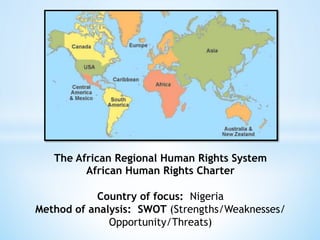
The African Regional Human Rights System
African Human Rights Charter
Country of focus: Nigeria
Method of analysis: SWOT (Strengths/Weaknesses/
Opportunity/Threats)
Purpose of the Product Presentation;
to explore on the following questions and mapping out the foundational basis of the
Regional Human Rights System of Africa.
• What was the impetus for the establishment of the African Charter on Human
and Peoples’ Rights?
• What makes the Charter unique from other international instruments designed to
protect the human rights of individuals?
• How does the African Commission on Human and Peoples’ Rights fulfill its
mandate in promoting and providing protection for human rights in Nigeria? How
effective is it at doing so?
• In what way is the African Court of Justice and Human Rights being challenged?
• Recommendations & Remedies?
History of the African Charter
*To establish human rights mechanism based on the
Historical African unique experiences of decolonization
from the west.
*First conceived in Lagos, Nigeria 1961 at Congress of
African Jurists = attempt failed
*Second President of Senegal, President Senghor has put
the agenda of creating regional human rights mechanism
in Africa in 1979 in Dakar= failed
*Third President of Gambia convened the 1st drafting and
adopted of African charter for this reason African Charter
is also called Banjul charger in 28 June 1981
* It entered into force (EIF) on 21 October 1986
Countries in Africa:
55 The number of Int’ recognised states in Africa; Morocco included
56 The number of Int’ recognised states and de facto states if you include
Somaliland (source: https://africacheck.org)
Ratification Map of the African Charter:
States which have Signed & Ratified 53 Green
States that didn't yet signed or ratified 1 Gray (South Sudan)
(source: http://www.achpr.org)
Nigeria South
Sudan
Morocco
Somaliland
KEY FACTS
Background of Nigeria and the African Charter:
Recognition for collective rights
Africa
Oil Rich
Country
Nigeria
Independence
from the UK
1900-1960
Civil War
eastern region
and the rest of
the country
1967-1970
Over 300-500
indigenous
groups
Nigeria ratified
African Charter
16 Dec 2004
Nigeria has “A”
status in NHRI
by ICC
Full compliance
with the Paris
Principles westerners
Christians
ICC: International Coordinating
Committee
of National Institutions for the
Promotion
and Protection of Human Rights
Ogoni
Ratification of International Human
Rights Instrument
(Instruments)
Domestic Laws
(Instruments)
National Human Rights
Institution (NHRI)
(Institutions)
Judicial
Implementation
(Implementations)
Scope of Civil
Society in
Protection and
Promotion of
Human Rights
(Impacts)
African [Banjul] Charter on Human and
Peoples' Rights *
• Constitution
• National Human
Rights Commission Nigeria
1995
A – Status NHRI
http://www.ohchr.org/
Documents/Countries/NHRI/
Chart_Status_NIs.pdf
Convention Governing the Specific
Aspects of Refugee Problems in Africa
• African Commission on
Human and Peoples’
Rights
Protocol to the African Charter on
Human and Peoples' Rights
the African Charter
on Human and
Peoples’ Rights Act)
• African Court on Human
and Peoples’ Rights
African Charter on the Rights and
Welfare of the Child
• Directive
Principles of State
Policy
• Universal Basic
education Act
2004
• Child rights Act
2003
• Family Courts Watch youtube
Civil Society
participation
International Covenant on Economic,
Social and Cultural Rights (ICCPR)
• Chapter IV of the
1999 Constitution
Nigeria: Anti-LGBT
Law Threatens Basic
Rights
Jan 2014
http://
www.hrw.org/
news/
2014/01/14/
nigeria-anti-
lgbt-law-
threatens-basic-
rights
International Covenant on Civil and
Political Rights (ICESCR)
• Chapter IV of the
1999 Constitution
SEARAC v. Nigeria http://
www.crin.org/
docs/
FileManager/
Summary_of_Ca
ses.pdf
AFRICAN CHARTER: NIGERIA
Strength
- Incorporation of CPR and ESC rights
- Individuals complaint is allowed
- The concept of Peoples Rights
- The enforcement machinery including
both African commission and the Court
Weakness
- The lack of implementation and
enforcement of its recommendations
to state parties.
Opportunity
- Bridging the gap of human rights
violation beyond the geo-political
spheres. See next slide.
Threat
- Non-western centric will have their
own share in the world politics and
economy, i.e. Africa alone or Africa +
China (double impact for the none
western-centric balance)
SWOT
Analysis
AFRICAN CHARTER
Strength
- Has mandate for human rights
promotion and protection in Section 5
of its enabling Act.
- The Commission has developed a
political action plan to improve the
lives of Nigerian
Weakness
- Poor funding
- Inadequate operational resources
- Lack of Political will regarding
enforcement of its mandate
Opportunity
- Seek for source of funding through
its own oil rich area and focus more
on its peoples lives condition
through the political and economic
plan of actions.
Threat
- Lack of political will results in the
adequacy of its peoples’ live
condition and violation of human
rights without any protection.
SWOT
Analysis
NHRCN: National Human Rights Commissioner Nigeria
Published in Jan 2014 by African Independent Television
Source: https://www.youtube.com/watch?v=nwi8Wr7wIjY
Civil Society in Nigeria
Non-Western Hegemony Growing Partnership:
China gifts the African Union with a home
*
References:
* https://africacheck.org
* https://www.youtube.com/watch?v=DnaBJhOrpN0#t=62
* http://www.africamasterweb.com/BiafranWarCauses.html
* https://www.youtube.com/watch?v=nwi8Wr7wIjY
* http://www1.umn.edu/humanrts/research/ratification-
nigeria.html
* http://www1.chr.up.ac.za/chr_old/indigenous/country_reports/
Country_reports_Nigeria.pdf
* http://humanrightsinasean.info

African_Human_Rights_System_PPT_10_mins.pdf

  • 1.
    The African RegionalHuman Rights System African Human Rights Charter Country of focus: Nigeria Method of analysis: SWOT (Strengths/Weaknesses/ Opportunity/Threats)
  • 2.
    Purpose of theProduct Presentation; to explore on the following questions and mapping out the foundational basis of the Regional Human Rights System of Africa. • What was the impetus for the establishment of the African Charter on Human and Peoples’ Rights? • What makes the Charter unique from other international instruments designed to protect the human rights of individuals? • How does the African Commission on Human and Peoples’ Rights fulfill its mandate in promoting and providing protection for human rights in Nigeria? How effective is it at doing so? • In what way is the African Court of Justice and Human Rights being challenged? • Recommendations & Remedies?
  • 3.
    History of theAfrican Charter *To establish human rights mechanism based on the Historical African unique experiences of decolonization from the west. *First conceived in Lagos, Nigeria 1961 at Congress of African Jurists = attempt failed *Second President of Senegal, President Senghor has put the agenda of creating regional human rights mechanism in Africa in 1979 in Dakar= failed *Third President of Gambia convened the 1st drafting and adopted of African charter for this reason African Charter is also called Banjul charger in 28 June 1981 * It entered into force (EIF) on 21 October 1986
  • 4.
    Countries in Africa: 55The number of Int’ recognised states in Africa; Morocco included 56 The number of Int’ recognised states and de facto states if you include Somaliland (source: https://africacheck.org) Ratification Map of the African Charter: States which have Signed & Ratified 53 Green States that didn't yet signed or ratified 1 Gray (South Sudan) (source: http://www.achpr.org) Nigeria South Sudan Morocco Somaliland KEY FACTS
  • 5.
    Background of Nigeriaand the African Charter: Recognition for collective rights Africa Oil Rich Country Nigeria Independence from the UK 1900-1960 Civil War eastern region and the rest of the country 1967-1970 Over 300-500 indigenous groups Nigeria ratified African Charter 16 Dec 2004 Nigeria has “A” status in NHRI by ICC Full compliance with the Paris Principles westerners Christians ICC: International Coordinating Committee of National Institutions for the Promotion and Protection of Human Rights Ogoni
  • 6.
    Ratification of InternationalHuman Rights Instrument (Instruments) Domestic Laws (Instruments) National Human Rights Institution (NHRI) (Institutions) Judicial Implementation (Implementations) Scope of Civil Society in Protection and Promotion of Human Rights (Impacts) African [Banjul] Charter on Human and Peoples' Rights * • Constitution • National Human Rights Commission Nigeria 1995 A – Status NHRI http://www.ohchr.org/ Documents/Countries/NHRI/ Chart_Status_NIs.pdf Convention Governing the Specific Aspects of Refugee Problems in Africa • African Commission on Human and Peoples’ Rights Protocol to the African Charter on Human and Peoples' Rights the African Charter on Human and Peoples’ Rights Act) • African Court on Human and Peoples’ Rights African Charter on the Rights and Welfare of the Child • Directive Principles of State Policy • Universal Basic education Act 2004 • Child rights Act 2003 • Family Courts Watch youtube Civil Society participation International Covenant on Economic, Social and Cultural Rights (ICCPR) • Chapter IV of the 1999 Constitution Nigeria: Anti-LGBT Law Threatens Basic Rights Jan 2014 http:// www.hrw.org/ news/ 2014/01/14/ nigeria-anti- lgbt-law- threatens-basic- rights International Covenant on Civil and Political Rights (ICESCR) • Chapter IV of the 1999 Constitution SEARAC v. Nigeria http:// www.crin.org/ docs/ FileManager/ Summary_of_Ca ses.pdf AFRICAN CHARTER: NIGERIA
  • 7.
    Strength - Incorporation ofCPR and ESC rights - Individuals complaint is allowed - The concept of Peoples Rights - The enforcement machinery including both African commission and the Court Weakness - The lack of implementation and enforcement of its recommendations to state parties. Opportunity - Bridging the gap of human rights violation beyond the geo-political spheres. See next slide. Threat - Non-western centric will have their own share in the world politics and economy, i.e. Africa alone or Africa + China (double impact for the none western-centric balance) SWOT Analysis AFRICAN CHARTER
  • 8.
    Strength - Has mandatefor human rights promotion and protection in Section 5 of its enabling Act. - The Commission has developed a political action plan to improve the lives of Nigerian Weakness - Poor funding - Inadequate operational resources - Lack of Political will regarding enforcement of its mandate Opportunity - Seek for source of funding through its own oil rich area and focus more on its peoples lives condition through the political and economic plan of actions. Threat - Lack of political will results in the adequacy of its peoples’ live condition and violation of human rights without any protection. SWOT Analysis NHRCN: National Human Rights Commissioner Nigeria
  • 9.
    Published in Jan2014 by African Independent Television Source: https://www.youtube.com/watch?v=nwi8Wr7wIjY Civil Society in Nigeria
  • 10.
    Non-Western Hegemony GrowingPartnership: China gifts the African Union with a home
  • 11.
  • 12.
    References: * https://africacheck.org * https://www.youtube.com/watch?v=DnaBJhOrpN0#t=62 *http://www.africamasterweb.com/BiafranWarCauses.html * https://www.youtube.com/watch?v=nwi8Wr7wIjY * http://www1.umn.edu/humanrts/research/ratification- nigeria.html * http://www1.chr.up.ac.za/chr_old/indigenous/country_reports/ Country_reports_Nigeria.pdf * http://humanrightsinasean.info