Human rights are rights owned by human beings since their birth and
presence in societal life. In relation to human rights, state has
facilitated law apparatus that functions to protect and maintain human
rights for the survival of human beings.
For Grade X of SHS – Saint John’s Catholic School, BSD
Definition and forms of human rights.
Legal foundation of human rights in
Indonesia.
Legal instrument and international
judicature of human rights.
Self-involvement in improving,
respecting and maintaining human
rights.
Learning Objectives
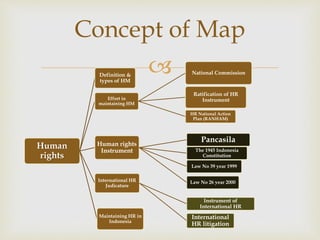

Human
rights
Definition &
types of HM
Effort in
maintaining HM
National Commission
Ratification of HR
Instrument
HR National Action
Plan (RANHAM)
Human rights
Instrument
Pancasila
The 1945 Indonesia
Constitution
Law No 39 year 1999
Law No 26 year 2000International HR
Judicature
Instrument of
International HR
International
HR litigation
Maintaining HR in
Indonesia
Concept of Map

 HUMAN RIGHTS
 NATIONAL COMMISSION OF HUMAN
RIGHTS
 NGO (NON- GOVERNMENT ORGANIZATION)
 HUMAN RIGHTS’ VIOLATION
 HUMAN RIGHTS NATIONAL ACTION PLAN
 SANCTION
KEY WORDS

A. Definition &
Types of Human
Rights

Basic rights that every
human being is entitled as
endowment from God.
1. Definition of Human Rights

The fundamental
rights which are
entitled to all
human beings as
their nature so
that it is pure
matter.
Prof. M. Koentjoro Peorbapranoto

Basic rights
that are innate
to all human
beings
John Locke

Rights that are entitled as the nature and
existence of God’s creature and it is God’s
endowment that should be respected,
protected by state, law, government, and
everyone for the sake of protecting
human beings’ value.
Law No. 26 Year 2000 on HR

1. Personal rights
2. Property rights
3. Legal equality rights
4. Political rights
5. Social and cultural rights
6. Procedural rights
2. Types of Human Rights

Freedom which adhere in everyone.
1) Religion
2) Right to life
3) Right to freedom of speech.
Personal Rights

Rights to receive equal legal
protection and government
protection
Legal equality rights

1) Ownership rights
2) Right to sell and buy something
3) Right to make contracts
Property rights

Right to be recognized as an equal citizen.
1) Rights to elect and to be elected.
2) Rights to found a political party or an
organization.
3) Rights to pose a petition, critic, and
suggestion.
Political rights

Right to choose certain
education or develop certain
desirable culture.
Social and Cultural rights

Rights to receive the same treatment on
court procedure such as right to receive
equal and power treatment in arrest,
detention, frisk, court and legal advocacy.
Procedural rights

Human rights are the most
basic rights that are entitled to
all human beings.
conclusion

B. Indonesian
Government Efforts in
Maintaining Human
Rights
1. Establishment of
National Commission of
Human Rights
(Komnasham)
 Human rights enforcement process in Indonesia has
commenced since the new order era by issuing
Presidential Decree No. 50 Year 1993 on 7th
December 1993 on National Commission of Human
Rights which is later known as Komnas HAM.
 The establishment of National Commission of
Human Rights is a follow up of Vienna Declaration
and Program Action of the World Conference on
Human Rights which has been accepted in the
second world conference of Human Rights in
Vienna, Austria on 25th June 1993.

Objective of the establishment of National Commission
of Human Rights:
1. Developing conducive condition for human
rights implementation which is in line with
Pancasila, the 1945 Constitution, the United
Nations Charter, and Universal Declaration of
Human Rights.
2. Improving human rights protection and
enforcement in order to maximally develop
everyone’s character and their capability in
various life aspects.
 continuation

Through Presidential Decree No. 129
Year 1998, President B.J. Habibie
proclaimed Human Rights National
Action Plan 1998-2003 on Jun 25th 1998. it
covers four main pillars for human rights
protection which was correctly
formulated by deciding the schedule of
human rights implementation programs.
2. Establishment of Human Rights
National Action Plan (RANHAM)
1. Preparation for ratification of international Human Rights
instruments which is consider as a part of comprehensive national
law development.
2. Dissemination of information and education on human rights
either for state Apparatus or society in general.
3. Implementation of priority issues on human rights in which its
violation is consider as human rights’ major violation and should
be processed in international level.
4. Implementation of international human rights instruments that
have been ratified by Indonesia and report them to UN relating
bodies.

3. Human Rights Enforcement
through Ratification
Ratification has 2 meanings:
1. A formal agreement of treaty which
leads to international obligation after
its signing.
2. An agreement of a treaty design in
order to prevail for every member
country

1) Genoa Convention, August 12th 1949
2) Convention on the political rights of women
3) Convention on the elimination of all forms of
discrimination against women.
4) Convention on rights of the child
5) Additional protocol convention on the rights of the
child, child prostitution and pornography.
Several international
Convention of Human Rights

a) Preparation for ratification of international human rights
instruments which is consider as a part of comprehensive
national law development.
b) Dissemination of information and education on human
rights either for state apparatus or society in general.
c) Implementation of priority issues on human rights in
which its violation is consider as human rights’ major
violation and should be processed in international level.
d) Implementation of international human rights
instruments that have been ratified by Indonesia and
report them t the UN relating bodies.

C. Legal Instrument of
managing Human
Rights in Indonesia

 Definition of human rights in ‘belief of the one and only
God’  principle are recognition and guarantee.
 Meaning of human rights in ‘just and civilized humanity’
 principle is the desire of implementation of human
values (human dignity, human rights and human
freedom)
 Human rights according to ‘the unity of Indonesia’ 
principle are awareness that Indonesia is formed from the
pretension of being a dignified nation which equal to
other nations in the world and freedom the shackle of
colonizer.
1. Pancasila

 Definition of human rights in the principle of
‘democracy guided by the inner wisdom in the
unanimity arising out of deliberations amongst
representatives.
 Human rights according to social justice for the
whole of the people of Indonesia. Principle  every
citizen has right to enjoy the result of development
equality based in the humanity values and
devotional duty.
pancasila

a) The preamble of the 1945 Indonesia
Constitution
b) Articles of the 1945 constitution
c) The Decree of the People’s
Consultative Assembly of the Republic
of Indonesia No. XVII/MPR/1998, and
law No. 39 Year 1999.
2. The 1945 Indonesian Constitution

 Independence is the grace of God Almighty.
 The state of Indonesia will protect all the people of
Indonesia and their entire native land
 The state will improve the public welfare and
advance the intellectual life of the people
 The state will contribute to the establishment of the
world order based on freedom, abiding peace and
social justice
 Indonesia is a law based state with pancasila as its
state foundation
a. The preamble of the 1945
Indonesia Constitution

The second amendment of the 1945 Indonesian
Constitution has completed the guarantee of human
rights in Indonesia Constitution. It is initially
mentioned in Article 26 – 34. it is recently added in the
article 28 A up to 28 J of Indonesian Constitution. It
signifies that our constitution has qualified the
standard of modern state constitution which is equal to
other states constitution in the world.
b. Articles of the 1945
constitution
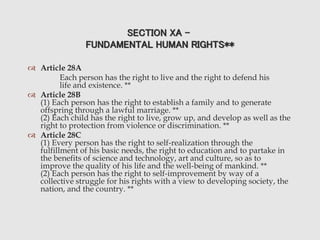
SECTION XA -
FUNDAMENTAL HUMAN RIGHTS**
 Article 28A
Each person has the right to live and the right to defend his
life and existence. **
 Article 28B
(1) Each person has the right to establish a family and to generate
offspring through a lawful marriage. **
(2) Each child has the right to live, grow up, and develop as well as the
right to protection from violence or discrimination. **
 Article 28C
(1) Every person has the right to self-realization through the
fulfillment of his basic needs, the right to education and to partake in
the benefits of science and technology, art and culture, so as to
improve the quality of his life and the well-being of mankind. **
(2) Each person has the right to self-improvement by way of a
collective struggle for his rights with a view to developing society, the
nation, and the country. **
 Article 28D
(1) Each person has the right to recognition, security, protection
and certainty under the law that shall be just and treat
everybody as equal before the law. **
(2) Every person is entitled to an occupation as well as to get
income and a fair and proper treatment in labor relations. **
(3) Each citizen has the right to equal opportunity in
government. **
(4) Each person has a right to a nationality. **
 Article 28E
(1) Each person is free to worship and to practice the religion of
his choice, to choose education and schooling, his occupation,
his nationality, his residency in the territory of the country that
he shall be able to leave and to which he shall have the right to
return. **
(2) Each person has the right to be free in his convictions, to
assert his thoughts and tenets, in accordance with his
conscience. **
(3) Each person has the right to freely associate, assemble, and
express his opinions. **
 Article 28F
Each person has the right to communication and to
acquiring information for his own and his social
environment's development, as well as the right to
seek, obtain, possess, store, process, and spread
information via all kinds of channels available. **
 Article 28G
(1) Each person is entitled to protection of self, his
family, honor, dignity, the property he owns, and
has the right to feel secure and to be protected
against threats from fear to do or not to do
something that is part of basic rights. **
(2) Each person has the right to be free from torture
or inhuman and degrading treatment and shall be
entitled to obtain political asylum from another
country. **
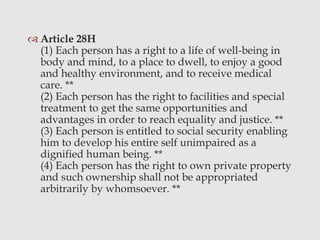
 Article 28H
(1) Each person has a right to a life of well-being in
body and mind, to a place to dwell, to enjoy a good
and healthy environment, and to receive medical
care. **
(2) Each person has the right to facilities and special
treatment to get the same opportunities and
advantages in order to reach equality and justice. **
(3) Each person is entitled to social security enabling
him to develop his entire self unimpaired as a
dignified human being. **
(4) Each person has the right to own private property
and such ownership shall not be appropriated
arbitrarily by whomsoever. **
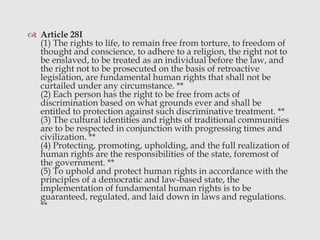
 Article 28I
(1) The rights to life, to remain free from torture, to freedom of
thought and conscience, to adhere to a religion, the right not to
be enslaved, to be treated as an individual before the law, and
the right not to be prosecuted on the basis of retroactive
legislation, are fundamental human rights that shall not be
curtailed under any circumstance. **
(2) Each person has the right to be free from acts of
discrimination based on what grounds ever and shall be
entitled to protection against such discriminative treatment. **
(3) The cultural identities and rights of traditional communities
are to be respected in conjunction with progressing times and
civilization. **
(4) Protecting, promoting, upholding, and the full realization of
human rights are the responsibilities of the state, foremost of
the government. **
(5) To uphold and protect human rights in accordance with the
principles of a democratic and law-based state, the
implementation of fundamental human rights is to be
guaranteed, regulated, and laid down in laws and regulations.
**
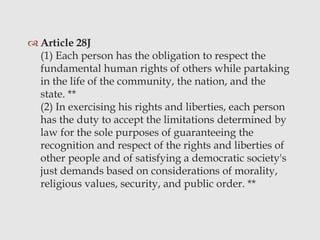
 Article 28J
(1) Each person has the obligation to respect the
fundamental human rights of others while partaking
in the life of the community, the nation, and the
state. **
(2) In exercising his rights and liberties, each person
has the duty to accept the limitations determined by
law for the sole purposes of guaranteeing the
recognition and respect of the rights and liberties of
other people and of satisfying a democratic society's
just demands based on considerations of morality,
religious values, security, and public order. **
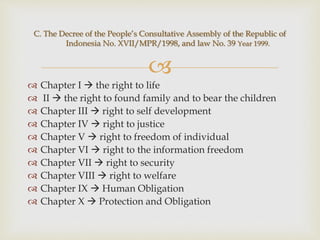

 Chapter I  the right to life
 II  the right to found family and to bear the children
 Chapter III  right to self development
 Chapter IV  right to justice
 Chapter V  right to freedom of individual
 Chapter VI  right to the information freedom
 Chapter VII  right to security
 Chapter VIII  right to welfare
 Chapter IX  Human Obligation
 Chapter X  Protection and Obligation
C. The Decree of the People’s Consultative Assembly of the Republic of
Indonesia No. XVII/MPR/1998, and law No. 39 Year 1999.
D. International Legal
Instrument and Human
Rights Court

The most important instrument of
human rights  Bill of Rights
a) the universal declaration of human
rights
b) international convention on
economic, social and cultural rights
c) international convention on civil and
political rights
1. International Human Rights
Instruments

Every human rights violation could be
brought to International Court for several
condition as follows.
1. Crimes against humanity
2. War crimes
3. Crimes of aggression
4. Crimes of genocide
2. International Human Rights Courts

a. Act on commission (tindakan
kekerasan) is a violance act that is
conducted by a state, institution or
organization (non-state actor)
b. Act of Omission (tindakan pembiaran)
is an omission act which is done by the
state

 crimes against peace
War crimes
Crimes against humanity
International military tribunal

E. Maintaining Human
Rights in Indonesia

Mass media
Non- government Organization
Cooperation with international
Institution
Society’s Involvement in Maintaining
Human Rights in Indonesia
Four obstacles and challenges in
maintaining human rights:
the obstacles and challenges might be
from political, economy, social and
culture and defense and security issues.
Thus, the implementation and protection
of human rights have not effectively and
efficiently overcome yet.
Furthermore, the obstacles and challenges for
human rights in Indonesia might merge due to
several reason:
1. lack of Indonesian legal and humanity
awareness,
2. lack of government political will which might
lead to power abuse and then human right
violation,
3. lack of law supremacy implementation,
4. lack of society awareness on their rights and
obligation as citizens.

thanks

Human Rights

  • 1.
    Human rights arerights owned by human beings since their birth and presence in societal life. In relation to human rights, state has facilitated law apparatus that functions to protect and maintain human rights for the survival of human beings. For Grade X of SHS – Saint John’s Catholic School, BSD
  • 2.
    Definition and formsof human rights. Legal foundation of human rights in Indonesia. Legal instrument and international judicature of human rights. Self-involvement in improving, respecting and maintaining human rights. Learning Objectives
  • 3.
     Human rights Definition & types ofHM Effort in maintaining HM National Commission Ratification of HR Instrument HR National Action Plan (RANHAM) Human rights Instrument Pancasila The 1945 Indonesia Constitution Law No 39 year 1999 Law No 26 year 2000International HR Judicature Instrument of International HR International HR litigation Maintaining HR in Indonesia Concept of Map
  • 4.
      HUMAN RIGHTS NATIONAL COMMISSION OF HUMAN RIGHTS  NGO (NON- GOVERNMENT ORGANIZATION)  HUMAN RIGHTS’ VIOLATION  HUMAN RIGHTS NATIONAL ACTION PLAN  SANCTION KEY WORDS
  • 5.
  • 6.
     Basic rights thatevery human being is entitled as endowment from God. 1. Definition of Human Rights
  • 7.
     The fundamental rights whichare entitled to all human beings as their nature so that it is pure matter. Prof. M. Koentjoro Peorbapranoto
  • 8.
     Basic rights that areinnate to all human beings John Locke
  • 9.
     Rights that areentitled as the nature and existence of God’s creature and it is God’s endowment that should be respected, protected by state, law, government, and everyone for the sake of protecting human beings’ value. Law No. 26 Year 2000 on HR
  • 10.
     1. Personal rights 2.Property rights 3. Legal equality rights 4. Political rights 5. Social and cultural rights 6. Procedural rights 2. Types of Human Rights
  • 11.
     Freedom which adherein everyone. 1) Religion 2) Right to life 3) Right to freedom of speech. Personal Rights
  • 12.
     Rights to receiveequal legal protection and government protection Legal equality rights
  • 13.
     1) Ownership rights 2)Right to sell and buy something 3) Right to make contracts Property rights
  • 14.
     Right to berecognized as an equal citizen. 1) Rights to elect and to be elected. 2) Rights to found a political party or an organization. 3) Rights to pose a petition, critic, and suggestion. Political rights
  • 15.
     Right to choosecertain education or develop certain desirable culture. Social and Cultural rights
  • 16.
     Rights to receivethe same treatment on court procedure such as right to receive equal and power treatment in arrest, detention, frisk, court and legal advocacy. Procedural rights
  • 17.
     Human rights arethe most basic rights that are entitled to all human beings. conclusion
  • 18.
     B. Indonesian Government Effortsin Maintaining Human Rights
  • 19.
    1. Establishment of NationalCommission of Human Rights (Komnasham)
  • 20.
     Human rightsenforcement process in Indonesia has commenced since the new order era by issuing Presidential Decree No. 50 Year 1993 on 7th December 1993 on National Commission of Human Rights which is later known as Komnas HAM.  The establishment of National Commission of Human Rights is a follow up of Vienna Declaration and Program Action of the World Conference on Human Rights which has been accepted in the second world conference of Human Rights in Vienna, Austria on 25th June 1993.
  • 21.
     Objective of theestablishment of National Commission of Human Rights: 1. Developing conducive condition for human rights implementation which is in line with Pancasila, the 1945 Constitution, the United Nations Charter, and Universal Declaration of Human Rights. 2. Improving human rights protection and enforcement in order to maximally develop everyone’s character and their capability in various life aspects.  continuation
  • 22.
     Through Presidential DecreeNo. 129 Year 1998, President B.J. Habibie proclaimed Human Rights National Action Plan 1998-2003 on Jun 25th 1998. it covers four main pillars for human rights protection which was correctly formulated by deciding the schedule of human rights implementation programs. 2. Establishment of Human Rights National Action Plan (RANHAM)
  • 23.
    1. Preparation forratification of international Human Rights instruments which is consider as a part of comprehensive national law development. 2. Dissemination of information and education on human rights either for state Apparatus or society in general. 3. Implementation of priority issues on human rights in which its violation is consider as human rights’ major violation and should be processed in international level. 4. Implementation of international human rights instruments that have been ratified by Indonesia and report them to UN relating bodies.
  • 24.
     3. Human RightsEnforcement through Ratification Ratification has 2 meanings: 1. A formal agreement of treaty which leads to international obligation after its signing. 2. An agreement of a treaty design in order to prevail for every member country
  • 25.
     1) Genoa Convention,August 12th 1949 2) Convention on the political rights of women 3) Convention on the elimination of all forms of discrimination against women. 4) Convention on rights of the child 5) Additional protocol convention on the rights of the child, child prostitution and pornography. Several international Convention of Human Rights
  • 26.
     a) Preparation forratification of international human rights instruments which is consider as a part of comprehensive national law development. b) Dissemination of information and education on human rights either for state apparatus or society in general. c) Implementation of priority issues on human rights in which its violation is consider as human rights’ major violation and should be processed in international level. d) Implementation of international human rights instruments that have been ratified by Indonesia and report them t the UN relating bodies.
  • 27.
     C. Legal Instrumentof managing Human Rights in Indonesia
  • 28.
      Definition ofhuman rights in ‘belief of the one and only God’  principle are recognition and guarantee.  Meaning of human rights in ‘just and civilized humanity’  principle is the desire of implementation of human values (human dignity, human rights and human freedom)  Human rights according to ‘the unity of Indonesia’  principle are awareness that Indonesia is formed from the pretension of being a dignified nation which equal to other nations in the world and freedom the shackle of colonizer. 1. Pancasila
  • 29.
      Definition ofhuman rights in the principle of ‘democracy guided by the inner wisdom in the unanimity arising out of deliberations amongst representatives.  Human rights according to social justice for the whole of the people of Indonesia. Principle  every citizen has right to enjoy the result of development equality based in the humanity values and devotional duty. pancasila
  • 30.
     a) The preambleof the 1945 Indonesia Constitution b) Articles of the 1945 constitution c) The Decree of the People’s Consultative Assembly of the Republic of Indonesia No. XVII/MPR/1998, and law No. 39 Year 1999. 2. The 1945 Indonesian Constitution
  • 31.
      Independence isthe grace of God Almighty.  The state of Indonesia will protect all the people of Indonesia and their entire native land  The state will improve the public welfare and advance the intellectual life of the people  The state will contribute to the establishment of the world order based on freedom, abiding peace and social justice  Indonesia is a law based state with pancasila as its state foundation a. The preamble of the 1945 Indonesia Constitution
  • 32.
     The second amendmentof the 1945 Indonesian Constitution has completed the guarantee of human rights in Indonesia Constitution. It is initially mentioned in Article 26 – 34. it is recently added in the article 28 A up to 28 J of Indonesian Constitution. It signifies that our constitution has qualified the standard of modern state constitution which is equal to other states constitution in the world. b. Articles of the 1945 constitution
  • 33.
    SECTION XA - FUNDAMENTALHUMAN RIGHTS**  Article 28A Each person has the right to live and the right to defend his life and existence. **  Article 28B (1) Each person has the right to establish a family and to generate offspring through a lawful marriage. ** (2) Each child has the right to live, grow up, and develop as well as the right to protection from violence or discrimination. **  Article 28C (1) Every person has the right to self-realization through the fulfillment of his basic needs, the right to education and to partake in the benefits of science and technology, art and culture, so as to improve the quality of his life and the well-being of mankind. ** (2) Each person has the right to self-improvement by way of a collective struggle for his rights with a view to developing society, the nation, and the country. **
  • 34.
     Article 28D (1)Each person has the right to recognition, security, protection and certainty under the law that shall be just and treat everybody as equal before the law. ** (2) Every person is entitled to an occupation as well as to get income and a fair and proper treatment in labor relations. ** (3) Each citizen has the right to equal opportunity in government. ** (4) Each person has a right to a nationality. **  Article 28E (1) Each person is free to worship and to practice the religion of his choice, to choose education and schooling, his occupation, his nationality, his residency in the territory of the country that he shall be able to leave and to which he shall have the right to return. ** (2) Each person has the right to be free in his convictions, to assert his thoughts and tenets, in accordance with his conscience. ** (3) Each person has the right to freely associate, assemble, and express his opinions. **
  • 35.
     Article 28F Eachperson has the right to communication and to acquiring information for his own and his social environment's development, as well as the right to seek, obtain, possess, store, process, and spread information via all kinds of channels available. **  Article 28G (1) Each person is entitled to protection of self, his family, honor, dignity, the property he owns, and has the right to feel secure and to be protected against threats from fear to do or not to do something that is part of basic rights. ** (2) Each person has the right to be free from torture or inhuman and degrading treatment and shall be entitled to obtain political asylum from another country. **
  • 36.
     Article 28H (1)Each person has a right to a life of well-being in body and mind, to a place to dwell, to enjoy a good and healthy environment, and to receive medical care. ** (2) Each person has the right to facilities and special treatment to get the same opportunities and advantages in order to reach equality and justice. ** (3) Each person is entitled to social security enabling him to develop his entire self unimpaired as a dignified human being. ** (4) Each person has the right to own private property and such ownership shall not be appropriated arbitrarily by whomsoever. **
  • 37.
     Article 28I (1)The rights to life, to remain free from torture, to freedom of thought and conscience, to adhere to a religion, the right not to be enslaved, to be treated as an individual before the law, and the right not to be prosecuted on the basis of retroactive legislation, are fundamental human rights that shall not be curtailed under any circumstance. ** (2) Each person has the right to be free from acts of discrimination based on what grounds ever and shall be entitled to protection against such discriminative treatment. ** (3) The cultural identities and rights of traditional communities are to be respected in conjunction with progressing times and civilization. ** (4) Protecting, promoting, upholding, and the full realization of human rights are the responsibilities of the state, foremost of the government. ** (5) To uphold and protect human rights in accordance with the principles of a democratic and law-based state, the implementation of fundamental human rights is to be guaranteed, regulated, and laid down in laws and regulations. **
  • 38.
     Article 28J (1)Each person has the obligation to respect the fundamental human rights of others while partaking in the life of the community, the nation, and the state. ** (2) In exercising his rights and liberties, each person has the duty to accept the limitations determined by law for the sole purposes of guaranteeing the recognition and respect of the rights and liberties of other people and of satisfying a democratic society's just demands based on considerations of morality, religious values, security, and public order. **
  • 39.
      Chapter I the right to life  II  the right to found family and to bear the children  Chapter III  right to self development  Chapter IV  right to justice  Chapter V  right to freedom of individual  Chapter VI  right to the information freedom  Chapter VII  right to security  Chapter VIII  right to welfare  Chapter IX  Human Obligation  Chapter X  Protection and Obligation C. The Decree of the People’s Consultative Assembly of the Republic of Indonesia No. XVII/MPR/1998, and law No. 39 Year 1999.
  • 40.
    D. International Legal Instrumentand Human Rights Court
  • 41.
     The most importantinstrument of human rights  Bill of Rights a) the universal declaration of human rights b) international convention on economic, social and cultural rights c) international convention on civil and political rights 1. International Human Rights Instruments
  • 42.
     Every human rightsviolation could be brought to International Court for several condition as follows. 1. Crimes against humanity 2. War crimes 3. Crimes of aggression 4. Crimes of genocide 2. International Human Rights Courts
  • 43.
     a. Act oncommission (tindakan kekerasan) is a violance act that is conducted by a state, institution or organization (non-state actor) b. Act of Omission (tindakan pembiaran) is an omission act which is done by the state
  • 44.
      crimes againstpeace War crimes Crimes against humanity International military tribunal
  • 45.
  • 46.
     Mass media Non- governmentOrganization Cooperation with international Institution Society’s Involvement in Maintaining Human Rights in Indonesia
  • 47.
    Four obstacles andchallenges in maintaining human rights: the obstacles and challenges might be from political, economy, social and culture and defense and security issues. Thus, the implementation and protection of human rights have not effectively and efficiently overcome yet.
  • 48.
    Furthermore, the obstaclesand challenges for human rights in Indonesia might merge due to several reason: 1. lack of Indonesian legal and humanity awareness, 2. lack of government political will which might lead to power abuse and then human right violation, 3. lack of law supremacy implementation, 4. lack of society awareness on their rights and obligation as citizens.
  • 49.