Universal
Declaration of
Human Rights
UDHR
• UDHR is a declaration
  adopted by the United Nations
  General Assembly on 10
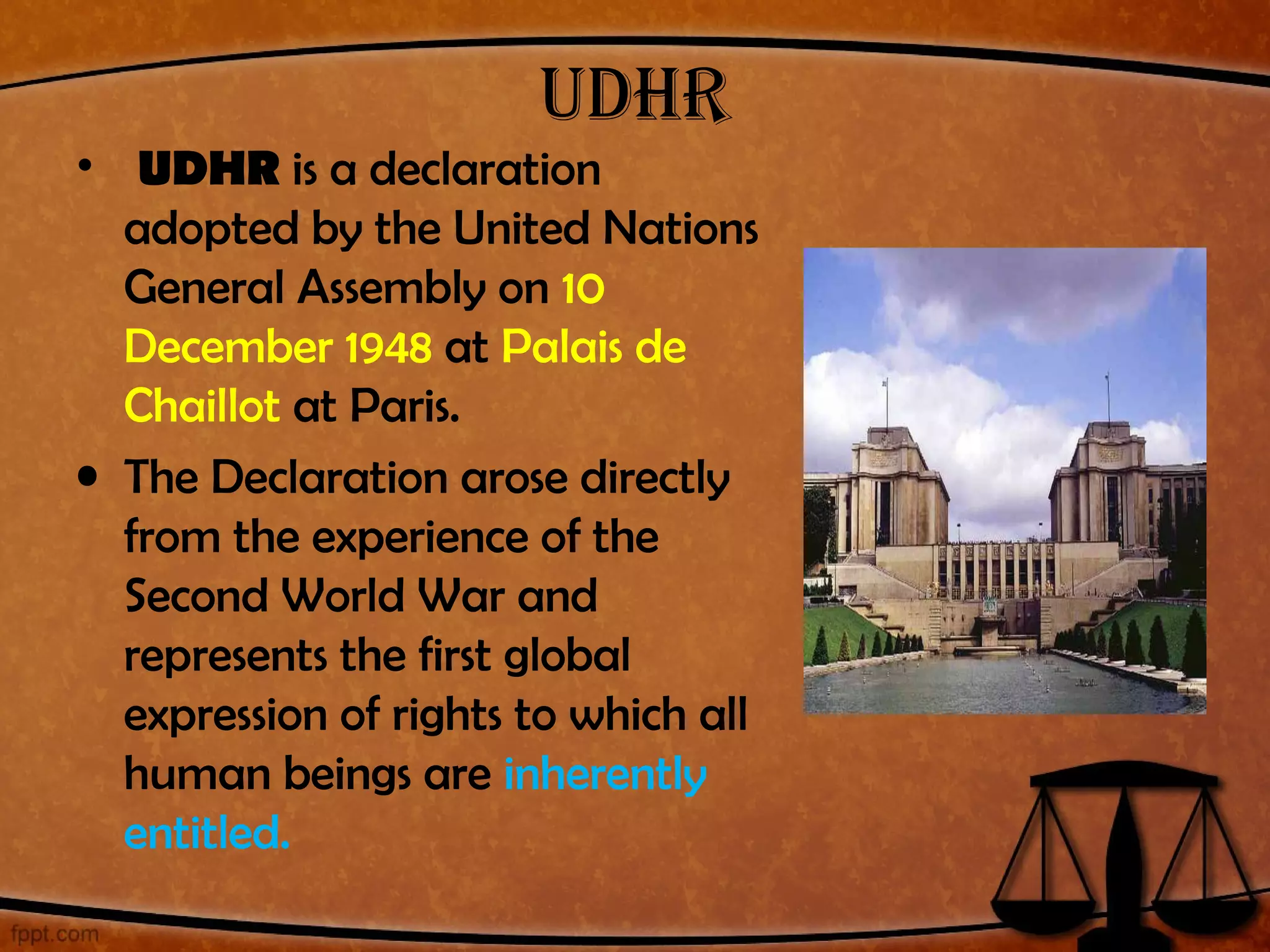
  December 1948 at Palais de
  Chaillot at Paris.
• The Declaration arose directly
  from the experience of the
  Second World War and
  represents the first global
  expression of rights to which all
  human beings are inherently
  entitled.
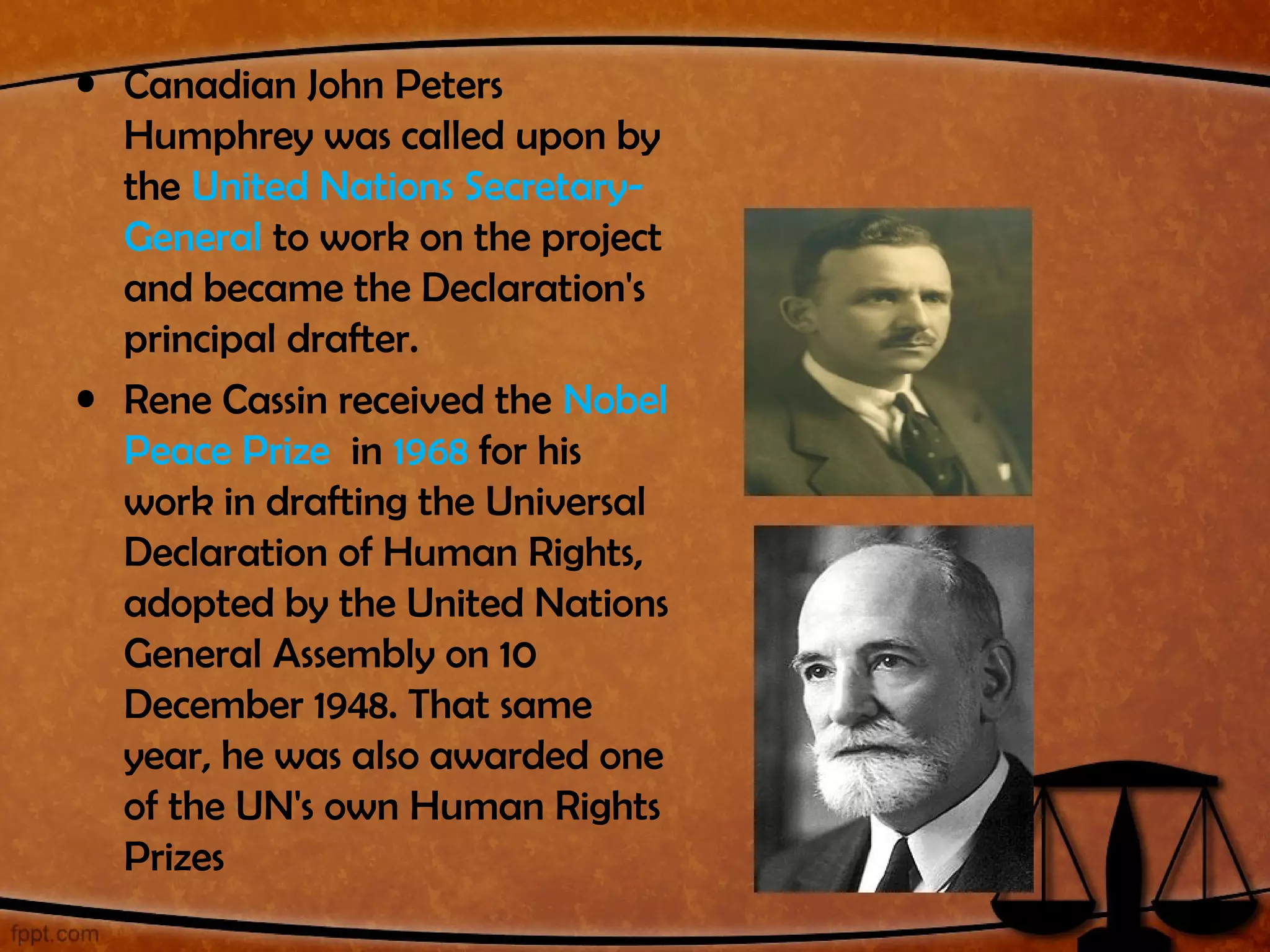
• Canadian John Peters
  Humphrey was called upon by
  the United Nations Secretary-
  General to work on the project
  and became the Declaration's
  principal drafter.
• Rene Cassin received the Nobel
  Peace Prize in 1968 for his
  work in drafting the Universal
  Declaration of Human Rights,
  adopted by the United Nations
  General Assembly on 10
  December 1948. That same
  year, he was also awarded one
  of the UN's own Human Rights
  Prizes
InteRnatIonal HUman RIgHts
           Day
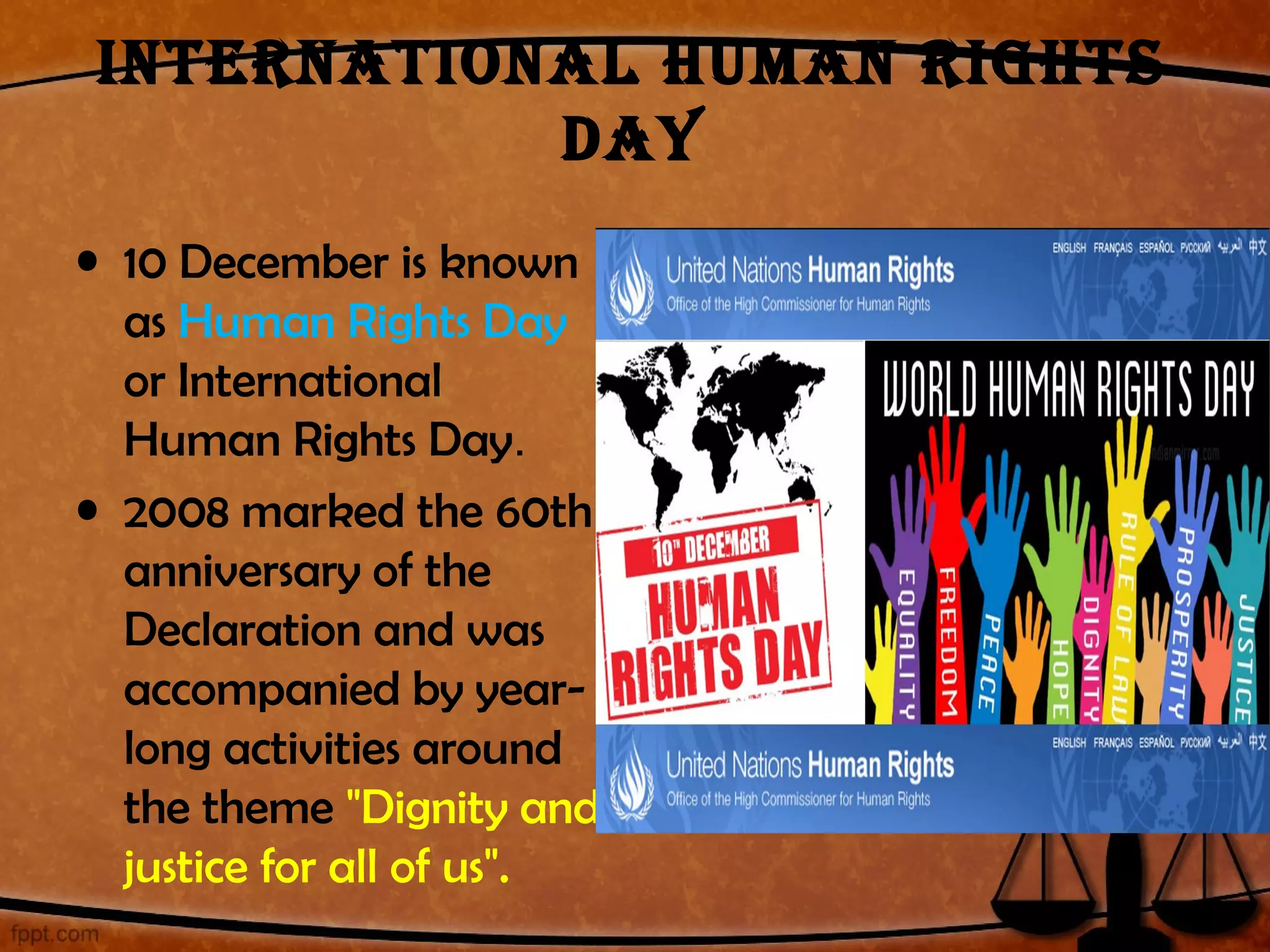
• 10 December is known
  as Human Rights Day
  or International
  Human Rights Day.
• 2008 marked the 60th
  anniversary of the
  Declaration and was
  accompanied by year-
  long activities around
  the theme "Dignity and
  justice for all of us".
Significance
• The Guinness Book of Records
  describes the UDHR as the
  "Most Translated Document“ in
  the world.
• It has also served as the
  foundation for a growing
  number of national laws,
  international laws, and
  treaties, as well as regional,
  national, and sub-national
  institutions protecting and
  promoting human rights.
•  Article 1 Right to Equality.
•  Article 2 Freedom from Discrimination.
•  Article 3 Right to Life, Liberty, Personal Security
•  Article 4 Freedom from Slavery
•  Article 5 Freedom from Torture and Degrading
  Treatment
• Article 6 Right to Recognition as a Person before
  the Law
• Article 7 Right to Equality before the Law
• Article 8 Right to Remedy by Competent Tribunal
• Article 9 Freedom from Arbitrary Arrest and Exile
• Article 10 Right to Fair Public Hearing
• Article 11 Right to be Considered Innocent until
  Proven Guilty
• Article 12 Freedom from Interference with Privacy,
  Family, Home and Correspondence
• Article 13 Right to Free Movement in and out of the
  Country
• Article 14 Right to Asylum in other Countries from
  Persecution
• Article 15 Right to a Nationality and the Freedom to
  Change It
• Article 16 Right to Marriage and Family
• Article 17 Right to Own Property
• Article 18 Freedom of Belief and Religion
• Article 19 Freedom of Opinion and Information
• Article 20 Right of Peaceful Assembly and
  Association.
• Article 21 Right to Participate in Government
  and in Free Elections
• Article 22 Right to Social Security
• Article 23 Right to Desirable Work and to
  Join Trade Unions
• Article 24 Right to Rest and Leisure
• Article 25 Right to Adequate Living Standard
• Article 26 Right to Education
• Article 27 Right to Participate in the Cultural
  Life of Community
• Article 28 Right to a Social Order that
  Articulates this Document
• Article 29 Community Duties Essential to
  Free and Full Development
• Article 30 Freedom from State or Personal
  Interference in the above Rights
ADVANTAGES OF UDHR
• PEACE
One of the advantages that the Universal
  Declaration of Human Rights is intended
  to achieve is increased international peace
  and stability. By encouraging basic human
  rights and democracy, it is hoped that the
  Declaration will decrease international
  violence.
A war in one country -- even a civil war --
  can cause instability in other countries if
  violence spills over the border or
  neighboring countries are flooded with
  refugees.
EDUcATiON
• A final advantage of the UDHR is its inclusion
  of education as a human right. In many poor
  countries, children go to work at an early age
  to help support the family. Research, such as
  that done by the Center for Global
  Development, shows that education results in
  increased economic growth, higher wages,
  better health and increased political
  participation and stability. By encouraging
  education internationally, the Declaration
  seeks to improve the quality of life of all of
  the world's people.
Udhr

Udhr

  • 1.
  • 2.
    UDHR • UDHR isa declaration adopted by the United Nations General Assembly on 10 December 1948 at Palais de Chaillot at Paris. • The Declaration arose directly from the experience of the Second World War and represents the first global expression of rights to which all human beings are inherently entitled.
  • 3.
    • Canadian JohnPeters Humphrey was called upon by the United Nations Secretary- General to work on the project and became the Declaration's principal drafter. • Rene Cassin received the Nobel Peace Prize in 1968 for his work in drafting the Universal Declaration of Human Rights, adopted by the United Nations General Assembly on 10 December 1948. That same year, he was also awarded one of the UN's own Human Rights Prizes
  • 4.
    InteRnatIonal HUman RIgHts Day • 10 December is known as Human Rights Day or International Human Rights Day. • 2008 marked the 60th anniversary of the Declaration and was accompanied by year- long activities around the theme "Dignity and justice for all of us".
  • 5.
    Significance • The GuinnessBook of Records describes the UDHR as the "Most Translated Document“ in the world. • It has also served as the foundation for a growing number of national laws, international laws, and treaties, as well as regional, national, and sub-national institutions protecting and promoting human rights.
  • 6.
    • Article1 Right to Equality. • Article 2 Freedom from Discrimination. • Article 3 Right to Life, Liberty, Personal Security • Article 4 Freedom from Slavery • Article 5 Freedom from Torture and Degrading Treatment • Article 6 Right to Recognition as a Person before the Law • Article 7 Right to Equality before the Law
  • 7.
    • Article 8Right to Remedy by Competent Tribunal • Article 9 Freedom from Arbitrary Arrest and Exile • Article 10 Right to Fair Public Hearing • Article 11 Right to be Considered Innocent until Proven Guilty • Article 12 Freedom from Interference with Privacy, Family, Home and Correspondence • Article 13 Right to Free Movement in and out of the Country
  • 8.
    • Article 14Right to Asylum in other Countries from Persecution • Article 15 Right to a Nationality and the Freedom to Change It • Article 16 Right to Marriage and Family • Article 17 Right to Own Property • Article 18 Freedom of Belief and Religion • Article 19 Freedom of Opinion and Information • Article 20 Right of Peaceful Assembly and Association.
  • 9.
    • Article 21Right to Participate in Government and in Free Elections • Article 22 Right to Social Security • Article 23 Right to Desirable Work and to Join Trade Unions • Article 24 Right to Rest and Leisure • Article 25 Right to Adequate Living Standard • Article 26 Right to Education
  • 10.
    • Article 27Right to Participate in the Cultural Life of Community • Article 28 Right to a Social Order that Articulates this Document • Article 29 Community Duties Essential to Free and Full Development • Article 30 Freedom from State or Personal Interference in the above Rights
  • 11.
    ADVANTAGES OF UDHR •PEACE One of the advantages that the Universal Declaration of Human Rights is intended to achieve is increased international peace and stability. By encouraging basic human rights and democracy, it is hoped that the Declaration will decrease international violence. A war in one country -- even a civil war -- can cause instability in other countries if violence spills over the border or neighboring countries are flooded with refugees.
  • 12.
    EDUcATiON • A finaladvantage of the UDHR is its inclusion of education as a human right. In many poor countries, children go to work at an early age to help support the family. Research, such as that done by the Center for Global Development, shows that education results in increased economic growth, higher wages, better health and increased political participation and stability. By encouraging education internationally, the Declaration seeks to improve the quality of life of all of the world's people.