 The United Nations is an international organization
      designed to make the enforcement of international
   law, security, economic development, social progress, and
      human rights easier for countries around the world.

 The United Nations includes 192 member countries and its
       main headquarters are located in New York City.

Purposes: The purposes of the United Nations, as set forth
    in the Charter, are to maintain international peace and
   security, to develop friendly relations among nations, to
               cooperate in solving international
  economic, social, cultural and humanitarian problems and
    to promote respect for human rights and fundamental
                           freedoms.

 It is to be a center for harmonizing the actions of nations in
                      attaining these ends.
HISTORY:

 The League of Nations failed to prevent World War
       II (1939–1945). Because of the widespread
    recognition that humankind could not afford a
       Third World War, the United Nations was
     established to replace the flawed League of
  Nations in order to maintain international peace
  and promote cooperation in solving international
   economic, social and humanitarian problems.
 The term "United Nations" was coined in 1942 by Winston
 Churchill and Franklin D. Roosevelt in the Declaration by
  United Nations. This declaration was made to officially
   state the cooperation of the Allies (Great Britain, the
 United States, and the Union of Soviet Socialist Republics)
          and other nations during World War II.

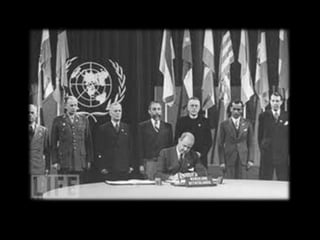
  The UN as it is known today however was not officially
 founded until 1945 when the Charter of the United Nations
     was drafted at the UN Conference on International
  Organization in San Francisco, California. The conference
  was attended by 50 nations and several non-governmental
   organizations all of which signed the Charter. The UN
   officially came into existence on October 24, 1945 after
                  ratification of the Charter.
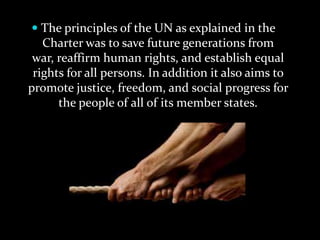
 The principles of the UN as explained in the
   Charter was to save future generations from
 war, reaffirm human rights, and establish equal
 rights for all persons. In addition it also aims to
promote justice, freedom, and social progress for
      the people of all of its member states.
Aims of the United Nations:

         To keep peace throughout the world.

    To develop friendly relations between nations.

  To work together to help people live better lives, to
     eliminate poverty, disease and illiteracy in the
    world, to stop environmental destruction and to
     encourage respect for each other's rights and
                        freedoms.

 To be a centre for helping nations achieve these aims.
Principles of the United Nations:

      All Member States have sovereign equality.
       All Member States must obey the Charter.
    Countries must try to settle their differences by
                    peaceful means.
 Countries must avoid using force or threatening to use
                         force.
  The UN may not interfere in the domestic affairs of
                      any country.
Membership
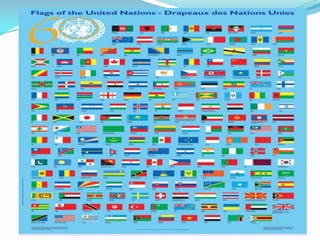
 There are currently 192 United Nations member
  states, including all fully recognized independent states.

 The United Nations Charter outlines the rules for
  membership:

 Membership in the United Nations is open to all other
  peace-loving states that accept the obligations
  contained in the present Charter and, in the judgment
  of the Organization, are able and willing to carry out
  these obligations.

 The admission of any such state to membership in the
  United Nations will be effected by a decision of the
  General Assembly upon the recommendation of the
  Security Council.
Permanent members
 The Security Council's five permanent members have the
    power to veto any substantive resolution:

 The five permanent members of the Security Council consisted
    of France, the Republic of China, the United
    Kingdom, the United States, and the USSR, at the UN's
    founding in 1946. With the exception of the People's Republic
    of China (which replaced the Republic of China in
    1971), and Russia (which superseded the Soviet Union seat in
    1991), the current P5 membership are represented by some of
    the victorious powers of World War II, along with France, for
    some reason, and the present Chinese administration, for
    political expediency.

 There have been two seat changes since then, although not
  reflected in Article 23 of the Charter of the United Nations as it
  has not been accordingly amended:

 China's seat was originally filled by the Republic of China, but
  due to the stalemate of the Chinese Civil War in 1949, there
  have been two states claiming to represent China since
  then, and both officially claim each other's territory. In
  1971, the People's Republic of China was awarded China's seat
  in the United Nations by UN General Assembly Resolution
  2758, and the Republic of China (based in Taiwan) soon lost
  membership in all UN organizations.

 Russia, being the legal successor state to the Soviet Union after
  the latter's collapse in 1991, acquired the originally-Soviet
  seat, including the Soviet Union's former representation in the
  Security Council.
 The five permanent members of the Security Council
   are also the only countries recognized as nuclear-
    weapon states (NWS) under the Nuclear Non-
                  Proliferation Treaty.
 However, membership of the UN Security Council is
       not dependent on nuclear weapons status.
Non-permanent members
 Ten other members are elected by the General Assembly for
  two-year terms starting on 1 January, with five replaced each
  year.

 The members are chosen by regional groups and confirmed
  by the United Nations General Assembly.

 The African bloc is represented by three members; the Latin
  America and the Caribbean, Asian, and Western European
  and Others blocs by two members each; and the Eastern
  European bloc by one member. Also, one of the members is
  an "Arab country," alternately from the Asian or African bloc.
Organization

 The United Nations' system is based on five
 principal organs the General Assembly, the
 Security Council, the Economic and Social
 Council (ECOSOC), the Secretariat, and the
       International Court of Justice.

   The six official languages of the United
Nations, used in intergovernmental meetings
             and documents, are
Arabic, Chinese, English, French, Russian, and
 Spanish,. The Secretariat uses two working
        languages, English and French.
 Four of the five principal organs are located at the
    main United Nations headquarters located on
     international territory in New York City. The
   International Court of Justice is located in The
Hague, while other major agencies are based in the UN
  offices at Geneva, Vienna, and Nairobi, Other UN
    institutions are located throughout the world.
1. General Assembly:
 The General Assembly is the main deliberative assembly of the
  United Nations. Composed of all United Nations member
  states, the assembly meets in regular yearly sessions under a
  president elected from among the member states.

 Over a two-week period at the start of each session, all
  members have the opportunity to address the assembly.
  Traditionally, the Secretary-General makes the first
  statement, followed by the president of the assembly.

 The first session was convened on 10 January 1946 in
  the Westminster Central Hall in London and included
  representatives of 51 nations.
 When the General Assembly votes on important questions, a two-
  thirds majority of those present and voting is required. The
  Assembly may make recommendations on any matters within the
  scope of the UN, except matters of peace and security that are
  under Security Council consideration.


                     2.Security Council:

 The Security Council is charged with maintaining peace and
  security among countries. While other organs of the United
  Nations can only make 'recommendations' to member
  governments, the Security Council has the power to make
  binding decisions that member governments have agreed to carry
  out, under the terms of Charter Article 25. The decisions of the
  Council are known as United Nations Security Council
  resolutions.
 The Security Council is made up of 15 member states, consisting
  of 5 permanent members–China, France, Russia, the United
  Kingdom and the United States–and 10 non-permanent
  members, currently Bosnia and
  Herzegovina, Brazil, Colombia, Gabon, Germany, India,
 Lebanon, Nigeria, Portugal, South Africa. The five permanent
  members hold veto power over substantive but not procedural
  resolutions allowing a permanent member to block adoption
  but not to block the debate of a resolution unacceptable to it.

 The ten temporary seats are held for two-year terms with
  member states voted in by the General Assembly on a regional
  basis.

 The presidency of the Security Council is rotated alphabetically
  each month.
3.Secretariat
 The United Nations Secretariat is headed by the Secretary-
  General, assisted by a staff of international civil servants
  worldwide. It provides studies, information, and facilities
  needed by United Nations bodies for their meetings.

 It also carries out tasks as directed by the UN Security
  Council, the UN General Assembly, the UN Economic and
  Social Council, and other UN bodies.

 The United Nations Charter provides that the staff be chosen
  by application of the "highest standards of
  efficiency, competence, and integrity," with due regard for the
  importance of recruiting on a wide geographical basis.
 The Charter provides that the staff shall not seek or
  receive instructions from any authority other than the
  UN. Each UN member country is enjoined to respect the
  international character of the Secretariat and not seek to
  influence its staff. The Secretary-General alone is
  responsible for staff selection.


 The Secretary-General may bring to the attention of the
  Security Council any matter that, in his or her opinion, may
  threaten international peace and security.
4.Economic and Social Council:
 The Economic and Social Council (ECOSOC) assists the
  General Assembly in promoting international economic and
  social cooperation and development. ECOSOC has 54
  members, all of which are elected by the General Assembly
  for a three-year term.

 The president is elected for a one-year term and chosen
  amongst the small or middle powers represented on
  ECOSOC. ECOSOC meets once a year in July for a four-week
  session.

 Since 1998, it has held another meeting each April with
  finance ministers heading key committees of the World
  Bank and the International Monetary Fund (IMF).
 Viewed separate from the specialized bodies it
 coordinates, ECOSOC's functions include information
 gathering, advising member nations, and making
 recommendations. In addition, ECOSOC is well-
 positioned to provide policy coherece and coordinate
 the overlapping functions of the UN’s subsidiary
 bodies and it is in these roles that it is most active.
5.International Court of Justice:
 The International Court of Justice (ICJ), located in The
   Hague, Netherlands, is the primary judicial organ of
  the United Nations. Established in 1945 by the United
   Nations Charter, the Court began work in 1946 as the
    successor to the Permanent Court of International
                         Justice.

        The Statute of the International Court of
  Justice, similar to that of its predecessor, is the main
  constitutional document constituting and regulating
                         the Court.
 It is based in the Peace Palace in The
     Hague, Netherlands, sharing the building with
   the Hague Academy of International Law, a private
        centre for the study of international law.

 Several of the Court's current judges are either alumni
     or former faculty members of the Academy. Its
     purpose is to adjudicate disputes among states.

 The court has heard cases related to war crimes, illegal
     state interference and ethnic cleansing, among
           others, and continues to hear cases.
 A related court, the International Criminal Court
    (ICC), began operating in 2002 through international
       discussions initiated by the General Assembly.

 It is the first permanent international court charged with
   trying those who commit the most serious crimes under
    international law, including war crimes and genocide.

 The ICC is functionally independent of the UN in terms of
   personnel and financing, but some meetings of the ICC
 governing body, the Assembly of States Parties to the Rome
                Statute, are held at the UN.
Specialized institutions
 There are many UN organizations and agencies that function to
  work on particular issues.

 It is through these agencies that the UN performs most of its
  humanitarian work. Examples include mass vaccination
  programmes (through the WHO), the avoidance of famine and
  malnutrition (through the work of the WFP) and the protection
  of vulnerable and displaced people (for example, by the
  UNHCR).

 The United Nations Charter stipulates that each primary organ
  of the UN can establish various specialized agencies to fulfill its
  duties.
 Linked to the United Nations through special agreements, the
  separate, autonomous specialized agencies of the UN family set
  standards and guidelines help formulate policies, provide
  technical assistance, and other forms of practical help in
  virtually all areas of economic and social endeavor.
Agencies of the United Nations
     The International Labor Organization (ILO)
Formulates policies and programs to improve working conditions and
employment opportunities, and defines international labor standards as
                      guidelines for governments.

    The Food and Agriculture Organization of the UN (FAO)
Works to raise levels of nutrition and standards of living, to improve
agricultural productivity and food security, and to better the conditions
                          of rural populations.

   The UN Educational, Scientific and Cultural Organization
                              (UNESCO)
 Promotes education for all, cultural development, protection of the
       world's natural and cultural heritage, press freedom, and
                           communication.
The World Health Organization (WHO)
  Coordinates programs aimed at solving health problems and the
   attainment by all people of the highest possible level of health; it
   works in areas such as immunization, health education, and the
                      provision of essential drugs.

                         The World Bank
Group provides loans and technical assistance to developing countries
     to reduce poverty and advance sustainable economic growth.

             The International Monetary Fund (IMF)
    Facilitates international monetary cooperation and financial
              stability, and provides a permanent forum for
        consultation, advice, and assistance on financial issues.

     The International Civil Aviation Organization (ICAO)
          Sets international standards necessary for the
  safety, security, efficiency, and regularity of air transport, and
     serves as the medium for cooperation in all areas of civil
                                aviation
The Universal Postal Union (UPU)
   Establishes international regulations for the organization and
  improvement of postal services, provides technical assistance, and
               promotes cooperation in postal matters.

      The International Telecommunication Union (ITU)
 Fosters international cooperation for the improvement and use of
 telecommunications of all kinds, coordinates usage of radio and TV
    frequencies, promotes safety measures, and conducts research.

      The World Meteorological Organization (WMO)
  Promotes scientific research on the atmosphere and on climate
  change, and facilitates the global exchange of meteorological data
                           and information.

       The International Maritime Organization (IMO)
Works to improve international shipping procedures, encourages the
  highest standards in marine safety, and seeks to prevent marine
                       pollution from ships.
The World Intellectual Property Organization (WIPO)
Promotes international protection of intellectual property and fosters
cooperation on copyrights, trademarks, industrial designs, and patents.

 The International Fund for Agricultural Development (IFAD)
Mobilizes financial resources for better food production and nutrition
               among the poor in developing countries.

    The UN Industrial Development Organization (UNIDO)
Promotes the industrial advancement of developing countries through
          technical assistance, advisory services, and training.

        The International Atomic Energy Agency (IAEA)
An autonomous intergovernmental organization under the aegis of the
       UN, works for the safe and peaceful uses of atomic energy.

       The UN and the World Trade Organization (WTO)
The major entity overseeing international trade, cooperate in assisting
 developing countries' exports through the Geneva-based International
                             Trade Center.
Effectiveness
 Some have questioned whether or not the UN might be relevant in the
  21st century. While the UN’s first and second Charter mandates require
                                    the UN :
“To maintain international peace and security.... (and if necessary
       to enforce the peace by) taking preventive or enforcement
                                    action,”
due to its restrictive administrative structure, the permanent members of
    the Security Council themselves have sometimes prevented the UN
                 from fully carrying out its first two mandates.

Without the unanimous approval, support (or minimally abstention) of
 all 5 of the permanent members of the UN's Security Council, the UN's
          charter only enables it to "observe", report on, and make
            recommendations regarding international conflicts.

 Such unanimity on the Security Council regarding the authorization of
  armed UN enforcement actions has not always been reached in time to
     prevent the outbreak of international wars. Even with all of these
   restraints and limitations in place on the UN’s abilities to respond to
   situations of conflict, still various studies have found the UN to have
        had many notable successes in the 65 years of its existence.
 A 2005 RAND Corporation study found the UN to be
  successful in two out of three peacekeeping efforts. It
  compared UN nation-building efforts to those of the
   United States, and found that seven out of eight UN
  cases are at peace, as opposed to four out of eight US
    cases at peace. Also in 2005, the Human Security
     Report documented a decline in the number of
   wars, genocides and human rights abuses since the
   end of the Cold War, and presented evidence, albeit
  circumstantial, that international activism — mostly
 spearheaded by the UN — has been the main cause of
 the decline in armed conflict since the end of the Cold
                           War.
Future Goals:
 For the future, the UN has established what it calls its
  Millennium Development Goals. Most of its member
 states and various international organizations have all
    agreed to achieve these goals relating to reducing
      poverty, child mortality, fighting diseases and
   epidemics, and developing a global partnership in
   terms of international development by 2015. Some
      member states have achieved a number of the
   agreement's goals while others have reached none.
  However, the UN has been successful over the years
 and only the future can tell how the true realization of
                 these goals will play out.
THE END

United nations organization2

  • 2.
     The UnitedNations is an international organization designed to make the enforcement of international law, security, economic development, social progress, and human rights easier for countries around the world.  The United Nations includes 192 member countries and its main headquarters are located in New York City. Purposes: The purposes of the United Nations, as set forth in the Charter, are to maintain international peace and security, to develop friendly relations among nations, to cooperate in solving international economic, social, cultural and humanitarian problems and to promote respect for human rights and fundamental freedoms.  It is to be a center for harmonizing the actions of nations in attaining these ends.
  • 4.
    HISTORY:  The Leagueof Nations failed to prevent World War II (1939–1945). Because of the widespread recognition that humankind could not afford a Third World War, the United Nations was established to replace the flawed League of Nations in order to maintain international peace and promote cooperation in solving international economic, social and humanitarian problems.
  • 5.
     The term"United Nations" was coined in 1942 by Winston Churchill and Franklin D. Roosevelt in the Declaration by United Nations. This declaration was made to officially state the cooperation of the Allies (Great Britain, the United States, and the Union of Soviet Socialist Republics) and other nations during World War II.  The UN as it is known today however was not officially founded until 1945 when the Charter of the United Nations was drafted at the UN Conference on International Organization in San Francisco, California. The conference was attended by 50 nations and several non-governmental organizations all of which signed the Charter. The UN officially came into existence on October 24, 1945 after ratification of the Charter.
  • 6.
     The principlesof the UN as explained in the Charter was to save future generations from war, reaffirm human rights, and establish equal rights for all persons. In addition it also aims to promote justice, freedom, and social progress for the people of all of its member states.
  • 8.
    Aims of theUnited Nations:  To keep peace throughout the world.  To develop friendly relations between nations.  To work together to help people live better lives, to eliminate poverty, disease and illiteracy in the world, to stop environmental destruction and to encourage respect for each other's rights and freedoms.  To be a centre for helping nations achieve these aims.
  • 9.
    Principles of theUnited Nations:  All Member States have sovereign equality.  All Member States must obey the Charter.  Countries must try to settle their differences by peaceful means.  Countries must avoid using force or threatening to use force.  The UN may not interfere in the domestic affairs of any country.
  • 11.
    Membership  There arecurrently 192 United Nations member states, including all fully recognized independent states.  The United Nations Charter outlines the rules for membership:  Membership in the United Nations is open to all other peace-loving states that accept the obligations contained in the present Charter and, in the judgment of the Organization, are able and willing to carry out these obligations.  The admission of any such state to membership in the United Nations will be effected by a decision of the General Assembly upon the recommendation of the Security Council.
  • 12.
    Permanent members  TheSecurity Council's five permanent members have the power to veto any substantive resolution:  The five permanent members of the Security Council consisted of France, the Republic of China, the United Kingdom, the United States, and the USSR, at the UN's founding in 1946. With the exception of the People's Republic of China (which replaced the Republic of China in 1971), and Russia (which superseded the Soviet Union seat in 1991), the current P5 membership are represented by some of the victorious powers of World War II, along with France, for some reason, and the present Chinese administration, for political expediency. 
  • 13.
     There havebeen two seat changes since then, although not reflected in Article 23 of the Charter of the United Nations as it has not been accordingly amended:  China's seat was originally filled by the Republic of China, but due to the stalemate of the Chinese Civil War in 1949, there have been two states claiming to represent China since then, and both officially claim each other's territory. In 1971, the People's Republic of China was awarded China's seat in the United Nations by UN General Assembly Resolution 2758, and the Republic of China (based in Taiwan) soon lost membership in all UN organizations.  Russia, being the legal successor state to the Soviet Union after the latter's collapse in 1991, acquired the originally-Soviet seat, including the Soviet Union's former representation in the Security Council.
  • 14.
     The fivepermanent members of the Security Council are also the only countries recognized as nuclear- weapon states (NWS) under the Nuclear Non- Proliferation Treaty.  However, membership of the UN Security Council is not dependent on nuclear weapons status.
  • 15.
    Non-permanent members  Tenother members are elected by the General Assembly for two-year terms starting on 1 January, with five replaced each year.  The members are chosen by regional groups and confirmed by the United Nations General Assembly.  The African bloc is represented by three members; the Latin America and the Caribbean, Asian, and Western European and Others blocs by two members each; and the Eastern European bloc by one member. Also, one of the members is an "Arab country," alternately from the Asian or African bloc.
  • 16.
    Organization  The UnitedNations' system is based on five principal organs the General Assembly, the Security Council, the Economic and Social Council (ECOSOC), the Secretariat, and the International Court of Justice.  The six official languages of the United Nations, used in intergovernmental meetings and documents, are Arabic, Chinese, English, French, Russian, and Spanish,. The Secretariat uses two working languages, English and French.
  • 17.
     Four ofthe five principal organs are located at the main United Nations headquarters located on international territory in New York City. The International Court of Justice is located in The Hague, while other major agencies are based in the UN offices at Geneva, Vienna, and Nairobi, Other UN institutions are located throughout the world.
  • 18.
    1. General Assembly: The General Assembly is the main deliberative assembly of the United Nations. Composed of all United Nations member states, the assembly meets in regular yearly sessions under a president elected from among the member states.  Over a two-week period at the start of each session, all members have the opportunity to address the assembly. Traditionally, the Secretary-General makes the first statement, followed by the president of the assembly.  The first session was convened on 10 January 1946 in the Westminster Central Hall in London and included representatives of 51 nations.
  • 19.
     When theGeneral Assembly votes on important questions, a two- thirds majority of those present and voting is required. The Assembly may make recommendations on any matters within the scope of the UN, except matters of peace and security that are under Security Council consideration. 2.Security Council:  The Security Council is charged with maintaining peace and security among countries. While other organs of the United Nations can only make 'recommendations' to member governments, the Security Council has the power to make binding decisions that member governments have agreed to carry out, under the terms of Charter Article 25. The decisions of the Council are known as United Nations Security Council resolutions.
  • 20.
     The SecurityCouncil is made up of 15 member states, consisting of 5 permanent members–China, France, Russia, the United Kingdom and the United States–and 10 non-permanent members, currently Bosnia and Herzegovina, Brazil, Colombia, Gabon, Germany, India,  Lebanon, Nigeria, Portugal, South Africa. The five permanent members hold veto power over substantive but not procedural resolutions allowing a permanent member to block adoption but not to block the debate of a resolution unacceptable to it.  The ten temporary seats are held for two-year terms with member states voted in by the General Assembly on a regional basis.  The presidency of the Security Council is rotated alphabetically each month.
  • 21.
    3.Secretariat  The UnitedNations Secretariat is headed by the Secretary- General, assisted by a staff of international civil servants worldwide. It provides studies, information, and facilities needed by United Nations bodies for their meetings.  It also carries out tasks as directed by the UN Security Council, the UN General Assembly, the UN Economic and Social Council, and other UN bodies.  The United Nations Charter provides that the staff be chosen by application of the "highest standards of efficiency, competence, and integrity," with due regard for the importance of recruiting on a wide geographical basis.
  • 22.
     The Charterprovides that the staff shall not seek or receive instructions from any authority other than the UN. Each UN member country is enjoined to respect the international character of the Secretariat and not seek to influence its staff. The Secretary-General alone is responsible for staff selection.  The Secretary-General may bring to the attention of the Security Council any matter that, in his or her opinion, may threaten international peace and security.
  • 23.
    4.Economic and SocialCouncil:  The Economic and Social Council (ECOSOC) assists the General Assembly in promoting international economic and social cooperation and development. ECOSOC has 54 members, all of which are elected by the General Assembly for a three-year term.  The president is elected for a one-year term and chosen amongst the small or middle powers represented on ECOSOC. ECOSOC meets once a year in July for a four-week session.  Since 1998, it has held another meeting each April with finance ministers heading key committees of the World Bank and the International Monetary Fund (IMF).
  • 24.
     Viewed separatefrom the specialized bodies it coordinates, ECOSOC's functions include information gathering, advising member nations, and making recommendations. In addition, ECOSOC is well- positioned to provide policy coherece and coordinate the overlapping functions of the UN’s subsidiary bodies and it is in these roles that it is most active.
  • 25.
    5.International Court ofJustice:  The International Court of Justice (ICJ), located in The Hague, Netherlands, is the primary judicial organ of the United Nations. Established in 1945 by the United Nations Charter, the Court began work in 1946 as the successor to the Permanent Court of International Justice.  The Statute of the International Court of Justice, similar to that of its predecessor, is the main constitutional document constituting and regulating the Court.
  • 26.
     It isbased in the Peace Palace in The Hague, Netherlands, sharing the building with the Hague Academy of International Law, a private centre for the study of international law.  Several of the Court's current judges are either alumni or former faculty members of the Academy. Its purpose is to adjudicate disputes among states.  The court has heard cases related to war crimes, illegal state interference and ethnic cleansing, among others, and continues to hear cases.
  • 27.
     A relatedcourt, the International Criminal Court (ICC), began operating in 2002 through international discussions initiated by the General Assembly.  It is the first permanent international court charged with trying those who commit the most serious crimes under international law, including war crimes and genocide.  The ICC is functionally independent of the UN in terms of personnel and financing, but some meetings of the ICC governing body, the Assembly of States Parties to the Rome Statute, are held at the UN.

  • 28.
    Specialized institutions  Thereare many UN organizations and agencies that function to work on particular issues.  It is through these agencies that the UN performs most of its humanitarian work. Examples include mass vaccination programmes (through the WHO), the avoidance of famine and malnutrition (through the work of the WFP) and the protection of vulnerable and displaced people (for example, by the UNHCR).  The United Nations Charter stipulates that each primary organ of the UN can establish various specialized agencies to fulfill its duties.  Linked to the United Nations through special agreements, the separate, autonomous specialized agencies of the UN family set standards and guidelines help formulate policies, provide technical assistance, and other forms of practical help in virtually all areas of economic and social endeavor.
  • 29.
    Agencies of theUnited Nations The International Labor Organization (ILO) Formulates policies and programs to improve working conditions and employment opportunities, and defines international labor standards as guidelines for governments. The Food and Agriculture Organization of the UN (FAO) Works to raise levels of nutrition and standards of living, to improve agricultural productivity and food security, and to better the conditions of rural populations. The UN Educational, Scientific and Cultural Organization (UNESCO) Promotes education for all, cultural development, protection of the world's natural and cultural heritage, press freedom, and communication.
  • 30.
    The World HealthOrganization (WHO) Coordinates programs aimed at solving health problems and the attainment by all people of the highest possible level of health; it works in areas such as immunization, health education, and the provision of essential drugs. The World Bank Group provides loans and technical assistance to developing countries to reduce poverty and advance sustainable economic growth. The International Monetary Fund (IMF) Facilitates international monetary cooperation and financial stability, and provides a permanent forum for consultation, advice, and assistance on financial issues. The International Civil Aviation Organization (ICAO) Sets international standards necessary for the safety, security, efficiency, and regularity of air transport, and serves as the medium for cooperation in all areas of civil aviation
  • 31.
    The Universal PostalUnion (UPU) Establishes international regulations for the organization and improvement of postal services, provides technical assistance, and promotes cooperation in postal matters. The International Telecommunication Union (ITU) Fosters international cooperation for the improvement and use of telecommunications of all kinds, coordinates usage of radio and TV frequencies, promotes safety measures, and conducts research. The World Meteorological Organization (WMO) Promotes scientific research on the atmosphere and on climate change, and facilitates the global exchange of meteorological data and information. The International Maritime Organization (IMO) Works to improve international shipping procedures, encourages the highest standards in marine safety, and seeks to prevent marine pollution from ships.
  • 32.
    The World IntellectualProperty Organization (WIPO) Promotes international protection of intellectual property and fosters cooperation on copyrights, trademarks, industrial designs, and patents. The International Fund for Agricultural Development (IFAD) Mobilizes financial resources for better food production and nutrition among the poor in developing countries. The UN Industrial Development Organization (UNIDO) Promotes the industrial advancement of developing countries through technical assistance, advisory services, and training. The International Atomic Energy Agency (IAEA) An autonomous intergovernmental organization under the aegis of the UN, works for the safe and peaceful uses of atomic energy. The UN and the World Trade Organization (WTO) The major entity overseeing international trade, cooperate in assisting developing countries' exports through the Geneva-based International Trade Center.
  • 33.
    Effectiveness Some havequestioned whether or not the UN might be relevant in the 21st century. While the UN’s first and second Charter mandates require the UN : “To maintain international peace and security.... (and if necessary to enforce the peace by) taking preventive or enforcement action,” due to its restrictive administrative structure, the permanent members of the Security Council themselves have sometimes prevented the UN from fully carrying out its first two mandates. Without the unanimous approval, support (or minimally abstention) of all 5 of the permanent members of the UN's Security Council, the UN's charter only enables it to "observe", report on, and make recommendations regarding international conflicts. Such unanimity on the Security Council regarding the authorization of armed UN enforcement actions has not always been reached in time to prevent the outbreak of international wars. Even with all of these restraints and limitations in place on the UN’s abilities to respond to situations of conflict, still various studies have found the UN to have had many notable successes in the 65 years of its existence.
  • 34.
     A 2005RAND Corporation study found the UN to be successful in two out of three peacekeeping efforts. It compared UN nation-building efforts to those of the United States, and found that seven out of eight UN cases are at peace, as opposed to four out of eight US cases at peace. Also in 2005, the Human Security Report documented a decline in the number of wars, genocides and human rights abuses since the end of the Cold War, and presented evidence, albeit circumstantial, that international activism — mostly spearheaded by the UN — has been the main cause of the decline in armed conflict since the end of the Cold War.
  • 35.
    Future Goals:  Forthe future, the UN has established what it calls its Millennium Development Goals. Most of its member states and various international organizations have all agreed to achieve these goals relating to reducing poverty, child mortality, fighting diseases and epidemics, and developing a global partnership in terms of international development by 2015. Some member states have achieved a number of the agreement's goals while others have reached none. However, the UN has been successful over the years and only the future can tell how the true realization of these goals will play out.
  • 36.

Editor's Notes