Welcome to Presentation
UNITED NATIONSUNITED NATIONS
By Avinash MurkuteBy Avinash Murkute
Galaxy4u PuneGalaxy4u Pune
International OrganizationsInternational Organizations
UN Day, observed on 24th October, marks the ratification of the UN
Charter, which came into force on 24th October 1945.
UNITED NATIONS
OVERVIEW OF UN
The United Nations is an international organization
founded in 1945. It is currently made up of 193
Member States. The mission and work of the United
Nations are guided by the purposes and principles
contained in its founding Charter.
This year, 2015, marks the 70th
anniversary of the
United Nations.
OVERVIEW OF UN
The United Nations (UN) is an intergovernmental
organization to promote international co-operation. A
replacement for the ineffective League of Nations, the
organization was established on 24 October 1945
after World War II. At its founding, the UN had 51
member states; there are now 193. The headquarters
of the UN is in Manhattan, New York City, and
experiences extraterritoriality. Main offices are situated
in Geneva, Nairobi and Vienna. The organization is
financed by assessed and voluntary contributions from
its member states.
OVERVIEW OF UN
Due to the powers vested in its Charter and its unique
international character, the United Nations can take
action on the issues confronting humanity in the 21st
century, such as peace and security, climate change,
sustainable development, human rights, disarmament,
terrorism, humanitarian and health emergencies,
gender equality, governance, food production, and
more.
GENERAL ASSEMBLY
The UN also provides a forum for its members to
express their views in the General Assembly, the
Security Council, the Economic and Social Council,
and other bodies and committees. By enabling dialogue
between its members, and by hosting negotiations, the
Organization has become a mechanism for
governments to find areas of agreement and solve
problems together.
The UN's Chief Administrative Officer is the Secretary-
General.
GENERAL ASSEMBLY
The General Assembly is the main deliberative
assembly of the United Nations. Composed of all United
Nations member states, the assembly meets in regular
yearly sessions, but emergency sessions can also be
called. The assembly is led by a president, elected from
among the member states on a rotating regional basis,
and 21 vice-presidents. The first session convened 10
January 1946 in the Methodist Central Hall
Westminster in London and included representatives of
51 nations.
GENERAL ASSEMBLY
When the General Assembly votes on important
questions, a two-thirds majority of those present and
voting is required. Examples of important questions
include recommendations on peace and security;
election of members to organs; admission, suspension,
and expulsion of members; and budgetary matters.
Each member country has one vote. Not all resolutions
are not binding on the members. The Assembly may
make recommendations on any matters within the
scope of the UN, except matters of peace and security
that are under consideration by the Security Council.
GENERAL ASSEMBLY – 8 Committees
General Committee – a supervisory committee
consisting of the assembly's president, vice-president,
and committee heads
Credentials Committee – responsible for determining
the credentials of each member nation's UN
representatives
First Committee (Disarmament and International Security)
Second Committee (Economic and Financial)
Third Committee (Social, Humanitarian, and Cultural)
Fourth Committee (Special Political and Decolonization)
Fifth Committee (Administrative and Budgetary)
Sixth Committee (Legal)
SECURITY COUNCIL
SECURITY COUNCIL
One of the PRINCIPAL ORGAN OF UNITED NATIONS
charged with Maintenance of International Peace &
Security, Approving New Members, Approving Changes
to UN Charter.
Critics of the council often describe it as an
undemocratic international body, and argue it fails its
principal task, mainly because of the veto power of the
5 permanent members (USA , France, China, Russia,
Great Britain). 10 Non Permanent Members , Depending
upon Regional Representation. These non Permanent
Members are elected from GA for two years Starting
from 1st
of January. Veto Power Plays very Important
Role as far as Decision Concerned.
Role of Security Council
The UN's role in international collective security is
defined by the UN Charter, which authorizes the
Security Council to investigate any situation
threatening international peace; recommend
procedures for peaceful resolution of a dispute; call
upon other member nations to completely or partially
interrupt economic relations as well as sea, air,
postal, and radio communications, or to sever
diplomatic relations; and enforce its decisions
militarily, or by any means necessary.
LLM One
“VETO”
Important Provision
Under Article 27 of the UN Charter, Security Council
decisions on all substantive matters require the affirmative
votes of nine members. A negative vote or "veto" by a
permanent member prevents adoption of a proposal, even
if it has received the required votes. Abstention is not
regarded as a VETO in most cases, though all five
permanent members must actively concur to amend the
UN Charter or to recommend the admission of a new UN
member state. Procedural matters are not subject to a
veto, so the veto cannot be used to avoid discussion of an
issue. The same holds for certain decisions that directly
regard permanent members. A majority of vetoes are used
not in critical international security situations, but for
purposes such as blocking a candidate for Secretary-
General or the admission of a member state.
Security Council UN Charter Specified
Authorities
• Under Chapter VI of the Charter, "Pacific Settlement of
Disputes", the Security Council "may investigate any dispute, or
any situation which might lead to international friction or give
rise to a dispute".
• Under Chapter VII, the Council has broader power to decide
what measures are to be taken in situations involving "threats to
the peace, breaches of the peace, or acts of aggression"
ECONOMIC SOCIAL COUNCIL
1. The Economic and Social Council (ECOSOC) is the United Nations’ central
platform for reflection, debate, and innovative thinking on sustainable development.
2. ECOSOC, one of the main organs of the United Nations established by the UN
Charter, is the principal body for coordination, policy review, policy dialogue and
recommendations on economic, social and environmental issues, as well as for
implementation of the internationally agreed development goals.
3. ECOSOC serves as the central mechanism for the activities of the United Nations
system and its specialized agencies, and supervises the subsidiary and expert bodies
in the economic, social and environmental fields.
4. ECOSOC has undergone reforms in the last decade to strengthen the Council and
its working methods, giving special attention to the integrated and coordinated
implementation of, and follow-up to, the outcomes of all major United Nations
conferences summits in the economic, social, environmental and related fields.
ECONOMIC SOCIAL COUNCIL, Structure and work
• ECOSOC engages a wide variety of stakeholders – policymakers,
parliamentarians, academics, major groups, foundations,
business sector representatives and 3,200+ registered non-
governmental organizations.
• The work of the Council is guided by an issue-based approach,
and there is an annual theme that accompanies each
programmatic cycle, ensuring a sustained and focused discussion
among multiple stakeholders.
ECONOMIC SOCIAL COUNCIL, Role with Example
• The current president of the ECOSOC is Oh Joon, UN ambassador of the Republic
of Korea. He was elected on 24 July 2015 and is the 71st President of ECOSOC.
• In a report issued in early July 2011, the UN called for spending nearly
USD 2 trillion on green technologies to prevent what it termed "a major planetary
catastrophe", warning that "It is rapidly expanding energy use, mainly driven
by fossil fuels, that explains why humanity is on the verge of breaching
planetary sustainability boundaries through global warming, biodiversity loss, and
disturbance of the nitrogen-cycle balance and other measures of the
sustainability of the earth's ecosystem".
• UN secretary-general Ban Ki-moon added: "Rather than viewing growth and
sustainability as competing goals on a collision course, we must see them as
complementary and mutually supportive imperatives". The report concluded that
"Business as usual is not an option".
CONCEPT OF COLLECTIVE
SECURITY
Collective security is one type of coalition building strategy in which
a group of nations agree not to attack each other and to defend
each other against an attack from one of the others, if such an
attack is made.
In other words collective security is in system by which states have
attempted to prevent or stop wars.
CONCEPT OF COLLECTIVE
SECURITY
Collective security is one type of coalition building strategy in
which a group of nations agree not to attack each other and to
defend each other against an attack from one of the others, if such
an attack is made.
In other words collective security is in system by which states have
attempted to prevent or stop wars.
Definition of Collective Security:
“Collective Security clearly implies collective
measures for dealing with threats to peace.”
- Palmer and Perkins
Nature of Collective Security:
Collective Security stands for preserving security through collective actions. Its
two key elements are:
(1) Security is the chief goal of all the nations. Presently the security of each nation
stands inseparably linked up with the security of all other nations. National
security is a part of the international security.
Any attack on the security of a nation is in fact an attack on the security of all
the nations. Hence, it is the responsibility of all the nations to defend the
security of the victim nation.
(2) The term ‘collective’, as a part of the concept of collective security, refers to the
method by which security is to be defended in the event of any war or
aggression against the security of any nation. The power of the aggressor has
to be met with by the collective power of all the nations. All the nations are
required to create an international preponderance of power for negating the
aggression or for ending a war.
Main Features/Characteristics of
Collective Security:
(1) A Device of Power Management: Collective Security is a device of power management or
crisis management. It seeks to preserve international peace through crisis management
in the event of any war or aggression in the world.
(2) It accepts Universality of Aggression: Collective Security accepts that violations of the
security of a nation are bound to occur and that wars and aggressions cannot be totally
eliminated from international relations.
(3) All Nations are committed to pool their power for ending Aggression: Collective
Security believes that in the event of a violation of international peace by any aggression
in any part of the world, all the nations are committed to pool their power and resources
for taking effective steps against every aggression for restoring international peace.
(4) Global Preponderance of Power: Collective Security stands for the creation of a universal
or global preponderance of power involving all the nations for the maintenance of
international peace and security. Under it all the nations are ready to defend
international peace and security through collective military action against aggression.
(5) Admits the presence of an International Organization: Collective Security presupposes
the existence of an international organization under whose flag a global preponderance
of power is created for ending the aggression.
Ideal Conditions for the Success of
Collective Security:
Collective Security system can successfully operate when the following conditions
are present in the international system:
1. Agreement on the definition of Aggression.
2. More broader based and more powerful United Nations.
3. More powerful role of UN Security Council and strong commitment of its
permanent members in favor of collective security of international peace and
security.
4. Existence of a permanent international peace keeping force.
5. An established procedure for termination of every collective security action.
6. Popularization of peaceful means of conflict resolution.
7. Sustainable socioeconomic development of all the nations.
8. Strengthening of peaceful means of crisis management and international peace
keeping.
ISSUES IN UN
• As the world’s only truly universal global organization, the United
Nations has become the foremost forum to address issues that
transcend national boundaries and cannot be resolved by any one
country acting alone.
• To its initial goals of safeguarding peace, protecting human rights,
establishing the framework for international justice and promoting
economic and social progress, in the six and a half decades since its
creation the United Nations has added on new challenges, such as
Agriculture, Human Rights, international Law, terrorism.
• While conflict resolution and peacekeeping continue to be among its
most visible efforts, the UN, along with its specialized agencies, is also
engaged in a wide array of activities to improve people’s lives around
the world – from disaster relief, through education and advancement of
women, to peaceful uses of atomic energy.
1. Agriculture
• Since its inception, the UN system has been working to ensure adequate
food for all through sustainable agriculture. More than simply a
humanitarian concern, food security advances world peace. This was
recognized as far back as 1949, when the Nobel Peace Prize was
awarded to Lord John Boyd Orr for his role as founding Director-General
of the Food and Agriculture Organization of the United Nations (FAO).
• As the UN system’s lead agency for agriculture and rural
development, FAO advances long-term strategies to increase food
production and food security. Among the many UN bodies that support
these goals, the International Fund for Agricultural Development (IFAD),
finances agricultural development programs and projects to help rural
people overcome poverty.
2. Human Rights
• Human rights are rights inherent to all human beings, regardless of
race, sex, nationality, ethnicity, language, religion, or any other status.
• Human rights include the right to life and liberty, freedom from slavery
and torture, freedom of opinion and expression, the right to work and
education, and many more. Everyone is entitled to these rights,
without discrimination.
• International human rights law lays down the obligations of
Governments to act in certain ways or to refrain from certain acts, in
order to promote and protect human rights and fundamental freedoms
of individuals or groups.
• Since its establishment in 1945, one of the fundamental goals of the
United Nations has been promoting and encouraging respect for human
rights for all, as stipulated in the United Nations Charter.
3.International Law (IL)
• The development of IL is one of the primary goals of the UN. The UN
Charter, in its preamble, sets the objective "to establish conditions
under which justice and respect for the obligations arising from treaties
and other sources of IL can be maintained".
• IL defines the legal responsibilities of States in their conduct with each
other, and their treatment of individuals within State boundaries. Its
domain encompasses a wide range of issues of international concern
such as human rights, disarmament, international crime, refugees,
migration, problems of nationality, the treatment of prisoners, the use
of force, and the conduct of war, among others. It also regulates the
global commons, such as the environment, sustainable development,
international waters, outer space, global communications and world
trade.
• More than 500 multilateral treaties have been deposited with the
Secretary-General of the UN. Many other treaties are deposited with
governments or other entities.
4. Terrorism
• During the 1990s, the end of the cold war led to an entirely new global
security environment, marked by a focus on internal rather than inter-
state wars. In the early 21st century, new global threats emerged. The
attacks of 11 September 2001 on the United States clearly
demonstrated the challenge of international terrorism, while subsequent
events heightened concern about the proliferation of nuclear weapons
and the dangers from other non-conventional weapons.
• The organizations of the UN system mobilized immediately in their
respective spheres to step up action against terrorism. On 28
September, the Security Council adopted resolution 1373, under the
enforcement provisions of the UN Charter, to prevent the financing of
terrorism, criminalize the collection of funds for such purposes, and
immediately freeze terrorist financial assets. It also established
a Counter-Terrorism Committee to oversee the resolution’s
implementation.
Terrorism Contd.
• Sadly, major terrorist assaults have continued over the years since 9-11
— including attacks on UN headquarters in Baghdad (August 2003), on
four commuter trains in Madrid (March 2004), on an office and an
apartment block used by Westerners in al-Khobar, Saudi Arabia (May
2004), the London Underground (July 2005), a seaside area and
shopping hub in Bali (October 2005), multiple sites in Mumbai
(November 2008), the Marriott and Ritz-Carlton hotels in Jakarta (July
2009), and the Moscow Metro (March 2010), to name only a few.
• As part of the international effort to stem this deadly tide, the General
Assembly, in September 2006, unanimously adopted and launched the
UN Global Counter-Terrorism Strategy. Based on the fundamental
conviction that terrorism in all its forms is unacceptable and can never
be justified, the Strategy outlines a range of specific measures to
address terrorism in all its aspects, at the national, regional and
international levels.
ISSUES IN UN
WE THE FORCEWE THE FORCE
Suppression
Supreme Authority
Supra Nations
Hidden Agenda
Counter Terrorism
Suppy of Arms and Weapons
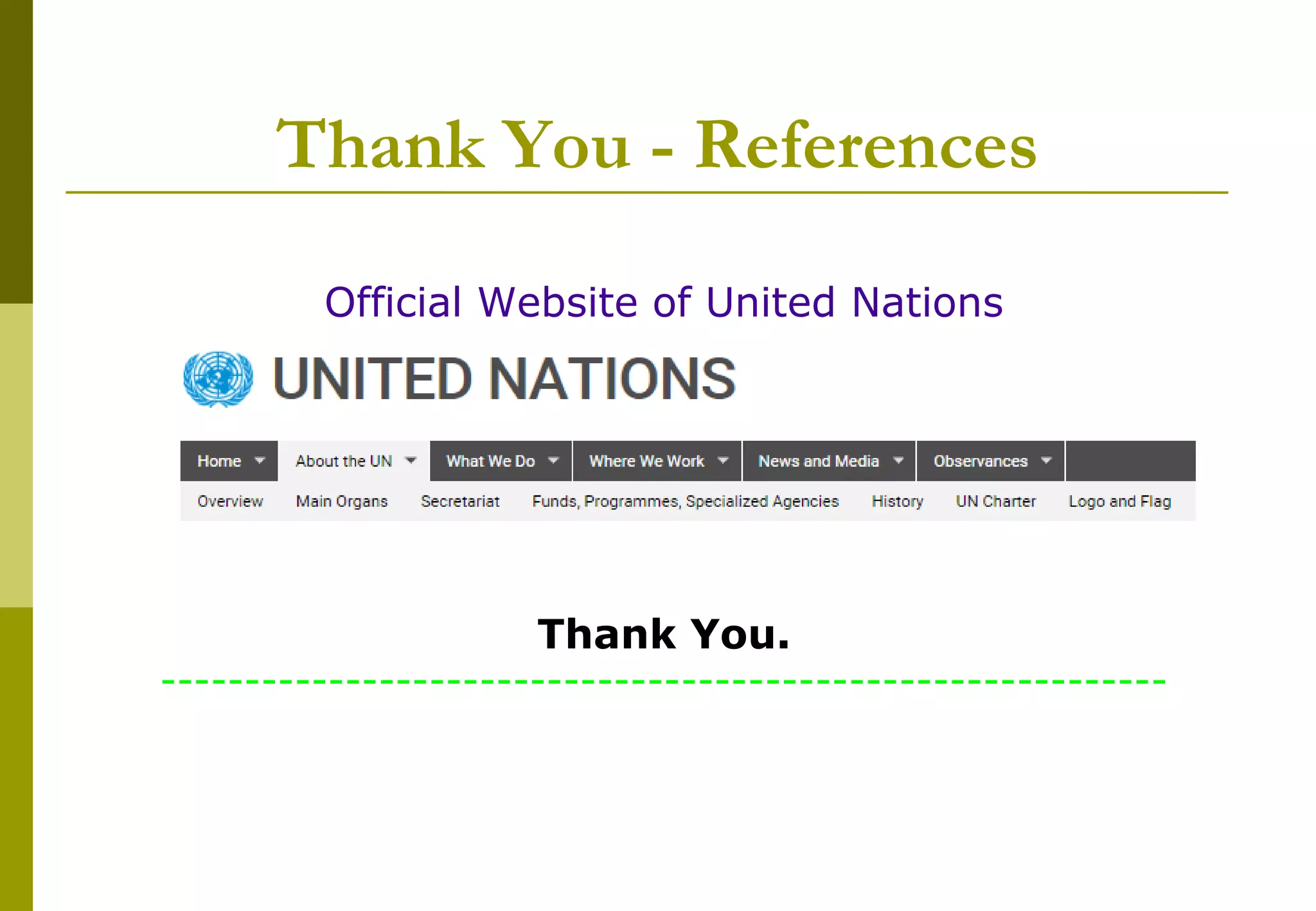
Thank You - References
Official Website of United Nations
Thank You.
------------------------------------------------------------
Thank You
This presentation was made for academic* purposes only.
Feel free to use for academic purposes only.
Attribution-Non Commercial 4.0 International (CC BY-NC 4.0)
AVINASH MURKUTE
Galaxy4u Pune
www.Galaxy4u.in
+91- 9822698070 / +91- 9822698070

UNITED NATIONS

  • 1.
    Welcome to Presentation UNITEDNATIONSUNITED NATIONS By Avinash MurkuteBy Avinash Murkute Galaxy4u PuneGalaxy4u Pune International OrganizationsInternational Organizations
  • 2.
    UN Day, observedon 24th October, marks the ratification of the UN Charter, which came into force on 24th October 1945. UNITED NATIONS
  • 3.
    OVERVIEW OF UN TheUnited Nations is an international organization founded in 1945. It is currently made up of 193 Member States. The mission and work of the United Nations are guided by the purposes and principles contained in its founding Charter. This year, 2015, marks the 70th anniversary of the United Nations.
  • 4.
    OVERVIEW OF UN TheUnited Nations (UN) is an intergovernmental organization to promote international co-operation. A replacement for the ineffective League of Nations, the organization was established on 24 October 1945 after World War II. At its founding, the UN had 51 member states; there are now 193. The headquarters of the UN is in Manhattan, New York City, and experiences extraterritoriality. Main offices are situated in Geneva, Nairobi and Vienna. The organization is financed by assessed and voluntary contributions from its member states.
  • 5.
    OVERVIEW OF UN Dueto the powers vested in its Charter and its unique international character, the United Nations can take action on the issues confronting humanity in the 21st century, such as peace and security, climate change, sustainable development, human rights, disarmament, terrorism, humanitarian and health emergencies, gender equality, governance, food production, and more.
  • 6.
    GENERAL ASSEMBLY The UNalso provides a forum for its members to express their views in the General Assembly, the Security Council, the Economic and Social Council, and other bodies and committees. By enabling dialogue between its members, and by hosting negotiations, the Organization has become a mechanism for governments to find areas of agreement and solve problems together. The UN's Chief Administrative Officer is the Secretary- General.
  • 7.
    GENERAL ASSEMBLY The GeneralAssembly is the main deliberative assembly of the United Nations. Composed of all United Nations member states, the assembly meets in regular yearly sessions, but emergency sessions can also be called. The assembly is led by a president, elected from among the member states on a rotating regional basis, and 21 vice-presidents. The first session convened 10 January 1946 in the Methodist Central Hall Westminster in London and included representatives of 51 nations.
  • 8.
    GENERAL ASSEMBLY When theGeneral Assembly votes on important questions, a two-thirds majority of those present and voting is required. Examples of important questions include recommendations on peace and security; election of members to organs; admission, suspension, and expulsion of members; and budgetary matters. Each member country has one vote. Not all resolutions are not binding on the members. The Assembly may make recommendations on any matters within the scope of the UN, except matters of peace and security that are under consideration by the Security Council.
  • 9.
    GENERAL ASSEMBLY –8 Committees General Committee – a supervisory committee consisting of the assembly's president, vice-president, and committee heads Credentials Committee – responsible for determining the credentials of each member nation's UN representatives First Committee (Disarmament and International Security) Second Committee (Economic and Financial) Third Committee (Social, Humanitarian, and Cultural) Fourth Committee (Special Political and Decolonization) Fifth Committee (Administrative and Budgetary) Sixth Committee (Legal)
  • 10.
  • 11.
    SECURITY COUNCIL One ofthe PRINCIPAL ORGAN OF UNITED NATIONS charged with Maintenance of International Peace & Security, Approving New Members, Approving Changes to UN Charter. Critics of the council often describe it as an undemocratic international body, and argue it fails its principal task, mainly because of the veto power of the 5 permanent members (USA , France, China, Russia, Great Britain). 10 Non Permanent Members , Depending upon Regional Representation. These non Permanent Members are elected from GA for two years Starting from 1st of January. Veto Power Plays very Important Role as far as Decision Concerned.
  • 12.
    Role of SecurityCouncil The UN's role in international collective security is defined by the UN Charter, which authorizes the Security Council to investigate any situation threatening international peace; recommend procedures for peaceful resolution of a dispute; call upon other member nations to completely or partially interrupt economic relations as well as sea, air, postal, and radio communications, or to sever diplomatic relations; and enforce its decisions militarily, or by any means necessary. LLM One
  • 13.
    “VETO” Important Provision Under Article27 of the UN Charter, Security Council decisions on all substantive matters require the affirmative votes of nine members. A negative vote or "veto" by a permanent member prevents adoption of a proposal, even if it has received the required votes. Abstention is not regarded as a VETO in most cases, though all five permanent members must actively concur to amend the UN Charter or to recommend the admission of a new UN member state. Procedural matters are not subject to a veto, so the veto cannot be used to avoid discussion of an issue. The same holds for certain decisions that directly regard permanent members. A majority of vetoes are used not in critical international security situations, but for purposes such as blocking a candidate for Secretary- General or the admission of a member state.
  • 14.
    Security Council UNCharter Specified Authorities • Under Chapter VI of the Charter, "Pacific Settlement of Disputes", the Security Council "may investigate any dispute, or any situation which might lead to international friction or give rise to a dispute". • Under Chapter VII, the Council has broader power to decide what measures are to be taken in situations involving "threats to the peace, breaches of the peace, or acts of aggression"
  • 15.
    ECONOMIC SOCIAL COUNCIL 1.The Economic and Social Council (ECOSOC) is the United Nations’ central platform for reflection, debate, and innovative thinking on sustainable development. 2. ECOSOC, one of the main organs of the United Nations established by the UN Charter, is the principal body for coordination, policy review, policy dialogue and recommendations on economic, social and environmental issues, as well as for implementation of the internationally agreed development goals. 3. ECOSOC serves as the central mechanism for the activities of the United Nations system and its specialized agencies, and supervises the subsidiary and expert bodies in the economic, social and environmental fields. 4. ECOSOC has undergone reforms in the last decade to strengthen the Council and its working methods, giving special attention to the integrated and coordinated implementation of, and follow-up to, the outcomes of all major United Nations conferences summits in the economic, social, environmental and related fields.
  • 16.
    ECONOMIC SOCIAL COUNCIL,Structure and work • ECOSOC engages a wide variety of stakeholders – policymakers, parliamentarians, academics, major groups, foundations, business sector representatives and 3,200+ registered non- governmental organizations. • The work of the Council is guided by an issue-based approach, and there is an annual theme that accompanies each programmatic cycle, ensuring a sustained and focused discussion among multiple stakeholders.
  • 17.
    ECONOMIC SOCIAL COUNCIL,Role with Example • The current president of the ECOSOC is Oh Joon, UN ambassador of the Republic of Korea. He was elected on 24 July 2015 and is the 71st President of ECOSOC. • In a report issued in early July 2011, the UN called for spending nearly USD 2 trillion on green technologies to prevent what it termed "a major planetary catastrophe", warning that "It is rapidly expanding energy use, mainly driven by fossil fuels, that explains why humanity is on the verge of breaching planetary sustainability boundaries through global warming, biodiversity loss, and disturbance of the nitrogen-cycle balance and other measures of the sustainability of the earth's ecosystem". • UN secretary-general Ban Ki-moon added: "Rather than viewing growth and sustainability as competing goals on a collision course, we must see them as complementary and mutually supportive imperatives". The report concluded that "Business as usual is not an option".
  • 18.
    CONCEPT OF COLLECTIVE SECURITY Collectivesecurity is one type of coalition building strategy in which a group of nations agree not to attack each other and to defend each other against an attack from one of the others, if such an attack is made. In other words collective security is in system by which states have attempted to prevent or stop wars.
  • 19.
    CONCEPT OF COLLECTIVE SECURITY Collectivesecurity is one type of coalition building strategy in which a group of nations agree not to attack each other and to defend each other against an attack from one of the others, if such an attack is made. In other words collective security is in system by which states have attempted to prevent or stop wars.
  • 20.
    Definition of CollectiveSecurity: “Collective Security clearly implies collective measures for dealing with threats to peace.” - Palmer and Perkins
  • 21.
    Nature of CollectiveSecurity: Collective Security stands for preserving security through collective actions. Its two key elements are: (1) Security is the chief goal of all the nations. Presently the security of each nation stands inseparably linked up with the security of all other nations. National security is a part of the international security. Any attack on the security of a nation is in fact an attack on the security of all the nations. Hence, it is the responsibility of all the nations to defend the security of the victim nation. (2) The term ‘collective’, as a part of the concept of collective security, refers to the method by which security is to be defended in the event of any war or aggression against the security of any nation. The power of the aggressor has to be met with by the collective power of all the nations. All the nations are required to create an international preponderance of power for negating the aggression or for ending a war.
  • 22.
    Main Features/Characteristics of CollectiveSecurity: (1) A Device of Power Management: Collective Security is a device of power management or crisis management. It seeks to preserve international peace through crisis management in the event of any war or aggression in the world. (2) It accepts Universality of Aggression: Collective Security accepts that violations of the security of a nation are bound to occur and that wars and aggressions cannot be totally eliminated from international relations. (3) All Nations are committed to pool their power for ending Aggression: Collective Security believes that in the event of a violation of international peace by any aggression in any part of the world, all the nations are committed to pool their power and resources for taking effective steps against every aggression for restoring international peace. (4) Global Preponderance of Power: Collective Security stands for the creation of a universal or global preponderance of power involving all the nations for the maintenance of international peace and security. Under it all the nations are ready to defend international peace and security through collective military action against aggression. (5) Admits the presence of an International Organization: Collective Security presupposes the existence of an international organization under whose flag a global preponderance of power is created for ending the aggression.
  • 23.
    Ideal Conditions forthe Success of Collective Security: Collective Security system can successfully operate when the following conditions are present in the international system: 1. Agreement on the definition of Aggression. 2. More broader based and more powerful United Nations. 3. More powerful role of UN Security Council and strong commitment of its permanent members in favor of collective security of international peace and security. 4. Existence of a permanent international peace keeping force. 5. An established procedure for termination of every collective security action. 6. Popularization of peaceful means of conflict resolution. 7. Sustainable socioeconomic development of all the nations. 8. Strengthening of peaceful means of crisis management and international peace keeping.
  • 24.
    ISSUES IN UN •As the world’s only truly universal global organization, the United Nations has become the foremost forum to address issues that transcend national boundaries and cannot be resolved by any one country acting alone. • To its initial goals of safeguarding peace, protecting human rights, establishing the framework for international justice and promoting economic and social progress, in the six and a half decades since its creation the United Nations has added on new challenges, such as Agriculture, Human Rights, international Law, terrorism. • While conflict resolution and peacekeeping continue to be among its most visible efforts, the UN, along with its specialized agencies, is also engaged in a wide array of activities to improve people’s lives around the world – from disaster relief, through education and advancement of women, to peaceful uses of atomic energy.
  • 25.
    1. Agriculture • Sinceits inception, the UN system has been working to ensure adequate food for all through sustainable agriculture. More than simply a humanitarian concern, food security advances world peace. This was recognized as far back as 1949, when the Nobel Peace Prize was awarded to Lord John Boyd Orr for his role as founding Director-General of the Food and Agriculture Organization of the United Nations (FAO). • As the UN system’s lead agency for agriculture and rural development, FAO advances long-term strategies to increase food production and food security. Among the many UN bodies that support these goals, the International Fund for Agricultural Development (IFAD), finances agricultural development programs and projects to help rural people overcome poverty.
  • 26.
    2. Human Rights •Human rights are rights inherent to all human beings, regardless of race, sex, nationality, ethnicity, language, religion, or any other status. • Human rights include the right to life and liberty, freedom from slavery and torture, freedom of opinion and expression, the right to work and education, and many more. Everyone is entitled to these rights, without discrimination. • International human rights law lays down the obligations of Governments to act in certain ways or to refrain from certain acts, in order to promote and protect human rights and fundamental freedoms of individuals or groups. • Since its establishment in 1945, one of the fundamental goals of the United Nations has been promoting and encouraging respect for human rights for all, as stipulated in the United Nations Charter.
  • 27.
    3.International Law (IL) •The development of IL is one of the primary goals of the UN. The UN Charter, in its preamble, sets the objective "to establish conditions under which justice and respect for the obligations arising from treaties and other sources of IL can be maintained". • IL defines the legal responsibilities of States in their conduct with each other, and their treatment of individuals within State boundaries. Its domain encompasses a wide range of issues of international concern such as human rights, disarmament, international crime, refugees, migration, problems of nationality, the treatment of prisoners, the use of force, and the conduct of war, among others. It also regulates the global commons, such as the environment, sustainable development, international waters, outer space, global communications and world trade. • More than 500 multilateral treaties have been deposited with the Secretary-General of the UN. Many other treaties are deposited with governments or other entities.
  • 28.
    4. Terrorism • Duringthe 1990s, the end of the cold war led to an entirely new global security environment, marked by a focus on internal rather than inter- state wars. In the early 21st century, new global threats emerged. The attacks of 11 September 2001 on the United States clearly demonstrated the challenge of international terrorism, while subsequent events heightened concern about the proliferation of nuclear weapons and the dangers from other non-conventional weapons. • The organizations of the UN system mobilized immediately in their respective spheres to step up action against terrorism. On 28 September, the Security Council adopted resolution 1373, under the enforcement provisions of the UN Charter, to prevent the financing of terrorism, criminalize the collection of funds for such purposes, and immediately freeze terrorist financial assets. It also established a Counter-Terrorism Committee to oversee the resolution’s implementation.
  • 29.
    Terrorism Contd. • Sadly,major terrorist assaults have continued over the years since 9-11 — including attacks on UN headquarters in Baghdad (August 2003), on four commuter trains in Madrid (March 2004), on an office and an apartment block used by Westerners in al-Khobar, Saudi Arabia (May 2004), the London Underground (July 2005), a seaside area and shopping hub in Bali (October 2005), multiple sites in Mumbai (November 2008), the Marriott and Ritz-Carlton hotels in Jakarta (July 2009), and the Moscow Metro (March 2010), to name only a few. • As part of the international effort to stem this deadly tide, the General Assembly, in September 2006, unanimously adopted and launched the UN Global Counter-Terrorism Strategy. Based on the fundamental conviction that terrorism in all its forms is unacceptable and can never be justified, the Strategy outlines a range of specific measures to address terrorism in all its aspects, at the national, regional and international levels.
  • 30.
    ISSUES IN UN WETHE FORCEWE THE FORCE Suppression Supreme Authority Supra Nations Hidden Agenda Counter Terrorism Suppy of Arms and Weapons
  • 31.
    Thank You -References Official Website of United Nations Thank You. ------------------------------------------------------------
  • 32.
    Thank You This presentationwas made for academic* purposes only. Feel free to use for academic purposes only. Attribution-Non Commercial 4.0 International (CC BY-NC 4.0) AVINASH MURKUTE Galaxy4u Pune www.Galaxy4u.in +91- 9822698070 / +91- 9822698070

Editor's Notes

  • #2 Lima Lima Mike 01 – PAPA PAPA TANGO
  • #3 Lima Lima Mike 01 – PAPA PAPA TANGO BY ALPHA MIKE
  • #4 Lima Lima Mike 01 – PAPA PAPA TANGO BY ALPHA MIKE
  • #5 Lima Lima Mike 01 – PAPA PAPA TANGO BY ALPHA MIKE
  • #6 Lima Lima Mike 01 – PAPA PAPA TANGO BY ALPHA MIKE
  • #7 Lima Lima Mike 01 – PAPA PAPA TANGO BY ALPHA MIKE
  • #8 Do you have passport? It might be useful if someone ask you proof of citizenship.
  • #9 Do you have passport? It might be useful if someone ask you proof of citizenship.
  • #10 Lima Lima Mike 01 – PAPA PAPA TANGO BY ALPHA MIKE
  • #11 Lima Lima Mike 01 – PAPA PAPA TANGO BY ALPHA MIKE
  • #12 Private bodies are also covered in The RTI Act 2005
  • #14 Lima Lima Mike 01 – PAPA PAPA TANGO BY ALPHA MIKE
  • #15 Lima Lima Mike 01 – PAPA PAPA TANGO BY ALPHA MIKE
  • #16 Lima Lima Mike 01 – PAPA PAPA TANGO BY ALPHA MIKE
  • #17 Lima Lima Mike 01 – PAPA PAPA TANGO BY ALPHA MIKE
  • #20 Lima Lima Mike 01 – PAPA PAPA TANGO BY ALPHA MIKE
  • #21 Lima Lima Mike 01 – PAPA PAPA TANGO BY ALPHA MIKE
  • #22 Lima Lima Mike 01 – PAPA PAPA TANGO BY ALPHA MIKE
  • #24 Lima Lima Mike 01 – PAPA PAPA TANGO BY ALPHA MIKE
  • #25 Lima Lima Mike 01 – PAPA PAPA TANGO BY ALPHA MIKE
  • #26 Lima Lima Mike 01 – PAPA PAPA TANGO BY ALPHA MIKE
  • #27 Lima Lima Mike 01 – PAPA PAPA TANGO BY ALPHA MIKE
  • #28 Lima Lima Mike 01 – PAPA PAPA TANGO BY ALPHA MIKE
  • #30 Lima Lima Mike 01 – PAPA PAPA TANGO BY ALPHA MIKE
  • #31 Lima Lima Mike 01 – PAPA PAPA TANGO BY ALPHA MIKE
  • #32 Lima Lima Mike 01 – PAPA PAPA TANGO BY ALPHA MIKE
  • #33 Lima Lima Mike 01 – PAPA PAPA TANGO BY ALPHA MIKE gy.