Contemporary
Strategic Issues
1
Chapter VII(a)
Internet EraInternet Era
2
Michael Porter
Professor, Harvard Business School
“Our strategy is to integrate the Internet into all
of our core businesses.” Thomas Middelhoff
CEO, Bertelsmann, AG, Germany
“Quote”
3
The Internet : A Revolutionary Driving Force
• Adds an important new distribution channel
• An important technological tool
for performing some value
chain activities better and
for bypassing others
• Alters the strength of competitive forces
• Generates entirely new industries
• Affects a company’s competitiveness vis-à-vis rivals
4
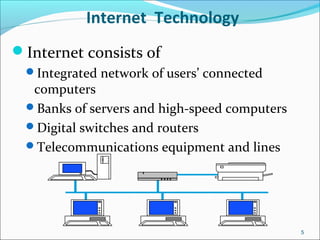
Internet Technology
Internet consists of
Integrated network of users’ connected
computers
Banks of servers and high-speed computers
Digital switches and routers
Telecommunications equipment and lines
5
Suppliers of Internet Technology and Services
• Makers of specialized communications components and equipment
• Providers of Internet communications services
• Suppliers of computer components and hardware
• Developers of specialized software
E-commerce enterprises:
1. Business-to-Consumer (B2C) – businesses develop
attractive electronic market places to sell products
and services to consumers. E.g. Amazon, Dell
2. Business-to-Business (B2B) – involves both electronic
business market places and direct market links between
businesses. Eg. GM/ Ford
3. Consumer-to-Consumer (C2C) – includes auction
websites and electronic personal advertising. E.g. EBay
4. Consumer-to-Business (C2B)- A consumer posts his project with a set
budget online and within hours companies review the consumer’s
requirements and bid on the project. E.g. Priceline, Accompany
6
The Impact of Vigorous Competition Among
Alternative Internet Technologies
• Often, competing technologies have materially different
advantages and disadvantages (pluses and minuses).
• Competing technologies may be incompatible, preventing users
of one from interfacing with users of another—and costs of
parallel systems may be prohibitive
• Strategic options for technology rivals:
– Invest aggressively in R&D to win technology race
– Form strategic alliances to build
consensus for the favored
technological approach
– Acquire other companies with
complementary technological expertise
– Hedge the company’s bets by investing resources in more
than one of the competing technologies
7
How Internet Technology Affects Company
Value Chain Efficiency
• Companies can use the Internet Technologies to improve the
efficiency and effectiveness of particular value chain activities
– Powerful tool for better supply
chain management
– Internal operations—just-in-time inventory, different parts’
production schedules and production quantities to buyer
orders, more accurate monitoring of buyer preferences and
shifts in demand
– Collaborative data sharing with
distribution channel partners—
online systems reduce
transactions costs
8
How Internet Technology Can Revamp
Company Value Chains
• Internet technologies allow some value chain activities
to be bypassed entirely
– Some manufacturers can build-to-order and sell direct
(thus eliminating traditional wholesalers)
– Online systems facilitate build-to-order instead build-for-
dealer inventory
The benefits of Internet technology are pervasive,
bringing fundamental changes in the ways business is
conducted internally and with suppliers, wholesalers,
retailers, and end-users.
9
How Internet Reshapes the
Competitive Environment (cont…)
• The Impact on Barriers to Entry
– Entry barriers into e-commerce
are often relatively low
• Can be easy for new
dot-coms to gain entry
into some businesses
• Can be easy for many
existing firms to expand into
new geographic markets via online sales
When the Internet lowers the industry’s barriers to entry,
the outcome is nearly always heightened competition
and stronger competitive pressures for industry
participants to compete with.
10
How Internet Reshapes the
Competitive Environment (contd…)
• The Impact on Buyer Bargaining Power
– Use of Internet allows buyers to gather extensive
information about competing products and brands
– Buyers can readily use the Internet to “shop the market” for
the best deal
– Buyer efforts to seek out the best deal spurs competition
among rival sellers to provide the best deal
– Internet makes it easier for buyers to join buying groups and
pool their purchases to negotiate better terms and
conditions
Overall impact of Internet is to
increase buyer bargaining power
(or at least to make buyers wiser
and more informed)
11
How Internet Reshapes the
Competitive Environment (cont…)
• Impact on Supplier Bargaining Power and Supplier-Seller
Collaboration
– Helps companies extend geographic reach for the best
suppliers
• Sometimes via online marketplaces or “e-markets”
– Helps companies collaborate
closely with suppliers across a
wide front—fosters long-term
partnerships with key suppliers
Impact on bargaining power is unclear—can enhance or
diminish bargaining power depending on specific
circumstances—have to assess case-by-case
12
How Internet Reshapes the
Competitive Environment
• The Impact on Competitive Rivalry
– Use of Internet widens a firms’
geographic market reach
– Rivalry is often increased by
freshly launched e-commerce
initiatives of existing rivals
– Rivalry is often increased by
entry of enterprising dot-com
rivals with sell-direct strategies
– Rivalry is often increased when an industry consists of
online sellers against pure brick-and-mortar sellers. The
competitive strength further increased with the
combination brick-and-click strategy.
13
Other Strategy-Shaping Features of Internet
Technology
Internet is a force for globalizing competition
Internet and PC technologies are advancing at uncertain speeds and
sometimes in unexpected directions
Internet technologies tend to reduce variable/incremental costs and
incline the cost structure more toward fixed costs
Some Internet-related businesses have high fixed cost/low variable
cost structure, which accounts for heavy losses until sales volume
builds significantly
Internet results in much faster diffusion of new technology and new
ideas across the world
Widespread adoption of Internet Technology puts companies under
the gun to move swiftly - “at Internet speed”
The Internet can be an economical means of delivering customer
service
The capital for funding new e-businesses is available for ventures
with solidly attractive business models and has dried up for ventures
with uncertain prospects 14
Difficulty of Relying on Internet Technology
to Gain Competitive Advantage
All companies are rapidly gaining experience in use and
application of Internet technology
Mostly with use of generic, off-the-shelf software
packages readily available to rivals
Most industry participants inclined to
use of many of the same Internet
technology applications
(and achieving comparable
operating benefits)
Achieving sustainable competitive advantage generally
requires use of proprietary Internet technology not
readily available to rivals
15
The First Mover Advantage Myth
Early Internet businesses failed to capture a durable
competitive edge over “late-moving” rivals because
User/buyer switching costs to visit/patronize new sites
of competitors are very low (not high as some once
believed).
Network effects (where a site’s features became more
valuable as more people use them) have proven
comparatively weak in blocking competition from rivals
and discouraging Internet users from using multiple
networks.
16
Strategic Mistakes Made by Early Internet
Entrepreneurs
• The mistake of ignoring low barriers to entry
– Eager capital providers paved the way
for market overcrowding and fierce rivalry
• The mistake of competing solely on the
basis of low price
– Price became the predominant attention-getting
competitive variable—price war atmosphere turned
into a battle for market share and profits later (when
volume built to levels high enough to support fixed
costs)
– Low price is not a competitive advantage unless it is
accompanied by truly lower costs
17
Strategic Mistakes Made by Early Internet
Entrepreneurs (cont.)
• The mistake of selling below cost and trying to make
it up with revenues from other sources (selling site
ads, charging partners for click-throughs to their site,
selling data on visitor browsing patterns)
– Foolish to employ price discounting
without offsetting cost advantage
– Makes firm reliant on ever-rising
ad revenues to offset losses from
growing unit sales volumes below cost
– Ignores strong bargaining power of Internet advertisers
18
E-Commerce Business Models and
Strategies for the Future
Three basic options
A “pure” dot-com strategy
Combination brick-and-click
strategies
A traditional business that
only uses Internet
technology to improve
operational effectiveness
and value chain efficiency
19
Business Models and Strategies for “Pure”
Dot-Com Enterprises
Successful dot-com strategies tend to incorporate the
following features:
A distinctive strategy that delivers
unique value to buyers and
makes buying online very appealing
Deliberate efforts to engineer a
value chain that enables differentiation or
lower costs or better value for the money
Focusing on a limited number of competencies and
performing a specialized number of value chain
activities where proprietary Internet applications and
capabilities can be developed
20
Business Models and Strategies for “Pure”
Dot-Com Enterprises (cont.)
• Successful dot-com strategies tend to incorporate the
following features (cont…):
– Having strong capabilities in cutting-edge Internet
Technology
– Using innovative marketing techniques that are efficient
in reaching the targeted audience and effective in
stimulating purchases or help boost ancillary revenues
(additional revenues) like advertising
– Minimal reliance on ancillary for bottom-line profitability
– Keeping the Web site fresh, user-friendly (Southwest
Airlines),and often entertaining (eBay) or innovative
(audio, video, appealing to eye, interesting content)
21
Issues for “Pure” Dot-Com Enterprises
• Broad versus narrow product lines
– One-stop shopping (Amazon.com, eBay) or a classic
focus strategy (eToys)
• Whether to outsource order fulfillment to specialists or
handle it internally
• Whether to employ unconventional
business models and strategies
– Yahoo!—rely heavily on advertising
– Provide information for a fee
– Pay per use (software, video games)
22
Brick-and-Click Strategies: An Appealing Middle
Ground Strategy
• Gives customers the option of shopping online or in stores
• Effective when customers want to
see or inspect before purchasing
• Effective when customers want to do
some part of their business in person
and some online (banking)
• Many brick-and-mortar enterprises can
enter online retailing at relatively low costs (a web site and
systems for filling and delivering customer orders)
– Web ordering can enhance the value of local stores
because they can be used as local stocking and
delivery/pick-up points (Office Depot)—eliminates the
need for picking, packing, and shipping from a central
warehouse
23
Internet Strategies for Traditional Businesses
• Few, if any, businesses can/should squeeze out internal cost
with the effective use of Internet technology.
• Key issue is how to use the Internet to position the
company in the marketplace
– Use Internet as …….. ?
• company’s exclusive distribution
channel
• Primary channel
• One of several important channels
• Secondary or minor channel
• Solely as a vehicle for disseminating product information (with
traditional distribution channel partners making all sales to
end-users)
24
Advantages of Different Internet
Positioning Options
• Advantage of operating a website that provides existing
and potential customers with extensive information:
Avoids channel conflict and lingering wholesale/retail
dealers
– Important where strong support
and goodwill of dealer networks
is essential
• Advantage of using online sales as a
secondary/minor distribution channel: Helps
a company gain online experience, achieve
incremental sales, and do marketing research
to respond more precisely to buyer preferences
– Unlikely to provoke much outcry from dealers
25
Advantages of Different Internet
Positioning Options (cont.)
• Advantages of employing a brick-and-click strategy to
sell direct to end-users and compete directly with
traditional wholesalers and retailers: Cuts out costs of
wholesalers/retailers, enhances profit margins, may
give customers quicker product access (software),
helps educate buyers to the advantages of buying
online
– When sell-direct positioning increases risks of channel
conflict; online sales may evolve into the firm’s primary
distribution channel
26
Advantages of Different Internet
Positioning Options (cont...)
• Advantage of entirely bypassing traditional
distribution channels : Allows capture of full retail
price by the manufacturer (downloads of music) and
more economical build-to-order manufacturing and
assembly (Dell Computer)
– Revamped value chain may
allow for price reductions and
minimal reliance on sales
through distribution allies
27
Thank You
28

Chapter vii (a) internet era

  • 1.
  • 2.
  • 3.
    Michael Porter Professor, HarvardBusiness School “Our strategy is to integrate the Internet into all of our core businesses.” Thomas Middelhoff CEO, Bertelsmann, AG, Germany “Quote” 3
  • 4.
    The Internet :A Revolutionary Driving Force • Adds an important new distribution channel • An important technological tool for performing some value chain activities better and for bypassing others • Alters the strength of competitive forces • Generates entirely new industries • Affects a company’s competitiveness vis-à-vis rivals 4
  • 5.
    Internet Technology Internet consistsof Integrated network of users’ connected computers Banks of servers and high-speed computers Digital switches and routers Telecommunications equipment and lines 5
  • 6.
    Suppliers of InternetTechnology and Services • Makers of specialized communications components and equipment • Providers of Internet communications services • Suppliers of computer components and hardware • Developers of specialized software E-commerce enterprises: 1. Business-to-Consumer (B2C) – businesses develop attractive electronic market places to sell products and services to consumers. E.g. Amazon, Dell 2. Business-to-Business (B2B) – involves both electronic business market places and direct market links between businesses. Eg. GM/ Ford 3. Consumer-to-Consumer (C2C) – includes auction websites and electronic personal advertising. E.g. EBay 4. Consumer-to-Business (C2B)- A consumer posts his project with a set budget online and within hours companies review the consumer’s requirements and bid on the project. E.g. Priceline, Accompany 6
  • 7.
    The Impact ofVigorous Competition Among Alternative Internet Technologies • Often, competing technologies have materially different advantages and disadvantages (pluses and minuses). • Competing technologies may be incompatible, preventing users of one from interfacing with users of another—and costs of parallel systems may be prohibitive • Strategic options for technology rivals: – Invest aggressively in R&D to win technology race – Form strategic alliances to build consensus for the favored technological approach – Acquire other companies with complementary technological expertise – Hedge the company’s bets by investing resources in more than one of the competing technologies 7
  • 8.
    How Internet TechnologyAffects Company Value Chain Efficiency • Companies can use the Internet Technologies to improve the efficiency and effectiveness of particular value chain activities – Powerful tool for better supply chain management – Internal operations—just-in-time inventory, different parts’ production schedules and production quantities to buyer orders, more accurate monitoring of buyer preferences and shifts in demand – Collaborative data sharing with distribution channel partners— online systems reduce transactions costs 8
  • 9.
    How Internet TechnologyCan Revamp Company Value Chains • Internet technologies allow some value chain activities to be bypassed entirely – Some manufacturers can build-to-order and sell direct (thus eliminating traditional wholesalers) – Online systems facilitate build-to-order instead build-for- dealer inventory The benefits of Internet technology are pervasive, bringing fundamental changes in the ways business is conducted internally and with suppliers, wholesalers, retailers, and end-users. 9
  • 10.
    How Internet Reshapesthe Competitive Environment (cont…) • The Impact on Barriers to Entry – Entry barriers into e-commerce are often relatively low • Can be easy for new dot-coms to gain entry into some businesses • Can be easy for many existing firms to expand into new geographic markets via online sales When the Internet lowers the industry’s barriers to entry, the outcome is nearly always heightened competition and stronger competitive pressures for industry participants to compete with. 10
  • 11.
    How Internet Reshapesthe Competitive Environment (contd…) • The Impact on Buyer Bargaining Power – Use of Internet allows buyers to gather extensive information about competing products and brands – Buyers can readily use the Internet to “shop the market” for the best deal – Buyer efforts to seek out the best deal spurs competition among rival sellers to provide the best deal – Internet makes it easier for buyers to join buying groups and pool their purchases to negotiate better terms and conditions Overall impact of Internet is to increase buyer bargaining power (or at least to make buyers wiser and more informed) 11
  • 12.
    How Internet Reshapesthe Competitive Environment (cont…) • Impact on Supplier Bargaining Power and Supplier-Seller Collaboration – Helps companies extend geographic reach for the best suppliers • Sometimes via online marketplaces or “e-markets” – Helps companies collaborate closely with suppliers across a wide front—fosters long-term partnerships with key suppliers Impact on bargaining power is unclear—can enhance or diminish bargaining power depending on specific circumstances—have to assess case-by-case 12
  • 13.
    How Internet Reshapesthe Competitive Environment • The Impact on Competitive Rivalry – Use of Internet widens a firms’ geographic market reach – Rivalry is often increased by freshly launched e-commerce initiatives of existing rivals – Rivalry is often increased by entry of enterprising dot-com rivals with sell-direct strategies – Rivalry is often increased when an industry consists of online sellers against pure brick-and-mortar sellers. The competitive strength further increased with the combination brick-and-click strategy. 13
  • 14.
    Other Strategy-Shaping Featuresof Internet Technology Internet is a force for globalizing competition Internet and PC technologies are advancing at uncertain speeds and sometimes in unexpected directions Internet technologies tend to reduce variable/incremental costs and incline the cost structure more toward fixed costs Some Internet-related businesses have high fixed cost/low variable cost structure, which accounts for heavy losses until sales volume builds significantly Internet results in much faster diffusion of new technology and new ideas across the world Widespread adoption of Internet Technology puts companies under the gun to move swiftly - “at Internet speed” The Internet can be an economical means of delivering customer service The capital for funding new e-businesses is available for ventures with solidly attractive business models and has dried up for ventures with uncertain prospects 14
  • 15.
    Difficulty of Relyingon Internet Technology to Gain Competitive Advantage All companies are rapidly gaining experience in use and application of Internet technology Mostly with use of generic, off-the-shelf software packages readily available to rivals Most industry participants inclined to use of many of the same Internet technology applications (and achieving comparable operating benefits) Achieving sustainable competitive advantage generally requires use of proprietary Internet technology not readily available to rivals 15
  • 16.
    The First MoverAdvantage Myth Early Internet businesses failed to capture a durable competitive edge over “late-moving” rivals because User/buyer switching costs to visit/patronize new sites of competitors are very low (not high as some once believed). Network effects (where a site’s features became more valuable as more people use them) have proven comparatively weak in blocking competition from rivals and discouraging Internet users from using multiple networks. 16
  • 17.
    Strategic Mistakes Madeby Early Internet Entrepreneurs • The mistake of ignoring low barriers to entry – Eager capital providers paved the way for market overcrowding and fierce rivalry • The mistake of competing solely on the basis of low price – Price became the predominant attention-getting competitive variable—price war atmosphere turned into a battle for market share and profits later (when volume built to levels high enough to support fixed costs) – Low price is not a competitive advantage unless it is accompanied by truly lower costs 17
  • 18.
    Strategic Mistakes Madeby Early Internet Entrepreneurs (cont.) • The mistake of selling below cost and trying to make it up with revenues from other sources (selling site ads, charging partners for click-throughs to their site, selling data on visitor browsing patterns) – Foolish to employ price discounting without offsetting cost advantage – Makes firm reliant on ever-rising ad revenues to offset losses from growing unit sales volumes below cost – Ignores strong bargaining power of Internet advertisers 18
  • 19.
    E-Commerce Business Modelsand Strategies for the Future Three basic options A “pure” dot-com strategy Combination brick-and-click strategies A traditional business that only uses Internet technology to improve operational effectiveness and value chain efficiency 19
  • 20.
    Business Models andStrategies for “Pure” Dot-Com Enterprises Successful dot-com strategies tend to incorporate the following features: A distinctive strategy that delivers unique value to buyers and makes buying online very appealing Deliberate efforts to engineer a value chain that enables differentiation or lower costs or better value for the money Focusing on a limited number of competencies and performing a specialized number of value chain activities where proprietary Internet applications and capabilities can be developed 20
  • 21.
    Business Models andStrategies for “Pure” Dot-Com Enterprises (cont.) • Successful dot-com strategies tend to incorporate the following features (cont…): – Having strong capabilities in cutting-edge Internet Technology – Using innovative marketing techniques that are efficient in reaching the targeted audience and effective in stimulating purchases or help boost ancillary revenues (additional revenues) like advertising – Minimal reliance on ancillary for bottom-line profitability – Keeping the Web site fresh, user-friendly (Southwest Airlines),and often entertaining (eBay) or innovative (audio, video, appealing to eye, interesting content) 21
  • 22.
    Issues for “Pure”Dot-Com Enterprises • Broad versus narrow product lines – One-stop shopping (Amazon.com, eBay) or a classic focus strategy (eToys) • Whether to outsource order fulfillment to specialists or handle it internally • Whether to employ unconventional business models and strategies – Yahoo!—rely heavily on advertising – Provide information for a fee – Pay per use (software, video games) 22
  • 23.
    Brick-and-Click Strategies: AnAppealing Middle Ground Strategy • Gives customers the option of shopping online or in stores • Effective when customers want to see or inspect before purchasing • Effective when customers want to do some part of their business in person and some online (banking) • Many brick-and-mortar enterprises can enter online retailing at relatively low costs (a web site and systems for filling and delivering customer orders) – Web ordering can enhance the value of local stores because they can be used as local stocking and delivery/pick-up points (Office Depot)—eliminates the need for picking, packing, and shipping from a central warehouse 23
  • 24.
    Internet Strategies forTraditional Businesses • Few, if any, businesses can/should squeeze out internal cost with the effective use of Internet technology. • Key issue is how to use the Internet to position the company in the marketplace – Use Internet as …….. ? • company’s exclusive distribution channel • Primary channel • One of several important channels • Secondary or minor channel • Solely as a vehicle for disseminating product information (with traditional distribution channel partners making all sales to end-users) 24
  • 25.
    Advantages of DifferentInternet Positioning Options • Advantage of operating a website that provides existing and potential customers with extensive information: Avoids channel conflict and lingering wholesale/retail dealers – Important where strong support and goodwill of dealer networks is essential • Advantage of using online sales as a secondary/minor distribution channel: Helps a company gain online experience, achieve incremental sales, and do marketing research to respond more precisely to buyer preferences – Unlikely to provoke much outcry from dealers 25
  • 26.
    Advantages of DifferentInternet Positioning Options (cont.) • Advantages of employing a brick-and-click strategy to sell direct to end-users and compete directly with traditional wholesalers and retailers: Cuts out costs of wholesalers/retailers, enhances profit margins, may give customers quicker product access (software), helps educate buyers to the advantages of buying online – When sell-direct positioning increases risks of channel conflict; online sales may evolve into the firm’s primary distribution channel 26
  • 27.
    Advantages of DifferentInternet Positioning Options (cont...) • Advantage of entirely bypassing traditional distribution channels : Allows capture of full retail price by the manufacturer (downloads of music) and more economical build-to-order manufacturing and assembly (Dell Computer) – Revamped value chain may allow for price reductions and minimal reliance on sales through distribution allies 27
  • 28.