VALUE ADDED TAX
&
EXCISE TAX
TABLE OF CONTENT
Value Added Tax 3
Excise Tax 19
Approach to implement VAT changes 22
VALUE ADDED TAX
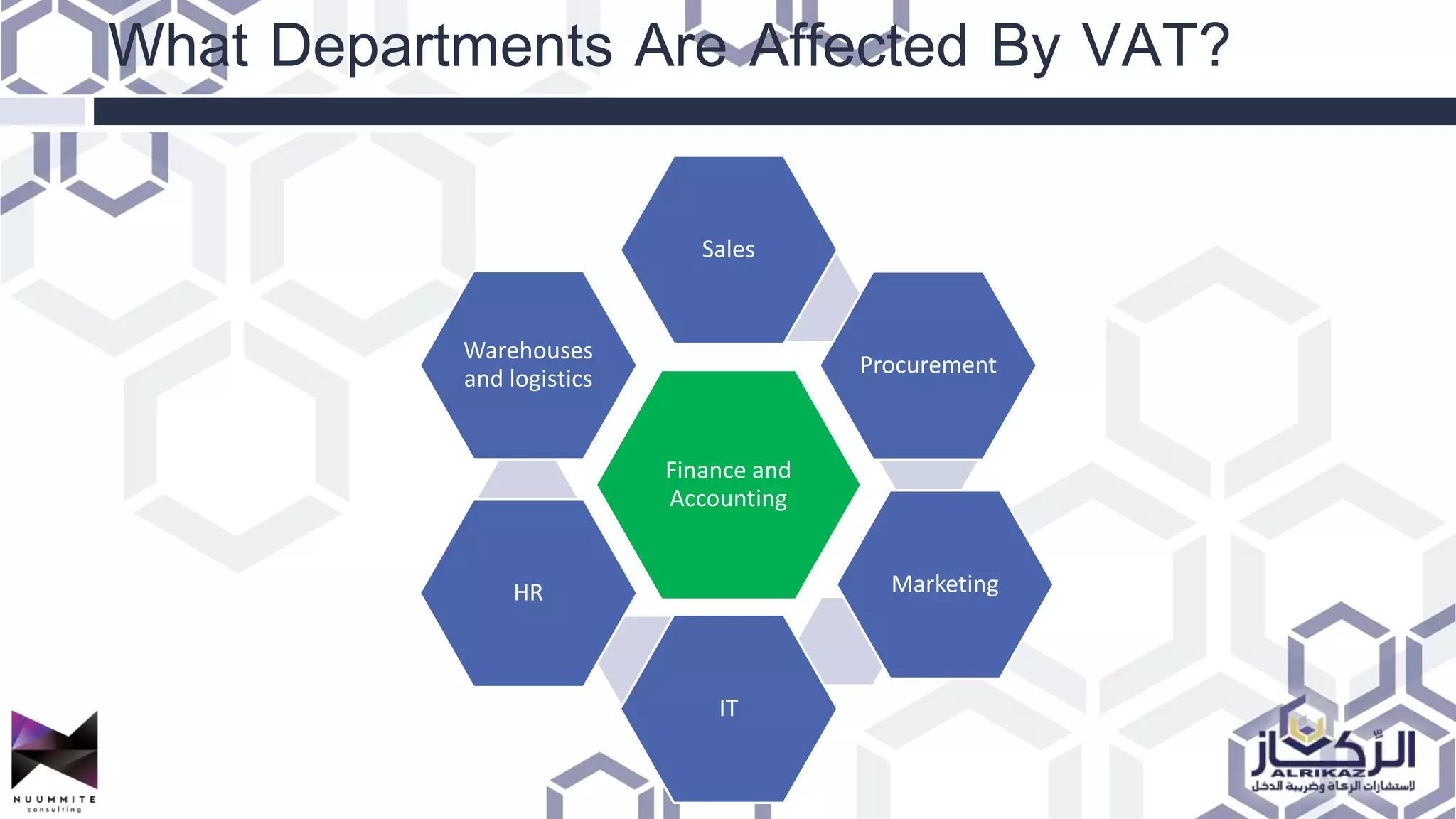
What Departments Are Affected By VAT?
Finance and
Accounting
Sales
Procurement
Marketing
IT
HR
Warehouses
and logistics
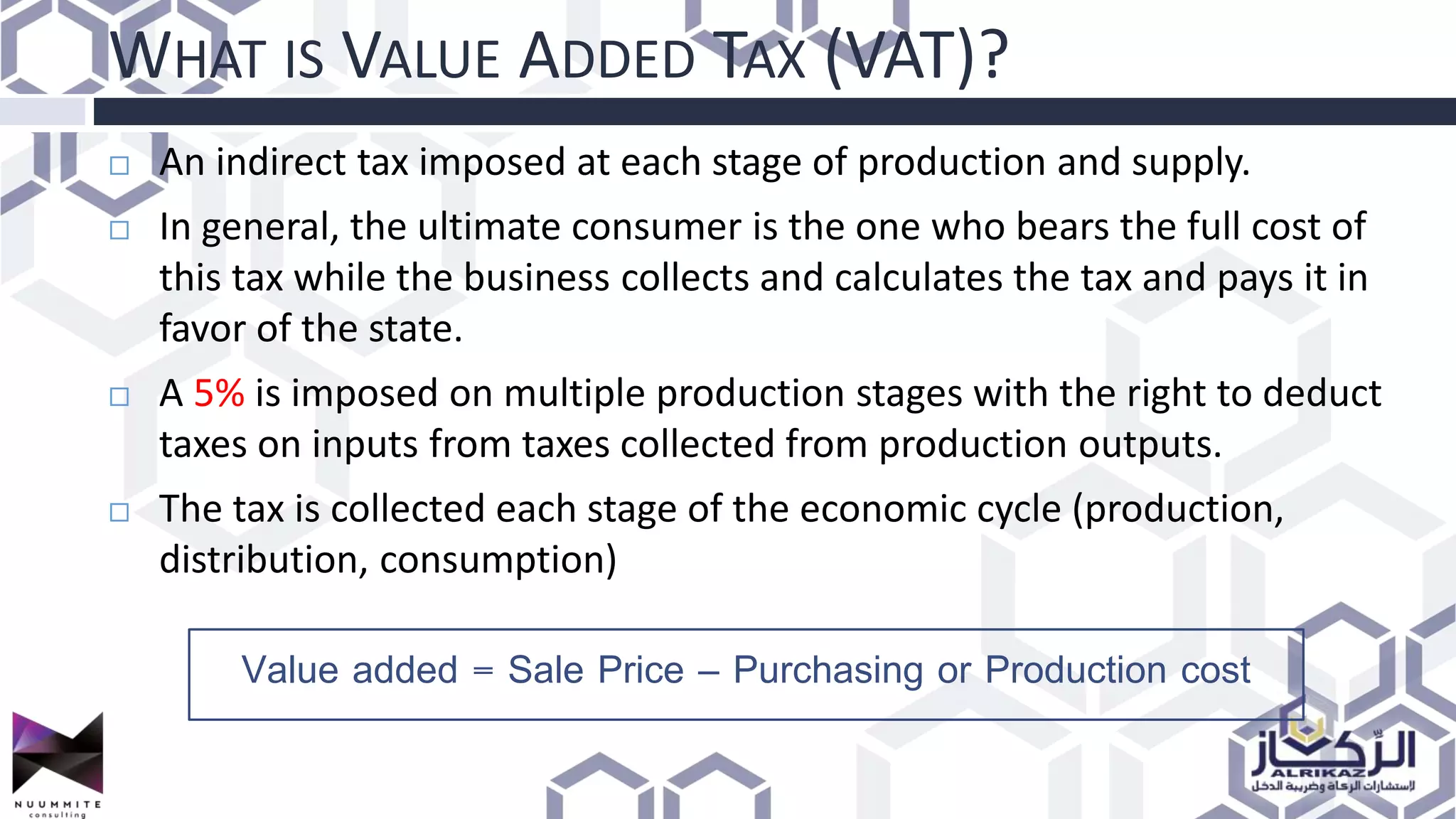
WHAT IS VALUE ADDED TAX (VAT)?
 An indirect tax imposed at each stage of production and supply.
 In general, the ultimate consumer is the one who bears the full cost of
this tax while the business collects and calculates the tax and pays it in
favor of the state.
 A 5% is imposed on multiple production stages with the right to deduct
taxes on inputs from taxes collected from production outputs.
 The tax is collected each stage of the economic cycle (production,
distribution, consumption)
Value added = Sale Price – Purchasing or Production cost
RecoveryRecovery
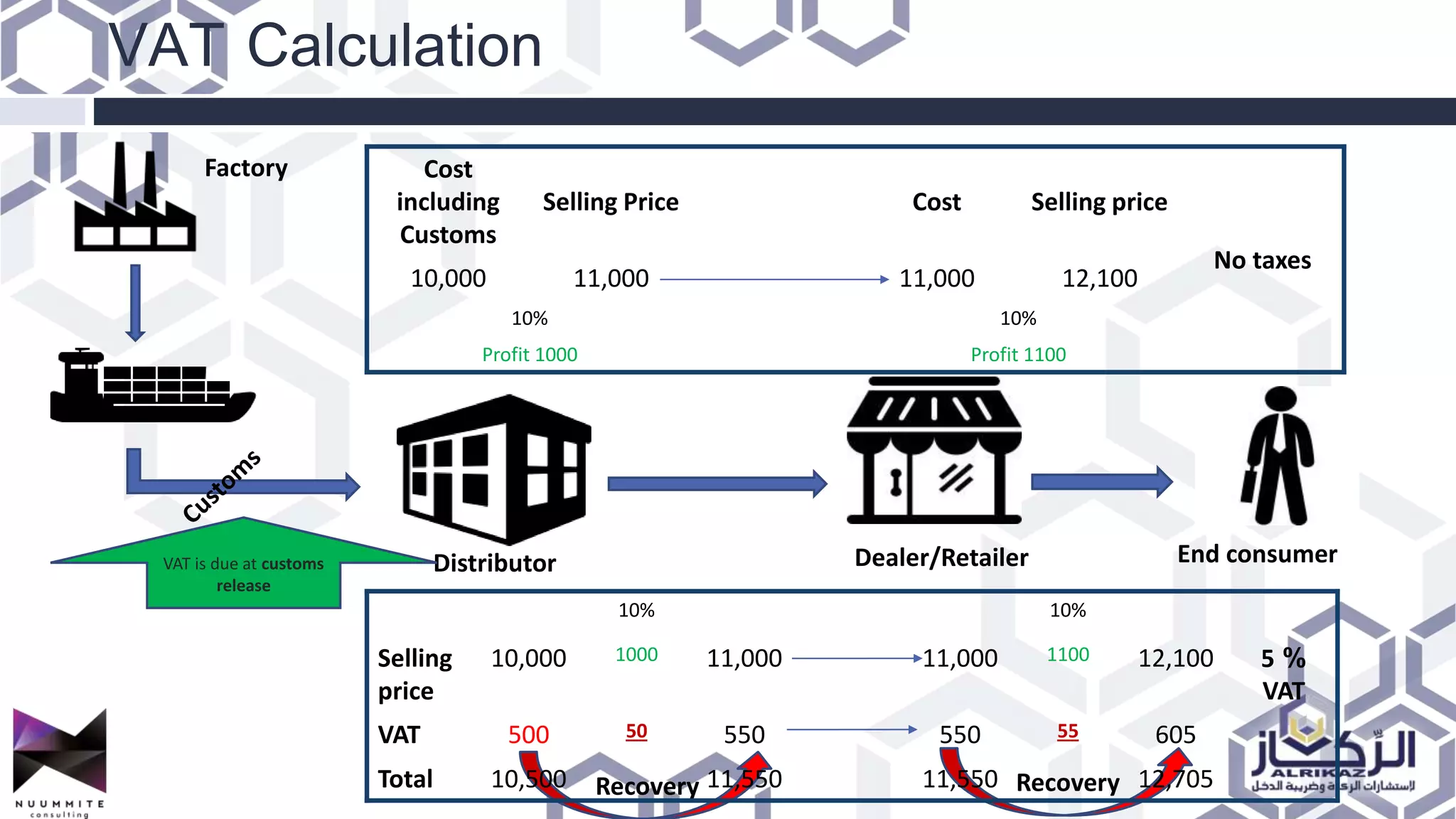
VAT Calculation
Factory
Distributor Dealer/Retailer End consumer
Cost
including
Customs
Selling Price Cost Selling price
No taxes
10,000 11,000 11,000 12,100
10% 10%
Profit 1000 Profit 1100
10% 10%
Selling
price
10,000 1000 11,000 11,000 1100 12,100 5 %
VAT
VAT 500 50 550 550 55 605
Total 10,500 11,550 11,550 12,705
VAT is due at customs
release
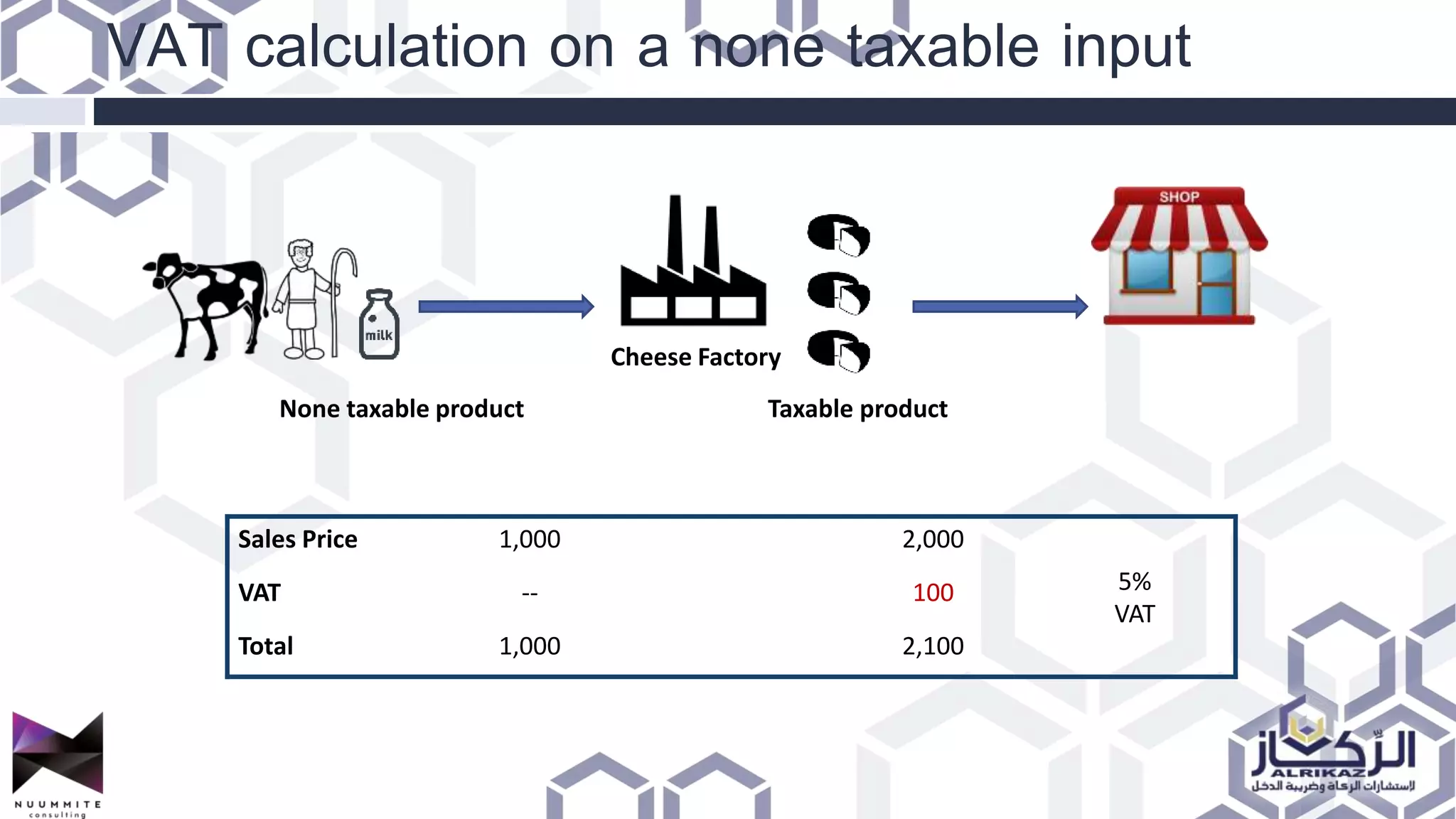
VAT calculation on a none taxable input
None taxable product
Cheese Factory
Taxable product
Sales Price 1,000 2,000
5%
VAT
VAT -- 100
Total 1,000 2,100
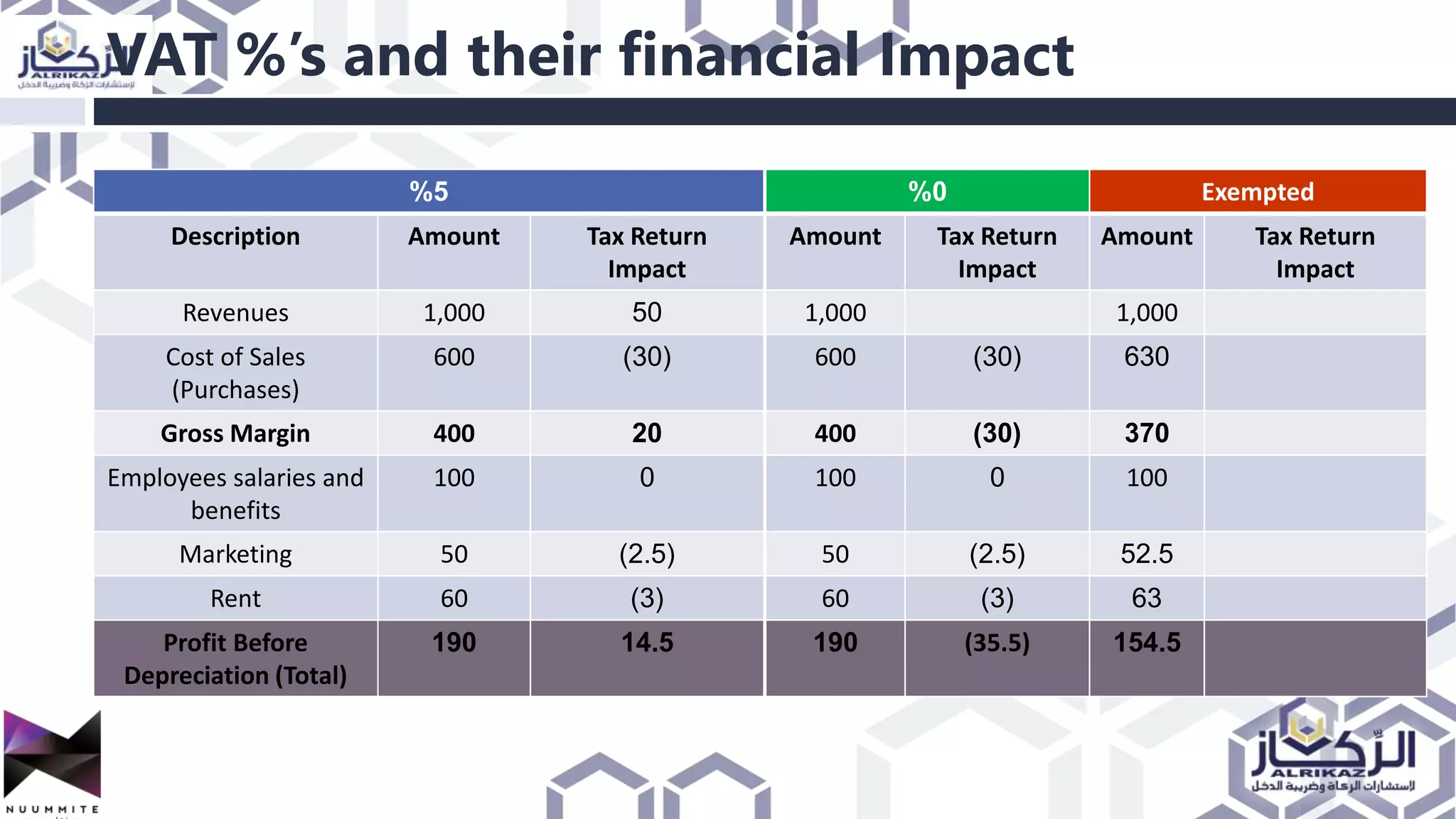
VAT %’s and their financial Impact
0%
Amount Tax Return
Impact
1,000
600 (30)
400 (30)
100 0
50 (2.5)
60 (3)
190 (35.5)
Exempted
Amount Tax Return
Impact
1,000
630
370
100
52.5
63
154.5
5%
Description Amount Tax Return
Impact
Revenues 1,000 50
Cost of Sales
(Purchases)
600 (30)
Gross Margin 400 20
Employees salaries and
benefits
100 0
Marketing 50 (2.5)
Rent 60 (3)
Profit Before
Depreciation (Total)
190 14.5
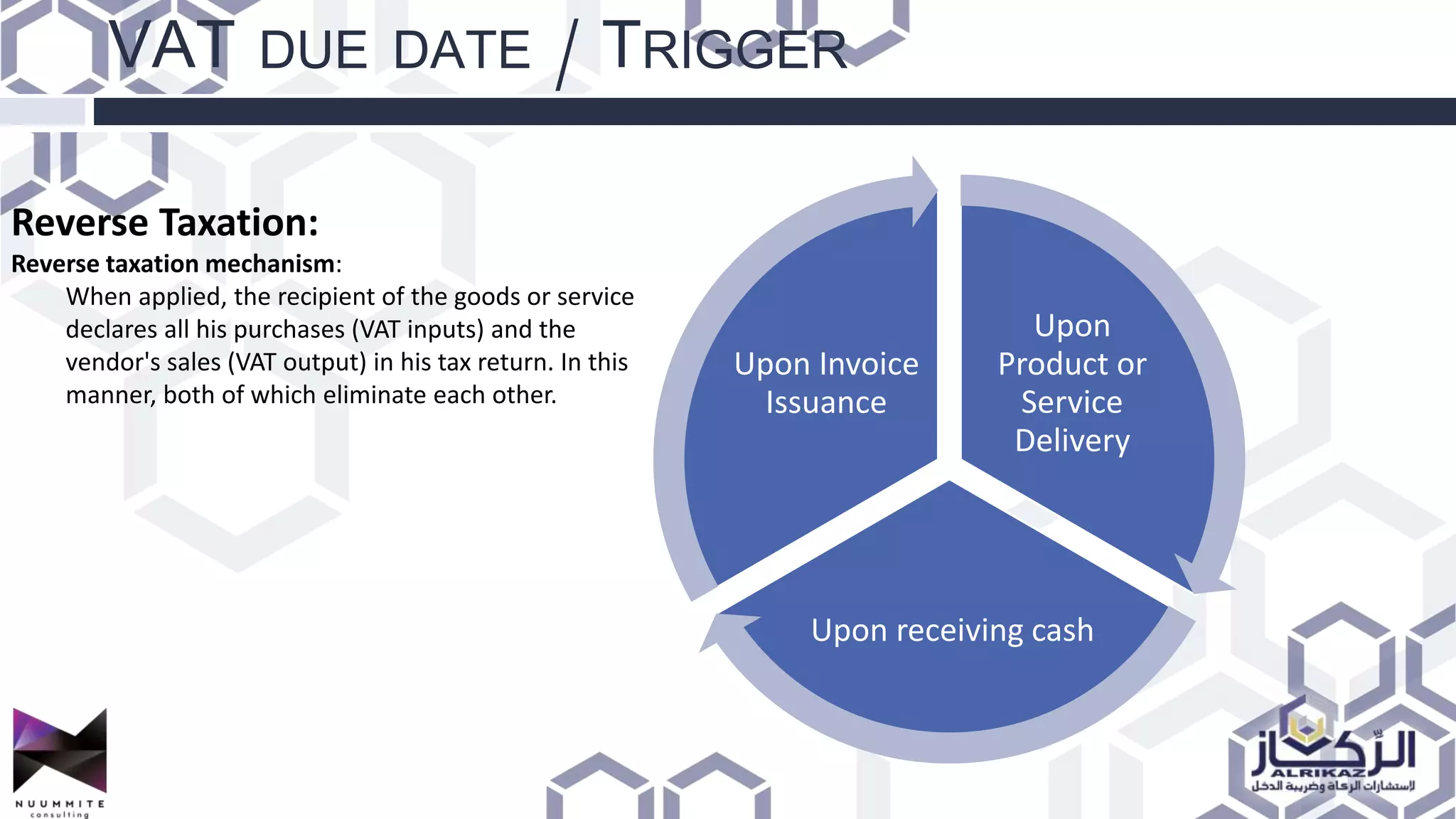
VAT DUE DATE / TRIGGER
Upon
Product or
Service
Delivery
Upon receiving cash
Upon Invoice
Issuance
Reverse Taxation:
Reverse taxation mechanism:
When applied, the recipient of the goods or service
declares all his purchases (VAT inputs) and the
vendor's sales (VAT output) in his tax return. In this
manner, both of which eliminate each other.
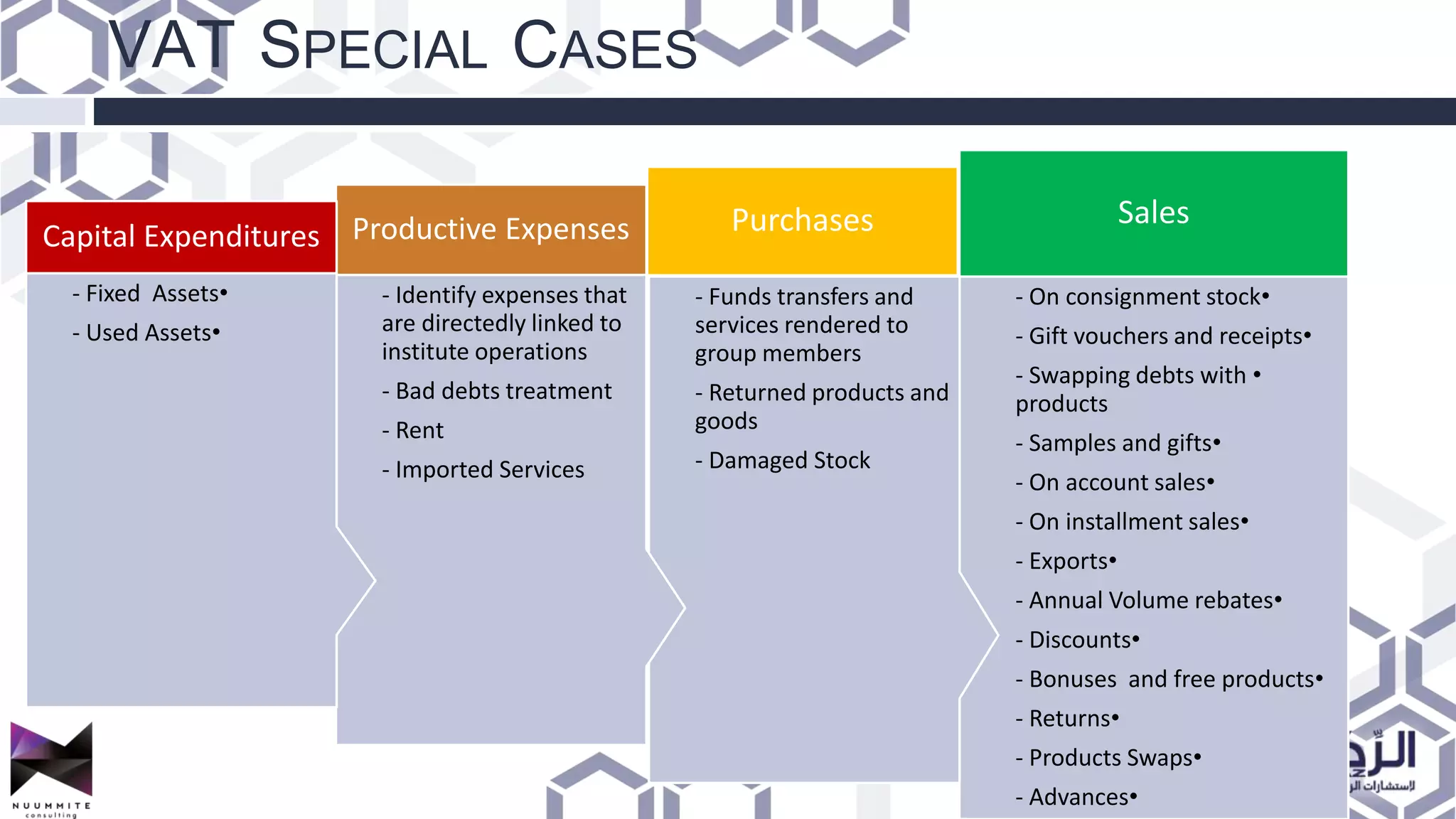
VAT SPECIAL CASES
•- On consignment stock
•- Gift vouchers and receipts
•- Swapping debts with
products
•- Samples and gifts
•- On account sales
•- On installment sales
•- Exports
•- Annual Volume rebates
•- Discounts
•- Bonuses and free products
•- Returns
•- Products Swaps
•- Advances
Sales
- Funds transfers and
services rendered to
group members
- Returned products and
goods
- Damaged Stock
Purchases
- Identify expenses that
are directedly linked to
institute operations
- Bad debts treatment
- Rent
- Imported Services
Productive Expenses
•- Fixed Assets
•- Used Assets
Capital Expenditures
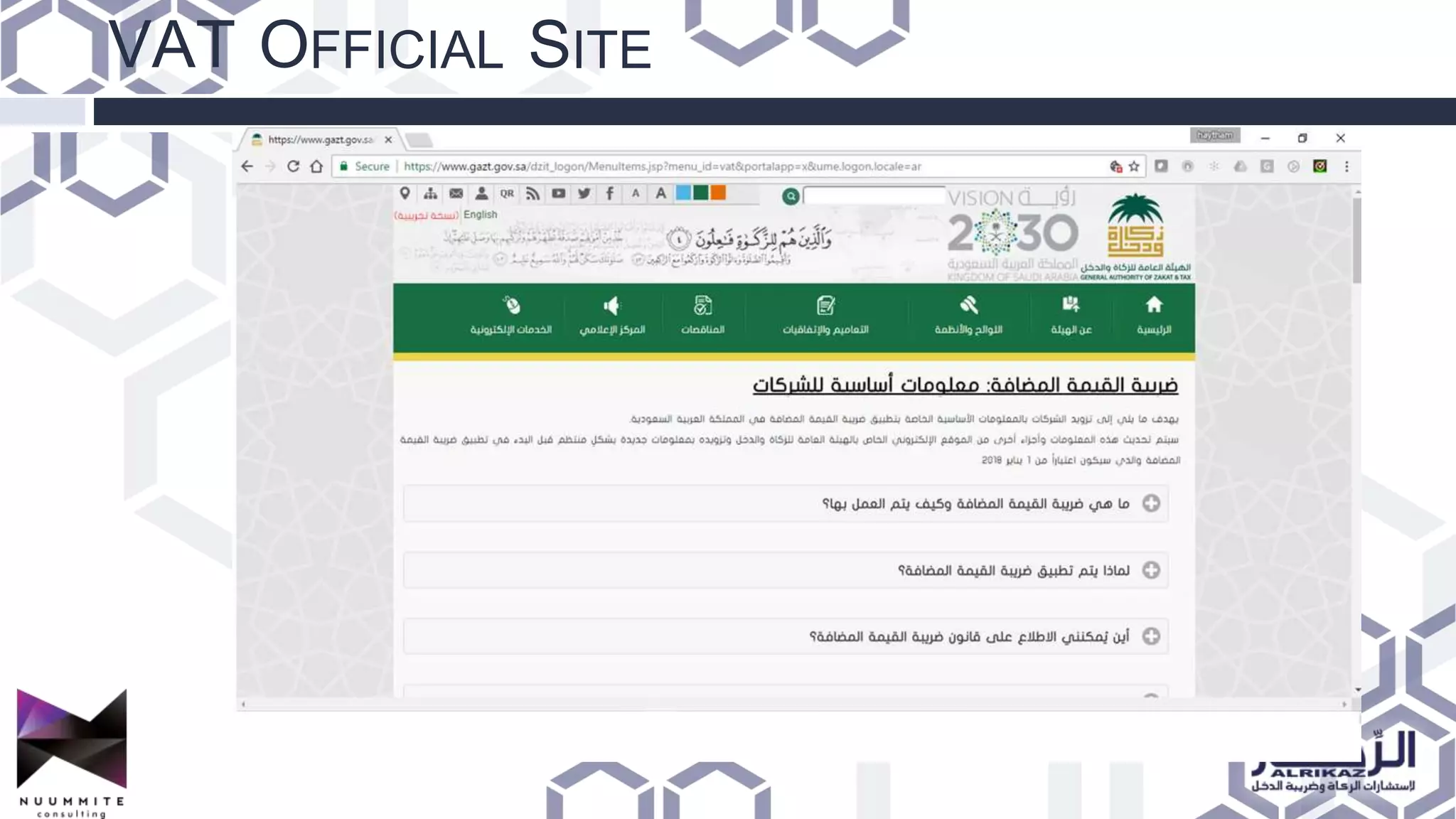
VAT OFFICIAL SITE
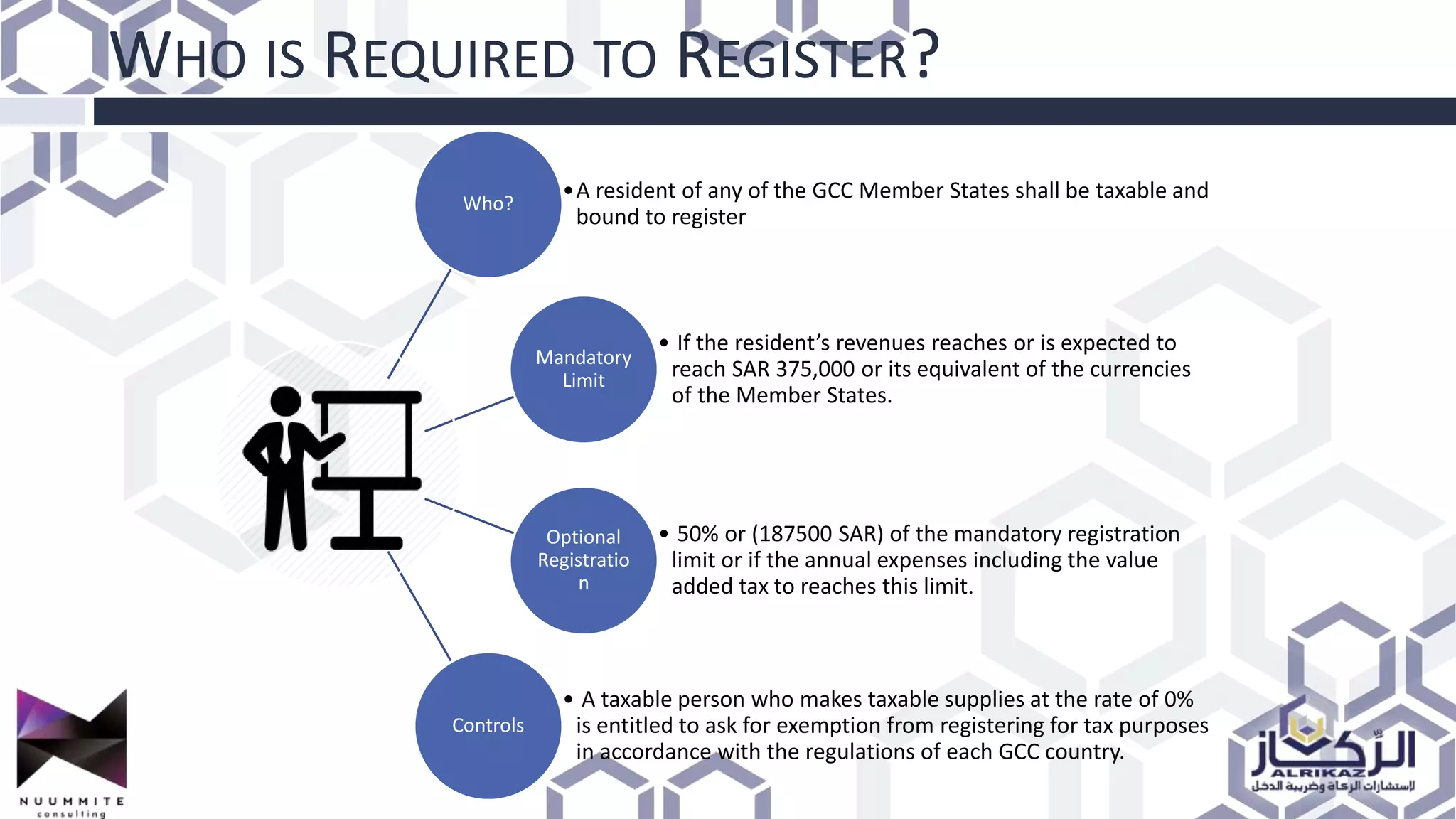
WHO IS REQUIRED TO REGISTER?
Who?
•A resident of any of the GCC Member States shall be taxable and
bound to register
Mandatory
Limit
• If the resident’s revenues reaches or is expected to
reach SAR 375,000 or its equivalent of the currencies
of the Member States.
Optional
Registratio
n
• 50% or (187500 SAR) of the mandatory registration
limit or if the annual expenses including the value
added tax to reaches this limit.
Controls
• A taxable person who makes taxable supplies at the rate of 0%
is entitled to ask for exemption from registering for tax purposes
in accordance with the regulations of each GCC country.
MEMBER COUNTRIES
 Saudi Arabia
 Bahrain
 Kuwait
 The United Arab Emirates
 Oman
 Qatar
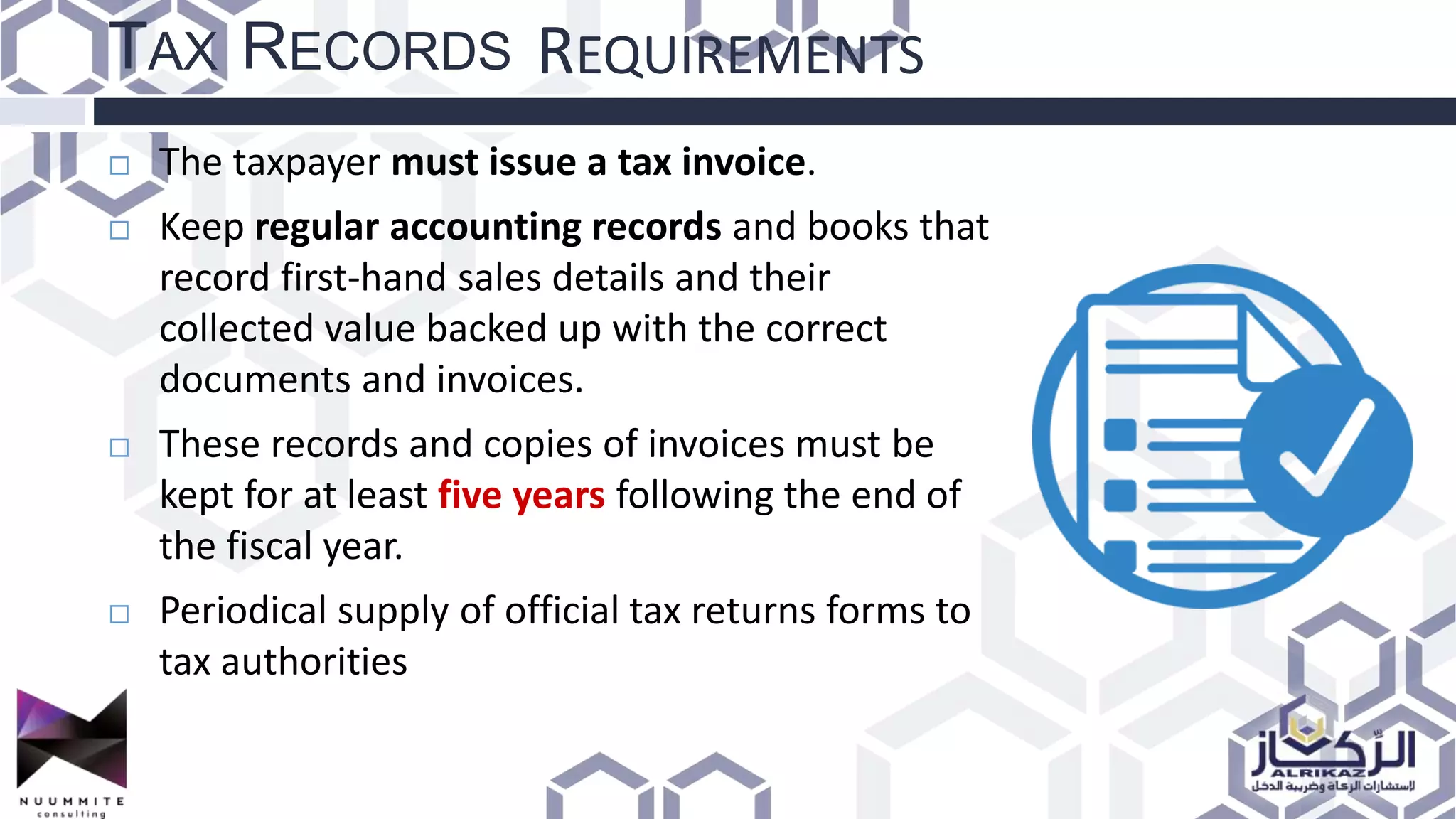
TAX RECORDS REQUIREMENTS
 The taxpayer must issue a tax invoice.
 Keep regular accounting records and books that
record first-hand sales details and their
collected value backed up with the correct
documents and invoices.
 These records and copies of invoices must be
kept for at least five years following the end of
the fiscal year.
 Periodical supply of official tax returns forms to
tax authorities
TAX PERIODS AND REPAYMENT
 Tax period: Two calendar months starting from the first day
of the first month and ending in the last day of the second
month. Authorities may also make the tax period one
month.
 Tax return submission and due amounts payment: mostly
15 days from the end of the tax period (not yet determined)
FINES AND PENALTIES
 None registration fine
 None submission or delay of submission of a tax
return
 Delay in paying the due taxes on time
 None complying records
 Submitting false or misleading data
 Tax evasion
EXEMPTIONS FROM TAX
 According to article 30 of the GCC unified agreement and in
accordance with the regulations determined by each
country, the following entities are exempted from VAT:
 Government bodies as determined by each country.
 Charities and institutions of public benefit as determined by each
country.
 Companies exempted under agreements to host international
events.
 Citizens of the Member State when constructing their own homes
for private use.
 Farmers and non-registered fishermen
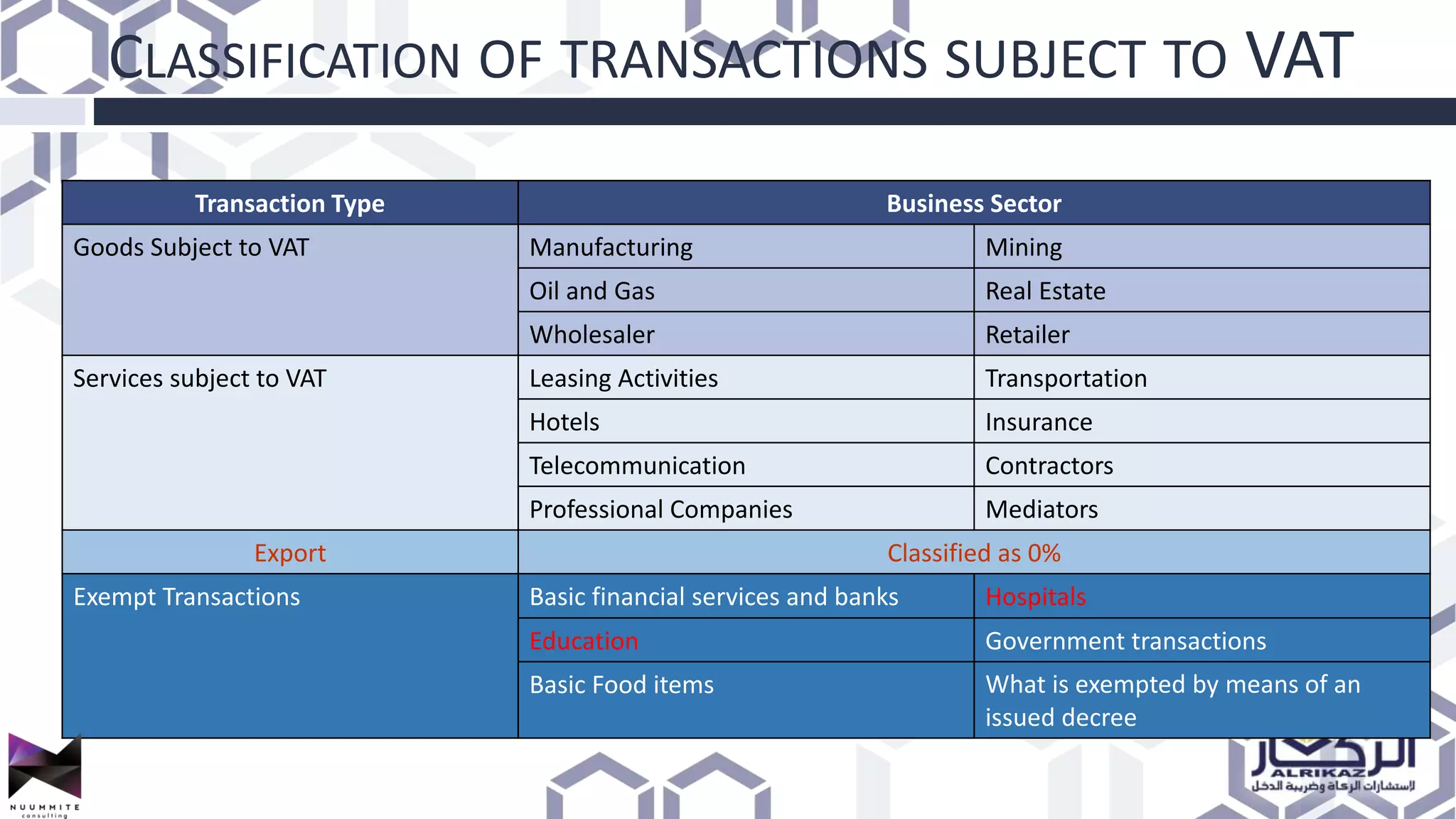
CLASSIFICATION OF TRANSACTIONS SUBJECT TO VAT
Business SectorTransaction Type
MiningManufacturingGoods Subject to VAT
Real EstateOil and Gas
RetailerWholesaler
TransportationLeasing ActivitiesServices subject to VAT
InsuranceHotels
ContractorsTelecommunication
MediatorsProfessional Companies
Classified as 0%Export
HospitalsBasic financial services and banksExempt Transactions
Government transactionsEducation
What is exempted by means of an
issued decree
Basic Food items
APPROACH TO
IMPLEMENT VAT
CHANGES
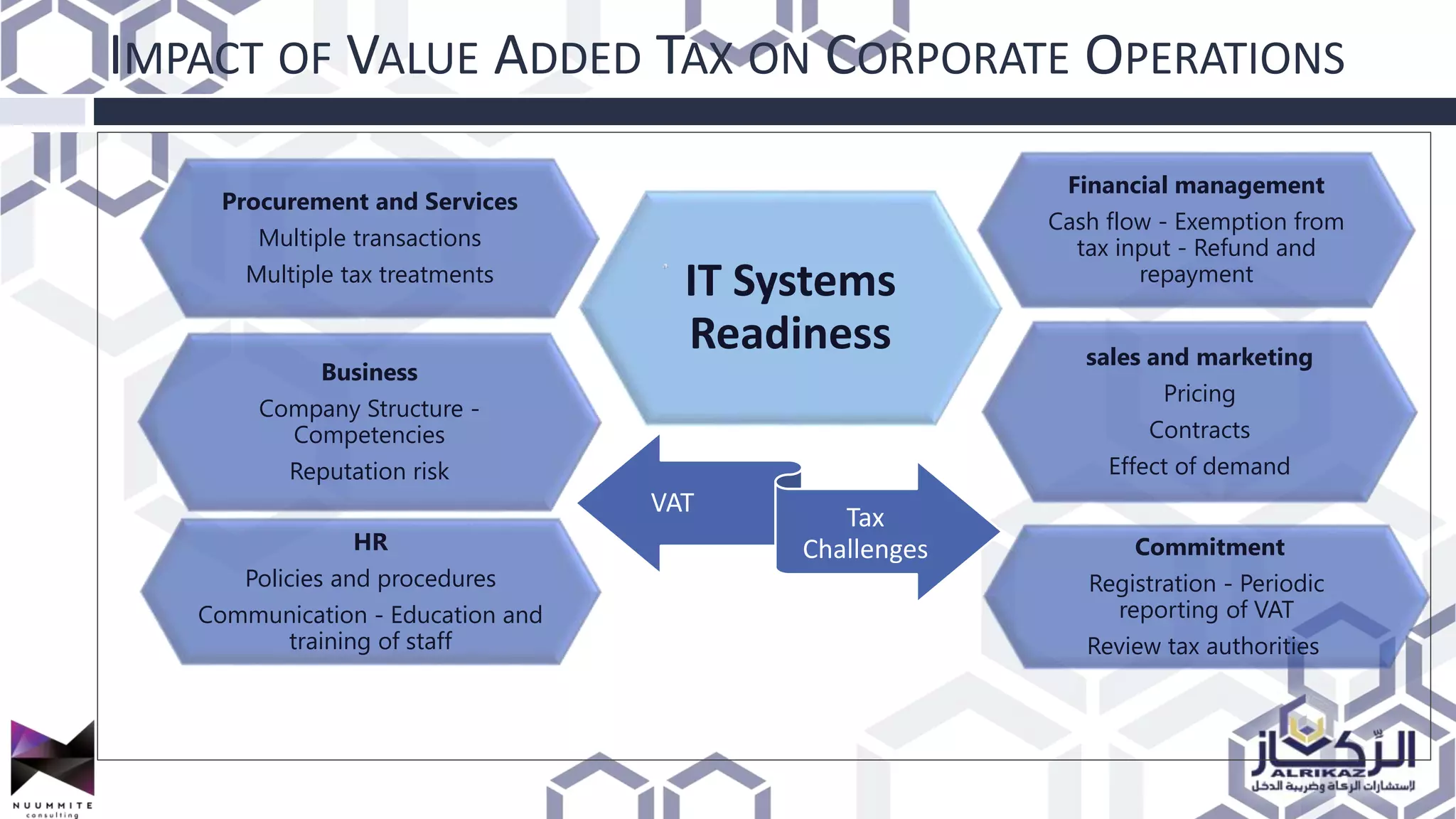
IMPACT OF VALUE ADDED TAX ON CORPORATE OPERATIONS
IT Systems
Readiness
Procurement and Services
Multiple transactions
Multiple tax treatments
sales and marketing
Pricing
Contracts
Effect of demand
Commitment
Registration - Periodic
reporting of VAT
Review tax authorities
Financial management
Cash flow - Exemption from
tax input - Refund and
repayment
HR
Policies and procedures
Communication - Education and
training of staff
Business
Company Structure -
Competencies
Reputation risk
VAT
Tax
Challenges
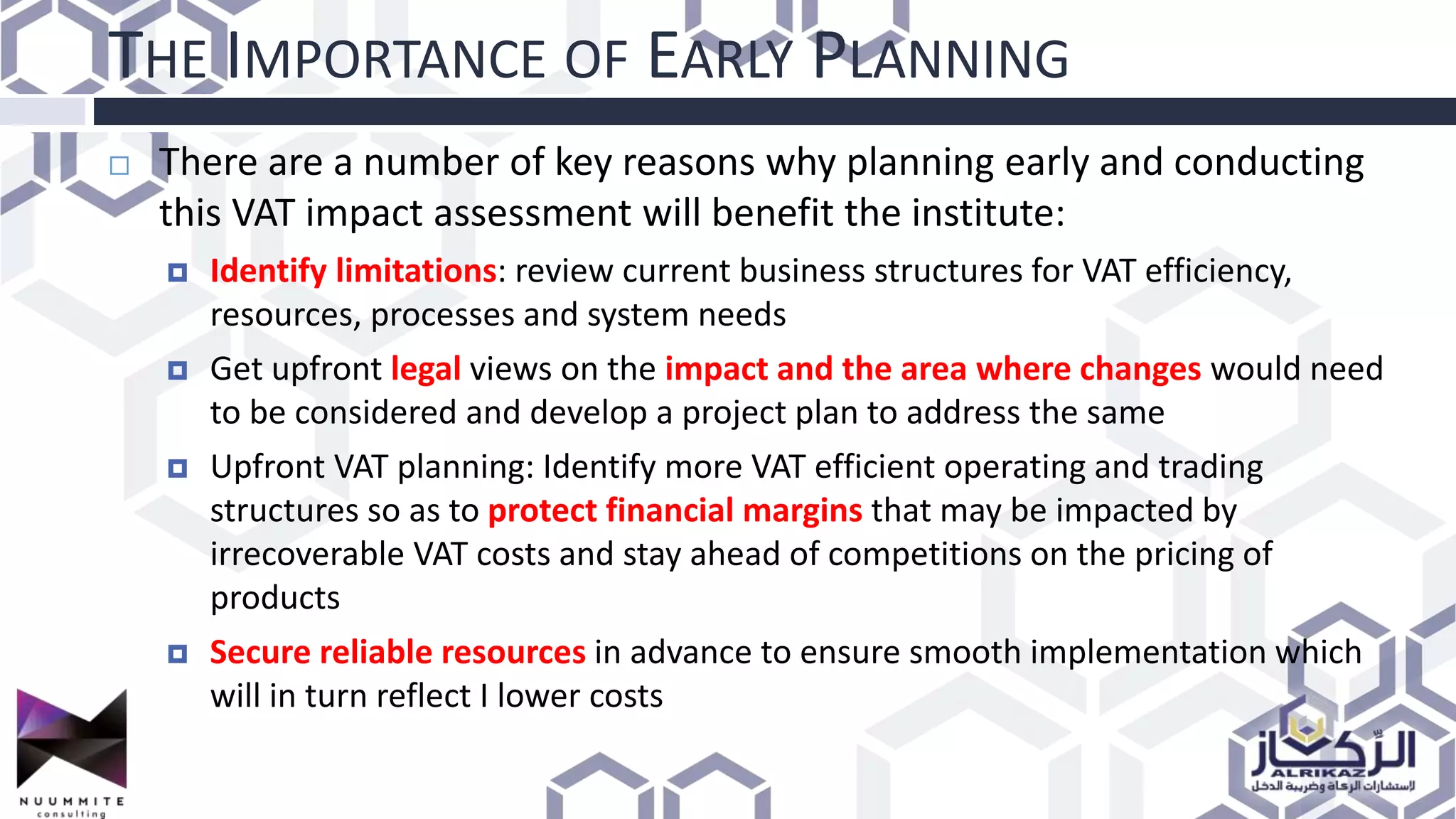
THE IMPORTANCE OF EARLY PLANNING
 There are a number of key reasons why planning early and conducting
this VAT impact assessment will benefit the institute:
 Identify limitations: review current business structures for VAT efficiency,
resources, processes and system needs
 Get upfront legal views on the impact and the area where changes would need
to be considered and develop a project plan to address the same
 Upfront VAT planning: Identify more VAT efficient operating and trading
structures so as to protect financial margins that may be impacted by
irrecoverable VAT costs and stay ahead of competitions on the pricing of
products
 Secure reliable resources in advance to ensure smooth implementation which
will in turn reflect I lower costs
THE IMPORTANCE OF EARLY PLANNING (CONT’D)
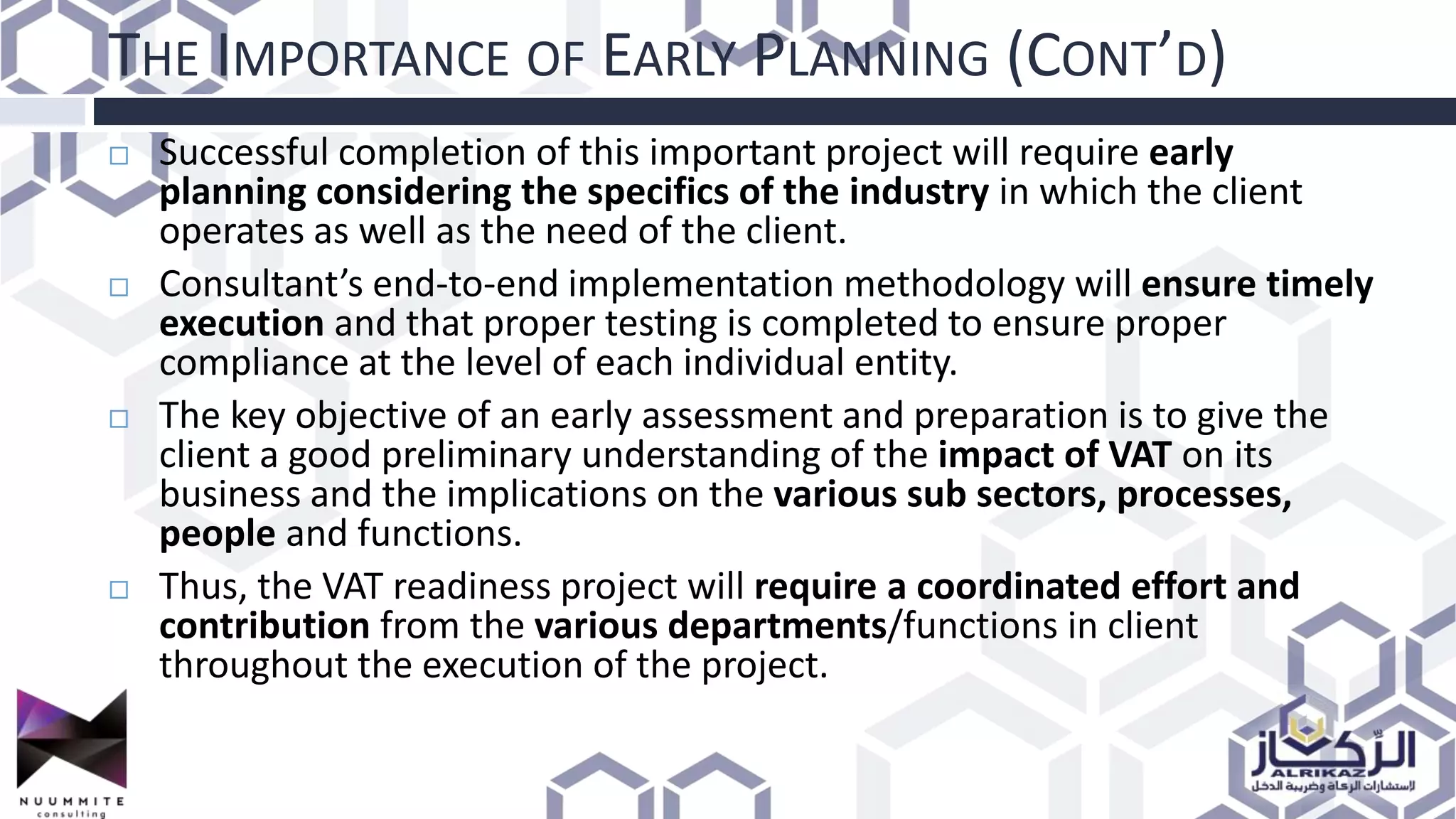
 Successful completion of this important project will require early
planning considering the specifics of the industry in which the client
operates as well as the need of the client.
 Consultant’s end-to-end implementation methodology will ensure timely
execution and that proper testing is completed to ensure proper
compliance at the level of each individual entity.
 The key objective of an early assessment and preparation is to give the
client a good preliminary understanding of the impact of VAT on its
business and the implications on the various sub sectors, processes,
people and functions.
 Thus, the VAT readiness project will require a coordinated effort and
contribution from the various departments/functions in client
throughout the execution of the project.
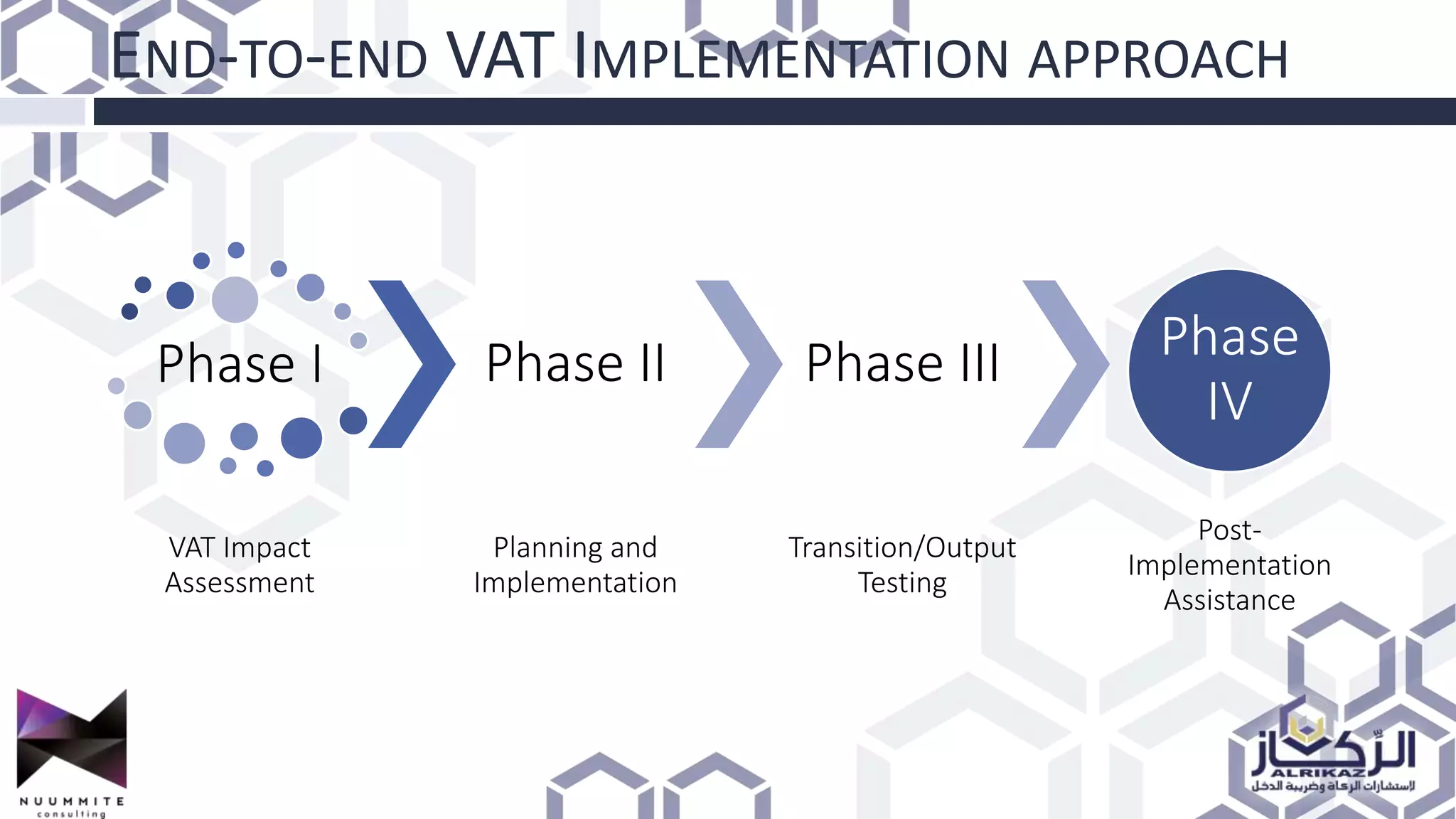
END-TO-END VAT IMPLEMENTATION APPROACH
Phase I
VAT Impact
Assessment
Phase II
Planning and
Implementation
Phase III
Transition/Output
Testing
Phase
IV
Post-
Implementation
Assistance
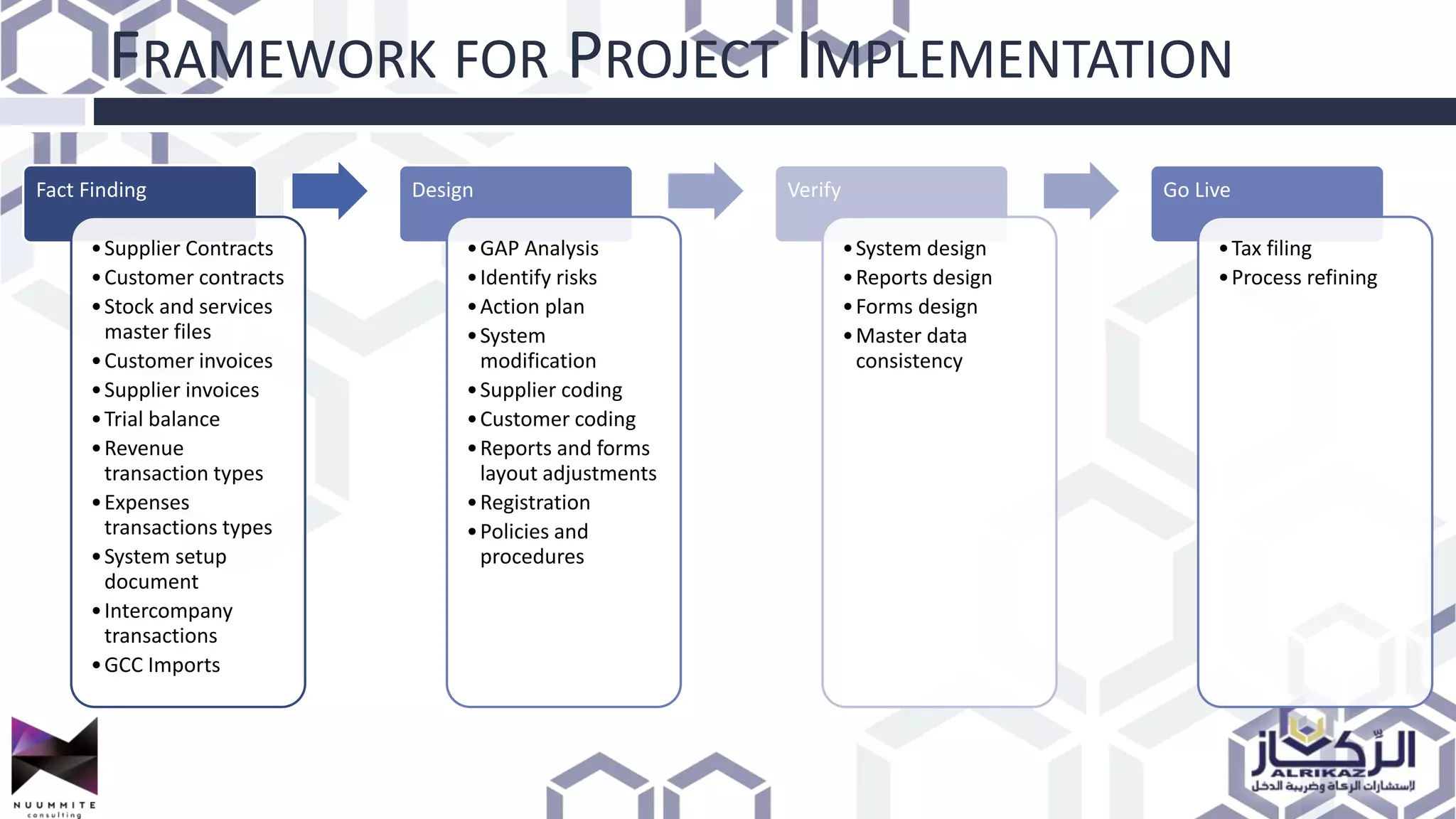
FRAMEWORK FOR PROJECT IMPLEMENTATION
Fact Finding
•Supplier Contracts
•Customer contracts
•Stock and services
master files
•Customer invoices
•Supplier invoices
•Trial balance
•Revenue
transaction types
•Expenses
transactions types
•System setup
document
•Intercompany
transactions
•GCC Imports
Design
•GAP Analysis
•Identify risks
•Action plan
•System
modification
•Supplier coding
•Customer coding
•Reports and forms
layout adjustments
•Registration
•Policies and
procedures
Verify
•System design
•Reports design
•Forms design
•Master data
consistency
Go Live
•Tax filing
•Process refining
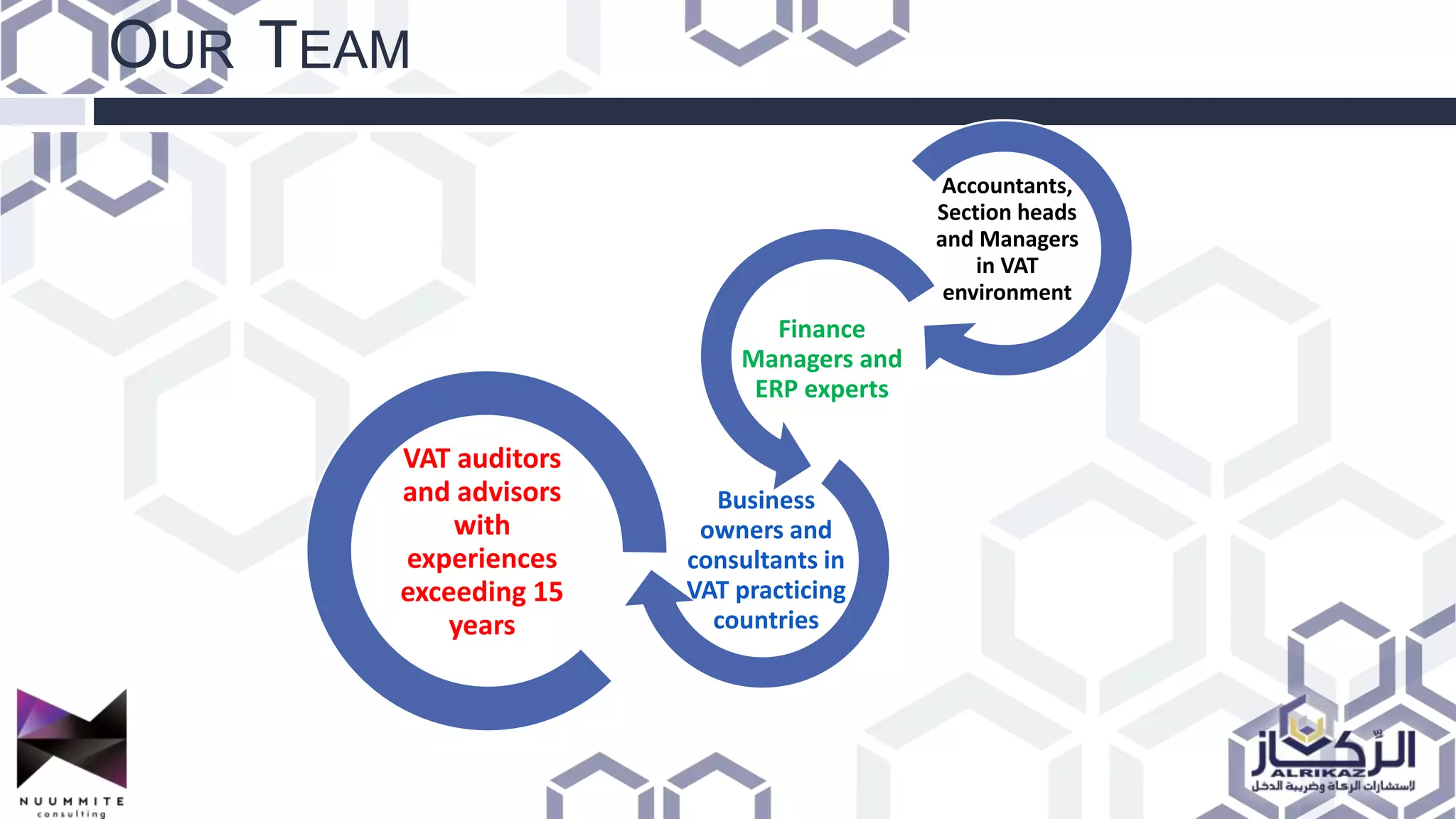
OUR TEAM
VAT auditors
and advisors
with
experiences
exceeding 15
years
Finance
Managers and
ERP experts
Business
owners and
consultants in
VAT practicing
countries
Accountants,
Section heads
and Managers
in VAT
environment
EXCISE TAX
WHAT IS EXCISE TAX?
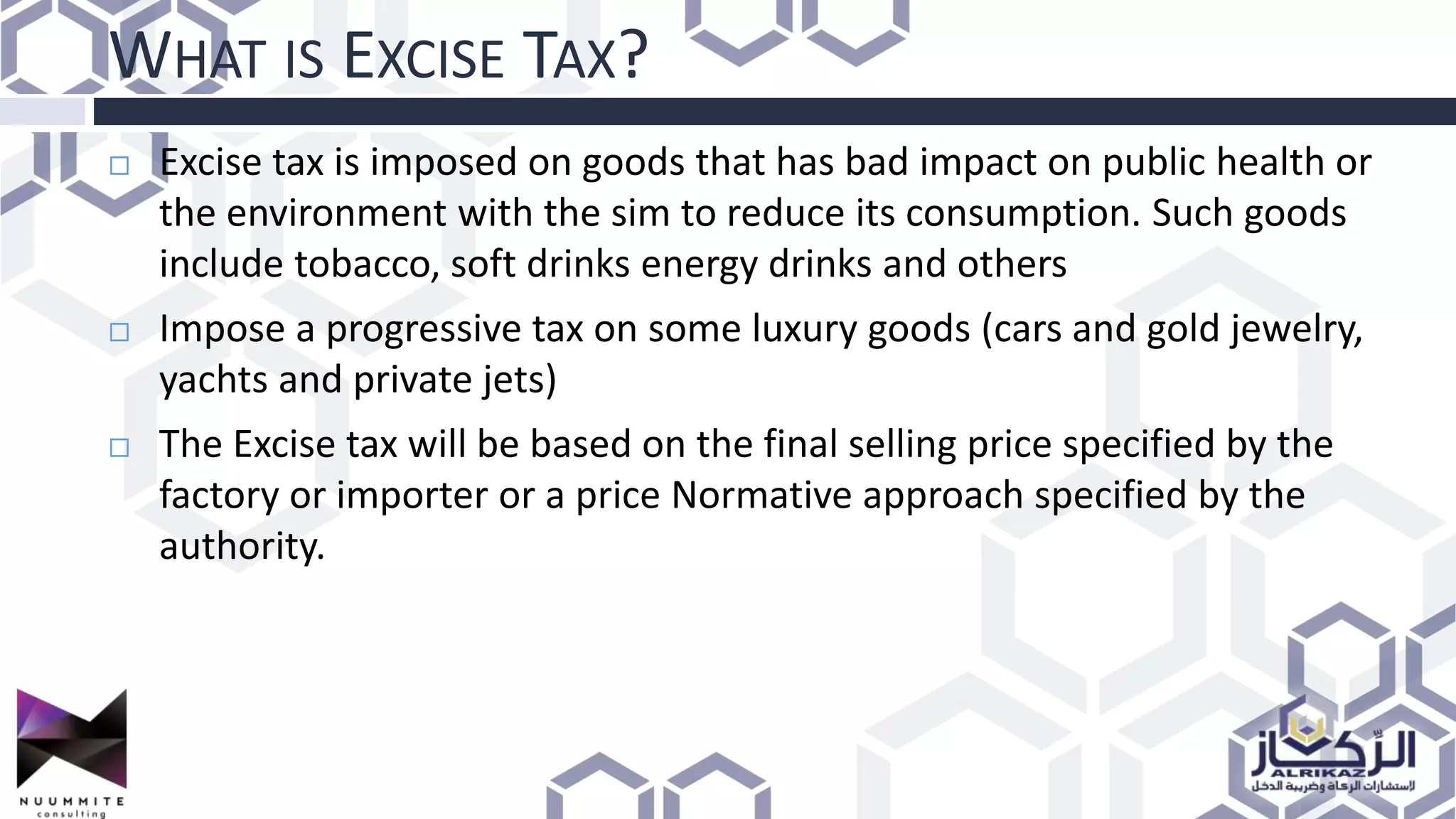
 Excise tax is imposed on goods that has bad impact on public health or
the environment with the sim to reduce its consumption. Such goods
include tobacco, soft drinks energy drinks and others
 Impose a progressive tax on some luxury goods (cars and gold jewelry,
yachts and private jets)
 The Excise tax will be based on the final selling price specified by the
factory or importer or a price Normative approach specified by the
authority.
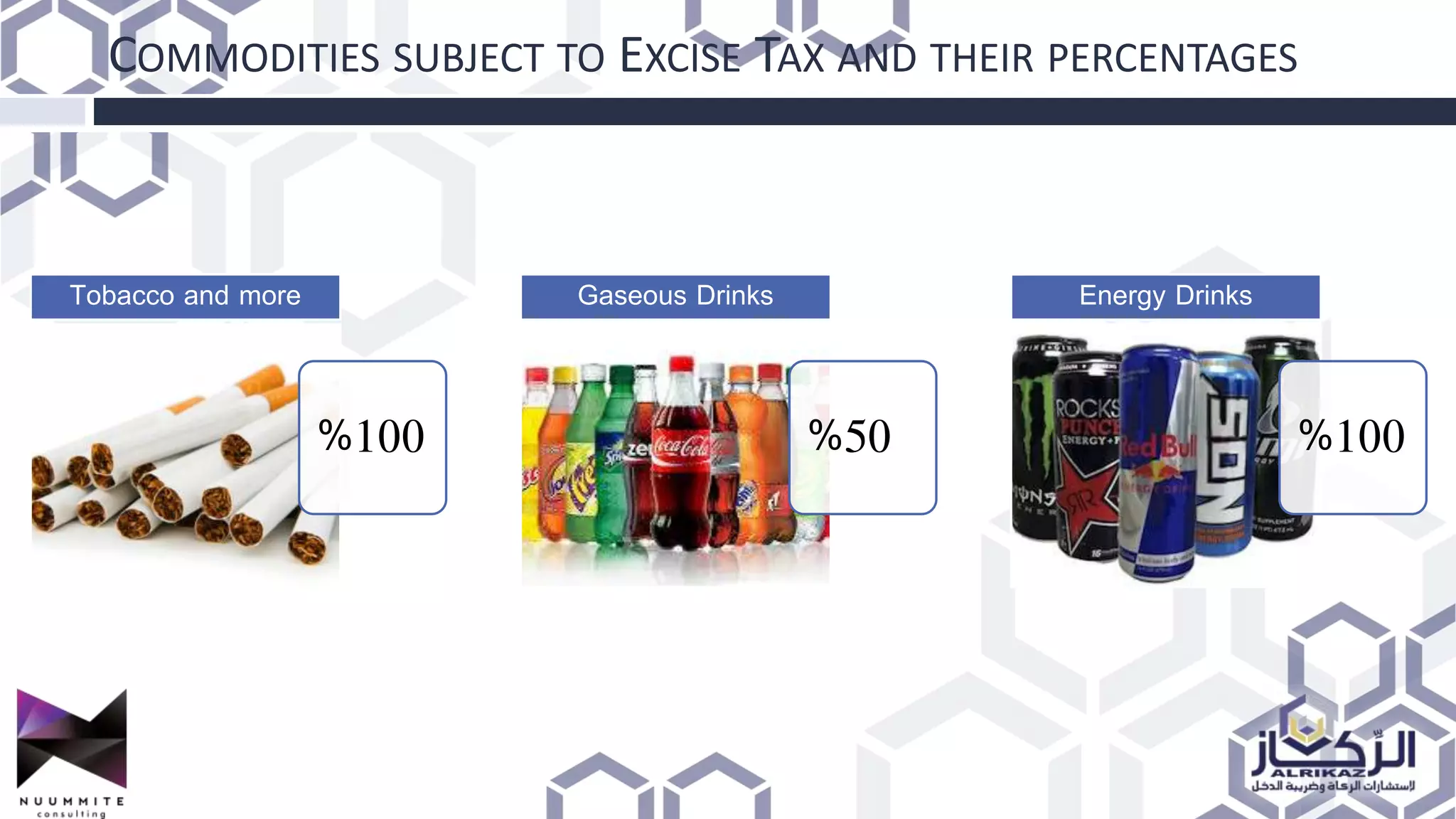
COMMODITIES SUBJECT TO EXCISE TAX AND THEIR PERCENTAGES
100%
Tobacco and more
50%
Gaseous Drinks
100%
Energy Drinks
Vat introduction By Nuummite Consulting

Vat introduction By Nuummite Consulting

  • 1.
  • 2.
    TABLE OF CONTENT ValueAdded Tax 3 Excise Tax 19 Approach to implement VAT changes 22
  • 3.
  • 4.
    What Departments AreAffected By VAT? Finance and Accounting Sales Procurement Marketing IT HR Warehouses and logistics
  • 5.
    WHAT IS VALUEADDED TAX (VAT)?  An indirect tax imposed at each stage of production and supply.  In general, the ultimate consumer is the one who bears the full cost of this tax while the business collects and calculates the tax and pays it in favor of the state.  A 5% is imposed on multiple production stages with the right to deduct taxes on inputs from taxes collected from production outputs.  The tax is collected each stage of the economic cycle (production, distribution, consumption) Value added = Sale Price – Purchasing or Production cost
  • 6.
    RecoveryRecovery VAT Calculation Factory Distributor Dealer/RetailerEnd consumer Cost including Customs Selling Price Cost Selling price No taxes 10,000 11,000 11,000 12,100 10% 10% Profit 1000 Profit 1100 10% 10% Selling price 10,000 1000 11,000 11,000 1100 12,100 5 % VAT VAT 500 50 550 550 55 605 Total 10,500 11,550 11,550 12,705 VAT is due at customs release
  • 7.
    VAT calculation ona none taxable input None taxable product Cheese Factory Taxable product Sales Price 1,000 2,000 5% VAT VAT -- 100 Total 1,000 2,100
  • 8.
    VAT %’s andtheir financial Impact 0% Amount Tax Return Impact 1,000 600 (30) 400 (30) 100 0 50 (2.5) 60 (3) 190 (35.5) Exempted Amount Tax Return Impact 1,000 630 370 100 52.5 63 154.5 5% Description Amount Tax Return Impact Revenues 1,000 50 Cost of Sales (Purchases) 600 (30) Gross Margin 400 20 Employees salaries and benefits 100 0 Marketing 50 (2.5) Rent 60 (3) Profit Before Depreciation (Total) 190 14.5
  • 9.
    VAT DUE DATE/ TRIGGER Upon Product or Service Delivery Upon receiving cash Upon Invoice Issuance Reverse Taxation: Reverse taxation mechanism: When applied, the recipient of the goods or service declares all his purchases (VAT inputs) and the vendor's sales (VAT output) in his tax return. In this manner, both of which eliminate each other.
  • 10.
    VAT SPECIAL CASES •-On consignment stock •- Gift vouchers and receipts •- Swapping debts with products •- Samples and gifts •- On account sales •- On installment sales •- Exports •- Annual Volume rebates •- Discounts •- Bonuses and free products •- Returns •- Products Swaps •- Advances Sales - Funds transfers and services rendered to group members - Returned products and goods - Damaged Stock Purchases - Identify expenses that are directedly linked to institute operations - Bad debts treatment - Rent - Imported Services Productive Expenses •- Fixed Assets •- Used Assets Capital Expenditures
  • 11.
  • 12.
    WHO IS REQUIREDTO REGISTER? Who? •A resident of any of the GCC Member States shall be taxable and bound to register Mandatory Limit • If the resident’s revenues reaches or is expected to reach SAR 375,000 or its equivalent of the currencies of the Member States. Optional Registratio n • 50% or (187500 SAR) of the mandatory registration limit or if the annual expenses including the value added tax to reaches this limit. Controls • A taxable person who makes taxable supplies at the rate of 0% is entitled to ask for exemption from registering for tax purposes in accordance with the regulations of each GCC country.
  • 13.
    MEMBER COUNTRIES  SaudiArabia  Bahrain  Kuwait  The United Arab Emirates  Oman  Qatar
  • 14.
    TAX RECORDS REQUIREMENTS The taxpayer must issue a tax invoice.  Keep regular accounting records and books that record first-hand sales details and their collected value backed up with the correct documents and invoices.  These records and copies of invoices must be kept for at least five years following the end of the fiscal year.  Periodical supply of official tax returns forms to tax authorities
  • 15.
    TAX PERIODS ANDREPAYMENT  Tax period: Two calendar months starting from the first day of the first month and ending in the last day of the second month. Authorities may also make the tax period one month.  Tax return submission and due amounts payment: mostly 15 days from the end of the tax period (not yet determined)
  • 16.
    FINES AND PENALTIES None registration fine  None submission or delay of submission of a tax return  Delay in paying the due taxes on time  None complying records  Submitting false or misleading data  Tax evasion
  • 17.
    EXEMPTIONS FROM TAX According to article 30 of the GCC unified agreement and in accordance with the regulations determined by each country, the following entities are exempted from VAT:  Government bodies as determined by each country.  Charities and institutions of public benefit as determined by each country.  Companies exempted under agreements to host international events.  Citizens of the Member State when constructing their own homes for private use.  Farmers and non-registered fishermen
  • 18.
    CLASSIFICATION OF TRANSACTIONSSUBJECT TO VAT Business SectorTransaction Type MiningManufacturingGoods Subject to VAT Real EstateOil and Gas RetailerWholesaler TransportationLeasing ActivitiesServices subject to VAT InsuranceHotels ContractorsTelecommunication MediatorsProfessional Companies Classified as 0%Export HospitalsBasic financial services and banksExempt Transactions Government transactionsEducation What is exempted by means of an issued decree Basic Food items
  • 19.
  • 20.
    IMPACT OF VALUEADDED TAX ON CORPORATE OPERATIONS IT Systems Readiness Procurement and Services Multiple transactions Multiple tax treatments sales and marketing Pricing Contracts Effect of demand Commitment Registration - Periodic reporting of VAT Review tax authorities Financial management Cash flow - Exemption from tax input - Refund and repayment HR Policies and procedures Communication - Education and training of staff Business Company Structure - Competencies Reputation risk VAT Tax Challenges
  • 21.
    THE IMPORTANCE OFEARLY PLANNING  There are a number of key reasons why planning early and conducting this VAT impact assessment will benefit the institute:  Identify limitations: review current business structures for VAT efficiency, resources, processes and system needs  Get upfront legal views on the impact and the area where changes would need to be considered and develop a project plan to address the same  Upfront VAT planning: Identify more VAT efficient operating and trading structures so as to protect financial margins that may be impacted by irrecoverable VAT costs and stay ahead of competitions on the pricing of products  Secure reliable resources in advance to ensure smooth implementation which will in turn reflect I lower costs
  • 22.
    THE IMPORTANCE OFEARLY PLANNING (CONT’D)  Successful completion of this important project will require early planning considering the specifics of the industry in which the client operates as well as the need of the client.  Consultant’s end-to-end implementation methodology will ensure timely execution and that proper testing is completed to ensure proper compliance at the level of each individual entity.  The key objective of an early assessment and preparation is to give the client a good preliminary understanding of the impact of VAT on its business and the implications on the various sub sectors, processes, people and functions.  Thus, the VAT readiness project will require a coordinated effort and contribution from the various departments/functions in client throughout the execution of the project.
  • 23.
    END-TO-END VAT IMPLEMENTATIONAPPROACH Phase I VAT Impact Assessment Phase II Planning and Implementation Phase III Transition/Output Testing Phase IV Post- Implementation Assistance
  • 24.
    FRAMEWORK FOR PROJECTIMPLEMENTATION Fact Finding •Supplier Contracts •Customer contracts •Stock and services master files •Customer invoices •Supplier invoices •Trial balance •Revenue transaction types •Expenses transactions types •System setup document •Intercompany transactions •GCC Imports Design •GAP Analysis •Identify risks •Action plan •System modification •Supplier coding •Customer coding •Reports and forms layout adjustments •Registration •Policies and procedures Verify •System design •Reports design •Forms design •Master data consistency Go Live •Tax filing •Process refining
  • 25.
    OUR TEAM VAT auditors andadvisors with experiences exceeding 15 years Finance Managers and ERP experts Business owners and consultants in VAT practicing countries Accountants, Section heads and Managers in VAT environment
  • 26.
  • 27.
    WHAT IS EXCISETAX?  Excise tax is imposed on goods that has bad impact on public health or the environment with the sim to reduce its consumption. Such goods include tobacco, soft drinks energy drinks and others  Impose a progressive tax on some luxury goods (cars and gold jewelry, yachts and private jets)  The Excise tax will be based on the final selling price specified by the factory or importer or a price Normative approach specified by the authority.
  • 28.
    COMMODITIES SUBJECT TOEXCISE TAX AND THEIR PERCENTAGES 100% Tobacco and more 50% Gaseous Drinks 100% Energy Drinks