Paulo Vargas Moniz; Vitória / Rio de Janeiro - 2011 Quantum Cosmology - p. 1
(NEW) BORDERS FOR QUANTUM COSMOLOGY
Standpoint and (some) SUSY
LNP 803 - 804, Springer, 2010
Paulo Vargas Moniz(1)
(1) UBI & CENTRA-IST,
Paulo Vargas Moniz; Vitória / Rio de Janeiro - 2011 Quantum Cosmology - p. 3
Abstract
Quantum Cosmology tackles the quantum description of the
early universe. It is aimed as an accessible primer that covers
the basics, critically discussing ideas and concepts that
comprise our current knowledge. The scope for analyzing
quantum cosmological models within a supersymmetric
framework is pointed.
As much as possible, it summarizes what we know, what we
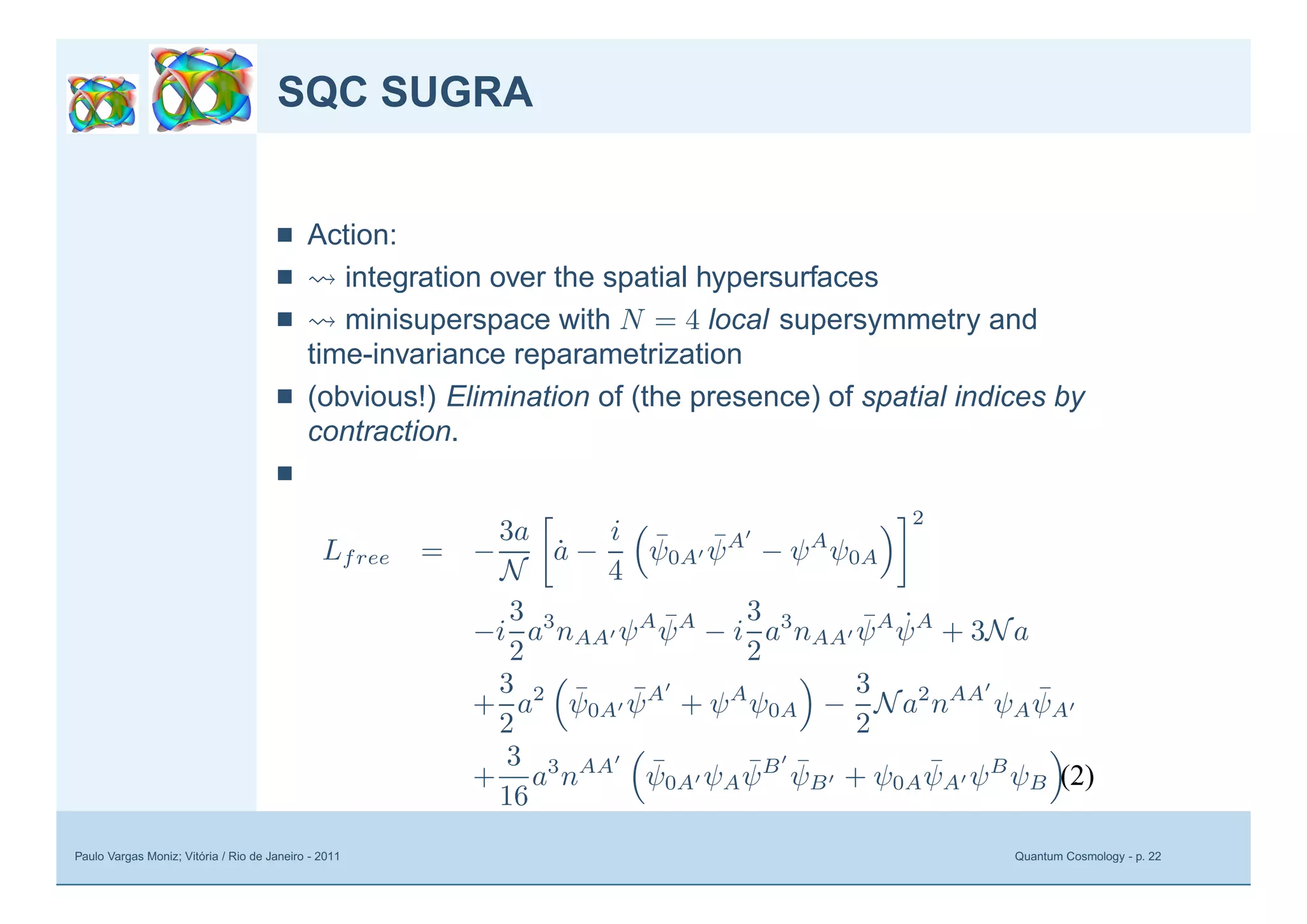
think we know and what we think we do not know on an equal
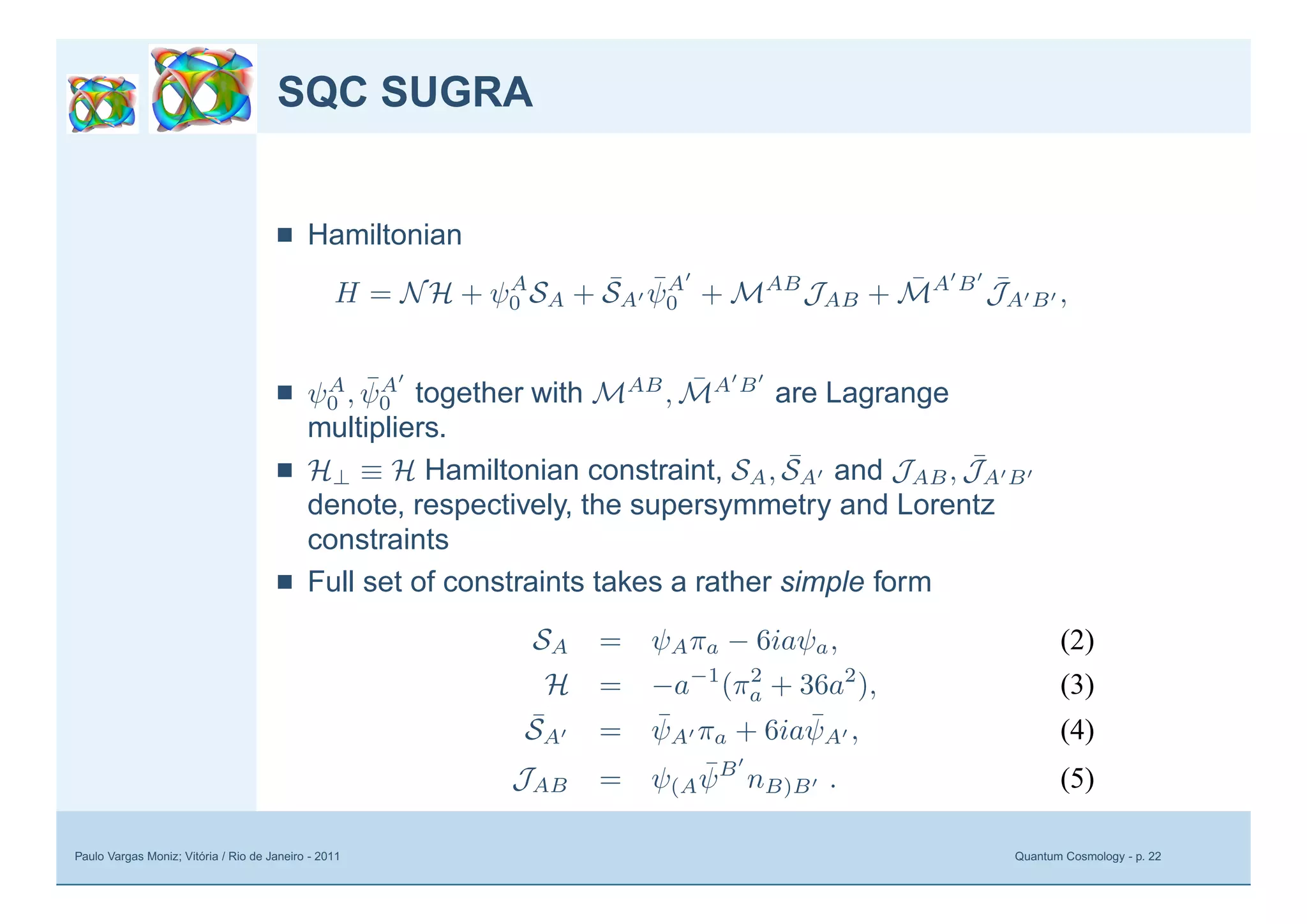
footing. It is focused for ‘young’, inquisitive minds eager to
embark on in-depth research in this field. It is hoped to suggest
the tools researchers will need to go on their own, pushing
them to ask the right questions rather than seek definitive
answers.
Paulo Vargas Moniz; Vitória / Rio de Janeiro - 2011 Quantum Cosmology - p. 19
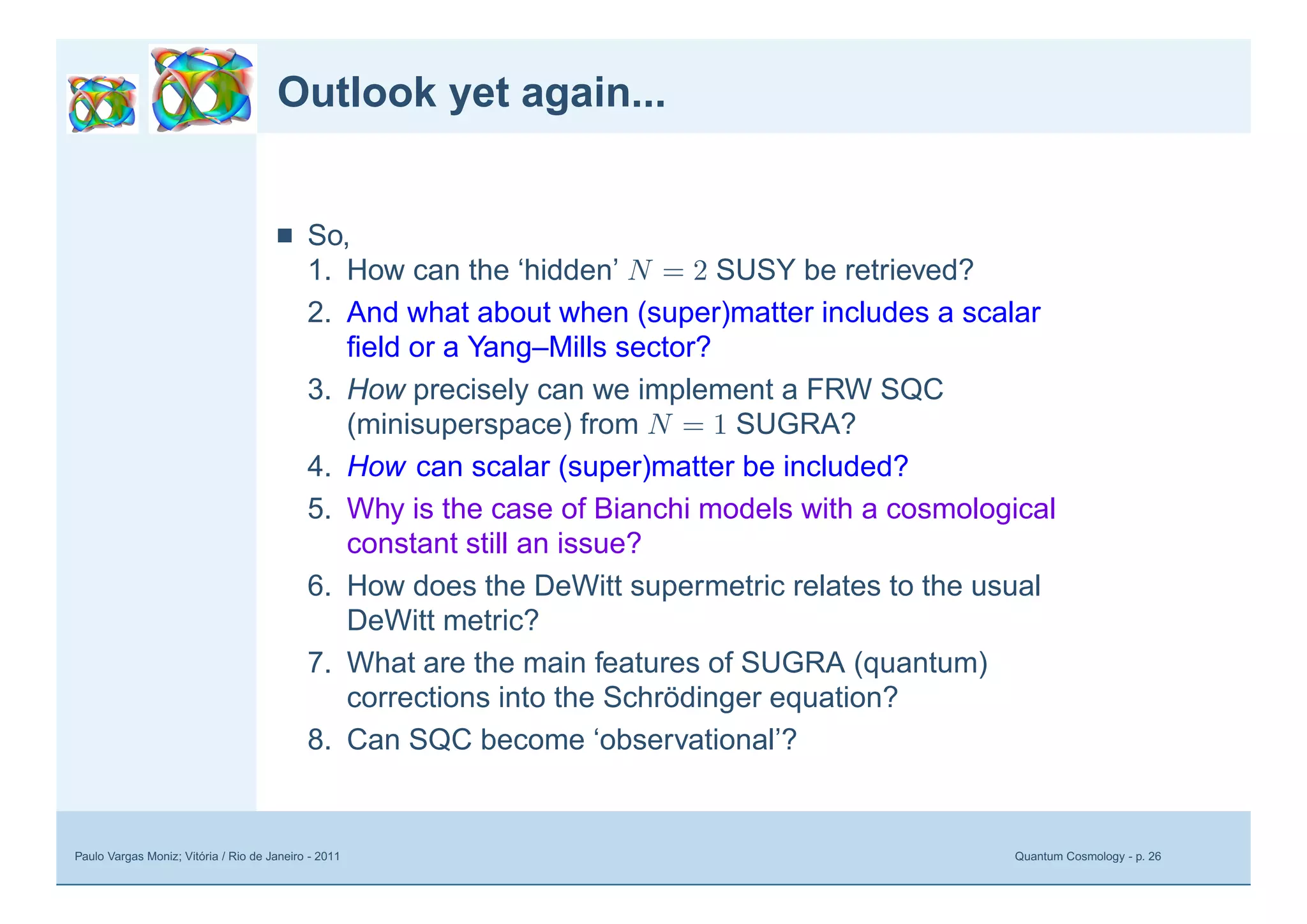
N=2 SUSY
Paulo Vargas Moniz; Vitória / Rio de Janeiro - 2011 Quantum Cosmology - p. 20
QC SUSY part-I
■ Starting from
■ bosonic configurations
■ General Relativity or bosonic sector (strings)
■ Setting:
ds2
= −N2
(t)dt2
+ hij(t)ωi
ωj
hij(t) =
1
6π
e2α(t)
e2β
(t) ij
=
1
6π
e2βi
δij,
βij(t) ≡ diag(β+ +
√
3β−, β+ −
√
3β−, −2β+)
Paulo Vargas Moniz; Vitória / Rio de Janeiro - 2011 Quantum Cosmology - p. 20
QC SUSY part-I
■ Hamiltonian
H =
1
2
(−p2
α + p2
+ + p2
−) + U(0)
(α, β+, β−)
=
3
2
(p1)2
+ (p2)2
+ (p3)2
− 2p1p2 − 2p1p3 − 2p2p3
+ U(0)
(β1
, β2
, β3
), (1)
■ U(0)
≡ −12π2
h(3)
R
type I : U
(0)
I ≡ 0 (2)
type II : U
(0)
II ≡
1
6
e4α
e−8β+
=
1
6
e4β3
, (3)
type IX : U
(0)
IX ≡
1
6
e4α
2e4β+
(cosh(4
√
3β−) − 1) + e−8β+
−4e−2β+
cosh(2
√
3β−)
=
1
6
e4β1
+ e4β2
+ e4β3
− 2e2β1
+2β2
Paulo Vargas Moniz; Vitória / Rio de Janeiro - 2011 Quantum Cosmology - p. 20
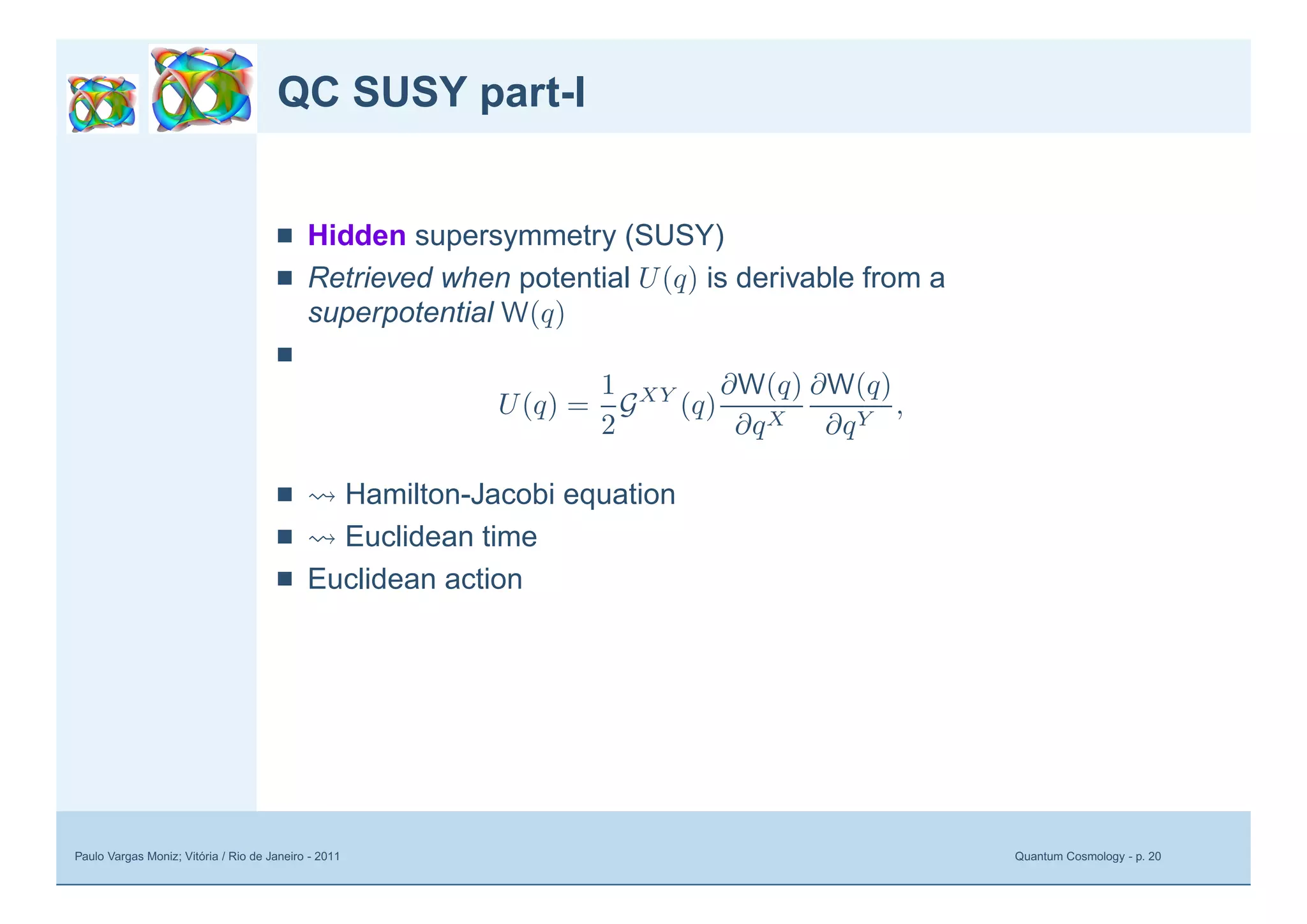
QC SUSY part-I
■ Hidden supersymmetry (SUSY)
■ Retrieved when potential U(q) is derivable from a
superpotential W(q)
■
U(q) =
1
2
GXY
(q)
∂W(q)
∂qX
∂W(q)
∂qY
,
■ Hamilton-Jacobi equation
■ Euclidean time
■ Euclidean action
Paulo Vargas Moniz; Vitória / Rio de Janeiro - 2011 Quantum Cosmology - p. 20
QC SUSY part-I
■ Superpotentials W
◆ Bianchi type I:
WI ≡ 0;
◆ Bianchi type II:
WII ≡
1
6
e2α−4β+
=
1
6
e2β3
;
◆ Bianchi type IX:
W
(0)
IX ≡
1
6
e2α
2e2β+
cosh 2
√
3β− + e−4β+
=
1
6
e2β1
+ e2β2
+ e2β3
; (1)
Paulo Vargas Moniz; Vitória / Rio de Janeiro - 2011 Quantum Cosmology - p. 20
QC SUSY part-I
■ Classical Hamiltonian
Hc =
1
2
GXY
(q) pX pY +
∂W
∂qX
∂W
∂qY
.
■ Quantum Hamiltonian H,
2H = ˜SS + S ˜S
■ where S, ˜S are linear operators satisfying
S2
= 0 = ˜S2
.
Paulo Vargas Moniz; Vitória / Rio de Janeiro - 2011 Quantum Cosmology - p. 20
QC SUSY part-I
■ The operators S and ˜S have the explicit form
S ≡ ψx
ex
Y
(q) πY + i
∂W
∂qY
(1)
˜S ≡ ¯ψxexY
(q) πY − i
∂W
∂qY
, (2)
■ ex
Y
(q) ≡ e−Ω
δY
x is the minisuperspace vielbein associated
with GXY
(q)
■ They satisfy ex
Y
(q)ey
X
(q)ηxy
≡ GXY
(q),
Paulo Vargas Moniz; Vitória / Rio de Janeiro - 2011 Quantum Cosmology - p. 20
QC SUSY part-I
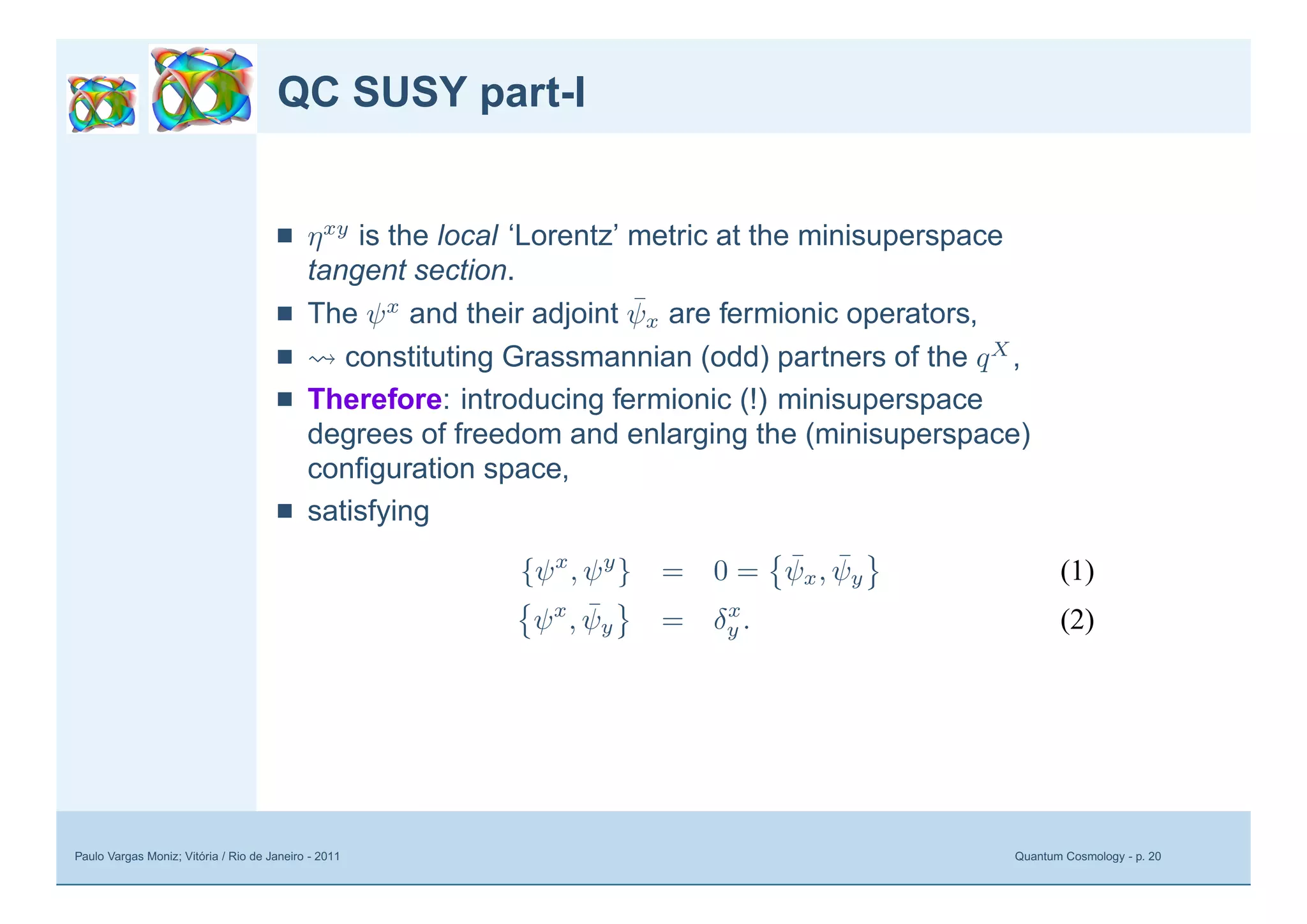
■ ηxy
is the local ‘Lorentz’ metric at the minisuperspace
tangent section.
■ The ψx
and their adjoint ¯ψx are fermionic operators,
■ constituting Grassmannian (odd) partners of the qX
,
■ Therefore: introducing fermionic (!) minisuperspace
degrees of freedom and enlarging the (minisuperspace)
configuration space,
■ satisfying
{ψx
, ψy
} = 0 = ¯ψx, ¯ψy (1)
ψx
, ¯ψy = δx
y . (2)
Paulo Vargas Moniz; Vitória / Rio de Janeiro - 2011 Quantum Cosmology - p. 20
QC SUSY part-I
■ Hamiltonian
H = −
2
2 GXY ∂
∂qY
∂
∂qX + 1
2 GY X ∂W
∂qY
∂W
∂qX
+2 ex
Y
ey
X ∂2
W
∂qY ∂qX [ ¯ψx
, ψy
]
;
■ Fermion number
F ≡ ¯ψxψx
■ Conserved:
■
[H, F] = 0, [S, F] = S, [ ˜S, F] = − ˜S.
Paulo Vargas Moniz; Vitória / Rio de Janeiro - 2011 Quantum Cosmology - p. 21
SQC and SUGRA
Paulo Vargas Moniz; Vitória / Rio de Janeiro - 2011 Quantum Cosmology - p. 22
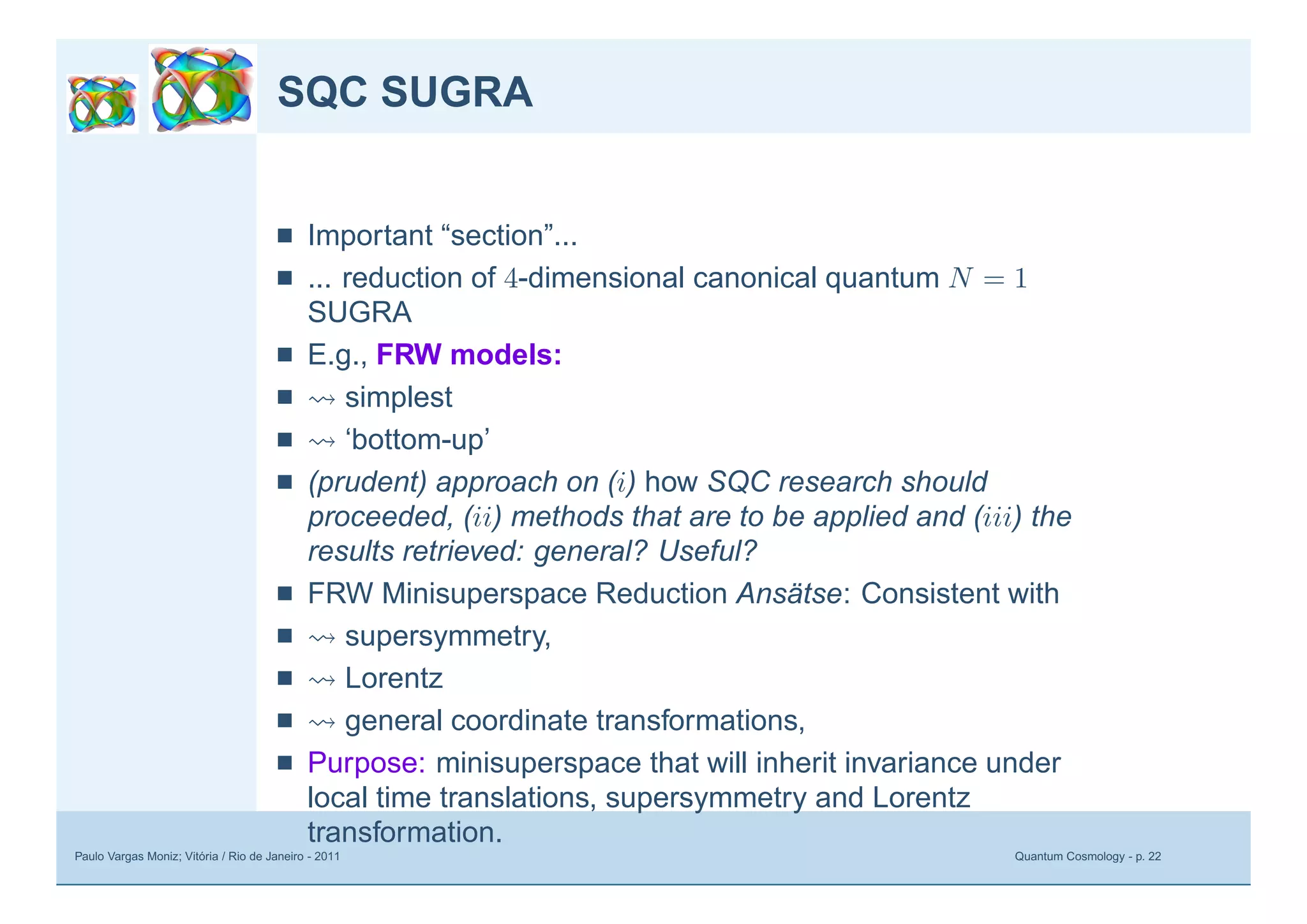
SQC SUGRA
■ Important “section”...
■ ... reduction of 4-dimensional canonical quantum N = 1
SUGRA
■ E.g., FRW models:
■ simplest
■ ‘bottom-up’
■ (prudent) approach on (i) how SQC research should
proceeded, (ii) methods that are to be applied and (iii) the
results retrieved: general? Useful?
■ FRW Minisuperspace Reduction Ansätse: Consistent with
■ supersymmetry,
■ Lorentz
■ general coordinate transformations,
■ Purpose: minisuperspace that will inherit invariance under
local time translations, supersymmetry and Lorentz
transformation.
Paulo Vargas Moniz; Vitória / Rio de Janeiro - 2011 Quantum Cosmology - p. 22
SQC SUGRA
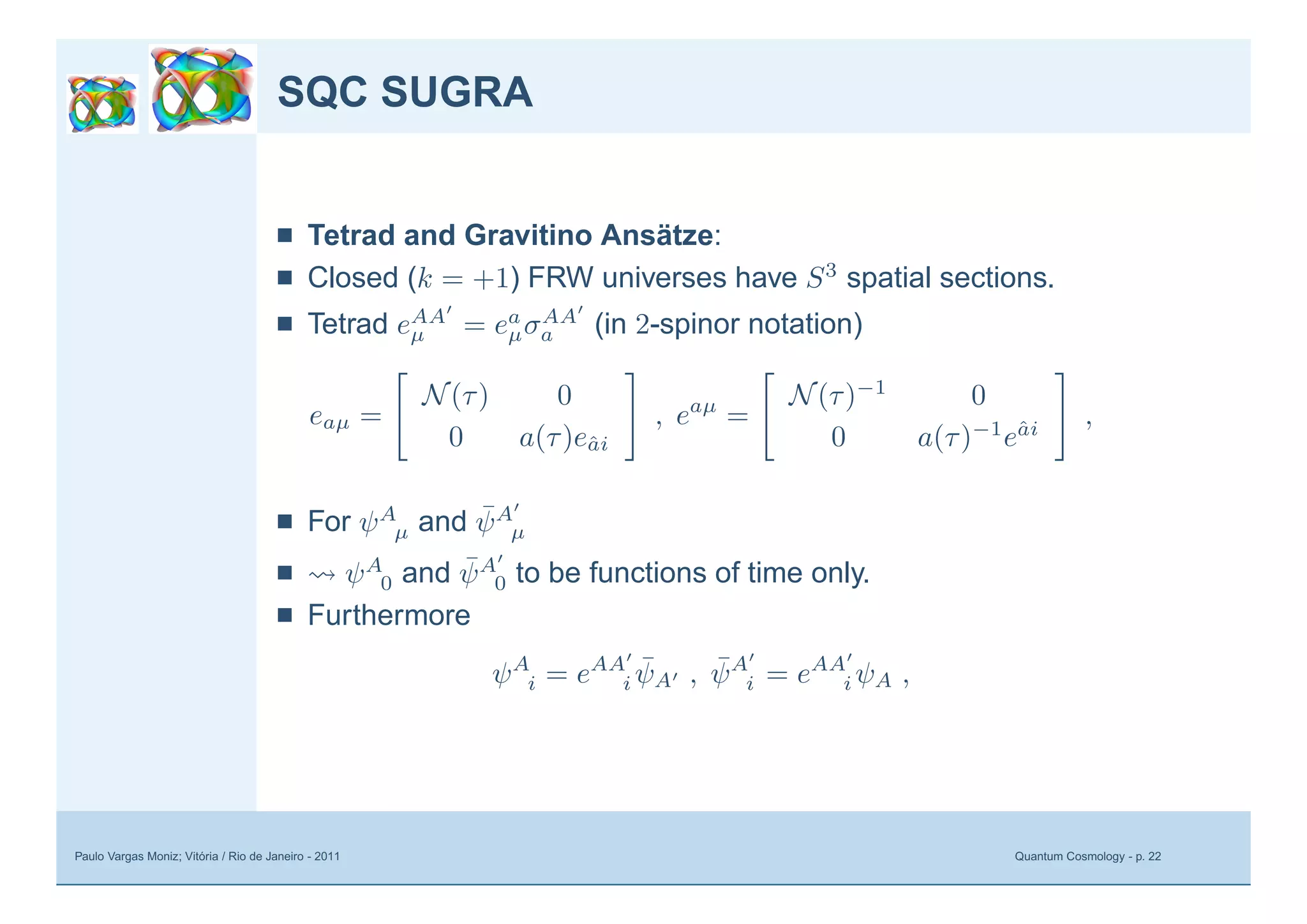
■ Tetrad and Gravitino Ansätze:
■ Closed (k = +1) FRW universes have S3
spatial sections.
■ Tetrad eAA
µ = ea
µσAA
a (in 2-spinor notation)
eaµ =
N(τ) 0
0 a(τ)eˆai
, eaµ
=
N(τ)−1
0
0 a(τ)−1
eˆai
,
■ For ψA
µ and ¯ψA
µ
■ ψA
0 and ¯ψA
0 to be functions of time only.
■ Furthermore
ψA
i = eAA
i
¯ψA , ¯ψA
i = eAA
i ψA ,
Paulo Vargas Moniz; Vitória / Rio de Janeiro - 2011 Quantum Cosmology - p. 22
SQC SUGRA
■ Action:
■ integration over the spatial hypersurfaces
■ minisuperspace with N = 4 local supersymmetry and
time-invariance reparametrization
■ (obvious!) Elimination of (the presence) of spatial indices by
contraction.
■
Lfree = −
3a
N
˙a −
i
4
¯ψ0A
¯ψA
− ψA
ψ0A
2
−i
3
2
a3
nAA ψA ¯ψA
− i
3
2
a3
nAA
¯ψA ˙ψA
+ 3Na
+
3
2
a2 ¯ψ0A
¯ψA
+ ψA
ψ0A −
3
2
Na2
nAA
ψA
¯ψA
+
3
16
a3
nAA ¯ψ0A ψA
¯ψB ¯ψB + ψ0A
¯ψA ψB
ψB .(2)
Paulo Vargas Moniz; Vitória / Rio de Janeiro - 2011 Quantum Cosmology - p. 22
SQC SUGRA
■ Hamiltonian
H = NH + ψA
0 SA + ¯SA
¯ψA
0 + MAB
JAB + ¯MA B ¯JA B ,
■ ψA
0 , ¯ψA
0 together with MAB
, ¯MA B
are Lagrange
multipliers.
■ H⊥ ≡ H Hamiltonian constraint, SA, ¯SA and JAB, ¯JA B
denote, respectively, the supersymmetry and Lorentz
constraints
■ Full set of constraints takes a rather simple form
SA = ψAπa − 6iaψa, (2)
H = −a−1
(π2
a + 36a2
), (3)
¯SA = ¯ψA πa + 6ia ¯ψA , (4)
JAB = ψ(A
¯ψB
nB)B . (5)
Paulo Vargas Moniz; Vitória / Rio de Janeiro - 2011 Quantum Cosmology - p. 22
SQC SUGRA
■ E.g., Quantum States for the Vacuum Case
■ Momentum variables are represented as
¯ψA →
∂
∂ψA
, πa → −i
∂
∂a
.
■ SUSY constraints:
SA = −
1
2
√
3
aψA
∂
∂a
−
√
3a2
ψA,
¯SA =
1
2
√
3
a
∂
∂a
∂
∂ψA
−
√
3a2 ∂
∂ψA
. (2)
■ Lorentz:
JAB = ψ(A
∂
∂ψB)
.
Paulo Vargas Moniz; Vitória / Rio de Janeiro - 2011 Quantum Cosmology - p. 22
SQC SUGRA
■ Wave function:
ΨF RW
SUSY = A(a) + B(a)ψF
ψF . (2)
■ Equations to solve: SAΨ = 0, ¯SAΨ = 0
a
√
3
∂aB − 2
√
3a2
B = 0,
a
√
3
∂aA + 2
√
3a2
A = 0.
■ Solutions are
Ψ = A0 exp[−3a2
/ ] + B0 exp[3a2
/ ]ψAψA
,
■ A0 and B0 are independent of a and ψA
.
■ Semi-classical interpretation as exp(−I/ )
■ I.e., we get a Hartle–Hawking solution for B = 0
Paulo Vargas Moniz; Vitória / Rio de Janeiro - 2011 Quantum Cosmology - p. 23
Can it be real?!
Paulo Vargas Moniz; Vitória / Rio de Janeiro - 2011 Quantum Cosmology - p. 24
Semiclassical Expansion
■ ... if (and how) our physical (observed) universe can be
retrieved from SQC physical states
Paulo Vargas Moniz; Vitória / Rio de Janeiro - 2011 Quantum Cosmology - p. 25
For Research...
Paulo Vargas Moniz; Vitória / Rio de Janeiro - 2011 Quantum Cosmology - p. 26
Outlook yet again...
■ So,
1. How can the ‘hidden’ N = 2 SUSY be retrieved?
2. And what about when (super)matter includes a scalar
field or a Yang–Mills sector?
3. How precisely can we implement a FRW SQC
(minisuperspace) from N = 1 SUGRA?
4. How can scalar (super)matter be included?
5. Why is the case of Bianchi models with a cosmological
constant still an issue?
6. How does the DeWitt supermetric relates to the usual
DeWitt metric?
7. What are the main features of SUGRA (quantum)
corrections into the Schrödinger equation?
8. Can SQC become ‘observational’?

(New) Borders for Quantum Cosmology

  • 1.
    Paulo Vargas Moniz;Vitória / Rio de Janeiro - 2011 Quantum Cosmology - p. 1 (NEW) BORDERS FOR QUANTUM COSMOLOGY Standpoint and (some) SUSY LNP 803 - 804, Springer, 2010 Paulo Vargas Moniz(1) (1) UBI & CENTRA-IST,
  • 2.
    Paulo Vargas Moniz;Vitória / Rio de Janeiro - 2011 Quantum Cosmology - p. 3 Abstract Quantum Cosmology tackles the quantum description of the early universe. It is aimed as an accessible primer that covers the basics, critically discussing ideas and concepts that comprise our current knowledge. The scope for analyzing quantum cosmological models within a supersymmetric framework is pointed. As much as possible, it summarizes what we know, what we think we know and what we think we do not know on an equal footing. It is focused for ‘young’, inquisitive minds eager to embark on in-depth research in this field. It is hoped to suggest the tools researchers will need to go on their own, pushing them to ask the right questions rather than seek definitive answers.
  • 3.
    Paulo Vargas Moniz;Vitória / Rio de Janeiro - 2011 Quantum Cosmology - p. 19 N=2 SUSY
  • 4.
    Paulo Vargas Moniz;Vitória / Rio de Janeiro - 2011 Quantum Cosmology - p. 20 QC SUSY part-I ■ Starting from ■ bosonic configurations ■ General Relativity or bosonic sector (strings) ■ Setting: ds2 = −N2 (t)dt2 + hij(t)ωi ωj hij(t) = 1 6π e2α(t) e2β (t) ij = 1 6π e2βi δij, βij(t) ≡ diag(β+ + √ 3β−, β+ − √ 3β−, −2β+)
  • 5.
    Paulo Vargas Moniz;Vitória / Rio de Janeiro - 2011 Quantum Cosmology - p. 20 QC SUSY part-I ■ Hamiltonian H = 1 2 (−p2 α + p2 + + p2 −) + U(0) (α, β+, β−) = 3 2 (p1)2 + (p2)2 + (p3)2 − 2p1p2 − 2p1p3 − 2p2p3 + U(0) (β1 , β2 , β3 ), (1) ■ U(0) ≡ −12π2 h(3) R type I : U (0) I ≡ 0 (2) type II : U (0) II ≡ 1 6 e4α e−8β+ = 1 6 e4β3 , (3) type IX : U (0) IX ≡ 1 6 e4α 2e4β+ (cosh(4 √ 3β−) − 1) + e−8β+ −4e−2β+ cosh(2 √ 3β−) = 1 6 e4β1 + e4β2 + e4β3 − 2e2β1 +2β2
  • 6.
    Paulo Vargas Moniz;Vitória / Rio de Janeiro - 2011 Quantum Cosmology - p. 20 QC SUSY part-I ■ Hidden supersymmetry (SUSY) ■ Retrieved when potential U(q) is derivable from a superpotential W(q) ■ U(q) = 1 2 GXY (q) ∂W(q) ∂qX ∂W(q) ∂qY , ■ Hamilton-Jacobi equation ■ Euclidean time ■ Euclidean action
  • 7.
    Paulo Vargas Moniz;Vitória / Rio de Janeiro - 2011 Quantum Cosmology - p. 20 QC SUSY part-I ■ Superpotentials W ◆ Bianchi type I: WI ≡ 0; ◆ Bianchi type II: WII ≡ 1 6 e2α−4β+ = 1 6 e2β3 ; ◆ Bianchi type IX: W (0) IX ≡ 1 6 e2α 2e2β+ cosh 2 √ 3β− + e−4β+ = 1 6 e2β1 + e2β2 + e2β3 ; (1)
  • 8.
    Paulo Vargas Moniz;Vitória / Rio de Janeiro - 2011 Quantum Cosmology - p. 20 QC SUSY part-I ■ Classical Hamiltonian Hc = 1 2 GXY (q) pX pY + ∂W ∂qX ∂W ∂qY . ■ Quantum Hamiltonian H, 2H = ˜SS + S ˜S ■ where S, ˜S are linear operators satisfying S2 = 0 = ˜S2 .
  • 9.
    Paulo Vargas Moniz;Vitória / Rio de Janeiro - 2011 Quantum Cosmology - p. 20 QC SUSY part-I ■ The operators S and ˜S have the explicit form S ≡ ψx ex Y (q) πY + i ∂W ∂qY (1) ˜S ≡ ¯ψxexY (q) πY − i ∂W ∂qY , (2) ■ ex Y (q) ≡ e−Ω δY x is the minisuperspace vielbein associated with GXY (q) ■ They satisfy ex Y (q)ey X (q)ηxy ≡ GXY (q),
  • 10.
    Paulo Vargas Moniz;Vitória / Rio de Janeiro - 2011 Quantum Cosmology - p. 20 QC SUSY part-I ■ ηxy is the local ‘Lorentz’ metric at the minisuperspace tangent section. ■ The ψx and their adjoint ¯ψx are fermionic operators, ■ constituting Grassmannian (odd) partners of the qX , ■ Therefore: introducing fermionic (!) minisuperspace degrees of freedom and enlarging the (minisuperspace) configuration space, ■ satisfying {ψx , ψy } = 0 = ¯ψx, ¯ψy (1) ψx , ¯ψy = δx y . (2)
  • 11.
    Paulo Vargas Moniz;Vitória / Rio de Janeiro - 2011 Quantum Cosmology - p. 20 QC SUSY part-I ■ Hamiltonian H = − 2 2 GXY ∂ ∂qY ∂ ∂qX + 1 2 GY X ∂W ∂qY ∂W ∂qX +2 ex Y ey X ∂2 W ∂qY ∂qX [ ¯ψx , ψy ] ; ■ Fermion number F ≡ ¯ψxψx ■ Conserved: ■ [H, F] = 0, [S, F] = S, [ ˜S, F] = − ˜S.
  • 12.
    Paulo Vargas Moniz;Vitória / Rio de Janeiro - 2011 Quantum Cosmology - p. 21 SQC and SUGRA
  • 13.
    Paulo Vargas Moniz;Vitória / Rio de Janeiro - 2011 Quantum Cosmology - p. 22 SQC SUGRA ■ Important “section”... ■ ... reduction of 4-dimensional canonical quantum N = 1 SUGRA ■ E.g., FRW models: ■ simplest ■ ‘bottom-up’ ■ (prudent) approach on (i) how SQC research should proceeded, (ii) methods that are to be applied and (iii) the results retrieved: general? Useful? ■ FRW Minisuperspace Reduction Ansätse: Consistent with ■ supersymmetry, ■ Lorentz ■ general coordinate transformations, ■ Purpose: minisuperspace that will inherit invariance under local time translations, supersymmetry and Lorentz transformation.
  • 14.
    Paulo Vargas Moniz;Vitória / Rio de Janeiro - 2011 Quantum Cosmology - p. 22 SQC SUGRA ■ Tetrad and Gravitino Ansätze: ■ Closed (k = +1) FRW universes have S3 spatial sections. ■ Tetrad eAA µ = ea µσAA a (in 2-spinor notation) eaµ = N(τ) 0 0 a(τ)eˆai , eaµ = N(τ)−1 0 0 a(τ)−1 eˆai , ■ For ψA µ and ¯ψA µ ■ ψA 0 and ¯ψA 0 to be functions of time only. ■ Furthermore ψA i = eAA i ¯ψA , ¯ψA i = eAA i ψA ,
  • 15.
    Paulo Vargas Moniz;Vitória / Rio de Janeiro - 2011 Quantum Cosmology - p. 22 SQC SUGRA ■ Action: ■ integration over the spatial hypersurfaces ■ minisuperspace with N = 4 local supersymmetry and time-invariance reparametrization ■ (obvious!) Elimination of (the presence) of spatial indices by contraction. ■ Lfree = − 3a N ˙a − i 4 ¯ψ0A ¯ψA − ψA ψ0A 2 −i 3 2 a3 nAA ψA ¯ψA − i 3 2 a3 nAA ¯ψA ˙ψA + 3Na + 3 2 a2 ¯ψ0A ¯ψA + ψA ψ0A − 3 2 Na2 nAA ψA ¯ψA + 3 16 a3 nAA ¯ψ0A ψA ¯ψB ¯ψB + ψ0A ¯ψA ψB ψB .(2)
  • 16.
    Paulo Vargas Moniz;Vitória / Rio de Janeiro - 2011 Quantum Cosmology - p. 22 SQC SUGRA ■ Hamiltonian H = NH + ψA 0 SA + ¯SA ¯ψA 0 + MAB JAB + ¯MA B ¯JA B , ■ ψA 0 , ¯ψA 0 together with MAB , ¯MA B are Lagrange multipliers. ■ H⊥ ≡ H Hamiltonian constraint, SA, ¯SA and JAB, ¯JA B denote, respectively, the supersymmetry and Lorentz constraints ■ Full set of constraints takes a rather simple form SA = ψAπa − 6iaψa, (2) H = −a−1 (π2 a + 36a2 ), (3) ¯SA = ¯ψA πa + 6ia ¯ψA , (4) JAB = ψ(A ¯ψB nB)B . (5)
  • 17.
    Paulo Vargas Moniz;Vitória / Rio de Janeiro - 2011 Quantum Cosmology - p. 22 SQC SUGRA ■ E.g., Quantum States for the Vacuum Case ■ Momentum variables are represented as ¯ψA → ∂ ∂ψA , πa → −i ∂ ∂a . ■ SUSY constraints: SA = − 1 2 √ 3 aψA ∂ ∂a − √ 3a2 ψA, ¯SA = 1 2 √ 3 a ∂ ∂a ∂ ∂ψA − √ 3a2 ∂ ∂ψA . (2) ■ Lorentz: JAB = ψ(A ∂ ∂ψB) .
  • 18.
    Paulo Vargas Moniz;Vitória / Rio de Janeiro - 2011 Quantum Cosmology - p. 22 SQC SUGRA ■ Wave function: ΨF RW SUSY = A(a) + B(a)ψF ψF . (2) ■ Equations to solve: SAΨ = 0, ¯SAΨ = 0 a √ 3 ∂aB − 2 √ 3a2 B = 0, a √ 3 ∂aA + 2 √ 3a2 A = 0. ■ Solutions are Ψ = A0 exp[−3a2 / ] + B0 exp[3a2 / ]ψAψA , ■ A0 and B0 are independent of a and ψA . ■ Semi-classical interpretation as exp(−I/ ) ■ I.e., we get a Hartle–Hawking solution for B = 0
  • 19.
    Paulo Vargas Moniz;Vitória / Rio de Janeiro - 2011 Quantum Cosmology - p. 23 Can it be real?!
  • 20.
    Paulo Vargas Moniz;Vitória / Rio de Janeiro - 2011 Quantum Cosmology - p. 24 Semiclassical Expansion ■ ... if (and how) our physical (observed) universe can be retrieved from SQC physical states
  • 21.
    Paulo Vargas Moniz;Vitória / Rio de Janeiro - 2011 Quantum Cosmology - p. 25 For Research...
  • 22.
    Paulo Vargas Moniz;Vitória / Rio de Janeiro - 2011 Quantum Cosmology - p. 26 Outlook yet again... ■ So, 1. How can the ‘hidden’ N = 2 SUSY be retrieved? 2. And what about when (super)matter includes a scalar field or a Yang–Mills sector? 3. How precisely can we implement a FRW SQC (minisuperspace) from N = 1 SUGRA? 4. How can scalar (super)matter be included? 5. Why is the case of Bianchi models with a cosmological constant still an issue? 6. How does the DeWitt supermetric relates to the usual DeWitt metric? 7. What are the main features of SUGRA (quantum) corrections into the Schrödinger equation? 8. Can SQC become ‘observational’?