GPS
Unit II
Signal Characteristics
-By
GVNSK Sravya
Assistant Professor
ECE Dept.
GNITS
Contents
 GPS Signal Components, Purpose,
 Properties and Power level,
 Signal Acquisition and Tracking,
 Navigation Information Extraction,
 Pseudo Range Estimation,
 Frequency Estimation,
 GPS Satellite Position Calculation,
 Signal Structure,
 Anti Spoofing (AS),
 Selective Availability,
 Difference between GPS and GALILEO Satellite Construction.
2
GPS Signal Components, Purpose and
Properties
 Each GPS satellite simultaneously transmits on two L-band frequencies:
L1 -1575.42 MHz and L2 - 1227.60 MHz
 The carrier of the L1 signal consists of an in-phase and a quadrature-
phase component.
3
Contd…
 The in-phase component is bi-phase modulated by a 50-bps (bits per
second) data stream and a pseudorandom code.
 The pseudorandom code is called the C/A-code consisting of a 1023-
chip sequence that has a period of 1 ms and a chipping rate of 1.023
MHz.
4
Contd…
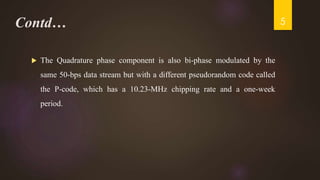
 The Quadrature phase component is also bi-phase modulated by the
same 50-bps data stream but with a different pseudorandom code called
the P-code, which has a 10.23-MHz chipping rate and a one-week
period.
5
Contd…
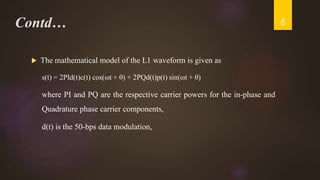
 The mathematical model of the L1 waveform is given as
s(t) = 2PId(t)c(t) cos(ωt + θ) + 2PQd(t)p(t) sin(ωt + θ)
where PI and PQ are the respective carrier powers for the in-phase and
Quadrature phase carrier components,
d(t) is the 50-bps data modulation,
6
Contd…
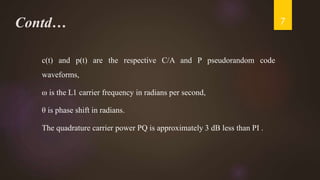
c(t) and p(t) are the respective C/A and P pseudorandom code
waveforms,
ω is the L1 carrier frequency in radians per second,
θ is phase shift in radians.
The quadrature carrier power PQ is approximately 3 dB less than PI .
7
Contd…
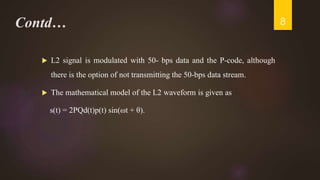
 L2 signal is modulated with 50- bps data and the P-code, although
there is the option of not transmitting the 50-bps data stream.
 The mathematical model of the L2 waveform is given as
s(t) = 2PQd(t)p(t) sin(ωt + θ).
8
50 bps Data Stream
 The 50-bps data stream conveys the navigation message.
 The Navigation Message contains the following information.
1. Satellite Almanac Data
2. Satellite Ephemeris Data
3. Signal Timing Data
4. Ionospheric Delay Data
5. Satellite Health Message
9
Contd…
 The Navigation Message contains the following information.
1. Satellite Almanac Data
2. Satellite Ephemeris Data
3. Signal Timing Data
4. Ionospheric Delay Data
5. Satellite Health Message
10
1. Satellite Almanac Data
 Each satellite transmits orbital data called the almanac.
 It enables the user to calculate the approximate location of every satellite in the GPS
constellation at any given time.
 Almanac data are not accurate enough for determining position but can be stored in a
receiver where they remain valid for many months.
 They are used primarily to determine which satellites are visible at a given location
so that the receiver can search for those satellites when it is first turned on.
11
2. Satellite Ephemeris Data
 Ephemeris data are similar to almanac data but enable a much more accurate
determination of satellite position needed to convert signal propagation delay
into an estimate of user position.
 Ephemeris data for a particular satellite are broadcast only by that satellite, and
the data are valid for only several hours.
12
3. Signal Timing Data
 The 50-bps data stream includes the transmission time of specific points
on the GPS signal.
 This information is needed to determine the satellite-to-user propagation
delay used for ranging.
13
4. Ionospheric Delay Data
 Ranging errors due to ionospheric effects can be partially
canceled by using estimates of ionospheric delay that are
broadcast in the data stream.
14
5. Satellite Health Message
 The data stream also contains information regarding the
current health of the satellite, so that the receiver can ignore
that satellite if it is not operating properly.
15
Structure of the Navigation Message
 The navigation message is a bit stream of ones and
zeros with a data rate of 50 Hz.
 The information in the navigation message has the
basic frame structure.
 Navigation message is divided into frames.
16
Contd…
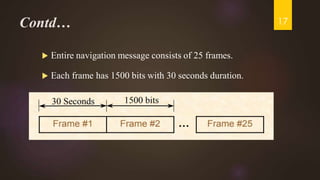
 Entire navigation message consists of 25 frames.
 Each frame has 1500 bits with 30 seconds duration.
17
Navigation Frame
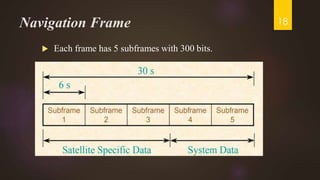
 Each frame has 5 subframes with 300 bits.
18
Contd…
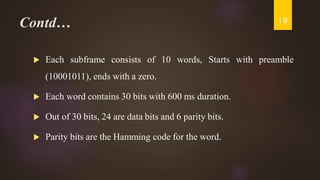
 Each subframe consists of 10 words, Starts with preamble
(10001011), ends with a zero.
 Each word contains 30 bits with 600 ms duration.
 Out of 30 bits, 24 are data bits and 6 parity bits.
 Parity bits are the Hamming code for the word.
19
Contd…
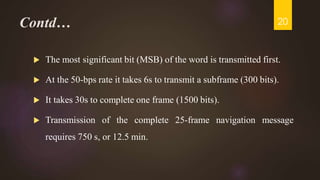
 The most significant bit (MSB) of the word is transmitted first.
 At the 50-bps rate it takes 6s to transmit a subframe (300 bits).
 It takes 30s to complete one frame (1500 bits).
 Transmission of the complete 25-frame navigation message
requires 750 s, or 12.5 min.
20
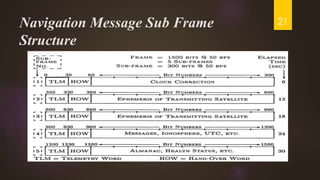
Navigation Message Sub Frame
Structure
21
Contd… 22
Contd…
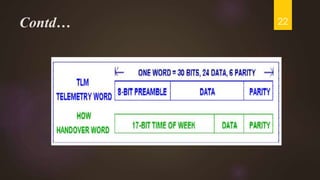
 Each subframe begins with a telemetry word (TLM).
 The first 8 bits of the TLM word is preamble bits that enables the
receiver to determine when a subframe begins.
 The remaining of the TLM contains parity bits and a telemetry
message that is available only to authorized users.
23
Contd…
 The second word of each subframe is called the handover word
(HOW).
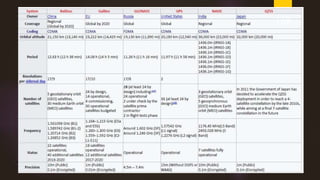
 HOW contains the 17 bit Time of Week (TOW).
 TOW is synchronized to beginning of next subframe.
 It contains ID of the subframe.
24
Z Count
 Information contained in the HOW is derived from a 29-bit
quantity called the Z count.
 The Z-count is not transmitted as a single word, but part of it is
transmitted within the HOW.
25
Contd…
 The 19 LSBs of the Z-count, called the time-of-week (TOW)
count, indicate the number of epochs that have occurred since the
start of the current week.
 The start of the current week occurs at approximately midnight of
Saturday night/Sunday morning.
26
Contd…
 The TOW count increases from zero at the start of the week and
then rolls over to zero again at the start of the following week.
 A TOW count of zero always occurs at the beginning of subframe 1
of the first frame.
27
Contd…
 Since the receiver can use the TLM preamble to determine
precisely the time at which each subframe begins, the time of
transmission of any part of the GPS signal can be determined.
28
GPS Week Number
 The 10 MSBs of the Z-count contain the GPS week number (WN),
which is a modulo-1024 week count.
 The zero state is defined to be that week that started at midnight on
the night of January 5, 1980/morning of January 6, 1980.
29
Contd…
 Because WN is a modulo-1024 count, an event called the week
rollover occurs every 1024 weeks (a few months short of 20 years),
and GPS receivers must be designed to accommodate it.
 The WN is not part of the HOW but appears as the first 10 bits of
the third word in subframe 1.
30
Contd…
 Frame and Subframe Identification Three bits of the HOW are
used to identify which of the five subframes is being transmitted.
 Information by Subframe In addition to the TLM and HOW,
which occur in every subframe, the following information is
contained within the remaining eight words of subframes 1–5.
31
Subframe 1
 The WN portion of the Z-count is part of word 3 in this subframe.
 Subframe 1 also contains GPS clock correction data for the satellite in the
form of polynomial coefficients defining how the correction varies with time.
 Time defined by the clocks in the satellite is commonly called SV time (space
vehicle time).
 The time after corrections have been applied is called GPS time.
32
Contd…
 Thus, even though individual satellites may not have perfectly
synchronized SV times, they do share a common GPS time.
 Additional information in subframe 1 includes the quantities t0c,
TGD, and IODC.
 The clock reference time t0c is used as a time origin to calculate
satellite clock error.
33
Contd…
 The ionospheric group delay TGD is used to correct for
ionospheric propagation delay errors.
 IODC (issue of date, clock) indicates the issue number of the clock
data set to alert users to changes in clock parameters.
34
Subframes 2 and 3
 These subframes contain the ephemeris data, which are used to
determine the precise satellite position and velocity required by the
navigation solution.
35
Contd…
 Unlike the almanac data, these data are very precise, are valid over
a relatively short period of time (several hours), and apply only to
the satellite transmitting it.
 Each time new parameters are uploaded from the GPS control
segment, the IODE number changes.
36
Subframe 4
 This subframe contain the almanac for satellites with PRN
(pseudorandom code) numbers 25 and higher, as well as special
messages, ionospheric correction terms, and coefficients to convert
GPS time to UTC time.
37
Contd…
 The components of an almanac are very similar to those of the
ephemeris, and the calculation of satellite position is performed in
essentially the same way.
38
Subframe 5
 This subframe includes the almanac for satellites with PRN
numbers from 1 to 24.
 Almanac data for all satellites are transmitted by every satellite.
 Almanac data remain valid for long periods (months) but are much
less precise.
39
Contd…
 Additional data contained in the navigation message are user range
error (URE), which estimate the range error due to errors in
satellite ephemeris, timing errors, and selective availability (SA)
and flags to indicate the health status of the satellites.
40
C/A Code and its Properties
 The C/A-code has the following functions.
1. To enable accurate range measurements and resistance to errors
caused by multipath.
2. To permit simultaneous range measurement from several satellites.
3. To provide protection from jamming
41
Properties of C/A Code
 Temporal Structure Each satellite has a unique C/A-code, but all
the codes consist of a repeating sequence of 1023 chips occurring
at a rate of 1.023 MHz with a period of 1 ms.
 The leading edge of a specific chip in the sequence, called the
C/A-code epoch, defines the beginning of a new period.
 Each chip is either positive or negative with the same magnitude.
42
Temporal Structure
 The polarities of the 1023 chips appear to be randomly distributed
but are in fact generated by a deterministic algorithm implemented
by shift registers.
 The algorithm produces maximal-length Gold codes, which have
the property of low cross correlation between different codes
(orthogonality) as well as reasonably small autocorrelation
sidelobes.
43
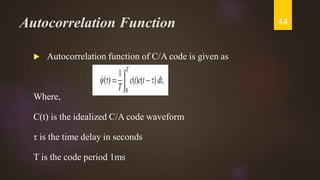
Autocorrelation Function
 Autocorrelation function of C/A code is given as
Where,
C(t) is the idealized C/A code waveform
τ is the time delay in seconds
T is the code period 1ms
44
Autocorrelation Function
 The C/A-code autocorrelation function plays a substantial role in
GPS receivers, inasmuch as it forms the basis for code tracking and
accurate user-to-satellite range measurement.
45
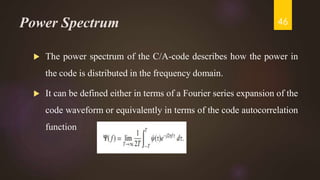
Power Spectrum
 The power spectrum of the C/A-code describes how the power in
the code is distributed in the frequency domain.
 It can be defined either in terms of a Fourier series expansion of the
code waveform or equivalently in terms of the code autocorrelation
function
46
Code Division Multiplexing Property
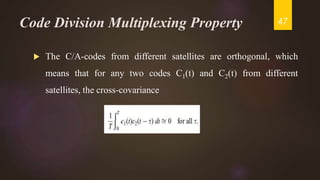
 The C/A-codes from different satellites are orthogonal, which
means that for any two codes C1(t) and C2(t) from different
satellites, the cross-covariance
47
Code Division Multiplexing Property
 When a selected satellite signal is despread using a replica of its
code, the signals from other satellites look like wide-band which
are below the noise level.
48
Code Division Multiplexing Property
 This permits a GPS receiver to extract a multiplicity of individual
satellite signals and process them individually, even though all
signals are trans- mitted at the same frequency. This process is
called code division multiplexing (CDM).
49
P Code and its Properties
 The P-code, which is used primarily for military applications, has
the following functions.
1. Increased Jamming Protection
2. Provision for Anti Spoofing
3. Denial of P-Code Use
4. Increased Code Range Measurement Accuracy
50
Increased Jamming Protection
 The bandwidth of the P-code is 10 times greater than that of the
C/A-code. So, it offers approximately 10 dB more protection from
narrowband interference.
 In military applications, the interference is likely to be a deliberate
attempt to jam (render useless) the received GPS signal.
51
Provision for Anti Spoofing
 Enemy can radiate a signal that appears to be a GPS signal
(spoofing), but in reality is designed to confuse the GPS receiver.
 This is prevented by encrypting the P-code.
 The spoofer cannot know the encryption process and cannot make
the contending signal look like a properly encrypted signal.
 Thus the receiver can reject the false signal and decrypt the desired
one.
52
Denial of P-Code Use
 The structure of the P-code is published in the open literature, so
than anyone may generate it as a reference code for despreading
the signal and making range measurements.
 However, encryption of the P-code by the military will deny its use
by unauthorized parties.
53
Increased Code Range Measurement
Accuracy
 The accuracy in range measurement improves as the signal
bandwidth increases.
 Thus, the P-code provides improved range measurement accuracy
as compared to the C/A code.
54
Contd…
 Simultaneous range measurements using both codes are even
better.
 Because of its increased bandwidth, the P-code is also more
resistant to range errors caused by multipath.
55
P Code Characteristics
 Unlike the C/A-code, the P-code modulates both the L1 and L2
carriers.
 Its chipping rate is 10.23 MHz, which is precisely 10 times the C/A
rate, and it has a period of one week.
56
Contd…
 It is transmitted synchronously with the C/A-code so that each chip
transition of the C/A code always corresponds to a chip transition
in the P-code.
 Each satellite broadcasts a unique P-code.
57
Y Code
 The encrypted form of the P-code used for anti spoofing and denial
of the P-code to unauthorized users is called the Y-code.
 The Y-code is formed by multiplying the P-code by an encrypting
code called the W-code.
 The W-code is a random-looking sequence of chips that occur at a
511.5-kHz rate.
58
Contd…
 Thus there are 20 P-code chips for every W-code chip.
 The Y-code cannot be despread by a receiver replica P-code unless
it is decrypted.
 Decryption consists of multiplying the Y-code by a receiver
generated replica of the W-code that is made available only to
authorized users.
59
Contd…
 Since the encrypting W-code is also not known by the creators of
spoofing signals, it is easy to verify that such signals are not
legitimate.
60
L1 and L2 Carriers
 The L1 (or L2) carrier is used for the following purposes.
1. To provide very accurate range measurements for precision
applications using carrier phase.
2. To provide accurate Doppler measurements. The phase rate of the
received carrier can be used for accurate determination of user
velocity.
61
Dual-Frequency Operation
 The use of both the L1 and L2 frequencies provides the following
benefits.
1. Provides accurate measurement of ionospheric signal delay.
2. Facilitates carrier phase ambiguity resolution.
3. Provides system redundancy (primarily for the military user).
62
Provides accurate measurement of
ionospheric signal delay.
 A major source of ranging error is caused by changes in both the
phase velocity and group velocity of the signal as it passes through
the ionosphere.
 Minimum Range errors of 10–20 m are common.
63
Contd…
 Because the delay induced by the ionosphere is known to be
inversely proportional to the square of frequency, ionospheric
range error can be estimated accurately by comparing the times of
arrival of the L1 and L2 signals.
64
Facilitates carrier phase ambiguity
resolution
 In high-accuracy GPS differential positioning, the range estimates
using carrier phase measurements are precise but highly ambiguous
due to the periodic structure of the carrier.
 The ambiguity is more easily resolved (by various methods) as the
carrier frequency decreases.
65
Contd…
 By using L1 and L2 carrier frequencies, the ambiguity resolution
can be based on their frequency difference (1575.42– 1227.6
MHz), which is smaller than either carrier frequency alone, and
hence will result in better ambiguity resolution performance.
66
Signal Power Levels
Transmitted Power Levels
 The L1 C/A-code signal is transmitted at a minimum level of
478.63 W (26.8 dBW) effective isotropic radiated power (EIRP) in
a beam approximately 30◦ wide toward the earth.
67
Free-Space Loss Factor
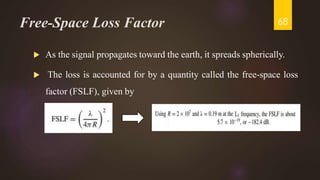
 As the signal propagates toward the earth, it spreads spherically.
 The loss is accounted for by a quantity called the free-space loss
factor (FSLF), given by
68
Atmospheric Loss Factor
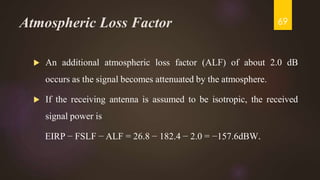
 An additional atmospheric loss factor (ALF) of about 2.0 dB
occurs as the signal becomes attenuated by the atmosphere.
 If the receiving antenna is assumed to be isotropic, the received
signal power is
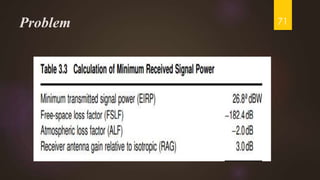
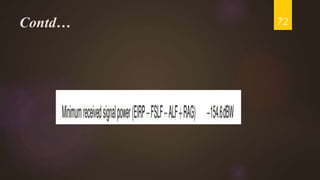
EIRP − FSLF − ALF = 26.8 − 182.4 − 2.0 = −157.6dBW.
69
Antenna Gain and Minimum Received
Signal Power
 A typical GPS antenna with right-hand circular polarization and a
hemispherical pattern has about 3.0 dB of gain relative to an
isotropic antenna.
70
Problem 71
Contd… 72
Signal Acquisition and Tracking
 When a GPS receiver is turned on, a sequence of operations must
ensue before information in a GPS signal can be accessed and used
to provide a navigation solution.
73
Contd…
 In the order of execution, these operations are as follows.
1. Determine which satellites are visible to the antenna.
2. Determine the approximate Doppler of each visible satellite.
3. Search for the signal both in frequency and C/A-code phase.
4. Detect the presence of a signal and confirm detection.
5. Lock onto and track the C/A-code.
74
Contd…
6. Lock onto and track the carrier.
7. Perform data bit synchronization.
8. Demodulate the 50-bps (bits per second) navigation data.
75
1. Determine which satellites are visible
to the antenna
 In many GPS receiver applications it is desirable to minimize the
time from receiver turn on until the first navigation solution is
obtained.
 This time interval is commonly called time to first fix (TTFF).
 Depending on receiver characteristics, the TTFF might range from
30 s to several minutes.
76
Contd…
 An important consideration in minimizing the TTFF is to avoid a fruitless
search for those satellite signals that are blocked by the earth, that is, below
the horizon.
 A receiver can restrict its search to only those satellites that are visible if it:
1. Knows its approximate location (within several hundred miles)
2. Knows its approximate time (within approximately 10 min)
3. Has satellite almanac data obtained within the last several months.
77
Contd…
 Using the approximate time, approximate position, and almanac
data, the receiver calculates the elevation angle of each satellite
and identifies the visible satellites as those whose elevation angle
is greater than a specified value.
 This elevation angle called the mask angle, which has typical
values of 5˚ to 15˚.
78
Contd…
 At elevation angles below the mask angle, tropospheric attenuation
and delays tend to make the signals unreliable.
 Most receivers automatically update the almanac data when in use.
 If the receiver is just “out of the box” or has not been used for
many months, it will need to search “blind” for a satellite signal to
collect the needed almanac.
79
2. Determine the approximate Doppler of
each visible satellite
 The TTFF can be further reduced if the approximate Doppler shifts
of the visible satellite signals are known.
 This permits the receiver to establish a frequency search pattern in
which the most likely frequencies of reception are searched first.
80
Contd…
 The expected Doppler shifts can be calculated from knowledge of
approximate position, approximate time, and valid almanac data.
 Once the first satellite signal is found, a fairly good estimate of
receiver clock frequency error can be determined by comparing the
predicted Doppler shift with the measured Doppler shift.
81
Contd…
 This error can then be subtracted out while searching in frequency
for the remaining satellites, thus significantly reducing the range of
frequencies that need to be searched.
82
3. Search for the signal both in frequency
and C/A-code phase
Why is a signal search necessary?
 GPS signals are spread-spectrum signals in which the C/A or P
codes spread the total signal power over a wide bandwidth.
 The signals are therefore virtually undetectable unless they are
despread with a replica code in the receiver that is precisely aligned
with the received code.
83
Contd…
 Since the signal cannot be detected until alignment has been
achieved, a search over the possible alignment positions (code
search) is required.
84
Contd…
 A relatively narrow post despreading bandwidth (perhaps 100–
1000 Hz) is required to raise the signal-to-noise ratio to detectable
and/or usable levels.
 But because of the high carrier frequencies and large satellite
velocities used by GPS, the received signals can have large
Doppler shifts (as much as ±5 kHz), which may vary rapidly (by as
much as 1 Hz/s).
85
Contd…
 Therefore, a GPS receiver must conduct a two-dimensional search
in order to find each satellite signal, where the dimensions are C/A-
code delay and carrier frequency.
 A search must be conducted across the full delay range of the C/A
code for each frequency searched.
86
4. Detect the presence of a signal and
confirm detection
 There is a tradeoff between the probability of detection PD and
false alarm PFA.
 As the detection threshold is decreased, PD increases but PFA also
increases.
87
Contd…
 Thus, the challenge in receiver design is to achieve a sufficiently
large PD so that a signal will not be missed but at the same time
keep PFA small enough to avoid difficulties with false detections.
 When a false detection occurs, the receiver will try to lock onto and
track a nonexistent signal.
88
Contd…
 By the time the failure to track becomes evident, the receiver will
have to initiate a completely new search for the signal.
 When a detection failure occurs, the receiver will waste time
continuing to search remaining search cells that contain no signal,
after which a new search must be initiated.
89
Detection Confirmation
 To obtain the detection probability PD = 0.95 with a typical
medium-strength GPS signal, we obtain the false-alarm probability
PFA = 10−3 .
 This means that on the average, there will be one false detection in
every 1000 frequency/code cells searched.
90
Contd…
 By performing a confirmation of detection before turning the signal
over to the tracking loops, PD can be increased and PFA can be
decreased.
 In the event that confirmation indicates no signal, the search can
continue without the large time delay in detecting the failure to
track.
91
Adaptive Signal Searches
 Some GPS receivers use a simple adaptive search in which shorter
dwell times are first used to permit rapid acquisition of moderate to
strong signals.
92
5. Lock onto and track the C/A-code
 There are two objectives in maintaining alignment
1. Signal Despreading To fully despread the signal so that it is no
longer below the noise and information contained in the carrier can
be recovered.
2. Range Measurements To enable precise measurement of the time
of arrival (TOA) of received code for purposes of measuring
range.
93
Contd…
 A code tracking loop, which has a large processing gain, is
employed to generate a reference code precisely aligned with that
of the received signal.
94
6. Lock onto and track the carrier
 The purposes of tracking carrier phase are to
1. Obtain a phase reference for coherent detection of the GPS biphase
modulated data
2. Provide precise velocity measurements (via phase rate)
3. Obtain integrated Doppler for rate aiding of the code tracking loop
4. Obtain precise carrier phase pseudorange measurements in high-
accuracy receivers
95
Contd…
 Tracking of carrier phase is usually accomplished by a phase-lock
loop (PLL).
96
7. Perform data bit synchronization
 A simple method of bit synchronization is to clock a modulo-20 counter
with the epochs of the receiver-generated reference C/A-code and record
the count each time the polarity of the I integrator output changes.
 A histogram of the frequency of each count is constructed, and the count
having the highest frequency identifies the epochs that mark the data bit
boundaries.
97
8.Demodulate the 50-bps (bits per
second) navigation data
 Once bit synchronization has been achieved, demodulation of the data
bits can occur.
 GPS receivers demodulate the data by integrating the in-phase (I)
component of the baseband phasor generated by a Costas loop, which
tracks the carrier phase.
98
Contd…
 Each data bit is generated by integrating the I component over a 20-ms
interval from one data bit boundary to the next.
 The Costas loop causes a polarity ambiguity of the data bits that can be
resolved by observation of the subframe preamble in the navigation
message data.
99
Navigation information extraction
 After data demodulation the navigation information can be classified
into the following three categories.
1. The information needed to determine signal transmission time
2. The information needed to establish the position and velocity of each
satellite (ephemeris)
3. The various pseudo range and Doppler measurements made by the
receiver
100
Signal Transmission Time Information
 The receiver can establish the time of transmission of the beginning of
each subframe of the signal and of the corresponding C/A-code epoch
that coincides with it.
 Since the epochs are transmitted precisely 1 ms apart, the receiver labels
subsequent C/A code epochs merely by counting them.
 This enables the determination of the transmission time of any part of
the signal.
101
Ephemeris Data
 The ephemeris data permit the position and velocity of each
satellite to be computed at the signal transmission time.
102
Pseudo range Measurements Using C/A-
Code
 Finding the three-dimensional position of a user consists of determining
the range (the distance of the user from each of three or more satellites)
and solving for a point in space.
 The range to each satellite can be determined by measuring how long it
takes for the signal to propagate from the satellite to the receiver and
multiplying the propagation time by the speed of light.
103
Contd…
 This method of computing range requires very accurate
synchronization of the satellite and receiver clocks used for the time
measurements.
 GPS satellites use very accurate and stable atomic clocks, but it is too
expensive to provide a similar clock in a receiver.
104
Contd…
 So, the receiver clock error is treated as an additional unknown
in the navigation equations and using measurements from an
additional satellite (4th satellite) to solve for time as well as for
position.
105
Contd…
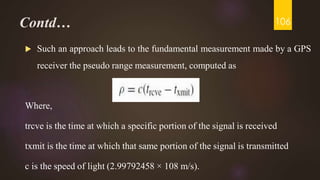
 Such an approach leads to the fundamental measurement made by a GPS
receiver the pseudo range measurement, computed as
Where,
trcve is the time at which a specific portion of the signal is received
txmit is the time at which that same portion of the signal is transmitted
c is the speed of light (2.99792458 × 10⁸ m/s).
106
Contd…
 trcve is measured according to the receiver clock, which may have a
large time error txmit is in terms of GPS time, which is SV (spacecraft
vehicle) time plus a time correction transmitted by the satellite.
 If the receiver clock were synchronized to GPS time, then the
pseudorange measurement would be the exact range to the satellite.
107
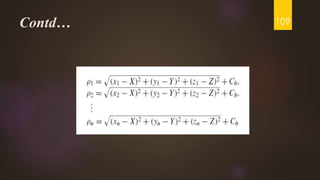
Basic Positioning Equations
 If pseudorange measurements can be made from at least four satellites,
enough information exists to solve for the unknown position (X, Y , Z)
of the GPS user and for the receiver clock error Cb (clock bias).
 The equations are set up by equating the measured pseudorange to each
satellite with the corresponding unknown user-to-satellite distance plus
the distance error due to receiver clock bias
108
Contd… 109
Pseudo range Measurements Using
Carrier Phase
 Although pseudorange measurements using the C/A-code are the most
commonly employed, a much higher level of measurement precision can
be obtained by measuring the received phase of the GPS L1 or L2
carrier.
110
Contd…
 Because the carrier waveform has a very short period (6.35 × 10⁻¹⁰ s at
the L1 frequency), the noise-induced error in measuring signal delay by
means of phase measurements is typically 10–100 times smaller than that
encountered in code delay measurements.
111
Contd…
 However, carrier phase measurements are highly ambiguous because
phase measurements are simply modulo 2π numbers.
 Such measurements determine only the fractional part of the
pseudorange when measured in carrier wavelengths.
 Additional measurements are required to affect ambiguity resolution, in
which the integer number of wavelengths in the pseudorange
measurement can be determined.
112
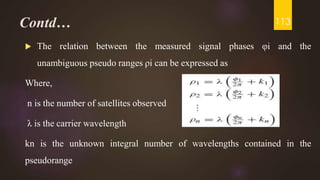
Contd…
 The relation between the measured signal phases φi and the
unambiguous pseudo ranges ρi can be expressed as
Where,
n is the number of satellites observed
λ is the carrier wavelength
kn is the unknown integral number of wavelengths contained in the
pseudorange
113
Contd…
 The additional measurements required for determination of the kn may
include C/A and/ or P(Y)-code pseudorange measurements from the
same satellites used for the phase measurements.
 Since the code measurements are unambiguous, they significantly
narrow the range of admissible integer values for the kn .
114
Contd…
 Additionally, phase measurements made on both the L1 and L2 signals
can be used to obtain a virtual carrier frequency equal to the difference
of the two carrier frequencies (1575.42 − 1227.60 = 347.82 MHz).
 The 86.3-cm wavelength of this virtual carrier decreases the density of
pseudorange ambiguities by a factor of about 4.5, making the ambiguity
resolution process much easier.
115
Contd…
 Redundant code and phase measurements from extra satellites can also
be used to aid the process.
 Because of unpredictable variations in propagation delay of the code and
carrier due to the ionosphere and other error sources, it is impossible to
obtain ambiguity resolution with single-receiver positioning.
116
Contd…
 Therefore, carrier phase measurements are mostly used in high-
accuracy applications in which such errors are canceled out by
differential operation with an additional receiver (base station).
117
Carrier Doppler Measurement
 Measurement of the received carrier frequency provides information
that can be used to determine the velocity vector of the user.
 Frequency measurement is accurate and has fast response time.
118
Contd…
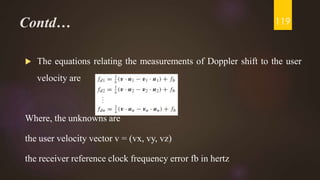
 The equations relating the measurements of Doppler shift to the user
velocity are
Where, the unknowns are
the user velocity vector v = (vx, vy, vz)
the receiver reference clock frequency error fb in hertz
119
Contd…
the known quantities are,
the carrier wavelength λ
the measured Doppler shifts fdn in hertz
satellite velocity vectors vn unit
satellite direction vectors un (pointing from the receiver antenna toward
the satellite antenna) for each satellite index n
120
Theoretical Considerations in Pseudo
range and Frequency Estimation
 The major source of measurement error within a GPS receiver is
thermal noise.
 Method of maximum likelihood (ML) estimates of pseudorange
(using either code or carrier) and frequency are accurate.
121
Contd…
 The lower bound on the error variance of an estimator is provided by
the Cramer–Rao bound, and any estimator that reaches this lower limit
is called a minimum-variance unbiased estimator (MVUE).
 It can be shown that at the typical SNRs encountered in GPS, ML
estimates of code pseudo range, carrier pseudo range, and carrier
frequency are all MVUEs.
122
Contd…
 The error variance is proportional to the power spectral density of the
noise and inversely proportional to the integrated square of the
derivative of the received code.
123
Code Based Pseudo ranging
Performance of Typical Receivers
 Most GPS receivers approximate the ML estimator by correlating the
incoming signal with an ideal code waveform.
 It does not include band limiting effects and use early and late
correlators in the code tracking loop that straddle the location of the
correlation function peak rather than find its actual location.
124
Contd…
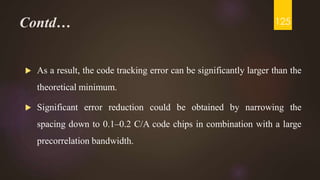
 As a result, the code tracking error can be significantly larger than the
theoretical minimum.
 Significant error reduction could be obtained by narrowing the
spacing down to 0.1–0.2 C/A code chips in combination with a large
precorrelation bandwidth.
125
Theoretical Error Bounds for Carrier-
Based Pseudo ranging
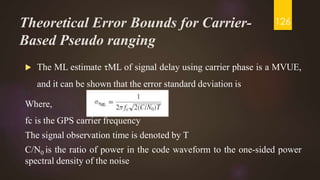
 The ML estimate τML of signal delay using carrier phase is a MVUE,
and it can be shown that the error standard deviation is
Where,
fc is the GPS carrier frequency
The signal observation time is denoted by T
C/N0 is the ratio of power in the code waveform to the one-sided power
spectral density of the noise
126
Theoretical Error Bounds for Frequency
Measurement
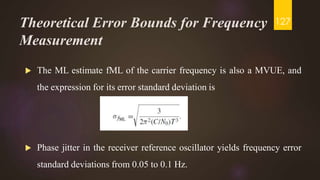
 The ML estimate fML of the carrier frequency is also a MVUE, and
the expression for its error standard deviation is
 Phase jitter in the receiver reference oscillator yields frequency error
standard deviations from 0.05 to 0.1 Hz.
127
Anti spoofing (AS) and Selective
Availability (SA)
 The PPS is primarily intended for military and selected government
agency users.
 Civilian use is permitted, but only with special U.S. DOD approval.
 Access to the aforementioned PPS position accuracies is controlled
through two cryptographic features denoted as antispoofing (AS) and
selective availability (SA).
128
Contd…
 AS is a mechanism intended to defeat deception jamming through
encryption of the military signals.
 Deception jamming is a technique in which an adversary would
replicate one or more of the satellite ranging codes, navigation data
signal(s), and carrier frequency Doppler effects with the intent of
deceiving a victim receiver.
129
Contd…
 SA had intentionally degraded SPS user accuracy by dithering the
satellite’s clock, thereby corrupting TOA measurement accuracy.
 Furthermore, SA could have introduced errors into the broadcast
navigation data parameters.
130
Contd…
 SA was discontinued on May 1, 2000, and per current U.S.
government policy is to remain off.
 When it was activated, PPS users removed SA effects through
cryptography.
131
Contd…
 Selective availability (SA) is a combination of methods available to
the U.S. Department of Defense to deliberately derating the accuracy
of GPS for “nonauthorized” (i.e., non-U.S. military) users during
periods of perceived threat.
 Measures may include pseudorandom time dithering and truncation of
the transmitted ephemerides.
132
Contd…
Precise Positioning Service
 Formal, proprietary service Precise Positioning Service (PPS) is the
full-accuracy, single-receiver GPS positioning service provided to the
United States and its allied military organizations and other selected
agencies.
 This service includes access to the unencrypted P-code and the
removal of any SA effects.
133
Contd…
Standard Positioning Service without SA
 Standard Positioning Service (SPS) provides GPS single-receiver
(standalone) positioning service to any user on a continuous,
worldwide basis.
 SPS is intended to provide access only to the C/A-code and the L1
carrier.
134
Contd…
Standard Positioning Service with SA
 The horizontal-position accuracy, as degraded by SA, currently is
advertised as 100 m, the vertical-position accuracy as 156 m, and time
accuracy as 334 ns—all at the 95% probability level.
 SPS also guarantees the user-specified levels of coverage, availability,
and reliability.
135
GPS Satellite Position Calculations
Transmission of Satellite Ephemerides
 The interface between the GPS space and user segments consists of
two radiofrequency (RF) links, L1 and L2.
 The carriers of the L-band links are modulated by up to two bit trains,
each of which normally is a composite generated by the modulo-2
addition of a PRN ranging code and the downlink system data.
136
Contd…
 Utilizing these links, the space vehicles of the GPS space segment
should provide continuous earth coverage for signals that provide to
the user segment the ranging codes and system data needed to
accomplish the GPS navigation mission.
 These signals are available to a suitably equipped user with RF
visibility to a space vehicle.
137
Contd…
 Therefore, the GPS users continuously receive navigation information
from the space vehicles in the form of modulated data bits.
 The received information is computed and controlled by the control
segment and includes the satellite’s time, its clock correction and
ephemeris parameters, almanacs and health for all GPS space vehicles,
and text messages.
138
Contd…
 The precise position and clock offset of the space vehicle antenna
phase center in the ECEF coordinates can be computed by receiving
this information.
 The ephemeris parameters describe the orbit during the interval of
time (at least 1 h) for which the parameters are transmitted.
139
Contd…
 The age of data word (AODE) provides a confidence level in the
ephemeris representation parameters.
 The AODE represents the time difference (age) between the reference
time (t0e) and the time of the last measurement update (tL) used to
estimate the representation parameters.
140
Contd…
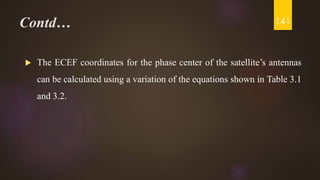
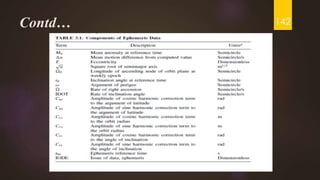
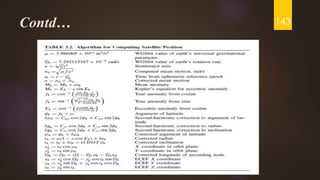
 The ECEF coordinates for the phase center of the satellite’s antennas
can be calculated using a variation of the equations shown in Table 3.1
and 3.2.
141
Contd… 142
Contd… 143
Contd… 144
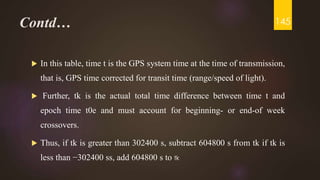
Contd…
 In this table, time t is the GPS system time at the time of transmission,
that is, GPS time corrected for transit time (range/speed of light).
 Further, tk is the actual total time difference between time t and
epoch time t0e and must account for beginning- or end-of week
crossovers.
 Thus, if tk is greater than 302400 s, subtract 604800 s from tk if tk is
less than −302400 ss, add 604800 s to tk
145
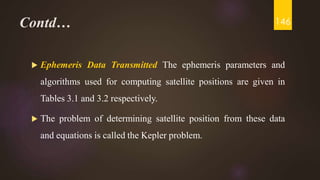
Contd…
 Ephemeris Data Transmitted The ephemeris parameters and
algorithms used for computing satellite positions are given in
Tables 3.1 and 3.2 respectively.
 The problem of determining satellite position from these data
and equations is called the Kepler problem.
146
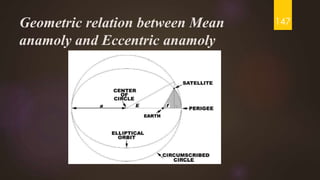
Geometric relation between Mean
anamoly and Eccentric anamoly
147
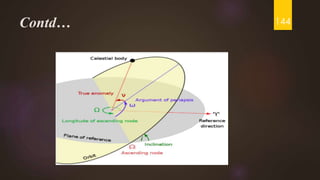
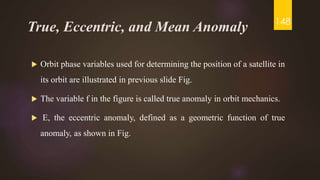
True, Eccentric, and Mean Anomaly
 Orbit phase variables used for determining the position of a satellite in
its orbit are illustrated in previous slide Fig.
 The variable f in the figure is called true anomaly in orbit mechanics.
 E, the eccentric anomaly, defined as a geometric function of true
anomaly, as shown in Fig.
148
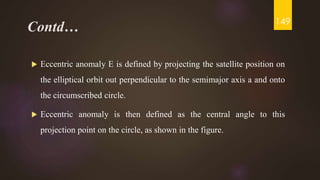
Contd…
 Eccentric anomaly E is defined by projecting the satellite position on
the elliptical orbit out perpendicular to the semimajor axis a and onto
the circumscribed circle.
 Eccentric anomaly is then defined as the central angle to this
projection point on the circle, as shown in the figure.
149
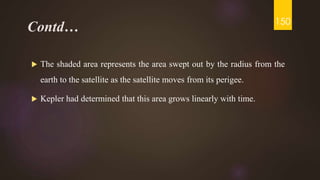
Contd…
 The shaded area represents the area swept out by the radius from the
earth to the satellite as the satellite moves from its perigee.
 Kepler had determined that this area grows linearly with time.
150
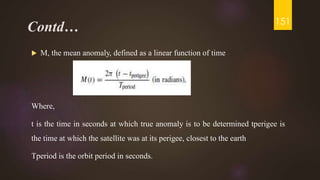
Contd…
 M, the mean anomaly, defined as a linear function of time
Where,
t is the time in seconds at which true anomaly is to be determined tperigee is
the time at which the satellite was at its perigee, closest to the earth
Tperiod is the orbit period in seconds.
151
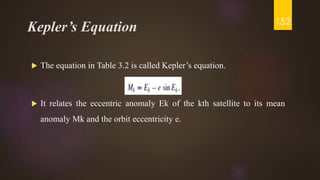
Kepler’s Equation
 The equation in Table 3.2 is called Kepler’s equation.
 It relates the eccentric anomaly Ek of the kth satellite to its mean
anomaly Mk and the orbit eccentricity e.
152
Difference between GPS and GALILEO
satellite construction
 The Galileo system is the third satellite-based navigation system
developed by European Union(EU) and European Space
Agency(ESA).
 Its frequency structure and signal design is being developed by the
European Commission’s Galileo Signal Task Force (STF), which was
established by the European Commission (EC) in March 2001.
153
Contd…
 The STF consists of experts nominated by the European Union (EU)
member states, official representatives of the national frequency
authorities, and experts from the European Space Agency (ESA).
154
Galileo Navigation Services
 The EU intends the Galileo system to provide the following four
navigation services plus one search and rescue (SAR) service.
1. Open Service (OS) The OS provides signals for positioning and
timing, free of direct user charge, and is accessible to any user
equipped with a suitable receiver, with no authorization required.
155
Contd…
2. Safety of Life Service (SOL) The SOL service is intended to increase public safety by
providing certified positioning performance, including the use of certified navigation
receivers.
3. Commercial Service (CS) The CS service is intended for applications requiring
performance higher than that offered by the OS. Users of this service pay a fee for the
added value.
4. Public Regulated Service (PRS) The PRS is an access-controlled service for government-
authorized applications
156
Contd…
 It will be used by groups such as police, coast guards, and customs.
 The signals will be encrypted, and access by region or user group
will follow the security policy rules applicable in Europe.
157
Contd…
 The Search and Rescue (SAR) It will feature near real-time reception
of distress messages from anywhere on Earth, precise location of
alerts (within a few meters), multiple satellite detection to overcome
terrain blockage, and augmentation by the four low earth orbit (LEO)
satellites and the three geostationary satellites in the current COSPAS-
SARSAT system.
158
Galileo Signal Characteristics
 Galileo will provide 10 right-hand circularly polarized navigation
signals in three frequency bands.
 The various signals fall into four categories: F/Nav, I/Nav, C/Nav, and
G/Nav.
 The F/Nav and I/Nav signals are used by the Open Service (OS),
Commercial Service (CS) and Safety of Life (SOL) service.
159
Contd…
 The I/Nav signals contain integrity information, while the F/Nav
signals do not.
 The C/Nav signals are used by the Commercial Service (CS).
 The G/Nav signals are used by the Public Regulated Service (PRS).
160
Galileo Signal Bands
E5a– E5b Band
 This band, which spans the frequency range from 1164 to 1214 MHz.
 It contains two signals, denoted E5a and E5b, which are respectively
centered at 1176.45 and 1207.140 MHz.
 Each signal has an in-phase component and a quadrature component.
 Both components use spreading codes with chipping rate of 10 Mcps
(million chips per second).
161
Contd…
E6 Band
 This band spans the frequency range from 1260 to 1300 MHz and
contains a C/Nav signal and a G/Nav signal, each centered at 1278.75
MHz.
 The C/Nav signal is used by the CS service and has both an in-phase
and Quadrature pilot component using a BPSK spreading code
modulation of 5 Mcps.
162
Contd…
E2–L1–E1 Band
 The E2–L1–E1 band (sometimes denoted as L1 for convenience)
spans the frequency range from 1559 to 1591 MHz and contains a
G/Nav signal used by the PRS service and an I/Nav signal used by the
OS, CS, and SOL services.
163
Contd…
 Both the GPS and Galileo systems are subdivided into three
components: the space segment, comprised of the satellites; the control
(or ground) segment, consisting of the command and control
infrastructure; and the user segment, encompassing the end user or
customer.
 Space Segment The purpose of the GPS space segment is to transmit
timing pulses and satellite positional data to users worldwide.
164
Contd…
 Galileo consists of 30 satellites in a Walker constellation at an altitude
of 23,616 km, equally spaced within three orbital planes with a 56-
degree inclination.
 The higher altitude and inclination afford Galileo better coverage in the
higher latitudes, including some polar regions, than does GPS—
especially benefiting civilian users in Scandinavian countries.
165
Contd…
 Galileo consists of 30 satellites in a Walker constellation at an altitude
of 23,616 km, equally spaced within three orbital planes with a 56-
degree inclination.
 GPS currently provides only two signals, Galileo will provide 10
navigation signals to support a number of different services.
166
Contd…
 Specifically, Galileo plans to employ two signals on the E5A band
centered at 1176.45 MHz, two signals on E5B at 1207.14 MHz, three
signals on E6 at 1278.75 MHz, and three signals on E2-L1-E1 at 1575.42
MHz.
 Similar to GPS, Galileo signals will carry different PRN code schemes that
effectively segregate users into three distinct groups: the general public,
commercial users, and authorized government users.
167
Contd…
 Specifically, Galileo plans to employ two signals on the E5A band
centered at 1176.45 MHz, two signals on E5B at 1207.14 MHz, three
signals on E6 at 1278.75 MHz, and three signals on E2-L1-E1 at 1575.42
MHz.
 Similar to GPS, Galileo signals will carry different PRN code schemes that
effectively segregate users into three distinct groups: the general public,
commercial users, and authorized government users.
168
Contd… 169

Unit II GPS Signal Characteristics

  • 1.
    GPS Unit II Signal Characteristics -By GVNSKSravya Assistant Professor ECE Dept. GNITS
  • 2.
    Contents  GPS SignalComponents, Purpose,  Properties and Power level,  Signal Acquisition and Tracking,  Navigation Information Extraction,  Pseudo Range Estimation,  Frequency Estimation,  GPS Satellite Position Calculation,  Signal Structure,  Anti Spoofing (AS),  Selective Availability,  Difference between GPS and GALILEO Satellite Construction. 2
  • 3.
    GPS Signal Components,Purpose and Properties  Each GPS satellite simultaneously transmits on two L-band frequencies: L1 -1575.42 MHz and L2 - 1227.60 MHz  The carrier of the L1 signal consists of an in-phase and a quadrature- phase component. 3
  • 4.
    Contd…  The in-phasecomponent is bi-phase modulated by a 50-bps (bits per second) data stream and a pseudorandom code.  The pseudorandom code is called the C/A-code consisting of a 1023- chip sequence that has a period of 1 ms and a chipping rate of 1.023 MHz. 4
  • 5.
    Contd…  The Quadraturephase component is also bi-phase modulated by the same 50-bps data stream but with a different pseudorandom code called the P-code, which has a 10.23-MHz chipping rate and a one-week period. 5
  • 6.
    Contd…  The mathematicalmodel of the L1 waveform is given as s(t) = 2PId(t)c(t) cos(ωt + θ) + 2PQd(t)p(t) sin(ωt + θ) where PI and PQ are the respective carrier powers for the in-phase and Quadrature phase carrier components, d(t) is the 50-bps data modulation, 6
  • 7.
    Contd… c(t) and p(t)are the respective C/A and P pseudorandom code waveforms, ω is the L1 carrier frequency in radians per second, θ is phase shift in radians. The quadrature carrier power PQ is approximately 3 dB less than PI . 7
  • 8.
    Contd…  L2 signalis modulated with 50- bps data and the P-code, although there is the option of not transmitting the 50-bps data stream.  The mathematical model of the L2 waveform is given as s(t) = 2PQd(t)p(t) sin(ωt + θ). 8
  • 9.
    50 bps DataStream  The 50-bps data stream conveys the navigation message.  The Navigation Message contains the following information. 1. Satellite Almanac Data 2. Satellite Ephemeris Data 3. Signal Timing Data 4. Ionospheric Delay Data 5. Satellite Health Message 9
  • 10.
    Contd…  The NavigationMessage contains the following information. 1. Satellite Almanac Data 2. Satellite Ephemeris Data 3. Signal Timing Data 4. Ionospheric Delay Data 5. Satellite Health Message 10
  • 11.
    1. Satellite AlmanacData  Each satellite transmits orbital data called the almanac.  It enables the user to calculate the approximate location of every satellite in the GPS constellation at any given time.  Almanac data are not accurate enough for determining position but can be stored in a receiver where they remain valid for many months.  They are used primarily to determine which satellites are visible at a given location so that the receiver can search for those satellites when it is first turned on. 11
  • 12.
    2. Satellite EphemerisData  Ephemeris data are similar to almanac data but enable a much more accurate determination of satellite position needed to convert signal propagation delay into an estimate of user position.  Ephemeris data for a particular satellite are broadcast only by that satellite, and the data are valid for only several hours. 12
  • 13.
    3. Signal TimingData  The 50-bps data stream includes the transmission time of specific points on the GPS signal.  This information is needed to determine the satellite-to-user propagation delay used for ranging. 13
  • 14.
    4. Ionospheric DelayData  Ranging errors due to ionospheric effects can be partially canceled by using estimates of ionospheric delay that are broadcast in the data stream. 14
  • 15.
    5. Satellite HealthMessage  The data stream also contains information regarding the current health of the satellite, so that the receiver can ignore that satellite if it is not operating properly. 15
  • 16.
    Structure of theNavigation Message  The navigation message is a bit stream of ones and zeros with a data rate of 50 Hz.  The information in the navigation message has the basic frame structure.  Navigation message is divided into frames. 16
  • 17.
    Contd…  Entire navigationmessage consists of 25 frames.  Each frame has 1500 bits with 30 seconds duration. 17
  • 18.
    Navigation Frame  Eachframe has 5 subframes with 300 bits. 18
  • 19.
    Contd…  Each subframeconsists of 10 words, Starts with preamble (10001011), ends with a zero.  Each word contains 30 bits with 600 ms duration.  Out of 30 bits, 24 are data bits and 6 parity bits.  Parity bits are the Hamming code for the word. 19
  • 20.
    Contd…  The mostsignificant bit (MSB) of the word is transmitted first.  At the 50-bps rate it takes 6s to transmit a subframe (300 bits).  It takes 30s to complete one frame (1500 bits).  Transmission of the complete 25-frame navigation message requires 750 s, or 12.5 min. 20
  • 21.
    Navigation Message SubFrame Structure 21
  • 22.
  • 23.
    Contd…  Each subframebegins with a telemetry word (TLM).  The first 8 bits of the TLM word is preamble bits that enables the receiver to determine when a subframe begins.  The remaining of the TLM contains parity bits and a telemetry message that is available only to authorized users. 23
  • 24.
    Contd…  The secondword of each subframe is called the handover word (HOW).  HOW contains the 17 bit Time of Week (TOW).  TOW is synchronized to beginning of next subframe.  It contains ID of the subframe. 24
  • 25.
    Z Count  Informationcontained in the HOW is derived from a 29-bit quantity called the Z count.  The Z-count is not transmitted as a single word, but part of it is transmitted within the HOW. 25
  • 26.
    Contd…  The 19LSBs of the Z-count, called the time-of-week (TOW) count, indicate the number of epochs that have occurred since the start of the current week.  The start of the current week occurs at approximately midnight of Saturday night/Sunday morning. 26
  • 27.
    Contd…  The TOWcount increases from zero at the start of the week and then rolls over to zero again at the start of the following week.  A TOW count of zero always occurs at the beginning of subframe 1 of the first frame. 27
  • 28.
    Contd…  Since thereceiver can use the TLM preamble to determine precisely the time at which each subframe begins, the time of transmission of any part of the GPS signal can be determined. 28
  • 29.
    GPS Week Number The 10 MSBs of the Z-count contain the GPS week number (WN), which is a modulo-1024 week count.  The zero state is defined to be that week that started at midnight on the night of January 5, 1980/morning of January 6, 1980. 29
  • 30.
    Contd…  Because WNis a modulo-1024 count, an event called the week rollover occurs every 1024 weeks (a few months short of 20 years), and GPS receivers must be designed to accommodate it.  The WN is not part of the HOW but appears as the first 10 bits of the third word in subframe 1. 30
  • 31.
    Contd…  Frame andSubframe Identification Three bits of the HOW are used to identify which of the five subframes is being transmitted.  Information by Subframe In addition to the TLM and HOW, which occur in every subframe, the following information is contained within the remaining eight words of subframes 1–5. 31
  • 32.
    Subframe 1  TheWN portion of the Z-count is part of word 3 in this subframe.  Subframe 1 also contains GPS clock correction data for the satellite in the form of polynomial coefficients defining how the correction varies with time.  Time defined by the clocks in the satellite is commonly called SV time (space vehicle time).  The time after corrections have been applied is called GPS time. 32
  • 33.
    Contd…  Thus, eventhough individual satellites may not have perfectly synchronized SV times, they do share a common GPS time.  Additional information in subframe 1 includes the quantities t0c, TGD, and IODC.  The clock reference time t0c is used as a time origin to calculate satellite clock error. 33
  • 34.
    Contd…  The ionosphericgroup delay TGD is used to correct for ionospheric propagation delay errors.  IODC (issue of date, clock) indicates the issue number of the clock data set to alert users to changes in clock parameters. 34
  • 35.
    Subframes 2 and3  These subframes contain the ephemeris data, which are used to determine the precise satellite position and velocity required by the navigation solution. 35
  • 36.
    Contd…  Unlike thealmanac data, these data are very precise, are valid over a relatively short period of time (several hours), and apply only to the satellite transmitting it.  Each time new parameters are uploaded from the GPS control segment, the IODE number changes. 36
  • 37.
    Subframe 4  Thissubframe contain the almanac for satellites with PRN (pseudorandom code) numbers 25 and higher, as well as special messages, ionospheric correction terms, and coefficients to convert GPS time to UTC time. 37
  • 38.
    Contd…  The componentsof an almanac are very similar to those of the ephemeris, and the calculation of satellite position is performed in essentially the same way. 38
  • 39.
    Subframe 5  Thissubframe includes the almanac for satellites with PRN numbers from 1 to 24.  Almanac data for all satellites are transmitted by every satellite.  Almanac data remain valid for long periods (months) but are much less precise. 39
  • 40.
    Contd…  Additional datacontained in the navigation message are user range error (URE), which estimate the range error due to errors in satellite ephemeris, timing errors, and selective availability (SA) and flags to indicate the health status of the satellites. 40
  • 41.
    C/A Code andits Properties  The C/A-code has the following functions. 1. To enable accurate range measurements and resistance to errors caused by multipath. 2. To permit simultaneous range measurement from several satellites. 3. To provide protection from jamming 41
  • 42.
    Properties of C/ACode  Temporal Structure Each satellite has a unique C/A-code, but all the codes consist of a repeating sequence of 1023 chips occurring at a rate of 1.023 MHz with a period of 1 ms.  The leading edge of a specific chip in the sequence, called the C/A-code epoch, defines the beginning of a new period.  Each chip is either positive or negative with the same magnitude. 42
  • 43.
    Temporal Structure  Thepolarities of the 1023 chips appear to be randomly distributed but are in fact generated by a deterministic algorithm implemented by shift registers.  The algorithm produces maximal-length Gold codes, which have the property of low cross correlation between different codes (orthogonality) as well as reasonably small autocorrelation sidelobes. 43
  • 44.
    Autocorrelation Function  Autocorrelationfunction of C/A code is given as Where, C(t) is the idealized C/A code waveform τ is the time delay in seconds T is the code period 1ms 44
  • 45.
    Autocorrelation Function  TheC/A-code autocorrelation function plays a substantial role in GPS receivers, inasmuch as it forms the basis for code tracking and accurate user-to-satellite range measurement. 45
  • 46.
    Power Spectrum  Thepower spectrum of the C/A-code describes how the power in the code is distributed in the frequency domain.  It can be defined either in terms of a Fourier series expansion of the code waveform or equivalently in terms of the code autocorrelation function 46
  • 47.
    Code Division MultiplexingProperty  The C/A-codes from different satellites are orthogonal, which means that for any two codes C1(t) and C2(t) from different satellites, the cross-covariance 47
  • 48.
    Code Division MultiplexingProperty  When a selected satellite signal is despread using a replica of its code, the signals from other satellites look like wide-band which are below the noise level. 48
  • 49.
    Code Division MultiplexingProperty  This permits a GPS receiver to extract a multiplicity of individual satellite signals and process them individually, even though all signals are trans- mitted at the same frequency. This process is called code division multiplexing (CDM). 49
  • 50.
    P Code andits Properties  The P-code, which is used primarily for military applications, has the following functions. 1. Increased Jamming Protection 2. Provision for Anti Spoofing 3. Denial of P-Code Use 4. Increased Code Range Measurement Accuracy 50
  • 51.
    Increased Jamming Protection The bandwidth of the P-code is 10 times greater than that of the C/A-code. So, it offers approximately 10 dB more protection from narrowband interference.  In military applications, the interference is likely to be a deliberate attempt to jam (render useless) the received GPS signal. 51
  • 52.
    Provision for AntiSpoofing  Enemy can radiate a signal that appears to be a GPS signal (spoofing), but in reality is designed to confuse the GPS receiver.  This is prevented by encrypting the P-code.  The spoofer cannot know the encryption process and cannot make the contending signal look like a properly encrypted signal.  Thus the receiver can reject the false signal and decrypt the desired one. 52
  • 53.
    Denial of P-CodeUse  The structure of the P-code is published in the open literature, so than anyone may generate it as a reference code for despreading the signal and making range measurements.  However, encryption of the P-code by the military will deny its use by unauthorized parties. 53
  • 54.
    Increased Code RangeMeasurement Accuracy  The accuracy in range measurement improves as the signal bandwidth increases.  Thus, the P-code provides improved range measurement accuracy as compared to the C/A code. 54
  • 55.
    Contd…  Simultaneous rangemeasurements using both codes are even better.  Because of its increased bandwidth, the P-code is also more resistant to range errors caused by multipath. 55
  • 56.
    P Code Characteristics Unlike the C/A-code, the P-code modulates both the L1 and L2 carriers.  Its chipping rate is 10.23 MHz, which is precisely 10 times the C/A rate, and it has a period of one week. 56
  • 57.
    Contd…  It istransmitted synchronously with the C/A-code so that each chip transition of the C/A code always corresponds to a chip transition in the P-code.  Each satellite broadcasts a unique P-code. 57
  • 58.
    Y Code  Theencrypted form of the P-code used for anti spoofing and denial of the P-code to unauthorized users is called the Y-code.  The Y-code is formed by multiplying the P-code by an encrypting code called the W-code.  The W-code is a random-looking sequence of chips that occur at a 511.5-kHz rate. 58
  • 59.
    Contd…  Thus thereare 20 P-code chips for every W-code chip.  The Y-code cannot be despread by a receiver replica P-code unless it is decrypted.  Decryption consists of multiplying the Y-code by a receiver generated replica of the W-code that is made available only to authorized users. 59
  • 60.
    Contd…  Since theencrypting W-code is also not known by the creators of spoofing signals, it is easy to verify that such signals are not legitimate. 60
  • 61.
    L1 and L2Carriers  The L1 (or L2) carrier is used for the following purposes. 1. To provide very accurate range measurements for precision applications using carrier phase. 2. To provide accurate Doppler measurements. The phase rate of the received carrier can be used for accurate determination of user velocity. 61
  • 62.
    Dual-Frequency Operation  Theuse of both the L1 and L2 frequencies provides the following benefits. 1. Provides accurate measurement of ionospheric signal delay. 2. Facilitates carrier phase ambiguity resolution. 3. Provides system redundancy (primarily for the military user). 62
  • 63.
    Provides accurate measurementof ionospheric signal delay.  A major source of ranging error is caused by changes in both the phase velocity and group velocity of the signal as it passes through the ionosphere.  Minimum Range errors of 10–20 m are common. 63
  • 64.
    Contd…  Because thedelay induced by the ionosphere is known to be inversely proportional to the square of frequency, ionospheric range error can be estimated accurately by comparing the times of arrival of the L1 and L2 signals. 64
  • 65.
    Facilitates carrier phaseambiguity resolution  In high-accuracy GPS differential positioning, the range estimates using carrier phase measurements are precise but highly ambiguous due to the periodic structure of the carrier.  The ambiguity is more easily resolved (by various methods) as the carrier frequency decreases. 65
  • 66.
    Contd…  By usingL1 and L2 carrier frequencies, the ambiguity resolution can be based on their frequency difference (1575.42– 1227.6 MHz), which is smaller than either carrier frequency alone, and hence will result in better ambiguity resolution performance. 66
  • 67.
    Signal Power Levels TransmittedPower Levels  The L1 C/A-code signal is transmitted at a minimum level of 478.63 W (26.8 dBW) effective isotropic radiated power (EIRP) in a beam approximately 30◦ wide toward the earth. 67
  • 68.
    Free-Space Loss Factor As the signal propagates toward the earth, it spreads spherically.  The loss is accounted for by a quantity called the free-space loss factor (FSLF), given by 68
  • 69.
    Atmospheric Loss Factor An additional atmospheric loss factor (ALF) of about 2.0 dB occurs as the signal becomes attenuated by the atmosphere.  If the receiving antenna is assumed to be isotropic, the received signal power is EIRP − FSLF − ALF = 26.8 − 182.4 − 2.0 = −157.6dBW. 69
  • 70.
    Antenna Gain andMinimum Received Signal Power  A typical GPS antenna with right-hand circular polarization and a hemispherical pattern has about 3.0 dB of gain relative to an isotropic antenna. 70
  • 71.
  • 72.
  • 73.
    Signal Acquisition andTracking  When a GPS receiver is turned on, a sequence of operations must ensue before information in a GPS signal can be accessed and used to provide a navigation solution. 73
  • 74.
    Contd…  In theorder of execution, these operations are as follows. 1. Determine which satellites are visible to the antenna. 2. Determine the approximate Doppler of each visible satellite. 3. Search for the signal both in frequency and C/A-code phase. 4. Detect the presence of a signal and confirm detection. 5. Lock onto and track the C/A-code. 74
  • 75.
    Contd… 6. Lock ontoand track the carrier. 7. Perform data bit synchronization. 8. Demodulate the 50-bps (bits per second) navigation data. 75
  • 76.
    1. Determine whichsatellites are visible to the antenna  In many GPS receiver applications it is desirable to minimize the time from receiver turn on until the first navigation solution is obtained.  This time interval is commonly called time to first fix (TTFF).  Depending on receiver characteristics, the TTFF might range from 30 s to several minutes. 76
  • 77.
    Contd…  An importantconsideration in minimizing the TTFF is to avoid a fruitless search for those satellite signals that are blocked by the earth, that is, below the horizon.  A receiver can restrict its search to only those satellites that are visible if it: 1. Knows its approximate location (within several hundred miles) 2. Knows its approximate time (within approximately 10 min) 3. Has satellite almanac data obtained within the last several months. 77
  • 78.
    Contd…  Using theapproximate time, approximate position, and almanac data, the receiver calculates the elevation angle of each satellite and identifies the visible satellites as those whose elevation angle is greater than a specified value.  This elevation angle called the mask angle, which has typical values of 5˚ to 15˚. 78
  • 79.
    Contd…  At elevationangles below the mask angle, tropospheric attenuation and delays tend to make the signals unreliable.  Most receivers automatically update the almanac data when in use.  If the receiver is just “out of the box” or has not been used for many months, it will need to search “blind” for a satellite signal to collect the needed almanac. 79
  • 80.
    2. Determine theapproximate Doppler of each visible satellite  The TTFF can be further reduced if the approximate Doppler shifts of the visible satellite signals are known.  This permits the receiver to establish a frequency search pattern in which the most likely frequencies of reception are searched first. 80
  • 81.
    Contd…  The expectedDoppler shifts can be calculated from knowledge of approximate position, approximate time, and valid almanac data.  Once the first satellite signal is found, a fairly good estimate of receiver clock frequency error can be determined by comparing the predicted Doppler shift with the measured Doppler shift. 81
  • 82.
    Contd…  This errorcan then be subtracted out while searching in frequency for the remaining satellites, thus significantly reducing the range of frequencies that need to be searched. 82
  • 83.
    3. Search forthe signal both in frequency and C/A-code phase Why is a signal search necessary?  GPS signals are spread-spectrum signals in which the C/A or P codes spread the total signal power over a wide bandwidth.  The signals are therefore virtually undetectable unless they are despread with a replica code in the receiver that is precisely aligned with the received code. 83
  • 84.
    Contd…  Since thesignal cannot be detected until alignment has been achieved, a search over the possible alignment positions (code search) is required. 84
  • 85.
    Contd…  A relativelynarrow post despreading bandwidth (perhaps 100– 1000 Hz) is required to raise the signal-to-noise ratio to detectable and/or usable levels.  But because of the high carrier frequencies and large satellite velocities used by GPS, the received signals can have large Doppler shifts (as much as ±5 kHz), which may vary rapidly (by as much as 1 Hz/s). 85
  • 86.
    Contd…  Therefore, aGPS receiver must conduct a two-dimensional search in order to find each satellite signal, where the dimensions are C/A- code delay and carrier frequency.  A search must be conducted across the full delay range of the C/A code for each frequency searched. 86
  • 87.
    4. Detect thepresence of a signal and confirm detection  There is a tradeoff between the probability of detection PD and false alarm PFA.  As the detection threshold is decreased, PD increases but PFA also increases. 87
  • 88.
    Contd…  Thus, thechallenge in receiver design is to achieve a sufficiently large PD so that a signal will not be missed but at the same time keep PFA small enough to avoid difficulties with false detections.  When a false detection occurs, the receiver will try to lock onto and track a nonexistent signal. 88
  • 89.
    Contd…  By thetime the failure to track becomes evident, the receiver will have to initiate a completely new search for the signal.  When a detection failure occurs, the receiver will waste time continuing to search remaining search cells that contain no signal, after which a new search must be initiated. 89
  • 90.
    Detection Confirmation  Toobtain the detection probability PD = 0.95 with a typical medium-strength GPS signal, we obtain the false-alarm probability PFA = 10−3 .  This means that on the average, there will be one false detection in every 1000 frequency/code cells searched. 90
  • 91.
    Contd…  By performinga confirmation of detection before turning the signal over to the tracking loops, PD can be increased and PFA can be decreased.  In the event that confirmation indicates no signal, the search can continue without the large time delay in detecting the failure to track. 91
  • 92.
    Adaptive Signal Searches Some GPS receivers use a simple adaptive search in which shorter dwell times are first used to permit rapid acquisition of moderate to strong signals. 92
  • 93.
    5. Lock ontoand track the C/A-code  There are two objectives in maintaining alignment 1. Signal Despreading To fully despread the signal so that it is no longer below the noise and information contained in the carrier can be recovered. 2. Range Measurements To enable precise measurement of the time of arrival (TOA) of received code for purposes of measuring range. 93
  • 94.
    Contd…  A codetracking loop, which has a large processing gain, is employed to generate a reference code precisely aligned with that of the received signal. 94
  • 95.
    6. Lock ontoand track the carrier  The purposes of tracking carrier phase are to 1. Obtain a phase reference for coherent detection of the GPS biphase modulated data 2. Provide precise velocity measurements (via phase rate) 3. Obtain integrated Doppler for rate aiding of the code tracking loop 4. Obtain precise carrier phase pseudorange measurements in high- accuracy receivers 95
  • 96.
    Contd…  Tracking ofcarrier phase is usually accomplished by a phase-lock loop (PLL). 96
  • 97.
    7. Perform databit synchronization  A simple method of bit synchronization is to clock a modulo-20 counter with the epochs of the receiver-generated reference C/A-code and record the count each time the polarity of the I integrator output changes.  A histogram of the frequency of each count is constructed, and the count having the highest frequency identifies the epochs that mark the data bit boundaries. 97
  • 98.
    8.Demodulate the 50-bps(bits per second) navigation data  Once bit synchronization has been achieved, demodulation of the data bits can occur.  GPS receivers demodulate the data by integrating the in-phase (I) component of the baseband phasor generated by a Costas loop, which tracks the carrier phase. 98
  • 99.
    Contd…  Each databit is generated by integrating the I component over a 20-ms interval from one data bit boundary to the next.  The Costas loop causes a polarity ambiguity of the data bits that can be resolved by observation of the subframe preamble in the navigation message data. 99
  • 100.
    Navigation information extraction After data demodulation the navigation information can be classified into the following three categories. 1. The information needed to determine signal transmission time 2. The information needed to establish the position and velocity of each satellite (ephemeris) 3. The various pseudo range and Doppler measurements made by the receiver 100
  • 101.
    Signal Transmission TimeInformation  The receiver can establish the time of transmission of the beginning of each subframe of the signal and of the corresponding C/A-code epoch that coincides with it.  Since the epochs are transmitted precisely 1 ms apart, the receiver labels subsequent C/A code epochs merely by counting them.  This enables the determination of the transmission time of any part of the signal. 101
  • 102.
    Ephemeris Data  Theephemeris data permit the position and velocity of each satellite to be computed at the signal transmission time. 102
  • 103.
    Pseudo range MeasurementsUsing C/A- Code  Finding the three-dimensional position of a user consists of determining the range (the distance of the user from each of three or more satellites) and solving for a point in space.  The range to each satellite can be determined by measuring how long it takes for the signal to propagate from the satellite to the receiver and multiplying the propagation time by the speed of light. 103
  • 104.
    Contd…  This methodof computing range requires very accurate synchronization of the satellite and receiver clocks used for the time measurements.  GPS satellites use very accurate and stable atomic clocks, but it is too expensive to provide a similar clock in a receiver. 104
  • 105.
    Contd…  So, thereceiver clock error is treated as an additional unknown in the navigation equations and using measurements from an additional satellite (4th satellite) to solve for time as well as for position. 105
  • 106.
    Contd…  Such anapproach leads to the fundamental measurement made by a GPS receiver the pseudo range measurement, computed as Where, trcve is the time at which a specific portion of the signal is received txmit is the time at which that same portion of the signal is transmitted c is the speed of light (2.99792458 × 10⁸ m/s). 106
  • 107.
    Contd…  trcve ismeasured according to the receiver clock, which may have a large time error txmit is in terms of GPS time, which is SV (spacecraft vehicle) time plus a time correction transmitted by the satellite.  If the receiver clock were synchronized to GPS time, then the pseudorange measurement would be the exact range to the satellite. 107
  • 108.
    Basic Positioning Equations If pseudorange measurements can be made from at least four satellites, enough information exists to solve for the unknown position (X, Y , Z) of the GPS user and for the receiver clock error Cb (clock bias).  The equations are set up by equating the measured pseudorange to each satellite with the corresponding unknown user-to-satellite distance plus the distance error due to receiver clock bias 108
  • 109.
  • 110.
    Pseudo range MeasurementsUsing Carrier Phase  Although pseudorange measurements using the C/A-code are the most commonly employed, a much higher level of measurement precision can be obtained by measuring the received phase of the GPS L1 or L2 carrier. 110
  • 111.
    Contd…  Because thecarrier waveform has a very short period (6.35 × 10⁻¹⁰ s at the L1 frequency), the noise-induced error in measuring signal delay by means of phase measurements is typically 10–100 times smaller than that encountered in code delay measurements. 111
  • 112.
    Contd…  However, carrierphase measurements are highly ambiguous because phase measurements are simply modulo 2π numbers.  Such measurements determine only the fractional part of the pseudorange when measured in carrier wavelengths.  Additional measurements are required to affect ambiguity resolution, in which the integer number of wavelengths in the pseudorange measurement can be determined. 112
  • 113.
    Contd…  The relationbetween the measured signal phases φi and the unambiguous pseudo ranges ρi can be expressed as Where, n is the number of satellites observed λ is the carrier wavelength kn is the unknown integral number of wavelengths contained in the pseudorange 113
  • 114.
    Contd…  The additionalmeasurements required for determination of the kn may include C/A and/ or P(Y)-code pseudorange measurements from the same satellites used for the phase measurements.  Since the code measurements are unambiguous, they significantly narrow the range of admissible integer values for the kn . 114
  • 115.
    Contd…  Additionally, phasemeasurements made on both the L1 and L2 signals can be used to obtain a virtual carrier frequency equal to the difference of the two carrier frequencies (1575.42 − 1227.60 = 347.82 MHz).  The 86.3-cm wavelength of this virtual carrier decreases the density of pseudorange ambiguities by a factor of about 4.5, making the ambiguity resolution process much easier. 115
  • 116.
    Contd…  Redundant codeand phase measurements from extra satellites can also be used to aid the process.  Because of unpredictable variations in propagation delay of the code and carrier due to the ionosphere and other error sources, it is impossible to obtain ambiguity resolution with single-receiver positioning. 116
  • 117.
    Contd…  Therefore, carrierphase measurements are mostly used in high- accuracy applications in which such errors are canceled out by differential operation with an additional receiver (base station). 117
  • 118.
    Carrier Doppler Measurement Measurement of the received carrier frequency provides information that can be used to determine the velocity vector of the user.  Frequency measurement is accurate and has fast response time. 118
  • 119.
    Contd…  The equationsrelating the measurements of Doppler shift to the user velocity are Where, the unknowns are the user velocity vector v = (vx, vy, vz) the receiver reference clock frequency error fb in hertz 119
  • 120.
    Contd… the known quantitiesare, the carrier wavelength λ the measured Doppler shifts fdn in hertz satellite velocity vectors vn unit satellite direction vectors un (pointing from the receiver antenna toward the satellite antenna) for each satellite index n 120
  • 121.
    Theoretical Considerations inPseudo range and Frequency Estimation  The major source of measurement error within a GPS receiver is thermal noise.  Method of maximum likelihood (ML) estimates of pseudorange (using either code or carrier) and frequency are accurate. 121
  • 122.
    Contd…  The lowerbound on the error variance of an estimator is provided by the Cramer–Rao bound, and any estimator that reaches this lower limit is called a minimum-variance unbiased estimator (MVUE).  It can be shown that at the typical SNRs encountered in GPS, ML estimates of code pseudo range, carrier pseudo range, and carrier frequency are all MVUEs. 122
  • 123.
    Contd…  The errorvariance is proportional to the power spectral density of the noise and inversely proportional to the integrated square of the derivative of the received code. 123
  • 124.
    Code Based Pseudoranging Performance of Typical Receivers  Most GPS receivers approximate the ML estimator by correlating the incoming signal with an ideal code waveform.  It does not include band limiting effects and use early and late correlators in the code tracking loop that straddle the location of the correlation function peak rather than find its actual location. 124
  • 125.
    Contd…  As aresult, the code tracking error can be significantly larger than the theoretical minimum.  Significant error reduction could be obtained by narrowing the spacing down to 0.1–0.2 C/A code chips in combination with a large precorrelation bandwidth. 125
  • 126.
    Theoretical Error Boundsfor Carrier- Based Pseudo ranging  The ML estimate τML of signal delay using carrier phase is a MVUE, and it can be shown that the error standard deviation is Where, fc is the GPS carrier frequency The signal observation time is denoted by T C/N0 is the ratio of power in the code waveform to the one-sided power spectral density of the noise 126
  • 127.
    Theoretical Error Boundsfor Frequency Measurement  The ML estimate fML of the carrier frequency is also a MVUE, and the expression for its error standard deviation is  Phase jitter in the receiver reference oscillator yields frequency error standard deviations from 0.05 to 0.1 Hz. 127
  • 128.
    Anti spoofing (AS)and Selective Availability (SA)  The PPS is primarily intended for military and selected government agency users.  Civilian use is permitted, but only with special U.S. DOD approval.  Access to the aforementioned PPS position accuracies is controlled through two cryptographic features denoted as antispoofing (AS) and selective availability (SA). 128
  • 129.
    Contd…  AS isa mechanism intended to defeat deception jamming through encryption of the military signals.  Deception jamming is a technique in which an adversary would replicate one or more of the satellite ranging codes, navigation data signal(s), and carrier frequency Doppler effects with the intent of deceiving a victim receiver. 129
  • 130.
    Contd…  SA hadintentionally degraded SPS user accuracy by dithering the satellite’s clock, thereby corrupting TOA measurement accuracy.  Furthermore, SA could have introduced errors into the broadcast navigation data parameters. 130
  • 131.
    Contd…  SA wasdiscontinued on May 1, 2000, and per current U.S. government policy is to remain off.  When it was activated, PPS users removed SA effects through cryptography. 131
  • 132.
    Contd…  Selective availability(SA) is a combination of methods available to the U.S. Department of Defense to deliberately derating the accuracy of GPS for “nonauthorized” (i.e., non-U.S. military) users during periods of perceived threat.  Measures may include pseudorandom time dithering and truncation of the transmitted ephemerides. 132
  • 133.
    Contd… Precise Positioning Service Formal, proprietary service Precise Positioning Service (PPS) is the full-accuracy, single-receiver GPS positioning service provided to the United States and its allied military organizations and other selected agencies.  This service includes access to the unencrypted P-code and the removal of any SA effects. 133
  • 134.
    Contd… Standard Positioning Servicewithout SA  Standard Positioning Service (SPS) provides GPS single-receiver (standalone) positioning service to any user on a continuous, worldwide basis.  SPS is intended to provide access only to the C/A-code and the L1 carrier. 134
  • 135.
    Contd… Standard Positioning Servicewith SA  The horizontal-position accuracy, as degraded by SA, currently is advertised as 100 m, the vertical-position accuracy as 156 m, and time accuracy as 334 ns—all at the 95% probability level.  SPS also guarantees the user-specified levels of coverage, availability, and reliability. 135
  • 136.
    GPS Satellite PositionCalculations Transmission of Satellite Ephemerides  The interface between the GPS space and user segments consists of two radiofrequency (RF) links, L1 and L2.  The carriers of the L-band links are modulated by up to two bit trains, each of which normally is a composite generated by the modulo-2 addition of a PRN ranging code and the downlink system data. 136
  • 137.
    Contd…  Utilizing theselinks, the space vehicles of the GPS space segment should provide continuous earth coverage for signals that provide to the user segment the ranging codes and system data needed to accomplish the GPS navigation mission.  These signals are available to a suitably equipped user with RF visibility to a space vehicle. 137
  • 138.
    Contd…  Therefore, theGPS users continuously receive navigation information from the space vehicles in the form of modulated data bits.  The received information is computed and controlled by the control segment and includes the satellite’s time, its clock correction and ephemeris parameters, almanacs and health for all GPS space vehicles, and text messages. 138
  • 139.
    Contd…  The preciseposition and clock offset of the space vehicle antenna phase center in the ECEF coordinates can be computed by receiving this information.  The ephemeris parameters describe the orbit during the interval of time (at least 1 h) for which the parameters are transmitted. 139
  • 140.
    Contd…  The ageof data word (AODE) provides a confidence level in the ephemeris representation parameters.  The AODE represents the time difference (age) between the reference time (t0e) and the time of the last measurement update (tL) used to estimate the representation parameters. 140
  • 141.
    Contd…  The ECEFcoordinates for the phase center of the satellite’s antennas can be calculated using a variation of the equations shown in Table 3.1 and 3.2. 141
  • 142.
  • 143.
  • 144.
  • 145.
    Contd…  In thistable, time t is the GPS system time at the time of transmission, that is, GPS time corrected for transit time (range/speed of light).  Further, tk is the actual total time difference between time t and epoch time t0e and must account for beginning- or end-of week crossovers.  Thus, if tk is greater than 302400 s, subtract 604800 s from tk if tk is less than −302400 ss, add 604800 s to tk 145
  • 146.
    Contd…  Ephemeris DataTransmitted The ephemeris parameters and algorithms used for computing satellite positions are given in Tables 3.1 and 3.2 respectively.  The problem of determining satellite position from these data and equations is called the Kepler problem. 146
  • 147.
    Geometric relation betweenMean anamoly and Eccentric anamoly 147
  • 148.
    True, Eccentric, andMean Anomaly  Orbit phase variables used for determining the position of a satellite in its orbit are illustrated in previous slide Fig.  The variable f in the figure is called true anomaly in orbit mechanics.  E, the eccentric anomaly, defined as a geometric function of true anomaly, as shown in Fig. 148
  • 149.
    Contd…  Eccentric anomalyE is defined by projecting the satellite position on the elliptical orbit out perpendicular to the semimajor axis a and onto the circumscribed circle.  Eccentric anomaly is then defined as the central angle to this projection point on the circle, as shown in the figure. 149
  • 150.
    Contd…  The shadedarea represents the area swept out by the radius from the earth to the satellite as the satellite moves from its perigee.  Kepler had determined that this area grows linearly with time. 150
  • 151.
    Contd…  M, themean anomaly, defined as a linear function of time Where, t is the time in seconds at which true anomaly is to be determined tperigee is the time at which the satellite was at its perigee, closest to the earth Tperiod is the orbit period in seconds. 151
  • 152.
    Kepler’s Equation  Theequation in Table 3.2 is called Kepler’s equation.  It relates the eccentric anomaly Ek of the kth satellite to its mean anomaly Mk and the orbit eccentricity e. 152
  • 153.
    Difference between GPSand GALILEO satellite construction  The Galileo system is the third satellite-based navigation system developed by European Union(EU) and European Space Agency(ESA).  Its frequency structure and signal design is being developed by the European Commission’s Galileo Signal Task Force (STF), which was established by the European Commission (EC) in March 2001. 153
  • 154.
    Contd…  The STFconsists of experts nominated by the European Union (EU) member states, official representatives of the national frequency authorities, and experts from the European Space Agency (ESA). 154
  • 155.
    Galileo Navigation Services The EU intends the Galileo system to provide the following four navigation services plus one search and rescue (SAR) service. 1. Open Service (OS) The OS provides signals for positioning and timing, free of direct user charge, and is accessible to any user equipped with a suitable receiver, with no authorization required. 155
  • 156.
    Contd… 2. Safety ofLife Service (SOL) The SOL service is intended to increase public safety by providing certified positioning performance, including the use of certified navigation receivers. 3. Commercial Service (CS) The CS service is intended for applications requiring performance higher than that offered by the OS. Users of this service pay a fee for the added value. 4. Public Regulated Service (PRS) The PRS is an access-controlled service for government- authorized applications 156
  • 157.
    Contd…  It willbe used by groups such as police, coast guards, and customs.  The signals will be encrypted, and access by region or user group will follow the security policy rules applicable in Europe. 157
  • 158.
    Contd…  The Searchand Rescue (SAR) It will feature near real-time reception of distress messages from anywhere on Earth, precise location of alerts (within a few meters), multiple satellite detection to overcome terrain blockage, and augmentation by the four low earth orbit (LEO) satellites and the three geostationary satellites in the current COSPAS- SARSAT system. 158
  • 159.
    Galileo Signal Characteristics Galileo will provide 10 right-hand circularly polarized navigation signals in three frequency bands.  The various signals fall into four categories: F/Nav, I/Nav, C/Nav, and G/Nav.  The F/Nav and I/Nav signals are used by the Open Service (OS), Commercial Service (CS) and Safety of Life (SOL) service. 159
  • 160.
    Contd…  The I/Navsignals contain integrity information, while the F/Nav signals do not.  The C/Nav signals are used by the Commercial Service (CS).  The G/Nav signals are used by the Public Regulated Service (PRS). 160
  • 161.
    Galileo Signal Bands E5a–E5b Band  This band, which spans the frequency range from 1164 to 1214 MHz.  It contains two signals, denoted E5a and E5b, which are respectively centered at 1176.45 and 1207.140 MHz.  Each signal has an in-phase component and a quadrature component.  Both components use spreading codes with chipping rate of 10 Mcps (million chips per second). 161
  • 162.
    Contd… E6 Band  Thisband spans the frequency range from 1260 to 1300 MHz and contains a C/Nav signal and a G/Nav signal, each centered at 1278.75 MHz.  The C/Nav signal is used by the CS service and has both an in-phase and Quadrature pilot component using a BPSK spreading code modulation of 5 Mcps. 162
  • 163.
    Contd… E2–L1–E1 Band  TheE2–L1–E1 band (sometimes denoted as L1 for convenience) spans the frequency range from 1559 to 1591 MHz and contains a G/Nav signal used by the PRS service and an I/Nav signal used by the OS, CS, and SOL services. 163
  • 164.
    Contd…  Both theGPS and Galileo systems are subdivided into three components: the space segment, comprised of the satellites; the control (or ground) segment, consisting of the command and control infrastructure; and the user segment, encompassing the end user or customer.  Space Segment The purpose of the GPS space segment is to transmit timing pulses and satellite positional data to users worldwide. 164
  • 165.
    Contd…  Galileo consistsof 30 satellites in a Walker constellation at an altitude of 23,616 km, equally spaced within three orbital planes with a 56- degree inclination.  The higher altitude and inclination afford Galileo better coverage in the higher latitudes, including some polar regions, than does GPS— especially benefiting civilian users in Scandinavian countries. 165
  • 166.
    Contd…  Galileo consistsof 30 satellites in a Walker constellation at an altitude of 23,616 km, equally spaced within three orbital planes with a 56- degree inclination.  GPS currently provides only two signals, Galileo will provide 10 navigation signals to support a number of different services. 166
  • 167.
    Contd…  Specifically, Galileoplans to employ two signals on the E5A band centered at 1176.45 MHz, two signals on E5B at 1207.14 MHz, three signals on E6 at 1278.75 MHz, and three signals on E2-L1-E1 at 1575.42 MHz.  Similar to GPS, Galileo signals will carry different PRN code schemes that effectively segregate users into three distinct groups: the general public, commercial users, and authorized government users. 167
  • 168.
    Contd…  Specifically, Galileoplans to employ two signals on the E5A band centered at 1176.45 MHz, two signals on E5B at 1207.14 MHz, three signals on E6 at 1278.75 MHz, and three signals on E2-L1-E1 at 1575.42 MHz.  Similar to GPS, Galileo signals will carry different PRN code schemes that effectively segregate users into three distinct groups: the general public, commercial users, and authorized government users. 168
  • 169.