Unit 5
GPS
Mrs B.Prathyusha
Asst.Professor
Department of ECE
Text Book:
• Satellite Communications, Third Edition. Timothy Pratt and Jeremy
Allnutt.© 2020 JohnWiley & Sons Ltd. Published 2020 by JohnWiley &
Sons Ltd.
UNIT V
• SATELLITE NAVIGATION & THE GLOBAL POSITIONING SYSTEM [1] :
Radio and Satellite Navigation, GPS Position Location principles,
GPS Receivers and codes, Satellite signal acquisition,
GPS Navigation Message, GPS signal levels,
GPS receiver operation, GPS C/A code accuracy,
Differential GPS.
• Global Positioning System (GPS) is a navigation system based on satellite. The
Global Positioning System (GPS) is a worldwide radio-navigation system
formed from a constellation of 24 satellites and their ground stations.
• It has created the revolution in navigation and position location.
• It is mainly used in positioning, navigation, monitoring and surveying
applications.
• The major advantages of satellite navigation are real time positioning and
timing synchronization.
• That’s why satellite navigation systems have become an integral part in most
of the applications, where mobility is the key parameter.
• A complete operational GPS space segment contains twenty-four satellites
in MEO.
• These satellites are made into six groups so that each group contains four
satellites.
• The group of four satellites is called as one constellation.
• Any two adjacent constellations are separated by 60 degrees in longitude.
• The orbital period of each satellite is approximately equal to twelve hours.
• Hence, all satellites revolve around the earth two times on every day.
• At any time, the GPS receivers will get the signals from at least four
satellites.
• Global Positioning System (GPS) Architecture
• The Architecture of Global Positioning System consists of three
segments or units namely:
• GPS Space Segment
• GPS Control Segment
• GPS Receiver (User) Segment
• Global Positioning System (GPS) Space Segment
• The Space Unit consists of 24 active satellites which are
assembled with huge solar panels with rechargeable
batteries that act as a power source.
• The function of the satellites in space is to route or navigate
the radio signals received from the control unit to store and
re-transmit the message to the respective Receiver Unit.
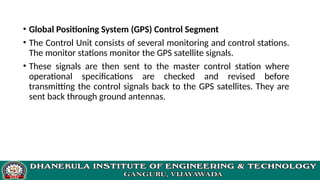
• Global Positioning System (GPS) Control Segment
• The Control Unit consists of several monitoring and control stations.
The monitor stations monitor the GPS satellite signals.
• These signals are then sent to the master control station where
operational specifications are checked and revised before
transmitting the control signals back to the GPS satellites. They are
sent back through ground antennas.
Global Positioning System (GPS) Receiver (User) Segment
The User Unit is the term given to all GPS receivers like
mobile phones, laptops, PC or any other device. The devices
receives the signals from the GPS satellites and determines
how far away it is from each satellite.
• GPS Receiver
• There exists only one-way transmission from satellite to users in GPS system.
• Hence, the individual user does not need the transmitter, but only a GPS
receiver.
• It is mainly used to find the accurate location of an object.
• It performs this task by using the signals received from satellites.
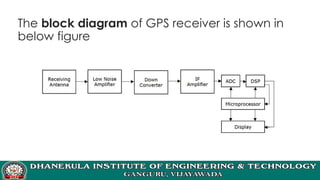
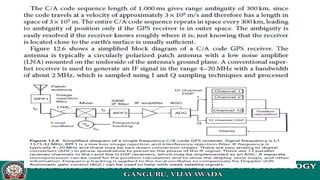
The block diagram of GPS receiver is shown in
below figure
• The function of each block present in GPS receiver is mentioned below.
• Receiving Antenna receives the satellite signals. It is mainly, a circularly polarized antenna.
• Low Noise Amplifier (LNA) amplifies the weak received signal
• Down converter converts the frequency of received signal to an Intermediate Frequency
(IF) signal.
• IF Amplifier amplifies the Intermediate Frequency (IF) signal.
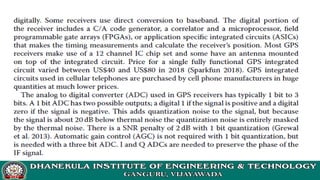
• ADC performs the conversion of analog signal, which is obtained from IF amplifier to
digital. Assume, the sampling & quantization blocks are also present in ADC (Analog to
Digital Converter).
• DSP (Digital Signal Processor) generates the C/A code.
• Microprocessor performs the calculation of position and provides the timing signals in
order to control the operation of other digital blocks. It sends the useful information to
Display unit in order to display it on the screen.
• GPS Codes and Services
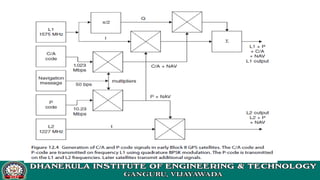
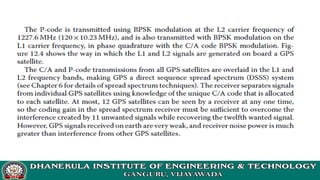
• Each GPS satellite transmits two signals, L1 and L2 are of different frequencies.
• Trilateration is a simple method for finding the position (Latitude, Longitude,
Elevation) of GPS receiver.
• By using this method, the position of an unknown point can be measured
from three known points
• GPS Codes
• Following are the two types of GPS codes.
• Coarse Acquisition code or C/A code
• Precise code or P code
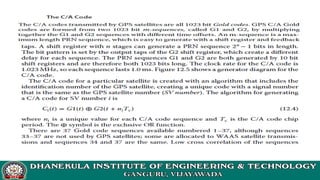
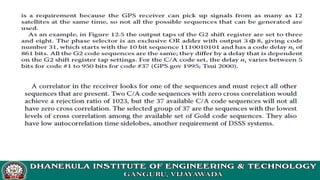
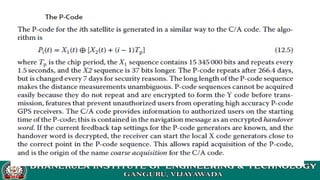
• The signal, L1 is modulated with 1.023 Mbps pseudo random bit sequence. This code is
called as Coarse Acquisition code or C/A code and it is used by the public.
• The signal, L2 is modulated with 10.23 Mbps pseudo random bit sequence. This code is
called as Precise code or P code and it is used in military positioning systems.
• Generally, this P code is transmitted in an encrypted format and it is called as Y code
• The P code gives better measurement accuracy when compared to C/A code, since the bit
rate of P code is greater than the bit rate of C/A code.
• GPS Services
• Following are the two types of services provided by GPS.
• Precise Positioning Service (PPS)
• Standard Positioning Service (SPS)
• PPS receivers keep tracking of both C/A code and P code on two signals, L1 and L2. The Y
code is decrypted at the receiver in order to obtain P code.
• SPS receivers keep tracking of only C/A code on signal, L1.
GPS Position
Location Principles
• Dr M Vamshi Krishna
• Professor
• Dhanekula Institute of Engineering & Management
• The basic requirement of a satellite navigation system like GPS is that
there must be four satellites transmitting suitably coded signals from
known positions.
• Three satellites are required to provide the three distance
measurements, and the fourth is used to remove receiver clock error.
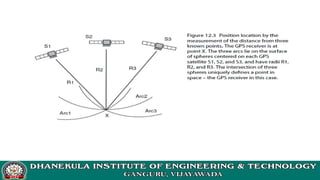
Figure 12.2 shows the general arrangement of position location with
GPS.
The three satellites provide distance information when the GPS receiver
makes three measurements of range, Ri, from the receiver to three
known points, that is, GPS satellites.
• Each distance Ri can be thought of as the radius of a sphere with a GPS
satellite at its center.
• The receiver lies at the intersection of three such spheres, with a satellite
at the center of each sphere.
• A basic principle of geometry is that the intersection of three planes
completely defines a point.
• Thus three satellites, through measurement of their distances to the
receiver, define the receiver location close to the earth’s surface.
• Although the principles by which GPS locates a receiver are very simple,
requiring only the accurate measurement of three ranges to three
satellites, implementing the measurement with the required accuracy is
quite complex.
• We will look first at the way in which range is measured in a GPS receiver
and then consider how to make the measurements.
• Range is calculated from the time delay incurred by the satellite signal in
traveling from the satellite to the GPS receiver, using the known velocity
of EM waves in free space.
• To measure the time delay, we must know the precise instant at which
the signal was transmitted, and we must have a clock in the receiver that
is synchronized to the clock on the satellite.
• GPS satellites each carry three atomic clocks, which are calibrated against
time standards in GPS control stations around the world. The result is
GPS time, a time standard that is available in every GPS satellite.
• The accuracy of an atomic clock is typically 1 part in 1012.
• A standard crystal oscillator with a long term accuracy of 1 in 105 or 1 in
106 is used in low cost civil GPS receivers.
• However, over the short time period in which GPS location
measurements are made, the oscillator is stable to one part in 1012.
• The receiver clock is allowed to have an offset relative to the GPS satellite
clocks, so when a time delay measurement is made, the measurement
will have an error caused by the clock offset.
• For example, suppose the receiver clock has an offset of 10 ms relative to
GPS time.
• All distance measurements will then have an error of 3000 km. Clearly,
we must have a way to remove the time error from the receiver clock
before we can make accurate position measurements.
• C/A code receivers can synchronize their internal clocks to GPS time
within 10 ns, corresponding to a distance measurement uncertainty of 3
m.
• Repeated measurements and integration improve the position location
error to below 10 m.
• It is surprisingly easy to remove the clock error, and this removal is one of
the strengths of GPS. All that is needed is a time measurement from a
fourth satellite.
• We need three time measurements to define the location of the receiver
in the three unknown coordinates x, y, and z .
• When we add a fourth time measurement we can solve the basic position
location equations for a fourth unknown – the receiver clock offset error τ
(often called clock bias). Thus the four unknowns in the calculation of the
location of the receiver are x, y, z, and τ.
Position Location in GPS
• First, we will define the coordinates of the GPS receiver and the GPS
satellites in a rectangular coordinate system with its origin at the center
of the earth.
• This is called the earth centered earth fixed (ECEF) coordinate system,
and is part of the WGS-84 description of the earth.
• WGS-84 is an internationally agreed description of the earth’s shape and
parameters, derived from observations in many countries (Strang and
Borre 1997).
• GPS receivers use the WGS-84 parameters to calculate the orbits of the
GPS satellites with the accuracy required for precise measurement of the
range to the satellites.
• The Z-axis of the coordinate system is directed through the earth’s north
pole and the X- and Y-axes are in the equatorial plane.
• The X-axis passes through the Greenwich meridian – the line of zero
longitude on the earth’s surface, and the Y-axis passes through the 90°
east meridian.
• The ECEF coordinate system rotates with the earth.
• The receiver coordinates are (Ux, Uy, Uz), and the four satellites have
coordinates (Xi, Yi, Zi), where i = 1, 2, 3,4. There may be more than four
satellite signals available, but we use only four signals in a basic position
calculation.
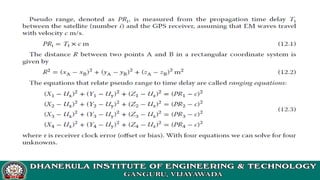
• The measured distance to satellite number (i) is called a pseudo range,
PRi, because it uses the internal clock of the receiver to make a timing
measurement that includes errors caused by receiver clock offset.
• The geometry of a GPS measurement is illustrated in Figure 12.3.
• The position of the satellite at the instant it sent the timing signal (which
is actually the start of a long sequence of chips) is obtained from
ephemeris data transmitted along with the timing signals in the
navigation message.
• Each satellite sends out a data stream that includes ephemeris data for
itself and the adjacent satellites.
• The receiver calculates the coordinates of the satellite relative to the
center of the earth (Xi, Yi, Zi), at the instant the satellite started to
transmit the chip sequence and then solves the four ranging equations
for the four unknowns using standard numerical techniques for the
solution of nonlinear simultaneous equations.
• (The equations are non-linear because of the squared terms.)
• The four unknowns are the location of the GPS receiver, (Ux, Uy, Uz),
relative to the center of the earth and the clock offset τ – called clock
bias in GPS terminology.
• The receiver position is then referenced to the surface of the earth, and
can be displayed in latitude, longitude, and elevation.
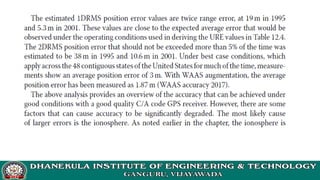
• Typical accuracy for a GPS receiver using the GPS C/A code is 5m defined
as a 2DRMS error.
• The term DRMS means the root mean square (RMS) error of the
measured position relative to the true position of the receiver.
• If the measurement errors are Gaussian distributed, as if often the case,
68% of the measured position results will be within a distance of 1DRMS
from the true location and 95% of the results will be within 2DRMS of the
true location.
• Accuracy in GPS measurements is usually defined in terms of 2DRMS, in
the horizontal or vertical plane.
GPS Time
• The clock bias value τ, which is found as part of the position location
calculation process can be added to the GPS receiver clock time to yield a
time measurement that is synchronized to the GPS time standard.
• The crystal oscillator used in the GPS receiver is highly stable over a
period of a few seconds, but will have a frequency that changes with
temperature and with time.
• Temperature changes cause the quartz crystal that is the frequency
determining element of a crystal oscillator to expand or contract, and
this changes the oscillator frequency.
• Crystals also age, which causes the frequency to change over time. The
changes are very small, but sufficient to cause errors in the clock time at
the receiver when the clock is not synchronized to a satellite.
• Calculating the clock bias by solving the ranging equations allows the
receiver clock time to be updated every second or two so that the GPS
receiver time readout is identical to GPS time.
• Every GPS receiver is automatically synchronized to every other GPS
receiver anywhere in the world through GPS time.
• This makes every GPS receiver a super clock which knows time more
accurately than any other time standard.
• GPS time differs from Greenwich Mean Time (GMT or UTC) because UTC
is tied to the rotation of the earth. Leap seconds are added to UTC to
account for the slowing of the earth’s rotation, but not to GPS time.
GPS Navigation Message
Every satellite receives from the ground antennas the navigation data which is
sent back to the users through the navigation message.
The Navigation Message provides all the necessary information to allow the
user to perform the positioning service.
•Ephemeris parameters
•Time parameters
•Clock Corrections
•Service Parameters
•Ionospheric parameters
It includes the Ephemeris parameters, needed to compute the satellite
coordinates with enough accuracy,
the Time parameters and Clock Corrections, to compute satellite clock offsets
and time conversions,
the Service Parameters with satellite health information (used to identify the
navigation data set),
Ionospheric parameters model needed for single frequency receivers, and the
Almanacs, allowing the computation of the position of ”all satellites in the
constellation”, with a reduced accuracy (1 - 2 km of 1-sigma error), which is
needed for the acquisition of the signal by the receiver.
The ephemeris and clocks parameters are usually updated every two hours,
while the almanac is updated at least every six days.
•Besides the "legacy" L1 C/A navigation message, four additional new
messages have been introduced by the so called GPS modernisation:
• L2-CNAV, CNAV-2, L5-CNAV and MNAV.
• The "legacy" message and the first three of the modernised GPS are civil
messages, while the MNAV is a military message.
•In modernised GPS, the same type of contents as the legacy navigation
message (NAV) is transmitted but at higher rate and with improved
robustness.
•The messages L2-CNAV, L5-CNAV and MNAV have a similar
structure and (modernised) data format.
• The new format allows more flexibility, better control and
improved content.
• Furthermore, the MNAV includes new improvements for the
security and robustness of the military message.
•The CNAV-2 is modulated onto L1C, sharing the same band as
the "legacy" navigation message.
L1 C/A
•The current “legacy” Navigation Message (NAV) is modulated on both carriers
at 50 bps.
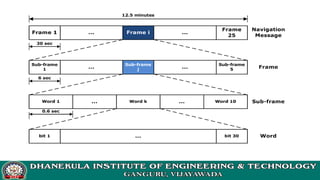
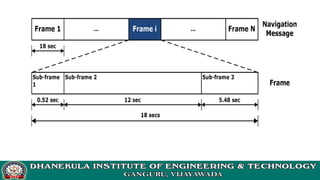
•The whole message contains 25 pages (or ’frames’) of 30 seconds each,
forming the master frame that takes 12.5 minutes to be transmitted.
• Every frame is subdivided into 5 sub-frames of 6 seconds each; in turn, every
sub-frame consists of 10 words, with 30 bits per word (see figure 3).
•Every sub-frame always starts with the telemetry word (TLM), which is
necessary for synchronism. Next, the transference word (HOW) appears. This
word provides time information (seconds of the GPS week), allowing the
receiver to acquire the week-long P(Y)-code segment.
•The content of every sub-frame is as follows:
•Sub-frame 1: contains information about the parameters to be applied to
satellite clock status for its correction. These values are polynomial
coefficients that allow converting time on board to GPS time. It also has
information about satellite health condition.
•Sub-frames 2 and 3: these sub-frames contain satellite ephemeris.
•Sub-frame 4: provides ionospheric model parameters (in order to adjust for
ionospheric refraction), UTC information (Universal Coordinate Time), part of
the almanac, and indications whether the Anti-Spoofing, A/S, is activated or
not (which transforms P code into the encrypted Y code).
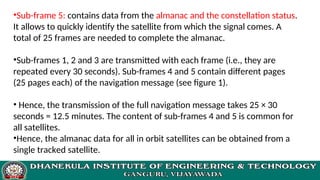
•Sub-frame 5: contains data from the almanac and the constellation status.
It allows to quickly identify the satellite from which the signal comes. A
total of 25 frames are needed to complete the almanac.
•Sub-frames 1, 2 and 3 are transmitted with each frame (i.e., they are
repeated every 30 seconds). Sub-frames 4 and 5 contain different pages
(25 pages each) of the navigation message (see figure 1).
• Hence, the transmission of the full navigation message takes 25 × 30
seconds = 12.5 minutes. The content of sub-frames 4 and 5 is common for
all satellites.
•Hence, the almanac data for all in orbit satellites can be obtained from a
single tracked satellite.
L2-CNAV
The initial L2C broadcast consisted of a default message (Message Type 0) that
did not provided full navigational data.
Initially the plan was to keep the dummy transmission until the new
Operational Control Segment (OCX) would be operational.
However the Air Force decided to anticipate the provision of the L2C navigation
message with the aim of helping the development of compatible user
equipments as well facilitate the CNAV Operations Concept.
•The message-populated broadcast started on April 2014 with
reduced data accuracy and update frequency compared to the legacy
GPS signals in wide use today.
•From December 2014 is planed that L2-CNAV data updates will
increase to a daily rate, bringing L2C signal-in-space accuracy on par
with the legacy signals.
• However, derived position accuracy cannot be guaranteed during
the pre-operational deployment of the frequencies and its use must
be used only for testing and research activities despite the health bit
set “healthy”.
On December 2014, the CNAV navigation message started to be updated on a
daily basis just like the legacy message but must be still considered as pre-
operational data and its use must be restricted to testing purposes[3]
.
Operational declarations for L2-CNAV will require implementation of new
monitoring and control capabilities in Block 1 of the Next Generation
Operational Control System (OCX).
Its design replaces the use of frames and sub-frames of data
(repeating in a fixed pattern) of the original “legacy” NAV by a
packetised message-based communications protocol, where individual
messages can be broadcast in a flexible order with variable repeat
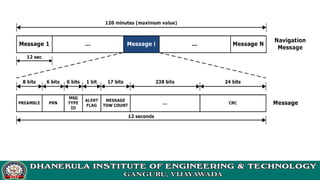
cycles as represented in figure 2.
Moreover, Forward Error Correction (FEC) and advanced error
detection (such as a CRC) are used to achieve better error rates and
reduced data collection times.
Each message is composed by fixed data such as a Preamble, Message Type
ID, Alert Flag, Message TOW count and CRC which lets 238 bits to be filled
with other navigation related data.
It is possible to define up to 63 different message types, but currently only the
messages types 10-14 and 30-37 are defined.
The remaining undefined and unused message types are reserved for future
use. Broadcast of messages is completely arbitrary, but sequenced to provide
optimum user performance.
L5-CNAV
Like L2-CNAV, the L5 message-populated broadcast started on April
2014 but set “unhealthy,” but as greater experience with the L5
broadcast and implementation of signal monitoring is achieved, this
status may change upon review.
Operational declarations for L5-CNAV will require implementation of
new monitoring and control capabilities in Block 1 of the Next
Generation Operational Control System (OCX).
The L5-CNAV is modulated onto L5I signal component, containing
basically the same information data as L2-CNAV. The message
structure is exactly the same but its content may vary slightly.
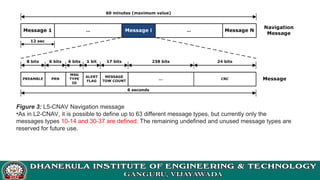
Figure 3: L5-CNAV Navigation message
•As in L2-CNAV, it is possible to define up to 63 different message types, but currently only the
messages types 10-14 and 30-37 are defined. The remaining undefined and unused message types are
reserved for future use.
CNAV-2
The message CNAV-2 consists of sub-frames and frames
and is modulated onto the L1C signal.
Each frame is divided into three sub-frames of varying length
being required multiple frames to broadcast a complete data
message set to users.
•Subframe 1 (9 bits) provides Time of Internal.
•Subframe 2 (600 bits) provides clock and ephemeris data.
•Subframe 3 (274 bits) provides other navigation data which is
commutated over multiple pages.
Differential GPS
• Dr M Vamshi Krishna
• Professor
• Department of ECE
• Dhanekula Institution of Engineering and Management
Contents
• Differential GPS
• Errors in GPS Range Measurements.
• Correction Parameterization and Distribution
• Ionospheric Divergence
• Solution Method
• New Developments
Differential GPS
• The Global Positioning System delivers about 6 m horizontal error and 10 m
in three dimensions to a dual frequency user.
• This was much worse for the civilian user before the intentional degradation
of the signal was removed. It likely will improve in the future.
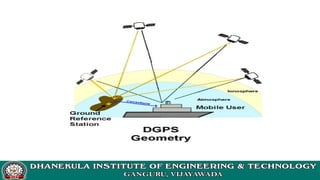
• Differential GPS works by having a reference system at a known location
measure the errors in the signals and send corrections to users in the "local"
area.
• These corrections will not be universal, but will be useful over a significant
area.
• The corrections are normally sent every few seconds. The user is generally
some mobile platform such as a ship, car, truck or even an aircraft.
• For the majority of civilian users single frequency receivers are used.
• The public ranging modulation is currently only on the L1 signal. The
only ranging signal on L2 is encrypted.
• The exceptions are survey and scientific systems that use expensive
receivers with methods to work around the L2 encryption.
• The single frequency user must deal with the error produced as the
signals go through the ionosphere.
• The second frequency was put on the GPS satellites to allow real time
removal of the ionospheric error.
• It does this to an accuracy better than 1 cm.
• The use of differential GPS produces a position solution much more
accurate than the that of the standalone user, either civilian or military.
• It does this even for the single frequency receivers. In fact all common
DGPS systems work only with the L1 frequency signal, even if the
receiver can track both L1 and L2 frequencies.
• It is common today to have ships navigating on DGPS with 1 to 2 meter
position accuracy.
Errors in GPS Range
Measurements.
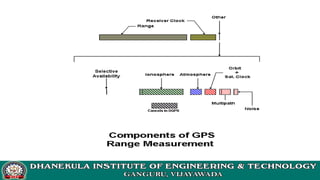
• Differential GPS works by measuring the errors in GPS signals at a
reference station(s) and sending the corrections to users.
• The errors in the signal at then antenna should be almost the same for
another receiver close by. The definition of "close" depends on the
specific error.
• The Selective Availability (SA), when it was turned on, had a standard
deviation of about 30 meters.
• It was usually the dominant error for the civilian GPS user. It is zero now.
However, when it was on, it was totally removed by DGPS systems.
• The ionosphere error varies greatly with time of day, location, and the
solar cycle. It also is a function of elevation angle.
• Low elevation angle lines of sight have a longer path length within the
ionosphere than vertical paths. At night for high elevation angles the
ionospheric error can be as low as 1 meter.
• In late afternoon, in the tropics, at solar maximum, a 20 degree
elevation angle observation could have a 50 m ionospheric error.
Ionosphere errors in the tropics at the 10 to 30 m level are common.
• The atmospheric error is about 2.5 m for a vertical line of sight. It varies
in a very predictable way and is well modeled in most receivers.
• Only at angles below 5 degrees do complex bending effects come into
play. Only very precise scientific work needs to go beyond the standard
modeling for this error.
• The ionosphere is the dominant error for single frequency user. The
last three errors are the dominant error sources for a dual frequency
user. They are also important for the single frequency user.
• In order to navigate, not only are good ranges needed, but also the
location of the end point of the range. That is, the positions of the
satellites are required. Providing this information is the job of the US
Air Force, which runs the GPS system.
• They use a series of monitor stations to acquire data in real time and
estimate the position, velocity, and satellite clock error of each satellite
every 15 minutes.
• They use these solutions to make a prediction of the satellite
parameters for the following day. These predictions are then
parameterized and loaded into the satellite onboard memory. This data
is sent to the user on the GPS signal. It is called the Broadcast
Ephemeris (BCE). On average this prediction will be 12 hours old.
• The largest error will be the satellite clock error. If all the satellite clocks
are not synchronized, navigation is degraded. Setting all the GPS
satellite clocks to a form of Universal Time Coordinated (UTC)
accomplishes this. (The time differs from UTC by some integer number
of seconds. For this reason it is called GPS Time.)
• Even though extremely good atomic clocks are on each satellite, there
is a wander in the clocks. This is a random process and cannot be
modeled. There may also be some residual systematic error in the
predicted clock state.
• There are two remaining errors that are specific to individual receivers.
The multipath error is caused by reflections of the GPS signals from
metal objects near the antenna.
• DGPS reference stations go to great lengths to minimize this error
though good antenna locations. The DGPS user may not have this
option.
•
• The last error is the thermal noise inside the receiver. This is a function
of the individual receiver design. It is lower in more expensive
receivers.
• However each year the receiver noise level on new receivers decreases
some. It is like the increase in speed on computers, but not quite as
dramatic a change. Today the receiver noise varies from 2 m to 10 cm
for civilian receivers.
• Today the ionosphere and Orbit-and-Clock errors are usually the
dominant errors for the civilian navigator.
• DGPS essentially removes these.
• The orbit error is only slightly different for users within a 1000 km or so
of the reference station. That cannot be said of the ionosphere error.
• Its change with distance from the reference station is discussed later
under ionospheric divergence.
• The remaining issues in designing or choosing a DGPS system are how
to get the errors to the user, and what solution technique to use.
Correction Parameterization and Distribution
• There are two approaches to parameterizing the errors measured by
the reference station(s).
• In the most common approach, the range error is measured for each
satellite and these satellite by satellite errors sent to the user. This is a
point approach.
• It is valid at the reference receiver. Its validity will decrease with
distance from that site.
• In the second approach multiple stations are used to estimate the
errors over an extended area.
• This is called Wide Area DGPS (WADGPS).
• The Federal Aviation Administrations (FAA) Wide Area Augmentation
System (WAAS) is this type of system.
• There are also commercial systems of this type. The corrections are
parameterized in a way that allows the user to compute corrections
based on his location. Two users separated by a 100 km or so will get
different corrections from the same WADGPS parameter set.
Ionospheric Divergence
• The normal limitation on the utility of DGPS corrections is the
difference in the ionospheric error seen by the reference station and
the user.
• This ionospheric error is determined by the ionospheric conditions
where the line of sight passes through 300 to 400 km altitude.
• For a vertical ray, this is overhead. For a low elevation ray it can be 1500
km away (about 15 degrees of earth central angle).
• The ionosphere is much more variable than the atmosphere. It most
dramatic variation is from day to night.
• It essentially goes away late at night. It rebuilds quickly at dawn and
then intensifies thought the day. Its decay after sunset is gradual.
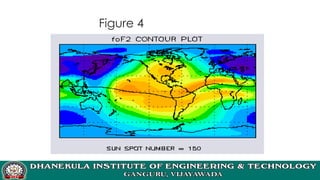
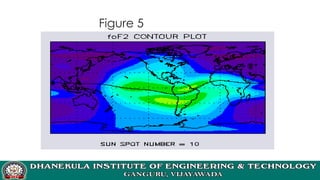
• Maps of the peak electron density of the ionosphere are shown in
Figures 4 and 5.
• These values are proportional to the ionospheric error. The plots are for
1800 UT, when sunrise is in the Pacific and sunset over the zero of
longitude line. Sunrise at 300 km occurs before it does on the ground.
Figure 4
Figure 5
Solution Method
• There are two common methods of finding a location with differential
GPS. The most common method for navigation applications is to use
corrected ranges. This is the same solution method used by the
standalone user, but with some systematic errors removed. The survey
community has used the carrier phase as its basic measurement from
the beginning of GPS surveying.
• This was then applied to cases where the unknown location was in
motion. This was called Kinematics. In practice kinematics can only be
done with dual frequency data.
• Even though both frequencies are used, it is sensitive to ionospheric
divergence. The user usually needs to be within 30 km of the reference
site during the day.
• In the beginning, kinematics was only done on a post-processing basis.
However with the increase in computation capabilities, it became
possible to do the kinematic solution inside the GPS receiver.
• This is called Real Time Kinematics, or RTK. Many high end dual
frequency receivers now can do RTK.
• It is still limited to ranges of 30 to 100 km of the reference sites. Also
the system often needs to be initialized at 30 km or less.
• The original version of the RTCM format did not allow for the
corrections necessary for RTK.
• However, revision 2 has new message formats designed for this. Many
RTK implementations allow both the RTCM and manufacturer
proprietary DGPS formats.
New Developments
• The package of changes that was accepted when the Selective
Availability was turned off includes two other items important to
civilian DGPS users.
• First the publicly available ranging signal will be placed on both the GPS
frequencies beginning with launches in 2003. The earlier spacecraft
only had this signal on the L1 frequency.
• This will make it possible for low end receivers now to automatically
correct for the ionospheric error.
• Using the L2 signal in DGPS will require some changes to the RTCM
format, but this is expected.
• Beginning in about 2007, satellites launched will have a third civilian
frequency, called L5.
• This will allow kinematic solutions to be initialized and utilized at much
longer ranges.
• The precise ranges will have to be determined post launch. It is likely
that WAAS will not utilize the new signal on L2, but it is likely to use the
L5 signal.
• This is due to a low, but measurable, probability of interference on L2
with some radars and mobile communications services in Europe.
• There are many science experiments done each year using GPS. Some,
for example from NASAs Goddard Space Flight Center, have done
kinematics out to a thousand kilometers.
• Experiments have been conducted on using a network of reference
stations to generate standard GPS corrections.
• Receivers are becoming immune to multipath, at least for the top of
the line receivers.
• The noise level in receivers is also coming down. Where all this will
lead is unclear, but the results can only be beneficial to the GPS
community.
Any Queries?
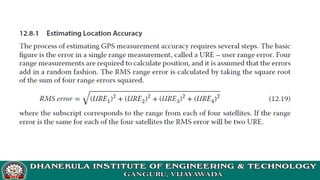
• GPS C/A Code Standard Positioning System Accuracy
• Position location accuracy is defined as the probability that the measured
location of a GPS receiver is within a specified distance of its true location.
• For example, typical accuracy for a GPS receiver using the GPS C/A code is 5 m,
defined as a 2DRMS error, which means that 95% of measurements will be
within 5m of the receiver’s true location.
• The term DRMS means the RMS error of the measured position relative to the
true position of the receiver
• If the measurement errors are Gaussian distributed, as if often the
case, 68% of the measured position results will be within a distance of
1DRMS from the true location and 95% of the results will be within
2DRMS of the true location.
• For 99.8% of measurements the accuracy will be within 3DRMS.
Accuracy in GPS measurements is usually defined in terms of 2DRMS,
in the horizontal or vertical plane.
• Accuracy is always better in the horizontal plane than the vertical plane
because GPS satellites can surround the receiver in the horizontal
plane, but can only be above the receiver in the vertical plane.
SATELLITE SIGNAL
ACQUISITION
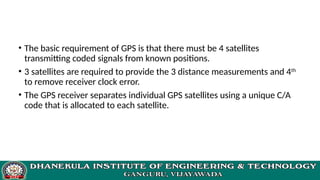
• The basic requirement of GPS is that there must be 4 satellites
transmitting coded signals from known positions.
• 3 satellites are required to provide the 3 distance measurements and 4th
to remove receiver clock error.
• The GPS receiver separates individual GPS satellites using a unique C/A
code that is allocated to each satellite.
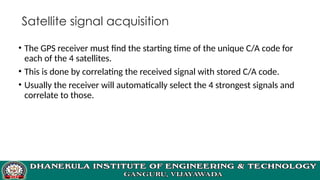
Satellite signal acquisition
• The GPS receiver must find the starting time of the unique C/A code for
each of the 4 satellites.
• This is done by correlating the received signal with stored C/A code.
• Usually the receiver will automatically select the 4 strongest signals and
correlate to those.
• If the receiver is making a cold start ,with no information about the
current position of GPS satellites, or its own location ,it must search all
37 C/A codes until it can correlate with one.
• Once correlation is obtained ,the data stream (called navigation
message) from that satellite can be read by the receiver.
• The data stream contains information about adjacent satellites ,so once
correlated ,the receiver no longer needs to search through all other 36
possible codes to find the next satellite ;it can go directly to correct the
code.
• Searching all 36 C/A codes of 1023 bits for correlation is a slow process.
• The receiver locks to a given code by matching the locally generated code to
the code received from the wanted satellite.
• Since the start time of the code transmitted by satellite is not known when
receiver commences the locking process, an arbitary start point must be
selected.
• The locally generated code is compared ,bit by bit, through all 1023 bits of the
sequence ,until either lock is found, or the receiver concludes that this is not
the correct code for the satellite signal it is receiving
• If the starting time for the locally generated code was not selected
correctly, correlation will not be obtained immediately.
• Then locally generated code is moved one bit in time, and correlation is
attempted again.
• The process is continued 1023 times until a possible starting times for the
locally generated code have been tried.
• If the satellite with that particular C/A is not visible, no correlation will
occur and lock will not be achieved.
• It takes a minimum of 1s to search all 1023bit positions of a 1023 bit C/A
code, so it will take atleast 15s to acquire the first satellite.
• Although it takes only 20s on average to lock to the C/A code of one
satellite , the receiver must find the doppler frequency offset for at least
one satellite before correlation can occur.
• The receiver bandwidth is matched to the bandwidth of C/A code.
• There are 8 possible doppler shifts for each signal and 1023 possible code
positions ,giving 8184 possible signal states that must be searched.
• Once any of the GPS satellite has been acquired, the navigation message
provides sufficient information about the adjacent satellites to be acquired
quickly.
• The GPS receiver retains the information from the navigation message when
switched off, and it also runs its internal clock.
• When next switched on ,the receiver will assume that its position is close to its
last known position when it was switched off, calculate which satellites should
be visible ,and search for those first.
• If the receiver has been moved a large distance while turned off ,a cold start is
needed.
• The correlation process described above assumes that each satellite is
acquired sequentially.
• Some low cost receivers use sequential acquisition of the satellites, i.e
one satellite at a time.
• More sophisticated receivers have parallel correlators which can search
for and acquire satellites in parallel.
• 12 parallel correlators guarantee that all visible GPS satellite will be
acquired with better start up time and accuracy.
• Integrity monitoring of GPS measurement is possible by using a 5th
satellite to recalculate the receiver position.
• With 5 satellites there are 5 possible ways to select 4
pseudoranges ,leading to 5 calculations of position.
• If there is disagreement between the results ,one bad measurement
can be eliminated.
• GPS receivers used for navigation of aircraft uses integrity monitoring
to guard against receiver or satellite failures and interference with or
jamming of GPS signals.
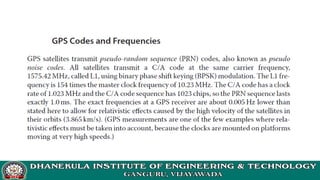
GPS Codes and
Frequencies
• Dr M Vamshi Krishna
• Professor
• Department of ECE
• Dhanekula Institution of Engineering & Technology
• 7. b) Explain the principle and advantages of Differential GPS. [7]
• 7. a) Explain the generation of GPS L1 and L2 signals. [7]
• 7. a) Draw the basic architecture of GPS and explain in detail. [7]
• 7. a) Explain the various functions of Ground segment of GPS architecture. [7]
• b) Describe the format of GPS navigation message. [7]
• 7. a) Explain the position location principles of GPS system. [8]]
• 7. a) Explain about the GPS receivers and its codes. [8]
• 7. a) Explain the trilateration method used for position of GPS receiver. [8]
• b) Explain the function of the non-coherent delay lock loop in GPS receiver.
[8]
• b) Explain the technology of range error budget used to provide accuracy in
GPS C/A code receiver.
• b) Write short note on GPS C/A code accuracy. [8]
• 7. a) Explain the functions of control segment in GPS. [8]
• b) Describe the various sources of errors in GPS. [8]
• 7. a) Write notes on GPS Navigation Message and GPS signal levels. [8]
• b) What are the different segments in GPS configuration? Explain. [8]

Unit 6 gps.ppt presentation on gps system

  • 1.
  • 2.
    Text Book: • SatelliteCommunications, Third Edition. Timothy Pratt and Jeremy Allnutt.© 2020 JohnWiley & Sons Ltd. Published 2020 by JohnWiley & Sons Ltd.
  • 3.
    UNIT V • SATELLITENAVIGATION & THE GLOBAL POSITIONING SYSTEM [1] : Radio and Satellite Navigation, GPS Position Location principles, GPS Receivers and codes, Satellite signal acquisition, GPS Navigation Message, GPS signal levels, GPS receiver operation, GPS C/A code accuracy, Differential GPS.
  • 4.
    • Global PositioningSystem (GPS) is a navigation system based on satellite. The Global Positioning System (GPS) is a worldwide radio-navigation system formed from a constellation of 24 satellites and their ground stations. • It has created the revolution in navigation and position location. • It is mainly used in positioning, navigation, monitoring and surveying applications. • The major advantages of satellite navigation are real time positioning and timing synchronization. • That’s why satellite navigation systems have become an integral part in most of the applications, where mobility is the key parameter.
  • 5.
    • A completeoperational GPS space segment contains twenty-four satellites in MEO. • These satellites are made into six groups so that each group contains four satellites. • The group of four satellites is called as one constellation. • Any two adjacent constellations are separated by 60 degrees in longitude. • The orbital period of each satellite is approximately equal to twelve hours. • Hence, all satellites revolve around the earth two times on every day. • At any time, the GPS receivers will get the signals from at least four satellites.
  • 6.
    • Global PositioningSystem (GPS) Architecture • The Architecture of Global Positioning System consists of three segments or units namely: • GPS Space Segment • GPS Control Segment • GPS Receiver (User) Segment
  • 7.
    • Global PositioningSystem (GPS) Space Segment • The Space Unit consists of 24 active satellites which are assembled with huge solar panels with rechargeable batteries that act as a power source. • The function of the satellites in space is to route or navigate the radio signals received from the control unit to store and re-transmit the message to the respective Receiver Unit.
  • 8.
    • Global PositioningSystem (GPS) Control Segment • The Control Unit consists of several monitoring and control stations. The monitor stations monitor the GPS satellite signals. • These signals are then sent to the master control station where operational specifications are checked and revised before transmitting the control signals back to the GPS satellites. They are sent back through ground antennas.
  • 9.
    Global Positioning System(GPS) Receiver (User) Segment The User Unit is the term given to all GPS receivers like mobile phones, laptops, PC or any other device. The devices receives the signals from the GPS satellites and determines how far away it is from each satellite.
  • 10.
    • GPS Receiver •There exists only one-way transmission from satellite to users in GPS system. • Hence, the individual user does not need the transmitter, but only a GPS receiver. • It is mainly used to find the accurate location of an object. • It performs this task by using the signals received from satellites.
  • 11.
    The block diagramof GPS receiver is shown in below figure
  • 12.
    • The functionof each block present in GPS receiver is mentioned below. • Receiving Antenna receives the satellite signals. It is mainly, a circularly polarized antenna. • Low Noise Amplifier (LNA) amplifies the weak received signal • Down converter converts the frequency of received signal to an Intermediate Frequency (IF) signal. • IF Amplifier amplifies the Intermediate Frequency (IF) signal. • ADC performs the conversion of analog signal, which is obtained from IF amplifier to digital. Assume, the sampling & quantization blocks are also present in ADC (Analog to Digital Converter). • DSP (Digital Signal Processor) generates the C/A code. • Microprocessor performs the calculation of position and provides the timing signals in order to control the operation of other digital blocks. It sends the useful information to Display unit in order to display it on the screen.
  • 13.
    • GPS Codesand Services • Each GPS satellite transmits two signals, L1 and L2 are of different frequencies. • Trilateration is a simple method for finding the position (Latitude, Longitude, Elevation) of GPS receiver. • By using this method, the position of an unknown point can be measured from three known points
  • 14.
    • GPS Codes •Following are the two types of GPS codes. • Coarse Acquisition code or C/A code • Precise code or P code • The signal, L1 is modulated with 1.023 Mbps pseudo random bit sequence. This code is called as Coarse Acquisition code or C/A code and it is used by the public. • The signal, L2 is modulated with 10.23 Mbps pseudo random bit sequence. This code is called as Precise code or P code and it is used in military positioning systems. • Generally, this P code is transmitted in an encrypted format and it is called as Y code • The P code gives better measurement accuracy when compared to C/A code, since the bit rate of P code is greater than the bit rate of C/A code.
  • 15.
    • GPS Services •Following are the two types of services provided by GPS. • Precise Positioning Service (PPS) • Standard Positioning Service (SPS) • PPS receivers keep tracking of both C/A code and P code on two signals, L1 and L2. The Y code is decrypted at the receiver in order to obtain P code. • SPS receivers keep tracking of only C/A code on signal, L1.
  • 16.
    GPS Position Location Principles •Dr M Vamshi Krishna • Professor • Dhanekula Institute of Engineering & Management
  • 17.
    • The basicrequirement of a satellite navigation system like GPS is that there must be four satellites transmitting suitably coded signals from known positions. • Three satellites are required to provide the three distance measurements, and the fourth is used to remove receiver clock error.
  • 18.
    Figure 12.2 showsthe general arrangement of position location with GPS. The three satellites provide distance information when the GPS receiver makes three measurements of range, Ri, from the receiver to three known points, that is, GPS satellites.
  • 19.
    • Each distanceRi can be thought of as the radius of a sphere with a GPS satellite at its center. • The receiver lies at the intersection of three such spheres, with a satellite at the center of each sphere.
  • 20.
    • A basicprinciple of geometry is that the intersection of three planes completely defines a point. • Thus three satellites, through measurement of their distances to the receiver, define the receiver location close to the earth’s surface.
  • 21.
    • Although theprinciples by which GPS locates a receiver are very simple, requiring only the accurate measurement of three ranges to three satellites, implementing the measurement with the required accuracy is quite complex. • We will look first at the way in which range is measured in a GPS receiver and then consider how to make the measurements.
  • 22.
    • Range iscalculated from the time delay incurred by the satellite signal in traveling from the satellite to the GPS receiver, using the known velocity of EM waves in free space. • To measure the time delay, we must know the precise instant at which the signal was transmitted, and we must have a clock in the receiver that is synchronized to the clock on the satellite.
  • 23.
    • GPS satelliteseach carry three atomic clocks, which are calibrated against time standards in GPS control stations around the world. The result is GPS time, a time standard that is available in every GPS satellite. • The accuracy of an atomic clock is typically 1 part in 1012. • A standard crystal oscillator with a long term accuracy of 1 in 105 or 1 in 106 is used in low cost civil GPS receivers.
  • 24.
    • However, overthe short time period in which GPS location measurements are made, the oscillator is stable to one part in 1012. • The receiver clock is allowed to have an offset relative to the GPS satellite clocks, so when a time delay measurement is made, the measurement will have an error caused by the clock offset.
  • 25.
    • For example,suppose the receiver clock has an offset of 10 ms relative to GPS time. • All distance measurements will then have an error of 3000 km. Clearly, we must have a way to remove the time error from the receiver clock before we can make accurate position measurements. • C/A code receivers can synchronize their internal clocks to GPS time within 10 ns, corresponding to a distance measurement uncertainty of 3 m. • Repeated measurements and integration improve the position location error to below 10 m.
  • 26.
    • It issurprisingly easy to remove the clock error, and this removal is one of the strengths of GPS. All that is needed is a time measurement from a fourth satellite. • We need three time measurements to define the location of the receiver in the three unknown coordinates x, y, and z . • When we add a fourth time measurement we can solve the basic position location equations for a fourth unknown – the receiver clock offset error τ (often called clock bias). Thus the four unknowns in the calculation of the location of the receiver are x, y, z, and τ.
  • 27.
    Position Location inGPS • First, we will define the coordinates of the GPS receiver and the GPS satellites in a rectangular coordinate system with its origin at the center of the earth. • This is called the earth centered earth fixed (ECEF) coordinate system, and is part of the WGS-84 description of the earth. • WGS-84 is an internationally agreed description of the earth’s shape and parameters, derived from observations in many countries (Strang and Borre 1997).
  • 28.
    • GPS receiversuse the WGS-84 parameters to calculate the orbits of the GPS satellites with the accuracy required for precise measurement of the range to the satellites. • The Z-axis of the coordinate system is directed through the earth’s north pole and the X- and Y-axes are in the equatorial plane. • The X-axis passes through the Greenwich meridian – the line of zero longitude on the earth’s surface, and the Y-axis passes through the 90° east meridian.
  • 30.
    • The ECEFcoordinate system rotates with the earth. • The receiver coordinates are (Ux, Uy, Uz), and the four satellites have coordinates (Xi, Yi, Zi), where i = 1, 2, 3,4. There may be more than four satellite signals available, but we use only four signals in a basic position calculation. • The measured distance to satellite number (i) is called a pseudo range, PRi, because it uses the internal clock of the receiver to make a timing measurement that includes errors caused by receiver clock offset. • The geometry of a GPS measurement is illustrated in Figure 12.3.
  • 32.
    • The positionof the satellite at the instant it sent the timing signal (which is actually the start of a long sequence of chips) is obtained from ephemeris data transmitted along with the timing signals in the navigation message. • Each satellite sends out a data stream that includes ephemeris data for itself and the adjacent satellites.
  • 33.
    • The receivercalculates the coordinates of the satellite relative to the center of the earth (Xi, Yi, Zi), at the instant the satellite started to transmit the chip sequence and then solves the four ranging equations for the four unknowns using standard numerical techniques for the solution of nonlinear simultaneous equations. • (The equations are non-linear because of the squared terms.)
  • 34.
    • The fourunknowns are the location of the GPS receiver, (Ux, Uy, Uz), relative to the center of the earth and the clock offset τ – called clock bias in GPS terminology. • The receiver position is then referenced to the surface of the earth, and can be displayed in latitude, longitude, and elevation. • Typical accuracy for a GPS receiver using the GPS C/A code is 5m defined as a 2DRMS error. • The term DRMS means the root mean square (RMS) error of the measured position relative to the true position of the receiver.
  • 35.
    • If themeasurement errors are Gaussian distributed, as if often the case, 68% of the measured position results will be within a distance of 1DRMS from the true location and 95% of the results will be within 2DRMS of the true location. • Accuracy in GPS measurements is usually defined in terms of 2DRMS, in the horizontal or vertical plane.
  • 36.
    GPS Time • Theclock bias value τ, which is found as part of the position location calculation process can be added to the GPS receiver clock time to yield a time measurement that is synchronized to the GPS time standard. • The crystal oscillator used in the GPS receiver is highly stable over a period of a few seconds, but will have a frequency that changes with temperature and with time.
  • 37.
    • Temperature changescause the quartz crystal that is the frequency determining element of a crystal oscillator to expand or contract, and this changes the oscillator frequency. • Crystals also age, which causes the frequency to change over time. The changes are very small, but sufficient to cause errors in the clock time at the receiver when the clock is not synchronized to a satellite.
  • 38.
    • Calculating theclock bias by solving the ranging equations allows the receiver clock time to be updated every second or two so that the GPS receiver time readout is identical to GPS time. • Every GPS receiver is automatically synchronized to every other GPS receiver anywhere in the world through GPS time.
  • 39.
    • This makesevery GPS receiver a super clock which knows time more accurately than any other time standard. • GPS time differs from Greenwich Mean Time (GMT or UTC) because UTC is tied to the rotation of the earth. Leap seconds are added to UTC to account for the slowing of the earth’s rotation, but not to GPS time.
  • 40.
  • 42.
    Every satellite receivesfrom the ground antennas the navigation data which is sent back to the users through the navigation message. The Navigation Message provides all the necessary information to allow the user to perform the positioning service. •Ephemeris parameters •Time parameters •Clock Corrections •Service Parameters •Ionospheric parameters
  • 43.
    It includes theEphemeris parameters, needed to compute the satellite coordinates with enough accuracy, the Time parameters and Clock Corrections, to compute satellite clock offsets and time conversions, the Service Parameters with satellite health information (used to identify the navigation data set), Ionospheric parameters model needed for single frequency receivers, and the Almanacs, allowing the computation of the position of ”all satellites in the constellation”, with a reduced accuracy (1 - 2 km of 1-sigma error), which is needed for the acquisition of the signal by the receiver. The ephemeris and clocks parameters are usually updated every two hours, while the almanac is updated at least every six days.
  • 44.
    •Besides the "legacy"L1 C/A navigation message, four additional new messages have been introduced by the so called GPS modernisation: • L2-CNAV, CNAV-2, L5-CNAV and MNAV. • The "legacy" message and the first three of the modernised GPS are civil messages, while the MNAV is a military message. •In modernised GPS, the same type of contents as the legacy navigation message (NAV) is transmitted but at higher rate and with improved robustness.
  • 45.
    •The messages L2-CNAV,L5-CNAV and MNAV have a similar structure and (modernised) data format. • The new format allows more flexibility, better control and improved content. • Furthermore, the MNAV includes new improvements for the security and robustness of the military message. •The CNAV-2 is modulated onto L1C, sharing the same band as the "legacy" navigation message.
  • 46.
    L1 C/A •The current“legacy” Navigation Message (NAV) is modulated on both carriers at 50 bps. •The whole message contains 25 pages (or ’frames’) of 30 seconds each, forming the master frame that takes 12.5 minutes to be transmitted. • Every frame is subdivided into 5 sub-frames of 6 seconds each; in turn, every sub-frame consists of 10 words, with 30 bits per word (see figure 3). •Every sub-frame always starts with the telemetry word (TLM), which is necessary for synchronism. Next, the transference word (HOW) appears. This word provides time information (seconds of the GPS week), allowing the receiver to acquire the week-long P(Y)-code segment.
  • 48.
    •The content ofevery sub-frame is as follows: •Sub-frame 1: contains information about the parameters to be applied to satellite clock status for its correction. These values are polynomial coefficients that allow converting time on board to GPS time. It also has information about satellite health condition. •Sub-frames 2 and 3: these sub-frames contain satellite ephemeris. •Sub-frame 4: provides ionospheric model parameters (in order to adjust for ionospheric refraction), UTC information (Universal Coordinate Time), part of the almanac, and indications whether the Anti-Spoofing, A/S, is activated or not (which transforms P code into the encrypted Y code).
  • 49.
    •Sub-frame 5: containsdata from the almanac and the constellation status. It allows to quickly identify the satellite from which the signal comes. A total of 25 frames are needed to complete the almanac. •Sub-frames 1, 2 and 3 are transmitted with each frame (i.e., they are repeated every 30 seconds). Sub-frames 4 and 5 contain different pages (25 pages each) of the navigation message (see figure 1). • Hence, the transmission of the full navigation message takes 25 × 30 seconds = 12.5 minutes. The content of sub-frames 4 and 5 is common for all satellites. •Hence, the almanac data for all in orbit satellites can be obtained from a single tracked satellite.
  • 50.
    L2-CNAV The initial L2Cbroadcast consisted of a default message (Message Type 0) that did not provided full navigational data. Initially the plan was to keep the dummy transmission until the new Operational Control Segment (OCX) would be operational. However the Air Force decided to anticipate the provision of the L2C navigation message with the aim of helping the development of compatible user equipments as well facilitate the CNAV Operations Concept.
  • 51.
    •The message-populated broadcaststarted on April 2014 with reduced data accuracy and update frequency compared to the legacy GPS signals in wide use today. •From December 2014 is planed that L2-CNAV data updates will increase to a daily rate, bringing L2C signal-in-space accuracy on par with the legacy signals. • However, derived position accuracy cannot be guaranteed during the pre-operational deployment of the frequencies and its use must be used only for testing and research activities despite the health bit set “healthy”.
  • 52.
    On December 2014,the CNAV navigation message started to be updated on a daily basis just like the legacy message but must be still considered as pre- operational data and its use must be restricted to testing purposes[3] . Operational declarations for L2-CNAV will require implementation of new monitoring and control capabilities in Block 1 of the Next Generation Operational Control System (OCX).
  • 53.
    Its design replacesthe use of frames and sub-frames of data (repeating in a fixed pattern) of the original “legacy” NAV by a packetised message-based communications protocol, where individual messages can be broadcast in a flexible order with variable repeat cycles as represented in figure 2. Moreover, Forward Error Correction (FEC) and advanced error detection (such as a CRC) are used to achieve better error rates and reduced data collection times.
  • 54.
    Each message iscomposed by fixed data such as a Preamble, Message Type ID, Alert Flag, Message TOW count and CRC which lets 238 bits to be filled with other navigation related data. It is possible to define up to 63 different message types, but currently only the messages types 10-14 and 30-37 are defined. The remaining undefined and unused message types are reserved for future use. Broadcast of messages is completely arbitrary, but sequenced to provide optimum user performance.
  • 56.
    L5-CNAV Like L2-CNAV, theL5 message-populated broadcast started on April 2014 but set “unhealthy,” but as greater experience with the L5 broadcast and implementation of signal monitoring is achieved, this status may change upon review. Operational declarations for L5-CNAV will require implementation of new monitoring and control capabilities in Block 1 of the Next Generation Operational Control System (OCX). The L5-CNAV is modulated onto L5I signal component, containing basically the same information data as L2-CNAV. The message structure is exactly the same but its content may vary slightly.
  • 57.
    Figure 3: L5-CNAVNavigation message •As in L2-CNAV, it is possible to define up to 63 different message types, but currently only the messages types 10-14 and 30-37 are defined. The remaining undefined and unused message types are reserved for future use.
  • 58.
    CNAV-2 The message CNAV-2consists of sub-frames and frames and is modulated onto the L1C signal. Each frame is divided into three sub-frames of varying length being required multiple frames to broadcast a complete data message set to users. •Subframe 1 (9 bits) provides Time of Internal. •Subframe 2 (600 bits) provides clock and ephemeris data. •Subframe 3 (274 bits) provides other navigation data which is commutated over multiple pages.
  • 60.
    Differential GPS • DrM Vamshi Krishna • Professor • Department of ECE • Dhanekula Institution of Engineering and Management
  • 61.
    Contents • Differential GPS •Errors in GPS Range Measurements. • Correction Parameterization and Distribution • Ionospheric Divergence • Solution Method • New Developments
  • 62.
    Differential GPS • TheGlobal Positioning System delivers about 6 m horizontal error and 10 m in three dimensions to a dual frequency user. • This was much worse for the civilian user before the intentional degradation of the signal was removed. It likely will improve in the future. • Differential GPS works by having a reference system at a known location measure the errors in the signals and send corrections to users in the "local" area. • These corrections will not be universal, but will be useful over a significant area. • The corrections are normally sent every few seconds. The user is generally some mobile platform such as a ship, car, truck or even an aircraft.
  • 64.
    • For themajority of civilian users single frequency receivers are used. • The public ranging modulation is currently only on the L1 signal. The only ranging signal on L2 is encrypted. • The exceptions are survey and scientific systems that use expensive receivers with methods to work around the L2 encryption. • The single frequency user must deal with the error produced as the signals go through the ionosphere. • The second frequency was put on the GPS satellites to allow real time removal of the ionospheric error. • It does this to an accuracy better than 1 cm.
  • 65.
    • The useof differential GPS produces a position solution much more accurate than the that of the standalone user, either civilian or military. • It does this even for the single frequency receivers. In fact all common DGPS systems work only with the L1 frequency signal, even if the receiver can track both L1 and L2 frequencies. • It is common today to have ships navigating on DGPS with 1 to 2 meter position accuracy.
  • 66.
    Errors in GPSRange Measurements. • Differential GPS works by measuring the errors in GPS signals at a reference station(s) and sending the corrections to users. • The errors in the signal at then antenna should be almost the same for another receiver close by. The definition of "close" depends on the specific error.
  • 68.
    • The SelectiveAvailability (SA), when it was turned on, had a standard deviation of about 30 meters. • It was usually the dominant error for the civilian GPS user. It is zero now. However, when it was on, it was totally removed by DGPS systems.
  • 69.
    • The ionosphereerror varies greatly with time of day, location, and the solar cycle. It also is a function of elevation angle. • Low elevation angle lines of sight have a longer path length within the ionosphere than vertical paths. At night for high elevation angles the ionospheric error can be as low as 1 meter. • In late afternoon, in the tropics, at solar maximum, a 20 degree elevation angle observation could have a 50 m ionospheric error. Ionosphere errors in the tropics at the 10 to 30 m level are common.
  • 70.
    • The atmosphericerror is about 2.5 m for a vertical line of sight. It varies in a very predictable way and is well modeled in most receivers. • Only at angles below 5 degrees do complex bending effects come into play. Only very precise scientific work needs to go beyond the standard modeling for this error. • The ionosphere is the dominant error for single frequency user. The last three errors are the dominant error sources for a dual frequency user. They are also important for the single frequency user.
  • 71.
    • In orderto navigate, not only are good ranges needed, but also the location of the end point of the range. That is, the positions of the satellites are required. Providing this information is the job of the US Air Force, which runs the GPS system. • They use a series of monitor stations to acquire data in real time and estimate the position, velocity, and satellite clock error of each satellite every 15 minutes. • They use these solutions to make a prediction of the satellite parameters for the following day. These predictions are then parameterized and loaded into the satellite onboard memory. This data is sent to the user on the GPS signal. It is called the Broadcast Ephemeris (BCE). On average this prediction will be 12 hours old.
  • 72.
    • The largesterror will be the satellite clock error. If all the satellite clocks are not synchronized, navigation is degraded. Setting all the GPS satellite clocks to a form of Universal Time Coordinated (UTC) accomplishes this. (The time differs from UTC by some integer number of seconds. For this reason it is called GPS Time.) • Even though extremely good atomic clocks are on each satellite, there is a wander in the clocks. This is a random process and cannot be modeled. There may also be some residual systematic error in the predicted clock state.
  • 73.
    • There aretwo remaining errors that are specific to individual receivers. The multipath error is caused by reflections of the GPS signals from metal objects near the antenna. • DGPS reference stations go to great lengths to minimize this error though good antenna locations. The DGPS user may not have this option. •
  • 74.
    • The lasterror is the thermal noise inside the receiver. This is a function of the individual receiver design. It is lower in more expensive receivers. • However each year the receiver noise level on new receivers decreases some. It is like the increase in speed on computers, but not quite as dramatic a change. Today the receiver noise varies from 2 m to 10 cm for civilian receivers.
  • 75.
    • Today theionosphere and Orbit-and-Clock errors are usually the dominant errors for the civilian navigator. • DGPS essentially removes these. • The orbit error is only slightly different for users within a 1000 km or so of the reference station. That cannot be said of the ionosphere error. • Its change with distance from the reference station is discussed later under ionospheric divergence. • The remaining issues in designing or choosing a DGPS system are how to get the errors to the user, and what solution technique to use.
  • 76.
    Correction Parameterization andDistribution • There are two approaches to parameterizing the errors measured by the reference station(s). • In the most common approach, the range error is measured for each satellite and these satellite by satellite errors sent to the user. This is a point approach. • It is valid at the reference receiver. Its validity will decrease with distance from that site.
  • 77.
    • In thesecond approach multiple stations are used to estimate the errors over an extended area. • This is called Wide Area DGPS (WADGPS). • The Federal Aviation Administrations (FAA) Wide Area Augmentation System (WAAS) is this type of system. • There are also commercial systems of this type. The corrections are parameterized in a way that allows the user to compute corrections based on his location. Two users separated by a 100 km or so will get different corrections from the same WADGPS parameter set.
  • 78.
    Ionospheric Divergence • Thenormal limitation on the utility of DGPS corrections is the difference in the ionospheric error seen by the reference station and the user. • This ionospheric error is determined by the ionospheric conditions where the line of sight passes through 300 to 400 km altitude. • For a vertical ray, this is overhead. For a low elevation ray it can be 1500 km away (about 15 degrees of earth central angle).
  • 79.
    • The ionosphereis much more variable than the atmosphere. It most dramatic variation is from day to night. • It essentially goes away late at night. It rebuilds quickly at dawn and then intensifies thought the day. Its decay after sunset is gradual. • Maps of the peak electron density of the ionosphere are shown in Figures 4 and 5. • These values are proportional to the ionospheric error. The plots are for 1800 UT, when sunrise is in the Pacific and sunset over the zero of longitude line. Sunrise at 300 km occurs before it does on the ground.
  • 80.
  • 81.
  • 82.
    Solution Method • Thereare two common methods of finding a location with differential GPS. The most common method for navigation applications is to use corrected ranges. This is the same solution method used by the standalone user, but with some systematic errors removed. The survey community has used the carrier phase as its basic measurement from the beginning of GPS surveying.
  • 83.
    • This wasthen applied to cases where the unknown location was in motion. This was called Kinematics. In practice kinematics can only be done with dual frequency data. • Even though both frequencies are used, it is sensitive to ionospheric divergence. The user usually needs to be within 30 km of the reference site during the day.
  • 84.
    • In thebeginning, kinematics was only done on a post-processing basis. However with the increase in computation capabilities, it became possible to do the kinematic solution inside the GPS receiver. • This is called Real Time Kinematics, or RTK. Many high end dual frequency receivers now can do RTK. • It is still limited to ranges of 30 to 100 km of the reference sites. Also the system often needs to be initialized at 30 km or less. • The original version of the RTCM format did not allow for the corrections necessary for RTK. • However, revision 2 has new message formats designed for this. Many RTK implementations allow both the RTCM and manufacturer proprietary DGPS formats.
  • 85.
    New Developments • Thepackage of changes that was accepted when the Selective Availability was turned off includes two other items important to civilian DGPS users. • First the publicly available ranging signal will be placed on both the GPS frequencies beginning with launches in 2003. The earlier spacecraft only had this signal on the L1 frequency. • This will make it possible for low end receivers now to automatically correct for the ionospheric error. • Using the L2 signal in DGPS will require some changes to the RTCM format, but this is expected.
  • 86.
    • Beginning inabout 2007, satellites launched will have a third civilian frequency, called L5. • This will allow kinematic solutions to be initialized and utilized at much longer ranges. • The precise ranges will have to be determined post launch. It is likely that WAAS will not utilize the new signal on L2, but it is likely to use the L5 signal. • This is due to a low, but measurable, probability of interference on L2 with some radars and mobile communications services in Europe.
  • 87.
    • There aremany science experiments done each year using GPS. Some, for example from NASAs Goddard Space Flight Center, have done kinematics out to a thousand kilometers. • Experiments have been conducted on using a network of reference stations to generate standard GPS corrections. • Receivers are becoming immune to multipath, at least for the top of the line receivers. • The noise level in receivers is also coming down. Where all this will lead is unclear, but the results can only be beneficial to the GPS community.
  • 88.
  • 89.
    • GPS C/ACode Standard Positioning System Accuracy • Position location accuracy is defined as the probability that the measured location of a GPS receiver is within a specified distance of its true location. • For example, typical accuracy for a GPS receiver using the GPS C/A code is 5 m, defined as a 2DRMS error, which means that 95% of measurements will be within 5m of the receiver’s true location. • The term DRMS means the RMS error of the measured position relative to the true position of the receiver
  • 90.
    • If themeasurement errors are Gaussian distributed, as if often the case, 68% of the measured position results will be within a distance of 1DRMS from the true location and 95% of the results will be within 2DRMS of the true location. • For 99.8% of measurements the accuracy will be within 3DRMS. Accuracy in GPS measurements is usually defined in terms of 2DRMS, in the horizontal or vertical plane. • Accuracy is always better in the horizontal plane than the vertical plane because GPS satellites can surround the receiver in the horizontal plane, but can only be above the receiver in the vertical plane.
  • 99.
  • 100.
    • The basicrequirement of GPS is that there must be 4 satellites transmitting coded signals from known positions. • 3 satellites are required to provide the 3 distance measurements and 4th to remove receiver clock error. • The GPS receiver separates individual GPS satellites using a unique C/A code that is allocated to each satellite.
  • 101.
    Satellite signal acquisition •The GPS receiver must find the starting time of the unique C/A code for each of the 4 satellites. • This is done by correlating the received signal with stored C/A code. • Usually the receiver will automatically select the 4 strongest signals and correlate to those.
  • 102.
    • If thereceiver is making a cold start ,with no information about the current position of GPS satellites, or its own location ,it must search all 37 C/A codes until it can correlate with one. • Once correlation is obtained ,the data stream (called navigation message) from that satellite can be read by the receiver. • The data stream contains information about adjacent satellites ,so once correlated ,the receiver no longer needs to search through all other 36 possible codes to find the next satellite ;it can go directly to correct the code. • Searching all 36 C/A codes of 1023 bits for correlation is a slow process.
  • 103.
    • The receiverlocks to a given code by matching the locally generated code to the code received from the wanted satellite. • Since the start time of the code transmitted by satellite is not known when receiver commences the locking process, an arbitary start point must be selected. • The locally generated code is compared ,bit by bit, through all 1023 bits of the sequence ,until either lock is found, or the receiver concludes that this is not the correct code for the satellite signal it is receiving
  • 104.
    • If thestarting time for the locally generated code was not selected correctly, correlation will not be obtained immediately. • Then locally generated code is moved one bit in time, and correlation is attempted again. • The process is continued 1023 times until a possible starting times for the locally generated code have been tried. • If the satellite with that particular C/A is not visible, no correlation will occur and lock will not be achieved. • It takes a minimum of 1s to search all 1023bit positions of a 1023 bit C/A code, so it will take atleast 15s to acquire the first satellite.
  • 105.
    • Although ittakes only 20s on average to lock to the C/A code of one satellite , the receiver must find the doppler frequency offset for at least one satellite before correlation can occur. • The receiver bandwidth is matched to the bandwidth of C/A code. • There are 8 possible doppler shifts for each signal and 1023 possible code positions ,giving 8184 possible signal states that must be searched.
  • 106.
    • Once anyof the GPS satellite has been acquired, the navigation message provides sufficient information about the adjacent satellites to be acquired quickly. • The GPS receiver retains the information from the navigation message when switched off, and it also runs its internal clock. • When next switched on ,the receiver will assume that its position is close to its last known position when it was switched off, calculate which satellites should be visible ,and search for those first. • If the receiver has been moved a large distance while turned off ,a cold start is needed.
  • 107.
    • The correlationprocess described above assumes that each satellite is acquired sequentially. • Some low cost receivers use sequential acquisition of the satellites, i.e one satellite at a time. • More sophisticated receivers have parallel correlators which can search for and acquire satellites in parallel. • 12 parallel correlators guarantee that all visible GPS satellite will be acquired with better start up time and accuracy.
  • 108.
    • Integrity monitoringof GPS measurement is possible by using a 5th satellite to recalculate the receiver position. • With 5 satellites there are 5 possible ways to select 4 pseudoranges ,leading to 5 calculations of position. • If there is disagreement between the results ,one bad measurement can be eliminated. • GPS receivers used for navigation of aircraft uses integrity monitoring to guard against receiver or satellite failures and interference with or jamming of GPS signals.
  • 109.
    GPS Codes and Frequencies •Dr M Vamshi Krishna • Professor • Department of ECE • Dhanekula Institution of Engineering & Technology
  • 118.
    • 7. b)Explain the principle and advantages of Differential GPS. [7] • 7. a) Explain the generation of GPS L1 and L2 signals. [7] • 7. a) Draw the basic architecture of GPS and explain in detail. [7] • 7. a) Explain the various functions of Ground segment of GPS architecture. [7] • b) Describe the format of GPS navigation message. [7] • 7. a) Explain the position location principles of GPS system. [8]] • 7. a) Explain about the GPS receivers and its codes. [8]
  • 119.
    • 7. a)Explain the trilateration method used for position of GPS receiver. [8] • b) Explain the function of the non-coherent delay lock loop in GPS receiver. [8] • b) Explain the technology of range error budget used to provide accuracy in GPS C/A code receiver. • b) Write short note on GPS C/A code accuracy. [8] • 7. a) Explain the functions of control segment in GPS. [8] • b) Describe the various sources of errors in GPS. [8] • 7. a) Write notes on GPS Navigation Message and GPS signal levels. [8] • b) What are the different segments in GPS configuration? Explain. [8]