2
3
1) Introduction:
• What is learning through play?
• Controversy/concerns with
learning through play
2) Pros of learning through play:
• Developmentally appropriate materials
• Promoting deeper learning
3) Cons of learning through play….
• Concerns of learning through play
4) Conclusion/Review
Meaningful business of play Pg. 76
4
• It is an activity that children undertake for pleasure and is one of children’s
primary needs in their development.
• The Early Years Foundation Stage: Promotes the use of play to help
children develop a broad range of knowledge & skills that provide the
right foundation for future progress through school & throughout life.
• Play is what children and young people do when they follow their own
ideas in their own way & for their own reasons. A powerful element of this
is that children have ownership of their play. From a child’s perspective
play can be a satisfying & enjoyable occupation that can promote feelings
of inner well-being.
• The importance of the pleasure gained from play should not be
underestimated both for psychological & physiological development.
Children play because it is fun.
Learning Through Play, pg.8
5
Theoretical perspectives on play “The
Early Years Foundation Stage: Theory and
Practice, Pg. 74
6
https://presidentscircle.childcare.utah.edu/_documents/children-learn-thru-play.pdf
7
Age Range: Description:
Birth-1 year old Learns about surroundings by
using all 5 sense & is learning
cause & effect
1-3 years old Moves around environment a
lot. Strong interest in
manipulating & problem solving
with objects begin during this
period.
3-5 years old Preschoolers love to be around
other children and enjoy sharing
many kinds of activities.
Developmentally Appropriate Toys:
Birth-1 year old: 1-3 years old
3-5 years old:
Stacking toys Mirrors
Dress up/Dramatic
play
Puzzles
Large building blocks
Shape & color
stackers
https://www.allhandsondeck.community/play-chiappetti-1/
8
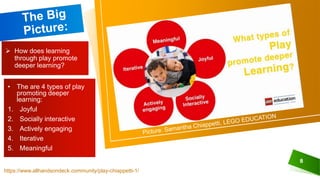
 How does learning
through play promote
deeper learning?
• The are 4 types of play
promoting deeper
learning:
1. Joyful
2. Socially interactive
3. Actively engaging
4. Iterative
5. Meaningful
Learning through play: a review of the evidence, pg.19
9
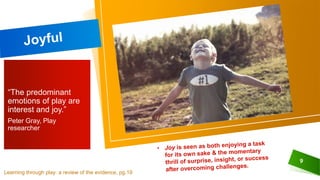
“The predominant
emotions of play are
interest and joy.”
Peter Gray, Play
researcher
Learning through play: a review of evidence, Pg.21
10
• Meaningful: Is about
children finding meaning in
experience by connecting it
to something they already
know.
• In play, children often
explore what they have
seen & done, or noticed
others do, as a way of
grasping what it means.
• By doing so, they can
express & expand their
understanding.
Learning through play: a review of evidence, Pg.23
11
Example:
A little girl is intently absorbed in
playing with a set of building
bricks. She is actively imagining
how the pieces will go together
& is so immersed that she didn’t
hear her father call her for
dinner.
• This mental immersion &
resistance to distraction is a
hallmark of both play &
learning separately, but
seems to be especially
powerful within the context of
learning through play.
Learning through play: a review of evidence, Pg.25
12
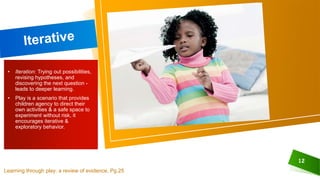
• Iteration: Trying out possibilities,
revising hypotheses, and
discovering the next question -
leads to deeper learning.
• Play is a scenario that provides
children agency to direct their
own activities & a safe space to
experiment without risk, it
encourages iterative &
exploratory behavior.
Learning through play: a review of evidence, Pg.27
13
Positive caregiver-child
interactions help build the neural
foundations for developing healthy
socio-emotional regulation and
protecting from learning barriers,
such as stress.
(Center for the Developing Child
at Harvard University, 2016).
Theoretical perspectives on play “The Early Years Foundation Stage: Theory and Practice, Pg. 74
14
• After spending a lot of time researching and looking for negatives of learning through play, it has come
to my attention that there were no articles or journals about the down sides of learning through play.
The only things I could find were some concerns about learning through play…..
Concerns of learning through play:
 Little understanding of how play progresses in early childhood and how
progression can be supported
 Practitioners tend to espouse an ideological adherence to the efficacy of free
play even though there is little empirical evidence to support this
 Practitioners make assumptions about the competence & ability of young
learners to benefit from predominantly laissez-faire environment in which they
are expected to choose a wide range of activities & experiences.
 Not all young children know how to play
15
16
CHIAPPETTI, S. (n.d.). All Hands on Deck. Retrieved May 22, 2019, from
https://www.allhandsondeck.community/play-chiappetti-1/
Palaiologou, I. (2009, October 29). The Early Years Foundation Stage.
Retrieved May 20, 2019, from
https://books.google.nl/books/about/The_Early_Years_Foundation_Stage
.html?id=uuAHvy8irpEC&redir_esc=y
Zosh, J. ., Hopkins, E. ., Liu, C., Neale, D., Hirsh-Pasek, K., Solis , S. ., &
Whitebread, D. (2017, November). Learning through play: a review of
evidence [Pdf]. Retrieved from
https://www.legofoundation.com/media/1063/learning-through-
play_web.pdf

Learning through play

  • 2.
  • 3.
    3 1) Introduction: • Whatis learning through play? • Controversy/concerns with learning through play 2) Pros of learning through play: • Developmentally appropriate materials • Promoting deeper learning 3) Cons of learning through play…. • Concerns of learning through play 4) Conclusion/Review
  • 4.
    Meaningful business ofplay Pg. 76 4 • It is an activity that children undertake for pleasure and is one of children’s primary needs in their development. • The Early Years Foundation Stage: Promotes the use of play to help children develop a broad range of knowledge & skills that provide the right foundation for future progress through school & throughout life. • Play is what children and young people do when they follow their own ideas in their own way & for their own reasons. A powerful element of this is that children have ownership of their play. From a child’s perspective play can be a satisfying & enjoyable occupation that can promote feelings of inner well-being. • The importance of the pleasure gained from play should not be underestimated both for psychological & physiological development. Children play because it is fun.
  • 5.
    Learning Through Play,pg.8 5 Theoretical perspectives on play “The Early Years Foundation Stage: Theory and Practice, Pg. 74
  • 6.
  • 7.
    https://presidentscircle.childcare.utah.edu/_documents/children-learn-thru-play.pdf 7 Age Range: Description: Birth-1year old Learns about surroundings by using all 5 sense & is learning cause & effect 1-3 years old Moves around environment a lot. Strong interest in manipulating & problem solving with objects begin during this period. 3-5 years old Preschoolers love to be around other children and enjoy sharing many kinds of activities. Developmentally Appropriate Toys: Birth-1 year old: 1-3 years old 3-5 years old: Stacking toys Mirrors Dress up/Dramatic play Puzzles Large building blocks Shape & color stackers
  • 8.
    https://www.allhandsondeck.community/play-chiappetti-1/ 8  How doeslearning through play promote deeper learning? • The are 4 types of play promoting deeper learning: 1. Joyful 2. Socially interactive 3. Actively engaging 4. Iterative 5. Meaningful
  • 9.
    Learning through play:a review of the evidence, pg.19 9 “The predominant emotions of play are interest and joy.” Peter Gray, Play researcher
  • 10.
    Learning through play:a review of evidence, Pg.21 10 • Meaningful: Is about children finding meaning in experience by connecting it to something they already know. • In play, children often explore what they have seen & done, or noticed others do, as a way of grasping what it means. • By doing so, they can express & expand their understanding.
  • 11.
    Learning through play:a review of evidence, Pg.23 11 Example: A little girl is intently absorbed in playing with a set of building bricks. She is actively imagining how the pieces will go together & is so immersed that she didn’t hear her father call her for dinner. • This mental immersion & resistance to distraction is a hallmark of both play & learning separately, but seems to be especially powerful within the context of learning through play.
  • 12.
    Learning through play:a review of evidence, Pg.25 12 • Iteration: Trying out possibilities, revising hypotheses, and discovering the next question - leads to deeper learning. • Play is a scenario that provides children agency to direct their own activities & a safe space to experiment without risk, it encourages iterative & exploratory behavior.
  • 13.
    Learning through play:a review of evidence, Pg.27 13 Positive caregiver-child interactions help build the neural foundations for developing healthy socio-emotional regulation and protecting from learning barriers, such as stress. (Center for the Developing Child at Harvard University, 2016).
  • 14.
    Theoretical perspectives onplay “The Early Years Foundation Stage: Theory and Practice, Pg. 74 14 • After spending a lot of time researching and looking for negatives of learning through play, it has come to my attention that there were no articles or journals about the down sides of learning through play. The only things I could find were some concerns about learning through play….. Concerns of learning through play:  Little understanding of how play progresses in early childhood and how progression can be supported  Practitioners tend to espouse an ideological adherence to the efficacy of free play even though there is little empirical evidence to support this  Practitioners make assumptions about the competence & ability of young learners to benefit from predominantly laissez-faire environment in which they are expected to choose a wide range of activities & experiences.  Not all young children know how to play
  • 15.
  • 16.
    16 CHIAPPETTI, S. (n.d.).All Hands on Deck. Retrieved May 22, 2019, from https://www.allhandsondeck.community/play-chiappetti-1/ Palaiologou, I. (2009, October 29). The Early Years Foundation Stage. Retrieved May 20, 2019, from https://books.google.nl/books/about/The_Early_Years_Foundation_Stage .html?id=uuAHvy8irpEC&redir_esc=y Zosh, J. ., Hopkins, E. ., Liu, C., Neale, D., Hirsh-Pasek, K., Solis , S. ., & Whitebread, D. (2017, November). Learning through play: a review of evidence [Pdf]. Retrieved from https://www.legofoundation.com/media/1063/learning-through- play_web.pdf

Editor's Notes

  • #6 Learning through play: a review of the evidence Jennifer M. Zosh, Emily J. Hopkins, Hanne JensLen, Claire Liu, Dave Neale, Kathy Hirsh-Pasek, S. Lynneth Solis and David Whitebread Theoretical perspectives on play “The Early Years Foundation Stage: Theory and Practice, Pg. 74
  • #7 Picture: UNICEF/UNI107199/Dormino
  • #8 Source: https://presidentscircle.childcare.utah.edu/_documents/children-learn-thru-play.pdf
  • #9 Picture: SAMANTHA CHIAPPETTI, LEGO EDUCATION https://www.allhandsondeck.community/play-chiappetti-1/
  • #10 Learning through play: a review of the evidence Jennifer M. Zosh, Emily J. Hopkins, Hanne JensLen, Claire Liu, Dave Neale, Kathy Hirsh-Pasek, S. Lynneth Solis and David Whitebread
  • #15 Theoretical perspectives on play “The Early Years Foundation Stage: Theory and Practice, Pg. 74