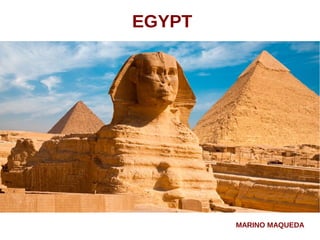
EGYPT
MARINO MAQUEDA
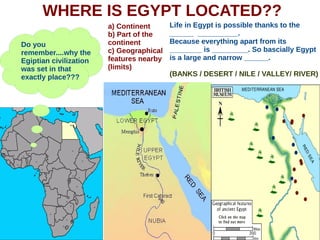
WHERE IS EGYPT LOCATED??
Do you
remember....why the
Egiptian civilization
was set in that
exactly place???
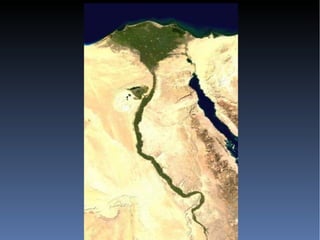
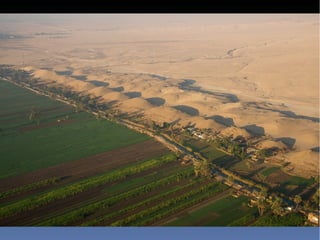
Life in Egypt is possible thanks to the
______ __________.
Because everything apart from its
________ is _________. So bascially Egypt
is a large and narrow ______.
(BANKS / DESERT / NILE / VALLEY/ RIVER)
a) Continent
b) Part of the
continent
c) Geographical
features nearby
(limits)
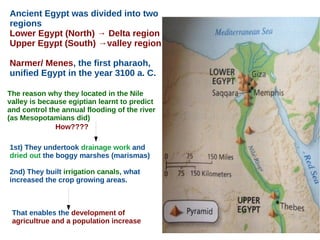
Ancient Egypt was divided into two
regions
Lower Egypt (North) → Delta region
Upper Egypt (South) →valley region
Narmer/ Menes, the first pharaoh,
unified Egypt in the year 3100 a. C.
The reason why they located in the Nile
valley is because egiptian learnt to predict
and control the annual flooding of the river
(as Mesopotamians did)
How????
1st) They undertook drainage work and
dried out the boggy marshes (marismas)
2nd) They built irrigation canals, what
increased the crop growing areas.
That enables the development of
agricultrue and a population increase
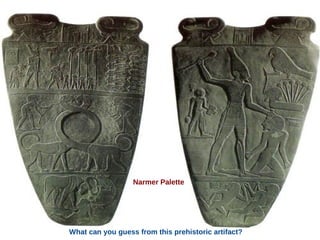
Narmer Palette
What can you guess from this prehistoric artifact?
HISTORICAL PERIODS -
TIMELINE
Watch the video and answer the following questions:
● How was organized the egyptian territories before
the Empire?
● What are the egiptian historical periods?
● Why were pharaos important?
● What was the function of pyramids?
● What was their contribution to Maths?
● How is called the egyptian writing?
ANCIENT EGYPT
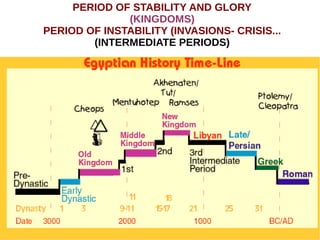
PERIOD OF STABILITY AND GLORY
(KINGDOMS)
PERIOD OF INSTABILITY (INVASIONS- CRISIS...
(INTERMEDIATE PERIODS)
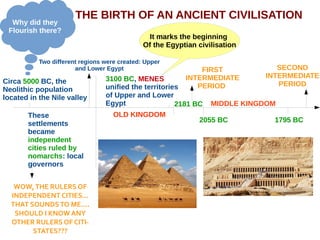
THE BIRTH OF AN ANCIENT CIVILISATION
Circa 5000 BC, the
Neolithic population
located in the Nile valley
These
settlements
became
independent
cities ruled by
nomarchs: local
governors
WOW,THE RULERS OF
INDEPENDENT CITIES...
THAT SOUNDSTO ME....
SHOULD I KNOW ANY
OTHER RULERS OF CITI-
STATES???
3100 BC, MENES
unified the territories
of Upper and Lower
Egypt
It marks the beginning
Of the Egyptian civilisation
Two different regions were created: Upper
and Lower Egypt
Why did they
Flourish there?
OLD KINGDOM
2181 BC MIDDLE KINGDOM
1795 BC2055 BC
FIRST
INTERMEDIATE
PERIOD
SECOND
INTERMEDIATE
PERIOD
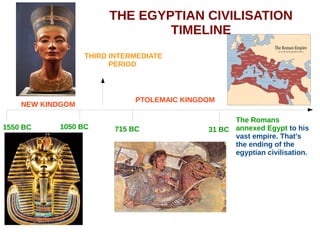
THE EGYPTIAN CIVILISATION
TIMELINE
NEW KINDGOM
1550 BC 1050 BC
PTOLEMAIC KINGDOM
715 BC 31 BC
THIRD INTERMEDIATE
PERIOD
The Romans
annexed Egypt to his
vast empire. That's
the ending of the
egyptian civilisation.
THE EGYPTIAN TIMELINE IN MAPS
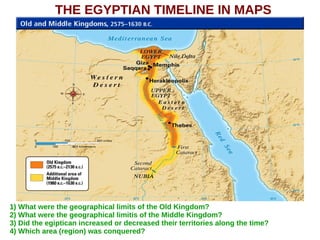
1) What were the geographical limits of the Old Kingdom?
2) What were the geographical limitis of the Middle Kingdom?
3) Did the egiptican increased or decreased their territories along the time?
4) Which area (region) was conquered?
THE EGYPTIAN TIMELINE IN MAPS
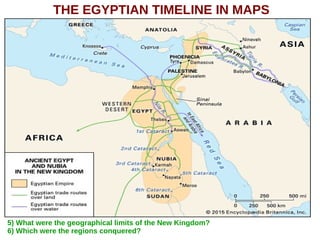
5) What were the geographical limits of the New Kingdom?
6) Which were the regions conquered?
THE EGYPTIAN TIMELINE IN MAPS
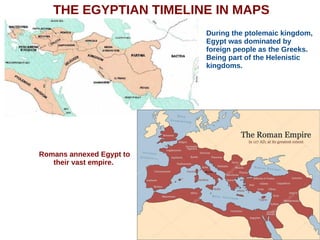
During the ptolemaic kingdom,
Egypt was dominated by
foreign people as the Greeks.
Being part of the Helenistic
kingdoms.
Romans annexed Egypt to
their vast empire.
EGYPTIAN HISTORICAL PERSONALITIES
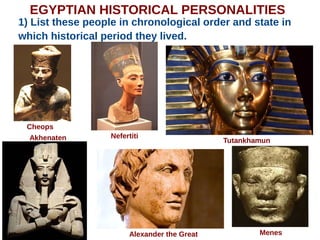
1) List these people in chronological order and state in
which historical period they lived.
Cheops
Nefertiti
Tutankhamun
Alexander the Great Menes
Akhenaten
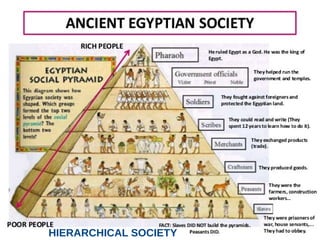
HIERARCHICAL SOCIETY
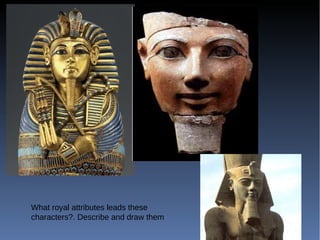
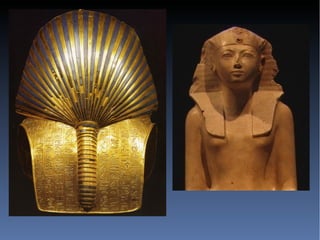
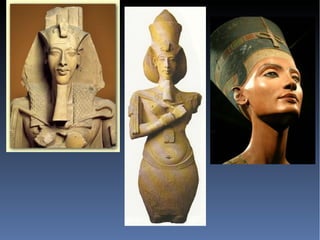
What royal attributes leads these
characters?. Describe and draw them
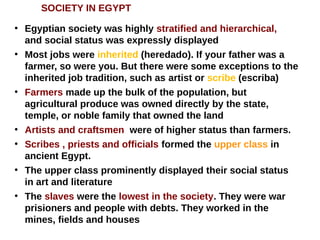
SOCIETY IN EGYPT
●
Egyptian society was highly stratified and hierarchical,
and social status was expressly displayed
●
Most jobs were inherited (heredado). If your father was a
farmer, so were you. But there were some exceptions to the
inherited job tradition, such as artist or scribe (escriba)
●
Farmers made up the bulk of the population, but
agricultural produce was owned directly by the state,
temple, or noble family that owned the land
●
Artists and craftsmen were of higher status than farmers.
●
Scribes , priests and officials formed the upper class in
ancient Egypt.
●
The upper class prominently displayed their social status
in art and literature
●
The slaves were the lowest in the society. They were war
prisioners and people with debts. They worked in the
mines, fields and houses
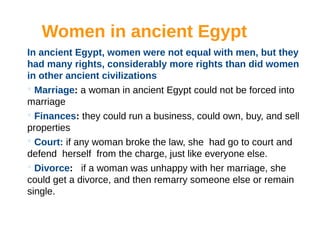
Women in ancient Egypt
In ancient Egypt, women were not equal with men, but they
had many rights, considerably more rights than did women
in other ancient civilizations
 Marriage: a woman in ancient Egypt could not be forced into
marriage
 Finances: they could run a business, could own, buy, and sell
properties
 Court: if any woman broke the law, she had go to court and
defend herself from the charge, just like everyone else.
 Divorce: if a woman was unhappy with her marriage, she
could get a divorce, and then remarry someone else or remain
single.
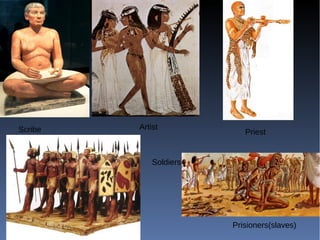
Scribe Artist
Priest
Soldiers
Prisioners(slaves)
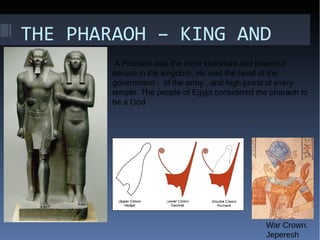
THE PHARAOH – KING AND
GOD A Pharaoh was the most important and powerful
person in the kingdom. He was the head of the
government , of the army , and high priest of every
temple. The people of Egypt considered the pharaoh to
be a God
War Crown.
Jeperesh
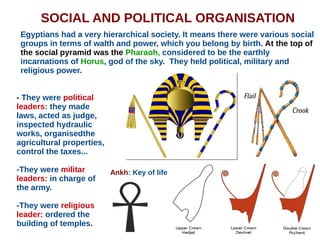
SOCIAL AND POLITICAL ORGANISATION
Egyptians had a very hierarchical society. It means there were various social
groups in terms of walth and power, which you belong by birth. At the top of
the social pyramid was the Pharaoh, considered to be the earthly
incarnations of Horus, god of the sky. They held political, military and
religious power.
- They were political
leaders: they made
laws, acted as judge,
inspected hydraulic
works, organisedthe
agricultural properties,
control the taxes...
-They were militar
leaders: in charge of
the army.
-They were religious
leader: ordered the
building of temples.
Ankh: Key of life
THE PHARAOH → SYMBOLS OF POWER
●
Crook (cetro) and flail (mayal) were a general sign
of authority in Ancient Egypt.
●
The Nemes is the striped headcloth. It covered the
whole crown and back of the head
●
The Uraeus is the stylized, upright form of
an Egyptian cobra , used as a symbol
of sovereignty, royalty, deity, and divine authority
in Ancient Egypt.
●
Fake beard: used as a symbol of authority taken
from Osiris.
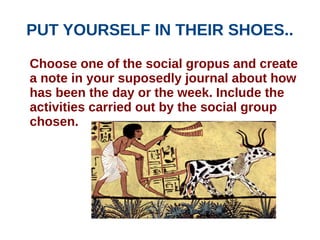
PUT YOURSELF IN THEIR SHOES..
Choose one of the social gropus and create
a note in your suposedly journal about how
has been the day or the week. Include the
activities carried out by the social group
chosen.
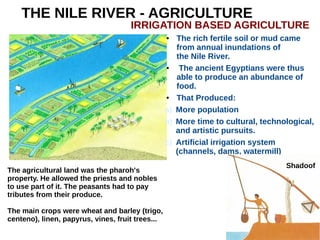
THE NILE RIVER - AGRICULTURE
● The rich fertile soil or mud came
from annual inundations of
the Nile River.
● The ancient Egyptians were thus
able to produce an abundance of
food.
● That Produced:
a) More population
b) More time to cultural, technological,
and artistic pursuits.
c) Artificial irrigation system
(channels, dams, watermill)
IRRIGATION BASED AGRICULTURE
The agricultural land was the pharoh's
property. He allowed the priests and nobles
to use part of it. The peasants had to pay
tributes from their produce.
The main crops were wheat and barley (trigo,
centeno), linen, papyrus, vines, fruit trees...
Shadoof
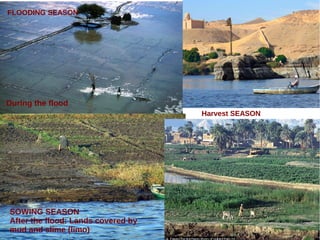
During the flood
Harvest SEASON
FLOODING SEASON
SOWING SEASON
After the flood: Lands covered by
mud and slime (limo)
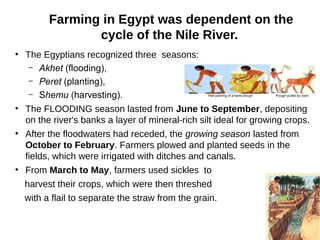
Farming in Egypt was dependent on the
cycle of the Nile River.
●
The Egyptians recognized three seasons:
– Akhet (flooding), 
– Peret (planting), 
– Shemu (harvesting). 
●
The FLOODING season lasted from June to September, depositing
on the river's banks a layer of mineral-rich silt ideal for growing crops.
●
After the floodwaters had receded, the growing season lasted from
October to February. Farmers plowed and planted seeds in the
fields, which were irrigated with ditches and canals.
●
From March to May, farmers used sickles to
harvest their crops, which were then threshed
with a flail to separate the straw from the grain.
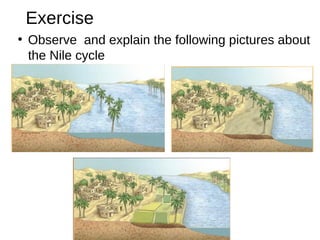
Exercise
●
Observe and explain the following pictures about
the Nile cycle
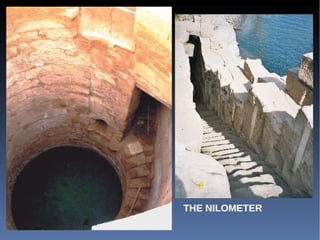
THE NILOMETER
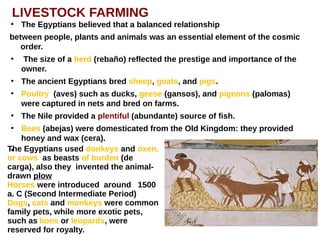
LIVESTOCK FARMING
●
The Egyptians believed that a balanced relationship
between people, plants and animals was an essential element of the cosmic
order.
●
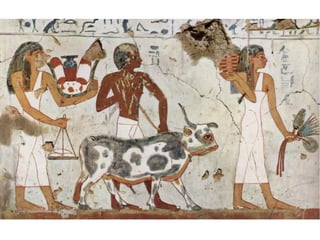
The size of a herd (rebaño) reflected the prestige and importance of the
owner.
●
The ancient Egyptians bred sheep, goats, and pigs.
●
Poultry (aves) such as ducks, geese (gansos), and pigeons (palomas)
were captured in nets and bred on farms.
●
The Nile provided a plentiful (abundante) source of fish.
●
Bees (abejas) were domesticated from the Old Kingdom: they provided
honey and wax (cera).
●The Egyptians used donkeys and oxen,
or cows as beasts of burden (de
carga), also they invented the animal-
drawn plow
Horses were introduced around 1500
a. C (Second Intermediate Period)
Dogs, cats and monkeys were common
family pets, while more exotic pets,
such as lions or leopards, were
reserved for royalty.
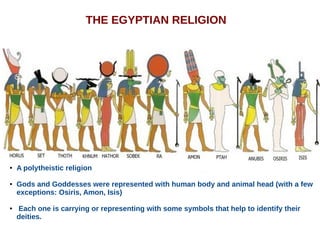
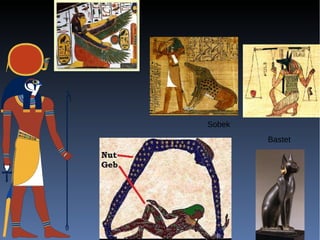
THE EGYPTIAN RELIGION
● A polytheistic religion
● Gods and Goddesses were represented with human body and animal head (with a few
exceptions: Osiris, Amon, Isis)
● Each one is carrying or representing with some symbols that help to identify their
deities.
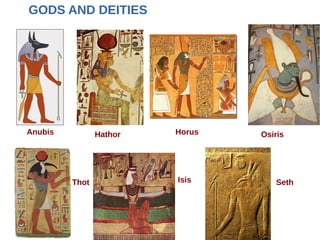
GODS AND DEITIES
Anubis Hathor Horus Osiris
Thot Isis Seth
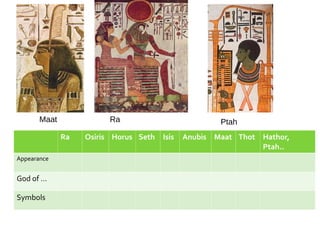
RaMaat Ptah
•Appearance
•God of….
•Symbols
Ra Osiris Horus Seth Isis Anubis Maat Thot Hathor,
Ptah..
Appearance
God of …
Symbols
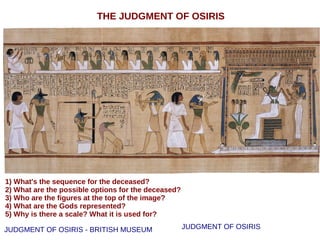
THE JUDGMENT OF OSIRIS
JUDGMENT OF OSIRIS
1) What's the sequence for the deceased?
2) What are the possible options for the deceased?
3) Who are the figures at the top of the image?
4) What are the Gods represented?
5) Why is there a scale? What it is used for?
JUDGMENT OF OSIRIS - BRITISH MUSEUM
Bastet
Sobek

Unit egypt

  • 1.
  • 2.
    WHERE IS EGYPTLOCATED?? Do you remember....why the Egiptian civilization was set in that exactly place??? Life in Egypt is possible thanks to the ______ __________. Because everything apart from its ________ is _________. So bascially Egypt is a large and narrow ______. (BANKS / DESERT / NILE / VALLEY/ RIVER) a) Continent b) Part of the continent c) Geographical features nearby (limits)
  • 3.
    Ancient Egypt wasdivided into two regions Lower Egypt (North) → Delta region Upper Egypt (South) →valley region Narmer/ Menes, the first pharaoh, unified Egypt in the year 3100 a. C. The reason why they located in the Nile valley is because egiptian learnt to predict and control the annual flooding of the river (as Mesopotamians did) How???? 1st) They undertook drainage work and dried out the boggy marshes (marismas) 2nd) They built irrigation canals, what increased the crop growing areas. That enables the development of agricultrue and a population increase
  • 4.
    Narmer Palette What canyou guess from this prehistoric artifact?
  • 5.
    HISTORICAL PERIODS - TIMELINE Watchthe video and answer the following questions: ● How was organized the egyptian territories before the Empire? ● What are the egiptian historical periods? ● Why were pharaos important? ● What was the function of pyramids? ● What was their contribution to Maths? ● How is called the egyptian writing? ANCIENT EGYPT
  • 6.
    PERIOD OF STABILITYAND GLORY (KINGDOMS) PERIOD OF INSTABILITY (INVASIONS- CRISIS... (INTERMEDIATE PERIODS)
  • 7.
    THE BIRTH OFAN ANCIENT CIVILISATION Circa 5000 BC, the Neolithic population located in the Nile valley These settlements became independent cities ruled by nomarchs: local governors WOW,THE RULERS OF INDEPENDENT CITIES... THAT SOUNDSTO ME.... SHOULD I KNOW ANY OTHER RULERS OF CITI- STATES??? 3100 BC, MENES unified the territories of Upper and Lower Egypt It marks the beginning Of the Egyptian civilisation Two different regions were created: Upper and Lower Egypt Why did they Flourish there? OLD KINGDOM 2181 BC MIDDLE KINGDOM 1795 BC2055 BC FIRST INTERMEDIATE PERIOD SECOND INTERMEDIATE PERIOD
  • 8.
    THE EGYPTIAN CIVILISATION TIMELINE NEWKINDGOM 1550 BC 1050 BC PTOLEMAIC KINGDOM 715 BC 31 BC THIRD INTERMEDIATE PERIOD The Romans annexed Egypt to his vast empire. That's the ending of the egyptian civilisation.
  • 9.
    THE EGYPTIAN TIMELINEIN MAPS 1) What were the geographical limits of the Old Kingdom? 2) What were the geographical limitis of the Middle Kingdom? 3) Did the egiptican increased or decreased their territories along the time? 4) Which area (region) was conquered?
  • 10.
    THE EGYPTIAN TIMELINEIN MAPS 5) What were the geographical limits of the New Kingdom? 6) Which were the regions conquered?
  • 11.
    THE EGYPTIAN TIMELINEIN MAPS During the ptolemaic kingdom, Egypt was dominated by foreign people as the Greeks. Being part of the Helenistic kingdoms. Romans annexed Egypt to their vast empire.
  • 12.
    EGYPTIAN HISTORICAL PERSONALITIES 1)List these people in chronological order and state in which historical period they lived. Cheops Nefertiti Tutankhamun Alexander the Great Menes Akhenaten
  • 13.
  • 14.
    What royal attributesleads these characters?. Describe and draw them
  • 18.
    SOCIETY IN EGYPT ● Egyptiansociety was highly stratified and hierarchical, and social status was expressly displayed ● Most jobs were inherited (heredado). If your father was a farmer, so were you. But there were some exceptions to the inherited job tradition, such as artist or scribe (escriba) ● Farmers made up the bulk of the population, but agricultural produce was owned directly by the state, temple, or noble family that owned the land ● Artists and craftsmen were of higher status than farmers. ● Scribes , priests and officials formed the upper class in ancient Egypt. ● The upper class prominently displayed their social status in art and literature ● The slaves were the lowest in the society. They were war prisioners and people with debts. They worked in the mines, fields and houses
  • 19.
    Women in ancientEgypt In ancient Egypt, women were not equal with men, but they had many rights, considerably more rights than did women in other ancient civilizations  Marriage: a woman in ancient Egypt could not be forced into marriage  Finances: they could run a business, could own, buy, and sell properties  Court: if any woman broke the law, she had go to court and defend herself from the charge, just like everyone else.  Divorce: if a woman was unhappy with her marriage, she could get a divorce, and then remarry someone else or remain single.
  • 20.
  • 21.
    THE PHARAOH –KING AND GOD A Pharaoh was the most important and powerful person in the kingdom. He was the head of the government , of the army , and high priest of every temple. The people of Egypt considered the pharaoh to be a God War Crown. Jeperesh
  • 22.
    SOCIAL AND POLITICALORGANISATION Egyptians had a very hierarchical society. It means there were various social groups in terms of walth and power, which you belong by birth. At the top of the social pyramid was the Pharaoh, considered to be the earthly incarnations of Horus, god of the sky. They held political, military and religious power. - They were political leaders: they made laws, acted as judge, inspected hydraulic works, organisedthe agricultural properties, control the taxes... -They were militar leaders: in charge of the army. -They were religious leader: ordered the building of temples. Ankh: Key of life
  • 23.
    THE PHARAOH →SYMBOLS OF POWER ● Crook (cetro) and flail (mayal) were a general sign of authority in Ancient Egypt. ● The Nemes is the striped headcloth. It covered the whole crown and back of the head ● The Uraeus is the stylized, upright form of an Egyptian cobra , used as a symbol of sovereignty, royalty, deity, and divine authority in Ancient Egypt. ● Fake beard: used as a symbol of authority taken from Osiris.
  • 24.
    PUT YOURSELF INTHEIR SHOES.. Choose one of the social gropus and create a note in your suposedly journal about how has been the day or the week. Include the activities carried out by the social group chosen.
  • 25.
    THE NILE RIVER- AGRICULTURE ● The rich fertile soil or mud came from annual inundations of the Nile River. ● The ancient Egyptians were thus able to produce an abundance of food. ● That Produced: a) More population b) More time to cultural, technological, and artistic pursuits. c) Artificial irrigation system (channels, dams, watermill) IRRIGATION BASED AGRICULTURE The agricultural land was the pharoh's property. He allowed the priests and nobles to use part of it. The peasants had to pay tributes from their produce. The main crops were wheat and barley (trigo, centeno), linen, papyrus, vines, fruit trees... Shadoof
  • 26.
    During the flood HarvestSEASON FLOODING SEASON SOWING SEASON After the flood: Lands covered by mud and slime (limo)
  • 31.
    Farming in Egyptwas dependent on the cycle of the Nile River. ● The Egyptians recognized three seasons: – Akhet (flooding),  – Peret (planting),  – Shemu (harvesting).  ● The FLOODING season lasted from June to September, depositing on the river's banks a layer of mineral-rich silt ideal for growing crops. ● After the floodwaters had receded, the growing season lasted from October to February. Farmers plowed and planted seeds in the fields, which were irrigated with ditches and canals. ● From March to May, farmers used sickles to harvest their crops, which were then threshed with a flail to separate the straw from the grain.
  • 32.
    Exercise ● Observe and explainthe following pictures about the Nile cycle
  • 33.
  • 34.
    LIVESTOCK FARMING ● The Egyptiansbelieved that a balanced relationship between people, plants and animals was an essential element of the cosmic order. ● The size of a herd (rebaño) reflected the prestige and importance of the owner. ● The ancient Egyptians bred sheep, goats, and pigs. ● Poultry (aves) such as ducks, geese (gansos), and pigeons (palomas) were captured in nets and bred on farms. ● The Nile provided a plentiful (abundante) source of fish. ● Bees (abejas) were domesticated from the Old Kingdom: they provided honey and wax (cera). ●The Egyptians used donkeys and oxen, or cows as beasts of burden (de carga), also they invented the animal- drawn plow Horses were introduced around 1500 a. C (Second Intermediate Period) Dogs, cats and monkeys were common family pets, while more exotic pets, such as lions or leopards, were reserved for royalty.
  • 36.
    THE EGYPTIAN RELIGION ●A polytheistic religion ● Gods and Goddesses were represented with human body and animal head (with a few exceptions: Osiris, Amon, Isis) ● Each one is carrying or representing with some symbols that help to identify their deities.
  • 37.
    GODS AND DEITIES AnubisHathor Horus Osiris Thot Isis Seth
  • 38.
    RaMaat Ptah •Appearance •God of…. •Symbols RaOsiris Horus Seth Isis Anubis Maat Thot Hathor, Ptah.. Appearance God of … Symbols
  • 39.
    THE JUDGMENT OFOSIRIS JUDGMENT OF OSIRIS 1) What's the sequence for the deceased? 2) What are the possible options for the deceased? 3) Who are the figures at the top of the image? 4) What are the Gods represented? 5) Why is there a scale? What it is used for? JUDGMENT OF OSIRIS - BRITISH MUSEUM
  • 40.