1890 - 1920
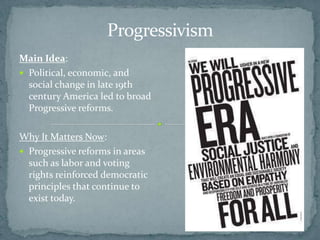
Progressivism
Main Idea:
ď‚— Political, economic, and
  social change in late 19th
  century America led to broad
  Progressive reforms.

Why It Matters Now:
ď‚— Progressive reforms in areas
  such as labor and voting
  rights reinforced democratic
  principles that continue to
  exist today.
ď‚— Identify the four goals of the progressive movement.
ď‚— Provide examples of each of the 4 goals.
ď‚— Evaluate how the reform improves the lives of ordinary
  Americans.
ď‚— At the dawn of the new century, middle class
  reformers addressed many of the problems that
  contributed to the social upheavals of the 1890’s.
  During the Progressive era, reformists sought to
  improve various aspects of society. Evaluate whether or
  not the progressive reforms improved the lives of
  ordinary Americans.
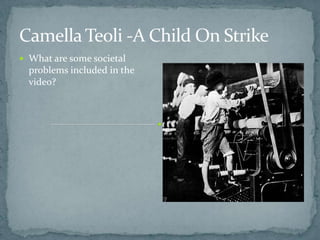
Camella Teoli -A Child On Strike
ď‚— What are some societal
  problems included in the
  video?
What are problems in society today?
ď‚— On your own create a list of as
    many problems as you can
    possibly think of that society
    faces today?
ď‚—   Share your list with a partner.
ď‚—   Make a class list of problems.
ď‚—   Organize problems together
    and create categories for each
    group of problems.
ď‚—   Are any of your problems
    similar to problems during
    the Progressive Era?
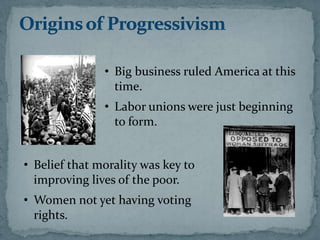
• Big business ruled America at this
                 time.
               • Labor unions were just beginning
                 to form.


• Belief that morality was key to
  improving lives of the poor.
• Women not yet having voting
  rights.
Reform                        Progressivism
The process of making         Political attitude favoring
changes to                    changes or reform through
social, moral, economic, or   governmental actions.
political institutions or
practice in order to          What are some examples
change/improve it.            of governmental actions?
What are some examples
of reforms?                   Minimum wage, child labor
SADD, MADD,                   laws, unemployment
                              compensation, workmen’s
                              compensation, drinking age,
1) Social welfare- protecting the health and well being
   of individuals in society or the society itself.

2) Moral improvement-improving one’s personal
   behavior for the betterment of society.

3) Economic Reform -changing the way in which the
   U.S. produces, distributes, and consumes goods and
   services.

4) Political Reform- making government more
   responsive to voters and ending political corruption.
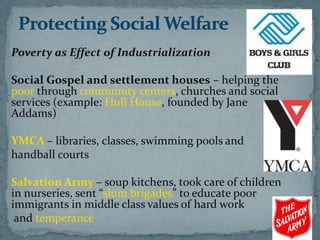
Poverty as Effect of Industrialization

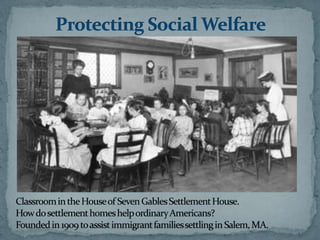
Social Gospel and settlement houses – helping the
poor through community centers, churches and social
services (example: Hull House, founded by Jane
Addams)

YMCA – libraries, classes, swimming pools and
handball courts

Salvation Army – soup kitchens, took care of children
in nurseries, sent “slum brigades” to educate poor
immigrants in middle class values of hard work
 and temperance
What do the
children appear
to be doing?
Where might
this be?
How does a
YMCA improve
the lives of
ordinary
Americans?
YMCA improves
the health and
well being of
individuals in
society.
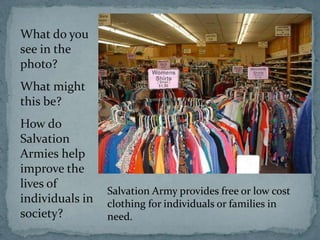
What do you
see in the
photo?
What might
this be?
How do
Salvation
Armies help
improve the
lives of
                 Salvation Army provides free or low cost
individuals in   clothing for individuals or families in
society?         need.
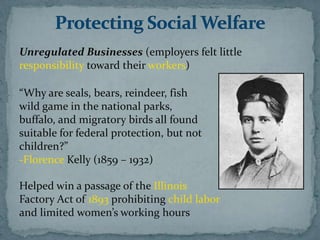
Unregulated Businesses (employers felt little
responsibility toward their workers)

“Why are seals, bears, reindeer, fish
wild game in the national parks,
buffalo, and migratory birds all found
suitable for federal protection, but not
children?”
-Florence Kelly (1859 – 1932)

Helped win a passage of the Illinois
Factory Act of 1893 prohibiting child labor
and limited women’s working hours
Temperance Movement leads to Prohibition
The goal of the movement was to promote morality and
improve the lives of the poor.

 Temperance     refraining from alcohol consumption

 Prohibition    the prevention by law of the
                manufacture and sale of alcohol, esp. in
                the U.S. between 1920 and 1933
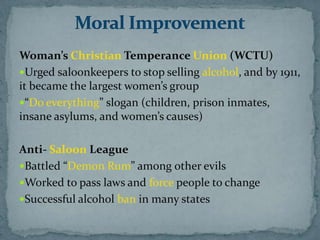
Woman’s Christian Temperance Union (WCTU)
ď‚—Urged saloonkeepers to stop selling alcohol, and by 1911,
it became the largest women’s group
“Do everything” slogan (children, prison inmates,
insane asylums, and women’s causes)

Anti- Saloon League
Battled “Demon Rum” among other evils
ď‚—Worked to pass laws and force people to change
ď‚—Successful alcohol ban in many states
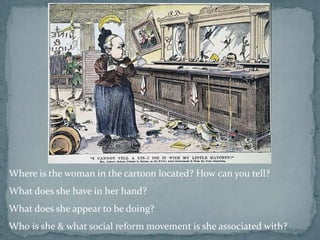
Where is the woman in the cartoon located? How can you tell?
What does she have in her hand?
What does she appear to be doing?
Wh0 is she & what social reform movement is she associated with?
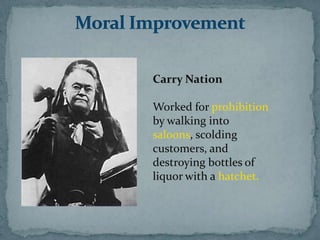
Carry Nation

Worked for prohibition
by walking into
saloons, scolding
customers, and
destroying bottles of
liquor with a hatchet.
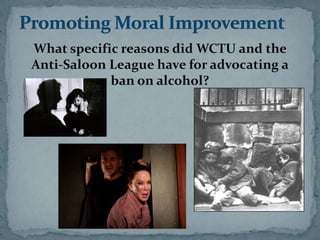
What specific reasons did WCTU and the
Anti-Saloon League have for advocating a
            ban on alcohol?
Do you think prohibition was effective? Why or why not?

      Alcohol Prohibition, 18th Amendment Video


•   Many immigrants reacted against Prohibition
•   Claimed alcohol an integrated part of their culture
    and customs
•   Saloons provided other services like cashing
    paychecks and serving food.
Did America need economic reform?

“Competition was natural enough at one time, but do
  you think you are competing today? Many of you
think you are competing. Against whom? Against [oil
 magnate John D.] Rockefeller? About as I would if I
 had a wheelbarrow and competed with the Santa Fe
        [railroad] from here to Kansas City.”
  - Eugene Debs (His Life, Writings, and Speeches)
ď‚— The Panic of 1893 caused many to question their
  capitalist economic system
ď‚— Many workers embraced socialism (Eugene V. Debs,
  became a prominent socialist supporter)

 Capitalism      an economic and political system in which a country's
                 trade and industry are controlled by private owners for
                 profit, rather than by the state.


 Socialism       a political and economic theory in which the
                 government controls the means of production,
                 distribution, and exchange
Who exposed corrupt business practices?
Muckrakers:
Journalists uncovered the corrupt side of business and
public life by writing detailed and sometimes
sensationalized exposes in magazines.
Examples: The Jungle by Upton Sinclair, and History of
the Standard Oil Company by Ida M. Tarbell

 Whom can we consider muckrakers of today?
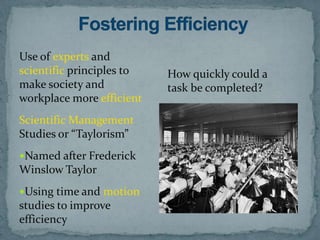
Use of experts and
scientific principles to   How quickly could a
make society and           task be completed?
workplace more efficient
Scientific Management
Studies or “Taylorism”
ď‚—Named after Frederick
Winslow Taylor
ď‚—Using time and motion
studies to improve
efficiency
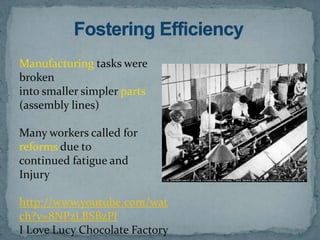
Manufacturing tasks were
broken
into smaller simpler parts
(assembly lines)

Many workers called for
reforms due to
continued fatigue and
Injury

http://www.youtube.com/wat
ch?v=8NPzLBSBzPI
I Love Lucy Chocolate Factory
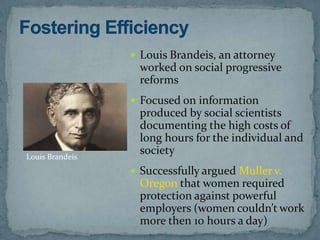
ď‚— Louis Brandeis, an attorney
                  worked on social progressive
                  reforms
                 ď‚— Focused on information
                  produced by social scientists
                  documenting the high costs of
                  long hours for the individual and
Louis Brandeis
                  society
                 ď‚— Successfully argued Muller v.
                  Oregon that women required
                  protection against powerful
                  employers (women couldn’t work
                  more then 10 hours a day)
Political Reform
Why reform local government?

1. Desire to make government more efficient and
responsive to citizens
2. Some Americans wanted to limit immigrants
influence in local governments (eliminate corrupt
political machines)
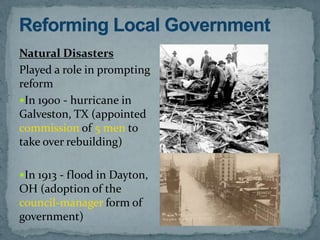
Natural Disasters
Played a role in prompting
reform
ď‚—In 1900 - hurricane in
Galveston, TX (appointed
commission of 5 men to
take over rebuilding)

ď‚—In 1913 - flood in Dayton,
OH (adoption of the
council-manager form of
government)
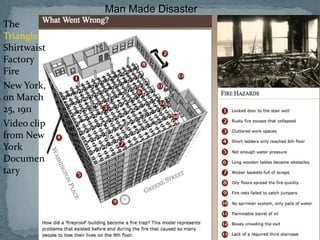
Man Made Disaster
The
Triangle
Shirtwaist
Factory
Fire
New York,
on March
25, 1911
Video clip
from New
York
Documen
tary
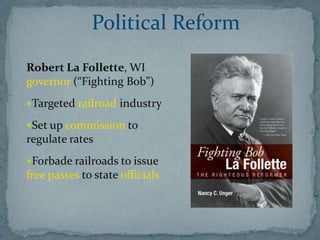
Political Reform
Robert La Follette, WI
governor (“Fighting Bob”)
ď‚—Targeted railroad industry

ď‚—Set up commission to
regulate rates
ď‚—Forbade railroads to issue
free passes to state officials
Political Reform
ď‚— Secret Ballot (Australian ballot)

 Initiative – a bill originated by the people to create
  laws. Citizens can petition their government to place
  an initiative.
 Referendum – method of accepting or rejecting the
  initiative. A vote on the initiative.
 Recall – Enabled voters to remove public officials from
  office before the end of the term by forcing them to
  face another election before the term if enough voters
  ask for it.
Political Reform
Seventeenth Amendment
ď‚—Amendment to the Constitution allowing for the direct
election of U.S. senators by the people
Before this, each state’s legislature chose the senators
which put even more power in the hands of wealthy
bosses and heads of corporation
ď‚—American citizens had more of a voice in electing their
government officials and creating laws
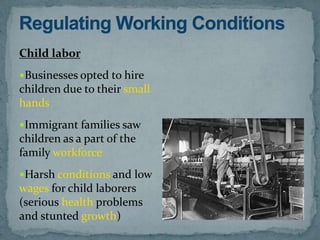
Child labor
ď‚—Businesses opted to hire
children due to their small
hands
ď‚—Immigrant families saw
children as a part of the
family workforce
ď‚—Harsh conditions and low
wages for child laborers
(serious health problems
and stunted growth)
National Child Labor Committee (1904)
ď‚—Sent investigators to gather evidence of harsh
conditions
ď‚—New evidence available and public support of labor
unions
ď‚—Keating-Owen Act of 1916 stated that goods made
through child labor were no longer allowed across state
borders
Limiting Working Hours
ď‚—Muller v. Oregon (1908): argued for the plight of poor
working women. Women were then limited to a 10-hr
workday
ď‚—Bunting v. Oregon (1917): upheld a 10-hr workday for
men
Progressives also won workers’ compensation to aid
families who suffered and work- related injury or death
American Stories

               A Child On Strike
      A Testimony of Camella Teoli, Mill Girl

Answer the following:
1.How did mill owners in Massachusetts react to the
new rules about shorter work week?
2.Do you think the labor strike that followed was
the appropriate response by labor unions? Why or
why not?

Ch17 progressivism1

  • 1.
  • 2.
    Progressivism Main Idea: ď‚— Political,economic, and social change in late 19th century America led to broad Progressive reforms. Why It Matters Now: ď‚— Progressive reforms in areas such as labor and voting rights reinforced democratic principles that continue to exist today.
  • 3.
     Identify thefour goals of the progressive movement.  Provide examples of each of the 4 goals.  Evaluate how the reform improves the lives of ordinary Americans.  At the dawn of the new century, middle class reformers addressed many of the problems that contributed to the social upheavals of the 1890’s. During the Progressive era, reformists sought to improve various aspects of society. Evaluate whether or not the progressive reforms improved the lives of ordinary Americans.
  • 4.
    Camella Teoli -AChild On Strike ď‚— What are some societal problems included in the video?
  • 5.
    What are problemsin society today? ď‚— On your own create a list of as many problems as you can possibly think of that society faces today? ď‚— Share your list with a partner. ď‚— Make a class list of problems. ď‚— Organize problems together and create categories for each group of problems. ď‚— Are any of your problems similar to problems during the Progressive Era?
  • 6.
    • Big businessruled America at this time. • Labor unions were just beginning to form. • Belief that morality was key to improving lives of the poor. • Women not yet having voting rights.
  • 7.
    Reform Progressivism The process of making Political attitude favoring changes to changes or reform through social, moral, economic, or governmental actions. political institutions or practice in order to What are some examples change/improve it. of governmental actions? What are some examples of reforms? Minimum wage, child labor SADD, MADD, laws, unemployment compensation, workmen’s compensation, drinking age,
  • 8.
    1) Social welfare-protecting the health and well being of individuals in society or the society itself. 2) Moral improvement-improving one’s personal behavior for the betterment of society. 3) Economic Reform -changing the way in which the U.S. produces, distributes, and consumes goods and services. 4) Political Reform- making government more responsive to voters and ending political corruption.
  • 9.
    Poverty as Effectof Industrialization Social Gospel and settlement houses – helping the poor through community centers, churches and social services (example: Hull House, founded by Jane Addams) YMCA – libraries, classes, swimming pools and handball courts Salvation Army – soup kitchens, took care of children in nurseries, sent “slum brigades” to educate poor immigrants in middle class values of hard work and temperance
  • 11.
    What do the childrenappear to be doing? Where might this be? How does a YMCA improve the lives of ordinary Americans? YMCA improves the health and well being of individuals in society.
  • 12.
    What do you seein the photo? What might this be? How do Salvation Armies help improve the lives of Salvation Army provides free or low cost individuals in clothing for individuals or families in society? need.
  • 13.
    Unregulated Businesses (employersfelt little responsibility toward their workers) “Why are seals, bears, reindeer, fish wild game in the national parks, buffalo, and migratory birds all found suitable for federal protection, but not children?” -Florence Kelly (1859 – 1932) Helped win a passage of the Illinois Factory Act of 1893 prohibiting child labor and limited women’s working hours
  • 14.
    Temperance Movement leadsto Prohibition The goal of the movement was to promote morality and improve the lives of the poor. Temperance refraining from alcohol consumption Prohibition the prevention by law of the manufacture and sale of alcohol, esp. in the U.S. between 1920 and 1933
  • 15.
    Woman’s Christian TemperanceUnion (WCTU) Urged saloonkeepers to stop selling alcohol, and by 1911, it became the largest women’s group “Do everything” slogan (children, prison inmates, insane asylums, and women’s causes) Anti- Saloon League Battled “Demon Rum” among other evils Worked to pass laws and force people to change Successful alcohol ban in many states
  • 16.
    Where is thewoman in the cartoon located? How can you tell? What does she have in her hand? What does she appear to be doing? Wh0 is she & what social reform movement is she associated with?
  • 17.
    Carry Nation Worked forprohibition by walking into saloons, scolding customers, and destroying bottles of liquor with a hatchet.
  • 18.
    What specific reasonsdid WCTU and the Anti-Saloon League have for advocating a ban on alcohol?
  • 19.
    Do you thinkprohibition was effective? Why or why not? Alcohol Prohibition, 18th Amendment Video • Many immigrants reacted against Prohibition • Claimed alcohol an integrated part of their culture and customs • Saloons provided other services like cashing paychecks and serving food.
  • 20.
    Did America needeconomic reform? “Competition was natural enough at one time, but do you think you are competing today? Many of you think you are competing. Against whom? Against [oil magnate John D.] Rockefeller? About as I would if I had a wheelbarrow and competed with the Santa Fe [railroad] from here to Kansas City.” - Eugene Debs (His Life, Writings, and Speeches)
  • 21.
    ď‚— The Panicof 1893 caused many to question their capitalist economic system ď‚— Many workers embraced socialism (Eugene V. Debs, became a prominent socialist supporter) Capitalism an economic and political system in which a country's trade and industry are controlled by private owners for profit, rather than by the state. Socialism a political and economic theory in which the government controls the means of production, distribution, and exchange
  • 22.
    Who exposed corruptbusiness practices? Muckrakers: Journalists uncovered the corrupt side of business and public life by writing detailed and sometimes sensationalized exposes in magazines. Examples: The Jungle by Upton Sinclair, and History of the Standard Oil Company by Ida M. Tarbell Whom can we consider muckrakers of today?
  • 23.
    Use of expertsand scientific principles to How quickly could a make society and task be completed? workplace more efficient Scientific Management Studies or “Taylorism” Named after Frederick Winslow Taylor Using time and motion studies to improve efficiency
  • 24.
    Manufacturing tasks were broken intosmaller simpler parts (assembly lines) Many workers called for reforms due to continued fatigue and Injury http://www.youtube.com/wat ch?v=8NPzLBSBzPI I Love Lucy Chocolate Factory
  • 25.
     Louis Brandeis,an attorney worked on social progressive reforms  Focused on information produced by social scientists documenting the high costs of long hours for the individual and Louis Brandeis society  Successfully argued Muller v. Oregon that women required protection against powerful employers (women couldn’t work more then 10 hours a day)
  • 26.
    Political Reform Why reformlocal government? 1. Desire to make government more efficient and responsive to citizens 2. Some Americans wanted to limit immigrants influence in local governments (eliminate corrupt political machines)
  • 27.
    Natural Disasters Played arole in prompting reform ď‚—In 1900 - hurricane in Galveston, TX (appointed commission of 5 men to take over rebuilding) ď‚—In 1913 - flood in Dayton, OH (adoption of the council-manager form of government)
  • 28.
    Man Made Disaster The Triangle Shirtwaist Factory Fire NewYork, on March 25, 1911 Video clip from New York Documen tary
  • 29.
    Political Reform Robert LaFollette, WI governor (“Fighting Bob”) Targeted railroad industry Set up commission to regulate rates Forbade railroads to issue free passes to state officials
  • 30.
    Political Reform  SecretBallot (Australian ballot)  Initiative – a bill originated by the people to create laws. Citizens can petition their government to place an initiative.  Referendum – method of accepting or rejecting the initiative. A vote on the initiative.  Recall – Enabled voters to remove public officials from office before the end of the term by forcing them to face another election before the term if enough voters ask for it.
  • 31.
    Political Reform Seventeenth Amendment Amendmentto the Constitution allowing for the direct election of U.S. senators by the people Before this, each state’s legislature chose the senators which put even more power in the hands of wealthy bosses and heads of corporation American citizens had more of a voice in electing their government officials and creating laws
  • 32.
    Child labor ď‚—Businesses optedto hire children due to their small hands ď‚—Immigrant families saw children as a part of the family workforce ď‚—Harsh conditions and low wages for child laborers (serious health problems and stunted growth)
  • 33.
    National Child LaborCommittee (1904) ď‚—Sent investigators to gather evidence of harsh conditions ď‚—New evidence available and public support of labor unions ď‚—Keating-Owen Act of 1916 stated that goods made through child labor were no longer allowed across state borders
  • 34.
    Limiting Working Hours Mullerv. Oregon (1908): argued for the plight of poor working women. Women were then limited to a 10-hr workday Bunting v. Oregon (1917): upheld a 10-hr workday for men Progressives also won workers’ compensation to aid families who suffered and work- related injury or death
  • 35.
    American Stories A Child On Strike A Testimony of Camella Teoli, Mill Girl Answer the following: 1.How did mill owners in Massachusetts react to the new rules about shorter work week? 2.Do you think the labor strike that followed was the appropriate response by labor unions? Why or why not?