Global warming


                 By Shljuka Selma
What Is Global Warming?

    • Global warming is the warming of the
        earth through carbon dioxide (CO2)
      being pumped into the atmosphere from
        tailpipes and smokestacks. Then the
         gases trap heat like the glass in a
      greenhouse. This is where the term the
           “greenhouse effect” came from.
If amount of solar energy absorbed by the earth is equal to
      the amount radiated back into space, the earth remains
      at a constant temperature


Sun


          Solar
                            Radiative
         Energy              Cooling
However, if the amount of solar energy is greater than the amount radiated,
      then the earth heats up.


Sun


       Solar
                                 Radiative
                                  Cooling
      Energy
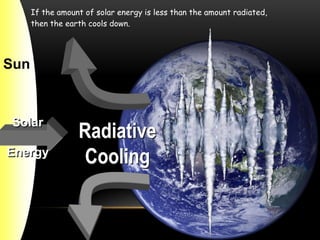
If the amount of solar energy is less than the amount radiated,
      then the earth cools down.


Sun


Solar
                  Radiative
Energy
                   Cooling
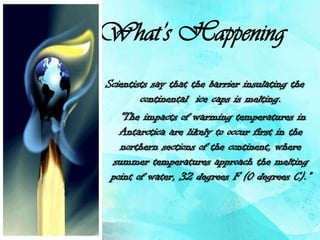
What’s Happening
Scientists say that the barrier insulating the
        continental ice caps is melting.
   “The impacts of warming temperatures in
   Antarctica are likely to occur first in the
   northern sections of the continent, where
 summer temperatures approach the melting
 point of water, 32 degrees F (0 degrees C).”
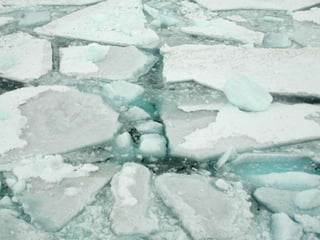
• As the ice melts, big chunks of glaciers
  will break off and become like ice cubes
       in a big glass of water. The ice
  chunks, known as icebergs, create mass
   in the ocean. The icebergs displace the
    water causing the ocean level to rise.
    Some of the shoreline in many places
  like Florida (where the land is at a low
        altitude) will go under water.
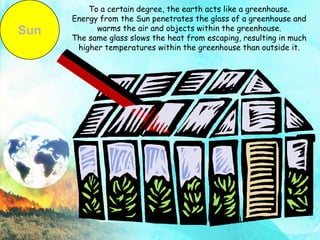
To a certain degree, the earth acts like a greenhouse.
      Energy from the Sun penetrates the glass of a greenhouse and
Sun         warms the air and objects within the greenhouse.
      The same glass slows the heat from escaping, resulting in much
       higher temperatures within the greenhouse than outside it.
Sun


   A dramatic example of the
 Greenhouse effect can be seen
 with the planet Venus. Venus’s
  atmosphere consists of 97%
carbon dioxide and 3% nitrogen.
    In addition, the surface is
   covered by dense clouds of
   water and sulfuric acid. The
combination of greenhouse gases    Venus
results in a surface temperature
of 860 F – even hotter than the
planet Mercury, which is nearest
             the Sun.
How Long Has It Been
      Going On
   • The reason the temperature has
       risen so much in the past 150
       years is because of how much
      more we have used fossil fuels,
      which gives off carbon dioxide.
       According to NOAA (National
          Oceanic and Atmospheric
         Administration), the global
        warming rate in the last 25
     years has risen to 3.6 degrees F
        per century, which tends to
         confirm the predictions of
      temperature increases made by
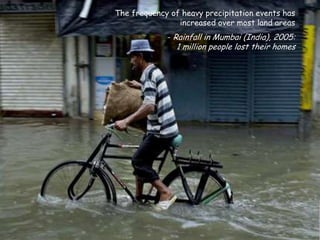
The frequency of heavy precipitation events has
                increased over most land areas
             - Rainfall in Mumbai (India), 2005:
                1 million people lost their homes
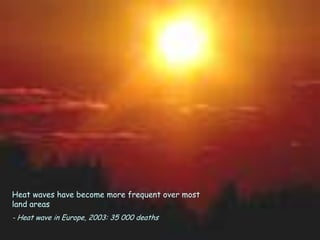
Heat waves have become more frequent over most
land areas
- Heat wave in Europe, 2003: 35 000 deaths
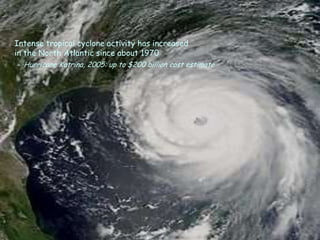
Intense tropical cyclone activity has increased
in the North Atlantic since about 1970
- Hurricane Katrina, 2005: up to $200 billion cost estimate
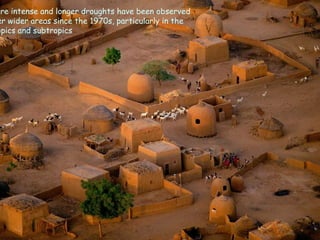
ore intense and longer droughts have been observed
er wider areas since the 1970s, particularly in the
opics and subtropics
What Will Happen
• Rising global temperatures are expected to
  raise sea level, and change precipitation and
     other local climate conditions. Changing
     regional climate could alter forests, crop
     yields, and water supplies. It could also
    affect human health, animals, and many
    types of ecosystems. Deserts may expand
    into existing rangelands, and features of
        some of our national parks may be
               permanently altered.
Kyoto Protocol

• In an effort to reduce carbon
  emissions, the Kyoto protocol
• was adopted in 1997.
   • It proposed to cut CO2 emissions
     by 5% from 1990 levels for period
     of 2008-2012
   • However, such minor cuts would be
     symbolic only, since such cuts
     would not significantly impact
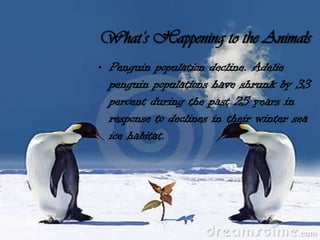
What’s Happening to the Animals
• Penguin population decline. Adelie
  penguin populations have shrunk by 33
  percent during the past 25 years in
  response to declines in their winter sea
  ice habitat.
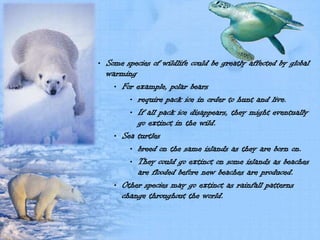
• Some species of wildlife could be greatly affected by global
  warming
    • For example, polar bears
        • require pack ice in order to hunt and live.
        • If all pack ice disappears, they might eventually
          go extinct in the wild.
    • Sea turtles
        • breed on the same islands as they are born on.
        • They could go extinct on some islands as beaches
          are flooded before new beaches are produced.
    • Other species may go extinct as rainfall patterns
      change throughout the world.
Effect on Humans
• Global warming will affect peoples throughout the world. For
                               example,
  – Fewer deaths will result from cold weather, but more deaths
                       will result from heat waves
   – Initially, decreased thermo hyaline circulation will result in
               – cooler temperatures in North Atlantic.
  – The CO2 fertilization effect will increase crop yields by up to
                                    30%
                 – Precipitation changes will result in
                • droughts and famine in some areas and
             • expanded arable land in Canada, Soviet Union


                     Free Powerpoint Templates
                                                               Page 19
Mitigation of Global Warming
     Methods of mitigating global warming include
                         Conservation
    • Reduce energy needs, such as electrical usage, petroleum
                     usage, reduced packaging
      • Recycling, which uses less energy to produce products
                             compared to
   Another way to reduce carbon emissions is to use alternate
                    energy sources, such as
                             • Nuclear
                               • Wind
                           • Geothermal
                          • Hydroelectric
                               • Solar
                              • Fusion
Solutions
     Sintetic trees that will
   apsorbe CO2 from air and
      reduce it into oxygen
Making sulphur
wrapping around the
Earth by launching
 rockets filled with
      sulphur.
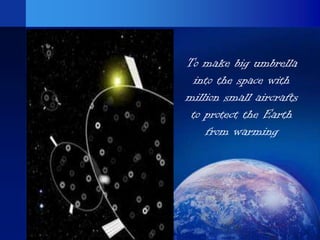
To make big umbrella
  into the space with
million small aircrafts
 to protect the Earth
    from warming
Conclusion
• Global warming is affecting plants, animals,
   humans and the earth. We need to learn
    how to conserve our use of fossil fuels to
  minimize carbon dioxide production. This will
    slow down the effects of global warming.
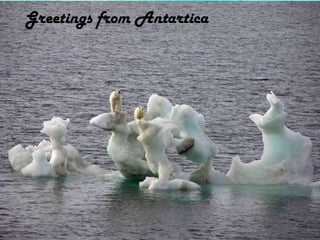
Greetings from Antartica
Global warming

Global warming

  • 1.
    Global warming By Shljuka Selma
  • 2.
    What Is GlobalWarming? • Global warming is the warming of the earth through carbon dioxide (CO2) being pumped into the atmosphere from tailpipes and smokestacks. Then the gases trap heat like the glass in a greenhouse. This is where the term the “greenhouse effect” came from.
  • 3.
    If amount ofsolar energy absorbed by the earth is equal to the amount radiated back into space, the earth remains at a constant temperature Sun Solar Radiative Energy Cooling
  • 4.
    However, if theamount of solar energy is greater than the amount radiated, then the earth heats up. Sun Solar Radiative Cooling Energy
  • 5.
    If the amountof solar energy is less than the amount radiated, then the earth cools down. Sun Solar Radiative Energy Cooling
  • 6.
    What’s Happening Scientists saythat the barrier insulating the continental ice caps is melting. “The impacts of warming temperatures in Antarctica are likely to occur first in the northern sections of the continent, where summer temperatures approach the melting point of water, 32 degrees F (0 degrees C).”
  • 7.
    • As theice melts, big chunks of glaciers will break off and become like ice cubes in a big glass of water. The ice chunks, known as icebergs, create mass in the ocean. The icebergs displace the water causing the ocean level to rise. Some of the shoreline in many places like Florida (where the land is at a low altitude) will go under water.
  • 8.
    To a certaindegree, the earth acts like a greenhouse. Energy from the Sun penetrates the glass of a greenhouse and Sun warms the air and objects within the greenhouse. The same glass slows the heat from escaping, resulting in much higher temperatures within the greenhouse than outside it.
  • 9.
    Sun A dramatic example of the Greenhouse effect can be seen with the planet Venus. Venus’s atmosphere consists of 97% carbon dioxide and 3% nitrogen. In addition, the surface is covered by dense clouds of water and sulfuric acid. The combination of greenhouse gases Venus results in a surface temperature of 860 F – even hotter than the planet Mercury, which is nearest the Sun.
  • 10.
    How Long HasIt Been Going On • The reason the temperature has risen so much in the past 150 years is because of how much more we have used fossil fuels, which gives off carbon dioxide. According to NOAA (National Oceanic and Atmospheric Administration), the global warming rate in the last 25 years has risen to 3.6 degrees F per century, which tends to confirm the predictions of temperature increases made by
  • 11.
    The frequency ofheavy precipitation events has increased over most land areas - Rainfall in Mumbai (India), 2005: 1 million people lost their homes
  • 12.
    Heat waves havebecome more frequent over most land areas - Heat wave in Europe, 2003: 35 000 deaths
  • 13.
    Intense tropical cycloneactivity has increased in the North Atlantic since about 1970 - Hurricane Katrina, 2005: up to $200 billion cost estimate
  • 14.
    ore intense andlonger droughts have been observed er wider areas since the 1970s, particularly in the opics and subtropics
  • 15.
    What Will Happen •Rising global temperatures are expected to raise sea level, and change precipitation and other local climate conditions. Changing regional climate could alter forests, crop yields, and water supplies. It could also affect human health, animals, and many types of ecosystems. Deserts may expand into existing rangelands, and features of some of our national parks may be permanently altered.
  • 16.
    Kyoto Protocol • Inan effort to reduce carbon emissions, the Kyoto protocol • was adopted in 1997. • It proposed to cut CO2 emissions by 5% from 1990 levels for period of 2008-2012 • However, such minor cuts would be symbolic only, since such cuts would not significantly impact
  • 17.
    What’s Happening tothe Animals • Penguin population decline. Adelie penguin populations have shrunk by 33 percent during the past 25 years in response to declines in their winter sea ice habitat.
  • 18.
    • Some speciesof wildlife could be greatly affected by global warming • For example, polar bears • require pack ice in order to hunt and live. • If all pack ice disappears, they might eventually go extinct in the wild. • Sea turtles • breed on the same islands as they are born on. • They could go extinct on some islands as beaches are flooded before new beaches are produced. • Other species may go extinct as rainfall patterns change throughout the world.
  • 19.
    Effect on Humans •Global warming will affect peoples throughout the world. For example, – Fewer deaths will result from cold weather, but more deaths will result from heat waves – Initially, decreased thermo hyaline circulation will result in – cooler temperatures in North Atlantic. – The CO2 fertilization effect will increase crop yields by up to 30% – Precipitation changes will result in • droughts and famine in some areas and • expanded arable land in Canada, Soviet Union Free Powerpoint Templates Page 19
  • 20.
    Mitigation of GlobalWarming Methods of mitigating global warming include  Conservation • Reduce energy needs, such as electrical usage, petroleum usage, reduced packaging • Recycling, which uses less energy to produce products compared to  Another way to reduce carbon emissions is to use alternate energy sources, such as • Nuclear • Wind • Geothermal • Hydroelectric • Solar • Fusion
  • 21.
    Solutions Sintetic trees that will apsorbe CO2 from air and reduce it into oxygen
  • 22.
    Making sulphur wrapping aroundthe Earth by launching rockets filled with sulphur.
  • 23.
    To make bigumbrella into the space with million small aircrafts to protect the Earth from warming
  • 24.
    Conclusion • Global warmingis affecting plants, animals, humans and the earth. We need to learn how to conserve our use of fossil fuels to minimize carbon dioxide production. This will slow down the effects of global warming.
  • 25.