Albedo
RADIATION
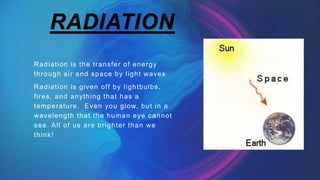
Radiation is the transfer of energy
through air and space by light waves
Radiation is given off by lightbulbs,
fires, and anything that has a
temperature. Even you glow, but in a
wavelength that the human eye cannot
see. All of us are brighter than we
think!
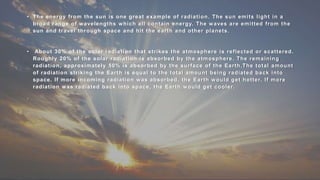
• The energy from the sun is one great example of radiation. The sun emits light in a
broad range of wavelengths which all contain energy. The waves are emitted from the
sun and travel through space and hit the earth and other planets.
• About 30% of the solar radiation that strikes the atmosphere is reflected or scattered.
Roughly 20% of the solar radiation is absorbed by the atmosphere. The remaining
radiation, approximately 50% is absorbed by the surface of the Earth.The total amount
of radiation striking the Earth is equal to the total amount being radiated back into
space. If more incoming radiation was absorbed, the Earth would get hotter. If more
radiation was radiated back into space, the Earth would get cooler.
,
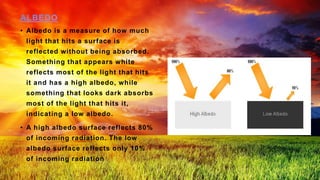
• Albedo is a measure of how much
light that hits a surface is
reflected without being absorbed.
Something that appears white
reflects most of the light that hits
it and has a high albedo, while
something that looks dark absorbs
most of the light that hits it,
indicating a low albedo.
• A high albedo surface reflects 80%
of incoming radiation. The low
albedo surface reflects only 10%
of incoming radiation
• The amount of energy that is reflected by a surface is determined by the
reflectivity of that surface, called the albedo. A high albedo means the
surface reflects the majority of the radiation that hits it and absorbs the
rest. A low albedo means a surface reflects a small amount of the
incoming radiation and absorbs the rest. Generally, dark surfaces have
a low albedo and light surfaces have a high albedo.
• Since 30% of the sun’s energy is reflected by the entire earth, the earth
has an average albedo of .30.
• Any albedo in visible light falls within a range of about 0.9 for fresh
snow to about 0.04 for charcoal, one of the darkest substances. Deeply
shadowed cavities can achieve an effective albedo approaching the zero
of a black body.
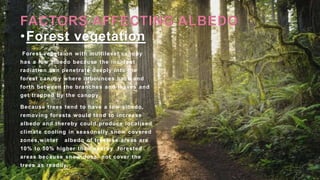
•Forest vegetation
Forest vegetaion with multilevel canopy
has a low albedo because the incident
radiation can penetrate deeply into the
forest canopy where it bounces back and
forth between the branches and leaves and
get trapped by the canopy.
Because trees tend to have a low albedo,
removing forests would tend to increase
albedo and thereby could produce localised
climate cooling in seasonally snow covered
zones,winter albedo of treeless areas are
10% to 50% higher than nearby forested
areas because snow does not cover the
trees as readily.
• Albedo-ice feedback
• Another important positive climate feedback is the ice albedo
feedback. This feedback arises from the simple fact that ice is more
reflective (that is, has a higher albedo) than land or water surfaces.
Therefore, as global ice cover decreases, the reflectivity of Earth’s
surface decreases, and thus more incoming solar radiation is
absorbed by the surface, and the surface warms.
• Snow albedo can be high as 0.9; this,however is for the ideal example
fresh deep snow over a featureless landscape .if a snow covered area
warms ,snow leads to melt,lowering the albedo,and leading to more
snow melt.
Effect of clouds
It is generally believed that as Earth’s surface warms and the
atmosphere’s water vapour content increases, global cloud cover
increases. However, the effects on near-surface air temperatures
are complicated. In the case of low clouds, such as marine
stratus clouds, the dominant radiative feature of the cloud is its
albedo. Here any increase in low cloud cover acts in much the
same way as an increase in surface ice cover: more incoming
solar radiation is reflected and Earth’s surface cools. On the
other hand, high clouds, such as the towering cumulus clouds
that extend up to the boundary between the troposphere and
stratosphere, have a quite different impact on the surface
radiation balance.The end result of the formation of high cumulus
clouds is greater warming at the surface.It is difficult to
determine the net feedback effect of clouds on increasing earth's
temperature cause it is uncertain.
IMPACTS OF ALBEDO ON ENVIRONMENT
• Here on Earth, the albedo effect has a significant impact on our climate. The lower the
albedo, the more radiation from the Sun that gets absorbed by the planet, and temperatures
will rise. If the albedo is higher, and the Earth is more reflective, more of the radiation is
returned to space, and the planet cools
• Much of the sunlight reflects back when it reaches the earth surface, if its not reflected then
its absorbed and thats why the temperature increasesthis melts the ice and increses the
global temperature to a few degrees,when ice melts,it can cause flooding in some
areas.Exposed water or exposed land is darker in colour and thus it absorbs more energy
from the sun and reflects less,means the albedo is low in such areas.When the ice
melts,more land is exposed ,this absorbs more heat,melting more ice. the snow and ice plays
an important role,without them the sunlight will not reflect back and temperature will rise
causing global warming due to an imbalance of light being reflected and absorbed.
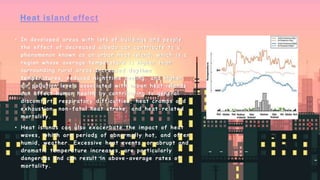
• In developed areas with lots of buildings and people,
the effect of decreased albedo can contribute to a
phenomenon known as an urban heat island, which is a
region whose average temperature is higher than
surrounding rural areas.Increased daytime
temperatures, reduced nighttime cooling, and higher
air pollution levels associated with urban heat islands
can affect human health by contributing to general
discomfort, respiratory difficulties, heat cramps and
exhaustion, non-fatal heat stroke, and heat-related
mortality.
• Heat islands can also exacerbate the impact of heat
waves, which are periods of abnormally hot, and often
humid, weather. Excessive heat events, or abrupt and
dramatic temperature increases, are particularly
dangerous and can result in above-average rates of
mortality.
INNOVATIVE WAYS TO INCREASE ALBEDO
According to the some experts, greenhouse effect and reduced Earth's Albedo effect is the
main reason of Global warming
The geo-engineers have suggested plan of action to increase the Earth's Albedo are given
below:
• 1. Spraying of sulphate aerosols into the stratosphere that reflect sunlight back to space.
• 2. Spraying of seawater.
• 3. Pouring of white colour on the world's roofs to increase reflectivity.
• 4. Floating thousands of tiny mirrors in space between Earth and the Sun.
• Albedo is a measure of how much light that hits a surface
is reflected without being absorbed. Something that
appears white reflects most of the light that hits it and has
a high albedo, while something that looks dark absorbs
most of the light that hits it, indicting a low albedo.
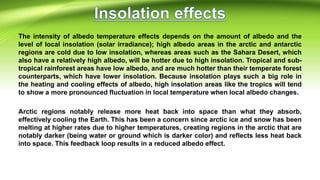
The intensity of albedo temperature effects depends on the amount of albedo and the
level of local insolation (solar irradiance); high albedo areas in the arctic and antarctic
regions are cold due to low insolation, whereas areas such as the Sahara Desert, which
also have a relatively high albedo, will be hotter due to high insolation. Tropical and sub-
tropical rainforest areas have low albedo, and are much hotter than their temperate forest
counterparts, which have lower insolation. Because insolation plays such a big role in
the heating and cooling effects of albedo, high insolation areas like the tropics will tend
to show a more pronounced fluctuation in local temperature when local albedo changes.
Arctic regions notably release more heat back into space than what they absorb,
effectively cooling the Earth. This has been a concern since arctic ice and snow has been
melting at higher rates due to higher temperatures, creating regions in the arctic that are
notably darker (being water or ground which is darker color) and reflects less heat back
into space. This feedback loop results in a reduced albedo effect.
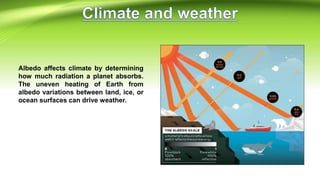
Albedo affects climate by determining
how much radiation a planet absorbs.
The uneven heating of Earth from
albedo variations between land, ice, or
ocean surfaces can drive weather.
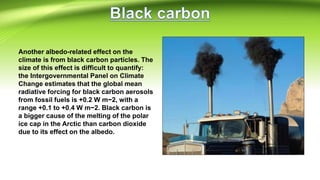
Another albedo-related effect on the
climate is from black carbon particles. The
size of this effect is difficult to quantify:
the Intergovernmental Panel on Climate
Change estimates that the global mean
radiative forcing for black carbon aerosols
from fossil fuels is +0.2 W m−2, with a
range +0.1 to +0.4 W m−2. Black carbon is
a bigger cause of the melting of the polar
ice cap in the Arctic than carbon dioxide
due to its effect on the albedo.
Human activities (e.g., deforestation, farming, and urbanization) change the albedo of
various areas around the globe. However, quantification of this effect on the global
scale is difficult.[citation needed]
Single-scattering albedo is used to define scattering of electromagnetic waves on
small particles. It depends on properties of the material (refractive index); the size of
the particle or particles; and the wavelength of the incoming radiation.
• A black body or blackbody is an idealized
physical body that absorbs all incident
electromagnetic radiation, regardless of
frequency or angle of incidence. (It does
not only absorb radiation, but can also emit
radiation. The name "black body" is given
because it absorbs radiation in all
frequencies, not because it only absorbs.)
A white body is one with a "rough surface
that reflects all incident rays completely
and uniformly in all directions
1. Kirchhoff in 1860 introduced the theoretical concept of a perfect black body
with a completely absorbing surface layer of infinitely small thickness, but
Planck noted some severe restrictions upon this idea. Planck noted three
requirements upon a black body: the body must (i) allow radiation to enter
but not reflect; (ii) possess a minimum thickness adequate to absorb the
incident radiation and prevent its re-emission; (iii) satisfy severe limitations
upon scattering to prevent radiation from entering and bouncing back out.
As a consequence, Kirchhoff's perfect black bodies that absorb all the
radiation that falls on them cannot be realized in an infinitely thin surface
layer, and impose conditions upon scattering of the light within the black
body that are difficult to satisfy.
• Black-body radiation is the thermal electromagnetic
radiation within or surrounding a body in
thermodynamic equilibrium with its environment,
emitted by a black body (an idealized opaque, non-
reflective body). It has a specific spectrum of
wavelengths, inversely related to intensity that depend
only on the body's temperature, which is assumed for
the sake of calculations and theory to be uniform and
constant

Albedo and Radiation

  • 1.
  • 2.
    RADIATION Radiation is thetransfer of energy through air and space by light waves Radiation is given off by lightbulbs, fires, and anything that has a temperature. Even you glow, but in a wavelength that the human eye cannot see. All of us are brighter than we think!
  • 3.
    • The energyfrom the sun is one great example of radiation. The sun emits light in a broad range of wavelengths which all contain energy. The waves are emitted from the sun and travel through space and hit the earth and other planets. • About 30% of the solar radiation that strikes the atmosphere is reflected or scattered. Roughly 20% of the solar radiation is absorbed by the atmosphere. The remaining radiation, approximately 50% is absorbed by the surface of the Earth.The total amount of radiation striking the Earth is equal to the total amount being radiated back into space. If more incoming radiation was absorbed, the Earth would get hotter. If more radiation was radiated back into space, the Earth would get cooler. ,
  • 4.
    • Albedo isa measure of how much light that hits a surface is reflected without being absorbed. Something that appears white reflects most of the light that hits it and has a high albedo, while something that looks dark absorbs most of the light that hits it, indicating a low albedo. • A high albedo surface reflects 80% of incoming radiation. The low albedo surface reflects only 10% of incoming radiation
  • 5.
    • The amountof energy that is reflected by a surface is determined by the reflectivity of that surface, called the albedo. A high albedo means the surface reflects the majority of the radiation that hits it and absorbs the rest. A low albedo means a surface reflects a small amount of the incoming radiation and absorbs the rest. Generally, dark surfaces have a low albedo and light surfaces have a high albedo. • Since 30% of the sun’s energy is reflected by the entire earth, the earth has an average albedo of .30. • Any albedo in visible light falls within a range of about 0.9 for fresh snow to about 0.04 for charcoal, one of the darkest substances. Deeply shadowed cavities can achieve an effective albedo approaching the zero of a black body.
  • 6.
    •Forest vegetation Forest vegetaionwith multilevel canopy has a low albedo because the incident radiation can penetrate deeply into the forest canopy where it bounces back and forth between the branches and leaves and get trapped by the canopy. Because trees tend to have a low albedo, removing forests would tend to increase albedo and thereby could produce localised climate cooling in seasonally snow covered zones,winter albedo of treeless areas are 10% to 50% higher than nearby forested areas because snow does not cover the trees as readily.
  • 7.
    • Albedo-ice feedback •Another important positive climate feedback is the ice albedo feedback. This feedback arises from the simple fact that ice is more reflective (that is, has a higher albedo) than land or water surfaces. Therefore, as global ice cover decreases, the reflectivity of Earth’s surface decreases, and thus more incoming solar radiation is absorbed by the surface, and the surface warms. • Snow albedo can be high as 0.9; this,however is for the ideal example fresh deep snow over a featureless landscape .if a snow covered area warms ,snow leads to melt,lowering the albedo,and leading to more snow melt.
  • 8.
    Effect of clouds Itis generally believed that as Earth’s surface warms and the atmosphere’s water vapour content increases, global cloud cover increases. However, the effects on near-surface air temperatures are complicated. In the case of low clouds, such as marine stratus clouds, the dominant radiative feature of the cloud is its albedo. Here any increase in low cloud cover acts in much the same way as an increase in surface ice cover: more incoming solar radiation is reflected and Earth’s surface cools. On the other hand, high clouds, such as the towering cumulus clouds that extend up to the boundary between the troposphere and stratosphere, have a quite different impact on the surface radiation balance.The end result of the formation of high cumulus clouds is greater warming at the surface.It is difficult to determine the net feedback effect of clouds on increasing earth's temperature cause it is uncertain.
  • 9.
    IMPACTS OF ALBEDOON ENVIRONMENT • Here on Earth, the albedo effect has a significant impact on our climate. The lower the albedo, the more radiation from the Sun that gets absorbed by the planet, and temperatures will rise. If the albedo is higher, and the Earth is more reflective, more of the radiation is returned to space, and the planet cools • Much of the sunlight reflects back when it reaches the earth surface, if its not reflected then its absorbed and thats why the temperature increasesthis melts the ice and increses the global temperature to a few degrees,when ice melts,it can cause flooding in some areas.Exposed water or exposed land is darker in colour and thus it absorbs more energy from the sun and reflects less,means the albedo is low in such areas.When the ice melts,more land is exposed ,this absorbs more heat,melting more ice. the snow and ice plays an important role,without them the sunlight will not reflect back and temperature will rise causing global warming due to an imbalance of light being reflected and absorbed.
  • 10.
    • In developedareas with lots of buildings and people, the effect of decreased albedo can contribute to a phenomenon known as an urban heat island, which is a region whose average temperature is higher than surrounding rural areas.Increased daytime temperatures, reduced nighttime cooling, and higher air pollution levels associated with urban heat islands can affect human health by contributing to general discomfort, respiratory difficulties, heat cramps and exhaustion, non-fatal heat stroke, and heat-related mortality. • Heat islands can also exacerbate the impact of heat waves, which are periods of abnormally hot, and often humid, weather. Excessive heat events, or abrupt and dramatic temperature increases, are particularly dangerous and can result in above-average rates of mortality.
  • 11.
    INNOVATIVE WAYS TOINCREASE ALBEDO According to the some experts, greenhouse effect and reduced Earth's Albedo effect is the main reason of Global warming The geo-engineers have suggested plan of action to increase the Earth's Albedo are given below: • 1. Spraying of sulphate aerosols into the stratosphere that reflect sunlight back to space. • 2. Spraying of seawater. • 3. Pouring of white colour on the world's roofs to increase reflectivity. • 4. Floating thousands of tiny mirrors in space between Earth and the Sun.
  • 12.
    • Albedo isa measure of how much light that hits a surface is reflected without being absorbed. Something that appears white reflects most of the light that hits it and has a high albedo, while something that looks dark absorbs most of the light that hits it, indicting a low albedo.
  • 13.
    The intensity ofalbedo temperature effects depends on the amount of albedo and the level of local insolation (solar irradiance); high albedo areas in the arctic and antarctic regions are cold due to low insolation, whereas areas such as the Sahara Desert, which also have a relatively high albedo, will be hotter due to high insolation. Tropical and sub- tropical rainforest areas have low albedo, and are much hotter than their temperate forest counterparts, which have lower insolation. Because insolation plays such a big role in the heating and cooling effects of albedo, high insolation areas like the tropics will tend to show a more pronounced fluctuation in local temperature when local albedo changes. Arctic regions notably release more heat back into space than what they absorb, effectively cooling the Earth. This has been a concern since arctic ice and snow has been melting at higher rates due to higher temperatures, creating regions in the arctic that are notably darker (being water or ground which is darker color) and reflects less heat back into space. This feedback loop results in a reduced albedo effect.
  • 14.
    Albedo affects climateby determining how much radiation a planet absorbs. The uneven heating of Earth from albedo variations between land, ice, or ocean surfaces can drive weather.
  • 15.
    Another albedo-related effecton the climate is from black carbon particles. The size of this effect is difficult to quantify: the Intergovernmental Panel on Climate Change estimates that the global mean radiative forcing for black carbon aerosols from fossil fuels is +0.2 W m−2, with a range +0.1 to +0.4 W m−2. Black carbon is a bigger cause of the melting of the polar ice cap in the Arctic than carbon dioxide due to its effect on the albedo.
  • 16.
    Human activities (e.g.,deforestation, farming, and urbanization) change the albedo of various areas around the globe. However, quantification of this effect on the global scale is difficult.[citation needed] Single-scattering albedo is used to define scattering of electromagnetic waves on small particles. It depends on properties of the material (refractive index); the size of the particle or particles; and the wavelength of the incoming radiation.
  • 17.
    • A blackbody or blackbody is an idealized physical body that absorbs all incident electromagnetic radiation, regardless of frequency or angle of incidence. (It does not only absorb radiation, but can also emit radiation. The name "black body" is given because it absorbs radiation in all frequencies, not because it only absorbs.) A white body is one with a "rough surface that reflects all incident rays completely and uniformly in all directions
  • 18.
    1. Kirchhoff in1860 introduced the theoretical concept of a perfect black body with a completely absorbing surface layer of infinitely small thickness, but Planck noted some severe restrictions upon this idea. Planck noted three requirements upon a black body: the body must (i) allow radiation to enter but not reflect; (ii) possess a minimum thickness adequate to absorb the incident radiation and prevent its re-emission; (iii) satisfy severe limitations upon scattering to prevent radiation from entering and bouncing back out. As a consequence, Kirchhoff's perfect black bodies that absorb all the radiation that falls on them cannot be realized in an infinitely thin surface layer, and impose conditions upon scattering of the light within the black body that are difficult to satisfy.
  • 19.
    • Black-body radiationis the thermal electromagnetic radiation within or surrounding a body in thermodynamic equilibrium with its environment, emitted by a black body (an idealized opaque, non- reflective body). It has a specific spectrum of wavelengths, inversely related to intensity that depend only on the body's temperature, which is assumed for the sake of calculations and theory to be uniform and constant