DEPARTMENT OF OBSTETRICS & GYNECOLOGICAL NURSING
MRS. NIVETHA G, ASST. P ROF TJ CN
RESEARCH PROBLEM/
RESEARCH QUESTION
MRS. NIVETHA G
ASSISTANT PROFESSOR
TJCN, BANGALORE
DEPARTMENT OF OBSTETRICS & GYNECOLOGICAL NURSING
MRS. NIVETHA G, ASST. P ROF TJ CN
DEFINITION
“A problem is an interrogative sentence or
statement that asks what relation exist between two or
more variables. The answer to questions will provide
what is having sought in the research.”
-Kerlinger.
DEPARTMENT OF OBSTETRICS & GYNECOLOGICAL NURSING
MRS. NIVETHA G, ASST. P ROF TJ CN
IDENTIFICATION OF RESEARCH PROBLEM
Identification of a research problem is the
first and most important step in research
process generally a broad area is selected and
then a board topic is delimited or narrowed
down to specific one sentence statement of the
problem.
DEPARTMENT OF OBSTETRICS & GYNECOLOGICAL NURSING
MRS. NIVETHA G, ASST. P ROF TJ CN
SOURCES OF RESEARCH PROBLEM
PERSON EXPERIENCE
Day-to-day personal experience of a researcher may serve as
good source of ideas to formulate a research problem.
For example, a researcher observed domestic violence suffered by
wives of alcoholic husbands. This experience may provide ideas to
identify several research problems related to domestic violence against
women. There may be so many such life experiences of a researcher
which could be used to develop a research problem.
DEPARTMENT OF OBSTETRICS & GYNECOLOGICAL NURSING
MRS. NIVETHA G, ASST. P ROF TJ CN
PRACTICAL EXPERIENCE:
Nurses get plenty of ideas to formulate research problems from their
clinical experiences. Every curious nurse has several questions to be
answered that are encountered during clinical experience.
For example, a nurse finds that unrestricted visiting hours in surgical wards
reduced the analgesic demand among postoperative patients. In another
instance, a nurse observed that application of ice at the site of heparin
injection reduced the chances of ecchymosis. Such clinical experiences
could be rich sources of ideas to identify a significant research problem.
DEPARTMENT OF OBSTETRICS & GYNECOLOGICAL NURSING
MRS. NIVETHA G, ASST. P ROF TJ CN
CRITICALAPPRAISAL OF LITERATURE:
When we critically study books and articles relating to the
subject of our interest, including research reports, opinion articles,
and summaries of clinical issues, pertinent questions may arise in
our mind. These may strike reader's mind indirectly by stimulating
imagination and directly by stating what additional research is
needed.
For example, a nurse reads an article on the prevalence of the pin
site infection among patients with external fixators
DEPARTMENT OF OBSTETRICS & GYNECOLOGICAL NURSING
MRS. NIVETHA G, ASST. P ROF TJ CN
PREVIOUS RESEARCH:
A body of knowledge should be developed on a sound foundation of
Research findings. Usually, at the end of a research, further research
problems are suggested, based on the shortcomings of previous research,
which can be investigated. In nursing profession, not much research has
been yet done; therefore, this profession needs researchers who are willing
to replicate or repeat other studies on different samples and settings where
all the essential elements of the original study are held intact. Further
refinements may be made in the experimental treatments, or more
appropriate outcome measures may be identified.
DEPARTMENT OF OBSTETRICS & GYNECOLOGICAL NURSING
MRS. NIVETHA G, ASST. P ROF TJ CN
EXISTING THEORIES:
Research is a process of theory development and theory testing.
Nurses use many theories from other disciplines in their practices. If
an existing theory is used in developing a researchable problem, a
specific statement from the theory must be isolated. Generally, a part
or parts of the theory are subjected to testing in the clinical situation.
The testing of an existing theory is definitely needed in nursing;
therefore, they serve as good sources of research problems.
DEPARTMENT OF OBSTETRICS & GYNECOLOGICAL NURSING
MRS. NIVETHA G, ASST. P ROF TJ CN
CONSUMER FEEDBACK:
Research problems may be generated from the results of
activities aimed to solicit patient feedback.
For example, at the time of discharge of patient after angiography, a
nurse obtained a feedback from the patient. Patient verbalized that it
was a wonderful experience except discomfort during removal of
pressure dressing at the oral puncture site. This feedback provided a
concept for nurse to research on efficacy available alternative means
of dressing at puncture site to minimize the discomfort patient
undergoing angiography.
DEPARTMENT OF OBSTETRICS & GYNECOLOGICAL NURSING
MRS. NIVETHA G, ASST. P ROF TJ CN
PERFORMANCE IMPROVEMENT ACTIVITIES:
The performance improvement activities, also
known as quality improvement activities, are used to
improve processes and outcomes to meet regulatory
requirement. In the process of performance activities,
several issues merge that require answers through
research. Thus performance improvement activities also
serve as an important source of research problem.
DEPARTMENT OF OBSTETRICS & GYNECOLOGICAL NURSING
MRS. NIVETHA G, ASST. P ROF TJ CN
SOCIAL ISSUES:
Sometimes, topics are suggested by more global contemporary
social or political issues of relevance to the health care community.
For example, HIV/AIDS, female feticide, sexual harassment,
domestic violence, and gender equality in health care and in research
are some of the current social and political issues of concern for
health care professionals. An idea for a study may stem from a
familiarity with social concerns or controversial social issues.
DEPARTMENT OF OBSTETRICS & GYNECOLOGICAL NURSING
MRS. NIVETHA G, ASST. P ROF TJ CN
BRAINSTORMING:
Brainstorming sessions are good techniques to find new
questions, where an intensified discussion among interested
people of the profession is conducted to find more ideas to
formulate a good research problem.
For example, ideas for studies may emerge from reviewing
research priorities by having brainstorming session with other
nurses, researchers, or nursing faculty
DEPARTMENT OF OBSTETRICS & GYNECOLOGICAL NURSING
MRS. NIVETHA G, ASST. P ROF TJ CN
INTUITION:
Traditionally, intuitions are considered good
sources of knowledge as well as sources to find new
research problems. It is believed that the reflective
mind is a good source of ideas, which may be used to
formulate a good research problem.
DEPARTMENT OF OBSTETRICS & GYNECOLOGICAL NURSING
MRS. NIVETHA G, ASST. P ROF TJ CN
FOLKLORES:
Common beliefs could be right or wrong.
For example, it is generally believed that studying just before
the test decreases the score. We believe we should not study
just before test to relax our mind. Researchers can conduct a
research study on whether one should study before the test or
not.
DEPARTMENT OF OBSTETRICS & GYNECOLOGICAL NURSING
MRS. NIVETHA G, ASST. P ROF TJ CN
EXPOSURE TO FIELD SITUATIONS:
During field exposure, researchers get variety of
experiences, which may provide plenty of ideas to formulate
research problems.
For example, while working in field, a researcher observed a
specific traditional practice for cure of a disease condition,
which can be used as research problem to investigate its
efficacy
DEPARTMENT OF OBSTETRICS & GYNECOLOGICAL NURSING
MRS. NIVETHA G, ASST. P ROF TJ CN
CONSULTATIONS WITH EXPERTS:
Experts are believed to have sound experience of
their respective field, which may suggest a significant
problem to be studied. In addition, experts may help in
finding a current problem of discipline to be solved,
which may serve as basis for formulation of research
problem.
DEPARTMENT OF OBSTETRICS & GYNECOLOGICAL NURSING
MRS. NIVETHA G, ASST. P ROF TJ CN
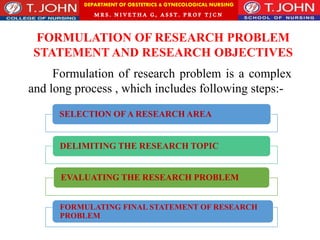
FORMULATION OF RESEARCH PROBLEM
STATEMENT AND RESEARCH OBJECTIVES
Formulation of research problem is a complex
and long process , which includes following steps:-
SELECTION OF A RESEARCH AREA
DELIMITING THE RESEARCH TOPIC
EVALUATING THE RESEARCH PROBLEM
FORMULATING FINAL STATEMENT OF RESEARCH
PROBLEM
DEPARTMENT OF OBSTETRICS & GYNECOLOGICAL NURSING
MRS. NIVETHA G, ASST. P ROF TJ CN
SELECTION OF A RESEARCH AREA:
Formulation of research problem begins with
selection of a broad research topic from personal
experience, literature, previous research and theories
in which researcher is interested and has significance
of nursing profession.
DEPARTMENT OF OBSTETRICS & GYNECOLOGICAL NURSING
MRS. NIVETHA G, ASST. P ROF TJ CN
DELIMITING THE RESEARCH TOPIC:
In this step , researcher proceeds from a general research area
of interest to more specific topic of research to conduct a study.
Example:- Initially a researcher decides to conduct a study on
female feticide ; later in this stage researcher limits it to specific
topic “a study on perception of women about causes and prevention
of female feticide in selected rural communities of district
Moradabad , Uttarpradesh”.
In this stage, a researcher clearly identifies variables ,
population, and settings of research study. Furthermore, at this stage,
a researcher is quite clear about the phenomenon to be studied,
where and on whom.
DEPARTMENT OF OBSTETRICS & GYNECOLOGICAL NURSING
MRS. NIVETHA G, ASST. P ROF TJ CN
EVALUATING THE RESEARCH PROBLEM
Once researcher is clear about the specific research problem ,
next the research problem must be carefully evaluated for its
significance , researchability and feasibility . Feasibility of the research
problem should be evaluated for time, cost , availability of subjects and
resources , administrative and peer support, ethical consideration and
researcher’s competence and interest.
DEPARTMENT OF OBSTETRICS & GYNECOLOGICAL NURSING
MRS. NIVETHA G, ASST. P ROF TJ CN
FORMULATING FINAL STATEMENT OF RESEARCH PROBLEM:
• After establishing the significance , researchability and feasibility , then
researcher finally formulates a final statement of a research problem.
• A research problem could be in declarative or interrogative format.
Example of declarative format:-
“A descriptive study on prevalence of bed sores among unconscious
patients admitted in intensive care units of Synergy hospital of medical science,
Dehradun”.
Example of Interrogative format:
What is the effect of ginger on morning sickness on pregnant women in
selected urban communities of district Hissar, Haryana?
DEPARTMENT OF OBSTETRICS & GYNECOLOGICAL NURSING
MRS. NIVETHA G, ASST. P ROF TJ CN
EXAMPLE OF WELL FORMULATED RESEARCH PROBLEM:
“A descriptive study on the prevalence of pin site infection
among patients with external skeletal fixation admitted in orthopedic
wards of Shri Mahant Indresh Hospital, Dehradun”.
DEPARTMENT OF OBSTETRICS & GYNECOLOGICAL NURSING
MRS. NIVETHA G, ASST. P ROF TJ CN
TYPES OF VARIABLES
Independent and dependent variables
Research variable
Demographic variables
Extraneous variables
DEPARTMENT OF OBSTETRICS & GYNECOLOGICAL NURSING
MRS. NIVETHA G, ASST. P ROF TJ CN
INDEPENDENT AND DEPENDENT VARIABLES
These are the two variables which are
interrelated & mainly observed in correlational,
interventional, pre-experimental, quasi-
experimental, experimental research studies.
DEPARTMENT OF OBSTETRICS & GYNECOLOGICAL NURSING
MRS. NIVETHA G, ASST. P ROF TJ CN
An independent variable: It is a stimulus or activity that is
manipulated or varied by the researcher to create the effect on the
dependent variable.
A dependent variable: It is the outcome or response due to
the effect of the independent variable, which researcher wants to
predict or explain.
For example; “Effectiveness of planned teaching on the knowledge
of staff nurses working in psychiatric unit regarding Physical
Restraints for psychiatric patient in selected hospital of Bangalore
region”.
In this study planned teaching is an independent variable &
knowledge is the dependent variable
DEPARTMENT OF OBSTETRICS & GYNECOLOGICAL NURSING
MRS. NIVETHA G, ASST. P ROF TJ CN
RESEARCH VARIABLE
In descriptive, exploratory, comparative, & qualitative
research studies, variable are observed or measured in natural
setting as they exist, without manipulating or imposing the
effect of intervention or treatment.
Here no independent variable is manipulated & no
cause-effect relationship is examined; these variable are
considered as research variable.
DEPARTMENT OF OBSTETRICS & GYNECOLOGICAL NURSING
MRS. NIVETHA G, ASST. P ROF TJ CN
Therefore, research variables can be defined as qualities,
attributes, properties or characteristics which are observed or
measured in a natural setting without manipulating & establishing
cause-&-effect relationship.
For example “An exploratory study on factors contributing to sleep
disturbance among patients admitted in selected intensive care unit
of AIMS, New Delhi ‟.
In this research study, “Factors contributing to sleep
disturbance” is a research variable, which is observed in natural
setting without manipulating it.
DEPARTMENT OF OBSTETRICS & GYNECOLOGICAL NURSING
MRS. NIVETHA G, ASST. P ROF TJ CN
DEMOGRAPHIC VARIABLES
In most of the research studies, researchers make the attempt to
study the sample characteristics & present them in research findings.
Sometimes researchers even try to establish relations of the
demographic variables with the research variables.
These characteristics & attributes of the study subjects are
considered as demographic variables.

Common demographic variables are age, gender, educational status,
religion, social class, marital status, habitat, occupation, income, &
medical diagnosis etc.
DEPARTMENT OF OBSTETRICS & GYNECOLOGICAL NURSING
MRS. NIVETHA G, ASST. P ROF TJ CN
EXTRANEOUS VARIABLES
Extraneous variables are the factors which are not the part of the
study but may affect the measurement of the study variables.

These variables are usually recognized & controlled by
researchers in quasi-experimental & experimental studies.
Generally, specific research design & sample inclusion &
exclusion criteria are used to control the influence of extraneous
variables.

DEPARTMENT OF OBSTETRICS & GYNECOLOGICAL NURSING
MRS. NIVETHA G, ASST. P ROF TJ CN
For example: ‘A study is conducted to assess the effect of two different
pin site care protocols on prevention of pin site infection among
patients with external skeletal fixation’.
In this study, pin site care protocols are independent variable, pin
site infection is the dependent variable
However, the dependent variable, pin site infection may also be
influenced by some of the other factors such as low hemoglobin level
or higher blood sugar level among these patients; these factors are
considered as extraneous variables
DEPARTMENT OF OBSTETRICS & GYNECOLOGICAL NURSING
MRS. NIVETHA G, ASST. P ROF TJ CN
CONCEPT 0F VARIABLES AND TYPES OF
VARIABLES
Variables are qualities, properties, or characteristics of person, things,
or situations that change or vary.
Chinn & Kramer stated that ‘variables are concepts at different level
of abstraction that are concisely defined to promote their measurement or
manipulation within study’.
Variables are classified based on their nature, actions, & effects on the
variables
DEPARTMENT OF OBSTETRICS & GYNECOLOGICAL NURSING
MRS. NIVETHA G, ASST. P ROF TJ CN
WRITING RESEARCH OBJECTIVES
MEANING:
“A research objective is a clear , concise , declarative
statement , which provides direction to investigate the
variables” .
“Research objectives are the results sought by the
researcher at the end of the research process , that what the
researcher will be able to achieve at the end of the research
study”.
DEPARTMENT OF OBSTETRICS & GYNECOLOGICAL NURSING
MRS. NIVETHA G, ASST. P ROF TJ CN
CHARACTERSTICS OF RESEARCH OBJECTIVES:
A well worded objective will be SMART.
S- Specific
M- Measurable
A – Attainable
R – Realistic
T – Time bound
Research objective should be Relevant, Feasible, Logical,
Observable, Unequivocal, Measurable
DEPARTMENT OF OBSTETRICS & GYNECOLOGICAL NURSING
MRS. NIVETHA G, ASST. P ROF TJ CN
NEED OF THE RESEARCH OBJECTIVES:
The formulation of research objectives will help to the
researcher to-
Focus
Avoid
Organize
Directions
DEPARTMENT OF OBSTETRICS & GYNECOLOGICAL NURSING
MRS. NIVETHA G, ASST. P ROF TJ CN
TYPES OF THE RESEARCH OBJECTIVES:
The research objectives are two types:
GENERAL OBJECTIVES
SPECIFIC OBJECTIVES
DEPARTMENT OF OBSTETRICS & GYNECOLOGICAL NURSING
MRS. NIVETHA G, ASST. P ROF TJ CN
GENERAL OBJECTIVES:
General objectives are broad goals to be achieved.
The general objective of the study states what the researcher expect to
achieve by the study in general terms.
General objectives are usually less in numbers.
SPECIFIC OBJECTIVES:
Specific objective are short term and narrow in focus .
General objectives can be broken into logically connected parts to
form specific objectives .
The specific objectives are more in number.

Research problem/ Research Question

  • 1.
    DEPARTMENT OF OBSTETRICS& GYNECOLOGICAL NURSING MRS. NIVETHA G, ASST. P ROF TJ CN RESEARCH PROBLEM/ RESEARCH QUESTION MRS. NIVETHA G ASSISTANT PROFESSOR TJCN, BANGALORE
  • 2.
    DEPARTMENT OF OBSTETRICS& GYNECOLOGICAL NURSING MRS. NIVETHA G, ASST. P ROF TJ CN DEFINITION “A problem is an interrogative sentence or statement that asks what relation exist between two or more variables. The answer to questions will provide what is having sought in the research.” -Kerlinger.
  • 3.
    DEPARTMENT OF OBSTETRICS& GYNECOLOGICAL NURSING MRS. NIVETHA G, ASST. P ROF TJ CN IDENTIFICATION OF RESEARCH PROBLEM Identification of a research problem is the first and most important step in research process generally a broad area is selected and then a board topic is delimited or narrowed down to specific one sentence statement of the problem.
  • 4.
    DEPARTMENT OF OBSTETRICS& GYNECOLOGICAL NURSING MRS. NIVETHA G, ASST. P ROF TJ CN SOURCES OF RESEARCH PROBLEM PERSON EXPERIENCE Day-to-day personal experience of a researcher may serve as good source of ideas to formulate a research problem. For example, a researcher observed domestic violence suffered by wives of alcoholic husbands. This experience may provide ideas to identify several research problems related to domestic violence against women. There may be so many such life experiences of a researcher which could be used to develop a research problem.
  • 5.
    DEPARTMENT OF OBSTETRICS& GYNECOLOGICAL NURSING MRS. NIVETHA G, ASST. P ROF TJ CN PRACTICAL EXPERIENCE: Nurses get plenty of ideas to formulate research problems from their clinical experiences. Every curious nurse has several questions to be answered that are encountered during clinical experience. For example, a nurse finds that unrestricted visiting hours in surgical wards reduced the analgesic demand among postoperative patients. In another instance, a nurse observed that application of ice at the site of heparin injection reduced the chances of ecchymosis. Such clinical experiences could be rich sources of ideas to identify a significant research problem.
  • 6.
    DEPARTMENT OF OBSTETRICS& GYNECOLOGICAL NURSING MRS. NIVETHA G, ASST. P ROF TJ CN CRITICALAPPRAISAL OF LITERATURE: When we critically study books and articles relating to the subject of our interest, including research reports, opinion articles, and summaries of clinical issues, pertinent questions may arise in our mind. These may strike reader's mind indirectly by stimulating imagination and directly by stating what additional research is needed. For example, a nurse reads an article on the prevalence of the pin site infection among patients with external fixators
  • 7.
    DEPARTMENT OF OBSTETRICS& GYNECOLOGICAL NURSING MRS. NIVETHA G, ASST. P ROF TJ CN PREVIOUS RESEARCH: A body of knowledge should be developed on a sound foundation of Research findings. Usually, at the end of a research, further research problems are suggested, based on the shortcomings of previous research, which can be investigated. In nursing profession, not much research has been yet done; therefore, this profession needs researchers who are willing to replicate or repeat other studies on different samples and settings where all the essential elements of the original study are held intact. Further refinements may be made in the experimental treatments, or more appropriate outcome measures may be identified.
  • 8.
    DEPARTMENT OF OBSTETRICS& GYNECOLOGICAL NURSING MRS. NIVETHA G, ASST. P ROF TJ CN EXISTING THEORIES: Research is a process of theory development and theory testing. Nurses use many theories from other disciplines in their practices. If an existing theory is used in developing a researchable problem, a specific statement from the theory must be isolated. Generally, a part or parts of the theory are subjected to testing in the clinical situation. The testing of an existing theory is definitely needed in nursing; therefore, they serve as good sources of research problems.
  • 9.
    DEPARTMENT OF OBSTETRICS& GYNECOLOGICAL NURSING MRS. NIVETHA G, ASST. P ROF TJ CN CONSUMER FEEDBACK: Research problems may be generated from the results of activities aimed to solicit patient feedback. For example, at the time of discharge of patient after angiography, a nurse obtained a feedback from the patient. Patient verbalized that it was a wonderful experience except discomfort during removal of pressure dressing at the oral puncture site. This feedback provided a concept for nurse to research on efficacy available alternative means of dressing at puncture site to minimize the discomfort patient undergoing angiography.
  • 10.
    DEPARTMENT OF OBSTETRICS& GYNECOLOGICAL NURSING MRS. NIVETHA G, ASST. P ROF TJ CN PERFORMANCE IMPROVEMENT ACTIVITIES: The performance improvement activities, also known as quality improvement activities, are used to improve processes and outcomes to meet regulatory requirement. In the process of performance activities, several issues merge that require answers through research. Thus performance improvement activities also serve as an important source of research problem.
  • 11.
    DEPARTMENT OF OBSTETRICS& GYNECOLOGICAL NURSING MRS. NIVETHA G, ASST. P ROF TJ CN SOCIAL ISSUES: Sometimes, topics are suggested by more global contemporary social or political issues of relevance to the health care community. For example, HIV/AIDS, female feticide, sexual harassment, domestic violence, and gender equality in health care and in research are some of the current social and political issues of concern for health care professionals. An idea for a study may stem from a familiarity with social concerns or controversial social issues.
  • 12.
    DEPARTMENT OF OBSTETRICS& GYNECOLOGICAL NURSING MRS. NIVETHA G, ASST. P ROF TJ CN BRAINSTORMING: Brainstorming sessions are good techniques to find new questions, where an intensified discussion among interested people of the profession is conducted to find more ideas to formulate a good research problem. For example, ideas for studies may emerge from reviewing research priorities by having brainstorming session with other nurses, researchers, or nursing faculty
  • 13.
    DEPARTMENT OF OBSTETRICS& GYNECOLOGICAL NURSING MRS. NIVETHA G, ASST. P ROF TJ CN INTUITION: Traditionally, intuitions are considered good sources of knowledge as well as sources to find new research problems. It is believed that the reflective mind is a good source of ideas, which may be used to formulate a good research problem.
  • 14.
    DEPARTMENT OF OBSTETRICS& GYNECOLOGICAL NURSING MRS. NIVETHA G, ASST. P ROF TJ CN FOLKLORES: Common beliefs could be right or wrong. For example, it is generally believed that studying just before the test decreases the score. We believe we should not study just before test to relax our mind. Researchers can conduct a research study on whether one should study before the test or not.
  • 15.
    DEPARTMENT OF OBSTETRICS& GYNECOLOGICAL NURSING MRS. NIVETHA G, ASST. P ROF TJ CN EXPOSURE TO FIELD SITUATIONS: During field exposure, researchers get variety of experiences, which may provide plenty of ideas to formulate research problems. For example, while working in field, a researcher observed a specific traditional practice for cure of a disease condition, which can be used as research problem to investigate its efficacy
  • 16.
    DEPARTMENT OF OBSTETRICS& GYNECOLOGICAL NURSING MRS. NIVETHA G, ASST. P ROF TJ CN CONSULTATIONS WITH EXPERTS: Experts are believed to have sound experience of their respective field, which may suggest a significant problem to be studied. In addition, experts may help in finding a current problem of discipline to be solved, which may serve as basis for formulation of research problem.
  • 17.
    DEPARTMENT OF OBSTETRICS& GYNECOLOGICAL NURSING MRS. NIVETHA G, ASST. P ROF TJ CN FORMULATION OF RESEARCH PROBLEM STATEMENT AND RESEARCH OBJECTIVES Formulation of research problem is a complex and long process , which includes following steps:- SELECTION OF A RESEARCH AREA DELIMITING THE RESEARCH TOPIC EVALUATING THE RESEARCH PROBLEM FORMULATING FINAL STATEMENT OF RESEARCH PROBLEM
  • 18.
    DEPARTMENT OF OBSTETRICS& GYNECOLOGICAL NURSING MRS. NIVETHA G, ASST. P ROF TJ CN SELECTION OF A RESEARCH AREA: Formulation of research problem begins with selection of a broad research topic from personal experience, literature, previous research and theories in which researcher is interested and has significance of nursing profession.
  • 19.
    DEPARTMENT OF OBSTETRICS& GYNECOLOGICAL NURSING MRS. NIVETHA G, ASST. P ROF TJ CN DELIMITING THE RESEARCH TOPIC: In this step , researcher proceeds from a general research area of interest to more specific topic of research to conduct a study. Example:- Initially a researcher decides to conduct a study on female feticide ; later in this stage researcher limits it to specific topic “a study on perception of women about causes and prevention of female feticide in selected rural communities of district Moradabad , Uttarpradesh”. In this stage, a researcher clearly identifies variables , population, and settings of research study. Furthermore, at this stage, a researcher is quite clear about the phenomenon to be studied, where and on whom.
  • 20.
    DEPARTMENT OF OBSTETRICS& GYNECOLOGICAL NURSING MRS. NIVETHA G, ASST. P ROF TJ CN EVALUATING THE RESEARCH PROBLEM Once researcher is clear about the specific research problem , next the research problem must be carefully evaluated for its significance , researchability and feasibility . Feasibility of the research problem should be evaluated for time, cost , availability of subjects and resources , administrative and peer support, ethical consideration and researcher’s competence and interest.
  • 21.
    DEPARTMENT OF OBSTETRICS& GYNECOLOGICAL NURSING MRS. NIVETHA G, ASST. P ROF TJ CN FORMULATING FINAL STATEMENT OF RESEARCH PROBLEM: • After establishing the significance , researchability and feasibility , then researcher finally formulates a final statement of a research problem. • A research problem could be in declarative or interrogative format. Example of declarative format:- “A descriptive study on prevalence of bed sores among unconscious patients admitted in intensive care units of Synergy hospital of medical science, Dehradun”. Example of Interrogative format: What is the effect of ginger on morning sickness on pregnant women in selected urban communities of district Hissar, Haryana?
  • 22.
    DEPARTMENT OF OBSTETRICS& GYNECOLOGICAL NURSING MRS. NIVETHA G, ASST. P ROF TJ CN EXAMPLE OF WELL FORMULATED RESEARCH PROBLEM: “A descriptive study on the prevalence of pin site infection among patients with external skeletal fixation admitted in orthopedic wards of Shri Mahant Indresh Hospital, Dehradun”.
  • 23.
    DEPARTMENT OF OBSTETRICS& GYNECOLOGICAL NURSING MRS. NIVETHA G, ASST. P ROF TJ CN TYPES OF VARIABLES Independent and dependent variables Research variable Demographic variables Extraneous variables
  • 24.
    DEPARTMENT OF OBSTETRICS& GYNECOLOGICAL NURSING MRS. NIVETHA G, ASST. P ROF TJ CN INDEPENDENT AND DEPENDENT VARIABLES These are the two variables which are interrelated & mainly observed in correlational, interventional, pre-experimental, quasi- experimental, experimental research studies.
  • 25.
    DEPARTMENT OF OBSTETRICS& GYNECOLOGICAL NURSING MRS. NIVETHA G, ASST. P ROF TJ CN An independent variable: It is a stimulus or activity that is manipulated or varied by the researcher to create the effect on the dependent variable. A dependent variable: It is the outcome or response due to the effect of the independent variable, which researcher wants to predict or explain. For example; “Effectiveness of planned teaching on the knowledge of staff nurses working in psychiatric unit regarding Physical Restraints for psychiatric patient in selected hospital of Bangalore region”. In this study planned teaching is an independent variable & knowledge is the dependent variable
  • 26.
    DEPARTMENT OF OBSTETRICS& GYNECOLOGICAL NURSING MRS. NIVETHA G, ASST. P ROF TJ CN RESEARCH VARIABLE In descriptive, exploratory, comparative, & qualitative research studies, variable are observed or measured in natural setting as they exist, without manipulating or imposing the effect of intervention or treatment. Here no independent variable is manipulated & no cause-effect relationship is examined; these variable are considered as research variable.
  • 27.
    DEPARTMENT OF OBSTETRICS& GYNECOLOGICAL NURSING MRS. NIVETHA G, ASST. P ROF TJ CN Therefore, research variables can be defined as qualities, attributes, properties or characteristics which are observed or measured in a natural setting without manipulating & establishing cause-&-effect relationship. For example “An exploratory study on factors contributing to sleep disturbance among patients admitted in selected intensive care unit of AIMS, New Delhi ‟. In this research study, “Factors contributing to sleep disturbance” is a research variable, which is observed in natural setting without manipulating it.
  • 28.
    DEPARTMENT OF OBSTETRICS& GYNECOLOGICAL NURSING MRS. NIVETHA G, ASST. P ROF TJ CN DEMOGRAPHIC VARIABLES In most of the research studies, researchers make the attempt to study the sample characteristics & present them in research findings. Sometimes researchers even try to establish relations of the demographic variables with the research variables. These characteristics & attributes of the study subjects are considered as demographic variables. Common demographic variables are age, gender, educational status, religion, social class, marital status, habitat, occupation, income, & medical diagnosis etc.

  • 29.
    DEPARTMENT OF OBSTETRICS& GYNECOLOGICAL NURSING MRS. NIVETHA G, ASST. P ROF TJ CN EXTRANEOUS VARIABLES Extraneous variables are the factors which are not the part of the study but may affect the measurement of the study variables. These variables are usually recognized & controlled by researchers in quasi-experimental & experimental studies. Generally, specific research design & sample inclusion & exclusion criteria are used to control the influence of extraneous variables.
  • 30.
    DEPARTMENT OF OBSTETRICS& GYNECOLOGICAL NURSING MRS. NIVETHA G, ASST. P ROF TJ CN For example: ‘A study is conducted to assess the effect of two different pin site care protocols on prevention of pin site infection among patients with external skeletal fixation’. In this study, pin site care protocols are independent variable, pin site infection is the dependent variable However, the dependent variable, pin site infection may also be influenced by some of the other factors such as low hemoglobin level or higher blood sugar level among these patients; these factors are considered as extraneous variables
  • 31.
    DEPARTMENT OF OBSTETRICS& GYNECOLOGICAL NURSING MRS. NIVETHA G, ASST. P ROF TJ CN CONCEPT 0F VARIABLES AND TYPES OF VARIABLES Variables are qualities, properties, or characteristics of person, things, or situations that change or vary. Chinn & Kramer stated that ‘variables are concepts at different level of abstraction that are concisely defined to promote their measurement or manipulation within study’. Variables are classified based on their nature, actions, & effects on the variables
  • 32.
    DEPARTMENT OF OBSTETRICS& GYNECOLOGICAL NURSING MRS. NIVETHA G, ASST. P ROF TJ CN WRITING RESEARCH OBJECTIVES MEANING: “A research objective is a clear , concise , declarative statement , which provides direction to investigate the variables” . “Research objectives are the results sought by the researcher at the end of the research process , that what the researcher will be able to achieve at the end of the research study”.
  • 33.
    DEPARTMENT OF OBSTETRICS& GYNECOLOGICAL NURSING MRS. NIVETHA G, ASST. P ROF TJ CN CHARACTERSTICS OF RESEARCH OBJECTIVES: A well worded objective will be SMART. S- Specific M- Measurable A – Attainable R – Realistic T – Time bound Research objective should be Relevant, Feasible, Logical, Observable, Unequivocal, Measurable
  • 34.
    DEPARTMENT OF OBSTETRICS& GYNECOLOGICAL NURSING MRS. NIVETHA G, ASST. P ROF TJ CN NEED OF THE RESEARCH OBJECTIVES: The formulation of research objectives will help to the researcher to- Focus Avoid Organize Directions
  • 35.
    DEPARTMENT OF OBSTETRICS& GYNECOLOGICAL NURSING MRS. NIVETHA G, ASST. P ROF TJ CN TYPES OF THE RESEARCH OBJECTIVES: The research objectives are two types: GENERAL OBJECTIVES SPECIFIC OBJECTIVES
  • 36.
    DEPARTMENT OF OBSTETRICS& GYNECOLOGICAL NURSING MRS. NIVETHA G, ASST. P ROF TJ CN GENERAL OBJECTIVES: General objectives are broad goals to be achieved. The general objective of the study states what the researcher expect to achieve by the study in general terms. General objectives are usually less in numbers. SPECIFIC OBJECTIVES: Specific objective are short term and narrow in focus . General objectives can be broken into logically connected parts to form specific objectives . The specific objectives are more in number.